




Abstract
The first aim of this study was to analyse performance self-efficacy as a predictor of music performance anxiety (MPA), and performance boost and self-rated performance as their outcomes in a sample of students and professionals (teachers and performers). This work also tries to ascertain the similarities and differences between genders and professional status by means of bivariate correlations, MANOVA, and structural equation model (SEM) analyses. A sample of 270 Spanish musicians participated in the study. With regard to the similarities, MPA was negatively predicted by self-efficacy and was a negative predictor of boost; the total effect of MPA on performance was negative and significant. Self-efficacy was a positive predictor of boost and performance. On the contrary, the predictive power of boost over performance was not significant. MPA mediated the effects of self-efficacy on boost; analogously, self-efficacy and boost mediated the influence of efficacy on performance. All of these relationships were equivalent for the four groups of females, males, students, and professionals. As for the main differences, the study showed that performers obtained the highest values in self-efficacy, boost, and performance; students surpassed teachers and performers in MPA; and females were the most anxious subsample. We discuss these findings, acknowledging their limitations and highlighting their implications.
The quality of musical performance is affected not only by the performer’s level of preparation and expertise, but also by psychological factors such as self-efficacy beliefs and performance anxiety (Papageorgi, Creech, & Welch, 2013). The most analysed emotion is music performance anxiety (MPA; Kenny, 2011; Nicholson, Cody, & Beck, 2015). However, musicians can draw emotional rewards (e.g., flow or boost) from the simple act of engaging in an aesthetic endeavour (Woody & McPherson, 2010). On the other hand, among the multiple personal predictors of positive and negative emotions, the motivational construct of self-efficacy plays a prominent role (Papageorgi, Hallam, & Welch, 2007). Little research has simultaneously examined self-efficacy, anxiety, boost, and performance. This study analyses the relations between these variables, bearing in mind the previous literature on these constructs, which will be briefly reviewed below.
MPA
MPA is a complex construct closely linked to other concepts such as social anxiety, test anxiety, and social phobia (Kenny, Driscoll, & Ackermann, 2014; Nicholson et al., 2015; Papageorgi et al., 2013). MPA is described as an experience of marked and persistent anxious apprehension in musical performance in front of an audience, which is manifested through affective, cognitive, somatic, and behavioural responses (Kenny, Fortune, & Ackerman, 2013; Osborne, 2016; Osborne & Kenny, 2005). This negative emotion is a critical problem for most professional musicians and depends upon the interaction of multiple environmental and individual variables, one of which is personal self-efficacy (Kenny, 2011; Papageorgi et al., 2007; Simoens, Puttonen, & Tervaniemi, 2015).
MPA has been investigated among professionals and students, but to our knowledge, only one study has analysed both simultaneously (Steptoe & Fidler, 1987). These authors compared 65 experienced professional orchestral players with 41 music students, and found that performance anxiety was lowest among professional musicians and highest among students; they also verified a negative association between age, performance experience, and MPA in professional musicians but not in students.
As for professionals, Kenny et al. (Kenny & Ackermann, 2015; Kenny, Davis, & Oates 2004; Kenny et al., 2014; Kenny et al., 2013), and Nicholson et al. (2015) found that MPA affected a large number of professionals. Furthermore, trait anxiety, social performance anxiety and fear of negative evaluation were closely and positively related with MPA. In contrast, the level of anxiety was negatively predicted by previous experience of playing the test pieces and negatively predicted musical performance. However, anxiety was not associated with occupational roles, issues related to the physical environment or working conditions. Female musicians were significantly more affected by MPA. The levels of MPA experienced by professionals were not correlated with years of experience playing the instrument, number of practice sessions per week or the amount of weekly practice (Fehm & Schmidt, 2006; Kenny et al., 2013; McCormick & McPherson, 2003).
With regard to music students, Kenny (2009), Osborne (2016), Osborne and Kenny (2005), Spahn, Walther, and Nusseck (2016), and Zarza, Orejudo, Casanova, and Mazas (2016) found a complex structure for MPA, a negative emotional state affecting many students. Furthermore, the mean values of MPA for students were similar to or higher than those of professional musicians in other studies. MPA was positively related with social phobia, depression, a decrease in the quality of their musical performance, and dropping out of music conservatory study. Fortunately, different school programmes improved student strategies for coping efficiently with MPA prior to performance.
Musical self-efficacy
Of all the factors that motivate us as individuals, perhaps none is more influential than self-competence beliefs (Hendricks, 2014). Self-efficacy is defined as the belief in one’s own capabilities to organize and execute the courses of action required to produce a given attainment (Bandura, 1997). Self-efficacy in music involves different components (Hendricks, 2014), i.e., for learning music, for performing music (Ritchie & Williamon, 2011), for successfully playing an instrument or piece of music, and for successfully performing a difficult section of a piece (Papageorgi et al., 2007). Self-efficacy is constructed through the integration of information drawn from personal mastery experiences, vicarious experience, social persuasion, and physiological and affective states (Bandura, 1997; Hendricks, 2014; Zelenak, 2015).
As a theoretical framework for the predictive power of self-efficacy over MPA, Bandura (1993) asserted that “perceived efficacy to exercise control over potentially threatening events plays a central role in anxiety arousal” (p. 132). This prediction of Bandura’s was repeatedly confirmed in diverse contexts and samples of students (Muris, 2002; Thomasson & Psouni, 2010) and athletes (Nicholls, Polman, & Levy, 2010).
Music self-efficacy has mainly been assessed in samples of students of different ages, and to a lesser degree in professionals. As for the relationships with other variables, music self-efficacy was positively correlated with cognitive and metacognitive involvement in trying to learn, practice regulation, self-regulatory activities (e.g., concentration, goal setting, and planning when practising), and the active use of strategies for dealing with performance anxiety (Bugos, Kochar, & Maxfield, 2016; Hewitt, 2015; McCormick & McPherson, 2003; McPherson & McCormick, 2006; Miksza, 2015). In addition, self-efficacy was a potent predictor of performance (self-rated and expert-rated). On the contrary, self-efficacy was not a significant predictor of solo and group MPA (Papageorgi et al., 2013); similarly, anxiety did not significantly predict self-efficacy and performance (McCormick & McPherson, 2003); finally, perceived competence negatively correlated with MPA (MacIntyre, Potter, & Burns, 2012).
Generally, musical self-efficacy (McCormick & McPherson, 2003; McPherson & McCormick, 2006) and self-perception of musical competence (Bonneville-Roussy & Bouffard, 2015) were positively correlated with amount of practice time. However, in some cases the amount of practice was a negative predictor of musical achievement (Bonneville-Roussy & Bouffard, 2015).
Engagement and performance boost
In contrast to the frequent studies analysing MPA, the experience of positive performance states, such as flow (Lamont, 2012; Woody & McPherson, 2010; Wrigley & Emmerson, 2013), well-being and engagement (Ascenso, Williamon, & Perkins, 2017; Kenny et al., 2014) and performance boost (Simoens et al., 2015), has remained almost entirely overlooked in music. Performance for an audience offers particularly heightened emotional rewards beyond those of music making (Woody & McPherson, 2010).
However, as Lamont (2012) contends, successful performers will derive considerable pleasure from their ability to make music, and playing and performing music has the potential to induce a flow-like state. This self-rewarding feeling can be attained when a musician is so engaged in a performance that he/she loses self-consciousness, feels a merging of awareness and action, and even loses track of time (Woody & McPherson, 2010). According to these authors, achieving a positive performance state depends on a balance between the musician’s skill level and the challenge presented in the task: when the skill exceeds the challenge, the result is boredom; if the challenge exceeds the skill, a feeling of anxiety appears.
In the context of these positive performance states, performance boost is defined as a positive state of extra alertness (Simoens et al., 2015). This experience is the often-reported “thrill” or “kick” when performing, and is a facilitator of better musical performance since low arousal levels can result in poor mental and physical activation during performance. As with other positive emotional states, boost and flow mainly occur with musicians who perceive performing as a challenge rather than a threat (Woody & McPherson, 2010).
The state of excitement in music performance is associated with high motivation, predicts achievement, and provides one reason to continue with the activity (Lamont, 2012; Woody & McPherson, 2010). Similarly, positive feeling states (e.g., excited) among conservatoire students were positively related with health-promoting behaviours, strategies for stress management, self-regulation of the learning process, and performance self-efficacy (Kreutz, Ginsborg, & Williamon, 2009). Among professionals and student musicians, Simoens et al. (2015) found that boost was stronger for females than for males and positively correlated with self-rated performance and negatively with MPA. On the other hand, the flow-like experience in music performance was found to be consistent with findings from sport performance (Martin & Jackson, 2008; Wrigley & Emmerson, 2013), was positively correlated with music involvement and aspirations (Martin & Jackson, 2008), and did not vary substantially according to instrument type, year level, or gender (Wrigley & Emmerson, 2013). Students with a higher sense of competence in musical skills experienced less debilitating performance anxiety (Osborne, Greene, & Immel, 2014). Simoens et al. (2015) found moderate negative relationships between performance boost and MPA.
Music performance
Musicians apply different standards to the evaluation of their experiences, accomplishments, and performances (Denton & Chaplin, 2016). There is no doubt that musicians compare themselves to others (external standards, social comparison or “normative standard”). In other cases, the focus of evaluation is on the self rather than others, with an emphasis on how one’s performances have changed over time (“ipsative standard”). A third type of evaluation is based on comparisons of ideals, goals or expectations, and does not require a reference either to others or to one’s past (“idiothetic standard”). The normative standard has dominated self-evaluation literature (see Denton & Chaplin, 2016; Papageorgi et al., 2013; Simoens et al., 2015); furthermore, Kenny et al. (2013) have found a strong correlation (from r = .60 to r = .76) between self-rated and expert-rated performance.
For assessing music performance, the most common alternative to self-rated performance is external expert judges (Braden, Osborne, & Wilson, 2015; Hewitt, 2015; Miksza, 2015; Wrigley & Emmerson, 2013) or the grade level obtained by students (McCormick & McPherson, 2003; McPherson & McCormick, 2006). However, the evaluation of performance by expert judges is not free from controversy. As Braden et al. (2015) have pointed out, the desired high inter-rater reliability is not always achieved since an outcome variable like music performance quality can often be notoriously subjective.
Need for research
The contribution of the present study primarily encompasses three aspects: the measured variables, the composition of the sample studied, and the analyses carried out.
First, no other studies have examined the role of performance self-efficacy as a predictor of MPA. Among the possible outcomes of this emotion, studies analysing the influence of MPA on variables related to engagement and performance, such as performance boost, are scarce.
Second, all of these variables and relations were assessed in musicians with three professional statuses; students, teachers, and performers. The aim was to compare the results obtained in all variables by these three groups. Furthermore, a comparison between women and men was also carried out due to the differences in anxiety between genders.
Third, three complementary analyses were carried out: (a) bivariate correlations between variables for each gender and professional status; (b) a MANOVA to compare the obtained means by gender and status; and (c) different structural equation models (SEM) to test the hypothesized model of relations between constructs, to find direct and mediated relations between variables, and to test the invariance of the model by gender and status.
The present study
The theoretical framework of this study was based on the proposals of Pekrun and Linnenbrink-Garcia (2012), and Zeidner (2014). These authors analysed the relationships of academic positive emotions (such as enjoyment, hope or pride) and negative emotions (such as anxiety, shame, anger or hopelessness) with engagement (i.e., hours of study or metacognitive strategies applied) and performance at different academic levels and in different contexts (i.e., before, during or after class and exams).
According to these authors, emotions (e.g., MPA) were influenced by motivational variables (e.g., self-efficacy) and determine the levels of engagement (e.g., boost) and performance. The hypothesized structural paths between variables are depicted in Figure 1. Moreover, most of the empirical studies previously reviewed provide evidence for these proposals.

Expected model of links between variables.
The model proposes that performance self-efficacy predicts MPA, which, in turn, predicts performance boost that subsequently predicts self-rated performance. MPA and boost would also mediate the effects between variables.
Method
Participants and procedure
The study involved a sample of 270 Spanish musicians aged 15 to 56 years (M = 29.4 years; SD = 11.4). Musicians had between 3 to 40 years of musical experience (M = 11.2; SD = 6.5), between 1 to 72 hours of music practice per week (M = 16.73; SD = 12.5), and had given between 1 to 140 concerts (M = 20.73; SD = 21.86). Table 1 summarizes the detailed composition of the sample by gender and professional status.
Characteristics of the sample, by gender and status.

The sample was obtained by contacting via email 72 music conservatories from several autonomous communities in Spain to request their collaboration. The email included a link to a questionnaire on the digital platform Google Drive. Respondents voluntarily completed the questionnaire online between August and November 2015.
Ethical considerations
The study was conducted in accordance with the Deontological Code of the Official College of Psychologists of Spain. Because the participants were volunteers, they were not required to provide their names or any other data related to their identity. Respondents were guaranteed that the data would remain anonymous and confidential, and they could withdraw from the questionnaire at any stage.
Measures
First, participants indicated their age, gender, years of musical experience, amount of music practice per week, and the total number of public performances.
Self-efficacy for musical performance
A subscale of the Scale of Attitudes toward Specific Musical Performance Activities (Ritchie & Williamon, 2011) was applied. This measure, named Self-efficacy for Musical Performance, contains three items. Examples of these items were: “I am confident that I can give a successful performance” or “I am capable of dealing with problems that might come up during the performance”. In the present study, the reliability coefficient Cronbach’s alpha for this subscale was α = .73.
MPA
Among the specific scales used to evaluate MPA, there are two that are the most frequently applied: the Kenny Music Performance Anxiety Inventory (K-MPAI) and the Music Performance Anxiety Inventory for Adolescents (MPAI-A). The K-MPAI (Kenny et al., 2004) contains 26 items and different factors are not distinguished. The MPAI-A (Osborne & Kenny, 2005) includes 15 items grouped in three factors. The first factor is “Somatic and cognitive features”; it includes 8 items and explains 43% of the variance. The second factor is “Performance context” and it includes 3 items and accounts for 6% of the variance. The third factor is “Performance evaluation”; it includes 4 items and explains 3% of the variance.
Once the content of the items from both scales was analysed (K-MPAI and MPAI-A), we determined that the best way to explicitly evaluate the personal aspects of MPA through a reduced number of items (3–4) was by applying the first factor of MPAI-A, which evaluates the somatic and cognitive features of MPA (Osborne & Kenny, 2005). From the 8 items that make up this factor, we selected and applied the four indicators with the highest factor loadings. The four indicators applied were: item 1 from the MPAI-A, “Before I perform, I get butterflies in my stomach”, with a factor loading of .93; item 12, “Just before I perform, I feel nervous”, with a factor loading of .77; item 6, “When I perform in front of an audience, my heart beats very fast”, with a factor loading of .77; and item 4, “Before I perform, I tremble or shake”, with a factor loading of .73. In the present study, the reliability coefficient for this scale was α = .83. A more recent version of the K-MPAI, the revised Kenny Music Performance Anxiety Inventory (K-MPAI-R), shows different factors, one of which is the “Proximal somatic anxiety” (Kenny, 2009). The four items with the highest loadings in this factor show similar content to that of the items applied in the present study.
Performance boost
This construct was assessed applying the Performance Boost Scale (Simoens et al., 2015). This instrument contained four items. Examples of applied items were: “Just before appearing on stage, I feel a euphoric thrill of excitement” or “Performing music gives me an extra ‘kick’ when in front of an audience”. In the present study, the reliability coefficient for this measure was α = .74.
Self-rated performance
We applied a sub-scale of the Confidence in Own Performance Scale (Simoens et al., 2015) to assess self-rated performance. This measure includes three items. Examples of applied items were: “In the past 6 months, how would you evaluate your performance compared to your peers?” or “Independently from others’ opinions, which impression do you most often have of your own performance afterwards?” For this subscale in the present study, Cronbach’s alpha was α = .71.
The Spanish version of the applied instruments was designed by employing cross-cultural scale translation (Hambleton & Patsula, 1998).
Data analyses
For initial statistical analyses, after the reliability coefficients, we calculated bivariate correlations for females, males, students, teachers, and performers. Secondly, we calculated the means and applied a MANOVA. These analyses were performed using the SPSS 22 software package. Then, data analyses involved three steps in which structural equation models (SEM) were applied to test the fit and equivalence of the measurement model, the fit and equivalence of the structural model, and the mediated effects between variables. In the invariance testing, we compared females vs. males and students vs. professionals (teachers and performers). These analyses were performed using the AMOS 22 package (Arbuckle, 2013; Byrne, 2010).
Results
Relationships between variables
Table 2 shows Pearson’s correlations for the observed variables. For the entire sample, we found significant positive correlations between self-efficacy, boost and performance, and negative correlations with MPA. The strongest correlation occurs between self-efficacy and boost. Furthermore, the values of the correlations of these variables with years of musical experience, number of performances, and amount of music practice per week were low. We observed the same pattern of results in all of the subgroups under evaluation.
Bivariate correlations between variables (N = 270).
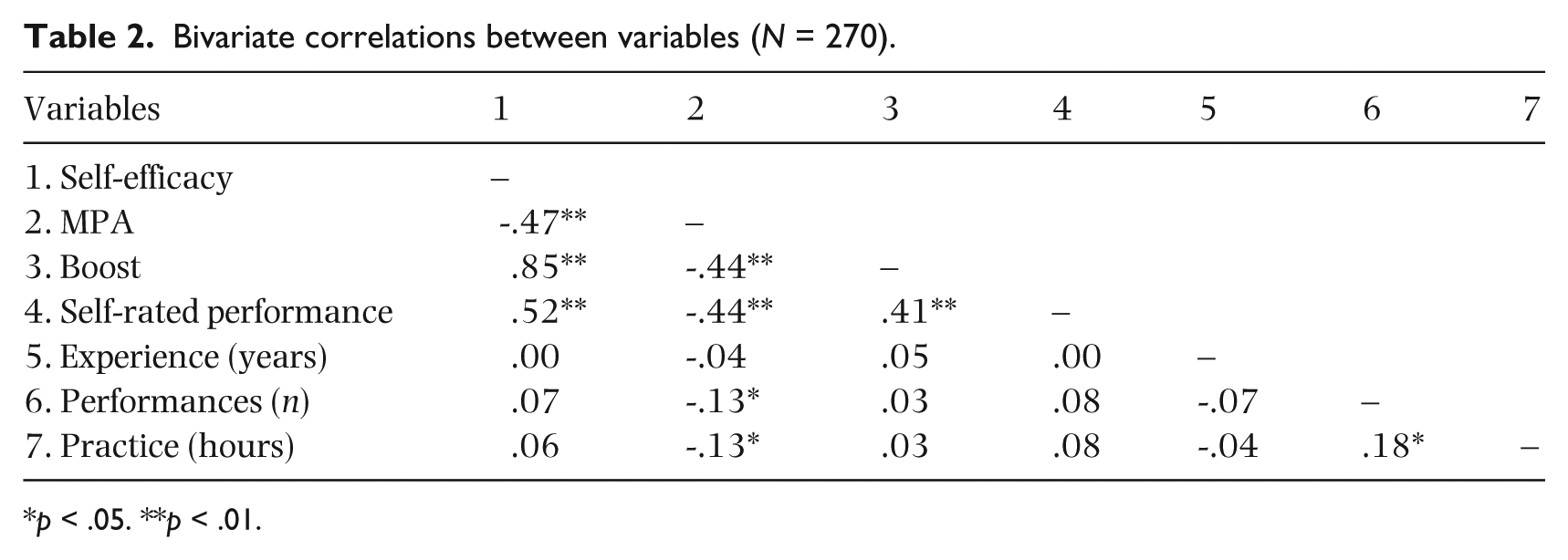
p < .05. **p < .01.
For the entire sample, we found a low negative correlation between MPA and number of performances, and between MPA and amount of music practice per week (in both cases, r = -.13, p < .05). The amount of practice positively correlated with the number of performances for the total sample (r = .18), for students (r = .29), and for females (r = .25); however, for males, teachers, and performers, this correlation was not significant. Finally, self-rated performance positively correlated with amount of music practice per week in students (r = .24) and with number of performances in males (r = .22). In general, the other correlations between variables were not significant.
Means and MANOVA
Next, a 3 (status: student, teacher, performer) × 2 (gender) MANOVA was conducted to uncover group differences in the dependent variables: self-efficacy, MPA, boost, performance, experience in years, number of performances, and hours of practice.
The results showed a significant main effect of professional status, F(2, 268) = 7.22, p =.001, η2 partial = .167, and gender, F(1, 269)= 2.89, p = .006, η2 partial = .075; the situation × gender interaction was not significant. Table 3 summarizes the descriptive statistics by gender and professional status.
Mean (M) and standard deviation (SD) by gender and status.
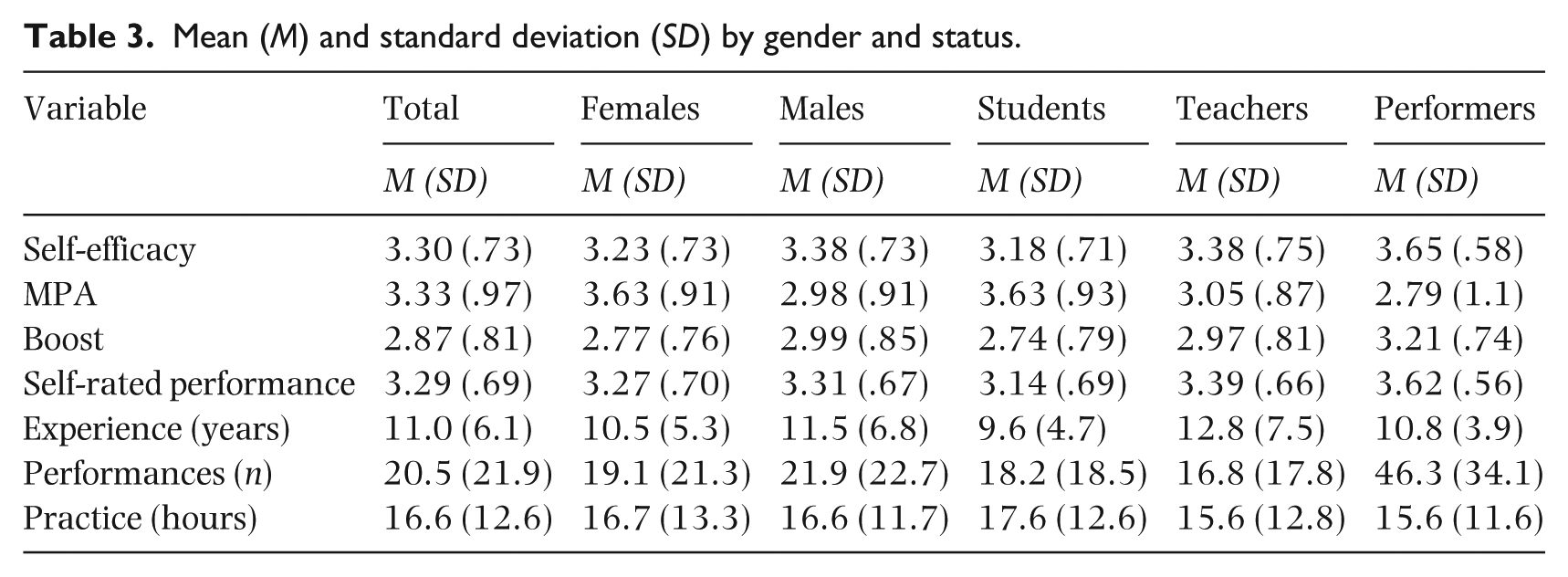
Post-hoc t-test analyses showed some differences. For gender, the differences in MPA were significant, t(268) = 5.75, p < .001, as were differences in boost, t(268) = -2.24, p = .026. The differences in self-efficacy, self-rated performance, years of experience, number of performances, and amount of music practice per week were not significant.
With regard to professional status, after applying Scheffé’s method for multiple comparison, differences were observed in the following variables: in self-efficacy, F(2, 268) = 5.46, p < .005, η2 partial = .039, with significant differences between students and performers; in MPA, F(2, 268) = 16.45, p < .001, η2 partial = .110, with significant differences between students and teachers/performers; in boost, F(2, 268) = 5.04, p < .007, η2 partial = .036, with significant differences between students and performers; in self-rated performance, F(2, 268) = 7.78, p < .001, η2 partial = .056, with significant differences between students and performers; in the number of years of experience, F(2, 268) = 9.08, p < .001, η2 partial = .066, with significant differences between students and performers; and in the number of performances, F(2, 268)= 23.63, p < .001, η2 partial = .155, with significant differences between teachers and students/performers.
Measurement model: Invariance
In order to test the robustness of the evaluation instruments and factorial invariance as a function of gender and professional status (students vs. teachers and performers), different confirmatory factorial analyses (CFA) were performed (Byrne, 2010).
The CFA included a total of four latent variables (factors) and 14 measured variables (i.e., indicators or items; see Figure 2).
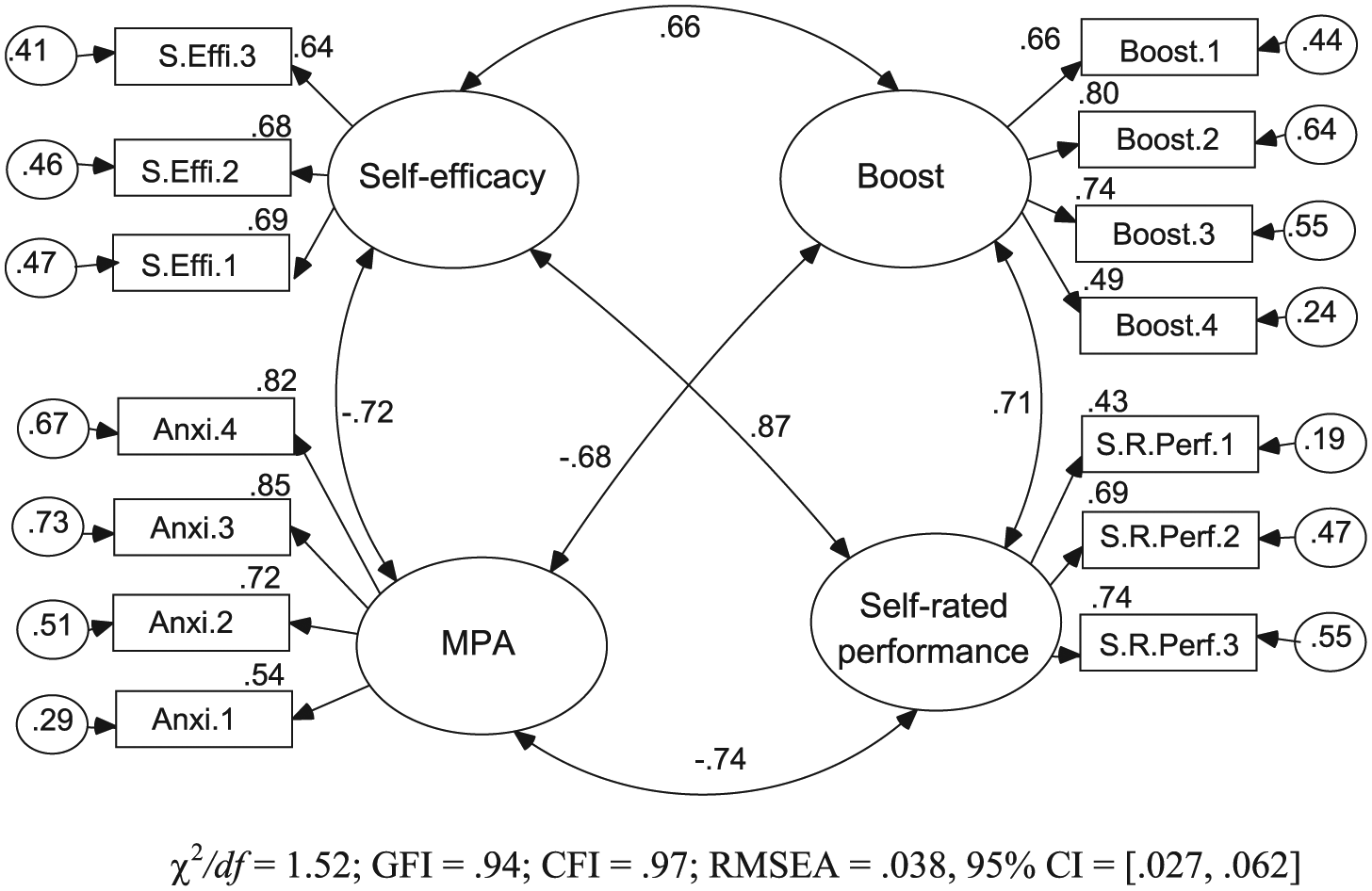
Measurement model for the entire sample (N = 270).
All indicators obtained adequate asymmetry and kurtosis indices, with values ranging from -.808 to .254 for skewness, and from -1.087 to .824 for kurtosis, confirming the univariate normality assumption (Arbuckle, 2013; Byrne, 2010). Nevertheless, Mardia’s multivariate kurtosis coefficient (30.46) exceeded the critical ratio (11.82). Thus, in order to determine the influence of non-normality on the estimators, two types of analysis were performed (Arbuckle, 2013; Byrne, 2010); one for the original sample using the maximum likelihood method, and the other for 5,000 bootstrap samples, using the maximum likelihood method. A 95% confidence interval was set to evaluate corrected bias. The comparison of the results obtained by both methods revealed no differences. Therefore, we proceeded to review the results of the analysis performed on the original sample.
For the entire sample, the measurement model with covariances among all constructs fitted the data well, χ2(68, N = 270) = 105.4; χ2/df = 1.52; GFI = .94; CFI = .97; RMSEA = .038, 95% CI [.027, .062]. The standardized factor loadings ranged from .43 to .85, and were all significant (p < .001). All correlations between latent constructs were significant (p < .001; see Figure 2).
Invariance of relationship by gender and status was also assessed by testing hierarchically organized multi-group CFA models adding more equality constraints with every consecutive model (Byrne, 2010). The indices of these analyses suggest that the number of factors and the pattern of their structure were similar across gender and status. All sub-samples showed similar correlations between latent variables.
Structural relations: Invariance
Thereafter, a SEM analysis was performed to corroborate the hypothesized structural model of relations between variables (Figure 1). The full mediational model for the entire sample revealed a good fit with the data, χ2(69, N = 270) = 111.6; χ2/df = 1.60; GFI = .94; CFI = .97; RMSEA = .042, 95% CI [.029, .069].
Next, we analysed if these relations were equivalent across gender and status. First, the test of the hypothesized model depicted in Figure 1, with factor loadings and structural links freely estimated, was performed simultaneously on females and males. The postulated model of causal structure fitted the data well, χ2(136, N = 270) = 189.3; χ2/df = 1.39; GFI = .91; CFI = .96; RMSEA = .035, 95% CI [.017, .052]. Furthermore, the hypothesized model was found to fit the data adequately in females, χ2(68, n = 144) = 91.8; χ2/df = 1.35; GFI = .91; CFI = .962; RMSEA = .051; 95% CI [.039, .085], and in males, χ2 (68, n = 126) = 96.5; χ2/df = 1.42; GFI = .91; CFI = .95; RMSEA = .061; 95% CI [.043, .092]. The direct paths between variables are shown in Figure 3.
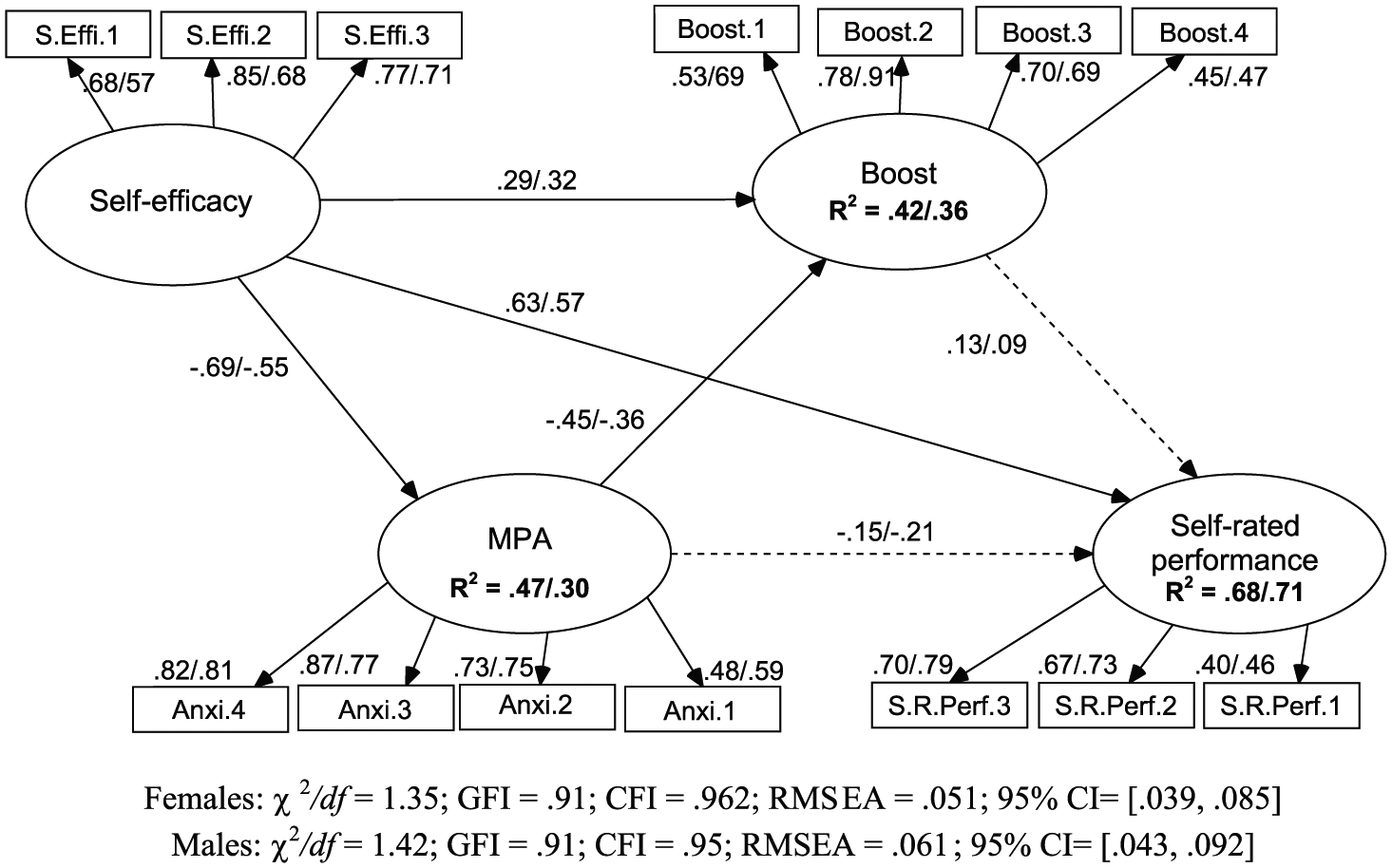
Structural relations among variables (females/males). All values are standardized regression coefficients. Dashed lines indicate no significant paths.
For both females and males, the direct paths from self-efficacy to boost, MPA, and self-rated performance were significant. In contrast, the direct paths from boost and MPA to performance were non-significant.
In the second step, all the structural links were constrained to be equivalent across both samples. This represented the specific test of the invariance of the relationships among constructs across groups (Byrne, 2010). The fit of this model was still acceptable, χ2(146, N = 270) = 194.2; χ2/df = 1.33; GFI = .91; CFI = .97; RMSEA = .035, 95% CI [.019, .056]. These indices suggested that the structural relationships among the assessed constructs were equivalent for females and males.
Analogously, we analysed the invariance of the model across professional status (students vs. professionals; see Figure 4).The hypothesized model of causal structure fitted the data well, χ2(136, N = 270) = 212.1;χ2/df = 1.56; GFI = .90; CFI = .94; RMSEA = .048, 95% CI [.035, .064]. Furthermore, this model was found to fit the data adequately in students, χ2(68, n = 141) = 97.8; χ2/df = 1.44; GFI = .91; CFI = .95; RMSEA = .061, 95% CI [.041, .088] and in professionals, χ2(68, n = 129) = 115.5; χ2/df = 1.7; GFI = .89; CFI =.93; RMSEA = .080, 95% CI [.033, .082].
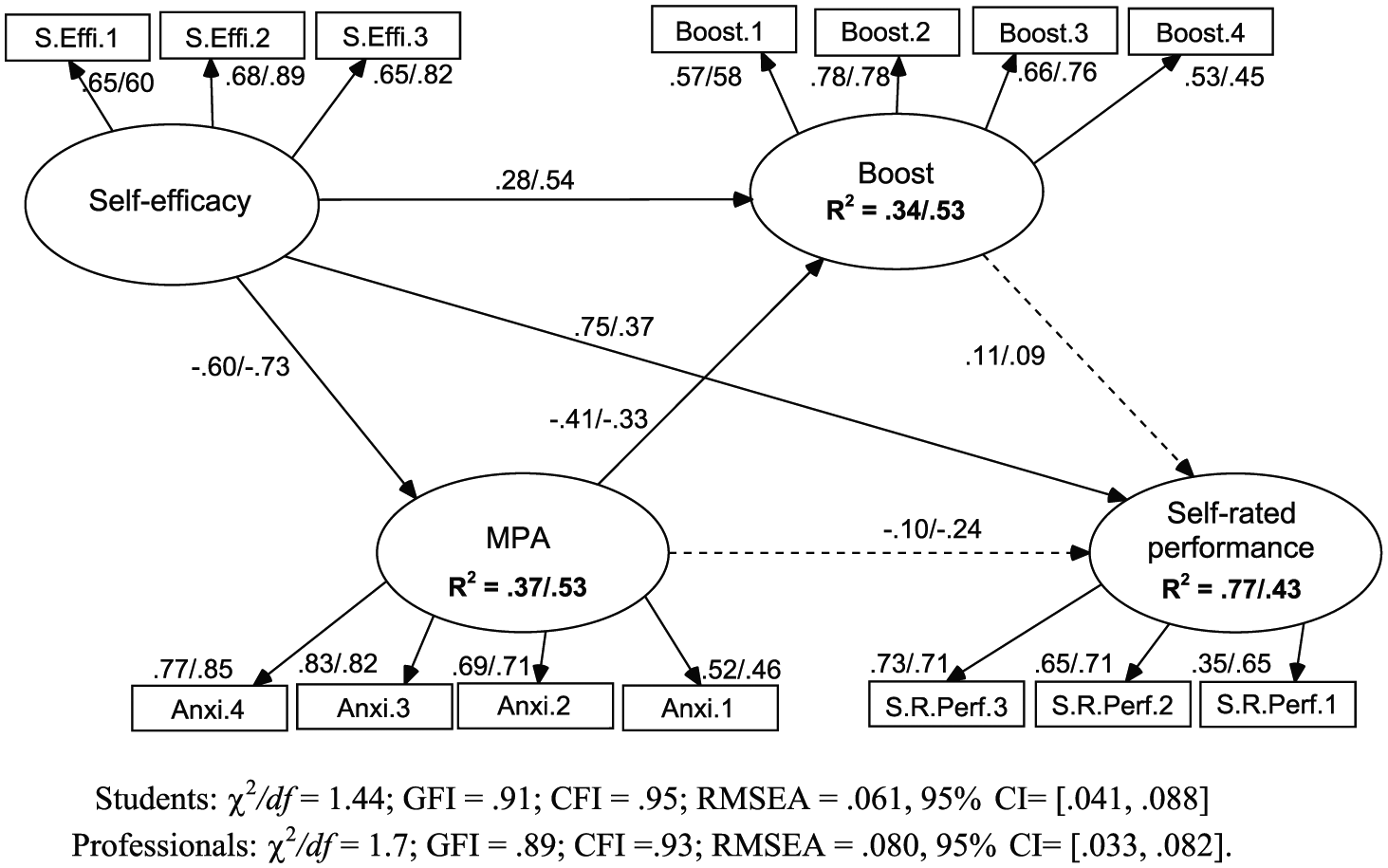
Structural relations among variables (students/professionals). All values are standardized regression coefficients. Dashed lines indicate no significant paths.
For both students and professionals, the direct paths from self-efficacy to boost, MPA, and self-rated performance were significant. The direct paths from boost and MPA to performance were not significant in either of the subsamples.
In the second step, all the structural links were constrained to be equivalent across students and teachers. The fit of this constrained model was acceptable, χ2(146, N = 270) = 219.0; χ2/df = 1.50; GFI = .90; CFI = .94; RMSEA = .046, 95% CI [.031, .065]. These indices suggested that the structural relationships among the assessed constructs were also equivalent for students and professionals.
Finally, the indirect effects for the four sub-samples were analysed using bootstrap. All subsamples showed similar results (see Table 4).
Total and indirect effects between variables, by gender and status (standardized values).
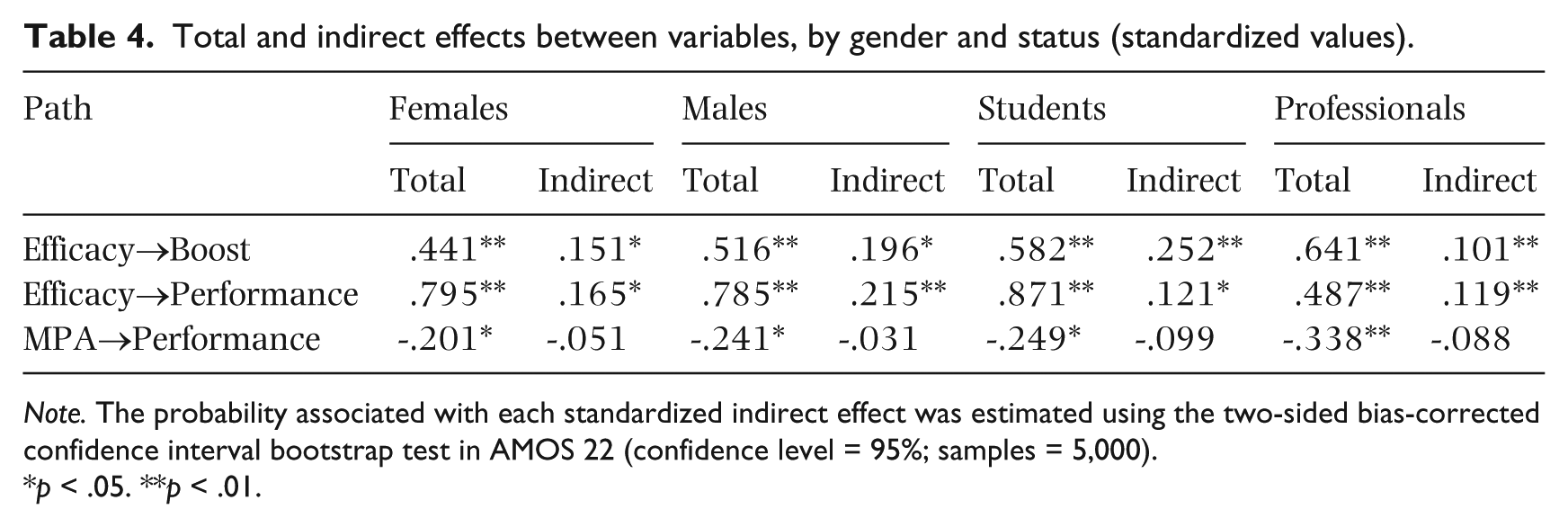
Note. The probability associated with each standardized indirect effect was estimated using the two-sided bias-corrected confidence interval bootstrap test in AMOS 22 (confidence level = 95%; samples = 5,000).
p < .05. **p < .01.
The indirect effect of self-efficacy on boost (mediated by MPA) was significant for females (β = .151, p < .05), males (β = .196, p < .05), students (β = .252, p < .01), and professionals (β =.101, p < .01); similarly, the direct effects of self-efficacy on boost were also significant in all cases. These results implied that MPA partially mediated the effects of self-efficacy on boost. Analogously, the indirect effects of self-efficacy on performance (through MPA and boost) were significant for females (β = .165, p < .05), males (β = .215, p < .01), students (β = .121, p < .05) and professionals (β = .119, p < .05). The direct effects of self-efficacy on performance were also significant in all cases, which implies that MPA and boost partially mediated the effects of self-efficacy on performance.
The direct and indirect paths from MPA to self-rated performance were negative and not significant in all sub-samples. However, the total effects of this path were in all cases negative and significant. This negative total effect was especially strong for professionals (β = -.338, p < .01).
Discussion
The present study analysed the structural relationships between self-efficacy, MPA, boost, and self-rated performance. Previously, the measurement instruments were found to be adequate and equivalent for different groups.
The Pearson correlations between the four main variables (self-efficacy, MPA, boost, and self-rated performance) had the same sign with similar indices for females, males, students, teachers, and performers. In all groups, MPA was negatively correlated with the rest of the variables which, in turn, positively correlated with one another. The strongest correlations were between boost and self-rated performance. These results are in line with previous research finding positive relationships between self-efficacy and performance (Hewitt, 2015; McCormick & McPherson, 2003; McPherson & McCormick, 2006), between self-efficacy and positive affect (Kreutz et al., 2009), and between boost and performance (Simoens et al., 2015). Previous work also found negative associations between MPA and boost (Simoens et al., 2015) and between MPA and performance (MacIntyre et al., 2012; Papageorgi et al., 2013; Simoens et al., 2015).
As for the correlations between the other three secondary variables (years of experience, number of performances, and hours of practice per week), most of the correlational indices between these three variables were non-significant and with similar values for all groups, with a low positive correlation between hours of practice and number of performances. Similarly, most correlations between these three variables and the four main assessed constructs were also not significant and equivalent for all groups.
The absence of any relationship between self-efficacy and the amount of practice is surprising. A possible explanation for this result could be offered by the four sources of self-efficacy (Bandura, 1993, 1997), one of which is the amount of practice/previous experience. While this is the main determining factor of self-efficacy, the other three sources (social comparison, the feedback received, and the emotional and physiological reactions to the task) undoubtedly regulate the importance of practice and prior experience. Bonneville-Roussy and Bouffard (2015) suggested another possible explanation: “music practice” is a rather subjective term, and musicians may interpret its meaning differently. Future research should evaluate the role of different types of practice (formal vs. informal; directed vs. non-directed) and their relations with self-efficacy and MPA.
Previous research also found no significant relationships between MPA and years of experience, practice time per week, or number of performances (Fehm & Schmidt, 2006; Kenny et al., 2013; McCormick & McPherson, 2003). Miksza (2015) also showed a non-significant correlation between practice time and self-efficacy.
With regard to the mean differences by group, the MANOVA showed that performers surpassed students in efficacy, boost, self-rated performance, and years of experience. Following an anonymous reviewer’s suggestion, this result may be interpreted from at least two different perspectives. On the one hand, as an overriding selection factor, only the graduates and musicians with more perceived competence and/or self-efficacy would end up gaining access to the professional field. On the other hand, professional experience itself could provide elements (such as the number of performances, years of experience or self- and other-rated performances) that modulate the levels of anxiety and self-efficacy. Finally, females experienced greater levels of MPA than males. Previous research repeatedly found that females obtained higher values in MPA (Kenny & Ackermann, 2015; Kenny et al., 2004; Kenny et al., 2014; Osborne, 2016; Osborne & Kenny, 2005; Papageorgi et al., 2013; Sârbescu & Dorgo, 2014).
As to the SEM, the measurement model was invariant and equivalent for females and males on the one hand, and for students and professionals on the other. This result indicated that all these groups conceived the applied measurement instruments identically. The same occurred with the hypothesized model of relations between main variables. Analysing the direct paths between these variables in all groups, we found that self-efficacy negatively predicted MPA and positively predicted boost and self-rated performance; furthermore, MPA negatively predicted boost. Finally, the direct paths from MPA and boost to self-rated performance were not significant.
Revising the indirect and total effects between main variables, we found that the most efficacious musicians showed higher boost (in part) because they experienced lower levels of MPA. Similarly, the most efficacious musicians obtained higher self-rated performance (in part) because they experienced higher boost and lower MPA. The indirect effects of MPA on self-rated performance (through boost) were not significant. However, the total effects (the sum of direct and indirect effects) of MPA on performance were significant. Based on these results, we can state that MPA negatively predicted performance, adding the direct paths between both variables and the indirect effects (i.e., high MPA lowered the experience of boost). This negative effect of MPA on self-rated performance was especially strong for teachers and performers.
Limitations
In the present study, all variables were self-assessment reports, which may explain the high correlation found between self-efficacy and performance. In future studies, performance should be evaluated by external expert judges (Braden et al. 2015; Hewitt, 2015; Miksza, 2015; Wrigley & Emmerson, 2013) or by the grade level (Bonneville-Roussy & Bouffard, 2015; McCormick & McPherson, 2003; McPherson & McCormick, 2006). Analogously, as Kenny and Ackermann (2015) recognize, researchers in health have known about the low reliability of self-report measures in assessing psychological well-being and predicting health outcomes. Hence, future studies could resort to alternative measures for assessing MPA, such as heart rate (Osborne, Kenny, & Cooksey, 2007).
The non-random nature of the sampling method of this study is another limitation. Future research should randomly select the participants from different music education majors (see, e.g., Bergee & Ceccioni-Roberts, 2002). This randomized design will enhance the reliability of the interpretation and extrapolation of the results obtained.
Practical applications
The present study showed that MPA was negatively predicted by self-efficacy and was a negative predictor of boost and self-rated performance. This result corroborated a large number of previous studies designed to treat and prevent MPA (Osborne, 2016). Treatment has involved an array of therapies, whereas prevention has focused on the key role of parents, teachers, and stress-coping strategies.
Many treatment programmes have been developed and applied to assist the anxious or stressed musician. However, there are a limited number of studies assessing the effectiveness of these treatments, particularly in younger musicians (Braden et al., 2015; Kenny, 2011; Kenny & Ackermann, 2012; Osborne, 2016). This has led to the reticence of several authors as to their efficacy. Thus, Kenny (2011) contends that affected individuals are rarely cured after psychological treatments. In this same sense, Osborne et al. (2014) affirm that clinical therapies only partially address the need to perform optimally under pressure. For that reason, Kenny and Ackermann (2012, pp. 397) recommend that the best form of treatment for performance anxiety is to prevent its occurrence.
First, it is essential for music educators to gain an understanding of their role in the development and maintenance of MPA (Patston, 2013). As graphically expressed by Kenny (2011), when MPA arises, the teacher assumes a decisive role assisting the learner to “navigate the treacherous rapids of his musical aspirations”. Thus, teachers not only need to be excellent practitioners in their musical craft but also sensitive to the complexities that arise in student–teacher interactions. Young learners should be offered frequent and low-stress opportunities to perform almost from the beginning of their musical training. These performances should be presented in a positive manner, so that young musicians can learn that performance is an enjoyable and manageable part of their musical curriculum (Kenny, 2011; Kenny & Ackermann, 2012; Osborne, 2016). Educators should also assist their students in understanding that the process of performance commences with the selection of a suitable repertoire and finishes with a session which discusses (also with peers) the strengths and weaknesses of the performance.
Second, many authors consider appropriate parental support and expectations to be crucial for preventing MPA. Kenny (2011) recognizes that children who are gifted are not psychologically different from their peer group. Thus, in common with all children of their age they have the need for secure attachment or an environment that supports the development of their special ability. Musical talent can only be nurtured in a context of secure attachment with parents who see their children as people first and talented musicians second. Some of the guidelines for parents of gifted children include the provision of emotional support for the child’s evolving aspirations or support for less formal creative musical practices, particularly in the early stages of musical development.
Third, other interventions are aimed at training students in self-management strategies. Recently, Spahn et al. (2016) designed and applied an intervention with music students to train them in a broad repertoire of coping strategies. The programme included cognitive techniques, body-oriented exercises, and mental performance training. The cognitive techniques applied were cognitive restructuring, i.e., changing negative thinking patterns into positive cognitions about the upcoming performance. The body-oriented exercises practised on the programme consisted of relaxation exercises (e.g., autogenic training) and breathing exercises. Mental performance training consisted in imagining a performance situation while practising creating a positive state of mind. The programme also included work with the pieces, such as playing technique or body position. Finally, as part of the concept of meta-communication, students were informed about the theoretical framework of MPA and about the coping strategies for the different phases of performance. The programme was shown to have positive influences on self-efficacy, MPA, and performance.
Finally, another means of reducing anxiety is to raise self-efficacy through the four “sources of self-efficacy” proposed by Bandura: adequate mastery and vicarious experiences, convincing social persuasion, and the interpretation of physiological and affective states (Bandura, 1997; Zelenak, 2015). Thus, Hendricks (2014) suggests that teachers may be able to help students learn to manage their self-efficacy beliefs, which can in turn positively influence persistence, self-regulation, and subsequent task-based achievement.
All these interventions could result in a more adequate approach to music education, whereby the goal of musical quality is balanced by an emphasis upon reducing anxiety and raising self-efficacy and, ultimately, engagement and enjoyment in music performance. The aim is to make performance less psychologically distressing and more enjoyable for the performer, rather than to achieve performance excellence (Braden et al., 2015).
Footnotes
Funding
The author(s) received no financial support for the research, authorship, and/or publication of this article.