



Abstract
A major issue concerning music educators is declining participation in music over the school years. This study aimed to explain why students choose to study music at school. The theoretical lens of self-determination theory was used to examine how the satisfaction of basic psychological needs might lead to students valuing music and choosing to study it at school. Participants were 204 male students in an Australian high school. A structural equation model was evaluated, with elective intentions predicted by value, psychological needs satisfaction, and instrumental experience. The hypothesized model was supported and explained 65% of variance in elective intentions and 50% of variance in students’ valuing of music. Students with higher psychological needs satisfaction and value for music had stronger intentions to continue studying music. Psychological needs satisfaction explained a considerable proportion of why students valued music. Students with more experience learning an instrument were also more likely to choose music, but psychological needs satisfaction and value were far more influential. These findings extend existing research on Self-Determination Theory(SDT) in educational and music contexts, and suggest implications for teachers wishing to increase participation in school music education.
In most school systems internationally, particularly in the final years of high school, students are provided with a degree of choice as to which subjects they wish to study. Music is usually offered as a core subject until some point in high school. In the state of New South Wales for example, as with some other states in Australia, music is a core part of the curriculum until the end of Year 8. In Year 9, students study six core subjects: mathematics, English, science, history, geography, and physical education (PE). Arts subjects (including music), technology and design subjects, plus extended core subjects are offered to students as elective courses, generally with the option of selecting only two (BOSTES, 2014). The processes by which students choose their elective subjects are poorly understood, yet this decision has substantial impact on their study and on music education more generally.
Current research in this area has examined motivation and value for instrumental music (Evans & Bonneville-Roussy, 2016; Evans, McPherson, & Davidson, 2012), and music as a school subject (McEwan, 2013; McPherson & O’Neill, 2010; McPherson, Osborne, Barrett, Davidson, & Faulkner, 2015). According to the literature, the degree to which students value music is one of the main explanations for why they would either continue or cease ongoing music learning. Indeed, the value construct dominates research in this area. Value of music in school is shown to be very low in the Australian context (McPherson et al., 2015; Pascoe et al., 2005), consistent with school systems internationally (McPherson & O’Neill, 2010). Generally, students believe that music is not of importance to them, see little usefulness of music learning in their future, and are not interested in the subject (McPherson et al., 2015). Value has also been implicated as a strong influence in the process of choosing elective subjects (Lamont & Maton, 2008; McEwan, 2013; Simpkins, Vest, & Becnel, 2010; Waters, McPherson, & Schubert, 2014). However, what the research seems to be missing is an understanding of how students form their sense of value for music, and why this sense of value might be so low. Therefore, the current study aimed to assess the development of value in the high school music classroom during Year 7 and Year 8 mandatory classes and how this impacts on the students’ intentions to take music as an elective subject in Year 9.
Value as predictor of elective subject choice
Expectancy–value theory posits that achievement-related choices are a function of students’ expectations about how well they can achieve and the extent to which they value the activity (Wigfield & Eccles, 2000). One of the important constructs to emerge from expectancy–value theory is subjective task value, comprising attainment value (the importance of an activity), interest value (the degree to which an activity is enjoyable), utility value (the usefulness of an activity), and perceived cost (including task difficulty) of achievement-related choices (Eccles, 2005; Eccles & Wigfield, 2002). Subjective task value has been examined in the field of music education research to understand achievement and success in instrumental learning and performance (e.g., McCormick & McPherson, 2007; McPherson, 2000).
Music tends not to be valued highly as a school subject. In a study of the Australian context, for example, students valued music as less interesting, useful, and important than other school subjects, particularly if they had not had opportunities to learn music outside of school (McPherson et al., 2015). Furthermore, as they progressed from primary school through to the upper levels of high school, their interest declined, along with their perceptions of competence (McPherson et al., 2015). Girls tended to value music more highly than boys in primary and lower high school (but not upper high school), and socioeconomic status (SES) was a factor in that high-SES students reported a stronger decline in valuing of music between primary school and lower high school. Lamont and Maton (2008) found the same pattern when examining music enrolment in the UK’s General Certificate of Secondary Education – music was perceived to be only for elite musicians, and most students rated their ability as low. Indeed, in a survey of 24,143 school students in 8 countries, music was consistently undervalued (McPherson & O’Neill, 2010): for 6 out of the 8 countries studied, music scored the lowest for value of all school subjects; for the remaining 2 countries, it was second-lowest. These results echo earlier work conducted in expectancy–value theory by Wigfield et al. (1997), whose three-year longitudinal study of students in US schools found that music was valued lower and declined more quickly than other subject areas.
Given that value is theorized to predict academic choices, it appears that the overall low valuing of music may lead to students turning away from music and choosing other subjects at school. In the context of a boys’ high school, Waters et al. (2014) found that when students did not enjoy music or find it interesting, their interest in selecting it as an elective subject was impeded. Simpkins et al. (2010) found that the strongest predictor of children’s choices of subjects in high school was their valuing of the subject. Once children had decided on an optimal activity, they tended to persist with it and were unlikely to switch, for example, from sport to music as they transitioned to high school. In a qualitative study of Year 8 students’ intentions to study music as an elective subject, McEwan (2013) found that despite a highly active music program with multiple large extracurricular ensembles, the strong sporting culture of the school outweighed students’ interest in music. Studying music as a school subject was not consistent with the kind of social image students wanted to portray at that age, and their friends, teachers, and parents tended not to value it highly.
Value thus appears to be an important predictor of elective subject choice. It is consistently shown to be centrally associated with the decision to study music as an elective subject at school. It is therefore an important concern for music education research, given that students consistently value music learning below other subjects. What has not been understood from the literature is how exactly students are developing their sense of value within this specialised environment. It is from this platform that the current study aimed to build. While subjective task value has given previous research a solid foundation from which to assess the value of music and the influence on subject selection, the current study calls for a theoretical foundation that can expand on explanations for why students choose elective music.
Psychological needs and the internalization of value
One such way to understand the development of value is through Self-Determination Theory (SDT). SDT is a theory of motivation, which posits that every person has three psychological needs: autonomy, having a sense of choice and volition; competence, feeling effective within an environment; and relatedness, feeling a sense of belonging and connectedness with others (Ryan & Deci, 2017). The social contexts that support these three needs are theorized to heighten the individual’s active participation in that environment, experiencing psychological wellbeing and growth (Deci & Ryan, 2008). Each of the three needs is essential for optimal development, functioning and wellbeing, with each need playing a specific role such that the neglect of any one need can reduce motivation significantly (Ryan & Deci, 2017).
SDT’s process of internalization is of the most importance for this study. Internalization is the process by which an individual comes to accept the values and regulations of the environment as their own, assimilating them to their own sense of self (Ryan & Deci, 2017). This internalization of values is experienced along a continuum from an external to an internal regulation (Ryan & Connell, 1989). The extent to which values move along this continuum is a function of individuals’ relative fulfilment of psychological needs (Deci & Ryan, 2008). The more that autonomy, competence and relatedness are supported in the environment, the more that the values of the environment will be integrated and transformed into a value of the individual (Ryan & Deci, 2017).
This phenomenon has been researched in educational contexts, showing that when students experience psychological needs satisfaction in the classroom, they internalize the value of learning and increase their motivation and engagement in class activities (Niemiec & Ryan, 2009). Teachers can support the satisfaction of psychological needs, and when they do, students are more likely to engage behaviorally, cognitively, and affectively in their work (Reeve, 2012).
Building on applications of SDT in education, as well as other life domains such as work environments, health care, domestic relationships, clinical psychology, and many others (Ryan & Deci, 2017), some research has begun to examine SDT in the context of music education. Theoretical reviews (Evans, 2015; Renwick & Reeve, 2012) have provided explanations for how students may benefit from psychological needs satisfaction and the ways in which teachers can support them. University music students have experienced higher levels of intrinsic motivation and increased practice quality when their psychological needs are fulfilled (Bonneville-Roussy & Bouffard, 2015; Evans & Bonneville-Roussy, 2016). When they are more autonomously motivated, they cope better with stress and are more likely to maintain an interest in pursuing a music career (Bonneville-Roussy, Evans, Verner-Filion, Vallerand, & Bouffard, 2017). In the high school context, Legutki (2010) found that internalized motivation, supported by the satisfaction of needs, was associated with students’ intentions to continue studying in a band program. Similarly, Liu (2016) found that psychological needs were influential in students intending to study in an orchestra program in the short-, medium-, and long-term future.
The literature has thus established relationships between value and intentions to continue participation in activities, particularly elective choice which is the focus of the present study. Less clear is a causal or proximal explanation for why some students might value music and why some do not. Theoretically, SDT suggests that the internalization of values can be explained by the fulfilment of psychological needs. The present study therefore aims to examine this hypothesis in the context of students choosing music as an elective subject in school.
Instrumental experience
An interesting feature of McPherson and O’Neill’s (2010) research is the difference in value between instrumentalists and non-instrumentalists. In the 8 countries surveyed, students who played an instrument generally valued music more, enjoyed the subject more, and held higher competence beliefs than their non-instrumental peers. The researchers suggested that instrumental experience leads to a much stronger commitment to music learning, reflecting the students’ interest, ability and capacity for achievement in this area. Therefore, it might be assumed that students with more instrumental experience are more likely to choose music as an elective subject. However, this same study also showed that even though instrumental students held higher values for music, this was still less than the value that they held for all other subjects tested (McPherson & O’Neill, 2010). Additionally, a recent study (Schatt, 2017) on instrumental students in the United States found that by 8th grade at school, these students are actually decreasing in motivation and increasing in amotivation for playing their instrument as compared to students in 5th grade. The researcher suggested that by the end of middle school (end of 8th grade), students are beginning to make decisions about what their future will hold and whether music will play a role in it. Taken together, these two studies may suggest that while instrumental students may initially consider music as of value to them, little is known about the strength of other external factors on their motivation, value and future intentions.
Aim and hypothesized model
The present research aimed to extend existing knowledge about how and why students choose music as an elective subject at school. To address this aim, we tested a structural equation model comprising several hypotheses, outlining several underlying psychological processes (see Figure 1). We hypothesized that elective intentions are predicted by value. This hypothesis has been borrowed from the already established expectancy–value theory in which value predicts subject related decisions (Eccles, 2005; Eccles & Wigfield, 2002; Wigfield & Eccles, 2000) and is supported by the prior research on the value of music education held by students in high school (Martin, 2007; McPherson & O’Neill, 2010; McPherson et al., 2015). Elective intentions are also hypothesized to be predicted by needs satisfaction, given the motivational tenets of SDT. An individual will be motivated to continue participating in their environment to the extent that psychological needs are supported (Deci & Ryan, 2008; Evans, 2015; Renwick & Reeve, 2012). We also hypothesized that value partially mediates the relationship between needs satisfaction and intentions. As SDT posits, the satisfaction of psychological needs in a social domain should lead students to internalizing values from that domain (Niemiec & Ryan, 2009; Ryan & Deci, 2017), and some evidence shows correlations between these constructs in music activities in high school (Evans, 2009). Instrumental experience was included as a covariate (i.e., predictive of all other factors in the model) to control for the effect that students with more instrumental experience are likely to feel more satisfied in their needs in the classroom, value music more, and be more likely to choose music as an elective. As McPherson and O’Neill (2010) and McPherson et al. (2015) found, instrumental experience is highly correlated with the value of music at school.
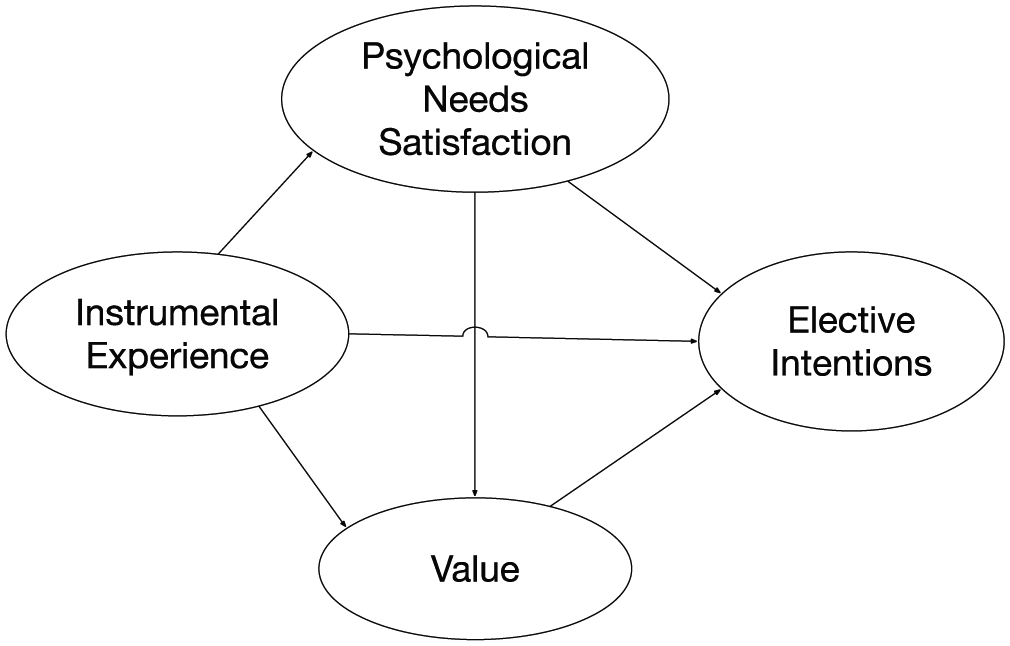
Hypothesized model.
Method
Context
In New South Wales, where this study is situated, classroom music is taught as a core “curricular” subject from Kindergarten to Year 8. It becomes an elective subject in Years 9 to 12. The curriculum is broad and includes a roughly equal treatment of the activities of performing, listening and composing, each explored using the “concepts of music” (e.g., pitch, rhythm, and tone color) through different musical genres (Board of Studies NSW, 2002). Some schools, such as the school in the present study, provide a co-curricular music program to complement their curricular learning, where students are given group or individual lessons on a musical instrument, a provision which obviously rests on economic resources of the school and the student’s family. Additionally, many schools in New South Wales have an extra-curricular music program where students can be involved in choir, band, orchestra, rock groups, or other types of ensembles. The range and provision of co-curricular and extra-curricular music opportunities varies between schools.
Participants and procedure
The sample for this study consisted of 204 students in Stage 4 (Years 7 and 8) at a boys’ high school in Sydney. The school in the present study provided an ideal site for analysis because of the consistent provision of core, co-curricular, and extra-curricular music throughout all levels of school and an environment that encourages and supports music. Participation involved completing a survey during class time. Procedures for conducting this study were approved by the university’s human ethics advisory panel and endorsed by the school’s principal.
Measures
Psychological needs satisfaction
The Balanced Measure of Psychological Needs (BMPN; Sheldon & Hilpert, 2012) was used to assess the satisfaction of students’ psychological needs in the music classroom. The participants were asked to think about their music classroom and answer the items under the stem of “When I am in this subject . . .” in order to contextualize the domain-general measure. Their agreement with these items was measured on a 7-point Likert scale from disagree to agree. Item parcels for competence (α = 0.73), autonomy (α = 0.71), and relatedness (α = 0.74) were created by using the mean of both positive items and reverse-scored negative items. The three psychological needs are well-known to have high intercorrelations (Chen et al., 2015; Johnston & Finney, 2010; Sheldon & Hilpert, 2012). As such, when individual paths from each need were attempted in the model, this resulted in issues of multicollinearity. To rectify this, while still maintaining the importance of each need, the three item parcels were used as indicators of the latent variable “needs satisfaction” (α = 0.84).
Value
Value was measured using the value subscale of the Motivation and Engagement Scale, which has previously been used across general high school, music, sports, and work domains (Martin, 2003, 2007, 2008a, 2008b). The current study used the original version of this scale (Motivation and Engagement Scale – High School; Martin, 2007). Students were asked to think about their music classroom and answer the items under the stem “When I am in this subject . . .” and rate their agreement with 4 value items (e.g., “learning in this subject is important”) on a 7-point Likert scale from disagree to agree (α = 0.89).
Instrumental experience
Students were asked to report how many years they had been having formal music lessons with a teacher. It was assumed that students were able to report on this question with very little measurement error and this item was modelled as such in the structural equation model (see Analytical Approach).
Elective intentions
Two items were developed to assess intentions to enroll in elective music, similar to those used in Standage, Duda and Ntoumanis’ (2005) study predicting intention to enroll in optional PE classes: “If I were choosing elective subjects, I would choose to study this subject” and “I would rather study this subject over other elective subjects.” Students were asked to rate their agreement on 7-point Likert scales from disagree to agree (α = 0.89). Although there are some limitations with using only two items to indicate latent factors, this approach is acceptable where the indicators are sufficiently correlated and exhibit low cross-loadings with other factors in the model (Byrne, 2012; Worthington & Whittaker, 2006; Yong & Pearce, 2013).
Analytical Approach
The hypothesised model was examined using structural equation modelling (SEM), a technique used to model structural relationships between latent factors. The SEM analysis was conducted using MPlus version 7.2 (Muthén & Muthén, 2014). SEM provides model fit indices to examine the degree to which the modelled relationships represent the data. The following criteria were used to examine model fit: comparative fit index (CFI) and Tucker–Lewis index (TLI) greater than 0.950 were considered to be indicators of good fit (Hu & Bentler, 1998); root mean square error of approximation (RMSEA) and standardized root mean square residual (SRMR) values less than 0.05 were considered good fit, less than 0.08 acceptable fit, and less than 1.0 mediocre fit (Byrne, 2012); the chi-square (χ2) significance statistic is reported but was not used in this analysis as the maximum likelihood with robustness to non-normality procedure was required. The criterion of p < 0.05 was used for determining whether parameters were statistically significant.
Results
Descriptive statistics
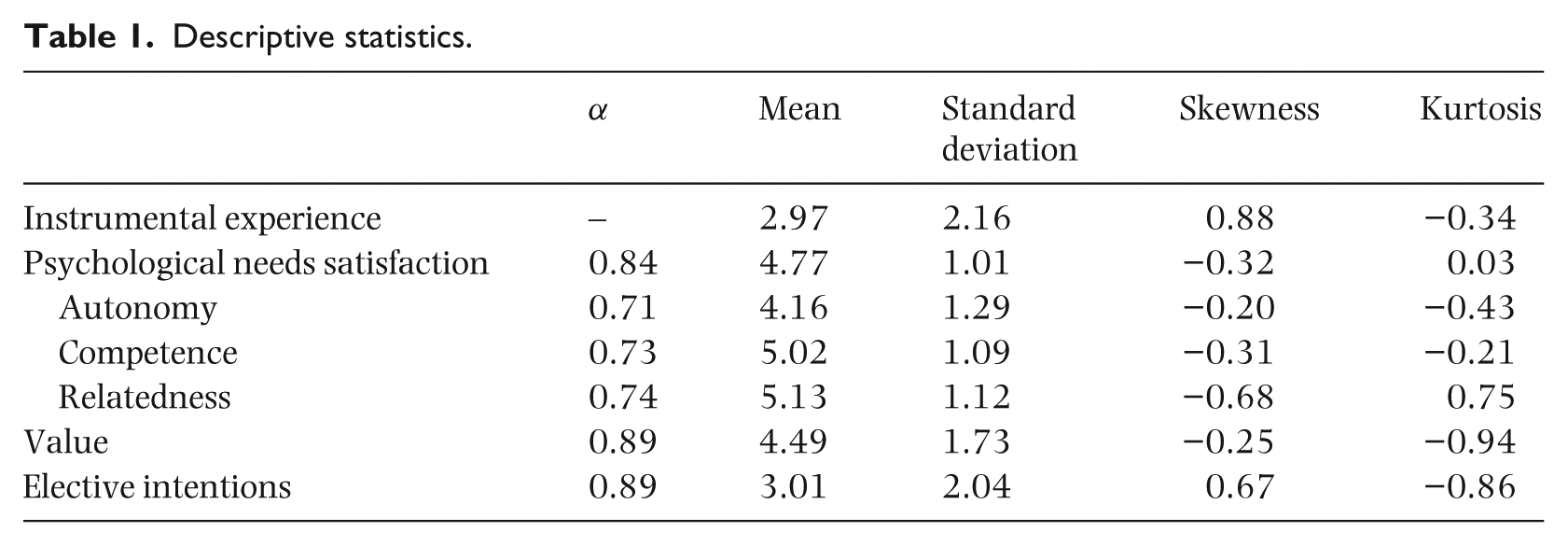
Descriptive statistics for all factors are reported in Table 1. Cronbach’s alpha (α) statistics ranged from 0.71 to 0.89. Skewness and kurtosis statistics were mostly within an acceptable range, however some indicated non-normal distributions, so the model was tested using maximum robustness to non-normality (MLR; Muthén & Muthén, 2014). Correlations of the variables used in the path analysis are shown in Table 2. Correlations ranged from 0.20 to 0.64 and were all significant at p < 0.01.
Descriptive statistics.
Correlations.
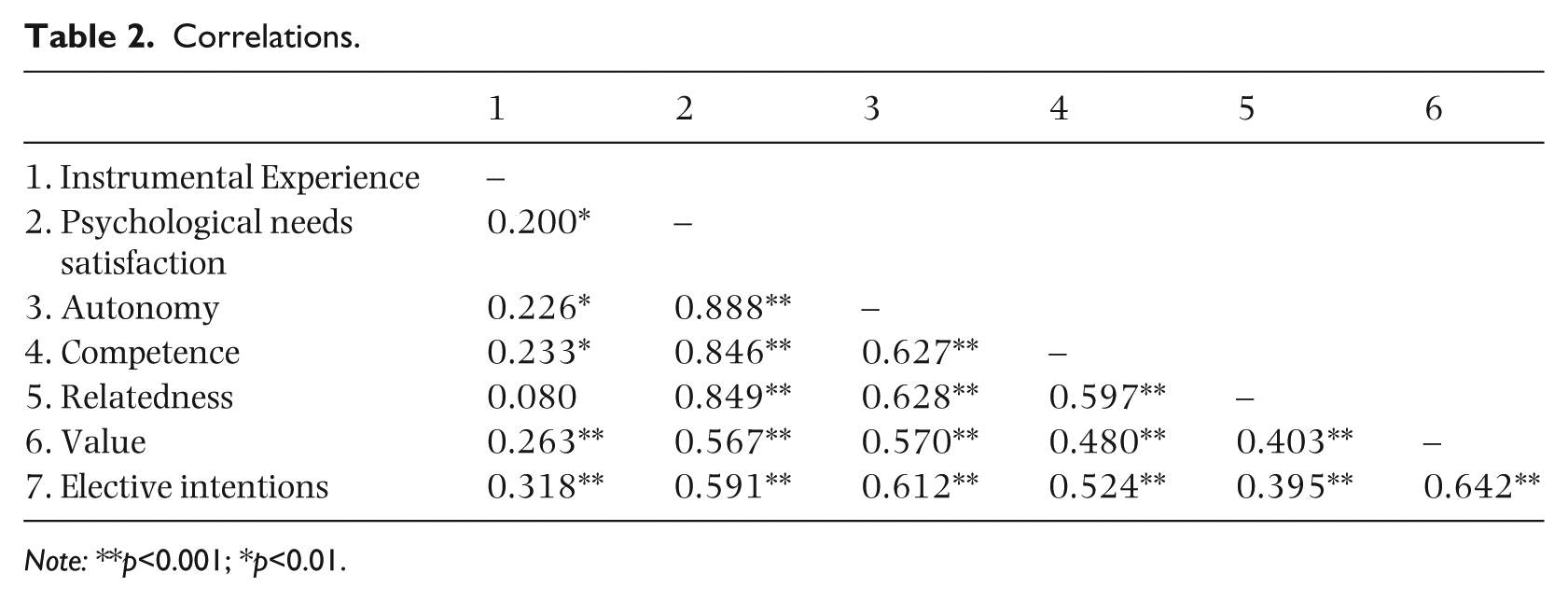
Note: **p<0.001; *p<0.01.
Structural Equation Modelling
Results of the SEM are shown in Figure 2. Fit indices overall indicated a good model fit, χ2(df: 30) = 46.488, p = 0.028, χ2/df = 1.550; CFI = 0.981; TLI = 0.971; RMSEA = 0.052 (90% CI 0.018, 0.080); SRMR = 0.039. All hypothesized parameters were supported by the model, except for the influence of instrumental experience on elective intentions which was nonsignificant. Elective intentions were predicted by value (β = 0.425, p < 0.001), psychological needs satisfaction (β = 0.393, p < 0.001), and instrumental experience (β = 0.143, p = 0.011). Value was predicted by needs (β = 0.668, p < 0.001). Needs was predicted by instrumental experience (β = 0.228, p = 0.011). The model explained 65% of the variance in music elective intentions, and 50% of the variance in students’ valuing of music.
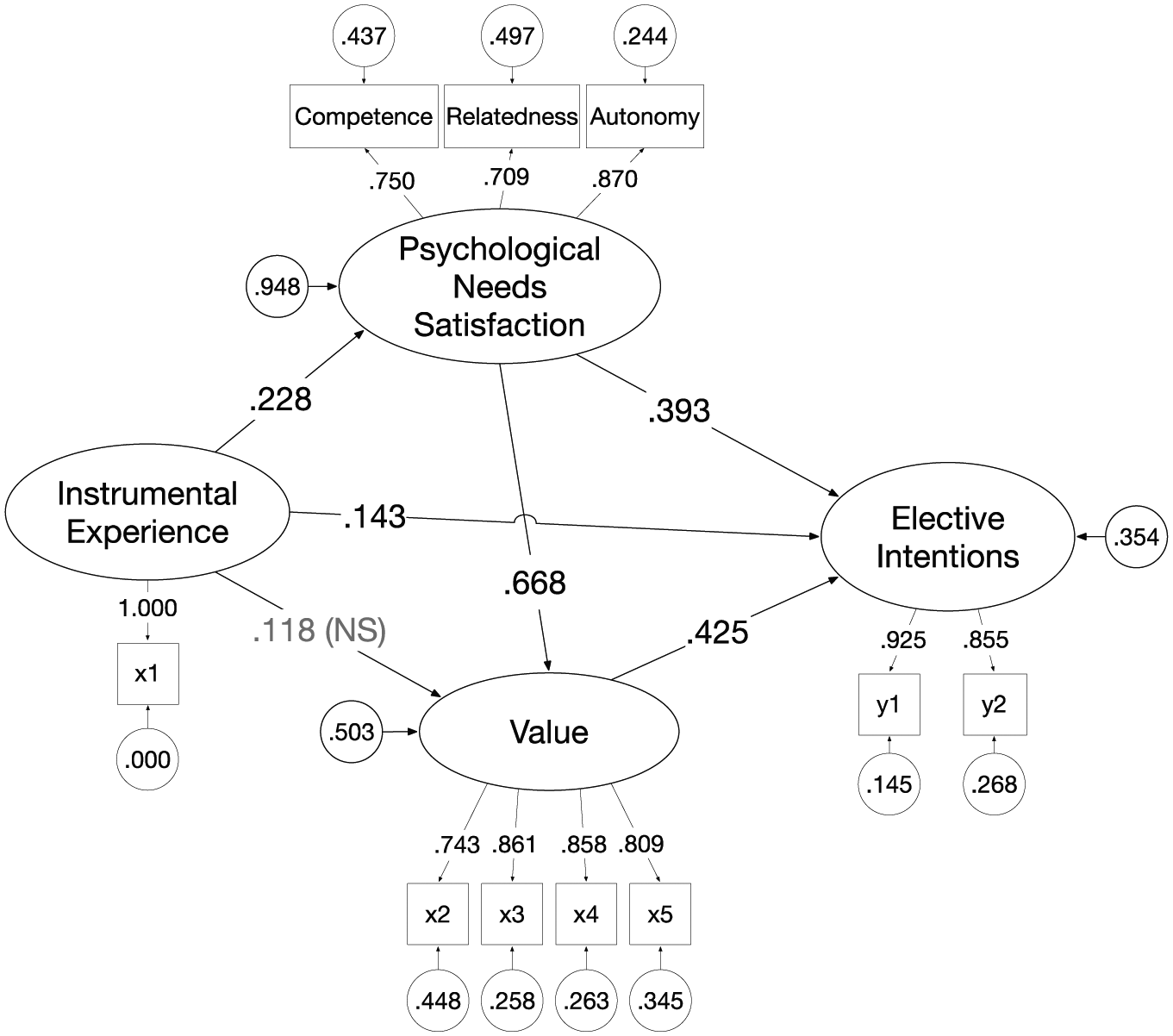
Structural equation model.
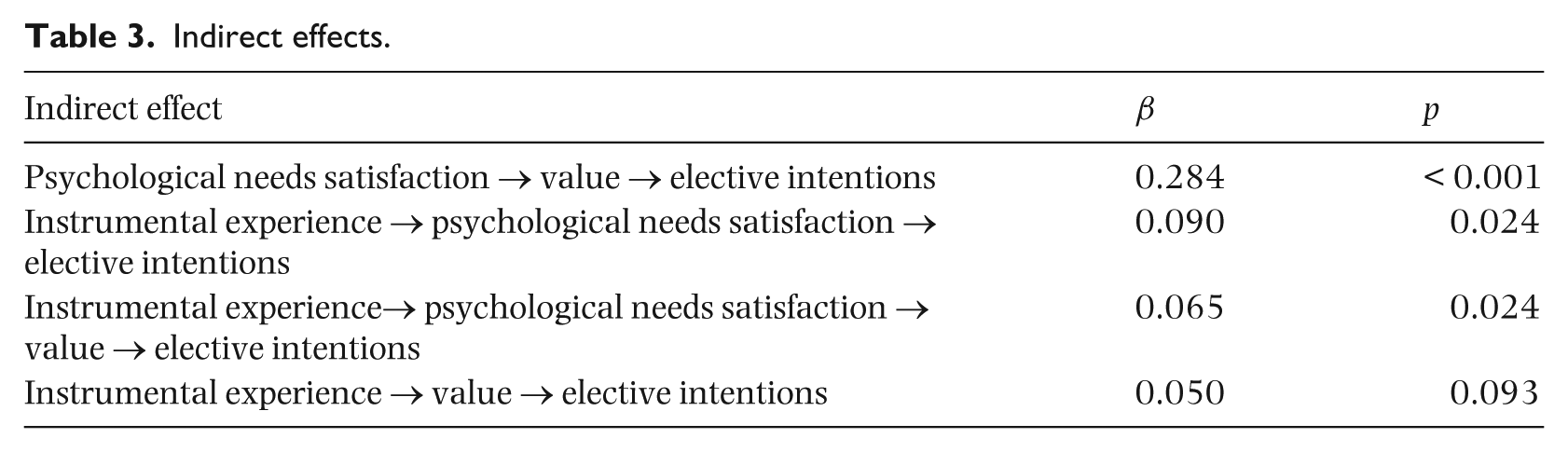
Indirect effects on intentions were also modelled and are shown in Table 3. The path from psychological needs satisfaction to elective intention through value was positive and significant: psychological needs satisfaction → value → elective intention (β = 0.284, p < 0.001). The following paths from instrumental experience to elective intention were also significant: Instrumental experience → psychological needs satisfaction → elective intentions (β = 0.090, p = 0.024); instrumental experience → psychological needs satisfaction→ value → elective intentions (β = 0.065, p = 0.024). The path instrumental experience → value → elective intentions was nonsignificant (β = 0.050, p = 0.093).
Indirect effects.
Discussion
This study aimed to explain high school students’ intentions to continue studying music when it becomes an elective subject at school. Students in this study were more likely to intend to continue with music as an elective subject at school when they valued it more, and they were more likely to value music when their psychological needs were more fulfilled. As expected, instrumental experience also played a role – students who had experiences of learning a musical instrument outside of school garnered greater psychological needs satisfaction in music and were more likely to choose music as an elective subject. However, even when the model accounted for this effect, the sense of psychological needs satisfaction in the classroom, along with valuing of music, far outweighed instrumental experience as predictors of students’ intentions to choose music as an elective subject. The final model accounted for 65% of the variance in students’ intentions to choose music as an elective subject at school.
The link between psychological needs support and behavioral intentions has been established in other high school subjects. For example, Ntoumanis (2005) found that students with greater psychological needs satisfaction in PE had more self-determined motivation and were more likely to participate in optional PE classes. Psychological needs satisfaction has also been closely linked to behavioral, cognitive, and affective engagement in high school classes (Reeve & Lee, 2014). In music education, psychological needs satisfaction has been linked to the length of children’s and adolescents’ engagement with music learning (Evans et al., 2012) and to motivation and practice quality in university students (Evans & Bonneville-Roussy, 2016). The current study has replicated these findings in the high school music context and thus added further support to the connection between the satisfaction of psychological needs and students’ behavior in the educational context.
Value was also strongly predictive of elective intentions, consistent with previous research, for example Waters et al. (2014) who found that interest, importance and enjoyment of music were strong predictors of intention. The current study’s findings also support the dominance of value as a key construct in the music education literature (McPherson & Hendricks, 2010; McPherson & O’Neill, 2010; McPherson et al., 2015). The study also investigated the process by which students come to value music. Psychological needs satisfaction was found to strongly predict students’ value of music. This link is theoretically central to SDT, which suggests that people will internalize values from social environments to the extent that they feel their psychological needs being supported within that environment (Deci & Ryan, 2008; Ryan & Deci, 2017). This process is supported by the indirect effects, where psychological needs satisfaction operated through value to influence elective intentions. McPherson and O’Neill (2010), McPherson and Hendrick (2010), and McPherson et al. (2015) have well established that music is valued poorly in relation to other school subjects, and the results of the current study suggest that future research and interventions may focus on psychological needs satisfaction as a factor to target in order to increase value of music at school.
The findings of this study indicate that instrumental experience was not particularly influential in students’ elective intentions when taking into account other psychological processes such as psychological needs satisfaction and value. As expected, instrumental experience was correlated with the intention to continue with music as an elective subject. But in the model, value, as predicted by psychological needs fulfilment, appeared to be far more influential, and instrumental experience became a nonsignificant predictor of value. The findings therefore challenge the intuitive assumption that students with experience of formal music learning are most likely to choose music as a subject and may derive greater value from music than students with less experience (McPherson & Hendricks, 2010; McPherson & O’Neill, 2010; McPherson et al., 2015). Even when students’ experience is taken into account, psychological needs satisfaction may therefore be a much stronger predictor of value and account for a substantially stronger explanation for elective intentions than experience alone.
Conclusions and limitations
The current study sought an understanding of why students choose music as an elective subject in high school. The findings indicated that the satisfaction of the students’ psychological needs, along with the degree to which they value music, provided a strong indication of their intention to choose music. Within the domain of music, students are vulnerable to the belief that you can only succeed or should only continue beyond a certain point of learning if you are particularly gifted (Evans et al., 2012; Lamont & Maton, 2008). The current study has shown that despite instrumental experience (i.e., ability) influencing students’ intentions to choose music, it is how students’ psychological needs are supported in their music classroom that provides a superior explanation for their value of music as a subject and in turn, their intention to pursue music learning further.
One limitation of this study is that the sample size, though large enough to establish a model, would need to be increased in order to observe any potential smaller effects. Future research may investigate some of these more nuanced differences, looking specifically at differences between groups (e.g., based on gender) and by accounting for the nesting of data within classes or teachers. Related to this, the present model aggregated the three psychological needs so as to examine the direct association between needs fulfilment and value and elective choice. However, it is also possible that different needs may affect both value and elective choice in different ways. Indeed, this is true of the value construct also, in that the dimensionality of value (e.g., intrinsic, importance, and utility) may be expanded. Having now provided evidence for the hypothesized model, future research may examine influences from specific psychological needs onto outcomes. For example, a sense of relatedness may have a more powerful impact on attainment value, while autonomy support may support intrinsic value. Such research is important because for practitioners, interventions need to be specific and proximal: for example, targeting a particular psychological need to improve elective choice or value would be more effective and efficient than simply targeting the broader construct of psychological needs fulfilment. However, we also note that the correlations between the individual psychological needs and value and intentions were all of similar magnitude, suggesting that it is indeed the higher-order factor (i.e., needs satisfaction) rather than specific lower-order effects (i.e., competence, relatedness, and autonomy) operating differentially on the outcomes modelled.
A second limitation is that the sample was drawn from only one school. The influence of high socioeconomic level of this particular school may limit the generalizability of the findings. Additionally, music programs of the range and quality in this particular school are not readily available in all schools, and therefore results from this school may not be generalizable to schools in the same state or country. McPherson et al.’s (2015) study on the value of music in Australian high schools showed a negative relationship between SES and a value of music. The National Review of Music Education (Pascoe et al., 2005) found that schools in remote and rural areas and areas of low SES are less likely to teach music, and are disadvantaged in this area because of a lack of funding, opportunities, access to qualified staff, and access to resources. Future research could resolve this limitation of the current study by examining the variations that exist in schools from areas of different SES. Furthermore, additional schools would allow for analysis of whether these results hold between schools of different sizes, in different locations, and among different approaches to music education.
A third limitation is generalisability across gender as the sample was drawn from an all-boys school. In terms of SDT factors, this may not be a significant concern. Several SDT studies have found non-significant gender differences in SDT constructs (Jang, Kim, & Reeve, 2012; Standage et al., 2005). In terms of value, however, gender is a particularly influential factor. For example, McPherson and O’Neill (2010) found that female students across 7 of the 8 countries they surveyed held a higher value of music, held higher competence beliefs about music, and found music less difficult than male students. In an Australian context (McPherson et al., 2015), female students believed music to be more important and useful than male students. In an examination of college students’ career intentions – somewhat cognate to high school students’ elective subject choices – autonomous motivation was more influential for female students than it was for male students (Bonneville-Roussy et al., 2017). Future research should therefore consider more closely exploring potential gender differences in value, or in the relationship between psychological needs satisfaction and value.
Implications for teachers
It is well-established in other areas of education that when teachers use strategies to support their students’ psychological needs, their students’ needs become more fulfilled, impacting their engagement (Reeve, 2012). Although there is an obvious and observable correlation between students’ instrumental experience and their intentions to choose elective music, teachers may find that a more effective strategy lies in the encouragement of all students through the satisfaction of their psychological needs.
There is a range of general teaching recommendations, derived from the educational literature, that teachers can use to provide a classroom environment that satisfies students’ psychological needs (Evans, 2015; Renwick & Reeve, 2012). To support autonomy, teachers could minimize pressure and contingency – when teachers use non-controlling forms of instruction and direction, students may not feel as pressured to complete tasks. Additionally, by eliminating penalties for not completing tasks and replacing with intrinsic motives for effort and improvement, contingency is replaced by autonomous motivation. Autonomy might also be supported by providing meaningful rationales for activities (Steingut, Patall, & Trimble, 2017). When students understand the purpose behind an uninteresting activity, they are likely to internalize the value of what they are doing. Recognizing students’ negative affect, when it arises, is also important so that students feel able to articulate a sense of voice (agentic engagement) in the classroom (Reeve, 2012).
To support competence, teachers might find ways to provide activities that are optimally challenging and where students can feel effective. This continues on from the last autonomy strategy in that students with varying abilities may become bored or frustrated if they are not challenged enough. Teachers are also encouraged to give constructive feedback to their students. When feedback is given in a controlling manner, students no longer feel effective in what they are doing, nor do they understand how to improve. However, when feedback is given in a constructive way, students are inclined to understand their mistakes and make effective changes. The undermining effects of penalties and rewards is well known in SDT’s motivational research (Ryan & Deci, 2017). When students are given incentives or penalties for task completion, their motivation may decrease because of seemingly unachievable goals. Therefore, teachers could provide praise for effort, so that students are not focused on the “prize” at the end, but rather on achieving progress and developing motivation to continue (Niemiec & Ryan, 2009; Reeve & Halusic, 2009; Renwick & Reeve, 2012).
Finally, a sense of relatedness between teacher and students can be developed through active listening and interacting in a warm, non-controlling way. A mutual liking and respect between teacher and students can help students to increase their sense of value for classroom music, as an individual will tend to develop the same values as those who they consider as significant others within certain environments. The importance of teacher–student relationships has been widely researched and should not be underestimated (e.g., Allen, Kern, Vella-Brodrick, Hattie, & Waters, 2016; Quin, 2016; Sparks, Dimmock, Lonsdale, & Jackson, 2016). Building a sense of community in the music classroom will also help students to increase relatedness satisfaction. Students will be more likely to participate and perform in an environment where they feel a sense of belonging. In this case, it is not only the teacher who provides the sense of relatedness but the peers within the classroom also. Teachers can create a sense of belonging for all students in their classroom by setting expectations for respect and providing opportunities for students to work together (Niemiec & Ryan, 2009; Reeve & Halusic, 2009; Ryan & Deci, 2017).
According to SDT, a sense of value for music as a subject and the activities in the classroom will be advanced to the extent that the students’ psychological needs are developed (Deci & Ryan, 2008; Niemiec & Ryan, 2009). Therefore, teachers are encouraged to employ the aforementioned strategies not only to increase students’ motivation in the music classroom and for future participation, but also to increase the value that students hold for music. Additionally, teachers should encourage students to reflect on the usefulness and importance of music for their future, at school and beyond (Waters et al., 2014). Interventions in utility value are also shown to be useful in other school subjects (Hulleman, Godes, Hendricks, & Harackiewicz, 2010; Hulleman, Kosovich, Barron, & Daniel, 2017) and are thus worthy of investigation in the music context.
Student participation in non-compulsory music education is a global issue and it appears that students on an international scale generally hold classroom music as low in value. It would be simple to assume that low participation and value levels are in proportion to students’ instrumental experience: Even students who do play an instrument hold low values for classroom music and are not continuing beyond mandatory studies. The current study’s supported model shows that over and above instrumental experience, it is the students’ psychological need satisfaction during mandatory music lessons that leads to the development of value for music, and stronger intentions to participate in elective music studies. Further, students’ sense of value not only provides the strongest prediction of intention, but acts as the mediator from psychological needs to intention. This finding alone has major implications for music teachers who want to increase student motivation, value and participation rates, but also for researchers in confirming the SDT process of internalization and motivation within the high school music classroom.
Footnotes
Funding
The authors received no financial support for the research, authorship, and/or publication of this article.