



Abstract
We examined whether timbre (instrument), pitch level, or both influence gender ratings of musical instruments. According to previous research, a variety of musical instruments are categorized or rated as masculine, neutral, or feminine in a relatively consistent way. Gender associations to musical instruments have been rather reliable across time and across participant populations. We investigated the gender ratings of nine musical instruments (three masculine, three neutral, and three feminine) each heard at low, medium, and high pitch levels within the playable range of each instrument. Both timbre and pitch level influenced participants’ gender ratings. The effect of timbre is consistent with results of previous studies, further demonstrating that participants rate instruments fairly consistently. One novel finding is that pitch level also played a role in participants’ gender ratings. The ratings of all instruments heard in low pitch levels were shifted in the masculine direction, and the ratings of all instruments heard in high pitch levels were shifted in the feminine direction. These results provide evidence for the notion that participants are influenced by associations to both timbre and pitch level when rating musical instruments on gender.
Gender associations to musical instruments have been a focal point of research since the late 1970s (Abeles, 2009; Abeles & Porter, 1978; for an overview see Eros, 2008; Wych, 2012). The available body of research offers strong empirical evidence that people conceptualize musical instruments along gender lines. Further, the existing research delineates the expected gender association for several instruments (e.g., tuba is considered masculine and flute is considered feminine). However, the findings give rise to further questions: What drives gender associations to musical instruments, and can otherwise fairly stable gender associations to instruments change? In the present study, we focus on auditory perceptions of timbre and pitch as potential drivers of gender associations to musical instruments. The novelty is that we empirically evaluated the influence of pitch level on gender ratings of musical instruments.
To date, studies on gender associations to musical instruments have generally been aimed at informing the music education community. A growing body of literature continually sheds light on the pervasive sex-based stereotypes and societally implied gender roles that bias instrument choice and career prospects for aspiring and novice musicians (Abeles, 2009; Eros, 2008; Wych, 2012). Alongside existing studies that focus on environmental contributors to gender associations, the tools of cognitive psychology can be used to evaluate the potential influence of perceptual factors on gender associations to musical instruments. In that vein, we aimed to determine whether timbre, pitch level, or both, influence gender ratings of musical instruments. Specifically, we asked a group of adult female participants to rate individual instruments on a continuum of masculine to feminine in response to short musical phrases (auditory-only stimuli) presented randomly in low, medium, and high pitch levels.
Our study differs from previous studies that use words, pictures, or live instrument demonstration, yet our study is connected to the underlying issue. We are building from previous work in which other types of stimuli were used, linked by the common theme of broadening our understanding of the circumstances that influence gender ratings.
Patterns of gender associations
Gender associations to musical instruments have shown relatively stable patterns across various studies (Abeles, 2009; Abeles & Porter, 1978; Delzell & Leppla, 1992; Griswold & Chroback, 1981; Harrison & O’Neill, 2000; for an overview see Eros, 2008; Wych, 2012). Some instruments, such as the tuba and percussion, are consistently categorized or rated as masculine by participants, while others, such as the violin and flute, are consistently categorized or rated as feminine. Additionally, some instruments, such as the piano, are consistently categorized or rated as neutral (i.e., at or near the middle of the gender continuum). Gender associations to musical instruments have exhibited somewhat stable patterns within age groups (Abeles & Porter, 1978; Delzell & Leppla, 1992; Kelly, 1997; Wrape, Dittloff, & Callahan, 2016) and when viewed by biological gender of the participant (Abeles & Porter, 1978; Delzell & Leppla, 1992; Fortney, Boyle, & DeCarbo, 1993; O’Neill & Boultona, 1996; Wrape et al., 2016; see also Sinsel, Dixon, & Blades-Zeller, 1997). Recent evidence also suggests that gender–instrument associations appear to become more entrenched as a result of participants’ musical experience and skill level by the end of middle school (Wrape et al., 2016).
Several researchers have looked for trends in gender associations to instruments. As the populations of interest differ across studies, the evidence appears mixed. Delzell and Leppla (1992) found a reduction of range in college students’ rankings of musical instruments as compared to Abeles and Porter (1978), leading to the conclusion that gender associations had lessened to a degree. Fifteen years later, Abeles (2009) verified the reduction in range in college students’ rankings found by Delzell and Leppla, leading Abeles to conclude that no further change had occurred during the time between the two studies. Delzell and Leppla had also found a lessening of strength in gender associations to musical instruments among fourth-grade students, but Abeles (2009) found little change in sixth- through eighth-grade band and orchestra students’ gender associations to instruments. Further, a recent study by Wrape and colleagues (2016) found no evidence of a trend toward change in gender stereotypes for sixth- through eighth-grade band students. When taken together, the given studies suggest an overall persistence of gender associations, especially for instruments such as the drums and the flute, which tend to anchor the ends of the gender continuum.
Timbre and pitch
According to Anderson, “people appear to organize objects into categories” (1991, p. 410), and “objects tend to cluster based on their attributes” (p. 411). A variety of attributes are potentially salient for purposes of gender-based categorization of objects, including size (e.g., tall versus petite), shape (e.g., squared versus rounded), color (e.g., blue versus pink), and sound qualities (e.g., brassy versus airy).
Two auditory factors stand out as potential drivers of gender associations to musical instruments: timbre and pitch. In a synopsis of prior studies involving timbre, Giordano and McAdams (2010) pointed out that timbre is “a multidimensional attribute of auditory sensation” and “the perceptual correlate of the mechanics of the sound source” (p. 165). The American National Standards Institute (ANSI) defines timbre as an attribute of auditory sensation that makes it possible to judge two similarly presented sounds with the same loudness and pitch to be dissimilar (1973). Note that in the present study, timbre is analogous with the experimental factor of “instrument”, as it represents the auditory information by which a listener identifies an instrument.
Prior investigations have set a precedent for further exploration of the relationships between timbre and gender associations to musical instruments. Notably, in a study of third graders, musical instruments were associated with traditional gender roles based on timbre alone – males with the cello and brass instruments, and females with flutes and the violin (Kelly, 1997). Based on a survey of middle school band students, Fortney, Boyle, and DeCarbo (1993) found further evidence of a gender–timbre connection such that, “Females tend to play and indicate preference for flute and clarinet, whereas males tend to play and indicate preference for trumpet, percussion, and low brass instruments” (p. 38). Moreover, Ziv, Ayash, and Ornstein (2013) concluded that timbre perception activates, influences, and enhances associations that lead to trait attributions in the direction of gender stereotypes found in previous studies of musical instruments.
Gender associations to instruments have shown the potential to be influenced by how instruments sound when played in a musical style that has masculine or feminine qualities. In a study by Marshall and Shibazaki (2012), three and four year olds listened to 10-second musical excerpts of instruments playing in either popular/jazz (masculine) or classical (feminine) musical style. Findings revealed that musical style influenced the gender of the player that the guitar and clarinet were assigned to, whereas the flute, violin, and drum were stably associated with gender regardless of musical style.
The Acoustical Society of America (n.d.) gives a general definition of pitch as “how high or low a tone sounds to a person”, with high frequency (i.e., high pitch or treble notes) being above 2000 Hz, and low frequency (i.e., low pitch or bass notes) having a frequency below 200 Hz. Just as adult males tend to have lower-pitched voices and adult females tend to have higher-pitched voices (Pernet & Belin, 2012), the pitch range at which an instrument is heard may also activate mental comparisons that lead to ascription of gender, with low pitch being considered more masculine and high pitch being considered more feminine. Interestingly, Pernet and Belin deduced that when timbre information is ambiguous (i.e., androgynous), human voice gender categorization relies mainly on pitch. Keeping in mind the potential of both timbre and pitch to evoke gender associations, we designed our experiment to allow for analysis of gender ratings across expected timbre (masculine, neutral, feminine) and across pitch level (low, medium, high).
The present study
We asked participants to rate musical instruments on gender along a continuous response bar using a computer mouse (Spivey, Grosjean, & Knoblich, 2005). One novelty of the present investigation is that this study represents the first effort to empirically evaluate whether participants will be influenced by gender associations that are evoked by both pitch and timbre when making gender ratings of musical instruments. As such, we evaluated the following competing hypotheses:
Participants will rate the musical instruments based only on their a priori gender associations to the timbre (Main Effect of Timbre). Specifically, replication of instrument gender ratings consistent with prior research is expected.
Participants will rate the musical instruments based only on their a priori gender associations to the pitch level (Main Effect of Pitch Level). Furthermore, planned comparisons based on this main effect are expected to demonstrate that the ratings for instruments heard in the low pitch level will be significantly more masculine than ratings for the instruments in the medium and high pitch levels, and ratings for instruments heard in the high pitch level will be significantly more feminine than ratings for instruments in the medium and low pitch levels.
Participants will rate the musical instruments based on their a priori gender associations to both timbre and pitch level, indicating that timbre and pitch level both influence the formation of gender ratings (Two Main Effects: Timbre and Pitch Level).
Method
Participants
Given the strong focus on gender in this study and the potential for an unbalanced participant gender ratio to confound results, only female participants were included in the pilots and main experiment. The reason that females were chosen instead of males was that there is a greater proportion of females in the Department of Psychology Participant Pool.
Thirty female Cleveland State University students (Mage = 18.3 years, SEage = 0.08) participated in the main experiment in the Language Research Laboratory for credit toward a research participation requirement. The pilot studies included 38 additional female participants: 18 in Pilot 1 (Mage = 19.5 years, SEage = 0.45), 10 in Pilot 2 (Mage = 18.9 years, SEage = 0.69), and 10 in Pilot 3 (Mage = 18.4 years, SEage = 0.16). All participants reported having normal hearing and normal or corrected-to-normal vision, provided informed consent, were appropriately debriefed, and were treated following APA ethical guidelines throughout the experiment.
Design
The main experiment consisted of a Timbre (masculine, neutral, feminine) × Pitch Level (low, medium, high) completely within-participants design. Three different musical phrases were employed to minimize participant fatigue. The combination of musical phrase with the other factors was counterbalanced across participants in different versions of the experiment. No participant heard the same musical phrase more than once for any given instrument. In addition, half of the participants saw the rating bar in the configuration M–|–|–|–|–|–F, and the other half of the participants saw the rating bar in the configuration F–|–|–|–|–|–M. The rating bar was continuous, capturing each rating as the x-coordinate of the final mouse click along the bar. Because of counterbalancing phrases and responses, there were six versions of the experiment. Participants were randomly assigned to one of the six versions.
Stimuli
Parameters
Each instrument has its own playable range, which varies based on instrument structure and mechanics. Thus, a suitable midpoint of the playable range was located for each instrument and was designated as the lowest tone of medium pitch level for that instrument’s stimuli. Each stimulus contained more than one tone to provide participants with enough information to identify and evaluate the instrument. Specifically, each stimulus consisted of a four-tone phrase of four quarter notes; each tone within the phrase was separated by an interval of exactly one major third. The tones in each phrase at each pitch level were exactly the same, but in a different order. As such, phrase one was always composed of tones 1, 3, 5, and 3 on the seven-tone diatonic major scale, with phrase two containing tones 5, 3, 1, and 3, and phrase three containing tones 3, 5, 3, and 1.
To avoid introducing emotionality into the stimuli, the phrases were free of articulations and dynamics such as accented notes, crescendos, or staccato-styled notes. Tempo was 75 beats per minute, chosen for its neutrality as “andante”, or “walking pace”, and the meter was 4/4. Each tone was quantized to fall directly on the beat. Importantly, for each instrument, the low pitch level stimuli were exactly one octave lower than medium pitch level stimuli, and high pitch level stimuli were exactly one octave higher than medium pitch level stimuli. For more details on instrument notation, see Appendix A.
Creation
All stimuli were created using virtual instruments 1 from the sample library in Garritan Personal Orchestra 5 (2016), which were digitally recorded into Cakewalk SONAR Platinum (2016) at 24-bit depth and 96kHz sampling rate. To give the sense of being played in an acoustically informal space, convolution reverb and ambience were set to Jazz Club and Jazz Club 1, respectively, within Garritan’s ARIA Player plug-in. Instruments were patched from the ARIA Player (one instrument per project file) into SONAR, with the mixer ins/outs panned to center. To the greatest degree possible, “noise” such as that which arises from static, electronic hiss, or hum, was minimized. All stimuli were initially recorded as MIDI. The MIDI data were bounced to audio and crossfaded, then exported as separate .wav files. The duration of each stimulus was 3,617 ms upon exportation. All stimulus files were normalized to 95% loudness in Peak Pro 5.2 (2006) and equated to 63 dB in Praat (Boersma & Weenink, 2017). The original set of stimuli contained 108 mono audio clips (from 12 instruments), plus 27 mono audio clips from three instruments (organ, marimba, and cello, each in low, medium, and high pitch level) as practice stimuli. After pilot screening, the final set of experimental stimuli was narrowed down to 81 audio clips (from nine instruments).
Pilots
To screen the stimuli, three pilot studies were performed. The first pilot served to narrow down the set of stimuli such that it comprised the nine instruments with the strongest masculine, neutral, and feminine gender ratings based on the medium pitch level stimuli. Final instrument selection based on gender ratings in medium pitch level made it possible to compare the high and low pitch level gender ratings against the medium pitch level gender ratings when evaluating data from the main experiment. Pilot 2 determined that participants could accurately distinguish when the pitch levels of an instrument were the same or different when comparing stimuli. Pilot 3 determined that participants could accurately distinguish when two consecutively presented stimuli were from the same or different instrument(s). For a full description of the pilots, see Appendix B.
Procedure
Upon arriving at the laboratory, each participant was given an informed consent, a demographics questionnaire, and a handedness inventory (Cohen, 2008), which is an adapted form of the Edinburgh Inventory (Oldfield, 1971). Participants were tested individually at a desktop computer in a quiet cubicle of the Language Research Laboratory. Auditory-only stimuli consisting of short musical phrases played by one instrument per clip were presented binaurally through standard Sony headphones. Participants were asked to listen to each instrument, to think about the degree to which they perceived the instrument to be masculine, feminine, or neutral, and to click at a point between M and F along the rating bar to rate the instrument. Participants were given nine practice trials, during which they could ask for clarification of the instructions and request adjustments to the speaker volume (default level was 75). Volume was never adjusted to lower than 70 or higher than 82 (two participants requested adjustment).
For each trial, a START button appeared. Upon clicking START, a stimulus was presented over the headphones. Participants then moved the mouse to click on the response bar at the top of the computer screen. After a 3,000 ms inter-trial interval, the START button re-appeared, prompting the next trial to begin. The experiment was implemented with the free software MouseTracker (Freeman & Ambady, 2010; Freeman, Dale, & Farmer, 2011), which was used to record the mouse trajectory – including the final click – for each trial. All participants completed a post-experiment questionnaire, on which the participants rated each listed instrument on how masculine or feminine they considered it to be, using a Likert scale from 1 to 10 (see Griswold & Chroback, 1981) and answered questions about their musical experience and the experiment. 2 Lastly, participants were debriefed by the experimenter and were provided with a debriefing form.
Results
There were nine instruments, resulting in 27 experimental trials per participant, for a grand total of 810 responses. Responses from participants who were assigned to the counterbalanced response bar (feminine to masculine) were flipped. In the following analyses, lower negative numbers correspond to increasingly masculine ratings (maximum −100), while higher positive numbers correspond to increasingly feminine ratings (maximum 100).
We performed a 3 (Timbre: masculine, neutral, feminine) × 3 (Pitch Level: low, medium, high) within-participants ANOVA on participants’ mean gender rating position of the final click. 3 First, there was a significant main effect of Timbre, F(2, 58) = 287.50, MSE = 543.61, p < .001, ηp2 = .91. Masculine instruments (M = −38.68, SE = 2.72) were rated significantly more masculine than neutral instruments (M = −0.13, SE = 2.61), Mdiff = 38.55, SE = 3.49, p < .001, and feminine instruments (M = 44.59, SE = 2.36) were rated significantly more feminine than neutral instruments, Mdiff = 44.72, SE = 2.88, p < .001 (see Figure 1). Note that in all of the following figures and in the appendices, the dependent variable is plotted on the x-axis to facilitate visualization of the results along the rating bar as it appeared within the experiment.
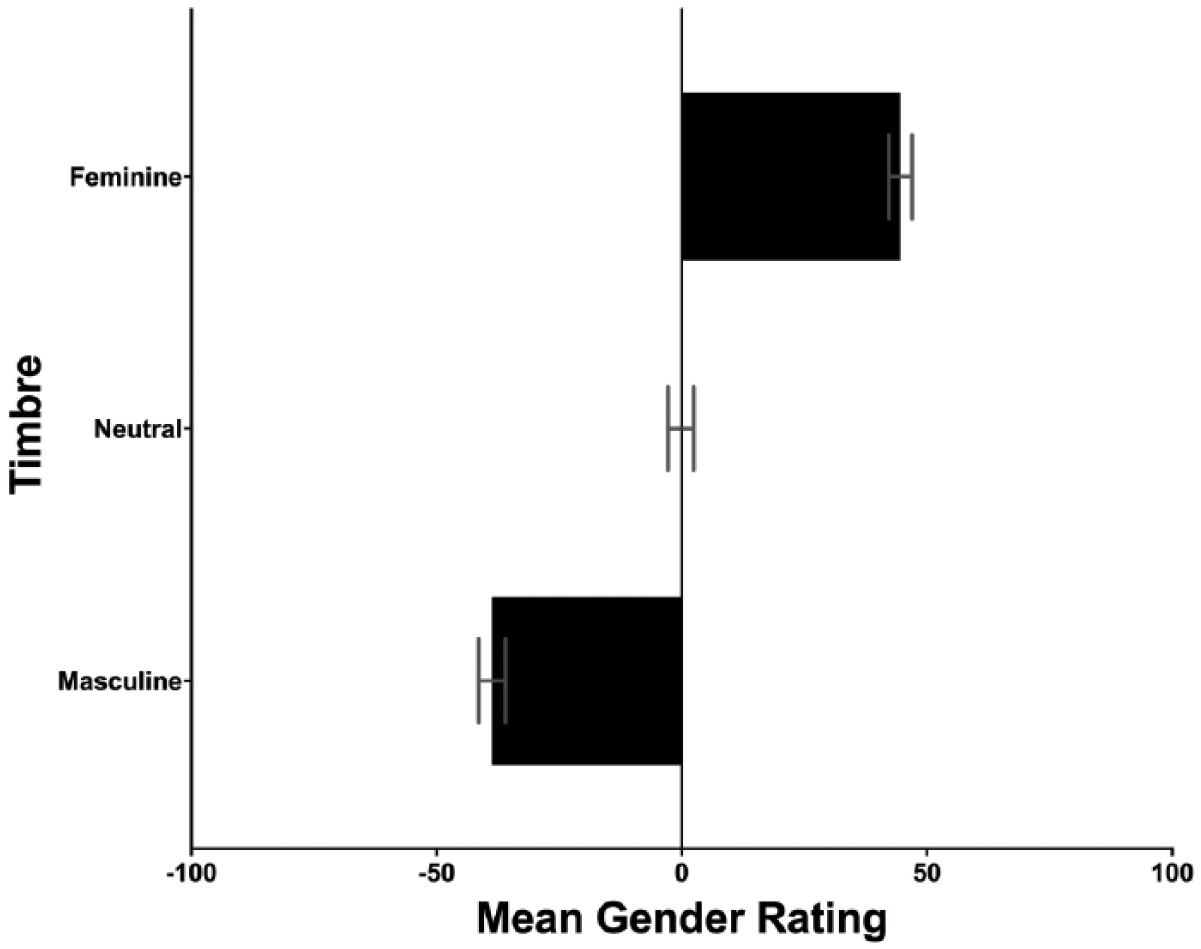
The Main Effect of Timbre. Error bars represent one standard error above and below the mean gender rating.
Second, there was a significant main effect of Pitch Level, F(2, 58) = 179.07, MSE = 681.75, p < .001, ηp2 = .86. Low pitch level phrases (M = −33.50, SE = 2.88) were rated significantly more masculine than medium pitch level phrases (M = −0.74, SE = 2.22), Mdiff = 32.76, SE = 3.17, p < .001, and high pitch level phrases (M = 40.02, SE = 3.11) were rated significantly more feminine than medium pitch level phrases, Mdiff = 40.76, SE = 3.35, p < .001 (see Figure 2).
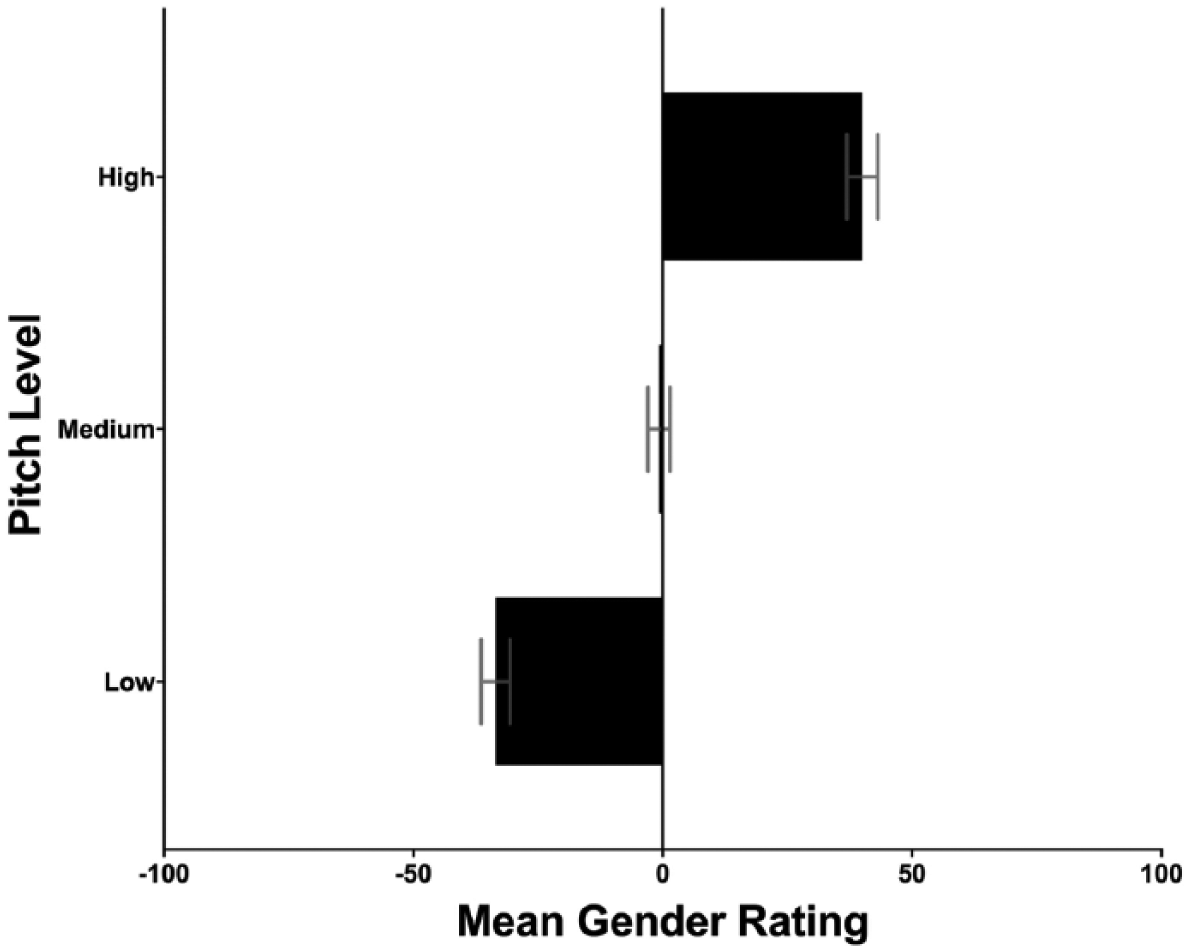
The Main Effect of Pitch Level. Error bars represent one standard error above and below the mean gender rating.
Thus, as predicted by the account wherein both Timbre and Pitch Level influence ratings (Hypothesis C), both main effects – Timbre and Pitch Level – were significant. The data are inconsistent with an account in which gender ratings are driven entirely by Timbre or an account in which gender ratings are driven entirely by Pitch Level, Hypotheses A and B, respectively.
In view of these findings, a secondary question was to explore whether Pitch Level had the same effect across the levels of Timbre. We found a significant Timbre × Pitch Level interaction, F(4, 116) = 15.50, MSE = 262.48, p < .001, ηp2 = .35 (see Figure 3). Within each timbre condition, the mean pitch level rating significantly differed from one another (all ps < .001). However, the interaction was driven by a larger effect of Pitch Level (high versus low) for the masculine instruments, M diff = 84.93, SE = 6.51, p < .001, followed by the neutral instruments, M diff = 77.09, SE = 6.66, p < .001, then the feminine instruments, M diff = 58.53, SE = 5.45, p < .001, with 95% CIs [71.62, 98.25], [63.47, 90.70], and [47.39, 69.66], respectively.
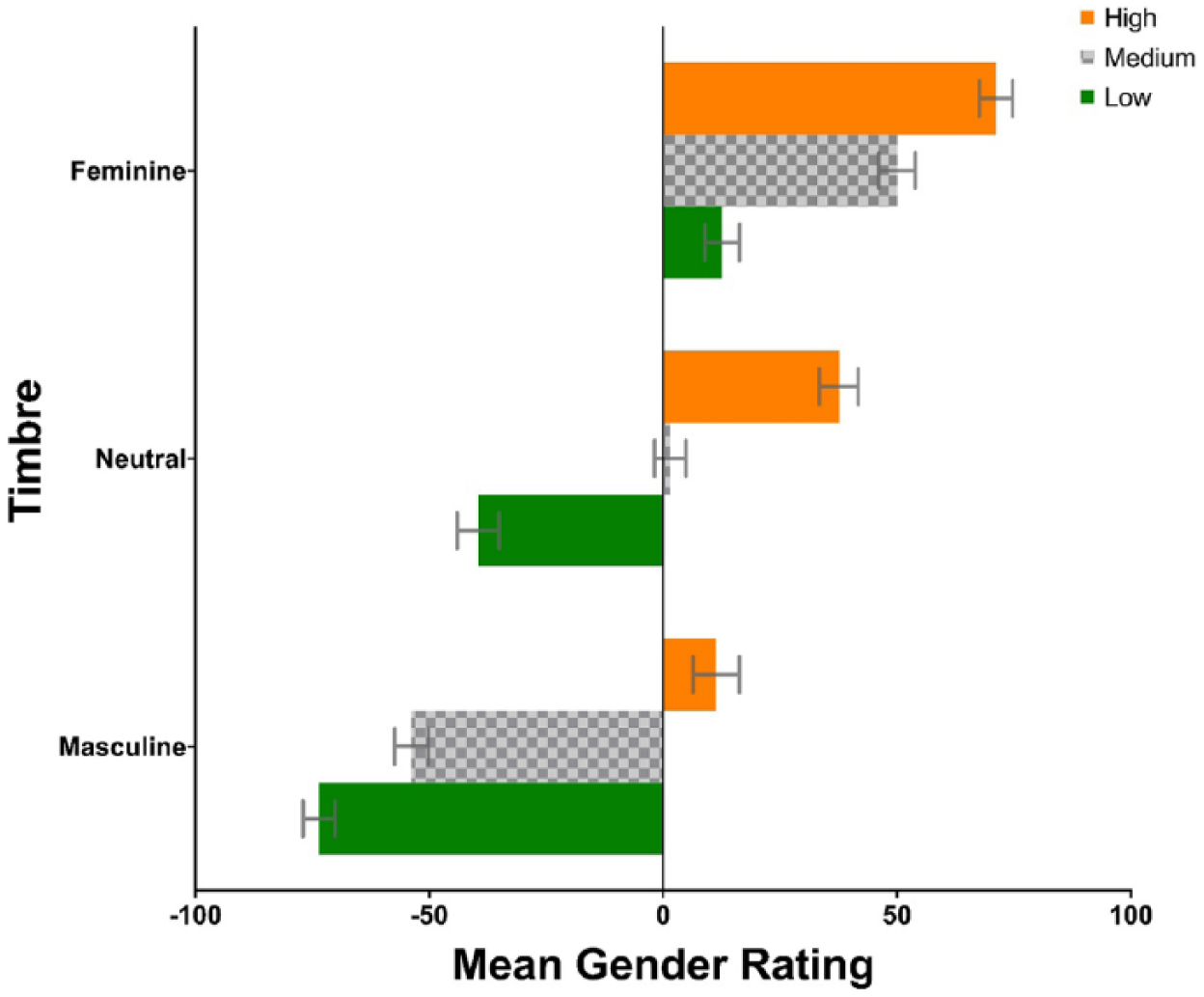
The Timbre X Pitch Level interaction and pull effect of Pitch Level. Each grouping of three bars appear in the order of high, medium, low from top down. Error bars represent one standard error above and below the mean gender rating.
It should be noted that the medium pitch level served as a control measure in this study, as instruments were sorted into masculine, neutral, and feminine timbre conditions based on participants’ mean ratings for instruments heard at medium pitch level in Pilot 1. Thus, we sought to examine the Timbre × Pitch Level interaction in light of the pull effect that the high and low pitch levels had on ratings against the medium pitch level control conditions. For low pitch level, the pull effect was computed by subtracting the low pitch level mean rating from the medium pitch level mean rating at each level of timbre. For high pitch level, the pull effect was computed by subtracting the medium pitch level mean rating from the high pitch level mean rating at each level of timbre.
For the masculine instruments, the high pitch level (M = 65.13, SE = 5.72) significantly pulled the mean gender ratings more than the low pitch level (M = 19.80, SE = 2.54), Mdiff = 45.33, SE = 6.01, p < .001. For the neutral instruments, the low pitch level (M = 41.09, SE = 4.21) did not significantly pull the mean gender ratings more than the high pitch level (M = 35.99, SE = 4.80), Mdiff = 5.10, SE = 6.09, p = .410. That is, for the neutral instruments, the pull was equivalent in both directions. For the feminine instruments, the low pitch level (M = 37.37, SE = 5.79) significantly pulled the mean gender ratings more than the high pitch level (M = 21.16, SE = 3.39), Mdiff = 16.22, SE = 7.78, p = .046 (see Figure 3).
Had the interaction been due to an issue of ceiling or floor effects, the masculine low pitch level mean gender ratings could not have been rated any more masculine, and the feminine high pitch level mean gender ratings could not have been rated any more feminine. However, this was not the case. The masculine low pitch level mean gender rating significantly differed from −100, t(29) = 7.75, p < .001; and the feminine high pitch level mean gender rating significantly differed from 100, t(29) = −8.18, p < .001.
Conclusion
In this study, we examined potential influences of timbre and pitch on participants’ gender ratings of musical instruments. The results supported the account wherein gender associations cued by both timbre and pitch level - together - influence gender ratings (Hypothesis C). Instruments typically considered feminine (e.g., flute) were rated feminine, while instruments typically considered masculine (e.g., tuba) were rated masculine. Importantly, high pitch level resulted in more feminine ratings – and low pitch level in more masculine ratings – across all musical instruments independently of their timbre (see Appendix C to view results for individual timbres). Thus, this study provides support for the idea that timbre and pitch level both inform gender ratings of musical instruments.
The finding of two main effects (Timbre and Pitch Level) is consistent with past research indicating that timbre and pitch are subject to interference with one another (i.e., participants do not selectively attend solely to one or the other, Allen & Oxenham, 2014; Caruso & Balaban, 2014; Melara & Marks, 1990). Accordingly, participants in our experiment most likely could not consider both sources of information separately during the ratings process.
A Timbre by Pitch Level interaction emerged that warranted further investigation. We checked for ceiling and floor effects and found that there was a significant difference between masculine low ratings and −100, and between feminine high ratings and 100, signifying that participants did not make full use of the rating scale. As such, the likelihood that restricted range was driving the interaction has been minimized. While these statistical comparisons allowed us to rule out extreme ceiling and floor effects, it is possible that the lower end of the scale may have imposed restrictions on some participants. If so, such restrictions could account for the finding that the high pitch pull on ratings was stronger than the low pitch pull. Another possible account has to do with the gender of the participants. All participants in this study were female. It is plausible that male participants are more responsive to low pitch stimuli than female participants. Thus, future studies should include male and female participants in order to analyze possible effects involving participant gender. An alternative possibility for the interaction is a methodological issue due to the range of the instruments. The interaction could be specific to the particular set of instruments we used. Future studies should replicate these findings with a new set of instruments to disentangle this possible explanation.
For each instrument in this experiment, the frequencies of the stimuli covered a range of two octaves and a perfect fifth. Some research has indicated that pitch variations beyond one octave for non-musicians and two-and-a-half octaves for musicians may cause misidentification of timbre (Steele & Williams, 2006). This is likely to occur more frequently among instruments in the same family (Giordano & McAdams, 2010); for example, the string bass heard at high pitch could be mistaken for a cello. Further, timbre differences can be perceived across two instruments of the same type (e.g., string basses made by different luthiers). However, in the present experiment, we carefully chose representative exemplars of the instruments, and we took care to present instruments with distinct timbres as confirmed in Pilot 3. Nonetheless, further studies should investigate whether (a) a different set of exemplars (of the same instruments used in this study) elicits different gender ratings at the instrument level, or (b) different pitch levels of an instrument affect perception of which instrument it is, affecting overall results. Future investigations could also include a pilot wherein participants listen to stimuli and identify the instrument by name.
As the present design incorporated a horizontal rating bar with pitch-based stimuli, we will briefly address potential accounts based on the horizontal Spatial-Musical Activation of Response Codes (SMARC) effect (i.e., a mental map of pitch that affects response performance, whereby left is associated with lower pitches and right is associated with higher pitches, Hartmann, 2017; Lidji, Kolinsky, Lochy, & Morais, 2007; Nishimura & Yokosawa, 2009; Rusconi, Kwan, Giordano, Umiltà, & Butterworth, 2005, 2006). As ratings in our experiment replicated prior studies not involving isolated auditory stimuli, and as the direction of the rating bar was counterbalanced, we believe that we effectively minimized any potential contribution of the SMARC effect in the present investigation.
The findings of this study have the potential to stimulate a host of future investigations. Gender associations to instruments are generally similar in college-aged participants across various studies (Abeles, 2009; Abeles & Porter, 1978; Delzell & Leppla, 1992; Griswold & Chroback, 1981). Thus, it is noteworthy that the gender ratings of college-aged participants shifted for all instruments in the present study. Our findings can be expounded on with a similar study involving school-aged participants grouped by grades K–2, 3–5, and 6–8, to examine whether pitch level influences younger populations differently. It would also be useful to follow up the present study with a comparison of musicians and non-musicians in the same task to determine the effect of musicianship on the ratings. Additionally, while our study found evidence of a combined influence of timbre and pitch on gender ratings in an all-female participant pool, male perceptions and ratings may differ from those of females; thus, future studies can expand on the present findings by comparing and/or contrasting ratings shifts within and between participant genders.
Future studies might include additional experimental measures such as eye tracking, which can be combined with mouse trajectories to gather additional information about the mental processes underlying the ratings. A logical extension of the present work would be an attempt to create lasting shifts in previously stable associations through repetition over a set time period (e.g., does playing the tuba at high pitch repeatedly over time result in less masculine – or even feminine – ratings of the tuba?). Finally, comparisons of gender ratings when instruments are played with articulations, such as vibrato, staccato, plucking (for strings), or tonguing (winds), might produce deeper insights into the effects of other auditory-specific instances on gender ratings of musical instruments.
Investigating the conditions under which gender ratings are flexible has important theoretical and practical consequences. On the theoretical level, the results of this study demonstrated that gender associations to both timbre and pitch level are involved in gender ratings of musical instruments. The findings relating to pitch level particularly suggest that auditory perceptual information can potentially enhance or downplay social roles and gender stereotypes ascribed to musical instruments. On the practical level, the present results will be of special interest to those in the music education community who are focused on balancing students’ preferences with their learning opportunities. As musicians tend to view their instruments as extensions of themselves, awareness of the perceptions that steer students toward one instrument over another is essential.
The strength of the effect of auditory information in the present study provides support for the notion that educators can play a part in ameliorating gender stereotyping of musical instruments – at least to some degree. Should further testing determine that these findings can be extended to naturalistic settings, educators might consider strategies that direct students’ attention to the different ways in which any one instrument can be perceived. The caveat is that further testing is needed before claims can be made suggesting that the perceptual shifts observed in our study can reliably extend beyond the laboratory. A more complete picture would result from testing the influence of timbre and pitch level in a naturalistic setting, including specifically examining differences in age longitudinally and for sustained perceptual shifts.
In conclusion, as our results highlight auditory perception as an important facet of the musical instrument gender biases reported in the literature, our study provides an important perspective to weigh along with the findings of prior studies involving other types of stimuli, such as words, photographs, and live instrument demonstration. Our investigation demonstrated that participants are influenced by gender associations evoked by both timbre and pitch level when rating musical instruments on gender. These findings have theoretical implications regarding the roles of pitch and timbre in the ratings of musical instruments, and these results offer new clarity to music educators and researchers about the way instruments are – and can be – perceived.
Footnotes
Appendix A
Scientific pitch notation for experimental and practice stimuli
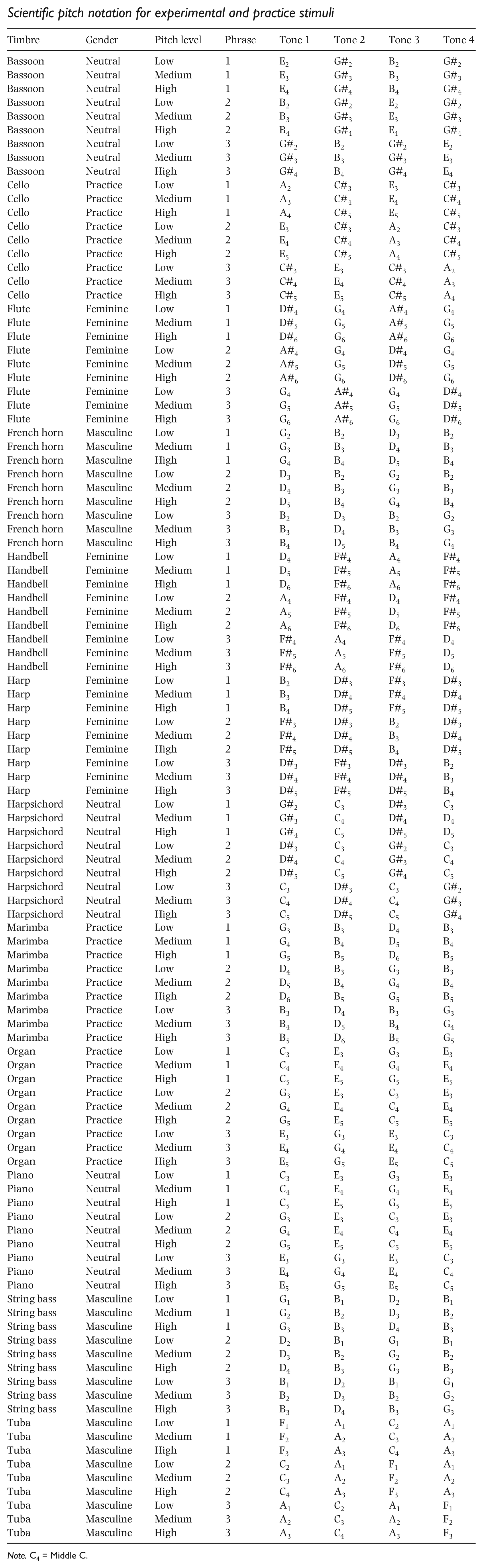
| Timbre | Gender | Pitch level | Phrase | Tone 1 | Tone 2 | Tone 3 | Tone 4 |
|---|---|---|---|---|---|---|---|
| Bassoon | Neutral | Low | 1 | E2 | G#2 | B2 | G#2 |
| Bassoon | Neutral | Medium | 1 | E3 | G#3 | B3 | G#3 |
| Bassoon | Neutral | High | 1 | E4 | G#4 | B4 | G#4 |
| Bassoon | Neutral | Low | 2 | B2 | G#2 | E2 | G#2 |
| Bassoon | Neutral | Medium | 2 | B3 | G#3 | E3 | G#3 |
| Bassoon | Neutral | High | 2 | B4 | G#4 | E4 | G#4 |
| Bassoon | Neutral | Low | 3 | G#2 | B2 | G#2 | E2 |
| Bassoon | Neutral | Medium | 3 | G#3 | B3 | G#3 | E3 |
| Bassoon | Neutral | High | 3 | G#4 | B4 | G#4 | E4 |
| Cello | Practice | Low | 1 | A2 | C#3 | E3 | C#3 |
| Cello | Practice | Medium | 1 | A3 | C#4 | E4 | C#4 |
| Cello | Practice | High | 1 | A4 | C#5 | E5 | C#5 |
| Cello | Practice | Low | 2 | E3 | C#3 | A2 | C#3 |
| Cello | Practice | Medium | 2 | E4 | C#4 | A3 | C#4 |
| Cello | Practice | High | 2 | E5 | C#5 | A4 | C#5 |
| Cello | Practice | Low | 3 | C#3 | E3 | C#3 | A2 |
| Cello | Practice | Medium | 3 | C#4 | E4 | C#4 | A3 |
| Cello | Practice | High | 3 | C#5 | E5 | C#5 | A4 |
| Flute | Feminine | Low | 1 | D#4 | G4 | A#4 | G4 |
| Flute | Feminine | Medium | 1 | D#5 | G5 | A#5 | G5 |
| Flute | Feminine | High | 1 | D#6 | G6 | A#6 | G6 |
| Flute | Feminine | Low | 2 | A#4 | G4 | D#4 | G4 |
| Flute | Feminine | Medium | 2 | A#5 | G5 | D#5 | G5 |
| Flute | Feminine | High | 2 | A#6 | G6 | D#6 | G6 |
| Flute | Feminine | Low | 3 | G4 | A#4 | G4 | D#4 |
| Flute | Feminine | Medium | 3 | G5 | A#5 | G5 | D#5 |
| Flute | Feminine | High | 3 | G6 | A#6 | G6 | D#6 |
| French horn | Masculine | Low | 1 | G2 | B2 | D3 | B2 |
| French horn | Masculine | Medium | 1 | G3 | B3 | D4 | B3 |
| French horn | Masculine | High | 1 | G4 | B4 | D5 | B4 |
| French horn | Masculine | Low | 2 | D3 | B2 | G2 | B2 |
| French horn | Masculine | Medium | 2 | D4 | B3 | G3 | B3 |
| French horn | Masculine | High | 2 | D5 | B4 | G4 | B4 |
| French horn | Masculine | Low | 3 | B2 | D3 | B2 | G2 |
| French horn | Masculine | Medium | 3 | B3 | D4 | B3 | G3 |
| French horn | Masculine | High | 3 | B4 | D5 | B4 | G4 |
| Handbell | Feminine | Low | 1 | D4 | F#4 | A4 | F#4 |
| Handbell | Feminine | Medium | 1 | D5 | F#5 | A5 | F#5 |
| Handbell | Feminine | High | 1 | D6 | F#6 | A6 | F#6 |
| Handbell | Feminine | Low | 2 | A4 | F#4 | D4 | F#4 |
| Handbell | Feminine | Medium | 2 | A5 | F#5 | D5 | F#5 |
| Handbell | Feminine | High | 2 | A6 | F#6 | D6 | F#6 |
| Handbell | Feminine | Low | 3 | F#4 | A4 | F#4 | D4 |
| Handbell | Feminine | Medium | 3 | F#5 | A5 | F#5 | D5 |
| Handbell | Feminine | High | 3 | F#6 | A6 | F#6 | D6 |
| Harp | Feminine | Low | 1 | B2 | D#3 | F#3 | D#3 |
| Harp | Feminine | Medium | 1 | B3 | D#4 | F#4 | D#4 |
| Harp | Feminine | High | 1 | B4 | D#5 | F#5 | D#5 |
| Harp | Feminine | Low | 2 | F#3 | D#3 | B2 | D#3 |
| Harp | Feminine | Medium | 2 | F#4 | D#4 | B3 | D#4 |
| Harp | Feminine | High | 2 | F#5 | D#5 | B4 | D#5 |
| Harp | Feminine | Low | 3 | D#3 | F#3 | D#3 | B2 |
| Harp | Feminine | Medium | 3 | D#4 | F#4 | D#4 | B3 |
| Harp | Feminine | High | 3 | D#5 | F#5 | D#5 | B4 |
| Harpsichord | Neutral | Low | 1 | G#2 | C3 | D#3 | C3 |
| Harpsichord | Neutral | Medium | 1 | G#3 | C4 | D#4 | D4 |
| Harpsichord | Neutral | High | 1 | G#4 | C5 | D#5 | D5 |
| Harpsichord | Neutral | Low | 2 | D#3 | C3 | G#2 | C3 |
| Harpsichord | Neutral | Medium | 2 | D#4 | C4 | G#3 | C4 |
| Harpsichord | Neutral | High | 2 | D#5 | C5 | G#4 | C5 |
| Harpsichord | Neutral | Low | 3 | C3 | D#3 | C3 | G#2 |
| Harpsichord | Neutral | Medium | 3 | C4 | D#4 | C4 | G#3 |
| Harpsichord | Neutral | High | 3 | C5 | D#5 | C5 | G#4 |
| Marimba | Practice | Low | 1 | G3 | B3 | D4 | B3 |
| Marimba | Practice | Medium | 1 | G4 | B4 | D5 | B4 |
| Marimba | Practice | High | 1 | G5 | B5 | D6 | B5 |
| Marimba | Practice | Low | 2 | D4 | B3 | G3 | B3 |
| Marimba | Practice | Medium | 2 | D5 | B4 | G4 | B4 |
| Marimba | Practice | High | 2 | D6 | B5 | G5 | B5 |
| Marimba | Practice | Low | 3 | B3 | D4 | B3 | G3 |
| Marimba | Practice | Medium | 3 | B4 | D5 | B4 | G4 |
| Marimba | Practice | High | 3 | B5 | D6 | B5 | G5 |
| Organ | Practice | Low | 1 | C3 | E3 | G3 | E3 |
| Organ | Practice | Medium | 1 | C4 | E4 | G4 | E4 |
| Organ | Practice | High | 1 | C5 | E5 | G5 | E5 |
| Organ | Practice | Low | 2 | G3 | E3 | C3 | E3 |
| Organ | Practice | Medium | 2 | G4 | E4 | C4 | E4 |
| Organ | Practice | High | 2 | G5 | E5 | C5 | E5 |
| Organ | Practice | Low | 3 | E3 | G3 | E3 | C3 |
| Organ | Practice | Medium | 3 | E4 | G4 | E4 | C4 |
| Organ | Practice | High | 3 | E5 | G5 | E5 | C5 |
| Piano | Neutral | Low | 1 | C3 | E3 | G3 | E3 |
| Piano | Neutral | Medium | 1 | C4 | E4 | G4 | E4 |
| Piano | Neutral | High | 1 | C5 | E5 | G5 | E5 |
| Piano | Neutral | Low | 2 | G3 | E3 | C3 | E3 |
| Piano | Neutral | Medium | 2 | G4 | E4 | C4 | E4 |
| Piano | Neutral | High | 2 | G5 | E5 | C5 | E5 |
| Piano | Neutral | Low | 3 | E3 | G3 | E3 | C3 |
| Piano | Neutral | Medium | 3 | E4 | G4 | E4 | C4 |
| Piano | Neutral | High | 3 | E5 | G5 | E5 | C5 |
| String bass | Masculine | Low | 1 | G1 | B1 | D2 | B1 |
| String bass | Masculine | Medium | 1 | G2 | B2 | D3 | B2 |
| String bass | Masculine | High | 1 | G3 | B3 | D4 | B3 |
| String bass | Masculine | Low | 2 | D2 | B1 | G1 | B1 |
| String bass | Masculine | Medium | 2 | D3 | B2 | G2 | B2 |
| String bass | Masculine | High | 2 | D4 | B3 | G3 | B3 |
| String bass | Masculine | Low | 3 | B1 | D2 | B1 | G1 |
| String bass | Masculine | Medium | 3 | B2 | D3 | B2 | G2 |
| String bass | Masculine | High | 3 | B3 | D4 | B3 | G3 |
| Tuba | Masculine | Low | 1 | F1 | A1 | C2 | A1 |
| Tuba | Masculine | Medium | 1 | F2 | A2 | C3 | A2 |
| Tuba | Masculine | High | 1 | F3 | A3 | C4 | A3 |
| Tuba | Masculine | Low | 2 | C2 | A1 | F1 | A1 |
| Tuba | Masculine | Medium | 2 | C3 | A2 | F2 | A2 |
| Tuba | Masculine | High | 2 | C4 | A3 | F3 | A3 |
| Tuba | Masculine | Low | 3 | A1 | C2 | A1 | F1 |
| Tuba | Masculine | Medium | 3 | A2 | C3 | A2 | F2 |
| Tuba | Masculine | High | 3 | A3 | C4 | A3 | F3 |
Note. C4 = Middle C.
Appendix B
Appendix C
Acknowledgements
We wish to thank Dr. Albert F. Smith for his guidance as part of Lisa M. Stronsick’s Honor’s thesis committee. Conor T. McLennan served as chair.
Authors’ note
This work represents portions of Lisa M. Stronsick’s Honors thesis.
Funding
The author(s) received no financial support for the research, authorship, and/or publication of this article.