



Abstract
In this study, the role of physical contact between teachers and students in the process of teaching guitar was investigated in the master class context. Thirty-five videotaped guitar master classes were classified into five groups according to student performance level. The musical topics studied in these classes were categorised, and all moments of physical contact between teachers and students were identified. Analyses of variance and non-parametric tests were used to determine the relationship between use of physical contact as a teaching approach and student gender, student performance level, the teacher giving the lesson, and topic presented by the teacher. The results indicated that physical contact was significantly related to the teacher giving the lesson and to guitar performance topics of “nails”, “muscle relaxation”, and “body posture”. However, of these three topics, only “body posture” was significantly related to students’ performance level. Ultimately, the results suggest that the topic presented by the teacher is helpful in determining the gestural behaviour of teachers in a musical instrument class.
Researchers generally agree on the importance of performers’ gestures in communicating musical intentions (for a review, see Palmer, 2013). Communication of intentions is also tied to the gestural behaviours that occur within the complex interaction between teachers and students in instrumental music classes (Ivaldi, 2016; Zhukov, 2012). In particular, teachers’ gestural behaviours may, among other things, complement the verbal information they provide (Woody, 2002, 2006) and can be adapted to students’ individual needs (Simones, Rodger, & Schroeder, 2015). Thus, studying teachers’ gestural behaviours, including physical contact between teachers and students, is important for a deeper understanding of these complex interactions.
Of the various gestural behaviours in instrumental music classes investigated previously, physical contact between teachers and students calls for special attention for three reasons. First, individuals tend to be extremely sensitive to being touched (Levasseur, 1994, as cited in Kurkul, 2007); thus, the success of a class may partly depend on teachers’ understanding of the limits of physical contact with their students as a teaching approach.
Second, physical contact “appears to provide a platform for teaching the essential haptic contact required to play a musical instrument, in addition to being a form in itself of establishing communication with others and developing musical communication” (Simones, Rodger, & Schroeder, 2015, p. 731). This is evident in the various transcriptions of musical instrument classes described in scientific literature, where physical contact seems to be employed to meet some students’ proprioceptive needs (Küpers, van Dijk, & van Geert, 2014; Küpers, van Dijk, van Geert, & McPherson, 2015). However, more evidence is needed to understand how physical contact can help improve students’ auditory perception. Finally, physical contact has, among all teaching approaches, suffered the greatest impact from the growing use of virtual technologies for teaching musical instruments (Lancaster, 2008), such as online lessons delivered via Skype. The impossibility of physical contact as a teaching approach in such situations raises questions that remain unanswered by the literature. As such, this study aims to improve scientific knowledge on the role of physical contact in the teaching of musical instruments, using the guitar master class context.
Guitar master classes organised by institutions promoting music events for pedagogical purposes appeared most suitable for the purposes of this study due to the absence of teacher–student familiarity. Because touch can help develop positive relationships (McHugh-Grifa, 2011), guitar master classes offer an opportunity to better illustrate the importance of physical contact compared to contexts where a relation between the teacher and student has already been established. Guitar master classes herein are defined as pedagogical events in the presence of an audience where experienced guitarists teach students the guitar and where the teacher and student do not maintain regular contact either before or after the class (Creech, Gaunt, Hallam, & Robertson, 2009; Long, Creech, Gaunt, & Hallam, 2014; Long, Creech, Gaunt, Hallam, & Robertson, 2012; Long, Hallam, Creech, Gaunt, & Robertson, 2012).
Research question and hypotheses
The following question was formulated based on the above background: How does physical contact between teachers and students play a role in the teaching process in a guitar master class context?
To guide the investigation, four hypotheses were proposed. The first hypothesis states that students’ performance level influences teacher–student physical contact time. This was based on evidence that “the teacher has to match their strategies not only to the knowledge to be gained, but also to the stage of learning that the pupil has reached” (Young, Burwell, & Pickup, 2003, p. 146). Furthermore, there is “a tendency of higher gestural production of certain gesture types for certain student proficiency levels” (Simones, Rodger, & Schroeder, 2015, p. 732), suggesting that physical contact as a teaching approach may relate to students’ performance level.
The second hypothesis states that there is an effect of students’ gender on teacher–student physical contact time. This was based on the results of previous investigations showing that male and female students differ somewhat in their perspectives on master classes (Long, Creech, et al., 2012; Long, Hallam, et al., 2012), with female students (who generally have more experience as listeners) being more likely to report that master classes have an unfriendly and intimidating atmosphere (Long et al., 2014).
The third hypothesis states that the teacher giving the lesson can influence teacher–student physical contact time. There may be differences in teachers’ gestural behaviours according to their teaching style, with some teachers using physical contact recurrently during their lessons, and others not using it at all. Generally, teaching style differences are outlined in terms of frequencies of various categorical variables through qualitative observations (Kurkul, 2007; Simones, Rodger, & Schroeder, 2015).
Finally, the fourth hypothesis states that the topics presented by the teacher can influence teacher–student physical contact time. Certain gestural behaviours appear to be related to some topics presented by the teacher in the one-to-one context. For instance, Simones, Schroeder, and Rodger’s (2015) experimental investigation of three female piano teachers showed that physical contact is a gestural behaviour related to the teacher’s didactic intention.
Method
Data collection procedures
Before data collection, the researchers sought the consent of the institution that organised each music event offering master classes as well as permission from both teachers and students for the classes to be recorded. All those involved were informed in advance that the study objective was to investigate teaching strategies used in musical instrument classes. Verbal guarantee of their anonymity was provided.
The study was conducted at eight music events offering guitar master classes in 2013–2015, located across Brazil (two in the south, three in the southeast, one in the central-western region, and two in the northeast). It is important to note that as of the publication of this article, the researchers were aware that Brazil had no legislation about the use of physical contact in educational settings, unlike some Western countries.
In total, 47 guitar master classes were recorded using a high-fidelity Sony camera, always positioned near the audience who were watching the classes, yielding nearly 30 hours of analysis material. To complement the data collection, matriculation records of students attending the music events were obtained and notes were written about important events that occurred during the master class recording sessions (e.g., events that interfered with the lesson but were not caught by the camera).
Data analysis
Classification of student performance level
Student performance ability in the master classes was classified by five guitar teachers into five levels: basic (level 1), basic/intermediate (level 2), intermediate (level 3), intermediate/advanced (level 4), and advanced (level 5). These teachers participated solely in this study phase and had no relationship to the master class teachers.
The classification procedure was as follows. The five teachers were called into the same room and asked not to talk with each other, after which a random sequence of excerpts from the first 10 seconds of students’ performances in each of the 47 master classes was presented. The teachers were instructed not to take any notes on students’ performances. The goal of this phase was to provide an initial overview to help determine possible limits between strata for later classification.
After a brief recess, another random sequence of excerpts was presented to teachers. However, this time the excerpts contained the first 30 seconds of students’ performances. Teachers were instructed to classify them according to the five levels. Cases that received at least three identical evaluations were considered to belong to a given performance level and were included in the analysis. The researchers then attempted to maximize the number of master classes for each level while ensuring that all levels had an equal number of cases (e.g., the first level had two other master classes that satisfied the condition of receiving at least three identical evaluations, but the other levels did not satisfy this condition; therefore, those two master classes were not considered). This resulted in seven master classes for each level (35 in total). General information on the material selected is shown in Table 1.
General information on the master classes for each performance level.

Note. Duration expressed in hours:minutes:seconds.
Participant characteristics
The master classes considered for analysis involved eight teachers, all of whom were male. According to their biographies, these teachers had extensive careers as international performers and vast experience teaching guitar. Their ages varied from 34 to 60 years.
The master classes also included 35 students, 27 were male and 8 were female. Their ages ranged from 17 to 56 years, and students came from 12 different Brazilian states, ensuring a sample with a wide regional distribution. Students’ gender and mean age according to their performance level are presented in Table 2.
Characteristics of the students at each performance level.
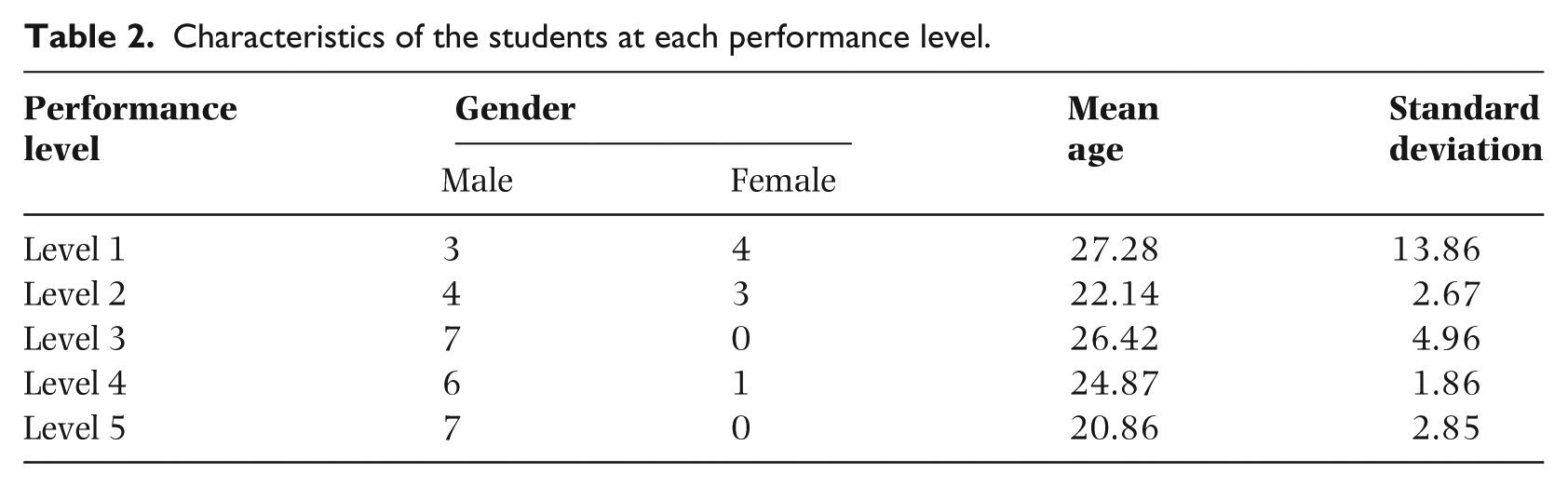
One observation concerning students’ characteristics is important to note. In Brazil, guitars are predominantly considered masculine musical instruments. As such, the low female participation rate observed for the analysed master classes is unsurprising. There are likely cultural and historical reasons for this finding, but such discussion is beyond the scope of this study. Notwithstanding, two arguments support the claim that gender may not have led to biased results. First, previous studies on teachers’ non-verbal cues in relation to student gender have shown that “male teachers seemed to have a similar approach to both student genders” (Zhukov, 2012, p. 474). Given that all teachers were male, there is empirical support to suggest that students’ gender would not interfere in teachers’ teaching approach. Second, there was a balanced number of students of both genders at levels 1 and 2. Thus, possible differences in the teaching approaches adopted in relation to the student’s gender could be detected at these two levels.
Theoretical framework for classifying topics of master classes
Music theory literature suggests that musical performances can be evaluated on two broad dimensions: technical and expressive (Davidson, Howe, & Sloboda, 1998; Gabrielsson, 1999; Sloboda & Davidson, 1996). The technical dimension includes aspects related to posture, relaxation, sound production and projection, body coordination, mechanical fluency, aural awareness, facility in executing rhythms, articulations, ornamentations, variations of dynamics, and timing, as well as the degree of influence that a mistake exerts on the final performance. The expressive dimension relates to the interpretation of the work, including selection of tempo, phrase modelling, dynamic nuances, and understanding of the piece’s structure; understanding of the style and genre; faithful reading of the musical text; and exploration of the intentions expressed by the composer. Other musical competencies include the player’s comprehension of the emotional nature and projection of the mood of the work; sensitivity to the relationship between the parts and the texture of the piece; the degree to which the performer captures the audience’s attention; the assuredness of a convincing and resolute performance; and the ability to critically assess their own and others’ performances (Juslin & Sloboda, 2013; McPherson & Schubert, 2004; and see the document entitled Instrumental Teaching and Learning in Context, prepared by the Music Advisors’ National Association, Young et al., 2003, p. 155).
Additionally, studies have discussed the role of teachers in developing metacognitive strategies for promoting autonomy among students (Jorgensen, 2000). This roster of strategies involves, for example, concepts related to self-teaching (Jorgensen, 2004), self-regulation (Leon-Guerrero, 2008), self-awareness (Hallam, 2001), and self-evaluation (Chaffin & Lemieux, 2004). Focusing on the acquisition of metacognitive strategies may be suitable for the one-to-one context, since such strategies target skills such as concentration, memory, and creativity during the process of planning the practical activity and in monitoring and evaluating the learning (Barry & Hallam, 2002).
Along with helping to develop students’ skills in their musical instrument, the master class carries with it the tradition of a community of musical practice personified in a musician of acknowledged competence (Creech et al., 2009; Long, Creech, et al., 2012; Long, Hallam, et al. 2012). Thus, the discourse of the musician in master classes is guided by an initial evaluation of the student’s level and is replete with experience earned over an extensive career. In general, these experiences are backed by primary and secondary theoretical-musical references that complement their understanding of the musical text presented by the student. Such references may consider images of the context in which the work was composed; consultations to other possible versions of the work; recordings of various interpreters of the work performed by the student; recordings of works with a similar musical style; and use of bibliographic material, such as articles and books (Haddon, 2014).
Based on the above theory, five categories were defined in determining the topics of the guitar master classes, as follows:
Musical technique;
Interpretation of the musical text;
Communication of musical expression;
Metacognitive development of the student;
Complementary theoretical-musical references.
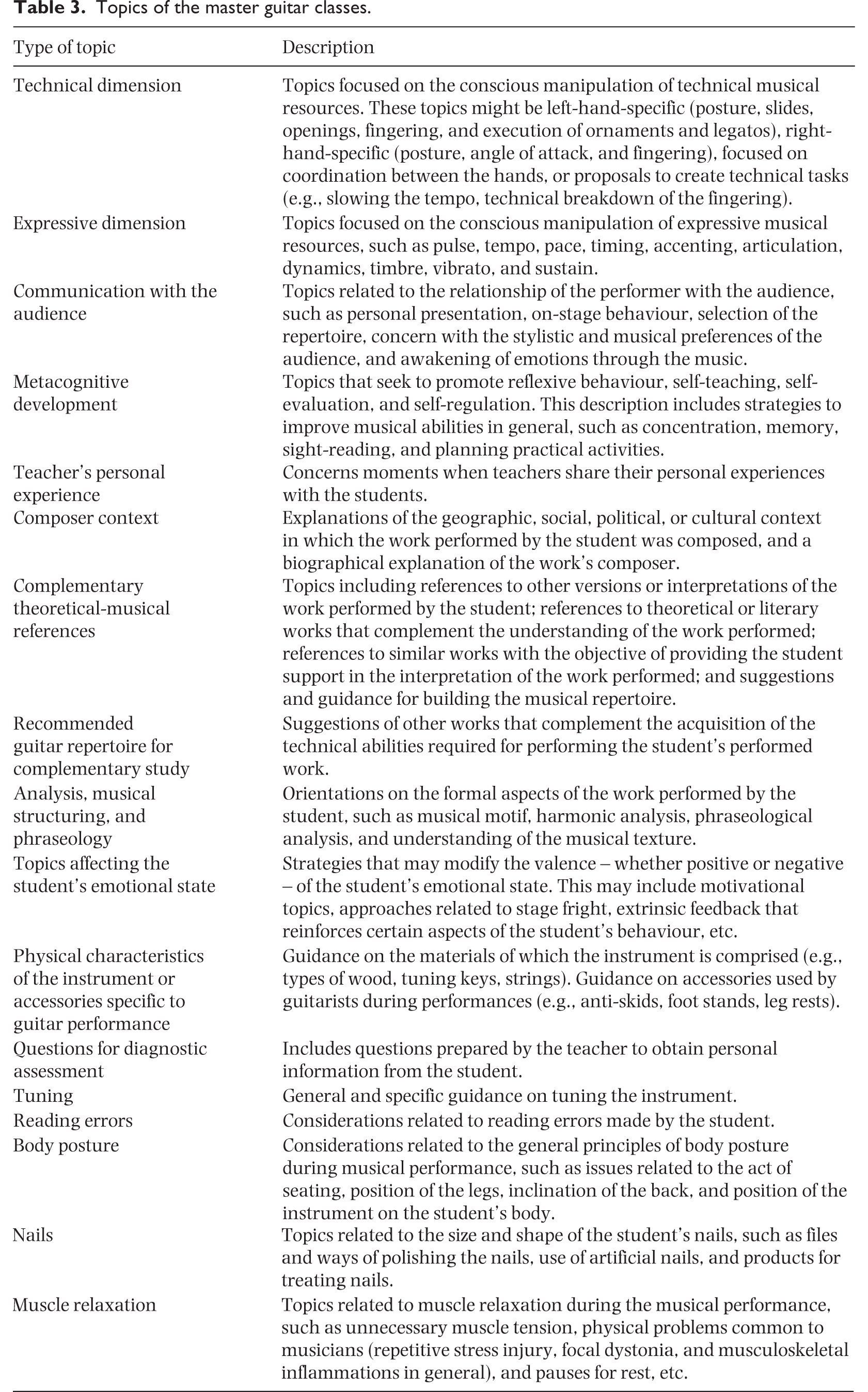
Using these content categories, a group of three university music professors collectively analysed five master classes selected randomly from the 12 in the classification of student performance levels in a pilot study. This pilot study aimed to precisely identify topics presented by the teachers and prepare descriptions of these topics. This material was analysed and validated by an independent research group in Music Education. Based on their recommendations, modifications were made. The results of the topic classification are detailed in Table 3.
Topics of the master guitar classes.
Categorisation of topics and physical contact in the master classes
The recorded content of the 47 master classes was transcribed shortly after data collection. The same group of three professors who prepared the topic categories helped categorise the 35 master classes used as study objects. Group members worked independently and the categorisations were performed using the NVivo 10 program.
Overlapping topic categories were considered permissible, even before beginning the process of establishing the categories. This was because it is difficult to clearly delineate musical competencies and teaching strategies typically used in the evaluation or teaching of performance (Daniel, 2006; McPherson & Schubert, 2004). In other words, a teacher could easily focus on two or more different topics simultaneously.
Kappa coefficients (measures of agreement between the professors) for the categorisations were satisfactory (k > .51) for all topic categories but communication with the audience, teacher’s personal experience, composer context, and topics affecting the student’s emotional state; these all had coefficients of < .43, and were therefore excluded.
After categorising the topics, the researchers identified instances of teacher–student physical contact in the master class videos. Thereafter, the duration of this contact was measured, and its occurrence was cross-referenced with the topic category.
Statistical analysis
The duration of physical contact between the teacher and student in each master class was presented in terms of percentages of the total duration of the respective lesson. All quantitative data were analysed using the software program GraphPad Prism.
Results
Figure 1 shows the mean percentage and variability of physical contact occurred between teachers and students in the master classes, according to student performance level (horizontal lines within and outside the box-plot represent the mean and extreme values, i.e., maximum and minimum). Level-1 students were the only group where all students had some form of physical contact with the teacher. Furthermore, although the mean percentage of physical contact was close between the levels, there was high variability within each group.
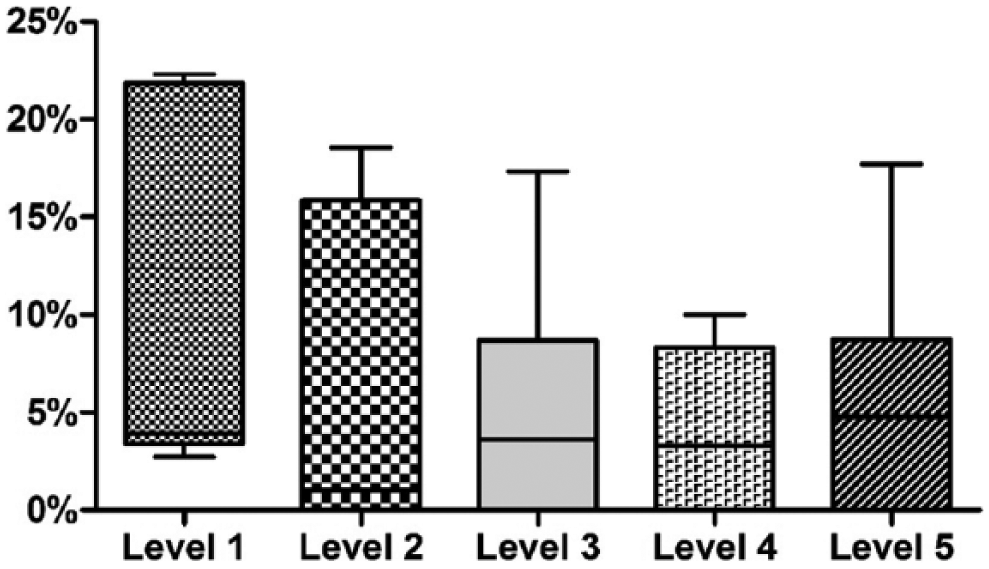
Mean percentage and variability in use of physical contact as a teaching approach by student performance level.
An analysis of variance (ANOVA), using Tukey’s range test for post hoc analysis, confirmed the observed pattern in Figure 1: the mean percentage of physical contact did not differ by performance level, F(4, 34) = .80, p = .54, η2 = .10. As students’ performance level did not influence physical-contact time, the first hypothesis was rejected.
The researchers then investigated the effect of students’ gender on physical-contact time. A non-parametric t-test showed that physical-contact time did not significantly differ by student gender, F(7, 26) = 1.67, p = .39, η2 = .02. Thus, the second hypothesis was also rejected.
A second ANOVA (paired with Tukey’s range test) was used to test the third hypothesis. The results indicated that there was an effect of the teacher giving the lesson on physical-contact time, F(7, 34) = 6.67, p = .001, η2 = .39. Therefore, the third hypothesis was supported.
Complementing the data analysis, Table 4 below shows the means and standard deviations of the percentages of the duration of the lessons wherein physical contact was used in the development of topic.
Percentages of physical-contact time used by topic.
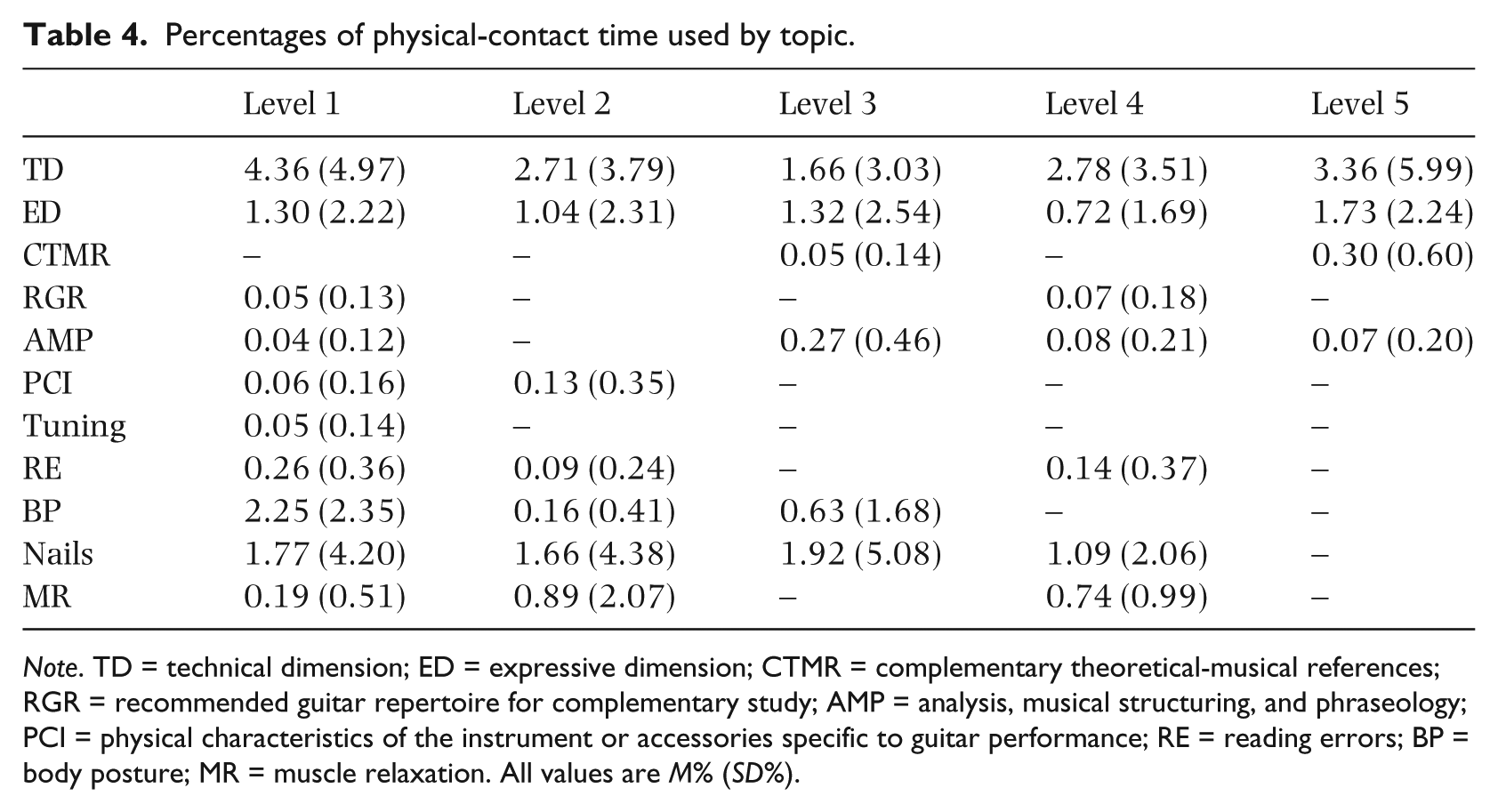
Note. TD = technical dimension; ED = expressive dimension; CTMR = complementary theoretical-musical references; RGR = recommended guitar repertoire for complementary study; AMP = analysis, musical structuring, and phraseology; PCI = physical characteristics of the instrument or accessories specific to guitar performance; RE = reading errors; BP = body posture; MR = muscle relaxation. All values are M% (SD%).
Based on this information, the researchers calculated Pearson correlations between the duration percentage of each topic’s discussion during the master classes and the duration percentage for when physical contact occurred in each topic’s discussion. As shown in Table 5, only the body posture, nails, and muscle relaxation topics showed significant correlations with teacher–student physical contact. In other words, the more the teacher worked on these three topics in the master classes, the more often he used physical contact with the student as a teaching approach.
Correlations between topics discussed by the teacher and physical contact as a teaching approach.
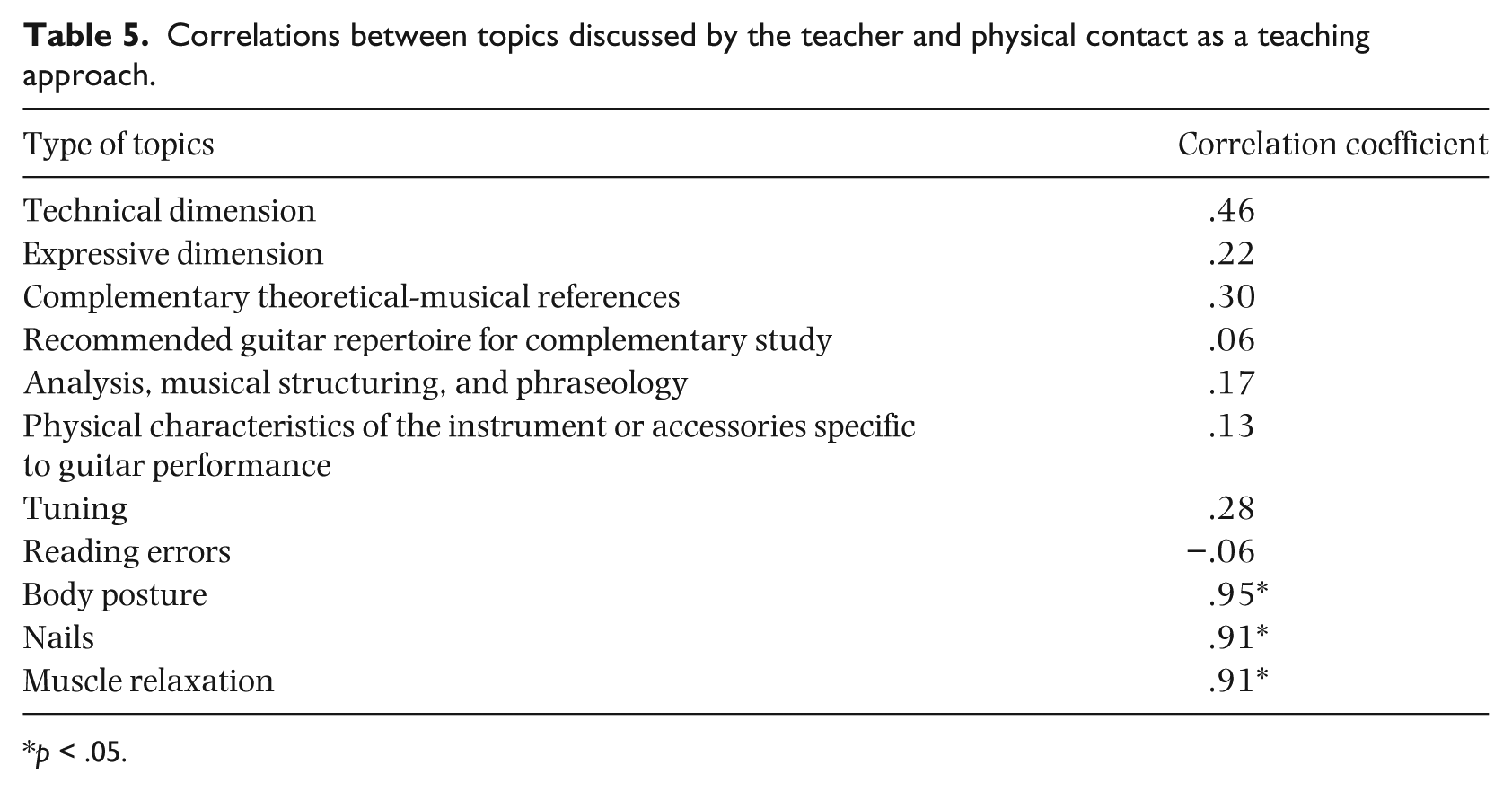
p < .05.
Given these data, additional ANOVAs (with Tukey’s range test) were used to determine whether the teacher’s use of physical contact as a teaching approach differed by student performance levels when discussing these three topics. The results indicated that when the teacher discussed “nails”, F(4, 34) = .32, p = .86, η2 = .04, and “muscle relaxation”, F(4, 34) = 1.12, p = .36, η2 = .12, physical contact did not differ by student performance level. However, when the “body posture” topic was discussed, F(4, 34) = 3.75, p = .01, η2 = .33, physical contact with level-1 students differed significantly from that with level-2, -4, and -5 students.
Some explanations are necessary to clarify the above results. Physical contact was used often when body posture was being discussed in five of the seven level-1 master classes (three male students and two female students). For level-2 students, this topic was discussed in only two master classes (two female students), and physical contact occurred considerably less often. Similarly, body posture was not discussed in any of the master classes with level-4 and -5 students.
Interestingly, students in level 3 showed atypical behaviour, probably because body posture was discussed in only one master class, wherein the theme dominated nearly half of the class and physical contact was exceedingly frequent. This likely occurred because the student supported the guitar on the right leg, whereas traditionally, the guitar is supported on the left leg. This helps explain why the results for level 3 did not significantly differ from that of other levels. Figure 2 graphically organises these results.
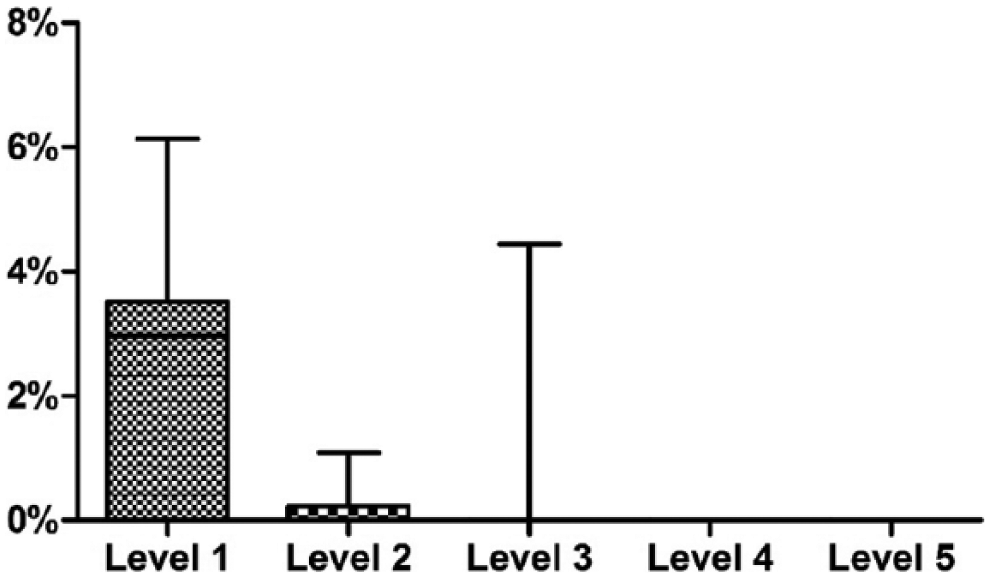
Mean percentages and variability in the use of physical contact as a teaching approach for the development of the “body posture” topic by student performance level.
Discussion
The objective of this study was to deepen scientific knowledge of the role of physical contact as a teaching approach in guitar master classes. Notably, no significant differences in the use of physical contact as a teaching approach between male and female students were found. All teachers in this study were male, and one (still inconclusive) finding has indicated that men tend to be less efficient in interpreting non-verbal behaviours, which may prompt them to engage in non-verbal behaviours more frequently when interacting with the opposite sex (Zhukov, 2012). However, Long and colleagues (Long et al., 2014; Long, Creech, et al., 2012; Long, Hallam, et al., 2012) also noted that male and female students differ somewhat in their perspectives on public master classes for musical instruments. Additionally, teachers’ non-verbal behaviours may negatively or positively influence students’ perception of the effectiveness of the class (Kurkul, 2007). Therefore, there is room for replication of this study with greater focus on the teacher’s and student’s gender. Furthermore, it may be helpful to verify possible differences in physical contact strictly from the student’s point of view.
There were also no significant statistical differences in the use of physical contact by student performance level. This result contrasts that of Simones, Rodger, and Schroeder (2015). One likely explanation concerns the methodological differences between the two studies. Simones, Rodger, and Schroeder (2015) investigated regular classes for piano students, with ages and proficiency levels lower than those of the students from this study sample. It is possible that these differences led to the contrasting results, which suggests that there is an intervening variable influencing the relationship between teacher’s physical contact and student’s performance level. This will be discussed further below.
Conversely, there were significant differences in the use of physical contact as a teaching approach according to the teacher giving the lesson. This indicates that the frequency and duration with which the teacher uses physical contact as a teaching approach can depend on the way in which the teacher approaches the student’s performance problems. In the sample, the researchers perceived that some teachers opted to keep a physical distance from their students. Others, however, were used to demonstrating expressive intentions by playing the student’s instrument or clearly preferred resolving technical problems by touching the student’s body.
Based on the above results, there is a need to differentiate the types of physical contact that may occur between teachers and students in guitar master classes. The observations in this study indicate that physical contact can be classified as direct or indirect.
Direct physical contact occurs when the student’s body receives and perceives contact with the teacher’s body, generally the teacher’s hands. This type of contact might be continuous (i.e., lasting for a few seconds) or discrete (i.e., instantaneous). In objective terms, direct physical contact was employed to maintain or call the student’s attention to technical, muscular, or postural issues, or the size and shape of their fingernails. Simones, Schroeder, and Rodger (2015) identified similar functions, with the caveat that their study was performed with three piano teachers and reflected the specific technical characteristics of this instrument. Generally, direct physical contact might serve as a teaching approach to meet the student’s proprioceptive, or kinaesthetic, needs. Citing a master class by cellist Mistslav Rostropovitch, Galvão and Kemp (1999, pp. 129–130) offer a clear example of this.
Indirect physical contact occurs when the student’s body perceives physical contact with the teacher through the guitar. This type of contact allowed the teacher to demonstrate issues that were expressive in nature on the student’s own guitar, or to prompt the student to experiment with the expressive characteristic of the teacher’s guitar. Through indirect contact, the teacher can empirically work on the complex reactions between the sensory dimensions of intensity, duration, height, and timbre. Considerable evidence suggests expressive music intention can affect these sensory dimensions (Juslin & Timmers, 2011); therefore, indirect physical contact may potentially improve students’ aural awareness and knowledge relating to emotional expression during musical performance. The excerpt below illustrates a moment where this type of contact occurred.
Your sound is too superficial. This here has to have sound, the melody has to appear, the chords, the harmonies have to be clear. This is the first difference between a good guitarist and a guy who still hasn’t made it into the profession. Every great guitarist takes your guitar and extracts a sound you’ve never heard before. And then you’re impressed. And you think it’s not possible, that you must be getting the note wrong, and it’s not that. It’s that the guy extracts all the harmonics, the entire harmony, from each note of the harmony. It sounds like an altogether different harmony. And so you have to think about not being so superficial. (Extracted from a transcript of one of the master classes of this study).
The results also indicate that guitar-teaching methodologies might especially consider students’ understanding of the topics necessary for the development of guitar performance. Disregarding student performance level, physical contact as a teaching approach was strongly correlated to topics of nails and muscle relaxation. When considering only the lower performance levels, physical contact was strongly associated with the body posture topic. Thus, the data from this study indicate that body posture is a topic that requires special support through physical contact, especially for students beginning to learn the guitar. These results concord with those of Simones, Schroeder, and Rodger (2015), who identified a strong association between teacher–student physical contact and body posture modelling among beginner students of piano. Similarly, these results are consistent with those of Long, Hallam, et al. (2012), who found that master classes are best administered carefully to students in the early years of their undergraduate degree. Overall, the data suggest that some of the topics presented by the teacher (e.g., body posture) served as intervening variables in the relationship between teacher’s physical contact and student’s performance level. For example, students in the lower performance levels may be required to focus on specific topics, which, in turn, are delivered by teachers with more frequent use of physical contact as a teaching approach.
Consistent with previous studies, the present results suggest that teaching methodologies that make physical contact an impossible approach for teachers (e.g., virtual teaching) should first analyse the following, regardless of gender or student performance level: (a) the learning style and individual needs of the student (Creech et al., 2009; Long, Creech, et al., 2012; Long, Hallam, et al. 2012; Nielsen, 1999); (b) the teacher’s way of approaching students’ problems (Burwell, 2005, 2006; Kurkul, 2007; Nerland, 2007; Presland, 2005); and (c) the type of interaction (Ivaldi, 2016; Zhukov, 2012) that may be compromised with the absence of teacher–student physical contact.
Conclusions
The results suggest that physical contact as a teaching approach plays a role in the teaching of certain topics inherent to learning to play the guitar, including body posture. Additionally, they indicate that physical contact depends on the way in which the teacher approaches the student’s performance problems. In some situations, such problems can be tackled by teachers through direct physical contact, to meet the student’s proprioceptive needs, or indirect physical contact, to stimulate the student’s auditory perception.
However, before the results can be considered conclusive, at least three conditions must be met. First, this study must be replicated in different contexts of musical instrument instruction, including regular one-to-one teaching in conservatories and music schools, group teaching, etc. Second, these findings should be tested for different musical instruments, as each instrument has execution particularities that may in part determine the teacher’s gestural behaviour. For example, teaching stationary instruments, such as the piano or drums, may require certain approaches from the teacher to develop body posture that differ from approaches aimed at the development of this same topic during teaching of non-stationary instruments, such as the clarinet or violin. Third, there could be greater variety in the characteristics of the study subjects; in particular, a replication of this study might propose additional stratifications in the initial levels of student performance and investigate the gestural behaviour of female teachers.
Furthermore, a deeper conceptual discussion on teacher–student physical contact in a musical instrument class is necessary. While research commonly attributes the term touch to physical contact, the concept of touch suggests a direct and unidirectional action from the teacher to the student, which appears to simplify the rather complex physical interaction that may occur between them in a musical instrument class.
Finally, future research could examine teaching methodologies for musical instruments that do not allow for teacher–student physical contact as a teaching approach. Further, while technological advances have increasingly made remote learning accessible, the consequences of physical distancing in teaching musical instruments should be investigated.
Footnotes
Acknowledgements
The authors express their immense gratitude to the participants of this study (teachers and students), and to Dr Heinz-Hermann Krüger and Dr Cristina Tourinho for their support.
Funding
The author(s) disclosed receipt of the following financial support for the research, authorship, and/or publication of this article: This study received funding from the following Brazilian financing agencies: the National Council for Scientific and Technological Development (CNPq) and the Maranhão Support Foundation for Research and Technological and Scientific Development (FAPEMA).