



Abstract
There is a growing body of literature that recognises how music perception affects first-language learning, but much less is known about its influence on foreign-language reading skills. The purpose of this paper is to examine the effect of music perception abilities on the acquisition of some foreign early reading skills based on their transference from first language. Data for this study were collected from 63 Spanish-speaking English-language learners studying second grade of primary school. We used a music perception test and the Early Grade Reading Assessment battery, which measures early reading skills in both languages. A mediation analysis using structural equation modelling was performed, integrating music perception and letter-sound knowledge, initial sound identification, and familiar word and pseudoword reading in Spanish and English. This research provides new insights into how music perception affects early reading skills in both languages. These findings indicate a transfer of music perception abilities to first-language alphabetic principle, phonemic awareness and word recognition skills that affect foreign language early reading abilities.
Keywords
Music aptitude is understood in this study to be the individual’s ability to discriminate tonal and rhythmic patterns. This perceptual ability comes from the “richness of musical stimulations in everyday life” (Bigand & Poulin-Charronnat, 2006, p. 101) and can be measured through music perceptual dimensions such as pitch discrimination, intensity–loudness, duration or time, rhythm recognition, musical timbre and musical tempo.
This definition of musical aptitude, although disputable, can be considered to be a continuum between two poles that are not necessarily opposites: the first is acquired skill (Levinson, 1997) and the second is innate talent (Trehub, 2003). As an acquired skill, music aptitude stems from periods of intensive training and practice. As a talent or instinct, it encompasses an individual’s innate giftedness and potential for learning music before formal training (Gordon, 1997; Law & Zentner, 2012). Francès, Zenatti, and Imberty (1979) argue in favour of a 10-year period where musical abilities develop naturally, while Bigand and Poulin-Charronnat (2006) conclude that some musical capacities are acquired by “musically experienced listeners” through exposure to music without explicit musical training. Thus, being a non-musician does not mean that one does not have musicianship or musical ability since musically untrained individuals may possess strong musical skills in the same way that individuals with extensive musical training and expertise do not always reach higher levels of musical competence than those without formal musical training (Law & Zentner, 2012).
Most of the studies that investigate aspects of music perception abilities in relation to language reading compare the performance of musicians or musically trained individuals to that of non-musicians or individuals without music training (Anvari, Trainor, Woodside, & Levy, 2002; Pei, Wu, Xiang, & Qian, 2016). From the language learning perspective, music perception has been described as an individual difference that affects phonological skills (Slevc & Miyake, 2006), probably because language and music both rely on coding auditory input and similar auditory neural mechanisms such as timing, frequency, pitch, intensity, timbre and auditory processing (Besson, Chobert, & Marie, 2011; Patel, 2011).
In this study, auditory perception in relation to musical abilities refers to mainstream language learners’ potential to perceive pitch, rhythm, intensity, duration, timbre and tempo. The main focus of the current study is to observe if young learners’ perceptual ability in discriminating tonal and rhythmic patterns has an influence on their first (L1) and foreign language (FL) phonological and decoding reading skills.
The need for differentiating second language (L2) and FL is due to the context of our study, which focuses on Spanish-speaking students learning English as a foreign language (EFL) in the classroom rather than on those using the L2 within a speech community. Students who participated in this study were not living in bilingual settings where the target language is an L2; for example, populations where the language of instruction is spoken at home or used within the speech community (for instance, Hispanic learners living in the US who are immersed in bilingual programmes and are instructed in both Spanish and English). Students with this natural exposure can more easily acquire the tonal and rhythmic structure of the new language through everyday life stimulation becoming, therefore, “experienced language listeners”. The difference in time of exposure to the English language constitutes a well-documented variable that may cause a difference in learners’ language acquisition process (Dörnyei, 1998).
For participants involved in this study, English was neither their official language nor their communication language, but was used mainly as a language of instruction in a context limited to the English-language classroom. Thus, it is studied as an FL.
Another relevant linguistic issue considered in this paper is the positive relationship between the auditory aspects of speech and the learning-to-read process in an L1 (Melby-Lervåg, Lyster, & Hulme, 2012; Wagner & Torgesen, 1987). Research has shown that phonological awareness predicts reading acquisition (Adams, 1990; Castles & Coltheart, 2004; Goswami & Bryant, 1990) and suggests a cross-linguistic transfer of the alphabetic principle, phonological awareness and word recognition skills across languages (Cárdenas-Hagan, Carlson, & Pollard-Durodola, 2007; Durgunoğlu, Nagy, & Hancin-Bhatt, 1993; Leafstedt & Gerber, 2005).
In conclusion, the current study aims to bring new insights into how music perception affects English and Spanish early reading skills. More specifically, this study addresses whether music perception has an effect on FL early reading skills through its influence on L1. Data have been analysed using structural equation modelling (SEM).
Music perception and language reading skills
Music perception abilities are a powerful aid in learning the sounds of a language (Gordon, Fehd, & McCandliss, 2015; Standley, 2008). Some auditory analysis skills necessary for language and reading processing, such as combining and segmenting sounds, are similar to those skills required for music perception, such as rhythmic, melodic and harmonic discrimination (Anvari et al., 2002; Lamb & Gregory, 1993). In this vein, it has been shown that children who have an accurate ear for music and the potential to discern pitch and rhythm seem to have greater auditory acuity in perceiving the prosodic contours of language. They, thus, obtain better results on L1 word decoding, and phonological and reading tests (Anvari et al., 2002; Zuk, Andrade, Andrade, Gardiner, & Gaab, 2013) than those who have less of a “musician’s advantage” for processing sounds (Kraus & White-Schwoch, 2016). Regarding L2 studies, Slevc and Miyake (2006, p. 675) consider that “being skilled at music means having a ‘good ear’ for perceiving and analysing foreign speech sounds” and show that “individuals who are good at analysing, discriminating, and remembering musical stimuli are better than other people at accurately perceiving and producing L2 sounds” (p. 679). In conclusion, music perception influences auditory perception skills and language phonetic coding, a basic ability for pronunciation and reading.
On the other hand, even though the role of musical training has provided relevant contributions to language reading development in both L1 and L2/FL contexts, it has also brought some controversy into the field. Kempert et al. (2016) demonstrated that adding musical training to an L1 conventional phonological training programme did not contribute more significantly to the development of phonological awareness in 4- to 5-year-old children. Moreno, Lee, Janus, and Bialystok (2015) showed that neither a language nor a music training programme improved the processing of trained L2 sounds in 4- to 6-year-old children. Using a mediation analysis based on SEM, Posedel, Emery, Souza, and Fountain (2012), concluded that in the presence of pitch perception ability the connection between music training and L2 productive phonology was not significant.
As far as FL studies are concerned, Herrera, Lorenzo, Defior, Fernandez-Smith, and Costa-Giomi (2011) pointed out that L1 and FL Spanish-speaking preschoolers who received a phonological training programme without musical input outperformed those with musical training in the phonological awareness and naming speed tests, except for the identification of word ending tasks. Likewise, Fonseca-Mora, Jara-Jimenez, and Gomez-Dominguez (2015) provided evidence that a phonological training programme with and without musical support has significant effects on second-graders’ FL early reading skills. These results may suggest that the relationship between music and language and FL early reading skills depends on variables such as L1 and music perception skills. However, insufficient attention has been paid to the extent to which music perception could have a mediating effect on L1-FL cross-linguistic transfer.
Cross-linguistic transfer in L1-L2 literacy skills
The specific focus on Spanish (L1), a syllable-timed language, and English (FL), a stress-timed language, sets especially high demands on students because both languages differ in letter-sound correspondences and in isochronic features. Since the prosody of speech or reading is dependent on musical elements such as rhythm, frequency and intensity, we suggest that students’ music perception abilities affect learners’ capacity to perceive and produce the sounds and the prosody of English as an FL.
The contribution of some early reading skills, such as phonological processing, alphabetic principle, naming speed and word-decoding abilities in learning to read has been well-established (Hulme & Snowling, 2013; Melby-Lervåg et al., 2012). Based on the phases of reading development for alphabetic languages proposed by Seymour, Aro, and Erskine (2003), learners acquire the knowledge of these basic foundational skills at the first phase of the reading acquisition process. These early reading abilities have been found highly relevant not only for subsequent literacy acquisition and success in the L1, but also for the learning of other languages (Sparks, Patton, Ganschow, & Humbach, 2009). Jongejan, Verhoeven, and Siegel (2007) claim that phonological language skills, lexical access and word recognition are of equal importance for L1 and L2 acquisition since they are considered to be the main processes underlying basic reading.
Among the phonological language skills, phonological and phonemic awareness are considered strong predictors of literacy skills in children learning to read in either an L1 or L2 (Haigh, Savage, Erdos, & Genesee, 2011; Hulme, Snowling, Caravolas, & Carroll, 2005). Phonological awareness refers to the oral manipulation of linguistic sounds on word- and phoneme-levels (Ziegler & Goswami, 2005). Children first develop awareness for larger phonological units, such as syllables, onsets and rimes (e.g. in the word spoil, sp = onset; oil = rime). Later, through instruction, children develop phonemic awareness, which refers to the ability to manipulate phonemes. Thus, phonological awareness is a global term that includes rime and syllable awareness, while phonemic awareness only involves the ability to manipulate phonemes by identifying, isolating and blending them within words.
Cross-linguistic transfer has been observed, with evidence of L1 reading skills functioning as predictors of L2 reading skills (Sparks, Patton, Ganschow, Humbach, & Javorsky, 2008). Thus, some studies show that phonological awareness skills are highly correlated with word-decoding skills across languages (Gottardo, 2002; Lindsey, Manis, & Bailey, 2003), and that deficits in phonemic and phonological language skills in the L1 may slow the development of phonological processing and word-decoding skills in an L2. Cárdenas-Hagan et al. (2007) stated that phonological awareness, letter-name and sound knowledge, are positively related in Spanish and English, emphasising the influence of the language of instruction received and the initial level skills in L1 and L2 on the outcomes of this relationship. Consistent with this, Leafstedt and Gerber (2005) pointed out that phonological awareness is the only phonological processing component predictive of word decoding in L1 and L2. They demonstrated that the language of instruction predicts phonological awareness and familiar word reading both in Spanish and English, but pseudoword decoding was only predicted in Spanish. On the other hand, Durgunoğlu et al. (1993) showed that Spanish speakers who had high phonological awareness and decoding skills were also good word and pseudoword decoders in English as L2. This suggests a phonological awareness and word recognition transfer from Spanish to English reading.
The cross-language transfer of alphabetic principle, phonological awareness and word recognition skills among Spanish-speaking learners of English as an FL is a core issue in our study. Hence, given the evidence for a positive relationship between phonological processing and reading in an L1, and taking into account that L1 reading skills are predictors of L2 reading skills, it could be reasonable to assume that musical abilities could also facilitate the processing of orthographic to phonological mapping systems in an FL.
Purpose of the current study
This study seeks to investigate the influence of music perception and L1 alphabetic principle, phonemic and word-decoding skills on the same early FL reading abilities. More specifically, this study hypothesises the existence of a mediation role of the L1 between music perception and FL reading skills and answers the following research questions:
Does music perception have an influence on FL early reading?
Do L1 early reading scores predict FL early reading scores?
Does music perception affect L1 and FL early reading skills?
Do L1 early reading abilities have a mediating effect between music perception and FL early reading?
Materials and methods
Participants
Three second-grade classes, consisting of 63 students (M = 7.6 years old, SD = 0.4; 29 boys and 34 girls) were selected from two primary schools located in the same low socio-economic and socio-cultural school district of Spain. All the participants were native speakers of Spanish who, at this age, should have acquired the L1 alphabetic principle, phonemic and word-decoding skills (Fernández-Corbacho, 2016). All of them had started attending kindergarten at the age of four where they were taught Spanish as the language of instruction and English as an FL. In the second grade of primary education they receive two hours of English lessons per week.
Measures
A test of music perception and a battery of early reading skills in both languages were administered to all participants.
Music perception test
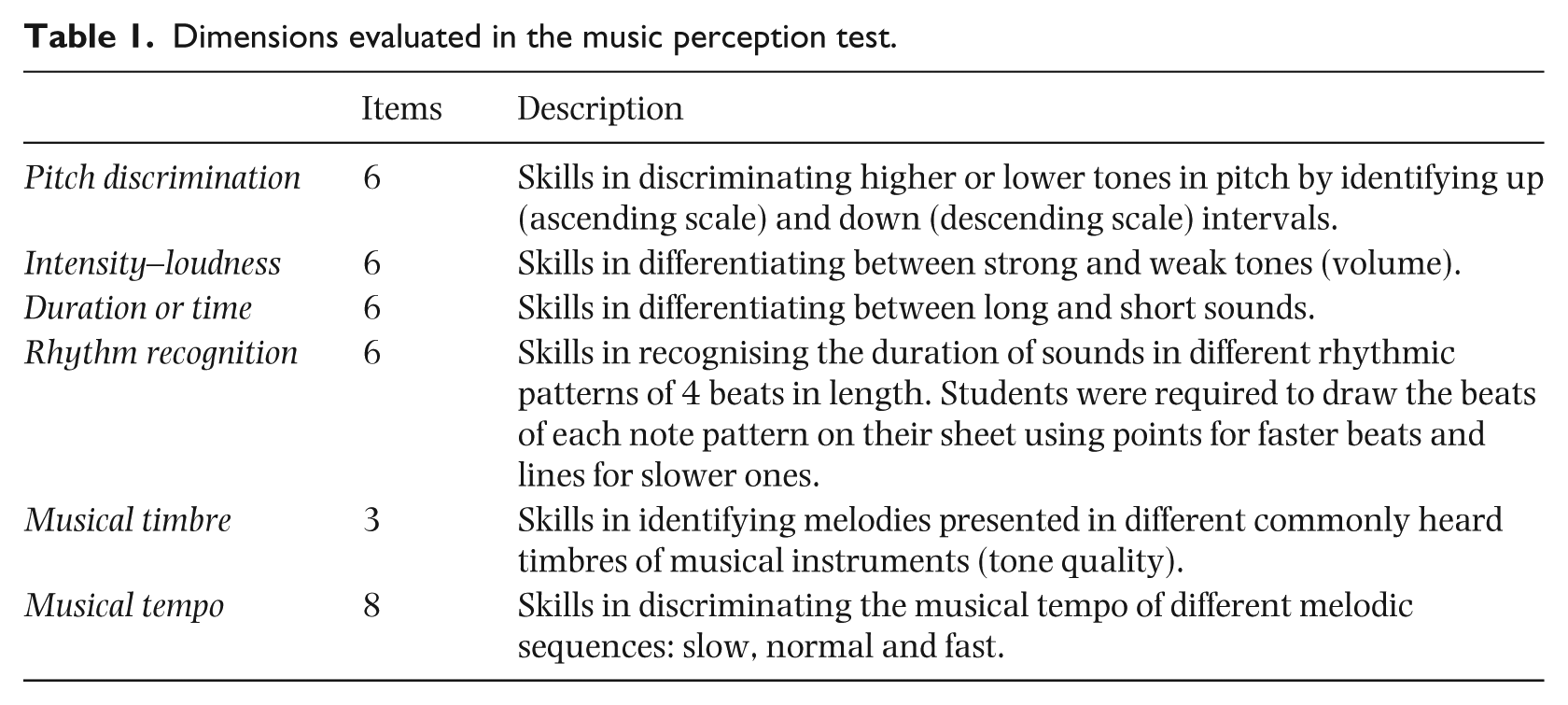
The music perception test by Hernández-Hernández and Santiago-González (2010) was adapted for 7–8-year-old students for administration purposes. This is a measure of auditory processing aimed at evaluating the accuracy of auditory discrimination skills within typically developing children. This test does not measure productive musical ability, such as singing or instrumental music performance, but takes into consideration the participants’ receptive sensitivity to basic sound patterns varying in pitch, rhythm and timbre. It consists of six parts that measure different aspects of perceptual musical skills across the following dimensions: pitch, intensity, duration, rhythm, musical timbre and musical tempo (see Table 1). Each correct answer scores one point and each incorrect one scores zero, and the maximum possible score is 35 points. During administration, two practice trials preceded each part to ensure that the children understood the task.
Dimensions evaluated in the music perception test.
Children’s reading skills
The Early Grade Reading Assessment (EGRA) battery was administered individually in its Spanish and English versions on separate days. This battery included 10 standard subtasks. To assess the alphabetic principle, phonemic awareness and word-decoding abilities, we selected five of these 10 tasks in both languages since they evaluate the foundational phases of the learning-to-read process. These tasks were: “Initial sound identification” (ISI) and “Identification of words with the same initial sound” (IWSIS) to assess phonemic awareness; “Letter-sound knowledge” (LSK) to evaluate the alphabetic principle; “Familiar word reading” (FWR), which consists of decoding common words and, finally, “Unfamiliar word reading” (UWR), which tests the ability to decode legal syllables and letter-sound correspondences in order to read pseudowords.
Procedure
The school community was informed and formal consent from the local administration was granted. Trained postgraduate language assistants tested the reading and musical skills of the FL learners. EGRA administration lasted around 20 minutes per child and version, and all students were individually assessed by their test administrators in a quiet room. The music perception test was administered collectively to the whole class during approximately 30 minutes. Musical stimuli were pre-recorded on a DVD and played in the classroom while students were completing the activities on a sheet.
Data analysis
Mediation analysis (Baron & Kenny, 1986) was performed using SEM. This statistical procedure allows us to contrast hypotheses concerning mediation relationships among independent and dependent variables, including the different interrelations between them, as well as the non-observable variables (Herrero, Jara, & Rosel, 2011). By investigating mediation processes, we acquire a better understanding of the influence of music perception on early phonological reading skills. The mediation analysis procedure explains how an independent variable (music perception) affects a dependent variable (English as FL) through a mediator (Spanish as L1). In this sense, SEM is a better-chosen analysis technique than the classical methods of regression because it assigns both types of variables to cause and effect categories, including their order of appearance. Additionally, it provides consistency fit indices of the hypothesised mediation causal model (Gunzler, Chen, Wu, & Zhang, 2013). The SEM system tests two types of mediation: partial mediation and full mediation.
Our structural model integrated 16 directly measured variables (five EGRA tasks in each language and six music dimensions) and three multi-factorial latent variables: L1, FL and music perception. All the relations between observed and latent variables were represented in a path diagram. Latent variables are represented by circles and observed variables by squares. The arrows show the relations between these variables (Figure 1). Our primary objective was to observe the mediating role of L1 between music perception and FL reading skills. Data analysis was performed using the 6.1 EQS statistics package.
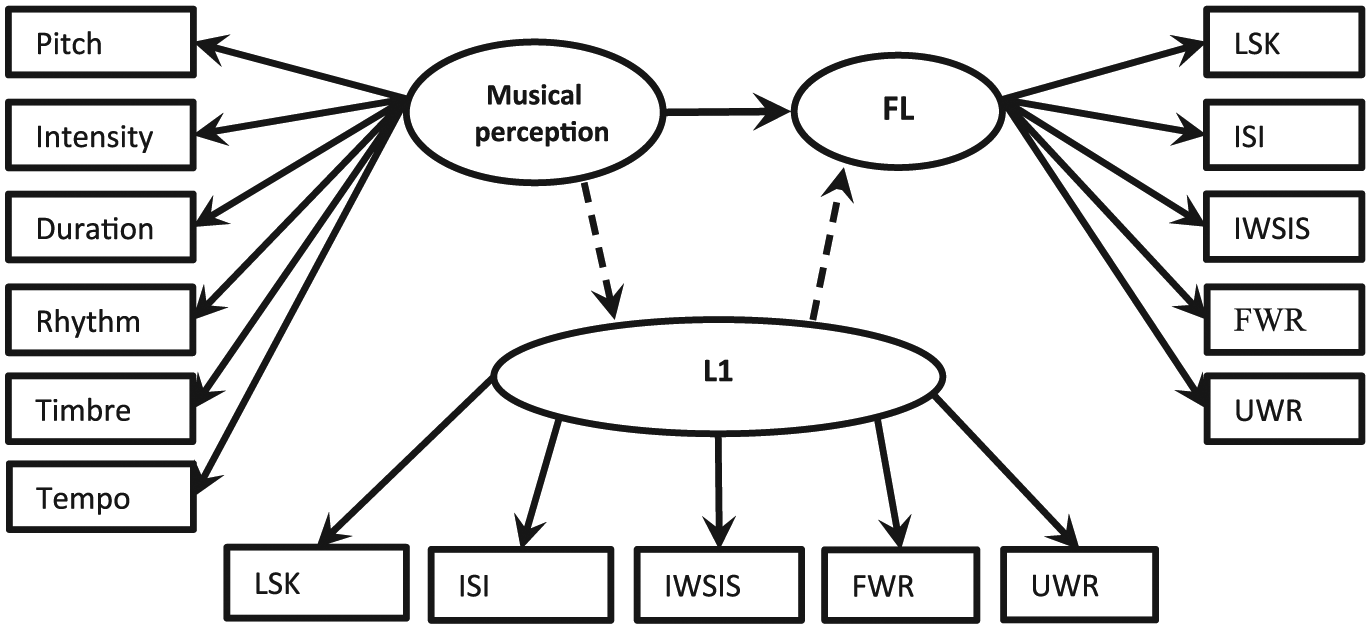
Structural equation mediation model.
Results
Preliminary analysis
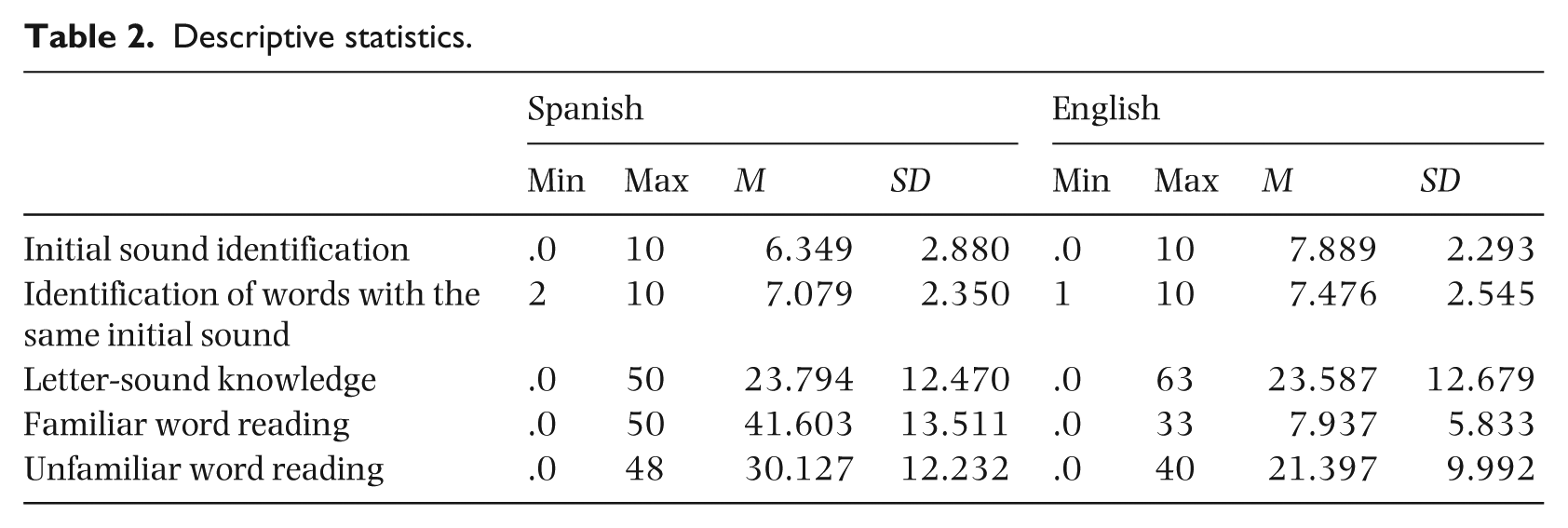
Analysis of variance (ANOVA) contrast indicated that there were no significant differences in mean age, F(2,62) = 0.942, p = .396, or in gender, χ2(2) = 1.97, p = .374, among students from the three classes. Table 2 contains the main description of the EGRA variables, both in Spanish and English.
Descriptive statistics.
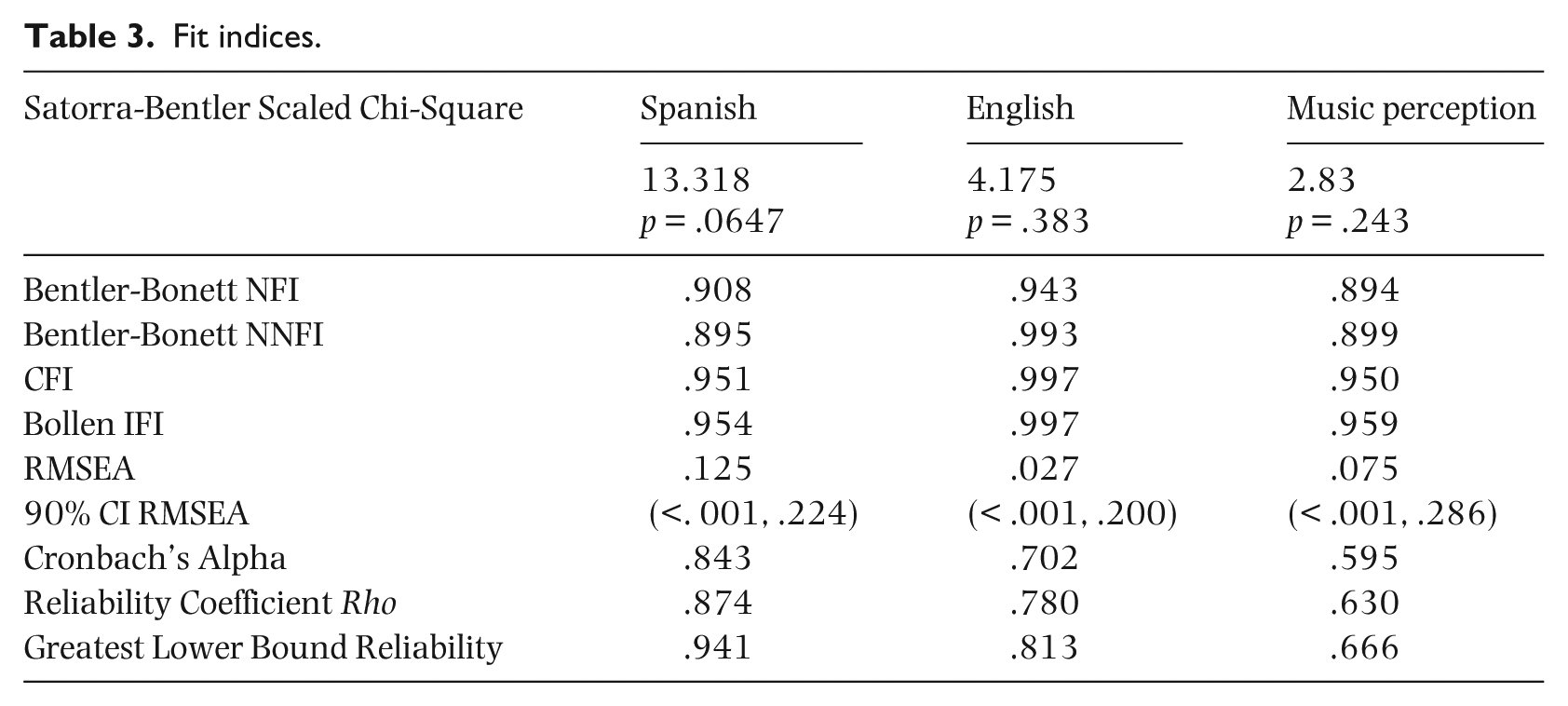
Firstly, the latent variables (L1 early reading skills, FL early reading skills, and music perception) were adjusted individually through an iterative process. At this point, indications of the Wald Test and the Lagrange Test were checked, and the following SEM fit indices – Robust Satorra-Bentler χ2, NFI, NNFI, CFI, IFI, RMSEA – were estimated as well as Cronbach’s Alpha coefficient test (Table 3). Confidence intervals of the standardised coefficients were estimated using 500 bootstrap iterations to take into account non-normal distributions of the variables. Score factors for each participant in each one of the latent variables have been extracted to test the mediation.
Fit indices.
Mediation analysis
The main reason for testing mediation is to understand the processes by which independent variables affect dependent variables, the mechanism through which the causal variable affects the outcome (Kenny, 2015). The mediation model is one of the more practical ways of studying the role of third variables involved in the relationship between an independent variable and a response or outcome variable (Ato & Vallejo, 2011).
Following the four steps for mediation analysis indicated by Baron and Kenny (1986), the following results were observed:
Step 1: Effect of music perception score on FL EGRA scores
The SEM provided acceptable indices of goodness-of-fit, BBNNFI = .946, CFI = .963, IFI = .966, and RMSEA = .058 (< .001, .116). Music perception had a positive effect on FL EGRA (β = .640, p < .05).
Step 2: Effect of L1 EGRA on FL EGRA scores
The SEM provided acceptable indices of goodness-of-fit, BBNNFI = .937, CFI = .954, IFI = .956, and RMSEA = .085 (.033, .126). L1 EGRA had a positive effect on FL EGRA (β = .940, p < .05).
Step 3: Effect of music perception on L1 EGRA and FL EGRA scores
The SEM provided unacceptable indices of goodness-of-fit, BBNNFI = .871, CFI = .895, IFI = .900, and RMSEA = .096 (.065, .124). L1 EGRA had a positive effect on FL EGRA (β = .926, p < .05), but music perception had no significant effect on FL EGRA (β = .153, p > .05).
Step 4: Study of L1 EGRA mediation between music perception and FL EGRA
The SEM provided acceptable indices of goodness-of-fit, BBNNFI = .900, CFI = .919, IFI = .923, and RMSEA = .085 (.051, .114). Music perception had a positive effect on L1 EGRA (β = .626, p < .05) but not on FL EGRA (β = .080, p > .05). L1 EGRA had a significant effect on FL EGRA (β = .888, p < .05). There was full mediation of L1 EGRA between music perception and FL EGRA (Figure 2).
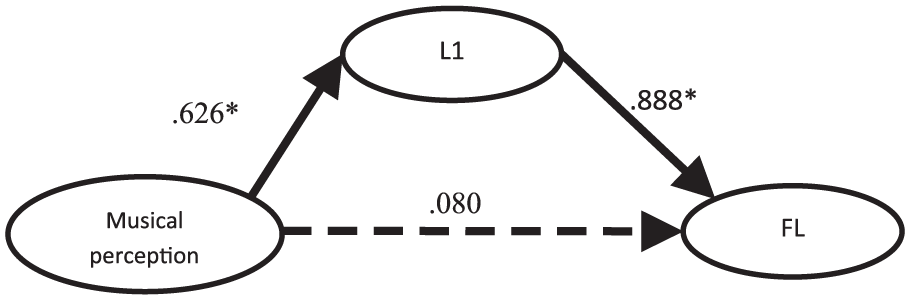
Mediation analysis.
Our results point to a full mediation of L1. The connection between music perception and FL early reading skills is mediated by the proficiency in L1 early reading skills. The pathway connecting music perception to the FL early reading skills is broken. Therefore, L1 is the way music perception influences FL early reading skills. So, FL early reading skills can be explained by music perception and by L1 early reading skills on an indirect pathway.
Discussion
This study set out with the aim of analysing the levels of transfer of L1 and music perception to FL early reading skills. It was hypothesised that music perception would affect L1 and FL early reading skills. The skills measured in this study were the alphabetic principle (LSK), phonemic awareness (ISI, and IWSIS), and word recognition (FWR, and UWR). The most interesting finding is that music perception had a significant effect on FL early reading skills through its influence on L1, but not directly. Therefore, the results of this study show a full mediation indicating a close link between the basic auditory analysis skills necessary for music perception, such as rhythmic and tonal discrimination, and early reading abilities across L1 and FL. Thus, the higher the students’ scores in analysis skills for music perception, the higher were their early reading skills (their alphabetic principle, phonemic awareness and word decoding) in L1, and therefore, the better these skills develop in the FL.
This study shares the musical ability and reading skills relationship evidenced in a large body of research (Gordon et al., 2015; Lessard & Bolduc, 2011; Standley, 2008; Tierney & Kraus, 2013), and produced results that corroborate the findings of previous correlational work showing positive associations between music perception and phonemic and phonological awareness in L1 (Anvari et al., 2002; Zuk et al., 2013).
This study also confirms that measures of the alphabetic principle, phonemic awareness and word decoding are positively related in Spanish and English, indicating that high levels of these early reading skills in Spanish contribute to the subsequent successful learning of these abilities in English. These results support previous research showing cross-language transfer of the alphabetic principle, early phonological awareness, and word-decoding skills among Spanish-speaking students learning English as a L2 (Cárdenas-Hagan et al., 2007; Durgunoğlu et al., 1993; Leafstedt & Gerber, 2005; Lindsey et al., 2003). The present findings seem to be consistent with these previous studies that have similarly emphasised the influence of young Spanish-speaking learners’ L1 reading competence on the development of reading skills in English as an L2.
However, previous research has paid insufficient attention to the relationship between music perception and the cross-linguistic transfer between L1 and FL. This study is one of the few to examine the influences of music perception and L1 early reading competence on the learning of FL early reading skills. This result not only confirms the importance of L1 competence on the development of early reading skills in an FL but also highlights that music perception has the effect of empowering the L1 and that this transfer will enhance the learning of FL early reading skills. Therefore, high music perception ability is not the only influential factor for a successful learning-to-read process in an FL because an adequate competence in the native language is also essential. The mediation influence observed here shows that the L1 is a mediator between music perception and FL early reading skills, suggesting that the effect is 100% mediated by L1 ability, meaning that in the presence of this variable, the connection between music perception and FL early reading skills is not significant.
Although more research on this topic is still required, in future investigations it could also be beneficial to observe the role of music perception in relation to other L1/FL reading abilities such as reading fluency and reading comprehension. Even though further work is needed to establish the most influential dimension of music perception (pitch or rhythm) on FL reading skills, this study provides clear evidence for the positive effect of music perception on L1 and FL early reading skills.
Footnotes
Ethical approval
Ethical approval for this project was given by the Spanish Ministry of Science and Innovation (no. FFI2010-15738 (subprogram FILO), Music perception and reading skills in foreign language learning project).
Funding
The authors disclosed receipt of the following financial support for the research, authorship, and/or publication of this article: This research was funded by the Spanish Ministry of Science and Innovation (no. FFI2010-15738 (subprogram FILO), Music perception and reading skills in foreign language learning project).