



Abstract
The present study investigated the development and training of music competencies in children in transition from kindergarten to school. In an intervention study with three experimental groups (music training, language training, no training) we investigated music performances of N = 202 5-year-old children before and after a period of 6 months. Results indicate substantial improvement in several low- and high-level musical competencies independent of children’s participation in one of the training groups. In addition, the music training group improved significantly more in their tonal discrimination, rhythm repetition, and synchronization skills compared to the no-training group. Results show that children in the language training group also improved in their music skills, which indicates noticeable overlap between these two domains. By contrast, interindividual differences in potentially relevant environmental factors, such as home musical environment and their socioeconomic status, did not affect children’s musical skills. By disentangling music training effects from musical experience based on informal exposure, the present findings contribute to the understanding of the development of various music competencies and to the effects of musical trainings in preschool.
Music represents one integral part of human life including universal as well as culture-specific characteristics, functions, and competencies across the lifespan. While some music competencies seem to be present from the very beginning and throughout the lifespan, other competencies reach a higher level of knowledge and specialization only in older and musically-experienced individuals. For example, sensitivity to melodic contour and relative pitch is encountered already in early infancy (e.g., Trainor, 2005). Other music competencies, such as the sensitivity to harmony, reach adult-like performance levels in later childhood (e.g., Schellenberg, Bigand, Poulin-Charronnat, Garnier, & Stevens, 2005).
Distinguishing between developmental progress by means of formal music training and by informal exposure to music while getting older is a challenge which has not been fully resolved yet. Previous studies have found that music competencies change throughout childhood and depend on musical experiences such as everyday exposure to culture-specific music, a process which is often referred to as enculturation (Hannon & Trainor, 2007). Additional formal music training seems to foster the development of music competencies by shaping domain-specific perceptual and cognitive representations (Hannon & Trainor, 2007). What kind of music competencies can be enhanced by formal music training in children in a critical phase of transition from kindergarten to school? How strong are the differences between children receiving formal music training and children with only informal exposure to music? Until now, answers remain unclear.
Generally, children in transition from kindergarten to school pass through a critical period of time that is characterized by developmental change, challenge and progress (e.g., Belsky & MacKinnon, 1994; Wildenger & McIntyre, 2012). During this critical phase, developmental trajectories also become evident in music competencies: When entering school around the age of 6, children already show fundamental universal as well as basic culture-specific music skills but are still progressing in refining culture-specific musical competencies (Trainor, 2005). However, our present knowledge is based on rather fragmentary results from studies focusing on specific music competencies in children from diverse samples and age groups and awaits further investigation.
The development of spectral and temporal music competencies across kindergarten and primary school ages
Music competencies comprise the perception and production of different music characteristics that can be summarized as spectral and temporal (e.g., Trainor & Corrigall, 2010). Spectral characteristics include pitch or tonal aspects such as timbre, intervals, and harmony, while temporal characteristics include the metrical organization of rhythm and synchronization. Evidence suggests that the development of music competencies in both spectral and temporal characteristics is structured hierarchically (e.g., Hannon & Trainor, 2007). Building on one another, children first develop basic music competencies and reach a higher perceptual subtlety and complexity throughout primary school age. Basal music competencies comprise the discrimination of relatively small units of cognitive processing including short melodic or rhythmic phrases whereas higher levels of cognitive processing are involved when processing polyphonic structures (harmony) or combined musical features of a music piece (cf. Cohrdes, Grolig, & Schroeder, 2016; Trehub & Hannon, 2006). Moreover, recent findings suggest that the development of music production skills rests upon perceptual competencies and evolves throughout childhood (e.g., Cohrdes et al., 2016).
With regard to spectral music characteristics, evidence suggest that 6-month-old infants already recognize changes in melodic contour and prefer consonant over dissonant intervals (e.g., Schellenberg et al., 2005; Trainor, Tsang, & Cheung, 2002). Although perceptual distinctions between consonant and dissonant intervals represent a relevant prerequisite for harmonic skills, it takes a longer period of time to become familiar with prototypical Western harmonic structure (Trainor & Corrigall, 2010). A lack of culture-specific musical understanding becomes apparent in the fact that young children outperformed adults in the detection of changes in notes that are consistent with the original melody key but not in the detection of an inconsistent note (cf. Trehub & Hannon, 2006). Thus, one can conclude that several years of exposure to prototypical music seems to be necessary for adult-like understanding of tonality. The average age at which children recognize culture-specific harmonic progression or scale membership remains unclear. A few studies suggest that 4- to 5-year-old children already have some harmonic discrimination abilities and prefer regular (tonic) over irregular (subdominant) chord endings within a harmonic sequence (e.g., Trainor, 2005). This finding is substantiated by an EEG study showing similar brain reactivity in 5-year-old children and adults while listening to regular and irregular harmonic sequences (Koelsch, Grossmann, Gunter, Hahne, Schröger, & Friederici, 2003). Other findings suggest that sensitivity to harmonic structure emerges around the age of 8 years (Krumhansl, & Keil, 1982) or even 12 years (Costa-Giomi, 2003). The same applies for recognizing differences in more subtle pitch and sound characteristics occurring in later stages of childhood (e.g., Cohrdes et al., 2016; Trainor & Corrigall, 2010).
Earlier than developing spectral music competencies, children seem to develop culture-specific ability to recognize metrical structures. Six-month-old infants are able to categorize rhythmic patterns based on underlying metrical structure (Hannon & Johnson, 2005). Moreover, they are able to detect temporal alterations to typical as well as atypical western musical patterns whereas 1-year-old children and adults do not show this competency any longer and only recognize temporal alterations to atypical patterns (Hannon & Trehub, 2005). In conclusion, results indicate that certain culture-specific biases in perceiving meter develop between 6 months of age and 1 year and further develops throughout childhood. With regard to reproduction skills, children at the age of 5 were able to reproduce simple binary meter representing a prototypical temporal structure almost as accurately as 7-year-old children and adult non-musicians (Drake, 1993). Conversely, more complex rhythms were reproduced more accurately at the age of 7 but the performance did not differ significantly from adult non-musicians (Drake, 1993). This finding indicates an improvement in rhythm reproduction skills between 5- and 7-year-old children based on informal exposure to music that does not develop until adulthood. Later improvement in complex rhythm reproduction skills in adulthood seems to be more influenced by formal musical training than by enculturation (Drake, 1993).
Synchronization competencies represent one central indicator of perceiving and understanding musical structure. Based on sensorimotor coupling processes, neuronal activity suggests a simultaneous activation of auditory as well as motor representations while listening to music (Zatorre, Chen, & Penhune, 2007). Philipps-Silver and Trainor (2005, 2007) extended these findings by showing how closely the auditory perception of rhythm is connected to actual movement in children as well as adults. The multi-modal interaction between body movement and sound perception became evident in the fact that bouncing on either every second or every third beat influenced the perception of and preference for rhythm in duple or triple form (Philipps-Silver & Trainor, 2005, 2007). In line with findings from research on rhythm perception and reproduction, children’s competency at synchronizing with a given beat appears at 4 years of age (e.g., Drake, Riess Jones, & Baruch, 2000; Provasi, & Bobin-Bègue, 2003; see also Eerola, Luck, & Toivainen, 2006 for indications of even earlier synchronization tendencies). With increasing age, children improve in their synchronization skills as indicated by an increasing flexibility of tapping to various tempi and metrical complexity (Drake et al., 2000). Again, this process seems to be unrelated to formal music training. Even musically untrained adults showed well-established synchronization skills, as indicated by their tapping behavior (e.g., Repp, 2005).
Effects of formal music training
Musical training has been identified as beneficial for the development of domain-general cognitive, social and personal competencies, e.g., language acquisition, motoric coordination, and executive skills (see Hallam, 2010 for an overview). In addition, and more importantly, it has been argued that formal music training enhances music skills (as discussed by Levinson, 1997). However, as reviewed above, a series of studies suggests training effects for some music subskills only and effects are typically small. A majority of music competencies develops through childhood by informal everyday exposure to music (e.g., Trainor & Corrigall, 2010). Thus, disentangling music competencies shaped by informal music experiences from those (additionally) profiting from specific music training is a central aim of current research (Bigand & Poulin-Charronnat, 2006).
Empirical evidence suggests that preschool children receiving formal music training for 1 year develop faster in recognizing key membership and harmonic irregularities (Corrigall & Trainor, 2009). This finding is supported by studies indicating similar neuronal activity in musically trained 4- and 5-year-old children and musically untrained 6- to 7-year-old children (Shahin, Roberts, & Trainor, 2004). In a review on music processing of musicians and non-musicians, Bigand and Poulin-Charronnat (2006) highlight similarities in responding to musical (e.g., expectancy, memory) and non-musical tasks, suggesting that formal music training is not required for the performance of these tasks and is associated with only small processing benefits. However, these conclusions are based on adults’ performance, and it is unclear whether these findings generalize to children.
Findings on rhythm skills, on the contrary, indicate a higher performance accuracy of musicians compared to non-musicians in complex rhythmic tasks (e.g., Drake, 1993; Repp, 2010) indicating that formal musical training can foster musical development.
The role of environmental factors in music development
Although effects of music training have been reported for children’s music-specific as well as domain-general competencies (e.g., Bilhartz, Bruhn, & Olson, 1999; Hannon & Trainor, 2007), the role of potentially confounding factors such as intelligence, musical experience, and socioeconomic background have not yet been fully explored. Previous findings suggest that exposure to music in childhood is associated with increases in IQ (e.g., Schellenberg, 2006). Furthermore, children with higher IQ were more likely to take music lessons and perform better in tests of cognitive skills (Schellenberg, 2011). However, the relationship between music skills and intelligence are typically only investigated using correlational designs.
Evidence on the impact of daily musical experience and practice on the efficacy of formal music training is accumulating. In particular, studies with young children have shown that their home musical environment and the involvement of parents or other siblings (e.g., Davidson, Howe, Moore, & Sloboda, 1996) as well as their socioeconomic status (e.g., Degé, Patscheke, & Schwarzer, in press) affects musical development.
The present study: Rationale and hypotheses
The present study investigated the development and training of music competencies in 5-year-old children during their last year in kindergarten. The central aim was to identify the competencies that benefit from formal music training and to determine the size of these training effects. In line with previous findings (e.g., Cohrdes et al., 2016), we hypothesized that children at this age already show well-developed skills in low-level musical processing (e.g., sound discrimination) and moderately developed skills involving high-level music processing (e.g., harmonic progression; Hypothesis 1a). Furthermore, we expected to find a better performance in perceptual (e.g., tonal discrimination) than in production skills (e.g., rhythm repetition; Hypotheses 1b).
Another aim of the present research was to investigate the development of a broad set of music competencies in a homogenous sample of children in their last kindergarten year. Consequently, we examined the development of music competencies within a period of 6 months shortly before entering school. As pointed out before (e.g., Trainor, 2005), the transition from kindergarten to school age represents a critical period with developmental trajectories in various music skills. Hence, we expected to find significant improvements in low-level as well as high-level music skills after a period of 6 months in preschool children (Hypothesis 2).
Moreover, we expected to find effects of formal music training on children’s musical development. In order to investigate this, we compared the development of perceptual and productive music competencies in children who participated in a music training program with an active and a passive control group. We predicted that children in the music training group show higher improvements in music competencies than children in both control groups (Hypothesis 3).
A third aim of the present research was to explore the role of potentially confounding factors such as the home musical environment and the socioeconomic background as well as intelligence on children’s musical development. To disentangle training effects from the effects of confounding factors, we tested whether children’s general intelligence, their home musical environment and their socioeconomic status influenced their musical development.
Method
Sample and procedure
At the beginning of the study (T1), the total sample consisted of N = 202 preschool children. There were no significant differences with regard to age and gender across the three experimental groups (see Table 1). Overall, children showed non verbal intelligence scores (IQ) within the expected age range, a moderate home musical environment (HOME) and a relatively high socioeconomic status (SES), as shown in Table 1. More importantly, there were no significant differences with regard to any of these background characteristics between experimental conditions at T1: IQ, F(2, 196) = 1.56, p = .21, HOME, F(2, 192) = 1.04, p = .37, and SES, F(2, 194) = 1.25, p = .29. Across testing sessions, missing values slightly differed between perceptual and production tasks with 8% more missing values for the production tasks on average, due to technical recording problems, sickness, or daily form (e.g., shyness) of participants.
Sample characteristics at study beginning (T1) grouped by experimental condition.

Note. Theoretical range for IQ (T-values) = 30 to 81, for HOME (sum score) = 0 to 36, for SES (sum score) = 16 to 90.
Children in the music group participated in a music training program while children in the active control group participated in a language training program (see below). The passive control group did not receive any specific training. Overall, N = 15 different kindergartens from various districts of Berlin (Germany) were randomly assigned to the three experimental conditions. Formal musical training such as guided instrumental playing or singing offered by external or internal qualified personnel were not part of the regular day-care activities in any of the kindergartens. After the intervention program had been administered (T2), the sample consisted of N = 195 preschool children (56 % male, mean age = 5.9 years, SD = 0.4) with n = 65 children in the music training group, n = 67 in the language group and n = 64 in the passive control group.
The study consisted of two individual testing sessions of 40 minutes each in the respective kindergartens. As part of a larger assessment protocol, participating children completed different computer-administered tasks assessing their music competencies in September and October 2015 (T1) and in May and June 2016 (T2). At T1, children’s non verbal intelligence was additionally assessed in small groups of up to six participants within 30–45 minutes. After each session, children received a small gift. Participation was voluntary and parents gave written consent for their children. Additionally, parents filled out a short demographic questionnaire. The present study was approved by the ethics committee of the Max Planck Institute for Human Development in Berlin, Germany.
Intervention
Between October 2015 and May 2016, for a period of 6 months, children in the music training group (n = 67) participated in music training. Training sessions were held in small groups of four to nine children twice a week for 45 minutes at each kindergarten. The training was administered by four music teachers holding a bachelor degree in music pedagogy and with several years of teaching experience. The structure of the training was based on a well-established early education music training program (Nykrin, Grüner, & Widmer, 2007). The program focused on three fundamental music competencies: tonal discrimination, rhythm repetition, and bodily synchronization with music. By using standardized training protocols, we ensured that the three main domains were each represented in at least 12 out of the total 42 sessions. Typical exercises involved the recognition of tonal characteristics in different songs or melodies (tonal discrimination), the repetition of spoken phrases or clapping in call and response format (rhythm repetition), as well as guided movement to specific characteristics of music examples (bodily synchronization).
In the active control group, children participated in a language training program. Length, intensity, and social characteristics of the language training were similar to the music training. Training sessions were held in small groups of 6 to 11 children twice a week for 45 minutes at each kindergarten. The training sessions were administered by experienced research assistants studying language pedagogy or clinical linguistics. The training combined two well-established training programs promoting phonological awareness (e.g., playful listening and reproducing of sounds, rhymes; Küspert & Schneider, 2008) and narrative abilities (e.g., incitation of storytelling from storybooks; Whitehurst et al., 1999).
Measures
Nonverbal intelligence
Nonverbal intelligence was assessed using a German adaption of the Culture Fair Intelligence Test (CFT 1-R; Weiß and Osterland, 2013) including the six subtests substitutions, mazes, series, classifications, typologies, and matrices. Standardized age-adjusted IQ scores (T-values; M = 50, SD =10) served as the test score.
Home musical environment
Musical activity and expertise in children’s home environment was measured with 12 items in the parent questionnaire (e.g., “We use music in our daily routine”; “My child plays a musical instrument”) using a four-point rating scale from 0 (never) to 3 (frequently) based on Brand (1985) and as used in Aherne (2011; see Appendix A for a detailed item list). The sum of the raw scores was used as the test score.
Socioeconomic status
As an indicator of children’s SES, we used the current occupational status of the higher-educated parent in accordance with the International Socio-Economic Index of Occupational Status (ISEI-08; Ganzeboom & Treiman, 1996).
Sound discrimination
Sixteen stimuli were used to measure children’s ability to discriminate subtle timbre differences. Stimuli were adapted from Grey (1977) and used the same tone (E-flat; above middle C for 280–400 ms) played on various synthesized instruments (oboe, horn, clarinet, saxophone, trombone, cello). The overall accuracy was used as an indicator of sound discrimination competency.
Tonal discrimination
The tonal subtest from the Primary Measures of Music Audiation (PMMA; Gordon, 1979) was used to assess tonal discrimination skills. Children were presented with 40 tonal sequences in random order. Their task was to indicate whether a pair of two- to four-tone phrases was the same or different. Standardized percentile norms were used as the test score.
Rhythm repetition
Six items adapted from Sallat (2008) were used to assess children’s rhythm repetition skills. Items consisted of three to six eighth and quarter notes and were presented with increasing difficulty (length) at same tempo (80 bpm) and sound (clap) via headphones. Children were asked to repeat the sequences using the syllable “ta.” Responses were coded as incorrect (0), partially correct (0.5) or correct (1). Responses were coded as partially correct when the repeated sequence was correct but incomplete. Fifteen percent of data was coded by a second independent rater. Inter-rater reliability was good, Cohen’s κ = .78. The mean score across items (overall accuracy) was used as the test score.
Harmonic progression
Children’s ability to discriminate between regular and irregular harmonic phrases was assessed using 10 items consisting of five chords with either a regular (tonic) or irregular (Neapolitan sixth chord) ending (see Jentschke & Koelsch, 2009). Participants were asked to indicate whether the ending of the harmonic phrases sounded correct or incorrect. The overall accuracy was used as an indicator the of harmonic sense.
Emotion recognition
Children’s ability to recognize emotions in music was measured using four 30-second excerpts from music pieces that represented two distinct emotional expressions (happy: Beethoven, Piano Concerto no. 4, third motive; Saint-Saens “Carnival of the Animals,” finale; sad: Chopin, Nocturne op. 27 no. 1, Grieg “Peer Gynt” Suite, no. 2, “Solveig’s song”) adapted from Dalla Bella, Peretz, Rousseau, and Gosselin (2001; see also Peretz, Gagnon, & Buchard, 1998). Children listened to the four items in randomized order and indicated whether the excerpt sounded happy or sad. The overall accuracy was used as an indicator of emotion recognition competency.
Synchronization
To assess children’s synchronization skills, they were asked to tap along to (a) a song and (b) a beat using a key and a clapping sound as auditory feedback. The song was an existing pop song (Pietro Lombardi, “Call my name”) that has successfully been used in previous studies (Cohrdes, Platz, & Kopiez, 2014). The beat was a constant sequence with 120 bpm (e.g., Provasi & Bobin-Bègue, 2003). Responses were coded with regard to the correspondence between children’s tapping and the meter of song or beat as random (0), partially consistent (0.5) and consistent (1). The inter-rater reliability between two independent raters based on 15 % double-coded data was good, Cohen’s κ = .92. The average of the code for the song and the beat (overall accuracy) was used as the test score.
Results
Performance accuracy of different music competencies in preschool children
To analyse differences in the children’s music competencies in their last kindergarten year, we tested their accuracy levels in respect to standardized percentile ranks (tonal discrimination) at T1 against a 50% chance accuracy. As predicted in Hypothesis 1a, we expected to find a higher performance accuracy in low-level (sound discrimination, tonal discrimination) as compared to high-level competencies (harmonic progression, emotion recognition). Moreover, and as predicted in Hypothesis 1b, we expected perceptual competencies (sound discrimination, tonal discrimination, harmonic progression, emotion recognition) to be already more developed than productive competencies (rhythm repetition, synchronization) in preschool children.
Results showed that, at T1, children already reached a relatively high performance accuracy for music competencies involving low-level processing with significant differences against a 50% chance accuracy for sound discrimination, t(200) = 9.69, p < .001, d = 0.86, and tonal discrimination, t(200) = 32.77, p < .001, d = 0.77, as predicted in Hypothesis 1a. Performance accuracies involving high-level processing on the contrary seem to be less developed, yet, with non-significant differences against a 50% chance accuracy in harmonic progression, t(200) = 1.38, p = .17, d = 0.15. One exception is represented by the ability to recognize emotions in music, which is supposed to involve high-level cognitive possessing, but already reached a high level of performance accuracy at this age and thus differed significantly from 50% chance accuracy with t(199) = 17.68, p < .001, d = 1.64. In conclusion, the average performance accuracy for perceptual competencies (sound discrimination, tonal discrimination, emotion recognition) already showed well-developed performances with significant differences from 50 % accuracy, except for harmonic progression.
Productive music competencies on the other hand showed less developed performances, not reaching a better-than-chance accuracy and thus differing negatively from 50% with t(197) = -2.68, p = .008, d = 0.25 for rhythm repetition and t(195) = -13.30, p < .001, d = 1.28 for synchronization competencies, as expected in Hypothesis 1b.
Development of music competencies across experimental groups
In general, children across experimental conditions significantly improved in their performance accuracy for all competencies from T1 to T2 (see Table 2), as predicted in Hypothesis 2. More precisely, they showed improvements with a small effect in harmonic progression and sound discrimination competencies (d < 0.45), moderate improvements in tonal discrimination, rhythm repetition and emotion recognition competencies (d > 0.45) and even large improvements in their ability to synchronize to a given beat or song (d = 0.84). Overall, they still showed sufficient variability to investigate developmental differences and training effects.
Children’s performance accuracy of six different music competencies separated by condition and effect sizes (Cohen’s d) indicating significant improvement from before (T1) to after (T2) intervention within as well as across experimental conditions. .

Note. Performance of the tonal discrimination task is indicated by standardized norm values (0–100). Performance accuracies (0–1) for T1 were: M = 0.69 (SD = 0.18) for the music training group, M = 0.76 (SD = 0.10) for the active control group, M = 0.67 (SD = 0.13) for the passive control group and M = 0.67 (SD = 0.13) across conditions; for T2: M = 0.74 (SD = 0.12) for the music training group, M = 0.67 (SD = 0.14), for the active control group, M = 0.71 (SD = 0.13), for the passive control group and M = 0.74 (SD = 0.12) across conditions. Significant differences as a result of paired sample t-tests are marked with ** p < .01 and * p < .05.
Effects of formal music training on the development of music competencies
No differences before intervention (T1)
First, we tested for differences in music competencies between experimental conditions at T1. Results of a multivariate analysis of variance yielded non-significant results indicating that the experimental groups of music training, and active and passive control did not differ in their average music competencies before intervention, F(12, 364) = 1.12, p = .34, η2 = .04.
Developmental differences between conditions after intervention (T2)
Afterwards, we tested the predictive value of the music training as compared to the active and passive control conditions on the performance accuracy of the six different music competencies after intervention (T2). In six multivariate linear stepwise regression analyses we first entered the experimental conditions in forms of two dummy coded variables with one variable testing the music condition against the active control condition and another one testing the music condition against the passive control condition. Moreover, we included the performance accuracy before intervention (accuracy at T1; grand-mean centered), as a covariate to control for possible effects by the initial performance level. In a second step, we entered the children’s IQ, HOME and SES scores (grand-mean centered) as further predictors to clarify their additional role for the explanation of variance in performance accuracies after intervention (T2).
Results revealed significant predictions from the experimental conditions on three music competencies (Figure 1, Table 3). In line with Hypothesis 3, children in the music reference group significantly improved their tonal discrimination, rhythm repetition and synchronization skills as compared to children in the passive control group. Results from a t-test comparing changes from T1 to T2 between experimental groups substantiate these findings showing that the music training group outperformed the passive control group with medium effect sizes of Cohen’s d = 0.59 in the tonal discrimination, with d = 0.50 in the rhythm repetition and with d = 0.39 in the synchronization competencies. Differences between the music and the active control group were only significant for the rhythm repetition competency with d = 0.42.

Mean accuracy values for the three music competencies showing significant differences in development from before (T1) to after (T2) intervention between the three experimental conditions of music training group, active and passive control group: (a) Tonal discrimination; (b) rhythm repetition; and (c) synchronization. Error bars represent 95% CI. ** p < .01, * p < .05.
Results of multiple linear regression analyses on the children’s performance accuracy at T2 (after intervention) by experimental condition and in control of performance accuracy at T1 (before intervention), fluid intelligence (IQ), home musical environment (HOME) and socioeconomic status (SES).

Note. Standardized regression coefficient β is given for each predictor on the six music competencies assessed at T2. Total R2 indicates the total model fit and ∆R2 indicates the model fit without covariates (step 1) and the change in ∆R2 with covariates included (step 2). Continous predictors were entered as z-standardized values, the experimental condition as a dummy coded variable (music condition as reference group), dependent variables as performance accuracies (0–1) except for tonal discrimination being entered as normalized percentile ranks (0-100). ** p < .01, * p < .05.
IQ, HOME, and SES had non-existent to small additional effects on children’s performance at T2 (see bottom part of Table 3). Only home musical environment explained some additional variance in children’s synchronization skills. Analyses of the predictive values of the 12 single items from the home musical environment scale revealed that item 7 (“Takes child to concerts”) was a significant positive predictor of the tonal discrimination competency (B = 0.004, SE = 0.001, t = 2.34, p = .02), as well as item 1 (“Parent sings to child”) of harmonic progression competency (B = 0.006, SE = 0.002, t = 2.75, p < .01), item 11 (“Parent purchases recorded music or musical devices for child”) of the emotion recognition competency (B = 0.005, SE = 0.001, t = 2.44, p = .02) and item 9 (“Dances with child to music he/she likes”) of the synchronization competency (B = 0.006, SE = 0.003, t = 2.05, p = .04).
Statistical power analysis
A post hoc power analysis was conducted using the software package G*Power (Faul, Erdfelder, Lang, & Buchner, 2007). Results revealed that, for the calculation of within- and between-interactions within a repeated measures design with three groups, effects of medium size (Cohen’s f = 0.25) with power (1 - β) set at 0.80 and α = .05 a sample size of n = 42 individuals per group would have been sufficient.
Discussion
In the present study, we investigated the development of various music competencies in children in transition from kindergarten to school. Moreover, performances of children with formal music training were compared to performances of same-aged active and passive control groups.
In line with Hypotheses 1a and 1b, results support previous findings suggesting that children already show qualified music perception skills involving low-level processing and moderately developed high-level processing and production skills in their last kindergarten year (cf. Cohrdes et al., 2016). One exception is represented by the ability to recognize emotions in music, which is already well-developed although high-level processing is involved.
After a period of 6 months, children across experimental groups showed substantial improvement in various music competencies, as predicted in Hypothesis 2. This finding supports previous research on music skill acquisition due to everyday music exposure and enculturation processes (e.g., Hannon & Trainor, 2007).
Beyond that, and as expected in Hypothesis 3, results revealed a more pronounced enhancement of music skills after music training. In accordance with the music training program’s key competencies, the children’s tonal discrimination, rhythm repetition, and synchronization skills were higher after music training as compared to a passive control group. High-level music skills as the recognition of emotions, subtle sound differences, or harmonic irregularities showed no training effects, as expected (Hypothesis 3). Hence, the present results are contradictory to findings indicating harmonic sensitivity already in preschool children (e.g., Koelsch et al., 2003; Trainor, 2005) but support assumptions on high-level competencies, as the recognition of subtle sound and harmonic progression, developing later throughout primary school age (e.g., Costa-Giomi, 2003; Krumhansl & Keil, 1982). Thus, one possible explanation might be that it is too early to investigate the development of high-level music competencies in preschool children. Another possible explanation for the discrepancy between the present and other findings might also relate to the fact that available studies differ according to the content and implementation of music training programs. Corrigall and Trainor (2009), for example, investigated effects of instrumental music lessons that moreover were found to be related to the timbre of the specific instrument a child had practiced with (Shahin, Roberts, & Trainor, 2004). Consequently, based on the current state of research it is not possible to entirely clarify whether a training program focusing on instrumental playing or on high-level music competencies might lead to different results. Moreover, based on the results of a statistical power analysis we conclude that the sample size in the present study was sufficient for the detection of medium effects but we cannot rule out the fact that rather small effects of musical development might become evident in larger samples, only.
The children’s competency to recognize happiness and sadness in music also showed no significant training effect. Findings are consistent with previous indications of an already relatively high accuracy in the recognition of basic emotions in 5-year-old children (e.g., Dalla Bella et al., 2001) and only little additional improvement from music training (e.g., Terwogt & van Grinsven, 1991). As highlighted by Thompson, Schellenberg & Husain (2004), future research should take more subtle emotions into account when investigating music training effects. They showed that 7-year-old children who received 1 year of music training identified comparably accurately happiness and sadness in music but outperformed musically non-trained peers on identifications of anger and fear (Thompson et al., 2004).
In the present study, children showed similar tonal discrimination and synchronization abilities after music or language training. Hence, children in the language training group benefited from a training of phonological awareness and narrative comprehension in the same way as children from training in tonal, rhythm and synchronization competencies. This finding can be interpreted in line with previous evidence on interrelatedness of specific music and language skills (cf. meta-analysis from Gordon, Fehd, & McCandliss, 2016) and argues in favor of common processing of acoustic parameters such as tonal and rhythm with respect to phonological processing (e.g., Besson, Chobert, & Marie, 2011; Patel, 2011). Taken together, previous findings suggest that music and language share cognitive resources so that music training can drive acoustic processing with even higher precision than needed for speech perception (e.g., Fedorenko, Patel, Casasanto, Winawer, & Gibson, 2009; Patel, 2011). Up to now, the question of how far specific aspects of language training might also support the development of music competencies has not been addressed, specifically. Only a few studies indicate enhanced music perception skills based on specific language expertise (speakers of tonal or quantity languages such as Mandarin or Finnish) as compared to non-musicians as well as musicians from another language area (Bidelman, Gandour, & Krishnan 2009; Marie, Kujala, & Besson, 2012). Thus, results of the present study offer an interesting starting point for the investigation of bidirectional overlap and training effects between both music and language competencies.
Furthermore, present results suggest that children’s development of music competencies seems to be less related to intelligence, SES and home musical environment than to formal music training. This is surprising considering available evidence from research on the development of music skills indicating significant relations with intelligence, SES and musical expertise (e.g., Degé et al., 2016; Schellenberg, 2006). Again, varying forms of musical experience and/or training implementations might be responsible for diverging results. Moreover, it is reasonable that a potential effect of home musical environment and SES did not become evident due to the low variability of the present sample. Another aspect that has not been taken into account is that intelligence as well as the home musical environment might have changed over time and thereby affected the children’s developmental improvement. For example, children might have encouraged their families into musical activities based on their musical involvement in the kindergarten. Single items of the HOME questionnaire seem to have a significant informative value for the improvement of specific competencies in this regard, such as joint dancing on synchronization skills. Up to now, explanations remain speculative and need further investigation. Future studies might therefore pay particular attention to potential changes in intelligence as well as specific aspects of the home musical environment initiated by formal training.
Summary and outlook
The results of the present study contribute to the understanding of music skill enhancement based on informal and formal training as well as to the role of potential environmental factors. Consistent with the music training’s key contents, children improved significantly more in their tonal discrimination, rhythm repetition and synchronization skills as compared to children without training. This effect was largely independent of the children’s intelligence, home musical environment and SES at the study’s beginning. Moreover, music performances improved in a comparable extent for children in the music as well as in the language training group, indicating a bidirectional overlap. Thus, the present study provides new insights into the development and promotion of a comprehensive selection of music competencies and moreover extends previous research on transfer effects which has focused on effects from music on language only.
With respect to diverging training programs in available research, future studies should pay more attention to the comparability of studies and the explanation of potentially differing effects. A systematic comparison of instrumental, perceptual, or more comprehensive approaches of early musical education might contribute to a more precise identification of factors relevant for the enhancement of diverse music-specific or domain-general skills. Especially, the identification of factors promoting developmental progress in high-level music competencies, such as subtle sound differences and harmonic progression, need further investigation. In sum, the present study provides valuable evidence for the short-term enhancement of music skills based on formal training, but further evidence on the long-term development is needed.
Footnotes
Appendix A
Item (M, SD) and scale (α) statistics for the n = 12 items of the home musical environment scale as used in the present study.
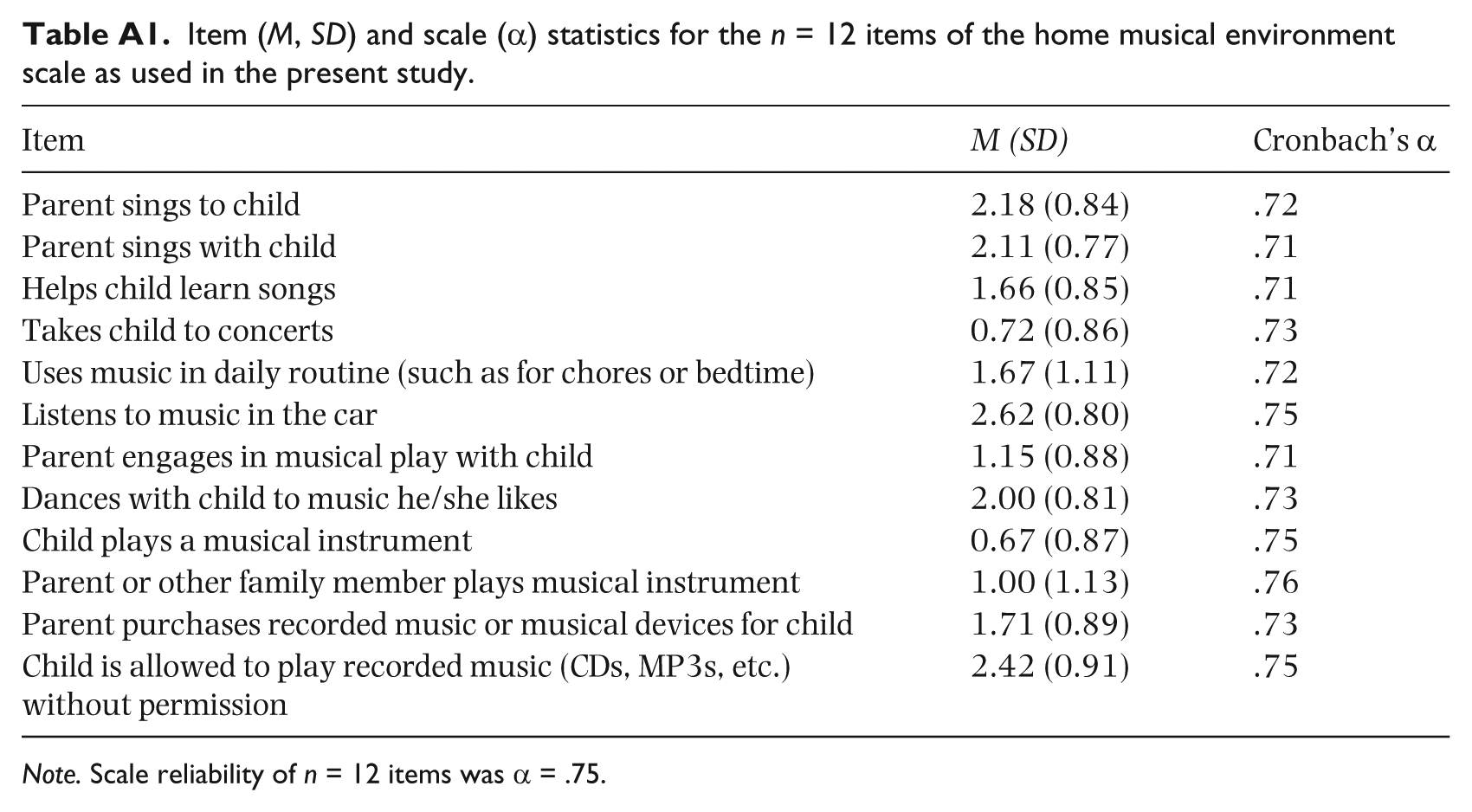
| Item | M (SD) | Cronbach’s α |
|---|---|---|
| Parent sings to child | 2.18 (0.84) | .72 |
| Parent sings with child | 2.11 (0.77) | .71 |
| Helps child learn songs | 1.66 (0.85) | .71 |
| Takes child to concerts | 0.72 (0.86) | .73 |
| Uses music in daily routine (such as for chores or bedtime) | 1.67 (1.11) | .72 |
| Listens to music in the car | 2.62 (0.80) | .75 |
| Parent engages in musical play with child | 1.15 (0.88) | .71 |
| Dances with child to music he/she likes | 2.00 (0.81) | .73 |
| Child plays a musical instrument | 0.67 (0.87) | .75 |
| Parent or other family member plays musical instrument | 1.00 (1.13) | .76 |
| Parent purchases recorded music or musical devices for child | 1.71 (0.89) | .73 |
| Child is allowed to play recorded music (CDs, MP3s, etc.) without permission | 2.42 (0.91) | .75 |
Note. Scale reliability of n = 12 items was α = .75.
Acknowledgements
We thank Maike Hille, Nicola Hohensee, Ye-Young Hwang, Janis Keck, and Laura Prieß for their assistance in conducting this study. Moreover, we thank all participating children and parents, day-care facilities as well as music teachers for supporting this study. Caroline Cohrdes is now a visiting scientist at the Center for Lifespan Developmental Science at the Friedrich Schiller University Jena, Germany.
Funding
The author(s) disclosed receipt of the following financial support for the research, authorship, and/or publication of this article: funding from the German Council of Cultural Education (Rat für Kulturelle Bildung), project number 14-001-4.