



Abstract
Music can modulate perceptions, actions, and judgments in everyday situations. The aim of this study was to investigate a potential influence of music on moral judgments in the context of film reception. In the course of an online experiment, 252 participants were assigned to three different experimental conditions (no, positive, or negative music). Participants were requested to assess actions shown in two 2–3-minute audio-visual film excerpts with regard to their perceived moral rightness and to report induced emotions after watching the film clips. Afterwards, they were asked to complete the MFQ-30 questionnaire measuring the foundations of their moral judgments. Results revealed that in one of four cases (i.e. happiness in film excerpt 1), music had a significant effect on recipients’ emotions and also indirectly influenced their moral judgment. In three of four cases, however, the intended emotion induction through film music did not succeed, and thus a significant indirect influence of music on moral judgment was not found. Furthermore, associations between moral foundations, perceived rightness of action, and induced emotions were observed. Future lab studies are indicated to investigate potential moderating influences of the experimental environment on emotion induction through film music.
Morality and emotions
Since antiquity, philosophers have debated the basis of moral judgment: “divine” reason or “animalistic” impulses and affects. For many years, moral psychology was dominated by rational approaches (e.g., Kohlberg, 1969; Piaget, 1965). From the rationalist perspective, moral emotions have been viewed as potentially influential variables in the reasoning process, but never as the direct cause of judgment (Haidt, 2001). This perspective is in sharp contrast with the so-called emotivist or intuitive approach. In the 18th century, British and Scottish philosophers such as David Hume presented alternative approaches to rationalism. They argued that moral knowledge does not originate from a chain of arguments and conclusions, but rather from direct feelings and an inner moral sense (Hume, 1777/1960, cf. Haidt, 2001). Similarly, Freud argued that judgments are guided by unconscious motives and emotions and then rationalized using socially accepted justifications (Freud, 2010).
This concept of a post-hoc rationalization of intuitive moral judgments is also reflected in modern approaches, such as Haidt’s (2001) Social Intuitionist Model. This model postulates that moral judgments should be understood as a dual process of (dominant) intuitive–affective response (moral “gut feelings”) and cognitive reflection (moral reasoning). In addition to the Social Intuitionist Model, Haidt and Graham (2007) have also developed Moral Foundation Theory (MFT), a nativist, cultural–developmentalist and pluralist approach to the study of morality (Graham et al., 2013). MFT proposes that the human mind is organized prior to experience; thus, it is prepared to learn values, norms, and behaviors related to a diverse set of recurrent adaptive social challenges. Due to the multitude of these challenges, there are also many moral foundations. It proposes five initial distinct foundations- in-group/loyalty, authority/respect, harm/care, fairness/reciprocity, and purity/sanctity- as the basis of moral judgments. Haidt and Graham (2007) postulate specific associations between these foundations and distinct emotions. For example, the harm/care foundation includes emotions which are associated with the avoidance or mitigation of the harm of others (e.g., compassion, sympathy; see Eisenberg & Strayer, 1987), whereas the fairness/reciprocity foundation includes emotions fostering reciprocal altruism (e.g., anger, guilt, or gratitude). However, according to a recent review article by Cameron, Lindquist & Gray (2015), there is no reliable empirical evidence for these postulated correspondences between moral foundations and discrete emotions. The authors argue that although there are general connections between moral judgments and emotions, these connections are not exclusive, as Haidt and Graham (2007) suggest. Hence, there is a need for further research investigating the correspondence between moral foundations and triggered emotions.
Film, music, and emotions
Numerous studies have shown that music is well suited to inducing emotions in humans (for a review, see: Juslin & Laukka, 2004). The power of music to induce emotions is useful in many contexts, including in film. Film music has a special ability to affect listeners’ emotions (Bullerjahn, 2001) and can be regarded as a second source of emotion besides the film itself (Cohen, 2001). Vinovich (1975), for example, revealed that music can drive neutral film excerpts in a certain emotional direction. According to La Motte-Haber and Emons (1980), the special effects of film music compared to other forms of music reception are due to a stronger inclusion of the recipient and a less “distant view” on behalf of them. If a person is emotionally affected by a movie scene, the reason for this affection is often unclear to them at first, and thus attributed to the actors in the film.
Also, in the context of film music, a sharp distinction must be made between perceived and felt emotions (Gabrielsson, 2002). According to Lissa (1965), there is an additive relationship between the viewer’s own emotions and the emotions attributed to the film’s protagonist. A study by Ellis and Simons (2005) further suggests that there is also an additive relationship between music and film in terms of emotion self-report.
Beyond its emotional impact, Lipscomb and Tolchinsky (2005) proposed a list of ways a soundtrack can communicate meaning: for example, by setting the general mood of a film; by reflecting the internal life, thoughts, and feelings of a character; and by clarifying or establishing a narrative structure. Film music can further convey messages about where the audience should focus their attention, such as toward mood-consistent information and away from other information that is inconsistent with the soundtrack’s affective valence (Boltz, 2001).
The effect of music on audiences’ interpretation and judgments of films has been demonstrated in several experiments. Hoeckner, Wyatt, Decety, and Nusbaum (2011) showed that film music can influence character likability and the certainty of knowing the character’s thoughts. Bullerjahn and Güldenring (1994) observed that interpretations of 10-minute film excerpts were influenced by the emotions perceived in the film music. The use of thriller music, for example, made participants think the protagonist had criminal intentions. Vitouch (2001) further observed that viewers’ anticipations about the further development of a sequence are systematically influenced by the underlying film music.
Effect of background music on moral judgments
Several studies have revealed that background music in general can influence judgment in interpersonal contexts. Maher, van Tilburg, and van den Tol (2013) found that music that defies expectations fosters the derogation of outgroups. Research by Greitemayer and colleagues further showed that music with prosocial lyrics increased the accessibility of prosocial thoughts and led to more interpersonal empathy (Greitemeyer, 2009), whereas sexually aggressive song lyrics fostered aggressive thoughts, emotions, and behavior (Fischer & Greitemeyer, 2006). Ziv, Hoftman, and Geyer (2012) investigated the influence of background music on recall and evaluation of a fictitious radio ad promoting different types of cheating. In all of their studies, background music led to reduced recall of information. Positive-valence music reduced awareness of unethical messages and increased acceptance of products. These findings were corroborated by Seidel and Prinz (2013), who showed that musically induced anger- but not happiness- can increase the tendency to judge actions as wrong. Seidel and Prinz (2013) also found that musically induced happiness increased the tendency to judge actions as good and obligatory.
In contrast to these findings, other studies were unable to demonstrate any manipulative effects of music in the context of film. For example, the results of a study by Brosius (1990) on the effects of music in information films could not be replicated by Kopiez, Platz, and Wolf (2013). A potential explanation for the null effect of background music used by Kopiez et al. (2013) is Behne’s (1999) habituation hypothesis, which states that the effect of background music has steadily decreased due to the growing omnipresence and availability of music in day-to-day life. In a meta-analysis, Behne (1999) observed that the effect of music on emotions, perceptions, and behavior had decreased by 8% per decade. This general historical trend, however, could not be replicated in a more recent and more methodically controlled meta-analysis by Kämpfe, Sedlmeier, and Renkewitz (2011).
In summary, effects of music on the evaluation of film content have not yet fully been assessed. Moreover, to the best of the author’s knowledge, no study has investigated the influence of music on the moral evaluation of actions in the context of feature films. Hence, the purpose of this study was to investigate whether film music would influence the perceived morality of two film actions representing ambiguous moral situations in which both “right” and “wrong” moral judgments could be inferred. These situations included taking “dirty” money from a dead criminal (film excerpt 1), and a murder for redemption (euthanasia; film excerpt 2).
It was assumed that music specifically chosen for emotion induction would either amplify or reduce positive or negative emotions compared to a condition without film music (H1). More concretely, for film excerpt 1, it was hypothesized that happy film music would amplify the happiness caused by the discovery of money. For film excerpt 2, it was assumed that music evoking love and tenderness would amplify the feelings of love and tenderness associated with the act of redemption. Regarding the negative emotions, it was hypothesized that tense film music would intensify the tension associated with the immorality of stealing money (film excerpt 1). Finally, it was expected that music evoking anger would amplify the perceived aggression of the depicted murder (film excerpt 2).
Consistent with Seidel and Prinz (2013) and Ziv et al. (2012), it was further assumed that, across the two film excerpts, induced positive emotions would be associated with higher ratings of rightness of action, whereas negative emotions would be associated with lower ratings (H2).
Combining H1 and H2, H3 assumed that music would have an indirect effect on the perceived rightness of action, mediated by the induced emotions. Thus, music would induce specific emotions (see H1), and these in turn would influence perceived rightness of action in opposing directions (depending on emotional valence; see H2). Moreover, it was hypothesized that for both film excerpts 1 and 2, where individuals were indirectly (film excerpt 1) or directly (film excerpt 2) harmed, a moral foundation based on harm and care would be negatively associated with the perceived rightness of action (H4). Finally, in addition to the aforementioned hypotheses, this study explored whether specific emotions are associated with an individual’s moral foundations.
Method
Sample
Based on theoretical considerations as well as on a pre-test (conducted with 17 persons) with the same design as the final experiment, a mean effect size of f = .25 (Cohen, 2013) was expected with regard to the influence of music on the relevant emotions (H1). The calculation of the required sample was performed with the statistical software G*Power (Faul, Erdfelder, Buchner & Lang, 2009) and revealed a total sample size of N = 159 (ANOVA: Fixed effects, omnibus, one-way, α = .05, 1-β = .80. Number of groups: 3).
Data collection was carried out online, and was browser-based, using Unipark/EFS Survey (Questback GmbH). The study was advertised via various social media and Internet portals. A total of 429 people began the experiment, but the final sample- including those who finished the study correctly- consisted of 252 persons (113 women, 139 men) with a mean age of 34.2 years (SD = 11.0). Participants’ educational levels were distributed as follows: 14.3% certificate of secondary education; 42.1% general qualification for university entrance; 13.1% bachelor’s degree; 25.8% master’s degree or diploma; and 4.8% PhD.
Materials
Selection of film excerpts
The two film excerpts used in the experiment were taken from the movies A Simple Plan (excerpt 1) and Amour (excerpt 2). A Simple Plan (1998) is about three men who find a suitcase full of money in the forest and, after intense discussion, decide to take it with them (Jacks, Schroeder, & Raimi, 1998). Over the course of the film, this decision increasingly becomes a curse for the protagonists. This film scene was selected because the act of taking the money is morally reprehensible, but the suspected owner is already dead and thus there is no immediate injured party. Moreover, punishment of the protagonists is uncertain at this time.
Amour (2012) is about an elderly couple whose love is tested after the woman suffers a stroke and becomes paralyzed (Ménégoz, Arndt, Heiduschka, Katz, & Haneke, 2012). As her condition worsens over time, she begins to speak to her husband about her suicidal thoughts. The excerpt presented in the experiment shows the husband as he first tells his wife a story, but then suddenly suffocates her with a pillow and thereby “redeems” her from her suffering. Thus, the excerpt also addresses the controversial issue of euthanasia and its moral evaluation.
In general, these two film clips were chosen for the controversial nature of the protagonists’ actions, meaning that the musical context could potentially lead to any kind of moral judgment. A further technical criterion for the selection of the excerpts was that no film music would occur in the original scene, since the music would be added for experimental manipulation afterwards. To create the audio-visual stimuli for the study, the films were purchased, converted with the software WinX DVD Ripper Platinum into AVI video files, and then edited with the software Video Edit Master. The sequence from A Simple Plan is from 00:14:39 to 00:16:30, while the sequence from Amour is from 01:43:01 to 01:46:01. Thus, the final sections used in the experiment were 1:51 min and 3:00 min long, respectively.
Selection of musical stimuli
The purpose of using musical stimuli was to induce different emotions in the participants- namely, negative (experimental group 1 [EG1]) and positive (experimental group 2 [EG2]) emotions- and thus to modulate their moral judgment. Based on findings in the relevant literature (e.g., Bolivar, Cohen, & Fentress, 1994), the goal was to ensure the highest possible congruency between the emotions induced by the music and the ones induced by the action of the film. Therefore, the aim was to induce a negative or positive emotion through music, which was related to the actions shown in the excerpts. For film excerpt 1 (A Simple Plan), tension was the intended negative emotion (EG1), which should intensify the tension presumably induced by the film’s moral dilemma (whether or not to take the money) and the heated discussion about possible consequences. To induce a positive emotion (EG2) in this excerpt, cheerful music was chosen, which was expected to reflect and amplify the happiness associated with discovery of the money.
Regarding film excerpt 2 (Amour), the goal was to induce anger as a negative emotion (EG1). This was expected to reflect and intensify the aggressiveness of the shown killing act. The positive emotion (EG2) which the music was intended to induce in this excerpt was love/tenderness, which was expected to emphasize the husband’s love for his wife, as well as her “redemption” through the killing act.
Based on the findings of Tan, Spackman and Bezdek (2007), it was also considered essential to adapt the music to the film content, as well as to achieve temporal congruence with regard to dramaturgy. Therefore, the music was only used from the moment when the action to be assessed (excerpt 2: murder) or the intention to do so (excerpt 1: idea to take the money) was depicted. In both cases, this corresponded to the temporal center of the film excerpts.
The music samples used were selected based on the work of Eerola and Vuoskoski (2010), who provided a novel set of stimuli- consisting of 110 unfamiliar, thoroughly tested and validated, non-synthetic music excerpts- for the study of music-mediated emotions. However, the stimuli in this study were only about 20 seconds long; thus, the task was to incorporate musically meaningful repetitions in the audio post production or to find longer sections in which the emotions did not change. An overview of the musical stimuli, as well as their intended emotional effects, can be found in Table 1.
Musical pieces used as stimuli with intended emotional effects.
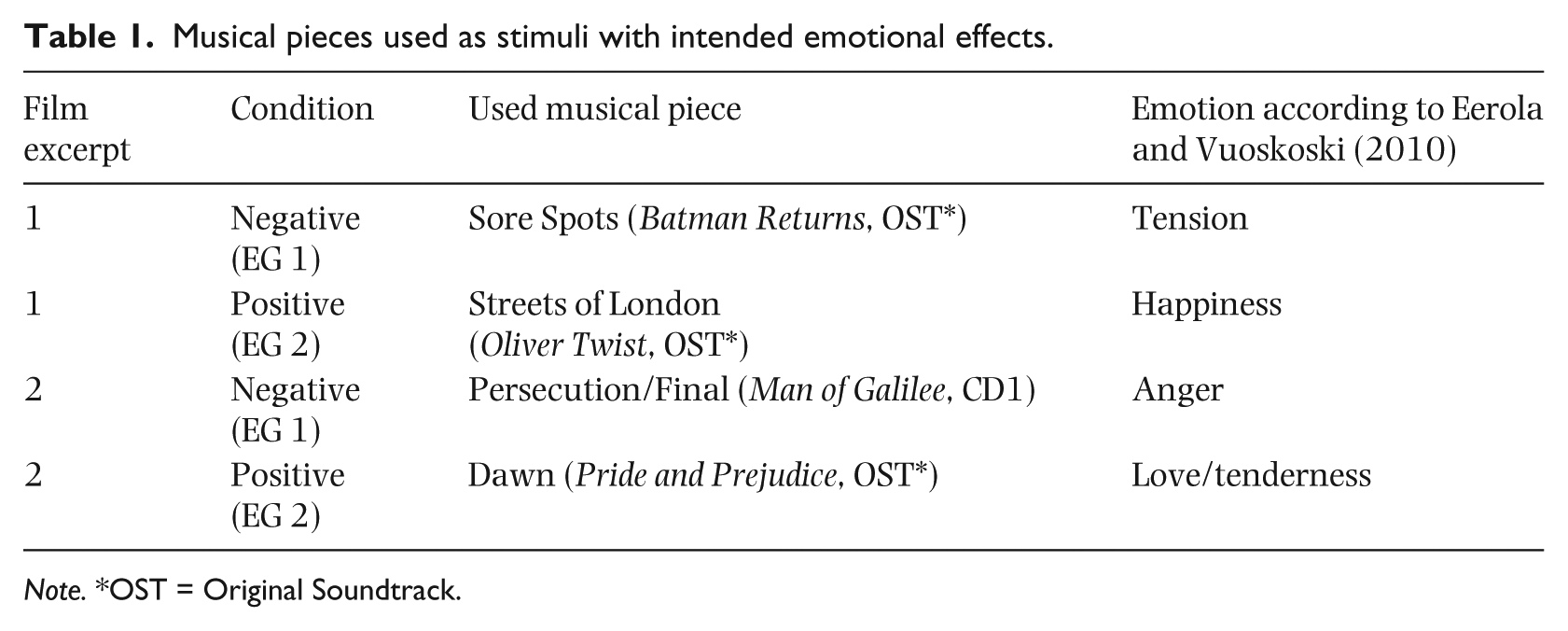
Note. *OST = Original Soundtrack.
To create the final musical stimuli for the experiment, the music titles were acquired and imported into the audio processing software Cubase LE AI Elements 8, together with the edited video files. The musical titles were then edited by a sound engineer in a dramaturgically and musically meaningful manner and mixed together with the existing audio tracks of the films. The completed film clips were uploaded to the YouTube video portal and embedded in html at a resolution of 853 × 480 points per line in Unipark.
Questionnaires
Rating scales specifically designed for the experiment were used. An overview of the questions and stimuli used can be found in the Appendix. The selection of potentially induced emotions in the course of the film and music reception was based on literature as well as characteristics of the stimuli. A list of emotions measured in the study is provided in Table 2.
Overview of the emotions obtained in the study with potential non-musical triggers and references.

In order to avoid drawing attention to the experimental manipulation, no questions related to the film music were asked. Moral foundations were measured by means of the German version of the Moral Foundation Questionnaire (MFQ-30, Bowman, 2010; Graham et al., 2011). The MFQ-30 distinguishes between the aforementioned five factors that form the basis of a moral judgment. The reliabilities (Cronbach’s α) of these factors, as measured in the study, were .58 for harm/care, .60 for fairness/reciprocity, .52 for in-group/loyalty, .58 for authority/respect, and .73 for purity/sanctity. Finally, it was investigated whether the type of audio setup used by the participants would modulate the effects of music on emotions and moral judgments. Here, a categorization of audio setups was employed distinguishing between headphones, stereo system, internal loudspeakers (laptop), internal loudspeakers (smartphone or tablet), external PC loudspeakers and others.
Procedure
First, the participants were welcomed and informed about the anonymous and voluntary nature of participation in the study. They were then asked to report their sex, year of birth, and highest level of education. Thereafter, they were informed about the task and procedure. Participants were asked to use headphones for audio playback, if possible. After successful completion of a task involving the recognition of audio-visual content in a test video, participants were randomly assigned to three different conditions: control group (CG, no film music; 81 participants), experimental group 1 (EG1, negative film music; 78 participants) or experimental group 2 (EG2, positive film music; 93 participants). In all three experimental groups, the task was to watch and listen to two film excerpts preceded by a textual introduction. For each film excerpt, participants were asked to judge the actions portrayed in the film with regard to their morality and to report the degree to which certain (pre-selected) emotions were induced. Additionally, they reported on how much they liked the movie scene and whether they had any prior familiarity with the scene before participating in the study. The sequence of the film excerpts was randomized, and questions were the same for both excerpts (exception: question formulations were adapted to the film action, see Appendix). After evaluating both film excerpts, participants reported on their moral foundations and the used audio setup. Finally, participants were thanked for their participation, and contact data were provided.
Statistical analysis
To investigate the influence of the three different conditions on the induction of the entity of emotions (see Table 2), two one-way multivariate analyses of variance (MANOVA) were calculated for both film excerpts, respectively. Four one-way analyses of variance (ANOVA) were further calculated to compare the three conditions with regard to the induction of the intended emotions happiness and tension (excerpt 1) as well as tenderness/love and anger (excerpt 2; H1). In the analyses of H1, the individual order of films was controlled for by including this factor as a second independent variable. H2 was tested by means of correlation and regression analyses between moral judgment and triggered emotions.
A mediation analysis was performed to examine a possible indirect effect of the experimental condition on the moral judgment mediated by induced emotions (H3). This was done utilizing the PROCESS macro for IBM SPSS 24.0 (Hayes, 2013). In addition, to check for a potential direct effect of music on perceived rightness of action, the mean values of participants’ moral judgments of the two film sections between the three experimental groups were compared by means of two one-way ANOVAs. H4 was tested by means of two correlation analyses. Finally, the relationship between moral foundations and induced emotions was investigated through two one-way MANOVAs and a post hoc correlation analysis. For all statistical analyses, IBM SPSS 24.0 was used, and the significance level was set to α = .05.
Results
Descriptive statistics
Tables 3 and 4 show the averaged moral judgments and reported emotions with their standard deviations, both separated by condition and film excerpt. It can be seen that the averaged moral judgments as well as the ratings of most emotions were rather low.
Averaged moral judgments and reported emotions with their standard deviations, separated by condition (excerpt 1).
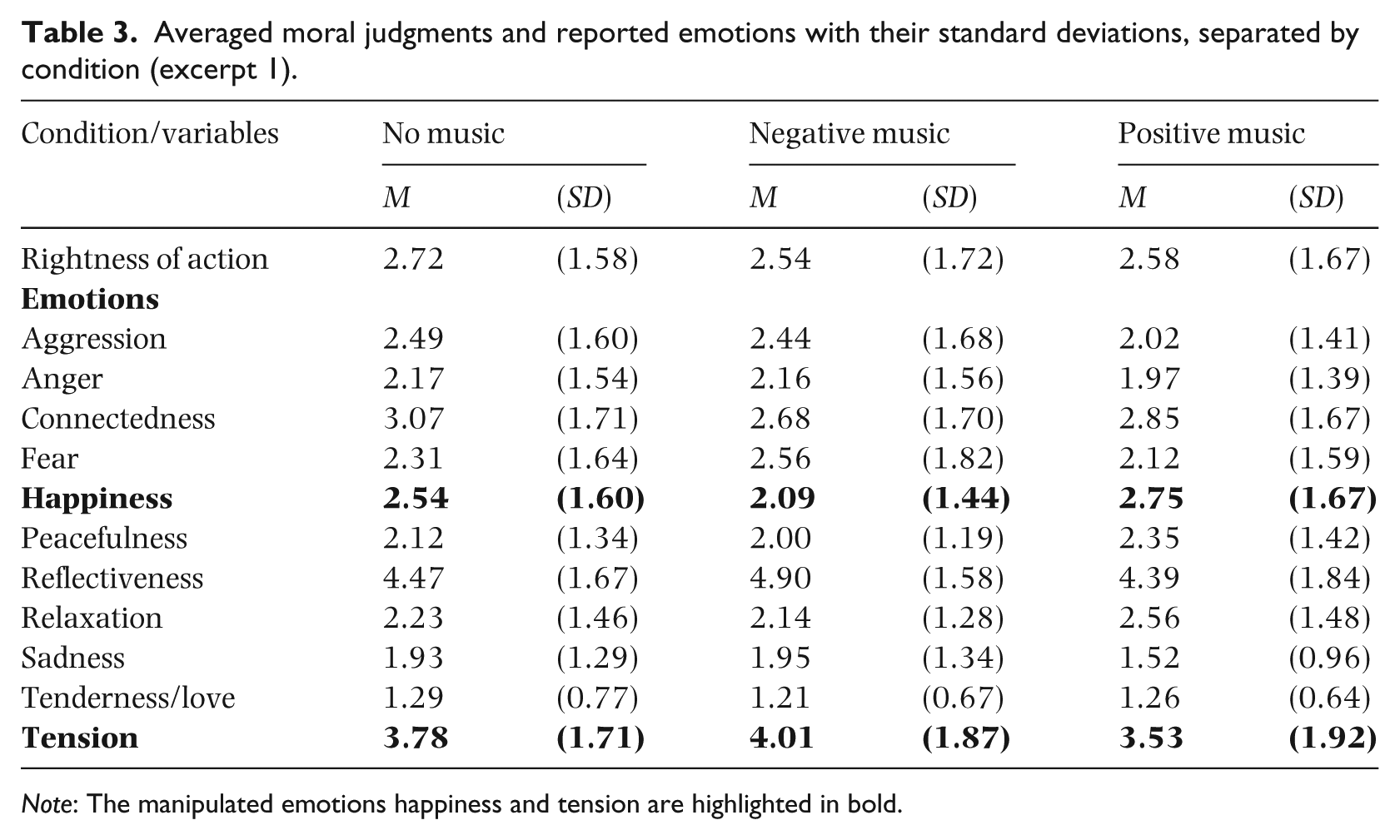
Note: The manipulated emotions happiness and tension are highlighted in bold.
Averaged moral judgments and reported emotions with their standard deviations, separated by condition (excerpt 2).
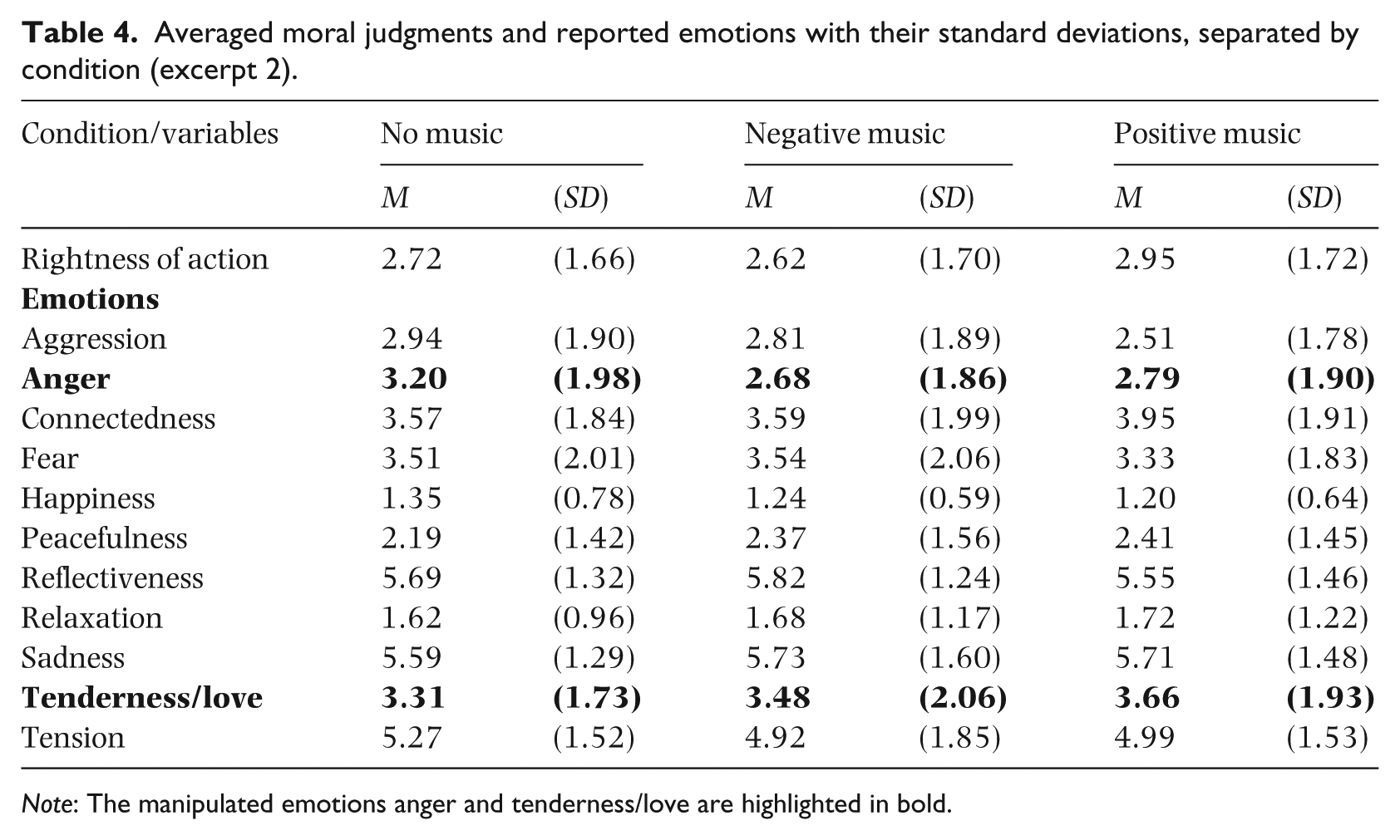
Note: The manipulated emotions anger and tenderness/love are highlighted in bold.
Similarity of the moral judgments of the two excerpts was obtained by means of a correlation analysis. Pearson’s r implies there is no linear relationship between the judgments, r (252) = .08, p = n.s. Therefore, the hypothesis tests (see following section) were performed separately for both film excerpts. Regarding the familiarity of the film excerpts, only 5.2% and 4.4% of the participants reported awareness of excerpts 1 and 2 before the study, respectively.
Finally, the audio setups used for film reception were examined: 27.0% of the participants followed the recommendation and used headphones, 42.1% used the internal speakers of a laptop and 7.1% of a smartphone or tablet; 21.4% used external PC speakers, 2.0% stereo systems, and 0.4% other equipment (active boxes).
Hypothesis testing
Hypothesis 1
H1 assumed an influence of the music manipulations on the induced emotions reported in the experiment. Two MANOVAs revealed no significant influence of the condition on the entity of induced emotions- excerpt 1: F(22, 450) = 1.22, Wilks’ Λ = .89, p = n.s., excerpt 2: F(22, 436) = 1.08, Wilks’ Λ = .90, p = n.s. In order to explore the potential effect of the equipment used, a separate analysis was calculated for participants who used headphones during the experiment (n = 68). This analysis also did not reveal any significant effect- excerpt 1: F(22, 104) = 1.04, Wilks’ Λ = .69, p = n.s.; excerpt 2: F (22, 98) = .83, Wilks’ Λ = .71, p = n.s.
When considering only those emotions which were hypothesized to be induced by music (excerpt 1: tension and happiness, excerpt 2: anger, tenderness/love), findings were mixed. The ANOVAs with tension (excerpt 1), anger (excerpt 2), and tenderness/love (excerpt 2) as dependent variables revealed no significant effect of condition- tension: F(2, 244) = 1.32, p = n.s.; anger: F(2, 243) = 1.78, p = n.s.; tenderness/love: F(2, 245) = 0.62, p = n.s. In contrast, the ANOVA with happiness (excerpt 1) as dependent variable revealed a significant difference between the three conditions, F(2, 245) = 3.67, p < .05. A post hoc Tukey test showed that the conditions “positive music” and “negative music” differed significantly at p < .05; the “no music” group, however, was not significantly different from the other two groups, lying in the middle.
Hypothesis 2
H2 assumed an influence of the emotions induced by the stimuli on the perceived moral rightness of the actions depicted in the film. Bivariate correlations between moral judgment and triggered emotions were first calculated using Pearson’s r. The significance level was Bonferroni-corrected for this analysis to αcor = .05/8 = .0063 (Abdi, 2007). Results revealed that happiness (r1 =.264, r2 =.208; both ps < αcor) and anger (r1 = −.191, r2 = −.335; both ps < αcor) were significantly related to the perceived rightness of action in both film excerpts. In contrast, tenderness/love was only associated with the moral judgment in excerpt 2 (r1 = .154, p = n.s.; r2 = .484, p < αcor), and tension was not significantly correlated with the moral judgments at all (r1 = −.018, r2 = −.070; both ps = n.s.). In order to determine the degree to which the variance in moral judgments could be explained by the induced emotions, a multiple regression model was calculated for both film excerpts with the moral judgment as a dependent variable and the emotions (found to be significantly associated with the judgments) as independent variables.
For film excerpt 1, the emotions happiness and anger explained 11.6% of the variance of the moral judgment, R2 = .116, F(2, 246) = 16.13, p < .001. For excerpt 2, it was more than twice as much variance (29.4%), which was explained by the emotions induced- R2 = .294, F(3, 244) = 33.82, p < .001.
Hypothesis 3
H3 suggested an indirect effect of music on moral judgment, mediated by the induced emotions happiness (excerpt 1), tension (excerpt 1), tenderness/love (excerpt 2), and anger (excerpt 2). Since a direct effect of music on emotion was only found for happiness, only one mediation analysis was computed with the effect-coded, multicategorical independent variable condition (split into two variables, positive_music and negative_music, representing the effects of the two experimental conditions compared to the control condition, respectively). Figure 1 illustrates that the standardized regression coefficients between condition and happiness were statistically significant, as was the standardized regression coefficient between happiness and perceived rightness of action.
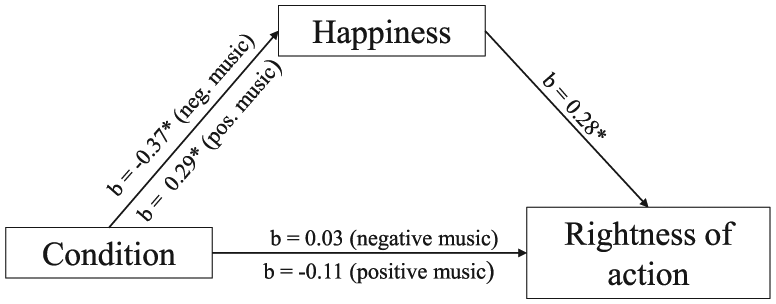
Indirect effect of music condition on perceived rightness of action, mediated by induced happiness (film excerpt 1).
The unstandardized indirect effects were (-0.37)∙(0.28) = −0.10 (negative music) and (0.29)∙(0.28) = 0.08 (positive music). The significance of these indirect effects was tested using bootstrapping procedures. Unstandardized indirect effects were computed for each of 5,000 bootstrapped samples, and the 95% confidence interval was computed by determining the indirect effects at the 2.5th and 97.5th percentiles. The 95% confidence intervals for both variables did not include zero (negative music: [-0.65 -0.09]; positive music: [0.01 0.56]). Therefore, the indirect effects were both statistically significant, and H3 was confirmed in case of happy film music (excerpt 1).
To check for a possible direct effect of music on perceived rightness of action, two one-way ANOVAs were computed which showed that music had no direct effect on the moral judgment in both film excerpts- excerpt 1: F(2, 249) = 0.25, p = n.s.; excerpt 2: F(2, 249) = 0.87, p = n.s.
Hypothesis 4
H4 assumed a negative linear relationship between the perceived rightness of action and a moral foundation based on harm/care (MFQ-30). Pearson correlation coefficients were calculated for both film excerpts. Both correlations showed a weak but significant negative correlation coefficient confirming H4- excerpt 1: r(252) = −.132, p <. 05; excerpt 2: r(252) = −. 126, p <. 05.
Finally, the link between the emotions induced by the two film excerpts and the moral foundations measured by the MFQ-30 was investigated by means of two MANOVAs, one for each film excerpt. For excerpt 1, none of the five moral foundations (independent variables) were significantly related to the emotions induced (dependent variables)—in-group/loyalty: F(11, 225) = 0.94, Wilks’ Λ = .96, p = n.s.; authority/respect: F(11, 225) = 1.23, Wilks’ Λ = .94, p = n.s.; harm/care: F(11, 225) = 0.69, Wilks’ Λ = .97, p = n.s.; fairness/reciprocity: F(11, 225) = 1.91, Wilks’ Λ = .91, p = n.s.; purity/sanctity: F(11, 225) = 0.44, Wilks’ Λ = .98, p = n.s.
For excerpt 2, however, two of the five moral foundations- harm/care and purity/sanctity- significantly predicted the emotional reaction of the participants- in-group/loyalty: F(11, 218) = 1.08, Wilks’ Λ = .95, p = n.s.; authority/respect: F(11, 218) = 0.39, Wilks’ Λ =.98, p = n.s.; harm/care: F(11, 218) = 3.42, Wilks’ Λ = .85, p < .001.; fairness/reciprocity: F(11, 218) = 1.04, Wilks’ Λ = .95, p = n.s.; purity/sanctity: F(11, 218) = 2.73, Wilks’ Λ = .88, p < .01. Post hoc correlation analyses revealed that the more a person’s judgment was based on harm/care, the more the emotions fear: r(247) = .203, p < .01, tension: r(248) = .303, p < .001, reflectiveness: r(251) =.140, p < .05, and sadness: r(251) =.281, p < .001, were triggered when watching excerpt 2. Likewise, harm/care was negatively associated with relaxation: r(251) = −.191, p < .01, and peacefulness: r(252) = −.133, p < .05. Finally, the more participants reported that their judgment was based on purity/sanctity, the more aggression: r(250) = .243, p < .001, anger: r(249) = .202, p < .01, fear: r(247) = .217, p < .01, and tension: r(248) = .227, p < .001, were induced.
Discussion
This study dealt with the question of whether moral judgments of actions depicted in movies can be modulated by music-induced emotions. Based on the social intuitionist model by Haidt (2001) and findings on the influence of music on emotions and judgments (e.g., Seidel & Prinz, 2013), it was expected that music inducing positive emotions (e.g., happiness, love/tenderness) would increase the perceived rightness of actions depicted in films. Accordingly, it was assumed that music inducing negative emotions- such as tension or anger- would reduce the perceived moral rightness of such actions.
Consistent with the literature, this study found that positive emotions evoked by two film excerpts were associated with increase in perceived rightness of action, while negative emotions were associated with a decrease in perceived rightness of action. Corroborating findings by Seidel and Prinz (2013) and Ziv et al. (2012), the results of the study further showed that in one of four cases (i.e., happiness in excerpt 1), music had a significant effect on recipients’ emotions and indirectly influenced their moral judgment. In three of four cases, however, the intended emotion induction through film music did not succeed, and thus a significant influence of music on moral judgment was not found. Furthermore, moral judgments made in the course of the experiment were observed to be associated with individual participants’ moral foundations. More specifically, the study showed that a moral foundation based on harm and care was negatively associated with the perceived rightness of action in the film clips where people were directly or indirectly harmed. Finally, correlational analyses revealed that the associations between moral foundations and induced emotions were moderated by the film content. While no association was found for excerpt 1, the foundations harm/care and purity/sanctity were significantly correlated with induced emotions in excerpt 2, corroborating findings by Cameron et al. (2015) that there is no exclusive relationship between moral foundations and induced emotions.
As for the effect of music on moral judgment, this study presents mixed results. Overall, the study demonstrated that music can modulate moral judgments in the context of feature films. This finding expands the understanding of the effects of music in general and the mediating role of emotions. However, the manipulation of the intended emotions only succeeded in one of the four cases. The discrepant findings might be due to stimulus characteristics and the experimental setting. First, the average perceived rightness of action in both stimuli was rated by the participants as rather low. This indicates that the actions shown in the scenes were not perceived as ambiguously as expected. This may have produced a floor effect, meaning that a potential effect of negatively valenced music on moral judgments might have been obscured due to decreased sensitivity of the scale at its lower end (Groth-Marnat, 2009). Another question that arises in this context is to what extent music can have a significant effect on emotions when those emotions are already being triggered by a comparatively dominant visual stimulus. In contrast to studies by Bullerjahn and Güldenring (1994) and Bolivar et al. (1994), who used emotionally neutral film content, an emotionally intense and dramatic feature murder scene was presented in film excerpt 2 of this study. The discrepancy of findings also raises the hitherto unexplained question of the nature of (sub)conscious processing of film music, and the degree of attention given to it in this complex, multimodal context with many emotional “layers.” The issue of multiple emotional “layers” is associated with the relationship between the recipient’s own emotions and the emotions attributed to the protagonist (Lissa, 1965) as well as with the perceived semantic and emotional congruence between film and music (Boltz, 2004; Marshall & Cohen, 1988). Neither was measured in this study. For example, in case recipients perceived the actions shown in the excerpts as wrong and experienced negative emotions, happy or tender film music reflecting the actor’s emotions might have been perceived as emotionally incongruent and ironic. This might have led to a negative effect of film music in some cases, resulting in an average null effect. Finally, the absence of effect in three of four cases might be attributed to the experimental setting. The study was conceptualized as an online study where participants’ attentiveness to the excerpts- and especially to the music- could not be controlled. In addition, it cannot be ruled out that the sound level was set too low by some test persons, so that the film music did not achieve its desired effect.
In the course of the study, empirical evidence for the plausibility of the social intuitionist model by Haidt (2001) was found. More precisely, connections between the triggering situation (film reception), emotions (intuition), moral judgment, and the reasoning process (i.e. the moral foundations) following the model were observed. The strong association between emotions- in particular happiness and anger- and moral judgment reinforces existing findings, for example by Seidel and Prinz (2013). However, although the Moral Foundation Questionnaire is a “gold standard for measuring different moral content” (Cameron et al., 2015, p. 7), it must also be mentioned that in Graham et al. (2011), and also in this study, only low reliability scores were obtained for the respective factors. Therefore, the findings associated with the relationship between moral judgments, moral foundations, and triggered emotions have to be interpreted with caution.
In conclusion, this study expands the understanding of the effects of music in general and specifically in the context of feature films. It further highlights the role of emotions in media consumption and judgment processes in the moral domain. The mixed findings concerning the effects of music underline the need for further research. For example, the experiment should be replicated in a controlled, cinema-like laboratory environment. As one would expect from personal experience, the emotional effect of a film in a “cinema atmosphere” with professional video and audio technology and a high degree of attention from viewers is presumably higher than in a comparable home TV situation. Future research should further investigate the “cognitive route” (in addition to the “affective route”) mediating the effect of film music on judgment processes (cf. Elaboration Likelihood Model of Persuasion; Petty & Cacioppo, 1986). For example, it could be analyzed whether the use of emotional information might lead to differences in perspective-taking, in the moral domain either taking the perspective of an agent or a patient of harm that is shown in a film excerpt. Here, qualitative interviews will be useful to further explore the cognitive and affective processes involved in moral judgments.
Footnotes
Appendix
Funding
The author received no financial support for the research, authorship, and/or publication of this article.