



Abstract
The schizophrenic disturbance of affective processing has seen a welcome revival in academic inquiry. However, laboratory research on emotion in schizophrenia has largely drawn on facial and prosodic stimuli and the suitability of this practice has been questioned. This article aims to explore the utility of musical material, and to motivate its use in research on emotion in schizophrenia. The article lists some of the empirical advantages of musical material and describes key auditory and affective deficits which could alter musical emotions in schizophrenia. Existing findings pertaining to the perception and experience of musical arousal and valence in schizophrenia are reviewed and compared with nonmusical findings. Results suggest that schizophrenia affects the recognition of both musical and nonmusical emotions. However, musical and nonmusical emotions appear to differ in that: 1) musical emotions are more arousing, 2) negative musical emotions stimulate approach tendencies, and 3) both the perception and experience of musical emotions share these characteristics. These differences are presently unexplained and warrant further investigation. An improvement in the use of musical material in research on emotion in schizophrenia is justified.
Schizophrenia is a serious psychiatric disorder characterized by positive symptoms such as hallucinations or delusions, and by negative symptoms which include social and cognitive deficits. A lingering debate concerns the contribution of affective disturbances to schizophrenia and its symptoms. Although diagnostic criteria specify the disorder as neurocognitive in nature and require that it be distinct from any affective diseases, academic trends advise the opposite. Given the 80% lifetime prevalence rate of mood disorders in schizophrenia (Livingstone, Harper, & Gillanders, 2009), with increased stress reactivity thought liable as an agent of the disorder’s cause and maintenance (Myin-Germeys & van Os, 2007), and the emotional content of psychotic episodes (Freeman & Garety, 2003), underlying affective abnormalities are being reconsidered.
Meta-analyses of laboratory studies highlight that schizophrenia affects the perception and experience of emotions incongruently. Nearly 100 studies have utilized facial expressions or recordings of prosodic speech in order to examine emotion perception (Aleman & Kahn, 2005; Trémeau, 2006): results agree that the identification of emotional valences is grossly impaired by schizophrenia and by the social and cognitive deficits that accompany it. Conversely, the experience of emotion has been probed via a multitude of diverse methods and materials (Aleman & Kahn, 2005; Trémeau, 2006) and appears to be generally unaffected by schizophrenia. However, three types of abnormalities may respond to psychotic symptoms and their connotations. Some experiences reach supreme arousal, negative experiences get worse (Aleman & Kahn, 2005), and positive experiences are accompanied by aversive tendencies (Cohen & Minor, 2008).
A dissociation between emotions perceived and felt has become a well-replicated finding in schizophrenia research. Yet, the root of the so-called emotion-paradox is not well understood (Aleman & Kahn, 2005). Critics have suggested that it may be an artefact of the predominant type of laboratory material (Burge & Siebert, 2010; Rossell & Boundy, 2005). Emotion perception tasks rely on facial and prosodic expressions; the effect of these may speak more for the social and cognitive deficits that are associated with schizophrenia and less for a generalized emotional impairment.
The primary objective of this paper is to motivate research on musical emotions in schizophrenia. Some of the qualities of music, which could advance the study and therapy of schizophrenia, are first listed. Variations specific to the interaction of music, emotion, and schizophrenia are next described. A qualitative review of the perception and experience of musical emotions in schizophrenia follows and draws attention to areas which demand further study.
Music in empirical research
Properties of music and the emotional phenomena that it underpins can match and, in some cases, outperform the empirical advantages of facial and prosodic material. Some qualities of music, which could benefit research on emotion in schizophrenia, are described below.
Expert separation of emotions perceived and felt. Music psychology excels at separating the perception and experience of emotions. Since the nature of musical percepts and the existence of musical experiences have long been debated, empirical and theoretical methods to study each in isolation had to be devised (Gabrielsson, 2002; Schubert, 2013). A perceived musical emotion is defined as the perceptual-cognitive judgment of the expression of an emotion in the music and is typically studied using identification and discrimination tasks. An experienced musical emotion is defined as the emotional reaction elicited by the music and is studied through a combination of self-report, behavioral and neurophysiological measures. Percepts and experiences are two theoretically isolated phenomena which typically co-occur in reality: percepts are not always free of emotional reaction, whereas experiences are modulated by perceptual and cognitive processes (Gabrielsson, 2002). Accordingly, perceived and felt emotions are often positively correlated (Schubert, 2013). Such experienced emotions tend to be less intense than their perceptual counterparts, indicating emotional regulation on the part of the listener (Schubert, 2013). A dissociated musical experience occurs in varied situations. It may circumvent cognitive interference and bloom into exceptional intensity, even giving the listener “chills” (Chanda & Levitin, 2013). Its valence could also vary, as when the stimulus is pre-conditioned by a differently charged memory or when ambivalent tendencies do not reach an agreement (Sachs, Damasio, & Habibi, 2015). A simultaneous assessment of the emotions expressed and induced by the same stimulus is one of the more sensitive measures of their differences (Schubert, 2013). Research on the emotion-paradox could benefit from the extensive guidance that music psychology can offer.
Fit with existing models of emotion. Both discrete and dimensional models of emotions can be applied to the study of musical percepts and experiences. Music can express most basic emotions although, typically, they are perceived with lesser accuracy than facial or prosodic emotions (Feingold et al., 2016; Weisgerber et al., 2015). The discrete model of emotions may befit the study of music-specific effects on emotion, and specialist questionnaires have been devised for this purpose (Zentner, Grandjean, & Scherer, 2008). A dimensional model, describing emotions in terms of valence and arousal, may facilitate the study of more general emotional abnormalities and their nuances (Eerola & Vuoskoski, 2011).
Consistency and nature of musical emotions. Musical emotions appear to be consistently perceived and experienced within and between individual listeners (Vieillard, Peretz, Khalfa, Gagnon, & Bouchard, 2008), cultures (Fritz et al., 2009), and ages (Trehub, 2003). This experimental utility of music is further improved by the medium’s low dependence on some social and cognitive competencies. Children no more than two months old prefer consonance over dissonance, and learn to identify most basic emotions, using the affective cues of tempo and mode, by six years of age (Vieillard et al., 2008). Musical emotions can flourish despite pathologically reduced social or intellectual prowess, and offer insight into underlying emotion processing. This has been the case for autism spectrum disorder, which impairs the recognition of facial and spoken emotions. Evidence suggests that autism does not impede musical emotions, meaning that it could involve social rather than affective deficits (Quintin, Bhatara, Poissant, Fombonne, & Levitin, 2011). Similarly, music could help measure the extent to which known schizophrenic disturbances can be considered general.
Music-specific effects on emotion. Music-specific effects on emotion should be considered whenever interpreting observed variations or their implications for treatment. This has been of importance in research on Parkinson’s disease, which is treated by medication that can have psychosis-like side-effects. The disease impairs the recognition of musical emotions which, nonetheless, may not reflect emotional disturbances as much as primary motor ones (Lima, Garrett, & Castro, 2013). Music-specific interactions with schizophrenia could have major implications for research on the illness as well as the therapeutic procedures used to alleviate some of its symptoms. Music therapy is a broadly and successfully used supplement to treatment (Silverman, 2003) but is neither well understood nor regulated. Notably, music therapy interventions may draw on the assumption of a positive correlation between the perception and experience of an emotion (Gabrielsson, 2002), which the emotion-paradox of schizophrenia might violate. Music is ever-present in today’s world and understanding its impact can help health professionals to support healthy listening habits, which patient listeners may otherwise forgo (Weisgerber et al., 2015).
Music-related deficits in schizophrenia
Auditory and affective processes precipitate or modulate musical emotions and help distinguish perception from experience. Perception of elementary auditory events and the implicit understanding of the spatial and temporal relations between them can determine musical percepts (Peretz, 2006) and, to a potentially lesser degree (Gabrielsson, 2002), musical experiences. These affective cues are further subject to the action of subcortical and autonomic pathways, which closely guide the emergence of an experience, and to cortical regulation. Schizophrenia is associated with deficits in many of these systems.
Auditory deficits in schizophrenia
Schizophrenia is associated with structural and functional changes in the auditory system, some of which are reflected in the electroencephalogram (EEG) waveform (Javitt & Sweet, 2015). Sound-evoked deflections in this waveform, called event-related potentials (ERPs), indicate the attentional resources available or dedicated to the sound. Early ERPs respond to unpredictable and salient stimuli, and wane otherwise, such as when a stimulus grows repetitive. Schizophrenia coincides with a reduced reactivity of these peaks, suggesting that individuals affected by the illness fail both to prefer unexpected sounds and to ignore predictable sounds (O’Donnell, Salisbury, Niznikiewicz, Brenner, & Vohs, 2012). Later potentials, which reflect the comparatively conscious treatment of incoming data, are also diminished. This can reduce working memory and undermine attentional sustainment (O’Donnell et al., 2012).
Auditory ERPs are commonly elicited in oddball tasks, in which participants listen to a series of events which vary slightly in one parameter. Many of these paradigms demonstrate that schizophrenic orientation in pitch space is impaired, although laterality effects imply that this may hinder the processing of speech or syntactically complex patterns more so than that of simple tonality (Green, Sergi, & Kern, 2004). Schizophrenia might also reduce the individual’s ability to differentiate temporal units (O’Donnell et al., 2012).
Amusia, a disorder which occurs congenitally in approximately 4% of the general population, reaches a 45–62% prevalence rate in schizophrenia (Hatada et al., 2014; Kantrowitz et al., 2014). Perception of pitch and melody is significantly impaired, and perception of rhythm and meter may also suffer (Kantrowitz et al., 2014). Schizophrenic variations in timbre perception have not been studied. Pitch-based auditory deficits correlate more strongly with impaired emotion recognition in speech (Leitman et al., 2010; Lu, Ho, Liu, Wu, & Thompson, 2015) than music (Gosselin, Paquette, & Peretz, 2015). Although pitch critically supports music perception, it is supplemented by other affective cues, which can help a sensitive subject register and construe a sharp emotion percept or experience (Leitman et al., 2010).
In summary, schizophrenic hearing can be characterized by a relative overabundance of sonic stimulation, and an inefficient treatment thereof. Relative to unaffected individuals, listeners with schizophrenia distinguish subtle differences in pitch less efficiently and may perceive temporal modulations less accurately. The extent to which schizophrenia impairs the perception of other affective cues remains unclear. These deficits might affect musical and prosodic emotions differently.
Affective deficits in schizophrenia
Positive symptoms of schizophrenia can be attributed to the excess and overactivation of dopamine receptors in the reward pathway. This pathway is integral to the musical experience and can distinguish it from the musical percept on a neurological level (Vieillard et al., 2008). Dopaminergic projections can activate during intense emotional responses to music (Chanda & Levitin, 2013), suggesting a release of the neurotransmitter dopamine, which plays an important role in reward, arousal, and salience. Music-induced activation of the reward pathway may intensify or otherwise alter the musical experience of an individual with schizophrenia.
Autonomic indices can reflect and shape the experience of arousal and valence. Experienced arousal is indexed by electrodermal activity (EDA; Khalfa, Peretz, Blondin, & Manon, 2002). Cardiovascular activity and especially the high-frequency component of heart rate variability (HF-HRV) may represent emotional regulation (Appelhans & Luecken, 2006), or experienced musical valence (Orini et al., 2010; van der Zwaag, Westerink, & van den Broek, 2011). In schizophrenia, both indicators are disturbed: EDA can range from non-responsivity in remission to hyper-responsivity during psychosis (Green, Nuechterlein, & Satz, 2013); HF-HRV is dangerously diminished by the illness and the medication used to treat it (Mujica-Parodi, Yeragani, & Malaspina, 2005). These impairments could modulate the emergence of an emotional experience and help distinguish it from perception. However, their variability between patients complicates their utilization as indices of mental state change.
The cortical treatment of emotion is measurable via spectral EEG, and alpha power asymmetry has been one of its more studied aspects. Alpha power reveals the inhibition of a cortical region and typically subsides over the left frontal lobe during the processing of pleasant stimuli (Davidson, 1992). Accordingly, unpronounced alpha power over the right hemisphere distinguishes musical fear or sadness (Flores-Gutiérrez et al., 2007; Schmidt & Trainor, 2001). Schizophrenia has been associated with a diffuse hyperactivity of frontocortical regions at baseline (Merrin & Floyd, 1996). When more positive symptoms are present, resting alpha may be skewed towards the left hemisphere (Merrin & Floyd, 1996). The findings suggest a blurring of emotional valences in schizophrenia, and a bias towards a more negative experience in some of its states.
In summary, schizophrenia affects subcortical pathways involved in the processing of musical emotions, but it is unknown how this changes the latter. Schizophrenic disruptions of autonomic indices have the potential to affect the musical experience. Individuals with schizophrenia exhibit abnormal activity in frontocortical areas, which may reflect an altered treatment of emotional valence.
A review of schizophrenic perception and experience of musical emotions
Methods
Studies were identified through an electronic search of PubMed and Google Scholar databases using the keywords “music AND emotion” and “schizophrenia OR psychosis”, and their morphological derivates, and through searches of reference lists from the resulting publications. Only peer-reviewed articles in English were considered. A scan of the titles and abstracts helped determine the face relevance of the articles. Articles were scrutinized to ensure their eligibility by the following criteria: samples included persons diagnosed with a schizophrenic disease; material included stimuli which had musical characteristics or were conceived as musical; studies used one or more quantitative measures related to the perception or experience of musical emotions; emotions were perceived or induced during the time of the study and within a controlled setting. The exclusion of qualitative and music performance studies was motivated by the rationale and scope of this article. Readers interested in those may appreciate a collection of essays on psychopathology and music edited by Reinhard Steinberg (2012).
In all, fifteen studies published between 1951 and 2016 were included. Six studies which pertained to the recognition, discrimination, or identification of emotion expressed by the stimulus were classified as emotion perception studies; nine studies which questioned emotional changes in a listener exposed to the stimulus were categorized as emotion experience studies. No studies measured both the perception and the experience of a musical emotion. Studies differed in sample characteristics, stimuli selection, emotion models, and outcome measures (Table 1). Experimental groups included persons diagnosed with schizophrenia, schizoaffective disorder, or a corresponding psychotic disorder as defined by earlier diagnostic criteria. Control groups typically matched experimental groups in age, gender, or education; four studies did not report a match. Notably, a single study matched participants by their musical backgrounds (Abe, Arai, & Itokawa, 2016), and no studies described the general music preferences of their participants. Participants who reported having abnormal hearing were excluded from nine studies; no studies examined auditory deficits in further detail. All musical stimuli were experimenter-selected. Only six research teams provided an empirically supported rationale for their choices, whereas others assumed some properties in the music they selected or did not defend their choice. Stimuli exhibited clear musical qualities in all but one study, which used non-verbal vocalizations (Rossell & Boundy, 2005), and ranged from computer-generated sounds, through single-instrument recordings, to excerpts of classical music. Stimuli tended towards complexity in twelve studies, and towards simple tonality in two studies; one study examined both (Feingold et al., 2016). Stimulus duration ranged from 3 seconds to 6 minutes. Studies employed variants of discrete or dimensional models of emotions. Outcome measures included self-report in eight studies, other quantitative measures in five studies, and both in two studies.
Characteristics of laboratory studies on the schizophrenic perception and experience of musical emotions.
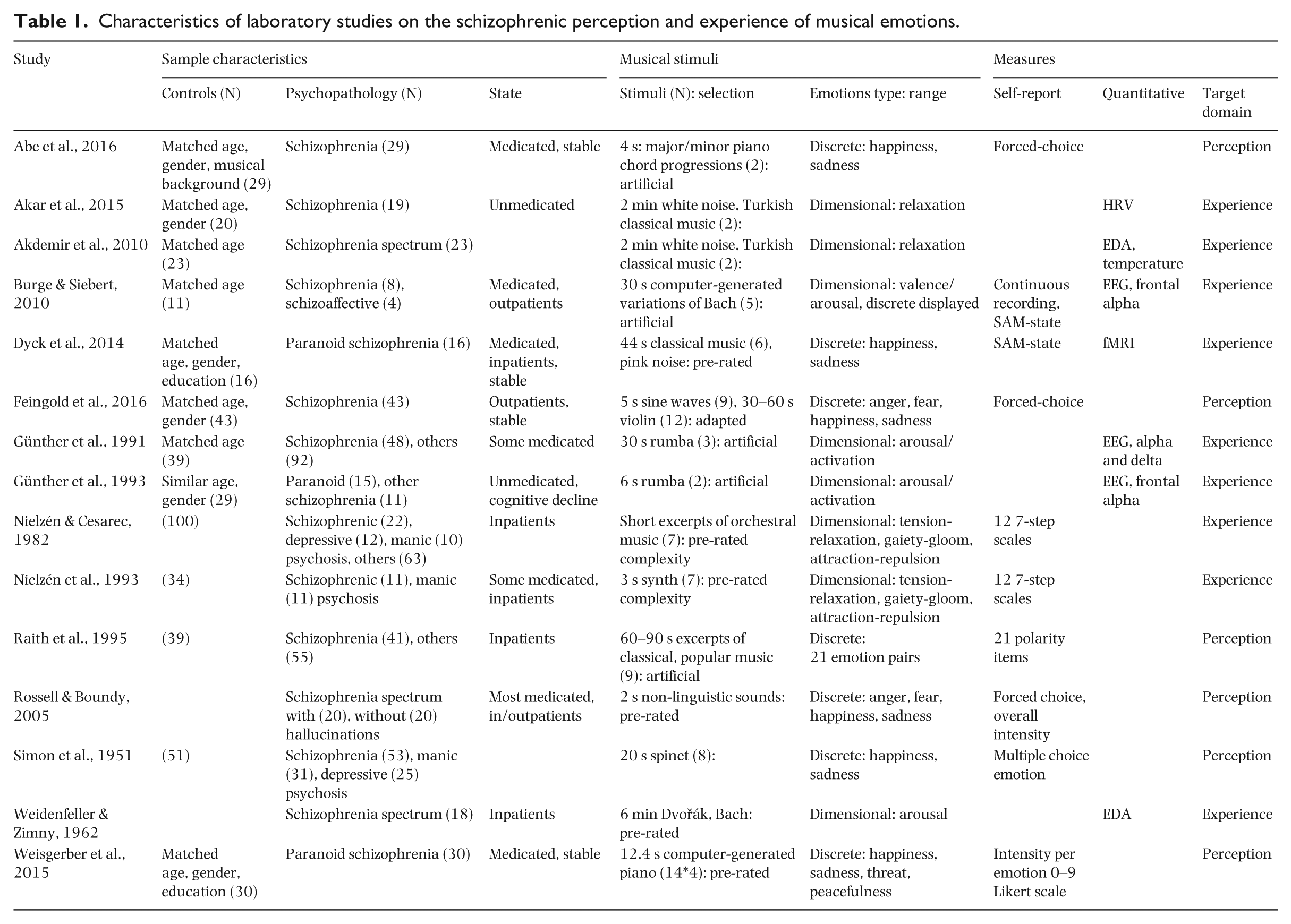
Given the scarcity of studies obtained, and their methodological disparities, a meta-analytic approach was unjustified. Thereby, a qualitative review follows.
Perception of musical emotions in schizophrenia
In a pivotal study, Simon, Holzberg, Alessi, and Garrity (1951) asked patients with schizophrenia, manic psychosis, and depressive psychosis, as well as a control group, to listen to short recordings of music played on a spinet, a type of harpsichord, and classify them by the sadness or happiness that they may express. Although all groups were reported to succeed in discriminating between musical valences, controls made significantly fewer errors. The effect was sensitive to negative valence – patients with schizophrenia and manic psychosis misidentified sad recordings more commonly; individuals with depressive psychosis were as proficient in recognizing sadness as controls were. The authors argued that impaired ego functioning and dissociative processes were to blame for the rejection of negative affects.
Four research teams made observations which were incongruent with Simon’s conclusion (1951) but also had some shortcomings. Raith, Steinberg, and Roth (1995) asked patients diagnosed with a schizophrenic disease to assess their perceptions of a wide range of emotions expressed by nine classical music excerpts. Patients were more likely to rate music as negative but a test of the statistical significance of this finding was not performed. Rossell and Boundy (2005) compared patients with and without auditory hallucinations with respect to their emotion recognition capacities. Hallucination sufferers mislabeled stimuli as more negative, and readily mistook happiness for fear. However, this study used vocalizations in place of complex musical stimuli. Abe, Arai, and Itokawa (2016) reported that individuals with schizophrenia could not discriminate between the valence of a major and a minor chord progression and that the more impaired their general functioning was, the likelier they were to associate a minor chord progression with neither sadness nor happiness. However, only a single pair of stimuli was used in this one-minute task. Lastly, Dyck, Loughead, Gur, Schneider, and Mathiak (2014) tested participants’ recognition of the emotions expressed by classical music excerpts that were to be used in a mood induction study. Schizophrenia patients recognized musical happiness and sadness, but exact accuracy data were not provided. These studies cast doubts on the deduction that negative valence specifically complicates schizophrenic emotion recognition (Simon et al., 1951) but cannot provide an alternative explanation.
Some elucidation on the matter comes from a comprehensive study by Weisgerber et al. (2015). Medicated patients listened to excerpts of piano music that expressed either happiness, sadness, threat, or peacefulness. Ratings of the discrete emotions were analyzed with respect to their accuracy and further compared with the same participants’ performance on similar tests using vocal affect bursts and facial expressions.
Though controls achieved accuracy scores that were far from perfect, patients scored significantly worse across all disciplines. Upon closer inspection, however, their performance deficits differed between the musical and nonmusical tasks. Whereas recognition of prosodic and facial emotions weakened as their valence decreased, recognition of musical emotions depended on their arousal, so that sadness and peacefulness were commonly misidentified as threat and happiness, respectively. Patients also assessed musical emotions as distinctly more intense. The trend grew stronger in individuals suffering from more pronounced positive symptoms, but not significantly so.
Auditory impairments in schizophrenia may explain the finding. When there is an overabundance of sonic information not organized by pitch, melodic discrepancies can go unnoticed and fail to convey the affective content presumed. Therefore, an afflicted listener should present with altered emotion recognition. However, the listener may access other affective cues to construct a percept, and this may be expressed in overestimated arousal and intensity levels (Weisgerber et al., 2015).
A recent study (Feingold et al., 2016), which examined the roles which stimulus complexity and modality play in schizophrenic emotion perception, partially supports this view. Stabilized outpatients were presented with visual, semantic, and auditory stimuli of low or high complexity levels. Auditory stimuli included low-complexity sine waves and high-complexity violin segments. Patients performed with uniformly lower accuracy than controls – no complexity-specific deficit was observed. Authors suggested that schizophrenically-impaired emotion recognition may be attributed to deficits in bottom-up processes, including attention, but cautioned that a contribution of deficits in higher-order cognitive processes could not be excluded.
A modality-specific deficit was not observed either. It was beyond the scope of the study to examine the effect of arousal or valence, which would have provided a more complete picture of the findings. No significant association emerged between schizophrenia symptoms and recognition rates.
Two studies probed the matter of preference and agreed that its relationship to stimulus valence may be inverted by schizophrenia. Simon et al. (1951) were able to associate schizophrenia and manic psychosis with an increased preference for sad music. Raith et al. (1995) noticed that between inpatients suffering from depressive schizophrenia or schizophrenic psychosis, only the former disliked negatively-valenced pieces of classical music.
In summary (Table 2), although individuals with schizophrenia make more errors than individuals without schizophrenia when recognizing musical emotions, the extent of this impairment is unclear. Recognition rates may change depending on the valence of the musical stimulus, but musical arousal is a likelier candidate factor; perceived arousal can be overestimated. Perception of musical emotions may be altered by symptomatology, but findings are inconclusive. In schizophrenia, approach tendencies accompany negative affects.
Schizophrenic variations in the perception of musical emotions and their correlations with stimulus valence (V), stimulus arousal (A), and patient symptomatology (S).
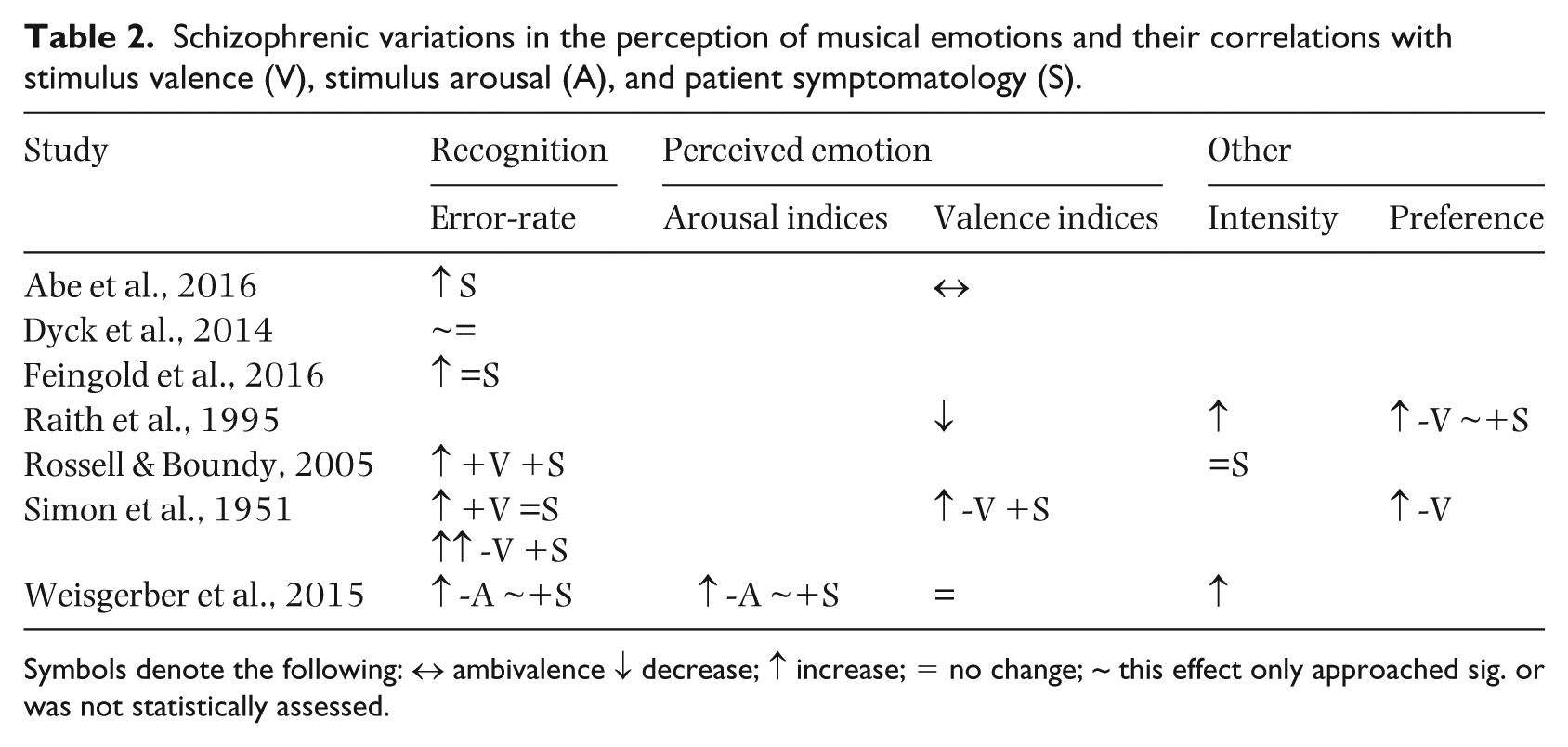
Symbols denote the following: ↔ ambivalence ↓ decrease; ↑ increase; = no change; ~ this effect only approached sig. or was not statistically assessed.
Experience of musical emotions in schizophrenia
An early study (Weidenfeller & Zimny, 1962) probed music-related changes in galvanic skin resistance of schizophrenia patients listening to classical music. Pieces of exciting music were reported to decrease electrical resistance throughout their duration, meaning that autonomic arousal was continually heightening. Calming music was associated with a delayed increase in resistance which plateaued out shortly. The study lacked a direct comparison group but, based on their previous research, the authors argued that healthy autonomic arousal would increase further when responding to exciting music and decrease comparably to patient samples when responding to calming music.
Two later studies recorded EDA (Akdemir, Kara, & Bilgiç, 2010) and HRV (Akar, Kara, Latifoğlu, & Bilgiç, 2015) while participants rested or listened to white noise or Turkish classical music. The music was selected for its calming and pleasing properties, although these were not affirmed experimentally.
Music appeared to foster an increase in EDA in patients and a greater increase in controls (Akdemir et al., 2010). HF-HRV did not significantly deviate from baseline in either group (Akar et al., 2015). Assuming that EDA reflects emotional arousal and HF-HRV speaks for valence, it would appear that: 1) the calming and pleasing properties of the music did not translate into respective changes in autonomic indices in either group, and 2) patients experienced less arousal in response to the particular piece of music. Possibly, the stimulus was more exciting than assumed and fostered the pattern of sympathetic changes theorized by Weidenfeller and Zimny (1962). Alternatively, the unfortunate lack of control over sample characteristics in both EDA studies (Akdemir et al., 2010; Weidenfeller & Zimny, 1962) may have skewed the results.
The comparative effects of music and noise are of special interest. Representing a neutral stimulus, white noise should promote a moderate level of arousal and lack a clear valence; although in comparison with other colours of noise, the dissonance and high frequency of white noise may irritate some. Indeed, white noise was associated with a significant increase in EDA in both groups (Akdemir et al., 2010). A decrease in parasympathetic activity, as indexed by HF-HRV, occurred in controls only (Akar et al., 2015). Overall, the patient group reacted very similarly to static and music. If not an artefact, this might indicate reduced responsiveness to valence cues.
Spectral EEG studies corroborate this. Burge and Siebert (2010) probed frontal alpha asymmetry values in schizophrenia inpatients listening to Bach compositions and to their computer-generated variants. The stimuli underwent increasing amounts of manipulation designed to attenuate their resemblance to the original. Assuming that unpronounced alpha power over the right hemisphere corresponds to a negatively-valenced experience, controls in this study experienced a strong distaste for the most degraded stimuli. Patients, on the other hand, demonstrated more diffuse activation, such that the steadily low alpha did not differ between hemispheres with any stimulation.
Similar findings were reported in a series of studies by Günther et al. (1991, 1993) who recorded overall neural activity from unmedicated schizophrenia patients suffering from serious general functioning decline. Alpha and delta frequency bands yielded signs of diffuse hyperactivation that remained non-responsive when exposed to rhythmic relaxation music, by contrast to controls and other psychiatric patients. As the authors suggested, an experience of intense arousal and disorganized or ambivalent valence may explain the data.
Dyck et al. (2014) raised support for this conclusion. Controls and inpatients diagnosed with paranoid schizophrenia underwent a visual or an audiovisual mood induction procedure and their experiences were probed via self-report and functional magnetic resonance. Both procedures raised similar valence ratings between groups. Arousal was significantly heightened during the audiovisual procedure in both groups, but the difference was especially pronounced amongst patients. Overall, the addition of classical music to a visual paradigm did not affect patient experiences of valence but increased their arousal.
Patient brain responses revealed great differences. Sensory areas manifested hypoactivation, whereas higher cortical areas were hyperactivated, especially during the audiovisual procedure. Increased connectivity between primary and secondary sensory areas was also observed. These findings were attributed to impaired sensory filtering in schizophrenia patients and a higher effort exerted by them to compensate for this (Dyck et al., 2014).
Burge and Siebert (2010), who cleverly supplemented their EEG study with self-report measures, re-introduced the theme of incongruent valence and preference ratings among schizophrenia patients. Irrespective of symptomatology, outpatients reported a greater attraction towards digitally-manipulated Bach compositions than controls, despite having an otherwise ‘correct’ experience of their valence and arousal. An earlier series of studies with over 100 psychiatric patients observed a similar effect (Nielzén & Cesarec, 1982; Nielzén, Olsson, & Ohman, 1993): patients undergoing psychosis were more attracted to music, and the difference was especially pronounced when negatively-valenced stimuli were at play. In one study (Nielzén & Cesarec, 1982), patients were drawn to those short pieces of orchestral music which controls had found the least appealing. In the other (Nielzén et al., 1993), patients reported an increased preference for complex synthesized sounds described as harsh and dissonant. Simultaneously, patients rated their experiences as more tense and less calming in both studies. The authors postulated that the combination of complexity and dissonance, which characterized some of their stimuli, was representative of the perceptual alterations that may occur during psychosis, and that it may have been this memory of the state that sensitized the listeners. Overall, self-reported data indicate that negatively-valenced properties of music foster ambivalence in schizophrenia.
In summary (Table 3), the experience of musical emotions tends to be more arousing in schizophrenic subgroups. Experienced valence is not clearly affected but might be more ambiguous. Negative affects coincide with approach tendencies. This seems unrelated to symptomatology.
Schizophrenic variations in the experience of musical emotions and their correlations with stimulus valence (V), stimulus arousal (A), and patient symptomatology (S).
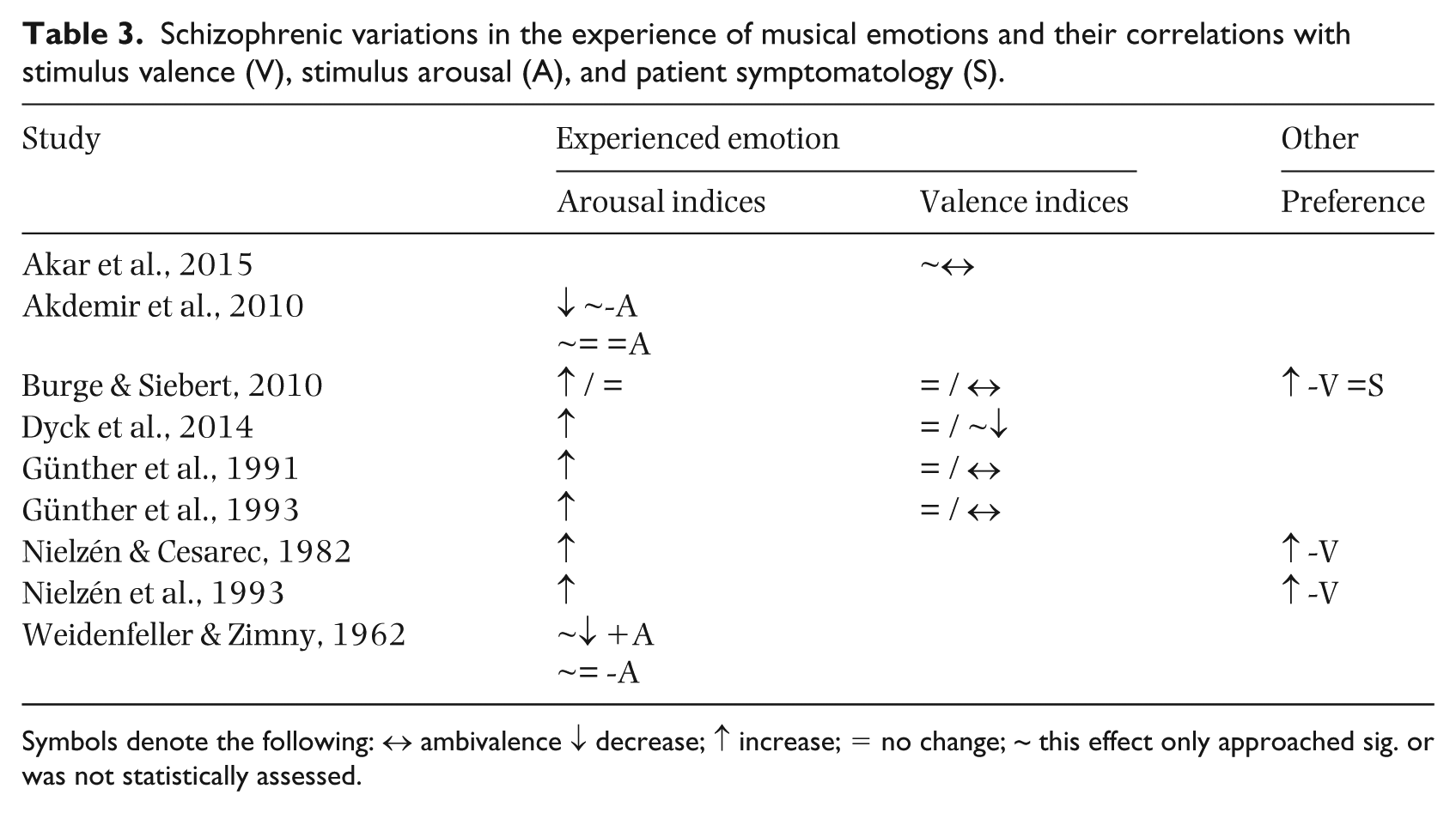
Symbols denote the following: ↔ ambivalence ↓ decrease; ↑ increase; = no change; ~ this effect only approached sig. or was not statistically assessed.
Discussion and conclusion
Musical emotions are not mere subjective phenomena that are too loosely defined to be studied scientifically – they can have experimental utility and practical applications (Vieillard et al., 2008). Indeed, music has a history of unexpected effects on psychopathologies, having helped to identify both underlying trends missing for a complete theory of emotion, as well as interactions specific to the stimulus or disorder (Lima, Garrett, & Castro, 2013; Quintin et al., 2011). This article seeks to motivate the use of musical material in research on emotion in schizophrenia. Impairments which could alter the processing of music and emotion in schizophrenia have been identified, and neurophysiological and self-reported data pertaining to the schizophrenic patient’s perception and experience of musical emotions have been reviewed. The comparative effects of musical and nonmusical materials on schizophrenic perception and experience of emotions are next assessed, highlighting the areas which warrant further investigation.
Musical and nonmusical research shared one major conclusion: that individuals with schizophrenia recognize emotions less accurately than individuals without schizophrenia. The extent of the musical impairment seen varied between studies. Whereas some authors identified a pronounced deficit, others saw negligible variations. Nonetheless, an effect of stimulus type on accurate emotion recognition was not confirmed by the two studies which were able to analyze it (Feingold et al., 2016; Weisgerber et al., 2015). General sensory and attentional deficits may explain this impairment. Hypoactivation of sensory areas (Dyck et al., 2014) and a reduced reactivity of ERPs (O’Donnell et al., 2012) suggest that individuals with schizophrenia do not efficiently parse some sonic data and therefore might inadvertently ignore some affective cues embedded therein. Recognition of prosodic and musical emotions may become less accurate, as a result. Although bottom-up processes likely contribute to emotion recognition deficits in schizophrenia, their relative importance remains a topic of study (Feingold et al., 2016). Future investigations in music could contribute to the discussion. Schizophrenia is comorbid with amusia and can alter the perception of pitch and other elements of music (Hatada et al., 2014; Kantrowitz et al., 2014) but how this relates to emotion recognition remains uncharted. Further, the presumed automaticity of musical relative to nonmusical emotions (Dyck et al., 2014; Peretz, 2006) could help specify the impact of higher-order deficits on emotion recognition and even rule out the causal role of a generalized emotion deficit (Feingold et al., 2016).
Musical research offered three conclusions that contested those arrived at previously, as follows: 1) schizophrenia does not modulate the valence of musical emotions but can magnify their arousal; 2) negatively-valenced material is more attractive to affected listeners; and 3) both perceived and experienced emotions share these characteristics.
A single observation of reduced emotion identification accuracy for negatively-valenced stimuli (Simon et al., 1951) matched nonmusical findings (Aleman & Kahn, 2005). Five later studies reported either a different relationship between identification accuracy and valence (Abe et al., 2016; Raith et al., 1995; Rossell & Boundy, 2005) or no relationship at all (Dyck et al., 2014; Weisgerber et al., 2015). Experiences of musical valence have shown signs of normality despite the diagnosis of schizophrenia, although tendencies towards greater ambiguity have been recorded. Nonmusical material can also elicit a preserved experience (Aleman & Kahn, 2005) but more negative experiences should have arisen in unstable individuals sampled by some of the reviewed studies (Akar et al., 2015; Günther et al., 1991, 1993). Overall, individuals with and without schizophrenia appear to perceive and experience musical valences similarly.
The vague relationship between valence and the schizophrenic listener’s perception and experience thereof might be explained by the concurrent arousal of the stimulus. A convincing finding indicated that patients with schizophrenia overestimated the arousal of music, irrespective of its valence, and were only sensitive to valence, not arousal, of nonmusical material (Weisgerber et al., 2015). Review of musical experiences in schizophrenia uncovered consistent evidence of overarousal. Varied patient samples had highly arousing experiences, as indexed by miscellaneous measures: stabilized patients as well as individuals undergoing psychosis or suffering from a steep cognitive decline reached higher than normal excitement, according to self-reported data (Nielzén & Cesarec, 1982; Nielzén et al., 1993), spectral EEG (Burge & Siebert, 2010; Günther et al., 1991; 1993), or imaging data (Dyck et al., 2014). Arousal typically rises in persons who are sensitized by the symptoms of psychosis or their connotations (Aleman & Kahn, 2005; Cohen & Minor, 2008). Indeed, some properties of music could connote psychotic symptoms and foster abnormal reactions (Nielzén & Cesarec, 1982; Nielzén et al., 1993). The uniformity of musical overarousal could also originate in schizophrenic auditory deficits (Dyck et al., 2014; Weisgerber et al., 2015). Music may provide a relative overload of affective cues, which patients could fail to inhibit. The interpretations are speculative but their implication – that even stabilized individuals cannot self-regulate when exposed to music – should motivate further investigation.
Music perception and experience studies noted that individuals with schizophrenia were more attracted to music which was negatively-valenced (and perceived or experienced as such) or which contained conventionally displeasing properties (such as harshness or dissonance). However, it is unclear if patients were more attracted to music in general or some music in particular. Schizophrenia is comorbid with amusia in up to 62% of the cases (Hatada et al., 2014) but none of the reviewed studies monitored this impairment in their participants. Listeners whose hearing was compromised may have been less affected by the unpleasant characteristics of a stimulus, not necessarily more attracted to them. Indeed, positively-valenced music also stimulated approach tendencies (Nielzén & Cesarec, 1982; Nielzén et al., 1993). Whether general or specific, the increased appeal of music is a rare finding in schizophrenia research. In nonmusical conditions, patients tend to be averted by positive or neutral experiences, possibly owing to their deficits in inhibiting negative emotions (Cohen & Minor, 2008). The contrasting appeal of music could be rooted in music’s intimate relationship with the reward pathway. Schizophrenia is associated with the overactivation of this pathway and, assuming that music can intensify this in patients as well as in controls (Chanda & Levitin, 2013), increased stimulus salience could follow. Subcortical imaging will need to determine the validity of this interpretation.
The emotion-paradox in schizophrenia denotes a commonly observed divide between the grossly impaired perception of emotions and relatively preserved experience thereof (Aleman & Kahn, 2005). Despite the clear dissociation between perceived and felt emotions in music (Gabrielsson, 2002; Schubert, 2013), their schizophrenic disjunction could not be supported by this review. Neither perceived nor experienced musical emotions were preserved and both shared heightened arousal and ambiguous valence. Furthermore, these characteristics did not appear to depend on symptomatology. This indicates that both the perception and experience of musical emotions are altered by similar underlying mechanisms, which could be inherent to schizophrenia or specific to music. The possible absence of an emotion-paradox in music warrants the keenest investigation.
Future research should target the reproducibility of the above findings. The collected studies differed widely in their methods, including key aspects such as stimulus selection and stimulus complexity. This variability may have skewed the present results. Furthermore, although music offers the opportunity to examine the emotion it expresses and elicits at once, none of the reviewed studies took advantage of this. The method can be more sensitive to variations between percepts and experiences (Schubert, 2013) and will be essential to determine their actual extent in schizophrenia.
Existing findings also need to be supplemented. As stressed previously, assessing the degree and kind of auditory deficits present in a sample will be essential. Relatedly, objective properties of the music should be more carefully considered. These are especially relevant to the study of musical percepts (Gabrielsson, 2002) and their manipulation could point to the origin of the emotion recognition impairment and explicate its relationship with valence and arousal. Properties which need to be addressed include pitch and melody, which are known to be perceived differently by people with schizophrenia (O’Donnell et al., 2012), as well as rhythm, timbre, and other characteristics that have not been sufficiently studied. Some personal and situational factors, with may be particularly important in the study of musical experiences (Gabrielsson, 2002), also need examining, including the musical background and general music preferences of participants, or stimulus familiarity. Researchers may also want to employ participant-selected stimuli, which could lead to different degrees of perception–experience dissociations (Schubert, 2013).
Once the evidence is clearer that musical emotions differ from nonmusical ones, and that musical percepts and experiences do not diverge from each other, further investigative methods will be warranted. These should elucidate not only the origin of the emotion-paradox in schizophrenia but also the potential role that music can play in the treatment of the disorder.
Music therapy interventions draw on the assumption of a close correspondence between emotion perception and experience (Gabrielsson, 2002), and it must be ascertained that this is not violated in the case of schizophrenia. The heightened attractiveness and arousal of musical emotions in this population should be closely inspected. While these characteristics can benefit stabilized individuals and decrease the negative symptoms that they may struggle with (Silverman, 2003), they could be undesirable in the acute phase of the illness. Emotional regulation is threatened by psychosis and intense emotional experiences need careful managing. In this respect, the importance of further research on the properties of music, including tempo, rhythm, complexity, and genre, is stressed again, as some could promote unhealthy reactions (Nielzén & Cesarec, 1982; Nielzén et al., 1993). Subcortical imaging could help determine the generalizability of musical findings and identify the causes of musical overarousal. Qualitative research, although excluded from this review, will be of great importance. Qualitative methods can illuminate the perspective of the patients and support therapist comprehension of their experiences. These will also be useful in order to better understand the everyday listening habits of persons with schizophrenia and to minimize potentially maladaptive uses of music in this population (Weisgerber et al., 2015).
Musical emotions may be indicative of unprecedented trends in schizophrenic emotion and the fields of music psychology, music therapy, and schizophrenia research alike can greatly benefit from further investigations of these. If music-related findings prove to be generalizable, this would mean that existing theories of schizophrenic emotion are incomplete and burdened by the thus-far-restricted range of emotional material. If the uncovered effects were music-specific, they could have implications for everyday and therapeutic uses of music in schizophrenia and psychosis. Either way, an improvement in the use of musical material in research on emotion in schizophrenia is justified.
Footnotes
Acknowledgements
Thank you to Dr. Tim Metcalfe for his assiduous proofreading of this paper.
Declaration of conflicting interests
The author(s) declare no potential conflicts of interest with respect to the research, authorship, and/or publication of this article.
Funding
The author(s) received no financial support for the research, authorship, and/or publication of this article.
