



Abstract
Research has shown that musical training is associated with a greater ability to aurally connect chord progressions to specific pieces of music. However, it is unclear what specific aspects of musical training contribute to that ability. The present study investigated the effects of various aspects of professional and amateur jazz musicians’ formal training and work with harmony on their ability to identify well-known jazz standards from chord progressions. For participants who were able to identify songs from commercial recordings in this experiment, general long-term involvement with activities believed to increase awareness of harmony, such as playing a harmonic instrument, playing chords by ear, and transcribing harmonic progressions was often not enough to enable them to identify songs from their chord progressions alone. Additionally, the ability to identify songs from chord progressions was most strongly correlated with having played and being able to write out the chord labels of the target pieces from long-term memory. Implications of these and other results of this experiment for our understanding of jazz musicians’ processing and memory of harmonic information are discussed.
Over the past six decades, studying the ability to name well-known tunes has been a popular way to investigate the encoding of melodies in long-term memory (for a review, see Halpern & Bartlett, 2010). More recently, identification of well-known music has also been used to study aspects of musical memory. For instance, it has been demonstrated that when familiar enough with a specific recorded version of a song, participants can identify it from excerpts as short as 100 ms, suggesting that timbre can be encoded with great detail in long-term memory (Krumhansl, 2010; Schellenberg, Iverson, & McKinnon, 1999). The present study uses the ability to name well-known music from chord progressions as a means to investigate memory for harmony. Although it has been claimed that it is possible to identify music from chords alone (Aikin, 2004; Berliner, 1994; Burns, 1987; Coker, Knapp, & Vincent, 1997; Maceli, 2009), this type of identification has largely remained unstudied. The lack of research on this topic is not surprising considering that such an ability appears to be at odds with the common belief that chord progressions are either generic formulas shared by many pieces of music (Baker 1983; Biamonte, 2010; Scott, 2000; Stoia, 2013) or an element of musical structure meant to contribute to the articulation of form and the ebb and flow of tension (Bigand & Parncutt, 1999; Lerdahl & Jackendoff, 1983; Lerdhal & Krumhansl, 2007; Meyer, 1956, 1973; Schenker, 1935/1979). However, recent research has demonstrated that it is indeed possible to identify well-known music from chord progressions alone (Jimenez & Kuusi, 2017), although this ability appears to be highly constrained by participants’ musical background (Kuusi, 2009; Povel & Van Egmond, 1993). We believe that investigating the exact nature of these stringent constraints can provide valuable insights into the ways that chord progressions are encoded in and activated from long-term memory.
Jimenez and Kuusi (2017) found that musicians are better than non-musicians at identifying well-known music from chord progressions. However, it is not clear what gives musicians their edge. One potential explanation is that musicians have developed the ability to form richer and more easily activated long-term auditory memory traces for harmony due to their frequent work with chord progressions (e.g., playing chords on a harmonic instrument or transcribing chord progressions). Or perhaps musicians are simply more familiar with the music used in identification tests, and this greater familiarity may include the multi-sensory (e.g., motor and visual) and multi-domain (e.g., conceptual and perceptual) knowledge acquired by having played or analyzed those specific pieces. Investigating the exact nature of musicians’ greater ability to identify well-known music from chord progressions can deepen our understanding of the effects of musical training on the perception of harmony. Evidence that amount of musical training has an effect on the identification of music from chord progressions would indicate that musical training can have long-term effects on the perception of and memory for harmony beyond its well-documented general effects on harmonic priming (for a review, see Bigand & Poulin-Charronnat, 2009) and sensitivity to bi-tonality (Kopiez & Platz, 2009; Wolpert, 2000).
Jazz musicians and harmony
The study of harmony has a central role in jazz musicians’ training, and the practice of identifying songs from chord progressions has sometimes been used by jazz musicians as a method to cultivate their listening skills (Berliner, 1994). Awareness of chords influences jazz musicians’ decisions during improvisation and their understanding of the structure of a piece (Baker, 1983; Crook, 1991; Dunscomb & Hill, 2002; Finkelman, 1997; Johnson-Laird, 2002; Laughlin, 2001; Monson, 1996; Owens, 1995; Palmer, 2016; Steedman, 1984). Although information about chords is included on lead sheets (abbreviated musical notation including the melody, lyrics and harmony of a popular song), it is believed that committing harmonic changes to memory can aid jazz musicians in making improvisations more fluid (Johnson-Laird, 2002; Norgaard, 2011; Norgaard, Emerson, Dawn, & Fidlon, 2016; Owens, 1995; Reeves, 2001; Spitzer, 2001) and more adaptable to different work environments. Additionally, because jazz chord progressions are often modified and because jazz performers often accompany pieces they have never heard before, jazz musicians are expected to aurally identify chord patterns and their common variations when improvising with other musicians (Coker 1964, 1989; LaPorta, 2000; Laughlin, 2001; Maceli, 2009; May, 2003; Palmer, 2016). It is presumed that such harmonic awareness can be developed by playing chord progressions on a harmonic instrument or outlining harmonic structures with a melodic instrument, as well as by transcribing chord progressions with or without the aid of an instrument (Berkman, 2009; Berliner, 1994; Halberstadt, 2001; Levine, 1995; Reeves, 2001; Spitzer, 2001).
Although the study of the relationship between musical training and identification of well-known music from chords is a new topic, much research exists on how musical training affects the perception of harmony in general. For instance, there is ample evidence that musical training is associated with increased attention to harmonic elements (Farbood, 2012; Norgaard, 2016; Sears, Caplin, & McAdams, 2014; Williams, 2004) and heightened harmonic sensitivity. The latter has been measured using both behavioral (Corrigall & Trainor, 2009; Loui & Wessel, 2007) and neuroscientific methods (Brattico, Tupala, Glerean, & Tervaniemi, 2013; Koelsch, Schmidt, & Kansok, 2002; Steinbeis, Koelsch, & Sloboda, 2006). There is also anecdotal evidence that music students who play a harmonic instrument (e.g., piano, guitar) are usually better than other musicians at activities requiring aural sensitivity to harmony, such as harmonic dictation (Chittum, 1969) and improvisation based on chord progressions (Berkman, 2009; Berliner, 1994). Jazz double bass players are believed to have a more developed sense of harmony because they are required to provide harmonic support for jazz compositions by emphasizing their chordal roots, outlining chord progressions, and adapting to harmonic variations proposed by other performers during improvisations (Berliner, 1994). Furthermore, playing a bass-range musical instrument (e.g., cello, double bass) can increase sensitivity to harmonic deviations in the low voice of polyphonic textures (Marie, Fujioka, Herrington, & Trainor, 2012). Interestingly, the sensitivity tested in Marie et al. (2012) used a pre-attentive physiological measurement, which suggests that the instrument musicians play can strongly impact the mental processing of sounds even during passive listening. However, it can be difficult to test the effect of jazz musicians’ instruments on their perception of harmony because, regardless of their main instrument, jazz musicians often play several instruments, including piano (Berkman, 2009; Levine, 1995; Spitzer, 2001; Waite, 1987).
It is possible that the influence of playing a specific instrument on harmonic awareness, specifically on the identification of well-known music from chord progressions, is also determined by how long musicians have played their instrument as well as the ways in which their playing interacts with harmonic structures such as chord progressions. Jazz instructors often believe that playing chord progressions on a harmonic instrument and outlining chord progressions with a melodic instrument can increase jazz students’ harmonic awareness (Levine, 1995; Reeves, 2001). But the way those harmonic structures are played may determine the degree of effect such playing has on harmonic awareness. Musicians can play chord progressions by reading or memorizing them from written notation (e.g., staff notation or chord symbols), or they can play chord progressions by ear by imitating other musicians from a recording or live performance. Jazz musicians have historically relied heavily on imitating recordings and other performers as a way of learning the subtleties of the jazz vocabulary, including its harmonic elements (Berliner, 1994). Although the development of reading skills is an important component of formal jazz training, many jazz musicians believe that aural skills, particularly the ability to imitate with their instrument, are more important than reading skills for jazz improvisation (Lawn & Hellmer, 1990). Laughlin (2001) found that the harmonic accuracy of improvisations was significantly higher for beginner jazz musicians whose previous practice had emphasized aural instrumental imitation exercises over notation. There is also neurological evidence that a performer’s reliance on musical notation in everyday musical activities can affect the mental processing of music during passive listening (Seppänen, Brattico, & Tervaniemi, 2007). Although there is evidence that the length of musical training correlates with the strength of pre-attentive responses to dissonant and mistuned chords (Brattico et al., 2009), the effects of playing by ear on harmonic awareness or other more specific forms of memory for harmony—such as identifying well-known music from chord progressions—have not yet been tested.
Aims of the present study
The present study examines the relationship between various aspects of jazz musicians’ training and work with harmony, and their ability to identify well-known jazz standards from chord progressions. More specifically, we investigated the following variables’ effects on the ability to identify jazz standards from chord progressions: participants’ formal training in jazz harmony; main instrument; amount of time devoted to different types of work with harmony (e.g., playing chords by ear, playing chords from labels, imitating and transcribing chord progressions); and having played and being able to write down the chords of the target pieces from long-term memory. Based on the literature and anecdotal evidence, we expected all of these variables to be significant.
Method
Design
Principal Component Analysis was used to group the participant variables into factors, and a linear regression analysis was used to analyze the effect of the factors on the identification of jazz standards. Additionally, we used a univariate analysis of variance to examine the importance on identification of the main instrument as well as the participants’ work with the chords of the target pieces.
Participants
Altogether 71 jazz musicians (55 male, 16 female; mean age = 32.9, SD = 13.03) completed the experiment either in group testing sessions or online. Participants for the group testing sessions (29) were volunteers recruited among jazz musicians who were enrolled or had completed a Master’s jazz program in Finland. These musicians completed a paper version of the questionnaire and were tested in small groups of fewer than 6 participants each. Online participants were recruited among students and colleagues of instructors from various jazz programs. A total of 127 jazz instructors from 39 conservatories, 35 colleges, and 7 jazz online forums, from 21 different countries were asked to help us distribute our call for participants. The 42 participants who completed the online experiment were currently or previously enrolled in jazz programs in the US (14), Canada (6), Germany (6), UK (4), Finland (4), Australia (1), or the Netherlands (1); or they worked as professional jazz musicians but had no formal training in a jazz program (6). Responses from participants who did not complete the online experiment in its entirety (40) were not included in our analysis. The total group of participants who completed either version of the experiment included 16 pianists, 15 saxophone players, 12 singers, 8 drummers, 7 bass players, 6 guitarists, 4 trumpet players, 2 trombone players, and 1 vibraphone player. The participants had studied their main instrument for 4–57 years (average 22.13 years). Our initial plan to have each type of instrument (e.g., harmonic, melodic, bass, rhythmic) represented by an equal number of participants was discarded because most participants reported having considerable experience in playing several instruments. There were also more than three times more male participants than female. However, to our knowledge, there is no evidence of a gender effect on harmonic awareness in the literature.
Stimuli: Pieces
The pieces for the experiment were selected using a three-step procedure. We first selected 200 pieces from the Hal Leonard Real Books volumes I, II, and III (The Real Book, 2004, 2005, 2006) based on their popularity on the music website LastFM.com. Popularity was determined by adding up the number of listenings (scrobbles) for the three most popular recordings of each piece. In the second step, we selected 40 pieces from the set of 200 pieces based on the following criteria:
a) Harmonic uniqueness: Coker (Coker et al., 1997) distinguished between two components of a jazz chord progression, which he termed “glue” and “hooks.” He described harmonic “glue” as the most common elements of jazz chord progressions, such as root motions by ascending P4 or descending P5, whereas harmonic “hooks,” though less common, often enable jazz musicians to identify specific tunes. While Coker estimated that the frequency of ascending P4 or descending P5 root motions in the core jazz repertoire was between 60% and 90%, a recent corpus analysis suggests that their average frequency is 46% (Broze & Shanahan, 2013). Taking into account both of these estimates, we decided to give priority to pieces with less than 50% of ascending P4 or descending P5 root motions in their opening chord progressions.
b) Rhythmic density: Jimenez and Kuusi (2017) found a strong significant correlation between piece identification from chord progressions and rhythmic density. Less rhythmically dense pieces were more often identified from chords than other, rhythmically denser pieces. Target pieces whose rhythm was at least eight times denser than the block-chord stimuli were rarely identified from chords. The authors hypothesized that this pattern of identification was a consequence of the different degrees of rhythmic similarity between the long isochronous block chords used as stimuli and the target pieces. Based on those findings and the fact that our experiment also uses long isochronous block chords, we decided to exclude from the pilot any piece whose opening melody had a pitch-×-chord-change ratio higher than 10:1 (e.g., an opening melody with 11 notes in the duration of the first chord). As a result, some jazz standards whose opening chords change very slowly were discarded even when the opening melody in those pieces featured relatively slow and simple rhythms (e.g., “Impressions”).
c) Harmonic rhythm: Jimenez and Kuusi (2017) found that harmonic rhythm differences between chordal stimuli and target pieces hindered identification. In the present study, in order to minimize the effect of rhythmic cues on piece identification, the stimuli were isochronous and no chord was immediately repeated. Pieces whose opening chord progression was originally isochronous were thus given preference in the selection process. Jazz standards whose original harmonic rhythm was not isochronous were only considered if they were very popular or harmonically distinctive. In the specific case of “Take Five,” evening out the duration of the chords (i.e., getting rid of the alternation of dotted and non-dotted half-note chords) also affected the meter (i.e., losing the quintuple meter feel). It is also possible that due to the predominance of binary/quadruple meter in the jazz repertoire, participants may have found it difficult to associate our isochronous non-repeating-block-chord progressions with less frequent meters such as 3/4 and 6/8 even when the harmonic rhythm itself was not changed. Such potential challenges notwithstanding, a few pieces in triple meter were considered because of their popularity and often identified by participants (e.g., “Tenderly,” “Moon River”).
d) Variety of recording artists: In order to create a balanced selection in terms of recording artists most commonly associated with the selected pieces, we decided that no more than four pieces in the pilot should have a strong association with the same recording artist (i.e., the artist with the most popular version on LastFM.com).
In the third step, we selected 16 pieces for the main experiment based on a pilot where nine professional jazz musicians were asked to identify the pre-selected 40 pieces from their chord progressions. We chose the 16 most often identified pieces for the main experiment. A list of these pieces is provided in Appendix A in the Supplementary Materials online.
Stimuli: Chord progressions and commercial recordings
Roots and main chord qualities for the chord progressions consisting of seven, eight, or nine chords from the beginning of the main theme of the standard were taken directly from Real Books. Additionally, the top voice of the chord progressions was composed to represent the most important, often harmonically characteristic, notes of the original melody of the jazz standard. A professional jazz pianist was consulted to ensure that the choice of chords and voicings in our progressions conformed to jazz stylistic practices. The durations of the chords were determined by averaging the duration of every chord in the three most-viewed versions of the original jazz tune on YouTube. In order to minimize the effect of harmonic rhythm on tune identification, the duration of the chords in the block-chord stimuli was modified so that every chord in each progression had the same duration. Chord progressions were recorded with a Steinway piano sound using Garage Band software. Audio excerpts for the second part of the experiment were extracted from commercial recordings. Excerpts lasted 15 seconds and contained the chord progressions used in the first part of the experiment. Some excerpts included vocals, but no excerpt contained any part of a song’s title.
Procedure
In the main experiment, participants were first asked to listen to each chord progression and to identify the piece from which the chord progression was taken. After participants heard all 16 chord progressions, the tunes were then presented as commercial recordings, and participants were asked to name the tunes and to provide information about whether they had ever played the chords of any of the pieces. To control for order effects, participants were presented with both the chordal stimuli and the commercial recording stimuli in different orders. After these two sections of the experiment were completed in their entirety, participants were asked to provide background information about their formal education and activities with the jazz repertoire (see Appendix B in the Supplementary Materials online for the questionnaire). At the end of the experiment, participants were asked to write from memory (using chord symbols or other types of chord labels) what they considered to be the typical first four chords of the pieces used in the experiment.
In scoring the responses, correct names, words from the lyrics, or other descriptions of a piece were scored as 1 (identified), while other responses were scored as 0 (unidentified). If a participant suggested a piece other than what we had in mind, we checked the response with the assistance of a professional jazz guitarist, who is also an experienced jazz theory instructor. The check revealed that none of the chord progressions of the suggested pieces was an acceptable match for the chord stimuli; hence, those responses were scored as unidentified (0). Since the identification of a piece from a commercial recording was a prerequisite for identifying it from the chord progression, only pieces that a participant had identified from commercial recordings were included in his/her data. The scores were summarized separately for each group of participants and for each of the 16 pieces. The scores were then given as percentages: 75%, for example, indicates that a piece was identified from its chord progression by 75% of participants who identified it from the commercial recording.
Results
In the results, we first describe the analysis of the background variables collected in the questionnaire. We then analyze the effects of other variables on identification.
Analysis of background variables
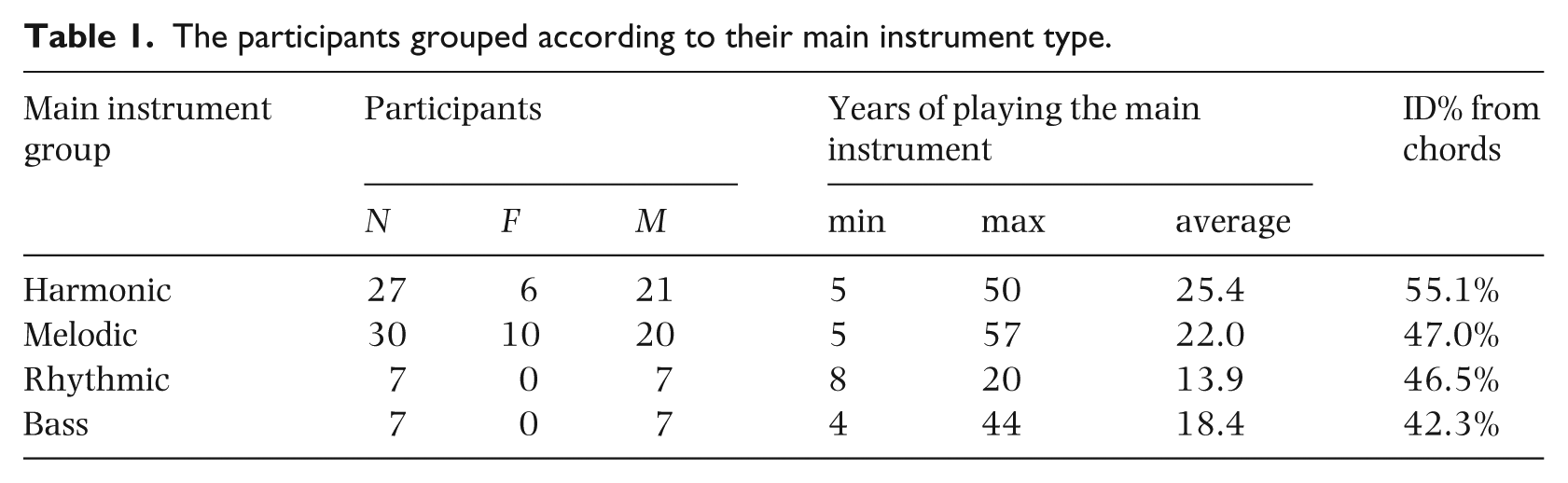
We started our analyses by investigating the effects of instrument type and years of training on the instrument by dividing the participants into four groups according to their main instrument or, if they had played multiple instruments, the instrument they reported having played for the longest time. The four groups were harmonic instrument, melodic instrument including voice, rhythmic instrument, and bass instrument (see Table 1). Figure 1 shows the scores (ID% from chords) for each participant against the years they had played the instrument; the figure also shows the main instrument. The general correlation between years playing and the ID% scores was low, r(71) = .234, indicating that more years of instrumental practice did not affect identification scores in our experiment. When we calculated correlations within each main instrument group, only in the group harmonic instrument was the correlation statistically significant, r(27) = .430, p = .025, yet still not very high.
The participants grouped according to their main instrument type.

Scatter diagram showing the ID% from chords and the type of the main instrument against years of playing.
The univariate analysis of variance confirmed that groups formed according to main instrument type did not differ from each other, F(3, 67) = 1.414, p = .246 (see Table C1; tables marked “C” are in Appendix C in the Supplementary Materials online). Since the years of instrument practice and instrument type did not explain the ID% from chords, we decided to analyze participant variables for all of the participants together by conducting an exploratory factor analysis (principal component analysis [PCA], varimax rotation) on them. After preliminary analysis of the correlation matrix and eliminating variables with high multicollinearity, we settled on the following variables: years of formal study (lessons) and courses on jazz harmony (wholehar); amount of time participants had spent with written material (e.g., lead sheets) playing, elaborating, and improvising chord progressions (playharm), bass lines (playbass), and melodic lines (playmelo); amount of time participants had spent imitating chord progressions (imiharm), bass lines (imibass), and melodic lines (imimelo) and transcribing harmonies (trachord). To reveal the effects of having worked with the target pieces, we used the scores from the question of whether or not the participants had played the chords of the target pieces (chord16) and how well they were able to write the first four chords from memory (written16). For this set of 11 variables, the KMO test (.773) and Bartlett’s test (p < .001) indicate that PCA can be conducted (see Table C2). The analysis revealed a three-factor structure explaining 74.83% of the variance (see Table C3). The structure was understandable and easy to interpret as follows (see the italicized numbers in Table 2): (1) experience playing, imitating, and transcribing jazz pieces (chords, melodic lines, bass lines); (2) specialized familiarity (having played and being able to write the chord labels of the target pieces); and (3) years of jazz harmony and instrument lessons.
Rotated component matrix. Rotation converged in five iterations.

Notes: Extraction method: PCA. Rotation method: varimax with Kaiser normalization. a The italics show the highest loadings to each component.
In order to analyze the effect of the participant variables for the identification of the pieces from chord progressions, we conducted a linear regression analysis where the identification from chords was the dependent variable and the three factors were used as predictor variables. The dependent variable had a normal distribution (see Tables C4 and C5). There was no multicollinearity between the predictor variables (the three factors). This was clear since the orthogonal rotation (varimax) was used in PCA analysis.
Analysis revealed that specialized familiarity was the only statistically significant participant factor influencing identification of well-known jazz standards from chords. Table 3 shows the model summary, and Table 4 shows the coefficients for the regression analysis. As can be seen, only after adding the second variable (Factor 2, specialized familiarity) does the R square change become statistically significant (p < .001), and the beta weight for Factor 2 (.479) is the only statistically significant factor (p < .001). The model with three factors explained only 19.9% of the variance, indicating a poor fit.
Model summary of three participant variables.
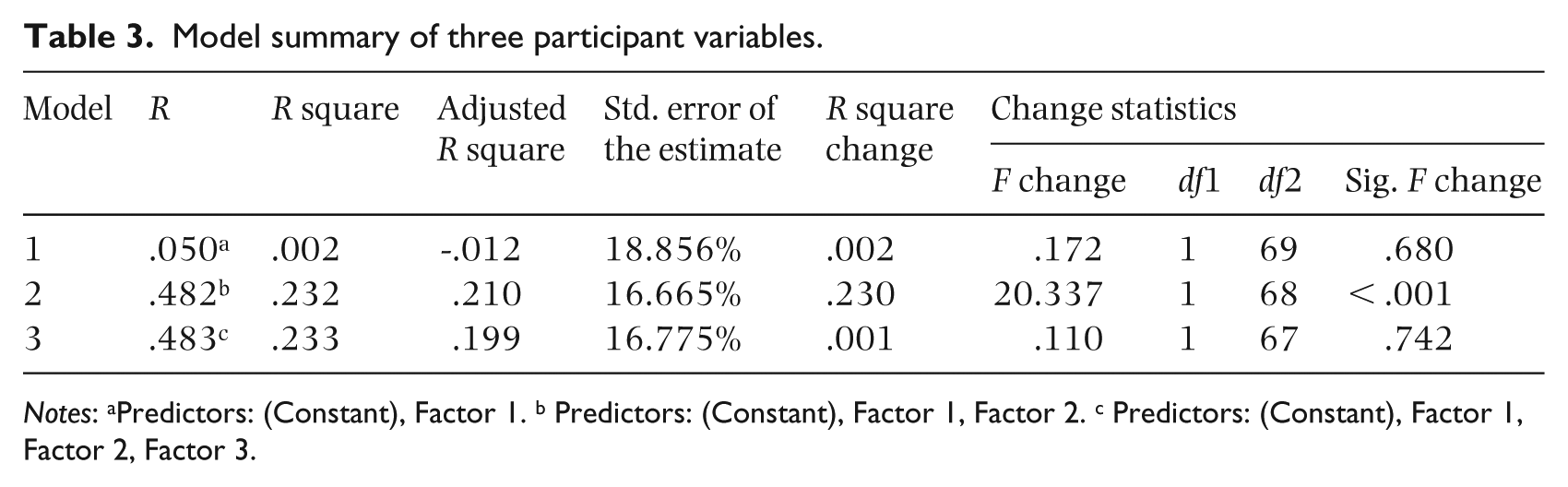
Notes: aPredictors: (Constant), Factor 1. b Predictors: (Constant), Factor 1, Factor 2. c Predictors: (Constant), Factor 1, Factor 2, Factor 3.
Results of the regression analysis.
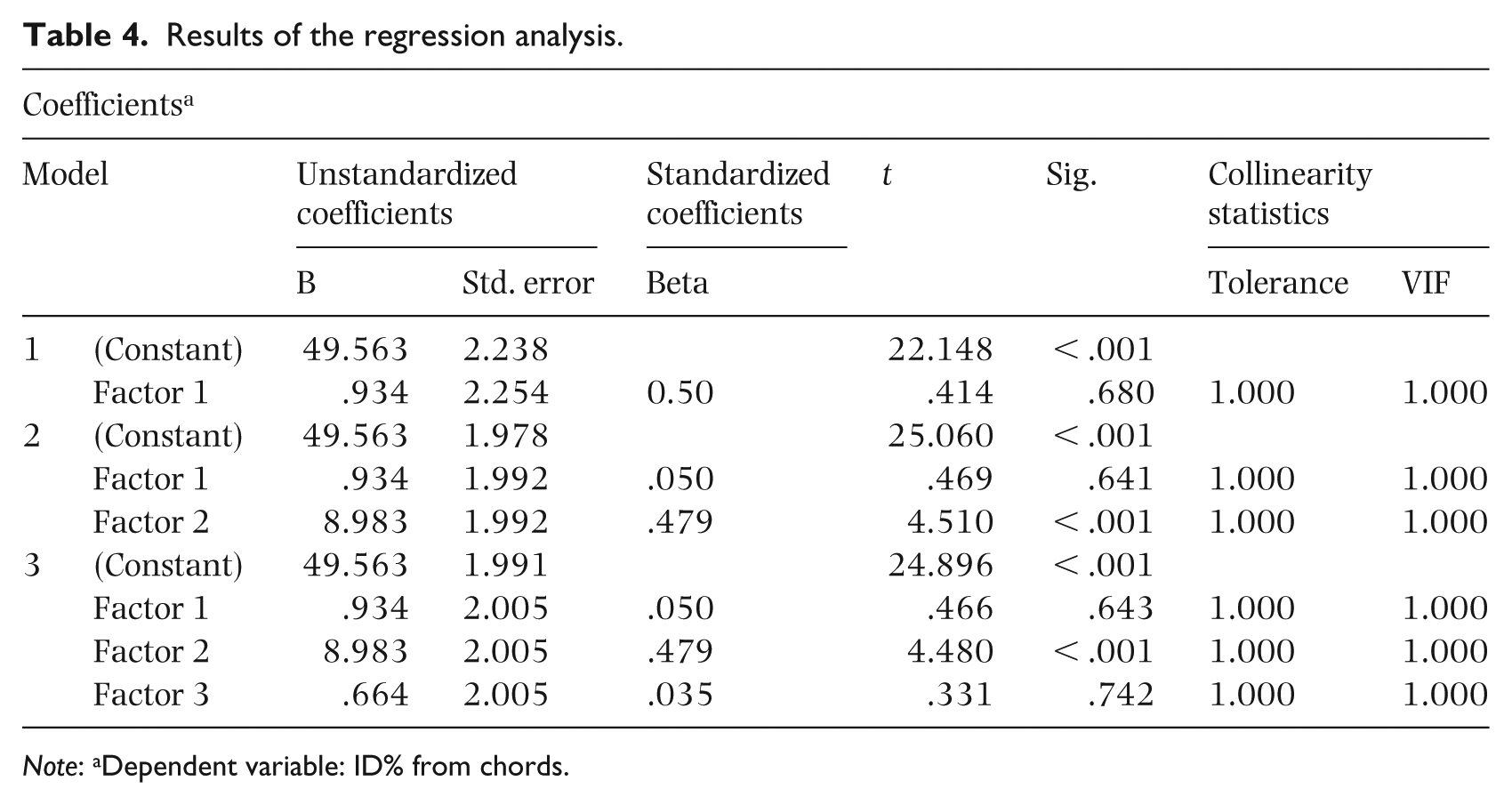
Note: aDependent variable: ID% from chords.
Effect of having played and being able to write out the chords of the target piece
Since the specialized familiarity (Factor 2) was formed by two components (having played the chords of the target pieces and being able to write out their chord labels from long-term memory), we decided to analyze the effect of these two components on identification of the piece from chord progressions. For this analysis, we categorized individual cases into three conditions: PW (the participant had played the target piece and was able to write out the chords); PnW (the participant had played the piece but was unable to write the chords); and nPnW (neither P nor W). We did not use the nPW, since there were only a few cases where the participant was able to write the chords out without having played the piece. Figure 2 shows the effect of conditions P and W on identification of the pieces; it seems that having played a piece’s chords and being able to write them out helped with the identification of the piece from its chord progression. A univariate analysis of variance (see Tables C6 and C7), however, showed that the effect of conditions P and W was only marginally significant, F(2, 45) = 3.090, p = .055. Since the Levene’s test of equality of error variances showed that the variances were not equal (p = .422; see Table C8), the Bonferroni post-hoc test was used, revealing that the main difference was between conditions PW and nPnW (p = .050; see Table 5).
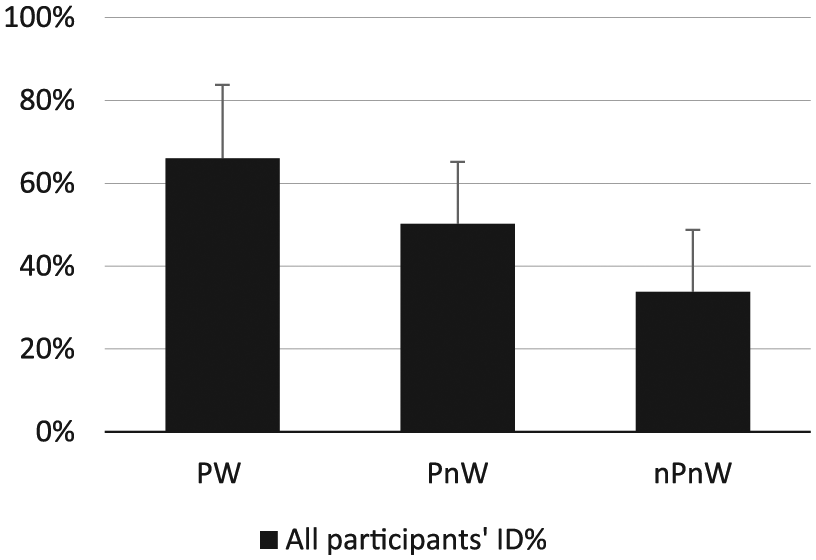
Effect of having played (P) and being able to write the chords (W) of individual target pieces. Y-axis shows the percentage of correct identifications from chords. Error bars show standard deviations.
Results from Bonferroni post-hoc test of the effect of having played and written the chords of individual target pieces.

In order to control for a potential stimuli effect, we then separately analyzed the effect of having played and being able to write out the chords of the target pieces for the five pieces that were very difficult or the five that were very easy to identify from chords. The analysis (see Figure 3 and Table 6) showed that the identification of the difficult pieces differed from that of the easy pieces (p < .001) and that playing and being able to write out the chords facilitated identification within both groups, i.e., of difficult and easy pieces (p = .001).
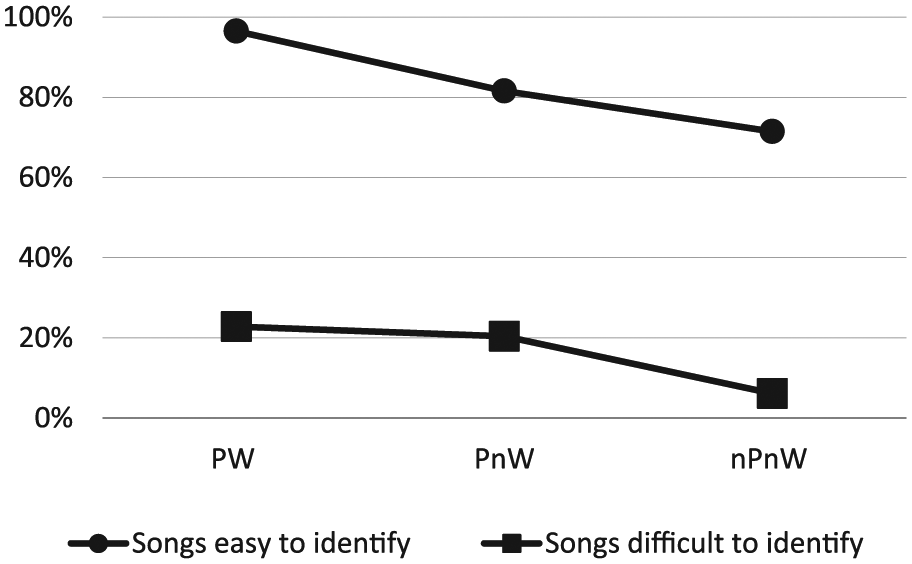
Effect of having played (P) or being able to write (W) the chords of the five most difficult and the five easiest target pieces. Y-axis shows the percentage of correct identifications from chords.
Results from ANOVA analysis of the effect of having played and being able to write the chords of the five most difficult and the five easiest target pieces.
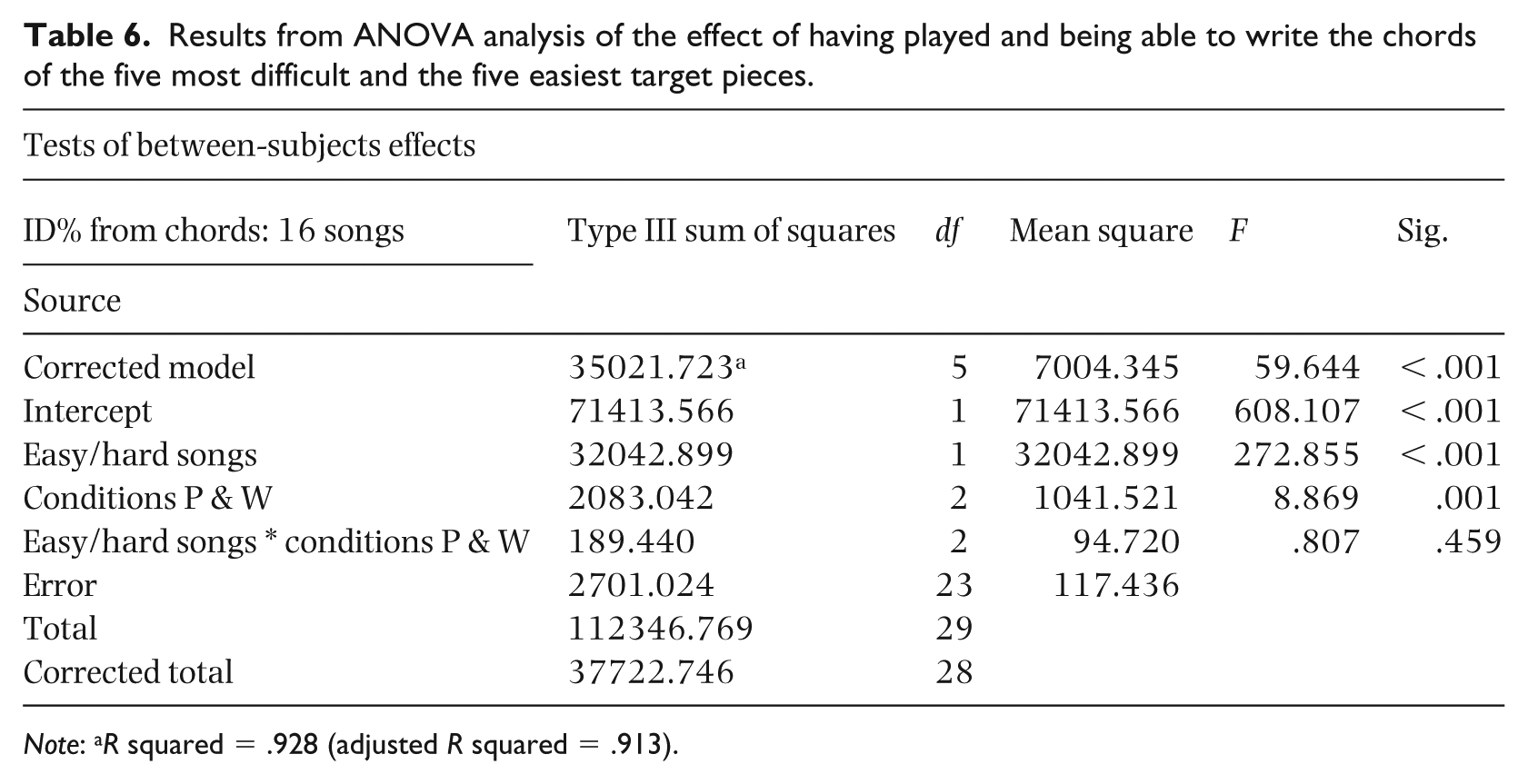
Note: aR squared = .928 (adjusted R squared = .913).
Discussion
The present study investigated participants’ ability to identify well-known jazz standards from chord progressions. Results from this experiment indicated that when participants were familiar enough with the standard to name it from a commercial recording, multi-sensory and multi-domain familiarity with the harmony of the specific target piece was much more important for identification than long-term involvement with activities traditionally associated with perceptual and conceptual harmonic awareness. In the following, we discuss our main findings and their implications for the general understanding of how jazz musicians process and remember chord progressions.
There is a common assumption that playing a harmonic instrument facilitates the perceptual and conceptual processing of harmonic structures (Berkman, 2009; Berliner, 1994; Chittum, 1969) and that the instrument a musician plays has an effect on his or her harmonic awareness (Brattico et al., 2009). As stated, most jazz musicians play a harmonic instrument (e.g., piano, guitar) regardless of their main instrument and, in our study, the main instrument did not seem to affect the ability to identify pieces from chords.
We predicted that the specific type of work with chord progressions would influence the ability to identify well-known jazz standards from chord progressions; we therefore collected information about the participants’ experience in playing chords from symbolic notation, playing chords by ear, transcribing chords, and taking jazz harmony and jazz ear-training courses. We also asked participants if they had played the specific chords of each target piece in addition to asking them to write out some of their chord labels from long-term memory. It is important to clarify that participants’ retrospective estimates of amount of time spent on different harmonic-related activities are at best a rough estimate of the actual amount of time devoted to such activities. Two jazz instructors who took the paper version of the questionnaire in fact confided that it was difficult to provide such retrospective estimates. Additionally, previous research suggests that musicians tend to overestimate when asked to retrospectively estimate practice hours (Ericsson, Krampe, & Tesch-Römer, 1993). Nevertheless, several researchers consider such estimates to be reliable enough for general comparison purposes (Jabusch, Alpers, Kopiez, Vauth, & Altenmüller, 2009; Kopiez et al., 2012; Lehmann & Ericsson, 1996; Woody, 2003). Accordingly, despite the degree of specificity of certain questions and the fact that participants’ estimates are likely inaccurate in absolute terms (i.e., number of years and hours spent practicing), we believe that in relative terms (e.g., remembering having played chords by ear more than by reading them from lead sheets), such estimates are adequate for the purposes of our study.
Even though we were able to group the background variables reasonably in three factors, two of the factors did not explain the participants’ responses in the identification task. We found that having played and being able to write the chord progressions of the specific jazz standards facilitated the identification of the standards from the chord progressions, but we found no such evidence with regard to the amount of playing, transcribing, and studying chord progressions in general. However, an interesting aspect of our results is that specialized familiarity with the chord progressions was, albeit beneficial, neither sufficient nor indispensable for identifying a piece from its chords. On the one hand, the pieces were correctly identified from chords in 66% of a total of 359 trials of the PW condition where participants both had played and were able to write out the chords of the target pieces, whereas participants successfully identified pieces in only 34% of the 349 trials under the nPnW condition, that is, when they neither had played nor were able to write out the chords. This suggests that there must be other factors that contribute to the identification of well-known jazz standards from chord progressions and that these factors were not captured by our questionnaire. Two such factors could be the age at which participants started playing harmonic instruments and the extent to which certain highly heritable traits such as working memory capacity could have influenced the experimental task. There is evidence that the age at which musicians start training influences certain musical abilities (for a review, see Ericsson et al., 1993). Additionally, studies comparing thousands of twins have found heritability estimates of 80% for the ability to identify incorrect pitches in familiar melodies (Drayna, Manichaikul, de Lange, Snieder, and Spector, 2001) and 59% for the ability to determine if two novel melodies are identical or not (Ullén, Mosing, Holm, Eriksson, & Madison, 2014). These are both likely to be influenced by working memory capacity, a more general ability whose heritable estimates are around 50% in some studies (Ando, Ono, & Wright, 2001; Polderman, Stins, Posthuma, Gosso, Verhulst, & Boomsma, 2006). Although the heritability of skills is quite controversial (Hambrick, Macnamara, Campitelli, Ullén, & Mosing, 2016), working memory capacity together with improvisation strategies developed by expert jazz musicians likely play a role in the identification process (Berkowitz, 2010). Future research should investigate the potential contribution of these participant factors on the identification of well-known music from chord progressions.
The effects of the two components of specialized familiarity, P (having played the chords of the target piece) and W (being able to write out the labels of its chords from long-term memory), could not be fully disentangled. The difference between PW and nPnW trials was statistically significant, but PW trials did not differ from PnW trials, and there were not enough nPW trials to perform a comparison with that condition. Intriguing patterns in the relationship between having played the chords and being able to write out the chord labels from memory did emerge, however. Most of the 395 trials—i.e., 91%—in which participants were able to write out the chord progressions were also trials in which they had actually played the chords, suggesting that our participants found it difficult to write chord progressions out from long-term memory if they had never actually played the chords. Additionally, the fact that there were 241 trials where participants had played the chords but did not provide written labels (40% out of 600 instances where participants had played the chords) also indicates that having played the chords of a piece is often not enough to be able to write out chord labels from memory. This does not rule out the possibility that participants who could not write the labels out may nevertheless have had procedural knowledge of the chords; that is, they may have been able to play those chord progressions from memory. It is also possible that they could have easily labeled the chords when listening to them in real time despite not being able to write them out from long-term memory.
On the whole, this result suggests that writing out the chord labels of a jazz standard from long-term memory is a demanding task. Fortunately, additional information we collected during the survey sheds some light on the nature of such demands. When participants were asked to write down the chord progressions, we also asked them to tell us if (a) they “figured out the chord labels by mentally transcribing them from aural memory” and (b) “it would have been possible to recall the chords from [their] current visual memory of the lead sheet or some other conceptual memory about the piece without having to mentally transcribe the chords from aural memory.” Of the total trials where chord progressions were correctly written out, participants responded yes to question (a) on 52% of the trials, yes to question (b) on 16% of the trials, and yes to both questions on 32% of the trials. These responses suggest that participants who were able to write out the chords from long-term memory may have possessed more vivid perceptual and/or conceptual harmony-related memory traces than other participants. Interestingly, the fact that only very small differences in identification scores were found between PW and PnW trials suggests that the vividness of such memory traces is not a crucial condition for the identification of pieces from chord progressions.
The process by which jazz musicians connect chord progressions to specific jazz standards can be broadly described as associative listening. In their book on aural identification of jazz chord progressions, Coker et al. (1997) described associative listening as the process by which “parts of the new tune’s progression may be recognized by associating its sounds with a tune already known” and claimed that such a process is “the key to learning to recognize chord progressions through the ear alone”. Although their book focuses on training jazz musicians to aurally identify short chord successions common to many jazz standards—a more general task than identifying specific jazz standards from chord progressions—several of their views are consistent with our findings. For instance, the authors state that although implicit learning of chord progressions is possible, paying conscious attention to chord progressions during the mental encoding phase greatly increases the chances that those long-term memory traces can be “efficiently accessed” and activated during associative listening. Additionally, they also believe that playing, analyzing, and memorizing chord progressions facilitates later aural identification of those progressions. This underscores our finding about specialized familiarity with chord progressions. This phenomenon is likely related to the richer encoding of chord progressions in long-term memory when various senses and modalities are involved. Additional support for this theory comes from research showing that motor patterns related to certain chord progressions are stored in pianists’ long-term memory and can be activated during motor imitation even when sound is physically absent (Sammler, Novembre, Koelsch, & Keller, 2013).
The present study’s findings have implications beyond the realm of jazz music. For instance, a better understanding of how associative listening works can improve the identification of chord progressions in music other than jazz. The fact that many of our participants struggled to label the chords of pieces they knew well from memory suggests that the challenges of identifying chord progressions are not limited to young musicians or professionals who do not play harmonic instruments (Chittum, 1969; Radley, 2008; Rogers, 1984). Coker et al.’s (1997) reliance on associative listening as a tool for the identification of chord progressions is arguably a faster and less atomistic approach than the more traditional and commonly taught process that starts by first figuring out the bass notes, inversions, and chord qualities (Cathey, 2015: Radley, 2008; Rogers, 1984). The fact that even non-musicians can sometimes identify pieces of music from chord progressions and that, furthermore, such identification can take place within just a single hearing (Jimenez & Kuusi, 2017) suggests that associating chord progressions with known pieces of music can be a useful method for teaching harmonic dictation. However, it is important to remember that having actually played the chords of the target piece in the past facilitates association as well as the ability to identify and label the chords. The role and utility of procedural knowledge in the labeling process calls for further investigation.
Conclusions
The present study shows that identification of well-known jazz standards from chord progressions is greatly facilitated when participants have had multi-sensory (auditory, motor, and visual) and multi-domain (perceptual and conceptual) experiences with the chord progressions of the specific standards. Specifically, having played and being able to write out the chords of the jazz standards from long-term memory, the latter apparently dependent on particularly vivid perceptual or conceptual memory traces, was found to facilitate identification of the jazz standards from chords. This advantage was also observed both for jazz standards that were relatively easy to identify from their chord progressions as well as for those that were more difficult to identify. To our knowledge, this is the first study to provide empirical evidence that jazz musicians are able to identify well-known jazz standards from their chord progressions and to provide insights into the factors that contribute to this ability. Future research is needed to clarify whether other listener-related factors such as the age at which jazz musicians start musical training and heritable abilities such as working memory capacity account for results that were not explained by the variables investigated in this study.
Supplemental Material
POM793005_Supl_Mat_ – Supplemental material for What helps jazz musicians name tunes from harmony? The relationship between work with harmony and the ability to identify well-known jazz standards from chord progressions
Supplemental material, POM793005_Supl_Mat_ for What helps jazz musicians name tunes from harmony? The relationship between work with harmony and the ability to identify well-known jazz standards from chord progressions by Ivan Jimenez and Tuire Kuusi in Psychology of Music
Footnotes
Acknowledgements
We would like to thank Tuuka Ilomäki for his invaluable help with programming the web-based experiment; Ritta Paakki, Sami Linna, Jukkis Uotilla, Visa-Pekka Oskari Mertanen, Danny Ziemann, Keith Salley, Tim Richards, Brent Edstrom, Russell Hoffman, Jeff Benatar, Yoko Susuki, Carlos Peña, Tim Williams, and Jake Clarin for technical suggestions and enlightening discussions while planning the experiment; Heikki Hyhkö for advice on the statistics; and Lynne Sunderman for help with preparing the manuscript.
Declaration of conflicting interests
The author(s) declare no potential conflicts of interest with respect to the research, authorship, and/or publication of this article.
Funding
The author(s) disclosed receipt of the following financial support for the research, authorship, and/or publication of this article: This project has been financially supported by a research grant from the Kone Foundation.
Supplemental material
Supplemental material for this article is available online.
References
Supplementary Material
Please find the following supplemental material available below.
For Open Access articles published under a Creative Commons License, all supplemental material carries the same license as the article it is associated with.
For non-Open Access articles published, all supplemental material carries a non-exclusive license, and permission requests for re-use of supplemental material or any part of supplemental material shall be sent directly to the copyright owner as specified in the copyright notice associated with the article.
