



Abstract
This article proposes that passion for music is an essential element in explaining the well-being of musicians. Based on the PERMA model of well-being and on research on passion for music, this article posits that being passionate about music, and more specifically holding a harmonious type of passion (HP), reduces music-related anxiety and enhances musicians’ life satisfaction, sense of psychological growth and mastery. Furthermore, it is expected that holding an obsessive passion (OP) toward music might thwart musicians’ well-being through increased musical anxiety. These hypotheses were tested with 225 trainee and expert classical musicians. In order to provide a valid measure of passion for music, the Passion Scale for Music (PSM) was first validated. Structural Equation Modelling (SEM) results provided support for the hypothesis that musicians who are passionate about music, and even more those who are HP, experience increased well-being, while OP does not contribute to musicians’ well-being. The relationships between passion and well-being in musicians were moderate to strong, confirming that the types of passion musicians hold is a central element in explaining their well-being. The article concludes that being passionate about music acts as a “sparkle” that brightens musicians’ lives with regards to their global well-being experience.
Researchers in music psychology and music performance have long held an interest in the factors that affect the quality of musicians’ involvement in music and the experiences they derive from such engagement. Although it is widely acknowledged that passion is a prerequisite for any musical endeavour, there has been little theorizing and research on the concept of passion for music. The Dualistic Model of Passion (Vallerand, 2015; Vallerand et al., 2003) proposes that passion for music may provide invaluable insights into the individual processes related to the well-being of musicians (Bonneville-Roussy, Lavigne, & Vallerand, 2011; Bonneville-Roussy, Vallerand, & Bouffard, 2013). Furthermore, as will be seen below, the Dualistic Model posits that not all passions are created equal and that the experiential outcomes derived from one’s musical engagement depends in large part on the type of passion one has for music. Therefore, the major purpose of the present article was to investigate the extent to which passion for music is a central contributor to musicians’ well-being.
The psychology of passion
Although a few psychologists have written about passion, no theory was formulated and empirically tested until Vallerand et al. (2003) posited and tested their Dualistic Model of Passion (DMP; see also Vallerand, 2010, 2015). The DMP defines passion as a strong inclination toward an activity that people love, find important, in which time and energy is invested, and that becomes an integral part of someone’s identity (Bonneville-Roussy et al., 2011; Vallerand et al., 2003). This definition describes most professional and advanced amateur musicians who devote a substantial amount of their free time to the activity they love the most: music. Indeed, Bonneville-Roussy et al. (2011) have found that 99% of expert musicians are passionate. Clearly, being a musician usually comes with a level of passion that is not widespread in the overall population. Passion may be one of the most important psychological drives that make musicians thrive, not only in their performance levels, but also in terms of their general well-being.
Harmonious and obsessive passions
An important contribution of the DMP is that it distinguishes between two types of passion, as a function of the type of internalization that takes place in identity. An autonomous internalization of music into one’s identity is posited to lead to harmonious passion (HP; Bonneville-Roussy et al., 2011; Vallerand, 2015). HP prompts a musician to freely choose to engage in music for the pleasure derived from it, without external or internal pressure. In addition, HP is characterized by a flexible persistence in the activity, leaving space for other important life domains, such as family, physical activity and hobbies (Vallerand et al., 2003). Because the involvement in the activity is more adaptable with HP, with this type of passion people experience mostly positive consequences from it. HP people usually derive positive emotions and reduced stress from participating in their favourite activity (Vallerand et al., 2003), and an enhanced perceived psychological well-being (Rousseau & Vallerand, 2008; Vallerand et al., 2007). In music, HP has been associated with future music-related career intentions and persistence in a music program for music students (Bonneville-Roussy, Vallerand, et al., 2013), and with higher levels of musical performance and life satisfaction in expert musicians (Bonneville-Roussy et al., 2011).
In contrast, with OP, musicians feel controlled by external or internal pressures (e.g., external pressures from auditions or internal pressures to excel at all costs) that drive their involvement in music. This results in an unmanageable urge to engage in the musical activity that they love. The passionate activity comes to control the person’s life and can create conflicts with other life domains. Thus, the importance of the activity may become disproportionate and the time invested in the passionate activity often occurs to the detriment of other important activities, such as family events or even health. As a result, OP leads to a rigid persistence as well as negative emotions, anxiety, and lower levels of well-being (Mageau, Vallerand, Rousseau, Ratelle, & Provencher, 2005; Vallerand et al., 2003). In music, obsessively passionate musicians may continue taking part in the activity regardless of the psychological and physical consequences associated with it.
Empirical research has provided strong support for the validity of the DMP in music and in other life activities. First, over 20 studies have supported the factorial structure of the Passion Scale (PS), revealing that it does indeed consist of two different types of passion (harmonious and obsessive; see Vallerand, 2015, Chapter 4 for a review). Further, the scale has been found to be equivalent as a function of gender, language (French and English), and types of activities (Marsh et al., 2013). Research has also shown that HP and OP respectively lead to different psychological outcomes. HP is positively, whereas OP is either unrelated or negatively, associated with adaptive outcomes such as the experience of flow (Vallerand et al., 2003, Study 1), positive emotions (e.g., Mageau & Vallerand, 2007; Philippe, Vallerand, Houlfort, Lavigne, & Donahue, 2010), reduced negative emotions (Mageau et al., 2005), and increased concentration during the task (Vallerand et al., 2003, Study 1). Conversely, OP has been found to be positively associated with negative emotions (Mageau et al., 2005; Philippe et al., 2010), anxiety (Rousseau & Vallerand, 2003), defensiveness, threat susceptibility (Donahue, Rip, & Vallerand, 2009) and conflict between one’s passion and other life domains (Caudroit, Boiché, Stephan, Le Scanff, & Trouilloud, 2011)
Passion has some ties with other concepts developed in psychology such as those of flow, grit, and intrinsic and extrinsic motivation. Flow is the experience one has when fully immersed in the activity (Csikszentmihályi, 1990). Because, as shown above, passion influences how one engages in the activity one is passionate about, it has been hypothesized and found that flow is a consequence of passion (see Vallerand et al., 2003, Study 1) that derives mainly from the more adaptive form of passion (harmonious). Further, flow does not reflect the duality of outcomes proposed by passion. Similarly, the concept of Grit (Duckworth, Peterson, Matthews, & Kelly, 2007) assesses perseverance of effort and sustained interest but not the affective and motivational components of love and importance of the activity into one’s life and, most importantly, the dual aspects of harmonious and obsessive passions.
Perhaps the most important similarity is with intrinsic motivation as hypothesized by Self-Determination Theory (Deci & Ryan, 2000). Indeed, both passion and intrinsic motivation involve interest and loving the activity. However, intrinsically motivated activities are typically not seen as being internalized in the person’s identity (Deci & Ryan, 2000). Further, contrary to the concept of passion, no theory or research has hypothesized or found that intrinsic motivation can lead to maladaptive outcomes. More important differences can be found with extrinsic motivation, as it entails performing an activity for reasons that lie outside the activity and not out of enjoyment. Thus, irrespective of the type of extrinsic motivation and whether or not it is internalized in the self (e.g., integrated or identified regulation) a fundamental difference between passion and extrinsic motivation is the lack of loving for the activity. Research empirically supports these distinctions between passion and intrinsic and extrinsic motivation (see Vallerand et al., 2003, Study 2).
In sum, while the passion framework does share some conceptual similarities with other motivational constructs, it also differs from them in significant ways. Furthermore, it would appear that no theoretical conceptualization exists to explain the adaptive and maladaptive effects of passion (see Vallerand, 2015, Chapter 2 for a more elaborate discussion on this issue).
In sum, with HP, musicians control their passion towards music, while with OP, musicians are controlled by music. Although both types of passion are expected to be powerful sources of motivation, HP is hypothesized to be more adaptive than OP and should therefore lead to more optimal psychological outcomes, including psychological well-being.
Musicians’ well-being
Many countries around the world have put the well-being of their populations at the center of their policy agenda. This agenda has had ramifications in the artistic domains, where increasing resources, research grants, and publications have been mobilized in studying and finding solutions to well-being issues of artists, including musicians (MacDonald, Kreutz, & Mitchell, 2013). Hargreaves and Lamont (2017) have classified research on music-making and well-being into four categories: physical health and well-being, mind and cognition, psychological health and well-being, and social health and well-being. Generally, Hargreaves and Lamont report that research on the links between music-making and well-being has mostly been performed with three distinct populations: children, amateur musicians, and music for therapeutic use in special populations. Amateur musicians, for instance, report physical, social and psychological benefits of making music through increases in vitality and physical fitness, and gains in social relationships with activities such as going to rehearsals and playing music in groups. The benefits of making music in childhood appear to be numerous, as links have been found between musical activities and IQ, self-regulation, and various positive psychological and social outcomes (Moreno et al., 2011; Zachariou & Whitebread, 2015).
In terms of the psychological well-being of advanced musicians, Ascenso, Williamon and Perkins (2017) have described the main components of musicians’ well-being in light of the PERMA model (Seligman, 2011), which provides a framework to understanding human well-being and flourishing: positive emotions (P), engagement (E), relationships (R), meaning (M) and accomplishment (A). Interestingly, and despite lay beliefs about the lives of musicians, Ascenco and colleagues have indicated that “music activity has typically been considered a threat to holistic wellbeing” (2017, p. 66). Using in-depth interviews with professional musicians, they have found that some musicians struggle with the distinction between the music and themselves, as if their musical identity is overwhelmingly important. Musicians also noted that music-making often was associated with periods of emotional and professional instabilities that were a threat to their overall well-being. In contrast, many musicians interviewed by Ascenso and colleagues showed resilience over musical adversities and displayed high levels of flow experiences, excitement, and positive emotions, all contributing to their overall well-being.
It was further hypothesized that musical anxiety may be negatively related to well-being. In clinical settings, the relationship between anxiety and well-being is well-known, with the widespread use of anxiety reduction therapy to increase the well-being of various populations, including the elderly and clinically depressed patients (De Beurs et al., 1999; Fava et al., 2005; Jorm et al., 2003). Music-related anxiety (MA) is one of the main psychological concerns of musicians (Kenny, Davis, & Oates, 2004; Kenny, Fortune, & Ackermann, 2011; Steptoe, 1989). In music, as in clinical settings, higher levels of anxiety have been related to reduced well-being (Stoeber & Eismann, 2007).
Of the six aspects of the PERMA model of well-being, two have had particular attention in music psychology research, and especially in music education: engagement and accomplishment (also named persistence and performance). In terms of performance, research has shown that higher levels of self-efficacy towards music, deliberate practice, and the use of mastery goals were linked with higher levels of achievement (Bonneville-Roussy, Evans, Verner-Filion, Vallerand, & Bouffard, 2017; Bonneville-Roussy et al., 2011; Ericsson, Krampe, & Tesch-Römer, 1993; Lacaille, Whipple, & Koestner, 2005; McPherson & McCormick, 2006; Miksza, 2009). In terms of persistence, measured with proxies as diverse as preference for challenging tasks, dropout rates and career intentions, research has shown that autonomous motivation and a supportive environment were conducive to greater musical persistence (Bonneville-Roussy, Vallerand, et al., 2013; Evans & Bonneville-Roussy, 2015; Hallam, 1998; McPherson, 2005; McPherson & Renwick, 2001; Renwick & McPherson, 2002). Other areas of the PERMA model have received lesser attention in music research, such as the determinants of experience of positive emotions in music (Evans & Bonneville-Roussy, 2015), and the roles of social relationships in the development and maintenance of musical skills (Ascenso et al., 2017; Gaunt, 2008; Gaunt, Creech, Long, & Hallam, 2012; McPherson, 2008). One area of the PERMA model has received almost no attention, that is, the contribution of music to a meaningful and fulfilling life in musicians (the “M,” or meaning, of PERMA). This latter aspect is the focus of the present study.
Passion and musician’s well-being
Research on passion and well-being has increasingly shown two paths toward which passion is associated with positive or negative outcomes. In the adaptive path, psychological well-being is enhanced with HP. Bonneville-Roussy, Vallerand et al., (2013) have found that only HP predicted long-term persistence in music education. Although the underlying reasons remain unexplored, OP music students may be more likely than their HP counterparts to drop out of music before attaining the professional levels because the negative consequences that musicians with OP experience (e.g. increased levels of general anxiety) during their musical education may outweigh their experienced positive consequences. They may also be more inclined to experience music performance anxiety (see Vallerand et al., 2003, Study 1). HP for music leads musicians to set mastery goals, to use more deliberate practice and to experience enhanced life satisfaction (Bonneville-Roussy et al., 2011). Harmoniously passionate musicians may also be more likely to seek help and to stop practicing when injured (as seen in dance; Rip, Fortin, & Vallerand, 2006). More generally, HP has been shown to lead to enhanced well-being both at the individual (e.g., flow, psychological well-being, health, motivation, etc.) and environmental levels (e.g., maintenance of healthy relationships; see Vallerand, 2015).
Individuals with OP seem to experience inconsistent outcomes, where their well-being goes up and down as a function of their performance on the passionate activity (see Lafrenière, St-Louis, Vallerand, & Donahue, 2012; Mageau, Carpentier, & Vallerand, 2011). With successes, obsessively passionate individuals may experience very positive emotions and well-being. However, failures lead individuals with OP to experience overwhelming negative consequences, with increased negative affect, burnout and injuries. Thus, obsessively passionate individuals may experience increased psychological ups and downs, whereby gains coming from successes are hindered by negative events. In contrasts, the positive effects due to HP are often sustainable (see Vallerand, 2015).
Finally, although the long-term effects of HP and OP may seem comparable, the processes leading to performance are quite different. Specifically, because HP also facilitates the experience of more positive psychological outcomes, the harmonious road to excellence would appear to be much more adaptive. The obsessive path often comes with deficits in positive experiences and may include psychological distress along the way (Vallerand, 2015). In music, the links between passion and performance and persistence are increasingly well understood. The paths linking passion to the well-being of musicians, however, are mostly unknown.
The present study
There were three objectives to this study. The first and most general one was to examine whether HP for music leads to an enhanced sense of general well-being in musicians, and whether OP would thwart well-being. Further, we assessed different dimensions of well-being, in line with the meaning (M) dimension of the PERMA model. In PERMA, meaning refers to the judgment that a person’s life has a purpose and is valuable (Seligman, 2011). It can be through someone’s satisfaction with their life, their sense of sense of mastery (the feeling that life is manageable), and sense of growth (a feeling of development in life; Ryff & Keyes, 1995). Thus, a multidimensional approach to assessing well-being was employed in this study.
A second objective was to assess the mediating role of musical anxiety in the passion–well-being relationship. Past research has shown that HP often negatively predicts negative emotions such as anxiety experienced during engagement in the activity one is passionate about. Therefore, the present study also addresses how passion may act as a protective factor against elevated MA. Since this study relates to a holistic view of well-being, musical anxiety is examined in three different areas of music: performance, practice, and group rehearsals (therefore being broader than the related music performance anxiety; Kenny, Driscoll, & Ackermann, 2014). In line with the DMP, it was expected that HP would negatively predict musical anxiety, while OP would be unrelated or positively related to it, and that musical anxiety, in turn, would negatively predict general well-being.
Finally, a third objective of this research was to further assess the inherent structure of the PSM. Although the PS has been confirmed in several studies with the use of confirmatory factor analyses, these studies were largely conducted outside the realm of music. Further, they did not make use of recent statistical analytical developments. In line with past research on the PS, it was posited that a factorial structure reflecting the presence of HP and OP would be supported.
To address the aims of this study, we used Exploratory Structural Equation Modelling (ESEM) to examine the structure of the PSM (Asparouhov & Muthén, 2009; Marsh et al., 2013; for uses in music, see Bonneville-Roussy, Rentfrow, Xu, & Potter, 2013; Scalas, Marsh, Vispoel, Morin, & Wen, 2017). ESEM has been established as the new standard in the SEM literature and can be conceptualized as a combination of the best features of exploratory and confirmatory factor analyses (CFA, Marsh et al., 2009). ESEM normally results in latent factors that are much more discriminated, provides strong hypotheses testing specific to SEM models, and provides a more flexible approach to factor analysis that is less rigid than CFA. Then, we evaluated a structural equation model of the links between passion and well-being through a second-order factor analysis of well-being (encompassing the constructs of life satisfaction, mastery, and growth).
Method
Participants
Two-hundred-and-twenty-five musicians (115 men and 110 women) were recruited in four conservatoires and higher education music schools in the United Kingdom. Of those musicians, 35 were professional musicians and 190 were musicians studying towards higher qualifications in music performance. They were between 18 and 58 years of age (M = 24.79 years, SD = 8.93 years). They had been playing their instrument for an average of 14.05 years (SD = 8.99). The vast majority of participating musicians were pianists (18%), singers (27%), and woodwind players (19%), and the remainder of the sample was split between string, percussion, and brass players. This study has received ethical approval from the University of Roehampton research ethics committee. In line with past research, only the participants who were highly passionate (those who scored 4/5 or above on the passion criterion subscale described below, Bonneville-Roussy et al., 2011) were kept for further analyses. This led to a final sample of 209 participants, who did not differ from the other participants in terms of their socio-demographic information.
Measures
All scales were measured using five-point Likert scale ranging from 1 (I strongly disagree) to 5 (I strongly agree) the extent to which musicians agreed with each of the statements.
The Passion Scale for Music
The PS (Vallerand et al., 2003), was adapted to music (Bonneville-Roussy, Vallerand et al., 2011; 2013; Mageau et al., 2009), and contains two six-item subscales assessing HP (e.g., “Music in harmony with the other activities in my life”) and OP (e.g., “I have difficulties controlling my urge to play music”). Psychometric properties of the PS have been assessed in previous studies, which have supported its validity and reliability (Marsh et al., 2013; Vallerand et al., 2003; α = .83, .77 for HP and OP, respectively in this study). Exploratory and confirmatory factor analyses have confirmed the two-factor structure of the general PS across samples (e.g., Vallerand et al., 2003, Study 1).
In order to examine the structural validity of the PS adapted to music (the PSM) and answer our third research question, one ESEM was conducted to examine the structural validity of the two constructs: HP and OP (see Marsh et al., 2013, for a similar approach). We used robust maximum likelihood and oblique rotation (geomin) to take into account that the two passion factors should be correlated (Kline, 2016). To do this, the PS was adapted to music (see Appendix 1) and the items of the PS that were hypothesized to measure HP (six items) and OP (six items) were entered into the ESEM analysis. This model provided excellent fit to the data, χ2(41) = 60.99, p = .02; CFI = .97; TLI = .96; RMSEA = .05 (.02, .07). The geomin-rotated factor solution is presented in Table 1. We saved the factor scores of HP and OP and used them in the following analyses.
Exploratory factor analysis (ESEM) geomin-rotated results of HP and OP.
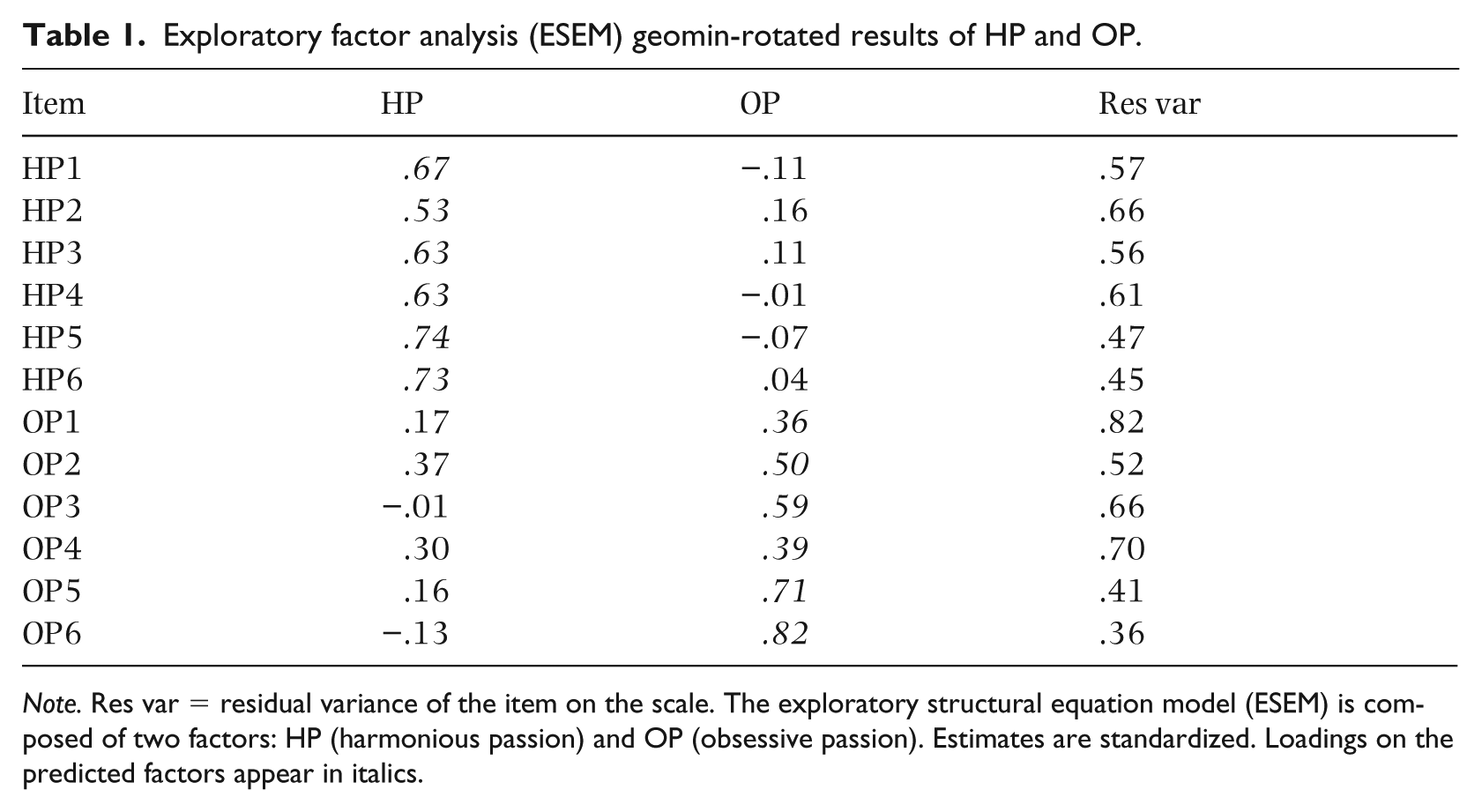
Note. Res var = residual variance of the item on the scale. The exploratory structural equation model (ESEM) is composed of two factors: HP (harmonious passion) and OP (obsessive passion). Estimates are standardized. Loadings on the predicted factors appear in italics.
A five-item criterion subscale is also included in the PS (see Vallerand, 2015, Chapter 4). This subscale measures the degree to which participants are passionate about the activity, in this case music (e.g., “Music is a passion for me.”). Each item of this subscale assesses a different criterion related to the definition of passion (the extent to which the activity is loved, valued, is a ‘passion’, as well as the time spent in the activity and integration of passion into the identity). The scores of each individual on the scale are averaged to provide a continuous score of the passion criteria. Although the purposes of this subscale are varied (see Vallerand, 2015), we used the passion criterion subscale to differentiate passionate from non-passionate musicians (in this study, a threshold of 4 on the five-point Likert scale is used; Vallerand et al., 2003), which provided 16 non-passionate and 209 passionate musicians (therefore, 93% of musicians in the sample were considered passionate). The internal consistency index for this subscale was adequate (α = .89).
Life satisfaction
The Satisfaction with Life Scale (Diener, Emmons, Larsen, & Griffin, 1985) was used to assess musicians’ well-being related to their overall satisfaction. The scale includes five items measuring the degree of satisfaction participants experience with their own life (e.g., “My life corresponds closely to what I desire,” α = .76).
Sense of mastery and growth
The Environmental Mastery and Personal Growth subscales of the Psychological Well-Being scale (short form; three items each; Ryff & Keyes, 1995) were used. The Mastery scale measures the extent to which individuals experience a sense of mastery and competence in their everyday lives and feel able to controls their activities (e.g., “In general, I feel I am in charge of the situation in which I live,” α = .59). The Growth subscale examines the extent to which musicians perceive themselves as growing and developing, and believe they realize their potential (e.g., “For me, life has been a continuous process of learning, changing and growth,” α = .67).
Music-related anxiety (MA; Bonneville-Roussy et al., 2017) was measured with a short scale measuring the extent to which musicians felt anxious in the following three musical situations: while performing in front of an audience; while rehearsing; while playing music in groups (on a Likert scale ranging from 1 Not at all to 5 Extremely, α = .73).
Results
Product–Moment correlations and descriptive statistics of the measures included in the present study are included in Table 2.
Pearson higher order correlations between, and means and standard deviations of the passion and well-being components included in this study.
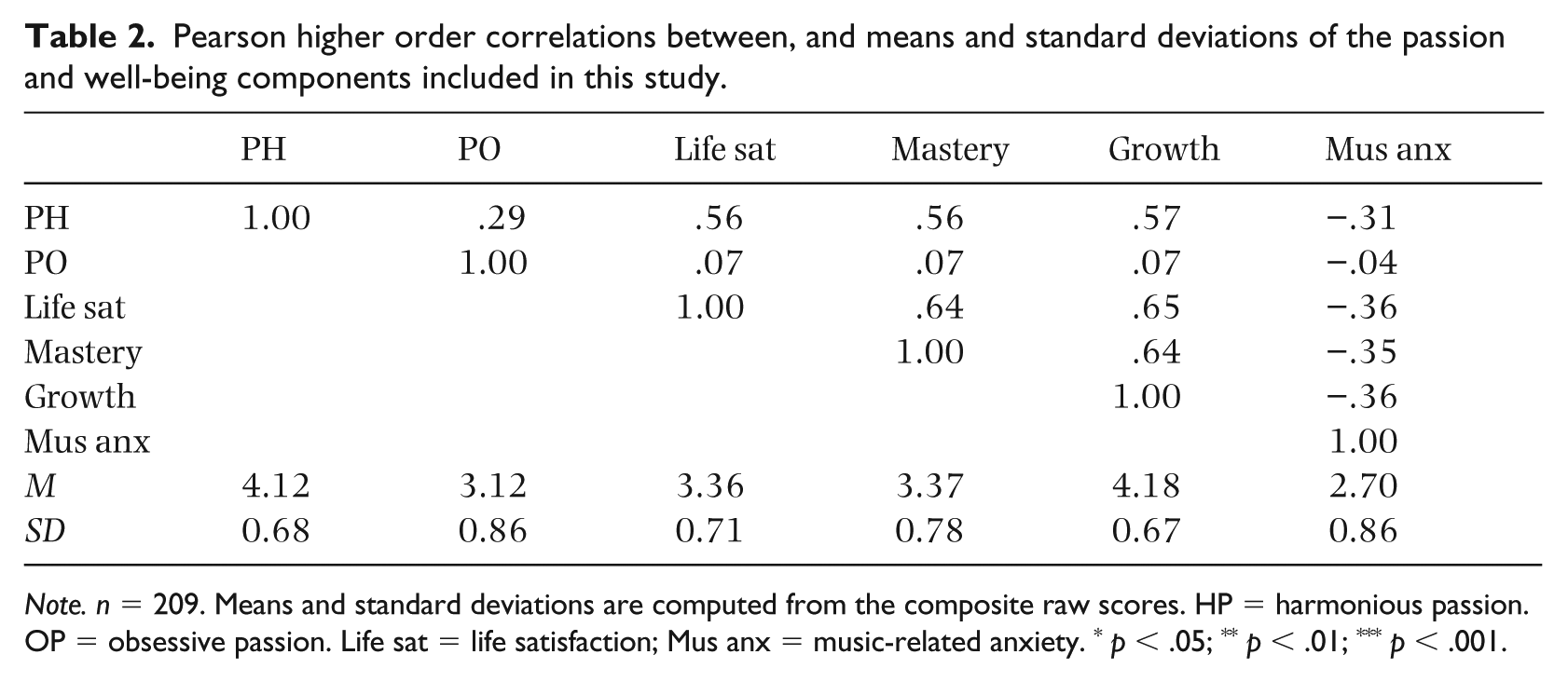
Note. n = 209. Means and standard deviations are computed from the composite raw scores. HP = harmonious passion. OP = obsessive passion. Life sat = life satisfaction; Mus anx = music-related anxiety. * p < .05; ** p < .01; *** p < .001.
Model linking harmonious and obsessive passions, musical anxiety and well-being
We examined the general links between HP and OP and the three well-being constructs: life satisfaction, sense of mastery and sense of growth. The model was estimated based on past research that has confirmed the validity of a general well-being factor (Abbott et al., 2006) that encompasses several well-being components (in the present case: life satisfaction, mastery and growth). Therefore, a second-order CFA was measured, with general well-being as the general second-order factor and the three components identified by their respective items. Then, general well-being was regressed on to HP and OP and musical anxiety as part of the SEM analysis.
In the SEM analyses the following fit indices are reported, based on the recommendations of Marsh, Hau, and Wen (2004) : chi-square (χ2), comparative fit index (CFI), Tucker-Lewis Index (TLI), standardized root-mean square residual (SRMR), and root-mean square error of approximation (RMSEA). Chi-square should be non-significant, although this index is sensitive to the number of subjects and to model complexity, with χ2 favoring small samples with low complexity levels. For CFI and TLI, values above .90 are considered adequate, with values above .95 deemed excellent (Marsh et al., 2009). For SRMR, values below .10 are adequate; and for RMSEA, values below .08 are also adequate (with the upper limit of confidence interval below .10 for an adequate model). We used robust maximum likelihood as the estimator. All analyses were carried out using Mplus version 8.0 (Muthén & Muthén, 2017).
The SEM model provided an excellent fit to the data, χ2(95) = 119.61, p = .05; CFI = .96; TLI = .95; RMSEA = .04 (.01, .05), SRMR = .06. The standardized solutions for the latent variables of HP and OP predicting well-being are shown in Figure 1 and the standardized and unstandardized overall solutions are presented in Table 3. As expected, general well-being encompassed the three constructs under study: life satisfaction, mastery, and growth. All three well-being components positively loaded onto the general well-being factor as expected. Of importance, as hypothesized, HP was negatively linked with musical anxiety (β = -.28, p = .001), but unrelated to OP. In turn, musical anxiety predicted a decreased sense of well-being (β = -.40, p < .001). Regarding the direct effects model, HP positively predicted general well-being with a strong effect (β = .50, p < .001), whereas OP was negatively related to the general measure of well-being (β = -.18, p = .03).
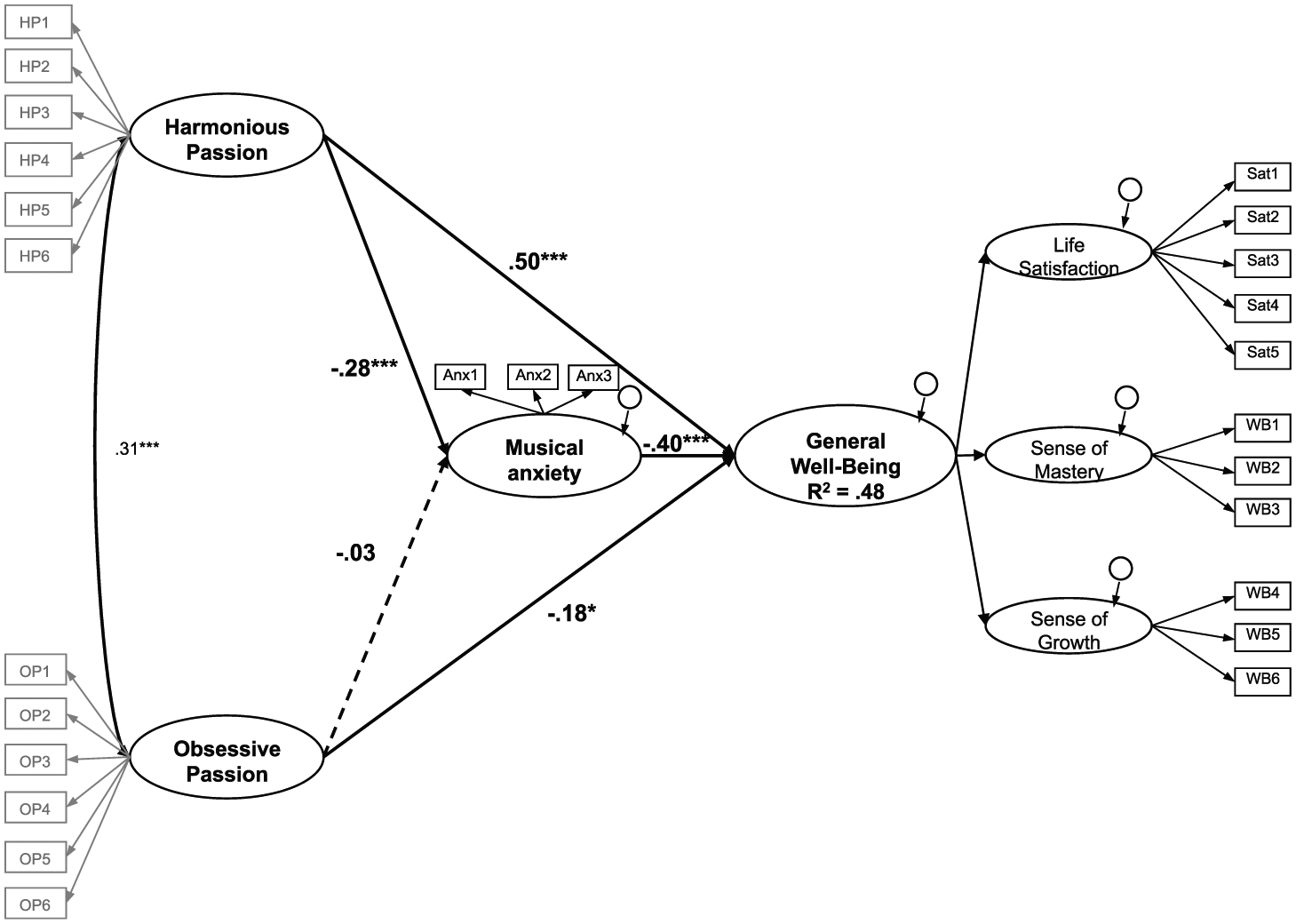
SEM results of HP and OP for music predicting general well-being. The estimates come from the standardized solution. The general well-being variable is a second-order latent factor explained by the three well-being components. The items loadings on the factors of each components of well-being are presented in Table 3. The factor loadings of HP and OP are presented in Table 1 and the scores on both factors were saved from that solution. * p < .05; *** p < .001.
Second-order SEM results of HP and OP predicting well-being.
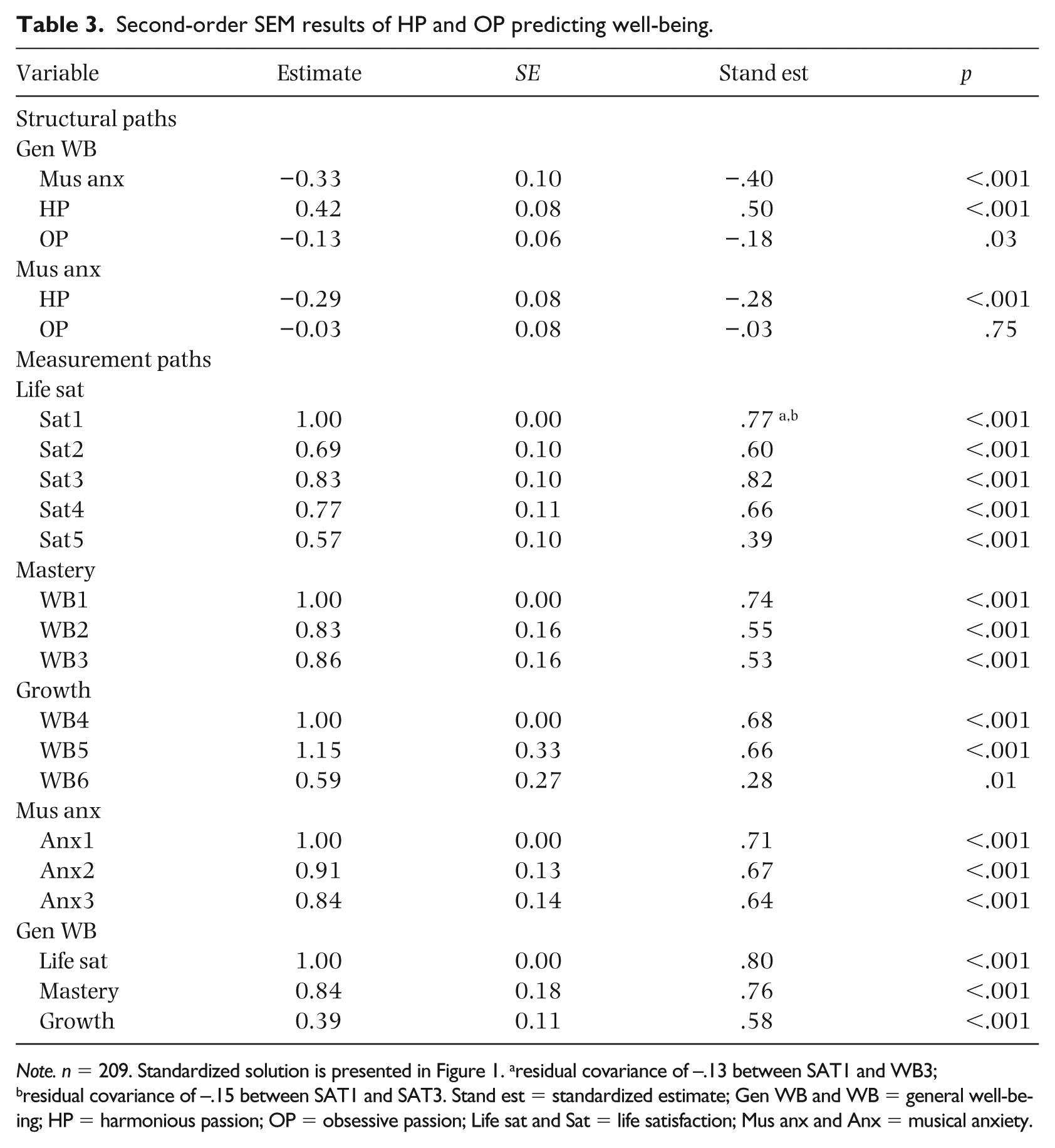
Note. n = 209. Standardized solution is presented in Figure 1. aresidual covariance of –.13 between SAT1 and WB3; bresidual covariance of –.15 between SAT1 and SAT3. Stand est = standardized estimate; Gen WB and WB = general well-being; HP = harmonious passion; OP = obsessive passion; Life sat and Sat = life satisfaction; Mus anx and Anx = musical anxiety.
The mediation from HP to well-being was found to be significant. HP indirectly predicted well-being through reduced musical anxiety, standardized mediation effect = .11, z = 2.49, p = .01. No indirect effect was found for the links between OP and well-being. Overall, the model explained a significant, and large, proportion of the variability in well-being (48% of variance explained).
Discussion
This study investigated the concept of passion for music as a central determinant of the well-being of musicians. This article expands knowledge in the area of music performance research in three ways: (1) it provides a validated tool for studying passion in music, the PSM, that could be used in future research with musicians; (2) it provides a first empirical examination of how passion is related to well-being in musicians, by showing that HP is related to enhanced well-being, whereas OP is negatively related to it; and (3) it underscores the role of musical anxiety as a deterrent to well-being.
Regarding the PSM, this research has found a valid structure that was similar to the structure of passion found in previous studies in other areas (using the PS), therefore confirming construct and factorial validity of the scale (Marsh et al., 2013; Vallerand et al., 2003). This scale can be used with saved factor scores of exploratory factor analysis, CFA or ESEM, or as composite scores (see Vallerand, 2015, for a review of the administration of the PS). The full PSM scale is presented in the Appendix for future use.
In light of the PERMA model of well-being (Seligman, 2011), the validation of the PSM allowed for the investigation of the links between passion and three indicators of psychological well-being, in light of the meaning (M) area of well-being: life satisfaction, sense of growth and sense of mastery. In this study, HP was related to well-being with large effects, whereas OP negatively predicted well-being. These results support the findings of previous research that HP is related to positive outcomes to a greater extent than OP. Indeed, HP has been linked with the experience of positive emotions, life satisfaction, and a general sense of well-being in various domains such as music, sports, and work (Bonneville-Roussy et al., 2011; Carpentier, Mageau, & Vallerand, 2012; Philippe, Vallerand, & Lavigne, 2009; Schellenberg, Gaudreau, & Crocker, 2013). On the contrary, OP is typically associated with lesser positive outcomes and even negative outcomes, such as burnout (Carbonneau, Vallerand, Fernet, & Guay, 2008; Gustafsson, Hassmén, & Hassmén, 2011). It is interesting that passion in musicians seems to follow the same patterns: harmoniously passionate musicians experience enhanced general well-being.
Importantly, while musical anxiety was negatively related to general well-being, the experience of HP seemed to buffer the negative effect of anxiety on well-being, while OP was unrelated to it. This result is unique as it is the first to show that being harmoniously passionate about music seems to act as a “sparkle” that brightens musicians’ lives, not only with regards to their performance and persistence (Bonneville-Roussy, Vallerand et al., 2011, 2013, 2017)), but also to their more global experience of well-being in life through the reduction of music-specific anxiety. This result confirms that having a higher level of HP towards music is conducive to enhanced well-being in musicians.
The importance of passion for music
This research is unique, as it is the first to systematically examine how passion can be operationalized in music, and how passion can improve the well-being of musicians. This research shows that passion, on its own, explains a substantial portion of the variance in the psychological well-being of musicians. From this research, we conclude that passion is central in explaining musicians’ psychological well-being.
Therefore, passion for music is worthy of further investigation and adds to the evidence that HP for music is conducive to performance, persistence and well-being, whereas OP may hinder them all (Bonneville-Roussy et al., 2011; Bonneville-Roussy, Vallerand, et al., 2013). The processes through which passion is linked with well-being need to be investigated further. For instance, flow experience, the experience of positive affect, and mastery goals may be processes that facilitate the links between HP and well-being, whereas music performance anxiety and perfectionism may mediate the links between OP and ill-being (Butkovic, Ullén, & Mosing, 2015; Kenny et al., 2011; Lacaille et al., 2005). Examining those variables using quantitative and qualitative research designs may shed light on the processes that link passion to the well-being of musicians.
Limitations
This research has some limitations that need to be highlighted. First, this research is correlational and therefore no causality can be inferred. In the present article, we assumed that passion preceded well-being. However, the two concepts could be interpreted within a transactional perspective in which, for instance, HP would first increase well-being that in turn would enhance HP, and so on. As such, the present research provides some early indications of the processes at play that could be further unveiled using longitudinal study designs. The sample was taken from classical music institutions and as such may not be representative of musicians from all genres. Since most of the results were in line with past research, and in areas other than music, we can safely assume that many of the processes described in the present research may be generalizable to most musicians. Finally, the study was conducted through self-report and is not immune to participant bias.
Implications for musicians and music students
This study has many implications for research and practice in music education and psychology research. Regarding the PSM scale, this research publishes the validated version of the scale for music, which can be used in future research with musicians and music students without changing the wording. In terms of practice, our results have confirmed that musicians benefit the most from being harmoniously passionate. We have seen in this study that HP for music seemed to enhance well-being on its own, and through the decrease of musical anxiety. OP was directly negatively related to well-being but had no buffer effect of anxiety. These result are important, as they show that trying to decrease musical anxiety without tackling its roots (in our case, through alleviating OP and promoting HP) may be inefficient or at most short-termed. HP partly comes from a flexible internalization of music into the musicians’ identity. This internalization process is facilitated in environments that promote “healthy passion,” with autonomy-supportive music tutors, coaches and colleagues, and environments that allow for flexibility and promote health (Bonneville-Roussy, Vallerand, et al., 2013; MacDonald et al., 2013). On the contrary, a controlling environment may lead to the development of a more obsessive type of passion.
Unfortunately, controlling behaviors seem to be prevalent in classical music cultures (Evans, 2015). Autonomy-supportive tutors and colleagues use a variety of techniques that are easily implemented to promote a healthy “autonomous” environment that leads to HP, such as providing choices and using non-controlling language with musicians (see, for examples of how to promote autonomy, Evans, 2015; Reeve, 1998; Reeve, Bolt, & Cai, 1999). In sum, it seems from this research that the well-being of musicians is greatly increased when musicians are harmoniously passionate. Future research should shed further light on the role of passion on the physical, psychological and social health, and well-being of musicians.
Footnotes
Appendix: Passion Scale for Music (PSM)
Acknowledgements
The author would like to thank Professors Adam Ockelford and David Hargreaves for their invaluable comments on a previous draft of the manuscript, and Hayley Trower and Lauren Hogg for the data collection.
Declaration of conflicting interests
The author(s) declare no potential conflicts of interest with respect to the research, authorship, and/or publication of this article.
Funding
The author(s) disclosed receipt of the following financial support for the research, authorship, and/or publication of this article: This research was funded by the Reg and Molly Buck Early Career Research Award from the Society for Education, Music and Psychology Research (SEMPRE).