



Abstract
Musically induced chills, an emotional response accompanied by gooseflesh, shivers and tingling sensations, are an intriguing aesthetic phenomenon. Although chills have been linked to musical features, personality traits and listening contexts, there exists no comprehensive study that surveys the general characteristics of chills, such as emotional qualities. Thus, the present research aimed to develop a broad understanding of the musical chills response, in terms of emotional characteristics, types of music and chill-inducing features, and listening contexts. Participants (N = 375) completed a survey collecting qualitative responses regarding a specific experience of musical chills, with accompanying quantitative ratings of music qualia and underlying mechanisms. Participants could also describe two more “chills pieces”. Results indicate that chills are often experienced as a mixed and moving emotional state, and commonly occur in isolated listening contexts. Recurring musical features linked to chills include crescendos, the human voice, lyrics, and concepts such as unity and communion in the music. Findings are discussed in terms of theories regarding musical chills, and implications for future empirical testing of the response.
Listeners engage with music for various reasons, such as passing the time (North, Hargreaves, & Hargreaves, 2004), or enhancing activities such as exercise (Greasley & Lamont, 2011); however, one of the most valued uses of music is to experience and regulate emotions (Juslin, Liljeström, Västfjäll, Barradas, & Silva, 2008). Music can both express emotions (Gabrielsson, 2001), and elicit emotional responses in listeners (Juslin, Liljeström, Laukka, Västfjäll, & Lundqvist, 2011; Lamont, 2011; Lundqvist, Carlsson, Hilmersson, & Juslin, 2009; Meyer, 1956). These responses range from less intense moods such as relaxation, to strong emotional experiences (Gabrielsson & Lindström Wik, 2003; Panzarella, 1980). One specific emotional state that has received attention in music and emotion research is “chills”, although many aspects of the response are not yet understood.
Definitions and terminology surrounding chills vary, with the response labelled as thrills (Goldstein, 1980), frisson (Huron & Margulis, 2010), or skin orgasms (Panksepp, 1995). For current purposes, the term “chills” will be used, as it is the most common label in the literature (Craig, 2005; Egermann et al., 2011; Grewe, Nagel, Kopiez, & Altenmüller, 2007; Guhn, Hamm, & Zentner, 2007; Maruskin, Thrash, & Elliot 2012; McCrae, 2007; Nusbaum & Silvia, 2011). As a working definition, chills are defined as an emotional experience accompanied by gooseflesh, shivers or tingling sensations; these aspects are more consistent across existing research, although it is important to note that chills may be conceptualised differently across individuals.
Chills may indicate strong emotional experiences. Developing from work by Maslow (1964), Panzarella (1980) studied the phenomenological aspects of aesthetic peak experiences; four components of the experience were proposed, including “motor-sensory ecstasy”, encapsulating physical changes such as shivers and tingling. Rickard (2004) found that emotional music resulted in more chills than other listening conditions. Chills have also been described as peak moments of pleasure, with links established between the response and dopaminergic systems of reward in the brain (Blood & Zatorre, 2001; Salimpoor, Benovoy, Larcher, Dagher, & Zatorre, 2011). Finally, across a large quantity of reports on strong experiences with music (Gabrielsson, 2011), gooseflesh and shivers are reported in roughly 10% of accounts. Interestingly, tears were reported in almost 25% of reports, and research has suggested that crying can coincide with chills, resulting in stronger experiences (Wassiliwizky, Jacobsen, Heinrich, Schneiderbauer, & Menninghaus, 2017).
As an intense emotional response, the study of musical chills offers numerous possibilities, evidenced by multiple approaches taken by researchers, such as assessing effects of musical structure, and the role of individual differences and listening contexts.
Elicitors and factors
A common approach to studying musical chills is to explore links between the response and musical features. Early research adopting this approach was carried out by Sloboda (1991); listeners retrospectively documented experiences with music in terms of physiological activity, and the corresponding moments in the music that elicited the response. Results showed that tears often corresponded with melodic appoggiaturas, whereas shivers were associated with sudden dynamic or textural changes, and new or unprepared harmony. Panksepp (1995) focussed specifically on chills, showing that these experiences occurred most frequently in a piece containing a large crescendo, supporting links between dynamic change and shivers.
Some results were replicated in studies using skin conductance to validate chills (Grewe et al., 2007; Guhn et al., 2007), a measurement indicative of emotional arousal (Khalfa, Peretz, Blondin, & Manon, 2002). Sudden dynamic changes were correlated with the frequency of chills across participants (Grewe et al., 2007; Guhn et al., 2007). Novel findings, however, note the possible role of interactions between solo and accompanying instruments (Guhn et al., 2007), and the entrance of new instruments (Grewe et al., 2007). Additionally, psychoacoustic features, such as increased loudness and roughness, were linked to chills (Nagel, Kopiez, Grewe, & Altenmüller, 2008). Consistencies across existing studies may be encapsulated by musical expectancy (Meyer, 1956); it must be noted, however, that expectancy violations have been found to affect arousal levels in listeners (Juslin, Harmat & Eerola, 2014; Steinbeis, Koelsch, & Sloboda, 2006), and whilst chills may be high arousal experiences (Rickard, 2004), existing research explains little in terms of the detailed emotional characteristics of the response.
Other research examined individual differences across listeners, and effects of listening contexts. Exploring the links between chills and personality traits, McCrae (2007) suggested that aesthetic chills are the best indicator of openness to experience; similar associations were reported by Nusbaum and Silvia (2011), and Colver and El-Alayli (2016). Effects of social listening contexts were assessed in relation to chills (Egermann et al., 2011); participants listened to music alone or with friends, with results showing that chills were less frequent in group listening conditions, though not significantly. Utilising the experience sampling methodology, Nusbaum et al. (2014) concluded that in everyday listening contexts, listening when alone was not a significant predictor of chills, but instead attention to the music and choosing the music were important factors; other results highlighted that musical chills were experienced in happy and sad states, a rare insight into the emotional characteristics of chills. Finally, familiarity with a piece of music may affect the chills response, although findings are inconsistent (Benedek & Kaernbach, 2011; Laeng, Eidet, Sulutvedt & Panksepp, 2016).
Theories of musical chills
Current research on musical chills describes numerous relationships between the response and aspects of the music, listener, and situation. However, few studies attempt to test links between chills and the listening experience, limiting understanding of causal processes. Despite this, theories have been posited, the first being the fear response. In work on musical expectation, Huron (2006) suggested that links between chills and expectancy are derived from the fear system in the brain; this is intuitive given that chills are reflected in sympathetic nervous system activity and the fight-or-flight response (Craig, 2005; Grewe et al., 2007; Laeng et al., 2016). Huron explains that chills may be an emotional response similar to what James (1894) describes; shivers and gooseflesh are produced by an automatic fear response, and are then appraised as pleasurable within a safe aesthetic context, resulting in contrastive valence effects between a rough “worst case scenario” appraisal, and slower, aesthetic appraisal. Issues arise, however, given that there seems to be no clear stimulus-response pattern in musical chills, and that some listeners may not experience chills; this might be surprising if the adaptive fear response was central to aesthetic chills.
An alternative view of chills concerns systems of social separation and closeness in the human brain (Panksepp, 1995; Panksepp & Bernatzky, 2002). Here it is theorised that chills are elicited by music through acoustic cues that resemble distress vocalisations or separation calls, and function as a motivator for social reunion by inducing phenomenological feelings of coldness. As a possible explanation of how thermoregulatory processes are recruited in music listening, Panksepp (1998) claimed that social bonding and thermoregulatory systems are integrated in the brain, resulting in possible crosstalk; indeed, the symbolic warmth and cold of social proximity has received empirical attention, suggesting that feelings of physical and social warmth share neural mechanisms (Inagaki & Eisenberger, 2013). However, it is currently unclear how acoustic features in music might reflect distress vocalisations.
Chills have further been linked to being moved (Benedek & Kaernbach, 2011; Wassiliwizky, Wagner, Jacobsen, & Menninghaus, 2015). In a conceptualisation presented by Menninghaus et al. (2015), this enigmatic emotional state comprises a mixture of happiness and sadness; furthermore, the experience may be related to significant personal, historical or political events, such as weddings or natural disasters. Studies have investigated being moved by film clips, concluding that eliciting stimuli should express a negative background (long separation of two lovers), and a positive foreground event (reunion of lovers), or vice versa (Wassiliwizky et al., 2015). Although little research has explicitly investigated chills with regard to being moved and mixed emotions, some evidence is available. Panksepp (1995) suggested that chills-inducing music is often melancholic, nostalgic, or expressive of love and acceptance, indicating mixed emotions or social themes. Additionally, the pleasure some listeners experience when listening to sad music has been associated with being moved (Vuoskoski & Eerola, 2017), possibly supporting the claims that sad music is more effective in eliciting chills (Panksepp, 1995). The concept of being moved is not a theory of chills, but may be encapsulated by ideas of social separation and bonding (Panksepp & Bernatzky, 2002; Seibt, Schubert, Zickfeld, & Fiske, 2017). However, most research on being moved has focussed on film clips with explicit narratives; assessing the link between being moved and chills in a musical context is difficult when considering instrumental music and its “floating intentionality” (Cross, 2014).
A final concept worth highlighting is awe (Shiota, Keltner, & Mossman, 2007), a vague emotional state in response to a stimulus perceived as beautiful, potentially dangerous, and as possessing grandeur (Keltner & Haidt, 2003). Awe has been linked to being moved and to chills by Konečni (2005), and may be linked to fear responses, and social processes such as hearing an inspirational speech, or witnessing a high level of artistic skill (Algoe & Haidt, 2009). Recently, gooseflesh has been linked to feelings of awe, both social and aesthetic (Schurtz et al., 2012), although how musical awe relates to chills has yet to be properly investigated; progress in this area is difficult, as the experience is not sufficiently understood.
Rationale for the current study
Musical chills have been associated with musical features, personality traits, and listening contexts. Explanations of chills refer to fear, social separation, and being moved. Despite encouraging findings, research into chills has developed slowly, and there exist substantial limitations and shortcomings in the literature. Firstly, although correlations have been reported between chills and musical features, these are few, and no extensive investigation exists regarding the many different pieces of music that can elicit chills in listeners. Secondly, whilst some work has focussed on the listening situations in musical chills, a general picture of typical situations that involve musical chills has yet to be developed. Finally, and perhaps most importantly for future research, is the fact that although chills are described as peak experiences of pleasure, almost no work exists that specifically targets and describes emotional characteristics of the response; therefore, there is uncertainty as to whether chills are a general indicator of emotional arousal, or a specific emotional experience. For example, Maruskin, Thrash, and Elliot (2012) have suggested that within the concept of chills there may be different structures, such as “goosetingles” and “coldshivers” that reflect different phenomenological experiences, and which are elicited by differing stimuli.
In line with three main shortcomings highlighted in existing chills research, the current study aimed to develop a general understanding of chills in terms of emotional and physiological qualities, listening situations, and musical elicitors of the experience.
Method
Materials
A survey was designed to target the experience of musical chills, partitioned into three main sections. The first section collected demographic information, whether the subject had experienced chills with music, and how frequent these chills occured (yearly, every few months, monthly, weekly, daily, and every time I listen to music); openness to experience was assessed using ten items scored from 1 to 7 (John & Srivastava, 1993).
In the second section, participants were asked to recall a specific experience of musical chills, and to provide open-ended responses regarding the subjective feelings during the experience, the eliciting piece of music, notable musical characteristics, and listening situation. Supplementary data for these experiences were collected in the form of experience qualia (Beerman, Trznadel, & Scherer, 2015), and underlying mechanisms of music and emotion (Juslin, 2013; Juslin, Harmat & Eerola, 2014). For these items, pre-tests ensured that ratings were understood, and that items were refined for the purposes of the study.
In the final section, participants provided up to two more pieces of music that elicited chills, and described notable qualities, general sound and style, and if possible, specific moments that directly elicited chills. As a final measure, participants were asked to explain why the chills occurred.
Procedure
Participants were recruited via online advertisements and a local library. In the survey, chills were defined as “an emotional response accompanied by shivers, gooseflesh and/or tingling sensations”; this was necessary to collect specific data, though it is worth noting that listeners may conceptualise chills differently. Participants gave informed consent, and data were anonymised (e.g., “participant 6”, references to data will follow this format). The survey took ten minutes to complete, and was approved by the Durham University Ethics Committee. Upon completion, participants could enter a draw to win one of three £20 Amazon gift vouchers.
Participants
The survey was completed by 375 participants (mean age = 36.14 years, range = 18 to 78 years), with the sample comprising 186 females, 183 males, and six transgender or other. Finally, 206 participants reported not playing any musical instrument.
Analysis
Quantitative data were analysed in R (https://cran.r-project.org). Qualitative responses were subject to thematic analysis (Braun & Clarke, 2006): Raw data were coded in terms of relevance for the study, with codes grouped into themes of similarity and association; next, themes were further categorised and grouped into broad top-level themes that best represented the data. Data were coded in categories of subjective feeling, listening situations, overall musical qualities, general sound and style of music, specific chills moments, and explanations of the chills response. Thematic analysis was accommodated by NVivo software (Version 11.2.2). For inter-coder reliability, a random subset (20%) of responses were coded by another annotator based on categories established; these codes were largely congruent, yielding Cohen’s kappa of 0.72 (p < .001).
Results
Descriptive statistics
The first section of the survey showed that 94% of participants had experienced musical chills; the remaining 6% of participants reported never having experienced musical chills, and were omitted from further analysis. For most participants, the frequency of chills was from “every few months” (30%) to “weekly” (28%). The average score for openness to experience across participants was 5.17 (SD = 0.82).
Specific chills experience
The second section of the survey concerned a specific recollection of musically induced chills; of the sample, 274 participants could recall a specific chills experience. The following results encapsulate open-ended responses regarding subjective feeling and listening situations, qualia ratings of music and feelings, and ratings of underlying mechanisms within chills pieces; data referring to overall musical qualities were analysed at a more holistic level, across all pieces of chills music reported by participants.
Subjective feeling
Participants were first asked to “describe how they felt during the experience”. From raw data, 484 codes were grouped into broader themes, with two accounting for most responses: emotions and feelings, and physical reactions (Figure 1).

Diagram of two main themes and most frequent codes for subjective feelings of chills pieces; numbers in parentheses indicate number of codes extracted from raw data.
Emotions and feelings was the largest theme, showing that chills are often reported as strong emotional experiences, as overpowering, and as resulting in feelings of awe. The following is an example of overpowering emotion, and a sense of losing control: I felt as though I had lost control of my emotions and had to retreat to my “special place” as I was leading a carol service at the time! (Participant 281)
The chills response also included states of mixed emotions, feelings of being moved, and experiences of nostalgia: I felt a heightened sense of emotions. It’s often a confused sense of happiness and intense sadness. (Participant 135) I was touched and moved. What can I say? The time stopped, and there was only this music and song. I didn’t cry, but I was really moved. (Participant 228)
Less frequently reported were states of joy, exhilaration and sadness without mixed feelings. Whilst strong and mixed emotional states were prevalent in musical chills, results also indicate that experiences are pleasurable and positive, leading to good or improved moods in some listeners.
The second theme of physical reactions covers bodily activity perceived by the listener, including changes such as gooseflesh and shivers. A frequent response reported was tears, a physiological marker not commonly included in definitions of chills. Other participants noted heart rate changes, feeling a lump in the throat, and warmth or tension in the chest.
Beyond the two larger themes, participants provided other responses, such as feeling engaged with the music, connected to relatable music, and empathy for characters within the narrative. The quantitative ratings of musical qualia (Figure 2) reflect main themes of the category subjective feeling, with experiences rated as highly moving, fascinating and positive.
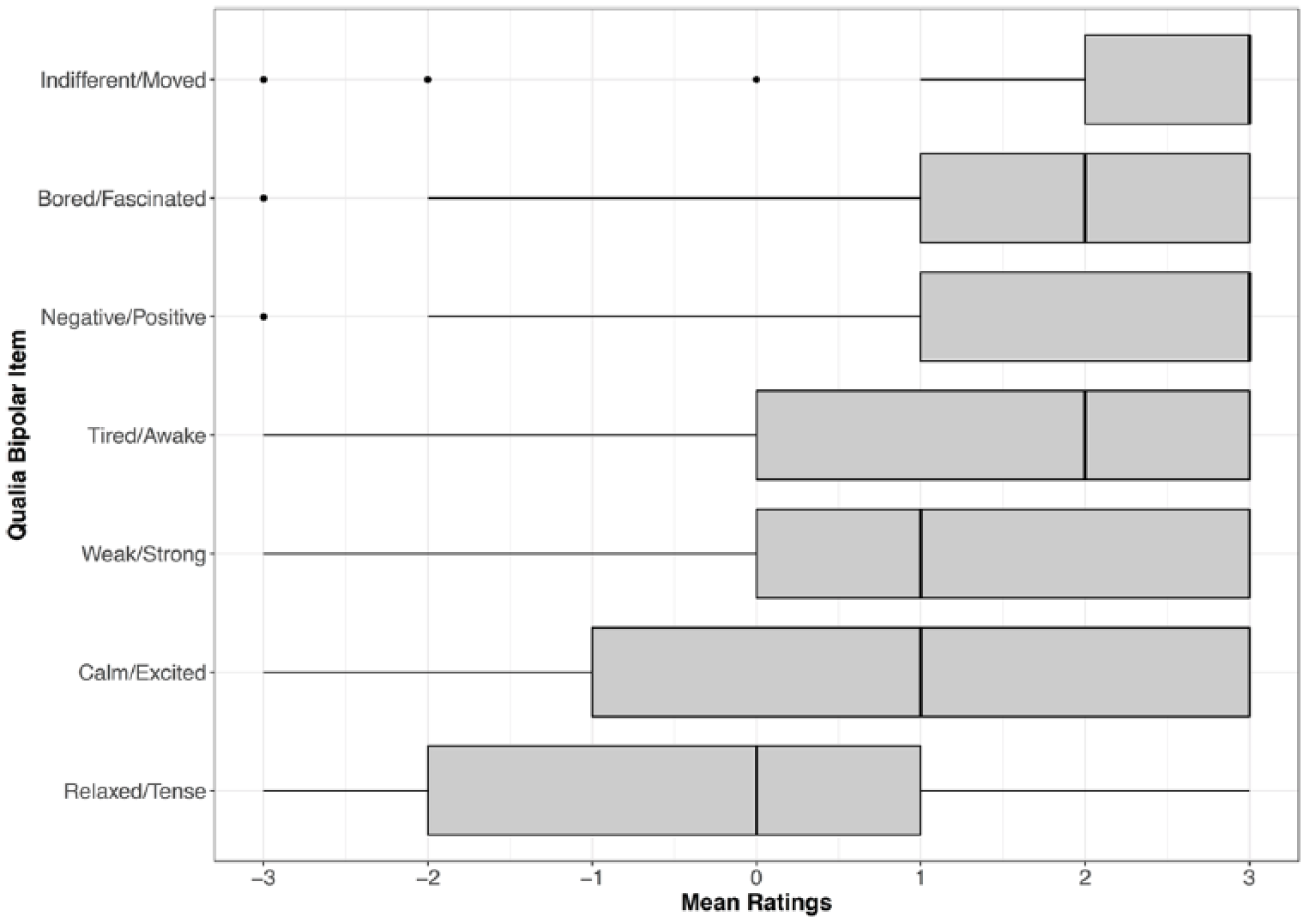
Boxplot of music qualia bipolar scales used to describe emotions and feelings within specific chills experiences (7-point scale from −3 to +3); negative scores correspond to the first/left-hand word in the descriptor.
Listening situation
The next set of responses concern listening contexts of musical chills. From 288 codes, four main themes were developed: social context, location, medium, and specific context.
The social context of musical chills documents whether experiences occurred when listening alone, or with others. Results show that most chills experiences occurred when listening alone. In terms of listening with others, certain relationships were highlighted, such as listening with a partner, family or friends.
The theme of location suggests that chills occur in various environments, commonly at concerts, home, or during transportation (car, train, walking). Although few participants specified venues for concerts, most who did referred to cathedrals and religious settings.
The medium of music listening addresses modes of listening, with most participants experiencing chills whilst listening through headphones or a sound system; other ways were documented, however, such as hearing music on television, or at the cinema, possibly indicating audio-visual sources as opposed to just music.
The final theme of specific context highlights idiosyncratic situations mentioned by certain participants, including experiencing chills whilst performing, or after a failed relationship or death of a family member.
Overall musical qualities
For all pieces of music reported, participants described notable and likable musical qualities. From 806 codes, seven main themes emerged: musical parameters, instrumentation, expression, interaction, lyrics, climaxes, and skill and artistry (Figure 3).
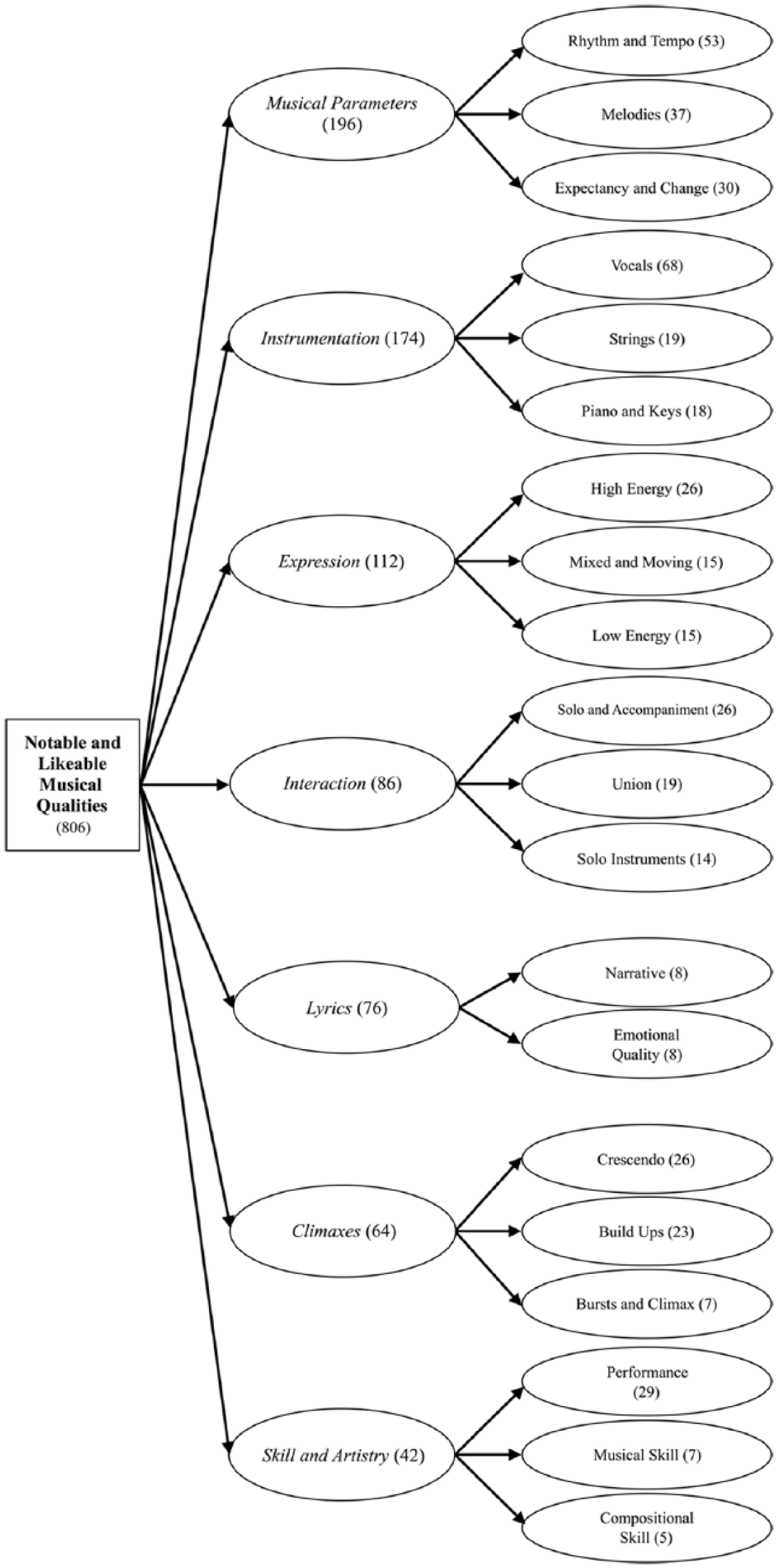
Diagram of seven main themes and most frequent codes for overall musical qualities of chills pieces; numbers in parentheses indicate number of codes extracted from raw data.
Musical parameters involved broad references to musical aspects that were preferred, such as melodies, harmonies, rhythm and tempo. Musical expectation, change, tension and tonality were highlighted by some participants, although no clear consistencies occurred within the theme.
With regard to instrumentation, the human voice was most frequently reported, which may indicate either an importance of voices in chills, or prevalence of popular music genres characterised by this feature. Other common instruments included various strings, guitars, and piano.
Expression in music was a prevalent theme, sub-divided into emotions and energy. Emotions expressed by chills music seemed to align with subjective feelings reported by participants, with mixed emotions perceived in the music. Sadness is also reported, but contrasts with positive expressions such as hope and passion. Concepts of darkness and haunting expression were common, sometimes referring to insidious tunes. In terms of energy, most pieces were described as expressing high levels of energy.
Interaction refers to relationships between instruments, people or patterns within a piece. The most frequent aspect describes interactions between solo and accompanying instruments: Powerful organ, rising over the other more delicate sounds of other instruments, a very chilling, thrilling sound. (Participant 280)
Closely related is the aspect of solo instruments, including guitar solos, or an instrument playing in isolation. Another common relationship is that of union, which may refer to intertwining voices or instruments, use of every orchestral element, togetherness, and comradeship: The sound of everyone’s voices intertwining, motifs from the rest of the music coming into play, the group chants of “We are powerless”. (Participant 53)
A final sub-theme of interaction refers to interplay and connections, a more direct description of relationships between instruments, performers or patterns; this includes interweaving melodies, and perceiving social interactions, such as an argument between people, a tender interplay of two people aiding each other, or general chemistry between performers.
Lyrics are of importance, but no patterns emerged, with lyrics described as cool, strong, touching, dark, religious and moving. Some narrative elements were highlighted, such as testing one’s faith, or right-wing violence.
Climaxes encapsulates peaks in music, such as crescendos and build ups. Other aspects include general swells of intensity and emotional bursts.
The final theme of musical qualities is that of skill and artistry, which often describes performance properties, such as amazing singing, vocal range, well-performed guitar solos and skilled instrumentalists. Compositional skill is also highlighted, referring to well-written music and genius.
The category overall musical qualities finds some parallels with quantitative measures of the underlying mechanisms of music and emotion (see Figure 4); for example, emotional contagion is rated higher than other mechanisms, possibly reflecting the human expression of emotion through vocal performance. Rhythmic entrainment is also rated highly, but lyrics appear less significant in quantitative ratings, suggesting some inconsistencies between open-ended responses and quantitative data.
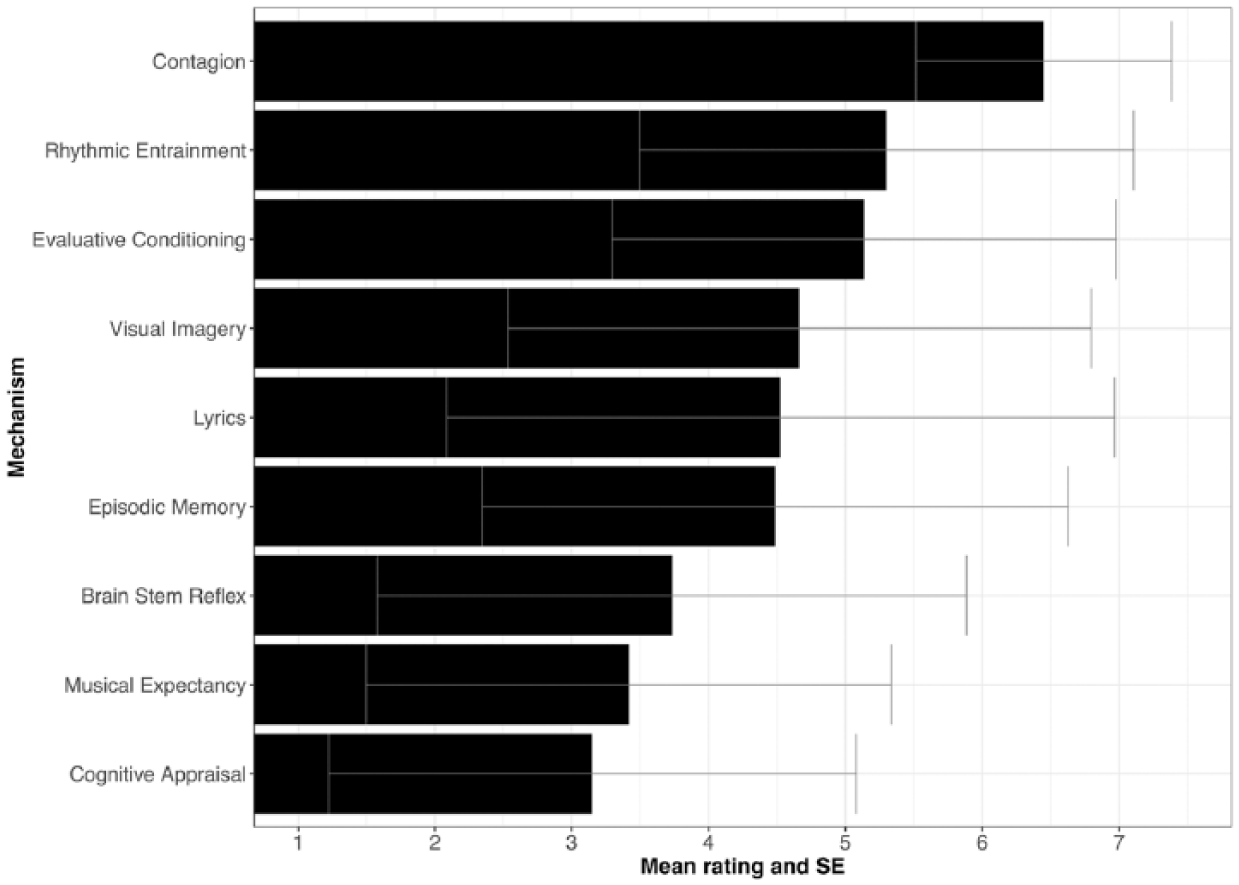
Bar chart visualisation of mean scores for reported underlying mechanisms across pieces of chills-eliciting music, on a scale of 1–7 (error bars indicate standard error).
General sound and style
In the third section of the survey where additional chills pieces were collected, participants described the music in terms of general sound, style and genre. The 438 codes were categorised into three main themes: expression and quality, genre and style, and images and concepts. Note that some results here share similarities with overall musical qualities previously reported.
Expression and quality refers to expressions of mixed emotion, sadness, tenderness and positive emotions. Chills-eliciting music was also reported as expressing beauty, sublimity and awe, sometimes labelled as enchanting, glorious and transcendental. Participants used a wide variety of descriptors when conveying the overall sound of a piece, referring to depth, fullness, catchiness, and music as an anthem.
Genre and style highlights the variety of music involved in chills. Pieces were described in terms of instrumentation, ranging from piano, fiddles and trumpets to guitars and synthesizers. Other music was described at a broader level of genre and style, with the two most reported styles defined as classical orchestral styles, and general popular styles; other genres include ballads, jazz, folk, and electronic.
Images and concepts refers to abstract descriptions of sounds within music; there are common references to heavenly, angelic sounds and the idea of God, whilst other reports portray quasi-emotional concepts such as music tugging on the listener’s heart. Some listeners refer to nature, such as moonlight, the sun, waves on a shore, or unearthly sounds.
Given the similarities between overall qualities and general style themes, some codes were identified multiple times. As a quick summary, however, participants again referred to crescendos and build ups, and aspects of musical union or solo and accompaniment interaction when discussing the sound and style of chills music.
Specific chills moments in music
A central question asked participants to describe the moment in a piece of music that elicited chills. From this, 153 codes were categorised into five central themes: voice and words, peaks, musical relationships, entrance of instrument, and transition and change (Figure 5).

Diagram of five main themes and most frequent codes for specific chills moments in music; numbers in parentheses indicate the number of codes extracted from the raw data.
The theme of voice and words appears to indicate significant elicitors of chills, with most coded data accounted for within this theme. Reports here describe the effects of lyrics, from specific lyrical lines, to broad reports of the importance of lyrics: It’s definitely the lyrics that affect me most with this one, in particular: “An old man said to me, won’t see another one”; “I turned my face away and dreamed about you”; and “You took my dreams from me when I first met you – I kept them with me babe, I put them with my own”. Oh man, I’m listening to this again, and crying! I’m soft as clarts. (Participant 156)
Narratives underlying the lyrics include love, romance and sadness. The human voice is also reported to elicit chills, though descriptions are often vague, highlighting expressions of strength and anguish.
Peaks is like the previously established theme of climaxes; in this context, however, participants confirm that crescendos and build ups specifically elicit the chills response. Further aspects include bursts of energy, melodic peaks and salient notes, such as high notes in a vocal or instrumental performance.
Another recurring theme is musical relationships and interactions: The part that almost never fails to give me chills if I’m listening attentively is near the end, where the full orchestra and choir join together for the first time. The main theme (which has been mostly cheerful and optimistic the whole time) turns dark for a few moments, as the choir is wailing. It’s a very powerful moment. (Participant 116)
This quotation describes concepts of union, highlighting the feeling of instruments and musical factors coming together to form a whole sonic object; this is often portrayed as instruments blending together, voices uniting in harmony, or a full orchestra “crashing in”. In contrast to musical union, some participants report that minimal moments or solo instrumental lines resulted in chills, referring to guitar solos, or specific moments in music where background instruments fade out, leaving one or two instruments playing alone. A final aspect of musical relationships is that of social narratives, linked to lyrics describing love, feelings of loss, and music that resembles a person’s cry for help, or the idea of reconciliation.
The entrance of new instruments reflects moments in a piece where a new instrument or voice enters, such as guitars kicking in, trumpets taking the tune, and strings entering.
Finally, transition and change encapsulates moments of structural transitions or alterations. Some examples include changes in dynamics, meter, tonality, and meta-structure such as moving from a bridge to a chorus.
Chills explanation
A final exploratory question asked participants to explain why they experienced chills. Some supplementary data was collected, with 308 codes grouped into three main themes of relationships, musical parameters, and evoking memories.
In the relationships theme, participants suggested that chills occur when the music and words are relatable, mirroring one’s life or reflecting previous experiences. Music is sometimes described as speaking to the listener, offering support or comfort, whereas other participants note that empathy for a performer or character in the narrative underlies the chills response. Finally, aspects of love and interpersonal relationships are highlighted, as well as how these are expressed in music.
Musical parameters contains varied explanations referring to specific musical features linked to chills, including build ups, climaxes and chord structures. The clearest trend, however, is reference to the human voice as being a common elicitor of chills.
The final theme of evoking memories has rarely been highlighted in the survey, but reflects extra-musical processes characterising music as a retrieval cue for emotional memories. There were no trends in the specificity of reported memories.
Discussion
The current study aimed to provide a first direct investigation into numerous characteristics of musically induced chills, and the results represent an advancement in knowledge of emotional qualities, prevalent listening situations, and a larger selection of music and features that elicit chills in listeners. Generally, participants experienced chills at a frequency of every few months to weekly; furthermore, chills responders were characterised by high scores for the personality trait openness to experience, supporting previous research (McCrae, 2007; Nusbaum & Silvia, 2011). Chills often occurred when listening alone, whilst concert environments were also reported frequently. Participants took part from numerous locations in the world, and varied in terms of age, instrumental playing, and occupation, resulting in a more representative sample than previous investigations into chills.
Central findings concern the emotional characteristics of chills, a central limitation in existing research. Chills have been linked to peak pleasure (Blood & Zatorre, 2001), strong emotions (Gabrielsson, 2011; Rickard, 2004), and being moved (Benedek & Kaernbach, 2011; Wassiliwizky et al., 2015). As a result of previous research and a working definition of chills provided to participants, it is not surprising to see emotions as a central theme in the survey; however, until now the specific emotional qualities of chills had not received empirical attention. The survey collected novel data that demonstrated for the first time that musical chills are often described directly as an overwhelming, strong experience, frequently containing mixed emotions such as an amalgam of happiness and sadness; it is also worth noting that being moved or touched were the most common descriptors used by participants. These results reflect existing literature, but develop from the ideas that certain emotions are accompanied by chills to assess specifically how listeners describe their chills responses to music.
Of the musical selections referenced in the survey, consistencies were evident in salient musical features and specific chills moments in the pieces. The human voice was frequently noted by participants, alongside emotional expressions perceived in the music. Further features associated with chills included crescendos, swells and climaxes, linked to increases in emotional arousal that may be conducive to chills (Rickard, 2004; Salimpoor, Benovoy, Longo, Cooperstock, & Zatorre, 2009). Finally, chills were associated with interactions and relationships perceived between instruments, performers or characters in the music. Although dynamic changes, unprepared harmonies and the entrance of new instruments have been linked to chills (Grewe et al., 2007; Sloboda, 1991), rarely has reference been made to moments when full orchestras unite, singers blend into harmony, or larger groups of performers begin chanting. Indeed, novel data regarding musical features are portrayed in themes of musical relationships and interactions, covering aspects of unity, blending, and developing relationships between solo and accompaniment instruments (although see Guhn et al., 2007).
The present study may inform theories and conceptualisations of chills. With regard to fear as a mechanism of musical chills (Huron, 2006), there are certainly reported musical characteristics that may elicit a rough fear appraisal, such as crescendos, build ups and unexpected chord changes. Syntactical expectancy violations have been shown to increase arousal levels in listeners (Steinbeis et al., 2006), a feature attributed to chills (Rickard, 2004); however, arousal levels are not sufficiently nuanced to explain the emotional experiences identified in this survey. Furthermore, the lack of a stimulus-response pattern in musical chills suggests that fear, an automatic survival mechanism, may not be central to the experience; however, investigations should move beyond correlative work and systematically test musical chills to better understand these processes, and how they differ across individuals. Despite this, crescendos and build ups were common in chills moments, and underlying processes linked to these features should be considered.
The enigmatic concept of awe has also been linked to chills (Keltner & Haidt, 2003; Konečni, 2005; Schurtz et al., 2012; Shiota et al., 2007). Consistent features in the survey such as crescendos may be related to awe, and in fact numerous participants reported feeling overwhelmed by the music in some way, perhaps due to the perception of grandeur or feelings of subordination to the musical object. The appreciation of artistic skill and musical excellence was reported in the survey, and this interpersonal, social appreciation has previously been discussed in terms of awe and admiration, with physiological indices including gooseflesh and warmth in the chest (Algoe & Haidt, 2009). However, further research is required in characterising awe, and understanding its possible connection to chills.
The final main concepts underlying chills are social separation, and the mixed state of being moved. Numerous participants explicitly referred to feeling moved or touched, with some stating feelings of happiness occurring with sadness. In earlier literature, it has been suggested that chills are a response to distress vocalisations (Panksepp, 1995; Panksepp & Bernatzky, 2002), given also that social and physical warmth share some neural mechanisms (Inagaki & Eisenberger, 2013; Panksepp, 1998), acoustic cues in music may resemble these vocalisations. Being moved has also been linked to prosocial cues and significant life events, involving social scenarios such as weddings or funerals (Hanich, Wagner, Shah, Jacobsen, & Menninghaus, 2014; Menninghaus et al., 2015). Interestingly, the prevalence of the human voice, lyrics and musical relationships in specific chills moments suggests a role of social aspects underpinning chills. The human voice may resemble distress vocalisations, and is innately more social, communicative and contagious than other instruments, evidenced through mirror neuron activity and perception-action loops (Davies, 2011; Molnar-Szakacs & Overy, 2006; Rizzolatti & Sinigaglia, 2016). As we better understand human action, emotional expression is strongly communicated by the voice, allowing for social processes such as empathy at the level of the person or the character that the voice belongs to (Clarke, DeNora, & Vuoskoski, 2015). Lyrics often describe explicit narratives, and can be relatable and understood in similar ways to literature or film; however, this prevalent aspect of modern music is often avoided, given the difficulties of understanding combined effects of linguistic and musical parameters (Ali & Peynircioglu, 2006; Fiveash & Luck, 2016). Regardless, specific lyrics quoted in the survey touched on topics of love and loss; these are often judged as relatable by listeners, highlighting the possible presence of empathic processes, and social bonding. Finally, the theme of musical relationships may be contextualised in terms of social cues and cognition, although it is unclear as to how these processes operate in complex musical situations. However, it appears intuitive to treat moments of musical union, such as full orchestras coming into the music together, as social; for example, these moments may reflect a sudden intensification of communal sharing relations implicated in experiences of being moved (Zickfeld, Schubert, Seibt, & Fiske, 2017). Additionally, interactions highlighted between solo and accompaniment instruments could be perceived in terms of interpersonal support and cooperation. Haidt (2003) suggested that the positive emotion of elevation, like being moved, is elicited by observed acts of altruism and moral virtue. Although little empirical research exists in the context of music, recent research suggests that social cues are identified by listeners in improvised duets (Aucouturier & Canonne, 2017), and perceiving these cues may be important in understanding chills as a response to social distance or being moved.
Although consistencies were found in the survey, there is also wide variability across participants, in terms of feelings, situations and musical moments linked to chills. Furthermore, numerous musical aspects highlighted above are not easily reconciled in terms of similarities between them. It does not seem intuitive that crescendos and lyrics activate the same psychological processes in listeners. The current study adopted a necessarily broad approach, but given the variability of responses, it is reasonable to suggest that musical chills do not specify a singular emotional response (see also Maruskin et al., 2012); instead, these experiences may be phenomenologically distinct, depending on whether chills are elicited by dynamic changes, lyrics, human voices, or expectancy. Physiological activity accompanying chills varied from tears, to warm feelings in the chest; interestingly, both responses and sensations have been linked to aesthetic and social awe respectively (Algoe & Haidt, 2009; Braud, 2001). These additional physical responses, not normally encapsulated by chills, may provide important clues regarding the differences in emotional experience, especially given recent work highlighting how different emotions might be felt in varying locations of the body (Nummenmaa, Glerean, Hari, & Hietanen, 2013), and proposed phenomenological distinctions between tears and chills (Mori & Iwanaga, 2017).
Conclusion
In conclusion, the current research has provided the first direct investigation of musically induced chills in terms of emotional qualities, listening situations, and the variety of music and musical features that elicit the response. The survey highlighted various aspects of the experience, such as chills being described as strong, overwhelming, and mixed emotional states. Musical aspects including dynamic changes have been linked to chills, supporting previous literature; however, much of the present data can be interpreted in terms of social cues and processes such as empathy with performers or characters in a narrative. The human voice is often linked to chills, possibly mimicking social separation calls, or activating contagion and empathic processes. Solo and accompaniment relationships are also reported as eliciting chills, which is speculatively contextualised in terms of perceiving social cues of support and cooperation between individuals or characters. Finally, the variability within the survey suggests that experiences of chills may be phenomenologically distinct from one another, and this may depend on eliciting musical features, characteristics of the listener, and the listening situation. Future research should test and manipulate links between musical features and chills, and develop an understanding of what is being investigated when targeting musical chills.
Footnotes
Declaration of conflicting interests
The author(s) declare no potential conflicts of interest with respect to the research, authorship, and/or publication of this article.
Funding
The author(s) disclosed receipt of the following financial support for the research, authorship, and/or publication of this article: The author received financial support for the research through the Arts and Humanities Research Council UK, Northern Bridge Doctoral Scholarship Award (Award No: AH/L503927/1).
