



Abstract
The purpose of this investigation was two-fold: (1) to determine if a musical stimulus can successfully generate a positive mood induction and (2) to identify particular personality traits that may correlate with the response to this mood induction. Participants were recruited from social media websites (Facebook and Twitter), as well as from introductory psychology classes at a private university in the northeast, and completed online measures of the Big Five personality traits, positive, and negative affect. Participants were then asked to listen to a piece of music designed to induce a positive mood, followed by a subsequent assessment of both positive and negative affect. Results of our study show a complex pattern of interrelationships, consistent with the notion that both extraversion and neuroticism are characterized by mood reactivity. Future studies should attempt to replicate these findings.
Mood induction procedures have been an important part of studying the psychological effects of emotion, cognition and behavior since the 1970s (Westermann, Spies, Stahl, & Hesse, 1996). These procedures allow researchers to establish cause and effect relationships between mood and other variables that might be associated with it (and to identify factors that might prevent or aid in the treatment of a negative mood state, such as sadness). The current study has two aims: (1) to demonstrate the ability of an online positive mood induction procedure and (2) to investigate the ability of personality variables to predict response to this positive mood induction. Online data collection is an increasingly popular method that has the potential to increase the generalizability of experimental results by removing geographic limitations to representative sampling. No prior studies have utilized an online positive mood induction, so the current study has the potential to fill an important gap in the literature. In addition, while a number of studies have examined personality predictors of response to a negative mood induction, this work has not been done with inducing a positive mood (Chamorro-Premuzic & Furnham, 2010). The current study attempts to answer the call of the Positive Psychology movement (e.g., Seligman & Csikszentmihalyi, 2000), which seeks to improve the human condition through an understanding and promotion of positive mood and human characteristics, as opposed to an almost exclusive traditional focus on the understanding and reduction of negative mood states and related characteristics.
Falkenberg, Kohn, Schoepker, and Habel (2012) define mood as “a slow-moving feeling state that is not strongly related to environmental cues or specific stimuli” (p. 1). While there are a variety of specific emotions, moods are placed into two broad categories: positive (e.g., happy) and negative (e.g., sad). There have been a number of techniques developed to induce both positive and negative moods. These induction procedures can range from film and pictures, to music, and performance feedback (Falkenberg et al., 2012; Westermann et al., 1996). A meta-analysis conducted by Westermann et al. (1996) investigated the validity and effectiveness of 11 of these mood induction procedures, some of which involved a musical stimulus. They found that, overall, positive mood inductions have been associated with roughly the equivalent weighted mean effect size (rm = .41, 104 studies) to negative mood inductions (rm = .53, 146 studies), with both of these effects approximating Cohen’s (1992) convention for a large effect. The arousal–mood hypothesis (e.g., Husain, Thompson, & Schellenberg, 2002; Schellenberg, 2005) attempts to explain how music can influence cognitive performance. The arousal–mood hypothesis posits that music affects cognitive performance via arousal, enjoyment, and mood and that, while the tempo of music directly impacts the listener’s arousal, the mode (major or minor) impacts their mood.
Musical mood induction procedures, specifically, have been shown to affect mood, cognition, and behavior in several studies (e.g., Krahé & Bieneck, 2012; Västfjäll, 2002). A number of induction studies using similar stimuli have focused primarily on inducing a negative mood (e.g., Clark, 1983; Krahé & Bieneck, 2012; Richell & Anderson, 2004). For example, the aforementioned meta-analysis by Westermann and colleagues (1996) indicated that positive mood induction procedures involving a film or story (with participant instruction) had a weighted mean effect size of rm =.73 in four studies (negative mood inductions had an effect size of rm =.74 in seven studies). Positive mood inductions using a film/story (without participant instruction) were associated with a weighted mean effect size of rm = .53 in 13 studies (rm =.50 in 16 studies for negative mood). Positive mood induction procedures using music as the stimulus (with instruction) had a lower average weighted effect size of rm =.33 in three studies (rm =.50 in four studies for negative mood).
Some induction studies utilize a combination of mood induction procedures in the hopes of augmenting the targeted mood. Jallais and Gilet (2010) sought to compare the efficacy of two mood induction procedures: music and guided imagery versus autobiographical recall. Results revealed that autobiographical recall was most effective in inducing all four specific moods (happiness, serenity, sadness, and anger). However, the combined induction procedure was unable to effectively produce changes in happiness. A possible explanation for this was that participants were already as happy as possible prior to the procedure. Nevertheless, both induction techniques were concluded to have influenced both aspects of mood.
Advancements in technology have resulted in internet studies becoming one of the most common ways to conduct experimental studies. Aside from the convenience and reduced cost of online studies, reduced social desirability effects further explain their popularity (Ferrer, Grenen, & Taber, 2015). A meta-analysis conducted by Ferrer and colleagues (2015), investigated the effectiveness of online affect induction procedures. Results of the investigation indicated that emotion can be effectively induced over the internet, with effect sizes being comparable to in-person mood inductions. The exception to this finding involves video mood inductions administered over the internet, which resulted in effect sizes greater than those obtained from laboratory settings. Furthermore, Ferrer, Grenen, and Taber (2015) discuss the increased difficulty of inducing positive affect over the internet, as participants may be in better moods when completing a study at home and at their own time.
Personality
Many studies have examined predictors of response to a mood induction (e.g., Clark, 1983; Krahé & Bieneck, 2012; Richell & Anderson, 2004), but most of these studies have induced a negative mood (typically, sadness). Individual variability in response to mood inductions has been attributed, in part, to personality traits, such as the Big Five (extraversion, neuroticism, openness to experience, agreeableness, and conscientiousness; Chamorro-Premuzic & Furnham, 2010; Garrido, 2015). Extraversion and neuroticism in particular are cited as significant predictors of change in positive and negative mood as a result of successful mood induction (i.e., Rafienia, Azadfallah, Fathi-Ashtiani, & Rasoulzadeh-Tabatabaiei, 2008; Verduyn & Brans, 2012). The emphasis on these two traits is due, in large part, to their definitions in the context of the Big Five. Neuroticism is defined as a tendency to experience negative moods, such as anxiety, depression, and stress (Costa & McCrae, 1992). Extraversion, while primarily defined as tendencies towards warmth, gregariousness, and excitement, is also defined by a tendency to experience positive emotions (Costa & McCrae, 1992). In a 2008 study utilizing both positive and negative mood inductions, Rafienia and colleagues (2008) found that individuals high in extraversion made more positive judgments and interpretations in response to a positive mood induction as compared to those lower in extraversion, while individuals high in neuroticism made more negative judgements and interpretations in the negative mood condition.
Ng and Diener (2009) found that high neuroticism individuals, as compared to those low in neuroticism, were less affected by a negative mood induction that involved imagining themselves in a series of negative scenarios. These results were replicated in the same paper using a laboratory-based difficult anagram task. In addition, a positive mood induction was administered that involved a very easy anagram task. Results using this task found that high extraversion individuals, as compared to those low in extraversion, responded more positively to this positive mood induction. In both positive and negative mood inductions, reduced ability to repair a negative mood (found in high neuroticism participants) and increased ability to savor a positive mood (found in high extraversion participants) mediated response to the mood induction. These results are important in that they link trait measures with more malleable emotion regulation processes that suggest avenues to attenuate or prevent negative mood and heighten the experience of positive mood.
Throughout the last decade, many researchers have used music as a stimulus in order to determine musical preference based on individual personality traits (e.g., Chamorro-Premuzic & Furnham, 2007; Rentfrow, Goldberg, & Levitin, 2011; Swaminathan & Schellenberg, 2015). While researchers have discovered that certain personality traits may influence levels of mood when listening to happy or sad music (i.e., extraverts generally prefer happy music), there are no known studies using personality traits to predict response to a positive mood induction (Chamorro-Premuzic, Fagan, & Furnham, 2010). This is due, in part, to the general lack of research investigating positive moods. A majority of studies examining personality in the context of a mood induction have utilized the Big Five. These five broad traits are thought to comprehensively account for the personality structure of most people (Chamorro-Premuzic & Furnham, 2007; Matthews, Deary, & Whiteman, 2003). In a study investigating two of the Big Five personality traits, extraversion and neuroticism, Larsen and Ketelaar (1989) evaluated the prediction that those high in extraversion would have a greater sensitivity to positive affect, while those high in neuroticism would demonstrate a greater sensitivity to negative affect. The study involved 67 undergraduate students. False feedback was used to induce both positive and negative affect, resulting in findings that supported the predictions of the authors.
The current study
There is limited amount of research done using the Big Five personality traits to predict response to a mood induction, none of which have both (1) used music and (2) attempted to induce a positive mood (i.e., Larsen & Ketelaar, 1989; Rusting & Larsen, 1997). As previously mentioned, this may be a reflection, in part, of a broader focus on the negative aspects of human experience (e.g., Seligman & Csikszentmihalyi, 2000). However, seeking to enhance positive affect, and examining traits related to this process, is as worthy of study as attempting to understand how negative affect is generated.
The current study seeks to explore positive mood induction in relation to personality. To do this, the investigation will attempt to determine if a musical stimulus can successfully induce a positive mood. A recent meta-analysis (Ferrer et al., 2015) focusing on the induction of mood via the internet found only three studies which attempted to induce positive mood. While the meta-analysis did not specify how many of these three studies were successful in inducing a positive mood, the average mood induction effect was small (Hedge’s g = .28) and nonsignificant, unlike the results for negative mood inductions delivered over the internet. With only three studies, the issue of inducing positive mood via the internet remains a largely open question that we hope to address. Our study will also attempt investigate if neuroticism and/or extraversion predicts response to a positive musical mood induction. At the present time, no prior research has addressed this topic. These two traits were chosen because, of all of the Big Five, they are defined with respect to the tendency to experience positive (extraversion) and negative mood states (neuroticism). We predict that extraversion will be more strongly associated with increases in positive affect in response to a positive mood induction than neuroticism. Furthermore, neuroticism will be more strongly associated with change in negative affect. Past research has shown that neuroticism is correlated with poorer baseline mood and negative reactivity to affective stimuli and events, whereas extraversion is more associated with better mood and positive reactivity (i.e., Hoerger & Quirk, 2010; Larsen & Ketelaar, 1989). We will also examine the potential interaction between extraversion and neuroticism. These analyses are exploratory, as we are not aware of any prior research that has addressed this interaction in the context of a mood prime, positive or negative.
Mozart’s Sonata for Two Pianos in D was used as the positive mood induction stimulus. This piece has previous been used in a study exploring music as an acute treatment for depression (Castillo-Perez, Gómez-Pérez, Velasco, Pérez-Campos, & Mayoral, 2010). In this study, participants with mild to moderate levels of depression, assessed via self-report, were randomly assigned to one of two groups. Participants were assigned to either psychotherapy or to listen to two pieces of music, one of which was Mozart’s Sonata for Two Pianos, 50 minutes every day for 8 weeks. The music therapy group evidenced lower depression scores than participants assigned to group psychotherapy at post-treatment.
Method
Participants
A total of 152 participants were recruited via social media sites (Facebook and Twitter) and introductory psychology classes at Adelphi University. Of this number, 131 were 18–24 years of age (86.2%), 5 were 25–34 (3.3%), 11 were 35–54 (7.2%), and 5 were 55 of age and over (3.3%). Of those who reported their gender, 107 (70.4%) were female, 43 (28.3%) were male, and 2 (1.3%) participants did not indicate their gender. Furthermore, 102 participants (67.1%) self-identified their race as White, 18 (11.8%) identified as Asian, 14 (9.2%) as African American, 15 (9.9%) as Latino, and 3 (2.0%) indicated “Other.” In addition, 129 (84.9%) self-identified as non-Hispanic, 21 (13.8%) identified as Hispanic, and 2 (1.3%) did not respond to this question. Power analysis indicated that a minimum of 98 participants were required in order to have sufficient power (.80) to detect a medium effect (Cohen’s f > .15) using a linear regression with six predictors (neuroticism, extraversion, response to mood induction [positive or negative], two two-way interactions between neuroticism/extraversion and response to the mood induction, and one three-way interaction).
Procedure
Participants were provided with an online link to the study via social media or through their introductory psychology class. In addition to course credit, participants were given the option of providing their email address in order to enter for a chance to win one of five $20 gift cards as compensation for participating in the study. Participants were asked to listen to the first 8 minutes and 20 seconds of Mozart’s Sonata for Two Pianos in D (Castillo-Perez et al., 2010) in addition to thinking of a happy moment in their lives. Participants were instructed to “Recall what was going on in your life, specific positive thoughts that you may have had, and specific feelings. If you felt loved, think about how loved you felt and thoughts that may have been running through your head, such as ‘I feel so confident when I’m with this person’ or ‘This person really understands me’ and how happy those thoughts made you feel.’” These instructions were adapted from a commonly-used negative mood induction procedure (e.g., Clark & Teasdale, 1985; Segal et al., 2006; Teasdale & Dent, 1987) that is designed to heighten autobiographical recall. Prior studies (Westermann et al., 1996) have demonstrated that mood induction procedures, regardless of the stimulus, are more effective with instruction by the researcher than without. The enhancing effect that these instructions have on mood induction implies that what is happening within the individual during the mood induction is just as important as the stimulus itself.
Measures
In order to assess personality traits, participants completed the NEO Five Factor Inventory (NEO-FFI; McCrae & Costa, 2004) prior to the positive mood induction. This 60-item questionnaire is a shortened version of the 180-item Revised NEO Personality Inventory (NEO-PI-R; Costa & McCrae, 1992) and utilizes a five-point Likert scale (0 through 4) in order to measure the extent to which participants agree with a series of statements. Each of the Big Five personality traits (neuroticism, extraversion, openness to experience, agreeableness, and conscientiousness) are incorporated and are given a numerical value based on responder scores, with higher values indicating increasing degrees of that trait. The NEO-FFI has demonstrated reliability and valid in a variety of different contexts, including when used with university students (e.g., McCrae & Costa, 2004; Robins, Fraley, Roberts, & Trzesniewski, 2001).
To assess the effect of the positive mood induction, the Positive and Negative Affect Schedule (PANAS; Watson, Clark, & Tellegen, 1988) was administered both before and after the mood induction. This 20-item survey measures the mood of the participant in the moment (i.e., as they are taking the questionnaire; Watson et al., 1988). The measure generates a score based on the five-point Likert rating subjects give to each item. Exactly half of the items measure positive affect while the other half measure negative affect. The PANAS has been credited as being a valid and reliable way of assessing two important foundations of mood (Falkenberg et al., 2012; Watson et al., 1988).
Results
There was a small, but significant amount of missing data. An average of 3.6% of data was missing from each variable. A t-test was utilized to compare participants who were missing data on at least one variable to participants with complete data on the following variables: neuroticism, t(141) = -.84, p = .40, Cohen’s d = .14; extraversion, t(142) = .44, p = .66, d= .07; pre-induction positive affect, t(143) = 2.63, p = .01, d = .44; post-induction positive affect, t(141) = 2.06, p = .04, d = .35; pre-induction negative affect, t(142) = 1.18, p = .24, d = .20; and post-induction negative affect, t(140) = 1.14, p = .26, d= .19. Individuals with missing data had higher pre-induction positive affect scores (M = 32.67, SD = 7.58) than those without missing data (M = 26.89, SD = 8.10). The same pattern was found for post-induction positive affect scores (missing: M = 35.62, SD = 7.69; present: M = 30.15, SD = 9.25). The number of participants used in each analysis is reflective of the fact that participants failed to answer some questions, but not others.
The first hypothesis stated that the positive mood induction procedure would be effective in increasing positive affect (PA) and decreasing negative affect (NA). This hypothesis was fully supported. Paired-sample t-tests revealed a significant increase in PA corresponding to Cohen’s convention for a large effect (Cohen, 1992), t(142) = 5.59; p <.001; d = .94, with a pre-induction mean of 27.41 (SD = 8.18) and a post-induction mean of 30.45 (SD = 9.11). There was also a significant decrease in NA which exceeded the convention for a large effect, t(139) = -7.28; p < .001; d = -1.23, with a pre-induction mean of 16.45 (SD = 6.73) and a post-induction mean of 13.41 (SD = 4.80).
The second hypothesis stated that extraversion would be more strongly associated with response to the positive mood induction than neuroticism. To evaluate the association of neuroticism (Neuroticism) and extraversion (Extraversion) with change in PA/NA, the difference between pre- and post-induction affect was split into two variables: a categorical variable indicating the direction of change (i.e., increase vs. decrease) and a dimensional variable representing the magnitude of change (the absolute value of the original difference score). The latter served as the criterion, while the former served as a predictor in the first step, along with Neuroticism and Extraversion. This was done in response to concerns that, due to the online nature of the study, many participants might not comply with the mood induction (e.g., might not think about a happy time in their lives or listen to the music). Participants who experienced increases in PA/decreases in NA as a result of the mood induction may represent participants who were compliant with the instructions of the mood induction and should, therefore, respond differently to it; the categorical variable would serve as a moderator, in this case. Other papers (Briñol, Petty, & Wheeler, 2006; Creemers, Scholte, Engels, Prinstein, & Weirs, 2012; Schröder-Abé, Rudolph, & Schütz, 2007) have successfully utilized this analytic method and provide a fuller discussion of the issues involved. Comparison of participants who experienced increases in PA to those who experienced decreases did not find differences in either Neuroticism, t(129) = -.91, p = .37, d = .16, or Extraversion, t(128) = -.81, p = .42, d = .14. A similar comparison of participants who experienced increases to decreases in NA did not find a difference on Extraversion, t(116) = 1.41, p = .16, d = .26, but found that participants who experienced decreases in NA had lower Neuroticism scores (M = 21.63, SD = 8.13) than those who experienced increases (M = 25.86, SD = 6.58), t(114) = 2.46, p = .015, d = .46. All two-way interactions between Neuroticism, Extraversion, and the direction of change, were entered into a second step, with the interaction of all three entered in a final step. Correlations between dimensional variables (see Table 1) and variance inflation factors (< 4.5 for all main effect predictors) did not indicate multicollinearity.
Correlations between extraversion, neuroticism, and the magnitude of change in PA and NA.
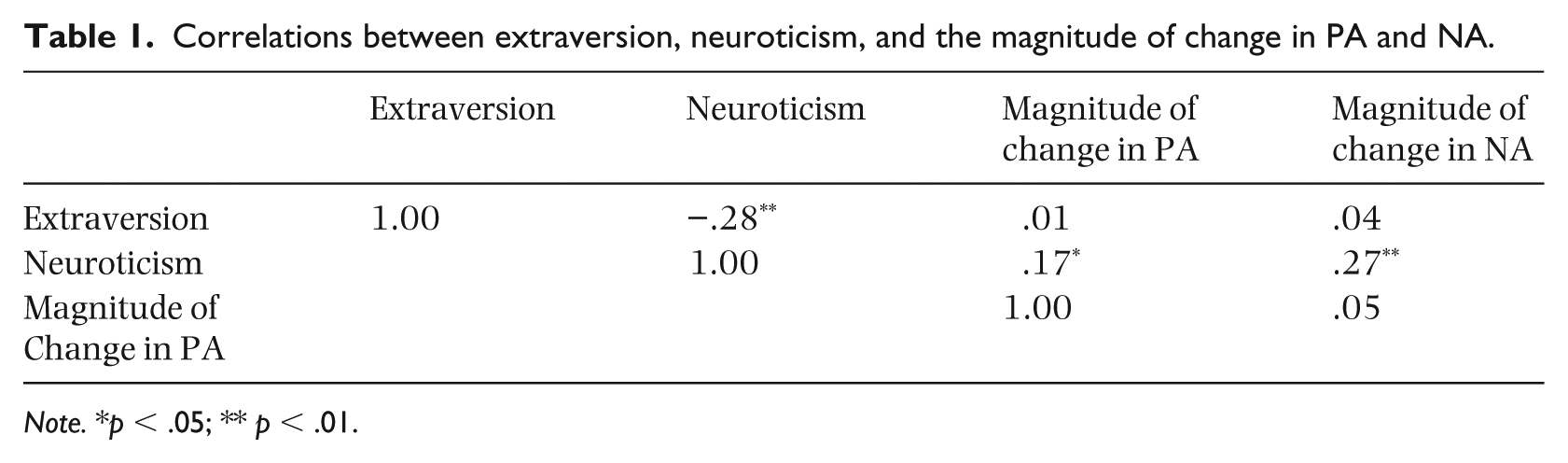
Note. *p < .05; ** p < .01.
Predicting change in positive affect (PA)
The results predicting the magnitude of change in PA found that Neuroticism and the direction of change in PA served as a significant predictors (albeit, at trend level), while Extraversion was not a significant predictor in step 1, the interaction of Neuroticism and the direction of change in PA was significant in step 2, but all of these results were qualified by the presence of a significant three-way interaction in step 3 (see Table 2 for results).
Prediction of magnitude of change in PA by neuroticism, extraversion, the direction of change, and their interactions.
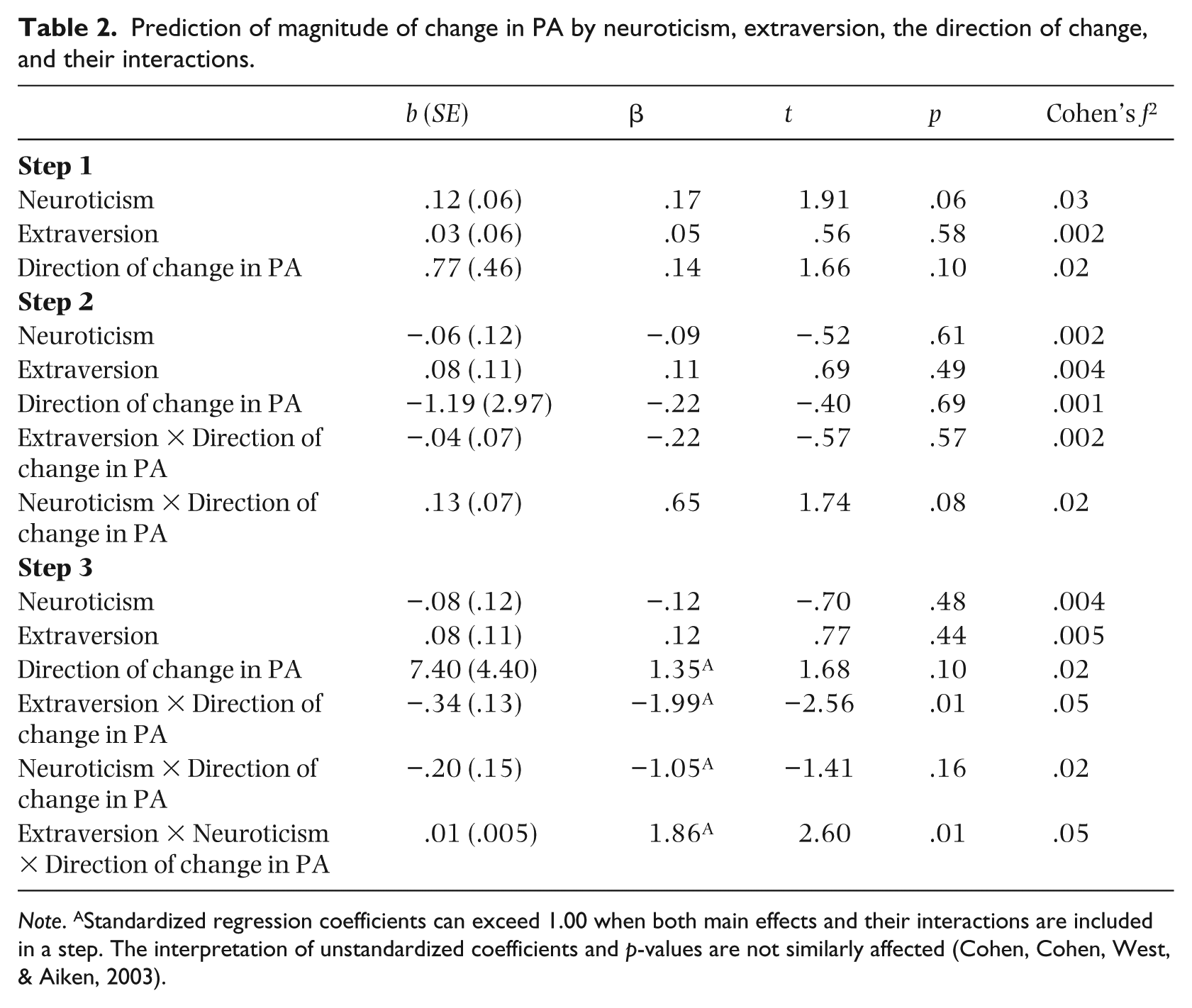
Note. AStandardized regression coefficients can exceed 1.00 when both main effects and their interactions are included in a step. The interpretation of unstandardized coefficients and p-values are not similarly affected (Cohen, Cohen, West, & Aiken, 2003).
To decompose this interaction, the sample was stratified by the direction of change (participants whose PA increased in response to the mood induction vs. everyone else), Neuroticism, and Extraversion (one SD above and below the mean for both personality variables). A negative relationship was found between response to the mood induction (PA) and Extraversion among low Neuroticism participants whose PA increased, r(22) = -.40, p = .06 (see Figure 1), but not high Neuroticism participants, r(41) = .24, p = .12. Counter to expectations, however, greater Extraversion scores were associated with smaller increases in PA in response to the mood induction for low Neuroticism participants. No significant relationship was found between response to the mood induction (PA) and Extraversion among low Neuroticism participants whose PA decreased, r(8) = .02, p = .97 (see Figure 2), while a positive correlation was found among high Neuroticism participants, r(11) = .49, p = .09. However, these follow-up results should be interpreted with caution given the small sample sizes among participants whose PA decreased in response to the mood induction (n = 33).
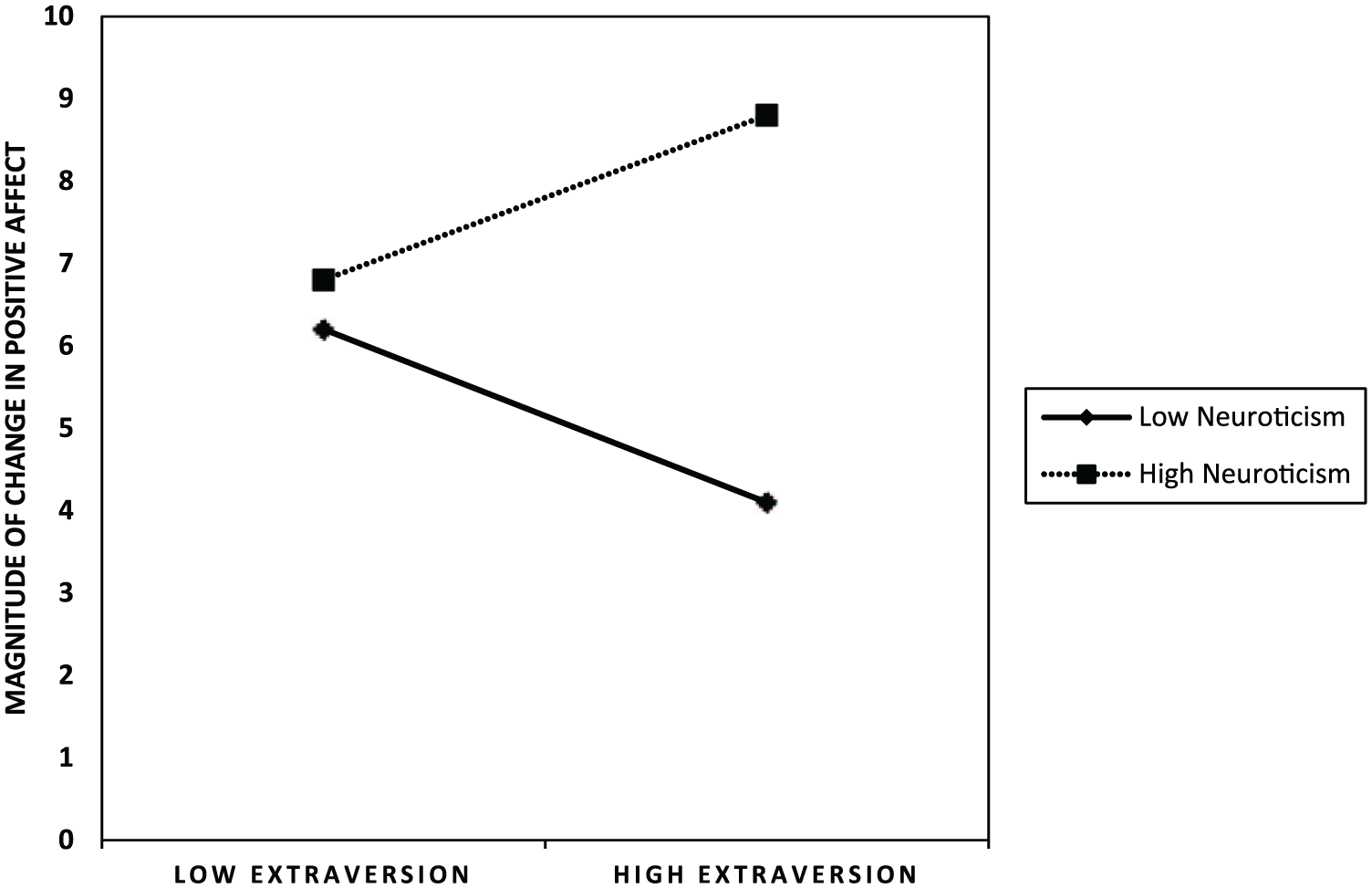
Association between magnitude of change in PA and Extraversion in participants low and high in Neuroticism.
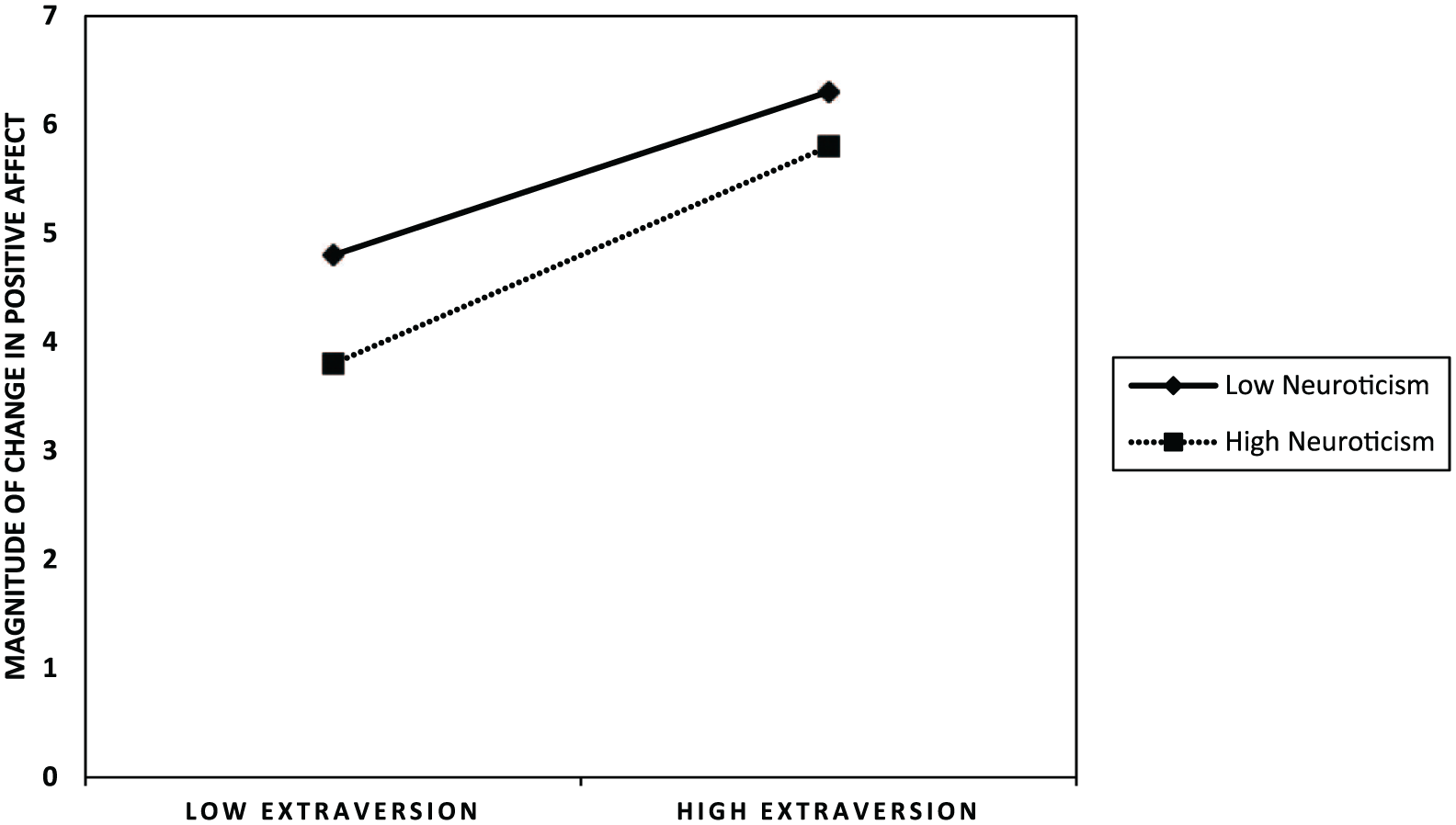
Association between magnitude of change in PA and Extraversion in participants low and high in Neuroticism.
One possible explanation, for the counter-intuitive association between Extraversion and less increase in PA, is a ceiling effect. Assuming that pre-induction PA and Extraversion are highly correlated, those high in Extraversion would also have near-maximum scores on PA. As a result, these scores could not, by definition, increase very much, if at all, resulting in the association between Extraversion and reduced PA response to the mood induction. 1 However, the correlation between Extraversion and pre-induction PA was, while strong, not indicative that the two variables are proxies for one another, r(143) = .53, p < .001. In addition, 90% of our sample had pre-induction PA scores less than 40 (the maximum score is 50). As the average change in PA, as stated above, was 5.47 points, ceiling effects would seem to be an unlikely candidate for the association between Extraversion and reduced increase in PA in response to the mood induction.
Predicting change in negative affect (NA)
The results predicting the magnitude of change in NA found that Neuroticism was a significant predictor, the direction of change in NA was a significant predictor (at trend level), and Extraversion was not a significant predictor in step 1. However, this was qualified by the presence of significant two-way interactions between both Neuroticism and Extraversion (the latter at trend level) and the direction of change in NA in step 2 (see Table 3). The three-way interaction of all three variables was not significant in step 3.
Prediction of magnitude of change in NA by Neuroticism, Extraversion, the Direction of change, and their interactions.
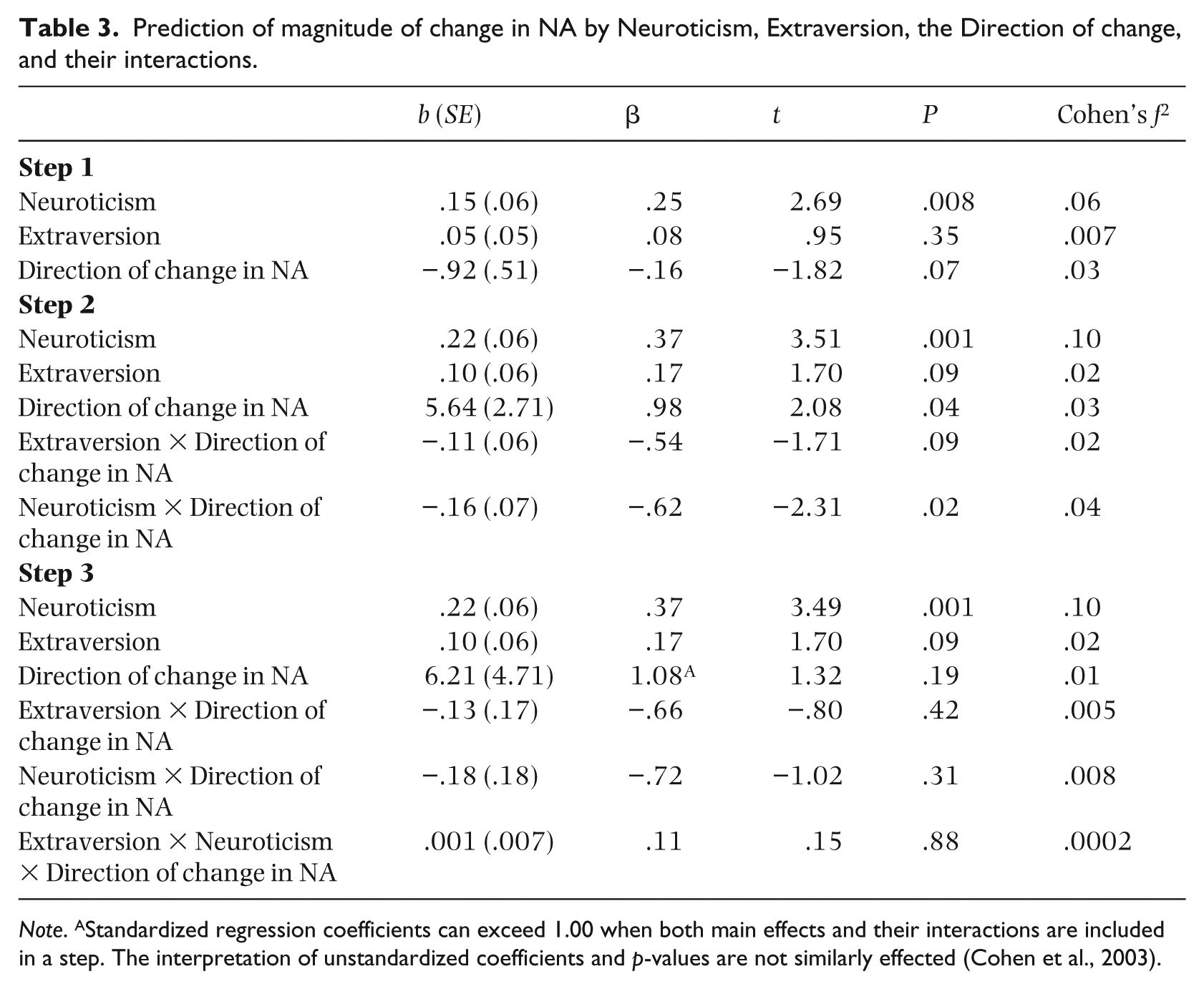
Note. AStandardized regression coefficients can exceed 1.00 when both main effects and their interactions are included in a step. The interpretation of unstandardized coefficients and p-values are not similarly effected (Cohen et al., 2003).
To decompose the (near) significant two-way interactions, the sample was again stratified by the direction of change (participants whose NA decreased in response to the mood induction vs. everyone else). Among participants who experienced a decrease in NA in response to the mood induction, Extraversion was unrelated to change in NA, r(97) = .08, p = .45, while Neuroticism was positively associated with it, r(95) = .24, p = .02. Among participants who experienced either no response or an increase in NA, Extraversion was negatively related to change in NA, r(36) = -.27, p = .01, while Neuroticism was unrelated to it, r(36) = -.06, p = .72. Again, these follow-up results should be interpreted with caution given the small sample sizes among participants whose NA increased in response to the mood induction (n = 19).
A similar analysis examining floor effects in pre-induction NA was conducted. The association between Extraversion and pre-induction-NA was very close to zero, r(142) = .002, p = .98. However, 14% of our sample had pre-induction NA scores of 10 (the lowest possible score), making further decreases as a result of the mood induction impossible. Taken together, these results would suggest the possibility that floor effects may have impact the results for NA presented above. To examine this possibility, the regression analyses predicting change in NA was repeated, but with pre-induction NA entered as a predictor, by itself, in the first step, and the remaining three steps following it. All of the results presented in Table 2 were identical, with the exception of the three-way interaction of Extraversion, Neuroticism, and direction of change, which was significant at a trend level, b(SE) = -.01 (.004), β = -.93, p = .053, Cohen’s f2 = .03, and corresponded to a small effect.
Discussion
The purpose of the present study was to explore the associations between neuroticism, extraversion, and response to a positive mood induction. Implementing an online musical mood induction enabled us to determine whether it is possible to induce a positive mood using this method and whether extraversion and neuroticism impact the magnitude of this experience. Corresponding to our first hypothesis, results showed both an increase in PA and a decrease in NA as a result of the mood induction. These results are consistent with the findings of a recent meta-analysis on the effectiveness of internet-based mood inductions (Ferrer et al., 2015) which concluded that emotion can be effectively induced via the internet. In fact, the effects found in the current study (d’s = .94 and 1.23) exceeded those found in Ferrer et al. (2015; g = .28). However, it should be noted that substantial variability existed in participants’ experience of the mood induction and not all participants experienced increases in positive, and decreases in negative, affect. Descriptive statistics representing the magnitude of change in both PA (M = 5.47, SD = 4.68) and NA (M = 3.85, SD = 4.20) support the idea that substantial individual differences exist in how people experienced the mood induction. Future work should focus on the generalizability of the effect observed above to other pieces of music, the identification of an optimal stimulus to prime negative affect, and the identification of, and interactions between, other individual difference variables that predict response to mood induction.
Our second hypothesis, that neuroticism and extraversion would be associated with response to the mood induction, was partially supported. With regard to changes in PA in response to the mood induction, an association was found between Extraversion and increases in PA, but only for low Neuroticism participants. Counter to expectation, this relationship was such that higher Extraversion was associated with less increase in PA. With regard to changes in NA, Neuroticism was associated with larger decreases in NA for those who experience a decrease in NA in response to the mood induction. The results presented above are partly a consequence of the interaction between Neuroticism and Extraversion, a process that has not, to the best of our knowledge, been examined in any prior research (e.g., Falkenberg et al., 2012; Larsen & Ketelaar, 1989; Rusting & Larsen, 1997). As such, it is difficult to say if these results represent a failure to replicate prior research. Ceiling and floor effects were examined as a potential explanation for these results. No evidence of ceiling effects, with respect to pre-induction PA, was found, but evidence of potential floor effects, with regard to pre-induction NA, was found. However, the presence of this floor effect in NA did not substantially alter any of the results presented above.
One possible explanation for the counter-intuitive finding, that low Neuroticism participants high in Extraversion experienced the greatest increases in PA, involves a consideration of mood reactivity. A number of studies have examined response to a negative mood prime as risk factor for depression (e.g., Lethbridge & Allen, 2008; Segal, Gemar, & Williams, 1999; Segal et al., 2006). In these studies, increases in sadness in response to a mood prime predicted increased symptoms of depression at a subsequent time. In addition, prior research has found that negative mood reactivity is a feature of Neuroticism (e.g., Gomez, Cooper, & Gomez, 2000; Gross, Sutton, & Ketelaar, 1998; Thake & Zelenski, 2013). The results of the current study suggest that mood reactivity may be an important component of Neuroticism with respect to positive mood, as well. While much of the prior research has examined reactivity to a negative mood, it is possible that reduced reactivity to a positive mood may be a feature of Extraversion, but only for low Neuroticism individuals, as increased mood reactivity may be a feature of Neuroticism. Clearly, more research is needed in this area as the link between Extraversion, Neuroticism, positive mood reactivity, and psychopathology is largely speculative at this point.
The current study is unique in its emphasis on predicting response to a positive mood induction; much of the literature focuses on negative mood induction. Much of traditional clinical psychology attempts to study and improve the human condition by reducing psychopathology, as opposed to focusing on increasing positive aspects of functioning (e.g., Sheldon & King, 2001). The current study fits within the broader Positive Psychology movement by identifying predictors of positive mood reactivity (i.e., those low in both Extraversion and Neuroticism were most likely to benefit from the mood induction). Future research should examine the Big Five traits more broadly, including both openness to experience and conscientiousness, to identify which traits are most predictive of positive mood reactivity.
Finally, the current study adds to the literature attesting to the beneficial effects of music, in general, (Koch, Kain, Ayoub, & Rosenbaum, 1998; Phunmdoung & Good, 2003; Zimmerman, Pozehi, Duncan, & Schmitz, 1989), and Mozart’s music, in particular (Menon & Levitin, 2005; Sutoo & Akiyama, 2004). In addition, in using an online mood induction, our study represents a potentially scalable intervention that could be administered cheaply to a large number of people, particularly since a similar intervention has already demonstrated efficacy to a sample of depressed participants (Castillo-Perez et al., 2010).
Limitations
A chief concern involves the online nature of assessments used in the current study. Experiments administered over the internet lack the degree of environmental control that is present in a laboratory study. This increases the likelihood of non-compliance, as participants may be more likely to disengage their attention from the study when they are not being directly observed by study personnel. It should be noted, however, that even in lab-based studies, there is no method of guaranteeing that participants are following the directions of the mood induction (i.e., listening to the music while thinking of a happy moment in their life). In addition, the absence of a control condition limits our ability to make inferences on causality. As such, it is possible that PA and NA could have changed from pre- to post-mood induction for reasons aside from the music stimulus. Another limitation concerns the degree to which results can be generalized. The majority of participants used for our study were a convenience sample of university undergraduates. As such, the age group of the participants is younger, better educated, and more likely to be Caucasian, non-Hispanic, and female than the general United States population. It is also unclear if such robust mood induction effects would be found from another piece of music.
Conclusion
To our knowledge, this study is the first to investigate the association between extraversion, neuroticism, and a positive mood induction using music as the stimulus. As mentioned above, mood induction studies have investigated both positive and negative affect using a variety of different induction procedures (e.g., Falkenberg et al., 2012; Westermann et al., 1996). Our study contributes to the debate about whether or not online mood inductions are effective. The results of our study show a complex pattern of interrelationships that are consistent with the notion that both extraversion and neuroticism are characterized by mood reactivity. Future studies should attempt to replicate the findings presented above and generalize them to more diverse populations.
Footnotes
Funding
The author(s) received no financial support for the research, authorship, and/or publication of this article.