



Abstract
In music, we “feel the beat” through rhythm. During successful social interactions, individuals establish an interpersonal rhythm through back-and-forth exchanges. Consequently, these two disparate domains share a common reliance on rhythm. This study investigates whether our sense of musical rhythm relates to our social competence. Ninety-eight undergraduate students (M = 20.9 years, SD = 2.8 years) participated in a rhythm reproduction task and completed Riggio’s Social Skills Inventory to examine whether the two skills are related. Scores on the rhythm task predicted participants’ scores on one part of the inventory – the Social Control subscale – which measures how well individuals can adjust and adapt to different social exchanges. Critically, performance on the musical rhythm task did not correlate with every social subscale but only with that related to social exchanges. The results suggest that a core rhythmic ability might underpin performance in both musical and social domains.
Rhythm is something you either have or don’t have, but when you have it, you have it all over. (Elvis Presley)
Across eras and cultures, music remains a constant feature of human society (Brown & Jordania, 2013; Wallin, Merker, & Brown, 2011). Although the nature of music may be particular to a specific time and place (e.g., the Beatles), there are core features of music that are universal, such as rhythm. Rhythms often follow cyclical patterns of alternating strong and weak sounds, creating an organized framework in which music unfolds (Sachs, 1953). From a psychological perspective, this rhythmic patterned framework not only facilitates the processing of music but also allows multiple musicians to coordinate their outputs (Keller, Novembre, & Hove, 2014).
Though we often speak of rhythm in the context of music, rhythmic frameworks also characterize everyday social interactions. People coordinate their interactions with one another (e.g., Warner, 1979), and rhythmic coordination in a social interaction facilitates positive social outcomes (Crown, 1982). On the contrary, rhythmic asymmetries can destroy smooth social interactions (e.g., Koudenburg, Postmes, & Gordijn, 2013). The current study examines whether the rhythmic undercurrent in these two domains of music and social interaction might be related – that is, whether social coordination shares a rhythmic foundation with music.
Researchers have studied a variety of aspects of rhythmic patterns that underpin social interaction. Conversational partners, for example, show coordinated temporal patterns in pause lengths, such that people tend to converge on the length of time that they pause when speaking (Welkowitz, Cariffe, & Feldstein, 1976). Speaking pauses also occur during conversations in between the end of one person’s speaking turn and the beginning of another’s speaking turn. The amount of time we wait before speaking in a conversation is parallel to the amount of time our partner took in between sentences (Stivers et al., 2009). When prior listeners become speakers in a conversation, they also mimic the speaking rate of their conversational partner (Reed, 2009). Consciously or not, two people in conversation generally adopt similar temporal patterns in their speech and pauses.
On a broader scale, members of dyads alternate between periods of high and low overall speech activity when examined in cycles of three to six minutes (Warner, 1979), a phenomenon referred to as ‘vocal activity rhythm.’ On the high end of the cycle, both individuals in a conversation pattern together by taking longer and more frequent turns. On the low end, they take shorter and less frequent turns. These rhythmic components of vocal activity are even visible in early mother-infant interactions, suggesting that rhythmic coordination might be a hard-wired feature of social interaction (Jaffe, Beebe, Feldstein, Crown, & Jasnow, 2001). Similar to the rhythms of high and low vocal activity, members of dyads alternate between types of behaviors in regular cycles (Sadler, Ethier, Gunn, Duong, & Woody, 2009; Lester, Hoffman, & Brazelton, 1985). For instance, when people interact in dyads, one may act assertive while the other acts passive for a certain period of time. Then, for a similar length of time, the behavior types reverse, with the previously passive person acting assertively and vice versa. This rhythmic coordination of behavior types is also seen between mothers and infants, who coordinate their cycles of positive and negative affect (Lester, Hoffman, & Brazelton, 1985).
Rhythmic coordination also appears in the body movements of listeners, as they synchronize body movements to the articulatory structure of the speech they hear (Condon, 1982) and the body movements of their conversational partners (Shockley, Richardson, & Dale, 2009). Listeners, for example, might slow their body movements during the consonant at the start of a word, speed their movements during the vowels, and slow their movements down again at the preceding consonant. As with the other forms of interactional rhythmic coordination, the synchronizing of body movements to speech is seen even in infants (Condon & Sander, 1974).
The degree of rhythmic coordination achieved by communicative partners has been linked to a variety of social outcomes. The length of pauses during changes in speakers, for example, affects people’s perceptions of one another. Koudenburg, Postmes, and Gordijn (2013) demonstrated that even a minor increase in the length of a pause during a change in speakers can have social consequences. Participants in dyads spoke to each other through headsets and in one condition the length of the pause between turns was artificially increased by just a second. Participants in this condition reported lower ratings of unity, belonging, and shared cognition with their interaction partners. Crown (1982) found that members of dyads who received more negative evaluations of their personality from their partner were also more likely to have longer pause durations when transitioning from listener to speaker. The same held true for general pauses during speech. Taken together, these two studies suggest a potential link between the temporal smoothness of dyadic exchanges and social evaluations from conversational partners.
Just as rhythmic disruption leads to negative evaluations, its converse, the coordination of vocal activity rhythms, has been linked to positive social outcomes. Warner, Malloy, Schneider, Knoth, and Wilder (1987) found that the degree to which members of dyads spoke with rhythmic regularity in their cycles of speech and non-speech was associated with positive observer ratings of involvement and affect in the conversation. Specifically, a moderate degree of rhythmic regularity was associated with the highest ratings of involvement and positive affect displayed between participants, suggesting that there is an optimal level of rhythmic coordination of vocal activity that people can achieve when interacting. Again, the benefits of coordinating vocal activity rhythms are not limited to adults. Jaffe, Beebe, Feldstein, Crown, and Jasnow (2001) noted that stronger coordination of vocal activity rhythms, as well as coordination of pause lengths, between mothers and their four-month-old infants predicted better infant attachment and cognition scores at 12 months of age. These results suggest that the ability to rhythmically coordinate when interacting is important for laying the foundation of adaptive social interactions.
Social interactions benefit from rhythmicity in other domains as well. For example, Beebe and colleagues (1982) examined how infants responded when mothers engaged in rhythmic body movements with the child. They found that when mothers swing their infants’ hands back and forth with rhythmic regularity, they engage infants who were previously dodging engagement. They also found that infants’ levels of affect became more positive during and after the hand swinging. Thus, a shared rhythmic cycle seems to be related to infant positive affect and to increased engagement with the mother. Similarly, work by Cirelli, Einarson, and Trainor (2014) found that bouncing in time with an experimenter led to increased helping behaviors among 14-month-old infants, offering corroborating evidence that rhythmic interactions have cascading social implications.
This body of research highlights the importance of rhythmic ability in the social arena. Little research, however, has asked whether the social rhythmic ability revealed in these studies might be related to the rhythmic ability found in the musical domain. Two lines of work hint at such a relationship. Kirschner and Tomasello (2009) provide evidence that music and social interaction rely on a common rhythmic mechanism. Children drummed along to a beat that was played by either an audio recording or an adult experimenter. Children drummed significantly more in sync when the beat was played by the experimenter than when it was played by the recording alone. Kirschner and Tomasello argue that drumming together may be a kind of joint action, allowing children to anticipate and coordinate their actions more easily. Additionally, only in the social condition did children as young as 2.5 years synchronize with beats at a quick tempo of 150 beats per minute – a feat that previous studies without a social model failed to document. Children’s musical rhythmic ability was facilitated by the socially interactive context.
Perhaps even more noteworthy, Kirschner and Tomasello (2010) demonstrated that making music together increased prosocial behaviors among four-year-old children. Children played a game in dyads that either did or did not involve making music, but was otherwise identical. Afterwards, the experimenters induced situations that required members of the dyads to help each other. Children in the musical condition helped each other significantly more than the children in the non-music condition. Wilthermuth and Heath (2009) found similar results with adults. Participants played an economic game after singing in synchrony, out of synchrony, or just listening to a song together. Participants who sang in synchrony cooperated more during the economic game and reported greater feelings of trust and similarity with the other members of their group. Similar research has demonstrated that simply tapping synchronously in time with others led to increased feelings of affiliation, compassion and altruism in adults (Hove & Risen, 2009; Valdesolo & DeSteno, 2011). These studies demonstrate that making music and even just tapping with others in a shared rhythmic framework can lead to increased feelings of rapport and prosocial behavior.
An important concept that ties rhythmic interaction in the musical and social domains together is entrainment. The broad definition of entrainment is the phenomenon in which two or more rhythmic processes interact and synchronize with each other (Clayton, Sager, & Will, 2005). Although the concept of entrainment was first introduced in the field of physics with the discovery that two pendulums on a common support will naturally synchronize with each other, the phenomenon has since been widely observed, including within and between human individuals (Thaut, McIntosh, & Hoemberg, 2015). Importantly, synchronization does not mean that the rhythms will necessarily mirror each other, but rather that they will develop and maintain a consistent relationship with each other (Collier & Burch, 1998). The studies discussed previously in this section all involve entrainment; the coordination of rhythms during social interaction is a form of entrainment, as is synchronization to an external beat or to other individuals when performing music (Clayton, Sager, & Will, 2005; Kirschner & Tomasello, 2009). Entrainment, thus, is an inherent rhythmic feature of both social and musical interaction, and the degree to which it occurs affects the outcome of the interaction.
One final thread of tantalizing evidence comes from studies of music education and musical therapy. By way of example, Spychiger, Patry, Lauper, Zimmerman, and Weber (1993) and Zulauf (1993) both report that increases in the amount of music used in school curriculums were related to increases in social cohesion within classes and better social adjustment. Harland, Kinder, Lord, Stott, Schagen, and Haynes (2000) showed that students involved in music education felt that awareness of others and social skills were improved due to their music education.
The most frequently reported benefits of music education by music teachers include the development of teamwork, coordination, and social skills in general (Brown, 1980; Hallam & Prince, 2000). Kim, Wigram, and Gold (2008) provided experimental evidence of the social benefits of music for children diagnosed with autism spectrum disorder (ASD). They assigned participants to receive either a play therapy or an improvisation-based music therapy that targeted joint attention skills. The music therapy involved the child and therapist improvising music together, with the therapist being especially sensitive to coordinating his or her melodies and rhythms with those of the child. The children receiving music therapy improved their joint attention behaviors, including duration of turn-taking, more than children in the play therapy program did. These studies all suggest that participating in music programs improves social skills and outcomes. None of the studies, however, investigated whether increases in rhythmic skill per se were a factor driving these social improvements.
Although much evidence points to a shared rhythmic ability underlying the playing of music and social interactions, as well as social benefits of being skilled in this rhythmic ability, no study has investigated the direct relationship between musical rhythmic ability and social interaction skills. This study addresses this gap: Participants took a musical rhythm test and filled out a self-report questionnaire regarding various social skills and behaviors. Critically, the measure of social skills was comprehensive, with subscales that address unique components of dyadic exchanges, from interpreting others’ emotions to competently regulating oneself so that the interaction is balanced. We predicted that musical rhythmic ability would be positively correlated with measures that involve skill in managing the back-and-forth dyadic interaction process, but that musical rhythmic ability would not link to social outcomes that were not related to the back-and-forth interaction process.
Method
Participants
Ninety-eight (55 female) undergraduates at a large urban university (M = 20.9 years, SD = 2.8) participated in the study. The sample was a diverse representation of the university’s undergraduate psychology population, in which 57.1% of the sample self-identified as Caucasian, 15.3% self-identified as African-American, 13.3% self-identified as Asian, and a remaining 14.3% self-identified as another race or more than one race. Eighty-three participants self-reported that they had trained in a musical instrument, singing, or dance at some point in their lifetime. Of those participants, 23 indicated that they currently practice; we refer to these individuals as “current musicians, singers, and/or dancers.” Table 1 presents information on participants’ training. Participants were recruited through an online psychological research participation system and received course credit for their participation. The recruitment system specified that individuals with hearing impairments were not eligible for this particular study; consequently, normal-hearing was presumed for all participants who signed up for the study. Informed consent was obtained from all participants. This research was approved by the University’s Institutional Review Board.
Overview of participants’ training in music or dance.

Apparatus and materials
Musical rhythm
To measure musical rhythmic ability, a test was created which required participants to listen to auditory rhythmic patterns and reproduce those patterns as accurately as possible by tapping a key on a computer keyboard. The first author (DL) designed a set of rhythmic pattern stimuli. Each trial consisted of a rhythmic pattern made up of eight isochronous sound events (Ammirante, Patel, & Russo, 2016). Each event either contained a snare drum sound or silence. The events were spaced 250 milliseconds apart. For example, a trial could be [sound-silence-sound-silence-sound-sound-silence-sound]. Each trial emulated a one-bar phrase at a tempo of 120 bpm in the 4/4 time signature, such that the phrase consists of 4 quarter note beats. In such a phrase, the four beats are 500 milliseconds apart, and so the sound events in each trial in the experiment can be thought of as occurring on each of the four beats as well as the half subdivision of each beat. A tempo of around 120 beats per minute has been found to be the preferred human tempo in both music perception and spontaneous movement, including finger tapping (Moelants, 2002). Each eight-event rhythmic pattern was created by combining two four-event patterns. All of the four-event patterns contained a sound on the first event in order to emulate rhythmic phrases typical of most popular Western music, where the first beat, or “downbeat,” is the strongest beat (Wright, 2011). There was a total of seven different four-event patterns, making a total of 49 possible eight-event pattern combinations. One eight-event pattern, [sound-silence-silence-silence-sound-silence-silence-silence], was excluded from the test because it only contained sounds on two event points and thus was deemed too simple in comparison to the rest of the patterns. All others were used at least once (see Appendix for the full set of rhythmic stimuli variations used). Twelve of the patterns were randomly selected to be used twice, resulting in a total of 60 trials. The same 12 repeated patterns were used for each participant. The order of trials was randomly assigned; all participants received the same order. A snare drum sample from the 9th Wonder Drum Kit sample pack, with a duration of 62 milliseconds, was used as the percussive sound stimulus. The rhythm test was administered through headphones on a Dell Inspiron 1545 laptop computer using Ableton Live 8 software. Participants responded by tapping a particular key on the keyboard. The time of the key press was recorded by the program. Participants’ key taps elicited the percussive sound. Steps were taken to ensure that the time latency between key taps and the computer’s output of the sound remained at the realistic, undetectable level of 4.0 milliseconds (Rossing, Moore, & Wheeler, 1990).
Social skills
Interpersonal skills were measured using the paper-and-pencil form of the Social Skills Inventory (SSI; Riggio, 1986). The SSI is a 90-item, self-report questionnaire that assesses emotional and social communication skills. The SSI is based on a model of communication, characterized by three basic types of skills: expressive (encoding) skills, sensitivity (decoding) skills, and control (regulatory) skills. The skills apply to both the emotional and social domains. The SSI contains a subscale for each skill domain, for a total of six subscales. Each subscale consists of 15 questions. Questions were presented in the form of self-statements about how one typically behaves or feels in various social situations. Participants responded on a one to five Likert scale, with 1 being Not at all like me and 5 being Exactly like me. Some questions were reverse coded to control for potential acquiescence bias effects. Participants’ levels of social competency were represented by the sum of the responses within each subscale. The SSI is a widely used measure. Its subscales have high internal consistency, ranging from 0.75 to 0.88, high reliability, with test-retest reliability ranging from 0.81 to 0.94, and it correlates with numerous related measures of social skills and personality as well as self-reported performance of social behaviors (Riggio, 1986).
Musical, singing, or dance training
Musical, singing, or dance training was measured using a self-report questionnaire. The questionnaire asked participants whether they (a) have ever trained and (b) currently train to play an instrument, sing, or dance. If participants responded yes, they were asked to indicate what the specific instrument(s) or medium(s) was. Participants were also asked how many years they had been practicing the instrument(s) or medium(s) and how many years it had been since they last practiced. This questionnaire also contained a demographics section that asked participants to report their age, gender, and ethnicity.
Procedure
Individual sessions took place in a quiet lab space, equipped with the laptop computer and headphones. After obtaining informed consent, participants were told that they would hear a series of rhythmic patterns and were instructed to reproduce each pattern as accurately as possible by tapping a key on the keyboard, first in a practice round consisting of six trials and then in the experimental portion consisting of 60 trials. The experimenter then left the room, and the participant was alone for both the practice round and experimental portion. For each trial, participants heard an eight-beat pattern played once. A tone then sounded to indicate that it was their turn to reproduce the pattern. The participants’ response window lasted three times as long as the pattern itself to allow ample time to respond. Another tone then sounded to indicate that the response window had ended and the next pattern was going to be played.
Once the rhythm test ended, participants notified the experimenter. The experimenter then administered the SSI and the musical background and demographics questionnaire. The participant was left alone in the room to complete these forms. They were then debriefed and received course credit for participating. Sessions lasted approximately 30 minutes.
Scoring
Scoring took place off-line, as participants’ responses were saved within the Ableton software. Trials on the rhythm reproduction task were considered incorrect if at least one of the intervals between sound points that the participant produced was more than 20% longer or shorter than the target interval. For instance, if the target rhythm contained an interval between sound points that was 500 milliseconds long, and the interval between these sound points in the participant’s response was less than 400 milliseconds or greater than 600 milliseconds, the trial would be considered incorrect. This plus-or-minus 20% cutoff point has been found not to be overly difficult or overly lenient (Grahn & Schuit, 2012). The proportion of correct trials out of the full 60 trials served as our independent variable of rhythmic ability. A second research assistant coded 26% of the sessions and inter-rater reliability for correct/incorrect judgments was 96.9% across all trials.
Results
All data were analyzed using IBM SPSS Statistics, Version 24.0. To determine if males and females in our sample scored similarly on our rhythm reproduction task and the SSI, we ran a series of independent samples t-tests after running the Levene’s Test for Equality of Variances. Across all measures, males and females did not score differently on any of the SSI subscales, SSI total score, or rhythm reproduction score, with all p values greater than 0.05. An independent-samples t-test revealed that current musicians, singers, and/or dancers (n = 23; M = 0.80; SD = 0.21) significantly outperformed participants who did not currently practice an art (n = 75; M = 0.66; SD = 0.23) on the rhythm reproduction task, t(97) = -2.58, p = .012. Consequently, we explored the correlations among the rhythm reproduction scores and the SSI subscales for current musicians and participants not currently practicing an art separately.
Among those participants who self-reported that they were not currently practicing music or dance, the correlations among the SSI subscales and the rhythm reproduction task are reported in Table 2. Only participants’ Social Control subscale scores correlated with their rhythm reproduction accuracy scores, r = 0.221, p = .057.
Correlations between the SSI and its subscales and accuracy on the rhythm task for participants not currently practicing a musical instrument, singing, or dance.
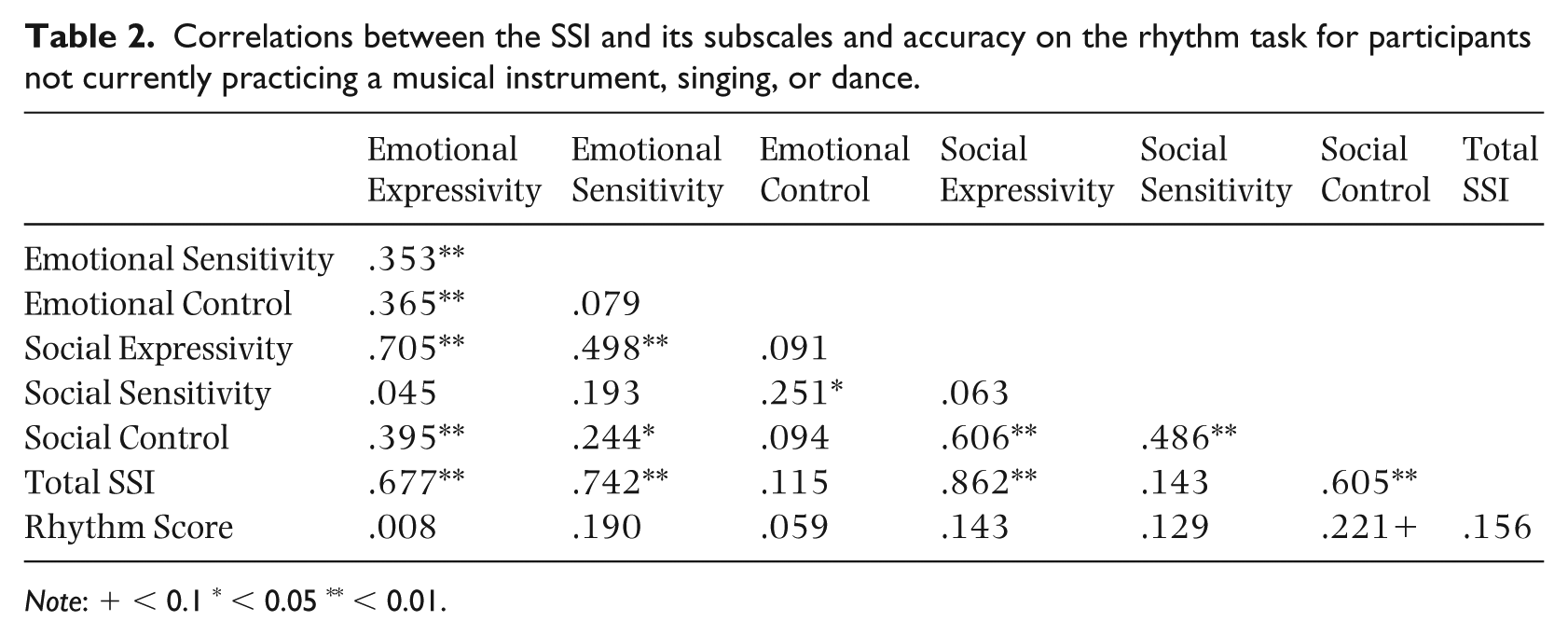
Note: + < 0.1 * < 0.05 ** < 0.01.
Correlations among the various SSI subscales and the rhythm reproduction tasks for current musicians are reported in Table 3. Unexpectedly, their rhythm reproduction scores did not correlate with any subscale of the SSI.
Correlations between the SSI and its subscales and accuracy on the rhythm task for current musicians, singers, and/or dancers.
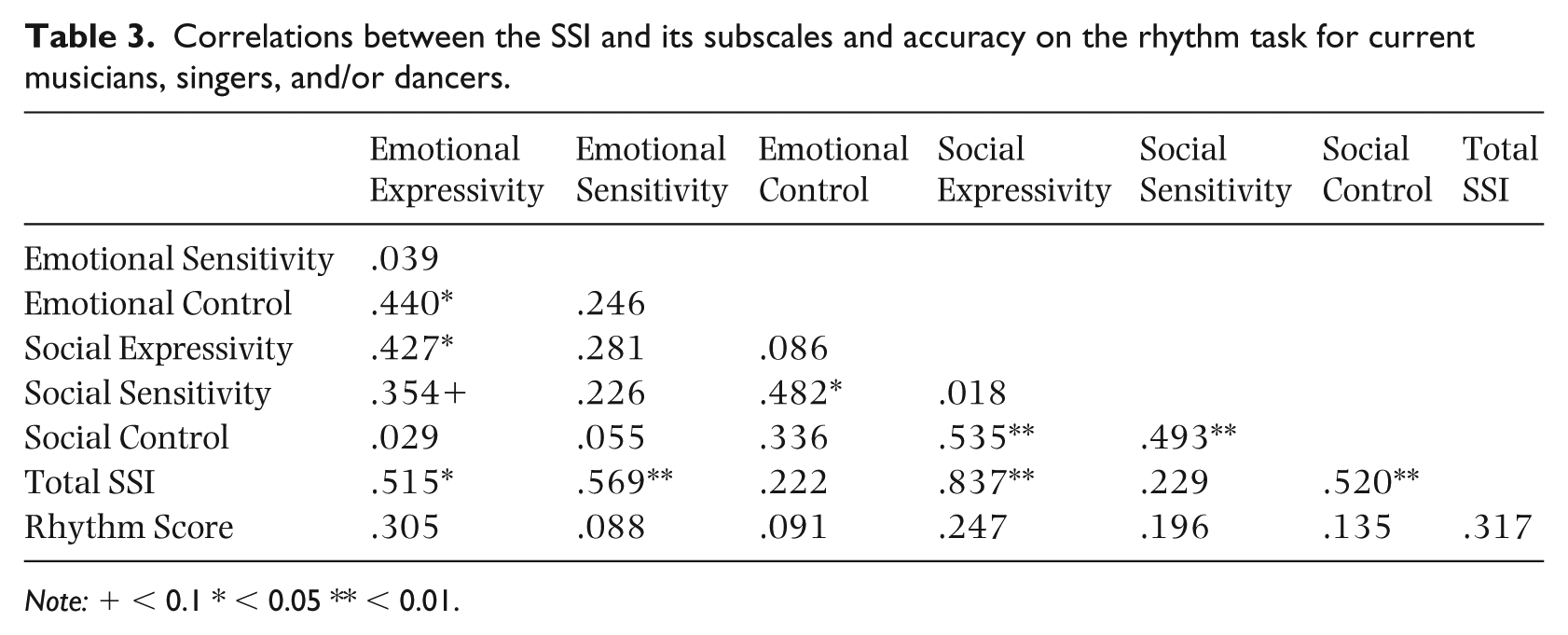
Note: + < 0.1 * < 0.05 ** < 0.01.
Linear regression was run to determine whether participants’ rhythm reproduction accuracy scores predicted their Social Control subscale scores, controlling for the number of years that individuals self-reported that they practiced an instrument. In this model, the Social Control subscale was our dependent measure. In the first step, we entered the number of years of musical, singing, or dance practice. In the second step, we entered participants’ rhythm scores. The addition of participants’ rhythm reproduction scores as a predictor resulted in a significant F change in the model, F change (1, 95) = 6.021, p = .016, R2 = 0.064. With both predictors, rhythm reproduction accuracy scores significantly predicted participants’ Social Control scores, controlling for their musical, singing, or dance experience (ß = 0.268, p = .016; see Table 4).
Linear regression model predicting Social Control subscale scores.

Discussion
This study investigated whether musical rhythmic ability predicted participants’ self-reported social competence in coordinating balanced social interactions. A significant relation emerged in our sample of undergraduate students, such that higher rhythm scores predicted higher scores on the Social Control subscale when controlling for years of musical, singing, or dance experience. As such, the data support our hypothesis that both musical and social rhythms seem to be related and may be rooted in a shared mechanism.
The other SSI subscales were not found to be correlated with individuals’ musical rhythm abilities. This may be due to the fact that they all measure skills involved in either the sending or receiving of messages, but not the broader back-and-forth process itself. Because rhythm emerges in social interaction through the repeated process of sending and receiving messages over time, rhythmic abilities may only be a factor in social interaction when considering the broader, back-and-forth interaction process, rather than the skills involved in the isolated sending or receiving of messages alone.
On the other hand, the Social Control subscale examines different dimensions of the interaction process. Social Control measures one’s ease of interacting with people and ability to manage the interaction process, and is thus squarely focused on the broader interaction process. For example, the subscale includes statements like “I am usually very good at leading group discussions” and the reverse-coded “I am not very good at mixing at parties,” which require skill in the back-and-forth exchange process that unfolds over time. Because interactions in their entirety are taken into account in these statements, the rhythmic aspects of dyadic exchanges that emerge over time are involved, and thus rhythmic abilities may play a role in the success of the interaction.
The lack of a correlation between Social Control subscale scores and rhythm reproduction accuracy scores among current musicians, singers, and/or dancers was unexpected. However, the high performance of musicians on the rhythm reproduction task – the average score was 80% – may have masked a possible correlation, given the restricted range. Indeed, when controlling for musical experience in the linear regression, rhythm reproduction accuracy scores did significantly predict Social Control subscale scores. Future research examining the dynamics of rhythmic ability and social skills among musicians, singers, and dancers is warranted. Indeed, the domain (here, musical instrument, voice, or dance) may also be germane, such that comparisons among dancers, singers, and musicians may be the focus of additional studies in the future.
The process of entrainment may be partially responsible for the observed relation between musical rhythmic ability and social coordination skills. Theoretical models, such as Tierney and Kraus’ (2014) Precise Auditory Timing Hypothesis, Patel’s (2011) OPERA (i.e., brain region overlap, precision, emotion, repetition, and attention) hypothesis, Patel and Iversen’s (2014) Action Simulation for Auditory Perception hypothesis, and Phillips-Silver and colleagues’ (e.g., Phillips-Silver, Aktipis, & Bryant, 2010; Phillips-Silver & Keller, 2012) framework of entrainable systems all assume that both domains – music and social – rely on precise coordination of motor and sensory information. For example, Phillips-Silver, Aktipis, and Bryant (2010) hypothesized that conversational turn-taking may depend on a “loop” system of entrainment, whereby the rhythmic output of one partner becomes the input for the other. The data from this study offers the first empirical evidence that musical rhythmic ability is correlated with interpersonal social skills, controlling for musical ability.
Regardless of domain (i.e., music or social interactions), rhythmic responses depend on fundamental processes of timing and coordination (D’Ausilio, Novembre, Fadiga, & Keller, 2015; Phillips-Silver & Keller, 2012). Suggestive neuropsychological and imaging studies complement our behavioral data, such that a core rhythmic mechanism may underpin performance in both domains. Different paradigms converge on the basal ganglia as one possible structure responsible for the observed relations between musical rhythm (operationalized as synchronization or entrainment) and social competencies, which are often measured as observed prosocial behaviors to an experimental situation (Iversen, Patel, Nicodemus, & Emmorey, 2015; Kokal, Engel, Kirschner, & Keysers, 2011; Sowiński & Dalla Bella, 2013). Utilizing functional magnetic resonance imaging (fMRI) technology, Kokal, Engel, Kirschner, and Keysers (2011) reported that when participants could effortlessly tap in synchrony with an experimenter, they had increased activity in the caudate and were more likely to help a confederate who surreptitiously spilled pens on the floor. While tapping a rhythm in synchrony with an experimenter is somewhat different from tapping rhythms without other individuals present, these studies do suggest that a common neural mechanism may underlie rhythmic activity involved in both music and social interaction.
This study also identifies a potential mechanism to explain the observed link between music education and improved social skills (e.g., Hallam & Prince, 2000); the improvement of rhythmic skills through music may lead to higher-quality temporal coordination during social interactions, resulting in the increases in social skills. Music education programs may want to focus on developing students’ rhythmic skills to aid their social development.
This study had several limitations. First, the SSI is a broad measure of social competence that looks at different domains and levels of social interaction. Musical rhythmic ability may only be related to the rhythmic aspects of social interaction, so the questions measuring aspects of interaction that do not involve rhythm may have weakened the relationship. Also, the SSI is a self-report measure, making it susceptible to response biases. The SSI correlates highly with other measures of social interaction skills, though, including observational methods (Riggio, 1986). Importantly, higher musical accuracy scores did not relate to higher scores on all subscales, which weakens the possibility that participants were inflating their self-reports in general. The sizeable proportion of participants with musical training may also be a concern for a study examining the correlates of rhythmic ability. Fifty-one percent of participants had five or more years of training, and 67.68% had at least three years of training. This created a ceiling effect on the rhythm test; many participants with strong musical backgrounds got all or nearly all trials correct. The finding that even when controlling for musical training, scores on the rhythm reproduction task still predicted participants’ scores on the Social Control subscale is, however, of interest.
Despite these limitations, the data revealed a pattern of those with stronger rhythmic ability also having stronger social interaction skills as revealed on a self-report questionnaire. Future studies should investigate what the specific mechanism is that causes the relationship. One approach will be to directly measure participants’ ability to rhythmically coordinate their social interactions to see if this moderates the relationship between musical rhythmic skill and social interaction competence. Another approach will be experimental studies examining whether improvements in musical rhythmic ability result in improvements in social interaction competence and, specifically, in the ability to rhythmically coordinate social interactions. This will not only lead to a better understanding of whether the rhythmic ability developed through music is common to that used in social interaction, but it will also identify a potential direct social-cognitive benefit of playing music. Identifying such a relationship could eventually allow people to use music as a conduit for increasing their social skills, leading to a more socially skilled – and musical – society.
Footnotes
Appendix A: Variations of Rhythmic Stimuli
Declaration of conflicting interests
The author(s) declared no potential conflicts of interest with respect to the research, authorship, and/or publication of this article.
Funding
The author(s) received no financial support for the research, authorship, and/or publication of this article.