



Abstract
In every culture and nation music has been mentioned as a sort of natural language. While the existence of dreams including music in musicians has been anecdotally reported, music in dreams have been rarely studied empirically. In the present study, 425 participants, mostly psychology students, reported their dreams in a dream diary for 14 days as well as the intensity of their dream emotions and answered a questionnaire about whether they play existing music or compose new music during the day. As expected, for persons playing an instrument in their leisure time, there was a direct link between playing an instrument during the day and having more dreams including music, thus confirming the continuity hypothesis of dreaming. In addition, dreams including music were more positively-toned regarding emotions than dreams in general. Further research might investigate, for example, whether dreams including music play a role in improving music performance skills.
In every culture and nation music has been mentioned as a sort of natural language (Herndon & McLeod, 1982). A power of inspiration from dreams including music has been reported by classical composers such as Beethoven, Stravinsky, Tartini, and Wagner. For example, Tartini remembered a dream in which the devil played a wonderful sonata (Grace, 2012) and Richard Wagner dreamed his opera Tristan and Isolde (Barrett, 2019). One of the most popular examples coming from a dream is the song “Yesterday” from the Beatles. Paul McCartney dreamed a melody and was doubtful at first whether he had heard this song before but he finally had to acknowledge that the composition originated from his dream (Barrett, 2001). Other artists like Billy Joel and Sting have reported that dreams inspired their songwriting (Grace, 2001). Reviewing the literature published so far, Massey (2006) observed that music in dreams does not become fragmented, chaotic, or incoherent but is melodious and euphonious. According to the continuity hypothesis of dreaming (Schredl, 2003), dreams reflect daily waking-life activities. This hypothesis has been supported, for example, by the finding that sports students dreamed more about sports than did psychology students (Erlacher & Schredl, 2004). In a follow-up study, the amount of time spent with sports activities during the day correlated directly with the frequency of sports dreams (Schredl & Erlacher, 2008). In a similar way, one would expect that persons who are engaged in musical activities during waking also dream more often about music. However, quantitative research in this area is scarce. The empirical studies that have been published in the last years will be briefly reviewed.
The frequency of music in dreams has been investigated using different methodological approaches. Using retrospective estimates, music-related dreams have been reported in between 6 and 12% of all remembered dreams (Kern et al., 2014; Schredl, Berres, Klingauf, Schellhaas, & Göritz, 2015; Vogelsang, Anold, Schormann, Wübbelmann, & Schredl, 2016). A dream diary study with additional questions about the occurrence of music in dreams yielded a music dream frequency of 20% for non-musicians and 40% for musicians (Uga, Lemut, Zampi, Zilli, & Salzarulo, 2006). This significant difference in music dream frequency between musicians and non-musicians (Uga et al., 2006) supported the continuity hypothesis of dreaming. The percentage of dreams with music was directly related to the total time spent on musical activities in waking life in one study (Vogelsang et al., 2016) but not in two other studies (Kern et al., 2014; Uga et al., 2006). A large-scale survey (König et al., 2018) with 1,966 participants showed that the amount of time playing an instrument and/or singing as well as actively listening to music (in contrast to passively listening to music while doing something else) was related to the percentage of music dreams, indicating that the non-significant findings of the smaller studies (Kern et al., 2014; Uga et al., 2006) have to be interpreted carefully. Interestingly, dreams including music also tended to be more positive in emotional tone than dreams in general (Kern et al., 2014; Schredl et al., 2015). This might reflect the finding that music often has positive effects on the listener in waking (Liljeström, Juslin, & Västfjäll, 2013).
The present study investigated the frequency and correlates of music in dreams in a group of psychology students. Based on the continuity hypothesis of dreaming (Schredl, 2003), persons playing an instrument in waking life should have more dreams including music because they are more likely to be more interested in musical activities like listening to music in addition to their daily practice. Additionally, we expected that dreams including music would be more positive in emotional tone than dreams in general, as music has a positive effect on the listener during the day (Liljeström et al., 2013).
Method
Participants
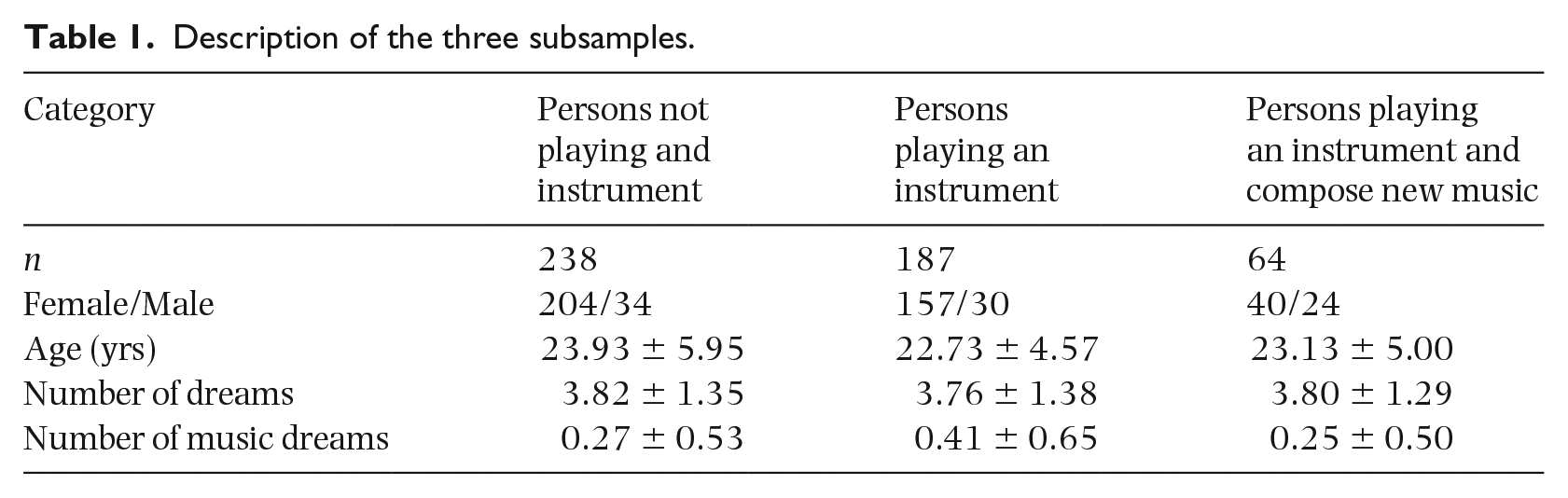
Overall, 425 persons (361 women and 64 men) with a mean age of 23.40 ± 5.41 years (range: 16 to 61 years; two missing values) participated in the present study, mostly psychology students. A total of 187 played an instrument in their leisure time (44.00%). The music group was subdivided into n = 123 only playing existing music, n = 7 only composing new music and n = 57 with a combination of existing and new music. Thus, 64 persons (34.22% of the persons playing music) were composing new music in waking life. The participants reported 3.79 ± 1.36 dreams with a range from 1 to 10 dreams. The mean length of the dreams per person was 148.98 words ± 98.90, with a range from 11 to 654.20. The characteristics of the three different subsamples are presented in Table 1.
Description of the three subsamples.
Measurement instruments
The participants kept a standardized dream diary for 14 consecutive days. If able to recall at least one dream, participants were asked to record their dream(s) as completely as possible. In order to avoid decrease in motivation in high recallers, participants were asked to record their dreams only on the first five mornings with successful dream recall. After that, they only checked whether they recalled a dream or not. After recording the dreams, two 4-point rating scales were presented to the participants in order to measure the intensity of positive and negative dream emotions (0 = none, 1 = mild, 2 = moderate, 3 = strong) – including all remembered dreams of the night. As a measure for emotional tone of the dream(s), the intensity of negative emotions was subtracted from the intensity of positive emotions.
A questionnaire item assessed whether the participants played an instrument in their waking life and if so, whether they only play existing music, only compose new music, or a combination of both.
Dream content analysis
The dream reports (analysis unit: all dreams of one night) were scored regarding the occurrence of music topics (Yes/No). The inter-rater reliability for this scale was κ = 0.81. If music topics were present, the following four music categories were rated: listening to music (κ = 0.84), dreamer is playing an instrument (κ = 0.80), dreamer is singing (κ = 0.73), and music themes (κ = 0.98). Examples for the music themes category are discussions about music, appearance of a famous musician, a concert invitation or ticket, and music that hasn’t started yet or is already over.
Procedure
Originally, the study entitled “Sleep, dreams, and personality” was designed to investigate factors of home dream recall (Schredl, Wittmann, Ciric, & Götz, 2003). The students were approached after their lectures and invited to participate. They received course credit or alternatively a small monetary compensation. Comparing the sample size to the total number of psychology students enrolled in this semester at the three universities of Heidelberg, Landau, and Mannheim, it can be assumed that the majority of the students participated. There were no exclusion criteria. The participants completed several questionnaires (personality, sleep quality, stress, and creativity) and the dream diary. The creativity questionnaire included the questions about musical activities in waking life. The dream reports were typewritten, randomized, and coded by an external judge for the presence of music topics. A second rater also independently coded a subsample of 288 dreams (of the total sample of 1,612 dreams) for the presence of music topics. The subset of dreams including music were coded by two raters independently along the four categories. The codings were aggregated per person, i.e., the number of dreams including music per person. The mean dream length was determined as the average number of words per analysis unit (all dreams of one night).
We carried out ordinal regression analyses, controlling for potentially confounding variables like age, gender, mean dream length, and number of dreams per person. Controlling for dream length is an approach that is often used, as longer dreams include more elements of all different kinds (Schredl, 1999; Urbina, 1981). Based on our hypothesis, we applied a one-tailed test for investigating the relationship between playing an instrument in waking life and the frequency of dreams including music.
To compare dreams including music and dreams without music regarding overall emotional tone, only persons with a music dream and at least one dream without music were selected – a strict within-subject design (n = 69). As participants sometimes reported several dreams per night, dreams including music were only included in the analysis if it was a night with a single dream report (not multiple dream reports) because in this case the self-rating scales (intensity of positive and negative dream emotions) correspond unambiguously to the music dream and are not an average of all dreams of the night. If the participant reported more than one dream without music, the dream without music closest in dream length to the music dream was selected. The emotion variables of the remaining 69 participants were statistically compared using a Wilcoxon signed-rank test. Statistical analysis was performed using SAS version 9.4 for Windows.
Results
Music dream frequency and influencing factors
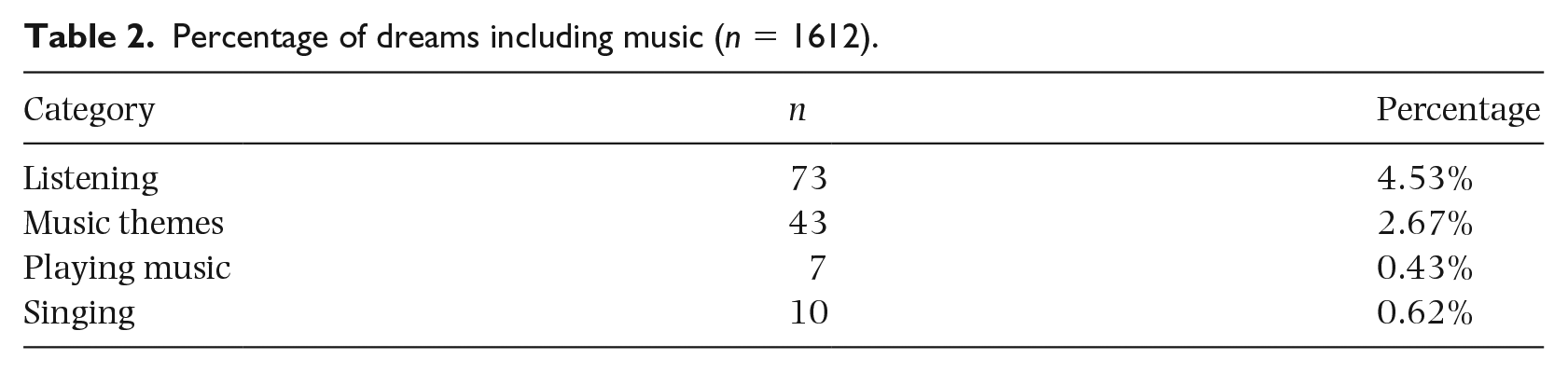
Overall, 131 dreams with reference to music (8.13% of all 1,612 remembered dreams) were found. The most frequent musical activity in the dreams was listening to music, and other topics like music themes, singing, and playing music were reported less often (see Table 2).
Percentage of dreams including music (n = 1612).
As some participants reported more than one dream, the numbers of dreams including music topics per person are presented in Table 3. Three persons had three dreams including music, seven persons had two music dreams, whereas the majority of persons with music dreams reported only one music dream. For the four different subcategories, the number of dreams with musical topics was lower.
Number of dreams including music topics per person (n = 425).

The ordinal regression analysis was done for the whole sample and the results are shown in Table 4. Playing an instrument during the day was significantly and positively associated with music dream frequency. A second ordinal regression analysis was done for those participants reporting musical activities. These results are shown in Table 5. Participants composing music during the day (the group that only compose music and the group that play existing music and compose music) had significantly fewer dreams including music at night than participants who were playing an instrument but were not composing.
Ordinal regression analysis for number of dreams including music (n = 423).
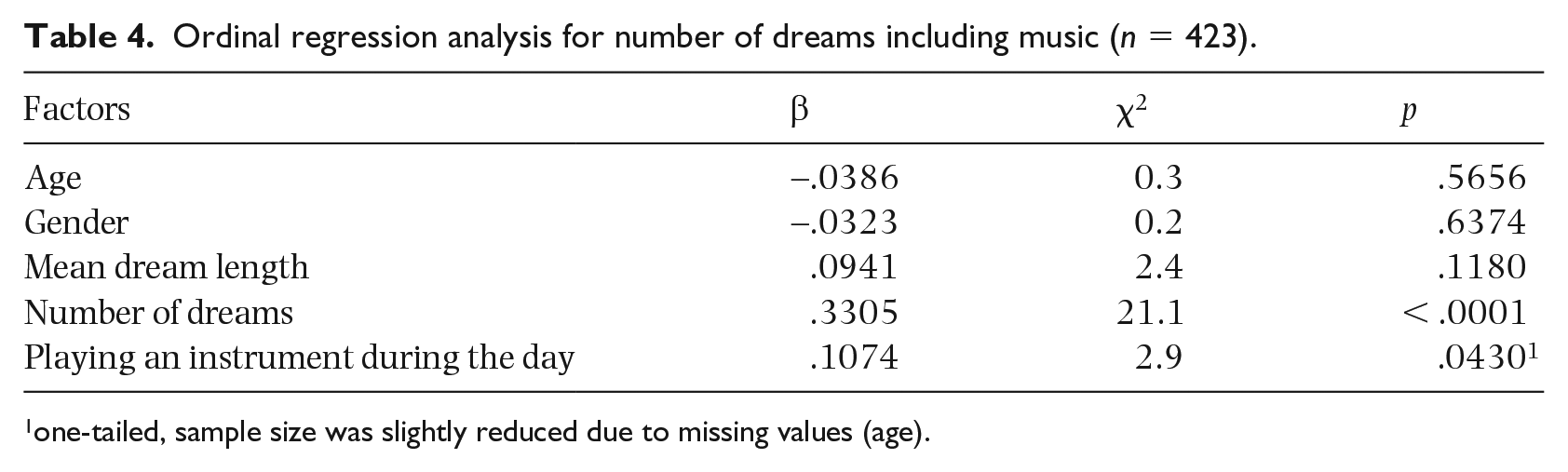
one-tailed, sample size was slightly reduced due to missing values (age).
Ordinal regression analysis for number of dreams including music in the subgroup of participants playing an instrument (n = 186).

β = Standardized estimates, sample size was slightly reduced due to a missing value (age).
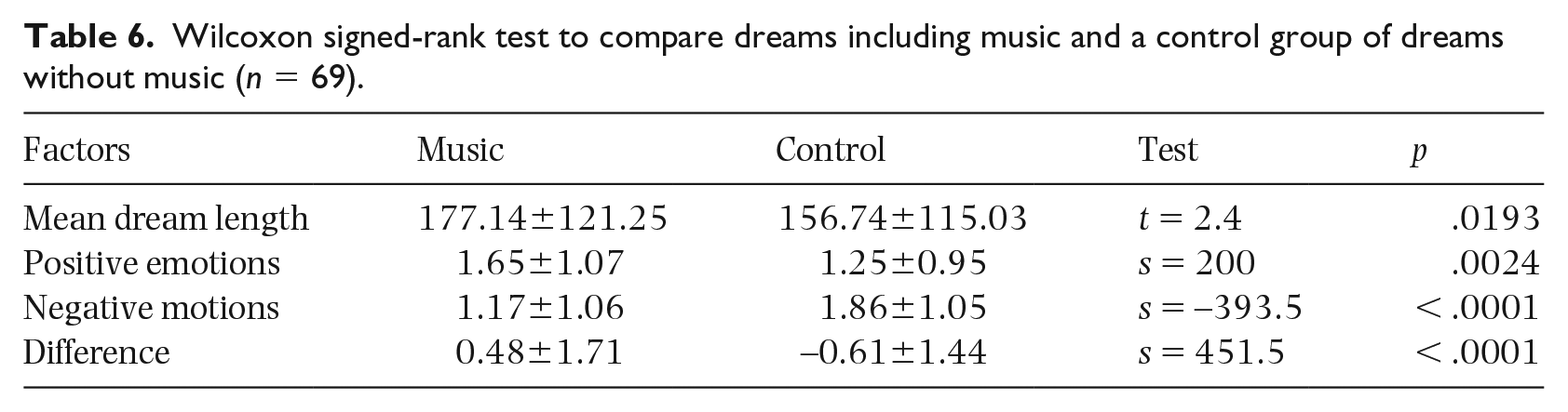
Finally, a Wilcoxon signed-rank test compared dreams including music with a matched control group of dreams without music reported by the same dreamer. The results are depicted in Table 6, showing significant effects on all variables: dreams including music were more positively-toned and less negatively-toned than the matched dreams without music. Nevertheless, the dreams including music consisted of a significantly higher number of words.
Wilcoxon signed-rank test to compare dreams including music and a control group of dreams without music (n = 69).
Music dream examples
Overall, some dreams including music were positively associated. Examples of positive-toned dreams are: I have to audition for the king’s jester who is deciding whether I have to play for the king. I try my best and my flute sounds absolutely wonderful. I was taken to the king already wearing a wedding dress ready to marry the prince. Friends and I talked, then suddenly started to dance, all together, to a wonderful, intoxicating music appearing from nowhere: it was electrifying!
As also few negative dreams occurred, one example of a negative music dream is: I wanted to sing but my voice cracked, it was sobering and frustrating, it was just a hoarse whisper.
Discussion
The main finding of the study indicates that in diary dreams 8% of all remembered dreams contain music and that the frequency of these dreams including music is significantly higher when the person is playing an instrument during the day. This result partly supports the continuity hypothesis of dreaming (Schredl, 2003) as the subgroup of persons composing music reported dreams including music less frequently than persons playing an instrument but not composing music. In addition, dreams including music were more positive with regard to emotional tone than dreams without music.
The music dream percentage of the present study is considerably lower than the reported 20% for the non-musicians of Uga et al. (2006). Several factors might explain this difference. First, their study was advertised as a study concerning music in dreams and thus one may assume that people with many dreams including music were more likely to participate. In the present study, the participants were recruited for a sleep and dream study without special reference to music in dreams. Second, asking participants directly about music in their dreams every morning with probing questions can bias the results – similar to a previous study about outdoor and urban settings (Stern, Saayman, & Touyz, 1978). In that study the participants who were explicitly asked about one topic every morning reported more dreams including this topic over the course of the study. The disadvantage of using data obtained for another research question is that there is only a very crude measure for musical activities during waking. It would be desirable to have the beginning of musical training, the time spent with playing an instrument, listening to music, talking about music and so on.
The music dream percentage in the current study is roughly comparable to the percentages of dreams including music reported by the participating psychology students of the study of Kern et al. (2014) with 11% and of the Vogelsang et al. (2016) study with 4%. One factor that might explain these differences is the methodological approach, i.e., analyzing diary dreams vs. eliciting music dream frequency retrospectively. Another factor might be the time spent with music activities in waking, as in the present study it was only measured whether the participants play an instrument or not. Future studies should measure the amount of time spent with all kinds of musical activities (playing an instrument, listening to music, talking about music etc.) during the day. The music dream percentage was also roughly comparable to the Schredl et al. (2015) study with 6%. Their result was lower compared to the current study, which might be explained by the fact that the age mean of the Schredl et al. (2015) study was considerably higher (about 45 years) and that the percentage of dreams including music decreased with age in this sample – this might reflect older people spending less waking time with music.
The result that playing an instrument in waking life results in significantly more dreams including music corroborates the findings of Vogelsang et al. (2016) and König et al. (2018) that music during the day affects the frequency of music in dreams, and is thereby in line with the continuity hypothesis of dreaming (Schredl, 2003). Two other studies found no significant relation between the amount of musical activities during the day and the frequency of dreams with music (Kern et al., 2014; Uga et al., 2006), which might be caused by the fact that they only asked for the amount of time spent with music instead of the emotional involvement. Interestingly, within the group of persons playing an instrument, the composer group reported having fewer dreams including music than the non-composing persons playing an instrument. This finding is difficult to interpret as we did not elicit any measures regarding the overall amount of musical activities during the day (e.g., listening to music, talking about music etc.). The positive effect of the emotional involvement of daytime activities on their incorporation rate has already been reported in several studies (Malinowski & Horton, 2014; Schredl, 2006).
The finding that dreams including music are toned more positively regarding dream emotions is consistent with the Kern et al. (2014) study. As music often has a positive effect on the listener during the day (Liljeström et al., 2013), positive emotions in dreams with music might be found. But negative emotions do occur, e.g., in the music dream example mentioned above as well as in the Vogelsang et al. (2016) study, similar to the findings for athletes (Erlacher, Ehrlenspiel, & Schredl, 2011). Future research could analyze whether professional musicians and music students have more negative dreams related to the stress of music performances.
To conclude, the main finding is that playing an instrument in waking life affects dream content and that if music is present in some form in the dream, the emotional tone of these dreams is more positive. Based on the examples of composing in dreams that were not only found for famous musicians (Barrett, 2001; Grace, 2012) but also for the sample of Vogelsang et al. (2016), the frequency of new music in dreams of professional composers might be an interesting avenue for future research. In addition to studying the relationship between musical activities in waking and dream content, it might be interesting to study the interplay between imagined music during the day and dreams, because music students report more waking-life imagery related to music that non-music students (Bailes, 2007) – a parallel to the increased number of music-related dreams in music students (Vogelsang et al., 2016) and also in line with research showing, for example, that the frequency of erotic phantasies in waking life correlated with the frequency of erotic dreams (Schredl, Desch, Röming, & Spachmann, 2009). Using a diary approach it would be very interesting to study professional musicians and/or music students prior to an important concert/exam and/or after a successful concert/exam. As there is a link between dreams and sleep-dependent memory consolidation (Wamsley, Tucker, Payne, Benavides, & Stickgold, 2010), practicing in dreams might be connected to improving musical skills. On the other hand, skilled lucid dreamers practiced motor skills in their dreams and improved their waking life (Stumbrys, Erlacher, & Schredl, 2016), so that for musicians lucid dream training might be beneficial for improving their waking-life performance.
