



Abstract
Musical taste is thought to function as a social “badge” of group membership, contributing to an individual’s sense of social identity. Following from this, social identity theory predicts that individuals should perceive those who share their musical tastes more favorably than those who do not. Social identity theory also asserts that this in-group favoritism is motivated by the need to achieve, maintain, or enhance a positive social identity and self-esteem (i.e., the “self-esteem hypothesis”). The findings of the present study supported both of these predictions. Participants rated fans of their favorite musical style significantly more favorably than fans of their least favorite musical style. The present findings also offer, for the first time, evidence of significant positive correlations between an individual’s self-esteem and the in-group bias shown to those who share their musical tastes. However, significant relationships with in-group identification also indicate that self-esteem is unlikely to be the sole factor responsible for this apparent in-group bias. Together these findings suggest that those who share our musical taste are likely to be regarded as in-group members and will be subject to in-group favoritism according to our self-esteem and how strongly we identify with our fellow music fans.
Research has shown that individuals perceive and behave more favorably toward those who share their musical tastes than toward those who do not (e.g., Bakagiannis & Tarrant, 2006; Knobloch, Vorderer, & Zillmann, 2000; Lonsdale & North, 2009; North & Hargreaves, 1999; Tekman & Hortaçsu, 2002, 2003; Zillmann & Bhatia, 1989). In this respect, musical taste has been argued to function as a social “badge” (Frith, 1981; North & Hargreaves, 1999), used by people to symbolically represent their membership of particular social groups. Given its proposed relationship with group membership, musical taste is expected to contribute to an individual’s sense of social identity.
According to social identity theory (Tajfel, 1978; Tajfel & Turner, 1979), individuals are motivated to evaluate the groups they belong to (so-called “in-groups”) more positively than other relevant out-groups because of a need to achieve, maintain, or enhance a positive social identity and high self-esteem (i.e., the “self-esteem hypothesis”). In this context, social identity theory has been suggested to explain why people tend to favor those who share their musical tastes. That is, people who share our musical tastes are likely to be considered in-group members, and as such, we may be motivated to judge them more favorably according to our need for high self-esteem.
Although broadly consistent with the predictions of social identity theory, to date, there is no evidence to suggest that the in-group favoritism shown to those who share our musical tastes is actually motivated by the need for high self-esteem. With the exception of one study (Lonsdale & North, 2009), all previous investigations concerned with this topic have failed to investigate the link between an individual’s self-esteem and the extent to which they exhibit in-group favoritism to those who share their musical tastes. Despite this, when Lonsdale and North (2009) tested this link, no significant relationships were found. This failure to establish a link with self-esteem draws into question whether the apparent in-group bias shown to those who share our musical tastes can actually be explained by social identity theory. However, these findings were subject to several important limitations.
There are arguably several different reasons why Lonsdale and North (2009) failed to find a significant relationship between self-esteem and in-group favoritism. Most notably, the collective self-esteem (CSE) scale (Luhtanen & Crocker, 1992) was inappropriately used to assess participants’ feelings toward all of the social groups they belonged to (e.g., their gender, nationality, and ethnicity) and was not tailored specifically to assess how they felt about fans of their favorite musical style. This oversight meant that participants were asked non-specific questions about “the social groups I belong to” rather than ones concerned solely with the specific social group under investigation (i.e., fans of their favorite musical style). In the light of this, the present investigation ensured that the CSE scale was adapted to reflect how participants felt about their fellow music fans rather than an overall assessment concerning all of the social groups they may belong to.
While the need for self-esteem might be expected to play an important role in the in-group favoritism shown to those who share our musical tastes, this is unlikely to be the sole factor motivating this apparent intergroup discrimination. For instance, according to the assumptions of social identity theory (Tajfel, 1978; Tajfel & Turner, 1979), identification with the in-group is a prerequisite for intergroup discrimination. That is, individuals who do not identify with the in-group (e.g., fans of their favorite musical style) are considered less inclined to display in-group favoritism than those who strongly identify with and are committed to the in-group. However, all previous attempts to study the in-group bias shown to those who share our musical tastes (e.g., Lonsdale & North, 2009; North & Hargreaves, 1999) failed to assess the extent to which participants identified with fans of their favorite musical style. It therefore remains to be seen if the apparent in-group favoritism effects of shared musical taste are linked to in-group identification.
Although listening to music often plays an important part in the lives of adolescents and young adults (e.g., Fitzgerald, Joseph, Hayes, & O’Regan, 1995; Lonsdale & North, 2011), this is not necessarily true for all young people; this variation might also explain individual differences in in-group favoritism. Indeed, people who ascribe music little importance and spend less time listening to music are perhaps less inclined to regard shared musical tastes as a salient criterion of in-group membership and as such may be less likely to exhibit in-group favoritism to those who share their musical tastes.
The present study aimed to re-examine the effects of shared musical tastes on in-group favoritism in the light of the aforementioned limitations and criticisms of previous research. Specifically, the present investigation aimed to address two main questions: (1) Do people’s stereotypes of musical taste exhibit an in-group bias? (2) To what extent is our tendency to favor those who share our musical tastes linked to self-esteem, in-group identification, and the importance we ascribe to music? In addition to this, previously unexplored questions concerning musical taste and in-group favoritism will be tested. For example, are the fans of certain musical styles rated more favorably than other music fans? Are the fans of certain music styles more inclined to exhibit in-group favoritism to those who share their musical tastes than other music fans?
To investigate these questions, the present study used the same research design employed in Lonsdale and North’s (2009) study where participants were asked to rate the typical music fans of six different musical styles. However, in contrast to this earlier study, the present study asked participants to evaluate the typical fans of two additional musical styles (i.e., jazz and classical music). This extended list of eight musical styles offers a more representative range of musical tastes than had previously been considered by similar investigations (e.g., Lonsdale and North, 2009; North & Hargreaves, 1999; Tekman & Hortaçsu, 2002, 2003) and was intended to address the possibility that the expected in-group bias might be a phenomenon limited only to musical styles closely associated with contemporary youth subcultures (e.g., chart pop, hip-hop, and dance music).
Method
Participants
One hundred and fifty one participants (86 females and 65 males) took part in the study voluntarily and were recruited using email invitations and online via posts on Facebook. Participants ranged from 18 to 66 years, with a mean age of 27.02 years (SD = 6.70 years).
Measures
Participants were asked to complete an online “musical taste survey” concerned with “how people perceive the fans of different musical styles.” The questionnaire established how positively or negatively participants evaluated the typical fans of eight musical styles (i.e., heavy metal/rock, hip-hop/rap, chart pop, dance music, indie rock, R&B, jazz, and classical music). Participants rated the extent to which 18 statements (e.g., “Chart pop fans are popular”) described typical fans of the eight musical styles using 11-point scales (0 = Poor description and 10 = Excellent description).
Each of the statements used one of 18 different adjectives used in a previous music fan evaluation study (Lonsdale & North, 2009). Nine adjectives were positive and socially desirable characteristics (e.g., trustworthy, considerate) and nine were negative, socially undesirable characteristics (e.g., unreasonable, dishonest). The 18 statements were presented in a random order for each musical style. Moreover, the sequence in which participants judged the typical fan of each of the eight musical styles was also randomized between participants. Following this, participants were asked to indicate which of the eight musical styles were (1) their favorite musical style and (2) their least favorite musical style.
Overall scores for the eight musical styles were calculated to reflect how positively or negatively participants rated their typical fans. A sum of the ratings on the nine negative adjectives (0–90) was subtracted from a sum of the ratings on the nine positive adjectives (0–90) for fans of each of the eight musical styles. Accordingly, a positive overall score (i.e., 1 to 90) would indicate that a participant had evaluated a typical [for example] heavy metal fan positively (i.e., music fan ratings were more positive than negative). In contrast, a negative overall score (i.e., −1 to −90) would indicate that a participant had evaluated a typical (for example) jazz fan negatively (i.e., music fan ratings were more negative than positive). An overall score of zero would indicate that a participant’s evaluation of a typical (for example) hip-hop fan was equally negative and positive or neutral.
Participants were then asked how important music is to them (0 = Not at all important, 10 = Extremely important) and to indicate how often they listen to music (0 = Never, 5 = Everyday). Participants were then asked to indicate the extent to which they identify with typical fans of their favorite musical style (0 = I don’t identify with them at all, 10 = I completely identify with them). The online questionnaire was programmed to personalize this question (e.g., “To what extent do you identify with typical [for example] classical music fans?”), in a way that corresponded with each participant’s favorite musical style (e.g., classical music) as determined by an earlier question.
Finally, participants completed measures of personal self-esteem (PSE) and CSE. The Rosenberg (1965) self-esteem scale was used to assess participants’ overall evaluation of self-worth. The 10-item scale asks participants to indicate the extent to which they agree with each of the statements (e.g., “On the whole, I am satisfied with myself”) using a 4-point rating scale. PSE scores range from 0 to 30, where high scores indicate a positive self-evaluation. In the present study, the Rosenberg self-esteem scale was found to be internally consistent (α = .82).
The CSE scale (Luhtanen & Crocker, 1992) was adapted to assess how positively participants evaluated fans of their favorite musical style and their membership of this social group. Wherever possible, the online questionnaire was programmed to ensure that these 16 questions were personalized to refer to fans of a participant’s favorite musical style (as determined by their response to an earlier question).
The 16-item measure is divided into four distinct 4-item sub-scales, namely (1) Membership esteem (i.e., an individual’s judgment of how good or worthy he or she is as a music fan of their favorite musical style; e.g., “I feel I don’t have much to offer other [for example] classical music fans”); (2) Private CSE (i.e., personal judgment of how good fans of their favorite musical style are as a social group; e.g., “In general, I am glad to consider myself a [for example] hip-hop/rap fan”); (3) Public CSE (i.e., individual judgments of how other people evaluate fans of their favorite musical style; e.g., “Overall, [for example] dance music fans are considered good by others”); and (4) Importance to identity (i.e., the importance of being a fan of their favorite musical style to an individual’s self-concept; e.g., “Being a [for example] R&B fan is an important reflection of who I am”). Scores for each of the four sub-scales were calculated as the mean of the relevant four items.
Analysis of the CSE scores showed that the membership self-esteem and private CSE sub-scales were internally consistent (α = .82 and .73, respectively). However, the internal consistency of the 4-item “importance to identity” sub-scale was found to fall short of acceptable levels (α = .63), and the public CSE sub-scale was somewhat disappointing (α = .58).
Results
Preliminary analysis
Before taking into account the impact of participants’ own musical tastes, the overall scores calculated for each musical style were examined to determine whether the fans of certain musical styles were rated more or less favorably than any of the others under investigation. Upon analysis, it was evident that there were no significant differences between the eight musical styles, F(4.90, 734.56) = 1.44, p = .21. Overall scores for all eight musical styles ranged from −1.46 to 1.51 indicating that participants’ evaluation of typical music fans were (on average) generally neutral or equally negative and positive. 1
Main analysis
A repeated measures t-test showed that participants rated fans of their favorite musical style (M = 15.29, SD = 19.82) significantly more favorably than fans of their least favorite musical style (M = −7.72, SD = 13.99), t(150) = 8.86, p < .001, d = .72. Pearson’s r correlations investigated the extent to which the in-group bias exhibited by participants toward fans of their favorite musical style was related to their (personal and collective) self-esteem, their in-group identification, the importance of music to their everyday life, and how often they listened to music. To achieve this, a new in-group bias score was calculated.
The overall score for fans of a participant’s least favorite musical style was subtracted from the overall score for fans of his/her favorite musical style (Lonsdale & North, 2009). In this context, participants with high overall in-group bias scores would be considered to have exhibited in-group bias to greater extent that those with lower scores. 2 This measure of in-group bias was then correlated with measures of self-esteem, in-group identification and musical interest/consumption. Table 1 shows that all of the variables under investigation, except for public CSE, correlated significantly with the in-group bias that participants exhibited toward fans of their favorite musical style.
Summary of in-group bias correlations.
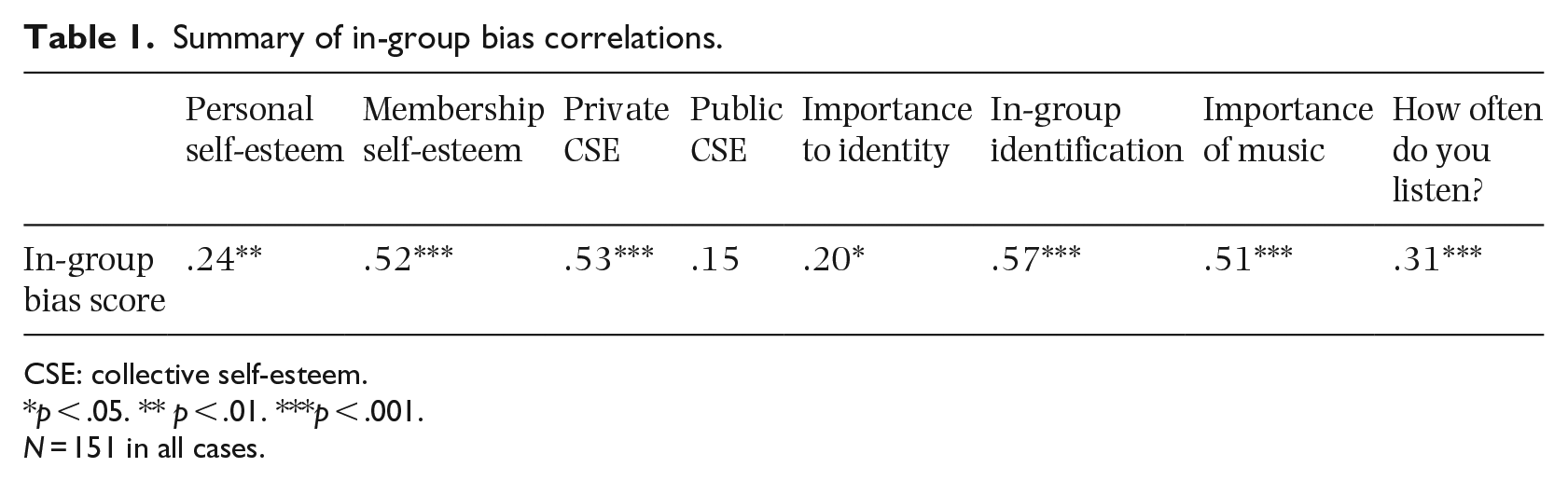
CSE: collective self-esteem.
p < .05. ** p < .01. ***p < .001.
N = 151 in all cases.
To assess their relative importance, each of these eight variables was entered into a multiple regression. Together these eight predictor variables predicted 41% of the variation (adjusted r2) in the in-group bias shown to the fans of participants’ favorite musical style, F(8, 142) = 14.16, p < .001. Upon closer inspection, it was evident that participants’ membership self-esteem (β = .21, p = .039), their private CSE (β = .26, p = .011), and the extent to which they identified with the typical fans of their favorite music style (β = .41, p < .001) were only three significant predictors of their in-group bias score.
When asked to indicate their favorite musical style, it was clear that participants liked a variety of different music styles. 3 For this reason, a one-way between-group analysis of variance (ANOVA) was used to test the possibility that fans of different musical styles might exhibit in-group bias to differing extents (e.g., do R&B fans exhibit in-group bias to a greater extent than jazz music fans?). No significant differences were found between the eight sub-groups, F(7, 143) = .47, p = .85. 4
Discussion
The findings of the present study are in keeping with the predictions of social identity theory and, most notably for the purposes of this article, the self-esteem hypothesis. As expected, participants rated the fans of their favorite musical style more favorably than fans of their least favorite musical style. This apparent in-group favoritism is consistent with previous studies (e.g., Lonsdale & North, 2009; North & Hargreaves, 1999; Tekman & Hortaçsu, 2002, 2003) and offers further empirical evidence for the predicted relationship between musical taste, group membership, and social identity (Frith, 1981; North & Hargreaves, 1999). The present findings also suggest this tendency to regard those who share our musical tastes more favorably than those who do not is one that is common to most (if not all) music fans and does not appear to be limited only to musical styles that are closely associated with contemporary youth subcultures (e.g., chart pop, hip-hop, and dance music).
Social identity theory asserts that in-group favoritism is motivated by the need to achieve, maintain, or enhance a positive social identity and self-esteem; this idea is widely referred to as the “self-esteem hypothesis.” The findings of the present study offer, for the first time, evidence of a significant link between an individual’s self-esteem and the in-group favoritism shown to those who share their musical tastes. With the exception of public CSE, significant positive correlations were found with all of the measures of PSE and CSE under investigation. These findings are in keeping with the predictions of social identity theory and suggest that people’s willingness to positively discriminate between those who do and do not share their musical tastes might be linked, in some way, to their self-esteem.
The significant positive correlations with self-esteem suggest that participants who feel good about themselves both as individuals and as fans of their favorite musical style were most likely to exhibit in-group favoritism toward those who share their musical tastes. Nonetheless, the correlational research design does not permit us to draw conclusions concerning the causal relationship between self-esteem and the in-group bias shown to fans of participants’ favorite musical style. This issue of causality is, however, nothing new; the evidence for the role played by self-esteem in intergroup discrimination is far from clear cut (Abrams & Hogg, 1988; Brown, 2000; Rubin & Hewstone, 1998). Indeed, Abrams and Hogg (1988) set out two competing hypotheses to explain this relationship: (1) successful intergroup discrimination leads to an increase in self-esteem (Corollary 1) or (2) low or threatened self-esteem motivates increased intergroup discrimination (Corollary 2). It therefore seems imperative that future studies approach this question experimentally to determine whether self-esteem is the cause or effect of the in-group bias shown to those who share our musical tastes.
The present findings highlight the importance of using measures of self-esteem adapted to the particular in-group under investigation, in this case fans of participants’ favorite musical style. Lonsdale and North (2009) used a global measure of collective esteem that asked non-specific questions about the social groups that participants belonged to rather than ones specifically tailored to assess their feelings as fans of their favorite musical style. This oversight may explain why Lonsdale and North (2009) failed to find a significant link with self-esteem, while the present study did. Research suggests that specific measures of self-esteem are often more powerful predictors of behavior than global measures (e.g., Crocker, Luhtanen, Blaine, & Broadnax, 1994; Dutton & Brown, 1997). Future investigations on this topic should bear this in mind and ensure measures of group-specific social self-esteem are used wherever possible.
The present findings are the first to show that the in-group favoritism shown to those who share an individual’s musical tastes might be linked to their self-esteem; this link was found using two well-established measures of PSE and social self-esteem (Luhtanen & Crocker, 1992; Rosenberg, 1965). Although both scales are psychometrically robust (Gray-Little, Williams, & Hancock, 1997; Greenberger, Chen, Dmitrieva, & Farruggia, 2003; Luhtanen & Crocker, 1992) and have been used extensively, there are countless other ways future researchers might go about assessing self-esteem.
Rubin and Hewstone (1998) suggest that there are at least three different types of esteem: (1) global or specific self-esteem, (2) trait or state self-esteem, and (3) PSE or social self-esteem. In most cases, self-esteem scales have traditionally tended to regard self-esteem as a global, personal trait, concerned with an individual’s overall evaluation of themselves as a person (rather than as a group member) that is unlikely to change over time or in the light of new experiences. This conception of self-esteem seems somewhat limited and ignores evidence that our sense of self-worth is often unstable and subject to fluctuations over time (e.g., Kernis, Cornell, Sun, Berry, & Harlow, 1993). Future studies might therefore consider employing state measures of self-esteem (e.g., Heatherton & Polivy, 1991) to explore the links with in-group bias and to detect any short-lived or temporary effects of intergroup discrimination at the time of questioning.
It is also interesting to note the study’s non-significant findings. While two measures of CSE (i.e., membership self-esteem and private CSE) significantly predicted participants’ in-group bias score, PSE did not. These results arguably add further weight to the argument that people’s musical tastes, group membership, and social identity are linked. Put simply, these findings suggest that the extent to which participants exhibited in-group bias toward those who shared their musical tastes was related to how positively participants regarded themselves as group members rather than how they felt about themselves as individuals.
The absence of a significant correlation with public CSE also highlights the possibility that a subtle distinction in how people evaluate themselves as group members might have differing consequences for in-group bias. Specifically, the present findings seem to imply that if participants personally hold fans of their favorite musical style in high esteem (i.e., high private CSE), they would be more inclined to exhibit an in-group bias. Whereas, in contrast, there was no such association between in-group bias and how participants think other people judge fans of their favorite musical style. This distinction warrants further exploration. However, this non-significant correlation should be regarded with caution given the disappointing internal consistency of the 4-item public CSE sub-scale (α = .58) and further investigation will be required to improve the reliability of this adapted sub-scale before any firm conclusions are drawn. The present findings, however, indicate that self-esteem is unlikely to be the sole factor responsible for the in-group favoritism shown to those who share our musical tastes.
A significant positive correlation with a measure of in-group identification suggested that participants who identified strongly with their fellow music fans were most likely to exhibit in-group favoritism toward those who share their musical tastes. In-group bias scores also correlated significantly with the self-rated importance of music and how often participants listened to music. Participants who ascribed greater importance to music may have been more inclined to regard musical taste as a salient criterion for social categorization and social comparison, and as such, this may explain why they were more likely to exhibit in-group favoritism toward fans of their favorite musical style. Subsequent analysis indicated that in-group identification was the most powerful of the three variables found to significantly predict participants’ in-group bias score (i.e., membership self-esteem and private CSE). This positive relationship is consistent with previous research (e.g., Brown, 2000; Brown et al., 1992; Hinkle & Brown, 1990; Perreault & Bourhis, 1998) and leads us to question the relative importance of self-esteem in explaining the in-group bias observed here.
It is possible that the relationship between in-group bias and self-esteem is moderated by the degree to which people identify with the in-group (De Cremer, 2001). If this were the case, we would expect the link between self-esteem and the in-group bias shown to those who share our musical tastes to be stronger among individuals who identify closely with fans of their favorite musical style than among those who do not. In any case, the present findings suggest that the self-esteem hypothesis offers only a partial explanation of the in-group bias observed, and it is clear that the interactions between in-group identification, self-esteem, and in-group bias warrant further investigation.
Although the present findings are the first to demonstrate a link between self-esteem and the in-group favoritism shown to those who share an individual’s musical tastes, it is important to acknowledge the limitations of the study. First, it is unclear if the measure of in-group bias used in the present study offers any meaningful insights into how participants regard music fans in everyday interactions. Indeed, it remains to be seen if the in-group bias shown to hypothetical/imagined music fans when completing an online questionnaire corresponds with how participants behave toward “real” music fans encountered in more naturalistic, real-life settings. Future studies should therefore look to explore alternative methods for assessing in-group bias that are more realistic and less obtrusive than rating the “typical” fan of several different musical styles.
Second, the eight musical styles under investigation arguably offered a more comprehensive account of participants’ musical tastes than previous studies (Lonsdale & North, 2009; North & Hargreaves, 1999; Tekman & Hortaçsu, 2002, 2003), but this list was far from exhaustive. It cannot therefore be assumed that participants’ favorite (or least favorite) musical style was among this pre-determined list of eight musical genres; it is unclear how this restricted range of choices may have affected the present results, but this draws into question the accuracy of the present findings. Future research on this topic will need to weigh up the benefits of investigating an ever-broader range of musical styles alongside the disadvantages of asking participants to complete an overly long questionnaire (e.g., Galesic & Bosnjak, 2009; Herzog & Bachman, 1981; Roszkowski & Bean, 1990). One possible solution might be to allow participants to report their musical taste for themselves or to select their favorite/least favorite musical style from a comprehensive list of options (e.g., North, 2010) and then program the remainder of the questionnaire to reflect these choices. Nonetheless, an approach like this would have limitations of its own; participants would immediately understand that the two musical styles were the focus of the study and this understanding is likely to bias/polarize how they rate their typical music fans.
Third, the present study used a single-item measure to assess the extent to which participants identified with fans of their favorite musical style. While this approach is far from unprecedented (e.g., Brown & Williams, 1984; Perreault & Bourhis, 1998; Sachdev & Bourhis, 1985), some argue that researchers should avoid using single-item measures because they are more prone to random error, and they often lack content validity and the sensitivity needed to discern subtle differences between individuals on complex, heterogeneous constructs (e.g., Churchill, 1979; Loo, 2002; Nunnally, 1978). Research over the past 40 years suggests that in-group identification is likely to be a multidimensional construct, including cognitive, affective, and evaluative components (e.g., Ellemers, Kortekaas, & Ouwerkerk, 1999; Hinkle, Taylor, Fox, Cardamone, & Crook, 1989; Leach et al., 2008; Roccas, Sagiv, Schwartz, Halevy, & Eidelson, 2008). Future research on this topic might therefore benefit from using measures that reflect the complex, multidimensional nature of in-group identification.
Finally, respondents taking part in the present study were predominantly young adults, as were those who took part in earlier studies (Lonsdale & North, 2009; Tekman & Hortaçsu, 2002, 2003). There is evidence to suggest that music is particularly important for adolescents and young adults (16–29 years) and that people aged 30 years and above become less and less likely to report listening to music as a means to define and express their identity as they grow older (Lonsdale & North, 2011). Moreover, research that has consistently shown that self-esteem tends to increase steadily as individuals grow older (see Orth & Robins, 2014 for an overview of the longitudinal evidence). It is, therefore, entirely possible that the in-group bias shown to those who share our musical tastes is limited to adolescents and young adults, who may be more inclined to regard musical tastes as a salient dimension for intergroup comparison, more likely to identify with fans of their favorite musical style, and have greater self-esteem concerns than their middle-aged counterparts. Future studies should look to determine whether the willingness to positively discriminate between those who do and do not share our musical tastes is common to people of all ages, or if this is a phenomenon uniquely associated with young people.
In conclusion, the present findings lend further empirical support to the idea that musical taste might function as a socially symbolic “badge” of group membership (Frith, 1981; North & Hargreaves, 1999) that contributes to an individual’s sense of social identity. Participants rated fans of their favorite musical style more favorably than fans of their least favorite musical style; this apparent in-group bias was found irrespective of participants own musical tastes and using a broader range of musical styles than has been used previously. In keeping with the predictions of the self-esteem hypothesis, the present study also found that the extent to which participants exhibited in-group favoritism to those who share their musical tastes was positively linked with their self-esteem. More broadly, these findings also suggest that musical taste might offer researchers a means to study the predictions of social identity theory in a way that is far more naturalistic and less obtrusive than traditional minimal group experiments.
Supplemental Material
Supplemental_material – Supplemental material for Musical taste, in-group favoritism, and social identity theory: Re-testing the predictions of the self-esteem hypothesis
Supplemental material, Supplemental_material for Musical taste, in-group favoritism, and social identity theory: Re-testing the predictions of the self-esteem hypothesis by Adam J Lonsdale in Psychology of Music
Footnotes
Acknowledgements
I would like to thank Razark Ali who (under the supervision of Dr Adam Lonsdale) collected the data for this study as part of his third-year undergraduate dissertation project. I am also grateful to the two anonymous reviewers for their helpful comments on earlier versions of this paper.
Declaration of conflicting interests
The author(s) declared no potential conflicts of interest with respect to the research, authorship, and/or publication of this article.
Funding
The author(s) received no financial support for the research, authorship, and/or publication of this article.

Supplemental material
Supplemental material for this article is available online.
Notes
References
Supplementary Material
Please find the following supplemental material available below.
For Open Access articles published under a Creative Commons License, all supplemental material carries the same license as the article it is associated with.
For non-Open Access articles published, all supplemental material carries a non-exclusive license, and permission requests for re-use of supplemental material or any part of supplemental material shall be sent directly to the copyright owner as specified in the copyright notice associated with the article.
