



Abstract
The purpose of this study was to determine the effect of the musical tempo on heart rate (HR), rating of perceived exertion (RPE), and distance run (DR) during a treadmill aerobic test in young male and female adults. Participants ran on the treadmill listening to music at 140 beats per minute (bpm; M140), 120 bpm (M120), or without music (NM). No significant sex differences were found on HR (M140 = 172.6 ± 12.7, M120 = 171.9 ± 11.1, NM = 170.1 ± 12.2 bpm, p = .312), RPE (M140 = 7.5 ± 1.4, M120 = 7.6 ± 1.3, NM = 7.6 ± 1.2, p = .931), or DR (M140 = 4,791.4 ± 2,681.1, M120 = 4,900.0 ± 2,916.9, NM = 4,356.1 ± 2,571.2 m, p = .715). Differences were found in the effect of tempo on HR between condition M140 and NM (172.6 ± 12.7 vs. 170.1 ± 12.2 bpm, p = .044, η2 = 0.32). In conclusion, musical tempo does not affect performance, physiological, or perceptual variables in young adults exercising on a treadmill at a constant speed.
Music and its evolving technology have exerted a positive influence on exercise and sports enthusiasts. For instance, dopamine release has been described as the only physiological mechanism positively related to listening to music during endurance aerobic exercise (Belfi & Loui, 2019; Chacón-Araya & Moncada-Jiménez, 2008; Menon & Levitin, 2005). It is known that this hormone is associated with pleasure and reward, and it is responsible for maintaining motivation during exercise in spite of fatigue. Therefore, a person is able to maintain an increased workload for longer periods of time.
Music and exercise interact in two ways on the human organism; first, music draws attention away from the fatigue caused by the exercise, and second, it directs the attention completely to the execution of the movements (Jones, Karageorghis, & Ekkekakis, 2014; Tate, Gennings, Hoffman, Strittmatter, & Retchin, 2012). The latter is associated with the unconscious synchronization to the tempo of the music, which causes individuals to exercise more intensely without paying attention to fatigue. This is known as a dissociation effect (Karageorghis, Terry, Lane, Bishop, & Priest, 2012).
There is evidence showing that listening to music while performing exercise improves physical performance (Carlier & Delevoye-Turrell, 2017; Stork, Kwan, Gibala, & Martin, 2015). Some potential mechanisms explaining the enhanced performance include the music–movement synchronization and the deviation of the attention on the perceived exertion. Music listened to at a rate of 120 to 140 beats per minute (bpm) significantly improves physical performance when executing long-duration activities of moderate to high intensity (Karageorghis, Jones, & Low, 2006).
Hassmén, Toohey, and Stevens (2018) recruited 24 participants to determine differences on ratings of perceived exertion (RPEs) and perception of time elapsed during moderate intensity exercise. The participants ran on a treadmill at 70% of their maximum heart rate (HRmax) while listening to slow-tempo music (i.e., 60–67 bpm) and in a control condition without listening to music. Music with slow tempo elicited a higher perception of time elapsed during exercise than a control condition without listening to music. In other words, the participants believed that they had spent more time exercising than they actually did. Identical results were found on RPE; slow tempo showed higher RPE compared to a control condition without music (NM). The researchers concluded that slow-tempo music should be avoided as it negatively affects RPE and exercise adherence compared to fast-tempo music.
Karageorghis, Cheek, Simpson, and Bigliassi (2018) studied the interaction between the music tempo (i.e., fast, slow) and intensity (i.e., loud, soft) on upper-body strength as measured by handgrip strength using a hand-held dynamometer. Participants were 52 male athletes (age = 26.1 ± 4.8 years) who performed to fast-loud (126 bpm, 80 dB), fast-soft (126 bpm, 70 dB), slow-loud (87 bpm, 80 dB), slow-soft (87 bpm, 70 dB) music, and no music conditions. Participants who listened to the fast-loud music achieved higher handgrip strength than those in the fast-soft music. The researchers concluded that fast-loud music improves performance of a simple motor task like handgrip strength.
Several variables are yet to be studied on the effects of music on physiological and exercise performance in humans. For instance, it has been reported that dehydration reduced cognitive processes such as sustained attention, short-term memory, and psychomotor function (Benton & Young, 2015; Masento, Golightly, Field, Butler, & van Reekum, 2014), a set of variables that might interfere with listening to music and performing exercise.
Music has been considered by researchers as an ergogenic aid, which allows athletes increasing the workload and at the same time delay fatigue, allowing users to work above their abilities (Karageorghis et al., 2013; Olson, Brush, O’Sullivan, & Alderman, 2015). Tempo is one of the most studied music components (Karageorghis & Priest, 2012), which can be applied synchronously (i.e., adjusting movements at the same time as music) or asynchronously (i.e., music used for the purpose of making exercise a more pleasant condition and not properly for synchronizing movements with the tempo; Morris & Terry, 2011).
Therefore, the purpose of this study was to determine the effect of listening to music at a fast tempo (140 bpm, M140), moderate tempo (120 bpm, M120), and during a condition NM, on heart rate (HR), RPE, and the distance run (DR) on a treadmill. These tempi were selected because they are considered the maximum and minimum parameters associated to improvements in physical performance (Ellis & Salmoni, 2019; Olson et al., 2015). In this context, the following question led our work: Is there a significant interaction between musical tempo conditions (i.e., M140, M120) and sex in running performance, HR, and RPE? We hypothesized that regardless of sex, it was expected to find similar HR and RPE and a greater distance ran in the M140 condition compared to M120 and NM.
Methodology
Participants
A convenience sample was preferred for this study to comply with inclusion criteria of having participants with previous experience and pleasure for exercising listening to electronic music, availability, and willingness to participate (Etikan, Musa, & Alkassim, 2016). Potential candidates were recruited by word of mouth, social media (Facebook), and by flyers posted at the university cafeteria and fitness centers. Volunteers were physically active and apparently healthy men (n = 10, age = 25.0 ± 5.1 years, height = 176.6 ± 6.3 cm, weight = 77.8 ± 11.4 kg, body mass index [BMI] = 24.9 ± 2.9 kg/m2, HRmax = 195.5 ± 5.6 bpm, maximal oxygen consumption [VO2max] = 48.7 ± 8.2 mL·kg-1 min-1) and women (n = 10, age = 24.3 ± 4.0 years, height = 164.2 ± 9.5 cm, weight = 63.8 ± 7.5 kg, BMI = 23.6 ± 1.1 kg/m2, HRmax = 188.7 ± 6.3 bpm, VO2max = 41.0 ± 5.8 mL·kg-1 min-1).
Procedures
The volunteers were given four appointments to the Human Motor Biosciences Laboratory of the Faculty of Sports of the Autonomous University of Baja California, Mexico. The measurements were recorded at the same schedule and were separated with an interval of 48 hr. During the first visit, participants read and signed an informed consent in accordance to the Declaration of Helsinki for research on human subjects, as well as the Physical Activity Readiness Questionnaire (Wasburton, Jamnik, Bredin, Shephard, & Glendhill, 2018).
Body height (cm) was measured with a BSM 170 stadiometer (Seoul, Korea), and body weight (kg), body fat (%), and muscle mass (kg) were measured with an InBody bioimpedance equipment model 770 (Seoul, Korea). Aerobic power (VO2max = mL·kg-1 min-1) was measured with graded exercise treadmill test (GXT) using a breath-by-breath COSMED metabolic cart (Quark CPET model, Rome, Italy) and a COSMED treadmill, model T200 (Rome, Italy). Thirty minutes after the GXT, participants were required to run again on the treadmill to determine a running speed eliciting a RPE of eight on the 0–10 Borg’s (1998) scale. Participants were instructed and encouraged to maintain the selected speed for more than 10 min during the experimental conditions.
Participants completed three experimental conditions: (a) M140, (b) M120, and (c) NM. The order of the experimental conditions was randomly assigned: with each condition, the participants performed a 5-min warm-up by jogging on the treadmill at a comfortable speed (the same for each condition; men = 6.3 ± 0.9 km/hr, women = 4.7 ± 0.7 km/hr). Then, participants ran at the predetermined running speed (men = 11.8 ± 2.1 km/h, women = 10.2 ± 1.8 km/h), maintaining it until exhaustion or quitting (Figure 1). The DR and time to exhaustion were recorded at cessation (Table 1). The treadmill incline remained at 0%, and every 5 min, HR was measured telemetrically with a Polar monitor, model FT4 (Kempele, Finland) and the RPE with the 0–10 Borg’s (1998) scale. It is worth mentioning that the subjects never received feedback during the conditions, that is, the subjects did not know their HR or the DR in each condition.
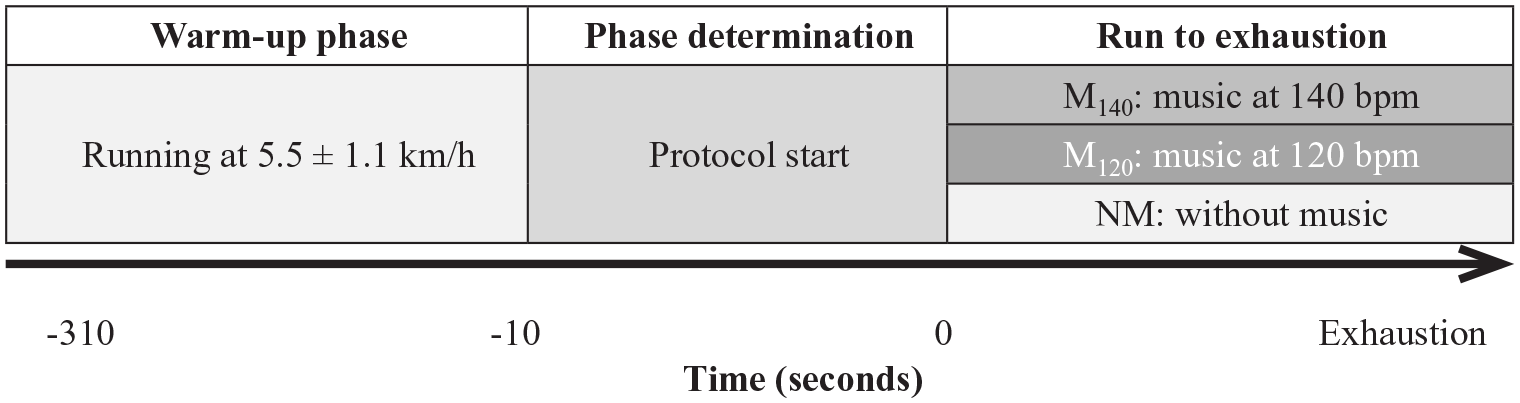
Outline of the experimental design in time and conditions.
Duration and intensity of the exercise in different conditions in male and females (values are mean ± SD).
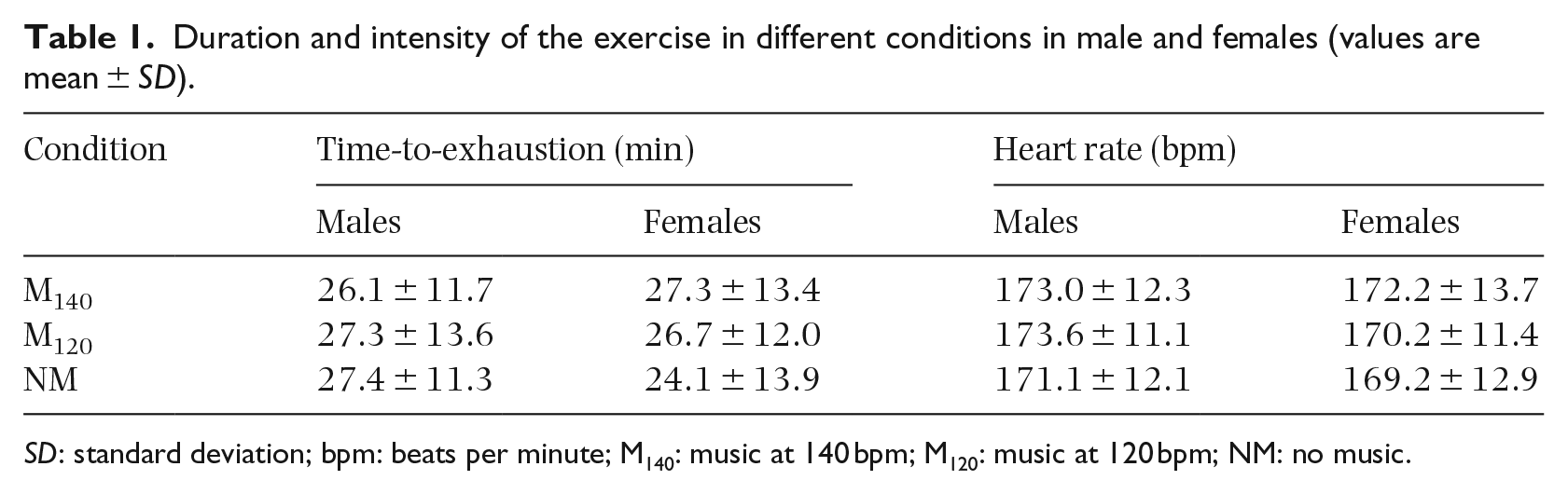
SD: standard deviation; bpm: beats per minute; M140: music at 140 bpm; M120: music at 120 bpm; NM: no music.
Exercise sessions were performed at a mean ambient temperature of 27.8°C ± 1.6°C and a mean relative humidity of 50.5% ± 4.4%. Hydration status was assessed before each session by requiring participants to bring a urine sample to determine the urine specific gravity (USG) with a Master-Sur/Na model Atago analyzer (Tokyo, Japan). Participants arriving in state of hypohydration were given water until they reached a state of euhydration.
Music selection
For this study, a compilation was made of 50 songs of the “electro house” subgenre reaching 130 bpm. This type of music was selected because it is one of the most listened musical genres in fitness centers that most impacts physical performance (Kreutz, Schorer, Sojke, Neugebauer, & Bullack, 2018; Van Dyck, 2019). The 130 bpm tempo was selected because it is an intermediate for both experimental conditions; in addition, when the tempo of the piece is increased to 140 bpm or decreased to 120 bpm, the subjects do not distinguish the subtle change throughout the conditions. For example, if a 110 bpm track is modified to 140 bpm, the change will be very noticeable between sessions. However, an increase or decrease of 10 bpm goes unnoticed among participants during music conditions. As depicted in Figure 2, each of the three recorded songs has a tempo of approximately 130 bpm (± 0.6 bpm). This figure shows that the songs have a digital adjustment of the tempo; that is, during the session, the songs had a same effect on the participant because the tempo is held constant. There was no moment in the session when the participant was exercising with a different tempo than the one corresponding to it. This is something different to the volume of music, because no matter how much a person wants to keep a piece of music at a certain volume level, there will be times when the person will hear the music more or less louder (Figure 2).

Variability in the tempo of three original songs (130 bpm) with the best Brunel Music Rating Inventory score according to the average tempo of each song.
All participants listened to the 50 songs and answered the The Brunel Music Rating Inventory (Karageorghis, Priest, Terry, Chatzisarantis, & Lane, 2006) to determine whether the song was motivating during exercise. This procedure allowed us to select the 20 songs with the best score (5.1 ± 0.6 arbitrary units). The tempo of each musical piece was estimated and modified by a specialized Virtual DJ PRO software (Atomix Productions America Inc., FL, USA), making an adjustment in the key effect so that when increasing or decreasing the piece’s speed, the sound would not be distorted.
A Sony speaker, model GTK-XB60 (Tokyo, Japan) was used for the M140 and M120 experimental conditions. The participant selected the music volume that was considered most comfortable (mean = 83.2 ± 6.1 dB). Although audiometry assessments were not conducted in this study, a specific intensity was not standardized due to the hypothesis that each person presents a degree of hearing loss or tinnitus (Sliwinska-Kowalska & Davis, 2012). The measurement of sound intensity was made by a Mastech sound level meter, model MS6700 (Victoria Harbor, Hong Kong), placing it at the same height and distance where the participant’s head was located.
Statistical analysis
The statistical analysis was performed with IBM SPSS Statistics for Windows, Version 23.0 (Armonk, NY). Descriptive statistics (M ± SD) were calculated for the variables age, height, weight, body fat (%), muscle mass, HRmax, and VO2max. An independent-samples Friedman’s test between men and women was used to compare the mean music intensity. Repeated-measures Friedman’s analysis of variance (ANOVA) were computed for USG, ambient temperature, and relative humidity variables. Mixed two-way ANOVA (Sex × Experimental conditions) were computed for the dependent variables HR, RPE, and DR. Statistical significance was set a priori at p ⩽ .05.
Results
During the three study sessions, the participants exercised at the same ambient temperature (p = .418), relative humidity (p = .078), and with similar USG (p = .695). Independent-samples Friedman’s test showed that men prefer to listen to music at a louder volume than women during a high-intensity aerobic test (86.2 ± 5.0 dB vs. 80.1 ± 5.7 dB, p = .029, η2 = 0.262).
The ANOVA test did not find a significant interaction between sex and experimental conditions on HR (p = .321). Men exercised at similar HR than women (172.5 ± 11.5 vs. 170.5 ± 12.3 bpm, p = .712) and HR were higher under M140 (172.6 ± 12.7 bpm), and M120 (171.9 ± 11.1 bpm) than during NM (170.1 ± 12.2 bpm; p=.038).
The Bonferroni-corrected post hoc test only showed a difference between experimental conditions M140 and NM (p = .044; η2 = 0.32, Figure 3). Listening to fast music (M140) during exercise increased HR compared to not listening to music at all.
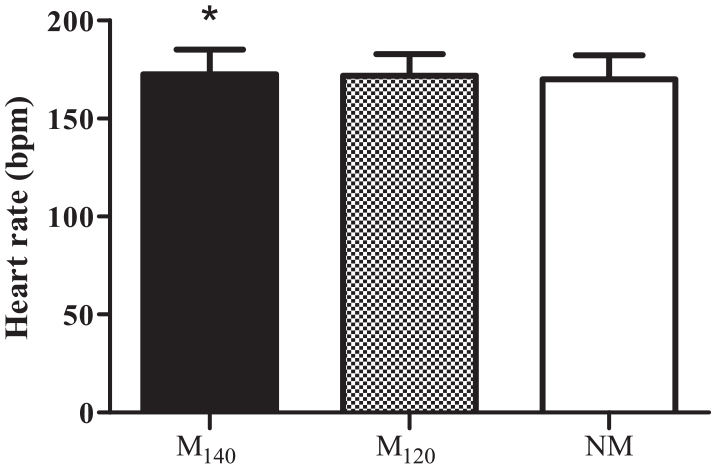
Comparison of heart rate between conditions (*M140 > NM; p = .044; η2 = 0.32).
The ANOVA test did not reveal a significant interaction between sex and experimental conditions on RPE (p = .931). Men showed similar RPE mean scores than women (7.5 ± 1.4 vs. 7.6 ± 1.1 arbitrary units, p = .846) regardless of the experimental conditions (M140 = 7.5 ± 1.4, M120 = 7.6 ± 1.3, NM = 7.6 ± 1.2 arbitrary units, p = .899).
The ANOVA test did not show a significant interaction between sex and experimental conditions on DR (p = .715). Men ran a similar distance as women (5,193.7 ± 3,273.6 vs. 4,171.2 ± 1,863.4 m, p = .405) regardless of the experimental conditions (M140 = 4,791.4 ± 2,681.1, M120 = 4,900.0 ± 2,916.9, NM = 4,356.1 ± 2,571.2 m; p = .056).
Discussion
The main finding of this study was that fast-tempo music affects the HR during treadmill running; exercising listening to fast music increased HR compared to exercising without listening to music. In a previous study (Amador-Guerrero, Aguirre-Fajardo, & Aburto-Corona, 2017), the researchers reported that exercising listening to loud music (95 dB) did not improve physical performance; however, HR increased compared to a control condition of NM. It is hypothesized that listening to loud music elicits a hypothalamic activation as a response of the nervous system, thus increasing the HR (Amador-Guerrero et al., 2017; Beach & Nie, 2014). On the present study, the participants ran in the treadmill listening to music at 83.2 ± 6.1 dB, which is considered as a high volume but which does not exceed the noise limits recommended by the United States Department of Labor, Occupational Safety and Health Administration (1983).
Van Dyck et al. (2017) studied the effect of the musical tempo on the HR response. Thirty-two participants’ resting HR were measured, with music and NM, using different musical tempi. Listening to music increased HR and slow music decreased it; however, this reduction never occurred below the baseline HR measurement. Based on these findings, the authors concluded that music produces different responses in selected brain regions and hypothesized that the magnitude of the response varies depending on the degree of motivation that each musical piece elicits.
Hsiao, Liu, Lin, and Lee (2016) determined whether fast or slow tempo affected HR recovery following moderate intensity exercise. Thus, following exercise, participants listened to slow-tempo (<100 bpm) and fast-tempo (>155 bpm) music, and it was found that fast tempo reduced the HR recovery in people with good fitness. Based on the findings, the researchers suggested low tempo music on people with low fitness and a fast tempo on fit people to improve HR recovery following exertion.
In this study, no significant differences were found between experimental conditions on RPE. This means that musical tempo does not affect the way people perceive exertion when listening to music while exercising. However, differences were found in the study by Aweau, Redus, and Cone (2015; p = .029). In that study, the researchers recruited 14 subjects to determine if motivational music decreased the RPE during an aerobic test of 2.4 km. However, the study showed significant drawbacks; for instance, researchers did not report the exercise intensity, music volume, or performance time. All these variables are considered important factors affecting RPE changes.
According to Gabana, Van Raalte, Hutchinson, Brewer, and Petitpas (2015), the RPE is reduced during prolonged aerobic tests (>30 min). In addition, music loses the ergogenic effect in the RPE when high-intensity exercise is performed (90%–100% HRmax; Ellis & Salmoni, 2019). Yamashita, Iwai, Akimoto, Sugawara, and Kono (2006) support this hypothesis and suggest that music causes a distracting effect only during low-intensity exercise. When jogging or walking at a low-intensity listening to favorite music, the RPE is decreased, increasing comfort of performing prolonged exercise. There is evidence supporting this hypothesis, with significant changes on RPE during exercise with intensity <70% of VO2max and when not performed at >75% of VO2max (Nethery, 2002).
In this study, no differences were found on DR. Others have reported similar results. For instance, Thakare, Mehrotra, and Singh (2017) studied 50 participants (25 men and 25 women), who ran on a treadmill selecting their own preferred speed. The test finished once participants decided to do so or because of fatigue or shortness of breath. The researchers found that participants exercised longer when listening to music (37.1 ± 16.3 min) than when they did not (22.5 ± 10.3 min). In addition, men ran longer when listening to music (42.4 ± 16.5 min) than women (31.8 ± 15.5 min). The results of the present study showed the same trend; participants ran a longer distance while listening to music (4,846 ± 2,799 m) compared to NM (4,356 ± 2,571 m). In addition, men ran longer distances (5,194 ± 3,274 m) than women (4,171 ± 1,863 m), yet, these figures were not statistically different. However, 60% of the participants perceived they had achieved a longer distance in the M140 condition, 35% in M120 condition, and 5% in the NM condition.
The majority of studies reporting significant differences on RPE have used the 15-point Borg’s (1982) scale when exercising longer than 30 min (Gabana et al., 2015). In this study, we used Borg’s 10-point scale for a mean exercise duration of 26 min.
A strength of the present study was that ambient temperature, relative humidity, and USG remained similar during the trials, which means that participants performed exercise under the same environmental and hydration conditions throughout the study. A minimal variation can generate an increase or decrease in the DR, RPE, or HR response (variables are not usually taken into account in these studies), which might contaminate the results. Another strength of the present study is that the sound intensity was personalized for each participant. In other studies, researchers standardized volume for the research protocol without considering that each person has a different sound perception and preference (Aburto-Corona & Aragón-Vargas, 2017; Amador-Guerrero et al., 2017; Bood, Nijssen, van der Kamp, & Roerdink, 2013).
A limitation of the study was the lack of audiometric tests to determine hearing integrity. Yet, this limitation was overcome by using a repeated-measures design where participants selected the volume in which they had total listening comfort. Another potential weakness of the present study could be the sample size; however, evidence with a similar research design has used samples from 12 to 25 subjects, which makes our study comparable to previous literature (Lee & Kimmerly, 2016; Lopes-Silva, Lima-Silva, Bertuzzi, & Silva-Cavalcantea, 2015; Ramji, Aasa, Paulin, & Madison, 2016; Sanchez, Moss, Twist, & Karageorghis, 2014). We acknowledge that we might have sacrificed internal validity; however, to reduce this limitation, we used a repeated-measures design, which has been shown to require fewer participants than a between-subject or independent group design, and participants were randomly assigned to the experimental conditions (Hyllegard, Mood, & Morrow, 1996).
Future research might consider using free running rather than treadmill running. Under this condition, the step frequency and stride amplitude can be analyzed during the experimental music tempo conditions. Nonetheless, environmental conditions at least must be recorded since heat stress will impact physical performance. A series of neurophysiological variables might also help to understand the effects of musical tempo on physical performance. For instance, hedonic responses to music are recently hypothesized to result from the interaction between structures involved in auditory perception and the dopaminergic reward system in the brain (Belfi & Loui, 2019). Cardiovascular parameters might also be studied; for instance, it may be relevant to determine the activity of the autonomic nervous system based on the HR variability. This variable has been related to overtraining and cardiovascular recovery. Therefore, it is necessary to design experimental studies and include HR variability as a dependent variable and to determine whether participation in different music conditions, or in their absence, relates to HR variability.
Finally, it is important to compare the musical preferences during exercise between sedentary, physically active, and athletic populations. In this way, a more generalized conclusion can be made for the different populations. The findings of the present study suggest that the use of music can have effects on physical (i.e., distance traveled) and psychophysiological (i.e., RPE, HR) variables, although the results were only significant in HR between M140 and NM during exercise to fatigue. The distance traveled showed that, although it was not significant, there was a trend to achieve a longer distance in the two groups that listened to music compared to the group that did not. This suggests that accompanying the session with moderate- or fast-tempo music allows its users to exercise longer than a condition NM. In conclusion, fast tempo produces an increase in HR during exercise, and while no other discernible effects were observed in this study, further research could examine other physiologic variables.
Footnotes
Declaration of conflicting interests
The author(s) declared no potential conflicts of interest with respect to the research, authorship, and/or publication of this article.
Funding
The author(s) received no financial support for the research, authorship, and/or publication of this article.
