




Abstract
This quasi-experimental study investigated the transfer of learning for effective practice strategies from large ensemble to individual rehearsal. Five middle school bands were randomly assigned to one of three conditions. Two treatment conditions had teachers use an iterative, explicit instruction protocol to teach a targeted practice strategy during a sight-reading activity on a novel piece of music over a series of six lessons. The control condition included non-specific sight-reading activities. A sample of students from each band (N=66) participated in a cycle of pre-test/post-test/delay-test observations that involved a ten- minute practice session followed by a performance on a new piece of music similar to those used in the treatment sessions. Student practice sessions were analyzed for frequency of usage of the targeted strategies, and performances were rated for pitch and rhythmic accuracy. A 3x2x3 ANOVA identified a significant effect for strategy used within groups (F(1,63)=122.388, p<.001, η2=.660), but no significant effect or interactions were found between groups. The results of a 3x3 ANOVA identified a moderate-sized main effect for test cycle on performance scores (F(2,63)=2.192, p<.001, η2=.414), leading to a series of repeated measures t-tests that demonstrated significant changes in performance scores from pre- to post-test in both treatment conditions
Keywords
Effective music practice
Effective practice is a critical skill for the development of musical mastery. While school musicians typically receive instruction in teacher-directed group settings, they develop their skills through individual practice without direct monitoring. Skills for deliberate practice must be learned through instruction that “includes activities that have been specially designed to improve the current level of performance” (Lehmann & Ericsson, 1997, p. 368). While practice time is important for developing expertise (Ericsson et al, 1993; Jørgensen, 2002), the quality of that time is of equal or greater importance (Bonneville-Roussy & Bouffard, 2015; Duke et al, 2009). Practice method is a primary dimension of self-regulation, defined as “the ‘how’ of practicing and performing music” including the “task-specific strategies that musicians use to enhance their own musical abilities” (McPherson, Nielsen, & Renwick, 2013, p. 361). Mastery of practice strategies is critical for independent musicianship.Studies of advanced musicians describe highly systematic, intentional, and varied approaches to practice. Expert musicians practice in phases, emphasizing large sections initially and becoming more detailed as practice progresses with attention to strategic planning, analysis, and versatility (Chaffin, Imreh, Lemieux, & Chen, 2003; Hallam, 1995; Nielsen, 1999). With greater expertise, musicians demonstrate greater command of strategies and create increasingly personalized approaches to practice driven by intrinsic motivation (Araújo, 2016).
Compared to their more experienced counterparts, musicians with less experience typically lack responsiveness and mastery in their practice approaches. They display a limited range of strategies, less versatile approaches, and fewer self-regulatory behaviors (Barry, 1991; Hallam, 2001a). Specifically, middle school students use a limited number of both effective and ineffective strategies and are hindered by poor diagnosis, prioritization, and intentionality (McPherson & Renwick, 2001; Miksza, Prichard, & Sorbo, 2012). Still, some beginning musicians are capable of highly sophisticated practice approaches (Austin & Berg, 2006; Pike, 2017). Rohwer and Polk (2006) grouped developing musicians into two general categories: holistic practicers, who have their individual practice dominated by run-throughs of sections, and analytical practicers, who are more focused on specific details and strategies during practice. While most musicians start as holistic practicers, more successful musicians intermittently use the skills of analytical and holistic practicers that allow for greater focus and more effective practice. Several scholars (Duke, 2012; Hallam, 2001b; Miksza, 2007; Nielsen, 2001) have suggested that teachers should instruct their students in effective practice strategies to facilitate the transfer of learning from large ensemble instruction to individual practice, but research into transfer of musical learning has been limited.
Transfer of learning
Outside of music education, transfer of learning has been extensively discussed in educational and psychological scholarship and is defined as the “use of past learning when learning something new and the application of that learning to both similar and new situations” (Haskell, 2001, p. xiii). It exists on a taxonomic continuum from non-specific close transfer to highly creative or analytical far transfer and requires a “transforming” of old knowledge and skills to new contexts, as opposed to direct “exporting” of old learning to new settings (Larsen-Freeman, 2013, p. 108). This model for near transfer emphasizes the “flexible use of knowledge and skills” in new learning contexts (Butterfield & Nelson, 1989, p. 5). A key component for effective near transfer, termed the common elements theory, is that the new context for learning must share recognizable elements with the older learning context (Butterfield & Nelson, 1989; Thorndike & Woodworth, 1901). In order for near transfer to occur, students must develop mastery of skills or concepts in the original context and recognize the association between new and old situations (Hunter, 1971).
The teacher’s role in promoting transfer of learning is creating an educable environment through highly scaffolded, explicit instruction (Butterfield & Nelson, 1989). Transfer “does not always occur automatically, or efficiently. Significant and efficient transfer predictably occurs only if we teach to achieve it” (Hunter, 1971, p. 2). Teachers provide explicit instruction followed by modeling and coaching, teach using iterative processes, and call attention to similarities between old and new learning (Larsen-Freeman, 2013, pp. 120–122).
Within music education, Colwell (2011) suggested using explicit, systematic instruction within ensembles to facilitate transfer of musical learning. He suggested an instructional sequence including daily review, direct instruction of new material, guided student practice, teacher feedback, independent practice or homework, and teacher-led review. As described, his instructional approach to transfer of musical learning places the teacher at the center of the classroom while explicitly presenting and modeling skills and encouraging student engagement.
Colwell (2011), along with Tunks (1992) and Forrester (2018), noted that music education research regarding transfer of learning has been limited. Still, some music education researchers have utilized near transfer paradigms and found that direct instruction can affect the transfer of requisite strategies to individual musical practice. Miksza (2015) applied a near transfer paradigm using video instruction to college students, finding that students used presented strategies more effectively with greater nuance than they did during the pre-test. Barry (1992) found that intermediate students who were taught structured rehearsal approaches exhibited stronger applications of effective practice strategies and improved performances compared to students who lacked a model. Mieder and Bugos (2017) found that while high school students did not change the individual practice strategies they used as a result of explicit teaching, they demonstrated greater self-efficacy in their use of those strategies. While these studies suggested that instruction can affect individual practice, specific studies of transfer from large ensembles to individual practice have not been conducted.
The purpose of this study is to identify whether conditions that are ideal for transfer of learning facilitate the transfer of effective strategies from large ensemble instruction to individual practice. Most beginning wind instrumentalists receive their music instruction in large groups, where strategies are used but, typically, are not taught explicitly. A clear identification of how to transfer effective strategy instruction from large ensemble to individual rehearsal through intentional group instruction could promote more effective practice. This study is guided by the following questions:
What effect does explicit, iterative instruction of effective practice strategies in middle school large ensembles have on the transfer of those strategies into students’ individual practice?
How does explicit, iterative instruction of effective practice strategies impact students’ performance?
For this study, greater transfer is operationalized as an increased frequency of usage of the targeted strategies during individual practice. The null hypothesis is that there will be no significant change in frequency of strategy usage across tests between treatment groups and, similarly, there will be no significant difference in performance accuracy across tests between treatment groups.
Method
Sample
Participants in this study included students in five suburban middle school bands near a major Midwestern city. The bands were selected through convenience sampling, as their teachers accepted participation in response to an e-mail sent to all middle schools in the region requesting participants for a study focused on teaching effective practice. The band descriptions given by the teachers suggested that the ensembles were qualitatively similar to one another in socio-economic status (middle income), student musical experience (2–4 years of school instruction), and ensemble size (40–60 students).
While all students in all bands received instruction using either experimental or control conditions, only a portion of each band’s members participated in the tests, representing between 20% and 25% of each band’s overall membership. Study participants included all students in each band who volunteered for the study and completed all three tests (N = 66). Two additional students (one from each treatment group) were removed from the study due to repeated school absences during its duration. Each experimental group included students in sixth, seventh, and eighth grades with between 1 and 5 years of study on their current wind instruments (M = 2.67 years, SD = 1.13 years). The groups showed no statistically significant differences in years of experience.
Design
This study used a mixed analysis of variance (ANOVA) design (Field, 2014). Each band was randomly assigned to one of three conditions. Two bands used an explicit instructional protocol for chaining (n = 23), two bands used a similar protocol for tempo alteration (n = 23), and one band did a control task involving group sight-reading (n = 20). All students in all bands received the treatment as part of their regular band class.
The participants were tested during three individual practice sessions: a pre-test before the treatment lessons, a post-test following the treatment lessons, and a delay-test 3 weeks after the post-test (o1 × o2 o3). The purpose of the delay-test was to assess retention of observed changes between the pre-test and post-test. The dependent variables included strategy usage (defined by the presence of identified strategies during practice) and musical performance (defined by pitch and rhythm accuracy).
The entire study was approved with expedited status by the Northwestern University’s Institutional Review Board (IRB).
Procedure
Instructional protocol
All treatment bands were taught by their teachers using an explicit, iterative instructional protocol for six lessons over 2 weeks. Each lesson included four steps: explicit naming of the strategy, explicit definition and description of the strategy, teacher modeling of the strategy, and guided practice with the strategy on music written for this study. The first lesson lasted 10 min and the remaining five lessons lasted 5 min with new music used for each lesson. Instead of the treatment, the control ensemble sight-read with teacher direction during six rehearsals using the same music and timeframe as the treatment groups without any explicit instruction of practice strategies. Each band used the six pieces in randomized order.
The researcher met with each teacher prior to their first lesson to provide a written copy of their instructional protocol and model its application. The teachers then delivered mock lessons to the researcher to show their comprehension of the protocol. Treatment teachers were told that they should only explicitly teach or name the targeted strategies during their treatment lessons but could conduct the remainder of their rehearsals using their typical rehearsal practices, including implicit use of target strategies. For the control group, the teacher did not explicitly teach or name any practice strategies for the duration of the study but otherwise used his regular sight-reading and rehearsal practices. The control teacher was not aware of any details of the treatment protocol. Prior to the study, all teachers had used the targeted strategies along with other effective strategies within their rehearsals, allowing for implicit strategy learning, but they had not explicitly taught the targeted practice strategies.
The targeted strategies were operationally defined as follows:
Chaining: When chaining, musicians break down difficult sections of music into smaller, manageable chunks. Chunks are as small as needed for the musician to be able to perform with accuracy, potentially being as short as a single note to as long as a phrase. Typically, once a chunk has been worked on, the musician “chains” the chunk to another chunk either immediately before or immediately after it.
Tempo alteration: Tempo alteration refers to the practice of slowing down a difficult section of music to allow for more detailed practice. Typically, after the section can be played accurately at the slower tempo, the tempo is increased.
These specific strategies were selected following a pilot study with a similar methodology using eight strategies identified in previous research (Austin & Berg, 2006; Hallam, 2001a; Leon-Guerrero, 2008; Miksza, 2007; Miksza et al., 2012; Rohwer & Polk, 2006). In that study, students experienced the greatest change in strategy usage for chaining and tempo alteration, leading to their selection as this study’s target strategies.
Participant protocol
Parental consent, student assent, and a demographic survey were completed prior to the pre-test. The survey asked for the student’s grade, instruments played, number of years on their current instrument, and private lesson enrollment.
Each participant completed a pre-test, a post-test, and a delay-test. While facilities varied between bands, each student returned to the same practice room for all three tests and were video-recorded using the same camera (either a Panasonic SDR-H18 or Panasonic DMC-ZS6) positioned to the student’s side.
Each test included an individual practice session on a new piece of music and a performance of that piece. In each session, after reading a brief script, the researcher left the room to allow the student to practice individually for 10 min. The researcher returned after 10 min and remained in the room for the student’s performance of the piece.
Within a month of the completion of the study, students and their parents were invited to a debriefing session at each school to share preliminary analysis of the study and answer their questions regarding effective practice.
Quasi-experimental conditions were controlled through randomization of the ensemble treatment conditions, standardization of the instructional and experimental protocols, and randomized assignment of the music performed. The individual practice sessions occurred during the participants’ band rehearsals to avoid bias in student participation due to scheduling issues.
Materials
The researcher composed nine pieces for this study, with strict parameters to ensure similarity regarding difficulty and content. Compositional criteria for the test materials included eight-measure durations, matched ranges, less common band key signatures, 16th-note runs, dotted-eighth rhythms, and similar melodic/rhythmic sequences. All nine pieces were tested for parallel form reliability using expert evaluation and correlational testing.
First, a panel of seven experienced band directors was given the pieces and asked to independently rank them in order of difficulty. They provided no consistent rating of the pieces, with an average standard deviation of each piece’s ranking by 2.16 on a 9-point ranking scale. Through panel discussion, qualitative feedback indicated that they considered the pieces broadly equivalent, particularly when two outlier pieces were removed from consideration.
To ensure parallel form, the nine pieces were performed in random order by 15 musicians at a local high school. The performances were scored by three music educators, and the pieces with the most similar average scores were assigned as the three test pieces (see Figure 1), with a high degree of score correlation across scorers (r = .92–.96). In the tests, the pieces were presented in randomized order with a third of the students receiving each piece in each test cycle to mitigate the impact that differences between the pieces could have on statistical measures. The remaining pieces were used as the music for the instructional treatments in randomized order.
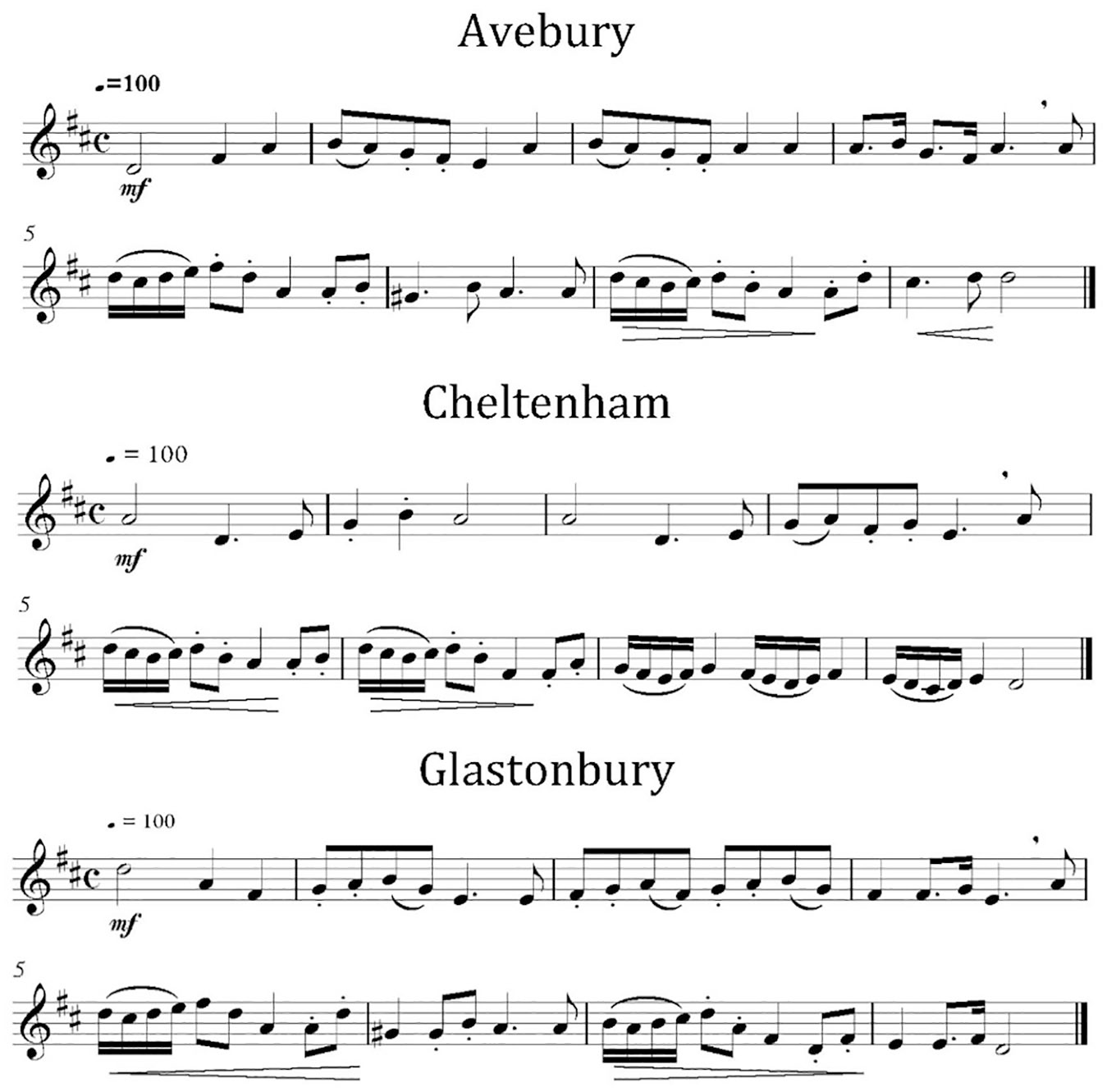
Test pieces for individual practice sessions and performances.
Analysis
Each 10-min practice video was divided into twenty, 30-s segments. For each segment, raters identified the presence or absence of each of seven practice strategies associated with developing musicians’ individual practice (Austin & Berg, 2006; Hallam, 2001a; Leon-Guerrero, 2008; Miksza, 2007; Miksza et al., 2012; Rohwer & Polk, 2006). A strategy was marked as present if it began, continued, or ended within a given segment. The list of practice strategies included the two target strategies and five non-targeted strategies, so that raters would remain blind to the targeted strategies to avoid biased identification. Strategy identification was based on the following definitions:
Chaining: previously defined.
Distraction playing: Distraction practice refers to the playing of musical material not related to the target materials. Practice of scales or rhythms that relate to the target materials is not distraction playing. Similarly, using scales/arpeggiations to find pitches does not count as distraction playing. This approach is typically considered ineffective practice.
Fingering/Sliding: This form of silent practice includes the manipulation of the instrument without actual sound production. When students finger or slide through the music, they may blow air, sing, or tongue, but they should not produce tone through the instrument.
Run-through: A run-through is a playing of the piece from beginning to end at the best of the student’s ability without excessive repetition or the use of an additional strategy. Starts and stops are allowed for small corrective repetition.
Silent study: When doing silent study, a student reviews the sheet music without playing for a minimum of 10 s continuously (which can be spread over two practice frames). The student may make markings, talk to themselves about their intended approach to practice, or sing/hum. Non-playing behavior that does not involve studying the sheet music does not count as silent study.
Simplification: Simplification is practicing with only pitch or rhythm in isolation from the other. Typically, once a student accurately performs the isolated element, the other is added back in to ensure that it can be performed in context, but reincorporation is not required for identification.
Tempo alteration: previously defined.
A panel of five music educators rated the practice videos. Each rater viewed all three videos of 17 or 18 of the 66 students. The order of each student’s videos was randomized so that the raters could not identify where the video fell in the test sequence. Every set of three recordings was viewed by one rater and 15 students’ recording sets (for a total of 45 videos) were viewed by two raters to establish interrater reliability. Each rater overlapped with another rater on two students’ recording sets per treatment condition. These shared videos represented 22.7% of the recordings collected and included 900 practice segments with seven identifications each for a total of 6,300 possible agreements. Reliability was calculated as a percentage of agreements over possible agreements. Interrater agreement was acceptable with 89.4% agreement of identification of strategies in video segments.
The performance videos were scored for pitch and rhythm accuracy by two band directors who did not score the practice videos. In each performance, each half measure received one point for correct pitch and one point for correct rhythm, giving each eight-measure performance a score between 0 and 32. Each scorer viewed all three performance videos from 41 students in randomized order. Recordings overlapped between scorers for 15 students’ performances, totaling 45 recordings (22.7% of all videos). With 32 possible identifications per performance and a total of 1,440 possible agreements, interrater agreement was acceptable with 88.9% agreement on identification of errors and a high correlation of total performance scores between the two scorers (r = .939).
Results
Strategy usage
Results from a one-way ANOVA of pre-test usage of chaining, F(1, 63) = 0.282, p = .755, and tempo alteration, F(1, 63) = 0.909, p = .408, showed no significant differences between the treatment groups for either strategy. In addition, there were no significant changes in the number of all observed strategies across tests or between groups. Subsequent analyses assumed no significant differences between these groups prior to the experimental treatment or in their overall strategy usage.
Chaining was the most frequently used of the strategies across all tests and across all groups (M = 6.616, SD = 4.88). Overall, tempo alteration was found to be used less than once per practice session (M = .848, SD = 1.34). Usage frequencies from individual tests of the target strategies are shown in Table 1. Outside of the target strategies, run-throughs (M = 3.452, SD = 3.45) and silent study (M = 2.541, SD = 2.77) were the only non-targeted strategies observed on average in more than one rehearsal segment per session in any test with no significant differences between cycles or groups.
Mean scores of strategy frequency and performance by test and condition.
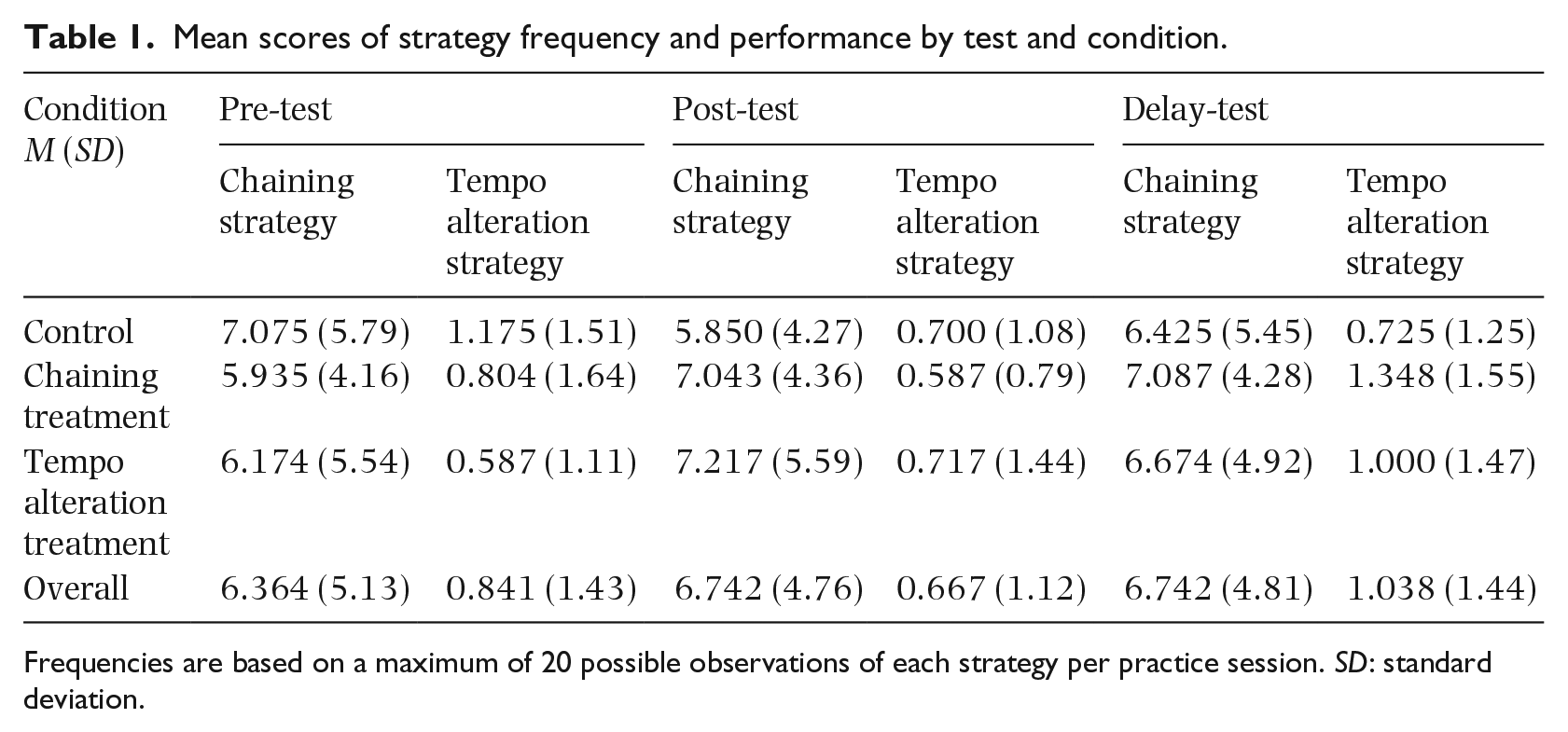
Frequencies are based on a maximum of 20 possible observations of each strategy per practice session. SD: standard deviation.
The first research question considered whether an explicit and iterative instructional treatment for teaching practice strategies impacts the frequency of strategy usage during individual practice. Data were analyzed using a mixed 3 × 2 × 3 ANOVA with test and strategy as the within-subject variables and instructional condition as the between-subject variable. There was a large, main effect for the strategies used within groups, F(1, 63) = 122.388, p < .001, η2 = .660. This effect can be attributed to the previously cited differences in the use of chaining and tempo alteration seen across all conditions throughout the test cycle. Repeated-measures t tests showed that individual students’ usage of the target strategies did not significantly change between subsequent tests in any condition. There were no significant differences between treatment conditions or tests or any significant interaction between any of the experimental variables regarding strategy usage.
Performance scores
The second research question considered whether the instructional treatment affected student performances as measured by pitch and rhythm accuracy, with mean scores for each test and condition shown in Table 2. Results of a one-way ANOVA of the pre-test scores between conditions demonstrated a significant difference in performance scores between groups, F(2, 63) = 7.914, p < .001. Post hoc, independent t tests showed that participants in the chaining condition had significantly higher initial scores than the control group, t = 2.754, p = .009, and the tempo alteration group, t = 4.667, p < .001.
Mean scores of performance by test and condition.
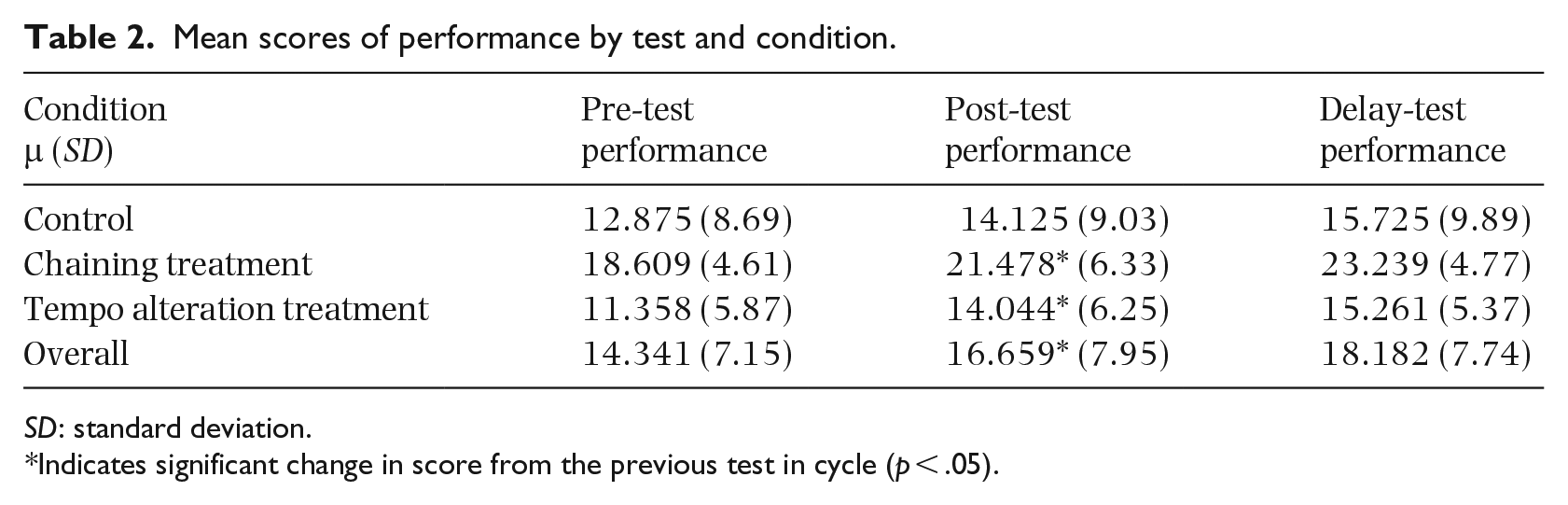
SD: standard deviation.
Indicates significant change in score from the previous test in cycle (p < .05).
Results of a 3 × 3 ANOVA, with test cycle as the within-subjects factor and treatment condition as the between-subjects factor, showed a moderate-sized main effect for test across groups, F(2, 63) = 2.192, p < .001, η2 = .414. Post hoc, repeated-measures t test analysis by condition revealed that this effect was not evenly distributed across all conditions and tests. Significant changes in performance scores occurred only between the pre- and post-tests in the tempo alteration, t = 2.36, p = .028, and chaining groups, t = 3.76, p < .001. No significant differences were observed between the pre- and post-tests in the control group or in any condition between the post- and delay-tests.
Since there was a marked difference in raw scores and a significant difference was seen in the individual t tests of the treatment performance scores, a mixed 2 × 3 ANOVA was conducted, with the change in performance scores between tests as the within-subjects factor and treatment condition as the between-subjects factor. This ANOVA revealed no significant interaction between change in scores and condition when considering all three conditions across all tests, F(2, 63) = 0.543, p = .464, despite the significant positive change in performance scores from pre-test to post-test in the two treatment conditions when considered individually.
Confounding variables
Student demographics of years on an instrument or tuition in private lessons had little effect on scores for strategy usage or performance. The number of years students played their instruments correlated with differences in chaining from pre- to post-test (r = .274) but did not correlate significantly with any other variable or condition, allowing this result to be considered spurious. Similarly, post hoc independent t tests of students with or without private lessons showed no significant differences in strategy usage or performance outcomes between any test sequences.
Discussion
This quasi-experimental study served as a critical test of near transfer of learning of effective practice from explicit group instruction to individual practice. Its treatment matched the conditions traditionally associated with near transfer including repeated direct instruction, guided practice, and modeling using highly similar materials (Butterfield & Nelson, 1989; Haskell, 2001; Hunter, 1971; Thorndike & Woodworth, 1901). The setting in which the knowledge was used was the primary difference requiring transfer. Changes to the conditions of where or how transferred skills are applied are a common characteristic of near transfer paradigms. The participants of this study experienced no significant change in the frequency of strategy usage as a result of this treatment but did show a significant change in performance. Specifically, the two treatment groups had significantly improved performance from pre-test to post-test which persisted through the delay-test 3 weeks later. This significant change in performance, not seen in the control group, suggests that the treatment altered the students’ strategic approaches during their 10-min practice sessions. This change in performance supports the suggestions made by Duke (2012), Hallam (2001b), Miksza (2007), and Nielsen (2001) regarding the potential positive impact of explicit instruction on effective practice.
Numerous researchers (Hallam, 2001a; Hallam et al., 2012; Miksza et al., 2012; Rohwer & Polk, 2006) have noted that less experienced musicians practiced with limited awareness of their effectiveness, but that some students demonstrated a high degree of metacognitive awareness which led to effective strategy usage. Similar to the participants in Miksza (2015) who showed changes in effective use of self-regulation strategies without changes in usage frequency, it is possible that students in this study came to use chaining and tempo alteration more effectively, but not more frequently. This change in effectiveness could imply that students developed greater awareness of their strategy usage. Transfer of learning for effective practice may be different from traditional, near transfer models of learning which focus on transfer as the application of learning to new settings, as opposed to increased effectiveness in the application of that learning.
The foundational studies on transfer (Thorndike & Woodworth, 1901) and its most commonly used taxonomy (Haskell, 2001) emphasized what Salomon and Perkins (1989) termed low-road transfer, which utilizes modeling and instructional reinforcement to promote transfer of learning to new settings. Notably, low-road transfer is largely automatic and requires little cognitive awareness. This low-road transfer model served as the instructional framework upon which this current study was designed. By contrast, Salomon and Perkins described high-road transfer, which requires sustained intentionality and “metacognitive guidance” to establish transfer of skills from instruction to complicated tasks (p. 126). The observed change in performance as a result of strategy instruction could suggest that students developed not only familiarity with practice strategies but also metacognitive skills for practice monitoring as a result of intentional, repeated instruction.
In studies from other high-skill disciplines like computer programming (Pea & Kurland, 1984) and visual art (M. Erickson, 2005), transfer from instruction to effective individual application went through multiple stages using high-road transfer. Initially, participants in these non-music studies were able to describe strategies and apply them when instructed, but they struggled to strategically use strategies without prompting. Music practice represents a similarly complex network of skills, including goal-setting, performance evaluation, and decisions for strategic action (Roesler, 2016). Tunks (1992) suggested that the transfer of strategies for music learning relies on these complex skill networks and requires conscious awareness of the learner. Christensen (2010) noticed the gradual development of awareness associated with high-road transfer in her study of middle school students’ practice approaches. Her participants could describe practice concepts during interviews but did not have the mastery to apply strategies effectively during individual practice without guidance.
Within this current study, the performance changes that were observed may be due to early stage development of greater metacognitive awareness through high-road transfer. Although this study did not include student reflection to provide insight into these metacognitive processes, it is possible that group instruction altered the students’ awareness of their effective use of the targeted strategies, leading to better performances. If this is the case, music educators should teach both the strategies needed for effective practice and the skills for monitoring effective strategy usage. Future research might be able to discriminate these stages of transfer by including a component for metacognitive measurement, similar to the ones used by Mieder and Bugos (2017) or Miksza (2015), accompanied by an extended period of study with multiple rounds of testing.
If this high-road transfer paradigm is a better fit for teaching effective practice, assessment of independent mastery of effective practice strategies becomes an important element of the instructional model. “Much of the failure to find transfer in the classroom and elsewhere is because the original material was not sufficiently practiced and thus mastered” (Haskell, 2001, p. 173). Brown, Collins, and Duguid (1989) suggested that instruction for cognitive mastery relies upon three phases of teacher engagement: modeling, coaching, and fading. As the current study only included teacher modeling and coaching, it is possible that students may not have independently mastered the strategy’s application prior to their practice sessions, which would be indicative of early stages of high-road transfer. This lack of complete mastery was reflected in comments made by two of the raters when returning their scores. They observed that while students used strategies according to the operational definitions, they did not always maximize their efficiency. For example, a student would use tempo alteration but return to full tempo before eliminating all errors. The students knew when and how to use the strategy, but still needed greater awareness of when it was appropriate to move forward. In view of this concern, teachers should ensure independent mastery of not only the strategy but also related skills for error detection, diagnosis, and correction before moving to unsupervised, independent practice.
For the sake of transparency, it is important to note that the target strategies were not completely new to many of the students. Anecdotally, during the debriefing following the study, three students commented that their target strategy had been previously introduced informally through usage during ensemble rehearsal, though they did not feel as though they had fully mastered it previously. Since the strategies of chaining and tempo alteration are commonly found in school band directors’ rehearsal practices (Duke, 1994; Worthy, 2006), some learning likely occurred through hundreds of implicit exposures during ensemble participation. The explicit instruction of the strategies refined what the students were already doing by intentionally modeling and coaching their use, making these strategies more effective. The lack of change in the frequency of strategy usage could be due to these strategies already being part of the students’ practice strategy toolbox, as suggested in studies of intermediate musicians (Miksza, 2007; Miksza et al., 2012; Rohwer & Polk, 2006). With this said, the treatment instruction advanced the effectiveness of individual practice, including the use of these strategies as evidenced in improved performance. Future studies could consider strategies with less incidental prior exposure to understand the impact of previous experiences with targeted strategies for effective practice.
Conclusion
The positive change in performance scores suggests that this explicit approach to ensemble rehearsal can improve the quality of individual practice. While the use of practice strategies in ensemble rehearsal allows for implicit learning, teachers should explicitly teach these strategies by defining them, modeling their effective use, and promoting their application in monitored and individual practice. Importantly, high-road transfer of learning occurs at a glacial pace, and teachers need to engage in explicit instruction over extended periods of time, allowing for the development by students of technical mastery with and conscious monitoring of strategies. Through explicit, iterative instruction, teachers should ensure that students not only use standard practice strategies; rather, they must also ensure that those strategies are used effectively during individual practice.
As most beginning and intermediate, non-keyboard instrumentalists experience their music education in an ensemble setting, it is critical that music educators prepare students for individual practice through intentional group instruction. This instruction needs to include introduction to and guided coaching with proper use and monitoring of effective practice strategies. Musical mastery is reliant upon the development of effective individual practice and self-assessment. Through careful attention by the teacher to explicit, iterative instruction coupled with student metacognition, the ensemble classroom can incubate the development of individual practice skills for students in their pursuit of independent musicianship.
Footnotes
Declaration of conflicting interests
The author(s) declared no potential conflicts of interest with respect to the research, authorship, and/or publication of this article.
Funding
The author(s) received no financial support for the research, authorship, and/or publication of this article.
