



Abstract
Peer group effects of relational victimization and empowerment among high school instrumental music students were examined using a cross-sectional design. We evaluated the homophily hypothesis that states peer group membership influences individual-level relational aggression and feelings of empowerment. Peer groups were identified using social network analysis, suggesting that participation in marching band significantly impacts feelings of empowerment reducing self-reported relational victimization, even after controlling for gender, caring behaviors, and positive attitudes toward bullying. The impact of peer group membership suggests that future studies consider peer relations across whole school populations and subtypes of aggression.
Numerous studies have documented peer victimization within music education settings (Elpus & Carter, 2016; Rawlings, 2016, 2017; Rawlings & Espelage, 2019; Silveira & Hudson, 2015), and significant advances in adolescent psychology research have been made to understand aggression, more specifically, relational aggression. The concept of relational aggression, also referred to as “indirect bullying” or “social aggression,” includes “behaviors that harm others through damage (or threat to damage) to relationships or feelings of acceptance, friendship, or group inclusion” (Crick et al., 1999, p. 77). Compared with physical aggression (e.g., kicking, hitting, punching) or verbal aggression (e.g., taunting, teasing), which often arises between two people, relational aggression involves manipulation of a social group (e.g., spreading rumors through peers, giving someone the “silent treatment,” or excluding someone from one’s own clique). Therefore, relational aggression by its nature originates in and is reinforced through social networks (Underwood, 2003). To clarify this phenomenon further, it is essential to understand this form of aggression associated with social power exchanges in music ensemble classrooms.
Similarly, researchers have shown that understanding youth empowerment in educational settings may be a promising protective factor preventing bullying, peer victimization, and psychopathology (Singh, Orpinas, & Horne, 2010). Youth empowerment is understood as a wellness construct that focuses on youth participation and youth having the ability to make decisions about some aspects of their learning (self-determination) and developing skill sets, attitudes, and competence (self-efficacy; Romanish, 1991). This study is the only investigation to directly identify and measure peer groups using social network analysis to assess peer-level network influence on youth empowerment and victimizing behavior in music education research.
Peer group influence
The power of groups can be astonishing, and within music ensembles, these groups prove to be important mechanisms for social support and growth (Abril, 2013; Adderley, Kennedy, & Berz, 2003; Morrison, 2001). Human development research emphasizes the strong role of peer groups in determining youth’s inclinations toward antisocial and prosocial behavior, and early adolescence is the developmental stage when youth spend a large proportion of time with peers (Brown & Larson, 2009; Steinberg & Monahan, 2007). Peer groups become more stable and friendships become more intimate during early adolescence (Steinberg, 2010), and qualitative research in music education documents the social strata inherent within secondary music ensembles, in which peer groups become increasingly stable and exclusive, with a clear social hierarchy (Abril, 2013; Adderley et al., 2003). As a result, friendship groups are an important manifestation of one’s social status and self-identity and “school [music] ensembles are not just classes or performing groups, but guardians of their own specific culture, a culture that informs and enriches the lives of their members” (Morrison, 2001, p. 24).
One of the most important processes contributing to establishing a friendship is the preference for friends who are similar to oneself. The term for this selective affiliation is understood as homophily (Kandel, 1978) and is one dimension of social structure (e.g., size, centrality, and stability are other characteristics of social networks). Undeniably, many studies have demonstrated strong within-group similarity on aggression (Espelage, Holt, & Henkel, 2003; Rawlings, 2017) and high centrality of aggressive peers within groups (Rodkin, Farmer, Pearl, & Van Acker, 2000). These authors provide further evidence highlighting the importance of specificity among forms of aggression, and this study aims to validate and extend this body of research by integrating social network analysis (SNA) and regression approaches to examine peer group influence on victimization and feelings of empowerment. SNA is a protocol for examining a group or an organization’s social structure through diagramming peer nominations of friendship. SNA is one way to understand a human within their social system.
Examining peer groups and their intragroup beliefs is an emerging research topic among music education researchers. Matthews and Kitsantas (2007) investigated whether collective efficacy, group cohesion, and perceived motivational climate in a music ensemble predict instrumentalist perceived teacher (conductor) support. Findings from this study of high school honor band students (N = 91) showed that instrumentalists who have a strong sense of collective efficacy and group cohesion are more likely to perceive their conductors as supportive. A mixed methods study conducted by Matthews (2017) also reported similar findings about group cohesion and collective efficacy with undergraduate students (N = 53). Furthermore, Matthews reported the familial aspect of the peer groups within the collegiate marching band that were based on their feelings of connectedness to one another. In light of the foregoing discussion, it seems clear that examining peer group influence on social behaviors and intragroup beliefs is an essential approach to adopt for this study.
Aggression and victimization research in music education
Peer victimization is a known concern for youth enrolled in music ensembles. Silveira and Hudson (2015) examined hazing incidents within college marching bands to uncover students’ experiences with and attitudes toward hazing behaviors. The participants (N = 1,233) were marching band members from Division I schools of the National Collegiate Athletic Association (NCCA) with a mean age of 19.7 (SD = 2.0) years. Prevalence rates of hazing behaviors among participants were relatively low, with the majority of participants indicating that they did not witness hazing behaviors within their bands (71.2%). However, among the most prevalence hazing behaviors self-reported, 5% of the participants “endure[d] being yelled, cursed, or sworn at” (p. 12). Similarly, prevalence rates of reporting hazing behaviors to teachers or school administration were relatively low (8%), with participants who observed hazing, and did not report it, citing rejection from their peers (or social retaliation) as reasons for not reporting. Given the similar physical and psychological effects caused by peer victimization and hazing (Acquaviva, 2008), while also acknowledging the peer group influence of behavior among college students, further explanation of how peer groups within high school music ensembles influence aggressive behaviors is needed.
In another study, Rawlings (2016) investigated middle school band students’ perceptions of bullying behavior. Youth participants (N = 291) reported experiencing peer victimization more frequently outside of the band classroom than inside the band classroom, with male youth reporting higher frequencies of physical victimization than females. He suggested that band students’ experiences with bullying behaviors differ depending on the biological sex and self-reported race. Elpus and Carter (2016) examined data from the 2005, 2007, 2009, 2011, and 2013 datasets of the School Crime Supplement to the National Crime Victimization Survey to determine the prevalence of reported school victimization through physical, verbal, and relational aggression among US performing arts students. Elpus and Carter found that the risk for male music and theater students experiencing face-to-face victimization was 69% greater than the risk for non-arts students, and male music and theater students were confronted with a 63% greater risk of being cyberbullied than non-arts participants. Therefore, if music ensemble students are more likely to be targets of victimization, then much research is needed to determine the prevalence of these behaviors. The aforementioned studies suggest a social network approach to examining data as a necessary analytic protocol to consider. Furthermore, Rawlings (2017) suggested exploring prosocial behaviors alongside antisocial-aggressive behaviors when investigating music ensemble populations.
Empowerment through musical engagement as positive youth development
Positive youth development provides an essential framework for considering youth’s engagement in musical activities, whereas its main premise states that all young people have the potential and capacity for healthy growth and development through musical engagement (O’Neill, 2006). O’Neill (2015) defines the process of musically engaging youth as “. . .providing learning opportunities that engage young people in a process that enables then to speak back [author emphasis] to the reality of today’s uncertain and unstable world” (p. 390). Using an ethnographic method, Dagaz (2012) examined members of two Midwestern high school marching bands over 2 years. She documented several prosocial behaviors present among members of the marching band and documented that the participants developed a familial “affective commitment. . .through emotional connections to others in the marching band, leading to a high level of trust and acceptance” (p. 450). Moreover, Dagaz reported deep connections and friendships among peers, and youth’s connection to other adults and teachers in the school was strengthened. Youth’s self-confidence, achievement, failure, character, commitment, connection, competence, and empowerment are a fundamental part of positive youth development (Villarruel, Perkins, Borden, & Keith, 2003).
Taken altogether, musical engagement that focuses on agentive actions or dialogical experiences should also aim to enhance youth’s voices, sense of well-being, and musical thriving, and by examining the notion of youth empowerment further, Zimmerman (2000) discussed empowerment as a complex construct that refers to individuals gaining control of their lives and learning, in order to improve their quality of life. Youth musical empowerment is based on the supposition that youth should have a voice in musical issues that interest or matter to them, and they should be part of the decisions that affect them. In this context, empowerment is often equated with a reduction in risky or unhealthy behavior (e.g., aggression; Kohfeldt, Chhun, Grace, & Langhout, 2011). Therefore, empowerment appears to be an important variable for consideration when examining relational victimization in school-based ensembles. Based on previous empirical research, a negative, direct relationship exists between empowerment and relational victimization, whereas increases in empowerment are associated with decreases in relational victimization. We are suggesting that marching band participation during high school affects the relationship between empowerment and relational victimization. To date, there has been no published research examining the effects of marching band participation on the relationship between empowerment and relational victimization of high school students enrolled in an instrumental music program.
Individual and peer-level risk factors associated with aggression and victimization
Few studies utilizing homophily theory have considered individual correlates of aggression as well as peer-level network data. Espelage, Green, and Polanin (2012) examined variables predictive of youth’s willingness to intervene in bullying episodes among males during early adolescence. These researchers found that once peer group bullying was included within a multilevel model, empathy and positive attitudes toward bullying did not significantly predict the individual levels of bullying. Therefore, it stands to reason that including comorbid individual correlates such as participant caring behaviors and positive attitudes toward bullying allows for a more accurate test of peer-level influence (Pellegrini, 2002). This study utilizes this recommendation and assesses whether empowerment predicts individual levels of relational victimization, after controlling for caring behavior and positive attitudes toward bullying.
The current study
This study validated and extended the previous research on peer group influence and victimization through examining two questions. First, we investigated which demographic variables influence the prevalence of relational victimization. Second, we implemented multilevel network methods in which peer groups were identified by SNA, and hierarchical multiple regression was used to evaluate whether feelings of empowerment predict a significant amount of variance in the self-reported relational victimization while controlling for caring behaviors and positive attitudes toward bullying. Based on previous studies investigating relational aggression (Low & Espelage, 2013; Low, Polanin, & Espelage, 2013), biological sex effects were expected.
Method
Research setting
All five high schools from the selected suburban school district have instrumental music programs. One school was purposely selected to participate in this study based on the diversity of the school population and music teacher reciprocal interest. All participants were enrolled in instrumental music courses during the 2018–2019 school year and were invited to participate taking a 20-minute questionnaire.
Youth elect to enroll in instrumental music classes within this school district and may begin formal, school-based instruction during their sixth-grade school year. Conversations with the high school music teachers revealed that the school district offers curricular concert band, jazz band, marching band, and string orchestra. Each class meeting is 90 minutes in duration and occurs every other day. Each class performs, on average, one evening concert per academic quarter (e.g., 10-week time period). The music teachers participate in spring regional music competitions, which feature opportunities for mandatory full-class performance, voluntary instrumental solo performance, and voluntary small ensemble performance (i.e., mixed instrumentation for groups of 3–15). The music teachers also reported additional music experience offerings (e.g., musical orchestra, marching band).
Participants and consent procedures
Data were collected from 10th to 12th grade students living in and around a metropolitan area within the Western United States. The total population available for sampling was 218 students enrolled in Grades 10, 11, and 12. Participants (N = 131) 1 volunteered to complete the questionnaire for an overall response rate of 60.1%. The sample of student participants was 52.3% male (n = 68), 46.9% female (n = 61), and one participant did not report their biological sex. In addition, the sample was 90.1% White, 5.3% Hispanic, 2.3% Pacific Islander, 0.8% Middle Eastern, and 1.5% no response. In all, 39.2% (n = 51) of the participants were in 10th grade, 26.2% (n = 34) were in 11th grade, and 34.6% (n = 46) were in 12th grade.
An active consent protocol was approved by the university institutional review board and school district administration as part of the data collection procedures. For participants under the age of 18, written parental permission was required for all volunteers. Questionnaires were electronically administered and multiple safeguards were implemented to protect students from being negatively affected by the content of the questionnaires. Students were assured that their answers would always remain anonymous. Those students who elected not to participate or whose parents did not want them to participate went to another supervised classroom.
Measures
Demographic variables
The questionnaire included items that assessed the following demographic characteristics: biological sex, grade level, race, self-reported academic achievement, extracurricular activity participation, and school attendance.
Relational victimization
The Adolescent Peer Relations Instrument (APRI) (Parada, 2000) is a 36-item instrument used to assess physical, verbal, and relational bullying and victimization. The six-item subscale assessing relational victimization was used in this study. For all items, participants were asked to indicate how often, in the past 30 days, they had experienced a specific behavior with six response options ranging from never to every day. For instance, youth were asked I wasn’t invited to a student’s place because other people didn’t like me and A student ignored me when they were with their friends. Higher scores indicated higher self-reported victimization. According to Parada, this particular subscale has good internal consistency (α = .89), with this study matching Parada’s score reliability (α = .89).
Empowerment and caring behaviors
The MUSIC Model of Academic Motivation Inventory (Jones, 2015) assesses the extent to which students perceive each of their five MUSIC components (eMpowerment, Usefulness, Success, Interest, and Caring) present in their learning environment. The eMpowerment and Caring subscales were selected for this study, and response options were presented on a 6-point Likert-type scale with the following descriptors: 1 (strongly disagree), 2 (disagree), 3 (somewhat disagree), 4 (somewhat agree), 5 (agree), and 6 (strongly agree). Youth were asked to respond to four items for empowerment (e.g., I have choice in what I am allowed to do in music class) and four caring items (e.g., My music teacher cares about how well I do in music class). According to Parkes, Jones, and Wilkins (2017), these particular subscales have good internal consistency (empowerment, α = .73; caring, α = .92). Cronbach’s alpha coefficients of .85 (empowerment) and .91 (caring) were found for this study.
Positive attitudes toward bullying
The University of Illinois Positive Attitude toward Bullying Scale (POSAT; Espelage & Asidao, 2001) includes four items where youth are asked how much they agree or disagree with statements related to their attitude toward bullying. Response options were strongly disagree, disagree, agree, and strongly agree. Higher scores on this scale were interpreted as having a positive or favorable view of bullying. The scale’s Cronbach’s alpha was .65 in a middle school sample (Low et al., 2013). A Cronbach’s alpha coefficient of .60 was found for this study.
Friendship nomination information
The Ennett and Bauman (1994) approach was used to collect friendship nominations. Students were asked to list up to eight students within the instrumental music program with whom they spend the most time and considered their friends, excluding siblings and dating partner(s). Participant names were converted to a code number and matched with the corresponding questionnaire data.
Data analysis protocol
Author 1 created a data file in SPSS 25.0 for Mac, and these data were screened utilizing techniques associated with data cleaning protocols (Pallant, 2013). Moreover, we explored patterns of missing data and found that missingness per instrument item ranged from 0% to 5%. Luengo, Garcia, and Herrera (2010) suggest that missing data between 1% and 5% are manageable for regression analyses. Following the preparation of the data file, Author 1 calculated the primary analysis and descriptive statistics to explore the data file for univariate and multivariate normality, linearity, and multicollinearity. Differences across the variables were examined by music ensemble grouping. Notwithstanding, we investigated the individual correlates including biological sex and race associated with relational victimization to corroborate past research.
Identifying peer groups
SNA was conducted using UCINET 6.0 for Windows and NetDraw programs (Borgatti, Everett, & Freeman, 2002) where the Girvan–Newman algorithm (Girvan & Newman, 2002) was used to identify groups of students who report having more friendships with each other than with students in other groups. For this investigation, we based peer group identification on reciprocated nominations with others. Peer groups were identified by creating multiple matrices of strongly tied peers (e.g., peers with reciprocated friendships), and we decided to examine only students with strongly tied peers for two reasons. First, research has shown that reciprocated adolescent friendships are typically considered to be closer friends with higher levels of contact (Newcomb & Bagwell, 1995). Second, preliminary analyses with both reciprocated and unreciprocated ties suggested that higher fit statistics would be obtained by examining only reciprocated friendships. The algorithm’s steps for community detection are the following: (1) the betweenness of all edges in the network is calculated; (2) the edge with the highest betweenness is removed; (3) the betweenness of all edges affected by the removal is recalculated; (4) Steps 2 and 3 are repeated until no edges remain. The algorithm produces a fit statistic called the modularity (Q) for each possible number of peer groups. The larger the value of Q equated, the stronger the group structure; therefore, we were confident that the number of peer groups selected is the best fit for the data. Social networks with good community structure commonly report Qs ranging from 0.3 to 0.7 (Du, Feldman, Li, & Jin, 2007). We categorized participants into peer groups and isolates.
Hierarchical regression data analysis
Hierarchical regression analyses were computed to test for the significance of empowerment scores in predicting relational victimization after controlling for gender, caring behaviors, and positive attitudes toward bullying. Relational victimization was input as the dependent variable in the regression models, with gender, caring behaviors, and positive attitudes toward bullying entered on Step 1. On Step 2, empowerment scores were entered as the independent variable.
Results
Identification of peer groups through SNA
Author 2 identified the peer groups through SNA with nodes representing participants and edges representing mutual friendship nomination. A total of 687 pair-wise friendship nominations were made across the participants, and 294 of them were reciprocal. Ninety-four percent (n = 123) of students identified at least one friend. The number of friendship nominations ranged from 0 to 8, and on average participants nominated 5.24 friends (SD = 2.48). Students who did not have any reciprocated friendships, also known as isolates, were coded within the data file as not having a peer group. Eleven peer groups were found across all students, with groups forming around demographic similarities including gender, music class, grade level, and race. However, when examining the marching band demographic variable (e.g., enrollment in marching band) among the participants, a four-group solution produced the best fit for the data. Peer group descriptive statistics appear in Table 1. Figure 1 displays the friendship networks and isolates for the entire dataset, and Figure 2 displays the friendship networks and isolates outside the marching band but within the instrumental music program.
Peer group descriptive statistics.

Note: Peer groups identified as female if >80% of members were female, as male if >80% of members were male, and as mixed gender if the peer group did not fall into the two previous categories. Peer groups identified as mostly Black if >80% of members were Black, as mostly White if >80% of members were White, and as mixed race if the peer group did not fall into the two previous categories.

Marching Band Versus Non–marching Band Cliques and Isolates.
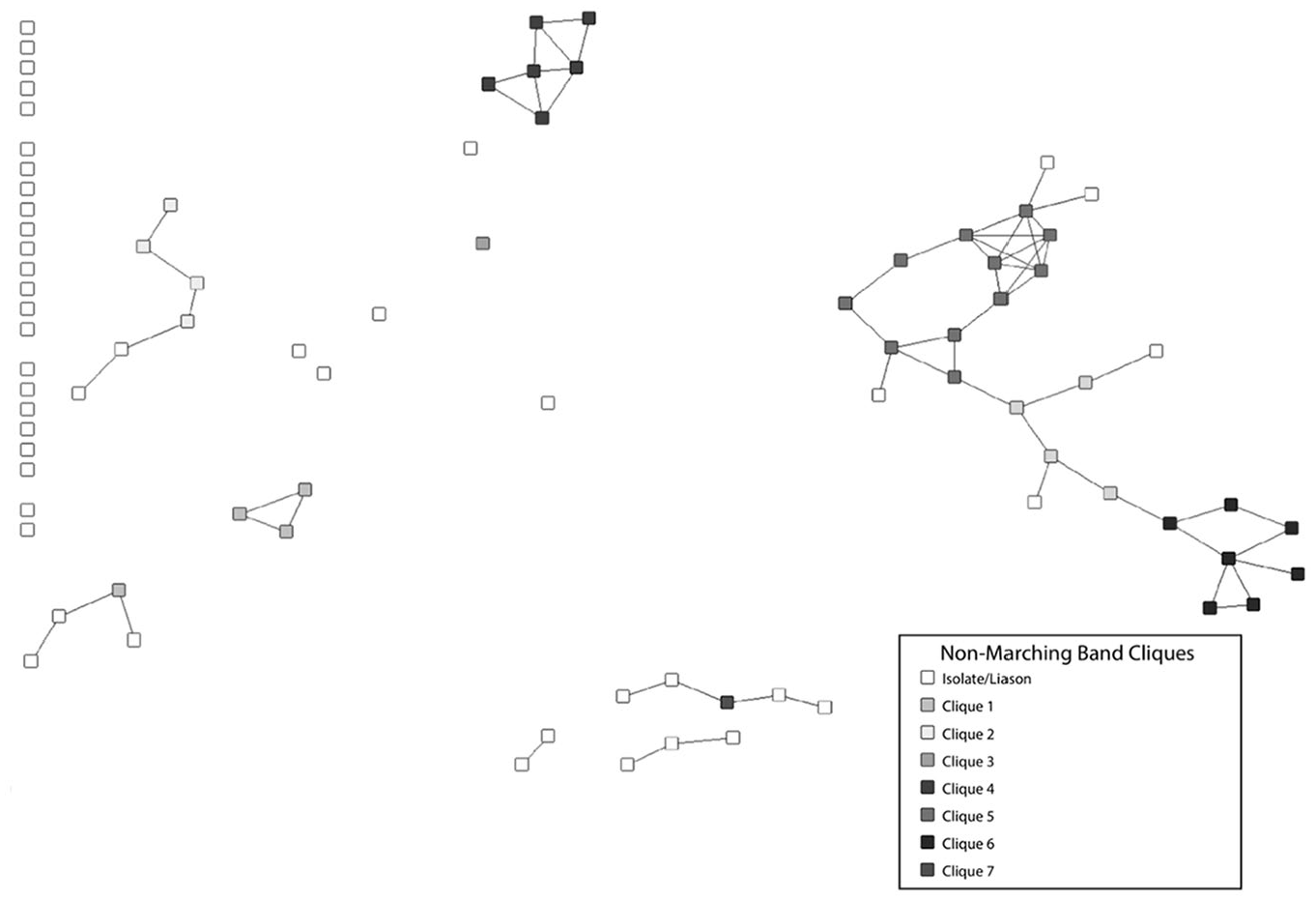
Non-Marching Band Cliques.
Descriptive statistics
Individual means, standard deviations, and correlations for each variable appear in Table 2. No bivariate relationships indicated significantly large covariation (i.e., r > .8); therefore, multicollinearity was not a concern. All other assumptions of hierarchical multiple regression, as outlined by Tabachnick and Fidell (2007), were met.
Individual means, standard deviations, and correlations across measures.
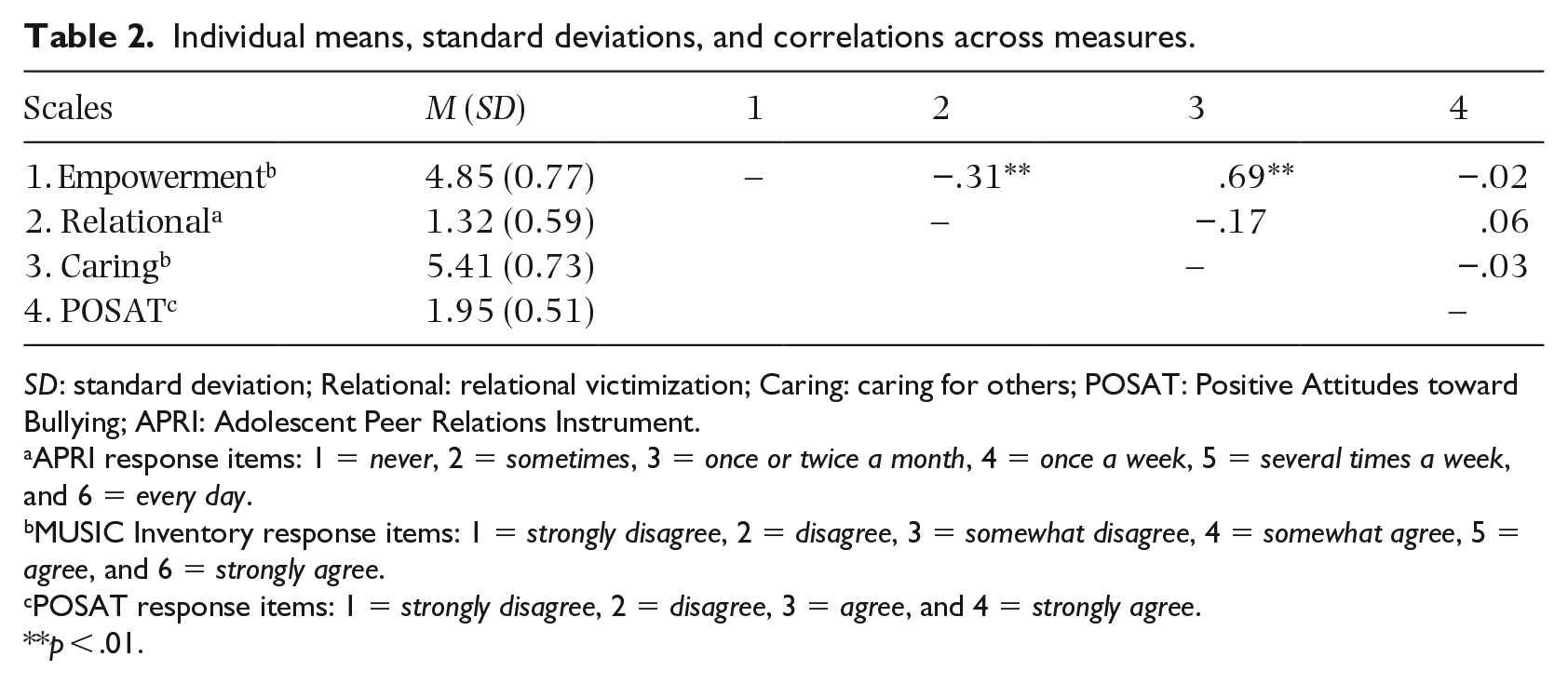
SD: standard deviation; Relational: relational victimization; Caring: caring for others; POSAT: Positive Attitudes toward Bullying; APRI: Adolescent Peer Relations Instrument.
APRI response items: 1 = never, 2 = sometimes, 3 = once or twice a month, 4 = once a week, 5 = several times a week, and 6 = every day.
MUSIC Inventory response items: 1 = strongly disagree, 2 = disagree, 3 = somewhat disagree, 4 = somewhat agree, 5 = agree, and 6 = strongly agree.
POSAT response items: 1 = strongly disagree, 2 = disagree, 3 = agree, and 4 = strongly agree.
p < .01.
To address our first research question, we calculated descriptive statistics for all four scales, and these appear in Table 3. To calculate differences in mean scores on the included measures for biological sex, ensemble/peer group membership, grade level, and race, independent t tests and analysis of variance were computed on continuous variables of interest. Although no statistically significant difference exists among self-reported race, there was a small statistically significant difference between males and females on the POSAT scale, meaning, on average, males (M = 2.05, SD = 0.52) reported more positive attitudes toward bullying than females (M = 1.84, SD = 0.47). Moreover, differences in the prevalence of relational victimization between males and females, ensemble/peer groups, and grade level were detected. Overall, these results indicate youth in the current sample are victims of relational aggression fewer than 1–2 times in the 30 days prior to data collection. Table 3 displays results from the difference tests.
Demographic differences across measures.

SD: standard deviation; Relational: relational victimization; Caring: caring for others; POSAT: Positive Attitudes toward Bullying; APRI: Adolescent Peer Relations Instrument.
APRI response items: 1 = never, 2 = sometimes, 3 = once or twice a month, 4 = once a week, 5 = several times a week, and 6 = every day.
MUSIC Inventory response items: 1 = strongly disagree, 2 = disagree, 3 = somewhat disagree, 4 = somewhat agree, 5 = agree, and 6 = strongly agree.
POSAT response items: 1 = strongly disagree, 2 = disagree, 3 = agree, and 4 = strongly agree.
p < .05.
As hypothesized, our results confirm past research suggesting that females are victims of relational aggression (M = 1.42, SD = 0.64) when compared with their male peers (M = 1.22, SD = 0.54), t(129) = 1.98, p < .05 (two-tailed), η2 = .03. Similar to other investigations, females often report being victims of relational aggression when compared with their male peers, who often report being victims of physical and verbal victimization during high school. Furthermore, we can confirm past research suggesting that males self-report more positive attitudes toward bullying (M = 2.05, SD = 0.62) when compared with females (M = 1.84, SD = 0.47), t(129) = 2.45, p < .05 (two-tailed), η2 = .05. The eta squared statistic (η2) indicated a range of moderately small effect sizes (Cohen, 1988, pp. 284–287).
Predicting relational victimization
Regression equations were computed separately for each of the four peer groups (see Table 4). As hypothesized, ensemble/peer group membership differs in the predictive significance of empowerment scores for relational victimization. After controlling for gender, caring behaviors, and positive attitudes toward bullying, empowerment scores significantly predicted self-reported relational victimization for youth enrolled in marching band and a member of a peer group (β = −.51; ƒ2 = .69) when compared with the other three, non-statistically significant groupings: marching band isolates (β = −.81; ƒ2 = .64), no marching band peer group (β = .08; ƒ2 = .01), and no marching band isolates (β = .03; ƒ2 = .22). According to Cohen’s (1988) guidelines, effect sizes for marching band peer groups are interpreted as large.
Hierarchical regression analyses results for empowerment predicting relational aggression—marching band peer group/marching band isolates/no marching band peer group/no marching band isolates.

RA: APRI Relational Aggression Scale; caring: caring for others; POSAT: Positive Attitudes toward Bullying; APRI: Adolescent Peer Relations Instrument.
p < .01.
Discussion, implications, and recommendations for future research
Researchers have made progress over the past 20 years advancing our understanding of the prevalence of relational aggression. Relational victimization accelerates during early adolescence (Coyne & Ostrov, 2018), and results from this study indicate relatively low frequencies of this behavior among high school instrumental music students. Moreover, results from this study add information to the body of knowledge about adolescent development by examining a target population of youth enrolled in a high school instrumental music program. Specifically, we found that being a member of a peer group while enrolled in marching band has a significant impact on feelings of empowerment reducing self-reported relational victimization for youth in the current sample. These findings are important because (1) participation in marching band with strong peer connections may influence perceptions of empowerment among youth, and (2) therefore, empowering youth through marching band participation reduces relational victimization.
While relational aggression and victimization are complex behaviors nested within peer group factors, having complete knowledge of nuanced differences among various forms of aggression is imperative (Low et al., 2013). To advance the corpus of knowledge around this topic, it remains essential to advance our knowledge of meaningful differences in the crucial components or contexts in which these behaviors are occurring. Even though relational aggression is facilitated by social networks, there are only a couple investigations that have examined social networks and relational aggression among this age group (Mayeux, 2014; Pokhrel, Sussman, Black, & Sun, 2010). This clear gap is surprising, and the current investigation was designed to address this apparent void in the research by utilizing mapping methodology (SNA) and hierarchical multiple regression to enhance our knowledge of the social nature of empowerment and relational victimization within high school instrumental music programs.
In a more novel contribution, for participants enrolled in a marching band with strong peer connections, our findings suggest feelings of empowerment may be a protective factor for youth experiencing relational victimization even after controlling for caring behaviors and positive attitudes toward bullying. In other words, given that relationally aggressive acts require group participation, social networks within this marching band may cultivate a level of peer connectedness that reinforces inclusionary tactics. Most school-based bullying prevention programming efforts predominantly target individual correlates, which may be more effective for overt forms of aggression (e.g., physical, verbal; Rawlings & Stoddard, 2019). The current findings are important in suggesting that the peer-level influence promotes feelings of empowerment, and for those students who do not have a peer group (or isolates), their feelings of empowerment do not significantly reduce relational victimization. Indeed, it is essential to emphasize that this is the first study within the music education body of research to document this finding, and this study joins a small group of investigations suggesting that peer-level influence within marching ensembles may be stronger than non-marching ensembles or concert ensembles. This finding holds promise for music education researchers promoting school-based music ensemble participation as it establishes the hypothesis that marching band participation may be a prevention program.
Researchers have documented an increase in relational victimization from middle school to high school, and this study found that the importance of a participant’s grade level was significant. This finding suggests that the trajectory of relational victimization and grade level may be attributed to the developmental course of peer group influence. Biological sex differences were also examined because scholars have previously assessed this variable in both social network and relational victimization.
Despite these contributions to the research literature, there are some important recommendations to consider for future studies. First, this study utilized hierarchical multiple regression to extend our understanding of how feelings of empowerment may predict the prevalence of relational victimization. Future examination of these variables may require additional analytic techniques to ascertain longitudinal effects of marching band participation on feelings of empowerment into adulthood and potentially investigate the moderating or mediating properties of psychopathological variables predicting relational aggression. Second, the current sample was homogeneous and few peer groups were detected. Therefore, the generalizability of the findings is limited, and future validation studies using diverse populations would stabilize the proposed importance of peer influences on aggression while participating in a high school instrumental music program. Finally, friendship detection was limited to the participants in this study. For instance, if participants nominated a peer who chose not to participate, we could not establish that connection. Also, participants were limited to eight nominations, which means that for a few participants networks may look different if they were allowed to list additional names.
This study validated and extended the previous research on peer group influence and aggression. Importantly, our findings validate the importance of peer context in predicting patterns of high school instrumentalist relational victimization. In terms of prevention, our findings suggest that marching band participation may be effective in preventing relational victimization. Leff, Waasdorp, and Crick (2010) highlighted that many bullying prevention programs targeting relational aggression need to be informed by developmental theory and the social ecology that promotes these behaviors.
Footnotes
Declaration of conflicting interests
The author(s) declared no potential conflicts of interest with respect to the research, authorship, and/or publication of this article.
Funding
The author(s) disclosed receipt of the following financial support for the research, authorship, and/or publication of this article: Programmatic support for the undergraduate student collaborator’s research experience was provided by the Summer Program for Undergraduate Research and the Office of Undergraduate Research at the University of Utah.
