



Abstract
Studies reveal consistent relationships between personality and preferred musical genre. This article explores these relationships using a novel methodology: genre dispersion among people’s mobile-phone music collections. By analyzing the download behavior of genre-based user subgroups, we investigated the following questions: (1) do genre-based subgroups exhibit different levels of genre exclusivity; and (2) does genre exclusivity relate to Big Five personality factors? We hypothesized that genre-based subgroups would vary in genre exclusivity, and that their degree of exclusivity would be associated with the personality factor of openness (if people have open personalities, they should be open to different musical styles). Consistent with our hypothesis, results showed that greater genre inclusivity, that is, many genres in people’s music collections, positively correlated with openness and (unexpectedly) agreeableness, suggesting that individuals with high openness and agreeableness have wider musical tastes than those with low openness and agreeableness. By demonstrating an association between personality and patterns of music consumption, this research serves to corroborate previous work linking genre preference and personality. The practical implications of this research may be useful in the implementation of music-recommendation systems.
Although research within the fields of music recommendation and music psychology have established bodies of knowledge concerning, respectively, how people categorize, tag and curate music, and the extent to which personality can influence musical preferences, arguably there is scope for further research that seeks to harness these domains for a common purpose. Existing music-personality studies have specifically examined the relationship between musical preference and Big Five personality factors (Dollinger, 1993; Dunn, de Ruyter, & Bouwhuis, 2012; Payne, 1967; Rentfrow & Gosling, 2003). The music people listen to—their musical preferences—reveal aspects of their identity (North & Hargreaves, 1999), to the extent that music can be worn as a “badge of honour” (Rentfrow & Gosling, 2003). Music-recommendation research, a subcategory of Music Information Retrieval (MIR), has attempted to create ever smarter personalized music systems based on attributes such as collaborative filtering (e.g., Lee, Cho, & Kim, 2010) and audio feature extraction (e.g., Shao, Wang, Li, & Ogihara, 2009). The following analyses attempt to leverage findings in both areas by examining music and personality (as explored by Dollinger, 1993; Zweigenhaft, 2008) in terms of genre-consumption patterns within people’s music downloads (MIR).
The primary pattern studied was genre exclusivity—a measure of the variety of genres in users’ music collections. Genre exclusivity can be thought of as a scale with two extremes. The lower end contains music collections with very few genres (referred to as “genre exclusive”); the upper end contains collections with many well-represented, distinct genres (referred to as “genre inclusive”). We investigated the link between genre exclusivity/inclusivity, musical preference and factors within the Big Five, and in so doing, evaluated possible associations between personality and genre exclusivity.
Big Five personality factors are designed to delineate basic, measurable features of personality. Each factor consists of various traits that describe behavior, thoughts and emotions; traits that co-vary with one another are categorized under one factor (Costa & McCrae, 1992). Factors in the Big Five model are openness, conscientiousness, extraversion, agreeableness, and neuroticism. Each factor is defined based on terms from everyday language (John & Srivastava, 1999). In more detail, openness measures open-mindedness to new experiences, including traits such as creativity, insightfulness, and originality. Conscientiousness measures efficiency and organization, including resourcefulness and intelligence. Extraversion measures sociability, including outgoingness, self-confidence, and aggression. Agreeableness measures friendliness and compassion, including trustworthiness, compliance, and modesty. Finally, neuroticism measures emotional vulnerability, including moodiness, hostility, self-consciousness, and impulsivity (McCrae & Costa, 1987).
With respect to individuals’ personalities, the Big Five are quantified using the Neuroticism-Extraversion-Openness Personality Inventory (NEO-PI; Costa & McCrae, 1992). A common methodology of music-personality studies associates NEO-PI results with music-preference tests (e.g., for genres). Results from existing studies have revealed many relationships between the Big Five and musical preferences, which are briefly as follows. Individuals with high openness (as measured by NEO-PI) typically prefer genres such as blues and jazz, while avoiding pop and country (Zweigenhaft, 2008). They also enjoy a wider variety of musical genres overall (Rawlings & Ciancarelli, 1997). High conscientiousness has been linked to soul and funk (Zweigenhaft, 2008). Extraverts prefer pop and rap (Zweigenhaft, 2008), which commonly occur in social situations, and thus may appeal to those high in extraversion (Pearson & Dollinger, 2004; Rawlings & Ciancarelli, 1997). High agreeableness is associated with soundtracks (e.g., of films). And the fifth factor, neuroticism, predicts preference for genres with exaggerated bass, such as dance (McCown, Keiser, Mulhearn, & Williamson, 1997). For research linking music listening with emotion and mood, states that are in turn influenced by personality (John & Gross, 2004), see Liljeström, Juslin, and Västfjäll (2013), Vuoskoski and Eerola (2011), and Juslin and Laukka (2004).
Nokia DB
This research utilized a music-download database, the majority of which were made onto Nokia mobile phones. These data became accessible through a data sharing agreement between McMaster University and the Nokia Corporation, which began in 2012. In January 2015, the Nokia division responsible for online music became a separate entity under the name MixRadio; MixRadio ceased commercial operations in February 2016. Henceforth, we refer to the data as pertaining to the Nokia DB. Beginning in January 2007, the Nokia DB contains downloads from 33 countries 1 across the globe and the metadata of 1.36 billion individual downloads from over 17 million users. 2 MixRadio users had free access to unlimited amounts of music on online music stores, meaning they could explore musical genres without cost constraints. Each download’s metadata include information such as track name, artist, album, genre, user ID (anonymous), date, (local) time and country. 3 Open source databases including MusicBrainz (the open music encyclopedia; Kaye, 2000) and The Echo Nest (Jehan, Lamere and Whitman, 2010) were used to supplement download metadata and enrich the Nokia DB. Examples of supplemented information from additional databases include track-release date, tempo, key, mode, time signature, and instrumentation, which were harvested for additional studies, such as Barone, Bansal, and Woolhouse (2017), and Bansal and Woolhouse (2015).
Given that genre depends to a degree upon the social setting in which it is heard (Rentfrow & Gosling, 2007), human judgment and “objective” genre classification using computational approaches are unlikely ever to fully agree (Lippens, Martens, & De Mulder, 2004). As a result, human genre classification that takes into account the complexity of human culture arguably provides an important ground truth with respect to the categorization of music. Genre information in the Nokia DB originates from the record labels holding rights to particular artists and songs, and was, therefore, derived entirely from expert human judgments. And while some genres are broad, subsuming multiple subgenres, they were at least applied by individuals with extensive experience and style-knowledge within the music industry. While the issue of subgenre is certainly interesting, its relevance with respect to this study was limited due to the definition and use of specific genres within existing studies, namely, Zweigenhaft (2008) and Dollinger (1993).
The data were arranged into a relational database management system and queried using the open-source MySQL implementation of Structured Query Language (SQL; see Weinberg, Groff, Oppel, & Davenport, 2010), and the Python Database application programming interface (see Lemburg, 2008), enabling more extensive, iterative analyses to be undertaken. The research presented in this article is organized into three related analyses.
Outline of analyses
The first analysis used the Nokia DB to explore music-consumption behaviors of genre-defined subgroups of users. 4 We refer to these subgroups as “x-heads,” where “x” is a user’s most downloaded genre. As genre is the most commonly used musical classifier (Rentfrow & Gosling, 2003), in line with previous studies, such as Dunn et al. (2012), genre preference was considered to reflect genuine musical interests within the study’s participants.
The second and third analyses examined the relationship between x-head subgroups’ genre exclusivity and Big Five personality factors. We hypothesized that users within x-head subgroups whose preferred genre had previously been associated with higher openness (e.g., Jazz; Zweigenhaft, 2008) would exhibit higher levels of genre inclusivity, that is, those who are open (as, in theory, demonstrated by their preferred genre) would also be open to numerous genres. Previous research arguably supports this notion. For example, Rawlings and Ciancarelli (1997) found that those high in openness tended to prefer a range of diverse musical genres. In addition, we conjectured, with the possible exception of extraversion, that Big Five factors neuroticism, agreeableness, and conscientiousness would not correlate with genre exclusivity due to lack of evidence of this in previous studies (e.g., Rawlings & Ciancarelli, 1997). However, Rawlings and Ciancarelli (1997) did link high extraversion with a preference for pop, which, given Zweigenhaft’s (2008) findings, might suggest that extraversion could be linked to genre exclusivity in some way. In short, with recourse to the Nokia DB, we sought to test, and thereby potentially corroborate, previous work associating personality with musical preference.
As existing music-personality studies focus on Western populations, we elected only to include user data from European countries with the database (14 countries in total: Austria, Finland, France, Germany, Great Britain, Ireland, Italy, Netherlands, Norway, Poland, Portugal, Spain, Sweden, and Switzerland). A further constraint concerned genre: downloads were also limited to the most commonly used genres in existing music and personality studies (10 genres in total: classical, country, dance, folk, indie, jazz, metal, pop, rap, and rock). Finally, to ensure robust measures of genre exclusivity, only users with between 10 and 5,000 downloads were included; heuristically, we decided that fewer than 10 would be an insufficient sample size to determine whether a user belonged to a particular x-head subgroup, or the extent of their genre exclusivity-inclusivity; we deemed that users with more than 5,000 downloads to be potential musical stamp collectors, and thus unreliable sources of genre-preference information. This resulted in a subset of 703,727 users within the total database of approximately 17 million users.
Analysis 1
Method
As previously stated, in our first analysis, we explored musical exclusivity in genre-defined subgroups of users. First, each user was categorized as an “x-head,” where x was the most popular genre within a user’s download collection. For example, if a user’s total collection contained 40 metal downloads and 10 dance, they were defined as a “metal-head,” and placed within the metal-head subgroup. If no genre was more popular than any other in a user’s collection (e.g., 10 pop and 10 rock), the user was classified based on whichever genre was first downloaded. Second, the raw counts per genre were obtained for each user, and a normalized level of genre exclusivity per user calculated by dividing the standard deviation (SD) of the genre counts by their total number of downloads (equation (1)). Third, to ensure that each country’s contribution to genre exclusivity was equal, users in each x-head subgroup were then subdivided based on their country, and a median SD per x-head subgroup per country calculated. Fourth, for each x-head subgroup, a single median was derived from the 14 country-level median SD values; this value we called “x-med.” Fifth, for each country, a single median was derived from the 10 genre-level median SD values; this value we called “c-med.” Sixth, x-head subgroups and countries were ranked based on their respective x-med and c-med values. The lower the x-med or c-med value, the more genre inclusive the x-head subgroup or country; the higher the x-med or c-med value, the more genre exclusive the x-head subgroup or country,

where σ = SD of genre counts per user, N = number of genres, j = genre, i = number of downloads per genre, X = normalized level of genre exclusivity per user.
Result
Table 1 shows the median SDs of x-head subgroups’ collections, broken down by user country (n = 140). Columns are x-head subgroups, sorted based on x-med values (bottom row) from left to right; rows are countries, sorted based on c-med values (right column) from top to bottom. X-head subgroups to the left were more genre inclusive than x-heads to the right; countries at the top were more genre inclusive than those at the bottom. Indie-heads, who had the lowest x-med (0.137), were the most genre-inclusive subgroup, while pop-heads, who had the highest x-med (0.200), were the most genre exclusive. Less important to this particular analysis, but interesting nonetheless, are the c-med values, that is, median SDs based on country. Norway (NO), Portugal (PT), and Sweden (SE), with the lowest c-meds (0.162) contained x-heads who were the most inclusive, whereas Switzerland (CH), with the highest c-med (0.175), contained x-heads who were the most exclusive (or musically “insular”). It is perhaps interesting to note that there is a far greater minimum-maximum range in the x-head row (bottom) than the c-med column (left). Which is to say, countries in general are not substantially different from one another in terms of genre exclusivity; this, however, cannot be said of x-head subgroups who demonstrated considerably more variance. A more in-depth analysis of x-head subgroups’ collections based on genre is discussed in Analysis 2 below.
Standard deviations of x-head subgroups’ collections based on genre, broken down by country. Columns are organized such that more genre-inclusive x-head subgroups are to the left. Rows are organized such that more genre-inclusive countries are at the top.

Country abbreviation codes: Norway (NO); Portugal (PT); Sweden (SE); Great Britain (GB); Poland (PL): Spain (ES); France (FR); Ireland (IE); Italy (IT); Austria (AT); Netherlands (NL); Germany (GR); Finland (FI); Switzerland (CH).
Analysis 2
Method
This analysis examined how x-head subgroups consumed music from individual genres. Specifically, we looked at pairs of x-head subgroups and investigated the degree to which both x-head subgroups consumed each other’s main, group-defining genre. Equation (2) calculates the degree to which x-head subgroups consumed each genre,

where Ci,j = count of genre i in x-head j’s collection, N = number of x-heads, Sj,i = the value of nth row and ith column (in particular, Sj,i is a measure of the average relative proportion of genre i in x-head j’s collection). Each value of Sj,i refers to a cell shown in Figure 1.
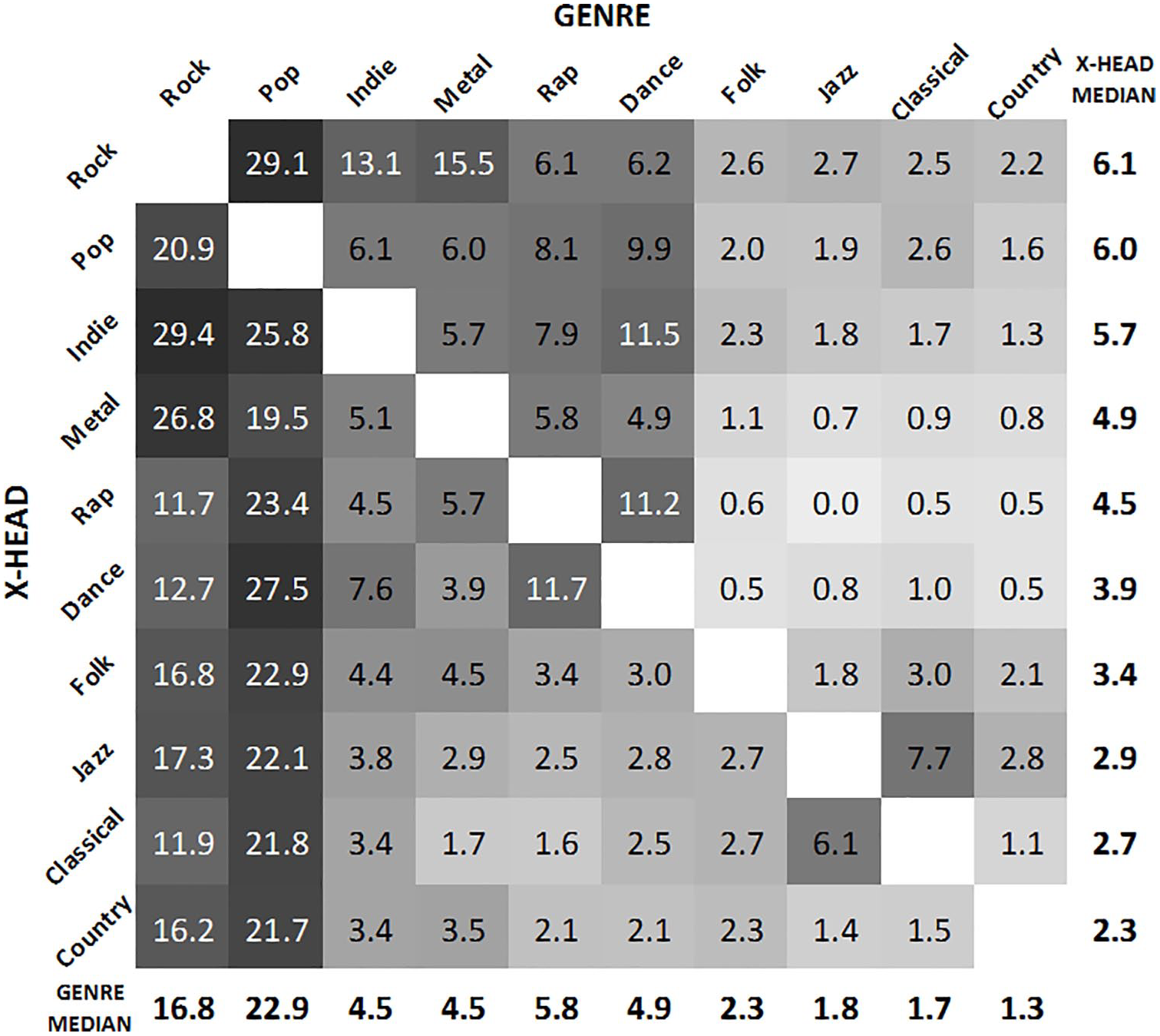
Percentage of Other Genres in Each x-Head Subgroup’s Collection Compared to Main Genre.
Result
The heat map in Figure 1 shows the degrees to which each x-head subgroup consumed genres other than their main genre. The left-axis lists x-head subgroups; the top-axis lists the genres they consumed. Darker cells indicate greater genre consumption. The x-head medians listed in the far-right column are the median percentages of the genres consumed by x-head subgroups. The genre medians listed along the bottom are the median percentages that each genre was consumed by x-head subgroups. Relationships can be explored by comparing x-head and genre pairs symmetrically positioned either side of the map’s diagonal axis (line of white cells). For example, rock-heads and pop-heads consumed the greatest percentage of each another’s genres: rock-heads consumed 29.1% of pop, pop-heads consumed 20.9% of rock.
Based on the degree of pairwise genre consumption, various types of relationships were evident. For example, some x-head pairs consumed roughly equal amounts of each other’s main genre, and therefore had balanced relationships; other x-head pairs consumed unequal amounts of each other’s main genre, and therefore, had imbalanced relationships. Balanced relationships were classified as either “inclusive” or “exclusive” based on the relative consumption volumes between the two x-head subgroups. Three categories of x-head relationships were heuristically identified, and are now defined and illustrated using example pairs of x-head subgroups.
Mutually inclusive: Pairwise relationship in which x-head subgroups downloaded significant and approximately equal amounts of each other’s main genre. Figure 2 shows the extent to which pop- and rock-heads consume their main genre (upper x-axis) and the other genre in the pairing (lower x-axis). For example, the left-hand bars show that for 60% of pop-heads and 46% of rock-heads, their main genres constituted between 90% and 100% of their collections; which is to say, 60% of pop-heads had between 0% and 10% of the other genre (rock), and 46% of rock-heads had between 0% and 10% of the other genre (pop). Although this may seem as though rock- and pop-heads were exclusive of one another, further inspection of Figure 2 reveals relatively significant (and balanced) consumption of both genres within each subgroup. For example, the right-hand bars show that 7% of pop-heads had between 40% and 50% of rock downloads, and 16% of rock-heads had between 40% and 50% of pop downloads—that is, relatively robust levels of near-mutual consumption, particularly with respect to rock-heads downloading pop. Mutually inclusive relationships are represented in Figure 1 by dark-shaded squares symmetrically located on either side of the map’s diagonal axis (line of white cells).
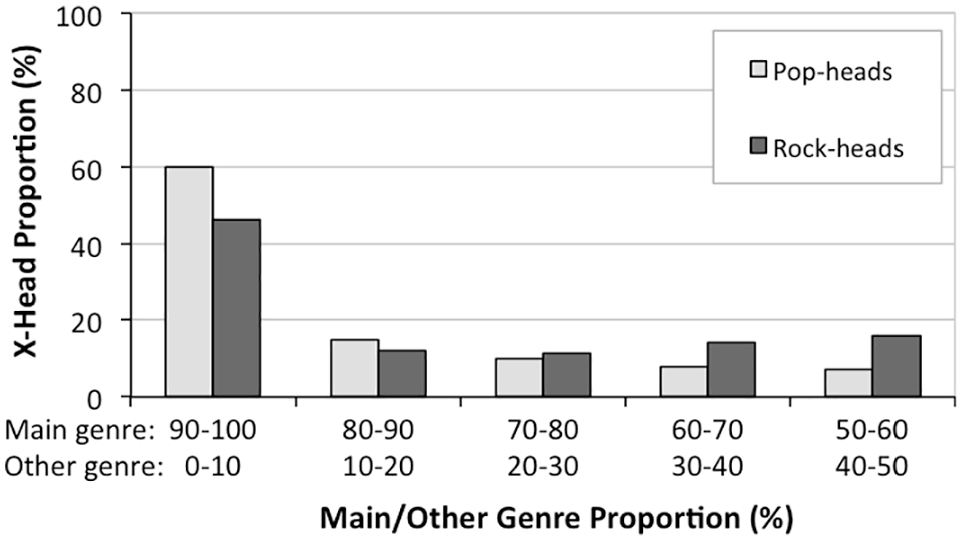
Mutually Inclusive Download Relationship: Pop-Heads and Rock-Heads.
Mutually exclusive: Pairwise relationship in which x-head subgroups downloaded approximately equal but insignificant amounts of each other’s main genre. Similarly to Figure 2, Figure 3 shows the extent to which jazz- and metal-heads consumed their main genre and the other genre in the pairing. For example, the left-hand bars show that the vast majority of jazz- and metal-heads downloaded 90%–100% of their main genre, and only 0%–10% of the other. And, consequently, very few jazz- or metal-heads downloaded significant amounts of both genres (right-hand bars). In other words, jazz- and metal-heads were highly exclusive of one another’s main genre. Mutually exclusive relationships are represented in Figure 1 by light-shaded squares symmetrically located on either side of the map’s diagonal axis. The x-heads could be thought of as being unsympathetic to one another’s main genre.
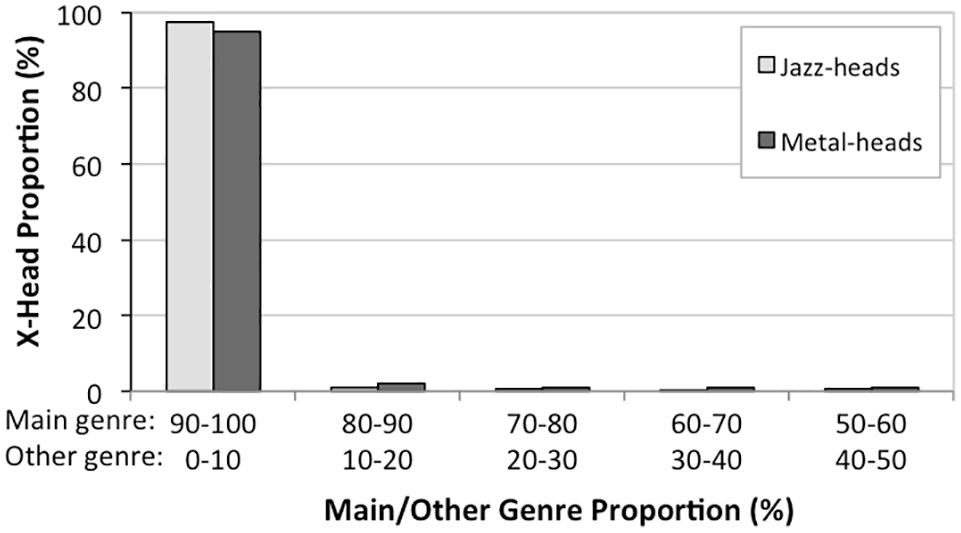
Mutually Exclusive Download Relationship: Jazz-Heads and Metal-Heads.
Inclusive-exclusive: Pairwise relationship in which x-head subgroups downloaded each other’s main genre unequally. Bar heights in Figure 4 revealed that many country-heads consumed large amounts of both pop and country music. However, the converse was not the case: a majority of pop-heads did not consume significant amounts of country music. Inclusive-exclusive relationships are represented in Figure 1 by cells, symmetrically located on either side of the map’s diagonal axis, in which there is mismatched shading, that is, light gray to dark gray.
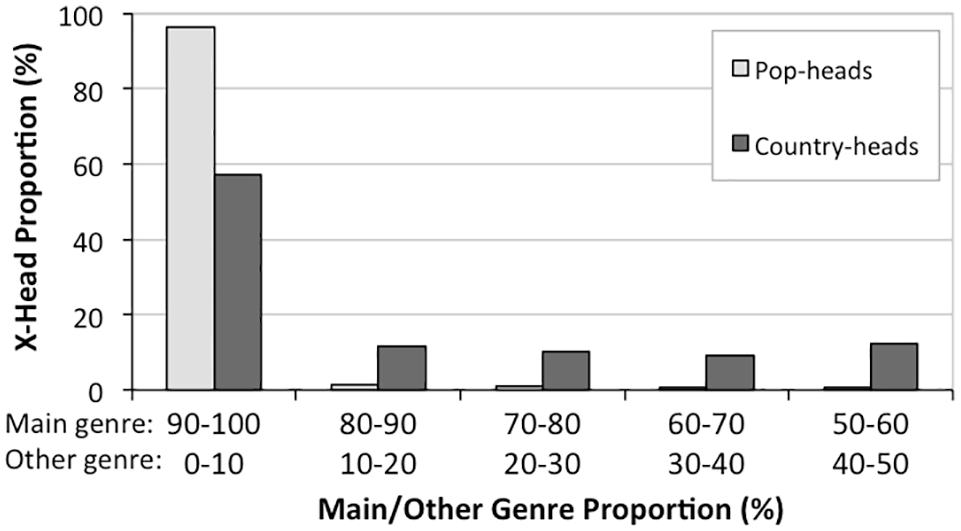
Inclusive-Exclusive Download Relationship: Pop-Heads and Country-Heads.
Conclusion for analyses 1 and 2
In Analysis 1, x-head subgroups ranked from genre exclusive to inclusive in the following order: pop, dance, rap, metal, rock, classical, country, folk, jazz, and indie (see Table 1). Intriguingly, this ranking is consistent with previous literature indicating that individuals who prefer jazz and folk music rank highly in the Big Five factor of openness, which has been linked to genre inclusivity (Zweigenhaft, 2008). Also, those high in openness have been found to be less enamored of pop; in our analysis, pop-heads were the most exclusive with respect to genre. Therefore, the results of Analysis 1 preliminarily hinted at links between genre exclusivity and aspects of personality. In Analysis 2, pairs of x-head subgroups were compared based on their consumption of one another’s main genre. Some x-head subgroup pairs were mutually inclusive of one another, while others were mutually exclusive. Remaining x-head pairs consumed each other’s main genres unequally (inclusive-exclusive). As in Analysis 1, the results of Analysis 2 are consistent with previous literature. For example, in Figure 4, country- and pop-heads are shown to have had an imbalanced relationship, which is in line with the order of x-head subgroups as shown in Table 1: pop-heads are to the right of country-heads indicating their relatively higher genre exclusivity. However, Analysis 2 is more nuanced than Analysis 1 in that specific x-head pairwise relationships are revealed, resulting in the three types of heuristic relationships expounded earlier.
Analysis 3
Method
Analysis 3 examined possible links between genre exclusivity and Big Five personality factors by correlating measures of genre exclusivity per x-head subgroup from Analysis 1 with data from Zweigenhaft (2008) and Dollinger (1993), two studies in which Big Five personality factors were associated with musical preference. To reiterate, Analysis 1 established genre exclusivity by calculating normalized standard deviations of genre distributions within x-heads’ downloads (median SD of x-heads’ music collections based on genre, grouped by user country). Zweigenhaft (2008) required subjects to complete the NEO-PI and a version of the Short Test of Music Preferences (STOMP; Rentfrow & Gosling, 2003), which were then correlated with one another. In Dollinger (1993), subjects completed the NEO-PI (Costa & McCrae, 1985) and a musical-preference scale developed by Litle and Zuckerman (1986); similarly to Zweigenhaft (2008), these measures were then correlated. Zweigenhaft investigated the degree to which all Big Five personality factors correlated with preference for certain genres, whereas Dollinger focused solely upon extraversion and openness. Dollinger’s analyses omitted rap or indie music; consequently, we excluded these genres from our analyses when working with Dollinger’s data. Other than these exclusions, the broad alignment between the genres in Zweigenhaft (2008) and Dollinger (1993) and the genres in the database enabled our research question to be investigated in detail. As previously stated, we hypothesized that users within x-head subgroups whose preferred genre had previously been associated with higher openness would exhibit higher levels of genre inclusivity than those whose preferred genre had previously been associated with lower openness. To test this, genre-personality associations from Zweigenhaft (2008) and Dollinger (1993) were correlated with our measures of genre exclusivity, derived from Analysis 1.
Result
A significant, negative correlation existed between measures of genre exclusivity from Analysis 1 and the genre associations found by Zweigenhaft (2008) for openness (Figure 5; n = 140, r = −.37, two-tailed, p < .001) and agreeableness (Figure 6; n = 140, r = −.32, two-tailed, p < .001). That is, genre-openness and -agreeableness were associated with genre exclusivity in x-head subgroups to some degree. There were no significant correlations between extraversion, conscientiousness and neuroticism with genre exclusivity. Figures 5 and 6 show relationships between openness and agreeableness with genre exclusivity. X-axes display the degree of genre exclusivity for x-head subgroups (median SD of x-heads’ music collections based on genre). X-head subgroups (listed on the right of the graphs) are represented with a different marker. Horizontally positioned identical markers are the median SDs per x-head subgroup for each of the 14 countries included in the analysis. The height of the markers on the y-axis corresponds to the degree of openness (Figure 5) or agreeableness (Figure 6) for each genre in Zweigenhaft (2008).
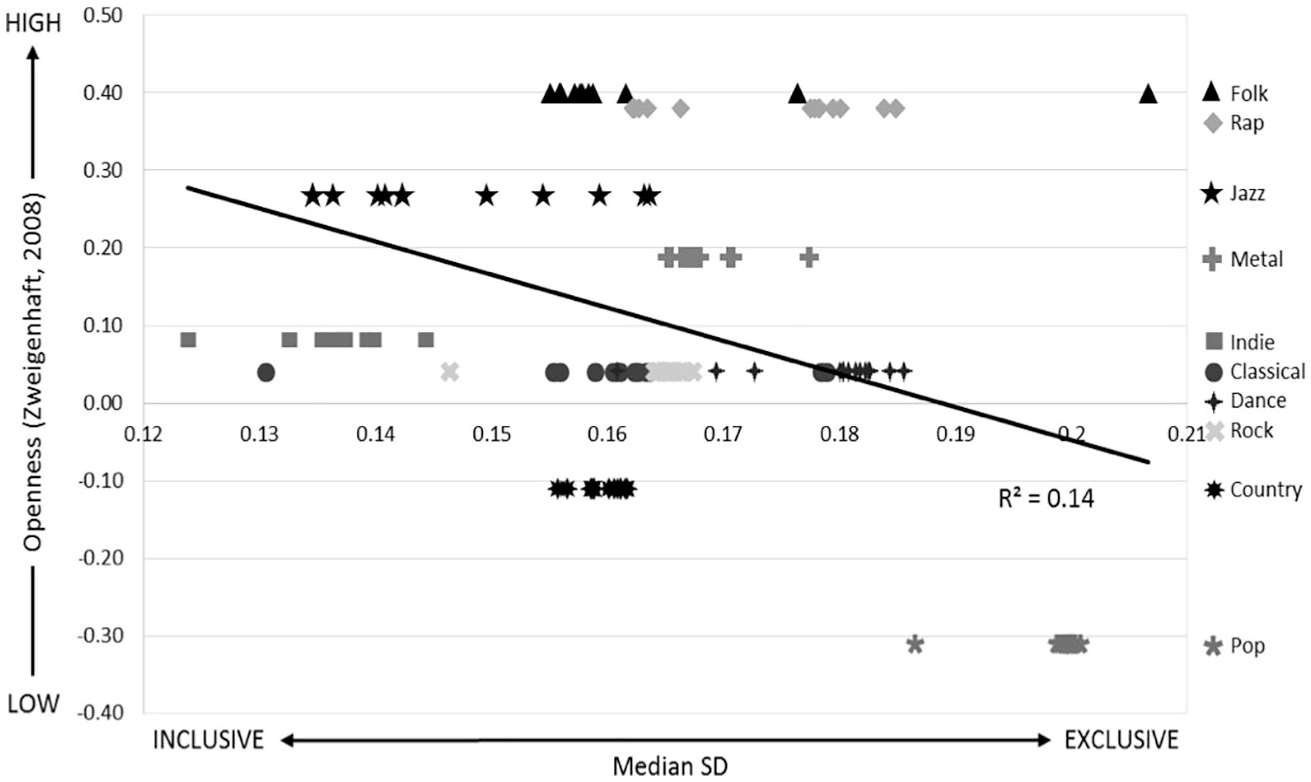
Relationship Between Genre Exclusivity and Openness Measures From Zweigenhaft (2008).
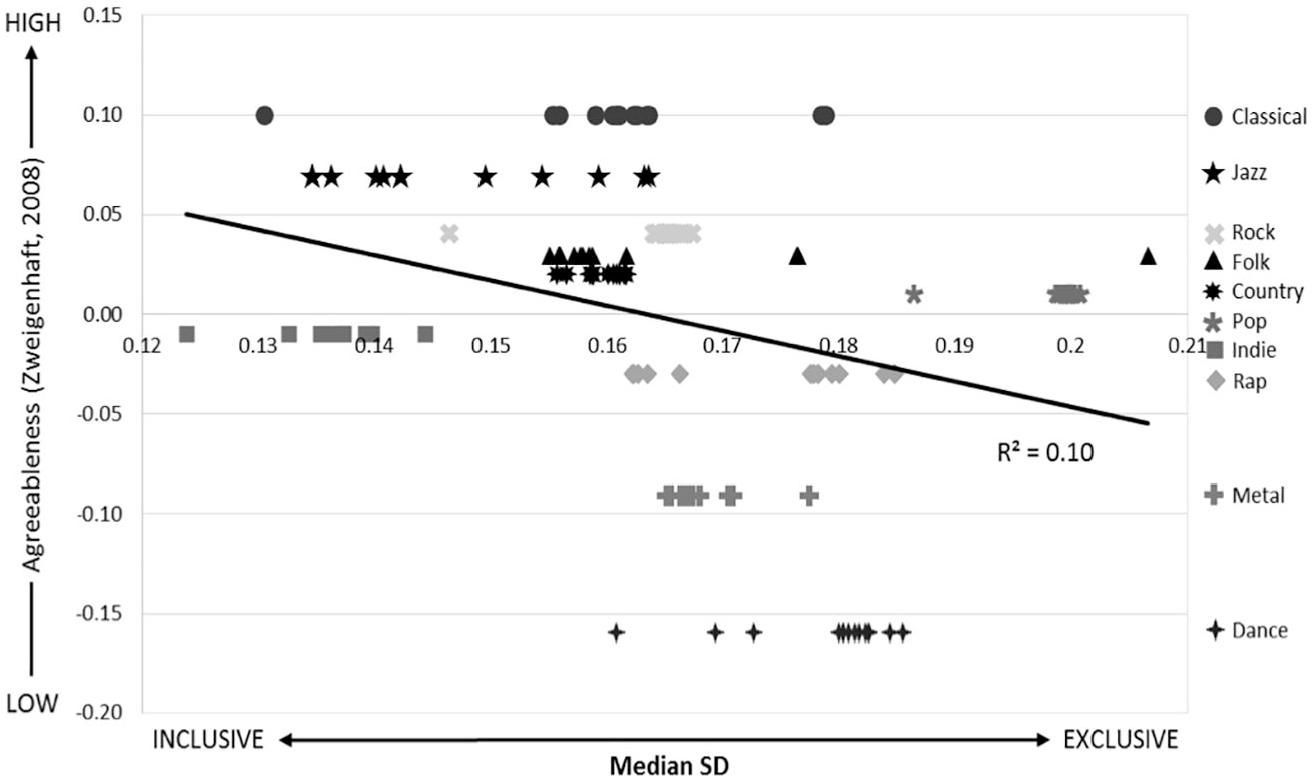
Relationship Between Genre Exclusivity and Agreeableness Measures From Zweigenhaft (2008).
A significant, negative correlation existed between measures of genre exclusivity from Analysis 1 and the genre associations found by Dollinger (1993) for openness (Figure 7; n = 112, r = −.58, two-tailed, p < .001); that is, genre-openness associations accounted for some of the genre exclusivity of x-head subgroups. There was no significant correlation between extraversion and measures of genre exclusivity. Figure 7 shows the relationship between openness and genre exclusivity. As in Figures 5 and 6, the x-axes display the degree of genre exclusivity for x-head subgroups. X-head subgroups (listed on the right of Figure 7) are represented with a different marker; horizontally positioned identical markers are the median SDs per x-head subgroup for each of the 14 countries included in the analysis. The height of the markers on the y-axis corresponds to the degree of openness for each genre in Dollinger (1993). Rap and indie were not considered in Dollinger’s analysis, and are therefore absent in Figure 7.

Relationship Between Genre Exclusivity and Openness Measures From Dollinger (1993).
Discussion
Analysis 1 explored overall genre exclusivity of x-head subgroups; Analysis 2 revealed pairwise relationships between x-head subgroups. Some of these relationships were unbalanced, with only one of the two x-head subgroups consuming music from the other’s main genre. Other pairwise relationships were more equitable—both x-head subgroups consumed each other’s main genre more equally. Analysis 3 revealed links between genre exclusivity and pre-existing musical-preference personality studies. Although not particularly strong, the correlations reported in Figures 5–7 indicated that genre-openness and -agreeableness associations from Zweigenhaft’s (2008) and Dollinger’s (1993) studies are related to genre exclusivity in x-head subgroups. Conscientiousness, extraversion, and neuroticism did not appear to relate to genre exclusivity. With respect to the issue of users where no genre was more popular than any other (e.g., 10 pop tracks and 10 rock), this was very rare, and thus, inclusion or exclusion of these individuals had no significant statistical effect on the results.
The relatively weak r-square values in Figures 5 and 6 may be due to a number of differences between the data sources. For example, our data span a 7-year period, from 2007 to 2014, whereas Zweigenhaft’s study, published in 2008, represents a single “snapshot” in time. Nor is there geographical overlap: although Western in origin, Zweigenhaft’s data do not fully mesh with our download data derived from 14 European countries. The sample sizes, too, are vastly different—our data represent many thousands of users; Zweigenhaft collected detailed data from 83 participants. In short, given the differences in temporal range, geography, and scale, significance mismatches exist which may have adversely affected the correlations as reported in Analysis 3. With respect to the correlation shown in Figure 7, similar limitations exist to those expressed in relation to Zweigenhaft’s data. Dollinger’s (1993) study employed 74 participants, who were required to complete personality questionnaires; self-reported information such as this can be biased by a number of factors, and thus, the extent to which generalized conclusions can be drawn are limited.
Breaking down openness and agreeableness based on their component traits suggests possible reasons for a relationship to genre exclusivity. Openness is a general willingness to encounter new experiences—different musical styles could be said to constitute new experiences, and thus, a degree of openness is required before being prepared to engage with unfamiliar musical styles. Those high in openness also tend to be more willing to break social codes, or push boundaries (Dollinger, Orf, & Robinson, 1991), which may, in turn, lead them to venture beyond Western musical norms more readily. In addition, people high in openness have been found to dislike ubiquitous genres like pop (Zweigenhaft, 2008), tending, instead, to enjoy less commercial musical styles. Moreover, those who enjoy non-mainstream genres have also been found to use music for cognitive and rational purposes, such as intellectual stimulation, focusing more on the quality, complexity, and performance characteristics (Chamorro-Premuzic & Furnham, 2007). Arguably, exploration of numerous, diverse genres would be more likely to provide listeners high in openness with these musical properties.
The association of agreeableness with genre exclusivity was unexpected—few studies have found this factor to be a reliable indicator of musical preference. However, agreeableness encompasses traits such as compliance, and willingness to compromise (Zweigenhaft, 2008), so arguably, it is the case that those who are agreeable may also be “compliant” to experiencing novel musical genres, or prepared to “compromise” their musical tastes. To test this theory, however, associations between traits of agreeableness and genre exclusivity should be examined in detail; as yet, no study exists in this regard.
Although comprised of large data volumes—many millions of downloads in some cases—studies based predominantly on mobile-phone data, such as ours, are limited to some degree; it is uncertain to what extent these data are indicative of more general patterns of music consumption and listening. Moreover, the countries included in our analyses were restricted to Europe, again, potentially limiting generalizability. Simply put, because personality, as measured in the Big Five, and musical preferences vary from country to country (Schmitt, Allik, McCrae, & Benet-Martinez, 2007), our findings are unlikely to be applicable globally. In addition, due to data-anonymization procedures (personal biographical information per user is absent from the database), we are not able to generalize within and between age ranges and genders. As men and women can have different musical preferences (Christenson & Peterson, 1988), the presence of gender biases could have affected the data, for example, females generally consume more pop than males (North, Hargreaves, & O’Neill, 2000; Rawlings & Ciancarelli, 1997). While the topic of genre and gender has generated significant research, given the constraints of our database, detailed discussion on this important topic is beyond the scope of this article. Given these limitations, the Nokia DB still provides a uniquely large sample size for each country, and its longitudinal nature makes it suitable to analyze personality with minimal effects of extraneous variables such as mood.
With respect to possible age biases, it is likely that the Nokia DB user population is skewed to younger people, due, in part, to the popularity of cellular phones and music technology in contemporary adolescent culture (Aoki & Downes, 2003). Musical tastes develop and can vary considerably with age (Hargreaves & Castell, 1987); download data that originate from a population with a more diverse age range may therefore yield varying results. A further possible population bias relates to socioeconomic variance between individuals and countries. The users in the Nokia DB are limited to those who could afford or chose to purchase a Nokia mobile phone. Despite this, Nokia has historically made a range of models to appeal to multiple market sectors. Consequently, although the self-selected users in our study may not be fully representative, it is assumed that they are relatively widely distributed throughout the populations of the countries within our analyses; by “self-selected,” we simply refer to individuals who chose to use the MixRadio music service.
A possible methodological complication relates to the way in which x-heads are defined: mode of downloaded genre. That is, we assume that users’ genre distributions represent genuine musical preferences, which, although likely to be the case, is not known for certain. In other words, multiple reasons may account for the dominance of a particular genre within an individual’s download collection, not simply popularity, although we assume that this is indeed the case.
Information concerning x-head genre exclusivity is a valuable resource in music marketing and in the creation of “intelligent” recommender systems. For example, based on results from Analysis 2, country-heads would appear to be susceptible to pop, although, given the asymmetrical relationship between these genres, the reverse seems not to be the case (country-heads consume pop, but pop-heads do not consume country). Understanding each side of a pairwise x-head-community relationship could be a useful component in song-succession optimization within personalized radio systems. Moreover, quantifying the link between personality and genre exclusivity may enable Big Five dimensions such as openness and agreeableness to be factored into recommendations; for example, a wide range of relatively obscure genres for those with a higher likelihood of being open and/or agreeable, and vice versa. While it is possible that this research could give rise to intelligent recommendation systems based upon the input by the user of personality related traits, further research is required to ascertain the effectiveness of this approach. In addition, the disclosure by users of personality-related information raises important ethical considerations which may be affected by data-protection legislation in different jurisdictions (Metcalf & Crawford, 2016).
The reasons underpinning the existence of genre inclusivity or exclusivity is a significant area of future study. For example, questions pertaining to whether certain genres are downloaded in tandem due to possessing similar acoustic properties, such as tempo, instrumentation, or emotional valence, have yet to be answered; analyses that include extracted audio features could well be enlightening in this regard. In addition, possible overlaps in genre preference may be influenced by cultural factors that will require a sociological rather than a data-analytic approach. For example, rap-heads and pop-heads consume substantial volumes one another’s genres, which, prima facie, could be considered unusual. Until relatively recently, the development of both genres have been distinct: rap is an expression of urban resistance (Martinez, 1997), whereas pop’s evolution, by definition, is more mainstream. The extent to which this overlap is being driven by sociocultural factors, as opposed to qualities intrinsic to the music itself, remains to be explored. The practical implications of this research may be useful in the implementation of music-recommendation systems. Future elaboration of these findings, in particular the exploration of personality and preference for musical features independent of genre (e.g., tempo, mode), could provide a deeper understanding of how music-listening behavior is related to personality.
Our analyses attempt to harness the power of big data and broaden the scope of research to which it can be applied. Analysis 3, in particular, exploring the link between the Big Five and genre exclusivity, seeks to corroborate existing psychological research through statistical associations with patterns within a database of international music consumption. In the future, other types of exclusivity relationships may be linked to personality traits, including artist exclusivity (the number of artists in users’ collections), tempo dispersion (variety of tempos in users’ collections), or release-date variability (the era from which a musical collection stems).
Conclusion
This article used a novel data-analytic method to study possible links between music and personality. Overall, genre exclusivity was most consistently associated with the Big Five personality factor openness, arguably corroborating existing music-personality research, notably that of Zweigenhaft (2008) and Dollinger (1993). Moreover, genre exclusivity was also linked to agreeableness, one of the few instances in which an association between this factor and music has been demonstrated, thereby potentially expanding this area of research. In sum, the more open and agreeable you are, the more genre inclusive your musical tastes are likely to be. Although not all of the relationships were particularly strong, our findings both reaffirm what researchers have been aware of for some time, and add new, pertinent information to this area of study: personality not only influences our style preferences, but also appears to influence the degree to which we are prepared to juxtapose genres within our music collections. Continued access to ever-growing music-listening and -acquisition databases will enable the influence of personality on genre exclusivity to be more fully understood, and for the rapidly expanding field of music-consumption research to contribute significantly to our understanding of music listening on local and global scales.
Footnotes
Funding
The author(s) disclosed receipt of the following financial support for the research, authorship, and/or publication of this article: This research was supported by a Partnership Development Grant (#890-2014-0126) from the Social Sciences and Humanities Research Council of Canada, awarded to the third author.
