



Abstract
Previous studies explored the relations between preference for intense music (i.e., alternative, heavy metal, punk, and rock) and mental health. However, the results so far are inconclusive and do not assess if a preference for intense music directly or indirectly predicts mental health. To address this issue, the present research assessed the mediational role of positive and negative affect on the relation between preference for intense music and mental health. We hypothesized that preference for intense music predicts positive and negative affect, which, in turn, contributes to lower levels of mental health (i.e., stress, depression, and anxiety). Participants were 268 individuals (Mage = 26.6; SDage = 8.30; 63.4% women). Supporting our hypothesis, preference for intense music directly predicted positive and negative affect, and indirectly mental health. Most of these relations remained significant even after controlling for important confounding effects, such as age, gender, and neuroticism. Alternative models were examined, but the hypothesized model presented a better fit. Overall, our research indicates that intense music plays an important role in people’s affects and mental health.
“I have lost the will to live Simply nothing more to give There is nothing more for me Need the end to set me free”
People are daily exposed to music on a variety of situations. For instance, while driving, studying, or doing domestic activities. When watching movies or playing video games, people are exposed to their respective soundtracks. If one decides to go to a shopping mall, department store, or even to a wine store, they are frequently exposed to songs that could increase their willingness to buy (North, Hargreaves, & McKendrick, 1999; Rentfrow, Goldberg, & Levitin, 2011). Another feature that shows the important role that music has in everyday life is the success of some streaming platforms (e.g., Apple Music, Spotify, and Deezer) that allow the access to millions of different bands and music. Despite the frequent presence that music has in people’s lives, one important characteristic that should be considered is that music can elicit different feelings and emotions (e.g., happiness, positivity, sadness, irritation; Panwar, Rad, Choo, & Roopaei, 2019). In addition, listening to music frequently represents a cumulative process that can influence our mental health (Miranda, Gaudreau, Debrosse, Morizot, & Kirmayer, 2012; Rentfrow, 2012). For instance, Miranda et al. (2012) presented a mediator model, in which music preference can predict internalizing symptoms through mediational variables, such as affect. Therefore, it is crucial to investigate the psychological effects triggered by listening to music.
In a literature review, Miranda et al. (2012) pointed that in the music psychology field, the most studied variable is music preference, which represents to what extent people like (or dislike) certain types of songs or music genres (e.g., punk rock, metal, hip-hop; Swaminathan & Schellenberg, 2015). In this sense, music preference is an attitude toward songs or genres, and this can lead people to approach or avoid them (Boer, 2009; Swaminathan & Schellenberg, 2015). Research indicates that five dimensions represent the structure of music preference (Rentfrow, 2012; Rentfrow et al., 2011): Mellow (i.e., romantic, relaxing, slow), Unpretentious (i.e., uncomplicated, unaggressive, acoustic), Sophisticated (i.e., inspiring, intelligent, complex), Intense (i.e., distorted, aggressive, loud), and Contemporary (i.e., electric, energetic, not sad). Considering these dimensions, the effects of music preferences in a wide range of outcomes have been assessed. For instance, listening to classical music is related with better cardiovascular health and decrease of anxiety levels (Trappe, 2010), whereas preference for unpretentious music is related to negative attitudes toward marijuana, and lower levels of antisocial behavior (Pimentel, Gouveia, & Vasconcelos, 2005).
The preference for intense music (e.g., rock, heavy metal, punk) is more strongly related to undesirable outcomes, such as risk of suicide (Pimentel, Gouveia, Santana, Chaves, & Rodrigues, 2009) depression, anxiety (Miranda & Claes, 2009; Shafron & Karno, 2013), and the use of drugs (Miller & Quigley, 2012). However, other studies could not replicate these patterns. For example, Till, Tran, Voracek, and Niederkrotenthaler (2016) verified that preference for intense music does not predict suicidal ideation, hopelessness, depression, and life satisfaction. Furthermore, longitudinal evidence did not support the predictive role of music preference on internalizing psychopathology (Miranda et al., 2012).
These mixed results indicate that the effects of intense music on internalizing psychopathology could be indirect. Therefore, it is important to explore the mechanisms that link music preference with mental health outcomes. Specifically, music influences our emotional state (Panwar et al., 2019; Shuman, Kennedy, DeWitt, Edelblute, & Wamboldt, 2016), and this can be induced through emotional contagion (Lundqvist, Carlsson, Hilmersson, & Juslin, 2009). Frequently, the lyrics of intense music involve themes like suicide, death, hopelessness, despair in regard to life, use and abuse of substances (Miranda & Claes, 2007; Miranda et al., 2012; Pimentel et al., 2009), and this constant exposure can increase the levels of negative affect and decrease positive affect. For instance, such themes can be seen in the song “Bob,” by the punk rock band NoFx (“He spent 15 years; Getting loaded for 15 years, till his liver exploded. Now what’s Bob gonna do now that he can’t drink?”), or in the song “Hurt,” by the rock band Nine Inch Nails (“I hurt myself today to see if I still feel; I focus on the pain, the only thing that’s real.”).
Prior research indicates that rock fans tend to exhibit rebellious emotions (e.g., angry, enraged, and irritated; Zentner, Grandjean, & Scherer, 2008). People who experience negative affects when listening to their favorite song have been more involved in risk-taking behaviors (e.g., physical fights, use of alcohol and drugs), and this effect is stronger for rock/metal fans (Roberts, Dimsdale, East, & Friedman, 1998). This suggests that intense music can increase negative and reduce positive affect, and this might predict some negative outcomes (e.g., externalizing behaviors). However, to the best of our knowledge, this has not been tested considering internalizing symptoms. The Tripartite Model suggests that higher levels of negative affect are related to anxiety and depression, and lower levels of positive affect are related to depression (Clark & Watson, 1991). Moreover, negative and positive affect account for the development of depression and anxiety and their maintenance (Lonigan, Phillips, & Hooe, 2003; Zanon, Bastianello, Pacico, & Hutz, 2013). Thus, considering these previous findings, the present research aims to test the indirect predictive role of intense music on internalizing psychopathology. Specifically, we tested whether the preference for such genre increases negative and decreases positive affect, resulting in lower levels of mental health. Moreover, considering that women (Riecher-Rössler, 2017), young people (Schweizer, Parker, Leung, Griffin, & Blakemore, 2020), and those with higher scores on neuroticism (Widiger & Oltmanns, 2017) are more prone to internalizing symptoms, the effects of these variables were controlled.
Method
Participants and procedure
Participants were 268 individuals, with age ranging from 18 to 63 years (Mage = 26.6; SD age = 8.30; 63.4% women). Preacher and Coffman’s (2006) online calculator (http://www.quantpsy.org/rmsea/rmsea.htm) was used to estimate the minimum sample size required to test the models considered in the present research. In this case, we looked for how many participants it would be needed to obtain a power of .80. Results suggested that considering the degrees of freedom that our model has, an alpha of .05, and root mean square error of approximation (RMSEA) as a reference of model fit, less than 100 participants were needed to examine any of the proposed models with enough power.
The present study is correlational, where the participants were invited through social media (e.g., Facebook, Instagram) to answer a questionnaire about music preference and mental health. A snowball strategy was used for data collection, asking the respondents to share the link of the research with their friends after the completion of the survey. Participants were presented to all ethical relevant information and to the researchers’ emails, in case they required any further information about the study or to raise an issue.
Material
Short Test Of Music Preference–Revised (STOMP-R; Rentfrow et al., 2011). Considering the objectives of our study, we used only the items of the intense factor of the STOMP-R (alternative, punk, heavy metal, and rock), and added the indie genre, that in another taxonomies loads on the same factor of punk and alternative (Herrera, Quadros, & Lorenzo, 2018). Participants indicate to what extent they like these genres (1 = dislike strongly to 7 = like strongly). In the present study, this factor presented an acceptable reliability coefficient (Cronbach’s alpha, α = .80).
Depression, Anxiety, and Stress Scale-12 (DASS-12; Monteiro & Gouveia, 2019). This is a 12-item version of DASS-21 (Lovibond & Lovibond, 1995) to assess symptoms of psychological distress. Participants indicate the extent to which they have experienced each of the symptoms in the last week (0 = I do not experience this at all to 3 = I experience this most of the time). Items include “I experienced trembling (e.g., in the hand)” (Anxiety; α = .80), “I felt that I was using a lot of nervous energy” (Stress; α = .88), and “I felt that life was meaningless” (Depression; α = .90).
Satisfaction with Life Scale (SWLS; Diener, Emmons, Larsen, & Griffin, 1985). This is a 5-item measure that assesses the general satisfaction with life. Participants indicate their level of agreement (1 = strongly disagree; 5 = strongly agree) to items such “In most ways my life is close to my ideal” and “If I could live my life over, I would change almost nothing.” The reliability of this scale was acceptable for the data used in the present study (α = .85).
Scale of Positive and Negative Affects (Gouveia et al., 2019). This measure is composed of 10 adjectives, 5 describing negative affect (e.g., worried, angry, unhappy) and 5 describing positive affect (e.g., satisfied, joyful, fun). Participants indicate the extent to which they have experienced each one of these emotions recently (1 = never; 7 = very frequently). Both factors showed acceptable reliability for the data used in the present study (α = .87 and α = .89, respectively).
Big Five Inventory (John, Donahue, & Kentle, 1991). The items of neuroticism were used, specifically the four with higher loadings in the transcultural study conducted by Schmitt, Allik, McCrae, and Benet-Martinez. (2007). Participants indicate their agreement (1 = totally disagree; 5 = totally agree) to items like “Worries a lot” and “Get nervous easily.” The neuroticism trait showed acceptable reliability for the data used in the present study (α = .83).
Data analysis
Analyses were done using the Robust-Maximum Likelihood (MLR) estimator on Mplus (version 8.3). Indirect effects were assessed using 5,000 bootstrap sampling and the maximum likelihood (ML) estimator. To examine whether the hypothesized model fits the data, the following fit criteria were considered (Brown, 2006; Hu & Bentler, 1999; Kline, 2015): comparative fit index (CFI) > .90 or close to .95, standardized root mean residual (SRMR) < .08, and RMSEA < .06. Non-nested models were examined to test whether the proposed model would fit the data better than alternative models, changing the hierarchy of the variables in the model. The nonnest2 statistical package (Merkle & You, 2014; Merkle, You, & Preacher, 2016) was used to assess which model would fit the data the better. This package examines Vuong’s distinguishability and likelihood ratio tests (Vuong, 1989), using the R environment (R Core Team, 2014), and the ML estimator. The distinguishability test examines whether the models are sufficiently different, and the likelihood ratio test examines the hypothesis that one model fits the data better than the other statistically. Each of these tests reports a test of significance (for details, see Merkle et al., 2016). In addition to these tests, the Bayesian information criterion (BIC) is also reported for each of the models. Models with a lower BIC suggests a better fit to the data (Merkle et al., 2016).
Results
Figure 1 shows the hypothesized structural equation model in which preference for intense music operates via affects to influence mental health (Model 1). Other two alternative models were also examined (Model 2 and Model 3). Model 2 places preference for intense music as an endogenous variable and Model 3 places preference for intense music as a mediator (see Figure 1). The alternative models were analyzed to make sure that the hypothesized model is the best fitting model. As can be seen, Model 1 fits the data better than the two alternative models when considering all the goodness-of-fit criteria, including the BIC, that is commonly used to compare non-nested models (Merkle et al., 2016). However, as BIC comparisons do not assess whether two models fit the data equally well, the Vuong’s distinguishability and likelihood ratio tests were assessed, as recommended by Merkle et al. (2016). Results showed that Models 1 and 2 were sufficiently distinguishable from each other, w2 = .205; p < .001, but there was no significant evidence in favor of Model 1 as a better fit to the data than Model 2, z = 1.103; p = .135. On the other hand, Model 1, z = 8.734; p < .001, and Model 2, z = 8.879; p < .001, fitted the data significantly better than Model 3.
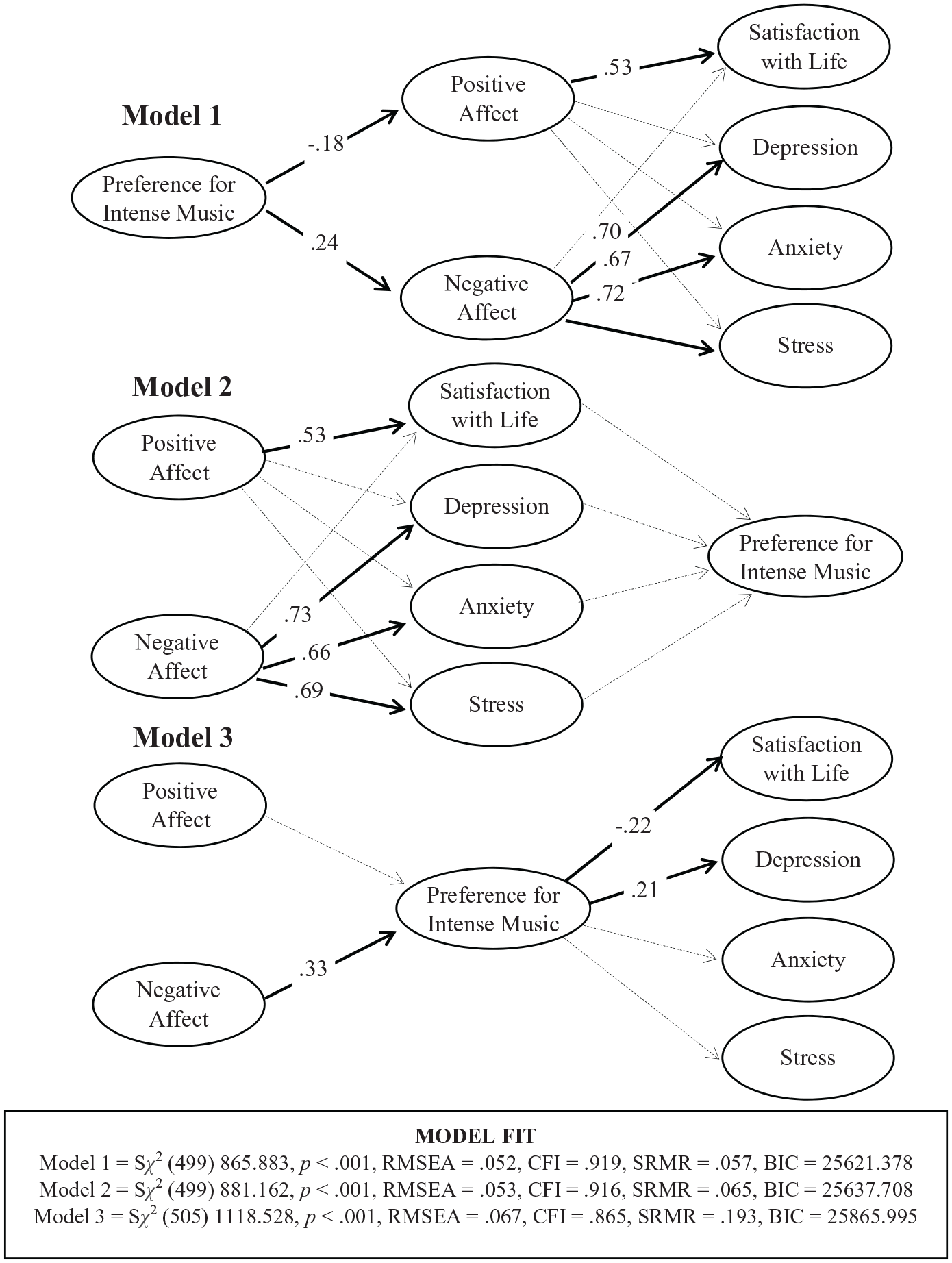
Hypothesized (Model 1) and Alternative Models (Models 2 and 3).
A fourth model (see Figure 2) examined the same relations as showed in Model 1, but adding neuroticism as a control variable. This is because neuroticism is a strong predictor of affect and mental health (Widiger & Oltmanns, 2017), and we were interested to test the robustness of the proposed paths ruling out the effects of personality traits. Results showed that all the relations, except for the link between preference for intense music and positive affect, remained significant when neuroticism was included in the model. Indirect effects of Model 4 (ML estimator with 5,000 bootstrapped samples) revealed that negative affects mediate the link between preference for intense music with depression, β = .204, 95% CI = [.044, .365], and stress, β = .114, 95% CI = [.019, .208], and marginally mediated the link between preference for intense music with anxiety, β = .089, 95% CI = [.000, .178].
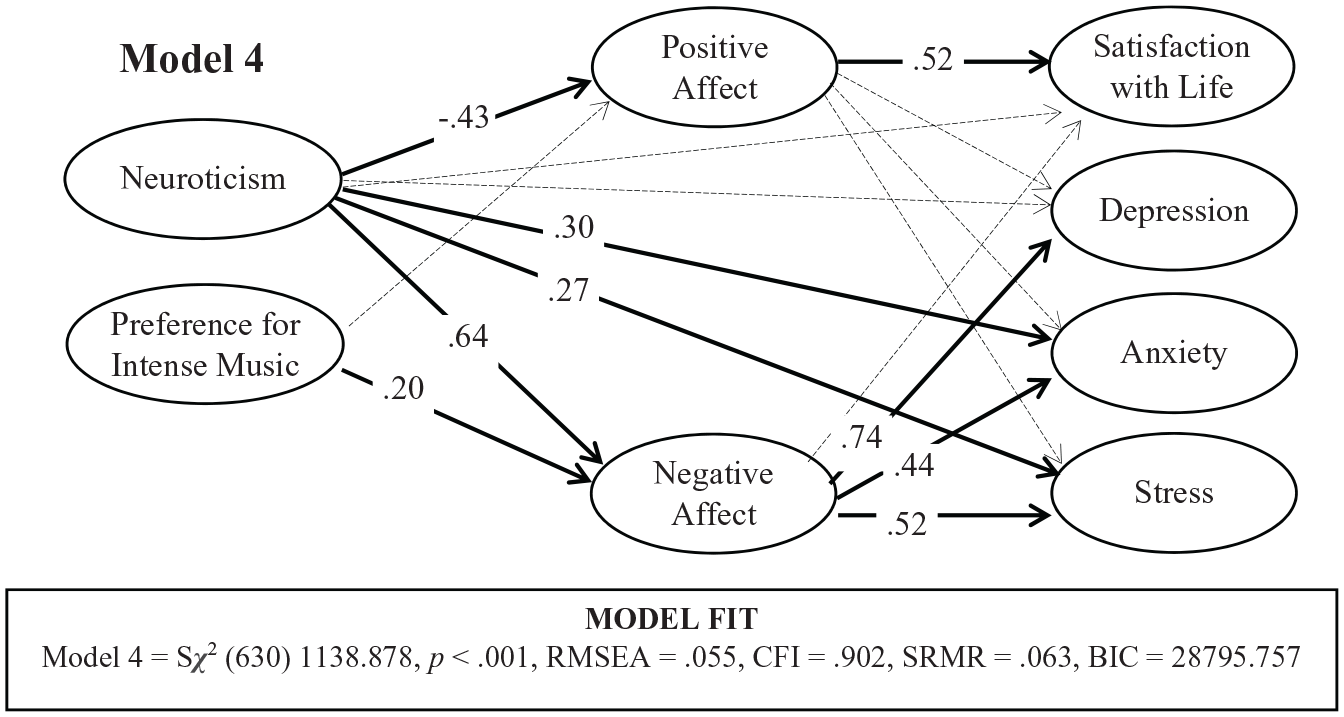
Hypothesized Model Controlled by Neuroticism.
Age and gender were used as control variables for all the four models examined. For simplicity, regressions for these variables were not included in Figures 1 and 2, but they are reported as Supplemental Materials Online. The most consistent relation for the control variables was the negative link between age and negative affect, and the positive link between gender (female = 1, male = 2) and preference for intense music. The negative effect of gender on anxiety and stress was consistent for all models, except when neuroticism was included (Model 4). Significant relations between age and well-being were also found (the older the better well-being) but only for Model 3 when there was no direct prediction between affects and well-being.
Discussion
People are frequently exposed to music, which might have effects on their feelings, emotions (Panwar et al., 2019; Rentfrow, 2012), and even in their behaviors (North et al., 1999). Research highlighted that genres like rock, heavy metal, and punk can influence negatively the listener (Lozon & Bensimon, 2014), specifically their mental health. However, results in this field are still inconsistent (Miranda & Claes, 2009; Shafron & Karno, 2013; Till et al., 2016). Therefore, the present research aimed to further advance the understanding of whether music preference can directly or indirectly influence mental health. The effect of preference for intense music is expected because genres like punk rock and metal often approach themes like suicide, death, hopelessness, and despair in regard to life (Miranda & Claes, 2007; Miranda et al., 2012; Pimentel et al., 2009).
Our findings showed some evidence that individuals from a specific profile (women, young, and neurotic) are more prone to internalizing symptoms, in line with previous studies (Riecher-Rössler, 2017; Schweizer et al., 2020; Widiger & Oltmanns, 2017). In addition, preference for intense music does not predict mental health directly, but indirectly through negative and positive affect. These results were consistent even after important confounding variables were controlled (e.g., neuroticism, demographic variables). Prior research has reported that music influences emotional states inducing them through emotional contagion (Lundqvist et al., 2009). Individuals that prefer genres such as intense music are usually more exposed to the themes explored through their lyrics. So, listening to this kind of music constantly represents a cumulative process, that can increase negative and decrease positive affect, leading to internalizing problems (Miranda et al., 2012).
Indeed, some authors observed that intense music can increase negative and rebellious emotions, and predict the involvement in externalizing problems (Roberts et al., 1998; Zentner et al., 2008). Our findings suggest that the same process occurs in internalizing problems. Higher negative affect and lower positive affect have a pivotal role on mental health, accounting for their development and maintenance (Clark & Watson, 1991; Lonigan et al., 2003; Zanon et al., 2013). Thus, the present research proposed a model in which preference for intense music operates via positive and negative affect to influence the individual’s mental health (Miranda et al., 2012).
It is important to highlight that although the proposed model (Model 1) showed the most promising results regarding the goodness-of-fit, the lack of significant results when assessing whether Model 1 fitted the data better than Model 2 demands caution. It might be that the lack of significant differences is influenced by the number of paths that are repeated in both models (the link between affects and mental health). As there are no significant direct regressions between mental health and preference for intense music in Model 2, we speculate that the effect of intense music on mental health is better represented through a mediation of positive and negative affects. However, future studies should examine these relations using a more proper method to establish causal inference, such as longitudinal analysis.
Another point that demand caution is the inconsistent literature in this area (Miranda & Claes, 2009; Shafron & Karno, 2013; Till et al., 2016). For instance, in a study with extreme metal music listeners, Sharman and Dingle (2015) found that when anger was induced to participants, they chose songs with angry and aggressive lyrics, leading them to experience and process the anger, causing an increase in positive affect. Such contradictory evidence suggests the importance of further studies to explore under which conditions exposure to this type of music can benefit or affect mental health.
Implications
From a clinical point of view, our findings might help psychologists to use musical preference as an indicator of psychological vulnerability (Martin, Clarke, & Pearce, 1993). As this style involves topics like suicide, despair and hopelessness, people can listen to it and ruminate about their negative thoughts, which can have long-term effects on mental health (Carlson et al., 2015). These authors highlight that listening to music to discharge negative emotions is an ineffective strategy for emotional regulation, and it is important to help clients to identify such dysfunctional strategies and promote healthier forms of emotional regulation through music.
Furthermore, it is also worth remembering that the preference for intense music has been related to the use of drugs (Miller & Quigley, 2012), which can also have a negative effect on young people’s mental health. These could focus on stating the importance of keeping a good mental health, and also promote programs that can help them to deal with any potential problem that they might be facing. Finally, our findings might help future research, which could also include this variable in a more complex model than the one that was tested in the present research. For instance, the amount of time they spend listening to intense musical and their motivations to listen to this style could be included. This would undoubtedly help to better understand the relations between music preference and mental health, considering models of moderate mediation, for example.
Limitations
It is important to highlight that although preference to intense music was indirectly related to mental health, our analyses do not rule out people’s preferences to other genres of music, such as Brazilian specific genre types (e.g., samba, funk carioca, bossa nova; Herrera et al., 2018). Future studies can explore whether these path models are consistent considering only samples with high scores on preference for intense music. Another limitation is that the present research assesses music listening behavior considering music preference. Although this is a common practice (Miranda et al., 2012), future studies can benefit from asking people to choose their most listened songs on streaming platforms or even to quantify the time spent in such apps. Another limitation refers to the non-probabilistic sample, composed mainly by university students. Despite these limitations, our results are consistent, showing that music has effects on emotional states and shed light on how music can predict mental health.
Supplemental Material
POM-19-1649.R2_supplementary_materials – Supplemental material for Indirect effects of preference for intense music on mental health through positive and negative affect
Supplemental material, POM-19-1649.R2_supplementary_materials for Indirect effects of preference for intense music on mental health through positive and negative affect by Renan P Monteiro, Gabriel Lins de Holanda Coelho, Roosevelt Vilar, Wilker Sherman Barcelos Andrade and Carlos Eduardo Pimentel in Psychology of Music
Footnotes

References
Supplementary Material
Please find the following supplemental material available below.
For Open Access articles published under a Creative Commons License, all supplemental material carries the same license as the article it is associated with.
For non-Open Access articles published, all supplemental material carries a non-exclusive license, and permission requests for re-use of supplemental material or any part of supplemental material shall be sent directly to the copyright owner as specified in the copyright notice associated with the article.
