



Abstract
This study aims to determine the effect of metacognitive strategies-based teaching practice in guitar education on preservice music teachers’ performance achievement. Preservice music teachers (n = 20) who were enrolled in and in the process of attending the School Instruments III-Guitar course offered by the Department of Music Education, under the school of Fine Arts Education within the Educational Faculty of Muğla Sıtkı Koçman University in Turkey during the 2018–2019 academic year constituted the sample group of the study. The study was designed as an experimental study that included a randomized pretest–posttest control group. The results revealed that both the control group students with traditional current-based education and the experimental group students with metacognitive strategies-based teaching achieved improvement in their guitar performance. However, no significant difference was found between the teaching methods used because the study was carried out with a small group and therefore has a weak statistical power to detect an effect. The results further indicated that the metacognitive strategies-based teaching practice in guitar education, as an effective alternative to the traditional curriculum-based method, can be used to achieve improvement in preservice music teachers’ guitar performance.
The guitar is one of the most popular instruments in music education programs due to some of its features and uses, including its polyphonic nature and its common employment as an accompanying instrument. The education process involves acquiring information about the guitar. It also involves learning skills like playing techniques necessary for guitar performance and using the instrument effectively by learning these techniques. In this regard, the awareness that individuals have of their learning and their ability to regulate their learning activities can be considered important factors for their performance development.
Metacognition is a commonly used term and refers to an individual’s awareness of their learning and thought processes and the conscious control of this awareness. Within the field of cognitive psychology, metacognition, which is considered higher level thinking (Blakey & Spence, 1990; Schraw & Dennison, 1994), is variously defined as cognition about cognition (Flavell, 1979), thinking about thinking (Akın & Abacı, 2011; Dawson, 2008; Sönmez, 2007), and learning to learn (Howe, 1991). Metacognition in the educational sense refers to individuals’ awareness of their learning process, monitoring and managing the process, and controlling these processes (Brown, 1987; Flavell, 1979; Jacobs & Paris, 1987; Martinez, 2006; Sternberg, 1981).
Many researchers classify metacognition into two main categories: knowledge about cognition and regulation of cognition (Brown, 1987; Flavell, 1979; Nietfeld, Cao, & Osborbe, 2005; Pintrich, 2002; Schraw, 1998; Schraw & Dennison, 1994; Schraw & Moshman, 1995). Knowledge about cognition involves individuals’ awareness of their own mental processes and capabilities, whereas regulation of cognition involves the use of metacognitive activities to assist individuals in controlling their learning. In this context, the successive processes individuals use to establish control in learning and to reach a cognitive goal refer to metacognitive strategies (Akın & Abacı, 2011; Berthold, Nückles, & Renkl, 2007). Cognitive strategies help individuals to make progress by constructing knowledge. Metacognitive strategies, on the other hand, enable individuals to monitor themselves, evaluate the process, and transfer knowledge to new settings (Gourgey, 2002). Strategies like defining what is/is not known, talking about thinking or keeping a diary of thinking, questioning the thinking process, and engaging in self-evaluation serve to develop metacognitive behaviors (Blakey & Spence, 1990).
To benefit from strategies in an educational process, it is not enough for teachers to simply inform students about strategies. Rather, students should monitor and regulate their own learning on the use of strategies (Palincsar, 1986), as the self-learning of skills and the monitoring of learning by the students themselves play a key role in their achievement in this process. The monitoring of learning helps individuals to gain awareness of their manner of thinking and learning and to regulate learning efficiently (Gagne & Driscoll, 1988). In this regard, the more metacognitive experience a student gains, the more his or her metacognitive skill improves (Hartman, 2002; Senemoğlu, 2005). Within this scope, to develop metacognition, students should be clearly provided with the opportunity to practice. Students should know the meaning and importance of metacognition, and the aim of students and teachers alike should be to increase the capacity for metacognition. Second, metacognition can and should be modeled. An example would be cognitive modeling, where “thinking aloud” could be used. Third, social interaction among students should be used to improve students’ metacognitive capacity. If students are collectively encouraged and directed to engage in critical thinking, they can model the concept of reasoning and other cognitive tools to each other in the best way (Martinez, 2006). T. Yokuş (2009) investigated the effect of activities designed to improve metacognitive strategies in guitar education on performance achievement. The results showed that those activities are effective and improved students’ guitar performance. Metacognition gradually improves as individuals gain conscious control over the process, making it more powerful and therefore more effective in terms of achieving performance improvement over time (Kuhn, 2000).
The strategic planning of learning, from the perspective of music education, can create the opportunity to organize conscious activities whereby students realize their individual needs and thus achieve a higher level of learning and performance development. In this regard, many studies conducted by researchers in the field of music education revealed the positive effects of metacognition, activities designed to improve metacognitive strategies, and metacognitive strategies-based educational practices on student performance achievement (Bathgate et al., 2012; Colombo & Antonietti, 2017; Ergin & Durak, 2016; Hallam, 2001; Hollenbeck, 2008; Kurtuldu, 2011; Miksza, 2015; T. Yokuş, 2010b).
The development of metacognition in terms of performance in instrument education, which is one dimension of music education, is a process that involves an individual’s ability to recognize the requirements of a task in line with their needs and planning, monitoring, and evaluating strategies for their performance development accordingly (Hallam, 2001). Performance, in the simplest and most concise terms, means “performing” or “doing” (Uçan, 2005). Performance achievement, on the other hand, represents the positive aspects of mental or actual activities shown for the work being carried out or performed (T. Yokuş, 2009). In the music education process, learning outcomes can be evaluated in terms of performance, and necessary measures can be taken to improve future performance by identifying certain challenges, having knowledge of various strategies to cope with these challenges, knowing which strategies are appropriate to overcome every task, monitoring goal-oriented progress, and if the progress is not satisfactory, admitting this and using alternative strategies (Hallam, 2001).
Professional music education aims to equip individuals interested in pursuing music as a profession with the musical behaviors and experience required by the profession (Say, 2009). Hallam (2001) indicated that professional musicians are capable of managing self-evaluation, the analysis of the musical structure, and performance anxieties. In other words, professional musicians exhibit high-level metacognitive skills. The well-developed metacognitive skills these professional musicians possess serve to support their practice. For students who take advanced education and play a musical instrument, practice is considered to be very important in making progress and building a professional career in the field of music. However, there is a wide range of perspectives on the amount of time musicians should commit to practicing (Jorgensen, 2002).
The relevant literature presents a variety of thoughts on the idea of practice, such as, that the time an individual spends in “deliberate” practice is related to the quality of their performance (Ericsson, Krampe, & Tesch-Romer, 1993), that the amount of practice is a key variable in determining music performance expertise (Sloboda, Davidson, Howe, & Moore, 1996), and that the amount of practice, if it is not planned or conscious, no longer functions as a determinant of success (Jorgensen, 2002). A study by Jorgensen (2004) addressed many strategies related to the practices used by musicians in the performance processes and classified them within the scope of the following meta-strategies: planning and preparation strategies (setting goals, time management, etc.); executive strategies (extending the practice over time for repetition and preparation for the performance, etc.); evaluation strategies (evaluation of the process and result, etc.); and strategy knowledge and the control and regulation of strategies.
To improve musical performances, individuals should play the role of auditor toward their performances, being sure to carry out this auditing process in a step by step, controlled manner (Swanwick, 2003). However, in tasks assigned, it is rare for students to engage in organizing, planning, monitoring, and evaluating the progress on their own; instead they simply “study” or “apply” concepts (Fry & Lupart, 1987: as cited in the work of Guerrero, 2008). To circumvent this problem, music education teaching should involve the modeling of effective practice processes, such as providing a general perspective, identifying challenges, selecting appropriate strategies, monitoring the process, setting personal goals, and conducting self-evaluation, all of which are related to enhancing student performance (Hallam, 1997).
Students’ use of metacognitive strategies in guitar education, which is one dimension of instrument education, can enable them to plan, monitor, control, and evaluate their performance development while practicing. The School Instruments III-Guitar Course in Music Teaching Undergraduate Programs in Turkey is a mandatory course that all preservice music teachers (within the scope of their music education) must take for one term during their undergraduate education. This course aims to teach undergraduate music education students to use a guitar when they teach because a guitar is a polyphonic instrument and different types of music like classic, jazz, or popular music can be performed with a guitar. All these features make the guitar one of the most functional instruments that can be used in music lessons. This course in the Music Education Undergraduate Curriculum includes the following topics: general characteristics of the guitar, correct sitting and holding position with the guitar, tuning the guitar, playing simple arpeggios, playing small-scale tunes, playing school songs solo, basic chords in the I position, and chord accompaniment to school songs (Yükseköğretim Kurulu, 2007). In this direction, by the end of this course, preservice music teachers are expected to know the general usage characteristics of the guitar, comprehend basic chords, and be able to play simple arpeggios.
Ryan (1987) states that to become a good guitarist, it is necessary that individuals, in addition to knowing all the techniques and methods related to playing, gain cognitive awareness, as one of the most essential requirements for improving playing skills is to improve awareness, because this enables individuals to discover and apply new ways to overcome the difficulties encountered while playing the guitar. In a different study, Steadman (2002) discusses the main principles of guitar education in his research on the development of metacognition as an important factor related to guitar pedagogy. Although experienced teachers often use metacognition in their teaching (Colombo & Antonietti, 2017), studies on music education have shown that the curriculum should be structured as such to involve practices that give students the opportunity to select and use effective strategies to enhance their metacognition (T. Yokuş, 2010b), and that to foster metacognitive skills in students, the number of activities involving the use of metacognitive strategies should be increased (Colombo & Antonietti, 2017; Hallam, 2001; Miksza, 2015; H. Yokuş, 2010; T. Yokuş, 2010a).
This study aimed to determine the effect of metacognitive strategies-based teaching practice in guitar education on preservice music teachers’ performance achievement. In line with the aim of the study, answers to the following questions were sought:
Is there a significant difference between the pre- and posttest Observation Form scores of the experimental group taught using the metacognitive strategies-based teaching practice?
Is there a significant difference between the pre- and posttest Observation Form scores of the control group, who are taught based on the traditional curriculum-based education?
Is there significant difference between the pre- and posttest Observation Form scores of the experimental group and the control group?
Method
Study model
The study used an experimental model to determine the effect of a metacognitive strategies-based teaching practice on preservice music teachers’ performance achievement. In this regard, the study was designed as a randomized pretest–posttest control group study. With this design, two groups were formed by random assignment from the first pool of participants, one of which was labeled as the experimental group and the other as the control group. Next, measurements related to the dependent variable of the participants in the two groups were taken before the experiment. During the implementation process, the experimental procedure being tested by the study was applied to the experimental group but not to the control group. At the completion of the implementation process, measurements related to the dependent variable were taken once again using the same data collection tool.
Study group
Preservice music teachers (n = 20) who were enrolled in and in the process of attending the School Instruments III-Guitar course offered by the Department of Music Education under the school of Fine Arts Education within the Educational Faculty of Muğla Sıtkı Koçman University in Turkey during the fall term of the 2018–2019 academic year constituted the sample group of the study. These preservice teachers participated in the study on a voluntary basis. The preservice music teachers were randomly assigned to the experimental group (n = 10) and the control group (n = 10). The number of female (50%) and male (50%) preservice teachers in both groups were equal. Within the scope of the School Instruments III-Guitar course, the researcher applied a metacognitive strategies-based teaching practice to the experimental group, while the control group was taught according to the traditional curriculum-based education. Measurements were made in both groups before and after the experiment. The study design used is shown in Table 1.
Design of the study.

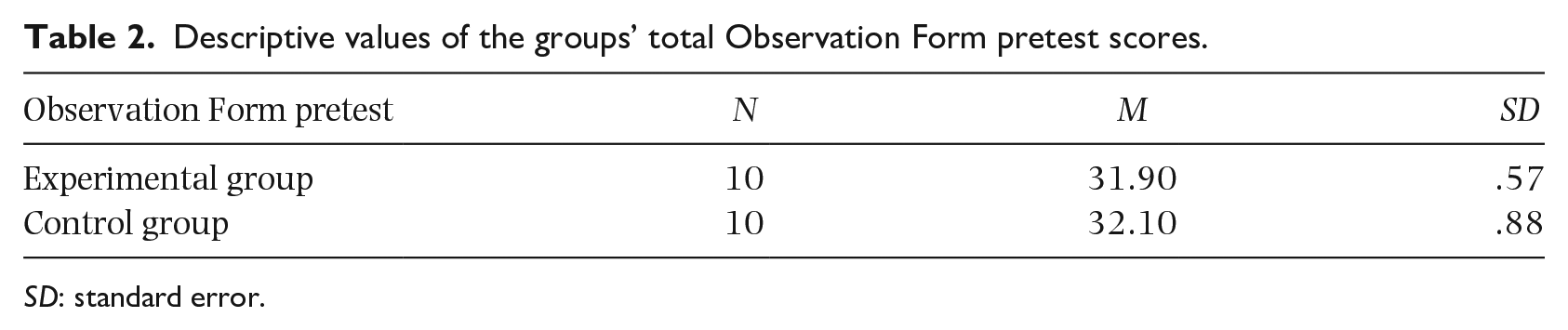
To investigate the pre-experimental equivalence of the experimental and control groups in terms of guitar performance, the results of the pretest applied to both groups were compared. The pretest data of the groups were not normally distributed (experimental group: Shapiro–Wilk (S–W) = .004, p < .05, control group: S–W = .026, p < .05). Therefore, the Mann–Whitney U test, a non-parametric test, was used. The results of this test are given in Table 2.
Descriptive values of the groups’ total Observation Form pretest scores.
SD: standard error.
The experimental group’s mean total Observation Form pretest score was M = 31.90, with a standard deviation of .57. The control group’s mean total Observation Form pretest score was M = 32.10, with a standard deviation of .88.
The results from the Mann–Whitney U test that was performed for the groups’ total Observation Form pretest scores revealed that there was no significant difference between the groups, U = 45.500, p > .05, meaning otherwise, that the groups were equivalent to each other in terms of their total Observation Form pretest scores (Table 3).
Mann–Whitney U test results on the groups’ total Observation Form pretest scores.

Data collection tool
The Observation Form developed by T. Yokuş (2009) was used to determine the preservice teachers’ guitar performance level of achievement. The form consists of 30 items, whose response options are arranged on the basis of a 5-point Likert-type scale (1 = Insufficient, 2 = Barely sufficient, 3 = A little sufficient, 4 = Quite sufficient, and 5 = Completely sufficient). The 30 items are organized under the seven sub-dimensions of (A) Technical, (B) Loudness, (C) Space, (D) Pitch, (E) Timbre, (F) Musical Expression, and (G) Integrity. The minimum and maximum scores possible on the form are 30 and 150, respectively. The study evaluated the preservice teachers’ guitar performance level of achievement according to their total scores on the Observation Form.
Using the Observation Form, the pretest guitar performance measurements were carried out by an expert researcher (guitar educator), while for the final test, an expert educator in the field of music education was added and the guitar performance was measured by these two experts. The guitar performances of the preservice music teachers were videotaped by the researcher, and each observer watched these videos and individually scored them based on the items listed on the Observation Form.
To evaluate the preservice music teachers’ performance, the researcher selected an etude (M. Carcassi Op. 60 no. 2) that was in line with the objectives targeted in the School Instruments III-Guitar course. This selection was evaluated in terms of technical level, musical content, and level of difficulty. Particular attention was given to ensuring that the etude selected by the researcher was reliable in the pedagogical sense and had not been performed by the participants before. Spearman’s rank-order correlation was used to determine whether there was a difference between the experts’ scores in the posttest performance measurements. A significant relationship was found between the scores the raters assigned on the Observation Form, p < .01, meaning there was a significant correlation between the raters’ evaluations of the performances. This infers that both raters largely agreed in terms of performance rating.
Procedure
In this study, the researcher taught the first 4 weeks of the School Instruments III-Guitar course. During this process, the preservice teachers were introduced to the instrument and taught proper holding and sitting position, basic technical information about the instrument, right- and left-hand techniques for the guitar, and the coordination between two hands, and they practiced scales and arpeggios. At the end of the fourth week, the two groups, that is, the experimental and control groups, were randomly created. Next, the groups were asked to sight play M. Carcassi Op. 60 no.2 etude, which had never been previously performed by them, and the measurements related to the guitar performance of the groups were taken. Afterward, studies on tirando, apoyando, legato, barre technique in guitar, position and arpeggio studies, and solving musical and technical problems were held with both groups for 10 weeks, 2 hr per week. During this process, the control group received traditional teaching methods and techniques specified in the curriculum. Along with these topics, the researcher stated the technical and theoretical aspects of the etude addressed and performed a demonstration. Later, the etude was studied with the method of meter to meter and then part to whole with the addition of sentences and sections and the students were asked to perform the etude by focusing on technical and musical elements. During these lessons, students repeated and reinforced the passages they had difficulty performing. As a result, during the 10-week period, courses were given to the control group using teaching methods like lecturing, question–answer, and demonstration. The courses in the experimental group were taught according to the metacognitive strategies-based teaching practice. The step-by-step process carried out within the scope of the courses taught to the experimental group are explained below:
(a) Metacognition and metacognitive strategies were introduced to the preservice music teachers, followed by the presentation of thought-provoking questions related to the guitar performance processes and the offering of tips (e.g., what are you going to do now, what is your aim? What changes do you need to make?) In addition, the preservice music teachers were asked to carry out goal- and attention-based (first week).
(b) The focus of metacognition is self-regulation, not regulation by others. For this reason, it is suggested that students form their own strategies independently, and they are encouraged to use these strategies and engage in self-questioning (Paris, Wixson, & Palincsar, 1986, as cited in the work of Akın & Abacı, 2011). In parallel with this view, questions were asked to facilitate in-depth questioning that would enable the preservice teachers to evaluate their own performances (e.g., is there anything important you overlooked while studying?), and the regulatory control list developed by King (1991, as cited in the work of Schraw, 2002) was given to the participants. The Thinking Diary developed by T. Yokuş (2009) was also given to the preservice teachers for them to make weekly notes of their thoughts regarding the guitar study processes and to raise their awareness about how they cope with the difficulties they encounter (second week).
(c) The preservice music teachers were asked to think aloud and to evaluate their thinking processes and the strategies they used to identify their mistakes and correct them on their own in the developmental process of their performances. Based on the evaluation, their personal needs regarding performance development were determined. Repeating and reinforcing practices involving the melodic, harmonic, and rhythmic structures in the etude were performed using strategies like organizing or summarizing. Also, the preservice music teachers in their performance processes were asked to focus on critical points like correct guitar grip technique and right- and left-hand coordination for the barre chord, ligature, and arpeggio techniques included in the etude (third week).
(d) The preservice music teachers were asked to determine what was useful and what was prohibitive in their studies in terms of achieving the desired level of performance. Moreover, examples were given, and explanations were provided on how to study and how to obtain effective results for being successful (fourth week).
(e) The preservice music teachers were asked to identify any difficulties in determining which technical skills were lacking in the progress of their performances (e.g., what can I do or what cannot I do?). Additionally, the preservice teachers were asked to record their own performances, then listen and evaluate themselves (fifth week).
(f) Strategies (e.g., mental repetition, musical organization, grouping, chaining, etc.) to improve the preservice music teachers’ guitar performances were presented. The preservice music teachers were asked to mentally repeat and reinforce one part or the entire etude through mental playing, mental visualizing, and mental hearing without touching the guitar (sixth week).
(g) The preservice music teachers were supported in organizing and clarifying their interpretations and thoughts regarding their performances and the challenges they identified. The preservice music teachers were asked to pose evaluation questions to improve metacognitive skills such as “In which sections I am successful?”, “In which sections I am not successful?”, and “What should I do differently in my future studies?” (seventh week).
(h) The preservice music teachers were asked to think aloud on their guitar performance in the course process, and the researcher modeled the way ideas were to be used. Strategies (e.g., note taking, organizing, summarizing, and grouping) that can be used regarding the structures indicating similarities and differences between the musical sentences in the etude were exemplified (eighth week).
(i) The preservice music teachers were asked to teach (to be a model to each other) the etude studies to each other during the class hour for them to gain awareness of their thoughts (ninth week).
(j) The “Thought Diaries”, which had been given to the preservice music teachers in the second week and asked to be filled out each week, were evaluated, and an analysis was conducted on whether they had reached the target determined and what could be done differently in further studies to reach their performance targets (tenth week).
Data analysis
To analyze the data obtained from the experimental and control groups’ pre- and posttest scores, the normality of the data was first investigated. Since the sample size was less than 50, the S–W values of the scores were analyzed for the normal distribution. The S–W test results are given in Table 4.
S–W’s test results on the significance level of the scores.
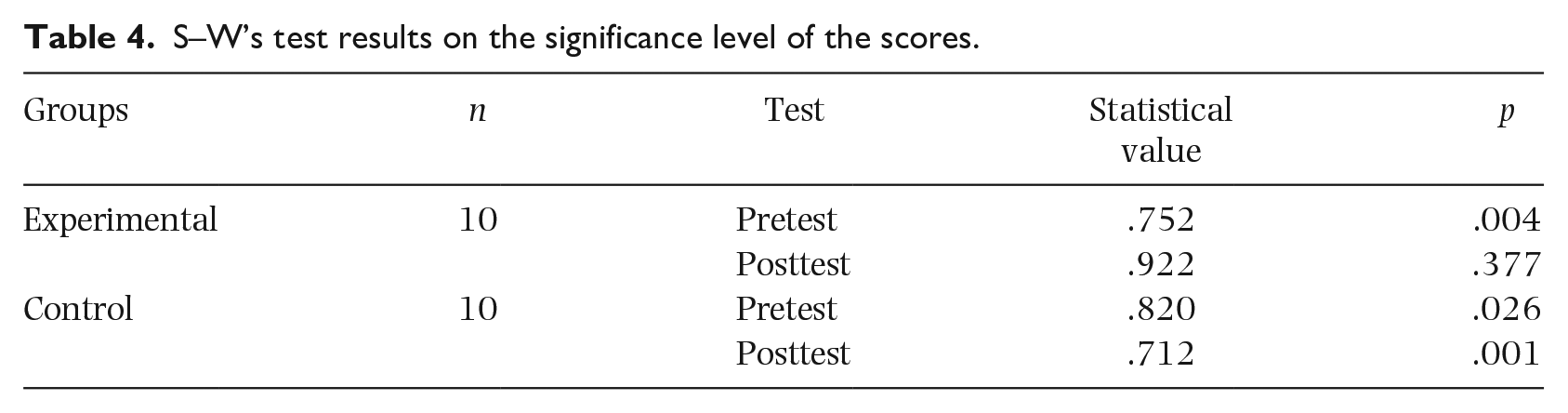
The S–W test results showed that the p-value calculated for the experimental group pretest scores and the control group’s pre- and posttest was lower than α = .05. However, the p-value calculated for the experimental group’s posttest scores was found to be higher than α = .05. Although the experimental group’s posttest scores did not greatly deviate from the normal distribution, it was decided that non-parametric statistical techniques be used considering the low sample size of the study (n = 20).
Independent samples Mann–Whitney U test was used to determine the pre-experimental equivalence of the groups in terms of the dependent variable of the study. To determine the difference between the groups’ achievement in terms of improving guitar performance, Fisher’s Z-transformation was used for the comparison of the pre- and posttest scores of the experimental and control groups. The pre-experimental equivalence of the control and experimental groups were determined. Nevertheless, the comparisons were made on the Fisher Z-scores to control both groups’ scores. Conversely, the related sample Wilcoxon test was administered to the pre- and posttest scores to examine the degree of progress made by the experimental and control groups in terms of the dependent variable. Using these two tests, the effect size values for the Wilcoxon test result for both groups progress in guitar performance were reported and calculated using the formula r = z/√N (Rosenthal, 1991) which transforms the z-score to the effect size predictions. Effect size values calculated were interpreted according to the specifications suggested by Cohen (1988), which were r = .10 for “small effect,” r = .30 for “medium effect,” and r = .50 or above for “large effect.”
Results
In this part, the data related to the research questions are listed, presented in tables, and interpreted.
Results on research question 1 and their interpretation
Is there a significant difference between the pre- and posttest Observation Form scores of the experimental group taught based on the metacognitive strategies-based teaching practice?
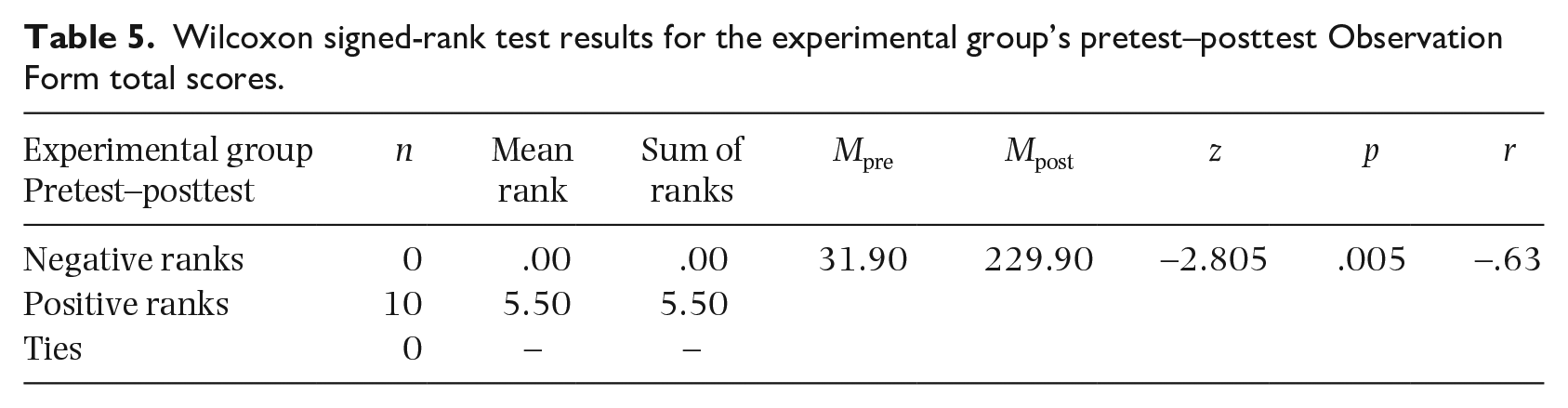
As the Wilcoxon signed-rank test results presented in Table 5 show, the difference in the experimental group was in favor of positive ranks, and after the metacognitive strategies-based teaching practice, the experimental group students’ total posttest scores on guitar performance achievement significantly increased, z = –2.805, p < .05. The effect size calculated was found to be close to the high level (r = –.63), which means that the metacognitive strategies-based teaching practice in guitar education was likely effective in increasing the experimental group students’ guitar performance achievement.
Wilcoxon signed-rank test results for the experimental group’s pretest–posttest Observation Form total scores.
Results on research question 2 and their interpretation
Is there a significant difference between the pre- and posttest Observation Form scores of the control group taught based on the traditional curriculum-based education?
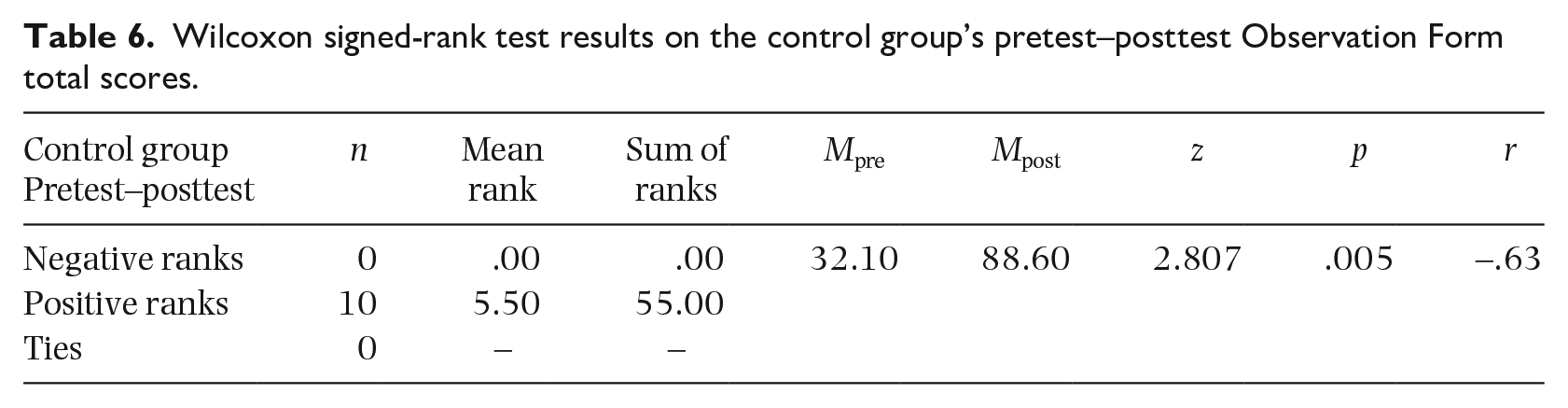
As the Wilcoxon signed-rank test results presented in Table 6 show, the difference in the control group was in favor of positive ranks, and after the teaching practice based on the traditional curriculum-based education, the control group students’ total posttest scores on the guitar performance achievement significantly increased, z = –2.807, p < .05. The effect size calculated was found to be close to the high level (r = –.63), which means that after the teaching based on the traditional curriculum-based education, the control group students, compared with the situation before the teaching, improved their guitar performance.
Wilcoxon signed-rank test results on the control group’s pretest–posttest Observation Form total scores.
Results on research question 3 and their interpretation
Is there significant difference between the pre- and posttest Observation Form scores of the experimental group and the control group?
As presented in Table 7, no significant difference was found between the pre- and posttest scores of the experimental and the control groups’ Observation Forms. The results showed that both the traditional curriculum-based guitar education and metacognitive strategies-based guitar education positively affected students’ guitar performance achievement. The difference between the teaching methods used were quite large. However, this difference was not significant due to the small number of groups, z = .75, p > .05.
Fisher’s Z-test results of the pre- and posttest Observation Form scores of the experimental and the control groups.

Discussion
At the core of all the skills aimed to be developed in line with the objectives of music education is a process that requires human conscious activity. This process is only possible through the performance of conscious teaching practices (H. Yokuş & Yokuş, 2010). If teachers offer opportunities to their students to improve metacognitive skills and assist them in doing this, then in cases where their students are not sure what to do, learning can be improved (Barry, 1992; Barry & McArthur, 1994; Fry & Lupart, 1987: as cited in the work of Guerrero, 2008; T. Yokuş, 2009). On the other hand, music performance requires that students have a high degree of self-knowledge and strong awareness of their cognitive processes. In this regard, it can be said that metacognitive strategies should be used to develop performance in music education programs (Hanna, 2007).
Studies conducted on music education have reported there to be a positive relationship between musical achievement and metacognition. Performance achievement in the musical sense can be described as the positive aspect of mental or operational activities that are implemented or carried out musically. In this regard, in a study by Bartolome (2009), the results showed that the use of self-regulation strategies in music education is related to high-level performance achievement, and a positive relationship between musical achievement and the use of self-regulation strategies was reported. However, some studies on instrument education indicate that students with advanced music education and professional musicians have stronger self-regulation skills, and that professional musicians make more use of metacognitive strategies in their performance work processes (Hallam, 2001; Nielsen, 2001, 2004).
Studies on music education have generally reported there to be a positive correlation between metacognitive competence and academic achievement (T. Yokuş, 2010a; T. Yokuş & Yürüdür, 2015). Similar to those studies, Okay (2016) also investigated the metacognitive competence of preservice music teachers in terms of certain variables but reported there to be a weak negative correlation between preservice music teachers’ metacognitive competence and their academic achievement. The teacher-centered method followed in the curriculum was highlighted as one of the reasons behind this result. In this regard, it was suggested that opportunities be created for students to discover themselves, that metacognitive strategies be included in the music education curricula, and that these curricula be based on a more constructive approach.
The present study was conducted to determine the effect of a metacognitive strategies-based teaching practice, performed by the researcher within the scope of the School Instruments III-Guitar course offered by the Department of Music Education under the school of Fine Arts Education within the Educational Faculty of Muğla Sıtkı Koçman University in Turkey, on preservice music teachers’ guitar performance achievement. The results derived from the study indicated there to be significant differences, at the .05 interval, between the experimental and control groups’ pre- and posttest scores. Considering this result, it can be said that the metacognitive strategies-based teaching practice applied to the experimental group was effective in improving the experimental group’s guitar performance achievement. Following the education received by the control group, which was taught according to the traditional curriculum-based education, their guitar performance achievement also increased. Regarding the education process (10 weeks) carried out within the scope of this study, it was expected that the control group too would improve their guitar performance achievement. In comparing the pre- and posttest scores of the experimental and control groups of the study, the difference was not significant, even though it was large. This might stem from the study being tested on a small group and therefore a weak statistical power to detect an effect in favor of the experimental group was seen. This result indicated that the metacognitive strategies-based teaching practice in guitar education, as an effective alternative to the traditional curriculum-based method, can be used to achieve improvement in guitar performance. Some studies encountered in the literature on guitar education corroborate that metacognitive strategies can be used in guitar education and metacognition-based education practices are effective. T. Yokuş (2010b) examined the effect of improving metacognition in guitar education, the individual instrument included in the undergraduate program of the Music Education Department of Fine Arts Education Faculty on guitar performance achievement. The study was designed as an experimental study and found that a teaching program applied based on improving metacognition in guitar education, compared with the traditional curriculum-based education, is much more effective in increasing students’ guitar performance achievement. In a different experimental study conducted with students taking guitar education at the undergraduate level, Ergin and Durak (2016) investigated the effect of an education process based on metacognition and self-regulation steps on students’ sight playing performance and their attitudes regarding sight playing. They found that the metacognition and self-regulation steps positively affected students’ ability to sight play and their attitudes regarding sight playing.
Studies addressing teaching methods as metacognitive strategies-based in jazz music, as well as classical music, are encountered in the related literature regarding guitar education. For example, a book by Goodrick (1987) gives practical information on guitar playing techniques and styles for guitarists who wish to progress. The book presents information in an article format and includes discussion topics such as modes, scales, chords, self-criticism, improvising short pieces, and different playing situations. The book titled “The Fundamentals of Guitar” by Okazaki (2015) presents various visual material encouraging and inspiring readers to interact with their thoughts.
In research conducted on different types of instruments within the scope of instrument education, Kurtuldu (2011) investigated the effect of executive cognition-based attitudes on piano performance achievement and found that second-year undergraduate students’ executive cognition-based attitudes regarding the piano course greatly affected their playing performance. In a different experimental study, Bathgate et al. (2012) worked with 35 adolescent students who could read music notes and had at most 3 years of experience of playing piano or guitar. They reported that students who were taught with a metacognition-based perspective, compared with students who were not taught with a metacognition-based perspective, reached a higher performance level. They also noted that students make better musical progress and therefore display more successful performances when they are aware of their strengths and weaknesses, identify study strategies suitable to them, and verbally express their development by directing their learning. Miksza (2015) conducted an experimental study with 28 students taking an undergraduate-level music education course and found that practices involving setting a goal, planning, or self-evaluation, all of which are based on personal learning experiences to improve instrument performances, are effective for students in terms of attaining key objectives for their performances. In addition, they indicated that teaching practices based on self-regulation are effective in improving student performance achievement. The results obtained by all the aforementioned studies corroborate the positive effect of metacognitive strategies-based teaching practice in instrument education on performance achievement.
In conclusion, considering the effectiveness of the metacognitive strategies-based teaching practice in guitar education on guitar performance achievement, it can be suggested that metacognitive strategies, as an effective alternative to the traditional curriculum-based guitar education be used for guitar education and instrument education in music education programs and other courses. In addition, further studies should be conducted on the effect of using metacognitive strategies in music education on other courses in the field of music, its effect on permanent learning, and its effect on advanced guitar players’ performance achievement. Further experimental studies should also be conducted with larger study groups or samples to reveal a significant difference in favor of the group where metacognitive strategies-based teaching practices are performed.
