



Abstract
Mindfulness meditation has frequently used sound and music as an important component. However, research on effective music stimuli is scarce. After a series of studies evaluating the most effective, useful, and preferred auditory stimuli, we were interested in exploring whether these effective musical features were transferred to new music. In this study, we evaluate our original music stimuli with three new stimuli composed under similar principles. Non-musician and musician participants (N = 114) in a multisite study evaluated their mindfulness state after listening to four music stimuli, and rated their usefulness and preference. Results from a repeated-measures analysis of variance (ANOVA) at each site indicated no significant difference in mindfulness effectiveness. Friedman’s ANOVAs for the usefulness of the music stimuli showed similar non-significant results in both sites. A mixed model among sites did not show significant differences among groups. Preference rankings were not significantly different for non-musicians, but musicians did show a statistically significant preference of the Original stimuli over Stimulus 2, probably due to sound quality. These results indicate the feasibility of transferring previously researched and effective musical features to new stimuli. Identifying the effective “active ingredients” of music interventions may be one way of supporting evidence-based practice in music therapy.
Mindfulness is the capacity to be aware and attentive to the present moment, without judgment, attachment to thoughts, feelings, past events, or preoccupation for the future (Kabat-Zinn, 2012). As with any human capacity, mindfulness can be improved through practice or therapeutic intervention (Bishop et al., 2004). Mindfulness practice can be found in many forms, with or without religious connotations, in health care interventions or daily activities (Birtwell, Williams, van Marwijk, & Armitage, & Sheffield, 2019; Csikszentmihalyi, 1990; Husgafvel, 2016). As a secular health care intervention, research establishes mindfulness practice as a useful treatment for anxiety, depression, and substance abuse, to name a few applications (Barnhofer et al, 2009; Bowen, De Boer, & Bergman, 2017; Brown & Ryan, 2003; Williams et al., 2014).
Sound and music are used in mindfulness meditation and may be an integral part of different practices (Baylan et al., 2018; Bell, McIntyre, & Hadley, 2016; Diaz, 2011; Kabat-Zinn, 1990; Lesiuk, 2016). However, empirical investigation of the use and impact of music on mindfulness meditation is scarce (Dvorak & Hernandez-Ruiz, 2019; Eckhardt & Dinsmore, 2012; Goldberg, 2015; Graham, 2010; Hernandez-Ruiz & Dvorak, 2020; Hernandez-Ruiz, Dvorak, & Weingarten, 2020; Lesiuk, 2015). To illustrate an example, we review Lesiuk’s (2015, 2016) work in an innovative Mindfulness-Based Music Therapy program for women receiving chemotherapy for breast cancer.1
Based on the Mindfulness-Based Stress Reduction program (Kabat-Zinn, 1990), Lesiuk (2016) designed and led music interventions where participants practiced elements of the program and transferred them to daily life through music interventions, and where music was the essential tool for the practices. Music interventions focused on four of the seven mindfulness attitudes: non-judging, beginner’s mind, suspending judgment, and acceptance and letting go. Participants practiced these attitudes in both receptive (i.e., listening) and expressive (i.e., singing, playing, moving, creating) music interventions. For example, participants listened with full attention and awareness to sounds, music improvisations, or familiar music; imitated simple rhythmic and harmonic patterns with percussion instruments to cultivate a beginner’s mind; or experienced music-assisted relaxation to cultivate the attitudes of acceptance and letting go. The music therapist encouraged homework activities with recorded music for generalization and transfer to everyday life (Lesiuk, 2016).
Despite this valuable application of music within mindfulness practices, the rationale for music choices was undefined. Both improvised and pre-composed music interventions were used with attention to behavioral components of the mindfulness activity (e.g., whether the music supported attentive listening). However, specific features of the music, such as tempo, rhythm, or harmony, were not described (Lesiuk, 2016). Although reasonable to suppose that the author, a trained music therapist, paid attention to musical features when selecting music, the criteria guiding these choices were not clearly reported.
Given the complexity of Lesiuk’s (2016) program, some applications used music in different ways that were not always clearly articulated. For example, music interventions used music as the focus of meditation practice (e.g., listening to a piano improvisation piece to promote non-judging), and others as a supportive environmental stimulus for mindfulness practice (e.g., music played as background during relaxation with a script to promote acceptance). Dvorak (in review) identified three functions of music in mindfulness meditation: (a) music as a support for mindfulness meditation, (b) music as a focus for mindful listening, and (c) music as a focus for mindful active engagement. In Lesiuk (2015), all three functions of the music are present but not clearly separated.
As Lesiuk’s (2015) pilot study assessed program effectiveness, without differentiation among interventions, one cannot determine which musical elements constituted the “active ingredients” of any of the music interventions. Current thinking in music therapy research suggests that identifying the “active ingredients” of an intervention can support replication and identification of mechanisms of action (Hanson-Abromeit, 2015). This information can support evidence-based practice: effective “ingredients” may be transferrable to new music, which can then be created or selected, while attending to cultural differences and individual preferences.
To investigate the role of different musical elements and music complexity on mindfulness practice, we developed a line of research investigating music stimuli and mindfulness. In three studies using repeated-measures and mixed-model designs, with a total of 156 participants, we considered musical features that may support mindfulness practice. In an initial study (Dvorak & Hernandez-Ruiz, 2019), we presented an original, unfamiliar musical stimulus composed with minimal timbral, melodic and harmonic complexity, created by layering a steady tone (played with a sampled counterbass), harmonic progression (I vi V ii chords, played with a sampled string ensemble), and melody (played with a sampled viola). We paired the music composition with a mindfulness script (labeled Melody), and compared it with a script without music (labeled Script), a script with the steady tone only (labeled Steady Tone), and a script with the same tone and the simple harmonic progression (labeled Harmony). We then compared musician and non-musician responses (Hernandez-Ruiz et al., 2020), and we replicated the original study in a new setting (Hernandez-Ruiz & Dvorak, 2020). We also assessed participants’ absorption in music, the degree to which each person immerses themselves in a musical stimulus (Sandstrom & Russo, 2013), as a possible moderator of the music intervention.
Our findings indicate that less complexity (Script and Steady Tone) seemed more effective for non-musicians (Dvorak & Hernandez-Ruiz, 2019) but only when absorption of music was not accounted for, indicating a possible moderating effect of absorption in music on the intervention. However, this moderating effect was not found among musicians (Hernandez-Ruiz et al., 2020) nor in the replication study (Hernandez-Ruiz & Dvorak, 2020), and no condition was found to be more effective in the latter studies (Hernandez-Ruiz & Dvorak, 2020; Hernandez-Ruiz et al., 2020). Despite this apparent discrepancy, multilevel analysis between the original (Dvorak & Hernandez-Ruiz, 2019) and replication study (Hernandez-Ruiz & Dvorak, 2020) indicated no overall significant differences in mindfulness effectiveness across studies when absorption in music was considered.
Interestingly, although music condition did not seem to impact a mindfulness meditation practice, the most complex stimulus of Melody (with a script, steady tone, harmonic progression, and melody) was indeed reported as most preferred and most useful by both musicians and non-musicians (Dvorak & Hernandez-Ruiz, 2019; Hernandez-Ruiz & Dvorak, 2020; Hernandez-Ruiz et al., 2020). The discrepancy between mindfulness effectiveness, preference, and usefulness ratings may be explained by the fact that the most “complex” music stimulus was still quite simple, and may have been at the ideal level of complexity (Berlyne, 1971) to generate preference as well as being more readily identified as “music.”
Purpose statement
Music therapy practice stands to benefit from research that identifies the best musical stimuli for interventions. After identifying the most preferred and useful stimulus (among equally effective conditions) in previous studies, we were interested in investigating whether novel stimuli composed under similar compositional principles were equally effective for mindfulness practice, and whether participants rated their preference and usefulness in a similar way. In an effort to understand the impact of musical experience and setting on the results, we conducted a multisite study with simultaneous implementation of the mindfulness and music intervention with non-musicians on Site 1, and musicians on Site 2. Furthermore, as this study was embedded within a course-based undergraduate research experience, we wanted to explore whether these music principles were readily understood and could be implemented by other musicians (i.e., music therapy and music education students in a Psychology of Music class). Students received instructions to create novel music based on the following parameters: a steady tone played with a sampled counterbass, with a simple rhythmic pattern; predictable, consonant harmonies played with sampled string orchestra sound; and repetition of an 8-bar musical phrase with a repetitive motif, and simple, non-syncopated rhythm in the melody played with a sampled viola sound (please see Dvorak & Hernandez-Ruiz, 2019, for the rationale for these choices).
Research questions
For each site, the following research questions were investigated and analyzed separately:
Do four auditory stimuli with similar components (i.e., script, steady tone, harmony, and melody) and similar compositional features have comparable effects on mindfulness practice, as reported by participants?
Does level of absorption in music moderate participant responses to the stimuli?
Which stimulus is considered by participants to be more useful for mindfulness meditation?
Which stimulus is most preferred by participants for mindfulness meditation?
The following research questions were investigated by pooling the data from both sites:
5. Do non-musicians at Site 1 and musicians at Site 2 demonstrate similar responses regarding the effectiveness of the four stimuli for mindfulness practice?
6. Do non-musicians and musicians indicate similar usefulness ratings of the four stimuli?
7. Do non-musicians and musicians indicate a similar preference ranking pattern of the four stimuli?
Considering our previous studies (Dvorak & Hernandez-Ruiz, 2019; Hernandez-Ruiz & Dvorak, 2020; Hernandez-Ruiz et al., 2020), and that all stimuli were composed under similar research-based principles, we hypothesized that all music stimuli would be equally effective for mindfulness practice, and that no music stimulus would be considered more useful. However, based on our previous comparison of non-musician and musician responses (Hernandez-Ruiz et al., 2020), and previous research that demonstrates differential responses to music between musicians and non-musicians (Deguchi et al., 2012; Hartmann, Lartillot, & Toiviainen, 2017; Larrouy-Maestri, Magis, Grabenhorst, & Morsomme, 2015), we hypothesized that musicians may demonstrate a significantly different preference for one of the stimuli, indicating a more nuanced understanding of the music.
Method
Recruitment and informed consent
The study received approval from the respective Human Research Protection Program (#00009218 and #00141275) at each of the two sites prior to participant enrollment. Participants were recruited through an online student recruitment system (SONA Systems Software, 2018) at both sites (which allows for rapid recruitment of student participants outside of our schools of music) and through invitation to students in music theory classes (Site 2 only). Participants recruited through SONA received research credit in a psychology course. To avoid interference with mindfulness experiences, students were asked to refrain from alcohol, drugs, and medication consumption (except contraceptives) 36 hr prior to the study, and caffeine or exercise 3 hr prior to the study. When students arrived at their scheduled appointment, the researchers explained the informed consent, allowed time for questions, and invited the students to participate. Participants signed the informed consent document prior to starting the study.
Participants
Participants were college students at two large research-intensive universities. For Site 1, only participants with five or fewer years of formal music training (i.e., non-musicians) were enrolled; for Site 2, only participants having more than 5 years of formal music (i.e., musicians) were enrolled. Furthermore, participants were selected if they were (a) over the age of 18; (b) enrolled in SONA or a music theory class; (c) able to speak, read, and write in English; and (d) with no significant hearing loss that impacted their ability to listen to music using headphones at 55 dB. A priori power analyses with online computational programs G*Power and GLIMMPSE (Kreidler et al., 2013) indicated that a sample size of 32 (GLIMMPSE) to 35 (G*Power) would yield a power of .80 (α = .05). Our sample sizes (n1 = 57; n2 = 65) exceeded the minimum requirements for a well-powered study, giving confidence to our results by decreasing the probability of showing null results when there might be, in fact, a significant difference between them (Type II error).
The demographic data for participants in both sites were analyzed through descriptive analysis and are reported in Table 1. Eight participants from Site 2 were excluded (for a final n2 = 57), as they indicated that they had 5 or less years of music experience, thus not fulfilling our inclusion criteria. Although definitions of “musician” vary among studies, previous research, including our own, has used more than 5 years of formal training as an operational definition of “musician” (Chapin et al., 2010; Dvorak & Hernandez-Ruiz, 2019; Hernandez-Ruiz & Dvorak, 2020; Hernandez-Ruiz et al., 2020). As mentioned, music training can impact music perception and preference (Deguchi et al., 2012; Hartmann et al., 2017; Larrouy-Maestri et al., 2015).
Demographic information for participants.
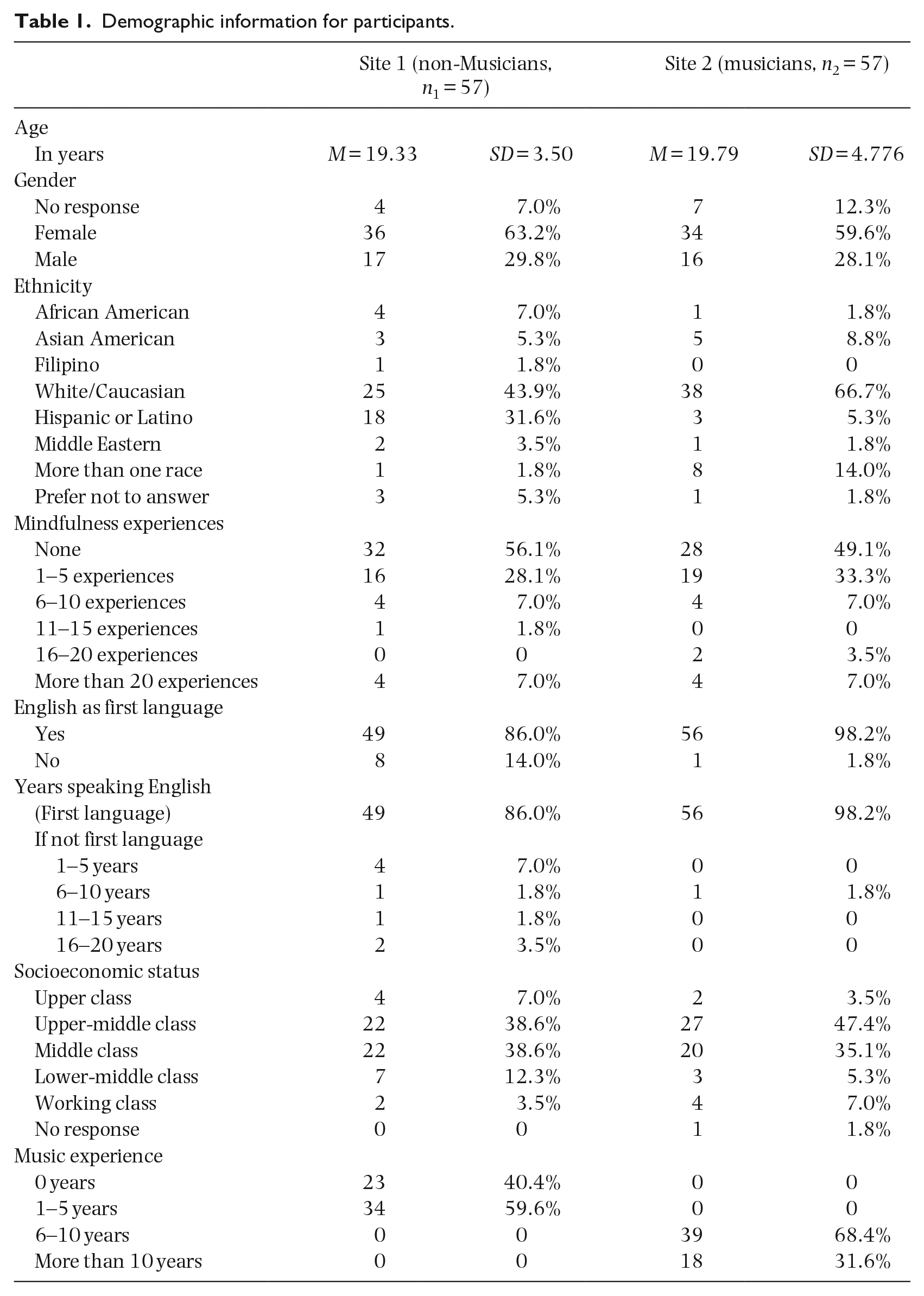
Most participants were young adults, mostly Caucasian/White (although Site 1 was more diverse, with only 44% participants identifying as Caucasian/White, compared to 67% in Site 2), female, from middle to upper class, with English as their first language or having spoken it for more than 11 years. Most participants (n1 = 52, 91.2%, and n2 = 51, 89.4%) were naïve to mindfulness practice, with 10 or fewer unique mindfulness experiences previous to this study. A unique mindfulness experience was defined as listening to one meditation recording, attending one short workshop, engaging in meditation practice one time, or a similar short experience.
Study design
This study was a follow-up to previous studies (Dvorak & Hernandez-Ruiz, 2019; Hernandez-Ruiz & Dvorak, 2020; Hernandez-Ruiz et al., 2020) with a similar repeated-measures design where the four auditory stimuli were counterbalanced and randomized across participants. All participants received all conditions. Three-minute pauses interspersed between each condition avoided carry-over effects and allowed participants to answer a brief questionnaire. The total testing period for each of the participants was approximately 40-min long. Participants were tested in groups of one to five at a time in music perception laboratories.
To compare musician and non-musician responses, data from both sites were pooled. A mixed design was used for the Mindfulness Attention Awareness Scale (MAAS) scores, with the four stimuli as the within-subjects factor, and the group (musicians and non-musicians) as the between-subjects factor. To compare responses from the Usefulness ratings and Preference rankings for musicians and non-musicians, median scores for each condition were graphically displayed and compared.
Measures
Absorption in Music Scale
The 34-item Absorption in Music Scale (AIMS; Sandstrom & Russo, 2013) measures the individual’s level of immersion in an emotional experience while listening to music. A person’s level of absorption in music may help explain dissimilar findings in psychological and physiological responses to music (Sandstrom & Russo, 2013). Researchers included this scale as a covariate, as our previous results demonstrated that absorption in music may moderate the effect of music on the mindfulness meditation experience. Psychometric information for the AIMS is available in Dvorak and Hernandez-Ruiz (2019).
MAAS
The MAAS (Brown & Ryan, 2003) assessed participants’ mindful state after each condition by asking them to rate their experience on seven items using a 6-point Likert-type scale (almost always to almost never experienced). For the purposes of the MAAS construction, Brown and Ryan (2003) defined mindfulness as “enhanced attention to and awareness of current experience of present reality” (p. 822). We used a modified version of this measure. Brown and Ryan (2003) tested a State version of the MAAS (internal consistency = .92). As reported in our previous studies (Dvorak & Hernandez-Ruiz, 2019; Hernandez-Ruiz & Dvorak, 2020; Hernandez-Ruiz et al., 2020), we used this State version but excluded Question 8 (due to similarity to Question 10), and added three more questions (1, 5, and 11 of the original MAAS) to reflect in-the-moment mindful states while performing the intervention. Please see Dvorak and Hernandez-Ruiz (2019) for further details on the measures.
Usefulness rating
To determine usefulness, participants rated their agreement to the statement I found this piece useful for this mindfulness experience on a Likert-type scale from 1 (strongly disagree) to 7 (strongly agree), after listening to each stimulus.
Ranked rating of preference
At the end of the study, participants ranked the four auditory stimuli in order of preference. To allow for effective comparisons and ensure focus on preference, participants listened again to the first 45 s of each stimulus as reminders, then ranked the stimuli from 1 (most preferred) to 4 (least preferred).
Materials
Demographic form
Participants responded to an online demographic questionnaire for age, gender, major, hearing, religion, first language, socioeconomic status, year in school, previous mindfulness training, and previous musical experience. This information was gathered for population description and explored for patterns.
Music stimuli
The original composition (i.e., labeled Original for the purposes of this study) was used in previous studies (Dvorak & Hernandez-Ruiz, 2019; Hernandez-Ruiz & Dvorak, 2020; Hernandez-Ruiz et al., 2020), based on music elements considered most conducive to support mindfulness meditation. The script included common mindfulness words, phrases, and images found in the literature and focused on the mindfulness skill of observing (Kabat-Zinn, 1990; Linehan, 2015; Rathus & Miller, 2015). The original music stimulus was a four-track recording that included the recorded speaking voice (Track 1); a steady beat in the bass, with a simple rhythmic pattern (Track 2); predictable, consonant harmonies played with sampled string orchestra sound (Track 3); and repetition of an 8-bar musical phrase with a repetitive motif, and simple, non-syncopated rhythm in the melody played with a sampled viola sound (Track 4). The piece had a moderate tempo (60–80 bpm), pleasing timbre, and constant dynamics (see Dvorak & Hernandez-Ruiz, 2019, for further details). “Pleasing” is defined here as soft, mellow, legato sounds, traits commonly associated with string instruments and considered agreeable to many Western listeners.
For the other three music stimuli, teams of three or four music psychology students at each site—who were participating in this project as part of a course-based research experience—crafted music stimuli (n = 16 stimuli) with the aforementioned compositional features of the original stimulus. Students recorded their stimulus and provided the recordings to the researchers. The first author created an online survey where the music students at both sites listened to all 16 stimuli. Using a 6-point scale, students scored the compliance of each stimuli to the given music requirements and their appropriateness for mindfulness meditation practice (see Appendix 1). Compliance and Appropriateness scores were averaged across raters; the three stimuli with the highest mean scores in both were selected as the comparison stimuli for this project. The selected stimuli are available for review at https://soundcloud.com/mindfulness-music/sets/music-and-mindfulness-study-4/s-ezKcLU6avij
Procedure
Given that this study was a follow-up to previous studies, the procedure was identical as reported in Dvorak and Hernandez-Ruiz (2019). In summary, after providing informed consent, participants shared demographic information; listened to the auditory stimuli; responded through an online platform to the MAAS, the AIMS, and Usefulness ratings after each stimulus; and provided Preference rankings for all stimuli at the end. Further details can be found in Dvorak and Hernandez-Ruiz (2019).
Results
The first four research questions were analyzed separately for each site, and are reported as such here. The remaining three research questions combine site data for comparison.
Site 1: Non-musicians
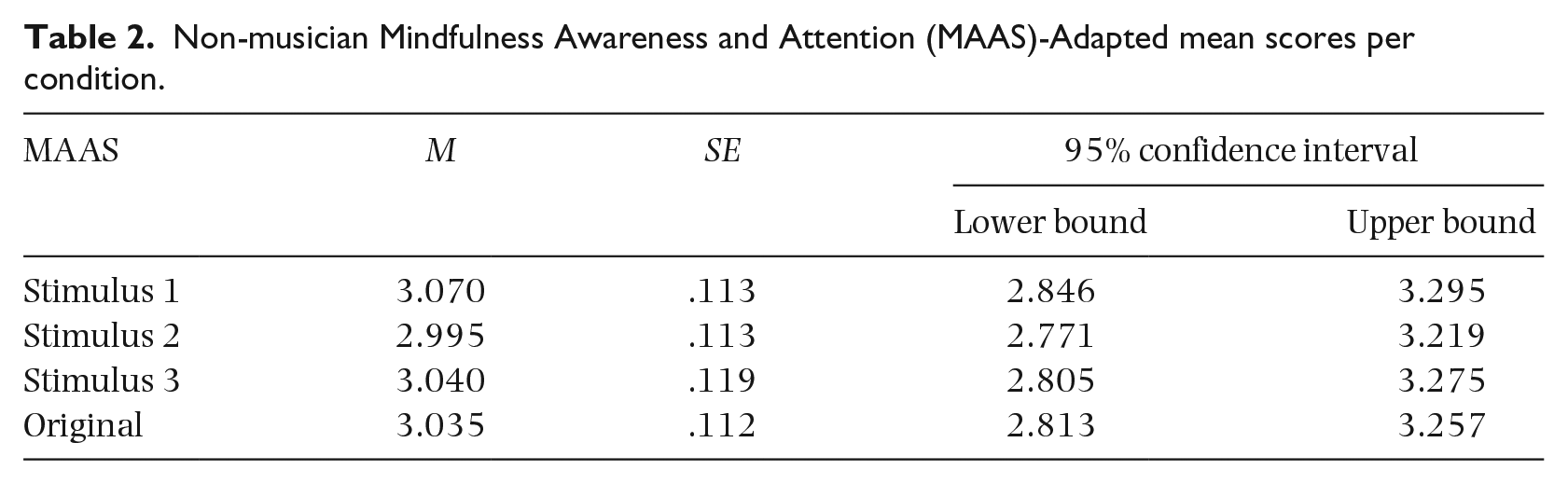
To answer the first research question, Do four auditory stimuli with similar components (i.e., script, steady tone, harmony, and melody) and similar compositional features have comparable effects on mindfulness practice, as reported by participants? descriptive statistics and a repeated-measures analysis of variance (ANOVA) were used to compare non-musicians’ scores in the MAAS-Adapted between conditions (i.e., stimuli). An exploration of outliers indicated no outlier for the MAAS, and Shapiro–Wilk tests and Q-Q plots indicated normal samples for the MAAS in all conditions. Results indicated a similar effect of all stimuli on mindfulness with no significant differences between conditions, F(3, 168) = .16, p = .926, η2 = .003, power = .078; sphericity assumed. Table 2 provides means and standard errors of conditions. Given that results among conditions in the MAAS scores were not statistically significant, we did not conduct moderation analysis with the AIMS scores (Question 2).
Non-musician Mindfulness Awareness and Attention (MAAS)-Adapted mean scores per condition.
To investigate perceived usefulness of the different auditory stimuli (Question 3), non-musicians (n1 = 57) rated their agreement to the statement, I found this piece useful for this mindfulness experience, with a 7-item Likert-type scale, from strongly disagree to strongly agree. Due to significant Shapiro–Wilks tests, indicating non-normal samples for all conditions, a Friedman’s ANOVA was used. Results showed no significant differences between conditions, χ2(3) = 3.00, n1 = 57, p = .392, indicating that all music stimuli were considered similarly useful for the mindfulness practice.
Preference of music stimuli (Question 4) was investigated by asking non-musicians (n = 57) to rank the four conditions from most (= 1) to least preferred (= 4). A Friedman’s ANOVA revealed no significant difference between conditions, χ2(3) = 1.695, p = .638.
Site 2: Musicians
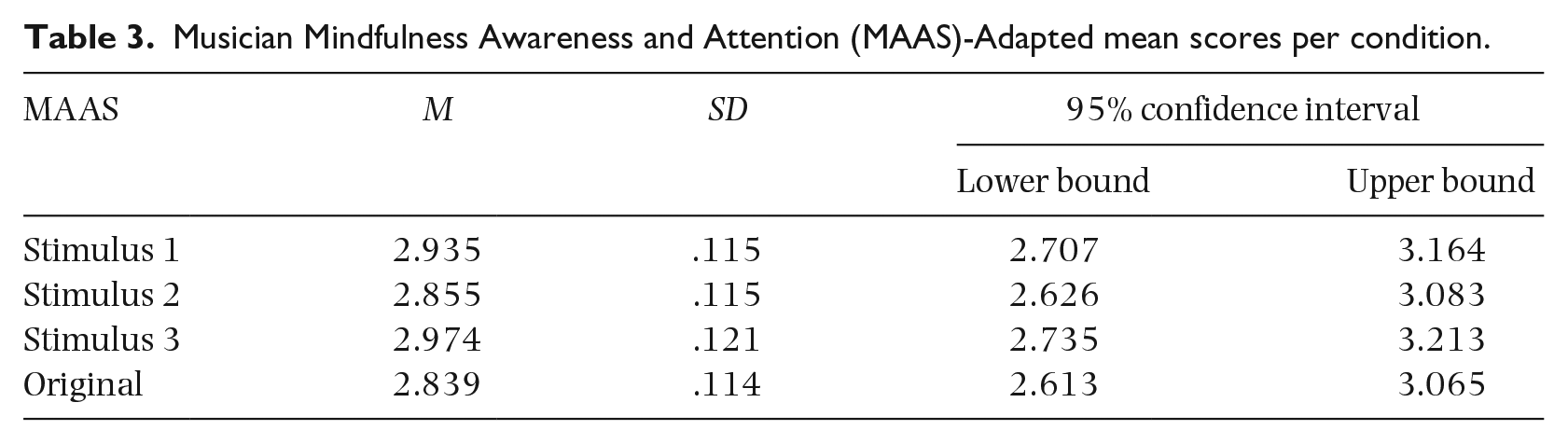
To answer the first research question, Do four auditory stimuli with similar components (i.e., script, beat, harmony, and melody) and similar compositional features have a similar effect on mindfulness practice, as reported by participants? descriptive statistics and a repeated-measures ANOVA were used to compare the musicians’ scores in the MAAS-Adapted between conditions. An exploration of outliers indicated an outlier for the Original stimulus, which was excluded from analysis, for a total sample size of 56. Shapiro–Wilk tests and Q-Q plots indicated normal samples for the MAAS-Adapted in all conditions. Results indicated no significant differences between conditions, F(3, 186) = .57, p = .635, η2 = .010, power = .166; sphericity assumed. Table 3 provides means, standard errors, and confidence intervals (CIs) of each stimulus. Given the non-significant results among conditions in the MAAS scores, we did not conduct moderation analysis with the AIMS scores (Question 2).
Musician Mindfulness Awareness and Attention (MAAS)-Adapted mean scores per condition.
To investigate perceived usefulness of the different auditory stimuli (Question 3), musicians (n = 57) rated their agreement to the statement, I found this piece useful for this mindfulness experience, with a 7-item Likert-type scale, from strongly disagree to strongly agree. Due to significant Shapiro–Wilk tests, indicating non-normal samples for all conditions, a Friedman’s ANOVA was used. Results indicated no significant differences between conditions, χ2(3) = 4.48, n = 55, p = .214.
Preference of music stimuli (Question 4) was investigated by asking participants (n = 56) to rank the four conditions from most (= 1) to least preferred (= 4). A Friedman’s ANOVA revealed overall significant differences between conditions, χ2(3) = 14.464, p = .002. Post hoc Wilcoxon signed rank tests (α = .008 after Bonferroni corrections for multiple comparisons) indicated a significant difference between Stimulus 2 and the Original stimulus, Z = 2.841, p = .005, with the Original stimulus being most preferred. No other pairwise comparisons were significantly different.
Comparison between sites
To answer the fifth research question regarding comparisons between musicians and non-musicians, data from both sites were pooled, for a total of 114 participants (57 non-musicians, 57 musicians, excluding outliers and missing data). Demographic data for both groups are presented on Table 1. For the MAAS scores, a mixed effects design (within-between subjects) was used, defining the four auditory conditions as the within-subjects factor, and the two groups (musicians, non-musicians) as the between-subjects factor. The within-subjects test indicated a non-significant simple effect, F(3, 330) = .55, p = .648, η2 = .005, power = .163, sphericity assumed. The between-subjects test indicated no overall significant difference between groups, F(1, 110) = 1.094, p = .298, η2 = .010, power = .179 (Figure 1).
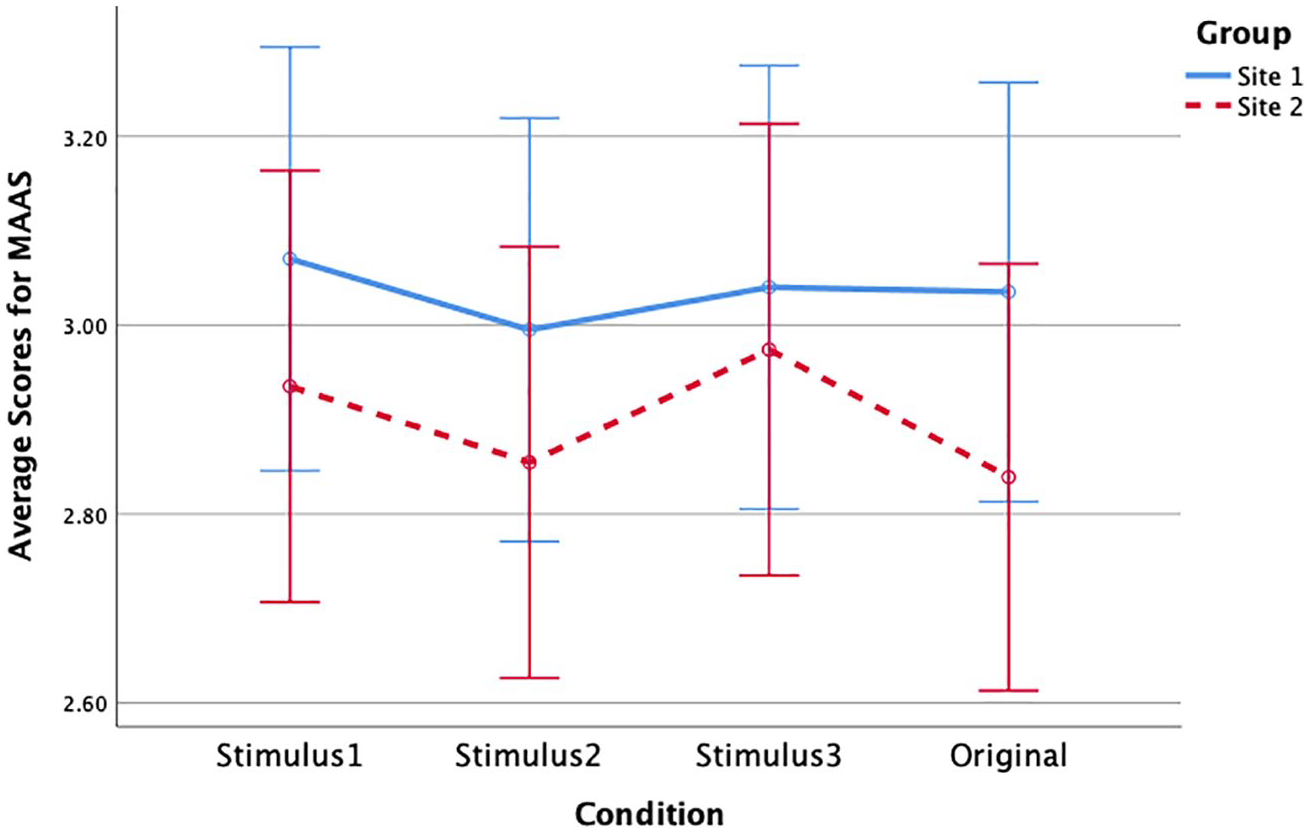
Average MAAS scores for site 1 (Non-Musicians) and site 2 (Musicians). Error bars represent the 95% CI. Higher scores reflect higher levels of dispositional mindfulness (Brown & Ryan, 2003).
Usefulness median scores per group were graphed and compared. Due to non-normality, parametric analyses were not possible. Graphic evaluation of results showed very similar patterns of response for both groups, with slightly lower scores for Stimulus 2 for non-musicians (Figure 2). Preference median rankings were also graphed and compared, showing similar patterns of response, but a clear difference between Stimulus 2 and the Original stimulus for musicians, as noted before (Figure 3).
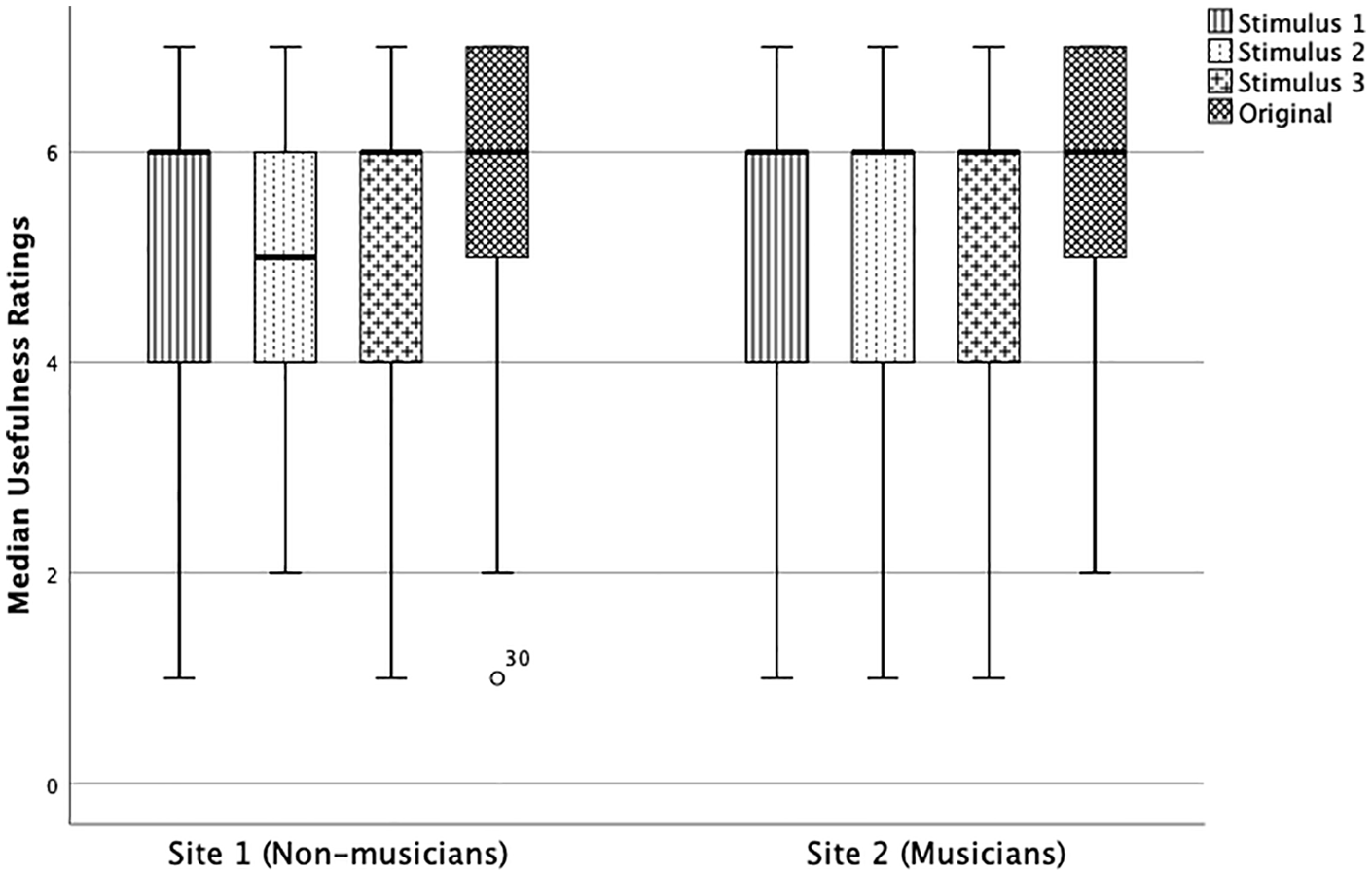
Median Usefulness scores for Site 1 (Non-Musicians) and Site 2 (Musicians) per condition. Higher score is considered more useful.
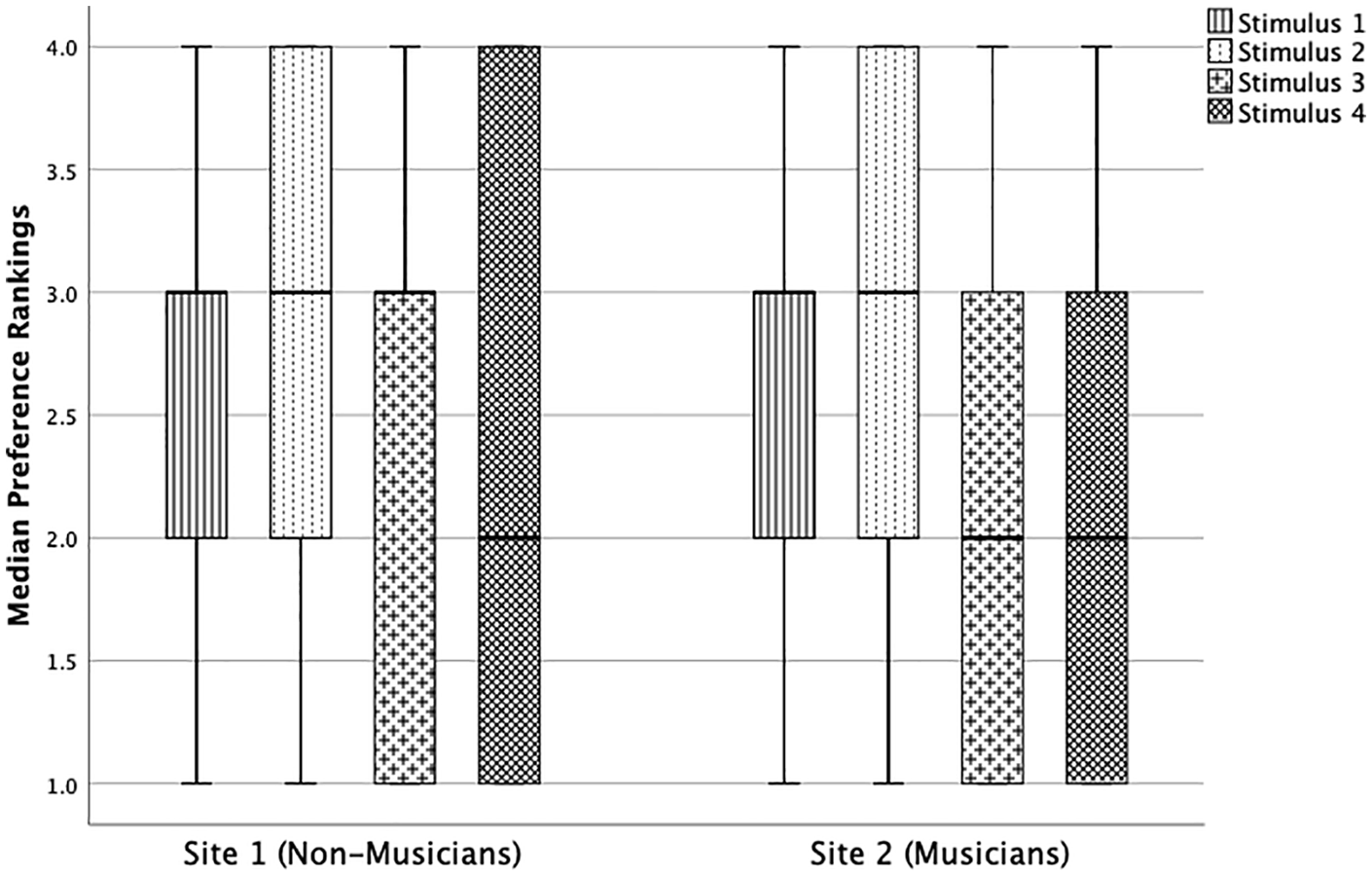
Median Preference rankings in Site 1 (Non-Musicians) and Site 2 (Musicians) per condition. Lower scores indicate a higher ranking of preference.
Discussion
In this study, we compared new music stimuli, composed under similar compositional principles, to a stimulus previously investigated (Dvorak & Hernandez-Ruiz, 2019; Hernandez-Ruiz & Dvorak, 2020; Hernandez-Ruiz et al., 2020). In a multisite study with non-musicians in Site 1 and musicians in Site 2, participants rated the effectiveness and usefulness of the music stimuli for mindfulness meditation practice, and they ranked the four music stimuli according to preference.
Our first research hypothesis, which posited that all music stimuli would be equally effective for mindfulness meditation, was supported for both groups. Both non-musicians and musicians rated all stimuli as equally effective in supporting mindfulness practice (average scores in the MAAS between 2.86 and 3.07 out of 5). Regarding our second hypothesis, which posited no significant differences among usefulness ratings of the stimuli, the results support this hypothesis, as participants rated all stimuli equally useful. Our third hypothesis, which indicated that musicians would prefer one of the stimuli over others due to more nuanced understanding of the music, was also supported. Musicians indeed preferred one of the stimuli (Original) significantly more than one of the others (Stimulus 2).
Overall, these results suggest that musical features of a previously investigated stimulus can be effectively transferred to new music, even when composed by different musicians. These findings have important clinical implications: they provide research support to the tailoring of music stimulus within music interventions (in this case, mindfulness meditation) that preserves their effectiveness and usefulness when the “active ingredients” are identified. Identifying “active ingredients” of music interventions and researching their efficacy may be one way of supporting evidence-based practice in music therapy (Hanson-Abromeit, 2015).
In contrast, significantly different ratings of preference in musicians point to a more nuanced evaluation of our findings. Musicians demonstrated a different preference response to the music stimuli than non-musicians. Musicians preferred the stimulus (i.e., Original) with better audio production (i.e., better volume mix and timbre quality), whereas non-musicians showed no difference in their preference rankings across stimuli. Although all stimuli where created with similar software (i.e., GarageBand® or equivalent software) and sounds (high-quality sampled sounds), differences in sound quality and volume mix between tracks were apparent. These differences did not seem to impact effectiveness or usefulness scores of both groups, nor non-musician preference rankings, but they seemed to affect musicians’ preference rankings. This result is unsurprising, considering that musicians show higher quality standards, greater error detection, and increased ability to process musical complexity compared to non-musicians (Deguchi et al., 2012; Hartmann et al., 2016; Hyde et al., 2009; Kraus & Chandrasekaran, 2010).
Limitations
As noted, the greatest limitation was the variety of sound quality in the music stimuli. Although students were instructed to use the same software and the “best keyboard sampled sounds,” the instructors/researchers allowed flexibility to accommodate students’ access to equipment. This decision introduced other variables (e.g., timbre quality) that may have affected musicians’ preferences. In addition, students had varying levels of experience with sound mixing and production, thus affecting sound quality of the overall recording. However, the fact that the other variables (i.e., effectiveness and usefulness) were not affected may indicate that the identified compositional principles may indeed be robust variables to compose effective music for mindfulness meditation. Further research that controls for sound quality is warranted.
Implications for clinical practice and future research
This study adds evidence to our previous results regarding the effectiveness and usefulness of a simple music stimulus for mindfulness meditation. Given that similar results were obtained with new stimuli based on the compositional principles, clinicians may feel confident using the stimuli description provided in the “Method” section as guidelines to create effective music for mindfulness meditation. It is important to note, however, that the research implemented thus far does not explore the efficacy of the music and mindfulness intervention, but rather the effect of the music stimuli on the mindfulness meditation. Further intervention research, with healthy and clinical populations, is needed to determine efficacy and effectiveness of the music intervention as a whole. Clinical outcomes—such as anxiety, depression, and stress reduction—may be needed to determine the clinical value of this intervention. Different meditation durations (e.g., 20-min intervention) should also be explored. Furthermore, basic research in this line may also address sound quality as an important variable, while exploring alternative instrumentations (e.g., piano, percussion, guitar, which are commonly used in music therapy practice), and live versus recorded music.
Conclusion
In this study, we investigated the feasibility of creating new music stimuli based on descriptions of a previously effective stimulus for mindfulness meditation. Results indicate that compositional guidelines based on mindfulness research allowed music psychology students to create similarly effective and useful music stimuli, as rated by both musician and non-musician participants. Contrastingly, preference for the stimuli was rated differently by musicians and non-musicians. Further research should explore the impact of other variables, such as instrumentation and sound quality, on preference of the music stimuli and on the mindfulness meditation. Intervention research with clinical populations, efficacy measures, and different durations should assess the music and mindfulness intervention as a whole.
Footnotes
Appendix 1
Acknowledgements
The authors would like to thank Dr Don Homa, Dr Mike Vitevitch, and Grace Hawkinson Jolly for assistance with SONA; Dr Scott Murphy and Dr Brad Osborn for their assistance with musician recruitment; graduate research assistants Ruowen (Viola) Qi and Halle Nick; students in the music psychology courses who served as data collectors; student composers Celeste Alderete, Zachary N. Frieze, Kirstin K. Georgeson, Jessica Kunst, Anthony Martin, Raquel Medina, Tamieka Melancon, Madeline Peterson, Tianna M. Smith, and Mitchell Weeks; and all the musicians and non-musicians who participated in this study. This study was completed while Dr Abbey Dvorak was an associate professor at the University of Kansas.
Funding
The author(s) disclosed receipt of the following financial support for the research, authorship, and/or publication of this article: Funding was provided by the School of Music, Herberger Institute of Design and the Arts, Arizona State University (Faculty Research Start-up funds), and the University of Kansas General Research Fund allocation #2279091.
