



Abstract
Using the Theory of Social Representations as theoretical and methodological framework, the purpose of this study was to analyze adults’ mental images (social representations) of music and musical selves across the lifespan. Participants (N = 74) were chosen using purposive sampling in various sociocultural contexts in a large city in the Southeastern United States. As previous studies documented, projective techniques (drawings and linguist associations) can access the most latent dimensions of thinking. Accordingly, drawings and linguistic associations to the textual stimuli “me,” “music,” and “music and me” were used to gain insights into adults’ mental images of music and musical selves. Participants were also asked to provide socio-demographic data that might affect or correlate with their responses. The Correspondences Analysis technique was used to reconstruct representational fields associated with the stimuli. For each stimulus, a five-factor extraction identified hidden dimensions in adult musical thinking and summarized the links between socio-demographic variables and adults’ responses. From a developmental perspective, the comparison of drawings and linguistic associations revealed stable and changing elements in adults’ representations of music and musical selves across the lifespan. From a sociocultural perspective, this study documented the influence of the variable ethnicity on adults’ responses.
Keywords
Adult musical engagement has steadily increased since 2012 (National Endowment for the Arts, 2018 report). More and more adults make music in their leisure time beyond attending music performances (Myers, 2012). Several reasons can explain the growing renaissance of adult music participation. According to Dabback and Smith (2012), “as people live both longer and healthier lives, they seek engagement in meaningful activities” (p. 229). In addition, recent developmental theories have determined new attitudes toward aging. While in the past society considered adulthood as a declining phase of life, aging is currently valued as a productive stage (Cohen, 2005). Thus, adults choose recreational and fulfilling experiences to express their potential.
As lifelong musical engagement increases, music education needs to rethink its approaches to music teaching. While formal pedagogies rely on detailed curricula and specific goals, adults are often self-directed learners who resonate with non-authoritarian teaching practices (Coffman, 2018). However, music teacher education programs mainly prepare students to teach music in K-12 school settings (Kerchner & Abril, 2012; Myers, 2012). Answering the call for a lifelong perspective in music teaching and a more nuanced understanding of adult musical engagement, this research can provide valuable insights into musical needs and interests throughout adulthood.
Previous studies addressed where, how, and why adults engage in musical activities. Adult music learning takes place in settings such as school facilities, private lessons, and community music programs (Drummond, 2012; Kerchner & Abril, 2012). Different educational contexts shape teaching and learning processes. Although recognizing possible overlaps, authors have discussed adult learning in formal, nonformal, and informal settings (Coffman, 2002; Veblen, 2012). Actively planned by a teacher, formal learning typically occurs in P-12 schools, universities, and colleges and usually requires an assessment of achievement. Nonformal learning is more flexible, less structured, and is often situated outside of formal institutions, such as churches and community centers. Informal learning includes self-initiated and accidental learning. As Veblen suggested, “such knowledge often comes about through unsystematic, accidental, purposeful, and incidental exposure to what is happening in a person’s environment” (p. 250).
Beyond describing learning contexts, previous studies showed that adults participate in musical activities for different reasons. As Coffman (2002) pointed out, adult musical engagement rests on personal, musical, and social motivations. Similarly, Drummond (2012) identified reasons such as increased personal well-being, love of music, and social relationships. Adults participate in musical activities when inspired by friends and colleagues or because of changes in life circumstances (Coffman, 2006). In addition, adults use music as a means to express individual identities and regulate moods (Hargreaves, Miell, & MacDonald, 2002).
Despite the growing interest in musical adulthood, little research has addressed adults’ musical experiences from a developmental and sociocultural perspective. Kerchner and Abril (2012) suggested that adults engage in musical activities for different reasons across the lifespan. An increased sense of belonging could motivate young adults. In their middle years, adults might value musical experiences as a gratifying activity beyond their careers. Older adults might view musical experiences as a way to reconcile missed opportunities. However, the findings of a few studies that addressed adult musical engagement from a developmental perspective were not consistent (Bonneville-Roussy, Rentfrow, & Xu, 2013; Lonsdale & North, 2011; Lukka, 2007). Thus, there is a need for studies that clarify changes in music participation throughout adulthood.
Moreover, studies on the where, how, and why of adult musical engagement have not provided comprehensive views of adults’ musical experiences across different sociocultural contexts. Myers (2012) suggested that adult music programs mainly “serve homogeneous populations of middle- and upper-class individuals with discretionary time and financial resources” (p. 227). More recent contributions within the field of community music have documented the development of adult music programs across a variety of settings (Bartleet & Higgins, 2018; Rohwer, 2018). However, there is a need for studies that complement the descriptive framework of previous contributions, studies that analyze how contextual variables may affect music learning and participation in different sociocultural contexts.
Answering the call for a more nuanced understanding of adults’ musical experiences from a developmental and sociocultural perspective, this study used the Theory of Social Representations (SRT) as theoretical and methodological framework.
Theoretical framework
Moscovici (1961/2008, 1973) developed the SRT to investigate psychoanalysis as a social set of images, ideas, and evaluations that people have used to interpret and understand mental illnesses (de Rosa, Fino, & Bocci, 2013). The heuristic value of the SRT successively transcended the specific object of study (psychoanalysis) on which Moscovici’s first investigations were centered and has been extended to the most varied objects of social knowledge. This theory has thus become a paradigm to investigate common sense and practices in everyday life.
Operationalized in the concept of social representations, common modes of understanding are considered a dynamic lens that people use to perceive and interpret their realities (Moscovici, 1973). The concept of social representations cannot be reduced to those of opinions, attitudes, and stereotypes. Social representations are complex networks of values, images, samples, and generalizations that are organized into structures of thinking (de Rosa, 1994; de Rosa, Bocci, & Dryjanska, 2018). Social representations are the products of the relationships between (a) the subject who produces a representation, (b) the object that is represented, and (c) the social group within representations are elaborated and shared (Bauer & Gaskell, 2001). Thus, the analysis of social representations, as individual and collective products, can highlight developmental and contextual influences in our structures of thinking.
Studies have provided in-depth insights into collective representations of different social objects (media industry, health organizations, education and community services, tourism, environment, and financial institutions) from a developmental and socio-cultural perspective (de Rosa, Bocci, & Dryjanska, 2018). At the crossroads of social and individual psychology, a few studies have also integrated the SRT with various theories of the self that emphasize the role of social dimensions in constructing self-identities (de Rosa, 2013). Conceiving the self as a function of individual and collective experiences with objects in the physical-natural and social world, studies suggest that individuals use social representations for defining their selves, positioning themselves in social groups, and maintaining positive self-concepts (Breakwell, 2001, 2010).
Despite the extensive research literature on social representations, only a few studies applied the SRT as heuristic framework to explore adults’ understandings of music. As Seca (2003) documented, underground musicians represented their music style as a means for challenging hierarchies and usual structures of socializations. Manchaiah et al. (2017) explored social representations of music and attitudes towards music listening habits in different cultural environments (India, Iran, Portugal, USA, and UK). As results showed, participants valued music as a source of positive emotions or actions and were aware of the negative consequences of loud music regardless of their origin. Scardua, de Souza, and Alves (2010) identified categories that musicians and non-musicians used to described music. Participants (a) defined music in terms of harmony, sound, and waves; (b) focused on purposes and consequences of listening to music, such as emotional involvement and construction of identity; and (c) mentioned musical preferences.
Although adults’ mental images of music have not been extensively addressed in terms of social representations, studies that used the SRT as a theoretical framework have provided methodological suggestions for a more comprehensive analysis of adult musical experiences. Previous studies on music and other social objects have used projective techniques such as drawings and free linguistic associations to textual stimuli. Becasue of their open nature, projective techniques do not inhibit participants from saying what they really think (de Rosa, 2002). Thus, overcoming the biasing effects of cognitive responses, projective techniques can produce deeper understanding of the most latent and consistent dimensions of thinking and highlight the influences of developmental and sociocultural factors on participants’ inner thoughts (Abric, 2003).
Research purpose and questions
Using the SRT as theoretical and methodological framework, the purpose of this study was to analyze adults’ social representations of music and musical selves across the lifespan. Specifically, this study addressed three research questions: (a) How do adults’ social representations of music change across the lifespan? (b) How do adults define themselves in and through music at different age levels? and (c) How do socio-demographic variables such as gender, ethnicity, musical involvement, and self-perception of musical expertise contribute to differentiate adults’ representations of music and musical selves across the lifespan?
To analyze adults’ selves in and through music, this study drew on Neisser’s theory of self-knowledge. Neisser (1988) defined the self as a perceived unitary object that includes five aspects: (a) the ecological self, perceived in relation to the physical environment; (b) the interpersonal self, built in interactions with others; (c) the extended self, based on memories and anticipations; (d) the private self, related to inner perceptions; and (e) the conceptual self, built on personal theories, assumptions, and self-concepts of one’s social role, emotions, and significant dimensions. Overall, Neisser conceived the self as a function of emotional and cognitive experiences with different objects in the natural and social world (de Rosa, 2013). His emphasis on the social dimensions of self has therefore been considered coherent with the SRT (Corugati, 1990; Laszlo, 1997; de Rosa, 2013) and with the theoretical framework of this study.
Method
Sample
The study was conducted in Miami, Florida (United States), whose cultural diversity was a bird’s-eye view for analyzing contextual influences on adults’ representations. After IRB approval and two weeks before data collection, flyers that described the study were distributed to members of a band for older amateur musicians, older adults in senior centers, university students, and parents whose children are enrolled in outreach programs. After obtaining verbal consent, participants’ data were collected in groups settings. The sample (N = 74) included an approximate equal number of men (41.9%, n = 31) and women (55.4%, n = 41). In addition, one participant selected the gender category “other” and one participant preferred not to comment.
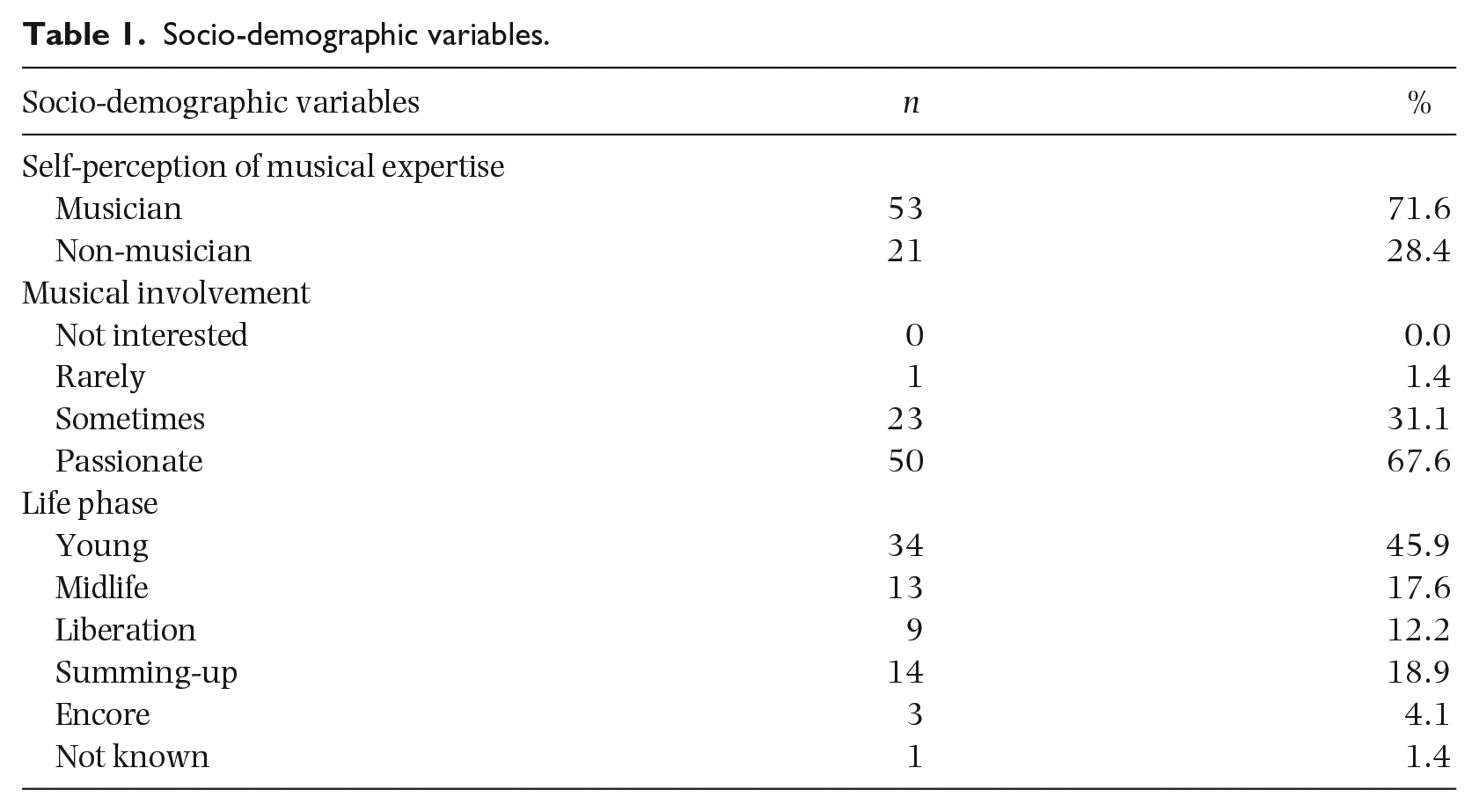
The majority of participants identified themselves as White (52.7%, n = 39) or Latino (33.8%, n = 25). The Black or African American (4.1%, n = 3) and Asian/Pacific Islander (4.1%, n = 3) ethnicities were less represented. Participants’ ages ranged between 19 and 90 years but were eventually recategorized into five life phases (more details in the Instrument section). The sample of the study included (a) adults actively involved in leisure musical activities, (b) adults not directly involved in music making, and (c) professional musicians. For the analysis of adults’ social representations of music and musical selves, the sample was eventually dived into two groups, musicians (71.6%, n = 53) and non-musicians (28.4%, n = 21) according to self-perception of musical expertise. In terms of musical involvement, the majority of participants defined themselves as passionate about music (n = 50, 67.6%). Table 1 illustrates distributions of the variables self-perception of musical expertise, musical involvement, and life phase.
Socio-demographic variables.
Instrument
Echoing prior research within the same theoretical paradigm (de Rosa, 1995; de Rosa & Bocci, 2013), this study used a multi-method approach that included drawings, free linguistic associations, and a questionnaire. The instrument of the study consisted of two sections. First, drawings and free linguistic associations to textual stimuli (“me,” “music,” and “music and me”) were collected to gain insights into adults’ social representations of music and musical selves. Second, participants were asked to provide socio-demographic data (age, life phase, gender, ethnicity, musical involvement, and self-perception of musical expertise) that might affect or correlate with their responses.
First section
The textual stimuli “me,” “music,” and “music and me” were presented in the middle of three blank pages. For each stimulus, participants (a) made drawing, (b) wrote all words that came to their minds (free linguistic associations), and (c) evaluated each associated word as positive, neutral, or negative by using the signs +, –, or 0, respectively. The stimuli “music” and “music and me” were used to analyze adults’ representations of music and musical selves. As de Rosa (2002) pointed out, reality is “selectively filtered by categorization processes that involve the identity of subjects” (p. 184). Beyond socio-demographic data, self-representations can provide additional information about participants. Thus, the stimulus “me” was introduced to elicit participants’ self-representations.
Second section
An author-designed questionnaire asked for socio-demographic variables such as age, life phase, gender, ethnicity, self-perception of musical expertise and musical involvement. Echoing developmental theories, participants’ self-reported ages were compared with their self-selected life phases for verification; subsequent analyses relied on life phases. Erikson (1963) had proposed three phases throughout the adult years—(a) early adulthood, (b) middle adulthood, and (c) older adulthood—but he gave limited attention to adult development in the second half of life. More recently, Cohen (2000), drawing on his own work as psychiatrist and gerontologist, demonstrated that adults continue to grow and flourish throughout adulthood and proposed five phases of life.
The life phase variable in this study was operationally defined on a five-level scale, following Cohen’s (2005) adult developmental theory: Young Adulthood (until late 30s: early stage in the career, building important relationships), Midlife (from early 40s to early 60s: reevaluation, exploration, and transition), Liberation (from 60s to late 70s: “if not now, when?” retirement or partial retirement), Summing-Up (from late 70s to 80s: recapitulation and reexamination), and Encore (from late 80s: advancing age, desire to make lasting contributions).
Moreover, two questions asked for self-perception of musical expertise: (a) “Would you describe yourself as a musician?” (b) “Why? Why not?” Musical involvement was operationally defined on a four-level scale: not interested, rarely engaged, partially engaged (music is not the primary hobby), and passionate about music. Two open questions asked participants to describe their current musical engagement and changes in musical engagement across their life spans.
Data analysis
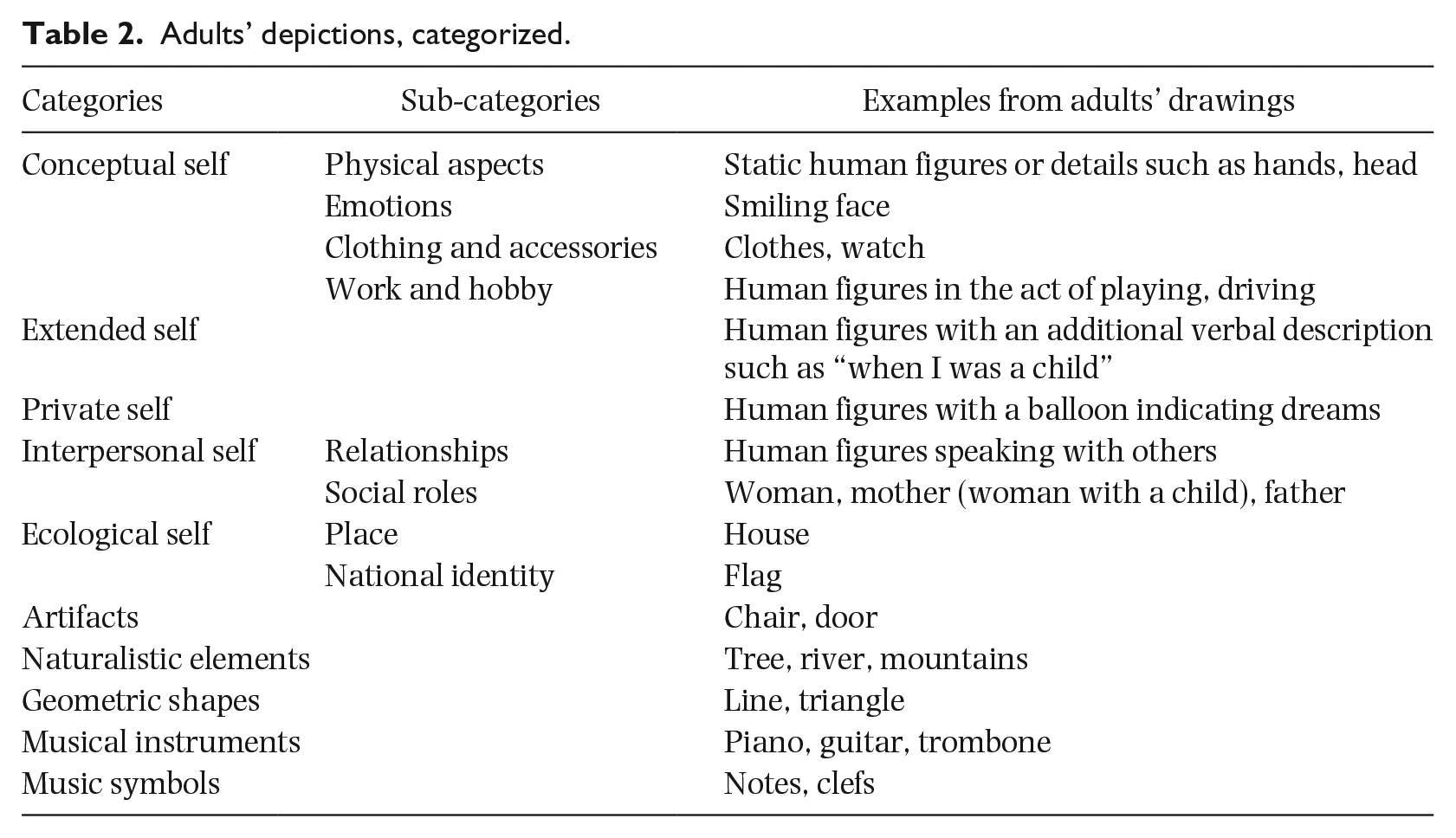
Data analysis included five phases. First, elements in participants’ drawings (such as smiling faces, human figures speaking with others, lines, trees, trombone, flag, musical notes) were classified into 10 categories (Table 2), hereafter referred to as depictions. Neisser’s five dimensions of self (ecological, interpersonal, extended, private, and conceptual; see Table 2) contributed to the framework for analyzing drawings of human figures.
Adults’ depictions, categorized.
Second, the depictions, words, and socio-demographic variables were processed by the software Spad—(Système Portable d’Analyse des Données) (Lebart, Morineau, & Bécue, 1989). For each stimulus (“me,” “music,” and “music and me”), the Spad procedure Talex constructed the following contingency tables: (a) depictions (rows) and socio-demographic variables (columns), and (b) words (rows) and socio-demographic variables (columns). At the intersection of rows and columns, the contingency tables contained the frequency of depictions or words for each socio-demographic variable. The Lexical contingency tables were used for the Correspondences Analysis procedure (Corbi).
Third, Correspondences Analysis, a form of Principal Component Analysis for categorial variables, was performed on (a) depictions and socio-demographic variables and (b) words and socio-demographic variables. The analysis was used to reconstruct representational fields associated with the stimuli (Ercolani, Areni, & Mannetti, 1990). For each stimulus (“me,” “music,” and “music and me”), a five-factor extraction (a) identified the content of adults’ representations of music and musical selves and (b) showed the influences of socio-demographic variables on adults’ visual and verbal responses (depictions and words). In each extraction, the first factors that explained more than 50% of the total variance (and followed by less variation in the explained variance) were considered for the analysis.
The fourth phase of analysis relied on the concept of social representations, which summarized complex networks of different aspects such as evaluations, feelings, values, and images into structure of thinking (de Rosa, 1994). For each textual stimulus (“me,” “music,” and “music and me”), the total number of positive, negative, and neutral words was used to create the index of polarity (ranging from ‒1 to 1) as a measure of the attitudinal component in participants’ free linguistic associations (words). The Spad procedure Characterization of Continuous Variables performed all of the one-way analyses of variance (ANOVAs) to examine the links between polarity indexes and socio-demographic variables. In the final phase, recurrent themes in the answers to the open questions supported the interpretation of adults’ representations of music and musical selves in the discussion section.
Results
The following sections summarize the results of the Correspondences Analysis and Characterization of Continuous Variables procedures for the stimuli “music,” “me,” and “music and me.” In addition, factorial plans help to visualize factors that the Correspondences Analysis extracted (a) to identify hidden dimension in adults’ depictions and words and (b) to document the influences of socio-demographic variables. Thus, factorial plans show significant depictions and socio-demographic variables, and words and socio-demographic variables on each factor.
Two indexes guided the selection of depictions, words, and socio-demographic variables on each factor: (a) absolute contribution (a.c. = contribution of depictions, words, and variables on each factor) and (b) relative contribution (r.c. = contribution of depictions, words, and variables across factors). On each factor, depictions and socio-demographic variables, and words and socio-demographic variables with absolute and relative contributions higher than the mean contribution were selected for the analysis. Socio-demographic variables with the highest absolute and relative contributions were used to label factors.
Adults’ representations of music (stimulus “music”)
The depictions and words that adults used to describe the stimulus “music” were analyzed to answer the first research question (How do adults’ social representations of music change across the lifespan?). In addition, socio-demographic variables such as life phase, gender, ethnicity, musical involvement, and self-perception of musical expertise were analyzed to answer the third research question (How do socio-demographic variables contribute to differentiate adults’ representations of music across the lifespan?). A two-factor extraction explained 56.8% of the total variance in the categories that adults used to portray the stimulus “music” and in the socio-demographic variables. The extraction highlighted the following (Figure 1):
First factor (Young vs. Summing-up and Encore life phases). Work-hobby activities (i.e., human figures in the act of making music) and relationships (i.e., human figures interacting with others) characterized young’s adults’ drawings. Depictions of artifacts and naturalistic elements were found in older participants’ drawings.
Second factor (Midlife phase). Depictions of social roles (i.e., human figures with emphasized gender-related physical aspects), and clothing and accessories (i.e., human figures with clothes) characterized middle-aged adults’ drawings.
Depictions of musical instruments and music symbols were recurrent across factors.
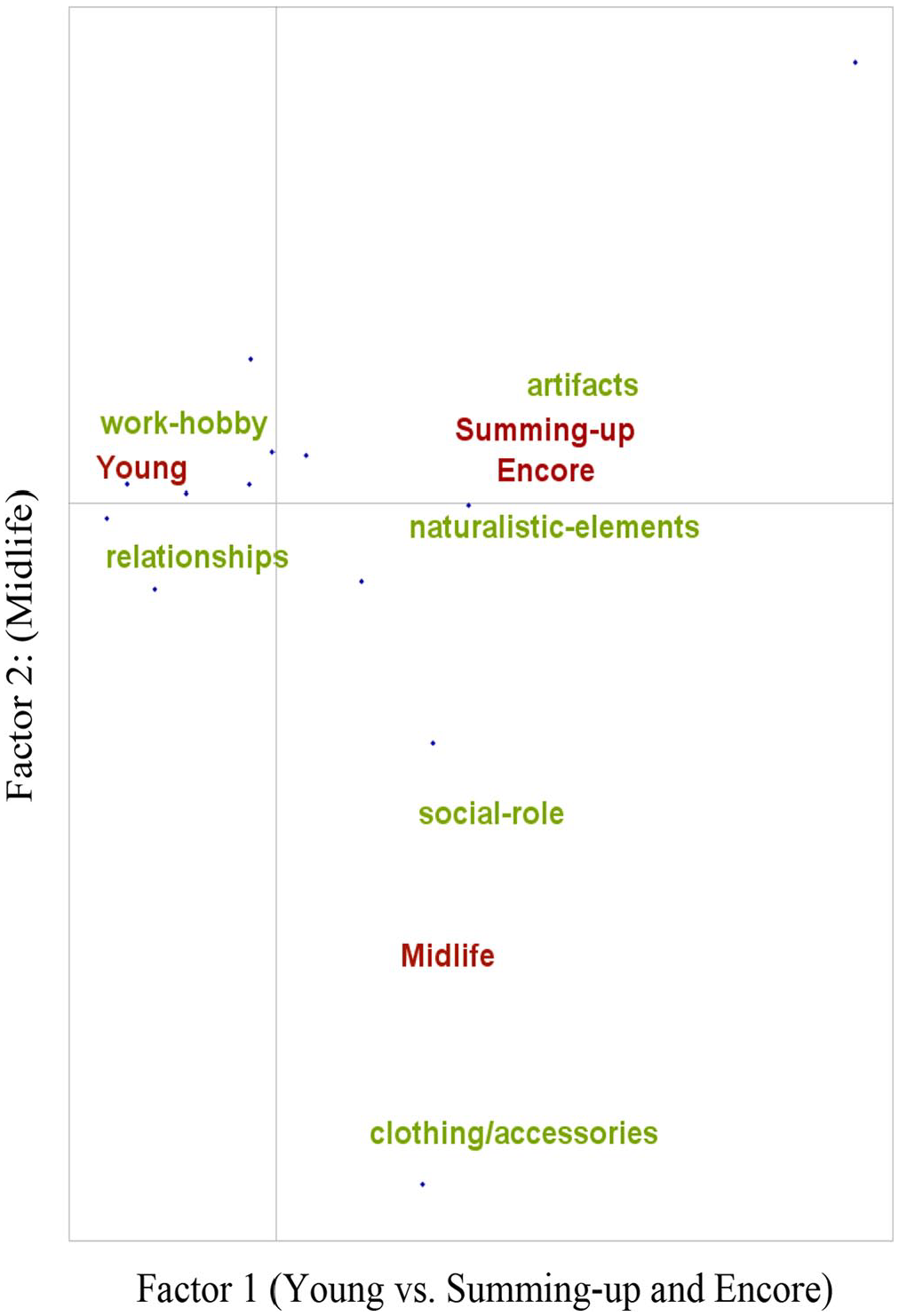
Significant Depictions and Socio-Demographic Variables (“Music”).
A three-factor extraction explained 54% of the total variance in the words that adults associated with the stimulus “music” and in the socio-demographic variables. The extraction highlighted the following (Figure 2):
First factor (Young vs. Midlife life phases). Young adults referred to music as a means of emotional expression (expression, passion), while middle-aged adults defined music in terms of mood regulation (peace, reflecting, relaxing) and social bounding (family).
Second factor (Summing-up/Encore vs. Liberation life phases). The elder participants highlighted the connection between music and religion (spiritual), while adults in the liberation phase referred to music in terms of pleasure and frustration.
Third factor (Summing-up vs. Encore life phases). Encore adults mentioned places for music consumption (TV, radio), while adults in the Summing-up phase evaluated music as necessary (necessary, daily).
The words “song” and “musician” were recurrent across factors.
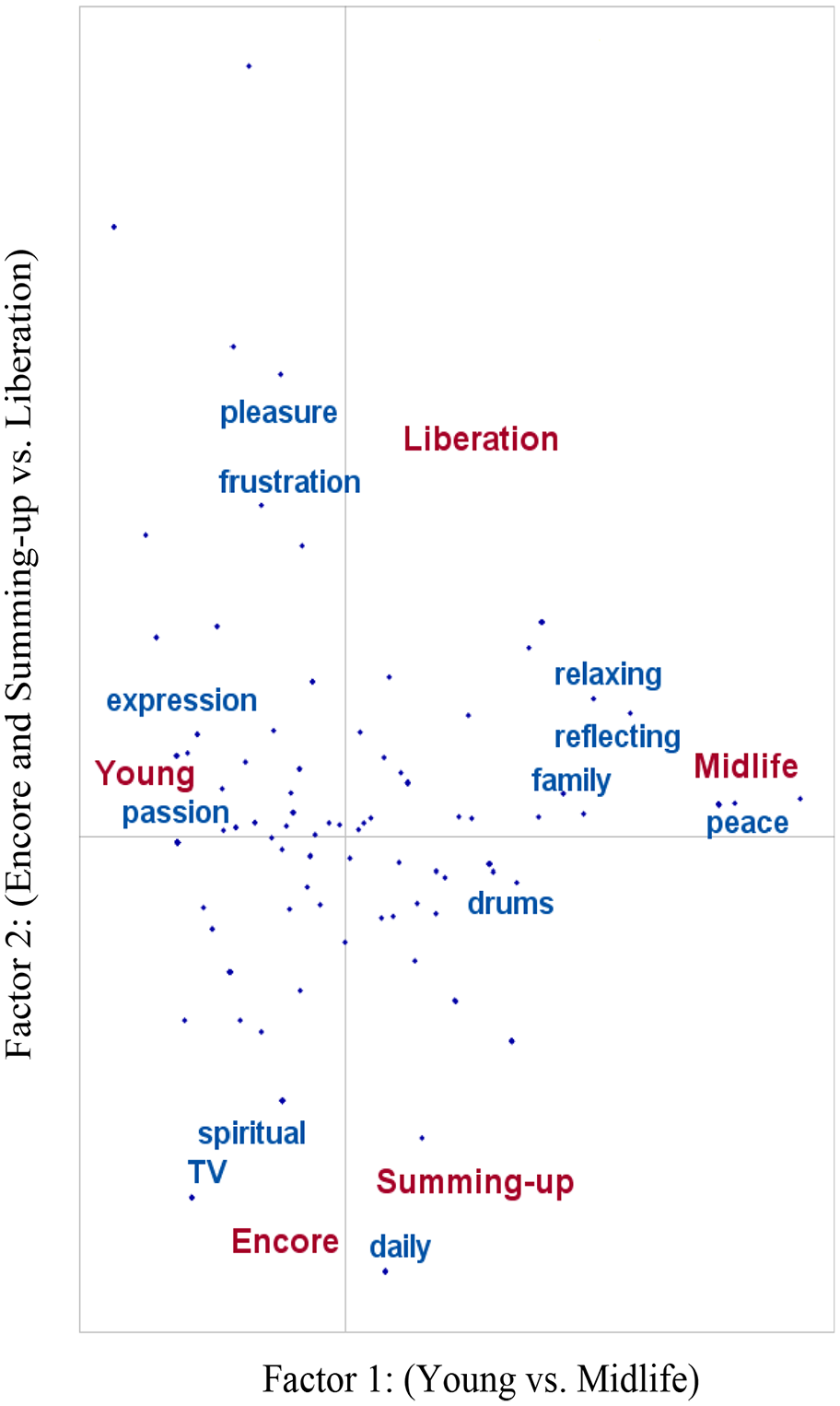
Significant Words and Socio-Demographic Variables (“Music”).
The analysis of the first three factors also highlighted influences of the variable ethnicity, self-perception of musical expertise, and engagement with music on adults’ free linguistic associations (words). White participants mainly referred to uses of music in the words “stress” and “spiritual.” Non-musicians more likely used the words “relaxing” that was absent in musicians’ responses. In addition, people who rarely engage themselves with music described the stimulus in terms of instruments (drums, stick), while individuals who sometimes engage themselves with music used the word “peace.”
The analysis of the indexes of polarity showed that the stimulus “music” was characterized by a high positive value (M = .73). Results of all of the one-way ANOVAs indicated a significant effect of ethnicity, F(4, 69) = 4.69, p = .002, phase of life, F(4, 69) = 3.13, p = .02, and engagement with music, F(2, 71) = 2.99, p = .05. White participants presented the lowest positive connotation of music in contrast to more positive evaluations provided by Latino participants (Ms = .33 and .73, respectively). Adults in the Encore phase provided the most positive evaluation of the stimulus in contrast to the lowest positive connotation expressed by young adults (Ms = 1 and .32, respectively). In addition, participants who sometimes engage themselves with music significantly evaluated the stimulus music more positively than participants who defined themselves as passionate (Ms = .73 and .64, respectively).
Adults’ self-representations in and through music
The depictions and words that adults used to define the stimuli “me” and “music and me” were analyzed to answer the second research question (How do adults define themselves in and through music at different age levels?). In addition, socio-demographic variables such as life phase, gender, ethnicity, musical involvement, and self-perception of musical expertise were analyzed to answer the third research question (How do socio-demographic variables contribute to differentiate adults’ representations of musical selves across the lifespan?).
Stimulus “me”
A two-factor extraction explained 76.7% of the total variance in the depictions that adults used to portray the stimulus “me” and in the socio-demographic variables. The extraction highlighted the following (Figure 3):
First factor (Young vs. Midlife life phases). Depictions of emotions (i.e., smiling faces) characterized young adults’ drawings, while relationships (i.e., human figures interacting with others) characterized middle-aged adults’ portraits.
Second factor (Liberation life phase). Depictions of artifacts characterized drawings of adults in the Liberation phase.
Depictions of physical aspects (i.e., static human figures) and social roles (i.e., gender-related characterizations) were found in adults’ drawings regardless of their age levels.
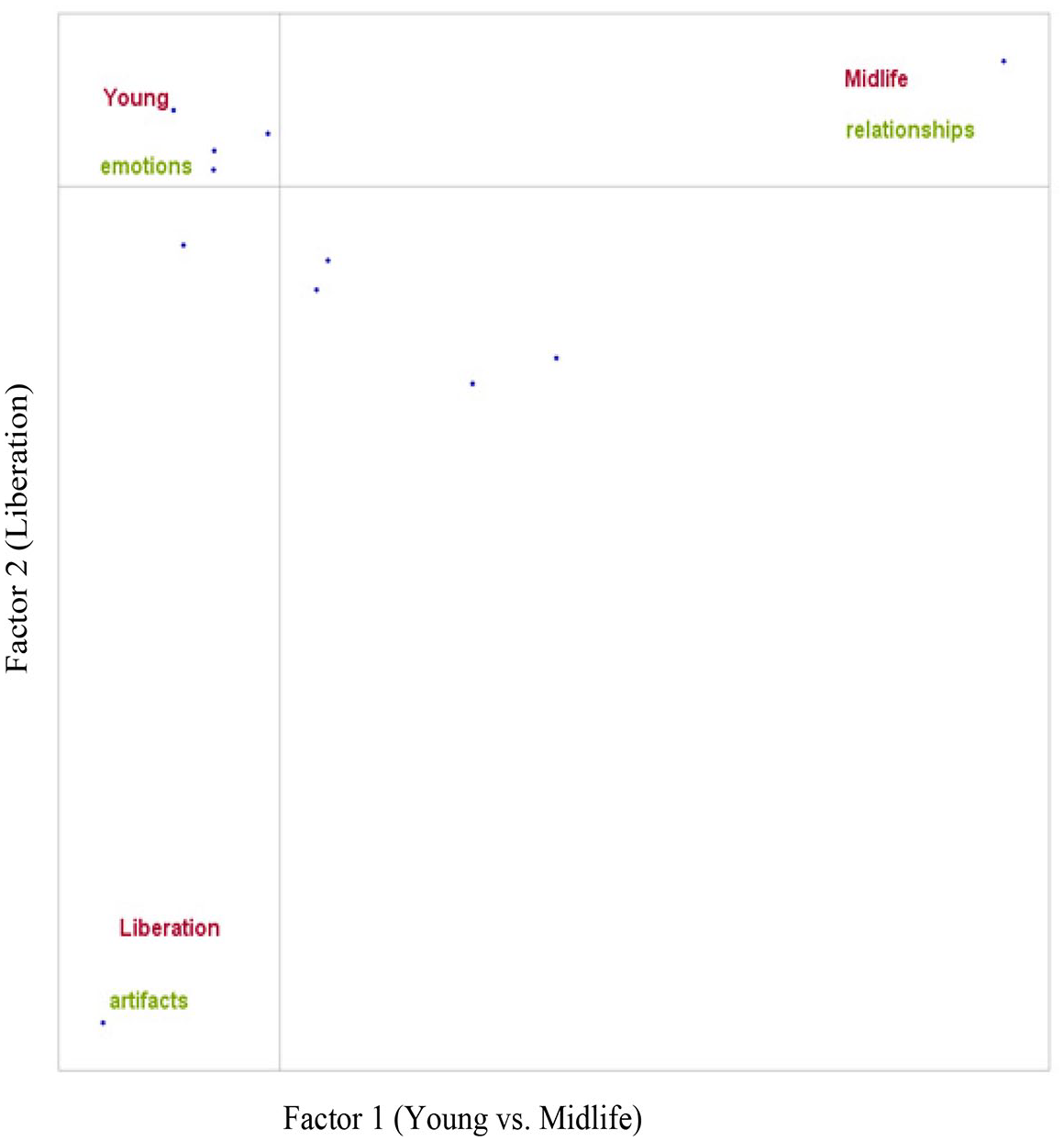
Significant Depictions and Socio-Demographic Variables (“Me”).
A three-factor extraction explained 52.5 % of the total variance in the words that adults used for the stimulus “me” and in the socio-demographic variables. The extraction highlighted the following (Figure 4):
First factor (White vs. Latino ethnicities). White participants used words such as “funny” and “anxious,” while Latino adults defined themselves as “friendly.”
Second factor (Young vs. Summing-up life phases). Young adults used words such as “musician,” “artist,” and “hardworking,” while adults in the Summing-up life phase defined the stimulus “me” in terms of “health,” “reading,” and “listening.”
Third factor (Liberation vs. Midlife life phases). Adults in the Liberation phase used words such as “band” and “gardening,” while middle-aged adults described themselves as “worker(s).”

Significant Words and Socio-Demographic Variables (“Me”).
The analysis of the first three factors highlighted further influences of the variables ethnicity. The third factor also contrasted the responses of Black participants who used words such as “woman” and “Christian” with those of Asian participants who used words such as “writer” and “wife.” The analysis of the indexes of polarity showed that the stimulus “me” was characterized by the lowest positive evaluations (M = .66). Results of all the one-way ANOVAs indicated a significant effect of gender F(3, 69) = 9.09, p < .001. More positive representations of the stimulus “me” characterized female than male participants (Ms = .73 and .64, respectively).
Stimulus “music and me”
A two-factor extraction explained 67.8 % of the total variance in the depictions that adults used to portray the stimulus “music and me” and in the socio-demographic variables. The extraction highlighted the following (Figure 5):
First factor (Midlife vs. Young life phases). Naturalistic elements were found in middle-aged adults’ drawings, while artifacts such as music sheets and music stands were characteristic of young adults’ drawings.
Second factor (Summing-up vs. Liberation life phases). Depictions of emotions (i.e., smiling faces) characterized drawings of adults in the Summing-up phase. Depictions of places (i.e., practicing room) characterized drawings of adults in the Liberation phase.
Depictions of musical instruments, music symbols, and work–hobby activities (i.e., human figures making music) were recurrent across factors.

Significant Depictions and Socio-Demographic Variables (“Music and Me”).
A two-factor extraction explained 57.5 % of the total variance in the words that adults used to describe the stimulus “music and me” and in the socio-demographic variables. The extraction highlighted the following (Figure 6):
First factor (Midlife vs. Young life phases). Middle-aged adults used words such as “relaxing,” “joy,” and “family,” while young adults used words such as “passion,” “educating,” and “teaching.”
Second factor (Summing-up and Encore vs. Liberation life phases). The elder participants used words such as “daily” and “everywhere,” while adults in the Liberation phase used words such as “calming” and “instruments.”
The words “love,” “happy,” “fun,” “singing,” and “listening” were recurrent across factors.
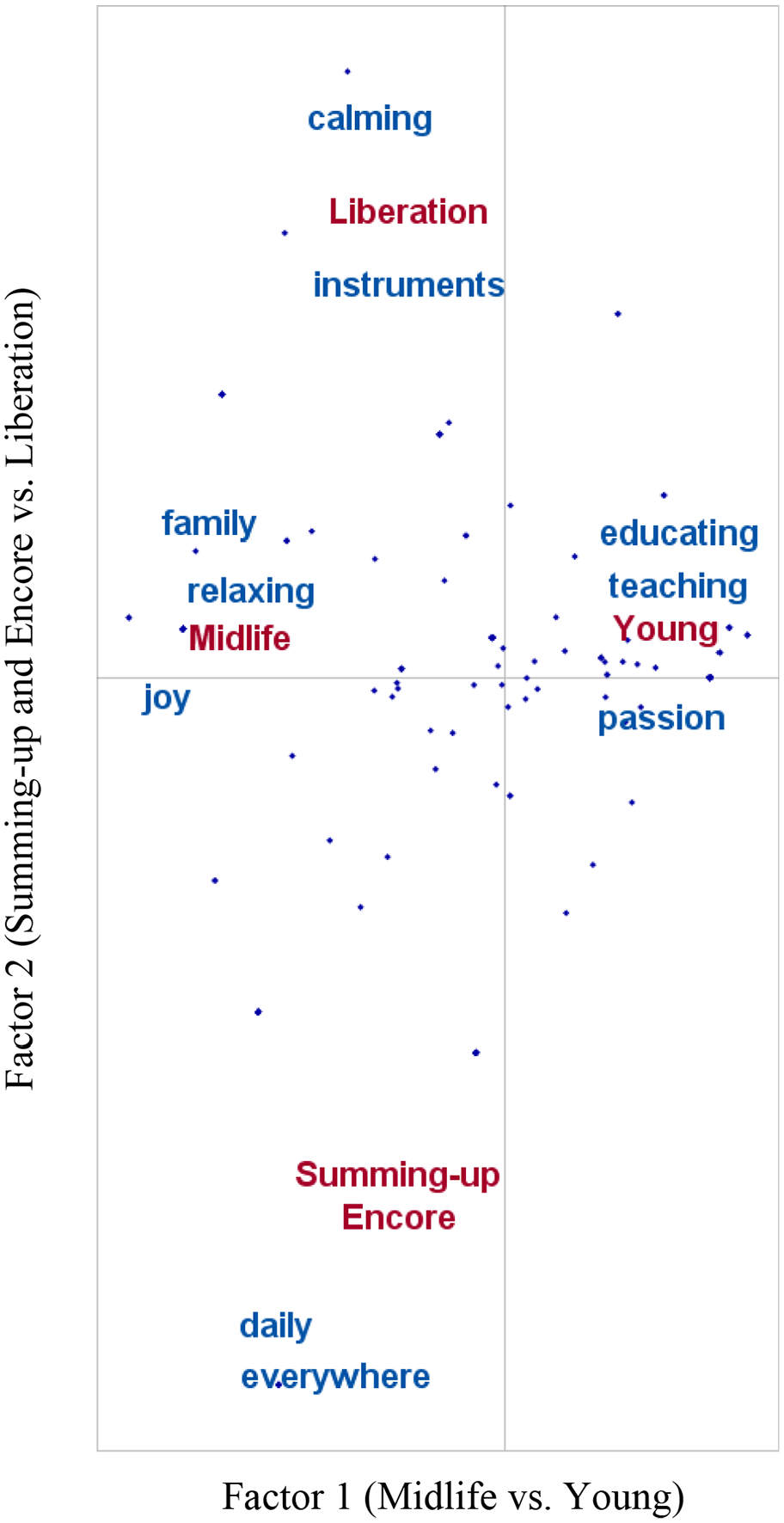
Significant Words and Socio-Demographic Variables (“Music and Me”).
The analysis of the first and second factor also highlighted influences of the variable ethnicity, self-perception of musical expertise, and engagement with music on adults’ free linguistic associations (words). Latino participants mentioned “family” and “friends,” while White adults used the words “life” and “job.” Black participants defined the stimulus with the words “release” and “refresh.” Non-musicians more likely used the word “relax” that was instead absent in musicians’ responses. Adults who rarely engage themselves with music used negative words such as “criticism” and “snobbism,” while adults who sometimes engage with music used the words “memories” and “company.”
The analysis of the indexes of polarity showed that the stimulus “music and me” was characterized by overall positive connotations (M = .70). Results of all the one-way ANOVAs indicated a significant effect of engagement with music, F(2, 71) = 4.91, p = .01. Participants who sometimes engage with music provided the most positive evaluation of the stimulus (M = . 54) in contrast to participants who defined themselves as passionate and participant who rarely engage with music (Ms = .54 and ‒1, respectively).
Discussion and conclusion
The results of the study helped construct a narrative of adults’ musical worlds in terms of definitions of music, meanings, and evaluations of musical experiences. From a developmental perspective, the comparison of drawings and linguistic associations highlighted stable and variable elements in adults’ representations of music and musical selves. Regardless of their age levels, adults drew instruments (music and music and me: trumpet, drums, piano, etc.) and music symbols (music and music and me: notes, clefs, etc.). In their linguistic associations, adults also mentioned instruments (music: piano, guitar; music and me: instruments) and music symbols (music and music and me: notes) but less frequently.
Drawings and linguistic associations seemed to confirm a developmental pattern that was highlighted in a previous study on children’s social representations of music (Ripani, 2019). At the beginning of middle childhood, children more likely mentioned instruments (music: guitar, violin; music and me: instruments, guitar, etc.) and music elements and symbols (music: sound, notes). Older children described music in terms of musical preference and uses of music, while references to instruments and music elements were less frequent.
The comparison of adults’ drawings and linguistic associations suggested that (a) drawings revealed the most stable, latent dimensions of musical representations as developed at the beginning of middle childhood; (b) linguistic associations revealed dimensions that are developed at later age levels; and (c) earlier dimensions in the representations of music and musical selves coexist with dimensions that are developed across the lifespan. Thus, beyond references to instruments and music symbols, adults’ responses reflected different internal drives throughout adulthood.
In Western societies, early adulthood has become “a time of prolonged exploration of attitudes, values, and life possibilities” (Berk, 2014, p. 364). Thus, young adults need to consolidate a sense of personal identity. According to Neisser (1988), individuals define their identities in terms of social roles, work, memories, internal models, and references to the physical environment. Accordingly, linguistic associations showed the importance of work and emotions in young adults’ identity development. For instance, young participants used words such as hardworking, musician, and artist to describe the stimulus “me.”
As highlighted in previous studies, music plays a central role in young individuals’ identity construction (Dobson, Hardy, Heyes, Humphreys, & Humphreys, 1981). Drawings (music: human figures in the act of playing, singing, or conducting) and linguistic associations (music: passion, expression; music and me: passion, educating) showed that young adults might use music as a means to navigate their interests and emotions. Similarly, young adults’ answers to the open question on musical engagement documented the role of music in their identity construction. As some of the young participants stated, “I have learned who I am thanks to aspects of music”; “Music has allowed me to grow as a person and to explore my creativity”; and “I listen to music frequently for leisure, analysis, and motivation.”
After establishing their identities, middle-aged adults are focused on family and career (Erikson, 1963). In defining the stimulus “me,” adults drew themselves, their partners, and children and used words such as work and efficient. In association with the stimulus “music,” middle-aged adults drew detailed human figures, while young adults mainly drew stylized figures in the act of making music. Two possible explanations could be advanced. First, middle-aged adults consider music as an external element (focus of drawings on human figures), while young adults use music to define their identities (focus of drawings on music making). Second, middle-aged adults may have a more defined sense of identity, as highlighted in their detailed drawings.
In middle adulthood, adults also confront physical and emotional transitions, seek gratifications, and consider their sense of mortality for the first time (Cohen, 2000, 2005). As linguistic associations documented, middle-aged adults might use music to accompany their reflections (music: reflecting) and as a gratifying and relaxing activity beyond their careers (music: peace, relaxing; music and me: joy, relax). The analysis of middle-aged adults’ answers to the open questions highlighted similar patterns. As some of the participants stated, “I like listening to classical music when I am stressed or while I am doing hobbies”; “Music helps me relax”; and “Music gives me inner peace and relaxation.”
In their 60s and 70s, adults have time to experiment with different activities because of retirement or partial retirement (Cohen, 2005). At this stage, adults might discover new interests (“I have recently become more serious about progressing”) or reconcile missed opportunities (“I started learning to read music and play at the age of 63 because I had no opportunities when younger”). Linguistic associations of adults in the Liberation phase reflected their experiences (me: retirement, gardening, band; music and me: instruments). Similarly, in the answers to the open questions, participants referred to activities such as playing instruments, singing, and dancing. Although a desire for novelty might motivate adults’ musical engagement, mixed feelings seemed to accompany the experience of learning an instrument (music: pleasure, frustration).
According to Cohen (2005), two phases occur from the 70s to end of life: Summing-up and Encore. The comparison of drawings and linguistic associations showed significant overlaps in the elder participants’ representations of music and musical selves. In describing the stimulus “me,” adults in the Summing-up and Encore phases referred to activities such as reading and listening. Moreover, they emphasized the connection between music and religion (music: spiritual). In comparison to adults in the Liberation phase, the elder participants who might experience lower energy levels seemed to prefer musical activities with no physical engagement (me: listening; music: TV, radio). Similarly, in the answers to the open questions, the elder participants mentioned elements such as listening, radio in the car, and TV. Some of them expressed regret for not playing an instrument (“Now, I regret not being able to play an instrument”), while others recognized physical limits for active musical engagement (“Less ability to perform after 70”).
Beyond instruments and music symbols, the elder participants drew artifacts and naturalistic elements to represent the stimuli “music” and “music and me.” A few differences were found in the free linguistic associations. While adults in the Summing-up phase described music as important (music: daily, necessary; music and me: daily, anywhere), adults in the Encore phase mainly mentioned channels for music consumption (music: TV, radio). The increasing emphasis on objects and places seemed to suggest that, although music may still have a role in the elder adults’ experiences, it loses its importance in defining their identities.
From a sociocultural perspective, the analysis of linguistic associations showed differences in adults’ representations across ethnicities. White participants more likely defined themselves in terms of emotions (me: funny, anxious). Emotions and values (conceptual self) also characterized their descriptions of the stimulus “music” (stress) and “music and me” (life). Latino adults mainly referred to their interpersonal self (me: friendly; music and me: family, friends; music: ensembles). Black participants defined themselves in terms of the ecological self (Christian) and, in common with the Asian participants, they referred to their social roles (woman, wife, worker). In addition, they described music in terms of mood regulation (music and me: release and refresh).
The comparison of the indexes of polarity showed that the three textual stimuli were characterized by overall positive evaluations. While the stimulus “me” received the slightest positive connotation, the stimulus “music and me” was more positively evaluated. In addition, gender-related differences that characterized the stimulus “me” (more positive for female than male) were not found for the stimulus “music and me.” This seemed to suggest that music had an overall positive influence on adults’ images of self. In addition, the effect of the variable ethnicity confirmed previous results. As documented in a study on children’s social representations of music (Ripani, 2019), Latino participants provided the most positive representation of the stimulus “music.”
Surprisingly, older adults and individuals who sometimes engage with music expressed more positive evaluations of the stimuli “music” and “music and me” than did young adults and adults who defined themselves as passionate. Chi-square analysis revealed significant interactions between engagement with music and phase of life, χ²(8) = 24.52, p = .002; engagement with music and self-perception of musical expertise, χ²(2) = 9.54, p = .009; and life phase and self-perceptions of musical expertise, χ²(4) = 39.65, p < .001. Participants who defined themselves as passionate were mainly young adults who also defined themselves as musicians. Participants who sometimes engaged with music were mainly older adults who did not define themselves as musicians. Although being passionate about music, young musicians might face negative emotions and stressful experiences in pursuing their musical career. As highlighted in the linguistic associations, non-musicians more likely defined “music” as relaxing, while musicians mentioned words such as stress.
Conclusion and recommendations for future research
Prior research that used the SRT as theoretical framework was based on a multi-method approach to reveal the complexity of mental images. Accordingly, this study used drawings, linguistic associations, and a questionnaire to obtain a more nuanced understanding of adults’ social representations of music and musical selves. The comparison of drawings, linguistic associations, and answers to the open questions showed the content of adults’ social representations of music and musical selves (first and second research questions) and summarized developmental and sociocultural influences on adults’ inner thoughts (third research question).
From a developmental perspective, the comparison of drawings and linguistic associations revealed stable and changing elements in adults’ representations across the lifespan. Regardless of their age levels, adults drew and mentioned elements such as instruments and music symbols. However, different internal drives differentiated adults’ representations of music and musical selves throughout adulthood. From a sociocultural perspective, this study documented the influence of the variable ethnicity on adults’ representations. Marginal differences were found for the variables gender, engagement with music, and self-perception of musical expertise. Nonetheless, future studies can provide deeper understanding of the role of socio-demographic variables in shaping adults’ representations of music and musical selves.
Because of the limited number of participants in their late 70s, 80s, and 90s, results showed marginal differences between the Summing-up and Encore phases. Future studies could clarify meanings and uses of musical experiences in the last two phases of life. In addition, longitudinal studies could document individual changes in representations of music across the lifespan. Future studies could also compare social representations of music and music selves across cultural contexts to highlight similarities and differences in uses and evaluations of music. Therefore, this first attempt to investigate adults’ social representations of music and musical selves should be supported, validated, and extended in future analyses.
Implications for practice
The analysis of adults’ representations of music and musical selves from a developmental and sociocultural perspective could have several implications for music instruction. As documented in this study, adults’ definitions and uses of music reflect different internal drives across the lifespan. Thus, music programs should address adults’ changing musical interests and needs. For instance, young adults should be supported in their emotional expression in and through music. Middle-aged adults need relaxing musical activities beyond their focus on family and career. Adults in the Liberation phase who have time to experiment with music may prefer active music making. As revealed in their linguistic associations, learning an instrument can bring mixed feelings of pleasure and frustration. Thus, adults should constantly be motivated while facing new musical challenges. Adults in the Summing-up and Encore phases may prefer musical activities with no physical engagement such a guided listening.
As highlighted in participants’ responses, the variable ethnicity contributed to differentiate adults’ social representations of music and musical selves. Latino participants often referred to their interpersonal selves (built in interactions with others). Black participants mainly defined themselves and music in terms of the ecological self (self perceived with respect to the physical environment). White participants more likely emphasized the conceptual self (built on emotions and personal theories). In order to promote culturally diverse and inclusive educational spaces, adult music programs could encourage positive relationships while responding to the musical atmosphere of local communities. Additionally, music activities could provide possibilities for emotional expressions and mood regulations. While contributing to link teachers’ pedagogical goals to adult students’ interests and needs, adults’ social representations of music and musical selves will eventually support ongoing commitment to music learning and musical engagement.
