



Abstract
Professional popular musicians are at increased risk of psychological distress, substance use problems, and suicide, yet little evidence is available on effective psychotherapeutic practices to address these issues. This scoping review aims to understand how professional popular musicians perceive, engage with, and respond to mental health interventions. Four databases were searched, garnering a total of 310 articles. Of these, six met inclusion criteria. Four thematic categories were explored: (1) amenability of professional popular musicians to particular therapeutic approaches; (2) attribution of treatment outcomes to tailored approaches; (3) professional popular musicians’ perceived barriers to treatment; and (4) recommendations for treatment approaches. The scoping review supports the importance of considering the characteristics of professional popular musicians as a distinct group with unique well-being needs, challenges, and strengths. There is a clear preference for tailored, affordable, and accessible approaches that consider the uniquities of musicianship and the need to explore the role of nonclinical support, such as friends, family, and industry peers.
Professional musicians are a high-risk and underserved population regarding mental health and well-being (Gross & Musgrave, 2016; Kenny et al., 2014; Vaag et al., 2016a; Van den Eynde et al., 2016). Specifically, professional musicians have an above-average likelihood of experiencing a range of adverse mental health outcomes, including psychological distress (Gross & Musgrave, 2016; Kenny et al., 2014; Raeburn, 1999, 2000; Van den Eynde et al., 2016), substance use problems (Dobson, 2010; Van den Eynde et al., 2016), and suicidal ideation (Kenny & Asher, 2016; Stack, 1997; Van den Eynde et al., 2016). While it is difficult to present an exhaustive list of risk factors, research suggests several occupational hazards such as the precarity of freelance or contract work, associated financial and job insecurity, lack of adequate industry regulation, unhealthy work hours, working in isolation, and a range of environmental risks such as increased exposure to alcohol and other substances contribute to this group’s problematic relationship with mental health (Van den Eynde et al., 2016). An additional potential risk factor inherent to the popular music context is the pressure for artists to fulfill ever-changing roles and develop numerous professional skillsets outside of creativity and musicianship, such as tour management, promotion and networking, and other technical or administrative skills (Lebler & Hodges, 2017; Raeburn, 1999).
Despite these advances in identifying risk, little evidence is available on how to address these issues. Research within the field of professional popular musicians’ mental health has been primarily concerned with the physiological aspects of performer well-being, such as musculoskeletal problems (Fishbein et al., 1988) or other playing-related injuries (Guptill, 2011). While the psychological phenomenon of music performance anxiety and its associated therapies have been explored (Kenny, 2005; Salmon, 1990), high-quality research specific to meeting the broader mental health needs of professional musicians (and performing artists more generally) remains scant and disconnected, to the point where it may hinder the development of evidence-based interventions (Willis et al., 2019).
Importantly, the limited extant research into musicians’ mental health needs does not adequately serve the professional popular musician community. This inadequacy is largely because much of the existing research deals predominantly with classical or symphonic musicians (Kenny et al., 2014; Voltmer et al., 2012). For those working in a popular music context, there are glaring gaps in the literature (Raeburn, 1999; Raeburn et al., 2003; Wills & Cooper, 1984). A recent Australian study clearly articulates this deficiency, stating that
Of the studies conducted on musicians, symphony players have been most regularly sourced sample, as this represents the most stable and organised musical career . . . Problematically, very little research has been done on musicians in more precarious (or less secure) work arrangements, who are likely at greater risk of work-related stress. (Parker, 2015, p. 4)
Evidence-based practice in mental health demands representative sampling to ensure population-relevant outcomes (Kirmayer, 2012). Existing research practices for the popular musician population do not adequately sample this burgeoning group’s experiences, and little evidence-based data are available for this group. If research gaps exist for the professional popular musician community, it can be assumed that there are similar gaps in evidence-based practice. The population of popular music professionals appears to be evolving to include larger numbers of independent artists—those who self-sustainably write, record, perform, and produce their music, independent of major record labels (sometimes referred to as “DIY musicians”; Lebler & Hodges, 2017). This trend’s validity is apparent in the growing pervasiveness of artists on contemporary self-publishing platforms like YouTube, SoundCloud, and Bandcamp (Hesmondhalgh et al., 2019). A report by Record Union (2019) revealed that 73% of independent music makers consulted had experienced some form of stress, anxiety, or depression concerning their role as a music creator. Similarly, a Norwegian study identified specific psychosocial risks for freelance musicians such as not being able to plan for the future due to job precarity adequately; blurred lines between work, identity, and lifestyle; and external pressures from fans, media, and the industry (Vaag et al., 2014).
Importantly, while few and not widely tested, there are some research-based recommendations for what successful interventions targeting positive mental health in musicians might involve. These advocate for tailored, person-centered approaches that consider the many unique challenges, strengths, and lifestyle factors that influence musician well-being (Berg & King, 2016; Hatfield, 2016; Kenny & Ackermann, 2012; Vaag et al., 2014). There is also some evidence to suggest that musicians may be more receptive to treatment from providers who possess an understanding or experience that reflects the unique concerns associated with a music career (Berg et al., 2018; Cohen & Kupersmith, 1986; Gross & Musgrave, 2017; Sternbach, 1993; Van den Eynde et al., 2016).
A small amount of existing research also brings into question the role of nonclinical interventions or supports in addressing the mental well-being needs of musicians. Here, the positive role of friends, family, and peers is identified (Ascenso et al., 2017; Hipple, 1998), as well as the value of supplementary self-care strategies such as yoga and meditation, which Khalsa et al. (2009) note to have statistically improved mood and reduced performance anxiety in a sample of young professional musicians. A study in Norway showed higher usage of manual, complementary, and alternative general health care by musicians than other workforces (Vaag & Bjerkeset, 2017), which begs further exploration of preferences in a mental health care context. Similarly, there is a question of whether inherent protective factors within the professional musician could be drawn on to support the treatment process. For example, a study on freelance musicians conducted by Vaag et al. (2013) identified specific personal resilience factors as being impactful on musician psychosocial well-being, namely, psychological flexibility (e.g., the ability to manage external criticism), in combination with family coherence and social resources.
Furthermore, there is the suggestion that the professional musician’s unique personality characteristics could be considered in therapeutic approaches. Specific examples of this included a study by Roy et al. (2016), who proposed that musicians are more inclined to experience elevated levels of negative thought patterns or rumination, leading to stress and other adverse health outcomes. Langvik et al. (2019) investigated links between personality traits and mental health care use among Norwegian musicians, finding that extraversion was linked to higher rates of help-seeking and openness to experience was associated with higher use of complementary and alternative medicine. Studies such as these suggest the need to investigate further the links between personality, engagement with mental health care, and mental health outcomes among musicians.
In assessing the opportunities for musicians to access appropriate supports and treatments, it is also essential to examine any barriers preventing musicians from engaging with current or future interventions. Emerging research indicates that potential barriers may include accessibility, affordability, and perceived suitability of interventions (Berg et al., 2018; Gross & Musgrave, 2017). Evidentially, the predominance of freelance work and subsequent impacts of variable income on accessing health supports (such as qualifying for health care insurance) are cited as a contributor to mental health care barriers among U.S.-based musicians (Berg et al., 2018). Furthermore, the expense of nonpharmacological treatments and gaps in both availability and suitability of services have been recently identified as a potential barrier to U.K. musicians getting the mental health support they need (Gross & Musgrave, 2016). This is echoed in a recent Australian research finding that satisfaction with current mental health services and practitioners is low among the performing arts community (Van den Eynde et al., 2016). Indeed, it is recognized that a proportion of the musician population may be fearful of psychotherapy affecting negatively on their creativity (Green, 2001; Raeburn et al., 2003). This is unlikely to boost the cohort’s engagement with interventive services. Conversely, other research suggests that musicians are naturally more actively engaged with the therapeutic process, with the capacity to apply the same disciplined approach to therapy as they do to their artistic pursuits (Miller & Kupersmith, 1990).
While existing research identifies mental health risks for professional musicians, it does little to identify appropriate responses, which hampers the development of evidence-based practice for supporting and treating this population. The professional popular musician cohort is overlooked in scholarly research, which is problematic given the specific mental health challenges, needs, and intricacies of this population. To fill the evidence gaps and create meaningful pathways for future research and improved practice, it is essential to better understand how this population might perceive and interact with psychological interventions. This understanding may facilitate treatment uptake and development of improved treatment approaches for a cohort demonstrably at risk of poor mental health outcomes.
Consequently, this scoping review aims to explore existing peer-reviewed research to answer the question, “How do professional popular musicians perceive, engage with, and respond to mental health interventions?”
For this review, professional popular musicians are defined as individuals who receive financial remuneration of any kind (full-time, part-time, or freelance) for their emerging or established work within one or more musical occupations (including performers, writers, and producers) and who operate in genres outside of the classical realm. This includes the genres of pop, rock, metal, jazz, electronic, dance, alternative, hip-hop, country, rhythm and blues, soul, punk, new folk, world, and nonclassical instrumentals, as well as their respective subgenres. This definition is consistent with modern usage (Harvard University, 2003) and definitions used in recent research in this context (Berg et al., 2018; Heyman et al., 2019).
Method
Design
A systematic scoping review was conducted using the Preferred Reporting Items for Systematic Review and Meta-Analysis (PRISMA) framework (Moher et al., 2009) to answer the research question, “How do professional popular musicians perceive, engage with, and respond to mental health interventions?” Scoping reviews are a helpful framework for identifying, synthesizing, reporting, and critically appraising research gaps, agendas, and practices. They are useful for providing evidence-based recommendations to those in need of a succinct summary for policy and practice (Levac et al., 2010). Informed by the work of Arksey and O’Malley (2005), six research steps were used: (1) identify the research question, (2) identify the relevant studies, (3) select studies, (4) chart the data, (5) summarize results, and (6) report results.
Search strategy
Two independent reviewers (A.V. & M.L.) carried out the literature search strategy working in conjunction with librarians. The following key terms and MESH headings were used: musician* OR “music industry” OR “music artist*” OR “music performer*” OR “performing artist*” AND “mental health” OR stress OR anxiety OR depression OR “substance use” OR distress AND treat* OR interven* OR program* OR support OR therapy NOT “performance anxiety” OR “music therapy” OR student*. Papers were screened by abstract and title. Delimiters of scholarly articles in English language were applied. Secondary and gray sources were not included.
Four databases were searched (Scopus, PsycINFO, CINAHL, and ProQuest). These databases were chosen because they have broad, interdisciplinary coverage of primary qualitative research on allied health and human psychology. The search was undertaken in December 2020. There were no date limiters placed on the initial searches because the search terms were quite specific, and there is a general paucity of research on mental health interventions as they relate to nonclassical musicians (Parker, 2015), meaning it was important to cast a wide net. Reference lists of all chosen articles were also examined.
Study selection
All results that met the following inclusion criteria were included in the review: (1) qualitative, quantitative, and mixed methods primary research studies; (2) included adults working in popular music; and (3) described responses to mental health interventions. Papers were excluded if they (1) only explored music therapy, (2) only focused on music performance anxiety, (3) only included adults working in classical or symphonic music settings, and (4) only included music students or amateur/hobbyist musicians.
The literature search garnered 374 articles (including two articles that were identified from reference list searching). After 64 duplicates were removed, 310 articles were left for possible inclusion. Of these, 283 titles were deemed unfit for this review for one of the following reasons: the study focused on classical musicians; did not adequately address mental health; focused on performance anxiety; was a secondary or gray research article; or described physical rather than mental health issues. An example of this is a paper by Aalberg et al. (2019), which explores musicians’ experiences of poor mental health outcomes, although does not present specific data around engagement with mental health interventions. See the PRISMA flow diagram (Figure 1) for complete screening and selection figures.
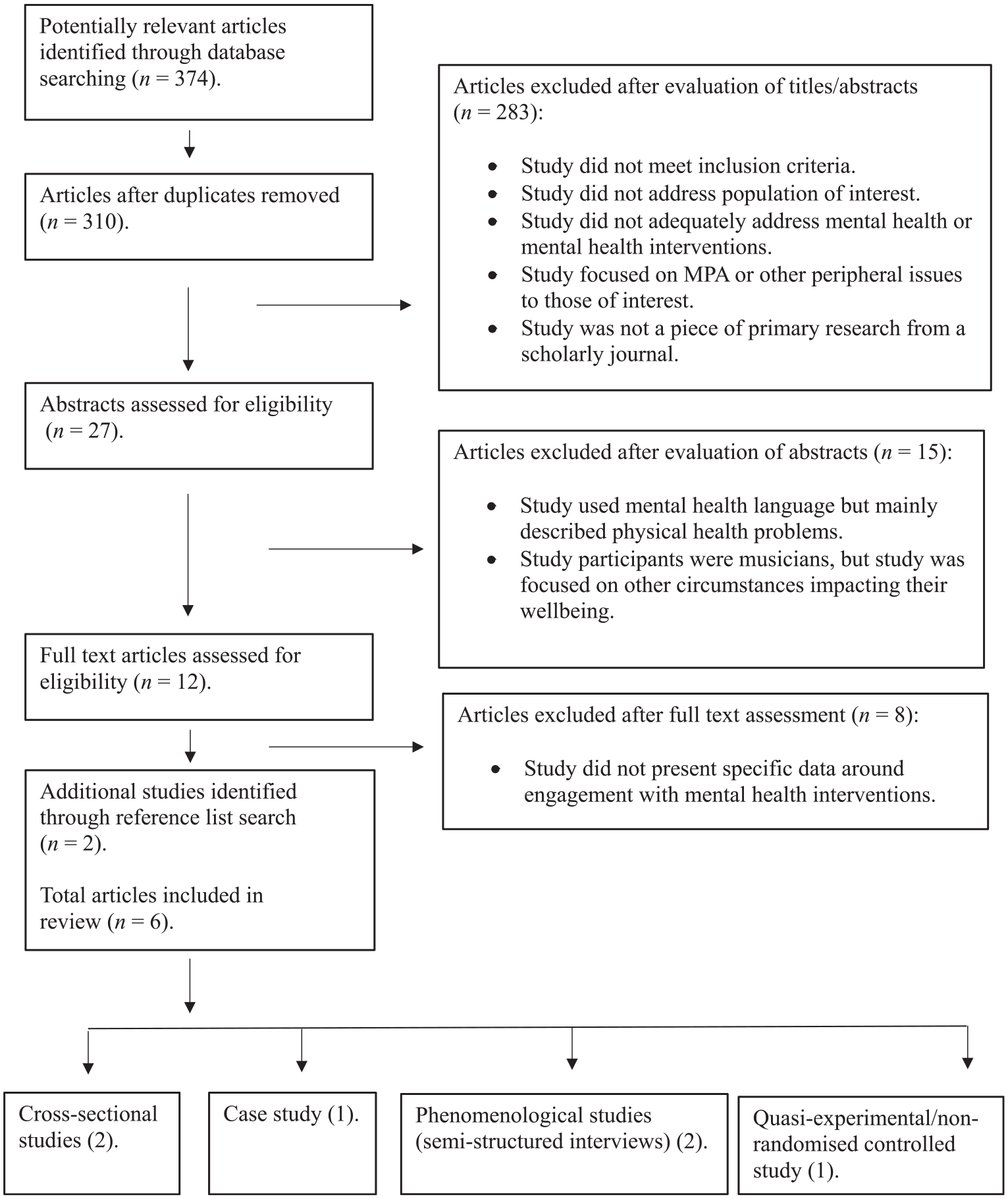
Modified PRISMA Flow Diagram of Literature Screening and Inclusion.
Quality of studies
Scoping reviews do not usually require a critical appraisal of the included studies. There is currently disagreement in the literature on the best method of critically appraising scoping review studies, especially when they include studies using differing methodologies (Tricco et al., 2018). The present review uses a framework guided by Pluye et al. (2009) that encourages professional judgment of the included studies’ quality, including relevance and content validity. A critical appraisal of each included study can be found in the supplemental material table online and includes sample size, bias, rigor, and control.
Data analysis charting and reporting
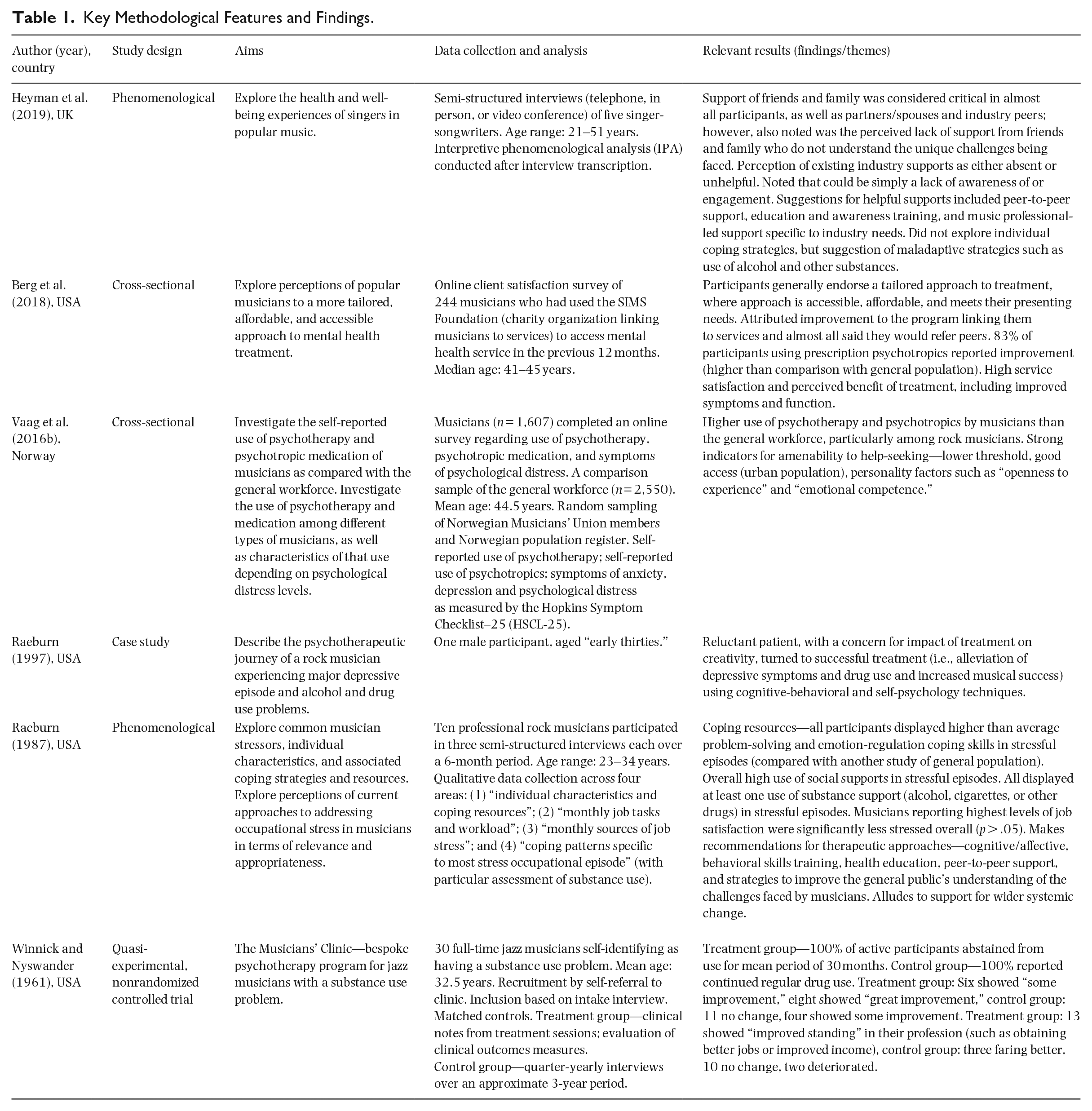
Key extracted data are presented in Table 1, including author, year, country, study design, intervention, participant characteristics, data collection, outcomes, and findings. Inclusion/exclusion criteria and key concepts were decided with consensus across all four authors. Discussions were undertaken to clarify the key concepts and identify themes that emerged from the included articles.
Key Methodological Features and Findings.
Results
Descriptive findings of study characteristics
The literature search yielded six international studies that met the inclusion criteria: two cross-sectional studies (Berg et al., 2018; Vaag et al., 2016b), one case study (Raeburn, 1997), two phenomenological studies (Heyman et al., 2019; Raeburn, 1987), and one nonrandomized controlled study (Winnick & Nyswander, 1961). Four of the studies were conducted in the United States (Berg et al., 2018; Raeburn, 1987, 1997; Winnick & Nyswander, 1961), one in the United Kingdom (Heyman et al., 2019), and one in Norway (Vaag et al., 2016b).
Inclusion criteria for this review were limited to musicians working in a popular music context. Winnick and Nyswander’s (1961) study was focused on full-time jazz musicians in New York. Similarly, Raeburn’s case study (1997) and phenomenological study (1987) targeted working rock musicians in San Francisco. Investigations conducted by Berg et al. (2018), Heyman et al. (2019), and Vaag et al. (2016b) were more broadly focused and encompass a range of genres, including blues, country, soul, hip-hop, reggae, pop, and R&B, and featured participants who specifically self-identified as working in the industry as musicians.
Sample sizes varied by study type. Qualitative studies ranged from a single case study (Raeburn, 1997) to interviewing five singer-songwriters in the United Kingdom (Heyman et al., 2019) and 10 musicians in the San Francisco area (Raeburn, 1987). Winnick and Nyswander (1961) explored the experiences of 30 New York musicians: 15 in the control group and 15 in the treatment group, of which five dropped out of treatment. Conducting the largest qualitative study reviewed, Berg et al. (2018) engaged with a sample of 244 Texan musicians. The phenomenological studies engaged with smaller sample sizes and detailed efforts to minimize bias—for example, Heyman et al.’s (2019) study of U.K. musicians assessed for leading questions, designed questions as open as possible, and extracted themes for discussion and cross-checking. The largest sample overall was engaged by Vaag et al. (2016b) and included 1,607 Norwegian musicians; however, only 842 of these were identified as nonclassical musicians.
Study length also varied according to type, with the longest taking place over 3 years (Winnick & Nyswander, 1961) and the shortest over 6 weeks (Berg et al., 2018). Age and gender were also widely represented across the six studies, with an overall mean age of approximately 35 years. Men had higher representation than women in all studies except Heyman et al. (2019), which had three female and two male participants, and Winnick and Nyswander (1961) did not specify gender. The key methodological features and findings of each study are summarized in Table 1.
The six identified studies were examined for thematic focus. While a range of themes were present, this article focuses on those relevant to the research question. Those that refer specifically to professional popular musicians’ perceptions of, engagement(s) with, and responses to mental health interventions. These themes were grouped into the following four categories: (1) amenability of professional popular musicians to particular therapeutic approaches, (2) attribution of treatment outcomes to tailored approaches, (3) professional popular musicians’ perceived barriers to treatment, and (4) recommendations for treatment approaches. These and other prominent themes are further outlined below.
Amenability of professional popular musicians to particular therapeutic approaches
Three of the six studies indicated high overall satisfaction with and perceived benefit of treatment among participating musicians (Berg et al., 2018; Raeburn, 1997; Winnick & Nyswander, 1961). Musicians involved in the Berg et al. (2018) study endorsed counseling, psychotropic medication, and addiction recovery services, with no statistical differences between modalities. Similarly, psychotropic medication and psychotherapy approaches were used considerably more by Norwegian musicians than those in the general workforce (Vaag et al., 2016b), and cognitive-behavioral and self-psychology techniques were endorsed in the San Francisco study (Raeburn, 1997). Collectively, these results reinforce the notion that musicians are open to and respond well to a range of treatment modalities.
The reviewed articles support several key considerations for musicians’ amenability to mental health interventions. Winnick and Nyswander (1961) refer to the phenomenon of “atypicality” of musician patients—referring to personality, behavioral and occupational factors that may influence the therapeutic process and outcomes. They also infer that the treated musicians showed elevated insight into their relationship with substances—understanding them as a means of self-medicating for anxiety, low self-confidence, and factors affecting their relationships such as rage and hostility—and demonstrated higher amenability to treatment. While not necessarily healthy, this elevated awareness of and conscious motivation to engage with self-medication can be linked to observations presented in more recent research.
Furthermore, Vaag et al. (2016b) note the existence of several positive help-seeking attributes of the musician workforce as compared with other workforces, such as a generally lower threshold for seeking support, higher accessibility to treatment given due to a tendency to reside in urban areas, and other personality factors such as “openness to experience” and “emotional competence” (p. 1450) as contributing to musicians’ amenability to psychotherapy, and worthy of further investigation as to whether this might explain increased interest in styles of psychotherapy that use imaginative or exploratory techniques.
Individual mediating factors to health risk are discussed in Raeburn (1987), whereby musicians reporting high job satisfaction levels were significantly less stressed overall, indicating links between occupational factors and musician health. However, all participants displayed at least one use of substance support (alcohol, cigarettes, or other drugs) during a stressful episode, somewhat echoing the Winnick and Nyswander’s (1961) findings around illicit substances as self-medication. Similarly, Heyman et al. (2019) allude to use of alcohol and other substances among participants as potential maladaptive coping strategies.
Attribution of treatment outcomes to tailored approaches
Significantly, two of the reviewed papers highlight the beneficial role of developing and administering specifically tailored approaches to musicians’ mental health care. Winnick and Nyswander (1961) provide an early insight into this, reporting overall improvements to addiction status, social adjustment, work performance, and addiction prognosis in the treatment group compared with the control group, and touting the role of an individualized, strengths-based, and flexible treatment option in achieving such a positive outcome. This study also noted the relevance of treating clinicians’ experience, with particular attention to the holistic approach, treating for more than just addiction, but rather catering to individual needs, problems, and personalities.
Echoing Winnick and Nyswander (1961), Berg et al. (2018) provide a more modern endorsement for administering a tailored approach to treatment, reporting that participants generally endorse such practice where it is accessible, affordable, and meets their presenting needs. Indeed, participants in this study attributed improvement to their well-being to participation in the targeted program, and almost all reported a willingness to refer peers.
Professional popular musicians’ perceived barriers to treatment
It is important to note the barriers to treatment identified in the reviewed papers. These include musicians’ concern for the impact of therapy on their creativity (Berg et al., 2018; Raeburn, 1997) and their reluctance to speak openly about mental health concerns where financial and job security are already uncertain (Heyman et al., 2019). Heyman et al. (2019) also noted a perception among musicians that existing industry supports were either absent or unhelpful—though the authors noted that this could simply be due to a lack of awareness of or engagement with such services. The authors also found that nonclinical positive factors, such as the support of friends and family, spouses/partners, and industry peers, were perceived as critical by almost all participants. However, they noted a perceived lack of support from friends and family who do not understand the particular challenges of life as a musician—further evidencing the need for tailored approaches cognizant of musicians’ lived experiences.
Recommendations for treatment approaches
Four of the reviewed studies made explicit mention of the paucity of available evidence to support professional popular musicians’ mental well-being and called for further investigation into therapeutic approaches, including cognitive therapies (Raeburn, 1987; Vaag et al., 2016b), behavioral skills training and health education programs (Heyman et al., 2019; Raeburn, 1987), and peer-to-peer supports (Heyman et al., 2019), as well as ways to improve general public understanding of the challenges faced by musicians (Raeburn, 1997). In addition, Berg et al. (2018) and Heyman et al. (2019) advocate for these approaches to be affordable, accessible and specific to the needs of the musician workforce, and preferably led by someone with an understanding of industry-related needs and challenges.
Discussion
This review highlights professional popular musicians’ experiences and perspectives toward mental health interventions in the available (albeit limited) peer-reviewed literature. Relevant findings are presented and critically interpreted, followed by examining limitations and recommendations for future research and practice.
Firstly, this review finds support for the importance of considering the characteristics of professional popular musicians as a distinct group with unique well-being needs, challenges, and strengths. The fact that the gaps in evidence identified by Berg et al. (2018) around how professional popular musicians experience or respond to mental health treatments are similar to those presented in a study some three decades earlier (Raeburn, 1987) suggests that the academic literature—and indeed, evidence-based practice—has not kept pace with research recommendations. A key issue here is that much of the field’s focus has been oriented around classical musicians, at the expense of those operating in other popular genres (Parker, 2015). This is inherently problematic, because as Heyman et al. (2019) state, “. . . we cannot assume that the health and well-being experiences of professional popular musicians, or the support that they require, echo that of classical musicians. . . The contexts and challenges they face can be different” (p. 176). This statement echoes previous research findings (Parker, 2015; Raeburn, 1999; Raeburn et al., 2003; Wills & Cooper, 1984).
In addition, this review emphasizes the need to consider individual characteristics and coping resources present in the professional popular musician population and how they might be leveraged during the therapeutic process. Examples of protective factors inherent to this cohort include the insight of New York jazz musicians into their substance use behavior (Winnick & Nyswander, 1961), the willingness and ability of Norwegian musicians to seek help early (Vaag et al., 2016b), and the openness to new experiences and capacity to regulate emotions and problem-solve demonstrated by rock musicians in San Francisco (Raeburn, 1987). Conversely, professional popular musicians’ propensity to self-medicate using alcohol and other substances (Heyman et al., 2019; Raeburn, 1987, 1997; Winnick & Nyswander, 1961) is a notable risk factor that should be addressed as part of any intervention.
Another finding of interest is the preference for tailored approaches that are accessible and affordable. This is most clearly explored by Berg et al. (2018), who postulate that accessibility and affordability are two key indicators for musicians not readily engaging in mental health interventions. Significantly, these authors analyze engagement with a subsidized service that specifically targets musicians in need. The results are positive because participants responded favorably to the program, their service providers, and the individual treatments. As other reviewed studies have demonstrated that once musicians are engaged in the therapeutic process, there is a good chance that they will respond positively (Raeburn, 1997; Vaag et al., 2016b), it would appear that crafting programs that are specifically designed to engage the target cohort is key. Further evidence of this comes from Heyman et al. (2019), who identified musicians’ overall lack of awareness or engagement with supportive services as a contributing factor in their negative attitudes about accessing health care.
Winnick and Nyswander (1961) also give some credence to the notion that a bespoke service for musicians can lead to positive outcomes for musician well-being, in that all of those who actively participated in the treatment withdrew from substance use voluntarily and for the duration of the program and experienced improvements to social adjustment and work performance. Again, the program was tailored (designed for musicians and staffed by specialist clinicians), accessible (open to anyone applying who met the inclusion criteria), and affordable (musicians could participate for free and pay back fees as they were able to).
There are notable limitations to this review. The methods used and the timeframe within which it could be conducted only allowed for the exploration of peer-reviewed scholarly journals and excluding books, chapters, conference papers, dissertations, and other gray literature. While this may potentially deprive the review of meaningful data, it highlights the lack of high-quality research in this field—an appraisal consistent with Willis et al.’s (2019) findings. Another limitation of this review is the focus on psychotherapeutic or medical models of mental health intervention. While the search terms used did attempt to encompass a range of intervention types (e.g., “programs” and “support”), it would be advantageous to gather data about musicians’ perceptions of or engagement(s) with psychosocial supports, peer-to-peer supports, and occupational supports. This aligns with the recommendations suggested by Raeburn (1987).
It is also worth noting that peer-reviewed research in the field of musician well-being is currently largely monopolized by one peer-reviewed journal, and only one study reviewed herein was published in a journal that does not specialize in the topic of music or performing arts. Here, it can be argued that musicians’ mental well-being is a public health issue and would benefit from researchers’ interest in disciplines such as population health, psychology, occupational health, and health policy research. Of relevance, increasing the wider population’s understanding and awareness about the unique well-being challenges the musicians face may better equip others in nonclinical roles (such as friends and family) to provide support—something Raeburn (1987) suggests as likely beneficial to musicians experiencing poor mental health. This may also remove some of the barriers around help-seeking, such as fear of being misunderstood and consequences of job security: two key concerns identified by Heyman et al. (2019).
There were also some notable sampling limitations. All six of the studies only included musicians who actively sought treatment or who were likely to have an interest in or proclivity toward health and well-being topics—a factor likely to increase the chance of selection or response bias (Vaag et al., 2016b). Risk of social desirability bias was also noted by Raeburn (1987) in the gathering of subjective data via the semi-structured interview method. However, researchers minimized efforts by demonstrating nonjudgment and in the data collection process by using repeated, standardized measures and second readers to interpret transcription.
Finally, there are limitations to the currency and cultural context of some of the included studies. This is particularly true for Winnick and Nyswander’s (1961) study, which is now 60 years old. While this study continues to be cited in the field of musician well-being and contributes helpful information to this review, its style of reporting is problematic and diminished by missing details about data and data collection, as well as general cultural biases revealed by language use pertaining to race, gender roles, people with substance use problems, and attitudes to musicians. The study would likely be difficult to replicate in the current context. On the topic of currency and context more broadly, this review’s authors acknowledge the limitations of defining a constantly evolving population. The professional popular musician cohort is diverse and complex (both in what constitutes “professional” and “popular”). This review intentionally avoids placing hard limiters on either definition—although the authors argue this should be considered in the future investigations of the cohort.
Based on this review’s findings, it is recommended that future research investigates the effectiveness and meaningfulness of tailored, accessible interventions that cater to the unique needs, challenges, and protective and risk factors for musicians’ mental health. Such studies should take into consideration the demands of the modern musician (including independent and freelance artists; Heyman et al., 2019), as well as sources of stress and coping throughout the musician life cycle (Raeburn, 1987). Research should explore a variety of intervention types and engagement strategies—including clinical, psychoeducational, and peer-to-peer (Heyman et al., 2019; Raeburn, 1987)—and study designs should consider how to build on existing themes, such as comparative descriptive studies (Raeburn, 1987) and/or mixed-method approaches with wider audiences (Heyman et al., 2019).
Conclusion and recommendations
In summary, this review found limited peer-reviewed research on professional popular musician engagement with and perceptions of mental health interventions. Responses and outcomes were varied. However, there is the suggestion of perceived benefit to developing supports that are tailored, affordable, and accessible, and exploring nonclinical options such as peer and social supports. In addition, professional popular musicians may demonstrate unique personality and psychosocial characteristics that should be considered to develop appropriate interventions. This review recommends that future research investigate the effectiveness and meaningfulness of such targeted interventions, using study designs that build on existing evidence.
Supplemental Material
sj-pdf-1-pom-10.1177_03057356211019477 – Supplemental material for Out of tune: Perceptions of, engagement with, and responses to mental health interventions by professional popular musicians—A scoping review
Supplemental material, sj-pdf-1-pom-10.1177_03057356211019477 for Out of tune: Perceptions of, engagement with, and responses to mental health interventions by professional popular musicians—A scoping review by Amy Visser, Megan Lee, Timothy Barringham and Nasim Salehi in Psychology of Music
Footnotes
Declaration of conflicting interests
The author(s) declared no potential conflicts of interest with respect to the research, authorship, and/or publication of this article.
Funding
The author(s) received no financial support for the research, authorship, and/or publication of this article.

Supplemental material
Supplemental material for this article is available online.
References
Supplementary Material
Please find the following supplemental material available below.
For Open Access articles published under a Creative Commons License, all supplemental material carries the same license as the article it is associated with.
For non-Open Access articles published, all supplemental material carries a non-exclusive license, and permission requests for re-use of supplemental material or any part of supplemental material shall be sent directly to the copyright owner as specified in the copyright notice associated with the article.
