



Abstract
In this article, we systematically reviewed the research literature dealing with expectancy-value motivation theory within music contexts. Employing the PRISMA (Preferred Reporting Items for Systematic Reviews and Meta-Analyses) approach, a total of 1,120 records were retrieved and examined, with 110 eventually included in the analyses. Frequencies/percentages were generated for research output in 5-year time periods, type of publication, sampling locations, and methodologies. Summaries of all 110 records were provided; content analyses on topics covered were also conducted. Findings indicated a clear increase in research interest over the past 15 years with quantitative methodologies being twice as prevalent as qualitative approaches. While the vast majority (97.7%) of quantitative research employed self-report questionnaires, the most common form of qualitative data collection was interviews (59.1%). Salient topics covered included students’ expectancy-value beliefs across music and other school subjects, continued music participation, intentions to pursue a career in music, and parental influences.
What influences students’ motivation to study music? How can these be conceptualized within a single theoretical framework? Among the most influential explanations for addressing these two questions is expectancy-value motivation theory. This framework was originally conceptualized by Atkinson (1957, 1964) to explain individuals’ achievement motivation. It was further theorized by Eccles and her colleagues (Eccles et al., 1983; Eccles & Wigfield, 1995, 2002; Wigfield & Eccles, 2000, 2002, 2020) to link individuals’ motivation to their achievement, performance, persistence, and decisions.
Expectancy-value theory consists of two main components: expectancies for success and subjective task value. Expectancies for success is defined as the self-beliefs individuals hold on how well they can perform a task, either now or in the future (Eccles et al., 1983; Wigfield & Eccles, 2000). These beliefs are related to their feelings of competence (or ability) and the perceived task difficulty (Eccles & Wigfield, 1995). Compared with self-efficacy which is situational-specific (Bandura, 1997), expectancies for success are task-specific (Eccles & Wigfield, 2002; McPherson & O’Neill, 2010; Wigfield & Eccles, 2000). Subjective task values are domain-specific, which researchers in this area (Eccles et al., 1983) have categorized into four components: attainment value (i.e., importance of the task), intrinsic value (i.e., enjoyment or interest in the task), utility value (i.e., usefulness of the task), and perceived cost (i.e., effort or sacrifice needed to perform the task).
Researchers in the educational domain have reported that students’ expectancy-value beliefs toward a subject are positively associated with their academic outcomes, such as achievement in that subject (Guo et al., 2015, 2016; Perez et al., 2019), and course completion (Luttrell et al., 2010). Students’ expectancy beliefs toward a subject have also been found to be negatively associated with text anxiety (Selkirk et al., 2011), suggesting that those who believed they are competent in a subject are less likely to experience anxiety during a test in that subject. Furthermore, researchers have found positive associations between expectancy-value beliefs and several adaptive dispositions and behaviors, such as flow experience (Elias et al., 2010), homework effort and completion (Yang & Xu, 2018), and perseverance of effort (Muenks et al., 2018).
Given the insights that expectancy-value theory offers and its potential applicability to the teaching and learning of music, several researchers have explored expectancy-value theory in music contexts. For instance, researchers have examined students’ expectancy-value beliefs across music and other school subjects (e.g., Koh, 2011; McPherson & Hendricks, 2010; Seog et al., 2011; Tossavainen & Juvonen, 2015). Other explorations included students’ career intentions in music (e.g., Jones & Parkes, 2010; Parkes & Jones, 2011, 2012), factors for continued music participation (e.g., Amundson, 2012; StGeorge, 2010), and parental influence on students’ music learning (e.g., Fredricks et al., 2006; Juvonen, 2019).
The importance of motivation in music contexts can be seen through a number of literature reviews on this topic (e.g., Cogdill, 2015; Tan & Sin, 2020; Tucker, 2018; West, 2013). In the only known review of literature with a section focusing on expectancy-value theory, Katsochi (2008) reviewed seven studies on students’ expectancy-value beliefs about music and found that their beliefs were influenced by their musical behaviors and expected intentions in the future. As far as can be determined, within the last decade, no published study has systematically and comprehensively documented the research literature on expectancy-value research in music contexts. Such a project would enable researchers to take stock of extant research, chart future directions, and contribute to music psychology in a novel and timely manner.
In this article, we systematically reviewed the research literature on expectancy-value theory in music contexts. Key issues relating to this purpose include the following: (1) What was the output trend of expectancy-value research in music contexts? (2) Which methodologies were employed? (3) What were the topics examined? (4) Based on the systematic review, what are some implications for future research?
Methods
We followed methodological procedures from PRISMA (Preferred Reporting Items for Systematic Reviews and Meta-Analyses; Moher et al., 2009) to generate data. Relevant literature was searched on five databases (PsycINFO, Sage, Informit, Web of Science, and Google Scholar) using the search string “music” AND “expectancy value.” To identify studies that may have been omitted during the initial database search, we conducted backward citation search.
The initial search was done on 3 April 2020, yielding 1,120 records (PsycINFO: 36; Sage: 36; Informit: 2; Web of Science: 48; Google Scholar: 998). After removing 105 duplicates, the titles and abstracts of 1,015 records were screened. Of the 1,015 records, 812 were removed as they were irrelevant (e.g., not related to music or expectancy-value). We retrieved the full texts of the remaining 203 records and examined them for their eligibility based on the following inclusion criteria: (1) the full text was written in English and available; (2) the expectancy-value framework was used or examined; and (3) the research was conducted in the music and/or music education domain. Three articles were added from the backward citation search. An additional search was conducted on 6 August 2020; no new records were found. The final number of records included in this review was 110. The process followed to identify the relevant literature for this systematic review is presented in Figure 1.
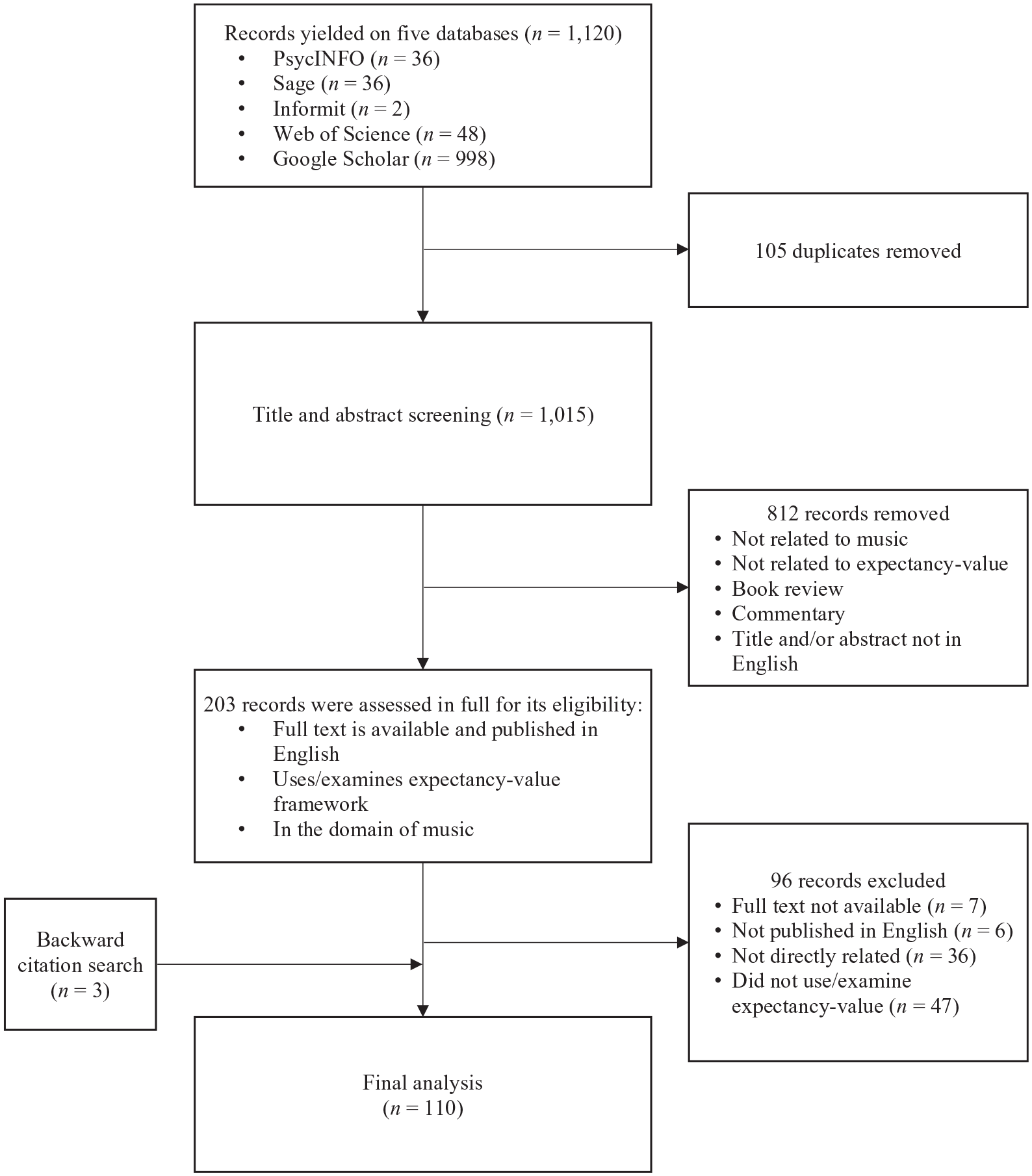
The PRISMA Flowchart.
Results
Figure 2 presents the research output trend in 5-year periods. Based on the procedures described above, the study by Chandler et al. (1987) was the first study published that examined expectancy-value in the context of music. However, the research output surged only after 2005, with 33 studies published between 2006 and 2010—a distinct leap from six in the previous 5-year period.
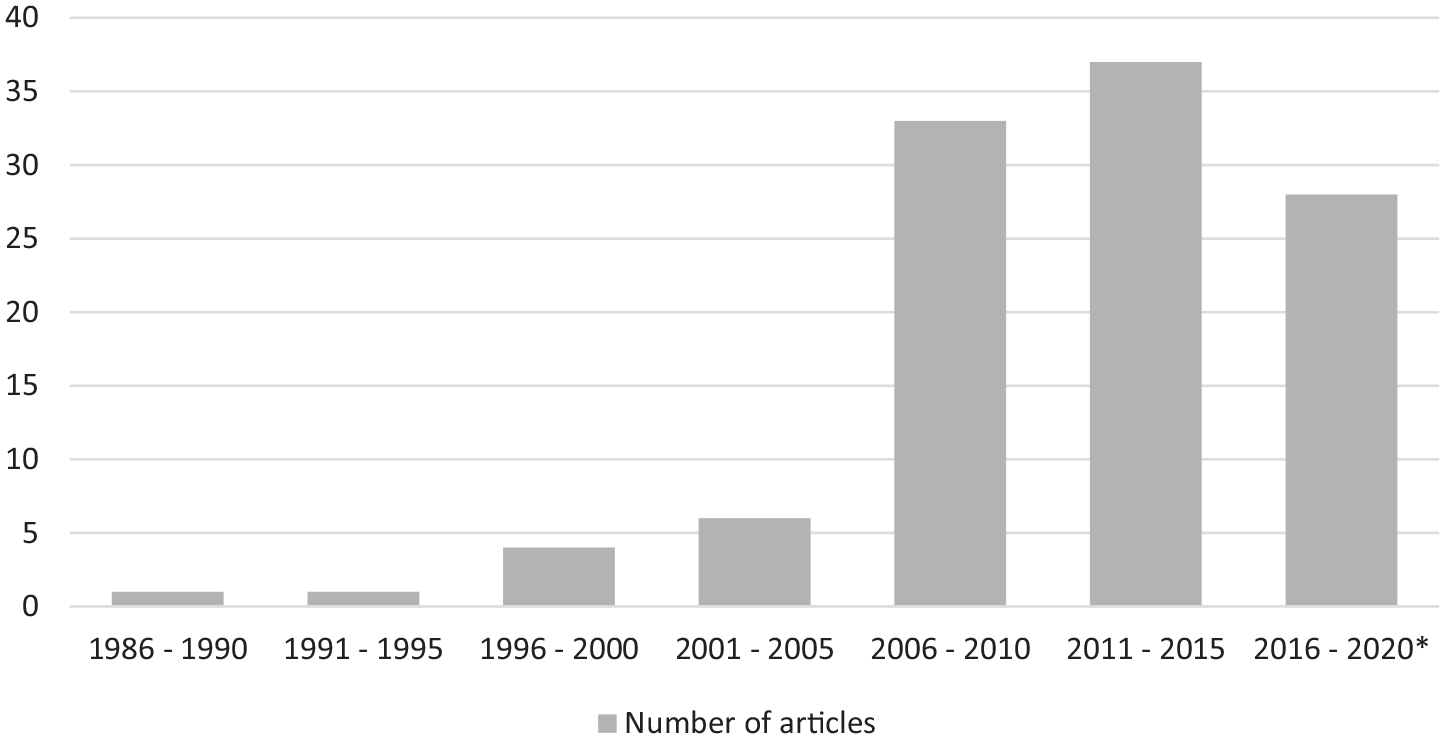
Expectancy-Value Research Output in 5-Year Periods.
Of the 110 records, 62 (56.4%) were published as journal articles. The remaining were dissertations/theses (n = 33; 30.0%), conference papers (n = 12; 10.9%), and book chapters (n = 3; 2.7%). Of the 62 journal articles, 49 (79.0%) were published in music and arts journals, while the remaining 13 were published in education and psychology journals. Journals that published the most articles on expectancy-value in music contexts were Research Studies in Music Education (n = 14), Music Education Research (n = 10), and Psychology of Music (n = 5). When combined, these three journals accounted for more than a quarter (26.4%) of all the records on expectancy-value in music contexts.
One hundred one records (91.8%) were empirical studies, while the remaining nine (8.2%) were non-empirical (e.g., literature reviews and conceptual articles). US participants were the most often sampled (n = 33), followed by Australia (n = 31) and the United Kingdom (n = 12). Other locations sampled were Hong Kong (n = 6); Canada, Finland, and Mexico (n = 5 each); South Korea (n = 3); Brazil, Mainland China, Israel, Portugal, and South Africa (n = 2 each); and Denmark, Malaysia, New Zealand, Norway, Singapore, Spain, Sweden, and Turkey (n = 1 each).
Analysis of methodologies
Table 1 presents a summary of the methodologies, countries sampled, study design, data collection methods, salient topics, and components examined. An overview of all 110 records is presented in Supplementary Materials 1 to 4, categorized according to the methodologies employed. The studies were displayed in chronological order, from the earliest to the most recent. Information on the participants, components included, study design, data collection methods, and key findings in relation to expectancy-value was provided for each study. As can be seen from Table 1, of the 110 studies, 57 (51.8%) were quantitative, 13 (11.8%) were qualitative, 31 were mixed-methods (28.2%), and 9 (8.2%) were non-empirical. Accordingly, 80% (51.8% + 28.2%) of all studies employed quantitative methods either in whole or in part, while 40% (11.8% + 28.2%) adopted qualitative approaches. Quantitative methodologies were therefore twice as prevalent as qualitative approaches.
Summary of Expectancy-Value Studies in Music Contexts.
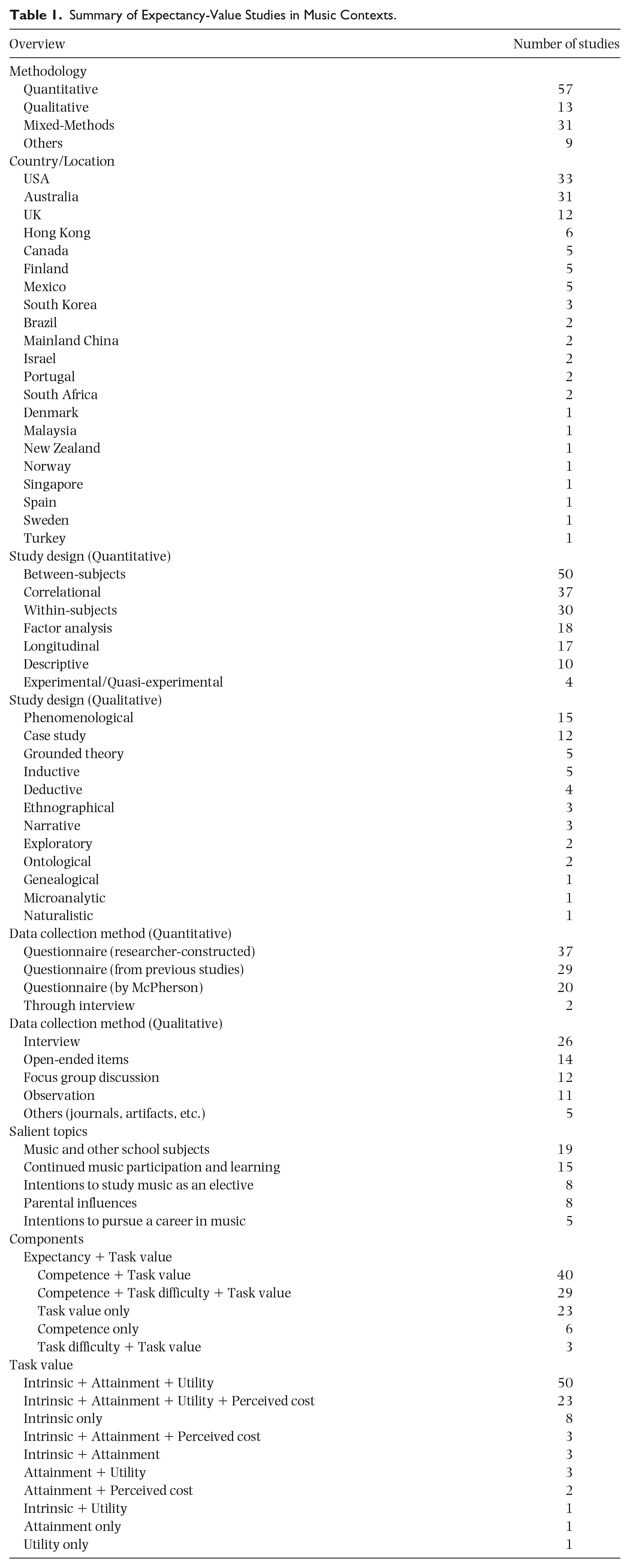
The majority (86/88 = 97.7%) of the studies that employed quantitative methodology used self-report questionnaires. Researcher-constructed questionnaires were commonly used (37/88 = 42.0%; for example, Amundson, 2012; Leung, 2008; Parkes & Jones, 2012; Sichivitsa, 2007). These questionnaires were devised based on expectancy-value theory and other existing theories (e.g., flow theory; Burak, 2014; Weiss, 2015) or scales (e.g., Intrinsic Motivation Inventory; StGeorge, 2010). A questionnaire developed by McPherson and based on guidelines outlined in Eccles et al. (2005) has also been used or adapted in several studies (20/88 = 22.7%; for example, Koh, 2011; Leung & McPherson, 2010; Lowe & Coy, 2016; McPherson & O’Neill, 2010; Seog et al., 2011; Xie & Leung, 2011). Twenty-nine studies (33.0%) used questionnaires that were used in earlier studies. For instance, Ivaldi and O’Neill (2010) administered the questionnaire used by Eccles et al. (1993), which was in turn adapted from earlier studies (e.g., Eccles et al., 1983). For the two studies (McPherson, 2001; Mota, 1999) that did not use self-report questionnaire, the authors collected quantitative data during the interviews with the participants.
Among the studies that employed qualitative methodology, interview was the most common approach to collect data (26/44 = 59.1%; for example, Burland, 2005; Buttermann, 2019; Kelly-McHale, 2011; Leung & McPherson, 2011; Miksza et al., 2018). Semi-structured interviews were conducted with students (e.g., Kelly-McHale, 2011; McEwan, 2013; Mota, 1999; Picone, 2012), teachers (e.g., Buttermann, 2019; Kelly-McHale, 2011; Tonissen, 2017), and students’ parents (e.g., McEwan, 2013; Picone, 2012) to elicit their beliefs and values toward music and music education. Sample interview questions for students included, “Is music important to you? Why?” (Kelly-McHale, 2011, p. 346) and “Do you think you were good at classroom music?” (McEwan, 2013, p. 121). For music teachers, sample interview questions were, “What are your expectations for student success?” (Buttermann, 2019; p. 45) and “Why do you think it’s important to have music in elementary schools?” (Kelly-McHale, 2011, p. 338). Sample interview questions for parents included, “Do you think it is important for students generally to learn a musical instrument while at school?” (McEwan, 2013, p. 124) and “What motivated you to involve your child in music education either in the school band or taking private lessons?” (Picone, 2012, p. 322).
The second common qualitative approach was the use of open-ended items (14/44 = 31.8%; for example, Deskins, 2019; McEwan, 2006, 2013; Parkes & Jones, 2011; Upitis et al., 2017). Sample open-ended items included, “If you are considering a career in music performance, what are some of the main reasons?” (Parkes & Jones, 2011, p. 22), “What were the most important reasons why you decided to enter a doctoral program in music education?” (Deskins, 2019, p. 26), and “Why do you want to continue learning your instrument?” (StGeorge, 2010, p. 337).
Another qualitative approach used by researchers involved focus group discussions (12/44 = 27.3%; for example, Lowe, 2010, 2012; Underhill, 2015). The discussions were often semi-structured to allow open dialogue among the participants (e.g., Harvey, 2013; Lowe, 2010; Weiss, 2015). Sample questions included, “Is music valued by other kids/staff/parents?” (Underhill, 2015, p. 92), “Can you describe the importance of jazz education to you?” (Buttermann, 2019, p. 150), and “Did you enjoy the process of composing with an iPad?” (Chen, 2020, p. 158). The responses were transcribed and analyzed based on thematic analysis (e.g., Lowe, 2011b, 2012; Miksza et al., 2018; Weiss, 2015) and expectancy-value theory (e.g., Lowe, 2008a, 2008b, 2010)
Finally, researchers have collected data through observations of participants (11/44 = 25.0%). Six of these studies video-recorded the participants (e.g., Miksza et al., 2018; Picone, 2012; Weiss, 2015). The video recordings were used and analyzed in various ways. For instance, Evans (2011) used video recordings to determine the amount of time participants spent on practicing and non-practicing activities. Miksza et al. (2018) employed behavioral analysis to identify certain behaviors and the status (i.e., routine completion, failure, improvement, or solution of task) of each practice frame. Picone (2012) analyzed the video recordings using expectancy-value theory and other frameworks such as self-regulation (McPherson & Zimmerman, 2002) and self-determination (Ryan & Deci, 2000).
Analysis of components included
As noted in the beginning of this article, expectancy-value theory consists of two main components: expectancies for success and subjective task value. While expectancies for success may be further understood in terms of beliefs that are related to competence and perceived task difficulty, subjective task values can be construed in terms of attainment value, intrinsic value, utility value, and perceived cost. Of the 101 empirical studies examined in this review, 72 included both expectancy and task value components. However, the task value component was examined more frequently than its expectancy counterpart (95 vs 78). Among studies that examined task value, intrinsic value was most frequently included (88 studies); this was followed by attainment value (85 studies), utility value (78 studies), and perceived cost (28 studies). Furthermore, researchers often examined attainment, intrinsic, and utility value together (50 studies), omitting perceived cost. With respect to the expectancy component, competence was included in more than twice the number of studies compared with its task difficulty counterpart (75 vs 32). Researchers often examined competence on its own (46 studies), while 29 studies looked at both competence and perceived task difficulty.
Topics covered
Salient topics covered included students’ expectancy-value beliefs across music and other school subjects (e.g., McPherson & O’Neill, 2010; Portowitz et al., 2010; Seog et al., 2011; Xie & Leung, 2011), continued music participation (e.g., Amundson, 2012; Sichivitsa, 2007; Simpkins, Vest, & Becnel, 2010), continued music learning (e.g., Lowe, 2007, 2008a, 2011a; Lowe & Coy, 2016), intentions to study music as an elective (e.g., Freer & Evans, 2018; Kingsford-Smith & Evans, 2019; McEwan, 2006, 2013), intentions to pursue a career in music (e.g., Jones & Parkes, 2010; Parkes & Jones, 2011, 2012) and parental influences (e.g., Fredricks et al., 2006; Juvonen, 2019).
First, researchers have compared students’ expectancy-value beliefs across music and other school subjects. An international research project led by McPherson and colleagues (González-Moreno, 2010; Hentschke, 2010; Juvonen, 2011; Leung & McPherson, 2010; McPherson & Hendricks, 2010; McPherson & O’Neill, 2010; Portowitz et al., 2010; Seog et al., 2011; Xie & Leung, 2011) investigated students’ motivation to study music as a school subject across eight countries (Brazil, Mainland China, Finland, Hong Kong, Israel, South Korea, Mexico, and the United States). Based on the data from these eight countries, McPherson and O’Neill (2010) compared students’ motivation to study music and other school subjects (art, mathematics, mother tongue, and physical education). Findings indicated that compared with other subjects (except for art), students valued music less and perceived music as less difficult. Students’ ratings of their competence beliefs for mother tongue and physical education were significantly higher than their rating of competence for music. For all countries except Brazil, students’ ratings of competence beliefs and values for most subjects (including music) declined across grade levels. Significant gender effects were found; for music, female students had higher ratings of competence beliefs and values than male students. Female students also perceived music as less difficult than male students. Compared with non-music learners, music learners had higher competence beliefs for all five subjects, higher values for three subjects (art, mother tongue, and music), and lower task difficulty for all subjects except physical education.
Second, researchers have explored the influence of expectancy-value beliefs on continued music participation and learning. Findings suggested that students’ expectancy-value beliefs toward music, which were shaped by their musical participation, had positive influence on their music learning experience and continued music participation and learning. For instance, Simpkins, Vest, and Becnel (2010) investigated 567 children’s participation in music and sports and continued participation in adolescence. Findings indicated that participants’ participation throughout elementary school influenced their self-concept and interest toward the music or sport activity, which predicted their participation during adolescence. StGeorge (2010) investigated the influence of subjective music learning experience on students’ participation in formal music lessons during childhood and adolescence. Results showed that feelings of ability, competence, and self-esteem influenced the meaningful experience of music learning, which in turn increased the likelihood of continued participation. Amundson (2012) explored factors that influenced continued music participation from high school to college among 369 college students. Results revealed that intrinsic value, perceived cost, competency, and background (e.g., peers, advice from high school choir teacher, knowledge of college choir program) were significant factors in terms of students’ continued music participation in college. In similar vein, Lowe (2011a, 2012) explored retention in class music among lower secondary school students in Australia. Findings indicated that the decline in task values toward class music (Lowe, 2011a) and weak competence beliefs (Lowe, 2012) contributed to low retention and enrollment in class music.
Third, researchers have examined the influence of expectancy-value beliefs on students’ intentions to study music as an elective. On the one hand, studies have found that students’ value toward music mattered. Venter (2019) explored possible factors that contributed to the continuation and discontinuation of learning music among 180 ninth- and tenth-grade students. Findings indicated that students who reported higher value and competence beliefs for music than other subjects were also those who were more motivated to study music as an elective. Lowe (2008a) investigated eighth-grade students’ motivation to study music after their first academic year in secondary school and found declining values toward music and a corresponding low enrollment in music elective for the following year. Qualitative findings suggested that the decline in value toward music may be related to the activities presented during Year 8 music classes. On the other hand, Kingsford-Smith and Evans (2019) found that values toward music of 180 seventh- and eighth-grade students did not significantly predict intentions to study music as an elective. Instead, psychological needs satisfaction (i.e., perceived autonomy, competence, and relatedness; Deci & Ryan, 2000; Ryan & Deci, 2017) in music classes was a predictor of their intention to study music as an elective and their value toward music.
Fourth, studies have explored the influence of expectancy-value beliefs on music career intentions. Jones and Parkes (2010) found that music teacher identity was the most influential reason why undergraduate music students chose to pursue a career in music education, while perceived competence as a music teacher and perceived usefulness of music teaching were the least important reasons. In a parallel study, Parkes and Jones (2011) found that undergraduate music students chose to pursue a career in music performance because they valued music performance (in terms of enjoyment and usefulness), perceived themselves to be competent at performing, and identified themselves as musicians.
In a later study, Parkes and Jones (2012) found that attainment value was the strongest predictor of students’ intention to choose a career in music education, followed by intrinsic interest value and expectancies for success. On the other hand, expectancies for success was the strongest predictor of students’ intentions to choose a career in music performance, followed by attainment value, perceived ability, and intrinsic interest value. However, Miksza et al. (2019) found that students’ socially prescribed expectations to be perfect at playing music were negatively associated with students’ intentions to pursue a career in music through autonomous motivation. In short, students’ expectancy-value beliefs toward music were found to positively influence their intentions to pursue a career in music (Jones & Parkes, 2010; Parkes & Jones, 2011, 2012), but socially imposed extreme expectancy beliefs (i.e., perfectionism) may be detrimental to students’ motivation to pursue a music career (Miksza et al., 2019).
Finally, researchers have investigated parental influences on their children’s behaviors and beliefs toward music. Sichivitsa (2007) found that parental support and involvement indirectly influenced non-music-major students’ value toward music, which was the strongest predictor of students’ intention to continue music participation. In a study involving 849 third, fourth, and sixth graders (Yoon, 1997), children’s perceived parental value toward music significantly predicted their preferred choice for music activity. Similarly, Juvonen (2019) found that fifth- and sixth-grade students’ interest in music positively correlated with their perceived parental beliefs (students’ competence and importance) toward music as a school subject.
Simpkins and colleagues (Fredricks et al., 2006; Simpkins et al., 2012; Simpkins, Vest, Dawes, & Neuman, 2010) conducted a line of research on parental beliefs on children’s motivation toward music. Parents’ perceived competence of children and value toward instrumental music predicted their children’s expectancy-value beliefs toward instrumental music and actual music participation (Fredricks et al., 2006). Elementary school students’ expectancy-value beliefs toward instrumental music were predicted by their parents’ musical behaviors during their childhood (Simpkins, Vest, Dawes, & Neuman, 2010). Mothers’ musical behaviors were predicted by their own beliefs toward music since 1 year; these behaviors predicted their children’s expectancy-value beliefs toward music during adolescence, which in turn predicted their musical behaviors (Simpkins et al., 2012). Taken together, these findings suggest that parental support, musical involvement, musical behaviors, expectancy-value beliefs, and how their beliefs were perceived by their children have positive influences on their children’ musical behaviors and expectancy-value beliefs toward music.
Discussion
In this section, we distill and interpret the literature with the goal of presenting implications for research and practice. As noted earlier, research on expectancy-value in music contexts was often conducted in North American, Oceanian, and European countries. South Africa (Parkes & Daniel, 2013; Venter, 2019) was the only African country covered, while Brazil (Hentschke, 2010) was the only South American country involved, resonating with Henrich et al.’s (2010) observation that in psychological research, participants from “WEIRD” (Western, educated, industrialized, rich, and democratic) populations were most often sampled. As Henrich et al. (2010) argued, “we need to be less cavalier in addressing questions of human nature on the basis of data drawn from this particularly thin, and rather unusual, slice of humanity” (p. 61). Future research may draw on a larger diversity of research participants to more accurately represent the psychological dispositions of music learners across varied cultures.
In our methodological analysis, we highlighted that the most common quantitative approach was the use of self-report questionnaires (97.7%), especially those constructed by researchers themselves (e.g., Leung, 2008; Parkes & Jones, 2012) and the questionnaire developed by McPherson and O’Neill (2010). Future studies may draw on data beyond self-report sources. Among qualitative studies, interviews were the most common sources of data (59.1%). Less common approaches, such as keeping journals and diaries, may be considered.
As noted in our analysis of components, perceived cost was examined in only 28 out of 94 studies on task value—which stands in stark contrast to all other three aspects (i.e., 88 for intrinsic value, 85 for attainment value, and 78 for utility value). One possible reason for the relative lack of research attention on perceived cost may be that it has not been well defined operationally, which in turn led to the paucity of validated scales for this construct (Barron & Hulleman, 2015; Wigfield & Eccles, 2020). Nonetheless, over the past decade, researchers in broader fields have developed scales to measure perceived cost (e.g., Flake, 2012; Flake et al., 2015; Kosovich et al., 2015). Future research may adapt these scales for music contexts, triangulating findings, where appropriate, with qualitative approaches. In addition, researchers could further theorize cost, including its subcomponents and how much it weighs within the larger expectancy-value framework (see Barron & Hulleman, 2015; Eccles & Wigfield, 2020; Flake et al., 2015).
Another potential area of concern relates to the fact that with respect to the expectancy component, competence was included in more than twice the number of studies compared with its task difficulty counterpart (75 vs 32). Furthermore, researchers often examined competence solely (46 studies). Future research on expectancy-value theory in music contexts may pay greater research attention on task difficulty, examining in particular how it distinguishes from expectancies for success and ability/academic self-concepts so as to “have a clearer sense of their interrelations and separate influences on outcomes” (Eccles & Wigfield, 2020, p. 3).
As reported in our analysis of topics covered, expectancy-value beliefs positively contributed to students’ continued music participation and learning (e.g., Amundson, 2012; Lowe & Coy, 2016), intentions to study music (e.g., Freer & Evans, 2018; Kingsford-Smith & Evans, 2019), and intentions to pursue a career in music (e.g., Parkes & Jones, 2011, 2012) However, no interventional studies were found. In other domains, there have been an increasing number of expectancy-value theory-based interventional studies (see Harackiewicz & Priniski, 2018; Rosenzweig & Wigfield, 2016). A systematic review by Rosenzweig and Wigfield (2016) found that interventions targeting students’ task values toward STEM (i.e., science, technology, engineering, and mathematics) significantly increased students’ self-reported levels of task values toward STEM activities or courses and their academic outcomes in those areas. This is a potentially fruitful future area of research for expectancy-value studies in music contexts that may yield positive outcomes in terms of practical strategies in music contexts.
One limitation of this study was that PRISMA guidelines were followed to retrieve the research literature on expectancy-value theory in music contexts. As stated in the inclusion criteria, the full text of records should be available and written in English; research works published in other languages were excluded. Future studies could systematically review research literature published in other languages and make comparisons with this study. Furthermore, this study was limited to the expectancy-value framework conceptualized by Atkinson (1957, 1964) and Eccles and colleagues (e.g., Eccles et al., 1983; Eccles & Wigfield, 1995; Wigfield & Eccles, 2000); research on similar notions (e.g., Lewin, 1938; Tolman, 1932) might have been left out.
Notwithstanding the limitations, this study has presented an overview of the research literature in music contexts and offered some recommendations for future research. Eccles and Wigfield (1995) pointed out that “over time, there has been an evolution in the conceptualization of constructs linked to expectancy for success and task value, as well as a refinement in the components of each construct” (p. 217). Sustained research endeavors in music contexts will undoubtedly contribute to the “continued evolution” (Barron & Hulleman, 2015, p. 508) of the theory and how the components work in concert to impact students’ motivation to study music during their schooling years—and beyond.
Supplemental Material
sj-pdf-1-pom-10.1177_03057356211024344 – Supplemental material for A PRISMA review of expectancy-value theory in music contexts
Supplemental material, sj-pdf-1-pom-10.1177_03057356211024344 for A PRISMA review of expectancy-value theory in music contexts by Hui Xing Sin, Leonard Tan and Gary E McPherson in Psychology of Music
Footnotes
Declaration of conflicting interests
The author(s) declared no potential conflicts of interest with respect to the research, authorship, and/or publication of this article.
Funding
The author(s) received no financial support for the research, authorship, and/or publication of this article.

Supplemental material
Supplemental material for this article is available online.
References
Supplementary Material
Please find the following supplemental material available below.
For Open Access articles published under a Creative Commons License, all supplemental material carries the same license as the article it is associated with.
For non-Open Access articles published, all supplemental material carries a non-exclusive license, and permission requests for re-use of supplemental material or any part of supplemental material shall be sent directly to the copyright owner as specified in the copyright notice associated with the article.
