




Abstract
In this study, we explored the relationship between extracurricular (formal and informal) music activity participation and music and Chinese language academic achievements of primary school students in China. Fourth graders (N = 10,958) reported their demographic information and extracurricular music activity participation, and completed two standardized academic achievement tests, one on music and another on the Chinese language. Results showed that students’ music activity participation was related to higher music academic achievement after controlling for gender, school location, and family socioeconomic status. The effect of students’ informal music activity participation on their music academic achievements was greater than that of students’ formal music activity participation. Remarkably, students’ informal music activity participation was also positively related to their Chinese language academic achievement, while formal music activity participation showed a negative correlation with academic achievement in Chinese language. Findings contributed to an increased understanding of the influence of different kinds of extracurricular music activities on students’ academic developments.
Keywords
“Extracurricular activity” is defined as participation in clubs, organizations, or other activities outside of class that enhance and extend classroom instruction at leisure (Darling et al., 2005; Mahoney & Cairns, 1997). In China, like other countries, extracurricular activities are activities outside of the school curriculum. They are in-school and out-of-school clubs, groups, or other forms of activities that constitute an integral part of the overall development of school-age learners. Evidence shows that participation in extracurricular activities may influence students’ social development (Bundick, 2011; Gilman et al., 2004) and academic achievement (Dick, 2010; Fredricks, 2012; Lipscomb, 2007; Zhang & Tang, 2017).
Introduction
Formal and informal extracurricular music activities
There are two kinds of extracurricular activities (Falk & Dierking, 2000; Suter, 2014). One is formal, which is regularly scheduled and highly structured with a teacher’s supervision, such as a chorus or an instrumental group. The other is informal, which may have an irregular schedule and be highly personalized, with no identifiable curriculum and widely varied, such as casually singing or playing instruments, or listening to music. Formal extracurricular music activities are typically situated in a traditional pedagogical environment, where the goals and procedures are aimed to advance, and learning outcomes are formalized, certified, or assessed (Wright & Kanellopoulos, 2010). In contrast, informal extracurricular music activities usually occur outside of the traditional learning environment, are not aimed for recognition or accountability, and do not result in formal certification or assessment (Eraut, 2000; Jaffurs, 2004).
This formal/informal dichotomy in music learning has gained substantial attention for over three decades as some researchers shifted their focus from studying teaching to studying learning (e.g., Rice, 1985), in which social interaction in real-life context and culture is a critical component, and Finn’s (1993) participation-identification model, from unidirectional to dialogic relationships between the teacher and the learner, and from school to non-school settings. The dichotomy is a foundation for the seminal work in informal music learning (Folkestad, 2006; Green, 2002, 2008) and other theories such as situated learning (Lave, 2019; Lave & Wenger, 1991), in which struggling students’ extracurricular activities participation may increase the students’ sense of school identification that leads to a greater likelihood for academic success. While informal music learning has received significant attention, much of the work was done in the West, as reflected in the special issue of the British Journal of Music Education on informal learning (2010, Volume 27, Issue 1) with all-European contributors except one Brazilian and one Canadian, leaving primarily the non-European and non-English-speaking nations out. A study in China could provide an avenue to start investigating formal and informal music learning in extracurricular setting outside of the European and English-speaking world.
Students’ extracurricular participation was affected by factors like gender, school location, and family socioeconomic status (SES). According to Gadbois and Bowker (2007), 11th-grade boys participated in more extracurricular athletic activities, while girls participated in more non-athletic activities. Leonard (2017) reported more urban youth participation in extracurricular activities than rural youth. In terms of SES, Lellock (2014) indicated children’s participation in extracurricular arts activities increased as their parents’ income increased. Maslow’s (1943) hierarchy of needs indicated that once the needs for physiological well-being and safety are satisfied, the needs for belongingness and esteem can emerge. Families with high SES might have higher intrinsic motivation, driving them to take their children to participate in more extracurricular activities. Due to the gamut of diversities found in China, it would be necessary to include a wide range of representation in the students’ school location, gender, and family SES if such a study is situated in China (Research Question [RQ] 1).
Effect of extracurricular music activity on academic achievement
In many countries, children’s academic achievement has been a concern for parents, researchers, educators, and policy makers. Evidence suggests that children with strong learning ability tend to have (a) less problematic behavior in the United States (Lee, 2010), (b) higher income and social prestige later in life in Serbia (Ana, 2017), and (c) higher life satisfaction and happiness in Germany (Crede et al., 2015). Furthermore, data from Australia, Europe, and North America showed that music-related extracurricular activities have positive influence on students’ academic achievements (Gromko & Poorman, 1998; Guhn et al., 2019). In South Korea, Yun (2011) found that fifth-grade students who participated in movement-based extracurricular music programs had significant improvement in their music academic performance.
Furthermore, there is extensive evidence that shows the effects of learning motivation (Jones et al., 2014; Tucker-Drob et al., 2014) and learning environment (Amin et al., 2017; Ciping et al., 2015; Marjoribanks, 2005) on academic achievements. The motivation and learning environment that informal extracurricular activities provide (Abramo & Austin, 2014; Höller et al., 2013) may affect academic performance different from those of formal extracurricular activities. As far as can be determined, no large-scale study is found in Asia regarding the association between the two kinds of extracurricular music activities and academic achievement.
Relationship between music and language in brain science and education
Due to the shared auditory communication system between music and language, music training may have a strong impact on the auditory aspect of language ability (Jakobson et al., 2003). Music and language are remarkable aspects of human cognition and sensorimotor processing (Zatorre, 2013). The relationship has been documented in neurolingustic research in that language areas in the brain, specifically Broca’s, are also implicated in musical processing (Patel et al., 1998). A meta-analysis of 25 studies demonstrated that there was indeed a strong and reliable association between students’ music-related activity participation (e.g., listening to music, reading notation) and their performance on standardized reading tests (Butzlaff, 2000). Some experimental and neuroscience studies of Chinese, English, and French speakers have reported the association between music training and language learning (Forgeard et al., 2008; Pearman & Friedman, 2009). In one of the studies, after over a year’s music training, children who continued music training showed more improvements in verbal memory (Ho et al., 2003). A longitudinal study by Moreno and his colleagues (2009) in France found that 32 children improved reading ability after a 6-month music training program. More studies are needed to determine if achievements in the local native language are associated with participation in extracurricular music activities.
In the field of education, many researchers have taken considerable interest in the music-language learning relation. Based on a study of only 46 undergraduate students, Delogu et al. (2006) found that students with a high melodic discrimination ability (same or different) with no previous experience of Mandarin or any other tonal language showed a better performance in detecting tonal variations in the language. Through Zoltán Kodály’s theories of musical training, Hurwitz et al. (1975) found that children who have been taught clapping activities, pitch notation, rhythmic notation, and games and singing became better readers than the control group who had received extra reading lessons.
One limitation to the overall knowledge on students’ extracurricular music activity participation is that the preponderance of evidence rarely contains music academic achievement per se, and there is no comparison of the effects on different subject matters, such as between music and language. Therefore, we explored the influence of Chinese students’ extracurricular music activity participation not only on their music academic achievements, but also on their Chinese language academic achievement. We investigated the extent to which extracurricular music activity participation predicts children’s academic achievement in music and in Chinese language (RQ 2). Although our research questions are set in a Chinese context, this study was built upon support from, and was intended to contribute to, a global body of literature.
Method
Participants
Participants were from six provincial-level divisions in China, from among eastern, central, and western provinces with high (Beijing and Jiangsu), average (Shanxi and Henan), and low (Sichuan and Gansu) levels of economic development, respectively (The National People’s Congress of People’s Republic of China, 1986; The Statistical Bulletin of National Economic and Social Development of the People’s Republic of China in 2020, 2021). In each province, a three-stage stratification cluster sampling design was adopted. First, we used three layers (upper, middle, and lower) to stratify counties based on their gross domestic product (GDP), urbanization level, and education index. At least two counties were extracted from each layer. Second, according to the geographical location and the size of the school, we used Probability Proportionate to Size Sampling to select about 12 primary schools from each county. Third, about 20 fourth graders were randomly selected in each school.
Fourth graders were chosen for the study, because (a) they are typically aged at 9 to 11, which is an important turning point in the development of cognitive and affective abilities (Byrnes, 2008) and (b) they were targets for large-scale international arts monitoring projects. The final sample contained 10,958 fourth graders from 627 schools and 73 counties, including 5,234 boys (47.8%) and 5,154 urban students (47.0%).
Measures
Family SES
We used three variables (parents’ educational levels, parents’ occupations, and family possessions) to develop an index of family SES (Bradley & Corwyn, 2002; Ren, 2010). We took the higher of the mother’s and father’s educational levels (1 = primary school and under, 2 = middle school, 3 = high school, 4 = junior college degree, 5 = bachelor’s degree, and 6 = graduate degree), used the higher of the parents’ occupational index (four-digit ISCO, International Standard Classification of Occupations), and used a family possession index instead of family income to avoid students’ incorrect answers or skipping the question because of not knowing the family income (Organisation for Economic Co-Operation and Development, 2010). Students reported whether their family had a TV, a washing machine, a refrigerator, a computer, or a personal car, van, or truck. The responses were coded as 1 = zero, 2 = one, 3 = two, or 4 = three or more among these items.
Extracurricular music activity participation
Frequency of formal extracurricular music activities was measured by the frequency of school-organized extracurricular music clubs and out-of-school-organized extracurricular music private lessons. Students reported their weekly frequencies using a scale ranged from 1 to 4 (1 = zero, 2 = once, 3 = twice, and 4 = three times or more). The total of the two items were used.
Frequency of informal music activities was measured by five items adapted from National Assessment of Educational Progress (2008): “What’s the frequency that you do the following things at your leisure time: (1) listen to music; (2) sing; (3) dance; (4) play an instrument; (5) read books on the arts.” Each item was coded as 1 = never, 2 = once or twice per semester, 3 = once or twice per month, 4 = once or twice per week, and 5 = almost every day. All items were summed.
Music academic achievement test
Students’ music academic achievement was assessed using a standardized test developed by a team of 65 music experts recruited by National Assessment Center of Education Quality, Ministry of Education, China, including music education and educational statistics experts and outstanding primary school music teachers. During the development of the standardized test, the experts took the National Curriculum Standards for Music Education (Ministry of Education of China, 2010, 2012) in compulsory stage as their reference and selected common knowledge and skills from the textbooks used in the sampled schools. After two rounds of pilot studies, the standardized test assessing music academic achievement was finalized. These rigorous processes provided excellent content validity (expert validity).
The music test included three dimensions: (1) Listening and Identification, (2) Appreciation, and (3) Performance and Creation. There were 37 items in the music academic achievement test. The item proportions of the three dimensions were 32%, 60%, and 8%, respectively. We evaluated music and Chinese academic achievements through the scale score based on Item Response Theory (IRT). After converting the original scale score into the ability score, we converted the ability score into a standard score (M = 500, SD = 100). The Cronbach’s alpha of the entire music test was .68. See Appendix A in Supplemental Materials Online for sample items.
Chinese language academic achievement test
The students’ Chinese language academic achievement was also assessed by a standardized test, in which the same development process was used as for the music test, but by a team of 44 experts in Chinese language education recruited by the same agency in China. These rigorous processes provided excellent content validity. The standardized Chinese language academic achievement test included three dimensions: (1) Basic knowledge (30%), (2) Reading comprehension (40%), and (3) Writing (30%) with six parallel tests (total 246 items), which were randomly assigned to the students. We also used IRT scores to estimate students’ Chinese language academic achievement (M = 500, SD = 100). The Cronbach’s alpha of the whole test was .87. See Appendix B in Supplemental Materials Online for sample items.
Procedure
Parents and teachers signed the informed consent approved by the institutional review board before the tests were administered. All tests and questionnaires were in Chinese. In the morning, students completed the Chinese test (80 min). In the afternoon, they took the music test (40 min with audio excerpts), followed by the questionnaire. The effective response rate was 97.03%.
Results
Demographics
Correlation coefficients among school location, gender, family SES, formal music activities, informal music activities, music academic achievement, and Chinese language academic achievement are shown in Table 1, which indicates that the absolute value correlation coefficients among the four dependent variables (i.e., formal and informal music activities and music and Chinese academic achievements) are low or moderate (|r| = .01–.60, median = .29). The means and standard deviations of the dependent variables by school location, gender, and family SES are presented in Table 2. Then, we used a 2 (gender) × 2 (school location: urban and rural) × 2 (family SES: high and low) multivariate analysis of variance (MANOVA) to explore whether there were differences in the dependent variables. Results showed that the overall model was significant, Wilks’s lambda = 0.76~0.99, df = 2, 909, p < .001.
Correlation Among All Variables.

N = 10,958. SES: socioeconomic status.
p < .05. **p < .01. ***p < .001.
Means and Standard Deviations by Location of School, Gender, and Family SES.
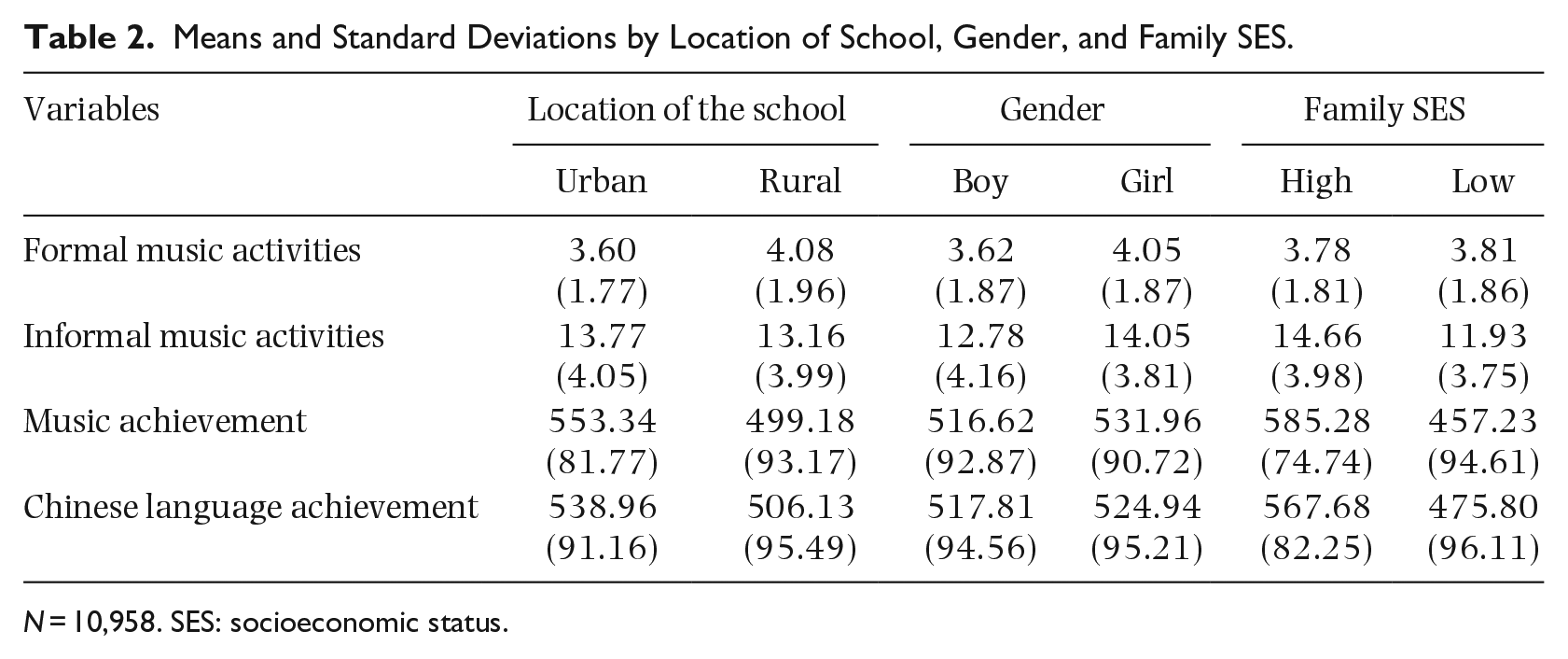
N = 10,958. SES: socioeconomic status.
For formal extracurricular music activities, urban students’ attendance was significantly lower than rural students’, F(1, 2913) = 12.90, p < .001; girls’ attendance was significantly higher than boys’, F(1, 2913) = 24.31, p < .001; and students with higher SES were significantly lower than those with low SES, F(1, 2913) = 4.69, p < .05. The family SES by gender interaction effect was also significant, F(1, 2913) = 4.80, p < .05. As shown in Figure 1(a), boys with high SES attended less formal extracurricular music activities than boys with low SES, while girls showed the opposite trend.

Interaction Results for Formal Extracurricular Activities (a), Informal Extracurricular Activities (b and c), Music Academic Achievement (d), and Chinese Language Academic Achievement (e): (a) Formal Music Extracurricular Activities on Gender and Family SES. (b). Informal Music Extracurricular Activities on Gender and Family SES. (c). Informal Music Extracurricular Activities on Family SES and School Location. (d). Music Academic Achievement on Family SES and Gender. (e). Chinese Language Academic Achievement on Family SES and School Location.
For informal extracurricular music activities, urban students’ attendance was higher than rural students’, F(1, 2913) = 1.43, p < .05; girls’ attendance was significantly higher than boys’, F(1, 2913) = 41.71, p < .001; and students with high SES was significantly higher than those with low SES, F(1, 2913) = 147.93, p < .001. The family SES by gender interaction effect was significant as well, F(1, 2913) = 8.19, p < .01. Figure 1(b) indicates that boys with high SES attended more informal music activities than boys with low SES, and girls showed a steeper slope, which meant that both boys and girls with high SES attended more informal music activities than those with low SES, but the difference was bigger in girls. The family SES by school location interaction effect was also significant, F(1, 2913) = 11.16, p < .01. As shown in Figure 1(c), urban students with high SES attended more informal music activities than students with low SES, and rural students showed a steeper slope, which meant that both urban and rural students with high SES attended more informal music activities than those with low SES, but the difference was bigger in rural students.
As to the music academic achievement, urban students’ mean score was significantly higher than rural students’, F(1, 2913) = 23.66, p < .001; girls’ mean score was significantly higher than boys’, F(1, 2913) = 6.56, p < .05); and students with high SES had significantly higher scores than those with low SES, F(1, 2913) = 315.49, p < .001. The family SES by gender interaction effect was significant, F(1, 2913) = 9.17, p < .01. As shown in Figure 1(d), boys with high SES attained higher music academic achievement than boys with low SES, and girls showed a steeper slope, which meant that both boys and girls with high SES had higher music academic achievement than those with low SES, but the difference was bigger in girls.
For Chinese language academic achievement, urban students’ Chinese academic achievement was significantly higher than that of rural students, F(1, 2913) = 49.54, p < .001; girls’ Chinese academic achievement was significantly higher than that of the boys, F(1, 2913) = 23.97, p < .001; and in students with high SES, Chinese academic achievement was significantly higher than those with low SES, F(1, 2913) = 746.19, p < .001. The family SES by school location interaction effect was significant, F(1, 2913) = 20.91, p < .001. As shown in Figure 1(e), urban students with high SES attained higher Chinese academic achievement than urban students with low SES, and rural students showed a steeper slope, which meant that both urban and rural students with high SES had higher Chinese academic achievement than those with low SES, but the difference was bigger in rural students.
Influence of formal and informal music activity attendance frequencies
Since there is extensive evidence for the influence of SES, gender, and school location on extracurricular activity attendance and academic achievement, we took SES, gender, and school location as control variables to sort out the influence of music extracurricular activities on academic achievements. We constructed four models to examine the extent to which formal and informal extracurricular music activity frequencies predicted music academic achievement by stepwise regression (see Table 3). Results showed that in Model 1, school location, gender, and family SES significantly predicted music academic achievement (β = −.049~.292, p < .001). Models 2 and 3 showed that, after controlling for demographic variables, both the frequencies of formal (β = .107, p < .001) and informal (β = .201, p < .001) extracurricular music activity attendance could positively predict music academic achievement. Model 4 showed that after controlling for demographic variables and incorporating the two music activity variables at the same time, only informal extracurricular music activity frequency (β = .193, p < .001) still positively predicted music academic achievement. Meanwhile, the relationship between formal extracurricular music activities and music academic achievement was non-significant (β = .016, p > .05). As shown in Table 3, by comparing the R2 of Model 2 versus Model 1 (△R2 = .011), and Model 3 versus Model 1 (△R2 = .038), the music academic achievement was more influenced by informal, rather than formal, extracurricular music activity attendance.
Stepwise Regression Analysis of Music and Chinese Language Academic Achievement by Extracurricular Music Activity Participations.
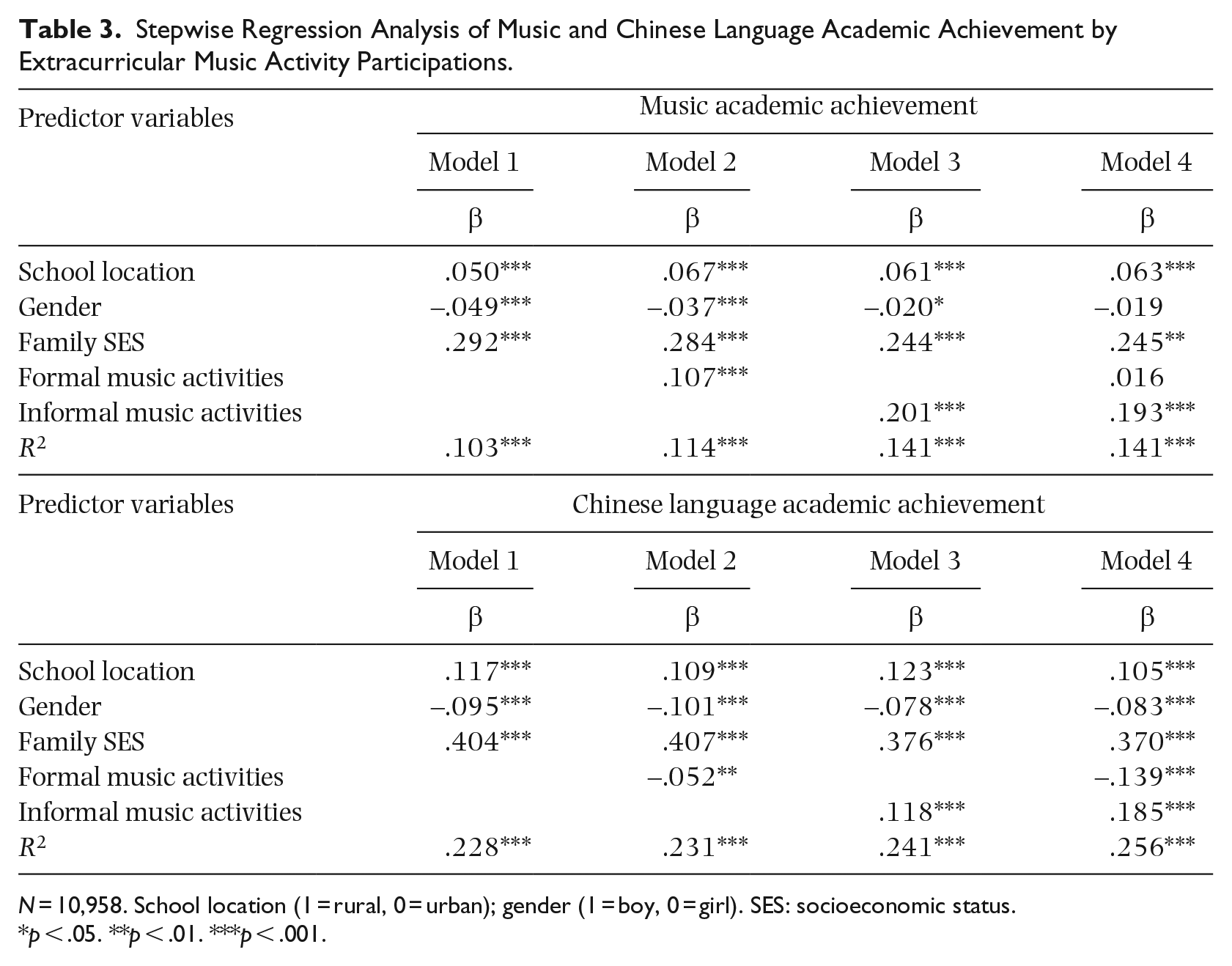
N = 10,958. School location (1 = rural, 0 = urban); gender (1 = boy, 0 = girl). SES: socioeconomic status.
p < .05. **p < .01. ***p < .001.
We used a similar procedure to explore the relationship between formal and informal extracurricular music activity participations and Chinese language academic achievement (see Table 3). In Model 1, school location, gender, and family SES significantly predicted Chinese language academic achievement (β = −.095~.404, p < .001). Models 2 and 3 showed that, after controlling for demographic variables, formal extracurricular music activity attendance frequency (β = −.052, p < .001) significantly and negatively predicted the Chinese language academic achievement, while informal extracurricular music activity attendance frequency (β = .118, p < .001) positively predicted the Chinese language academic achievement. In Model 4, the informal extracurricular music activity frequency (β = .185, p < .001) still positively predicted the Chinese language academic achievement after controlling for demographic variables, while formal extracurricular music activity frequency negatively predicted the Chinese academic achievement (β = −.139, p < .001). As shown in Table 3, by comparing the R2 of Model 2 versus Model 1 (△R2 = .003), and Model 3 versus Model 1(△R2 = .013), students’ Chinese language academic achievement was positively influenced by joining informal extracurricular music activities but negatively influenced by joining formal extracurricular music activities.
If we did not control the variable of SES, results showed that both formal and information extracurricular music activities were significantly correlated with music academic achievement (β = .094 and .261, respectively, p < .001) and Chinese academic achievement (β = −.061 and .213, respectively, p < .001).
Discussion and conclusion
This study extended prior research by considering two types of extracurricular music activities: formal and informal. First, results showed that rural students and low-SES students participated in more formal extracurricular music activities than urban students and high-SES students, while urban students and high-SES students participated in more informal extracurricular music activities than rural students and low-SES students. Not only both girls and boys with high SES, but also urban and rural students with high SES attended more informal extracurricular music activities. These were consistent with the gender difference (Gadbois & Bowker, 2007), urban–rural difference (Leonard, 2017), and SES difference (Lellock, 2014) in the studies mentioned above. This finding was also in line with Maslow’s (1943) hierarchy of needs in that only if physiological needs (e.g., food and safety) were met, would people go for higher level needs (e.g., aesthetics). Parents with high SES would pay more attention to create a better family arts atmosphere, which sets an environment for children to enjoy music.
Second, results showed consistent gender differences in that girls gained higher scores in formal and informal extracurricular music activity participations, music academic achievement, and Chinese language academic achievement than boys. These results corroborated with the literature in that girls had an advantage in music and language at this age level (Wei et al., 2012; Ranelli, 2010). It could be explained that boys with high SES might have attended technical and manipulative types of extracurricular activities such as computer programming and robotics. For girls, they might be more enculturated into the arts and music-related extracurricular activities.
Studies on the relationship between extracurricular activities and academic achievement of primary school students were mostly conducted in Western countries. Our study provided evidence, based on a large sample, for the correlation between music extracurricular activities and academic achievements in mainland China, filling an important gap in the literature for a global understanding. Furthermore, the distinction between formal and informal music activities in this study has elucidated the impact of the two types of extracurricular activities.
Specifically, we found that students’ music and Chinese academic achievement were significantly correlated with informal extracurricular music activities after controlling for school location, gender, and family SES, which is consistent with the positive link between music and language as multiple studies have shown (e.g., Forgeard et al., 2008). Furthermore, formal music activities could only positively predict participants’ music academic achievement but not Chinese academic achievement. These results collectively indicated that informal extracurricular music activities play an important role in children’s academic achievements.
Informal music activity participation could be natural and spontaneous responses to music (Jaffurs, 2004), which tended to be guided by the individual’s learning interests and other intrinsic motivation (Abramo & Austin, 2014). Previous studies demonstrated that learning interests played an important role in students’ academic achievement (Tucker-Drob et al., 2014). On the role of learning motivation, Jones and colleagues found that students’ motivations could moderate the relationship between extracurricular activities involvement and academic success (Jones et al., 2014). It could be speculated that students with high informal music activity participation might hold more interests and intrinsic motivation in music and have better academic achievement in music.
Also, informal music-related activities can calm individuals down and give them a free and suitable learning environment to relax (Höller et al., 2013). Evidence showed that a harmonious learning environment has a strong supportive effect on students’ academic study (Amin et al., 2017; Ciping et al., 2015; Marjoribanks, 2005). Therefore, children who participated in more informal extracurricular music activities may be cultivated in a better learning environment, which in turn boosted their academic performance. However, it is unexpected that formal extracurricular music activities had a negative effect on children’s Chinese language academic achievement. In fact, formal extracurricular music activities took up much time, such as practicing and competing, that children have less time for other formal subjects, including Chinese language, which probably led to lower Chinese language academic test scores.
These results inspired some implications for music educators, teachers, and parents. They should encourage children to attend interest-based informal extracurricular music activities by creating a rich and free musical family and school environment supportive of learning. Regarding formal extracurricular music activities, teachers and parents should guide children to select those that match the children’s interest, rather than compelling them to take part in specific formal extracurricular music activities for other reasons.
Since current participants were fourth graders only, future studies should include older children, who may show different behaviors in participating in extracurricular music activities. Investigating secondary school, high school, and even college students could help explore the effect of maturation in the relationship between extracurricular music activity and academic achievement. In addition, researchers should explore the mechanism by which informal extracurricular music activities affect music and Chinese language academic achievement. For example, it would be meaningful to investigate whether music learning interest or other internal psychological factors are mediating the relationship between extracurricular music activities and academic achievements.
Supplemental Material
sj-pdf-1-pom-10.1177_03057356211027642 – Supplemental material for The relationship between extracurricular music activity participation and music and Chinese language academic achievements of primary school students in China
Supplemental material, sj-pdf-1-pom-10.1177_03057356211027642 for The relationship between extracurricular music activity participation and music and Chinese language academic achievements of primary school students in China by Hui Guo, Wen Yuan, C Victor Fung, Fumei Chen and Yanfang Li in Psychology of Music
Footnotes
Declaration of conflicting interests
The author(s) declared no potential conflicts of interest with respect to the research, authorship, and/or publication of this article.
Ethical approval
All procedures performed in studies involving human participants were in accordance with the ethical standards of the institutional and/or national research committee and with the 1964 Helsinki declaration and its later amendments or comparable ethical standards. We would like to thank the children who participated in this study.
Funding
The author(s) received no financial support for the research, authorship, and/or publication of this article.

Supplemental material
Supplemental material for this article is available online.
References
Supplementary Material
Please find the following supplemental material available below.
For Open Access articles published under a Creative Commons License, all supplemental material carries the same license as the article it is associated with.
For non-Open Access articles published, all supplemental material carries a non-exclusive license, and permission requests for re-use of supplemental material or any part of supplemental material shall be sent directly to the copyright owner as specified in the copyright notice associated with the article.
