



Abstract
Small ensemble participation represents a unique form of human social activity involving a profound level of interpersonal and emotional communication. Previous researchers have suggested that engagement in group music making may have a positive influence on various social-emotional skills, including empathy. In line with this view, the initial study explored the relationship between small ensemble experience and empathy among college music students in the United States. The study results revealed a close association between the two, with students who participated in small ensembles more frequently showing a higher level of empathy. This study aimed to replicate the initial study using the identical survey questionnaire in a college music student population in South Korea (N = 183). Overall, Korean students scored significantly lower in the empathy measure than the US student sample, which echoed relatively lower empathy among Asian American students in the initial study. Also, consistent with the previous finding, an association between the primary area of music study and empathy was found, with popular music majors showing a higher level of empathy than classical music major students. Finally, some of the small ensemble experience variables appeared to be significant predictors of students’ empathy skills, which partially replicated the initial study.
Throughout human history, people in nearly every society have enjoyed making music in groups for varying purposes—to express emotions and values, represent identities, promote social affiliation, experience aesthetic enjoyment, or as a way to reach out to the divine (Turino, 2008). The various ways people engage in group music making are rooted in interpersonal coordination and communication that are crucial for human survival and wellbeing (Schulkin & Raglan, 2014). As one of the traditional forms of group music making, small ensemble (SE) is a unique musical activity, involving a profound level of social and emotional interaction. Following the same description used in the initial study (Cho, 2021), SE in this study denotes “a small group of performers [ideally 2 to 10] making music together, regardless of musical styles/genres, types of musical instruments, and levels of musical expertise” (p. 2), which requires a high degree of intimacy and subtlety for effective coordination. Unlike large ensembles in which a conductor is granted the leadership to direct a performance, it is the individual performers in an ensemble who retain the autonomy to make their own creative choices. Examples may include determining variations in performance parameters (e.g., tempo, dynamics, articulation, and timbre) and communicating expressive parameters, including artistic, stylistic, and emotional expression (Keller, 2014). In other words, all performers are directly and collectively responsible for their joint musical venture (Lim, 2014). In an SE performance, skilled performers strive to reach out to the other and coordinate their cognitive, motor, and emotional skills to effectively communicate moment-by-moment (Keller, 2014; Tan et al., 2010) because “mis-timings even of a fraction of a second, minute hesitations, slight differences in intonation, tiny misjudgments of dynamics and so on are regarded as monumental blunders” (V. M. Young & Colman, 1979, p. 12). At the same time, performers constantly share their intention of emotional expression with each other to achieve their joint expressive goals, which is what ideally creates the sense of “togetherness”—a feeling of being in synchrony with co-performers (Cross et al., 2012).
While making music in an SE requires a highly complex set of communication strategies, the capacity to recognize and reflect the emotional states of co-performers is an undoubtedly crucial skill for successful ensemble work. Previous research has suggested that “listening ability,” coupled with a sensitive attunement and adaptation to co-performers, is aligned with the concept of empathy (Myers & White, 2012; Seddon, 2005). Empathy, “the capacity to share and understand emotional states of others in reference to oneself” (Decety & Moriguchi, 2007, p. 1), is known to play a key role in the collaborative working process in a variety of contexts (I. Young, 2015), including performing ensembles. In an investigation of chamber ensemble performers’ peak performance experiences, Waddington (2017) outlined three components for the empathic experiences that ensemble performers commonly share. First is a shared approach to musical interpretation (e.g., an agreement on the expressive details) and to working together (e.g., an agreement on a style of working, a level of commitment, and goals), which is seen as a prerequisite for achieving empathic connections among performers. Second is an intentional awareness of co-performers’ experience on both a practical and musical level, considered to be vital to maintaining mutual respect and sustain a good working relationship. These components lead to the creation of a special connection among the performers, resulting in a musical cohesion, or as Waddington put it, a “clicking together.” This idea suggests that SE may be a context in which musicians consciously and unconsciously practice to “perceive the emotions of others, resonate with them emotionally and cognitively, take in the perspective of others, and distinguish between [one’s] own and others’ emotions” (Riess, 2017, p. 74), which is congruent with the capacity for empathy.
Aligned with this view, many researchers have demonstrated evidence for the association between group-based, interactive musical activities and various social-emotional skills among children and adults alike. For example, studies with young children (e.g., Brand & Bar-Gil, 2010; Gerry et al., 2012; Ritblatt et al., 2013) and school-aged children (e.g., Rabinowitch et al., 2012; Schellenberg et al., 2015) showed increased social-emotional skills, including empathy, cooperation, and prosocial values/behaviors, after regularly engaging in interactive musical activities over time. Other studies suggested that even a brief period of engagement in joint music making can lead to an increased cooperation and helping behavior among young children (Kirschner & Tomasello, 2010) and school-aged children (Good & Russo, 2016). Although the underlying mechanisms that these activities lead to the enhancement of social-emotional skills are unclear, two possibilities can be considered: the socially stimulating nature of group music making and synchrony among performers. The inherent socializing force of music often promotes performers to relate to one another in the dynamic interplay of a group music making and eventually experience a sense of belonging. This is known to be fundamental to finding and making meaning, developing competence and confidence, and enhancing engagement and collaboration (Dissanayake, 2000). Also, one of the critical elements of group music making, synchrony, is known to play an important role to effectively weaken the boundaries between the self and the group, eventually leading to a sense of collective bond (Hove & Risen, 2009). Some experimental studies with adult participants demonstrated the effect of rhythmic synchronic activities on an increased sense of affiliation (Hove & Risen, 2009) and helping and cooperative responses (Wiltermuth & Heath, 2009). These study findings suggest that interactive music making in a small group is likely to catalyze and strengthen other-oriented responses, including empathy.
Based on the assumption that SEs act as a scaffold that helps individuals to cultivate empathy skills, Cho (2021) conducted a survey study with college music students in the United States (N = 165) to investigate the relationship between SE experience and empathy skills. Undergraduate music performance majors in their senior year voluntarily completed an online survey that included questions about their background and musical experiences, along with two self-assessment questionnaires on personality and dispositional empathy. Results indicated some notable findings regarding the empathy skill of this population. First, a close association between empathy and ethnicity was found, with African American and Caucasian students scoring significantly higher than Asian American students—echoing the previous literature on the cultural differences in empathy (Atkins et al., 2016; Cassels et al., 2010; Trommsdorff et al., 2007). However, inconsistent with findings from the earlier research (Kim & Lee, 2010; Lawrence et al., 2004; Wakabayashi et al., 2007), no significant sex effect on empathy was found. The study also revealed the associations between empathy and several musical factors, such as the primary area of music study (classical vs. non-classical music) and age at the commencement of formal musical training. Specifically, non-classical music majors (i.e., jazz or popular music) and students who commenced music training before the age of 5 showed a higher level of empathy than classical music majors and those who picked up their instrument after the age of 5, respectively. Finally, a hierarchical multiple regression result indicated student level of participation in various SE activities to be significant predictors of their empathy skill even after controlling for the effect of other personal factors, with students who participated in SE more frequently showing higher levels of empathy. Notably, all the big five personality traits (i.e., extraversion, agreeableness, conscientiousness, openness, and emotional stability) also appeared to be significant predictors of music students’ empathy.
Although this work was correlational in nature, its findings demonstrated the potential effects of SE for cultivating empathy. As an attempt to validate these findings, this study aimed to replicate the initial study by employing the identical survey questionnaire to undergraduate music performance students in South Korea. Given that the initial study suggested possible influences of cultural background and area of music study (classical vs. non-classical) on music students’ empathy, we considered South Korea to be an interesting context for a replication of the study, mainly for two reasons. First, this allowed exploring the role of culture on empathy among music students from Asian and Western cultural backgrounds. Second, the distinct popularity of both Western classical music and popular music (what is typically called “applied music” in Korea) in higher education in Korea made it possible to examine empathy of both classical and popular music majors. While Western classical music has been widely popular in South Korea for decades (despite its slow but gradual decline in its popularity), with the sharp growth of the K-Pop music industry in the recent decade, popular music programs in higher education have been dramatically expanded year after year (Lee, 2013). We thus targeted a music college that serves both Western classical music and popular music majors, aiming to further explore the effects of culture (Western vs. Asian) and the primary area of study (Western classical vs. popular music) on music students’ empathy. The primary purposes of this study were to (a) determine any difference in empathy between music students from South Korea and the United States; (b) examine the relationships between empathy and some personal (i.e., sex, personality traits) and musical factors (i.e., the primary area of music study, age at the commencement of music training); and (c) validate the relationship between SE experience and empathy in the South Korean music student sample.
Method
Participants and procedures
The study population involved undergraduate music performance majors attending a large 4-year university, located in the central region of South Korea. While the music department offered two music major areas, Western classical music and popular music, the institution underwent significant changes around the time of data collection—most notably the downsizing of the classical music program, which reduced its offering to the piano performance major only (this change was only applied to new students). Meanwhile, the popular music program included voice, composition, music production, keyboard, drum, bass, guitar, and brass/woodwind majors. In terms of the school curriculum, the Western classical music program tended to focus on theory and solo performance with limited offerings for ensemble courses, while the popular music program offered more diverse options for ensemble courses. Convenience sampling was used to recruit participants. Upon the department’s approval, one of the authors, a faculty member of this department, disseminated an invitation to the online survey to music performance major students. In total, 221 students voluntarily participated in the survey; however, 27 participants failed to complete the survey and an additional 11 non-performance majors (i.e., composition and music production majors) were excluded from the final sample, yielding a final sample size of 183.
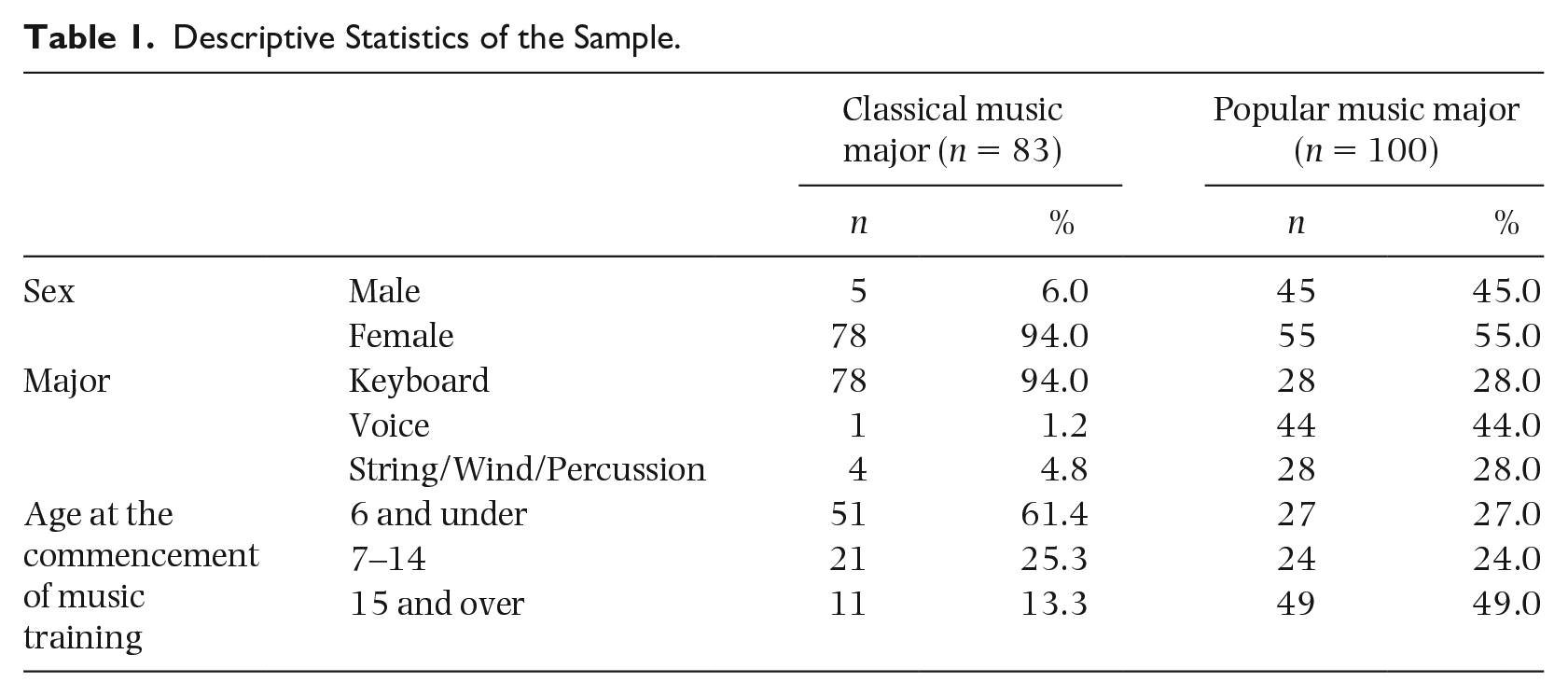
The age range of participants was 18 to 30 years with a mean of 21.06 years (SD = 1.95). Female students comprised over 70% of the sample. About half of the participants reported studying popular music (54.6%) while the remaining students were studying Western classical music (45.4%). In terms of the primary musical instrument, almost 60% of the participants were keyboard majors (57.9%), 24.6% were voice majors, and the remaining 17.5% played other instruments. The relatively large percentage of keyboard majors is primarily explained by the fact that the institution began to offer the piano performance major only for the classical music program around the time of data collection. Finally, over 40% of participants reported that they commenced formal music training before the age of 6 (42.6%), while 32.8% commenced music training over the age of 15. Students who began training between the ages of 7 and 14 made up 24.6% of the sample. Overall, classical music majors comprised of a large body of female students and keyboard majors and tended to have commenced music training earlier in their lives (see Table 1).
Descriptive Statistics of the Sample.
Measurement instruments
The identical survey questionnaire used in the initial study (Cho, 2021) was employed for the purpose of the replication study. The questionnaire consisted of four parts: (a) demographic information, (b) musical experiences before entering college, (c) SE experiences in college years, and (d) self-assessment psychological questionnaires. All questions, except one about ethnic background, were carried into this study. The first author translated the first three parts of the survey into Korean and then back-translated them into English. For the two psychological assessments, the Korean versions of Empathy Quotient (Yeo, 2012) and Ten-Item Personality Inventory (Ha et al., 2013) were adopted. Finally, two external bilingual professionals who were social science researchers checked for inconsistencies in the translations and minor revisions were made upon an agreement of both reviewers.
Demographic information
This section centered on demographic data, including age, grade level, sex, and information regarding participants’ musical background, such as the primary instrument, the primary area of study, and age at the commencement of formal music training. The ethnicity question was excluded from this study for the reason that Korea tends to be ethnically homogeneous, rendering the question inconsequential.
Musical experiences before entering college
The second section was designed to gather information about participants’ pre-college musical experiences. The queries focused on participants’ formal lessons and their experience playing in large and/or SEs in early childhood, elementary, middle, and high school years.
SE experience during college years
This section consisted of two parts—a scale to assess participants’ attitudes toward SE and a report of their participation in various SE activities during their college years. The attitude scale was devised to measure music students’ predisposition to think, feel, perceive, and behave toward SE activities for the purpose of the initial study (Cho, 2021). Participants rated 13 items related to their SE experiences on a five-point scale. All questionnaire items began with the common stem, “When I perform/work in small ensembles,” and some examples of items are “I gain more confidence in performance,” “I feel that I’m important and useful,” “I experience uplifting and motivating feelings,” and “I feel pride in relation to the group’s success.”
The second part sought to gather data on how frequently students were participating in various SE activities in and out of their college curricular. This included questions about the number of SE-related courses they had taken, numbers of gigs and public performances, such as recitals, concerts, and competitions they had participated in, and how often they engaged in informal music making in a small group setting with no explicit purpose for public performance (e.g., jamming).
Psychological assessments
The last section consisted of two self-assessment questionnaires, measuring personality traits and empathy. To measure personality traits based on the “Big Five” dimensions, we employed the Korean Version of the Ten-Item Personality Inventory (Ha et al., 2013). Originally developed by Gosling et al. (2003), the Ten-Item Personality Inventory (TIPI) contains 10 items, and each consists of a set of two descriptive words, separated by a comma, using the common stem, “I see myself as.” The two words are either descriptive of, or the opposite of, the personality traits. Examples are “extraverted, enthusiastic” and “reserved, quite” for Extraversion (Gosling et al., 2003). Participants rated how much they see themselves as possessing the traits using a 7-point Likert scale. The five dimensions of personality traits included Extraversion, Agreeableness, Conscientiousness, Emotional Stability (or Neuroticism), and Openness to Experience (Gosling et al., 2003).
In addition, a Korean version of Empathy Quotient–Short was used to measure participants’ dispositional empathy levels (Kim & Lee, 2010). Originally developed by Baron-Cohen and Wheelwright (2004), Empathy Quotient (EQ) is a self-report measure for cognitive and affective aspects of empathy among the adult population. This self-report questionnaire includes 40 statements for which participants rate their responses to each statement using a 4-point Likert scale. Examples of the statements are “I can pick up quickly if someone says one thing but means another,” “Seeing people cry doesn’t really upset me,” and “It upsets me to see an animal in pain” (Baron-Cohen & Wheelwright, 2004).
Data analysis
Statistical analyses were performed using the SPSS Statistics 27 package. We first descriptively analyzed data on the Korean students’ SE experience during their college years, which involved three separate variables: (a) participation in formal SE activities, (b) participation in informal SE activities, and (c) attitude toward SE. The first two variables related to how often students participated in different types of SE activities and the mean of participants’ responses to the related items was calculated for each variable, with the final score ranged from 0 to 9. Participants’ attitudes toward SE were the mean of the 13 items related to their perceptions to engage in SE activities, with the final score ranged from 1 to 5, and a Cronbach’s alpha coefficient of .926 indicated a high internal consistency. In this analysis, only data gathered from junior and senior students were considered (n = 121) to make it comparable with the initial study that only looked at senior students.
Next, to determine the difference in empathy skills between the Korean and US samples (Research Question 1), data from the initial study (N = 165) were combined with the current dataset. Data were analyzed descriptively first, followed by a Welch t-test. For the second research question, we performed a series of inferential analyses to examine the relationships between empathy and various personal and musical factors, including sex, personality traits, the primary area of music study, and age at the commencement of music training. All assumptions were tested prior to the analyses. Lastly, a hierarchical multiple regression was performed to answer the third research question. To be comparable with the initial study, we excluded freshmen and sophomore students in this analysis and only used data from junior and senior students (n = 121; note that the preliminary analysis indicated no significant difference in SE participation between juniors and seniors). Variables were placed into three groups: criterion, predictor, and control. The criterion variable was empathy as measured by the EQ, and predictor variables consisted of three SE experience variables described above, along with three additional variables for SE engagement in elementary, middle, and high school years. Control variables included personal factors that showed significant relationships with empathy in Research Question 2, which were the primary area of study, and three of the big five personality traits measured by TIPI.
Results
Korean students’ SE experience
Table 2 presents the descriptive statistics of Korean students’ SE experience. Overall, Korean students’ participation in SEs varied widely, while their attitudes toward SEs did not mark any notable differences. Generally, male, popular music majors, and students who commenced formal music training later in their lives tended to participate in various SE activities more frequently than female, classical music majors, and those who picked up their instrument earlier in their lives.
Descriptive Statistics of Korean Students’ Small Ensemble (SE) Experience.

Empathy of music students from the South Korean and US samples
Table 3 presents descriptive statistics of music students’ empathy from both studies. Overall, Korean students scored lower in the EQ across all the personal factors compared with the US student sample. A Welch t-test was performed to determine whether any differences existed in empathy between the samples due to the assumption of homogeneity of variances being violated, as assessed by Levene’s test for equality of variances (p < .001). Data were normally distributed, but two outliers were detected in the Korean sample; however, these cases were retained, as they did not seem to have any appreciable effect when results were compared with and without them.
Comparison of Mean and SD of the EQ Score From the Korean and US Samples.

EQ: Empathy Quotient.
Results revealed that Korean students scored in the EQ significantly lower than the US students, a significant difference of 7.03, t(297.54) = −5.157, p < .001. Given that the initial study (Cho, 2021) reported significant differences in the EQ among students from different ethnic backgrounds, with Asian American students scoring the lowest, we further performed an independent-samples t-test while isolating those who self-identified as Asian American (n = 51) from the US sample. While the results showed a significant group difference in the EQ between the Korean and US samples, t(295) = −6.592, p < .001, the mean difference increased by 2.22, M = 9.25, 95% confidence interval [CI] = [−12.01, −6.49]. This finding suggests relatively lower levels of empathy in individuals with an Asian background, echoing the previous literature on the cultural differences in empathy between Asian and Western countries (e.g., Atkins et al., 2016; Cassels et al., 2010; Trommsdorff et al., 2007).
Empathy and personal factors
Inferential statistical tests (i.e., one-way analyses of variance [ANOVAs], independent-samples t-tests, and a standard multiple regression) were performed to determine differences in the EQ due to personal and musical factors—sex, the primary area of study (classical vs. popular music), age at the commencement of formal music training, and the Big Five personality traits. In the initial study, significant group differences were linked to the primary area of study and age at commencement of music training, with non-classical music majors and students who commenced music training earlier (before the age of 5) showing higher empathy than classical music majors and those who picked up their instrument after the age of 5. Consistent with the study, an independent-samples t-test revealed that popular music majors (M = 38.06, SD = 10.60) scored significantly higher than classical music majors (M = 34.88, SD = 10.60), t(181) = −2.064, p = .041) in this study. However, no group differences were found among students who commenced music training at different ages, which failed to replicate some of the initial study results.
Despite the previous literature showing significant differences in the EQ between males and females (e.g., Kim & Lee, 2010; Lawrence et al., 2004; Wakabayashi et al., 2007), this study did not find that sex played a role in the EQ, something also found in the initial study. We thus assume that the sex influence on empathy may be mediated by the unique contexts and experiences in which trained musicians are situated. Finally, a standard multiple regression was performed to examine the extent to which the Big Five personality traits predicted students’ EQ scores. Results revealed three personality traits that significantly predicted the EQ, F(5, 115) = 7.177, p < .001, adj. R2 = .21, specifically, Extraversion (β = 1.90, SE = 0.72, p = .010), Agreeableness (β = 2.71, SE = 0.93, p = .005), and Conscientiousness (β = 2.99, SE = 0.88, p = .001), are positively correlated with the EQ. It is somewhat inconsistent with the initial study in which all five personality traits had significant relationships with the EQ.
Empathy and SE experiences
A hierarchical multiple regression was performed to determine the extent to which Korean students’ SE experience predicted their empathy, after controlling for the effect of personal factors. Given that sample size is important in analyzing the power of effect variables in a multiple regression analysis (Abu-Bader et al., 2006), personal factors that showed significant bivariate relationships with the EQ (i.e., the primary area of study, three of the Big Five personality traits) were entered as control variables in this analysis. Preliminary assumption testing was conducted. There was linearity as assessed by partial regression plots and a plot of studentized residuals against the predicted values. The scatterplot was fairly homoscedastic. The Durbin–Watson statistic was computed to evaluate the independence of errors, which was 2.067. There was no evidence of multicollinearity, as assessed by tolerance values greater than 0.1, and the assumption of normality was also met, as assessed by a Q–Q plot.
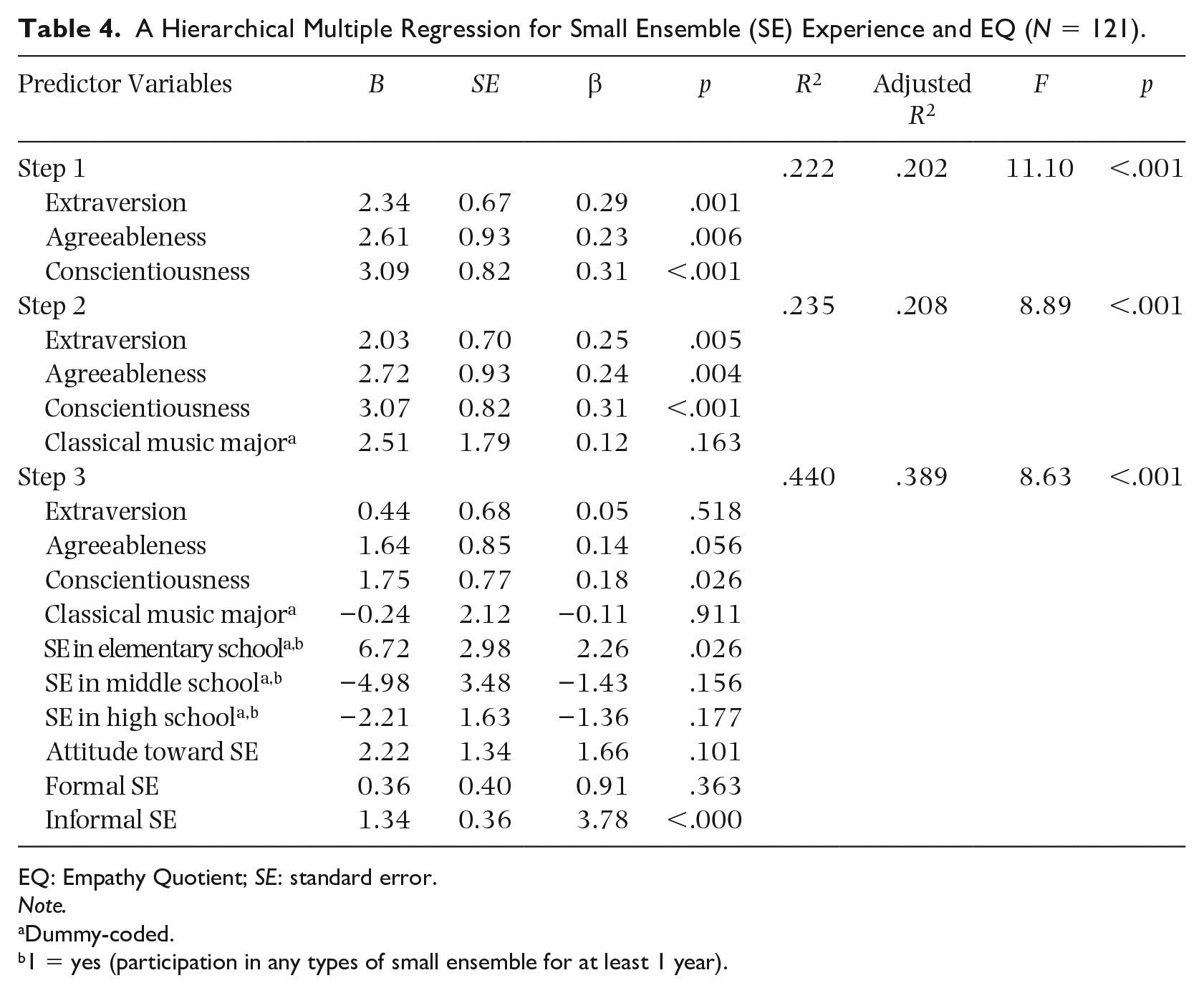
In light of the significant effect of some of the Big Five personality traits on the EQ, the traits of Extraversion, Agreeableness, and Conscientiousness were entered in Model 1 (Table 4), which accounted for 22.2% of the variance in the EQ, F(3, 117) = 11.10, p < .001; adjusted R2 = 202. Music students would attain the increase of 2.34, 2.61, and 3.09 in the EQ for every 1-point increase in Extraversion (t = 3.52, p = .001), Agreeableness (t = 2.90, p = .006), and Conscientiousness (t = 3.77, p < .001), respectively. The addition of the primary area of music study to the prediction of the EQ in Model 2 led to a statistically significant increase in R2 of 1.3%, F(4, 116) = 8.89, p < .001, adjusted R2 = .208, yet this variable appeared to be an insignificant predictor of the EQ. In the final model (Model 3), the addition of variables for SE experience to predict the EQ led to a significant increase in R2 of .205, F(10, 110) = 8.63, p < .001, adjusted R2 = .389. In this model, student participation in informal SE activities, along with their SE engagement during the elementary school years, appeared to be significant predictors of the EQ, while other SE experience variables did not. Meanwhile, the personality trait of Conscientiousness remained as a significant predictor of the EQ in this final model. Given that the initial study revealed participation in both formal and informal SE activities, along with all Big Five personality traits, as significant predictors of the EQ, this study partially replicated the initial study.
A Hierarchical Multiple Regression for Small Ensemble (SE) Experience and EQ (N = 121).
EQ: Empathy Quotient; SE: standard error.
Note.
Dummy-coded.
1 = yes (participation in any types of small ensemble for at least 1 year).
Discussion
As an attempt to validate the initial study findings (Cho, 2021), this study replicated the initial study by employing the identical survey questionnaire in a sample of undergraduate music performance majors in South Korea. Results from the present investigation were similar to the initial study, yet several inconsistent findings also emerged.
Consistent with the initial study in which Asian American students scored significantly lower than their African American and Caucasian counterparts, a significant difference was found in the EQ scores between the Korean and the US samples. The mean difference between these two samples became even larger when Asian American students from the US sample were removed in the subsequent analysis, which suggests the possible role of cultural background on the self-reporting of empathic reactions. This different pattern of empathy in music students from Asian and Western cultural backgrounds is consistent with previous studies (e.g., Atkins et al., 2016; Cassels et al., 2010; Trommsdorff et al., 2007). For example, in an attempt to examine a cross-cultural stability of the EQ, Groen and colleagues (2015) reviewed 16 studies that employed the EQ with healthy adult participants from different parts of the world and found that the average EQ scores reported in Asian countries were roughly one standard deviation lower than those reported from Western countries. While the reasons for this trend have not been clearly explained, some cross-cultural studies on emotion attributed cultural differences in self-construal in Asian and Western countries. The self is typically experienced as an independent entity, focusing on their own attributes, abilities, and preferences in the individualistic culture (i.e., Western culture) whereas, in the collectivistic cultures (i.e., Asian culture), the self is viewed as an interdependent, or relational, entity, with a tendency to focus on the emotions, thoughts, and actions of others (Kitayatna et al., 2007). The varying degree of overlap between the self and others is likely to influence the ways people understand, interpret, and respond to others’ emotional experiences (Atkins et al., 2016). Similarly, Groen and colleagues (2015) suggested that the different self-construal modes in Asian and Western cultures have an impact on the emotional expression and social habits—how emotions are felt and expressed in social situations tends to be constrained and thus empathy be expressed to a lesser extent in social situations in Asian countries. Different modes of emotional regulation may also have a role, given that positive emotional regulation (e.g., cognitive reappraisal; John & Gross, 2004), known to be linked to other-focused empathic behavior (Cassels et al., 2010), tends to be more prevalent in Western cultures. Yet, no consensus has been reached with regard to the cultural differences found in self-reports of empathic reactions to indicate Asian individuals having relatively lower empathy skills.
Another interesting finding from both the initial and current studies is that no significant association was found between sex and empathy among the music student population. This contradicts previous research which revealed significant effects of sex in empathy, with females displaying a higher level of empathy than males (Baron-Cohen & Wheelwright, 2004; Kim & Lee, 2010; Lawrence et al., 2004; Wakabayashi et al., 2007). Notably, the mean score of male students in this study was even higher than that of female college students reported from other research studies in Korea (M = 35.8, SD = 9.2; Kim & Lee, 2010) and in Japan (M = 36.1, SD = 10.4; Wakabayashi et al., 2007). Although no study, to our knowledge, has investigated the effect of sex on empathy among the musician population, we assume that the unique contexts in which trained musicians are situated have a role in this trend. For example, given that music is a constructive way to express one’s inner self, this deep and continuous engagement in exploring and expressing emotions may result in profound influences on male musicians’ emotion processing in the musical context and extend to social conditioning and conscious thought. Previous research on the profile of creative people has shown that sensitivity and openness—two traits that can be contradictory to each other—often coexist in creative performers (Bridges & Schendan, 2019; Csikszentmihalyi, 1996). Such sensitivity is known to be closely associated with stronger activation of brain regions involved in empathy and self–other processing (Acevedo et al., 2014). Thus, the unusual depth of emotional works involved in music performance may have an impact on the relatively higher empathy levels of male musicians.
The difference in the EQ between popular music students and classical music students is also worthy of commentary. In the initial study, non-classical music students (i.e., jazz and popular music majors) scored significantly higher in the EQ than classical music majors; however, this significant difference needed further investigation, due to a relatively small sample size of non-classical music majors (12.7% of the sample). While this study sample involved a nearly equal number of classical to popular music majors, we found a consistent pattern of empathy between the two. Given the nature of popular music practice as a group enterprise (Creech et al., 2008; Green, 2016), musicians in this area spend a considerable amount of time making music with others, practicing an intensive level of social and emotional exchange. Such collaborative experience may have trained these musicians to listen to, communicate with, and respond to their co-performers more sensitively, extending to an increased capacity for empathizing with others. This explanation is supported by the data that popular music majors had a higher level of engagement in ensembles, which was also found in the initial study. This perhaps relates to the relatively higher levels of empathy among the male music students in this study since 90% of the male sample were popular music majors.
Finally, as a primary interest of this study, music students’ SE experience as predictors of empathy found in this study partially replicated the initial study. Student participation in informal SE experiences during the college years and their SE engagement in their elementary school years appeared to be significant predictors of empathy. However, given the small sample size of students who engaged in SE during elementary school years (n = 10), it is difficult to make a meaningful interpretation of this data without further investigation. Nonetheless, the result of student participation in informal SE activities, but not in formal SE activities, to be a significant predictor of empathy needs to be addressed more in-depth. In this study, informal SE was explained to the participants as informally making music with friends for no explicit performance purpose, otherwise known as “jamming” in the lexicon of jazz and popular music. Formal SE activities involved SE-related coursework, and performing gigs, formal recitals, concerts, and participating in competitions. One obvious aspect distinguishing these two types is that participating in the former is highly voluntary, while the latter can be both voluntary and compulsory. If it is the case, it is possible that more empathetic students were more likely to initiate and/or be invited by other peers to make music together for fun than their less empathetic peers. This speculation is further supported by the data showing positive correlations between student participation in informal SE and three personality traits, Extraversion, Conscientiousness, and Openness. These three, perhaps in combination, seem to be important qualities when working with others in voluntary collaboration contexts. Although this is only a speculation based on data from this study, the overall combined study results support the idea of a close relationship between SE experience and empathy. As discussed in the previous literature on ensemble performances, skilled performers strive to coordinate their cognitive, motor, emotional, and social skills to effectively achieve a cohesive performance moment-by-moment by incorporating a variety of nonverbal communication strategies, including visual signaling (e.g., eye-contact, gestures, facial expression), breathing, and shared attention to audio cues (Bishop et al., 2019; Fulford et al., 2020; Kawase, 2014; Seddon & Biasutti, 2009; Williamon & Davidson, 2002). Such complex and delicate communication requires one to have the capacity for sensitive listening, attunement, and adaptation—qualities highly congruent with the skills required to empathize with others.
Study findings from the initial and current studies would be particularly informative to school music educators, given that there is an urgent demand to come up with strategies to cultivate well-balanced students who are not only intellectually but also socially and emotionally competent (Zins & Elias, 2006). Many daunting issues that school-aged children and youth today are facing, such as bullying, depression, smartphone/video game additions, juvenile delinquency, and suicide, highlight the need to nurture young people’s social-emotional skills. Despite the study results from both the current and initial studies being correlational in nature, this replication study has reinforced the idea that SE could be a fruitful context for the cultivation of empathy, one of the critical social-emotional skills that enhance interpersonal relationships. Music education researchers have suggested that by engaging in music making in a group context, students naturally learn how to work with others in socially and emotional skilled ways and practice healthy interpersonal behaviors (Durlak et al., 2011) and develop skills for leadership, value judgments, and critical thinking (Berg, 2008; Goolsby, 1994). Coupled with the earlier literature, the initial and current studies present a strong potential of SE participation to catalyze social-emotional growth and improvement.
