




Abstract
The COVID-19 pandemic disrupted many aspects of life, including the instructional practices of music educators. The purpose of this study was to examine music teachers’ well-being following the disruptions in schooling that resulted from the pandemic in the Spring of 2020. We also investigated how disruptions may have affected music teachers’ perceptions of their efficacy and the status of the profession. A questionnaire was completed by 2,023 music teachers who were members of the National Association for Music Education. We collected data related to (a) demographic and institutional information, (b) well-being, (c) teaching efficacy, (d) the impact of the pandemic upon the profession, and (e) the impact of the pandemic upon student learning. The questionnaire included the PERMA Profiler, a measure of well-being, and a portion of the Depression, Anxiety, and Stress Scale (DASS-21). Both PK–12 and collegiate teachers reported significantly lower levels of overall well-being and significantly higher levels of depression than published norms. Additional analyses examined the relationship of individual difference and teaching context variables to the well-being measures, perceptions of teaching efficacy, and perceptions of the pandemic’s impact on student learning.
The COVID-19 pandemic caused unprecedented changes in the lives of people around the world. In Spring 2020, the American Psychological Association (APA, 2020) surveyed 3,013 adults in the United States about the (a) degree of, (b) sources of, and (c) mental and physical responses to pandemic-related stress. Among their findings were that the COVID-19 virus had affected employment, education, health care, the overall economy, and personal and professional relationships of people in the United States, stating “We are facing a national mental health crisis that could yield serious health and social consequences for years to come” (APA, 2020, p. 1). The participants in the APA study indicated the following:
The Coronavirus was a major source of stress in their lives (78%).
Their level of stress had grown during the pandemic (67%).
The stress, both physical and emotional, had negatively affected their behavior (49%).
Their behaviors had included “increased tension in their bodies (21%), snapping or getting angry very quickly (20%), unexpected mood swings (20%), or screaming or yelling at a loved one (17%)” (p. 2).
Managing their children’s online education was a major cause of stress for 71% of parents.
As the COVID-19 pandemic reached the United States in Spring 2020, most teachers were asked to adjust their practices, and in the case of music classrooms, completely re-engineer their teaching almost overnight. Most pre-Kindergarten through 12th-grade schools (PK–12) as well as higher education campuses closed and nearly all school-age children across the country started learning remotely. Music teachers were forced to adapt to online teaching and learning (Hash, 2021), a task that required dealing with unique challenges given the lack of commonly available internet-based technologies allowing high-quality sound reproduction for musical fidelity and the type of communication and collaboration that are necessary to facilitate traditional ensemble performance, a focus of much music education in the United States. These issues caused some music educators to reconsider the very nature of music education (Liu, 2020) and reports of the effects of the pandemic-induced disruptions on the well-being of music teachers began to surface (Cheng & Lam, 2021; Cornett, 2020). The full effect of the pandemic has only begun to be explored. The aim of this study was to describe elementary, secondary, and collegiate music teachers’ perceptions of its impact and influence on their instructional practice and well-being during the Spring of 2020.
Authors of initial reports suggested that the pandemic’s impact was experienced more strongly by females. Researchers found that women with elementary school-age children and younger showed high levels of psychological distress (Prados & Zamarro, 2020). Likewise, scholars examining higher education suggested that the pandemic’s effects may be gendered (Viglione, 2020), finding that women faculty were submitting to journals at a lower rate when compared with pre-COVID-19 periods, with women early in their academic careers appearing to be disproportionately affected. Previously noted barriers to women in higher education (Howe-Walsh & Turnbull, 2016) may have been further exacerbated as shifts in both teaching responsibilities and caring for families were taken on by female faculty in higher education during COVID-19 pandemic-imposed conditions (Gabster et al., 2020).
Stress in teaching
Teaching, in general, is a stressful profession (Gray et al., 2017), and the level of stress teachers typically experience may have been increasing even before the pandemic. In the MetLife Survey of the American Teacher (MetLife, 2013), 1,000 teachers and 500 principals from U.S. PK–12 public schools were asked to provide their perspectives on schooling. Over half of the teachers (51%) reported feeling great stress several days per week, an increase from the 36% of teachers who indicated this in the 1985 survey conducted by the same organization. Overall, only 39% of the teachers reported they were very satisfied with their job compared with 62% when asked in 2008. Teacher stress can lead to burnout and low job satisfaction, and there may be a connection between teachers’ mental health and their longevity in the profession (Gray et al., 2017). Importantly, teacher well-being has been found to impact student performance (Gray et al., 2017).
Music teaching may be even more stressful than general teaching due to the types of assignments and responsibilities that are typical for music teachers. Scheib (2003) examined the occupational role stress of four music teachers. He found that the teachers experienced stress from (a) role conflict—conflict between various roles they had to fulfill, for instance, balancing personal and active professional lives; (b) underutilization of skills—having to engage in numerous, tedious job requirements not directly related to teaching music, like administrative tasks and fund-raising; (c) insufficient resources—specifically, a lack of resources related to staffing and the constant need to recruit and retain students; and (d) role overload—feeling like they needed to excel at many different facets of their job to have an excellent music program. Hedden (2005) conducted a longitudinal study, examining stress in 67 Midwestern United States music teachers. Over the 7-year period of the study, significant decreases in stress were found, perhaps indicating that the teachers learned to deal with their stress over time. However, no differences in stress by gender or between teachers in urban and nonurban settings were found. Isolation may also contribute to music teachers’ stress given that (a) there are typically few other music teachers in their school or district who they can connect with and discuss common issues, and (b) they frequently travel between buildings, which does not allow them to have a school home base (Sindberg, 2011). Numerous researchers (e.g., Bernhard, 2016; Hamann, 1986; Hamann et al., 1987; Hamann & Gordon, 2000; Sandene, 1995) have documented that stress from factors such as (a) inadequate training to execute job responsibilities, (b) lack of administrative support, (c) students’ parents, (d) having responsibilities in multiple school buildings, (e) inadequate budgets, and (f) heavy workloads and long work hours may result in psychological burnout in music teachers. Too much stress may ultimately result in music educators deciding to leave a particular teaching situation or changing careers (Russell, 2012).
Emergency remote teaching is different than systematically designed digital learning (Hodges et al., 2020) and the emergency nature of the change in 2020 forced teachers to work from home, under conditions in which there were wide disparities in technology access, health care, food security, financial security, and housing security for every individual. Authors of op-eds and newspaper reports described the ways in which teachers were coping (e.g., Turner et al., 2020) and models projecting the pandemic’s impact on teaching were not promising (Griffith, 2020; Kafka, 2020). In late March 2020, soon after many music teachers began remote instruction, the Frances Clark Center, a not-for-profit educational institution in New Jersey, hosted a webinar titled Navigating Mental Health and Resilience in the Age of COVID-19 (Cornett, 2020). Prior to the webinar, music teachers from around the world were contacted via social media and asked to submit questions and concerns about mental well-being. Teachers reported a number of issues they were dealing with, including (a) a loss of income from private students, (b) problems with disappearing boundaries between their professional and personal life, (c) social isolation from colleagues and others, (d) exhaustion after teaching online for several hours, (e) challenges in using new technologies, (f) grief over the loss of a previous way of life, and (g) concerns about the future.
Well-being
Most researchers examining the stressors associated with being a music teacher (e.g., Scheib, 2003), performing musician (e.g., Parasuraman & Purohit, 2000), or music student (e.g., Ginsborg et al., 2012) have focused on the negative effects of various situations and circumstances with the hopes of identifying causes of ill-being that could be avoided or methods of treating unhealthy states. In contrast, researchers have more recently tended to frame their studies as investigations of the features and correlates of well-being, as well as what might contribute to human flourishing (Araújo et al., 2017; Ascenso et al., 2017; Miksza et al., 2021). For example, using self-determination theory (Deci & Ryan, 2017) as a framework, Kang and Yoo (2019) investigated factors that might be used to predict music teachers’ well-being. They determined that competence, believing one has the necessary knowledge and skill to effectively accomplish a task, and relatedness, meaningful relationships and interactions with others, were strong predictors of well-being. Autonomy, feeling like one has control over what they do, was not a strong predictor. However, these results varied somewhat according to participants’ career stage, with relatedness being a significant predictor of well-being for teachers with 0–10 years, and 31+ years of teaching experience, whereas competence was a stronger predictor of well-being for teachers with 11–30 years of experience.
Defining what constitutes well-being is notoriously complex and heavily debated (Dodge et al., 2012); however, Seligman’s (2011) well-being theory has become somewhat common in music-related research, having recently been employed in investigations of collegiate (Roseth, 2019) and professional (Ascenso et al., 2018) musicians. Seligman (2011) proposed a model of well-being that consisted of five elements: Positive Emotion, Engagement, Relationships, Meaning, and Accomplishment (i.e., the PERMA model). To qualify as an element of the PERMA model, Seligman stated that each must (a) contribute to well-being, (b) be something that individuals generally pursue for its own sake, and (c) be able to be defined and measured relatively independently. The most critical element, Positive Emotion, refers to general feelings of positive affect and feeling well. Engagement refers to feelings of absorption in and/or connections with tasks individuals pursue, whereas the Relationships element represents social connections to other individuals and beliefs that one is loved and cared for. Meaning refers to the general sense one has that their life matters and that they are part of something larger than themselves. Last, Accomplishment refers to the perception that one is achieving goals, with a particular emphasis on intrinsically defined goals. Butler and Kern (2016) developed a self-report measure of the PERMA constructs (i.e., the PERMA profiler) and have shown via several studies that the psychometric properties (i.e., reliability and validity) of the PERMA profiler are robust. Butler and Kern (2016) also provided norms for the constructs included in the PERMA profiler based on data gathered from over 30,000 adults from around the world. As far as can be determined, the PERMA framework has yet to be applied to the study of music teacher well-being.
Research problem, purpose, and questions
The well-being of teachers is an important facet of their lives that may affect their work with students. It is logical to assume that teachers’ well-being was affected during the pandemic-imposed disruptions. However, few systematic empirical studies examining the nature of this impact and how music teachers have responded to these events have yet to be reported, thus creating a gap in the literature (e.g., Cheng & Lam, 2021; Hash, 2021). The purpose of this study was to examine music teachers’ well-being following the pandemic-induced disruptions in schooling that resulted from the emergence of the COVID-19 virus in the Spring of 2020. We asked the following research questions:
Did music teachers’ sense of well-being differ from that of the general population?
Did music teachers’ sense of well-being vary as a function of (a) their gender, (b) the level of students they teach (PK–12 or Higher Education), or (c) their highest earned degree?
For PK–12 music teachers, did their sense of well-being vary as a function of (a) school setting (rural, urban, suburban), (b) school Title 1 status, or (c) majority student ethnicity at their school?
For teachers in higher education, did their sense of well-being vary as a function of (a) institutional setting (rural, urban, suburban), (b) institutional enrollment, (c) whether their institution is public or private, or (d) whether or not they have tenure at their school?
Method
Sampling and participants
After receiving Institutional Review Board approval, we gathered data representative of the populations of elementary and secondary music educators as well as higher education music education faculty in the United States. The membership of the National Association for Music Education (NAfME) served as the sampling frame for this study. The Society for Research in Music Education Executive Committee reviewed and approved our proposal to survey members of the NAfME in July 2020. The survey, which was administered via Qualtrics, took place throughout July of 2020; however, participants were asked to report on their experiences teaching in the Spring of 2020. The NAfME sent email invitations to members requesting participation in this research on behalf of the researchers, targeting individuals who indicated in their membership information that they taught any of the following subject categories: general music, concert band, marching band, orchestra, contemporary instruments, small ensemble, piano, guitar, chorus, vocal ensemble, music theory, IB music, music history, music appreciation, composition/songwriting, strings, contemporary vocal ensemble, culturally influenced ensemble (e.g. mariachi), recording/production, technology/electronic music, and teacher education.
The NAfME initially invited 28,568 members, but 16,989 invitations remained unopened and 1,035 bounced back, leaving 10,541 that were opened and 1,311 that were clicked through. In a follow-up invitation 1 week later, 28,549 email invitations were sent to the same list of individuals as the initial mailing, of which, 17,885 were not opened and 1,081 bounced back, leaving 9,583 that were opened and 824 that were clicked through. Ultimately, 2,023 volunteers responded to the questionnaire; 1,834 (91%) were teachers at the PK–12 level and 162 (8%) were higher education music education faculty. Twenty-seven participants did not indicate their primary teaching level. As such, the response rate was approximately 7% when considering all possible members contacted, whereas the percentage of those who completed the survey compared with those who actually received and opened the email was 19%–21%.
Participant characteristics
The typical PK–12 teacher in this study was White/Caucasian (92.7%), taught for nearly 17 years, self-identified as female (67.5%, followed by 25.5% male and 6.3% nonbinary), and was most likely to have earned a master’s degree (54.9%) than had stopped at the bachelor’s degree (38.8%) or earned a doctoral degree (6.3%). The vast majority of the PK–12 participants earned certification to teach in their state via a traditional teacher preparation program (87.8%). Less than one tenth of the PK–12 participants (8.3%) earned their certification through an alternate route, while few reported not being certified to teach in their state (1.3%). The majority of PK–12 participants reported working in a school in which the majority of students were White/Caucasian (74.3%), followed by Hispanic or Latinx (8.9%) and Black or African American (7.1%).
The typical higher education faculty member participant was White/Caucasian (89.1%), taught for 20 years, and identified as male or cis male (49.4%), female or cis female (46.3%), or as nonbinary (4.3%). Nearly half of the college or university faculty participants had earned a PhD (49.4%), followed by a DMA (Doctor of Musical Arts) or DME (Doctor of Music Education; 30.2%), or a master’s degree (12.3%). Few participants reported earning an EdD (2.5%) or having only a bachelor’s degree (1.9%). See Table 1 for a summary of the PK–12 and higher education participants’ teaching contexts.
Teaching Context Characteristics of PK–12 and Higher Education Participants (All Values Are Percentages).
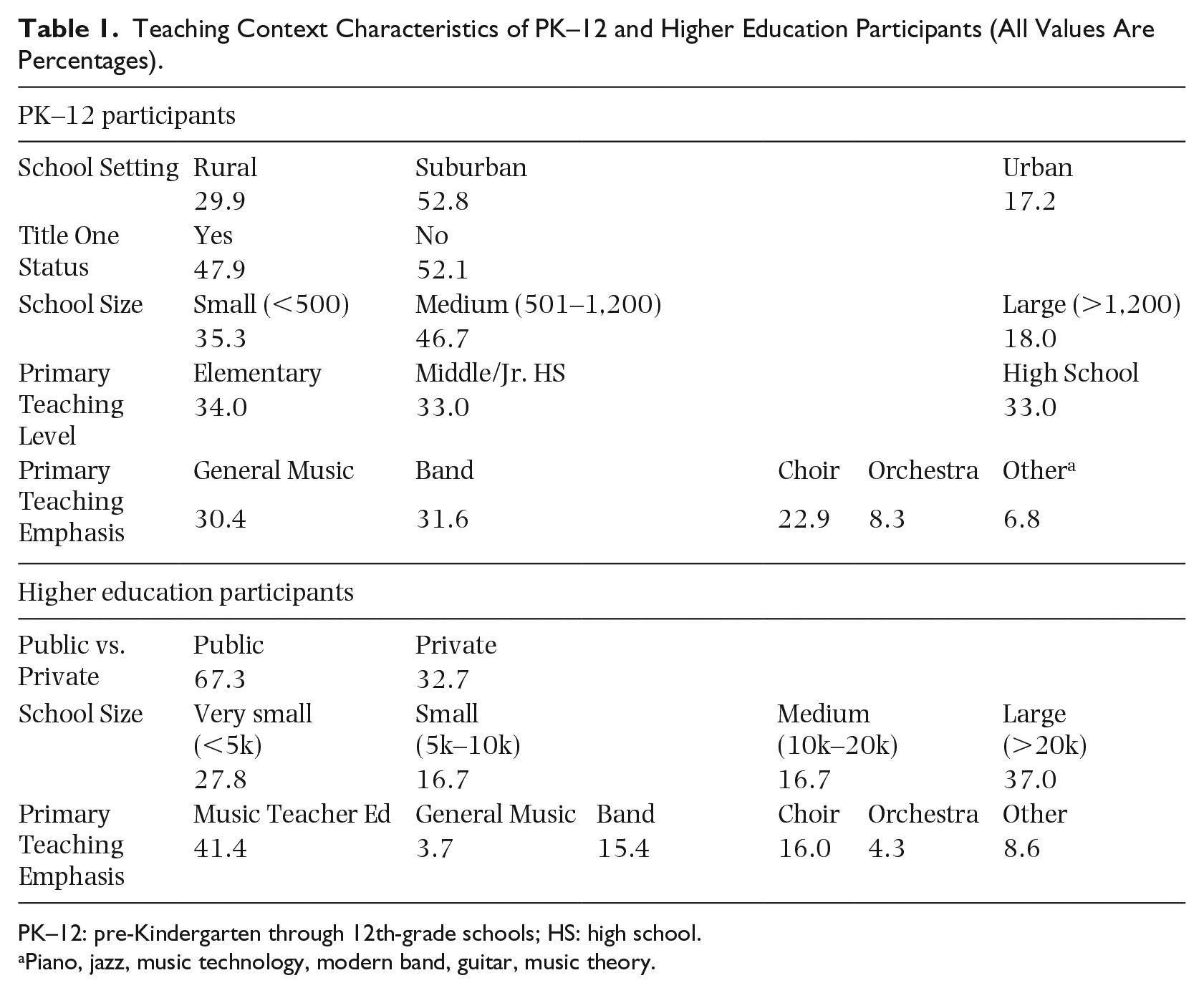
PK–12: pre-Kindergarten through 12th-grade schools; HS: high school.
Piano, jazz, music technology, modern band, guitar, music theory.
Questionnaire design
We designed a questionnaire for this study that consisted of five sections that addressed (a) demographic and institutional information, (b) music teacher well-being, (c) perceptions of teaching efficacy, (d) perceptions of the impact of the COVID-19 pandemic upon the profession, and (e) perceptions of the impact of the COVID-19 pandemic upon student learning. It included two existing instruments—the PERMA Profiler (Butler & Kern, 2016) and a portion of the Depression, Anxiety, and Stress Scale (DASS-21; Lovibond & Lovibond, 1995).
Music teacher well-being
The 23-item PERMA Profiler (Butler & Kern, 2016) was included in the questionnaire as a multidimensional global measure of participants’ well-being. This measure included subscales representing the five constructs of well-being that Seligman (2011) theorized to be most indicative of human flourishing (i.e., positive emotion, engagement, relationships, meaning, and accomplishment) as well as two subscales representing the related constructs of negative emotion and physical health, totaling seven subscales in all. Each subscale included three items that were rated by respondents using 11-point, Likert-type scales. There were also single-item measures of happiness and loneliness included in the PERMA Profiler. The response options for the items varied according to the wording of each item, for example, some items were responded to using a scale of 0 = not at all to 10 = completely, whereas others were paired with a scale of 0 = never to 10 = always, and others still were paired with a scale of 0 = terrible to 10 = excellent. Scores for each subscale were calculated by averaging the item responses to each three-item collection, with low scores indicating low levels of the presence of each construct and vice versa. Each of the five central PERMA constructs can also be combined with the single happiness item by averaging the participants’ responses to arrive at an overall, composite well-being score. For the current study, participants responded to each item after reading the following prompt: Considering the impact of your recent experiences teaching during pandemic-imposed disruptions, please answer the following questions about your current sense of well-being using the scales provided. There are no right or wrong answers. Do not spend too much time on any statement.
The internal consistency of the multi-item scales and the composite well-being score was assessed with Cronbach’s alpha and the reliability ranged from acceptable to excellent (r = .62–.93).
Depression measure
We included the seven-item depression scale from the short-form of the Depression, Anxiety, and Stress Scale (DASS-21; Lovibond & Lovibond, 1995) in the questionnaire. The items were designed to assess participants’ emotional state of depression by addressing the following issues: dysphoria, hopelessness, devaluation of life, self-deprecation, lack of interest/involvement, anhedonia, and inertia. Each item was paired with a Likert-type scale with the following response options: 0 = did not apply to me at all, 1 = applied to me to some degree, or some of the time, 2 = applied to me to a considerable degree or a good part of the time, and 3 = applied to me very much or most of the time. Participants’ depression scores were created by summing the responses to all the items, with low values indicating very little sense of depression and high values indicating more severe depression. The Cronbach’s alpha estimate of internal consistency for the scale was .90. Participants responded to each item after reading a prompt similar to that found in the PERMA section.
Teaching efficacy
We included a researcher-created, single-item measure of participants’ perceived change in teaching effectiveness in the questionnaire as well (“How has your teaching effectiveness changed as a result of the pandemic-imposed disruptions?”). This item was paired with a semantic differential-style response scale that ranged from −3 = less effective to +3 = more effective and included an additional middle-point anchor of 0 = the same. We chose to use a single-item measure in this instance as well as in other sections of the questionnaire as opposed to a pre-existing, multi-item scale due to the specificity of the information we wished to gather and for the sake of limiting the length of the questionnaire.
Perceptions of impact upon students
We included a single-item measure to address participants’ perceptions of how the pandemic had affected students. The item asked, “To what degree have the pandemic-imposed disruptions hindered or helped your students’ learning?” and was paired with a Likert-type response scale ranging from −3 = hindered to +3 = helped with an additional middle-point anchor at 0 = no impact.
Results
In the following paragraphs, we will report findings from several areas of analyses focusing on the comparison of music educator PERMA scores and depression scores to published norms, the association of any individual difference variables and participants’ PERMA and depression scores, the impact of teaching context variables, and participants’ perceptions about the pandemic’s impact on teaching efficacy and student learning.
Comparison of music educator PERMA and depression scores to published norms
We explored potential differences between our participants’ scores on the PERMA and the general adult population by comparing their responses with the norms presented by Butler and Kern (2016). Although not ideal, the prepandemic data provided by Butler and Kern (2016) represent the most comprehensive data set available to make a comparison between an adult population and our population of interest. The norm data from Butler and Kern (2016) are based on an extremely large sample of adults around the world. Unfortunately, there were no published PERMA data for our population from before the pandemic available.
As seen in Figure 1, we found that music educators’ scores significantly differed from published norms on each subscale as well as in overall well-being. Music educators (M = 5.77, SD = 1.83) reported significantly lower, t = −21.12, p < .001, d = .49, positive emotions than the norm (M = 6.69, SD = 1.97). Similarly, music educators (M = 6.51, SD = 1.73) scored lower, t = −18.00, p < .001, d = .43, on the engagement scale than the norm (M = 7.25, SD = 1.71). Moreover, music educators (M = 6.19, SD = 1.55) scored lower, t = −27.85, p < .001, d = .66, on the accomplishment scale than the norm (M = 7.21, SD = 1.78). Music educators (M = 6.52, SD = 2.02) also scored lower, t = −8.83, p < .001, d = .21, on the health scale than the norm (M = 6.94, SD = 2.18). Music educators (M = 7.28, SD = 1.84), however, scored higher, t = 8.73, p < .001, d = .21, on the relationship scale than the norm (M = 6.90, SD = 1.97). Music educators (M = 7.29, SD = 1.89) also scored significantly higher, t = 5.09, p < .001, d = .12, on the meaning scale than the norm (M = 7.06, SD = 2.17). Unfortunately, music educators (M = 5.26, SD = 1.86) also scored higher, t = 18.16, p < .001, d = .43, on the negative emotion scale than the published norm (M = 4.46, SD = 2.06). Finally, music educators (M = 6.61, SD = 1.46) scored lower, t = −11.82, p < .001, d = .28, in the overall well-being PERMA scale than the norm (M = 7.02, SD = 1.66).
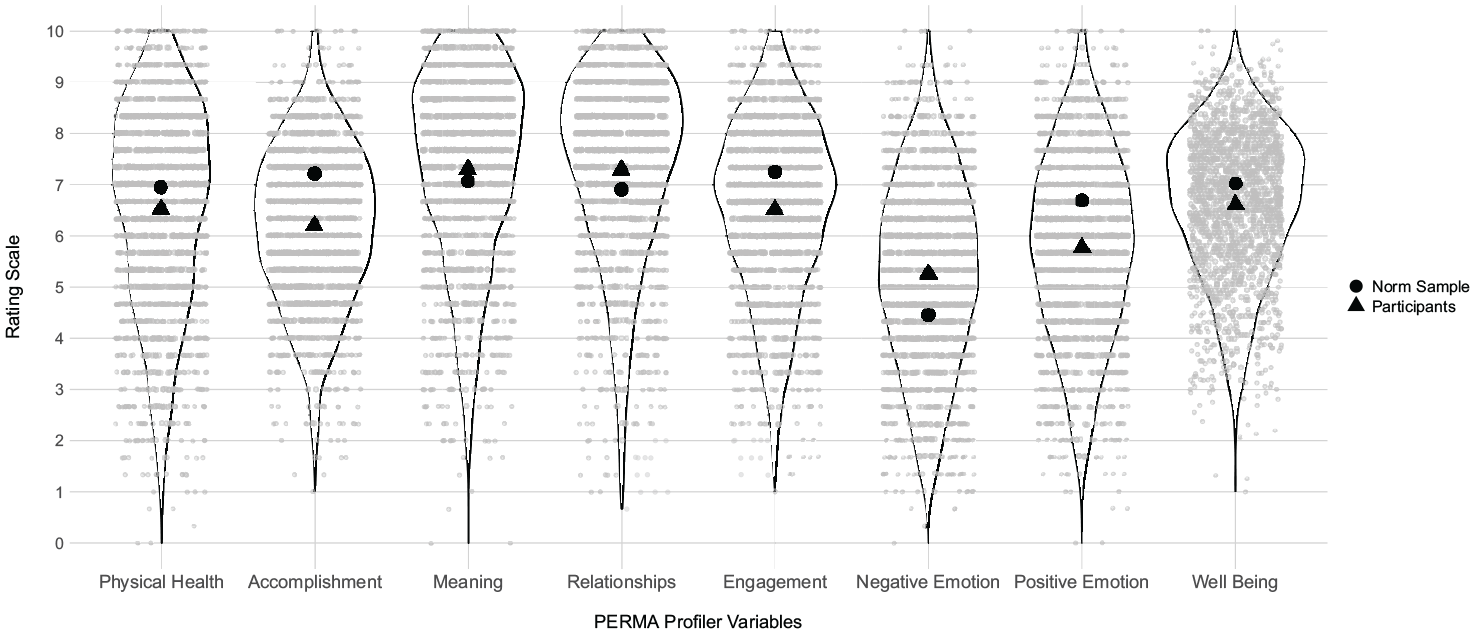
Comparison of Music Educators’ PERMA Scores to Published Norms.
Similarly, participants completed the section of the DASS, designed to explore depression. When comparing music educator depression scores with the original criteria for interpreting the scale scores (Lovibond & Lovibond, 1995), it appears that all but a quarter (25.6%) of the participants in this study suffered from mild to severe depression, with nearly one third (29%) suffering from moderate depression. Similarly, nearly one third of participants suffered from severe (15%) or extremely severe (14.4%) depression. Overall music educators reported experiencing greater depression than those found in the published norms, t = 7.36, p < .001, d = .14, see Figure 2.
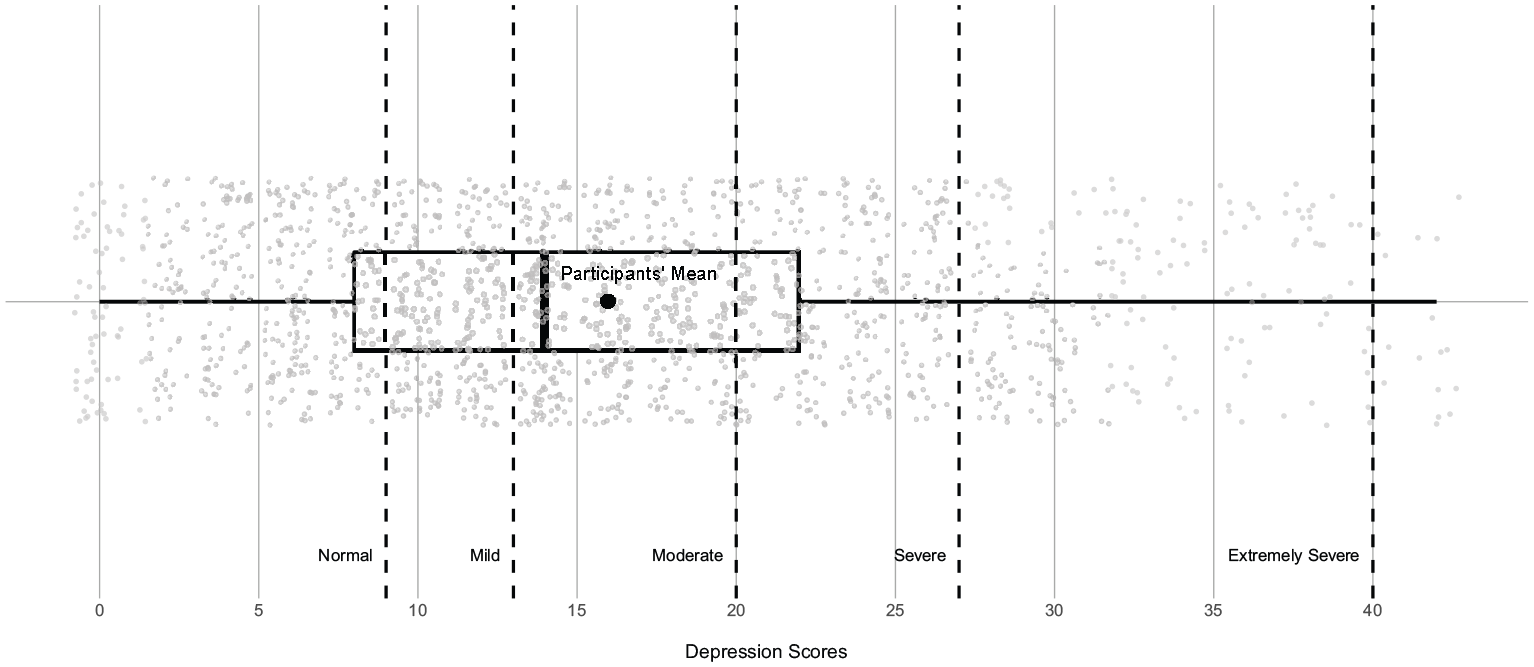
Comparison of Music Educators’ Depression Scores to Published Ranges of Severity.
Individual difference variables and the PERMA and depression subscales
To examine the potential impact of individual difference variables on the psychological well-being of the participants, we conducted a 2 × 2 × 3 factorial multivariate analysis of covariance (MANCOVA). Based on the extensive use of the PERMA in previous studies and its reported reliability, we employed the seven established subscales of the PERMA as dependent variables. We then conducted the analysis using gender (two levels—self-identified male and female; insufficient numbers of nonbinary responses were received to analyze), school level taught (PK–12 and higher education), and highest degree earned (bachelor’s, master’s, and all doctoral degrees regardless of type) as the three categorical independent variables. To control for differences in experience within the field, we used years teaching as a covariate, which was significant (covariate valued at 17.02, Pillai’s Trace = .046), F = 11.55, p < .001,
Follow-up univariate analyses showed that differences existed only for the PERMA subscales of meaning, F = 3.49, p = .03,
Similarly, participants completed the section of the DASS designed to explore depression. We conducted a 2 × 2 × 3 factorial ANCOVA employing the same independent variables and covariate as we did with the PERMA subscales. We found a very small but significant main effect for school level taught, F = 5.96, p = .015,
Individual difference variables and the overall PERMA score
We further explored individual differences by examining whether participants’ overall score on the PERMA well-being scale varied as a function of individual difference variables by conducting a 2 × 2 factorial analysis of covariance (ANCOVA). In this analysis, we did not include the highest degree as it violated the assumptions of the test. We included gender and teaching level as categorical independent variables and the overall PERMA score as the dependent variable, using years teaching as the covariate (covariate valued at 17.02), F = 48.97, p < .001,
Teaching context variables, the PERMA subscales, and DASS Depression Scale for PK–12 educators
Given the myriad differences between the jobs of PK–12 and college/university teachers, we decided to conduct separate analyses for these two groups of educators. We explored factors related to the teaching context for PK–12 educators via a 3 × 2 × 3 × 2 factorial MANCOVA. In this analysis, we employed each of the subscales as the dependent variables; the percentage of students on free or reduced lunch as a covariate; and the school setting, school Title 1 status, school size, and majority of student ethnicity (simplified as Caucasian and non-Caucasian to facilitate inclusion in this model) as the independent variables. This analysis violated the assumption of equality of the covariance matrices, and therefore, we employed the more conservative Pillai’s Trace to interpret the multivariate findings. Nonetheless, we found no interaction or main effects of institutional context variables that could discriminate among PK–12 teachers.
In a similar analysis, we examined the impact of context variables on depression experienced by PK–12 music educators. Using the same independent variables and covariate in this factorial ANCOVA, we found that although faculty members in rural areas, those who worked in Title 1 schools, and teachers from smaller schools seemed to be experiencing more depression, none of these differences were found to be statistically significant.
Teaching context variables, the PERMA subscales, and DASS Depression Scale for college and university educators
We examined the role of teaching context in higher education by conducting a 3 × 4 × 2 × 2 factorial multivariate analysis of variance (MANOVA) using the PERMA subscales as dependent variables and institutional setting, institutional enrollment, public or private, and faculty tenure (those with vs. those without) as the categorical independent variables. We found no significant interaction effects and only one significant main effect for institutional setting (Pillai’s Trace = .303), F = 2.24, p = .005,
Perceptions of the pandemic’s impact upon teaching efficacy, changes to the profession, and student learning
All music educators, regardless of the level taught, believed that their teaching efficacy had decreased during the global pandemic (M = −1.39, SD = 1.28, scale = −3 to +3), although PK–12 teachers (M = −1.44, SD = 1.29) believed that their teaching efficacy was more hindered than their higher education colleagues (M = −0.94, SD = 1.10; t = −5.19, p < .001, Hedges’s g = 1.87). One of the more concerning findings regarding the pandemic-imposed disruptions to learning was that both PK–12 participants (M = −2.06, SD = 1.01, scale = −3 to +3) and higher education participants (M = −1.52, SD = 1.04, scale = −3 to +3) believed that student learning was hindered.
In addition, we found that depression was correlated with teaching efficacy as well as with participants’ thoughts on whether or not the pandemic had helped or hindered student learning. Participants who tended to report that their teaching efficacy decreased during the pandemic also had a tendency to report relatively greater levels of depression, r = −.252, p < .001. Similarly, depression ratings were inversely correlated with beliefs about how the pandemic affected student learning for both higher education faculty members, r = −.288, p < .001, and PK–12 teachers, r = −.244, p < .001. As reported levels of depression increased, participants were more likely to believe student learning was negatively affected. However, it is important to note that these correlations involving depression were weak. Conversely, and logically, a significant, moderate, positive correlation was found between teaching efficacy and beliefs about student learning being unaffected by the pandemic for both PK–12, r = .468, p < .001, and higher education, r = .415, p < .001, teachers. The higher their reported teaching efficacy, the less participants were likely to report negative effects on student learning.
Discussion
Our results provided evidence that music teachers’ sense of well-being differed significantly from published norms on each facet of the PERMA profiler. The participants reported less positive emotion, less engagement, less accomplishment, more negative emotion, and poorer overall health. Moreover, nearly one third (29%) of the participants reported moderate degrees of depression, whereas nearly another third (29.4%) reported severe or extremely severe degrees of depression. Our findings suggest that music teachers have experienced mental health challenges during the pandemic. This result is consistent with other recent reports of the effects of the pandemic upon teachers (Cornett, 2020). Overall, our analysis suggests that many of the music teachers were experiencing less than optimal well-being and potentially serious levels of depression while teaching during the pandemic-imposed conditions.
Interestingly, participants also scored significantly higher on the relationship and meaning scales when compared with the published PERMA norms. Furthermore, the participants’ scores on each of these scales also varied as a function of their level of education, such that those with graduate degrees tended to report higher scores than those with only bachelor’s degrees. Educators often commit to teaching as a career because of the intrinsic satisfaction they get from opportunities to work with children and the knowledge they are helping to make a positive difference in the world (Jones & Parkes, 2010; Krueger, 2000; Miksza & Hime, 2015; Russell, 2008). Moreover, music educators often choose their career path, in part, because it allows them to continue to develop their identity as musicians and remain connected to music making in a meaningful way. For instance, many music teachers maintain a deep connection with their art form as performers in addition to carrying out their teaching duties (Miksza & Hime, 2015). As such, it is perhaps not terribly surprising that music educators scored higher than norms for the general population on the meaning scale—even amidst the COVID-19 pandemic.
Two significant findings emerged upon examining associations between selected individual difference variables and participants’ reports of well-being. A significant interaction effect indicated that women who taught in higher education scored lower on the overall PERMA measure than women who taught in PK–12 schools, whereas men who taught in higher education scored higher than men who taught in PK–12 schools. This finding is somewhat consistent with recent research exposing the gendered effects of the pandemic among college and university professors (e.g., Viglione, 2020). Gabster et al. (2020) suggested that females in higher education may be experiencing more psychological distress due to the unique challenges they have faced during the pandemic. For example, females have reported experiencing more stress during the pandemic compared with their male counterparts due to carrying a heavier load of childcare labor (Power, 2020; Prados & Zamarro, 2020).
In addition, although it was a very small effect, participants who taught in PK–12 settings reported experiencing significantly greater degrees of depression compared with those who taught in higher education. Given the differences in the typical settings they work in, as well as in the types of responsibilities these two groups of teachers must shoulder, it is reasonable to assume that a pivot to online instruction at the onset of the COVID-19 pandemic would be simpler in some ways for those in higher education. Faculty in higher education typically work with adult learners and may have had more institutional resources at their disposal for instructional support compared with PK–12 teachers. Similarly, sustaining online teaching throughout the Spring was likely more challenging, on average, for those in PK–12 settings given that they likely work with larger class sizes; are subjected to the high expectations and scrutiny of parents, administrators, and community members; and most likely had to radically adjust any active music curricula to suit the new online constraints they were working within (e.g., Hash, 2021). Cheng and Lam (2021) also reported the radical adjustments experienced by music teachers in Hong Kong caused psychological impacts and high levels of stress.
We found no significant effects when examining the association between PK–12 participants’ well-being and selected institutional context variables. This result implies that teaching continues to be stressful for all school music educators, which is consistent with previous research (e.g., Gray et al., 2017). However, higher education participants working in suburban settings reported significantly higher scores on the health subscale of the PERMA measure than those in rural settings. Given the differences in population density, faculty working in suburban settings may be more likely to have access to health-related resources or supports than those in rural settings.
The secondary purpose of this study was to investigate how the pandemic-imposed disruptions may have affected music teachers’ perceptions of their efficacy and their students’ learning. On average, it appears that all music educators believed that their teaching efficacy decreased during the Spring of 2020—although PK–12 teachers reported greater losses in teaching efficacy than their higher education colleagues. Both groups of participants reported that student learning had been hindered by the pandemic-imposed disruptions. Furthermore, those who tended to report being relatively less effective during the pandemic also tended to report that their students’ learning was more severely hindered by the pandemic. Previous researchers have indicated that teaching efficacy is likely a malleable construct (Tschannen-Moran & Woolfolk-Hoy, 2001), so it seems reasonable to infer that it could change as teachers faced challenging pandemic-imposed conditions. The relationship between teaching efficacy and depression has not previously been examined among music educators. However, our findings suggest that it would be useful to explore whether providing support for teachers’ mental health could help them to feel efficacious.
It is important to consider the findings of this study in light of its limitations. Given the design of this study, it is not possible determine whether the pandemic had a direct impact upon the participants’ well-being. Previous researchers have documented how teachers experience relatively high levels of stress (Gray et al., 2017) and that music teachers, in particular, experience excess stress for a variety of reasons (e.g., Bernhard, 2016; Hamann, 1986; Hamann et al., 1987; Hamann & Gordon, 2000; Sandene, 1995). Therefore, the differences we found between the participants’ reports of well-being in the current study and norm data could be due to the specialized nature of our music teacher sample. Future research involving qualitative designs might be able to investigate the manner in which the pandemic has had an impact among individual teachers in more detailed and precise ways. Moreover, future efforts to collect data regarding music teacher well-being once the impact of the pandemic has waned would be valuable for establishing a baseline assessment of music teacher well-being for comparison purposes.
Questions of causal inference aside, the results from our study and others (e.g., Cheng & Lam, 2021) indicate that music teachers were certainly suffering during the onset of the COVID-19 pandemic. As such, it is important that researchers also work to identify interventions for mitigating the pandemic-related effects and helping music teachers deal with the excess stress that may be associated with the profession. In addition, research that could inform policies regarding response methods should similar catastrophes occur in the future would also be helpful.
Conclusion
Teaching music is a stressful occupation and it is clear that stress only increased in Spring 2020 during the pandemic. The results from this study concerning the well-being of music educators during this period of time are troubling. It is clear that these music teachers could have benefited from support for well-being and depression. Not only did participants in this study report a sense of well-being lower than that of the general population, but they also reported serious concerns regarding the impact of the pandemic on their teaching and their students’ learning. In addition, the degree to which these teachers’ well-being will continue to be affected and what type of assistance may help them approach population norms once the pandemic is under control are unknown. The present study represents a first attempt to examine the mental health of PK–12 and higher education music educators during the COVID-19 pandemic. Much work remains to be done before the full extent of the effects of the pandemic can be ascertained. Further research examining the well-being of this population and efforts to identify potential strategies for providing relief and support for teachers is necessary.
