




Abstract
The article presents the development and validation of the instrumental practice–related affect measure (IPAM), based on the circumplex model of affect. This 16-item measure assesses four types of affect related to practicing a musical instrument: anxiety, comfort, depression, and enthusiasm. We conducted two studies. Confirmatory factor analysis supports the measure’s four-factor structure, allowing also for the distinction of two higher-order factors: positive and negative affect. The IPAM scales are highly reliable and correlate with affective traits, confirming the validity of the measure. The IPAM allows for capturing affective experiences in the musical learning context, in both basic and applied research.
Affect, conceptualized as consciously accessible moods and emotions (Fredrickson, 2001), is inevitably linked to musicians’ efforts to attain a level of music performance competency (McPherson & Renwick, 2011). On one hand, music activities such as listening, composing, or performing may induce affective responses (Juslin & Västfjäll, 2008). On the other hand, moods and emotions influence beliefs about and the perceptions of the learning activities musicians choose to undertake, thus being a source of their motivation (Woody & McPherson, 2010). The major drawback of formal music education is that so few students experience their musical practice as enjoyable. The music students’ lack of emotional commitment and personal interest in the musical pieces they play leads to diminished engagement with music and, ultimately, to learners dropping out of music schools (Twarowska, 2012). It is essential to study affect that appears in the context of music learning, given that there is a strong connection between affect and motivation to engage with music (Woody & McPherson, 2010).
The existing measures used in research of music learners’ affect capture mostly affective traits—tendencies to feel specific types of affect in general, regardless of the context (Kenny, Fortune, & Ackermann, 2011). Although these instruments effectively assess individual differences in affectivity, they ignore the fact that affect varies depending on the specific situation and context. For example, students may feel relaxed when they rest and tense when they await their public performance. Other scales used in music research do measure situation-specific affect, but they are mainly focused on one particular type of it—music performance anxiety (Biasutti & Concina, 2014).
However, research has indicated that the link between motivation to practice a musical instrument and affective traits or music performance anxiety is not clearly proven (Mazur & Laguna, 2019). Instead, interviews and observation studies show that students’ engagement with learning musical instruments changes as a function of the variability of affect related to particular pieces or musical tasks (Renwick & McPherson, 2002) or to the experienced moods (Berg, 2008).
A standardized measure of affect related to instrumental practice is currently lacking. Researchers studying this construct rely on observation and interview methods (Renwick & McPherson, 2002; StGeorge et al., 2014). Although these methods allow for tracking individual cases, they are time-consuming and thus often less useful for capturing universal phenomena on a group level. Self-report measures of affect related to music practice tend to take a nonstandardized form. For example, they consist of a single open question (Renwick & McPherson, 2002) or include items considering both affect and other phenomena (e.g., “Time passes slowly when practicing”; Austin & Berg, 2006). Most questionnaires consider single types of affect (e.g., boredom; Hallam et al., 2012; enjoyment; Renwick & McPherson, 2002) but do not include other affective experiences. The existing measures are generally used only in the context of a particular study and researchers do not have any well-validated measures of affect to rely on (Mazur & Laguna, 2019). Therefore, a new, psychometrically valid measure of affect related to musical practice is needed.
Such a tool would be particularly useful in the context of secondary music education. This stage of education is crucial for developing technical and performance skills (Konaszkiewicz & Chmurzyńska, 2014). However, the increasing difficulty of musical tasks, heavily laden schedules, and competing demands make it psychologically challenging for students (Freer & Evans, 2019). Psychologists may benefit from access to a self-report measure of affect related to practice that can be used in combination with other methods to gain a broad picture of students’ affective experiences in musical practice. Such data would inform decision-making in matters of psychological consultations or interventions aimed at maintaining students’ motivation to learn a musical instrument.
The current article aims to present the development and validation of the instrumental practice–related affect measure (IPAM) for use with students from secondary music schools and older. The measure we propose focuses exclusively on affect related to practice. It is based on a well-established theoretical model, namely, the circumplex model of affect (Russell, 1980).
Affect in musical practice
Practice is a central concern for musicians who are determined to acquire and improve their performance skills (Hallam et al., 2012). Expert performance results from motivation, structured learning sessions, and careful monitoring employed to increase the awareness of aspects to be improved (Ericsson et al., 1993; Sloboda et al., 1996). Various types of affect accompany these efforts. Up to now, the literature has identified terms such as “musical affect” or “emotional reactions to music” (Juslin, 2016). However, the construct of “practice-related affect” has not yet been clearly defined and fully characterized. It may be defined as the consciously available emotions and moods that accompany practice, while practice is “the repeated physical and/or mental performance of an activity pursued to acquire or maintain proficiency on a musical instrument or the voice” (Mielke, 2016, p. 190). McPherson and Renwick (2011) explained the connections between affective experiences and musical practice in the light of the self-regulated learning theory (Zimmerman, 2002). They postulated that learning an instrument was realized through self-enhancing cycles of forethought, performance, and self-reflective phases. Musicians’ affect in the forethought phase impacts their performance, as they may, for example, engage in ongoing learning because of the fascination by appealing music and personal interests (McPherson & Renwick, 2011). Also, affective experiences in the self-reflective phase impact decisions made in the forethought phase. For instance, students choose activities that made them “feel good” and “satisfied” and tend to avoid the tasks that made them feel “anxious” and “frustrated.”
Musicians can reach an optimal balance between challenge and skills (McPherson & Renwick, 2011). Such experiences may provide flow, a state of mind characterized by complete absorption in the task and by enhanced performance (Csikszentmihalyi, 1975; Sinnamon, Moran, & O’Connell, 2012). Feelings of power, relaxation, or calmness may occur in musical learning when practice presents continuous challenges, when there is no time to feel bored or worried, and if learners perceive their skills as adequate for mastering a task. Studies confirmed that the satisfaction of the needs for competence and autonomy are related to low anxiety, high involvement, flow, and pleasure derived from musical activities (Papageorgi et al., 2009; Valenzuela, Codina, & Pestana, 2018).
As can be seen, a spectrum of affective experiences accompanies practicing a musical instrument. To develop a new measure, we need a theory that organizes these experiences and classifies them into a coherent model.
The circumplex model of affect
Russell’s (1980) circumplex model of affect posits that “affect is best represented as a circle in a two-dimensional bipolar space” (p. 1162). Figure 1 shows the horizontal, pleasure–displeasure dimension and the vertical, arousal–sleep dimension of affect. Enthusiasm, comfort, anxiety, and depression are the four types of affective experiences represented by the different “quadrants” of the space (Warr, 1990). Thus, enthusiasm is a combination of pleasure and high arousal; depression, being opposite to enthusiasm, is a combination of displeasure and low arousal; anxiety, as a combination of displeasure and high arousal, is opposite to comfort. In sum, each combination of the two dimensions forms a single feeling, the way a given combination of hue, saturation, and brightness forms one unified sensation of a particular color (Russell, 2009).
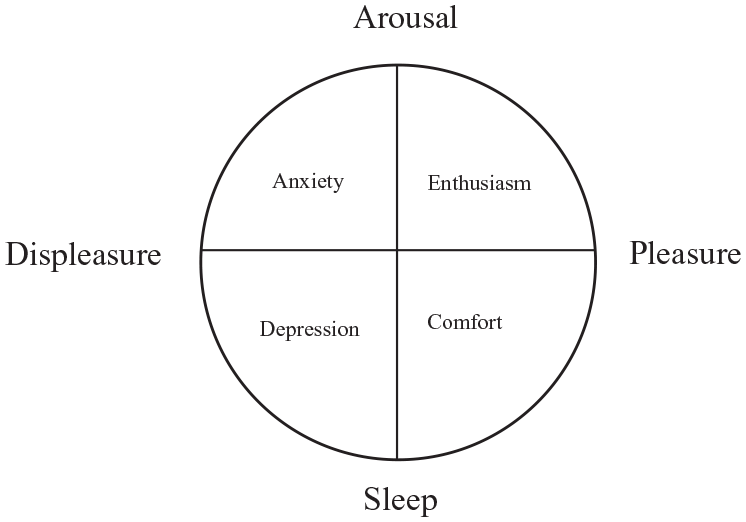
The Circumplex Model of Affect (Russell, 1980; Warr, 1990).
The circumplex model is supported by neurocognitive research (Posner, Russell, & Peterson, 2005) and applied in music research (Vuoskoski & Eerola, 2011). In the context of their learning activities, musicians experience various types of affect classified into different “quadrants” of Russell’s model. Pekrun et al. (2007; as cited in Boekaerts, 2011) found that the four types of affect differentially influenced motivation, the use of learning strategies, and achievement in academic setting. Therefore, we chose the circumplex model of affect as the basis for constructing a new measure to be used in the domain of musical practice.
There already exists a measure of affect based on Russell’s model: the job-related affective well-being measure (Warr, 1990), broadly used in research and having good psychometrical properties (Laguna, Mielniczuk, Razmus, Moriano, & Gorgievski, 2017; Mielniczuk & Łaguna, 2018). However, emotions in an aesthetic context such as music may differ from emotions experienced at work or in other situations (Vuoskoski & Eerola, 2011). Thus, to capture affect specific to the instrumental practice context, there is a need for a new measure of affective experiences related to learning a musical instrument.
Current study
Although research on emotions and music is continuously developing, a validated measure of affect related to practice remains unavailable. We therefore performed the two studies presented below to develop and validate the IPAM. IPAM is intended to be used with students attending secondary music schools and older. It assesses four types of affect felt in the situation of learning musical instruments, specifically: enthusiasm, comfort, anxiety, and depression, as defined according to the circumplex model of affect (Russell, 1980, 2009).
Study 1
Aim
Study 1 aimed to develop and select items for the IPAM and determine the factor structure, reliability, and validity of the measure. To assess validity, we hypothesized that IPAM scale scores would correlate consistently with affective traits (Watson, Clark, & Tellegen, 1988). General affective traits should be reflected in domain-specific affective experiences.
Method
Participants
The sample consisted of 171 (63.2% female) piano students from 22 Polish secondary music schools. In Poland, children, adolescents, and adults in a wide range of ages may attend such schools, as some music education institutions work independently of the compulsory education system. Participants were 13 to 22 (M = 16.83, SD = 1.51) years old and attended Grades 2 through 6. They had played the piano for 4 to 15 (M = 9.37, SD = 2.24) years.
Procedure
Before data collection, researchers contacted school management via e-mail and phone to obtain their consent. We collected data during a period of intensive instrumental practicing, shortly before end-term examinations. Participation was voluntary, and students did not receive any compensation or course credits. Data were collected anonymously using paper-and-pencil forms. The university’s Research Ethics Board approved the procedures of both studies.
Measures
IPAM
The circumplex model of affect served as the basis for the IPAM items. We derived 25 adjectives from Russell’s (1980) and Warr’s (1990) publications, six to seven per scale. The initial set of items included the following: for Enthusiasm: cheerful, enthusiastic, optimistic, happy, excited, and delighted; for Comfort: serene, content, relaxed, calm, satisfied, and at ease; for Anxiety: tense, uneasy, frustrated, distressed, annoyed, and afraid; for Depression: worried, depressed, gloomy, miserable, bored, sad, and tired. The IPAM respondents were instructed to choose one musical piece (e.g., etude, sonata) that they had practiced for the music school for at least 1 month and to indicate the frequency of experiencing each feeling in relation to practicing the piece during the past month (Appendix 1). Items were rated on a 6-point Likert-type scale ranging from 1 = never to 6 = all of the time.
Affective traits
We used 10 items from the Positive and Negative Affect Schedule (PANAS; Watson et al., 1988) to assess traits of positive affect (PA) and negative affect (NA). Participants rated to what extent they usually felt five types of PA (e.g., active, excited) and five types of NA (e.g., upset, nervous) on a 5-point scale ranging from 1 = very slightly or not at all to 5 = extremely. Reliability was α = .79 for the PA scale and α = .87 for the NA scale. This 10-item model had acceptable fit to the data (Weston & Gore, 2006) as tested using confirmatory factor analysis (CFA), χ2(34) = 84.192, p < .001, comparative fit index (CFI) = .921, root mean square error of approximation (RMSEA) = .093, standardized root mean square residual (SRMR) = .070, allowing two factors to correlate with each other.
Data analysis
We used CFA with maximum likelihood estimation, as available in AMOS 25.0, to test the fit of the hypothesized theoretical models of the IPAM. Missing data were estimated using full information maximum likelihood. Descriptive statistics, reliability, correlations, and the t test of group differences were calculated using SPSS 25.0.
Results
Item selection, descriptive statistics, and correlations between items
We assumed an a priori theoretical four-factor structure with 25 items. All items met the acceptable univariate normality criteria (skewness index < 3, kurtosis index < 10; Weston & Gore, 2006). Four items with the highest factor loadings on each factor were selected (Table 1), and nine items were dropped. All factor loadings of the selected items were significant and exceeded .70 (λ = .70–.90), suggesting that they were good representations of their respective theoretical dimensions.
Descriptive statistics and correlations of items of the four IPAM scales.

Note: All correlations are statistically significant at the level of at least p < .05. IPAM: instrumental practice–related affect measure; λ: factor loading derived from CFA four latent factor solution; CFA: confirmatory factor analysis.
In consequence, the IPAM consists of 16 items (see Appendix 1). Their descriptive statistics, factor loadings, and correlations are presented in Table 1. Mean item scores ranged from 1.78 to 3.94 on a 6-point scale, with no extremely low or high mean values. There were positive and statistically significant correlations between items within each scale.
Factorial structure
We tested how different theoretical models fit the data, considering 16 items and comparing four alternative solutions. No cross-loadings or correlated error terms were included in any of the models, and latent factors were allowed to correlate with each other. Model fit was assessed with the CFI, RMSEA, and SRMR. CFI values higher than or equal to .90, RMSEA values lower than or equal to .10, and SRMR values lower than or equal to .10 were used as criteria for acceptable model fit (Weston & Gore, 2006).
Model 1 included four intercorrelated factors (Russell, 1980; Warr, 1990), namely, enthusiasm, comfort, anxiety, and depression. Model 2 considered all items as loading on a single factor (Russell & Barrett, 1999). Model 3 consisted of two correlated factors, PA and NA (Watson et al., 1988). In the Hierarchical Model 4 (Mielniczuk & Łaguna, 2018), comfort and enthusiasm loaded onto a higher-order Positive Affect factor (HO-PA), whereas Anxiety and Depression loaded onto a higher-order Negative Affect factor (HO-NA; the higher-order factors correlated with each other).
Only Model 1 and Model 4 had acceptable values of all fit indices (Table 2). Tests of differences confirmed that Model 1 fits the data significantly better than Model 2, Model 3, and Model 4 (for all comparisons, p > .05 for Δχ2 and p > .01 for ΔCFI). Consequently, the postulated four-factor model of the IPAM was confirmed (Model 1), also allowing a hierarchical solution (Model 4).
Model fit of alternative measurement models of the IPAM.

Note: IPAM: instrumental practice–related affect measure; RMSEA: root mean square error of approximation; SRMR: standardized root mean square residual; CFI: comparative fit index.
Psychometric properties of the IPAM scales
Basic descriptive statistics and correlations between the IPAM scales resulting from Model 1 are presented in Table 3, together with the HO-PA and HO-NA factors derived from Model 4. The scale scores are calculated as means of all item scores belonging to each scale. Mean values are lower for NA scales than for PA scales (especially for Depression and HO-NA, which are also skewed); however, all scales’ variance is similar. Correlations between scales representing the same affect valence are positive, while correlations between scales measuring different valence of affect are negative.
Reliability, descriptive statistics, and correlations among the IPAM scales.
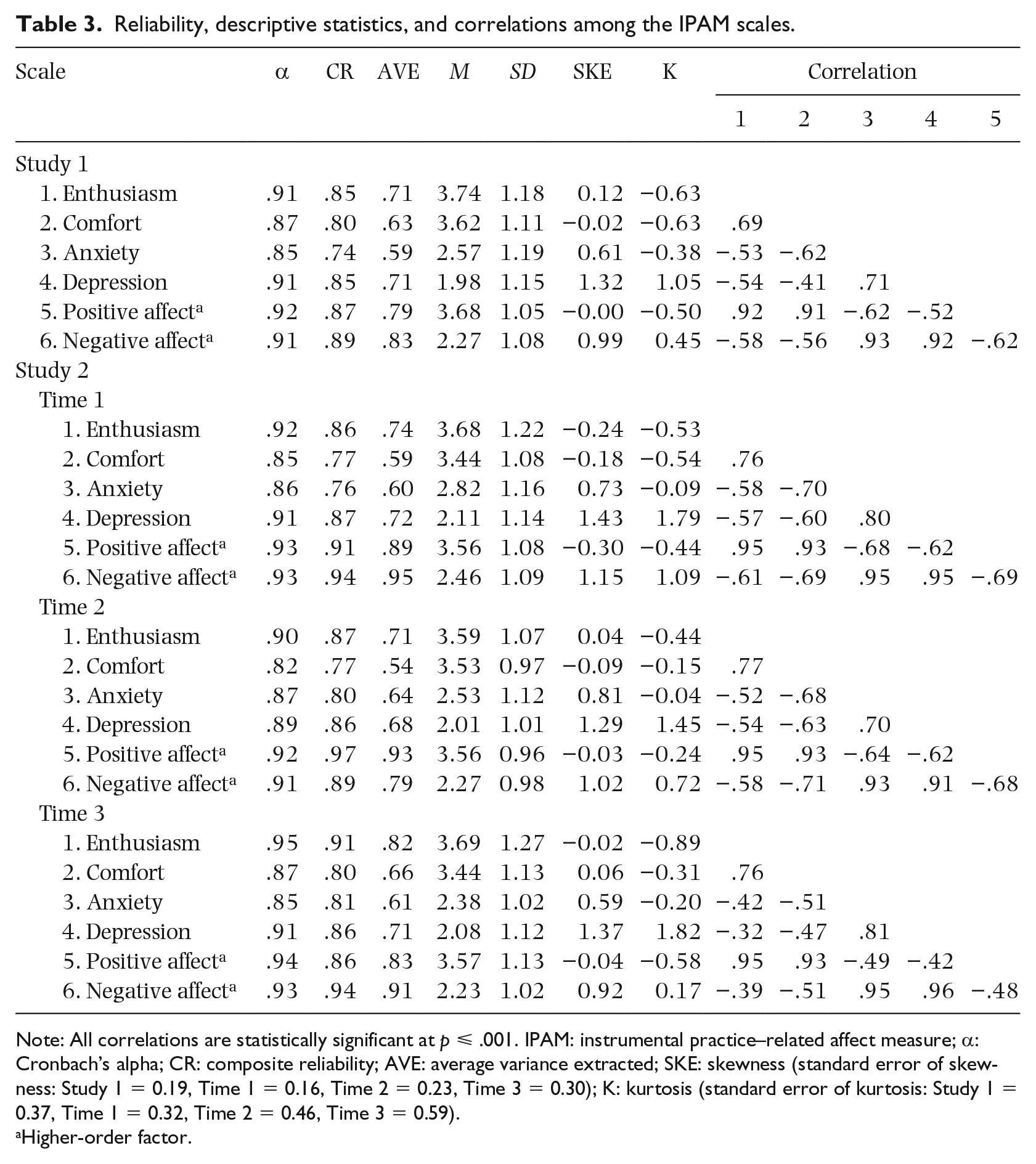
Note: All correlations are statistically significant at p ⩽ .001. IPAM: instrumental practice–related affect measure; α: Cronbach’s alpha; CR: composite reliability; AVE: average variance extracted; SKE: skewness (standard error of skewness: Study 1 = 0.19, Time 1 = 0.16, Time 2 = 0.23, Time 3 = 0.30); K: kurtosis (standard error of kurtosis: Study 1 = 0.37, Time 1 = 0.32, Time 2 = 0.46, Time 3 = 0.59).
Higher-order factor.
To assess the reliability and convergent validity of the scales, we calculated Cronbach’s alpha, composite construct reliability (CR; derived from CFA standardized factor loadings and measurement errors), and average variance extracted (AVE; based on CFA squared standardized factor loadings and the number of items; Hair, Black, Babin, & Anderson, 2014). For alpha and CR estimates, a value of .70 or higher indicates good internal consistency, while an AVE of .50 or higher suggests adequate convergence. Cronbach’s alpha values ranged from .85 to .92, CR values ranged from .74 to .89, and AVE ranged from .59 to .83 (Table 3), indicating the good reliability and convergent validity of all scales. This means that each subscale consistently represents the same latent construct.
Next, we examined the discriminant validity of the scales. The square root of AVE of each scale was compared with its correlations with other scales (Hair et al., 2014), except for correlations between higher-order factors and the scales they consist of. Square roots of AVE are .84 for enthusiasm and depression, .79 for comfort, and .77 for anxiety. These values exceed the correlations between scales (Table 3), indicating that discriminant validity has been achieved.
To provide further evidence of the validity of the IPAM scales, we examined how they correlated with trait affectivity. We expected that trait PA would correlate positively with comfort, enthusiasm, and HO-PA and negatively with anxiety, depression, and HO-NA. We further hypothesized that trait NA would correlate positively with anxiety, depression, and HO-NA and negatively with comfort, enthusiasm, and HO-PA. The results confirmed all these expectations (Table 4).
Correlations between the IPAM scales and affective traits.

Note: IPAM: instrumental practice–related affect measure.
Higher-order factor.
p < .05. **p < .01. ***p < .001.
Discussion
Study 1 allowed for IPAM item selection. CFA results supported a four-factor solution, reflecting the theoretical structure of affect according to the circumplex model (Russell, 1980). Each scale consists of four items, shows high internal consistency, and correlates in a logical manner with affective trait scales, which attests to the external validity of the IPAM. The measure was tested in a sample of piano students, which limited the generalizability of the results. Therefore, the next study with a broader sample was needed to further validate the IPAM.
Study 2
Aim
In Study 2, we attempted to further validate the IPAM scales in a sample of people learning different musical instruments. Moreover, the longitudinal study design allowed for testing the temporal stability of the measure.
Method
Participants
A sample of 235 (68.9% female) Polish students recruited from 12 secondary music schools participated in the study. Their age ranged from 13 to 28 (M = 17.42, SD = 2.33) years. The students were in Grades 2 through 6. They had learned keyboards (35.3%), strings (24.7%), woodwinds (22.6%), plucked string instruments (6.4%), brass instruments (6%), percussion instruments (2.6%), and vocal (2.6%) for 1 to 18 (M = 7.77, SD = 2.71) years.
Procedure
The research team contacted school managers via e-mail and phone to invite their students to participate in the study. We applied a longitudinal design with a three-time online measurement scheme. The first measurement (at Time 1), with 235 students, took place about a month before the end-of-year examination; the second measurement (at Time 2), with 109 participants, was performed 2 weeks later; the third measurement (at Time 3) was 4 weeks later, with 65 students participating. We offered the students who completed all questionnaires a small amount of money as compensation for participation in the study.
Measures
The measures administered in Study 1 were used also in Study 2. The PANAS (Watson et al., 1988)—model fit: χ2(34) = 111.470, p < .001, CFI = .926, RMSEA = .099, SRMR = .075; α = .79 for PA and α = .90 for NA—was applied at Time 1; the IPAM was administered in all three measurement times.
Data analysis
We used the same data analysis strategy as in Study 1.
Results
Factorial structure
To further confirm the factorial structure of the IPAM, we tested four alternative CFA solutions in a sample of musicians participating at Time 1 (Table 2). Model fit for the four-factor (Model 1), two-factor (Model 3), and hierarchical solutions (Model 4) was acceptable, and model fit for the one-factor solution was not (Model 2). Moreover, the four-factor model fitted the data better than the alternative models, except for the hierarchical model. It was also well fitted to the data collected at Time 2, χ2(98) = 184.008, p < .001, CFI = .929, SRMR = .0606, RMSEA = .090, and so was the hierarchical model, χ2(99) = 187.059, p < .001, CFI = .927, SRMR = .067, RMSEA = .091. Due to the small number of participants, we did not test how these models fit the data collected at Time 3.
Descriptive statistics, reliability, and validity of scales
Descriptive statistics and correlations between the IPAM scales resulting from Model 1 and HO-PA and HO-NA factors derived from Model 4 are presented in Table 3. As in Study 1, types of affect with the same valence correlate positively with each other, while types of affect representing different valence are negatively correlated.
Considering three measurement times (Table 3), Cronbach’s alpha values for scales range from .82 to .95, CR values range from .76 to 97, and AVE values are between .54 and .95. These results indicate good reliability in terms of internal consistency and the convergent validity of all scales.
With regard to the temporal stability of the scales, test–retest correlations over a 2-week interval (Time 1 to Time 2) is .70 for enthusiasm, .55 for comfort, .63 for anxiety, .62 for depression, .67 for HO-PA, and .68 for HO-NA, and over a 4-week interval (Time 1 to Time 3), the corresponding values are .57, .38, .37, .47, .51, and .46, respectively. All these coefficients are statistically significant at p < .01. These results demonstrate a moderate to good stability of the scales, although correlations for comfort and anxiety are relatively weak over the interval of 4 weeks. The most stable scores are those on the enthusiasm and HO-PA scales.
The square roots of AVE are .86, .84, and .91 for enthusiasm at Times 1, 2, and 3 respectively; .77, .73, and .81 for comfort; .77, .80, and .78 for anxiety; .85, .82, and .84 for depression; .94, .96, and .91 for HO-PA; and .97, .89, and .95 for HO-NA. These values exceed the values of correlations between scales. Only the square root of AVE for the comfort scale at Time 2 does not exceed the value of the correlation between comfort and enthusiasm; the square root of AVE for the depression scale at Time 1 and Time 3 does not exceed the correlation between depression and anxiety. Apart from these theoretically reasonable exceptions, overall, the results indicate that the discriminant validity of the scales has been achieved.
Table 4 presents the correlations between the IPAM scales and trait PA and NA (Watson et al., 1988). PA is positively correlated with enthusiasm at all measurement times, with comfort at Time 1 and Time 2, and with HO-PA at all measurement times. PA also correlates negatively with anxiety, depression, and HO-NA at Time 1. NA is positively associated with anxiety, depression, and HO-NA at all measurement times, and negatively associated with enthusiasm, comfort, and HO-PA at Time 1 and Time 2. These results confirm the convergent validity of the IPAM scales. The low to moderate strength of correlations between the types of affect captured by IPAM and affective traits suggests that these constructs are related to but distinct from each other.
Discussion
Study 2 confirmed the reliability and validity of the IPAM scales, their good internal consistency, and moderate to good stability over 2- and 4-week intervals, with the enthusiasm scale being the most stable. Over an interval of 4 weeks, the stability is lower. This is not surprising considering that the scales are very short and that the measure intends to capture affect associated with playing a musical piece, which may change over time as the learning of the piece proceeds. The discriminant validity was achieved in most cases. As we predicted, types of affect with the same valence are positively correlated with each other (except trait PA and comfort at Time 3).
General discussion
This study aimed to develop and validate the measure of students’ affect related to musical practice—the IPAM, which could be used in music schools and centers. Based on the circumplex model of affect (Russell, 1980), we operationalized the hypothesized four affective experiences: enthusiasm, comfort, anxiety, and depression. To test the structural validity of the IPAM, we conducted CFA on data collected from piano students (Study 1) and students playing different instruments (Study 2). Based on CFA results, it can be concluded that the structure of the IPAM is best represented by a four-factor solution, with four items representing each factor. It is also possible to measure two higher-order dimensions of positive and negative affect. All scales demonstrate adequate internal consistency and acceptable temporal stability over an interval of 2 and 4 weeks. The IPAM scales consistently correlate with trait positive and negative affect.
Both studies yielded consistent results concerning the psychometric properties of the IPAM, despite differences in the data collection technique (paper-and-pencil forms in Study 1 and online questionnaire in Study 2) and in the sample (pianists in Study 1 and students learning various instruments in Study 2). Thus, we have provided robust evidence on the factorial structure of the IPAM and the reliability and validity of its scales.
Limitations and avenues for future studies
Our studies provide first evidence concerning the psychometric properties of the IPAM, which can be extended in future research. We chose the circumplex model of affect as the theoretical basis for this new measure, given that each of the four types of affective experiences may play a different role in motivation to learn, learning strategies, and achievement (Boekaerts, 2011). As far as validity is concerned, we tested the measure’s structural and discriminant validity and examined its correlations with affective traits. There is a need to examine further whether affect related to musical practice correlates logically with other variables that determine practice motivation and behavior, such as intention to practice (McPherson & Renwick, 2011), flow (Sinnamon et al., 2012), autonomy need satisfaction, or perceived competence (Deci & Ryan, 2000; Valenzuela et al., 2018). Furthering the understanding of mutual relationships between these constructs and affect will bring us closer to explaining the motivational mechanisms involved in learning a musical instrument.
There is an increasing interest in the role of gender in musical learning (e.g., Papageorgi et al., 2009; Valenzuela et al., 2018). For instance, gender differences in music education have been reported in students’ self-efficacy level (Nielsen, 2004) and systematic practice strategies (Hallam et al., 2017). It would be fruitful to explore the role of gender in practice-related affect. Thus, future studies testing measurement invariance of the IPAM scales across gender would allow meaningful analyses of this issue. Moreover, studies on measurement invariance of affect in students learning different instruments may also be interesting.
The current IPAM instruction asks participants to recall their experiences from the last month. As affect may change during different stages of learning a musical piece, future research may test other instructions, asking participants to recall more recent affective experiences (e.g., feelings from the last practice session). As in the case of other measures (e.g., Warr, 1990), the same set of adjectives may be used to evaluate affective experiences in a different period. Such changes in the instruction, however, would require future validation.
Implications for theory and practice
The results of the current research have certain implications for theory and school practice. Regarding theory, our findings contribute to the better understanding of affect in music education, providing evidence that enthusiasm, comfort, anxiety, and depression are distinct latent indicators of affective experiences when learning a musical instrument. Thus, our research results confirm the two bipolar dimensions of activation and valence proposed in the circumplex model (Russell, 1980). Therefore, using one- or two-dimensional measures rather than multidimensional instruments such as the IPAM is likely to misrepresent the structure of practice-related affect. Emotions experienced while playing an instrument may either enhance or diminish motivation to learn (McPherson & Renwick, 2011). The IPAM can be used to test these theoretical postulates empirically.
The IPAM is also a promising instrument for psychological practice. It can be used along with other measures (e.g., emotion regulation) by school psychologists as a screening instrument for assessing students’ psychological functioning. The identification of students experiencing intensive negative practice-related affect during different periods of the academic year (e.g., before the instrumental exam) would inform professional efforts (e.g., relaxation training may be implemented for students scoring high on the anxiety scale). Moreover, teachers may evaluate students’ affect related to different musical pieces with IPAM when selecting a musical repertoire, adjusting it to students’ expectations, and supporting them to better cope with the more challenging pieces. Students may engage more in practicing a musical composition that evokes positive affect (Mazur & Laguna, 2019). In the long term, comfort and enthusiasm related to learning are likely to contribute to building stable resources (Fredrickson, 2001) such as a positive attitude toward playing an instrument and higher motivation to learn music.
Conclusion
We have developed a short multidimensional self-report measure that allows for assessing four types of students’ affect related to practicing musical instruments, plus two higher-order dimensions of positive and negative practice–related affect. The IPAM scales demonstrate good psychometric properties permitting their use in research and individual assessment. We hope that the IPAM will be applied both, as a research instrument and as a measure used in schools.
