




Abstract
Learning and performing music affect the brain and cognition and have a positive impact on emotional states. Negative emotional states such as stress, anxiety, and depression are harmful for teaching. Alternative certification teachers in particular are extremely vulnerable to and suffer greatly from negative emotional states. In addition, humor and coping humor are cognitive processes depending on neural networks of the brain. Therefore, the relationships between alternative certification pre-service teachers’ musical behaviors, negative emotional states, humor styles, and coping humor were examined in order to produce knowledge that can be used to increase effectiveness in education regarding negative emotional states, humor styles, and humor. The participants were 112 pre-service teachers enrolled in the alternative certification program of a public university in Turkey (N = 112). Responses to six psychometric scales and a musical behaviors questionnaire were collected. Results demonstrated that having music and instrument education, duration of those educations, playing a musical instrument, and being member of a musical group were related to various emotional states, humor styles, and coping humor. The findings obtained from the analyses of the relationships between 11 musical variables and negative emotional states, humor styles, and coping humor are discussed in light of the related literature.
Musical behaviors have an influence on individuals’ emotional states (Aydın & Yıldız, 2014; Doğan & Şenturan, 2012; Üstün, 2016). In turn, musical behaviors are also influenced by emotional states such as anxiety, stress, and depression (Kenny, 2005; Kenny et al., 2004; Sinden, 1999; Steptoe, 1989). Negative emotional states such as stress, anxiety, and depression may be harmful for the teaching profession (Atabek, 2020b; Aydın & Yıldız, 2014; Doğan & Şenturan, 2012; Üstün, 2016). When the effects of music on human psychology are considered, identifying musical variables that can relate to or influence psychological situations of pre-service teachers seem to be rather important, as they play crucial roles for their orientations and thus, increase their resiliency. This is especially important for increasing the quality of teacher training. In addition, musical behaviors have close interaction with coping strategies, such as using humor when confronted with problems, incongruities, and unpleasant situations (LeBlanc et al., 1992). As well as a having positive influence on learning and teaching, use of humor can be an effective coping mechanism for pre-service and in-service teachers to deal with psychological problems and conflicts. Thus, relationships between pre-service teachers’ musical behaviors and use of humor are a subject that needs to be examined.
On the other hand, the number of alternatively certified teachers has been increasing all over the world (Atabek, 2020a; Duncan et al., 2013; McFarland et al., 2018) reaching 50% of all teachers in private secondary schools (Glass, 2008). Alternative certification programs provide anyone who wants to be a teacher, regardless of whether they hold a degree from a faculty of education, with full teacher credentials, through a very limited instruction—lasting only months—instead of full-fledged teacher training (Atabek et al., 2019; Azar, 2011; A. Köse, 2017; Wise, 1994). Alternative certification programs have been criticized for allowing insufficiently qualified teachers to enter the system (Azar, 2011; A. Köse, 2017). Moreover, they suffer from stress, depression, and anxiety more than other undergraduate students (Atabek, 2020b). And yet, a lack of knowledge about alternative certification in-service and pre-service teachers has been reported (Atabek, 2020a; Roberts & Dyer, 2004; Schonfeld & Feinman, 2012) particularly with regard to emotional states (Atabek, 2020b). Scientific examination of the alternative certification process, which is the secondary route of the teacher training system, and of the alternatively certified pre-service teaches, may provide prior knowledge about and important insight into the structure of the future education system employing a greater number of alternatively certified teachers (Atabek et al., 2019). Therefore, the purpose of the present research is to examine the relationships between alternative certification pre-service teachers’ musical behaviors, emotional states (stress, depression, and anxiety), humor styles, and coping humor.
Background
Musical behaviors comprise aesthetic experiences and musical performances. Aesthetic experience “represents the composite emotional and intellectual responsiveness to music which is modified and reinforced through time and always defined as good” (Madsen, 1999, p. 78). Regarding aesthetic experience, experiencing music encompasses listening, appreciating, and criticizing music. Musical aesthetic experiences cause the formation of ideas, thoughts, and feelings in people. Experiencing music is subjective in the listening process. Individuals gain different feelings, ideas, and expressions during and after listening to music. As well as aesthetics, learning music should be individually experienced (Elliot, 2009). Experiencing music aesthetically impacts emotional states, pointing to the interaction between music and human behavior. Atabek (2020b) reported that stress, anxiety, and depression are “the most common negative emotional states that teachers experience” (p. 178) and alternative certification pre-service teachers suffer from them “even more so than other undergraduate students” (p. 186).
Stress
One of the negative emotional states is stress. Stress is defined as “the physiological or psychological response to internal or external stressors” (American Psychological Association [APA], 2021c). Stress involves changes affecting nearly every system of the body, influencing how people feel and behave. Although stress causes physiological disorders such as headaches, skin disorders, and similar psychosomatic symptoms, individuals are able to cope with stress with music (Hanser, 1985). Thus, music plays a significant role in reducing the physiological symptoms caused by stress (Knight & Rickard, 2001). The relaxing effect of music normalizes brain functions, reduces overstimulation, and controls stressor mechanisms. Music reduces stress hormones, blood pressure, breathing rhythm, and heart rate (Khalfa et al., 2003; Neuloh & Curio, 2004). Music in daily life is a means for coping with stress; therefore, it is used as a method to reduce clients’ stress levels in medicine (Leardi et al., 2007).
Depression
Depression is another negative emotional state, including extreme feeling of sadness and pessimism that interferes with daily life. Various physical, cognitive, and social changes also tend to co-occur, such as abnormal eating or sleeping habits, lack of energy and motivation, problems in concentration or making decisions, and social withdrawal. It is symptomatic of a number of mental health disorders (APA, 2021b). Depression is identified as a psychological illness with a wide range of therapies including musical therapy, psychotherapy, and electroconvulsive therapy. Among these therapy techniques, music is used to support for general care, but especially to overcome amnesia, concentration or attention deficits, perceptual distortions, and problems in cognition (Galińska, 2015; Giovagnoli et al., 2014; Kim et al., 2013; Pfeiffer & Sabe, 2015). Previous research has demonstrated that music decreases depression (Field et al., 1998; Siedliecki & Good, 2006; Waldon, 2001). Listening to music decreases the level of the illness in patients with major depression (Field et al., 1998). Music is also used to decrease depression levels and increase resiliency of patients with different pathologies. Positive changes in mood states as well as less pain were observed in cancer patients who listened to music during treatment (Siedliecki & Good, 2006; Waldon, 2001).
Anxiety
Anxiety is another negative emotional state characterized by apprehension and somatic symptoms of tension in which an individual anticipates impending danger, or other threats. Specific bodily functions arise during anxiety. For instance, muscles become tense, breathing becomes faster, and the heart rate is more rapid (APA, 2021a). Music is used as a means for the treatment of anxiety and depression (Ni et al., 2012; Sung et al., 2012). As one of the most common psychological health problems that teachers experience (Uzman & Telef, 2015), teachers’ performance in the classroom is linked to anxiety (Ripski et al., 2011; Uzman & Telef, 2015). Anxiety is reported to have a significant negative impact on job satisfaction (Ferguson et al., 2012) and is related with career satisfaction (Burak & Atabek, 2019). Unemployable graduates who enroll in alternative certification programs see the program as a source of hope (Erol et al., 2017) and suffer intense anxiety about their future (Sezgin Nartgün & Gökçer, 2014).
Humor
Stress, depression, and anxiety are negative emotional states that have an impact on physiological and psychological well-being. While stress, depression, and anxiety “reduce the ability of the individual to cope with stressors” (Atabek et al., 2019), humor seems to be an important coping mechanism. Cognitive theory describes humor as the cognitive reaction given to incongruities in situations (Suls, 1983). In addition, psychoanalytical theory defines humor as a defense mechanism, which helps an individual keep psychological safety, and creates an escape from pain or unpleasant thoughts (Matte, 2001). A good sense of humor accelerates learning (Gorham & Christophel, 1990), contributes to the development of problem solving skills (Klavir & Gorodetsky, 2001), and decreases stress (White, 2001).
Sense of humor is perceived as a human trait, but it can also be handled as a cognitive competence and an aesthetic reaction. It can also be seen as a behavioral habit, a mood trait, a coping strategy, and a defense mechanism. However, for psychological well-being, positive humor styles are required. Sense of humor can be described in two groups including two positive and two negative humor styles (Martin et al., 2003). One of the positive humor styles is self-enhancing humor (using humor to enhance the self) and affiliative humor (humor used to enhance social relations). On the other hand, negative humor styles are aggressive humor style (using humor to enhance the self at the expense of others) and self-defeating humor style (use of humor to enhance social relations at the expense of the self; Martin et al., 2003). Aggressive and self-defeating humor styles are related to neuroticism. In particular, self-defeating humor style is related to depression, anxiety, and negative emotions (Wanzer et al., 2010).
Positive humor is efficient not only in psychological well-being, but also in learning and education. Positive humor enhances positive attitudes toward teachers (Frymier & Thompson, 1992) and decreases test anxiety (Newton & Dowd, 1990). It also helps students focus on classes and thus makes instruction easier for teachers (Wallinger, 1997). Therefore, not all humor styles are appropriate for education; only positive humor styles enhance learning and classroom dynamics. In-service and pre-service teachers perceive sense of humor as an important factor that a teacher should possess (Teachout, 1997). Similarly, in a qualitative study where three teachers awarded in creative teaching were observed, use of humor was highlighted as a very important skill of highly creative teachers (Horng et al., 2005). Moreover, openness to experience, which is a “Big Five” personality trait, and which is associated with aesthetic and creative interests and greater engagement with music (Thomas et al., 2016), is reported to be correlated with both affiliative and self-enhancing humor. Affiliative and self-enhancing humor in turn are correlated with coping humor (Martin et al., 2003). Thomas et al. (2016) reported that the mediation models they present indicated that individuals who were more open to experience “had significantly more formal training in music and music training in turn significantly predicted auditory ability” (Thomas et al., 2016, p. 792). They reported that openness to experience predicted auditory ability and was mediated by music training. Torrance and Bugos (2017) reported that individuals who were more open to experience continued music training longer in childhood and adolescence. Openness to experience predicts duration of music training, involvement in musical activities (Corrigall et al., 2013), music flow, and music practice (Butkovic et al., 2015). Considering the impact of musical experiences on individuals’ brain, intelligence, sensory development, and social and academic skills (D. Campbell, 2009), musical experiences may also contribute to further development of openness to experience, positive humor styles, and coping humor. It is clear that there are deep-rooted and multifaceted relationships between musical behaviors and humor.
Method
The study had a correlational design. Throughout the study, the Ethical Principles of Psychologists and Code of Conduct was followed (APA, 2002).
Participants
The participants were 112 pre-service teachers enrolled in the alternative certification program of a public university in the southwestern part of Turkey. Participants were recruited through convenience sampling at the university where the researchers are also members of the faculty. There were 69 (62.2%) female and 42 (37.8%) male students. Participants’ ages ranged between 20 and 46 (M = 25.36). Of all participants, 51 (45.5%) were Turkish language and literature graduates, 41 (36.6%) were fine arts graduates, and 20 (17.9%) were humanities graduates. Only consenting individuals participated in the research.
Data collection
Data were collected by a paper-and-pencil survey comprising a demographics questionnaire, a musical behaviors questionnaire, and six psychometric scales. Psychometric scales included Beck’s Depression Inventory, Trait Anxiety Inventory, Perceived Stress Scale, Coping Humor Scale, and the Humor Styles Questionnaire. Demographics questionnaire collected information about sex, age, and department of the participants. Items of the musical behaviors questionnaire consisted of seven categorical and eight continuous variables. Questions with categorical answers examined whether the participants previously had (1) music education, (2) instrument education, (3) choir or voice training, (4) dance or theatrical training, (5) music group membership, have (6) previously played music instrument, do (7) currently play music instrument, and (8) go to music concerts. Questions with continuous answers included (9) number of years of previous music education, (10) number of years of playing the first instrument, (11) number of years of playing the current instrument, and (12) daily hours spent playing the current instrument. Permission was obtained from institution officials before conducting the research.
Beck’s Depression Inventory
The inventory was developed by Beck et al. (1961) for measuring the severity of depression and was adapted for Turkish participants by Hisli (1989). The inventory is a 4-point Likert-type scale consisting of 21 items. Score range is 0–63, and higher scores indicate more severe depressive symptoms. The standard cutoff scores are 0–9 for minimal depression, 10–18 for mild depression, 19–29 for moderate depression, and 30–63 for severe depression. Cronbach’s alpha value of the scale is 0.86.
Trait Anxiety Inventory
The inventory was developed by Spielberger et al. (1970) to diagnose trait anxiety and was adapted for Turkish participants by Öner and Le Compte (1983). The inventory is a 4-point Likert-type scale consisting of 20 items (from 1 = almost never to 4 = almost always). Score range is 20–80, and higher scores indicate greater anxiety. Cronbach’s alpha value of the scale is 0.881.
Perceived Stress Scale
The scale was developed by Cohen et al. (1983) to measure the degree to which situations in one’s life are appraised as stressful and was adapted for Turkish participants by Yerlikaya and İnanç (2007). The scale is a 5-point Likert-type scale consisting of 10 items (0 = never, 4 = very often). Score range is 0–40, and higher scores indicate more perceived stress. Cronbach’s alpha value of the scale is 0.84.
Coping Humor Scale
The scale was developed by Martin and Lefcourt (1983) to measure the use of humor in coping with stress and the association between sense of humor and mental health. It was adapted for Turkish participants by Yerlikaya (2009). The scale is a 4-point Likert-type scale consisting of 7 items (1 = strongly disagree, 4 = strongly agree). Score range is 7–28, and higher scores indicate greater frequency of mirthful behaviors. Cronbach’s alpha value of the scale is 0.716.
Humor Styles Questionnaire
The questionnaire was developed by Martin et al. (2003) to assess four dimensions relating to individual differences in uses of humor: affiliative, self-enhancing, aggressive, and self-defeating. It was adapted for Turkish participants by Yerlikaya (2003). The scale is a 7-point Likert-type scale consisting of 32 items (1 = strongly disagree, 7 = strongly agree). Cronbach’s alpha values for affiliative, self-enhancing, aggressive, and self-defeating humor styles are respectively: 0.83, 0.78, 0.629, and 0.715.
Data analysis
SPSS (IBM SPSS Statistics Version 25) was used to input, store, prepare, analyze, and interpret the data. Descriptive statistics were analyzed first. Later, whether the demographic variables, scale factors, and scale total scores were normally distributed was evaluated by kurtosis and skewness measures. Finally, relationships between demographic variables and psychometric variables were analyzed using Student’s t test, Pearson’s product-moment correlation coefficient, and Spearman’s ρ correlation coefficient. However, Bonferroni correction was considered not to be appropriate since (1) the comparisons were not independent, (2) there were within-group correlations (Armstrong, 2014; McDonald, 2014, pp. 254–260), (3) the study is exploratory in nature, (4) it is the results of the individual tests that are important rather than a holistic results of the comparisons, and (5) a single test of the universal null hypothesis was not sought (Armstrong, 2014).
Results
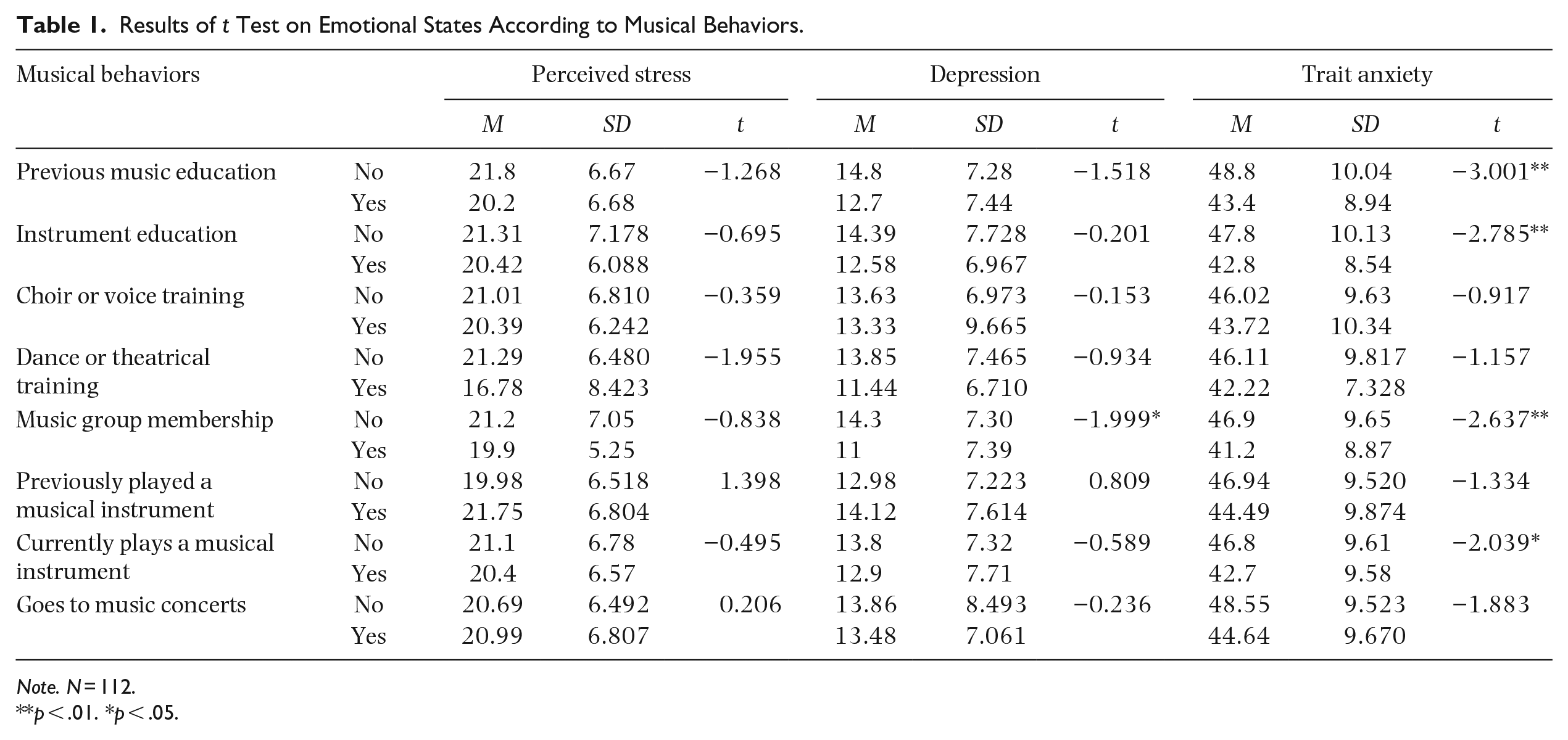
Initially, in order to investigate possible significant differences in terms of musical behaviors, a series of t tests were performed on participants’ perceived stress, depression, and trait anxiety scores. Results of these t test analyses are shown in Table 1. Results revealed that participants’ scores on perceived stress, depression, and trait anxiety did not differ significantly according to having previous choir, voice, dance or theatrical training, or going to music concerts (p > .05). However, there was significantly lower trait anxiety levels among participants who previously had instrument education (M = 42.8, SD = 8.54) than those who did not (M = 47.8, SD = 10.13), t(110) = −2.785, p < .01. Similarly, trait anxiety was lower among participants who had previous music education (M = 43.4, SD = 8.94) than those who did not (M = 48.8, SD = 10.04), t(110) = −3.001, p < .01. Lower trait anxiety levels were observed among participants who reported currently playing a music instrument (M = 42.7, SD = 9.58) than those who are not (M = 46.8, SD = 9.61) demonstrated significantly lower trait anxiety levels, t(110) = −2.039, p < .05. Lower trait anxiety levels were also found among participants who reported having being members of a music group (M = 41.2, SD = 8.87) than those who had not (M = 46.9, SD = 9.65), t(110) = −2.637, p < .01. In addition, there were significantly lower depression levels among those who had been members of a music group (M = 41.2, SD = 8.87) than those who had not (M = 14.3, SD = 7.30), t(110) = −1.999, p < .05. Remarkably, none of the musical behaviors had a significant relationship with stress (p > .05).
Results of t Test on Emotional States According to Musical Behaviors.
Note. N = 112.
p < .01. *p < .05.
Subsequently, in order to investigate possible significant differences in terms of musical behaviors, a series of t tests were performed on participants’ scores on coping humor and the factors of humor styles: affiliative, self-enhancing, aggressive, and self-defeating. Results of these t-test analyses are shown in Table 2. Results revealed that participants’ scores on affiliative, self-enhancing, aggressive, and self-defeating humor style or coping humor did not differ significantly according to having previous choir, voice, dance or theatrical training, having previous instrument education, having been a member of a music group, currently playing a music instrument, or going to music concerts (p > .05). On the other hand, coping humor was higher among participants who previously had music education (M = 18.8, SD = 3.72) than those who did not (M = 17.3, SD = 3.09), t(110) = 2.209, p < .05. Higher self-enhancing humor was found among participants who previously had music education (M = 36.7, SD = 7.58) than those who did not (M = 33.3, SD = 9.83), t(110) = 2.038, p < .05. Self-defeating humor was higher among participants who previously had music education (M = 28.3, SD = 8.87) than those who did not (M = 25.1, SD = 7.84), t(110) = 2.019, p < .05. Moreover, there was higher self-enhancing humor style among participants who reported going to music concerts (M = 36.3, SD = 8.34) than those who do not (M = 32.5, SD = 9.23), t(110) = 2.040, p < .05. Remarkably, none of the musical behaviors had a significant relationship with affiliative or aggressive humor styles (p > .05).
Results of t Test on Coping Humor and Humor Styles According to Musical Behaviors.

Note. N = 112.
p < .05.
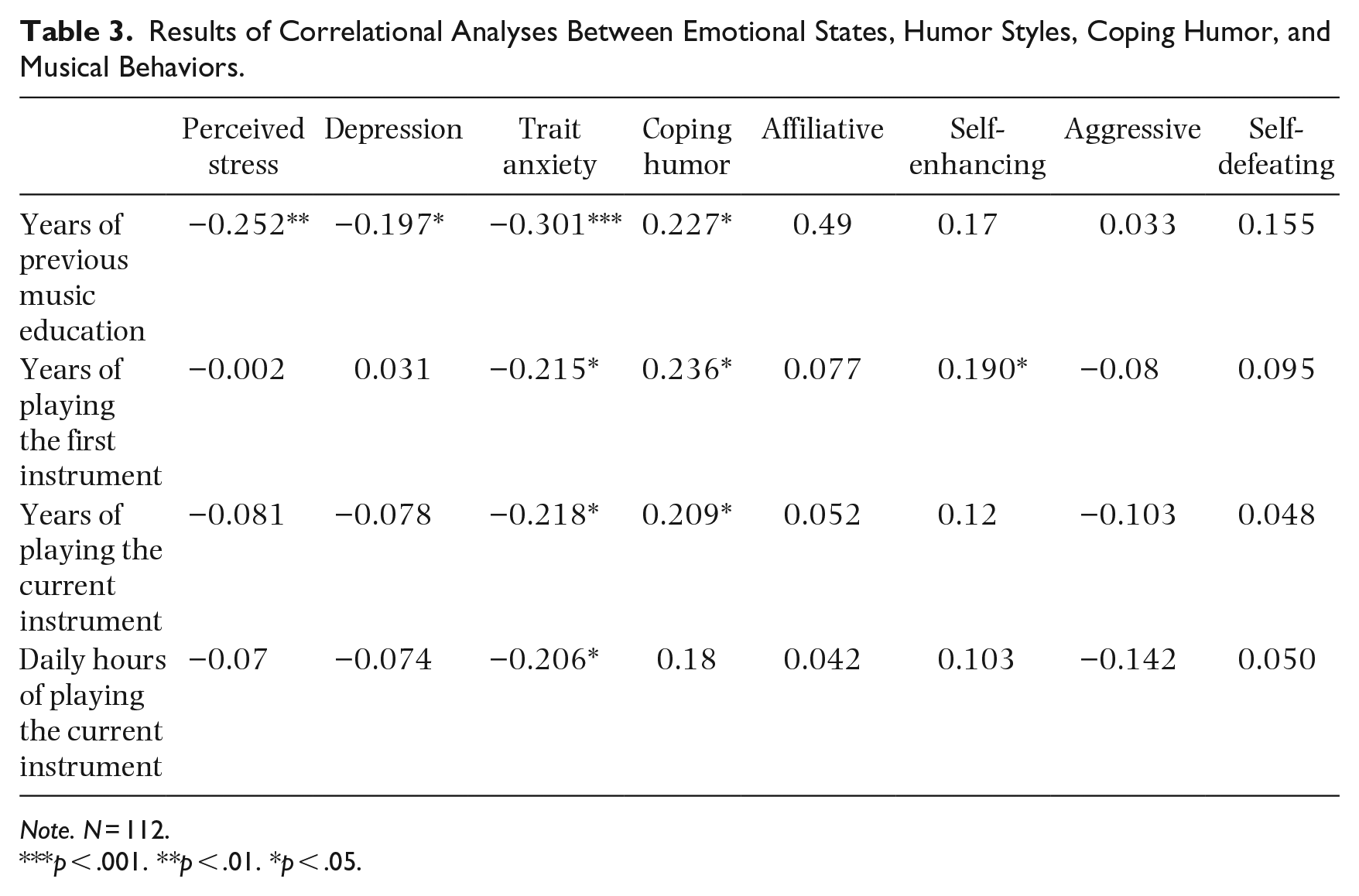
Finally, correlation coefficients were computed in order to investigate whether musical behaviors measured by continues variables correlated with perceived stress, depression, trait anxiety, affiliative, coping humor, self-enhancing, aggressive, or self-defeating humor style. Variables that did not meet the assumption of normality were investigated using Spearman’s ρ correlation coefficient. The results of the correlational analyses are shown in Table 3.
Results of Correlational Analyses Between Emotional States, Humor Styles, Coping Humor, and Musical Behaviors.
Note. N = 112.
p < .001. **p < .01. *p < .05.
Analyses with Spearman’s correlation coefficients revealed that the number of years of previous music education significantly negatively correlated with perceived stress, ρ = −0.252, p < .01, depression, ρ = −0.197, p < .05, trait anxiety, ρ = −0.301, p < .001, and coping humor, ρ = 0.227, p < .05. The number of years of playing the first instrument was significantly negatively correlated with trait anxiety, ρ = −0.215, p < .05, and positively correlated with coping humor, ρ = 0.236, p < .05, and self-enhancing humor style, ρ = 0.190, p < .05. Number of years of playing the current instrument significantly negatively correlated with trait anxiety, ρ = −0.218, p < .05, and positively correlated with coping humor, ρ = 0.209, p < .05. Daily hours of playing the current instrument significantly negatively correlated with trait anxiety, ρ = −0.206, p < .05. As seen in Table 3, none of the musical behaviors had a significant correlation with affiliative or self-defeating humor styles (p > .05).
Discussion
Emotional states
The results of the present study demonstrated that previous music education, instrument education, music group membership, currently playing a music instrument, number of years of previous music education, number of years of playing the first instrument, number of years of playing the current instrument, and daily hours of playing the current instrument were significantly related to various emotional states. These results add to the findings from previous research which demonstrated that music in general has a positive influence on human psychology (Castillo-Perez et al., 2010; Sung et al., 2012). In parallel with previous studies, the findings obtained in this study showed that those who had previously received music education had lower anxiety levels than those who did not (Boucher & Ryan, 2011; Güven, 2016; Mukherjee & Dasgupta, 2017; Üstün, 2016). Üstün (2016) stated that music education has a significant effect on reducing trait anxiety levels and increasing self-efficacy and stress management skills. In a similar vein, Güven (2016) stated that students who graduated from fine arts high schools, who studied music for four years before going to university, had lower test anxiety than students who graduated from other schools. Lower anxiety levels may be due to the effects of music education on cognitive functions and quality of life reported in previous studies (Berry, 2018; Suárez et al., 2016).
The findings showing that both the participants who had previously received instrument education and those who currently play a musical instrument had lower trait anxiety levels were consistent with the findings of previous studies (Boucher & Ryan, 2011; Güven, 2016; H. S. Köse, 2006; Simoens & Tervaniemi, 2013; Sung et al., 2012; Üstün, 2018). In studies conducted among students studying in various departments of the same school, it has been shown that the trait anxiety of the students of the departments where playing an instrument is a requirement is significantly lower (H. S. Köse, 2006). This result may be due to the fact that individuals’ relationship with their musical instrument is advantageous in terms of stress, anxiety, and coping (Simoens & Tervaniemi, 2013), as well as the positive relationship between playing an instrument and brain functions (Rohwer & Coffman, 2006) and cognitive functions (Suárez et al., 2016). Rohwer and Coffman (2006) stated that even learning to play a music instrument significantly correlates with cognitive brain functions. In this context, it has been understood that both the participants who had previously received musical instrument education and those who currently play musical instruments are less likely to suffer from anxiety.
Findings from this research revealed that the number of years of previous music education, number of years of playing the first instrument, number of years of playing the current instrument, and daily hours of playing the current instrument were all significantly but negatively correlated with trait anxiety. In accordance with previous research, participants with longer history in music education were observed to have significantly lower scores on stress, depression, and anxiety (Boucher & Ryan, 2011; Güven, 2016; Suh, 2015). Boucher and Ryan (2011) indicated that individuals with prior performing experience reported less anxiety and stress. In a similar vein, as a result of their systematic literature review, Palupi et al. (2018) concluded that previous experience with music is associated with a decrease in depression and anxiety, and improvements in cognitive functions, emotional states, and coping. Thus, not only having music or instrument education, but also having that education for a longer period of time seem to be important for being less likely to suffer from negative emotional states.
The positive effects of music education, instrument education, and playing a music instrument on emotional states are partly due to the effect of music on the brain and cognitive processes. Music education can improve general cognitive abilities (Schellenberg, 2004; Yu et al., 2017) and is positively associated with a wide range of cognitive functions (Suárez et al., 2016). In addition, learning to play a musical instrument significantly correlates with cognitive brain functions (Rohwer & Coffman, 2006). Playing a music instrument is reported to be a multidimensional task requiring efficient integration of multiple cognitive functions, and that long-term music education improves multiple perceptual and cognitive functions (e.g., George & Coch, 2011; Strait et al., 2015; Wang et al., 2015). Singing also has an impact on cognitive processes, which in turn affects emotional states and neural network reconfiguration (Tavormina et al., 2014). Moreover, as a result of their experimental research, Yu et al. (2017) found that music education affects linguistic ability (which is a cognitive ability), and significantly improves semantic processing (which is a linguistic ability). Their findings were in line with the findings from previous research indicating that music education facilitates semantic language processing (Dittinger et al., 2016), that the music capacity is related to linguistic ability (Anvari et al., 2002), that individuals with music education are more sensitive to violations of linguistic and musical syntax (Fitzroy & Sanders, 2013), and that professional musicians are better at semantic processing of novel words (Dittinger et al., 2016). Furthermore, Yu et al. (2017) stated that “the neural circuits underlying language and music are dissociable across the brain, some specific components of them may share common neural substrates” and that there is a “shared spontaneous neural basis of music and language based on a specific link between melodic analysis and semantic processing” (p. 217). Their research was consistent with previous work in indicating a shared neural basis for music and language processing (Fedorenko et al., 2011; Rogalsky et al., 2011; Schön et al., 2010).
It was found that the depression and anxiety scores of the pre-service teachers who were members of a music group were significantly lower than the others. These findings were in line with previous research reporting that performing in a group has a role in ameliorating anxiety (Ryan, 2004) and that involvement in music groups is beneficial for depression (P. S. Campbell et al., 2007). In addition, music group membership was reported to provide individuals with emotional and health benefits such as reduction in stress and alleviation of depression (Hallam & Creech, 2016). It has been stated that music has an effect as an “equalizer of emotional states of groups of people” (Roederer, 1984, p. 356). Findings of the present study add to the findings of previous research which reported that singing in a music group reduces anxiety and depression (Hallam et al., 2012; Lally, 2009; Sandgren, 2009) and group-singing activities reduce stress (Fancourt et al., 2015; Keeler et al., 2015). Moreover, in experimental studies, it has been revealed that participating in (Irle & Lovell, 2014) and performing in (Kreutz & Nater, 2021) music groups is effective in improving psychological well-being. The positive effects of joining and performing in a music group on stress, anxiety, and depression may be due to the positive effects of joining and playing in a music group on both brain and mental health (Rohwer & Coffman, 2006). Positive effects of music group membership on emotional states may also stem from the sense of belonging it provides (Woody & McPherson, 2010).
Humor styles
Results regarding the positive relationship between self-enhancing humor style and previous music education were in line with the findings in previous studies (Cesur & Köksal Akyol, 2019; Didin & Köksal Akyol, 2017; Zavgorodneva et al., 2020). The relationship between previous music education and self-enhancing humor style may be explained in part by the association of openness to experience with aesthetic and creative interests, greater engagement with music as well as affiliative and self-enhancing humor styles (Thomas et al., 2016).
Consistent with the findings of Didin and Köksal Akyol (2017), the findings of this research revealed that self-defeating humor style scores were higher among those who had previously received music education. The relationship between having a previous music education and self-destructive humor style may be an escapist coping strategy that individuals learn during (and because of) the necessity of constantly observing and criticizing themselves as part of this music education (Çelik, 2020; Martin et al., 2003). This relationship may also be due to a mechanism learned during previous music education related to social acceptance and gaining approval from others, similar to the sense of belonging provided by joining music groups (Çelik, 2020; Martin et al., 2003; Woody & McPherson, 2010).
Coping humor
Consistent with the previous research, the present research demonstrated that participants who had previous music education, who had more years of music education, who had played their first musical instrument for more years, or who have been playing the current musical instrument for longer years had higher coping humor scores (Didin & Köksal Akyol, 2017; Simoens & Tervaniemi, 2013; Üstün, 2016). It was reported that those with previous music education have superior stress management skills and choose more effective methods when solving interpersonal problems (Didin & Köksal Akyol, 2017; Üstün, 2016). Simoens and Tervaniemi (2013) stated that the relationship that individuals establish with musical instruments is advantageous in terms of stress, anxiety, and coping. Music in daily life is a means for coping with stress (Leardi et al., 2007). Musical behaviors have close interaction with coping strategies (LeBlanc et al., 1992) and music education may be useful in maintaining depression (Suh, 2015). Palupi et al. (2018) revealed that an improvement in cognitive functions, emotional states, and coping caused by previous experience of music was reported as a result of their systematic review. Therefore, the relationship between previous music education, years of music education, years of playing the first instrument, years of playing the current instrument, and coping humor may in part be due to the impact of those musical behaviors on brain and cognition (Dolcos et al., 2011; Fox et al., 2013; Moran et al., 2004; Ochsner & Gross, 2005; van der Wal et al., 2020; Wycoff & Pryor, 2003).
Conclusion
The findings of this study, combined with the large body of evidence from previous experimental research revealing the positive effects of experiencing, learning, and performing music on the brain and cognition, expanded the theoretical framework explaining that receiving music and instrument education, receiving this education for longer periods of time, playing an instrument, and participating in a music group contribute to the reduction of stress, amelioration of anxiety, and alleviation of depression. It should also be noted that the improvements in negative emotional states were observed in a sample of alternative certification pre-service teachers who could not get a job through the BSc program they graduated from in the first place, and therefore suffer from negative emotional states. In this context, it can be considered that it would be more accurate to understand music as an art that can also improve the quality of life by improving the emotional states of even individuals who have to cope with difficult socioeconomic conditions, rather than just seeing it as a form of entertainment, a leisure activity or a means of earning money.
Receiving music education, receiving this education for a longer period of time, and experiencing music as a group, such as going to concerts, seem to be making another contribution to the life of individuals by helping them to acquire a more constructive communication approach by supporting their use of positive humor styles. The use of positive humor styles such as self-enhancing humor is a critical issue for teachers in order for students to benefit more from education and to make education more effective. Moreover, coping humor is an inherently cognitive process because it is a complex and advanced form of humor. Therefore, the findings of this study support the understanding that receiving music education, playing a musical instrument, and exhibiting these musical behaviors for a longer period of time have positive effects on cognitive processes and that these effects are also positively reflected in coping humor. When the reflections of these musical variables on coping humor are evaluated together with the positive effects of coping humor and music education on negative emotional states, it was concluded that music education, instrument education, receiving these educations for longer periods of time, playing a musical instrument, and experiencing music in a group not only help the individual in terms of improvements in negative emotional states, but also provide mechanisms for the individual to cope with these negative emotional states. This conclusion highlights the understanding reached as a result of the relationships between musical behaviors and emotional states about how music should be understood in a more accurate way.
Footnotes
Declaration of conflicting interests
The author(s) declared no potential conflicts of interest with respect to the research, authorship, and/or publication of this article.
Funding
The author(s) received no financial support for the research, authorship, and/or publication of this article.
Consent to participate
Informed consent was obtained from all individual participants included in the study.
