



Abstract

Kudos to Oxford University Press and Gary McPherson for another outstanding contribution to scholarship in music psychology. Before commenting specifically on this newest achievement, I want to take a brief moment to celebrate this winning combination.
Oxford University Press
In the past 20 years, Oxford University Press (OUP) has produced more than 30 handbooks that are relevant for music psychology. One of the definitions of handbook is “a compendium of information on a particular subject” (Oxford English Dictionary, 2022.). The OUP says this about their handbooks:
Oxford Handbooks offer authoritative and up-to-date surveys of original research in a particular subject area. Specially commissioned essays from leading figures in the discipline give critical examinations of the progress and direction of debates, as well as a foundation for future research. Oxford Handbooks provide scholars and graduate students with compelling new perspectives upon a wide range of subjects in the humanities, social sciences, and sciences. (OUP, 2022)
Thus, individually and collectively, these handbooks have provided a veritable treasure trove of scholarly information on relevant topics such as music psychology (Hallam et al., 2009, 2016), musical cognition and development (Colwell, 2006), music and emotion (Juslin & Sloboda, 2001, 2010), and music and the brain (Thaut & Hodges, 2019).
One of the most intriguing aspects of these handbooks is the publication of second editions. These successors provide good markers of the expansion and development of topics. Two examples might suffice:
The first edition of Juslin and Sloboda’s (2001) work on Music and Emotion contained 20 chapters in 487 pages. In the preface, the editors stated that “It is all the more remarkable that this topic [emotional aspects of music] has been seriously neglected during the last decades” (p. 3) and they hoped that the book “may serve as a starting point for investigating the field” (p. 18). Evidence that they succeeded is seen in the second edition (2011), such that to provide an overview of the field just 10 years later took 33 chapters in 975 pages. Remarkable progress, indeed!
Similarly, the first edition of the Oxford Handbook of Music Psychology (Hallam et al., 2009) expanded from 52 chapters in 585 pages to 55 chapters in 950 pages only 7 years later.
These figures have relevance for the current review in that although it is a first edition in this format, it is really a follow-up to The Science and Psychology of Music Performance (Parncutt & McPherson, 2002). McPherson (2022b) stated that the “Oxford Handbook of Music Performance (OHMP) updates the 2002 publication” (p. 1, Vol. 1) by expanding from 21 chapters in 388 pages to 54 chapters in 1,384 pages. This latter effort involved 80 authors from 13 countries.
So, hat’s off to OUP. They, along with many other publishers, have enabled the field of music psychology to expand the depth and breadth of scholarship in our field in a consequential way.
Gary McPherson
Although many scholars have served as editors of OUP Handbooks, the affiliation between OUP and McPherson has been especially productive (see Table 1). In addition to these 12 handbooks, produced in a 20-year span, he has also edited or co-edited seven books, conference proceedings, and special issues of journals, and has authored or co-authored 62 book chapters and 81 refereed journal articles.
Books Edited or Co-Edited by McPherson and Published by OUP.

Each of these volumes has made a significant contribution and taken altogether represent a magnificent legacy. In addition to the collected wisdom contained within, they have also spurred new research in many important topics in music psychology.
Brief overview of the OHMP
The OHMP aims to provide a broad overview of the scholarly research literature on music performance, balanced with specific details on a myriad of topics. It is geared toward research scholars for those already in a career and those who are studying to enter the field. It will also be of interest to those performers and teachers who are curious about their field and want to inform, challenge, and expand their experiential knowledge. A chapter-by-chapter assessment of this massive work is not possible, given the necessary word restrictions. However, it is feasible to comment briefly on each of the eight main sections.
Volume 1
Topics covered in Volume 1 are shown in Table 2.
Table of Contents for Volume 1.
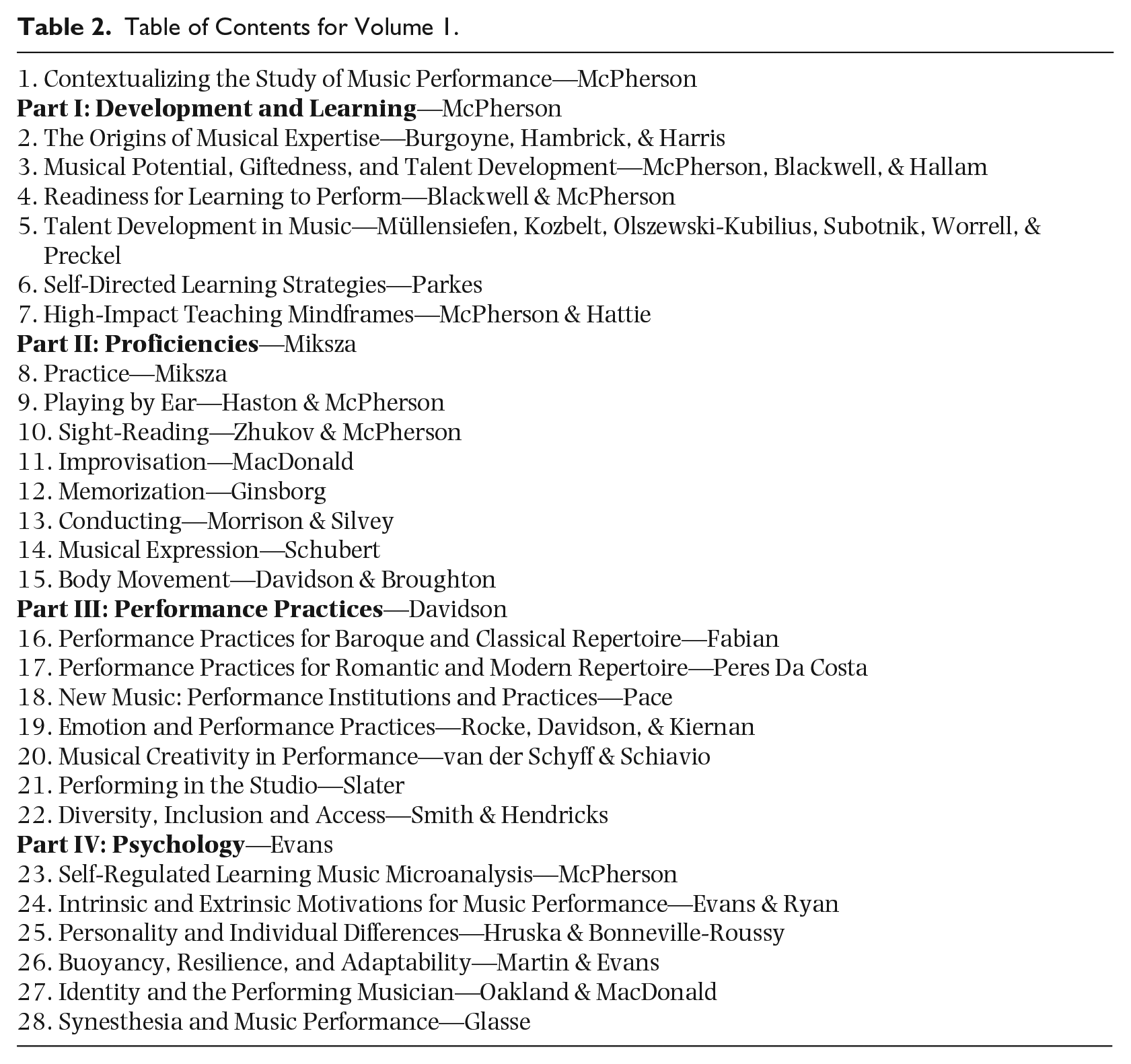
The opening chapter of Vol. 1 provides a broad survey of the contents of each section. McPherson states,
It is my hope, and that of the authors who have contributed to the OHMP, that our work will help move us closer to understanding the nature and scope of music performance in a way that satisfies both scientists who want robust, empirically validated evidence, and practical musicians and teachers of music performance who want clear, easy-to-digest explanations of the many and varied processes related to refining expertise in music performance. (2022a, p. 5)
Part I: Development and Learning
The first four chapters in this section explore the beginnings of music learning. In Chapter 2, the authors discuss nature versus nurture, music aptitude, starting age, and other topics related to the origins of musical expertise. The next three chapters discuss musical potential (Chapter 3), readiness for learning music (Chapter 4), and talent development (Chapter 5). The remaining two chapters discuss specific, practical strategies for developing talent in terms of self-directed approaches (Chapter 6) and high-impact teaching mindframes to affect, change, challenge, and enhance focus in student learners (Chapter 7).
Part II: Proficiencies
Part II is a much more practical section, focused on applications of research pertaining to practice (Chapter 8), playing by ear (Chapter 9), sight-reading (Chapter 10), improvisation (Chapter 11), memorization (Chapter 12), conducting (Chapter 13), musical expression (Chapter 14), and body movement (Chapter 15). One nice feature is the excellent balance between musical and research-oriented perspectives. These chapters are filled with research findings applied to the practical concerns of acquiring musical skills. This is surely a section that will be attractive to student musicians and their teachers, as well as professional musicians.
Part III: Performance Practices
This part continues the thrust of the previous one. Here, however, attention shifts in the first three chapters to Western classical music of different periods. Research findings are applied to the performance of Baroque and Classical repertoire (Chapter 16), Romantic and Modern repertoire (Chapter 17), and new music (Chapter 18). What is missing, of course, is attention paid to other musical styles in Western music (e.g., jazz, popular, rock, hip-hop, country) or to non-Western musical styles from around the world. Further comments regarding this issue are found in the subsequent “Assessment” section.
The next three chapters in this section deal with issues that are relevant for many, if not all, periods and styles: emotion (Chapter 19), creativity (Chapter 20), and performing in the recording studio (Chapter 21). The final chapter in this collection, deals with discrimination and marginalization in classical music performance (Chapter 22), including discussions of ethnicity, gender, and sexual orientation.
Part IV: Psychology
The final part in this volume takes up issues concerning psychological topics that are found in learning and performing music. These topics include self-regulated learning (Chapter 23), motivation (Chapter 24), personality (Chapter 25), resiliency and adaptability (Chapter 26), and identity (Chapter 27). As McPherson points out, these topics “are relevant for expertise in any domain, but they are particularly intertwined with the phenomenon of music itself” (p. 3). The final chapter takes up synesthesia (Chapter 28), a topic that tends to occur in those pursuing artistic endeavors more commonly than in other fields.
Volume 2
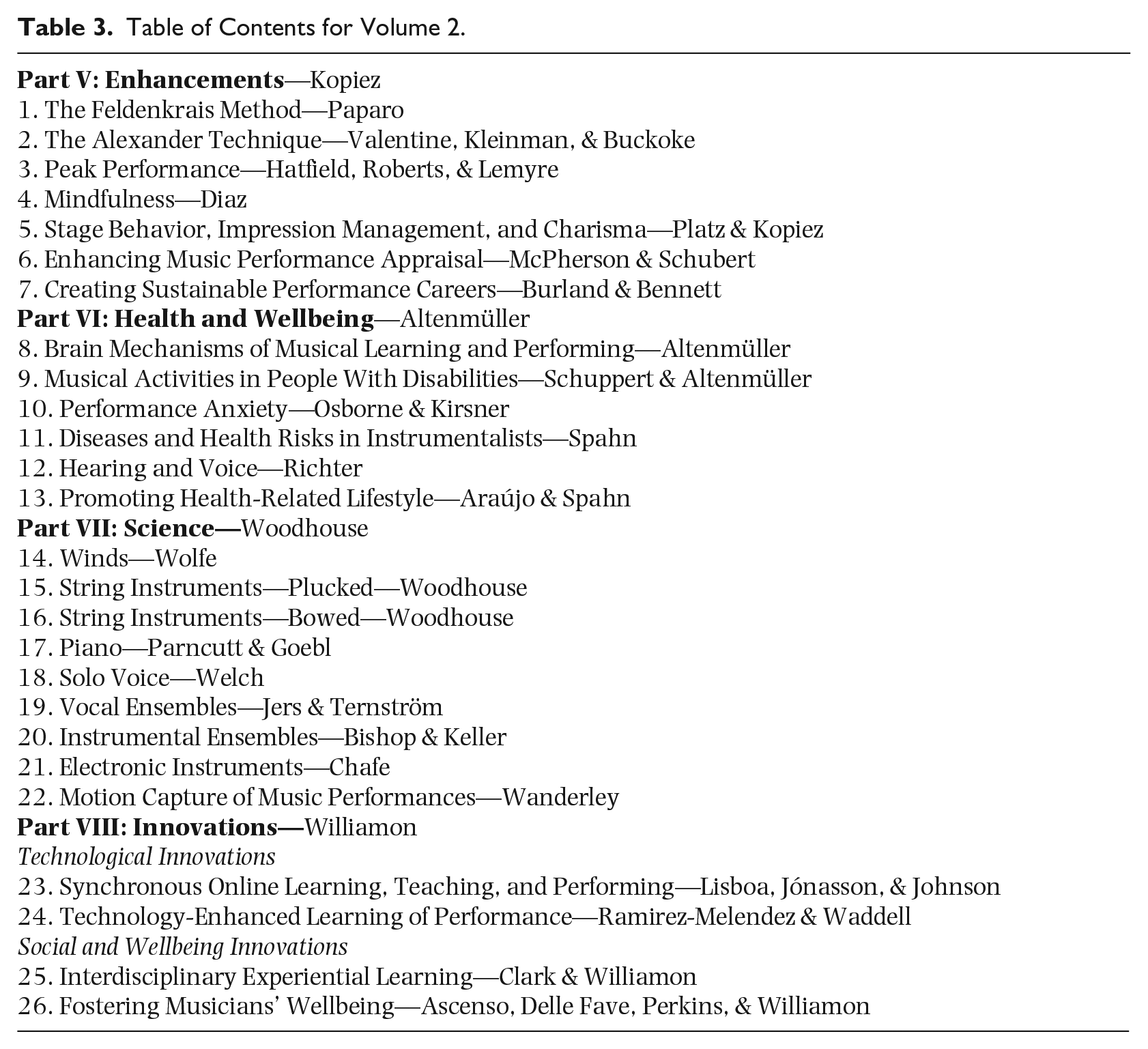
Topics in Volume 2 are shown in Table 3.
Table of Contents for Volume 2.
Part V: Enhancements
In this part, authors review a range of approaches that are designed to enhance more traditional performance routines. They include the Feldenkrais Method (Chapter 1), the Alexander Technique (Chapter 2), peak performance (Chapter 3), and mindfulness (Chapter 4). Chapter 5 covers elements concerned with live performances, such as stage behavior, impression management, and charisma. Two concluding chapters discuss music performance appraisal (Chapter 6) and creating sustainable performance careers (Chapter 7).
Part VI: Health and Wellbeing
Health and wellness of musicians is one of the most significant areas of growth in music psychology scholarship over the past few decades. The six chapters in this part cover a variety of topics, including brain mechanisms involved in musicianship (Chapter 8) and musicianship in those with disabilities (Chapter 9). These chapters are followed by discussions of music performance anxiety (Chapter 10); diseases and health risks such as musculoskeletal, mental health, and hearing problems (Chapter 11); and additional coverage of hearing issues, along with vocal problems (Chapter 12). The final chapter in this section deals with the promotion of healthy lifestyles among musicians (Chapter 13).
Part VII: Science
The title of this part does not immediately indicate what the following nine chapters cover. The first five cover the science of musical acoustics of woodwind and brass instruments (Chapter 14), plucked strings (Chapter 15), bowed strings (Chapter 16), piano (Chapter 17), and solo voice (Chapter 18). Vocal (Chapter 19) and instrumental ensembles (Chapter 20) are the next concern. Chapter 21 discusses the science of electronic instruments. The final chapter (Chapter 22) covers motion capture, that is, recording movements involved in music performances.
Part VIII: Innovations
This section is divided into technological innovations and social and wellbeing innovations. From its outset, music psychology investigations into music performance involved innovative technologies and strategies—for example, in 1938, Seashore (1938/1967) described the use of the oscillograph and the Henrici harmonic analyzer. In the first two chapters, authors describe advances in synchronous online learning, teaching, and performing (Chapter 23) and technology-enhanced learning of performance (Chapter 24). Two remaining chapters discuss interdisciplinary experiential learning (Chapter 25) and ways of fostering musicians’ wellbeing (Chapter 26).
Assessment of OHMP
As stated previously, OUP and Gary McPherson are two strengths of the OHMP. OUP has an enviable track record as a publisher, both in the sense of high-quality production values and in terms of their extensive publications list relevant for music psychology. McPherson has been a highly productive scholar, both in terms of his own, often collaborative, research and his extensive editorial contributions. One of the things his stature has allowed him to do is to attract high-level scholars to join him in various projects. Thus, another major strength of the OHMP is the roster of authors involved in this publication. These are top people in the field with expertise in their specific domains. Their brief bio-sketches in the front matter provide an impressive array of affiliations with major universities around the world and an extensive list of stellar research accomplishments. Some are senior scholars at the peak of their careers, some are mid-career, and a few are adding fresh, new voices to the conversation. Intriguingly, quite a few have degrees in both music and science (e.g., psychology, neuroscience, medicine) or extensive experience in both musical performance and scientific research. Thus, their writing carries the air of authenticity.
Previously, I alluded to the expansion of coverage from The Science and Psychology of Music Performance (Parncutt & McPherson, 2002) to the current two-volume set. Breadth is an obvious strength; to contain the “world” of scientific investigations into music performance in one publication is a tremendous advantage to scholars, particularly those wishing either to discover the status of current research or to look for interconnections among various sub-disciplines. The flip-side of breadth is depth. While it would not be fair to call this a weakness—after all, extensive coverage of any one topic is not possible unless the OHMP was expanded considerably—it is appropriate to recognize the limitations of coverage on any single topic.
In perusing the extensive list of topics covered in the tables of contents (Tables 2 and 3), one might legitimately ask how much coverage should any one subtopic receive? The desire for full coverage needs to be balanced with practical concerns like word count. In almost any situation, issues of breadth and depth are a concern, but particularly in a publication with such a broad scope as “music performance.” Here is just one example of limited coverage:
If one were asked to consider the most important themes to be covered in a two-volume set on music performance, “focal dystonia” would not likely rise to that level. Yet, to musicians who suffer from it or to teachers and researchers interested in the topic, it can be of major concern. Focal dystonia is covered in Vol. 1 in one paragraph (pp. 20–21) and in Vol. 2, it appears in about a page and a half of text (pp. 171–173). Although these brief entries do not qualify as “in-depth” coverage, they do have the advantage of being included in broader discussions. The first entry appears in Part I: Development and Learning, Chapter 1: The Origins of Musical Expertise, in a section titled “Perseverance.” As such, the focal dystonia experienced by the pianist Leon Fleischer is grouped with a hand injury suffered by the Russian composer and pianist Alexander Scriabin and Beethoven’s deafness as examples of how musicians have often overcome challenges and obstacles through perseverance, resilience, and determination. These are “important personality traits for aspiring musicians as they are for most anyone wanting to achieve mastery in a domain” (Burgoyne et al., 2022, p. 20).
More detailed and technical descriptions are found in Vol. 2, Part VI: Health and Wellbeing, Chapter 8: Brain Mechanisms of Musical Learning and Performing, in a section titled “Musician’s Dystonia as a Manifestation of Dysfunctional Brain Plasticity.” The text is accompanied by four images of hand and lip dystonia in a pianist, violinist, flutist, and trombonist (p. 171). Once again, a major advantage of this placement, brief as it is, is that it is positioned among several sections dealing with the brain and musical performance.
Another gap in coverage is not so much a problem with OHMP as it is a deficit in music psychology research. In his opening chapter, McPherson states that, “Many of the chapters in the OHMP are focused on ‘classical’ music partly because most literature currently available focuses on this genre of performance . . .” (p. 2). Indeed, an examination of the indices for both volumes indicates that neither country nor popular music is listed in either volume. Folk music has a brief mention on p. 2, Vol. 1; world music is mentioned only on p. 408, Vol. 1.; and rock music is mentioned on pp. 394–395, Vol. 2. Jazz gets slightly more coverage, appearing on the following pages in Vol. 1: 2, 221–222, 275–276, 375–376, 401. Issues of feminism, gender, disability, LGBTQ+ (lesbian, gay, bisexual, transgender, and queer/questioning), and queer theory are covered in Chapter 22, Vol. 1: Diversity, Inclusion, and Access. However, these topics are couched within the context of Western classical music.
More problematic for the entire field of music psychology is the vast preponderance of literature from Western, Educated, Industrialized, Rich, Democratic (WEIRD) countries. Scholars from WEIRD countries—primarily Canada and the United States in North America, the United Kingdom, Western Europe (especially Austria, Finland, France, Germany, Norway, and Sweden), and Australia—publish the majority of articles in psychology (Henrich et al., 2010). Anglada-Tort and Sanfilippo (2019) reviewed 2,089 articles published in the top three music psychology journals (Music Perception, Psychology of Music, and Scientiæ Musicæ) published between 1973 and 2017 and found that only 113 (5%) came from non-WEIRD countries. In addition,
Some would contend—with no criticism of individual studies necessarily implied—that a Westernised view of music prevails even in some of these reports. For example, in Zhang et al. (2019), participants were native Chinese speakers but musical stimuli were European opera melodies on violin, on flute or by voice. (Hodges, 2021, pp. 28–29)
One could hardly hold OHMP responsible for these lacunae in music psychology research. However, we might hope that the next edition would contain greatly enhanced coverage of these topics precisely because the field of music psychology has blossomed in this regard. How exciting it would be to know more about the psychology of Indian music (Castellano et al., 1984; Virmani, 1970) or African music (e.g., Steyn et al., 2016), to name just two rich musical cultures. Similarly, it would be enlightening to learn more about gender in country music (e.g., Rasmussen & Densley, 2017), anxiety while performing popular music (Nusseck et al., 2015), and many other under-represented topics.
A final concern is that OHMP is too expensive for the average student, independent or beginning scholar to afford—US$300 for both volumes in this set—a point well-taken. However, many, if not all, are likely to have access through university libraries. The economics of publishing is always difficult, and perhaps especially now. Smaller, modest publications that are more affordable should be and are available. However, substantial publications such as OHMP definitely provide an invaluable resource to the academic community. Demanding them at a student-friendly price would undoubtedly lead to their demise.
In sum, the OHMP is not perfect. However, it stands head, shoulders, and torso above anything else that is available in the way of music psychology research applied to music performance. Thanks are due to McPherson, OUP, and all the authors involved in providing this invaluable resource.
