




Abstract
Higher education students in music respond to a very vocational profile, so that, we start from the general hypothesis that their motivation toward these studies is very high. The aim of this study is to analyze the educational motivation of students of higher education in music from centers located in the Atlantic axis—Galicia and Northern Portugal—according to personal and social variables: sex, family ties with music, country, and center of studies. The results show that women present levels of intrinsic motivation to knowledge and achievement while men are generally more unmotivated. The comparison by country and type of center shows that Portuguese students are more motivated than students taking these studies in Spain. In relation to family ties related to music, it is observed that they do not have a significant influence on their motivation at this educational stage.
In the last third of the 20th century, interest in the study of motivation in music learning processes began to emerge. Music research in relation to motivation has focused on different aspects: motivation in musical beginnings, the importance of motivation during the process of musical learning, and the analysis of the context surrounding the student related to motivation. Ghazali (2006) discusses the factors that lead an individual to start in the world of music, and concludes that the individual perception, especially at early ages, builds a whole in which the formal and the informal are mixed, affecting in a positive way the evaluation of the task. Schmidt (2005) considers that motivation is fundamental at all levels of music education and Martínez Cantero (2018) adds that during the process of learning a musical instrument the student’s environment is key in his motivation. Therefore, knowing the environment surrounding the student will allow for a better understanding of which aspects most conclusively affect his or her motivation.
The different theories of academic motivation are a very valuable field of study to address musical learning. Authors, such as Tripiana-Muñoz (2019), consider that motivation exerts a key influence on the learning of any musical instrument. In a study by Evans (2015), in which he reviews the self-determination theory (SDT; Deci & Ryan, 2000), the author concludes that this is the most appropriate theoretical framework to undertake research related to motivation in the field of music education. This theory analyzes both intrinsic motivations, referring to the particular interest in learning a musical instrument, and extrinsic motivation, related to external sources of motivation, as well as amotivation or absence of motivation (Deci & Ryan, 2000). It is also important to consider authors, such as Locke and Schattke (2019), in which they point out the definition of intrinsic motivation, differentiating it from achievement motivation. These authors consider that intrinsic motivation is limited exclusively to the pleasure and enjoyment of an activity regardless of the result, while achievement motivation is oriented toward excellence and the achievement of goals, regardless of the pleasure experienced. Also using SDT principles, Douglas (2011) analyzes the extent to which participation in instrumental sets influences the satisfaction of psychological needs for autonomy, competence, and relatedness.
Krause et al. (2019) have done similar research associating musical participation and benefits in psychosocial well-being concluding that SDT is a very useful theoretical framework showing very positive associations between both factors. They also follow the same itinerary as Evans and Bonneville-Roussy (2016) in aiming to understand motivation in university students, observing that the satisfaction of psychological needs responded to greater involvement in practice and greater long-term commitment. Valenzuela et al. (2018) also applied SDT to understand motivation applied to flow in instrumental practice obtaining very satisfactory results demonstrating that perceived competence is fundamental to avoid demotivation. On the contrary, MacIntyre et al. (2018) in a general study on motivation and music conclude that intrinsic motivation responds to a more linear maintenance of motivation as well as extrinsic motivators show a lower influence. The same authors also observed increases in motivational intensity through feedback that is produced by a greater desire to learn and greater effort leading to greater perceived competence.
Regarding variables related to motivation, authors, such as Asmus (1986), Sandene (1998) or Zdzinski (1996, 2013), conducted research on the interaction between motivation and gender, age or social environment influences. The most current research on gender differences is conducted by Hallam together with other researchers. From the perspective of instrumental choice, Hallam et al. (2008) analyzed whether instruments associated with specific genders persist despite advances in gender equality in the United Kingdom, concluding that there are still associated patterns that condition the preference of an instrument according to sex. Long et al. (2012) observed that one of the predictors of musical performance lies in self-regulated learning and through a study in which they analyzed performance in master classes they concluded that women were more involved, more receptive, and participatory despite showing a tendency to perceive more negative content compared to men. With respect to motivation at different academic levels, Hallam et al. (2020) observed few differences associated with the gender of the participants, although they obtained higher results with respect to self-confidence in favor of men in practice. Following Freer and Evans (2019), music provides an optimal setting for developing student well-being and motivation toward learning in which gender differences may be smaller than in other disciplines. Given the scarce empirical evidence on the influence of personal, social, and academic variables on the motivation of music students, we considered carrying out an exploratory study that allows us a descriptive approach to the influence of certain variables on educational motivation. Therefore, we have chosen three variables that a priori could be significant: gender as a personal variable, family support, if parents with some connection to music could provide more support, and the academic environment, taking into account the different academic structures of music studies in Spain and Portugal.
Therefore, the aim of this study is to analyze the educational motivation of higher music education students from schools located in the Atlantic axis (Galicia and Northern Portugal) according to personal and social variables (gender, family ties with music, country, and school).
Based on the above theoretical review, we propose the following hypotheses:
H1. Women are more motivated than men.
H2. The academic environment is important for students’ motivation.
H3. Family support is important for the motivation of students.
Method
This research is framed within the interpretative approach with an exploratory character. The method used is the observational cross-sectional study with a non-experimental design, which allows us to study several variables and obtain data that are easy to extrapolate in a short period of time, making it possible to generate hypotheses. The quantitative methodology, using a questionnaire as an instrument, aims to collect and analyze data to answer the questions under study.
Contextualization
The study involved 249 students from different higher music conservatories belonging to the Atlantic axis (Galicia–North of Portugal). Of these, 38.6% were men and 61.4% were women, with a mean age of 23.20 (SD = 4.903; min. = 17; max. = 45 years).
Instrument
To collect information on the different independent variables, participants were asked directly about their sex (male/female), family ties to music (yes/no) and by country (Spain/Portugal) and study center (Spain: A Coruña and Vigo; Portugal: Minho, Escola Superior de Música e Artes do Espetáculo—ESMAE, Aveiro, Escola Superior de Artes Aplicadas—ESART).
For the measurement of the dependent variable, the Educational Motivation Scale (EME-E) validated in the context of Spanish music conservatories by Núñez et al. (2009) was used.
This scale consists of 28 Likert-type items distributed in seven subscales of four items each. This scale has seven factors that evaluate the three types of intrinsic motivation: intrinsic motivation to knowledge (2, 9, 16, and 23), intrinsic motivation to achievement (6, 13, 20, and 27), and intrinsic motivation to stimulating experiences (4, 11, 18, and 25), as well as the three types of extrinsic motivation: external regulation (7, 14, 21, and 28), introjected regulation (3, 10, 17, and 24), identified regulation (1, 8, 15, and 22), and amotivation (5, 12, 19, and 26).
The scale has good internal consistency on all factors ranging from .735 to .808.
Procedure and data analysis
The administration of the instrument took place electronically through the digital questionnaire creation tool Google Forms within 3 months of distribution. The questionnaire was translated into the languages of each country: Spanish and Portuguese. For the translation of the independent variables, as well as of the instrument, we had the collaboration of a sworn translator who accredited the correct wording and translation of each of the items. We had the collaboration and authorization of the management teams of both the Spanish and Portuguese centers.
With respect to ethical standards, given that this was an observational study, the following regulations were followed: the ethical standards recognized by the Declaration of Helsinki, the code of good scientific practice approved by the Spanish National Research Council (CSIC) in March 2010, the good practice agreements adopted by the Committee on Publication Ethics (COPE), and the current Spanish legal regulations governing research. The questionnaire was anonymous and all data were processed collectively. All participants who completed the questionnaire agreed to participate by means of an informed consent form.
For data analysis, descriptive statistics of central tendency (mean) and dispersion (standard deviation) were used. In addition, we used the parametric contrast statistics of Student’s t mean difference, analysis of variance (ANOVA) for dichotomous variables and ANOVA for polytomous variables, and the Bonferroni test to determine between which groups the observed differences existed. The significance level used was .05.
Results
The results obtained based on the socio-familial variables of the students studying in higher music centers (conservatories, colleges, and universities) present data of interest for the contrast of the hypotheses raised and the subsequent elaboration of conclusions.
First, we will describe the motivational level of students in higher music education. According to the results provided by the descriptive statistics, their main motivation for undertaking these studies is “the pleasure and satisfaction of learning to play a musical instrument” (M = 6.32). Within the results obtained, we have taken into consideration as high means those that exceed 5 points being “the satisfaction I feel when I excel in my musical studies,” the second item that presents a higher mean (M = 5.94). The students consider that one of the motivations they possess is “the pleasure I feel when I communicate my own musical ideas to the listener” (M = 5.83), “the satisfaction I feel when I overcome each of my personal goals” (M = 5.67), and “the satisfaction I feel when I manage to successfully solve the technical-expressive difficulties of my instrument” (M = 5.63).
We note within the means with scores between M = 5.54 and M = 5.43 that the students’ degree of motivation is also based on understanding that “my musical studies allow me to continue learning many different things that interest me” (M = 5. 54) and that “I believe that a few more years of studies will improve my competence as a professional” (M = 5.47) or it is “a pleasure to discover new things unknown to me” (M = 5.45) also stating that their motivation lies in the belief that “it will possibly allow me to enter the labor market in the specialty I like” (M = 5.43).
The lowest means within the 5-point range ranged from 5.23 to 5.32 points. With the highest mean in this range (M = 5.32), we find that the upper grade students find it motivating to “get really into it when playing different musical styles with my instrument” as well as they find it a “satisfaction to learn more about classical music” (M = 5.29), as well as they think that the conservatory “will help me get more preparation in my chosen profession” (M = 5.27) and that their motivation is given by the “pleasure of playing different musical styles” (M = 5.23).
The lowest mean of the instrument is in the item in which students state “not knowing why I go to the conservatory and also don’t care” (M = 1.33), with a similar item “not knowing why I go to the conservatory” occupying the next lowest mean of the questionnaire (M = 1.53).
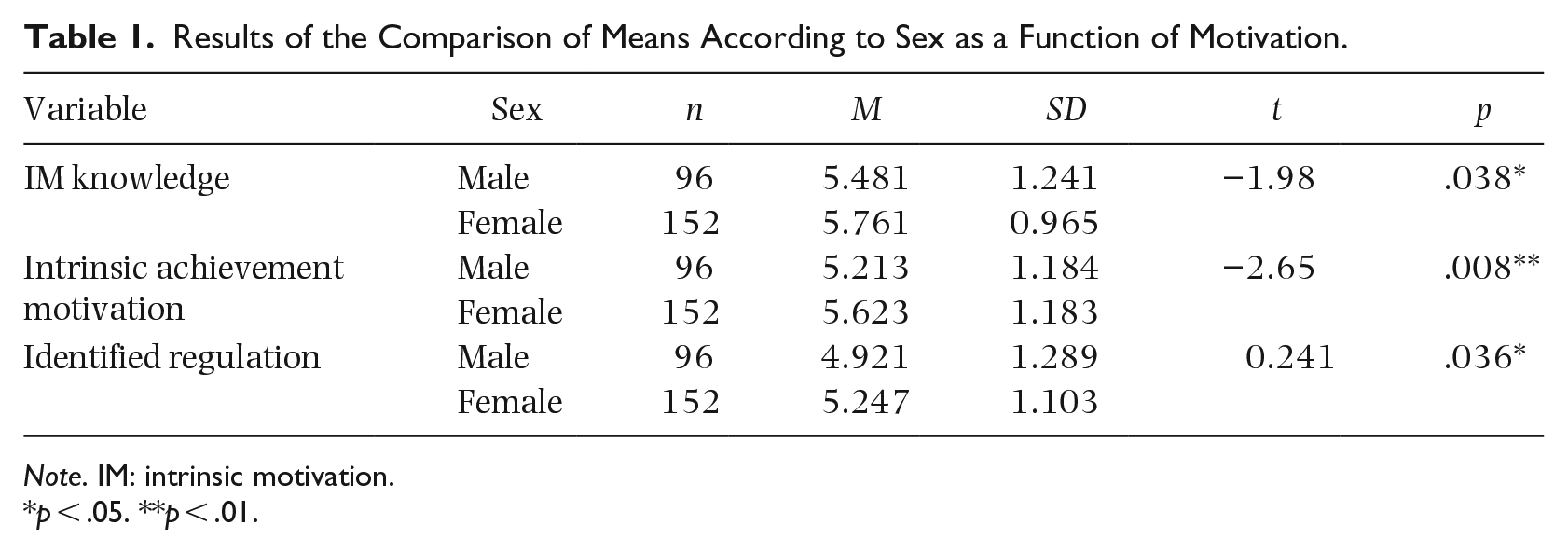
In Table 1, we present the results of comparison of means according to the sex of the participants. We observe that there are significant differences between being male and female, specifically in the results obtained in intrinsic knowledge and achievement motivation.
Results of the Comparison of Means According to Sex as a Function of Motivation.
Note. IM: intrinsic motivation.
p < .05. **p < .01.
With respect to extrinsic motivation, we observed that there are significant differences in extrinsic motivation, specifically in the parameter of identified regulation (p = .036). In all three cases, motivation was lower in the male gender.
There were no differences with respect to sex in the other constructs.
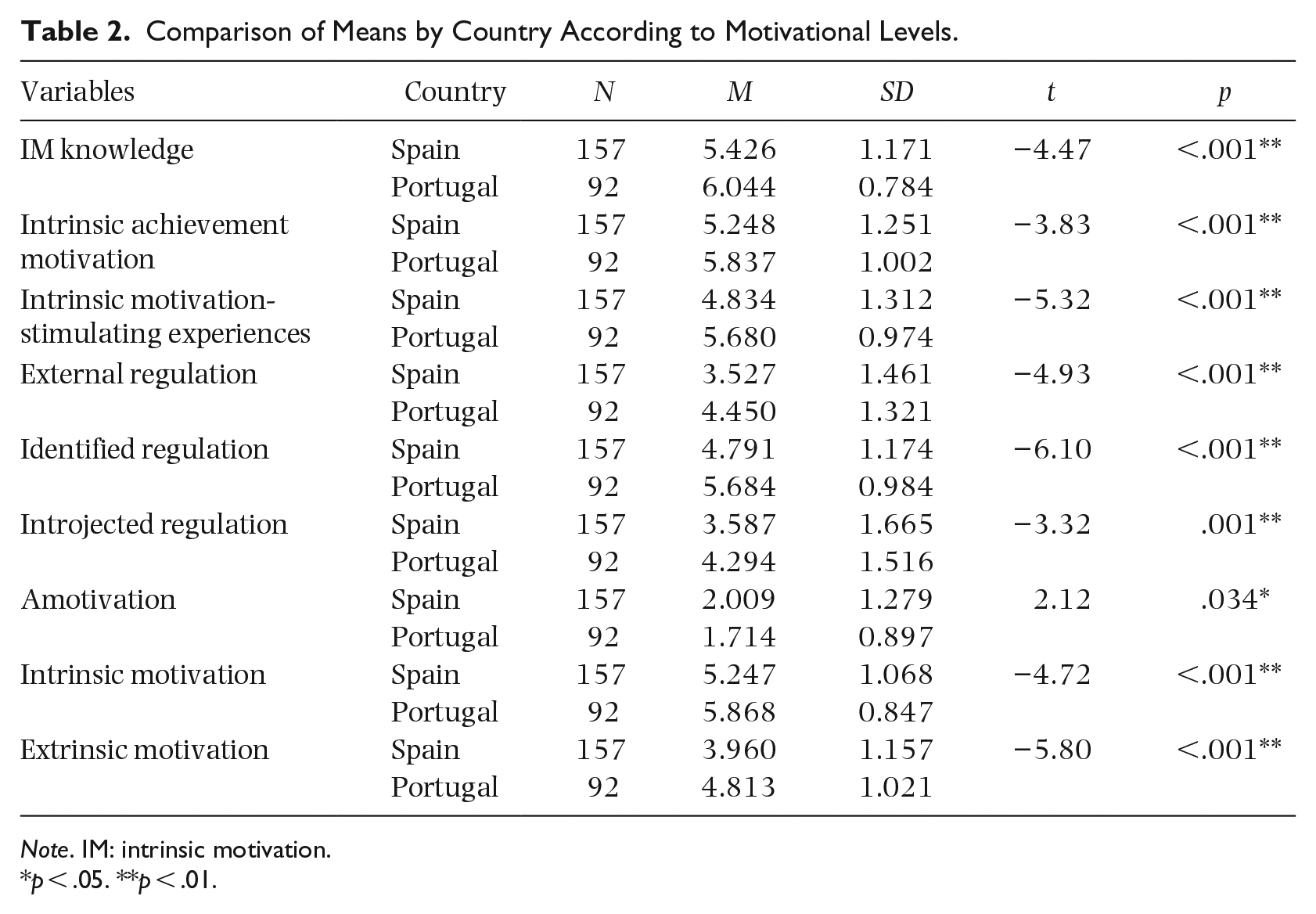
Table 2 contains the comparison by country. The results of the comparison between the means of students studying higher music studies in Spain and Portugal show that there are significant differences in all parameters between the two countries in terms of their motivational level, being higher in all cases in Portuguese students. As expected, demotivation is higher in Spanish students.
Comparison of Means by Country According to Motivational Levels.
Note. IM: intrinsic motivation.
p < .05. **p < .01.
Table 3 shows the data relating to the difference between the centers participating in the study. In the results derived from the motivational level per center, there are also numerous significant differences in favor of the Portuguese conservatories. The intrinsic motivation of knowledge is higher in the students of the Escola Superior de Artes de Castelo Branco (M = 6.078), the intrinsic motivation of stimulating experiences has the highest mean in the Universidade do Minho (M = 5.83), external regulation (M = 5.117), identified regulation (M = 5.750), and extrinsic motivation (M = 5.159) is placed more favorably in the student body of the Escola Superior de Música e Artes Escénicas de Porto. Intrinsic motivation is higher in the students of the Universidade do Minho (M = 5.956). However, in introjected regulation, it is the Escola Superior de Música e Artes Escénicas de Porto that presents the highest mean (M = 4.602).
Comparison of Means by Type of Center According to Motivation.

Note. ESMAE: Escola Superior de Música e Artes do Espetáculo; ESART: Escola Superior de Artes Aplicadas; IM: intrinsic motivation.
p < .05. **p < .01.
There are no significant differences in the amotivation construct between the different music schools.
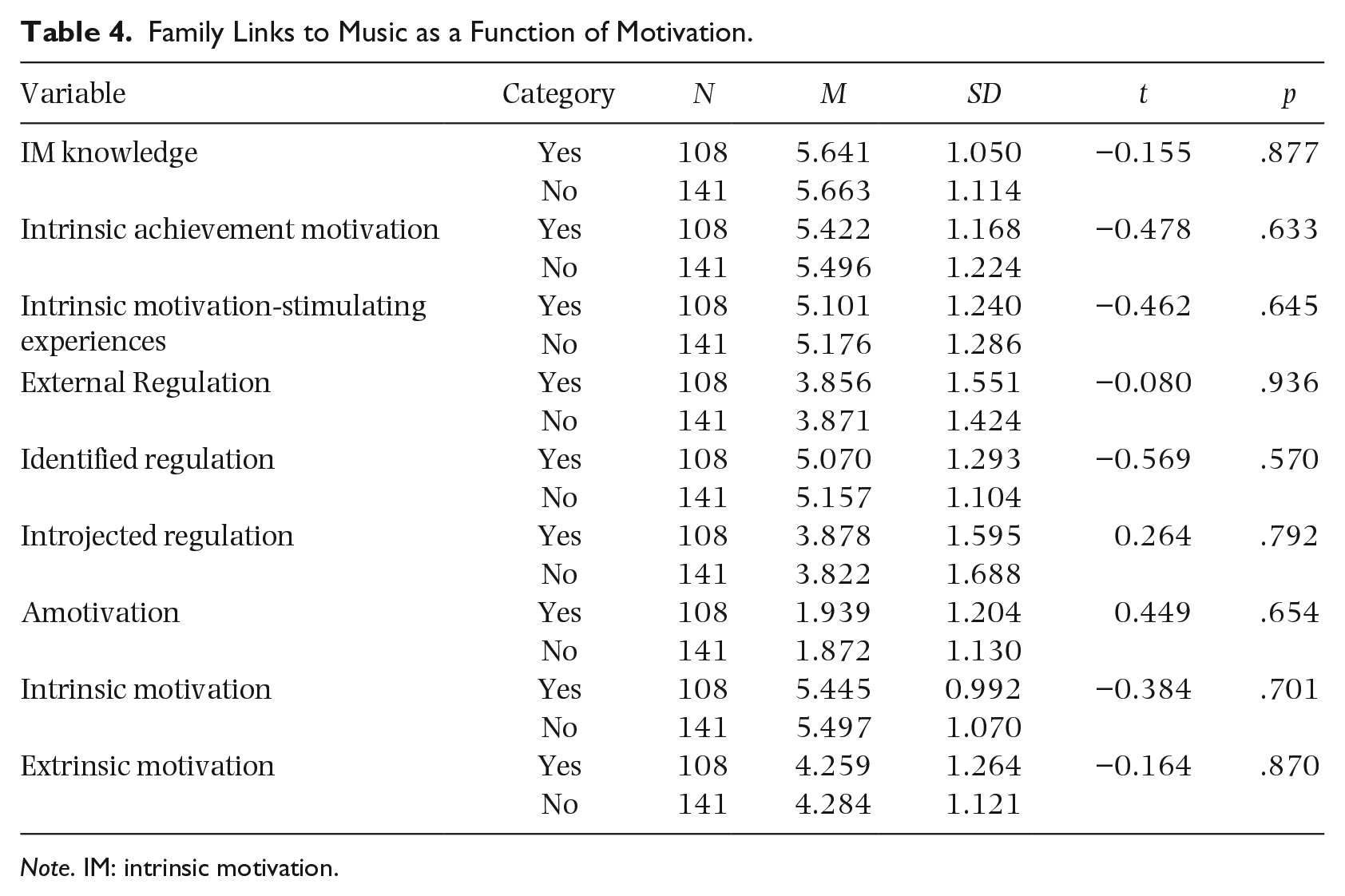
Table 4 shows the data related to family influence. With respect to the level of motivation of students whose family has ties to the world of music, there are no significant differences, although those who do not have family members in the musical field are more motivated in all the constructs.
Family Links to Music as a Function of Motivation.
Note. IM: intrinsic motivation.
Discussion and conclusion
With respect to our first hypothesis (H1) where we stated that women could be more motivated than men, we conclude that with respect to the sex of the students who study higher education in music, in general, women are more motivated than men. The most significant differences are shown above all in intrinsic motivation for knowledge and achievement. Authors, such as McPherson and O’Neill (2010) affirm that women show higher levels of competence toward music and the value they place on it is greater than men, in addition, they tend to attribute their success to effort (Schatt, 2011). Ghazali (2006) also states that, despite the low prestige attributed to music education, those who do so do so because of high intrinsic interests in the subject and, in relation to gender, it is women who place more value on musical performance. The data also show that male students are generally more unmotivated and external regulation also scores higher, which is consistent with a more externalized and less self-determined motivation. This can be explained by the tendency of the male sex to receive rewards as reported by Deci (1972), in which he concludes that to improve intrinsic motivation, interesting activities must be offered for their own sake without the interaction of rewards, since they end up conditioning participation in the activity.
We conclude that musical studies are vocational in nature, but the importance of motivation for these students should not be overlooked. The findings of this study in terms of gender reinforce previous theories in which it is observed that women have a more self-regulated motivation toward music learning. SDT postulates in autonomy one of its fundamental pillars in social environments that require specific support (Ryan et al., 2021).
The second proposed hypothesis (H2) presupposed that the academic environment was important for students’ motivation. One of the main markers of the academic environment is the country, with respect to which it is concluded that Portuguese students are more motivated than Spanish students in higher music education. This may be influenced by the conditioning factors surrounding these studies. Portuguese universities and music curricula favor the exclusive dedication of their students, which also has repercussions on the excellence of their students. Authors, such as Díaz et al. (2002), state that the academic performance of higher education students is a basic issue when addressing the quality of teaching in university education, since this has traditionally been a parameter that works as an indicator to approximate its measurement. The integration of music studies in general education, in addition to vocational music education, has contributed significantly to the excellence and dedication of students who decide to extend their musical studies to higher education in Portugal. Vocation is not always enough to guarantee success in musical studies if it is not accompanied by the component of constant daily effort and study. Following Sloboda et al. (1996), in their research on the role of daily practice in students of instrumental music disciplines, they observed that the students who obtained the best results were those who best systematized their study time and concluded that effort in daily practice was key to musical achievement. For this reason, we consider that those study plans that favor the integration of formal and musical education will allow students to have more time for study and daily practice. In addition, dynamics will be encouraged that allow the creation of routine study environments among students, which will help develop a more self-regulated motivation. In this line, the study by García Collazos (2019) cites the studies by Phillippe et al. (2009), Vallerand et al. (2003), and Vallerand (2010), and points out that music students have high levels of intrinsic, integrated, or identified motivation, so that, the study plans must favor autonomy and self-regulated learning as proposed by Deci and Ryan (2000).
If we delve deeper into the typology of centers, we also find significant differences in favor of Portuguese centers. Specifically, the best results for intrinsic motivation to knowledge are for the Escola de Artes Aplicadas de Castelo Branco, showing that its students are the most motivated to learn music. Fernandes da Silva (2008) points out that the higher schools of arts constitute an educational framework that maintains the traditional and therefore vocational conception. In addition to greater dedication to individual study, students with greater intrinsic motivation to knowledge are also linked to self-regulated behavior, in which their perception of autonomy is greater, and they are also capable of implementing study dynamics that guarantee greater success (Renwick, 2008; Schmidt, 2005). This implies that they engage in the activity of their own free will, for the sake of learning new things and because they perceive the activity as pleasurable and do not need external positive reinforcement (Blanco-Novoa et al., 2021). Following Niemiec and Ryan (2009), this result also highlights the tendency to get involved voluntarily and dedicate more time to the task. Study strategies, planning, as well as the time invested in it, imply a direct relationship between regulation and intrinsic motivation to knowledge. It starts from the individual’s own interest in self-improvement and effort, with a clear objective that seeks to guarantee success in their studies and improve their musical competencies (Blanco-Novoa et al., 2021). All this implies a greater enjoyment for the work process with clear goals of achievement, through self-regulated behavior and employing productive and success-oriented strategies (Austin & Haefner, 2006; Ericsson, 1996). In this sense, it is worth mentioning the importance of expectancy-value theory in which intrinsic motivation is essential (O’Neill & McPherson, 2002). In the variable intrinsic motivation to stimulating experiences, the Universidade do Minho presents the most favorable results, which may highlight the type of educational offer of the center that is very attractive to its students. As for extrinsic motivation, ESMAE students have the highest averages both in external regulation, and in identified and introjected. These results highlight a good teaching practice and a curriculum that favors self-regulated motivation. Authors, such as Tirado et al. (2010), affirm that students who are intrinsically motivated show more interest in what they learn, achieve greater satisfaction in what they are doing, make a greater effort, are persistent, experience a sense of personal control, and raise both self-esteem and creativity. In addition, providing students with tools based on autonomy and self-regulated learning favors intrinsic motivation, following Deci and Ryan’s (2000) SDT, which proposes avoiding competitiveness and favoring educational environments that offer a variety of options and enriching alternatives for learning, as well as adequate management of external rewards (Deci et al., 1991; Deci & Ryan, 2000; Ryan, 1995).
It is concluded that the diversity in the typology of the centers (music conservatories, music colleges, and universities), even with very similar curricula, show differences in the motivation of their students, being in this case, the country a clearly differentiating variable.
The third hypothesis (H3) predicted that family support was important for student motivation. Based on the results obtained with respect to family background in relation to motivation, we can conclude that there are no major differences, although in a very subtle way students who do not have family ties related to music obtain better results. This may be in line with the educational stage, since in higher education students are already adults and take more control over their decisions. Therefore, the influence exerted by the family is no longer as strong as in lower educational levels in which family support is a fundamental pillar of academic success or abandonment of musical education (Davidson et al., 1996; García-Dantas et al., 2014; Margiotta, 2011). On the contrary, as Orejudo et al. (2021) point out, there are not so many studies that address the importance of family support in the more advanced levels of musical learning. The family will be a factor that will affect extrinsic motivation, since support will be decisive for the student to continue his or her higher musical studies (Albert, 2006; Stewart, 2005), but at university levels, the will to pursue these studies is more autonomous and family support is less decisive (Orejudo et al. 2021). In addition, the fact that those who do not have a family background score slightly higher may be related to a lower perception of pressure on the student, since he or she does not have to satisfy the aspirations that may be placed on him or her. Academic goals are also linked to self-perception about task skills, family support, self-improvement goals, and a high return consideration of effort (Holgado et al., 2013; Martin et al., 2016; Mawang et al., 2020). Also gaining relevance in the continuation of studies is the emotional connection that is established with music, which is activated at the beginning and will accompany throughout the career (St. George et al., 2014).
As for the family influence, it is concluded that at this educational stage, it does not cause a special impact on their motivation since the autonomy of these students shows that the choice of these studies is based on their own self-determination. On the contrary, one of the main conclusions is the importance of the organization of higher studies and the impact on the motivation of their students.
Limitations of the study and lines of action
In quantitative research, the size of the sample is always a conditioning factor to be considered. The complexity of obtaining the responses can alter the homogeneity of the total sample, although in this study it was sufficiently representative, and it would be interesting to be able to enlarge it. On the contrary, students who agree to participate in a study of these characteristics are likely to be more motivated than those who decline to participate, so that, there may be bias in this regard. It would be interesting to be able to implement an intervention program aimed at improving motivation longitudinally and to analyze its possible impact. Although, as we have seen, family influence does not exert a significant influence on the results, it would be very useful for future research to study the influence exerted by teachers on motivation at this educational stage. Another line of future action is based on curricular differences in teacher training. As the legislative review of the curricula of studies between these two countries shows, the difference in the pedagogical preparation of future teachers is very noticeable. While in Spain, there is a quite remarkable deficit (Domínguez-Lloria & Pino-Juste, 2021), in Portugal, there is a very fertile field of pedagogical training (Mota, 2014).
