




Abstract
The purpose of this two-experiment study was to examine collegiate musicians’ ability to discern conductor intent. In Experiment 1, participants (N = 44) viewed two videos of Sir Simon Rattle conducting an ensemble performing an excerpt of the Finale to Gustav Mahler’s Symphony No. 2. One video featured the original performance, whereas the other video was synchronized with a different audio recording from a video of a performance led by Leonard Bernstein. When asked whether any of the two videos were mismatched, results indicated that the proportion of correct responses among our participants differed significantly from chance. In Experiment 2, participants (N = 127) watched two sets of videos, either matched (unaltered) or mismatched versions of videos featuring Sir Simon Rattle and Leonard Bernstein, and were asked to rate how well the musical intent of the conductor matched the performance of the ensemble they viewed. Although we found a nonsignificant overall result (p = .053) when comparing the matched and mismatched videos, we found a significant difference in participants’ ratings between the matched and mismatched Rattle videos, but not for those featuring Bernstein. Our findings suggest that a conductor’s visual contribution to the performance can enhance or detract from the observers’ musical experience.
Conductors play an ongoing and important role in realizing the performances they conduct. Through score study, conductors develop an internal sound image of the music that guides their interpretation (Battisti & Garafolo, 1990; Feldman et al., 2021) and informs their use of gesture (Colwell & Hewitt, 2011). Because score study is paramount in guiding conductors’ verbal and nonverbal conducting behaviors, score study processes have been documented by conducting pedagogues (Feldman et al., 2021; Hunsberger & Ernst, 1992; Labuta, 2010) and researchers who have interviewed expert conductors (Casey, 1993; Ellis, 1994; Wagar, 1991). Approaches to score study among novices has also been examined (Silvey et al., 2017). Although strategies for studying scores are numerous, there seems to be consensus that conductors of all levels should possess as much knowledge as possible about the pieces they are conducting, to the point that the conductor “becomes the music itself” (Neuen, 2002, p. 204).
Expert conductors translate this knowledge into nonverbal conducting skills that include high levels of variability both within individual conductors and across different conductors (Byo & Austin, 1994; Luck et al., 2010). Expert conductor gestures are characterized as highly expressive (Bergee, 1992, 2005) and include component skills such as exhibiting a varied repertory of beat styles, clearly representing dynamics and articulation via gesture, and maintaining stability in tempo. Although gestural behavior can vary widely among experts and is generally idiosyncratic to individual conductors (Byo & Austin, 1994; Luck et al., 2010), specific gestures (Kumar & Morrison, 2016; Morrison et al., 2014; Sousa, 1998) and even facial expressions (Kilpatrick, 2021; Mayne, 1992) are associated with particular meanings germane to ensemble performance (Poggi et al., 2021) and can be learned by young musicians (Cofer, 1998; Kelly, 1997; Thompson, 2012). However, not all components are of equal importance to observers (Johnson et al., 2008; VanWeelden, 2002). Research by Wöllner (2008) indicates that conductor arm movements convey musical information, whereas facial movements convey musical expressivity, but some evidence exists to suggest that both facial and gestural components of conductor expressivity must be present in performance in order for a musical performance to be perceived as globally expressive (Nápoles et al., 2021).
The act of conducting presupposes an ensemble context in which it occurs. Garnett (2009) posits an interpretive model of conducted ensembles that is comprised not merely of multiple bilateral relationships between conductor and individual musicians, but rather of a multiplicity of relationships, whereby “each connection impinges on all its neighbouring connections” (pp. 24–25). In this model, conducting is best understood not as transmission, but as interaction. Other empirical work has affirmed this perspective: Hilt and colleagues (2019) identified a set of dynamic aural, visual, and temporal relationships among performers and between a conductor and an ensemble, with kinetic activity including both ancillary (i.e., head) and instrumental (bow) movements, and with modes of cooperation that are at times either complementary or imitative. Stronger perceived conductor influence is associated with superior ensemble performance and is associated with a reduction of intra-ensemble influences among musicians (D’Ausilio et al., 2012). Research in other artistic realms suggests that expert performers infer meaning from both movement and stillness, and that they convey greater meaning through quantitatively less movement as compared with non-expert performers (Evola & Skubisz, 2019). Taken together, performance in a conducted ensemble evinces a feedback loop among all musicians, leader and performers alike, wherein the interpretation of gesture and the construction of meaning are informed by experience and praxis. Garnett (2009) even suggests that musical culture itself can become “not only like a repertoire of ways to imagine music, but like a repertoire of ways to move with music as well” (p. 151). Expressive movement ostensibly conveys a performer’s intent with a concomitant expectation of an appropriate response, whether from co-performers in the form of corresponding movements or sounds, or from observers or audience members in their tacit evaluative or aesthetic response.
Conductor gestures provide information for temporal congruence among musicians; successful synchronization has been found for observers responding to varying degrees of gesture curvature and various levels of conductor experience (Luck & Nte, 2008). Musicians who themselves have conducting experience have evinced superior synchronization results compared with both musicians without such experience and to non-musicians (Luck & Nte, 2008; Luck & Sloboda, 2007). Inasmuch as synchronization indicates a successful response, such results may indicate the presence of musical “intent” (or a component thereof) that is conveyed and perceived among knowledgeable musicians. In ensemble performance, conductor-ensemble synchronization varies between orchestras and wind bands (with the latter generally being more temporally congruent), and among ensembles of different experience levels (Meals, 2020). Experimental manipulations of conductor-ensemble synchrony (i.e., presentations of video recordings with either a slight audio lag or a slight video lag, or with no such temporal adjustment) revealed a preference among musician-observers for intact (unadjusted) performances as reflected in participant evaluations of both the ensemble and especially the conductor (Meals et al., 2019). Such findings could be interpreted as further evidence of conductor intent, with temporal misalignment being perceived as a threat to conductor efficacy and to overall musical effect.
Even given the variability within individual conductors, it is expected that expert conductors’ gestures look different from one another based upon their own understanding and knowledge of the music. But what if the musical intent of one conductor—as evidenced visually through their nonverbal conducting behavior—was synchronized with an audio performance led by a different conductor? Would musicians be able to recognize any difference between matched (unaltered) and mismatched conducting performances? Previous research might suggest not: In a series of studies, neither collegiate musicians (Madsen et al., 2007) nor secondary school music students (Madsen et al., 2009) discerned audio differences in a spliced-together performance of five different conductors leading the Vienna Philharmonic Orchestra in Johann Strauss’s Blue Danube Waltz. Still, when presented with the video of the same recording, participants’ written comments tended to focus on the conductor. Because “creative and accomplished juxtapositions of ensemble sound and conductor movement may result in variations of perceptual input that lead listeners to divergent cognitive experiences” (Morrison & Silvey, 2022, p. 268), continued exploration of the multifaceted and complex auditory and visual interaction that occurs among conductors, performers, and audience members remains important.
The array of gestures a conductor employs when leading an ensemble arguably constitutes an embodiment of conductor intent—that is, a visual indication of how the music ought to sound, encoded in gesture and interpreted by knowledgeable ensemble musicians as guidance regarding how to perform. Because this is manifested in real time, such gestures also incorporate the conductor’s responses to the ensemble, wherein the conductor offers immediate feedback to musicians regarding their performance. Therefore, conducting activity can be construed as specific to a particular conductor and ensemble, with gestures within this musical direction-and-feedback model ostensibly constituting a unique manifestation of conductor intent. Accordingly, the purpose of this two-experiment study was to examine collegiate musicians’ ability to discern such intent. Two research questions guided our study: (1) Can college musicians agree beyond chance levels whether a pair of conducting videos were correctly or incorrectly matched? (Experiment 1) (2) Would college musicians rate conductor intent differently based upon whether or not the performance they heard had actually been led by the conductor they viewed? (Experiment 2)
Method
Audiovisual stimuli
Stimuli were taken from intact performance videos that were publicly available on YouTube. We downloaded the video files using a video converter found at www.ytmp3.com, and then extracted measures 726–732 (approximately 25 s) of the Finale to Gustav Mahler’s Symphony No. 2 that was conducted by Sir Simon Rattle with the Berlin Philharmonic Orchestra (Berliner Philharmoniker, 2015) and Leonard Bernstein with the Vienna Philharmonic Orchestra (Traditumium, 2021).
A professional audiovisual engineer helped create two versions of the Rattle and Bernstein videos. The first video in each pair was left unaltered, with the original video paired with the same audio from that recording (hereafter referred to as the matched condition). In the second video in each pair, the audio from the opposite video was extracted and then synchronized to correspond exactly with the conducting of the other conductor (the mismatched condition). Therefore, the four versions of these videos were (a) Rattle—matched; (b) Rattle—mismatched; (c) Bernstein—matched; and (d) Bernstein—mismatched. Precise audio synchronization was made possible by using the time remapping feature in Adobe Premiere Pro (Adobe, Inc.) software. Audio resolution was CD quality (44.1 kHz, 128 kbps) and normalized such that the volume was consistent across all four videos. Video quality was 720p HD (640 × 360 pixels).
Procedures for both studies were facilitated through Qualtrics, an online survey tool. We pilot-tested the online evaluation used in each experiment to 15 music education graduate students (Experiment 1, n = 5; Experiment 2, n = 10) at our institutions to (a) solicit feedback about the ease, content, and clarity of the online evaluation process; (b) ensure that the videos appeared realistic; and (c) confirm that our deception was not easily recognizable. Aside from comments related to the directions, open-response questions, and requested demographic information, no pilot participant commented that the audiovisual materials seemed artificial.
Experiment 1
Participants
Participants (N = 44; Mage = 19.34 years, SD = 1.85) were recruited from concert bands at two music schools located in the midwestern and southwestern United States. Gender identities included female (n = 23), male (n = 20), and non-binary (n = 1). These undergraduate students had an average of 8.77 years (SD = 2.34) of conducted ensemble experience, and seven had previously taken or were currently enrolled in an undergraduate basic conducting course. Their main performing emphases included brass (n = 15), woodwinds (n = 16), percussion (n = 3), strings (n = 4), piano/keyboard (n = 1), and other (n = 5). Participants were majoring in either music education (n = 27), a music major other than music education (n = 5), or were non-music majors (n = 12).
Procedure
Participants were e-mailed a link to access the evaluation through Qualtrics. The first page of the questionnaire consisted of a description of the study with Institutional Review Board-approved consent information. After giving their informed consent by clicking “next,” participants were instructed to listen to a 15 s audio-only recording of Charles Ives’ Country Band March to check the volume level of their device and adjust it to a comfortable level before continuing with the study. In pursuit of our first research question, “Can college musicians agree beyond chance levels whether a pair of conducting videos were correctly or incorrectly matched?” the following instructions then appeared on the screen: You will view two videos of Sir Simon Rattle leading a performance of several measures of the Finale to Gustav Mahler’s Symphony No. 2. The audio that you hear may or may not be from the actual performance that was led by Rattle. After viewing both excerpts, you will be asked whether (a) neither video, (b) only the first video, (c) only the second video, or (d) both videos were mismatched. In addition, you will provide one brief comment explaining why you made that decision.
The matched and mismatched excerpts were presented to participants in one of two presentation orders that were randomly assigned by Qualtrics with an equal distribution of orders. 1 The online evaluation concluded with several demographic questions. On average, participants took 4 min, 10 s to complete these procedures.
Experiment 2
Participants
Similar to procedures used in Experiment 1, participants (N = 127; Mage = 21.08 years, SD = 4.01) were recruited from concert bands at four music schools in the southwestern United States. 2 Gender identities included male (n = 71), female (n = 47), non-binary (n = 5), and prefer not to answer (n = 3). One person did not respond to this question. Undergraduate (n = 120) and graduate students (n = 7) had an average of 10.15 years (SD = 5.86) of conducted ensemble experience, and 74 had previously taken or were currently enrolled in an undergraduate basic conducting course. Their main performing emphases included brass (n = 53), woodwinds (n = 41), percussion (n = 21), other (n = 9), strings (n = 2), and piano/keyboard (n = 1). Participants were majoring in either music education (n = 85), music performance (n = 12), a music major other than performance or education (n = 7), or were non-music majors (n = 23).
Procedure
Participants were sent a link to access the evaluation tasks through Qualtrics. Identical to Experiment 1, after reading a description of the study with institutional review board–approved consent information, they gave their informed consent by clicking “next” and listened to a 15 s recording of Charles Ives’ Country Band March as an audio test for their device. Pursuant to our second research question, “Would college musicians rate conductor intent differently based upon whether or not the performance they heard had actually been led by the conductor they viewed?,” the following instructions then appeared on the screen: You will view four videos of two conductors leading performances of the same music excerpt. After each excerpt, you will evaluate how well the musical intent of the conductor matched the performance of the ensemble by providing a rating on a scale of (1) not matched to (10) completely matched. In addition, you will write one comment about the conductor and one comment about the ensemble performance.
In addition to viewing the matched and mismatched Sir Simon Rattle videos that were used in Experiment 1, participants also saw the matched and mismatched versions of the Leonard Bernstein video. These four excerpts were presented equally in one of four orders using a 4× 4 Latin square design such that neither Rattle or Bernstein were viewed successively. We solicited demographic information at the conclusion of these procedures, which in total took participants an average of 10 min, 1 s to complete.
Results
Experiment 1
The results of a χ2 goodness-of-fit test indicated that the distribution of the number of correct responses by category differed significantly from chance, χ2(3, N = 44) = 17.636, p < .01, Φ = 0.63. In order of frequency, participants indicated correctly which video of the pair had been altered (n = 21), or incorrectly chose neither video (n = 14), mistakenly identified the matched video only as having been altered (n = 5), or mistakenly identified both videos as having been altered (n = 4).
Participants’ comments were analyzed by the primary and the third authors who assigned codes to each response and then grouped those codes into broader categories (Creswell, 2007). Once coding was finished, the primary and third authors exchanged, discussed, and modified emergent categories until consensus was reached (Denzin & Lincoln, 2005). We used a descriptive coding process by Saldaña (2016) that is suitable when “researchers may wish to transform their qualitative data and/or codes into quantitative representations [in order to] corroborate quantitative data” (p. 86). Because we were interested in the frequency of participants’ comments as they related to each category, we counted each individual comment. In total, there were 96 comments. Inter-rater reliability, using the formula [agreements ÷ total observations], was 91.67%, which exceeded the acceptability threshold of 80% proposed by Madsen and Madsen (2016).
We identified six categories in participants’ responses, which are presented in order of frequency: conductor synchronization, n = 44 (45.83%); ensemble synchronization, n = 21 (21.87%); conductor expressivity, n = 18 (18.75%); videos were identical, n = 5 (5.20%); audio synchronization, n = 4 (4.16%); and other, n = 4 (4.16%). Some examples of comments in each category included “The audio in the second video did not completely line up to the big impacts that Rattle was giving” (conductor synchronization), “the ensemble seems just the slightest bit behind” (ensemble synchronization), “the intensity in conducting translated more in the first recording” (conductor expressivity), “I suspect I may be able to tell a difference if I went back and forth between them, but I couldn’t tell now” (videos were identical), “I thought my audio was lagging” (audio synchronization), and “my ear did not like that” (other).
Experiment 2
We used a two-way analysis of variance with one within-subjects factor (matched or mismatched video) and one between-subjects factor (presentation order) to determine the effect of matching condition on participants’ ratings of conductor intent. Because Mauchly’s test indicated that the assumption of sphericity had been violated, χ2 = 23.09, p < .001, the degrees of freedom were corrected using the Greenhouse–Geisser adjustment. Results indicated a nonsignificant main effect for matching condition, F(2.63, 324.45) = 2.70, p = .053,
Because there was no order effect and the results of our main analysis approached statistical significance, we conducted post hoc tests to compare the ratings of the matched and mismatched versions of both Bernstein and Rattle videos. Using independent-samples t tests, we found a significant difference between participants’ ratings for matching condition for the matched Rattle video (M = 8.14, SD = 1.88) versus the mismatched one (M = 7.63, SD = 1.95); t(126) = 2.12, p = .017, d = 0.26. There was no significant difference between the matched (M = 7.75, SD = 1.86) and mismatched (M = 7.79, SD = 1.91) Bernstein videos, t(126) = −0.166, p = .43, d = 0.02.
Our free-response analysis procedures followed those used previously in similar studies involving conductors and ensemble performance (Montemayor & Silvey, 2019; Price & Mann, 2011; Silvey & Fischer, 2015). We grouped participants’ comments according to those focused on either the conductor or the ensemble and whether the video was matched (unaltered) or mismatched. In addition, we categorized comments as positive, negative, or neutral (Morrison et al., 2009). We used procedures identical to those in Experiment 1 when identifying the codes that generated our themes, which resulted in eight ensemble and five conductor categories. (See Table 1 for results.) To establish reliability, the first author examined all of the participants’ comments, and the third author independently examined 25% of those comments. Because inter-rater reliability was high for category assignment (r = .93) and comment direction (r = .97), we used the codings of the third and first authors, respectively.
Categorization of Comments for Matched and Mismatched Conducting Videos.
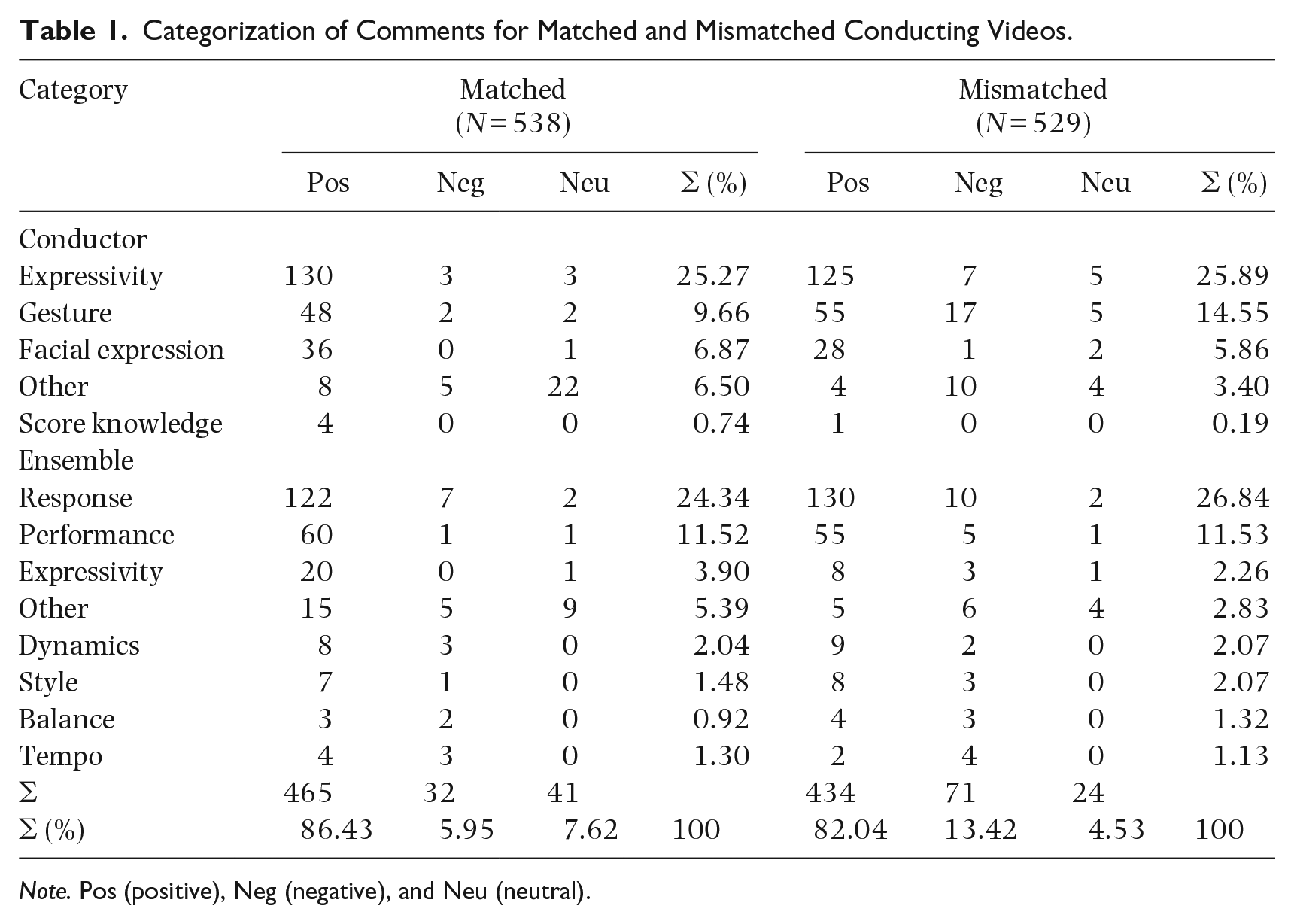
Note. Pos (positive), Neg (negative), and Neu (neutral).
Participants’ comments (N = 1,067) regarding the conductor and the ensemble were overwhelmingly positive regardless of whether the videos were matched (n = 465 out of 538, 86.43%) or mismatched (n = 434 out of 529, 82.04%). Furthermore, as depicted in Figure 1, the overall percentages of positive, negative, and neutral comments for the matched (86.43%, 5.95%, and 7.62%) versus the mismatched videos (82.04%, 13.42%, and 4.53%) were relatively consistent. One exception was that there were twice as many negative comments assigned to the mismatched videos (n = 71) compared with the matched videos (n = 32). A few examples of the negative comments that participants typed after viewing the mismatched videos included “the conductor was very overdramatic,” “he did okay, but he could do better with the cues,” and “great ensemble, but the second violins were flat.”
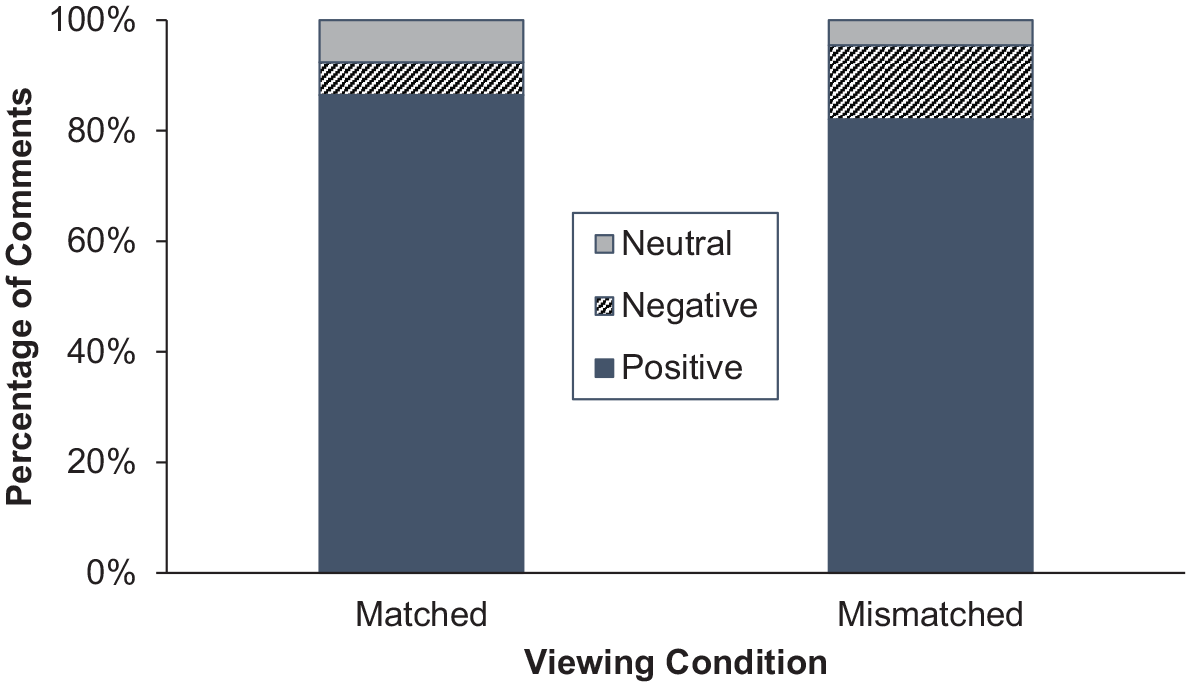
Distribution of Participants’ Positive, Negative, and Neutral Comments Regarding Conductors Viewed in Matched and Mismatched Conditions.
Approximately 50% of the total comments for the matched and mismatched videos involved either conductor expressivity (25.58%) or ensemble response (25.59%). Sample positive comments related to conductor expressivity included “the conductor was expressing tons of emotion through his movements” and “insistent, deliberate, intense, passionate, and vigorous.” Examples of ensemble response comments were “the ensemble matched the intensity that the conductor was giving them” and “they followed the conductor really well.” The remaining conductor categories included gesture, facial expression, score knowledge, and other, whereas ensemble categories were performance, expressivity, dynamics, style, balance, tempo, and other.
Discussion
To explore the idea of conductor intent, we designed two experiments using matched (unaltered) and mismatched videos of professional conductors. The results of our first experiment indicated that college musicians could discern beyond chance levels whether a pair of identical conducting videos featuring Sir Simon Rattle were correctly or incorrectly matched with audio from the original performance. Because the videos were presented successively, it may have been easier for participants to isolate differences between the matched and the mismatched recording, even though the video was identical. Did participants perceive something artificial about Rattle in the mismatched video when his interpretation was not realized sonically by the original ensemble? Or was it something about the performance itself that did not seem complementary?
Regardless of the accuracy of participants’ choices, approximately two-thirds of their comments (65 out of 96) involved issues of conductor or ensemble synchronization. When inspecting these comments more closely, many of them were described by those who did not correctly choose which video had been mismatched. Given research indicating that many listeners often hear changes in music performances that do not actually occur (Morrison et al., 2009; Silvey, 2013), and also given that none of those who helped pilot-test our procedures commented upon the mismatched audio track for the videos, we wonder if our prompt that “the audio you hear may or may not be from the actual performance that was led by Rattle” (which we did not provide in the pilot-test) may have primed our participants to search for any number of differences that did not exist. Nevertheless, participants’ comments highlighted the fact that they attended to issues of conductor and ensemble synchronization while observing these videos—findings that are consonant with Meals et al. (2019) and, more broadly, with Madsen et al. (2007, 2009). It may bear mentioning that in those studies and in both experiments of our current investigation, participants were afforded a frontal view of the conductor, which has been found to affect perception (Napoles, 2013) and is a perspective usually only ensemble musicians have, and that they were given a particular evaluative task, unlike what is typical in performance scenarios for either musicians or audience members.
In our second experiment, we added two videos featuring Leonard Bernstein along with the two Rattle videos from Experiment 1. We asked participants to rate how well the musical intent of the conductor matched the performance of the ensemble. Post hoc testing revealed a small but significant difference between the matched (M = 8.14) and mismatched (M = 7.63) Rattle videos, but not for those featuring Bernstein. Why did participants perceive conductor intent differently for Rattle than Bernstein? One explanation may be that Rattle’s gestures appeared more organic and less sensational than those of Bernstein. There were several contemporary critiques of how Bernstein conducted, perhaps best encapsulated by one critic who wrote that “one did wish that there had been more music and less exhilaration” (Schonberg, 1960, p. 32). Although the excerpts featured identical repertoire and both conductors were undeniably expressive, Rattle and Bernstein conducted very differently. Conductor intent—at least in this experiment—may have been confounded with viewer preference and the idiosyncratic nature of the two conductors (Byo & Austin, 1994).
We are also reminded of this question: “Is listening to music enhanced when viewing something such as when one knows who is conducting?” (Madsen et al., 2007, p. 447). Results from our study as well as those from Madsen et al. (2009) indicate that a conductor’s visual contribution to the performance can enhance or detract from the musical experience, particularly when the viewer-listener is tasked with providing an evaluation. In future investigations, researchers may wish to consider similar studies featuring novice conductors without similar professional profiles and a more precise set of listening and observation tasks for participants. Although we specifically asked participants to evaluate “how well the musical intent of the conductor matched the performance of the ensemble,” it is possible that participant ratings reflected some degree of preference for one conductor or another. Moreover, we do not know the extent to which these participants were familiar with either Sir Simon Rattle or Leonard Bernstein. Previous studies have found that expressive conductors are preferred over those with less expressivity (Morrison et al., 2009; Price et al., 2016; Silvey & Koerner, 2016), but the idea that a conductor (renowned or otherwise) could be viewed as too expressive has yet to be explored.
Participants’ free response comments regarding the matched and mismatched videos in Experiment 2 were similar. The percentage of comments for each conductor and ensemble category were comparable in content and valence (i.e., positive, negative, or neutral). One difference that should be highlighted is the number of overall negative comments that were typed after participants viewed the mismatched videos (n = 71 out of 529, 13.42%) versus the matched ones (n = 32 out of 538, 5.95%). Although these comments were solicited to help explain why participants assigned their ratings, given the volume of comments (N = 1,067), these negative comments may be somewhat inconsequential. It is important to note, however, that whether the videos were matched or mismatched did not significantly affect participants’ ratings of conductor intent.
This study has a number of limitations. Because we were only concerned if participants in Experiment 1 would be able to discern whether a pair of conducting videos were correctly or incorrectly matched, we did not use the term intent in the directions given to our participants. Also, in Experiment 2, it is unclear whether participants were evaluating the “match” of conductor-to-ensemble as we had instructed, or the conductor himself, or the ensemble. In retrospect, perhaps we should have considered providing a clear definition of the term in both experiments. This may have helped us draw connections more clearly between our findings, especially because a subset of the videos was used in Experiment 1. In addition to using the Rattle videos in the first experiment, we also could have replicated that same experiment using the Bernstein videos, as this might have further illuminated perceived differences among the videos before showing them to participants in Experiment 2. Although we sought to explore ideas related to conductor intent, participants may have been responding to any number of variables including video or audio quality, conductor preference, musical interpretation, or repertoire. Indeed, Gustav Mahler’s Symphony No. 2 (the sole work we employed in this initial study) is arguably one of the most expressive works in the orchestral repertoire, and the finale of this symphony is especially dramatic. As with all of these variables, the nature of the music itself ought to be taken into account in future studies of conductors (cf. D’Ausilio et al., 2012).
Is it possible that some of our participants were responding to some facet of conductor intent in the contexts of our two experiments? Maybe. As described by Judd (2016), “There’s the mystical, ineffable aspect of conducting—the reality that the sound of an orchestra subtly changes depending on who’s on the podium.” The results of our study and others (Madsen et al., 2009; Morrison et al., 2009; Silvey, 2013) suggest, however, that listener expectation of such changes contributes to this perceived aural phenomenon. Although these two experiments were exploratory in nature, we sought to investigate the idea that professional conductors’ intimate knowledge of the score is exhibited in ways that are unique to the individual conductor and the performance of that ensemble. Given the findings of this study, it seems clear that “conductor intent” is far from a unitary construct: Through their gestures and facial expressions, a conductor might “intend” to convey musical information in the form of deliberate instructions to the ensemble, and/or they might convey their own experience of the music, ostensibly with the hope that the ensemble (and perhaps the audience) will respond in an appropriate fashion. Although certain gestures can be considered as universal “emblems” (Sousa, 1998; see also Garnett, 2009, and Kumar & Morrison, 2016), the idiosyncratic nature of individual conductors makes the perception of conductor intent more complex. The discrepant responses to the two conductors in this study may even suggest that “conductor intent” itself resides with the observer, at least in part. Moreover, perception of such intent seems dependent on the nature of the observation task.
Continued exploration of musicians’ perceptions of conductor intent using professional and novice conductors in pre-recorded and live performance and rehearsal settings will help provide additional evidence about this phenomenon. Furthermore, researchers should consider surveying professional musicians who work regularly with professional conductors to gain insight into how they differentiate among and describe conductors’ musical intentions. Although designing experiments that explore relationships among score knowledge, gesture, and musical performance outcomes remains difficult due to the myriad factors involved in the complex act of conducting, results of these studies will continue to inform our understanding of the interactions among musicians, conductors, and those who watch and listen to their performances.
