




Abstract
There is growing evidence highlighting benefits of musical exposure and participation on several aspects of development and parenting. Aiming to establish a rigorous protocol allowing researchers to study different types of musical interactions and their benefits on the development of early communication, the present study explored parents’ experiences of musically engaging with their infants in different types of music groups. Twenty-five infants and their parents were randomly assigned to one of three groups: (1) singing, (2) flute playing, or (3) control group. Music sessions were held weekly for 14 weeks and were followed by the home use of the recorded routines specific of each group, for further 3 months. Semi-structured interviews were conducted with the experimental groups’ participants, and pre/post quantitative developmental measures were collected from all groups, to assess participants’ compliance. Qualitative analyses of the interviews revealed both shared themes, (communication enhancement, enjoyment, and regulation); and unique themes (creativity and freedom in the flute group; familiarity and responsiveness in the singing group). The feasibility study was successful in establishing a workable protocol to use in RCT longitudinal interventions aiming to examine how specific aspects of the musical experience might differentially support developmental outcomes, in parent–infant groups.
Informal, home musical interactions are common experience in families with infants (Mehr, 2014; Yan et al., 2021) and they have been shown to significantly support early language development (Falk et al., 2021; Franco et al., 2022; Papadimitriou et al., 2021; Schaal et al., 2020). The present study explored parents’ experiences of musically engaging with their infants in the context of structured sessions based on music therapy techniques (Abad & Williams, 2007; Nicholson et al., 2008). The research set out to evaluate the feasibility and establish a protocol for a longitudinal music group intervention, with the potential to support early communication development in contexts and with populations for which this might be desirable (e.g., due to known expected delays in language acquisition).
Recent literature has reported an array of benefits deriving from toddlers’ and preschoolers’ exposure to and participation in musical activities (Gerry et al., 2012; Ho et al., 2003; Kraus & Chandrasekaran, 2010 ; Moritz et al., 2013; Nicholson et al., 2008; Patel, 2013). However, with a few exceptions (e.g., Politimou et al., 2019) the investigation of which components of musical experience have an effect on which aspects of infants’ development (e.g., motor, linguistic, sensory, communicative) is still largely unexplored. Yet, it is precisely this type of information that would be useful to guide intervention programs addressing particular aspects of development as well as the parent–infant relationship.
With a view to support the development of controlled intervention trials, the current study aimed to establish and evaluate a protocol applicable in a group context and allowed the researchers to compare the long-term influence of different types of musical interactions on parent–infant reciprocity and infants’ communication. An essential part of this is to examine parents’ perceptions of engaging musically with their infants in different group settings. Therefore, the focus of this study was on assessing the impact of different experiences from the “users’” point of view when parents attended different types of longitudinal musical groups to which they were randomly allocated: in one, musical interactions were voice-based and in the other they were instrumental-based. Indeed Borrelli (2011) suggested to pilot test an intervention to increase protocol’s acceptability and replicability, thus using participants’ feedback as an essential component of protocol testing and general feasibility.
The infant-directed (ID henceforth) register of communication has been studied extensively (Räsänen et al., 2018; Trehub & Trainor, 1998). At the core of this communication register is what has been identified as a “more musical” and affect-rich speaking manner (Malloch, 1999; Papoušek & Papoušek, 1989; Papoušek et al., 1991), which includes repetitive loops, higher pitch, exaggerated intonation, slower tempo, and is generally associated with positive affect, compared with adult-directed (AD) speech (Corbeil et al., 2016). ID-singing is part of this register, and also presents similar alterations when compared with AD-singing (Falk, 2011; see also Nakata & Trehub, 2011). Infants prefer the ID-register over the AD-register in both speech and song (in particular in a multimodal format), but interestingly, in the first year of life, they show more sustained attentional engagement with ID-song than ID-speech (Nakata & Trehub, 2004; Trainor, 1996; Tsang et al., 2017). Therefore, there is great potential to explore how these more musical forms of communication may support and enhance developmental outcomes.
A first step in this direction is to separate the musical aspect per se (tentatively defined by the presence of a regular beat and rhythmic structure with culture-specific melodic/harmonic regularities) from the more general ID-register characteristics associated with speech. The latter are shared by ID-speech and -song, via the presence of lyrics (e.g., higher pitch, sometime enhanced speech clarity). It is possible that ID-song acts as a superstimulus characterized by the combined features of infant-preferred sounds (see also Vouloumanos et al., 2010; Vouloumanos & Werker, 2007): human speech + ID-register + musical aspects, which have been shown superior in attracting and holding infant attention. Indeed, it has been found that infants exposed to high levels of singing interactions would reach communication/language development milestones earlier/more successfully (e.g., larger receptive vocabularies at 15 months or better productive skills at 24 months; see Franco et al., 2022; Papadimitriou et al., 2021).
However, alternative hypotheses are also possible, suggesting that developmental outcomes in communication may be facilitated by musical interactions indirectly: (1) the superior engagement of infant attention with songs be largely determined by the musical aspects per se, for example, the regular beat of music could reduce online cognitive load by offering a predictive structure; (2) musical improvisations could optimize attentional resources by supporting infant emotion regulation particularly successfully (see Stern’s “vitality contours,” 1985; Shenfield et al., 2003); (3) via social benefits, for example, synchronized adult–infant interactions facilitate infant prosocial behavior toward a synchronized partner (Cirelli et al., 2014). In this respect, the social context created by the parent–infant dyad may support the infants’ learning of the group’s melodies, as shown by Mehr et al. (2016), or differently, the sung melodies might serve as a vehicle for conveying social cues perceived by the children, which consequently can support their speech development (Goldstein et al., 2003); (4) last, the musical stimuli might affect not only the infants’ level of arousal but also the parents’, as suggested by a range of studies (Cirelli et al., 2020; Fancourt & Perkins, 2018), therefore providing an underlying explanation for increased bonding and caregiver-infants co-regulation.
As an initial step to separate the purely musical from musical + speech forms, the present compared two groups: singing, which is associated with speech/lyrics; and another, flute playing, which is devoid of semantic content, proposing the same melodic and rhythmic engagements and following the same structure. The stimuli differ also in their timbre: while the singing group incorporated vocal timbre (in this case of Alto, presented by the music therapist [MT]), the flute introduced a different timbrical quality, through using the flute’s full range of three octaves, as well as modern techniques, for example, playing multiple sonorities (Heiss, 1972). In this article, we will specifically report parental responses to the experience of participating in these two types of musical groups conducted by an MT. A trained MT was chosen to lead the groups for two reasons: (1) differently from many musical-activity toddler groups, our focus is on music as a form of communication, not as entertainment; (2) the need to ensure stability across two types of musical experience, professionally mixing improvisational elements within a rigorous structure of routines that could support fidelity while seeking to create free musical dialogues between parents and their infants (Oldfield, 2006; Oldfield & Flower, 2008).
Indeed, music therapy appeared to be the ideal candidate to explore the characteristics of different types of musical interactions. Vocal work serves a central approach in music therapy and is widely used in the treatment of young children and infants (Abad & Edwards, 2004; Abad & Williams, 2007; Edwards, 2011; Edwards et al., 2007; Shoemark & Dearn, 2008). There is a vast amount of music therapy literature demonstrating the use of musical instruments and improvisation as means of eliciting reciprocity and musical communication between client and therapist (Abrams, 2012; Aigen, 2005; Bruscia, 1987; Nordoff & Robbins, 1971, 1977) as well as growing literature exploring the use of instrumental music among infants and young children (Oldfield, 2006; Oldfield & Flower, 2008). However, the potentially different impacts of vocal versus instrumental intervention have hardly been directly addressed to this date.
Thus, filling this gap, the main focus of the present study was in developing, comparing, and testing with caregivers a reliable protocol for a longitudinal intervention, including a core sequence of activities that could run equally well with the MT leading the group using songs or an instrument (flute) to interact with the participants. Furthermore, we wanted to assess the potential transferability of routines established within the groups to a subsequent phase of self-administration at home and test whether caregivers would use them to enrich their communication strategies on a more long-term basis. We assessed the above through interviews with participants. Finally, with a view to future applications in controlled studies, caregivers’ compliance with using parental reports and questionnaires (e.g., targeting infant/toddler communication, attachment) along the intervention was also tested.
To summarize, in order to test the feasibility of the suggested protocol in a longitudinal intervention, this article will examine the parent’s experiences of the intervention, particularly concerning the potentially differential impact of song/flute groups on their ways of interacting with their babies and using music. In congruence with Borrelli (2011), we examined the fidelity of the study’s design, more specifically, and compatibly with some of the suggestions in Borrelli (2011), we examined through interviews whether the families (1) remained engaged throughout the longitudinal program, (2) experienced benefits and could report on them, (3) used the groups’ musical activities at home, (4) complied with different types of quantitative testing in domains of relevance to assess a sample of developmental outcomes.
Method
Design
A 14 1 -week longitudinal weekly program compared two intervention music groups with infants, respectively: singing- and flute-based, with families having similar demographic characteristics. Semi-structured interviews about the group experience were conducted at the end of the 14-week intervention. This was followed by a 3-month follow-up phase during which the intervention groups were given a CD with the group routines (see Procedure). To complete the protocol, participants also completed questionnaire measures, and a control group was also recruited to assess compliance with questionnaire/testing when no intervention/activity was proposed.
Participants
The families were recruited through the Cambridge Children Centers. 2 A flyer was advertised on the Children Centers’ bulletin boards, inviting parents with infants to join a music group. Inclusion criteria: (1) English was their primary language, or one of two primary languages in the case of bilingual families; 3 (2) infants were aged between 5 and 9 months (±2 weeks) at the beginning of the study. Twenty-five infants and their parents were recruited and randomly assigned to one of the groups. In the first 3 weeks of the intervention, 11 families dropped out: two families moved out of the area; three families found the group meeting time not in synch with their baby’s daily schedule; and one family declined attending the group without providing us with a reason. In the control group, three families who initially consented to fill in the questionnaires, failed to respond by 3 months post intervention. The final sample of 14 families is displayed in Table 1.
Singing Group, Flute Group and Control Group Demographics.

Participants were asked to attend their assigned music group exclusively (i.e., flute or singing group, one group for each condition), throughout the intervention time and questionnaires’ administration. Participants were familiar with the child-center and might have attended the facility in the past. Two families were familiar with each other, but the rest of the participants did not have any prior acquaintance with one another.
Procedure
The certified MT who conducted the groups (Tamar Hadar) had completed both education (MA, PhD) and clinical training requirements in music therapy and could therefore provide clinical and evidence-based practice in music group settings. In addition, she is a professional flutist and has been exploring the use of her primary instrument as a musician in music therapy practice for over a decade (Hadar & Amir, 2018).
The intervention
The groups met in the two recruitment sites, in a music room that offered a range of small percussion instruments, which were held constant across the two groups. In both groups, the MT used her voice in the ID-register to call the children’s names and give some brief instructions to the parents.
The protocol incorporated the same sequence of musical activities for both music groups; these were conveyed by the voice only using songs with lyrics in the singing group (henceforth: SG), and by the flute sound in the flute group (henceforth: FG). There were nine musical activities in each weekly session (1 hr long) for both groups. 4
A CD containing each group’s sequence of songs (voice/lyrics vs. flute) was produced for each group separately and was handed to the caregivers on the final group’s meeting. The caregivers were guided to continue to listen to the CD twice a week for the next 3 months, until the final round of questionnaires were collected at follow-up. All parents were asked to fill in questionnaires and took part in a semi-structured interview at the end of the groups. Given the feasibility nature of this study, quantitative data were collected to determine (1) participants’ compliance with completing these measures, (2) administration time. The full protocol is summarized in Supplementary Material 1.
Participants of all groups answered two questionnaires at the start of the intervention: Music@home-infant (Politimou et al., 2018), an instrument with good psychometric properties to measure informal musical interactions in the home, and the Stim-Q_infant (Dreyer et al., 1996) for general enrichment in the family environment (e.g., children’s books). These data were mostly collected at the start of the sessions, unless the infants were <6 months old. Finally, at follow-up time (⩾3 months after the conclusion of the music groups), two parental reports were collected: about the infants’ language development (Communicative Development Inventory, Fenson et al., 1994) and about attachment styles (Bifulco et al., 2003).
Qualitative data collection and analysis
The week following the last group-meeting after the 14-week intervention, semi-structured interviews (Smith & Osborn, 2003) were conducted with all the parents that participated in the FG and SG (duration; approx. 20 mins). The interviews took place at the children’s centers. During the interviews, the participants were encouraged to talk freely about their experience in the music group. In addition, the MT 5 had a list of questions she wished to include in the interviews, which had been selected by the research team, for example: (1) Do you use music in different ways since the beginning of the music group you participated in? (2) Do you feel participating in the music group encouraged you to interact in new or different ways with your baby? (3) Do you repeat the groups’ activities at home? (4) Have you noticed any influence of the group on your baby’s behavior?
To track the perceptions of the participants regarding their experience of taking part in the music groups, we deployed a qualitative research paradigm based on the interpretative phenomenological analysis (IPA) method (Smith & Osborn, 2003). IPA was chosen to gain a better understanding regarding the caregivers’ “lived experiences” (Forinash & Grocke, 2005) of participating in a music group with their infant. IPA has shown to be a useful tool in capturing participants’ perceptions of their musical experiences in group settings (Bailey & Davidson, 2003; MacDonald, 2015; Solli & Rolvsjord, 2014). In addition, it enabled the researchers to involve a double hermeneutic, by first entering the participants’ personal understandings of their experience, followed by a more systematic interpretation of the meaning this kind of musical engagement might hold for them.
The process of data analysis was conducted separately for the two experimental groups. We first analyzed all interviews from the SG (randomly selected), and only after completing their data analysis, we turned to the analysis of the FG. The process of each group’s data analysis included the following steps: (1) the first interview of the SG was transcribed verbatim, with any disclosing information about the participant omitted; (2) the transcript was read and reread for a number of times, until a general sense of the nature of the interview was obtained. In addition, initial notes regarding potential themes and sub-themes were recorded; (3) the next stage involved developing the initial notes and comments into more specific themes and sub-themes, which relate to psychological concepts; (4) after all themes were extracted, they were copied into a new document and grouped into different theme-clusters. Each cluster was given a title, a superordinate theme representing the cluster’s essence; (5) After completing the analysis of the first interview, we moved to the second interview, repeating stages 1–4 further to the rest of the SG’s interviews. The sum of the SG included six interviews; (6) in the final stage, theme-clusters were compared across all six interviews. Clusters that were closely related were combined and renamed, and new superordinate theme titles were applied. Afterward, stages (1) to (6) were repeated across the interviews of the FG. The FG included five interviews. The final integrated analysis of each group will be presented in the “Results” section.
Trustworthiness and ethical considerations
To ensure the study’s reliability, we applied the following criteria: researcher’s journal, and peer debriefing. The MT (Tamar Hadar), kept a researcher journal, documenting all her impressions, thoughts, and reactions to both groups’ sessions, throughout the groups’ meetings. In addition, all the steps of analysis were monitored by the Principal Investigator who read through and commented on the whole process of data analysis. All participants signed a consent form allowing them to leave the research at any point. All names were changed and anonymized to keep the participants’ privacy. The research was approved by the Psychology Research Ethics Committee of Middlesex University (#1501 17/03/17).
Results
Concerning the feasibility of the quantitative assessments, the participants complied with responding to the questionnaires. All 14 remaining families completed them in one session. Although the sample size was too small to support any meaningful quantitative analysis, this compliance test was informative on the willingness to cooperate by intervention participants, but less so by control group participants, suggesting that no-intervention control groups should be offered incentives (e.g., wait-list design).
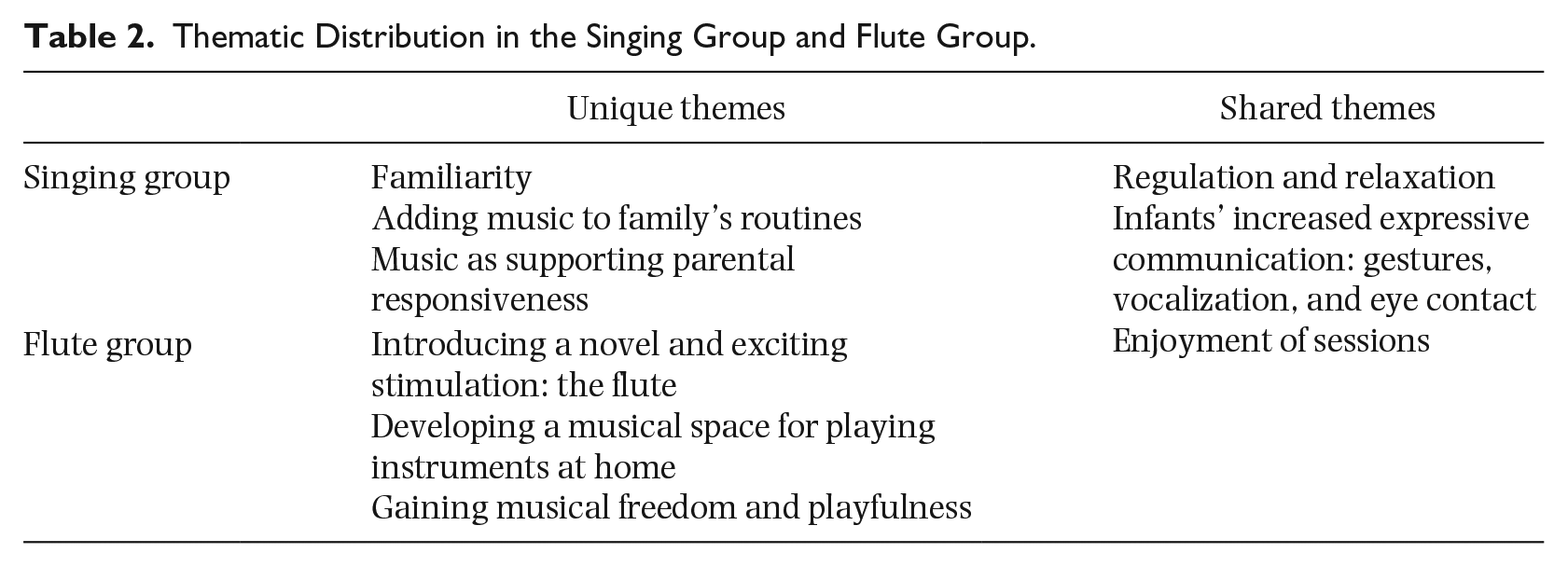
Nine themes emerged from the data analysis of both singing and FGs (see Table 2). Three themes were shared by the two group, including “Regulation and relaxation,” “Infants’ increased expressive communication: gestures, vocalization and eye contact,” and “Enjoyment of sessions.” In addition, the groups differed in three themes (i.e., unique themes), as follows: “Familiarity and reassurance,” “Adding music to family’s routines,” and “Music as supporting parental responsiveness” in the SG; and “Introducing a novel and exciting stimulation: the flute,” “Developing musical space for playing instruments at home,” and “Gaining musical freedom and playfulness” in the FG. We will begin with presenting the shared themes and follow with a description of each setting’s unique themes.
Thematic Distribution in the Singing Group and Flute Group.
Shared themes
Regulation and relaxation
All the participants mentioned the soothing component of some of the group’s songs, which assisted them to calm their babies within and outside of the group’s setting, emphasizing how the songs used in the group were relaxing for both parent and infant. For example, Cristina from the singing group stated, When I sing to him, I quite often make him sleep, and also my friend’s baby, I get him to sleep, I sing to them your song—“close your eyes”? I find it really calming. And I also find that if I repeat it over and over again, it’s not too annoying to repeat it over and over and over again.
Ella from the flute group emphasized that “it was extremely relaxing, the sessions, for both me and her.” Meg, flute group, explained, “the music is a physical reassurance for her (baby). As in, a way to be more comfortable with her body, the flute was very relaxing to listen to.”
The relaxing quality of the flute might have laid the basis for parents being open to engage in various activities led by the flute. As a result, the parents could allow themselves and their babies to embark on novel and exciting musical adventures. As will be shown in further themes, the parents’ tolerance to new ways of communicating musically with their infants seemed to influence the musical experiences they initiated in their own homes.
Infants’ increased expressive communication: gestures, vocalization, and eye contact
An increase in the babies’ communicative gestures was present among both groups’ participants. All the participants in the SG highlighted the influence of participating in the music group on their infants’ communicative gestures, language comprehension, and vocalizations, as described by Barb, The music sessions really brought on Martha’s communication skills! Definitely, whenever there’s music, she prompts what’s coming next. So especially, you know, the “clap, clap, clap”! Ya, as soon as she does the “high up in the sky,” she’s ready, she gets her hands ready, she knows! They are ready for “clap clap clap,” and then she is really excited—and claps!
The group created for the parents a strong and reassuring framework, which enabled them to use the songs when trying to encourage their child’s gestures and preverbal sounds. However, this new musical foundation seemed to also affect the parent–infant dyad in a deeper level. The parents reported that the new musical environment supported the parents in observing their infants and following their cues better. In other words, the music group enhanced the parent–infant bonding.
In the flute group, this theme did not stand out in the interviews, as the participants mentioned less frequently their babies’ increased communication, and seldom referred to it as the central influence of the group (as opposed to the high emphasis this theme received in the SG). However, this point was touched upon four of the FG participants. For example, Jana shared, Like spending more time and communicating with each child [. . .] and when you played with them individually, it’s lovely to have more time for that. Sometimes it felt like he was really engaged with you in improvising, and you were looking at him, and he were looking at you, and that’s lovely.
Enjoyment of sessions
All the participants emphasized how much they enjoyed coming to the group’s sessions and engaging in the musical activities. Shan, SG, declared, they have “really enjoyed coming! [. . .] So we’re going to miss it! We’re gonna have to make an effort to do more music with her!.” Hann, SG, shared, “at first she [the baby] was ambivalent regarding the ‘new’ music group, but then I realized how much she loved it! How she anticipated that!.” It seems that both musical settings provided parents and babies with moments of joy, which laid the basis for their enthusiasm and devotion to the sessions, as well as increased their sense of safety and willingness to explore new territories with their babies.
Unique themes (SG)
Familiarity
All the participants emphasized the significance of listening to the same songs, in the same order each week. This consistency enabled the parents to feel familiar with the songs, and to gain confidence in singing the songs to their infants at home. Some participants asserted that they haven’t felt as comfortable singing to their infants as they felt with the group’s songs. Hann specified, Because it has always been the same thing, I think she definitely knows the routine in a way! Not really knowing the routine, but to some degree she knows! She was quite getting excited when she saw the buildings, when we approached here . . . so there is something going on in her mind!
Parents reported singing much more to their infants in the home environment, using the group’s songs as originally sung in the group’s meetings, as well as altering and improvising the songs’ words, depending on what their infant was doing.
Adding music to family’s routines
All the participants highlighted how the participation in the music group enhanced their engagement in musical activities at home, with their babies: mostly singing more with their infants. For example, Cristina described, “sometimes I change the words or improvise on it, so in the bath sometimes I will go: ‘splash, splash, splash’—instead of ‘clap, clap, clap’!” [e.g., part of a tune that was sung in the music group]. Being immersed in the group’s songs elevated the participants’ confidence in using them in several new ways when taking care of their infants, for example, when calming their infants down.
Music as supporting parental responsiveness
Four participants described the musical activities in the group as cueing them to focus on their babies’ musical and non-musical reactions, thus assisting them to understand their babies better—within the group’s setting as well as at their home environments. Cristina came to realize, “at home, I have started noticing things more . . . how he is responding to things.” It seems that engaging in a musical relationship with their babies provided the parents with an increased ability to be in the moment and to focus on their child’s behaviors for longer periods of time. This relates to previous themes discussing the group’s influence on the parents’ sense of relaxation and joy which might account for their increased capacity to observe and respond to their baby’s cues.
Unique themes (FG)
Introducing a novel and exciting stimulation: the flute
One of the most prominent themes emerging from the analysis of all FG interviews revolved the stimulating characteristic of the flute. At times, the flute seemed to “cast a spell over the participants” (as mentioned by one of FG participants), engaging the babies musically in new and different ways. Yola described the particular sound of the flute, The flute’s sound was really special, because I haven’t been in touch with this sound very much, so for us it was something new. So I found it lovely! Because I love music, all kinds of music. All different sounds. And I think that was a really nice stimulation. It was new to us. And I think, ya, it was really nice to get to know it . . . I really like the sound of it!
Helen explained, “all the different pitches in the flute, she’s definitely picking up from and engaging from, she liked the flute.” The flute sound stimulated both parents and infants and captured their attention. As will be shown subsequently, engaging in a musical activity that incorporated a musician-MT, sharing her deep musicianship through her flute playing, seems to have encouraged the parents to develop their own personal, musical environments at their homes, as part of building a nurturing environment for their infants.
Developing a musical space for playing instruments at home
Four participants highlighted the significance of the FG in increasing their awareness regarding the importance of music in their babies’ lives. This new musical awareness resulted in expanding their musical environments, purchasing more musical instruments at home, expanding the musical activities at home and allowing their babies to create their individual musical space, as noted by Yola, The music was there already, but not in such an extended way, or in such structured thinking about it. So now I think about it a bit more consciously, about the instruments, about the way I can do it. Before it was there already but it was more as a part of who we are, but after the classes I would say it’s more [. . .] you think about it in a different way. More focused on what you can do, with what instruments.
Creating for their babies a rich musical environment promoted the babies’ engagement in musical activities at their homes. As a consequence, the parents in the FG described how playing music became a preferred way to spend time with their infants.
Gaining musical freedom and playfulness
A central theme highlighted by four participants, involved the playfulness and freedom that was facilitated in the group, due to its purely musical characteristic. It seems that the parents discovered, with their babies, new musical territories to explore and enjoy together. For example, Yola specified, What I took was within the music, the specific sounds, like, when you were playing on the flute, you were like doing little breaks, or suddenly speeding up the tunes, or the sounds, and I think I do now lots of different sounds like that at home as well [. . .] What I do differently or changed is the playfulness with the music. Maybe not so consciously, but because it was part of the classes I start also doing it at home, in terms of speed, or changing the pitch or the movements with the sound [. . .] So I can sing with a different speed, or with a different pitch, so sometimes like higher . . . or very like lower . . . and I noticed that that makes a difference . . . so it expanded the way that I can play with the music with her. The music became more playful . . . a bigger range of possibilities.
Comparing to other music groups, Jana mentioned, In the other music groups, there was not really space for him to explore, whereas in here, it’s a great place for him to explore and also take in the music, so he doesn’t get unhappy or distressed, if you know what I mean. It was more free, more adapted to him. ‘cause when you do rhymes, you have to sit still, and there’s no place to go and explore, so here there were a lot of options.
The more the parents embraced music as a way to interact with their baby, the more they started to notice how their baby responds and engages in their musical play.
Discussion
The aims of this feasibility study were (1) to establish a research protocol to test the potentially differential influence of vocal- versus instrument-based parent–infant musical interactions on the development of communication, (2) to explore parents’ perceptions of engaging musically with their infants in the two different settings, and to assess both (3) the transferability of the group experience to the home environment with self-administered components and (4) the compliance of participants in completing quantitative measures (i.e., questionnaires).
Overall, the results showed that we developed a workable, well-received, and feasible protocol leading to clearly differentiated experiences in function of group type, which can be used in future RCT longitudinal projects. We also showed that the inclusion of a self-administered phase in the home is viable.
The analysis of the parents’ interviews highlighted six themes for each group. Three themes were shared among the two groups, emphasizing increased communication, infants’ relaxation, and the families’ sense of joy from the sessions. Although the participants of the FG mentioned only moderately the influence of the music group on their babies’ expressive communication, the participants of the SG have much elaborated on this aspect. All parents of the SG indicated their infants’ communicative gestures, language comprehension, and vocalizations. The results imply that, in the parents’ experience, musical characteristics such as sung melodies may hold potential to influence language development, consistently with the literature on infants (Falk et al., 2021; Franco et al., 2022; Gerry et al., 2012; Papadimitriou et al., 2021), preschoolers, and adults (e.g., Politimou et al., 2019; Schön et al., 2008).
Different studies showed that using predictable and familiar songs supports parent–infant dyadic play (Shoemark, 2011), as well as elevates infants’ regulation (Cirelli & Trehub, 2020). The current study expands on these findings, focusing not only on the infants alone, but on the significance of predictability and familiarity for the parents as well. Recent studies have shown that parent–infant singing has an additional positive influence on parents’ regulation (Cirelli et al., 2020) and on maternal perceived emotional closeness (Fancourt & Perkins, 2018). Cirelli et al. (2020) asked mothers to sing to their infants “Twinkle Twinkle, Little Star,” in two contrasting styles: as a lullaby and as an activity song, while measuring infants’ attention as well mother–infant skin conductivity. The authors discovered that singing in a soothing style lowered not only infants’ arousal levels but also their mothers’. The authors mentioned the remaining ambiguity regarding this result, and their inability to determine whether the mothers’ decreased arousal levels originated from the music’s regulating effect or from observing their regulated infant.
The current research showed that the musical intervention not only created a positive place for the parent–infant dyads but also enhanced the parents’ abilities to observe their infants’ communicative behaviors, and to perceive and respond to their babys’ cues. This finding is consistent with Boorom et al. (2020), who examined the influence of parent–child musical engagements on parents’ responsiveness. Although the authors focused on preschool children with autism and their parents, their findings shed light on the bi-directional impact of musical experiences.
The distinctive themes of the FG surprised us the most. The flute is easily producing sound in the higher pitch used in the ID-register and, primarily, flute playing had a relaxing influence that seemed to be intrinsic to its sound. This idea resonates with the writings of Hadar and Amir (2018), regarding the tender sound of the flute and its ability to create an empathic and containing environment when engaging with a client in music therapy settings (although this finding pertains to flutist-music therapist specifically, it might relate to the MT being an expert on a particular instrument, and not to the sound quality of the flute per se).
Another theme involved the musical freedom the participants gained from the group sessions. It appeared that the musical and nonverbal relationship that the MT maintained with the parents and infants of the FG inspired the parent–infant relationship. The participants described a creative musical focus they gained from the group’s sessions, in which they embraced an instrumental approach to relate to their babies. Influenced by the sessions, most of the participants bought new instruments to their households and even started to make novel instruments at home (e.g., using plastic bottles filled with pebbles). Furthermore, some participants emphasized the playful approach to music they learned: how to play around with different pitches, to apply sudden breaks in their musical phrases or to combine sound and movement in a lively way. Words such as “freedom” and “exploration” were frequently and specifically indicated within the interviews of this group’s participants.
Improvisation has been long used in music therapy practice as gateways to elicit musicality, freedom, and creativity among clients (Amir, 2017; Bruscia, 1987; Hadar & Amir, 2021; Nordoff & Robbins, 1977). The present research illuminated the possibility of eliciting parent–infant playfulness with flute playing, thus promoting parental creativity and freedom. Noteworthily, the themes of “freedom” and “playfulness” did not emerge in the SG. Two possible reasons for this: (1) the flute being the MT’s principle instrument, thus influencing the levels of freedom and playfulness incorporated in her play (Hadar & Amir, 2018; Oldfield et al., 2015); (2) using exclusively musical instruments in group settings, might facilitate a unique kind of musical exploration due to the novelty of the experience for most participants (differently from singing). Future studies might elucidate if this result can be generalized to other musical instruments (e.g., guitar), or is somewhat specific of the flute.
In conclusion, even if with different nuances, both groups provided new tools for the parents to facilitate and develop communication with their babies. Concerning the transferability of the group experience to the home environment, it is of great interest that participants thought that using the CD with groups activities between the end of the intervention and the follow-up was useful, enjoyable hence regularly used. This is consistent with previous findings that have highlighted how the positive effects of family-based music therapy sessions were enhanced by repeating the musical activities at home with an audio cassette (Shoemark, 1996). The CD was not administered earlier on with the intention to test in the follow-up if it had been used as self-administered support. However, we do highly recommend including it from start in a larger scale RCT.
Furthermore, previous correlational studies that have addressed the effect of home musical enrichment on language and cognitive development have identified positive associations with language-related auditory neural processing (Putkinen et al., 2013), grammar (Politimou et al., 2019; Williams et al., 2015), emotional and prosocial skills (Williams et al., 2015; this study tested the associations longitudinally), and gestures and vocabulary (e.g., Papadimitriou et al., 2021; Schaal et al., 2020). The present study corroborates the suggestions emanating from the above studies that specific group interventions adopting a combination of participatory activities and home environment support activities are likely to be both embraced by families and effective in enhancing parent–infant communication.
This study had several limitations. The quantitative assessments trialed in this study concerned language development and attachment because such variables are key developmental outcomes in infancy (Groh et al., 2017; Leerkes & Zhou, 2018; Lytle & Kuhl, 2017), but other measures could also be used, for example, a transferability measurement of the participants’ use of group music at their home environments; coding of parent or infant behavior during classes. Another limitation pertains to the fact the same person leading the groups conducted the interviews, which could have possibly led to a bias in the participants’ interviews (Borrelli, 2011). In the Supplementary Material Online, we have also included recommendations for improvement, based on what we have learned throughout this study. Due to lack of parental motivation, we ended up with a very small control group (n = 3), which impeded an accountable comparison with the experiment groups.
Overall, this study was successful in identifying specific influences of different music group experience, hence offering a tested protocol suitable for use in a full-scale RCT in which a larger cohort of participants could be randomly allocated into different musical activities or control groups, giving researchers the opportunity to test the impact of specific musical aspects, and use a mixed-methods approach including quantitative measures in multiple time points to assess developmental outcomes. Such studies are important to develop specific forms of intervention tailored to different needs for support ranging from known developmental delays or difficulties (e.g., very premature birth/language development delay) to challenging social contexts (e.g., recent immigration with social isolation and second language difficulties).
Supplemental Material
sj-docx-1-pom-10.1177_03057356231166759 – Supplemental material for Comparing the benefits of parent–infant flute and singing groups for communication and parenting: A feasibility study
Supplemental material, sj-docx-1-pom-10.1177_03057356231166759 for Comparing the benefits of parent–infant flute and singing groups for communication and parenting: A feasibility study by Tamar Hadar, Nina Politimou and Fabia Franco in Psychology of Music
Footnotes

References
Supplementary Material
Please find the following supplemental material available below.
For Open Access articles published under a Creative Commons License, all supplemental material carries the same license as the article it is associated with.
For non-Open Access articles published, all supplemental material carries a non-exclusive license, and permission requests for re-use of supplemental material or any part of supplemental material shall be sent directly to the copyright owner as specified in the copyright notice associated with the article.
