



Abstract
Cognitive aging is characterized by the gradual decline of a number of abilities, such as attention, executive functioning, and memory. Research on memory aging has reported age-related deficits in short-term (STM), long-term (LTM), and working memory (WM) and linked these to structural and functional changes in the brain that occur with aging. However, only a few studies have drawn direct comparisons between these memory subsystems in the auditory domain. In this study, we assessed auditory STM, LTM, and WM abilities of young (under 25 years of age) and older (over 60 years of age) adults using musical and numerical tasks. In addition, we measured musical training history and tested its modulating effects on auditory memory performance. Overall, we found that older adults underperformed in specific memory tasks, such as STM related to discrimination of rhythmic sequences, LTM associated with identification of novel musical sequences, and numerical WM. Furthermore, we observed a positive influence of musical training on certain memory tasks involving music. In conclusion, aging differentially affects several types of auditory memory, and in the case of specific musical memory tasks, a higher level of musical training provides significant advantages.
Normal aging is accompanied by a number of physical and psychological changes. Among them, cognitive aging, or the physiological and functional age-dependent changes in the brain, can become an important cause for concern in older adults.
Cognitive aging has been well documented in the scientific literature. Age-related declines in selective (Geerligs et al., 2014; McAvinue et al., 2012) and sustained (McAvinue et al., 2012) attention are noticeable in many daily tasks and have been linked to overall white matter atrophy (Gunning-Dixon et al., 2009), reduced interhemispheric connectivity (Zhao et al., 2020), and altered mechanisms in the frontoparietal network (Chao & Knight, 1997; Geerligs et al., 2014; Madden et al., 2007). Deficits in executive functioning can occur with advancing age and have also been described in rodents (Bizon et al., 2012). Such disruptions have been reported in cognitive flexibility (Oosterman et al., 2010; Wecker et al., 2005), planning (Sorel & Pennequin, 2008), and inhibitory control (Chao & Knight, 1997). In addition, age-dependent deficits in processing speed can affect other cognitive domains (Finkel et al., 2007; Salthouse, 2000).
Among the affected cognitive functions during normal aging, memory is most worrying for older adults. More than 50% of older individuals (over 60 years of age) report subjective memory complaints (Kryscio et al., 2014) and are at higher risk of developing dementia than older adults without memory complaints (A. Mitchell et al., 2014). However, despite the overall decline in memory functioning that accompanies advancing age, not all types of memory are equally affected (Grady & Craik, 2000).
Semantic memory, which stores factual information and general knowledge, is relatively well preserved from early to late adulthood (Bäckman & Nilsson, 1996; Rönnlund et al., 2005). This semantic knowledge can even aid episodic (i.e. autobiographical) memory in older age. For example, Levine et al. (2002) showed that, compared to a matched group of young adults, older adults placed higher emphasis on semantic rather than autobiographical details when recalling life events.
Similarly, procedural memory is minimally affected by advancing age. Procedural or skill learning mediates the acquisition of cognitive and motor skills, such as reading or playing a musical instrument. Although age-related deficits in performance speed (Salthouse, 1984) and in consolidation of new procedural skills (Brown et al., 2009) can occur, memory of specific procedural skills is preserved (Churchill et al., 2003; Korman et al., 2015), and acquisition of new skills remains relatively intact with older age (Brown et al., 2009).
In terms of the temporal categories of memory (i.e. short-term [STM], long-term [LTM], and working memory [WM]), age-related deficits are often observed. STM refers to the ability to maintain information after the sensory input has been removed (Hartman & Warren, 2005; Murphy et al., 2000; Naveh-Benjamin et al., 2007; Park et al., 2002). Age-related deficits in STM have been linked to the decline in processing speed that often accompanies advancing age (Finkel et al., 2007; Salthouse, 1992; Sliwinski & Buschke, 1997; Verhaeghen & Salthouse, 1997). Another factor that can contribute to STM decay is the negative impact of divided attention, or dual-tasking, which increases with aging (Castel & Craik, 2003; Craik & McDowd, 1987; Verhaeghen et al., 2003). Neuroimaging studies have associated age-related decrements in visual STM with reduced connectivity between the posterior thalamus and occipital cortices (Menegaux et al., 2020) and deficits in source STM (i.e. memory for context) with reduced activity in the left lateral prefrontal cortex (K. J. Mitchell et al., 2006).
LTM, which retains information for periods of time in the range of hours or longer, is also age-sensitive (Nyberg et al., 1996; Nyberg et al., 2003; Rönnlund et al., 2005). Age-related declines are commonly observed in a variety of episodic LTM tests (e.g. recognition, paired-associate learning, free and cued recall, etc.) and often take place during the initial encoding phase (Brickman & Stern, 2009; Hasher, 2006). Similar to STM, processing speed is fundamental in explaining LTM decay in older adults (Park et al., 1996). In addition, disruption of the frontostriatal systems, medial temporal lobe, and associated cortical networks has been linked to deficits in declarative LTM, along with decrements in attention and executive functioning (Buckner, 2004; Grady, 2012).
WM is involved in the temporary storage and manipulation of information. A decline in this memory subsystem has been observed in older adults (Choi et al., 2014; Grady & Craik, 2000; Grégoire & Van der Linden, 1997; Salthouse, 1994), and WM deficits are associated with age-related decrements in episodic memory (Memel et al., 2019) and STM binding (Fandakova et al., 2014). In terms of the neural bases of WM age-related decline, the Compensation-Related Utilization of Neural Circuits Hypothesis (CRUNCH) (Reuter-Lorenz & Cappell, 2008) postulates that older adults overrecruit frontal and bilateral brain regions for completion of WM tasks when the demands are low. However, as task load increases, their neural resources are depleted, leading to neural under-recruitment and performance decline (Schneider-Garces et al., 2010).
Despite the extensive literature on memory and aging, few studies have drawn direct comparisons between the three types of temporal memory subsystems (i.e. STM, LTM, and WM), particularly regarding auditory memory. Furthermore, little is known about the mechanisms that can mitigate cognitive decline (Stern, 2002, 2003). Educational level and IQ are associated with the use of effective memory strategies in older ages (Frankenmolen et al., 2018). Similarly, musical training has positive effects on cognitive functioning in older adults. Seinfeld et al. (2013) found that piano training improved performance on measures of visual scanning, motor ability, executive function, divided attention, and inhibitory control in a group of older individuals. In addition, Hanna-Pladdy and MacKay (2011) showed that older musicians performed better than age-matched non-musicians in nonverbal memory, naming, and executive functioning tasks. Such findings are mirrored by the preservation of structural and functional neural features of a musicianship-related network (e.g. increased gyrification of auditory cortex, greater activation of auditory areas) in older musicians, which may have a neuroprotective effect during aging (Rus-Oswald et al., 2022).
In this study, we focus on differences in auditory memory functioning between young and older adults and the modulating influence of musical training on this cognitive domain. We wish to provide further information on this broad topic by comparing the performance of two age groups on several tasks that assess three types of auditory memory: musical STM and LTM and verbal WM. Some of the tasks involve music, so we also study how a history of musical training affects memory capacity. Following previous studies, we expect to observe a decline in older adults as compared to young adults in all the investigated memory systems. Furthermore, we hypothesize that the level of musical training will modulate this decline, especially in tasks comprising musical stimuli.
Methods
Participants
The sample consisted of 77 participants (43 females, 34 males) that were divided into two age groups. The young adults group comprised 37 participants (18 females, 19 males) aged 18 to 25 years (mean age: 21.89 ± 2.05 years). The older adults group included 40 participants (25 females, 15 males) aged 60 to 81 years (mean age: 67.50 ± 5.46 years). All participants were Danish. The inclusion criteria applied were (1) normal health (no reported neurological nor psychiatric illness), (2) individuals aged between 18 and 25 years (young adults) and above 60 years (older adults), (3) normal hearing, (4) normal sight or corrected normal sight (e.g. contact lenses), and (5) understanding and acceptance of participant information. The exclusion criteria applied were (1) the use of prescribed medication that affects the central nervous system, (2) neurological or psychiatric illness, (3) a lack of cooperation or verbal agreement to participate in the study, and (4) magnetic resonance imaging contraindications.
The project was approved by the Institutional Review Board of Center for Music in the Brain, Aarhus University (case number: DNC-IRB-2021-012). The experimental procedures complied with the Declaration of Helsinki—Ethical Principles for Medical Research. Participants’ informed consent was obtained before starting the experiment.
Materials and procedure
We tested participants’ individual STM, LTM, and WM with performance tests and assessed musical training levels with a questionnaire in a quiet room at Aarhus University Hospital (Aarhus, Denmark).
The Musical Ear Test (MET) (Wallentin et al., 2010) was used to measure musical STM abilities. The MET consists of 104 trials in which participants state whether two brief musical sequences are identical. The test is divided into two parts: melody, which consists of 52 sets of melodic sequences, and rhythm, comprising 52 sets of rhythmic sequences. Due to time constraints, we used a reduced version of the test consisting of 40 trials (20 sets of melodic sequences and 20 sets of rhythmic sequences) (Harrison et al., 2016, 2017). Scores ranged from 0 to 20 on each part.
To assess auditory LTM abilities, we used an old/new auditory recognition task. During the encoding part, participants were instructed to listen four times to a shortened version of the right-hand part of Johann Sebastian Bach’s Prelude in C minor, BWV 847. Subsequently, during the recognition part, participants were presented with 27 brief musical sequences (repeated twice) that were extracted from the prelude (“old”) and with 54 novel musical sequences (“new”) of the same length, and they were asked to make an “old/new” discrimination for each trial. Scores ranged from 0 to 54 for both old and new sequences.
We also assessed verbal WM abilities with the digit span and arithmetic subtests from the Working Memory Index in the Wechsler Adult Intelligence Scale IV (WAIS-IV) (Wechsler, 2009). During the Digit Span subtest, participants listened to sequences of numbers of increasing length and were asked to repeat them in the same, inverse, or ascending order (forward, backward, and sequencing, respectively). For the arithmetic subtest, participants computed mathematical operations without external aids (e.g. paper and pencil, calculator). To compute individual WM abilities, we combined the raw scores from the digit span and arithmetic subtests. Scores ranged from 5 to 70.
Finally, formal musical training was assessed with the Goldsmiths Musical Sophistication Index (Müllensiefen et al., 2014) (Gold-MSI) questionnaire. This self-report measure comprises 39 questions related to musical skills, experience, and habits. Each item is assessed on a seven-point Likert scale (from “1 = Completely disagree” to “7 = Completely agree”). Here, we used the musical training facet, which estimates an individual’s history of formal musical training. Individual scores on the musical training facet range from 7 to 49. For this study, we employed the Danish version of the Gold-MSI (see https://shiny.gold-msi.org/gmsi_toplevel/) used by Møller et al. (2021).
Statistical analyses
Descriptive statistics were computed for all variables. A one-way multivariate analysis of covariance (MANCOVA, Wilk’s Lambda [Λ], α = .05) was performed to compare STM, LTM and WM skills between the two age groups while controlling for individual musical training level. We used one independent variable with two groups (young adults and older adults), five dependent variables (STM melody, STM rhythm, LTM old, LTM new and WM scores), and one covariate (musical training score). The effect size was calculated using partial eta squared (i.e. partial η2).
Afterward, to determine the effects of the independent variable and covariate, 10 univariate analyses of covariance (ANCOVA) were computed individually for each of the dependent variables. These were computed at α = .005 after applying the Bonferroni correction (.05 divided by the number of ANCOVAs conducted) as follow-up tests to the MANCOVA.
Results
Descriptive statistics
Descriptive statistics for the measures of STM (melody and rhythm), LTM (old and new), WM and musical training are provided in Table 1. Two outliers were removed from the old and new variables (z-scores below −3), and four values were missing from the WM measure. Figure 1 illustrates group differences in normalized scores using raincloud plots (Allen et al., 2019).
Descriptive Statistics for STM (STM Melody and STM Rhythm), LTM (LTM Old and LTM New), WM, and Musical Training Scores as a Function of Group.

Note. Mean and standard deviation scores are reported. STM = short-term memory; LTM = long-term memory; WM = working memory.
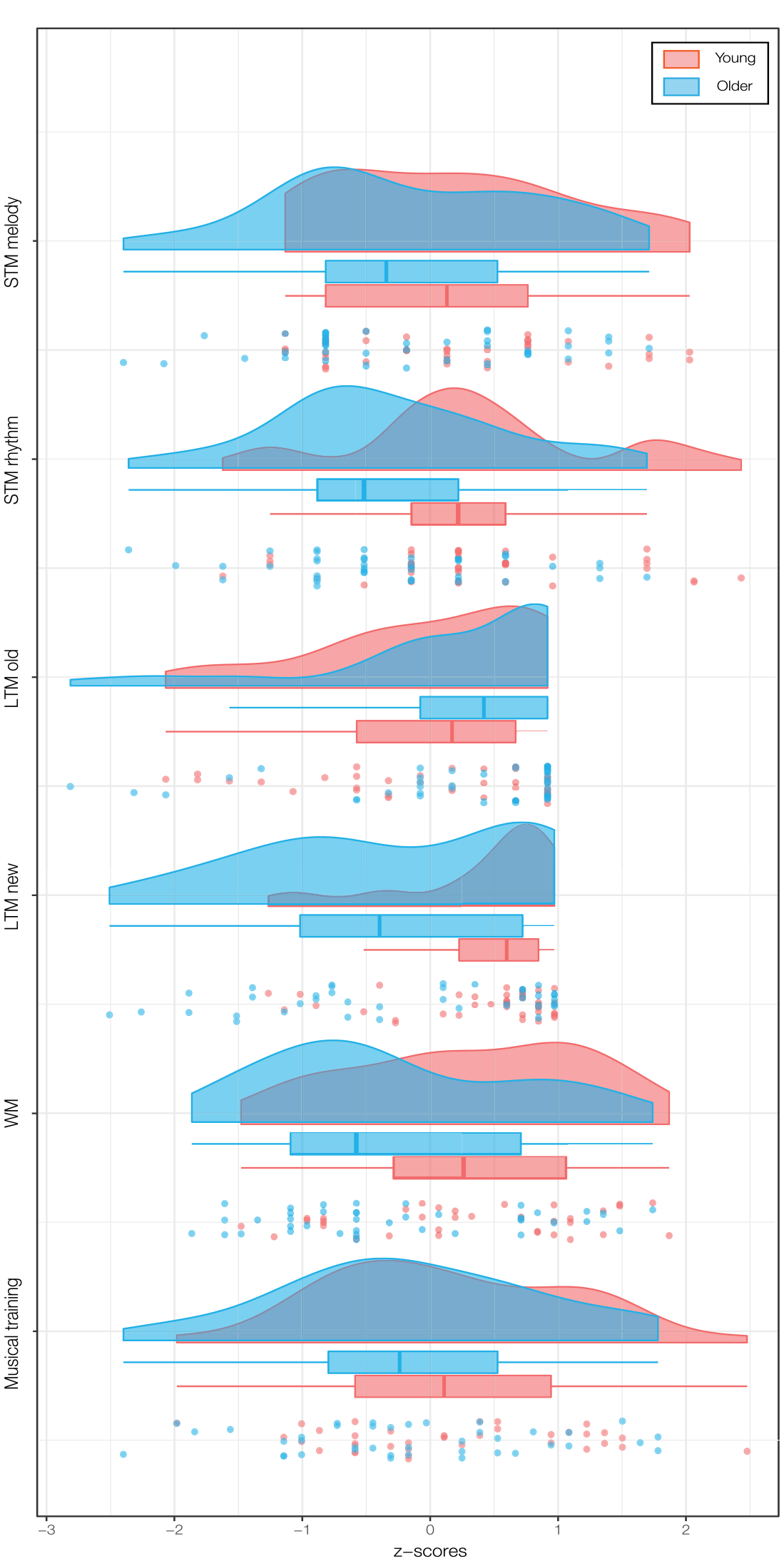
Raincloud Plots Show the Overlapping Distributions and Normalized Data Points of Both Age Groups in Short-Term Memory (STM melody and STM rhythm), Long-Term Memory (LTM old and LTM new), Working Memory (WM), and Musical Training.
Age-related differences in WM, STM, and LTM abilities
In order to assess the effect of age on WM, STM and LTM abilities while adjusting for musical training level, a one-way MANCOVA was used. Before computing the MANCOVA, we confirmed there were no significant differences in musical training level between the two groups, t(75) = 1.307, p = .195.
There was a statistically significant difference between the two groups on the dependent variables after controlling for musical training level, F(5, 64) = 4.129, p = .002, Wilks’ Λ = .756, partial η2 = .24. Follow-up ANCOVA showed statistically significant differences between young and older participants in STM rhythm, F(1, 74) = 10.299, p = .001, partial η2 = .12, and LTM new scores, F(1, 72) = 13.82, p < .001, partial η2 = .16. In addition, WM approached the significance level after correction for multiple comparisons, F(1, 70) = 7.631, p = .007, partial η2 = .10. On the contrary, STM melody, F(1, 74) = 3.535, p = .064, partial η2 = .05, and LTM old scores, F(1, 72) = 0.154, p = .696, partial η2 < .001, were not significant after controlling for musical training level.
There was a statistically significant effect of the covariate on the dependent variables, F(5, 64) = 3.858, p = .004, Wilks’ Λ = .768, partial η2 = .23. Follow-up ANCOVA showed statistically significant effects of musical training level on STM melody scores, F(1, 74) = 17.056, p < .001, partial η2 = .19, and LTM new scores, F(1, 68) = 13.46, p < .001, partial η2 = .16, meaning that a higher level of musical training was associated with higher STM melody and LTM new scores. Musical training had no effect on WM, F(1, 70) = 3.285, p = .074, partial η2 = .04; STM rhythm, F(1, 74) = 5.744, p = .019, partial η2 = .07; and LTM old scores, F(1, 72) = 1.843, p = .17, partial η2 = .02.
Discussion
The main goal of this study was to assess the impact of age on auditory memory functioning. Our sample consisted of two age groups with matching musical training experience. We found significant effects of age on specific memory abilities (i.e. STM for rhythm and LTM for new sequences). In addition, we observed a positive influence of musical training level on certain memory tasks involving music.
Previous research has shown that STM capacity tends to decline with age (Naveh-Benjamin et al., 2007; Park et al., 2002), and this is associated with decrements in processing speed and divided attention (Finkel et al., 2007; Verhaeghen et al., 2003; Verhaeghen & Salthouse, 1997). In this study, we employed a musical paradigm that comprised same/different judgments of melodic and rhythmic musical sequences and confirmed that auditory STM declines with age. We found that young participants outperformed older participants in the STM rhythm measure, but there were no significant differences in the STM melody measure. These results are consistent with previous research on neural specializations for rhythm and melody. Using positron emission tomography, Jerde et al. (2011) showed that WM for rhythm and melody activated distinct brain networks: the cerebellum, insular cortex, and cingulate gyrus for rhythmic sequences and right frontal, parietal, and temporal cortices for melodic sequences. Processing of rhythm has been typically linked to motor brain regions, such as the supplementary motor area, basal ganglia, and cerebellum (Kotz et al., 2018). One explanation for the decreased performance we observed in the STM rhythm measure is the changes in the cerebellar structure that occur with advancing age (Han et al., 2020; Woodruff-Pak et al., 2010). Indeed, one review linked age-related differences in cerebellar volume with cognitive and motor declines (Bernard & Seidler, 2014). This distinction between rhythm and melody was also evident when examining the effect of the musical training covariate. We found that musical training level had a positive effect on STM for melodic sequences, but not on rhythmic sequences. Because the musical training level of both groups was the same, it is reasonable that their performance was not significantly different in the STM melody measure.
To investigate age-related declines in LTM capacity (Nyberg et al., 2003; Rönnlund et al., 2005), we asked participants to perform a musical recognition task. Once again, results differed depending on the variable analyzed: Young individuals outperformed older individuals in identifying musical sequences that were not presented before (“new”), whereas the scores did not significantly differ when recognizing musical sequences that were previously listened to (“old”). Consistent with our results, older adults perform worse than young adults during free recall than during recognition tasks (Rhodes et al., 2019). Moreover, older individuals exhibit increases in the number of false recognitions (i.e. remembering an event that did not happen) (Gutchess et al., 2007; Schacter et al., 1997). In terms of musical training level, we found a significant positive effect of this variable on the identification of new sequences, but no effect on the recognition of old sequences. This result denotes that memory recognition for musical stimuli was unaffected by previous musical experience. However, the distinction of old and new musical sequences required some musical skills.
Regarding age-related differences in auditory WM, we found no significant difference between the two age groups in WM skills. However, the results from the univariate ANOVA approached the significance level after correction for multiple comparisons, suggesting that young adults were close to outperforming older adults. This is in line with previous studies that investigated age-related decline in WM abilities (Choi et al., 2014; Grégoire & Van der Linden, 1997; Salthouse, 1994). In this study, we employed two WM tasks that are part of the widely used WAIS-IV. Performance on these tasks was previously shown to decline with age (Choi et al., 2014; Grégoire & Van der Linden, 1997; Rozencwajg et al., 2010) and is accompanied by over- or under-activation of the dorsolateral prefrontal cortex (Cappell et al., 2010; Reuter-Lorenz et al., 2000; Rypma & D’Esposito, 2000). Such neural activity is coherent with the CRUNCH hypothesis, which suggests that over-recruitment of frontal and bilateral brain regions is a compensatory mechanism in older adults when task demands are low, while under-recruitment weakens their performance (Reuter-Lorenz & Cappell, 2008; Schneider-Garces et al., 2010).
In addition to investigating differences in verbal WM between the two age groups, we also examined the effect of musical training on WM ability. We found no effect of the covariate on this measure. This result was expected, since the WM measure employed in this study had no relation to music or musical abilities. However, previous studies have shown positive effects of musical training and expertise on cognitive functioning (Criscuolo et al., 2019; Hanna-Pladdy & MacKay, 2011; Seinfeld et al., 2013), as well as relationships between musical training and preferences, cognitive abilities, and neuroplasticity (Bonetti, Brattico, Vuust, et al., 2021; Bonetti & Costa, 2016, 2019; Bonetti et al., 2017, 2018; Criscuolo et al., 2022; Iorio et al., 2022; Pando-Naude et al., 2021; Reybrouck et al., 2018), so it would be interesting to investigate this effect with the current WM measure in a sample of musicians and non-musicians.
Overall, our results indicate that (1) age has an effect on auditory memory abilities, (2) not all types of auditory memory are equally affected by aging, and (3) musical training level has a positive effect on music-specific memory skills. Furthermore, we found specific effects of aging on STM capacity for rhythmic sequences, but not for melodic sequences, and on LTM ability for identifying new sequences, but not for recognizing old sequences. Following previous studies on the spatiotemporal dynamics of memory (Bonetti, Brattico, Carlomagno, et al., 2021; Bonetti et al., 2020; Fernández-Rubio, Brattico, et al., 2022; Fernández-Rubio, Carlomagno, et al., 2022), our future research will focus on correlating these differences in memory capacity to patterns of brain activity and connectivity during auditory memory recognition.
Footnotes
Data availability

Funding
The Center for Music in the Brain is funded by the Danish National Research Foundation (project number DNRF117). L.B. is supported by Carlsberg Foundation (CF20-0239), Lundbeck Foundation (Talent Prize 2022), Center for Music in the Brain, Linacre College of the University of Oxford, the Society for Education and Music Psychology (SEMPRE’s 50th Anniversary Awards Scheme), and Nordic Mensa Fund. M.L.K. is supported by Center for Music in the Brain and the Centre for Eudaimonia and Human Flourishing funded by the Pettit and Carlsberg Foundations.