



Abstract
The Goldsmiths Musical Sophistication Index (Gold-MSI) measures a wide range of self-reported musical abilities and behaviors in the Western adult general population, regardless of musical expertise. This instrument has been validated in various languages, but an Italian version is lacking. The present study describes the Italian validation and adaptation of the Gold-MSI (Gold-MSI-IT) and investigates the effects of socio-demographic variables on scores of musical sophistication. Analyses of factor structure and internal reliability on an Italian sample (N = 429, mean age = 31.08, SD = 11.68, 75.5% female) and analyses of test–retest reliability on a smaller sample (N = 57, mean age = 34.68, SD = 10.80, 75% female) show that the Gold-MSI-IT conforms to a bifactor model, similarly to the original version, including an underlying General Musical Sophistication factor and five subfactors, and that our instrument has good internal consistency and good test–retest reliability. Additional tests showed gender differences in musical sophistication and that musical sophistication correlated with education but not with age. The study provides a reliable and stable tool to investigate individual differences in the Italian context and adds to our knowledge of musicality in the general population across countries.
Keywords
According to Gembris (1997), attempts to describe and assess musicality date back to as early as the 19th century. Until relatively recently, musicality was seen as the skillset developed by, and thus the privilege of, trained musicians through years of practice (Honing, 2018). Numerous studies have divided their samples (both of adult and young participants) into groups of musicians and non-musicians and investigated whether the possession of music skills is associated with benefits in other domains. Oftentimes, these studies have reported between-group differences in a number of areas, including language skills (e.g., Coffey et al., 2017; François et al., 2014; Zuk et al., 2013), episodic and working memory (e.g., Franklin et al., 2008; Talamini et al., 2017), inhibitory control (Bialystok & DePape, 2009; Jaschke et al., 2018), and motor skills (Jäncke et al., 1997; Kincaid et al., 2002). The enhanced abilities of musicians were interpreted as the consequence of the brain differences at the functional and structural levels found in neuroimaging studies (see Herholz & Zatorre, 2012, for a review), which, in turn, are thought to be ascribable to the cognitive and motor effects of musical training. Musical stimuli are unique in their highly complex sensorial structure and recruit many areas of the nervous system (Moreno & Bidelman, 2014; Münte et al., 2002; Zatorre, 2015). Consequently, music training has been elected as a model for studying cortical plasticity (Herholz & Zatorre, 2012; Jäncke, 2009; Moreno & Bidelman, 2014; Schlaug, 2015).
However, the definition of musicianship is arbitrary and inconsistent across studies (and cultures; Hallam & Prince, 2003). Although some studies place importance on the number of years of music training received only, others also consider the amount of daily or weekly practice to define a musician (see Zhang et al., 2020, for a review). The classification of participants into non-musicians is equally problematic and inconsistent. For example, in François et al. (2014), non-musicians were those who had no more than 2 years of formal musical training and who had not practiced an instrument during childhood, whereas in Zuk et al. (2013)’s study individuals had to have less than 3 years of instrumental experience and to have not been musically involved in the last 5 years to be considered non-musicians. An additional problem is posed by the definition of which training contexts can be considered “formal,” especially when it comes to children (Cogo-Moreira & Lamont, 2018).
Perhaps more importantly, the “musicians vs non-musicians” dichotomous approach fails to take into account the music abilities developed by less specialized groups. Although individuals differ in their understanding and perception of the formal elements of music (Oikkonen & Järvelä, 2014), all humans seem to have a predisposition for music. Basic skills in rhythmic and melodic perception and basic music competence, allowing individuals to acquire knowledge of musical systems, to synchronize motor behaviors to auditory stimuli, and to produce emotional and consistent responses to musical excerpts, are possessed by most individuals (Honing, 2018) and can be acquired through implicit learning by mere exposure to music (Bigand & Poulin-Charronnat, 2006; Saffran et al., 2000; Tillmann, 2008). According to neuroscience studies, experiencing music in a non-performative way could also lead to functional changes at the brain level (Janata et al., 2002; Popescu et al., 2004; Rickard & Chin, 2017). Studies on infants even suggest that these basic music skills could be innate, as after only 4 months of life children demonstrate sensitivity to musical features (e.g., consonance; M. R. Zentner & Kagan, 1996) that are found across different cultures (Trehub, 2015), regardless of their amount of previous exposure to music.
Moreover, the development of better or poorer music abilities across individuals is subject to the possession or lack of a genetic predisposition for music and is relatively independent of formal training. Genome-wide association studies have shown that some music skills are related to specific sets of genes and chromosomal loci (Gingras et al., 2015; Niarchou et al., 2022; Oikkonen & Järvelä, 2014; Tan et al., 2014). Recent behavioral studies also show that individual differences in music ability are stable over time, independently of music training (Kragness et al., 2021; Swaminathan & Schellenberg, 2020). Taken together, these studies suggest that, although most people show sensitivity to and knowledge of music features, there could still be large individual differences in the musicality of both musicians and non-musicians. Furthermore, distinguishing between musicians and non-musicians solely based on formal instrumental training leaves out the various ways in which individuals engage with music (Lima et al., 2020), their emotional and functional usage of music, and their creativity (Müllensiefen et al., 2013).
This body of work has motivated the delineation of a multifaceted profile of musicality, including identity-, creativity-, and receptive sensitivity-related aspects (Levitin, 2012; Rickard & Chin, 2017). Instruments have been developed encompassing the complexity of the experience of music (Chin & Rickard, 2012; Werner et al., 2006), such as engagement (Chin et al., 2018), the ability to decode emotions in music (MacGregor & Müllensiefen, 2019), music preferences (Rentfrow & Gosling, 2003), music making in children (Cogo-Moreira & Lamont, 2018), besides the perceptual and cognitive skills usually taken into account (Law & Zentner, 2012; Peretz et al., 2013; Ullén et al., 2014; Wallentin et al., 2010; Wolf & Kopiez, 2018; M. Zentner & Strauss, 2017).
The concept of musical sophistication and the English version of the Goldsmiths Musical Sophistication Index
One of the most important self-report tools designed to assess musicality across individuals is the Goldsmiths Musical Sophistication Index (Gold-MSI) by Müllensiefen and colleagues (2014). The construct of musical sophistication, as operationalized by Müllensiefen and colleagues (2014), plays an important role in the literature for its novelty. The authors enlarged upon the studies by Ollen (2006) and Hallam and Prince (2003); these studies addressed the need for a richer and more complex evaluation of musical ability, integrating technical and performance-related skills with motivation aspects and culture-embedded features belonging to the concept of musicality (Hallam & Prince, 2003). In line with this new, wider conception of musicality, Müllensiefen and colleagues (2013) developed the Gold-MSI, a 38-item self-report inventory assessing musical sophistication in the general Western population, with the aim of quantifying the multifaceted aspects of individual differences in musicality (Müllensiefen et al., 2013).
The questionnaire items investigate a wide range of musical behaviors and skills, such as perceptual and singing abilities, emotional aspects involved in musical experience, active engagement with music, time spent in practicing, and self-concepts related to the identity of a musician. These facets can be measured in anyone, regardless of formal music training (Müllensiefen et al., 2013). Participants are asked to indicate how much they agree with Items 1–31 (e.g., Item 24: “I would not consider myself a musician”) using a Likert scale from 1 (“Completely Disagree”) to 7 (“Completely Agree”). The response options are labeled differently for each of the remaining items (Items 32–38), which investigate the participants’ amount of engagement in several domains of musical experience (e.g., listening to music, participating at music events), but always range on a 7-point Likert scale, from a minimum amount to a given maximum amount (see, e.g., Item 35: “I have had formal training in music theory for . . .” where response options go from “0” to “7 or more years”). Higher total scores on the Gold-MSI indicate higher levels of musical sophistication.
The instrument has been validated in a large sample of English-speaking participants (N = 147,636) and factor analyses showed that the construct of musical sophistication is best described by a bifactor model, with a general factor, General Musical Sophistication, and five subfactors, Active Engagement (e.g., Item 1: “I spend a lot of my free time doing music-related activities”), Perceptual Abilities (e.g., Item 5: “I am able to judge whether someone is a good singer or not”), Musical Training (e.g., Item 33: “At the peak of my interest, I practiced __ hours per day on my primary instrument”), Singing Abilities (e.g., Item 23: “When I sing, I have no idea whether I’m in tune or not”), and Emotions (e.g., Item 2: “I sometimes choose music that can trigger shivers down my spine”). Because each one of these dimensions can be assessed individually, the questionnaire can be used for assessing both a variety of musical behaviors all together and a specific dimension of interest alone (Müllensiefen et al., 2013).
The Gold-MSI also showed good indices of internal consistency and very good indices of test–retest reliability. Importantly, Müllensiefen and colleagues (2014) found significant correlations between the subscales of the Gold-MSI and two listening tests assessing melodic memory and beat perception. This means that, despite its self-reported nature, the instrument allows a quantification of individual levels of performance (Lima et al., 2020). The English version of the Gold-MSI has been highly cited and influential and the use of the instrument in diverse research areas pertaining to music psychology has contributed to knowledge about the concept of musical sophistication and how it relates to various human functions and systems such as emotion regulation (Carvalho et al., 2022), language perception (Lad et al., 2022; Yates et al., 2019), music-induced emotions and affect perception (Küssner & Eerola, 2019; Smit et al., 2019; Taruffi et al., 2017), and age-related changes in brain structure (Chaddock-Heyman et al., 2021).
Given its merits, adaptations of the Gold-MSI have been carried out in various languages: Validated versions are currently available in German (Schaal et al., 2014), French (Degrave & Dedonder, 2019), European Portuguese (Lima et al., 2020), and Chinese (Lin et al., 2021). All the above fit the same structure of the bifactor model with a general factor and five subfactors consistent with the original version. However, an Italian version is lacking.
The present study
The present study aims to adapt and validate the Gold-MSI self-report questionnaire in the Italian context (Gold-MSI-IT). To have a reliable Italian version of the scale would help enlarge research and knowledge about musical sophistication as well as increase reliability of cross-cultural and cross-national comparisons. In this study, we were primarily interested in examining the internal validity (i.e., Grimm & Widaman, 2012) and, in particular, the dimensionality—in terms of a comparison between models with different indices of goodness of fit—and reliability of the Italian version of the scale. Our second aim was to explore the effect of some demographics and socio-economic variables on scores of musical sophistication in Italian nationals. Indeed, in the English (Müllensiefen et al., 2014), German (Schaal et al., 2014), and Portuguese (Lima et al., 2020) samples, higher musical sophistication was found for the younger, more educated, and more socio-economically advantaged participants. In the German, but not in the Portuguese, sample, higher socio-economic status was also associated with higher scores in the Musical Training subscale. Finally, in both the English and Portuguese samples, gender played a smaller predictive role. Accordingly, we aimed at investigating the effect of age, gender, and education on Gold-MSI-IT scores in Italy.
Method
Participants
A total of 433 Italian-native speakers from the adult general population were part of the initial test sample. Two participants were excluded because they were not of Italian nationality. Two further participants were excluded because they declared they were aged below 18. The final sample of N = 429 (75.5% females) consisted of people aged between 18 and 72 years (M = 31.08, SD = 11.68). All participants were Italian-native speakers and had completed, or were in the process of completing, their studies in Italy. Regarding occupational status, most participants had full-time jobs (37.4%) or were still attending the undergraduate level of instruction (39.7%); a smaller percentage was self-employed (9.99%); the remaining participants were unemployed, retired, had part-time jobs, or were homemakers. In terms of years of education, most participants (66.6%) had completed upper secondary and post-secondary education (from 13 to 21 years of study), 22.2% lower secondary education (8 years of study), and 11.1% primary education (5 years). For the retest sample, we collected answers from 60 participants, but we were only able to match 57 of those who responded to both surveys and provided the same e-mail address both times (mean age = 34.68; SD = 10.80; age range = 20–68 years; 75% female).
All participants gave their informed consent both for participation in the study and for data processing. The protocol was approved by the Ethics Committee of the Department of Human Sciences of the University of Verona (cod. 2021_36).
Materials and procedure
As mentioned in the Introduction, the original version of the Gold-MSI includes 38 items which can be grouped into five subscales: Active Engagement, Perceptual Abilities, Musical Training, Singing Abilities, and Emotions. A general factor of musical sophistication can also be calculated using a selection of 18 items from the other subscales. The first co-authors, who are Italian native speakers fluent in English, who received formal music training, and who are researchers in the music science field, independently translated the items of the Gold-MSI from English into Italian. The socio-demographic section included in the original documentation was adapted, so as to properly take into account the differences between the British and the Italian education systems. Discrepancies between the independent translations were sorted out between the two translators and a single version, as adherent to the meaning of the original one and as easily comprehensible as possible, was obtained. This version was sent to the penultimate author (an English native speaker fluent in Italian who received music training and who is an expert in music cognition and psychology), who performed as back translator. At this point, the new English version was checked again by the first co-authors. After checking the inconsistencies between the original version and the one created by the penultimate author and adjusting the Italian items that led to such inconsistencies, a final Italian version was obtained, and a small pilot study on five participants with varying degrees of music expertise was conducted to ensure the clarity of the items and the smoothness of the procedure. The participants did not report difficulties with either.
The final Italian version was set up as an online template using Google Form and the link to the questionnaire was disseminated via the main social networks, through e-mail, and through personal contacts of the co-first and last authors. People coming from different Italian regions and from different social and work environments (e.g., working as professional musicians or music teachers, university students, retired people) were contacted. The questionnaire was preceded by a short section explaining the general objectives of the research and informed consent. The questionnaire comprised the Gold-MSI 38 items and a short demographic section. Participation in the study was voluntary. The survey was freely accessible online from December 2021 to April 2022. The possibility for the participants to write down their e-mail address if they wanted to be contacted again was left open. To assess test–retest reliability, 8 weeks after the end of the first administration the link to the questionnaire was sent again to those participants who left their e-mail address.
The Gold-MSI-IT is freely available on Open Science Framework (OSF) at https://osf.io/9ytz2/. All the items translated into Italian are also listed in Supplemental Table S1 of the Supplementary Materials.
Data analysis strategy
We were interested in assessing factor structure and reliability of dimensions. Factor structure was investigated with several confirmatory factor analyses (CFA) of which we compared fit indices. More precisely, given that Gold-MSI is assumed to measure five different dimensions which are indicative of the general construct of musical sophistication, we tested four different solutions: (a) single-factor structure, (b) 5 correlated dimensions, (c) 5 dimensions plus one second-order factor, and (d) bifactor structure with five specific uncorrelated factors plus one general factor. In addition, because the bifactor model has been criticized for the risk of overestimating the real fit of the model and thus increasing the likelihood for that model to be better than alternative models (e.g., Eid et al., 2017), we also tested a slightly different bifactor model, that is, the S-1 bifactor model (e.g., Burns et al., 2020; Eid et al., 2017). The S-1 bifactor model uses one of the specific factors as a reference factor to which other specific factors are compared, controlling for the variance of the general factor. In this case, we considered Active Engagement as reference factor. In this way, its intended items were associated directly with the general factor only, whereas other items were associated with their intended remaining specific factors (which were, in this case, allowed to correlate with one another).
To evaluate the fit of the models, we considered several indices: Chi-squared (χ2), Comparative Fit Index (CFI), Tucker-Lewis Index (TLI), and Root Mean Square Error of Approximation (RMSEA). For both CFI and TLI, values greater than .90 and .95 are considered, respectively, adequate and excellent (e.g., Marsh, 2007; Perry et al., 2015), whereas values smaller than .08 and .06 indicate adequate and excellent RMSEA (Fabrigar et al., 1999). Given that the chi-squared test tends to produce significant results with large sample sizes (Bergh, 2015), we also considered the chi-squared/degrees of freedom ratio. This should be lower than 3 (Bollen, 1989; Ullman, 2001).
It is worth noting, however, that in our approach we did not search for a model with a good fit in absolute terms; rather, we were interested in observing the model that better fitted the data, assuming the stance that “all models are wrong, but some are more useful” (Bornovalova et al., 2020; Snyder & Hankin, 2017). For this reason, different factor structures were compared considering differences across these indices. A factor structure can be considered better than another when CFI and TLI are higher and RMSEA is lower. Given that not all tested models are nested in one another, we also considered Akaike Information Criterion (AIC) and Bayesian Information Criterion (BIC) to compare non-nested models. For both AIC and BIC, lower values indicate better model fit. Finally, we also used Vuong’s test (1989) to assess if non-nested models are distinguishable and better in terms of fit.
All models were tested with maximum-likelihood estimation with robust standard errors (MLR) estimation, which has been proved to perform well with ordinal measures with more than five categories (as in this study) (e.g., Brauer et al., 2023; Rhemtulla et al., 2012), and which provides AIC and BIC values, thus allowing for comparison of non-nested models. Analyses were carried out with the lavaan package (Version 0.6-12; Rosseel, 2012) in R (Version 4.2; R Core Team, 2022).
Reliability of dimensions was investigated by looking at different indices, namely robust Cronbach’s alpha (tau-equivalent) and robust McDonald’s omega (tau non-equivalent; Zhang & Yuan, 2016). Values of alpha and omega equal or greater than .70 were considered as indicating sufficient internal reliability (Rodriguez et al., 2016; Taber, 2017). For the evaluation of the bifactor structure we also considered hierarchical omega (omegaH) (Rodriguez et al., 2016), which indicates the proportion of variance in total scores that can be attributable to the general factor after controlling for the variance due to other dimensions. Values greater than .80 indicate that the majority of the reliable variance is due to a common factor (Rodriguez et al., 2016). Hierarchical omega can also be computed for subscales and indicates, in that case, the percentage of reliable variance due to a specific factor after controlling for variance due to the general factor (Reise et al., 2013).
Test–retest reliability was tested considering zero-order correlations between the Gold-MSI-IT scores obtained at the first administration and the Gold-MSI-IT scores obtained at the retest. We also used a paired-sample t-test to compare mean differences between the first and second administration to have an idea of the stability of scores over time.
Finally, associations between Gold-MSI-IT, age, and education were tested with zero-order correlations based on Pearson’s r, and gender differences in Gold-MSI-IT scores were tested with multivariate analysis of variance (MANOVA).
Results
Comparing factor structure
Table 1 shows the fit of the tested models along with their comparison. As indicated by χ2, χ2/df, RMSEA, CFI, TLI, and AIC and BIC values, the bifactor models showed the better fit to the data. Moreover, S-1 bifactor and bifactor models showed similar indices and thus appear to be equivalent in terms of fit. This suggests that the standard bifactor structure does not inflate estimations. Thus, the bifactor structure appears to be the most suitable model to describe patterns of relations among variables. Accordingly, the five correlated factor model showed a significantly worse fit than the bifactor model. The model with five dimensions and one second-order factor exhibited a worse fit than the previous models, whereas a single-factor model showed the worst fit. Thus, according to what the model comparison suggested, we considered our instrument to have a bifactor structure with five subscales and one general factor.
Fit Indices of the Tested Models and Results of the Model Comparison.
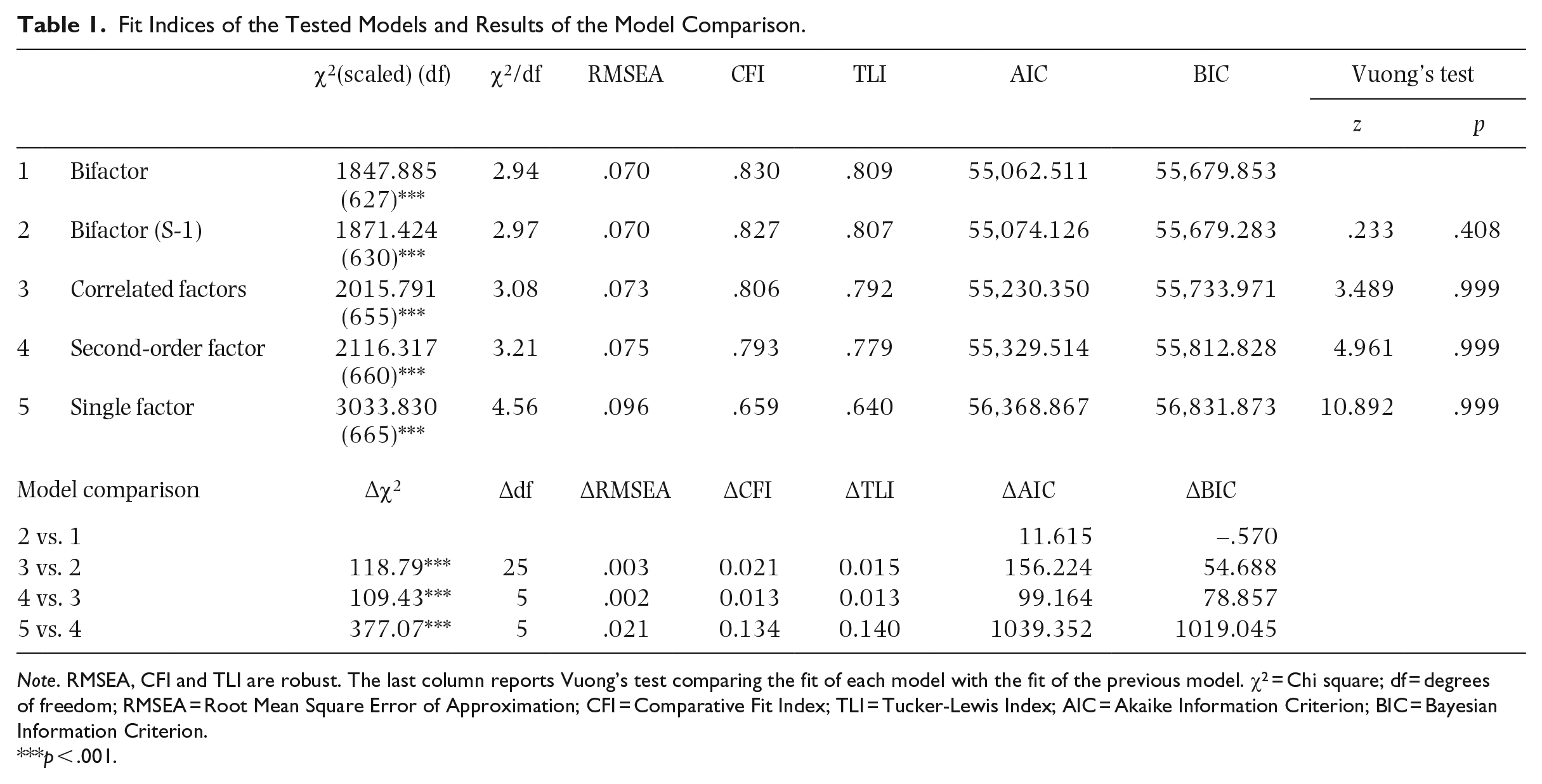
Note. RMSEA, CFI and TLI are robust. The last column reports Vuong’s test comparing the fit of each model with the fit of the previous model. χ2 = Chi square; df = degrees of freedom; RMSEA = Root Mean Square Error of Approximation; CFI = Comparative Fit Index; TLI = Tucker-Lewis Index; AIC = Akaike Information Criterion; BIC = Bayesian Information Criterion.
p < .001.
Analysis of internal reliability
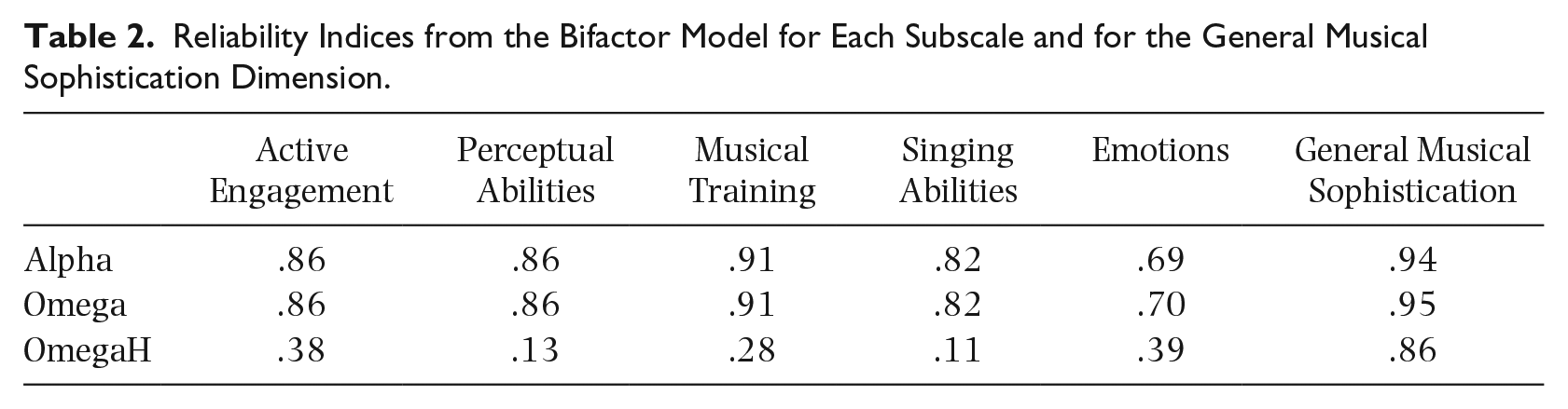
Table 2 shows the reliability index for each subscale and for the general factor from the bifactor model. As indicated, all scales appeared to have sufficient reliability as per robust Cronbach’s alpha and McDonald’s omega, although the Emotions dimension had an alpha slightly lower than the usual cutoff of .70. Moreover, omegaH suggested that the scale is measuring a single general trait (Musical Sophistication) which explains much of the reliable variance in participants’ responses. Nevertheless, single dimensions appeared to capture a portion of the variance beyond the general factor. In particular, the Emotions and Active Engagement dimensions showed to explain a moderate portion of reliable variance which was not explained by the general factor. Notwithstanding, the general reliability value was good (omega = .95) indicating that the Gold-MSI-IT is a highly reliable multidimensional composite. These results confirm that the Italian version of the Gold-MSI is able to measure a single construct with multiple, different facets all linked to the same construct. We then computed six composite scores by averaging the items composing each subscale as well as the general score to conduct descriptive and correlational analyses (see the bottom part of Table 3 for descriptive statistics and Figure 1 for violin plots of score distribution).
Reliability Indices from the Bifactor Model for Each Subscale and for the General Musical Sophistication Dimension.
Zero-order Correlations Among Gold-MSI-IT Scores, Age, and Education.
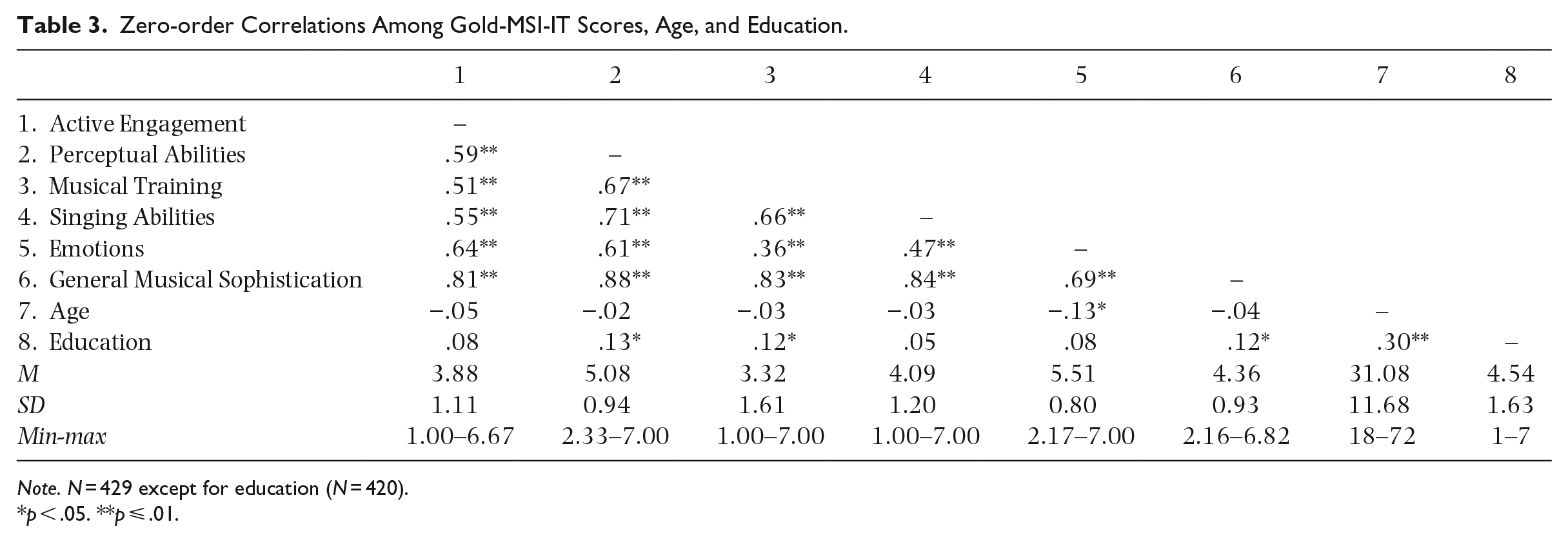
Note. N = 429 except for education (N = 420).
p < .05. **p ⩽ .01.
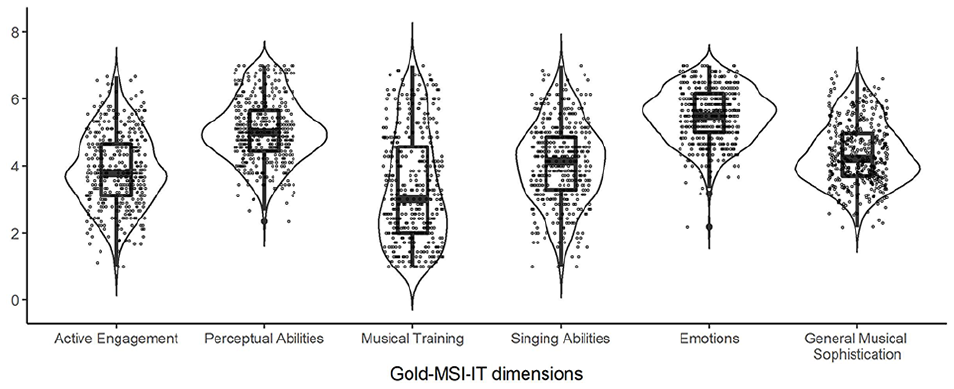
Gold-MSI-IT Scores Distribution for Each Dimension.
Relationship between Gold-MSI-IT scores, age, and education
Table 3 reports zero-order correlations among Gold-MSI-IT dimensions, age, and education as well as the descriptive statistics. As is to be expected from the bifactor structure, all dimensions of the Gold-MSI-IT strongly and positively correlated with one another. The Emotions subscale showed the weaker correlations with the other dimensions, which is consistent with the results of the reliability analysis reported above. This might indicate that the Emotions subscale is linked to the General Musical Sophistication dimension but also affected by other variables not connected directly with the general construct. One of these could be age, which only correlates significantly with Emotions (see Table 3). This correlation was negative, suggesting that the emotional aspects related to music lose part of their relevance as age increases. Finally, education was positively and significantly correlated with General Musical Sophistication, and with the Musical Training and Perceptual Abilities subscales.
Gender differences in Gold-MSI-IT scores
A MANOVA indicated a significant multivariate effect of gender, Wilks’ λ = .924, F(6, 421) = 5.75, p < .001. Univariate results (see Table 4) indicated that male participants scored higher than female participants on the General Musical Sophistication dimension and in the Active Engagement, Musical Training, and Perceptual Abilities subscales. No gender differences were detected for the Emotions and Singing Abilities subscales.
Descriptive Statistics and Results of the Univariate Analyses on Gender Differences in Gold-MSI-IT Scores.

Note. nmale = 104; nfemale = 324.
p < .05, **p ⩽ .01, ***p < .001.
Test–retest reliability
Table 5 shows zero-order correlations of the Gold-MSI-IT dimensions as well as mean differences between the first (test) and second (retest) administration. As reported therein, all dimensions showed strong and significant positive correlations between administrations, which indicate good test–retest reliability. The subscale that had the lowest test–retest reliability was Emotions. Mean score differences were very small for all dimensions, thus indicating that Gold-MSI-IT scores were reasonably stable over time.
Results of Test–Retest Correlations for the Gold-MSI-IT Dimensions and Mean Differences Between the Two Administrations.

Note. N = 57. ns = not significant.
**p < .01.
Discussion
The current article describes the adaptation and validation of the Italian version of the Gold-MSI (Gold-MSI-IT) and explores the relationship between the scores obtained in total and in each subscale of the Gold-MSI-IT and demographic and socio-economic variables (age, gender, and education) in a sample of Italian nationals. As factor analyses and model fit comparisons showed, the data obtained from our Italian sample were best described by a bifactor model including an underlying general factor (General Musical Sophistication) and five subfactors (Active Engagement, Perceptual Abilities, Musical Training, Singing Abilities, Emotions). These results are in line with those reported by Müllensiefen and colleagues (2014) for the original English version of the Gold-MSI. Furthermore, the fit of the Gold-MSI-IT, albeit not very good in absolute terms, is similar to those of the German (Schaal et al., 2014), French (Degrave & Dedonder, 2019), European Portuguese (Lima et al., 2020), and Chinese (Lin et al., 2021) versions.
The Gold-MSI-IT showed good internal consistency for the general factor and for all the subscales, even though the Emotions subscale’s reliability was slightly below the recommended cutoff. In line with these data, and consistently with the bifactor model, zero-order correlations showed that subscales were strongly and positively correlated to one another as well as to the general factor. Emotions was the subscale with the lower correlations to the other dimensions. The hierarchical omega suggested that a moderate part of variance in Emotions scores was not explained by the general factor and may be explained by other dimensions not directly pertaining to the construct of musical sophistication.
The present study also examined test–retest reliability on a subgroup of participants. Zero-order correlations showed good test–retest reliability for all dimensions, with the weaker correlation for the Emotions subscale, thus potentially indicating that the emotional aspects of music engagement may be relatively unstable over time. No mean differences were observed between the first and the second administration. On the whole, results clearly indicate that the Gold-MSI-IT is a reliable and stable tool for assessing musical sophistication in the Italian population.
Regarding the socio-demographic variables, we found that age negatively correlated with Emotions only. This negative correlation possibly indicates that the younger adults in our sample were more prone to use music in an emotional way (e.g., to evoke emotions and memories) than the older ones. These results diverge from those reported in the English (Müllensiefen et al., 2014), German (Schaal et al., 2014), and Portuguese (Lima et al., 2020) samples, which showed small to moderate effects of age, indicating higher musical sophistication for younger participants. However, they appear to be in line with those of Lin and colleagues (2021), who also found a nonsignificant association between age and musical sophistication. Because musicality is always related to the historical and cultural background in which this construct is conceptualized (Gembris, 1997; Trehub et al., 2015), these inconsistencies across studies might be attributed to cross-cultural differences which in turn might affect the effect of age on musical sophistication (Lin et al., 2021).
In contrast, positive correlations were found between level of education (measured in years of formal education) and General Musical Sophistication, Perceptual Abilities, and Musical Training. These results suggest that those with a higher level of education could have had more opportunities either to practice music and/or explore the facets of musical experience, than those with fewer years of study. Because education is often used as a proxy for socio-economic status (SES), these results may also stem from differences in wealth, with more music engagement opportunities being available to those with greater financial means and affecting, over time, the perceptual abilities that they develop. Significant associations between education and General Musical Sophistication or the Perceptual Abilities and Musical Training subscales were reported also in the English (Müllensiefen et al., 2014), Chinese (Lin et al., 2021), and German (Schaal et al., 2014) Gold-MSIs. Significant associations between education and General Musical Sophistication or Perceptual Abilities (but not with Musical Training) were also found in the European Portuguese Gold-MSI (Lima et al., 2020).
Finally, gender differences in musical sophistication emerged. Male participants scored higher than female participants on General Musical Sophistication and on Active Engagement, Perceptual Abilities, and Musical Training; no gender differences were detected for the Singing Abilities and Emotions dimensions. Interestingly, this pattern of results is the opposite of what Lima and colleagues (2020) observed in their Portuguese sample, where female participants scored higher than men only on the Singing Abilities and Emotions subscales. Because Lima and colleagues’ (2020) and our samples are similar in terms of gender distribution, differences in results are likely due to other factors than different gender distributions in samples. It is possible that these inconsistencies stem from cultural differences between Portugal and Italy or that our samples differ for gender distributions in terms of music training, with Lima et al.’s (2020) sample including more good singers who happen to be female and ours including more males who have received more years of instrumental training.
The overrepresentation of certain population groups, such as females and younger adults, in our sample compared with the national data (Istituto Nazionale di Statistica [ISTAT], 2022) limits the representativeness and generalizability of our results. Furthermore, the absence of additional socio-economic measures such as income does not allow the clarification of the extent to which SES affects scores in the Gold-MSI-IT. Despite these limitations, the present study is the first to provide a valid adaptation of the Gold-MSI which seems able to supply a reliable measure of musical sophistication in the Italian general population. Finally, it offers further support for cross-cultural evidence on musical sophistication by providing data on the music abilities and behaviors of people from another Western country, and by corroborating previous findings showing that music engagement is not a privilege of professional musicians but pertains—though in different ways—to most of the general population as a whole.
Supplemental Material
sj-docx-1-pom-10.1177_03057356231204855 – Supplemental material for The adaptation and validation of the Goldsmiths Musical Sophistication Index (Gold-MSI) in Italian: The Gold-MSI-IT
Supplemental material, sj-docx-1-pom-10.1177_03057356231204855 for The adaptation and validation of the Goldsmiths Musical Sophistication Index (Gold-MSI) in Italian: The Gold-MSI-IT by Michela Santangelo, Valentina Persici, Luca Caricati, Paola Corsano, Reyna L. Gordon and Marinella Majorano in Psychology of Music
Footnotes
Funding
The author(s) disclosed receipt of the following financial support for the research, authorship, and/or publication of this article: RLG was supported by the DP2HD098859 grant from the National Institute of Health. The content is solely the responsibility of the authors and does not necessarily represent the official views of the National Institutes of Health.

Supplemental material
Supplemental material for this article is available online.
References
Supplementary Material
Please find the following supplemental material available below.
For Open Access articles published under a Creative Commons License, all supplemental material carries the same license as the article it is associated with.
For non-Open Access articles published, all supplemental material carries a non-exclusive license, and permission requests for re-use of supplemental material or any part of supplemental material shall be sent directly to the copyright owner as specified in the copyright notice associated with the article.
