




Abstract
Students’ perceived belonging in academic spaces has emerged as a critical nexus of overall academic achievement, social-emotional outcomes (e.g., self-concept and self-efficacy), and engagement in K–12 schools. Furthermore, researchers have documented inverse relations of belonging and psychological distress, alienation, and isolation. The purpose of this study was to investigate differences in participants’ levels of belonging in band ensembles and school outside of band ensembles. Participants of this quantitative study—suburban and rural high school band students in the Pacific Northwest region of the United States—responded to modified General Belongingness Scales and a Rosenberg Self-Esteem Scale to measure individuals’ perceived levels of belonging both in their band ensembles and in their schools outside of band ensembles. The data indicated that secondary music students experienced greater levels of belonging in band ensembles than in the school environment outside of band ensembles. These findings highlight the potential for band classes/ensembles to foster belonging and support social-emotional well-being for high school students and have the potential to inform secondary education policy.
Social sciences researchers on an international level have become increasingly interested in the construct of belonging over the last two decades (Lähdesmäki et al., 2016). This increase in interest can be attributed to the recognition of the importance of belonging in sociobiological and evolutionary theoretical frameworks (Baumeister & Leary, 1995; Cross, 2009; Thompson, 2015). The observed relation of belonging and individuals’ patterns of emotion, motivation, identity (Baumeister & Leary, 1995), and social outcomes (e.g., Gillen-O’Neel & Fuligni, 2013; Korpershoek et al., 2020; Moallem, 2013; Nichols, 2008; Osterman, 2000) has spurred examination of belonging in various settings, including K–12 schools (i.e., primary and secondary schools).
Baumeister and Leary (1995) posited that individuals develop bonds and a sense of belonging through “frequent, nonaversive interactions within an ongoing relational bond” (p. 497). They theorized that humans’ deep-seated desire to belong is a vestige of evolutionary processes in which being associated with a group provided survival and reproductive advantages. Music sociobiologists have even posited that music—a practice ubiquitous among humans (Levitin, 2006)—serves an evolutionary function that promotes social bonding (Cross, 2009). Furthermore, music psychologists have described the mechanisms through which music nurtures social bonds, emotional conjoinment, and affective engagement (Thompson, 2015). The profound relation between belonging and the human species is supported by contemporary educational research. This ongoing research into belonging traces its roots to Maslow’s (1943) seminal work in which he theorized that individuals required feelings of belonging as a precondition of self-esteem and self-actualization.
Osterman’s (2000) examination of students’ need for belonging in the school community provided insight into the connection between belonging and prosocial behavior by demonstrating that individuals “who experience acceptance are more highly motivated and engaged in learning and more committed to school” (p. 359). This relation between belonging and motivated/engaged learning served to highlight the importance of belonging in the school environment. A longitudinal study on the relation between school belonging and academic motivation concluded that there was a positive relation between the belonging an individual felt and their perception of the extent to which school was enjoyable and useful (Gillen-O’Neel & Fuligni, 2013). The researchers identified several trends in self-reported belonging, including the trend that females’ perceptions of belonging in school decreased over their time in high school, while it remained stable for males. Gillen-O’Neel and Fuligni speculated that this phenomenon might have been caused by proportionately fewer females participating in school-related activities scheduled outside of the regular school day.
In a meta-analysis of research regarding belonging in academic contexts, Moallem (2013) found that there was a small-to-moderate positive relation between belonging in school and academic achievement. Korpershoek et al. (2020) conducted a meta-analysis of 82 studies on school belonging and student outcomes. The researchers documented positive correlations between belonging and each of academic achievement, self-concept, self-efficacy, and engagement. The researchers also noted negative correlations between belonging and both school absences and dropout rates. Grade level and socioeconomic status did not significantly impact the documented relations. Belonging has also been found to correlate with motivation. Goodenow and Grady (1993) examined the relation between belonging in school and motivation-related measures in two urban junior high schools in the Northeast United States. They observed a significant and positive relation between belonging in school and academic motivation. Goodenow and Grady also found that belonging in school was a better predictor of higher academic performance for girls than boys.
Researchers have also documented inverse relations between belonging and maladaptive psychological patterns. Baskin et al. (2010) found that belonging acted as a protective factor against loneliness among middle school students in the United States. The importance of this finding was underscored by McIntyre et al.’s (2018) demonstration that loneliness was the most salient predictor of psychological distress. Researchers have also found that belonging countered feelings of alienation that potentially contributed to negative behaviors in American adolescents (Schulz & Rubel, 2011). As London and Ingram (2018) pointed out in their article on social isolation in American middle schools, schools should consider offering initiatives and activities that support the development of belonging. Fontaine et al.’s (2009) demonstration of the relation between loneliness and negative physical and mental health outcomes among American K–12 students served to underscore the importance of examining belonging in K–12 schools and the specific K–12 environments which support the formation of social bonds among students.
MacDonald and Leary (2005) discussed the neurological basis through which social exclusion activates the physical pain system. They postulated that the connection of emotional and physical pain was an “evolutionary development to aid social animals in responding to threats in inclusion” (p. 202). Eisenberger et al. (2003) performed functional magnetic resonance imaging (fMRI) brain scans on participants primed to participate in a game and subsequently excluded. The fMRI results revealed that social exclusion and physical pain both resulted in heightened activity in the pain centers of the brain such as the anterior cingulate cortex. DeWall et al. (2010) used fMRI to demonstrate that acetaminophen reduced neural responses to both social exclusion and physical pain, reinforcing the conclusion that social exclusion impacts physical processes.
The construct of self-esteem has garnered significant interest, along with belonging, as a theorized precondition of self-actualization (Maslow, 1943). Prominent theoretical frameworks have recognized the role of self-esteem in mental processes (e.g., Rosenberg, 1965), resulting in a variety of research on an international level examining self-esteem and related social, learning, and emotional outcomes (e.g., Moksnes & Espnes, 2013; Robins et al., 2001; Schmitt & Allik, 2005; Shin, 2011; Sinden, 1999). In addition, self-esteem has been demonstrated to be the most salient predictor of belonging (Ma, 2003). Ma’s study of belonging in a Canadian middle school setting revealed that discrepancies in perceived levels of belonging were more apparent within schools, rather than across different schools. However, while a longitudinal study of individuals from New Zealand indicated that perceived self-esteem during adolescence was correlated with positive life health and social-emotional outcomes, Boden et al. (2008) concluded that the causal relation between self-esteem and these outcomes was largely explained by other psychosocial and biological factors.
Belonging and self-esteem in music performance ensembles
Interest in belonging has spurred applied research in the area of music education. Researchers using qualitative methods have demonstrated that individuals can develop bonds and belonging through participation in music classes/ensembles (e.g., Adderley et al., 2003; Boyce, 2015; Campbell et al., 2007; Kokotsaki & Hallam, 2007; Langston & Barrett, 2008; Monteiro, 2016; Schultz, 2018). These studies revealed social and emotional benefits experienced by individuals in music classes. Social benefits for individuals included elevated perceptions of camaraderie and the acceptance of differences and also concurrent emotional benefits derived from expression and enjoyment. Participants also recognized the capacity for involvement in a music ensemble to lessen perceived boundaries between individuals of different ethnic backgrounds and social groups. Individuals often incorporated aspects related to musical experiences into their identity, with some individuals going so far as to call the band room a “home away from home” (Adderley et al., 2003, p. 204). This sentiment was echoed by the finding of Campbell et al. (2007) that some students likened their music ensemble experience to being in a family. Monteiro (2016) examined the sense of community that American urban high school students developed through participating in a samba ensemble and provided compelling qualitative information about the development of belonging in music ensembles. Students developed meaningful and lasting relationships in the ensembles and incorporated participation in a samba ensemble as part of their identity. The potential for music performance to spur social connection between performers and audience members has garnered attention as well. A study involving university-level students in England yielded findings of the capacity for intense music performance experiences to engender connections not only between performers, but also with the audience (Lamont, 2012).
Researchers have also focused on the development of belonging in music education experiences across the life cycle. Schultz’s (2018) research into community music in adulthood revealed that adults’ satisfaction of the musical experience related to perceived belonging. Another examination of individuals in middle and late adulthood in England demonstrated that participation in community music afforded participants with significant opportunities to socialize and develop a sense of belonging with others (Hallam et al., 2012). Graves (2019) provided a quantitative examination of the relation between individuals’ perceived relatedness (i.e., the feeling of relating to others) and prosocial behavior and music practice in the context of an American high school band. The researcher demonstrated that perceived relatedness support was an effective predictor for perceived relatedness satisfaction. The researcher concluded that music directors might bolster the development of belonging in music ensembles by providing social supports to students.
The relation of belonging, identity, and music among displaced peoples has also garnered attention on an international level. Researchers have applied socioevolutionary theories to examine and appreciate the experiences of individuals forced either directly or indirectly from their homelands. De Martini Ugolotti (2022) considered the role of music among forced migrants in Britain as they navigated interpersonal relationships in a cultural milieu markedly different from their homeland. As the migrants contended with uncertainty and marginalization, music provided a context in which they experienced sociability that transcended social constructs (e.g., nationality). Lewis (2014) suggested that music and dance were not only indispensable means of self-expression, but also tools to culturally self-identify and connect in a social system in which migrants were legally obligated to be geographically scattered. The relation between belonging and music in migrant populations has also been examined in Norwegian primary schools (Rinde & Kenny, 2021), Palestinian refugees in Jordan (Van Aken, 2006), and displaced students in a school in Victoria, Australia (Crawford, 2017).
Self-esteem in the area of music education has received considerable attention and has been investigated in the context of music participation, performance anxiety (Sinden, 1999), and music therapy (Chen et al., 2016). Austin (1990) examined the relation between self-esteem and music participation behaviors of upper-elementary school-aged students in the music classroom and outside of school. The data indicated that participants’ scores on the Self-Esteem of Music Ability scale correlated with music participation both in school and outside of school. In a 2011 study, Shin found that among middle school students in low-income communities, participation in weekly music workshops correlated with increases in students’ general self-concept in school overall.
Need for study
While thorough qualitative research on perceived belonging in music ensembles has been conducted (e.g., Adderley et al., 2003; Boyce, 2015; Campbell et al., 2007; Kokotsaki & Hallam, 2007; Langston & Barrett, 2008; Monteiro, 2016; Schultz, 2018), there was a dearth of research relating to differences in the perception of belonging based on distinct spaces within the school. This study addressed a gap in existing literature by providing a quantitative investigation of belonging in the settings of high school band ensembles and school outside of band ensembles. The documented relation between belonging and positive social and physical outcomes in extant literature warranted further examination of students’ perceived belonging in the K–12 setting. Deepening our understanding of belonging in the context of music performance ensembles can contribute to the discourse on the role of music in K–12 schools and has the potential to inform institutional policy and education legislation. While Graves (2019) examined constructs related to belonging within the bounds of the band classroom, there seemed to be a gap in the literature regarding the differences of individuals’ perceived belonging based on setting (i.e., in band ensembles vs school outside of band ensembles). The purpose of this project was to investigate individuals’ perceptions of belonging in high school band ensembles and in school (outside of band ensembles).
Research questions
The following research questions were addressed in this study:
Method
Participants
Participants included band (e.g., concert band, wind symphony, wind ensemble, marching band) students from seven rural and suburban high schools in the state of Oregon in the Pacific Northwest region of the United States. While an examination of belonging in other areas of music in schools (e.g., chorus, orchestra, mariachi, steel band, samba) is warranted, the research questions focused solely on the band subset of scholastic music in part because of the scope of extant literature on belonging in band ensembles in particular. Also, the narrow focus of the research questions aimed to ensure that finite resources would yield a sufficient sample size. A priori power analysis was conducted using G*Power version 3.1.9.6 (Faul et al., 2007) to estimate the necessary sample size needed to utilize a paired samples t-test and hierarchical regression with four predictor variables. Both power analysis models specified a significance level of α = .05 and power = .80; an effect size of 0.2 was selected. The results indicated a required sample size of N = 199 for the paired samples t-test and N = 66 for the hierarchical regression model. The populations of the schools (during the 2020–2021 school year) ranged from 259 to 2,067 students (Oregon Department of Education, 2021). Each school served students from Grades 9 to 12. Three hundred ninety-five students completed the scales for belonging and self-esteem; incomplete responses were discarded. Potential participants were informed that participation was voluntary and anonymous and reviewed informed consent/assent information before participating. Of the 395 participants who completed the modified General Belongingness Scale (GBS) measures and Rosenberg Self-Esteem Scale, 283 provided years in band ensembles and age. The mean age of respondents was 15.8 years old. Of respondents who provided gender identity information, 156 (39.4%) identified as female, 199 (50.3%) identified as male, 24 (6.1%) identified as non-binary, eight (2.2%) identified as other—gender fluid, demigirl, or “all of the above”—and nine (2.4%) preferred not to answer. Among respondents (N = 395), a sizable portion (n = 259, 65.4%) were involved in additional music classes/ensembles beyond band. Participation in music classes/ensembles was as follows: concert band/wind ensemble/symphonic band/and so on (n = 389, 98.2%), marching band (n = 218, 55.1%), indoor percussion (n = 20, 5.4%), jazz band (n = 59, 7.3%), orchestra (n = 29, 7.3%), choir (n = 27, 6.8%), and other ensembles—for example, horn club, pit orchestra, basketball band, rock band, saxophone choir, and so on—(n = 19, 4.8%). The mean duration of involvement in ensembles was 4.97 years.
Measures
To better understand belonging and its relation to cognitive processes and emotional patterns, researchers have developed and tested several measures for belonging. Prompted by dissatisfaction with existing measures, Malone et al. (2012) developed the GBS. The GBS purportedly measures belonging through the constructs of acceptance/inclusion and rejection/exclusion by examining perceived inclusion, interpersonal bonds, connectedness, acceptance, belonging, isolation, and exclusion. The GBS was developed in accordance with several existing instruments to assure construct validity: Revised UCLA Loneliness Scale, Need to Belong Scale, Social Assurance Scale, Social Connectedness Scale, Satisfaction with Life Scale, Subjective Happiness Scale, and the Center for Epidemiologic Studies Depression Scale. The scale was designed for use in diverse settings and was demonstrated to be a valid and reliable measure of belonging. The GBS was modified to measure individuals’ perceived levels of belonging both in their band ensembles and their school outside of their band ensembles (see Supplemental Appendix A). Participants responded to two sets of the modified GBS that, except for differentiating between settings, were identical. Individuals were asked to consider their experience in band ensembles while responding to the first set of items and then asked to consider their experience in school outside of band ensembles while responding to the second set of items. For the purposes of this study, belonging was defined as the “perceived experience of strong and stable interpersonal relationships in a group” (Baumeister & Leary, 1995, p. 497).
The instrument employed a 7-point Likert-type scale utilizing a range of strongly disagree (1) to strongly agree (7). Ten out of the original 12 items were retained for each of the two settings (i.e., band ensembles and school outside of band ensembles), for a total of 20 items. Two music education experts served as reliability observers and provided feedback regarding item meaning. After consultation with the reliability observers, two items were removed. One did not apply to situational understandings of belonging and one did not apply to band ensembles (see Supplemental Appendix A). The observers indicated that the items included in the instrument assured content validity. Items 6 to 10 on each respective GBS were negatively worded and accordingly reverse scored. Sullivan and Artino (2013) discussed the suitability of using parametric tests for Likert-type scale data. The scales for belonging in band ensembles and belonging in school outside of band ensembles both indicated high internal reliability of the current study’s data, with Cronbach’s α = .923 and α = .934, respectively (Field, 2018).
The Rosenberg Self-Esteem Scale (Rosenberg, 1965) is perhaps the most widely used measure of self-esteem (i.e., feelings of overall self-worth that remain relatively stable over time). Recognizing the prominence of the Rosenberg Self-Esteem measure in educational and psychological literature, Robins et al. (2001) demonstrated the validity of the Rosenberg Self-Esteem Scale through cross referencing the scale with other measures of self-esteem. Longitudinal data collection demonstrated stability over time. The researchers documented the validity of the measure for men and women and for different ethnic groups. Schmitt and Allik (2005) demonstrated the stable internal consistency and factor structure of the measure across 16,998 participants in 53 nations. Park and Park (2019) demonstrated that the Rosenberg Self-Esteem scale was a valid and reliable psychometric scale for people with intellectual disabilities. Items 2, 5, 6, 8, and 9 on the Rosenberg Self-Esteem Scale were negatively worded and accordingly reverse scored (See Supplemental Appendix B).
Procedure
This study (ID: STUDY00000361) received an exempt determination from the University of Oregon’s Institutional Review Board (IRB) (i.e., Research Compliance Services). A pilot study (N = 89) was employed to validate the modified GBS. The pilot study was conducted in the fall of 2020 while students were remote-learning during the coronavirus disease-19 school shutdown. Students were asked to think back to their experiences in band ensembles before the closure of schools.
Data collection for the full study took place in late February and March of 2022, roughly 7 months after schools in the state resumed in-person learning. Using a state music education association directory, I contacted via email all the listed secondary band directors in the state. I provided background information regarding the study and asked teachers to fill out a Qualtrics questionnaire to ascertain their interest in facilitating this research. Band directors who were interested in facilitating the study received informed passive parental consent information for advance delivery to parents/guardians. This document, delivered to parents/guardians via email, was distributed a minimum of two weeks prior to data collection, per IRB stipulations. Parents who wished to opt their minor children out of the study indicated this preference using Qualtrics. This information was then relayed to the respective band directors. Students above the age of 18 reviewed informed consent information and students under the age of 18—whose parents granted passive consent—reviewed informed assent information. Both groups indicated their willingness to participate by advancing beyond the informed consent/assent information screen. Band directors were asked to select a date for the scheduled data collection. I traveled to four of the seven schools to provide brief background information regarding the study before inviting students to participate. For the remaining three schools for which in-person travel was logistically nonviable, I sent a prerecorded video message providing brief background information. Afterwards, eligible students who chose to participate in the survey used either a QR code or a link to navigate to the questionnaire which was hosted on Qualtrics. The questionnaire took roughly 10 min to complete.
Results
The research was guided by the following questions: (1) Are there differences in Oregon high school students’ perceived levels of belonging in band ensembles and perceived levels of belonging in school outside of band ensembles? (2) To what extent can belonging in band ensembles, self-esteem, duration of involvement in band ensembles, and age predict belonging in school outside of band ensembles? To address the first research question individuals responded to three sets of 10 items each. Scores for each measure were subsequently summed for analysis. Item frequencies, percentages, means, standard deviations, and ranges of responses for the scale of belonging in band ensembles are included in Table S1. Item frequencies, percentages, means, standard deviations, and ranges of responses for the scale of belonging in school outside of ensembles are included in Table S2. Item frequencies, percentages, means, standard deviations, and ranges of responses for the self-esteem scale are included in Table S3.
Although Q–Q plots and Kolmogorov–Smirnov’s test indicated a non-normal distribution, Lumley et al. (2002) demonstrated that t-tests are robust and can still be reliably used when the sample size is sufficiently large. The paired samples t-test was found to be statistically significant, t(395) = 12.91, p < .001, d = 0.65, 95% confidence interval (CI) = [0.54, 0.76]). These results indicate that individuals (N = 395) experienced greater perceived belonging in band ensembles (M = 57.84, SD = 9.45) than perceived belonging in school outside of band ensembles (M = 49.69, SD = 12.16).
To address the second research question—To what extent can belonging in band ensembles, self-esteem, duration of involvement in band ensembles, and age predict belonging in school outside of band ensembles?—a hierarchical regression analysis was performed (Field, 2018). Belonging in school outside of band ensembles was regressed on self-esteem, belonging in band ensembles, years in a music ensemble, and age. Self-esteem was selected as the first predictor in the regression model based on Ma’s (2003) finding that self-esteem was the most salient predictor of belonging in school. Belonging in band ensembles was found to demonstrate acceptable collinearity with belonging in school and was selected as the second predictor due to its relation to belonging in school, outside of music ensembles. Duration of involvement in band ensembles was selected as the third predictor based on Baumeister and Leary’s (1995) theory of the development of belonging. Age was selected as the fourth predictor based on Gillen-O’Neel and Fuligni’s (2013) longitudinal study of belonging which demonstrated decreased belonging over time among some high school students. Assumptions testing was performed prior to the regression analysis. The presence of linear relations between the outcome and predictor variables was demonstrated by appropriate values for Pearson’s r. The examination of collinearity among predictor variables using variance inflation factors and tolerances yielded acceptable results. A Durbin–Watson value of 1.833 indicated the values of the residuals were independent. A scatterplot of the regression standardized predicted value and regression standardized residual demonstrated acceptable constant variance of residuals. Bivariate correlations are shown in Table 1.
Bivariate Correlations.
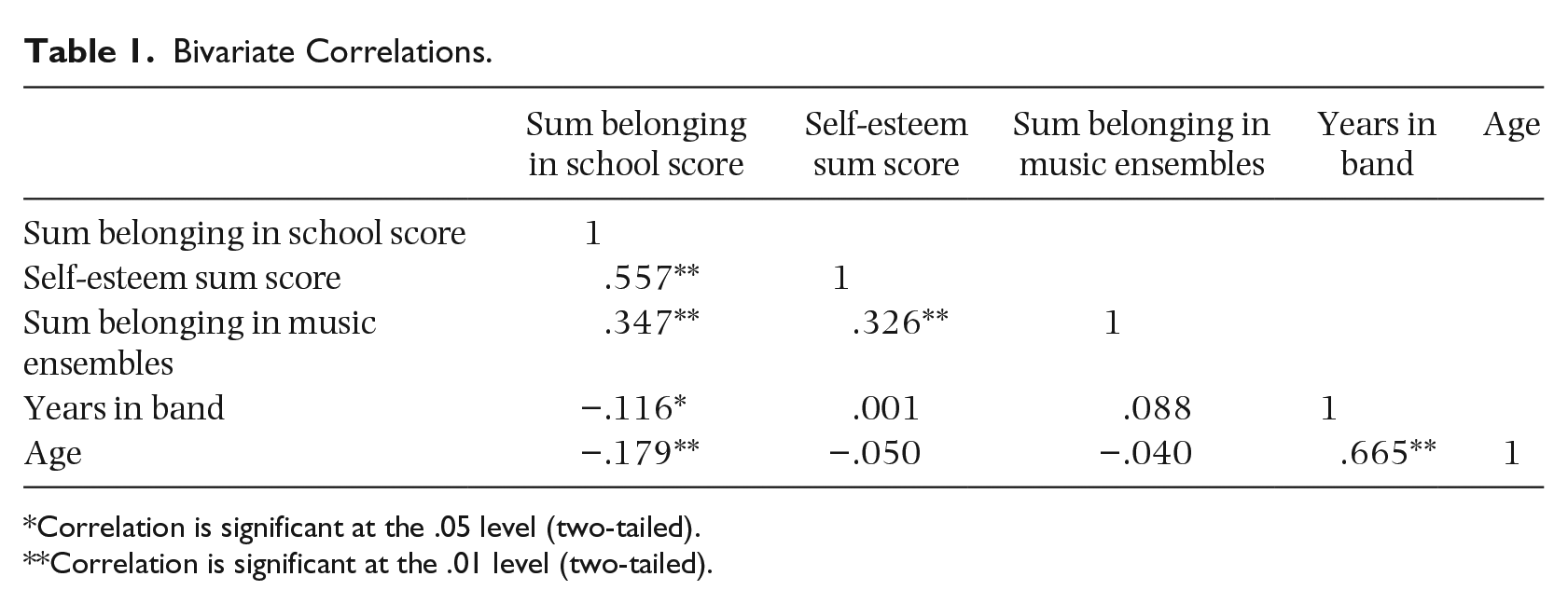
Correlation is significant at the .05 level (two-tailed).
Correlation is significant at the .01 level (two-tailed).
The results of the regression analysis indicated that the overall model significantly predicted scores of students’ belonging in school outside of band ensembles, F(4, 278) = 37.711, p < .001, R2adj = .342. A review of the model summary (see Table 2) indicated that self-esteem, belonging in band ensembles, and age were significant predictors of belonging in school outside of band ensembles. The model summary indicated that duration of involvement in band ensembles was not a significant predictor of belonging in school outside of band ensembles.
Coefficients for Model Variables (Belonging in School Outside of Music Ensembles).
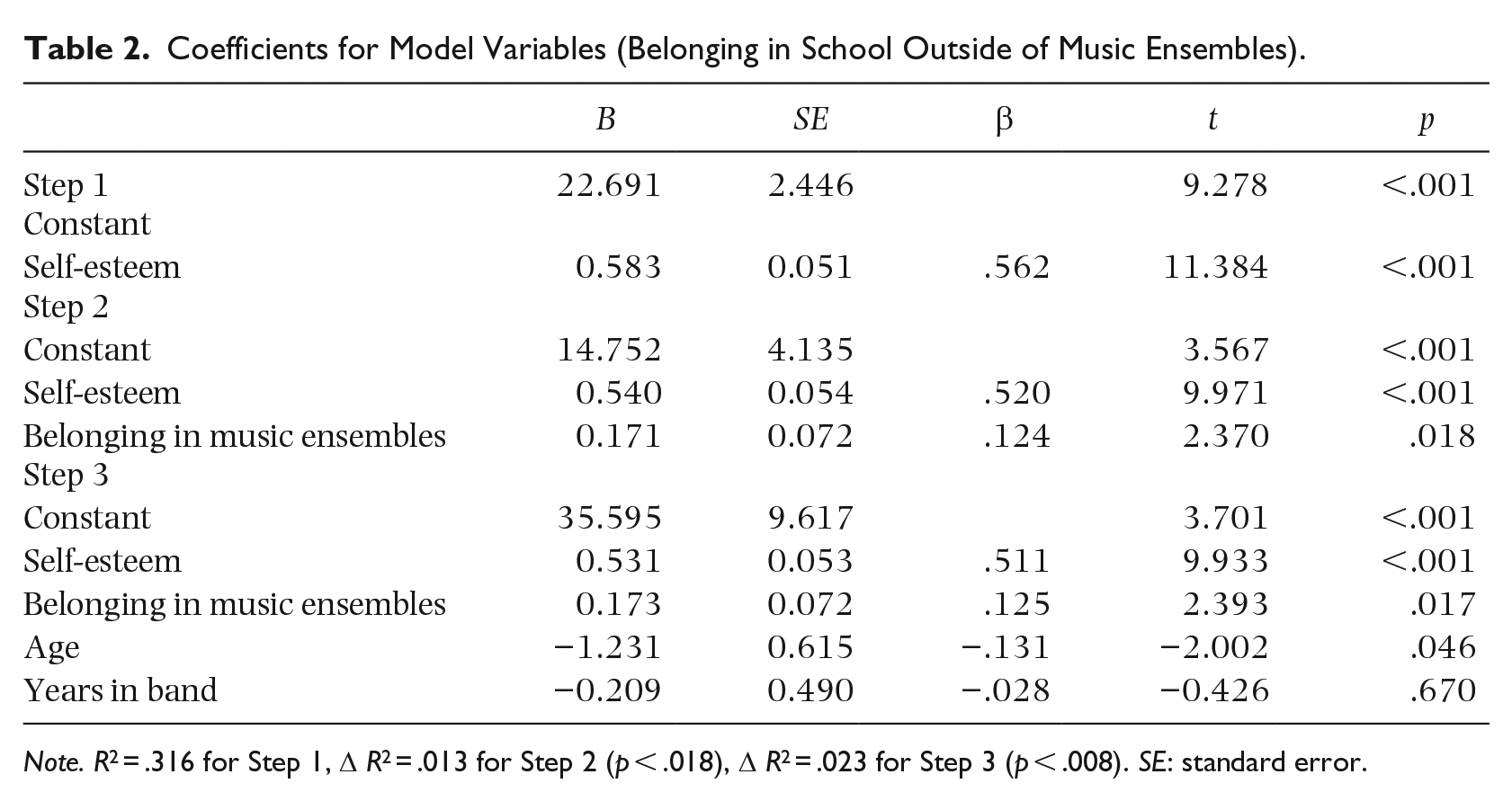
Note. R2 = .316 for Step 1, Δ R2 = .013 for Step 2 (p < .018), Δ R2 = .023 for Step 3 (p < .008). SE: standard error.
Discussion
The first objective of this study was to examine high school students’ perceived belonging in band ensembles and perceived belonging in school outside of band ensembles. The results indicate that students experienced belonging to a greater extent in band ensembles than in school outside of band ensembles. Examination of individual items within the scales provided detail relating to belonging within the distinct spaces (i.e., band ensembles and school outside of band ensembles). Over 80% of respondents indicated that they strongly agree or agree with the following statement: “When I am with other people in my music ensemble, I feel included.” This figure contrasts with the 48.3% of respondents who indicated that they strongly agree or agree with the corresponding item for inclusion in school outside of band ensembles. From a Maslowian perspective, this result is encouraging on the grounds that belonging is a precursor to self-esteem and self-actualization. The importance of this finding should also be considered in the context of research documenting pertinent neural processes. Namely, both the determination that social exclusion activates the physical pain system (Eisenberger et al., 2003; MacDonald & Leary, 2005) and that individuals with clinically low levels of persistent pain performed significantly worse on tests of retention and transfer than their peers without pain (Smith & Ayres, 2014).
In the current study, 74.3% of respondents indicated that they strongly agree or agree that they have a sense of belonging in their band ensembles while 43.9% of respondents indicated that they strongly agree or agree with the corresponding statement for belonging in school outside of band ensembles. This finding should be considered in conjunction with DeWall et al.’s (2011) recapitulation of research relating to individuals’ perceptions of belonging and associated cognitive, emotional, and behavioral outcomes. The researchers highlighted the impact and role of belonging in humans’ “evolutionary history” (p. 1281). Indeed, both theoretical and applied literature related to the deep-seated need for humans to belong suggests that providing learning spaces which foster belonging is of the greatest importance to effectively support prosocial outcomes.
The results from this study were consistent with prior research on individuals’ increased feelings of belonging in music ensembles (Adderley et al., 2003; Boyce, 2015; Campbell et al., 2007; Kokotsaki & Hallam, 2007; Langston & Barrett, 2008; Monteiro, 2016; Schultz, 2018). This quantitative analysis corroborated the aforementioned qualitative research and provided further evidence of the propensity for high school band ensembles to foster social belonging for participants. While this study focused on the band, it is reasonable to consider that other areas of music might similarly function as an environment where students develop community and belonging.
The second objective was to examine the extent to which belonging in band ensembles, self-esteem, duration of involvement in ensembles, and age predicted belonging in school outside of band ensembles. The results indicated that self-esteem, belonging in band, and age were significant predictors of belonging in school outside of band ensembles. Years in band was not a statistically significant predictor. The regression model predicted 34.2% of the variance in belonging in school outside of band ensembles. The finding that self-esteem was the most salient predictor of belonging in school outside of band ensembles aligned with Ma’s (2003) finding that self-esteem was the most effective predictor of belonging in school. The finding that age negatively correlated with belonging in school outside of band ensembles corroborates Gillen-O’Neel and Fuligni’s (2013) finding that belonging in school decreases over the course of secondary school. It is perhaps notable that the correlation between years of involvement in band and belonging in band ensembles was not statistically significant. Taken together with the finding that students feel heightened belonging in band ensembles, these findings might suggest that belonging is promptly experienced by individuals as they enter the social fabric of the ensemble. The band environment often supports the interaction of different grade levels and seems to be a space in which individuals develop positive social bonds during the school day.
These results highlight the potential for band classes to function as a positive social environment within K–12 schools. While some students might have ample environments in their life in which they experience belonging, other students may not. For these individuals, band ensembles might provide the social structure and opportunities to develop belonging and experience the associated benefits in a way that other academic spaces might not provide. Friendships and peer relationships which form in band ensembles may provide a basis for increased belonging in school overall. A friendship that forms in a music ensemble may transcend the music classroom and impact a student’s other experiences in school. When this possibility is considered in the context of Moallem’s (2013) meta-analysis, which showed a positive relation between belonging in school and academic achievement, it further highlights the potential positive impact of band ensembles. Additional research on the impact of involvement in music ensembles on individuals’ school experiences and perceptions of belonging overall is warranted to provide further insight into the role of music in secondary institutions.
Osterman (2000) demonstrated that “[s]tudents who experience acceptance are more highly motivated and engaged in learning and more committed to school” (p. 359). This correlation might in part be explained by Stillman and Baumeister’s (2009) postulate that belonging is required for individuals to create meaning in their lives. Band ensembles might function as key environments in the high school setting where students experience belonging and create meaning. The documentation of positive correlations between loneliness and psychological distress (McIntyre et al., 2018) further warrants a thorough examination of environments which support the development of belonging in K–12 schools. Band ensembles might function as critical social environments which have the potential to diminish social alienation (Schulz & Rubel, 2011) that may lead to negative behaviors among adolescents. Correlations of loneliness and negative physical and mental health outcomes (Fontaine et al., 2009) further serve to underscore the importance of creating K–12 spaces which foster social connections and belonging for students.
Implications and limitations
Understood in conjunction with previous findings on both the correlation of belonging and prosocial academic outcomes and the negative correlation to psychological distress, alienation, and isolation, the findings from this study highlight the essential role that band classes/ensembles (and presumably other music ensembles) play in supporting the development of belonging. These findings lend credence to extant qualitative studies that music ensembles and classes create a space for students to establish positive social bonds, and through this, create meaning in their lives. This study has the potential to inform education policy as legislators, experts, and laypeople alike consider and debate the merits of music, and the arts overall, during the school day. The finding that students experience greater belonging in band ensembles than in school outside of ensembles supports the assertion that music plays an essential role in providing an education that supports whole-person development.
Limitations of this study include a reliance on self-reported measures taken at a single point in time. Longitudinal examinations should be used to gauge the stability of individuals’ perceptions of belonging in band ensembles over time. Future studies should include other types of music ensembles (e.g., chorus, orchestra, mariachi, steel band, samba) and might also include an examination of the relation of belonging in music ensembles with other metrics (e.g., academic, physical health, and mental health outcomes). Examining potential correlates of belonging in music ensembles can further illuminate the role of music in K–12 schools. Future studies can further contribute to the appreciation of the role of music ensembles by diversifying study samples (e.g., expanding representation of different geographic, cultural, ethnic/racial, neurodiverse, etc., populations). While it was outside of the scope of this study, examining the relation of belonging in music ensembles and students’ ethnic/racial backgrounds has the potential to illuminate how music ensembles may or may not be serving all populations within a school. Future studies should also include participants from urban schools. The sample was drawn from only one state within the United States, and even within states, music programs and ensembles differ vastly from school to school. This should engender caution when considering the possibility of generalizing results from this study. However, as music education researchers continue to examine belonging in music ensembles, trends may emerge that will increase the validity of generalizing the results to larger populations. While quantifying individuals’ perceptions of belonging using a fixed self-report measure may be inherently reductionist, it can inform our understanding of the role of music in secondary schools.
An avenue for future research is the examination of the impact of music ensembles on overall belonging in school by including participants who are not involved in music. Rather than asking music students to consider their levels of belonging by setting, researchers might ask music and non-music students about their overall perceptions of belonging in school. The relationships that form in music ensemble classes might contribute to overall increased school belonging for individuals. One potential research question is as follows: Do music ensemble participants experience increased levels of perceived belonging in school overall compared with individuals who do not participate in music ensembles? This research stream could further inform understandings of the impacts of the arts in K–12 schools.
Music education will benefit from additional research into belonging in music classes/ensembles and associated behaviors. Increased understanding of the potential for music classes to function as environments which support the physical and mental well-being of young people is a task of the greatest importance. Further quantitative and qualitative examinations of belonging in music ensembles and school outside of music ensembles have the potential to inform the discourse on what it means to provide a holistic education for young people. While the aesthetic experience of music is valuable in and of itself (Reimer, 2000), recognizing social connections and belonging experienced by individuals in music ensembles can contribute to the discourse on music in K–12 schools.
Supplemental Material
sj-docx-1-pom-10.1177_03057356231214499 – Supplemental material for Situational belonging in high school band ensembles and high schools
Supplemental material, sj-docx-1-pom-10.1177_03057356231214499 for Situational belonging in high school band ensembles and high schools by Cameron R Siegal in Psychology of Music
Footnotes

References
Supplementary Material
Please find the following supplemental material available below.
For Open Access articles published under a Creative Commons License, all supplemental material carries the same license as the article it is associated with.
For non-Open Access articles published, all supplemental material carries a non-exclusive license, and permission requests for re-use of supplemental material or any part of supplemental material shall be sent directly to the copyright owner as specified in the copyright notice associated with the article.
