



Abstract
This study describes the spread of TCP/IP and therefore the diffusion of the Internet, beginning in the 1960s until the early 1990s. Understanding how TCP/IP emerged and spread provides insight into the changes and challenges brought by the Internet into world politics. Against arguments that the Internet reflects primarily economic or military concerns, I argue that notions of academic freedom are embedded in the fundamental technology of the Internet, TCP/IP, and that this embedded norm is essential to the Internet’s consequences for modern political life.
Keywords
Why TCP/IP?
The Internet is an important variable in analyses of contemporary international phenomena; studies of globalisation especially point to the Internet as both contributing to and accelerating the integrative tendencies of the modern world. 1 Some recent exemplar studies focus on the construction of cyber-security, 2 the application of theoretical lenses to describe the Internet in international relations, 3 and the symbolic politics of the Internet with respect to human rights. 4
Yet many of these studies never ask why the Internet should facilitate these trends, nor how it came to be so ubiquitous. This is par, as Herrera explains: ‘existing theories of international relations … view [technology] deterministically and exogenous to politics’. 5 Moreover, political scientists often assume that ‘information technologies are essentially neutral’, without ‘tilt in the direction of any particular values’. 6 These assumptions are severe handicaps to a meaningful understanding of the Internet and its particular challenges to international politics, when in fact technologies like the Internet do have political dimensions and are therefore tractable to International Relations (IR) analysis. It is thus desirable that our treatment of those technologies should have a political account of their origins.
Unfortunately for IR, studies of the Internet’s history often elide the international aspect of that process. Janet Abbate, in a classic work on the emergence of the Internet, describes in five pages the spread of the network outside the United States; 7 her work is excellent history but not focused on the political dynamics of the diffusion process. Other scholars mistakenly attribute the political origins of the Internet to the interests of the US military; one author writes: ‘the U.S. Defense Department, in order to render its communication system impervious to nuclear attack, made the network independent of command and control centers’. 8 This is demonstrably false; as discussed below, defence interests affected the design of the network, but it was never intended to serve operational purposes. Instead, the network reflects the interests of the scientists who designed it.
Understanding how technology can be political requires an appreciation of its ideational aspects. One definition considers technology ‘knowledge “how,” that is, instructional or prescriptive knowledge’. 9 When knowledge becomes prescriptive, it also becomes inherently normative and potentially political; this is especially true for the knowledge ‘how’ embedded in the Internet, which ‘reflects both a political decision about disabling control and a technological decision about the optimal network design’. 10 That is, the Internet embodies prescriptive decisions about how networking technology ought to work, and what privileges and responsibilities parties to the technology ought to have; these decisions have important political consequences. The simple fact of a global computer network is not interesting to International Relations; rather, why does the network function the way it does? Who made the decision to ‘disable control’?
The core technology which gives the Internet its particular characteristics is called Transmission Control Protocol/Internet Protocol, or TCP/IP; a protocol is roughly a set of rules for communication. 11 I argue that the development and spread of TCP/IP was deeply influenced by the specific political context from which it emerged – namely, the US and its allies during the Cold War, which comprised a relatively open political space. The US government put tremendous stock in technological knowledge, and gave the producers of that knowledge – academics – relative freedom to pursue it. The result was network technology with those freedoms embedded – TCP/IP. Simply put, cyberspace reflects political space. In the following, I review IR treatments of information technology, then offer an alternative explanation that TCP/IP spread by a process analogous to norm diffusion among sub-state actors. Understanding this process is critical to appreciating the Internet as a phenomenon not only in International Relations, but also of international politics.
Explaining the Internet
Few International Relations scholars have attempted to explain the spread of the Internet and similar technologies. Unfortunately, even this literature pays little attention to the crucial period before 1990. For example, Milner argues (correctly) ‘that the pattern of Internet adoption among countries has been driven neither by technological forces nor by economic ones alone. Rather, political factors … exert a powerful influence.’ 12 However, Milner’s portrait of the Internet begins in 1991, towards the end of the important phase in TCP/IP diffusion. This is due in part to her data, drawn from Internet Software Consortium (ISC) surveys and World Bank data; data collection in both organisations began when the Internet was already an interesting phenomenon, after the formative activity which shaped that phenomenon. So although Milner is correct in stating that ‘political institutions in particular matter’, 13 her concern with democracy and autocracy elides important details about the particular institutions that mattered in the development and spread of the Internet.
Milner’s account of the Internet is most prominent, but alternative explanations can be inferred from related IR scholarship. For example, an obvious argument – and, indeed, the starting hypothesis for this research – is that the spread of TCP/IP was in the United States’ interests as a form of hegemonic control. Drawing from Stephen Krasner’s work, in this explanation TCP/IP became the Internet because a powerful state, the US, desired that outcome; Krasner uses power to explain the presence of international regimes for satellite broadcasts and telecommunications against the absence of regimes in radio broadcasting and remote sensing. 14 However, Krasner’s argument rests on the material realities of the technology; the Internet’s material structures – fiber-optic cables and computer systems – are much more like those of telecommunications than of remote sensing and radio. 15 The problem is that this approach assumes the material and ideational structures of the Internet were fixed prior to any consideration of international regulation; this was not the case, as discussion of the X.25/OSI effort will show.
The X.25/OSI debates – in which international standards bodies developed rules for computer networks – also point to another relevant literature in IR. In this view, standards are a particular kind of institution, used to resolve coordination problems. In Abbot and Snidal’s typology, the Internet is a problem of ‘technological interconnectivity’, which creates ‘network externalities’; in these situations, firms and governments prefer private standards and ‘private governance is likely to be most effective’. 16 However, the involvement of the (Consultative Committee on International Telegraphy and Telephony (CCITT) and International Standards Organisation (ISO), as described below, suggests that firms and governments did not prefer private standards-setting, and their intervention appears to be an effort to stem what Spruyt calls the ‘clear advantages’ accrued to a ‘first mover’, 17 namely, those computer scientists who were already developing and using TCP/IP. But as first movers, those users were able to impose their vision of decentralised networking on telecoms and computer manufacturers. Thus the relevant coordination game was not between states but between interests – especially users versus telecoms.
A more complex argument is that the United States created during the Cold War a political space which incidentally allowed for the spread of the technology by sub-state actors. That is, the United States government facilitated such activity but did not dictate it; this approach allowed network users to develop the technology according to their own needs. Such processes – open source, user-driven – ‘tend to be powerful magnets that attract standards to form around them’, 18 in contrast to the CCITT and ISO where network standards were determined by officials who might not be extensive users of the technology. In this context, the important institutions are not ISO and CCITT but the North Atlantic Treaty Organisation (NATO) and the Organisation for Economic Co-operation and Development (OECD), understood as a political landscape created by the United States and its allies. Only where political interaction had created a degree of openness across international boundaries among the US and its allies did the early technology of the Internet spread. In Europe this spread reflected NATO membership, while the early connections in the Asia-Pacific region reflected the hub and spoke alliance structure of US engagement in that region. In this political space, ARPANET and other precursors to the Internet were allowed to develop and dominate.
To appreciate this explanation, it is important to understand the process by which TCP/IP spread – namely, the parties to that process, and the context and relationships in which it unfolded. My primary research involved correspondence with many of the people involved in that process to fill in needed details. I identified correspondents through print and online sources on the origins of the Internet, a request posted to the CYHIST list-serv in January 2000, 19 and through a ‘snowball’ referral process. I identified approximately 60 people for correspondence; of the 46 people I contacted successfully, only two people declined to participate. Though no single person could describe all the events surrounding the development and spread of TCP/IP, correspondents told parts of the same story. Often correspondents pointed me to relevant documentation that also informed this study, and the use of multiple sources allowed corroboration and correlation of the individual pieces. This project has taken some time in part because corroborating information – documents and proper histories – was not widely available when I began. Much more has become available over the last 10 years, especially online. Where my primary research duplicates extant published work, I cite the publication. Much of this literature is useful, and my research is a supplement to help illuminate the international and institutional aspects of the spread of the Internet.
My work diverges from that prior literature primarily in terms of its interpretation of these events. I argue that because the particular function of the Internet depends on the prescriptive norms embodied in TCP/IP, the spread of the Internet is best understood as a process of normative diffusion. To that end, I use Finnemore and Sikkink’s model of norm diffusion as a template to identify both the entrepreneurs and organisational platform responsible for TCP/IP. I show that TCP/IP reached a tipping point in the early 1990s, and that accounts of the spread of the Internet which begin after this point only explain the internalisation stage of its diffusion.
The Emergence of TCP/IP
Finnemore and Sikkink define ‘norm’ as ‘a standard of appropriate behavior for actors with a given identity’ 20 – that is, ‘knowledge how’ to behave. In their account of the ‘life cycle of norms’, Finnemore and Sikkink break the s-curve model of diffusion into three parts: emergence, cascade and internalisation, with the first two stages ‘divided by a threshold or “tipping point” at which a critical mass of relevant state actors adopt the norm’. 21 For TCP/IP, the ‘relevant actors’ are not so much states but the professional and academic computer users in each country. Thus TCP/IP was internalised not because state bureaucracies made official decisions to that effect, but because the technology became entrenched among the relevant users. Moreover, I argue that the ‘tipping point’ came in the early to mid-1990s, and the ‘cascade’ thereafter.
The focus of this account is ‘emergence’, which Finnemore and Sikkink break into two components: ‘norm entrepreneurs’ and an ‘organizational platform’. 22 Norm entrepreneurs are necessary because ‘norms do not appear out of thin air; they are actively built by agents having strong notions about appropriate or desirable behavior in their community’. 23 Nor do norm entrepreneurs exist in thin air; instead, they ‘need some sort of organizational platform from and through which they promote their norms’. 24 The norm entrepreneurs behind TCP/IP were a group of computer scientists working in the US and Europe in this period; their organisational platform was the US Department of Defense’s Advanced Research Projects Agency (ARPA). Though some of the scientists worked directly for ARPA, some did not – yet nonetheless they contributed to the development of TCP/IP and the Internet. The normative content of TCP/IP reflects their interests as computer scientists foremost; however, they were only able to realise those interests because of their situation within the Western bloc, which allowed them relatively unfettered interaction and collaboration; the scientists not only worked within that context but also exploited and shaped it to their advantage. The result is TCP/IP, the Internet and everything that entails.
Entrepreneurs
The idea of an internet – a network of networks – emerged as the answer to a problem faced by researchers in the 1960s: universities and research institutions had computer networks, but these networks often could not communicate with one another. One solution would have been extensive overhaul and standardisation of each institution’s network to match every other institution’s, with obvious expense and effort. Another solution was to develop technology that would allow each network to communicate with minimal reconstruction; the idea behind this technology, packet-switching, arrived in three places independently and nearly simultaneously. 25
In the US, Paul Baran’s seminal paper ‘Survivable Command and Control’ conceived of packet-switching as a way of building communications systems that could survive a nuclear conflict; in case one or several nodes of a packet-switching network were destroyed in a conflict, packets could be re-routed to maintain the communications link. His work was published in 1964 under the auspices of RAND, the Air Force connected think-tank, but the Air Force abandoned its interest in packet-switching when it learned the Defense Communications Agency would have to build it. 26 The same year, Leonard Kleinrock published his PhD thesis as a book, Communication Nets: Stochastic Message Flow and Delay; 27 Kleinrock, unlike Baran, was not focused on the military problems of command and control, but rather on the academic problem of computer networking. Meanwhile, Donald Davies was looking at packet-switching in the United Kingdom. Davies, the head of the National Physical Laboratory (NPL), sought a way to maximise computer resources through time-sharing. 28 None of these efforts resulted in an operational packet-switched network, but all three would contribute to the development of ARPANET.
ARPANET was a project of the Information Processing Techniques Office (IPTO) in ARPA. The first director of IPTO, J.C.R. Licklider, was interested in networking problems and pointed the agency in the direction of a large-scale computer network – which Licklider called the Great Intergalactic Network – an effort continued by his successor, Ivan Sutherland. 29 In 1965, Robert Taylor took over as director of IPTO; 30 Taylor soon began work on connecting the various research communities that IPTO sponsored. His goal, similar to that of Davies, was to make efficient use of the computers in the IPTO system, which he believed could be done through a network. 31 The resultant program was called ARPANET and began in 1968 under the management of Lawrence Roberts, ‘the concept’s chief promoter, and by general agreement the individual with the most valid claim to be the “father” of ARPANET technology’; 32 Roberts, meanwhile, attributes his interest in the problem to Licklider’s work. 33 The first nodes on ARPANET were established in 1969, at the Stanford Research Institute, UCLA, UC-Santa Barbara and the University of Utah. 34 All were sites of defence-related computing research, although none were involved in military operations.
Roberts succeeded Taylor as director of IPTO in 1969, and began looking for ways to spread ARPANET out of the US. In 1971, Roberts decided to mount a demonstration of ARPANET at the 1972 International Conference on Computers, and asked Robert Kahn of Bolt, Beranek and Newman to organise the demonstration. Among those in attendance was a graduate student named Vinton Cerf, who was already working on one of the first ARPANET nodes at UCLA. Cerf recalls that the demonstration drew representatives from France, the UK, Sweden and Italy, including Donald Davies, Peter Kirstein of University College London (UCL) and Louis Pouzin, who ran the CYCLADES packet-switching network in France. 35 The demonstration was a success and led to the formation of the ‘International Network Working Group’, with Cerf as chair. 36 Meanwhile, the obvious first choice for international connection was the UK, where Donald Davies had established NPLNET under his leadership of the National Physical Laboratory. Unfortunately, a dedicated ARPANET line to the UK was prohibitively expensive, especially in light of the pressure on the Defense Department budget; moreover, Davies was also obliged by the British government to focus his efforts on the European Informatics Network. 37
However, ARPA also had a branch called the Nuclear Monitoring Research Office (NMRO), which ran a project (‘Vela’) ‘to provide data US policy makers could use in negotiations for a treaty banning all nuclear weapon tests’; 38 to that end, NMRO maintained a seismic array in Norway, called NORSAR, to study the seismological differences between earthquakes and nuclear weapons explosions. While Roberts was looking for a way to extend ARPANET to the UK, Stephen Lukasik – deputy director of ARPA but also de facto head of NMRO – was looking for ways to transmit NORSAR data electronically to the US; Lukasik asked Roberts to connect NORSAR to ARPANET, but Roberts used this as a means to introduce a connection to the UK as well. Lukasik, as it happened, ‘was delighted, because not only did I get my Norway link for seismic monitoring and network demonstration purposes (with my arms control hat on) but I also got a richer R&D program of the UK (with my networking hat on)’. 39 Norway thus became the first international connection to ARPANET. Peter Kirstein was then able to establish a UK node for ARPANET at UCL. Kirstein first tried to develop support for the connection in the British computing community, but these attempts were unsuccessful; the Science Research Council and Department of Industry both denied Kirstein funding. Ultimately, the British Post Office and the NPL (specifically, Donald Davies using his NPL discretionary funds) provided the funding necessary to complete the link, which became operational on 25 July 1973. 40 British users had wide access to ARPANET; the UCL contract specifically stated that many users were necessary to test the network with real traffic, so almost any British academic user could log on to the network. By 1977, at least 30 distinct institutions within the United Kingdom were using ARPANET for a variety of projects and research. 41 Kirstein also ‘interconnected with many other European countries’, but ‘this was mostly underground, so as to not make the US Department of Defense (DOD) upset’. 42
In 1973, Vinton Cerf, by then an assistant professor at Stanford, and Robert Kahn, then at DARPA, 43 began collaborating on a paper entitled ‘A Protocol for Packet Network Interconnection’; this paper became the basis for TCP. 44 TCP/IP was a project of ARPA, but not part of ARPANET proper. Kahn had been recruited to DARPA specifically on promises that he would not be working on ARPANET in particular, but other forms of packet-switching network; 45 Cerf likewise was deliberately working towards a protocol that would allow the entire world to be connected. 46 In this, Cerf had advice from Louis Pouzin, founder of the French packet-switching network CYCLADES. 47 It was Louis Pouzin’s belief, implemented in TCP/IP, that the network hosts (i.e. the users’ computers) should ‘take on the primary responsibility for maintaining reliable connections’, instead of assigning that function to network nodes. 48 Pouzin’s motives may have been purely technical, but one of the consequences of delegating so much of the network function to hosts is that the network is far more resistant to centralised control; this is what Lessig means by ‘disabling control’. TCP was functional in 1977, and in the following year Xerox engineers suggested an addition – namely, the Internet Protocol, ‘a separate program that handles the routing of individual messages’. 49 The main purpose of TCP/IP was to integrate disparate networks – specifically, ARPANET and a satellite-linked packet-switching network called SATNET. The latter began with a connection to the UK in 1975, and continued with connections to Norway in 1977; this replaced the original cable link established in 1973. Connections to Italy and (West) Germany were added later. 50 In this sense, the connection between ARPANET and SATNET represented the first instance of ‘an internet’ – that is, a network of networks – based on TCP/IP.
The entrepreneurs behind TCP/IP were researchers and scientists working to connect their computers; their ideas about how the network should work now pervade the Internet. It is striking how difficult it is to locate their activity in economic or bureaucratic explanations. Their work did not, for the most part, lead to riches or high promotion; instead, they seem to have been motivated by a belief (Steven) Weber attributes to computer programmers in general, ‘that “scientific” success will outstrip and outlive financial success’. 51 This ethos not only encouraged the spread of TCP/IP through open source means, but also led users to attempt to access it even when not officially allowed: ‘at almost EVERY research site where there were students, the students figured out some way to hack the internet because it was the best game in town technically and it was free’. 52
Organisational Platform
Finnemore and Sikkink’s theory of norm diffusion holds that norm entrepreneurs do not exist in a vacuum; they require an organisational platform, which is as important to the emergence and spread of the norm as the entrepreneurs themselves. In this case, the scientists who designed TCP/IP had an extraordinary organisational platform, namely, ARPA. ARPA was created under the Eisenhower administration as part of its response to the Soviets’ launch of Sputnik. By the early 1960s, ARPA management was characterised by a ‘free-wheeling’ style that contrasted sharply with that of its bureaucratic siblings in the US government. 53 This managerial style gave ARPA staff and contractors – especially academic researchers in the computer sciences – the flexibility to pursue ambitious projects within the scope of defence relevance. ARPA’s position within the defence establishment also gave it access to resources and connections in Allied countries that were unavailable to other organisations. It is no coincidence that almost all nations directly connected before 1989 were either NATO members or Pacific allies of the United States (see Table 1). 54 At the most basic level, diffusion of ARPANET and thus TCP/IP operated within the boundaries of political alliances in the Cold War.
Connections to ARPANET and NSFNET by Year and Affiliation
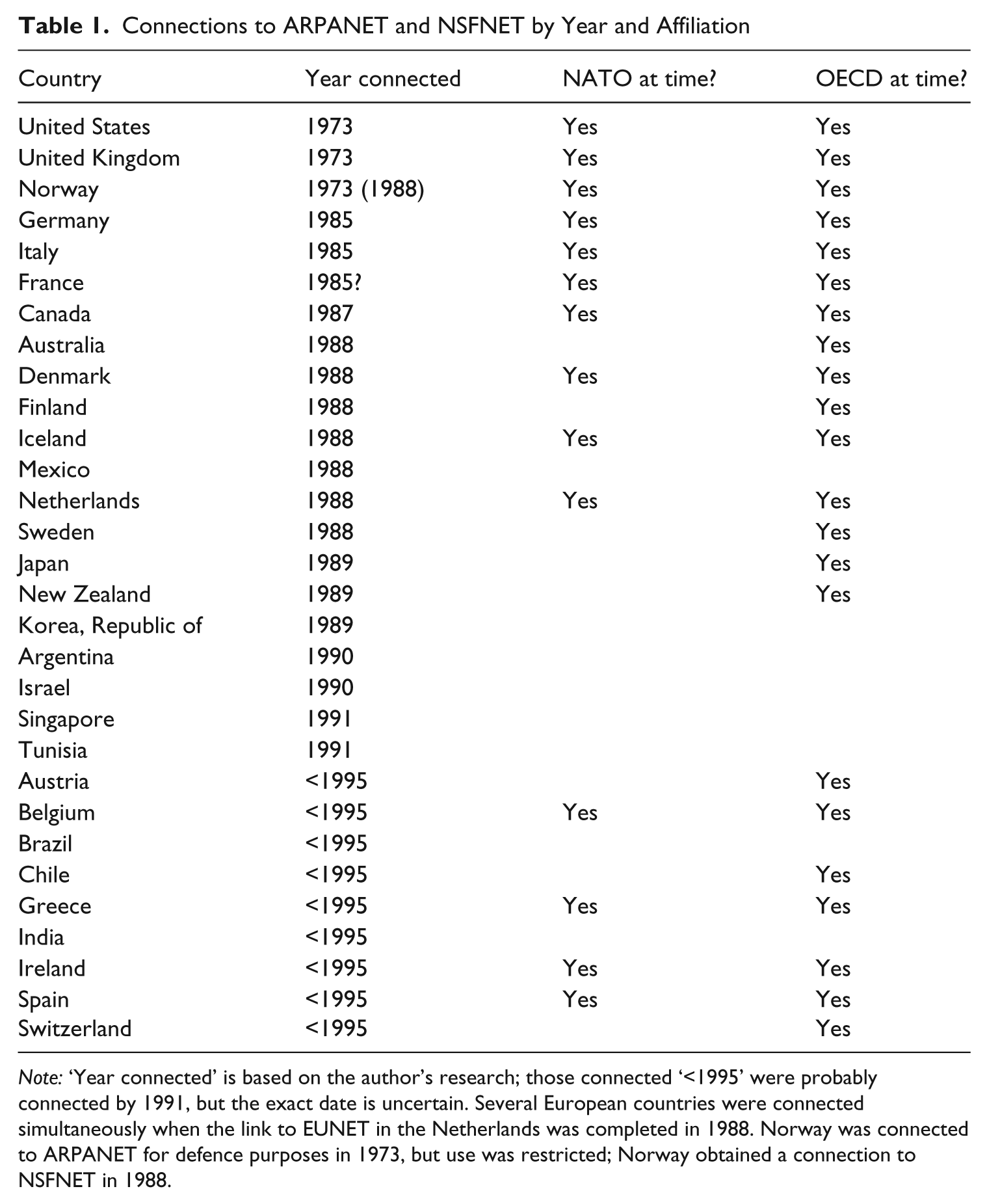
Note: ‘Year connected’ is based on the author’s research; those connected ‘<1995’ were probably connected by 1991, but the exact date is uncertain. Several European countries were connected simultaneously when the link to EUNET in the Netherlands was completed in 1988. Norway was connected to ARPANET for defence purposes in 1973, but use was restricted; Norway obtained a connection to NSFNET in 1988.
Yet the inference that this diffusion is indebted to military necessity – as mentioned in the introduction – is false. The closest available approximation of this conclusion comes from Stephen Lukasik, deputy director and then director of ARPA during the ARPANET era:
Why did ARPA build the network?… There were actually two reasons. One was that the network would be good for computer science.… This is by far the dominant reason among the researchers. But there was also another side of the story, which was that ARPA was a Defense Department agency.
55
At the time, ‘defence relevance’ had become the watchword in ARPA, meaning projects were required to have some conceptual relationship with military operations, at least on paper. This was in keeping with the precedent established by Lukasik’s predecessor as director, Eberhard Rechtin, to maintain an institutional ‘low profile’ to help ensure ARPA’s survival as an agency, especially against critics within the Department of Defense.
56
Lukasik states:
So in that environment, I would have been hard pressed to plow a lot of money into the network just to improve the productivity of the researchers. The rationale just wouldn’t have been strong enough. What was strong enough was this idea that packet-switching would be more survivable, more robust under damage to the network.… So I can assure you, to the extent that I was signing the checks, which I was from 1967 on, I was signing them because that was the need I was convinced of.
57
But whatever Lukasik’s priorities, he nonetheless maintained the ARPA management style, giving his staff and contractors in IPTO significant latitude to pursue their interests, and he ‘protected and encouraged what that office was trying to do’. 58 The product of that office was thus an ARPANET that reflected academic interests more than military necessity.
This is especially true of TCP/IP. Contrary to Abbate’s assertion that ‘military concerns and goals were built into the Internet technology’, 59 the peculiar design of TCP/IP was not due to military imperative, but to the very particular interests of academics such as Vinton Cerf, Robert Kahn, Louis Pouzin and others. Three facts point to this conclusion. First, Larry Roberts’ plan for ARPANET did not envisage ARPANET as an operational military communication system; Roberts states that there ‘never was a military restriction on the Internet’ during his tenure at IPTO. 60 Nor was ARPA networking technology classified, but instead openly published; this meant Soviet researchers – though not connected to ARPANET – could and did use TCP/IP technology in their own work. 61 Second, ARPANET already had an operating set of protocols in place before TCP/IP was developed, called Network Control Protocol (NCP); 62 the TCP/IP suite connected ARPANET to other networks, and vice versa, and would have been unnecessary for a military command-and-control network. Third, the relationship between ARPA networking and the Vietnam-era US military was a source of tension for many of the American researchers; but instead of dismissing ARPA as a branch of the military, they saw it as ‘an extension of the research community itself’. 63 Kahn says of his work for DARPA: ‘if you look at the people in the trenches who were building the technology and doing it, they thought they were solving a technical problem. This was not a military problem that had some urgency.’ 64 And given tensions among American researchers, it is also difficult to see how foreign academics would be willing to participate in a defence-specific project. Instead, TCP/IP owed much more to the academy than the military. Abbate describes as ‘military values’ features of the Internet such as ‘survivability, flexibility, and high performance’, 65 but the latter two are at least as much academic values. Abbate might also include universality, decentralisation and accessibility as manifest goals of the Internet’s technology, yet these are decidedly not military concerns; moreover, TCP/IP was notably lacking in the cardinal military value: security. Lukasik says that, in retrospect, he ‘should have pushed harder for security hooks in the project’, that the academics working on ARPANET were ‘too naïve and honest to conceive of REAL BAD GUYS’. 66 Abbate’s dichotomy between military and commerce ignores the academy, and the set of norms the academics brought to the design of the Internet.
It is important to note that ARPA not only allowed the academics to spread these norms, but also made that process possible. Few organisations possessed the resources and the flexibility to circumvent the rules of the CCITT and the national telecoms. As an organ of the US Department of Defense during the Cold War, ARPA had that power – the ability to lay cable, operate satellites and fund massive amounts of cutting-edge hardware. Had ARPA been more tightly controlled, or had the academics refused to work with the agency, the resulting network would have been very different. Some histories neglect the extent to which ARPA’s unique organisation made the spread of TCP/IP possible, but ARPA was indeed critical as an organisational platform for the academic entrepreneurs, even those not formally employed by the agency.
In 1972, the Defense Communications Agency (DCA) began a separate packet-switching network, called WIN, which did serve operational command and control purposes; soon thereafter, DARPA 67 officials began exploring the possibility of transferring control of ARPANET to a private organisation. 68 In fact, ARPANET had begun with the goal of transfer to private control in short order, but this proved ‘legally difficult’ given the ‘heavily regulated communications field’ in the US. 69 Meanwhile, ARPANET’s expansion into an ‘email service to its contractors 70 as well as supporting a networking research community’ meant that the project fell foul of government regulations, which led to its transfer to DCA control in 1975. 71 Despite the transfer to DCA, ARPANET remained an important research project, yet documents from this period barely acknowledge the existence and extent of foreign connections (see Figure 1). One explanation is that the DCA did not control those satellite connections, which were part of SATNET and still a DARPA project. 72 Whatever the reasons for obscuring SATNET’s existence, probably dozens, perhaps hundreds, of foreign academic, non-military users were already using TCP/IP by the late 1970s.
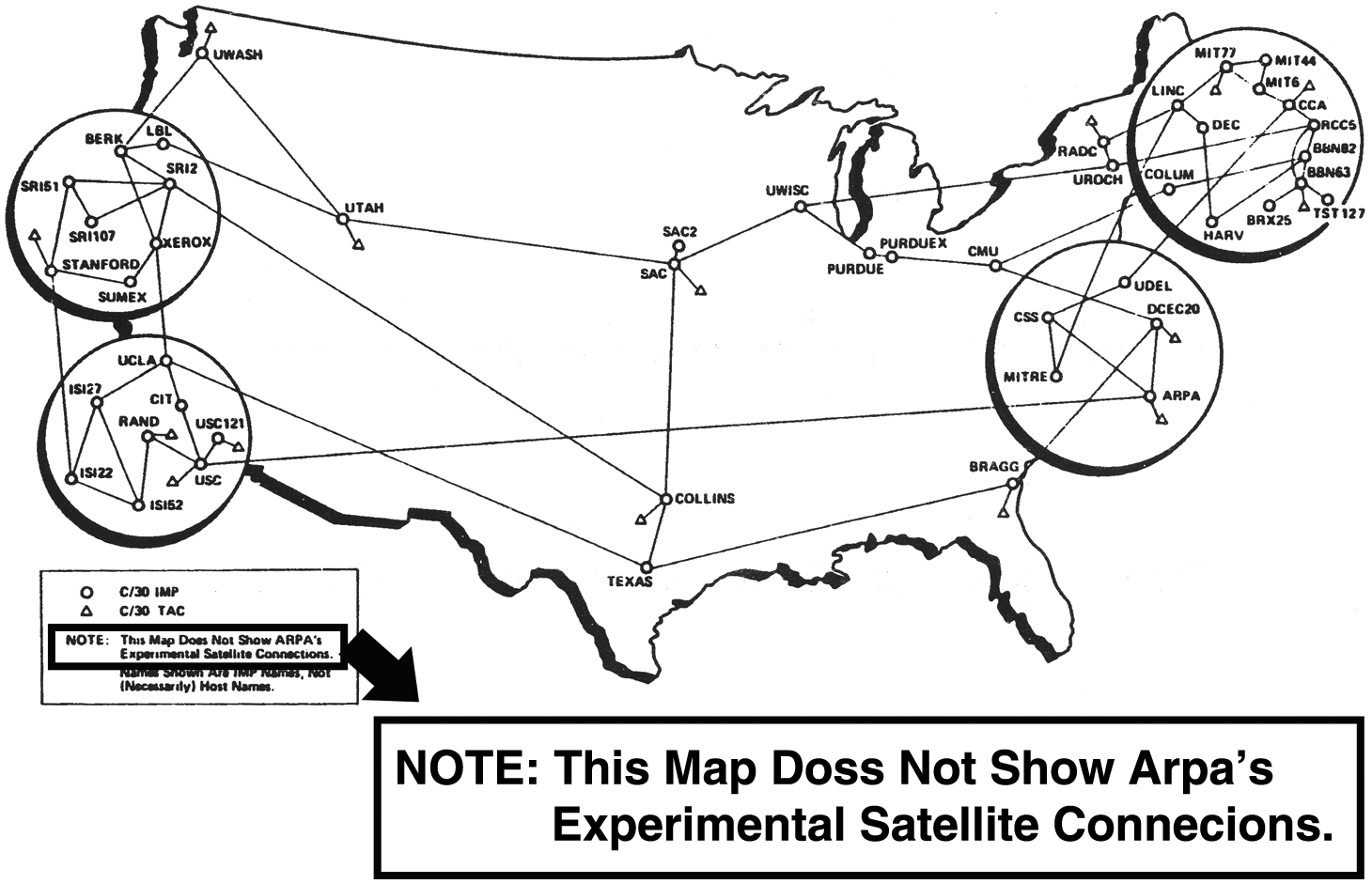
ARPANET Geographic Map, 30 September 1985
In London, for example, Peter Kirstein was not officially permitted to extend his connection to other nations – his governing committee specifically forbade it – but sometime between 1982 and 1985, networks such as BITNET, UUNET, EUNET and EARN began connecting to UK networks and UCL (see Table 2). This allowed users on those networks access to ARPANET, to an extent not fully appreciated until Kirstein was requested to block ‘unauthorised traffic’; to comply, he sent a message to all recorded users over the previous six months – to which he received angry responses from all over Europe. 73 In this way the entrepreneurs used ARPANET to pursue their interests, even at the expense of the US government’s interest in security.
Internet Precursor, Associated and Similar Networks, 1969–89
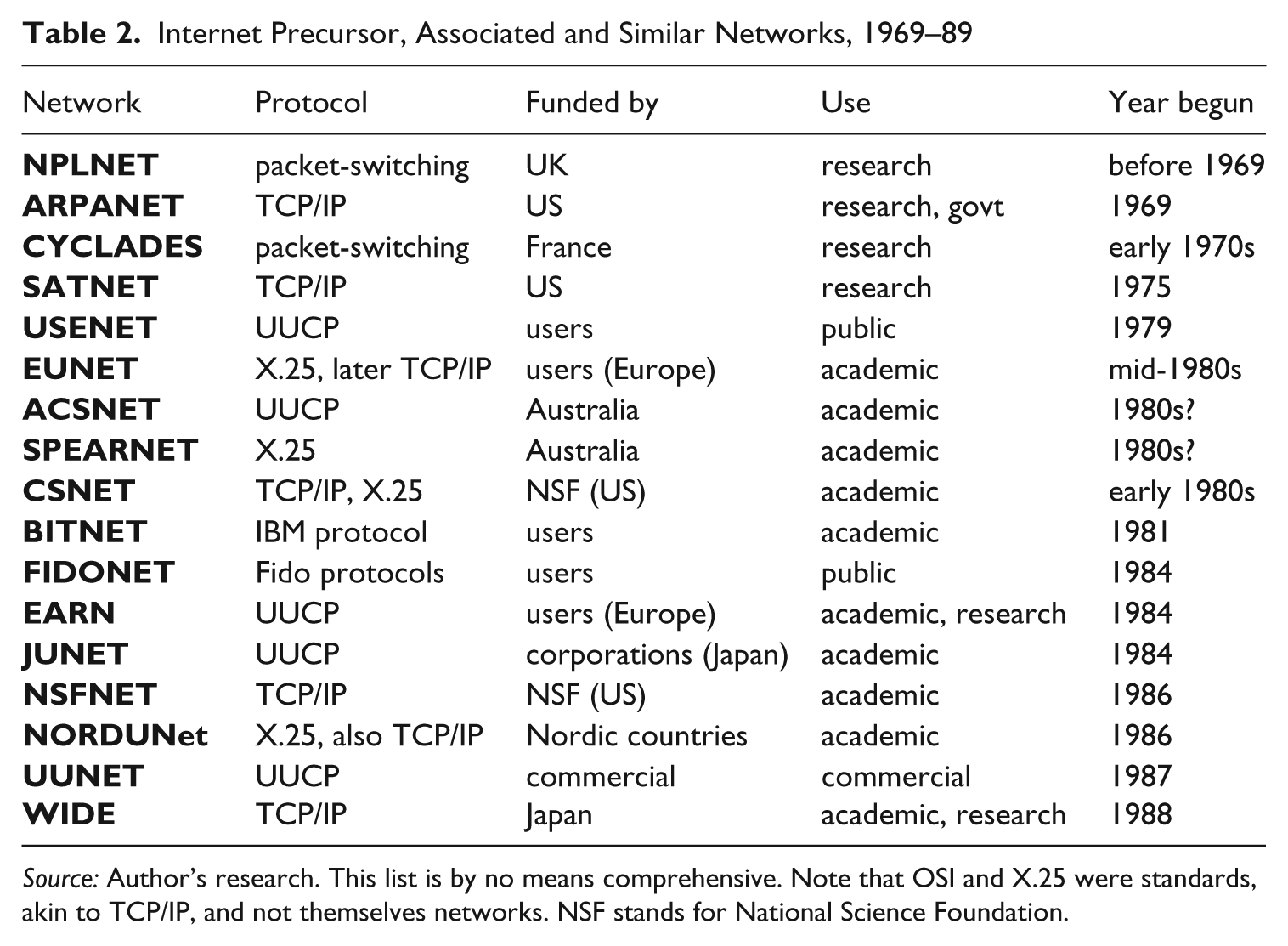
Source: Author’s research. This list is by no means comprehensive. Note that OSI and X.25 were standards, akin to TCP/IP, and not themselves networks. NSF stands for National Science Foundation.
ARPANET was not the only means by which TCP/IP spread. DARPA officials in the 1980s allowed the incorporation of TCP/IP into a freely distributed Unix operating system called 4.2BSD (also called BSD Unix); the software was developed by computer scientists at UC-Berkeley’s Computer Systems Research Group, which also received funding from DARPA. 74 This, more so than official connections to ARPANET, led to the spread of TCP/IP: ‘BSD UNIX was what Sun workstations ran, and Suns (along with VAXes running VMS with DECnet and TCP/IP) were the darlings of the research community and a major export item. It was a brilliant move on DARPA’s part. Europe (and Japan) sucked up Suns and got infected with TCP/IP for free (as it were).’ 75 Weber suggests: ‘In a real sense, 4.2BSD lies at the foundation of the Internet as we know it today.’ 76 The spread of TCP/IP allowed researchers in other countries to develop local networks running the protocols, even where they could not access ARPANET directly. In 1985, the five Nordic countries started NORDUNet to connect their national networks. As realised in 1988, NORDUNet was a star-shaped network connecting Finland, Norway, Denmark and Iceland to a hub in Stockholm, Sweden. 77 When NORDUNet began, ‘the most desired service was the entire TCP/IP protocol suite, with a connection to the US widely wanted’, 78 and the Stockholm hub was in fact linked to the NSFNET. 79 In 1989, EUNET established RIPE – the ‘Réseau IP Européen’ – to connect European users via TCP/IP, including FNET, NORDUNet and also links to NSFNET. 80
TCP/IP service was also attractive to other US government agencies: the National Science Foundation (NSF) established the Computer Science Network (CSNET) to connect academic computer science researchers in the United States.
81
CSNET was born of a proposal by Larry Landweber, at University of Wisconsin, which created a multi-protocol network that ‘included a provision to link the proposed CSNET with ARPANET. Vinton Cerf [at DARPA] not only proposed the link but urged that CSNET employ the TCP/IP protocol, thus making the link transparent.’ Cerf explains that NSF only got involved with TCP/IP in 1980, ‘when it became obvious that being on the ARPANET was critical for universities’.
82
In fact, ARPANET began using exclusively TCP/IP in 1983, approximately the same time CSNET connected, which meant that CSNET had to support TCP/IP to connect to ARPANET.
83
NSF then signed a memorandum of understanding with DARPA in 1985 that allowed the NSF to connect up to 40 academic institutions of their choice per year to the ARPANET, at a fee of $1 million per year – although this arrangement connected relatively few nodes.
84
Until 1985, ARPANET had been restricted to approved users; these restrictions denied a great many would-be users access to the network. In 1986, NSF started NSFNET as a general purpose academic TCP/IP network, built without ARPANET’s restrictions along a different topology:
By 1990, the NSFNET backbone had nodes at (I believe 13) universities where the emerging ‘regional’ networks of the NSFNET attached to the backbone. And the regionals linked university campuses to the backbone. It was a 3-tier system – backbone, regionals, campuses – whose layout/topology had exactly nothing to do with ARPANET (that was in fact the whole point!).
85
The establishment of NSFNET was a crucial step towards the Internet for two reasons. First, obviously, NSFNET helped connect many, many users via TCP/IP in a network that would become the Internet itself. Second, the academic nature of NSFNET’s commitment reinforced and amplified the decisions regarding information and control embedded in TCP/IP. It suffered neither the restrictiveness of a military network nor the financial demands of a commercial network. In building NSFNET according to distributed topology, project managers 86 also worked against other government agencies that wanted more central control; even the ultimate decision to allow commercial traffic on the Internet was managed in such a way as to ensure it remained ‘the Internet’, rather than degenerated into separate networks. 87
In 1990, ARPANET was decommissioned; by this point, CSNET/NSFNET had links to ‘Australia, Finland, France, Germany, Israel, Japan, Korea, New Zealand, Sweden, Switzerland, the United Kingdom, and the People’s Republic of China’ – among others. 88 By May 1995, NSFNET no longer ran the Internet, which ‘was “owned” by no one’; control of the main research backbone was turned over to MCI Communications, and myriad sub-networks were run by commercial, academic and non-profit groups. 89 The Internet was already an international phenomenon, with its decisions about political control firmly entrenched in TCP/IP technology.
Competitors to TCP/IP
The emergence of TCP/IP as the dominant international networking technology was not foreordained. Even within ARPANET, TCP/IP was one of two possible technologies – the other being NCP. 90 In 1983, ARPA made TCP/IP the mandatory protocols for the entire ARPANET and connected networks; ‘by spring [of 1983] any system that has not converted is bumped off the network’, and this had worldwide ramifications. At the same time, the use of the term ‘Internet’ to describe the TCP/IP landscape was made official, as the DCA split ARPANET into MILNET (for the military only) and the civilian Internet. 91
Outside of ARPA, still more alternatives to TCP/IP were in development. These included proprietary products developed by commercial interests: IBM developed Systems Network Architecture (SNA) in 1974, Xerox offered Xerox Network Services in 1975, Digital Equipment Corporation introduced DECNET that same year, and other companies introduced later products. 92 The proliferation of commercial networking software only reproduced the problem TCP/IP was designed to solve – an array of networking protocols that were not interoperable. Worse, these were not open source technologies – unlike TCP/IP.
The proliferation of network technologies led to the development of two successive technical standards for internetworking. Recall two of the theoretical arguments introduced earlier: Krasner’s realism predicts that the US would exercise hegemonic control in favour of its preferred standard, while Abbott and Snidal’s institutionalism predicts firms and governments will prefer private governance. In the X.25/OSI debates, neither prediction was borne out: firms and government argued for formal standards, but the US was unable to exercise hegemonic control. The standards that emerged from these processes proved unsuccessful, ultimately giving way to TCP/IP. The first official standard, X.25, came from the CCITT, an organisation of national telecommunications providers. 93 It was initially a response to IBM’s SNA, which many telecoms feared would allow the computer maker to dominate the market; American representatives to the CCITT suggested TCP/IP as a possible standard, but that was ‘flatly rejected’. 94 The national telecoms opposed the normative decisions about network architecture reflected in TCP/IP. The standard they promulgated instead reflected their interests: where TCP/IP gave the balance of control to the hosts (i.e. end users’ machines), X.25 gave control to the network nodes. This model favoured the telecoms and was similar to the way telephone exchanges operate. Because the CCITT only approved standards in plenary sessions held every four years, the ad hoc committee working on X.25 had to work quickly to ensure that it would be ready for the 1976 plenary meeting. As a result, X.25 was not as well developed as it could have been, nor was it as tested or reliable as TCP/IP. Nonetheless, it was deployed for a time and became the basis for many important networks, but TCP/IP was faster; some networks were configured to allow TCP/IP to work over X.25 links. 95
Development of the second standard began in 1978, when some members of the ISO began work on Open Systems Interconnection, or OSI. 96 OSI was not itself a protocol or software package, but a model that described how networks should interact across seven layers of protocols. Given the influence of the ISO, ‘the OSI framework was quickly endorsed by standards bodies in all the countries that were involved in computer networking’; this included the United States, where even the Defense Department made an effort to incorporate OSI into ARPANET. 97 However, the OSI model did not prescribe specific standards for each layer of protocol, out of concern that such standards might ‘prematurely freeze innovation’. 98 The model was to be filled out by protocol standards as they were developed and proven.
Initially, the ISO rejected TCP/IP as an international standard out of fear of US dominance, 99 but in many cases the OSI model allowed users of pre-existing network protocols to adapt their protocols to the OSI model, including TCP/IP users; by the mid-1980s, a version of the protocols had been approved as standards for their respective layers in the model. 100 Had OSI succeeded to the exclusion of TCP/IP, ‘Europe would have been an island, connected to the Internet via gateways with limited functionality’. 101 Although exclusion of TCP/IP did not happen, it was a very real threat; ultimately, however, the debate was settled by the users themselves. Those who recognised the value of the TCP/IP protocols got involved in the standards-development process and saw to it that OSI was reshaped to include TCP/IP. For some layers of the OSI model, however, no protocols were developed for many years, leaving users in the early 1980s with a fairly simple choice when it came to building networks: TCP/IP, which was well developed and supported, or OSI, which was still incomplete. 102 By 1990, Quarterman could still complain that OSI lacked ‘implementations of the necessary protocols’. 103 By 1992, OSI was ‘clearly dead’. 104
As TCP/IP was developing, other networks were spreading throughout the world. Most of these were based on dial-up software included in various computer systems. For example, BITNET was developed from a file-sharing protocol included in certain IBM computers. UUCP, included with AT&T’s Unix programs, was the basis for several networks, including Japan’s JUNET and the European Academic Research Network (EARN) (see Table 2). These networks were called ‘store and forward’: they connected users’ computers over regular telephone lines. A user would set his computer to dial a central computer at a given time to receive and send e-mail or files. Since BITNET and UUNET required only a computer, modem and telephone line – all easily attainable – these networks spread rapidly across the globe. Their spread had important consequences for the Internet: store-and-forward networks created demand for the kinds of services provided by the Internet. The store-and-forward model’s major drawback was that messages were not sent in real time: users usually set their computers to send and retrieve on a 24-hour cycle. They could also be expensive: making long-distance phone calls via modem to distant computers was not cheap. In most cases, store-and-forward networks were steps or stopgaps towards TCP/IP connectivity. For example, Japanese academics began JUNET in 1984, and connected it to USENET in 1985 and CSNET in 1987. 105 In 1986, the same group of researchers began a TCP/IP network called Widely Integrated Distributed Environment (WIDE); WIDE became part of the PACCOM project, and realised Japan’s connection to the Internet in 1989. 106 Along similar lines, as Internet connectivity exploded in the 1990s, many of the alternative networks were either discontinued or subsumed into the larger network.
The TCP/IP Tipping Point
Finnemore and Sikkink posit that widespread adoption – the ‘norm cascade’ – occurs after a ‘tipping point’, at which acceptance of the norm has reached ‘critical mass’. 107 In determining the tipping point of diffusion processes, Finnemore and Sikkink identify two salient issues. The first is that the tipping point ‘rarely occurs before one-third of total states in the system adopt the norm’. Second, ‘it matters which states adopt the norm’. 108 By these criteria, the tipping point for TCP/IP and the Internet occurred sometime in the early to mid-1990s: by 1995, nearly every major industrialised nation-state was connected through TCP/IP to the Internet (see Figure 2).
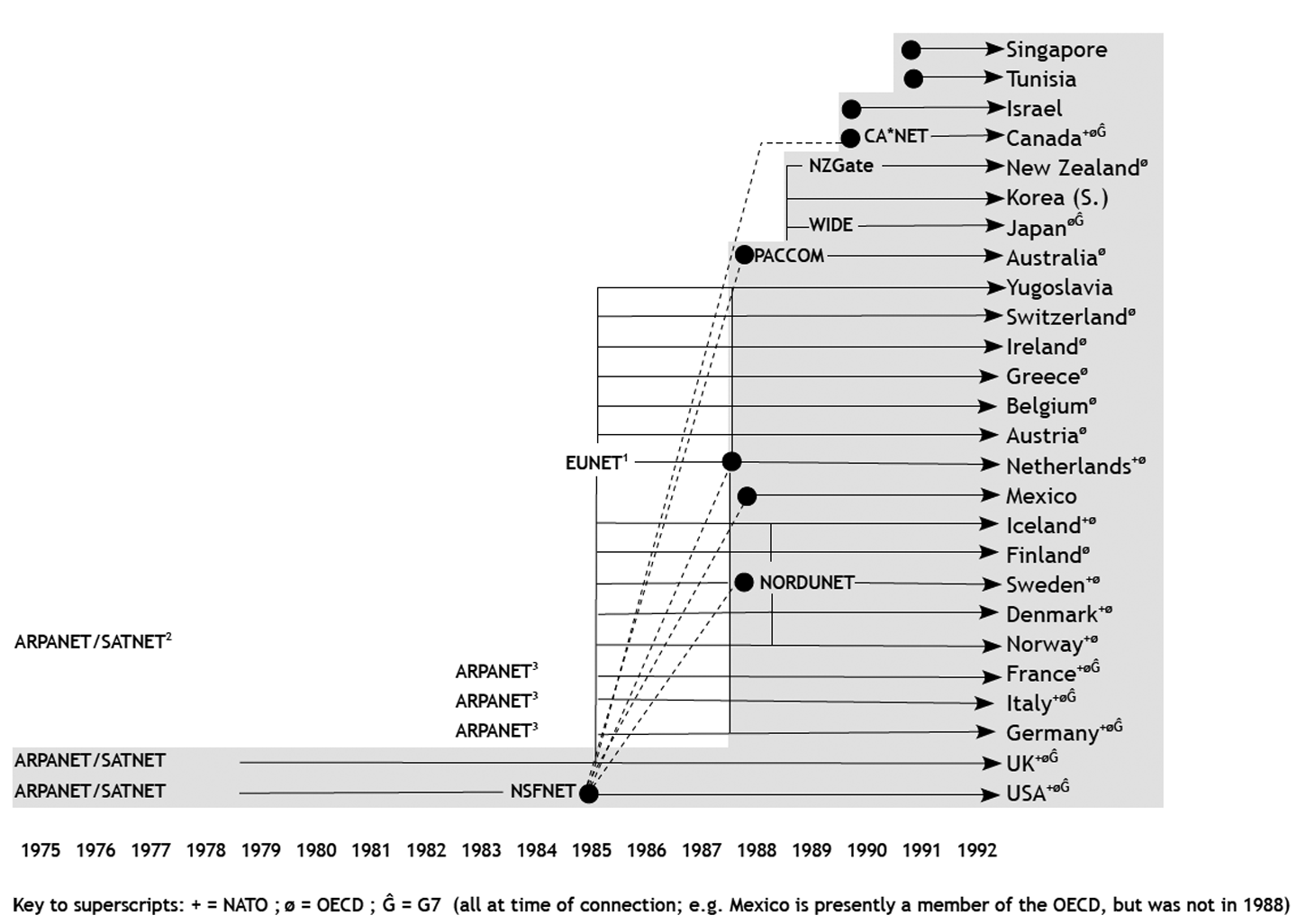
Official Connections to ARPANET and NSFNET prior to 1992
The key period for Internet expansion occurred between NSFNET’s establishment in 1986 and turnover in 1995. In 1990, Quarterman reported of the Internet: ‘Estimates of numbers of hosts range from 40,000 to 500,000, and of the number of users from 500,000 to more than a million.’ 109 ISC surveys the same year returned some 313,000 hosts, meaning computers attached to the Internet. In 1992, the survey returned 727,000 hosts spread across 33 ccTLDs 110 – approximately one-sixth of the countries in the world at that time. A similar survey by RIPE in late 1990 found more than 31,000 active hosts in 19 countries across Europe, the Middle East and part of Asia. 111 It is clear that the TCP/IP-based Internet was already an international phenomenon by the early 1990s; no other protocol suite was anywhere near as widely used.
If this is true of the Internet alone, it is doubly so when related networks are counted. Landweber’s data on international networking shows 50 countries with significant links to international networks (either the Internet, FIDONET, UUCP or BITNET) and a total of 91 with at least some form of international network connection. 112 These represented about one-quarter and almost half, respectively, of the countries in the world in 1991. Moreover, users on the Internet could communicate with users of BITNET, UUCP and other networks – and vice versa. 113 By 1991, some form of international network connection utilising TCP/IP was available in nearly every developed society – and a great many developing countries, too.
More important than simple quantity is the second aspect that Finnemore and Sikkink identify: which states adopted TCP/IP. By 1991, the countries connected to the TCP/IP Internet included most of NATO, most of the OECD and all of the G-7 (see Table 1 and Figure 2) – that is, an overwhelming majority of what Finnemore and Sikkink call ‘critical states’ were already connected to the Internet. Furthermore, most of the critical users – especially academic computer scientists – in these countries were using TCP/IP. Even in Europe – where official resistance to TCP/IP was particularly severe – ‘researchers were either for or were forced to use the open system [i.e. TCP/IP] because of the nature of their contracts. They then grew to know and love the open system approach.’ 114 By 1991, the Internet had a significant presence in nearly every developed country, but it was still dominated by academic and research interests and would not become an economic phenomenon until the late 1990s. Given the entrenchment of TCP/IP in the developed world, and especially among computer scientists, it is difficult to imagine that any other sort of internet could have replaced what was already the Internet by the early 1990s.
Conclusion
The spread of TCP/IP is essentially the spread of the Internet, a process accomplished by academics operating from a powerful organisational platform in a political space of relative freedom and mobility across international boundaries – a space created by the structure of US alliances during the Cold War. The spread of knowledge, especially technology, often occurs in such politicised contexts, and recognising the normative content of technological knowledge allows IR scholars to grasp questions that might otherwise be beyond reach. If a given technology facilitates one kind of political or social arrangement while precluding others – as does TCP/IP – this is of definite concern to political scientists.
The final stage in Finnemore and Sikkink’s norm diffusion model is ‘internalisation’: ‘norms may become so widely accepted that they are internalized by actors and achieve a “taken-for-granted” quality that makes conformance with the norm almost automatic’. 115 This is arguably true of a great many Internet users in Western countries, but elsewhere the normative tilt of TCP/IP remains controversial. Milner shows that the level of Internet adoption varies widely between democratic and authoritarian countries: ‘Among countries coded as democratic, the average percentage of the population that was an Internet user in 2000 was 12%. The same figure for autocracies was only 2%.’ 116 Milner points out that Internet technology poses a specific threat to autocratic regimes, 117 specifically because of the political decisions embedded in the technology, and that such regimes deploy a number of strategies to mitigate that threat. One in particular, ‘national intranet’, 118 effectively severs the network-of-networks connection that makes the Internet the internet.
This controversy is not limited to autocratic countries. In the United States and elsewhere, debates about ‘net neutrality’ 119 are also debates about the ‘decisions to disable control’ embedded in TCP/IP. The telecom companies attempting to end ‘neutrality’ possess the same interests that CCITT members asserted in the formation of X.25 in the 1980s, and their solution – to give more control to owners, versus users – is identical. One observer argues that the success of the Internet is largely attributable to its ‘structural architecture as a commons and its incubation in the (non-market) social milieu of academia’, and this ‘commons’ is threatened by business’s attempts to erect ‘new proprietary barriers of control over information and users’. 120 Likewise, debates in the United States over cyber-security are also debates over the underlying values of the Internet: consider the argument of Adm. Mike McConnell, former director of the US National Security Agency, that ‘we need to reengineer the Internet to make attribution, geolocation, intelligence analysis and impact assessment … more manageable’ – all of which are made more difficult by the current configuration of TCP/IP. 121 ‘Reengineering’ would necessarily require revisiting the decisions made by the entrepreneurs who developed and diffused TCP/IP, and the resulting network might look different and work significantly differently from the current Internet.
As currently constructed, the Internet is characterised by prescriptive norms typical of academia – and, in fact, it reflects the academic’s desire for ‘freedom of inquiry and research’. 122 This is not to say that the Internet is founded on a universal concern for human freedoms; academic freedoms have always been ‘an attempt to protect the interests of a particular occupational group’, even if ‘that group espouses and, at best, practices important values – intellectual honesty, scholastic rigour, self-examination, respect for divergent views, etc.’. 123 But in creating ARPANET, and then pushing its diffusion, academics have allowed users around the world a measure of that freedom. The extension of that freedom is both the power of the Internet and its challenge to international politics.
Footnotes
Acknowledgements
This project began under the guidance of Dr Seymour Goodman, presently Professor of International Affairs and Computing at the Georgia Institute of Technology. In my research, I have benefited from correspondence and conversation with the following people: Alex McKenzie, Piet Beertema, Dave Wortman, Larry Roberts, Jake Feinler, Saul Hahn, Hubert Zimmerman, Louis Pouzin, Hank Nussbacher, Hugo Garcia, Jan Sorensen, Marius Olafsson, Martin Wilhelm, Peter Kirstein, Robert Elz, Robert Kahn, Rolf Nordhagen, Ronda Hauben, Shigeki Goto, Steve Goldstein, Steven Huter, Steve Wolff, Suzanne Johnson, Sven Tafvelin, Torben Nielsen, Vinton Cerf, Larry Press and especially Stephen Lukasik. Henry Farrell and Erik Voeten provided helpful comments on early drafts of this article.
Author Biography
1.
For example, Thomas Friedman, The Lexus and the Olive Tree (New York: Farrar, Strauss, Giroux, 1999); David Held, Anthony G. McGrew, David Goldblatt and Jonathan Perraton, Global Transformations: Politics, Economics, Culture (Stanford, CA: Stanford University Press, 1999); James Rosenau, Distant Proximities (Princeton, NJ: Princeton University Press, 2003).
2.
For example, Ronald Deibert and Rafal Rohozinski, ‘Risking Security: Policies and Paradoxes of Cyberspace Security’, International Political Sociology 4, no. 1 (March 2010): 15–32; Myriam Dunn Cavelty, Cyber-security and Threat Politics: US Efforts to Secure the Information Age (London: Routledge, 2008).
3.
Mary McEvoy Manjikian ‘From Global Village to Virtual Battlespace: The Colonizing of the Internet and the Extension of Realpolitik’, International Studies Quarterly 54, no. 2 (June 2010): 381–402.
4.
Daniel McCarthy, ‘Open Networks and the Open Door: American Foreign Policy and the Narration of the Internet’, Foreign Policy Analysis 7, no. 1 (January 2011): 89–112.
5.
Geoffrey Herrera, Technology and International Transformation (Albany, NY: SUNY Press, 2006), 193.
6.
James N. Rosenau, ‘Information Technologies and the Skills, Networks, and Structures that Sustain World Affairs’, in Information Technology and Global Politics, eds James N. Rosenau and J.P. Singh (Albany, NY: SUNY Press, 2002), 275.
7.
Janet Abbate, Inventing the Internet (Boston, MA: MIT Press, 1999), 208–12.
8.
Bruce Mazlish, ‘Technology and Social Relations: From Patronage to Networks’, in Wiring Prometheus, eds P. Lyth and H. Trischler (Aarhus, Netherlands: Aarhus University Press, 2004), 22.
9.
Joel Mokyr, The Gifts of Athena (Princeton, NJ: Princeton University Press, 2002), 4, emphasis in the original.
10.
Lawrence Lessig, Code and Other Laws of Cyberspace (New York: Basic Books, 1999), 33.
11.
Transmission Control Protocol regulates computer-to-computer (or host-to-host) interactions; Internet Protocol regulates network-to-network interactions.
12.
Helen V. Milner, ‘The Digital Divide: The Role of Political Institutions in Technology Diffusion’, Comparative Political Studies 39, no. 2 (March 2006): 176–99.
13.
Ibid., 178.
14.
Stephen J. Krasner, ‘Global Communications and National Power: Life on the Pareto Frontier’, World Politics 43, no. 3 (April 1991): 343.
15.
In fact, Krasner would likely class the Internet as a form of ‘transborder data flow’; ibid., 353.
16.
Kenneth Abbott and Duncan Snidal, ‘International “Standards” and International Governance’, Journal of European Public Policy 8, no. 3 (2001): 350, 355, 364. At present, standards-setting on the Internet is in fact done by private governance – the Internet Engineering Task Force, a body made up primarily of users; Scott Bradner, ‘RFC 2026: The Internet Standards Process – Revision 3’ (1996), available at:  (accessed 14 Feb. 2011).
17.
Hendrik Spruyt, ‘The Supply and Demand of Governance in Standard-Setting: Insights from the Past’, Journal of European Public Policy 8, no. 3 (2001): 375.
18.
Steven Weber, The Success of Open Source (Cambridge, MA: Harvard University Press, 2004), 238.
20.
Martha Finnemore and Kathryn Sikkink, ‘International Norm Dynamics and Political Change’, in Exploration and Contestation in the Study of World Politics, eds Peter Katzenstein, Robert Keohane and Stephen D. Krasner (Cambridge, MA: MIT Press, 2002), 251.
21.
Ibid., 255.
22.
Ibid., 255–6.
23.
Ibid., 256.
24.
Ibid., 259.
25.
Packet-switching breaks data into discrete chunks called ‘packets’, which allows each packet of data to be sent by different routes – ‘switched’ – in the network; data packets are reassembled at the receiving end into a coherent message. Contrast with normal telephone systems, which require a single continuous connection to transmit data.
26.
27.
Leonard Kleinrock, Communication Nets: Stochastic Message Flow and Delay (New York: McGraw-Hill, 1964).
28.
Abbate, Inventing the Internet, 8, 27.
29.
Lukasik, ‘Why the ARPANET Was Built’, 6.
30.
31.
Abbate, Inventing the Internet, 44.
32.
Barber, ‘Advanced Research Projects Agency’, IX:57.
33.
Lukasik, ‘Why the ARPANET Was Built’, 11.
34.
Ibid., 13.
35.
36.
C.J.P. Moschovitis et al., History of the Internet: A Chronology, 1843 to the Present (Santa Barbara, CA: ABC-CLIO, 1999), 76.
37.
38.
Lukasik, ‘Why the ARPANET Was Built’, 17.
39.
Stephen Lukasik, email to the author, 28 Dec. 2010.
40.
Kirstein, ‘Early Experiences’, 1, 5.
41.
Peter Kirstein, ‘University College London ARPANET Project’ (April 1978): Table 8.1, available at Defense Technical Information Center (DTIC): http://oai.dtic.mil/oai/oai?verb=getRecord&metadataPrefix=html&identifier=ADA13502.
42.
Larry Roberts, email to the author, 28 January 2000.
43.
In 1972, ARPA’s named was changed to the Defense Advanced Research Projects Agency (DARPA).
44.
M. Mitchell Waldrop, The Dream Machine: J.C.R. Licklider and the Revolution That Made Computing Personal (New York: Viking, 2001), 378–80.
45.
Ibid., 376.
46.
Moschovitis et al., History of the Internet, 82.
47.
Louis Pouzin has written a brief narrative of his experience with networking in France: ‘Cyclades, ou comment perdre un marché’ (‘Cyclades, or How to Lose a Market’), La Recherche 328 (2000): 32–3, but it is not accessible to the author at present.
48.
Abbate, Inventing the Internet, 125.
49.
Moschivitis et al., History of the Internet, 91.
50.
Robert Kahn, email to the author, 28 June 2000.
51.
Weber, Success of Open Source, 140.
52.
Elizabeth ‘Jake’ Feinler, email to the author, 28 January 2000.
53.
Waldrop, The Dream Machine, 199.
54.
The only exceptions were Finland and Sweden, whose connections were incidental to their neighbours’, and Mexico. The NATO members missing from the table were likely able to connect via EUNET through the Netherlands’ connection in 1988.
55.
Waldrop, The Dream Machine, 279.
56.
Barber, ‘Advanced Research Projects Agency’, VIII:3–9, IX:5.
57.
Waldrop, The Dream Machine, 279–80.
58.
Ibid., 330.
59.
Abbate, Inventing the Internet, 5.
60.
Lawrence Roberts, email to the author, 28 January 2000.
61.
Stephen Lukasik, email to the author, 13 February 2011.
62.
Abbate, Inventing the Internet, 67–8.
63.
Waldrop, The Dream Machine, 281.
64.
Cerf, ‘Oral History of Robert Kahn’, 41.
65.
Abbate, Inventing the Internet, 5.
66.
Stephen Lukasik, email to the author, 15 December 2010.
67.
‘Defense’ was added to ARPA’s title in 1972, but ARPANET was unchanged.
68.
Abbate, Inventing the Internet, 134.
69.
Barber, ‘Advanced Research Projects Agency’, IX:59.
70.
‘Contractors’ here includes universities and research organisations working on ARPA projects.
71.
Lukasik, ‘Why the ARPANET Was Built’, 16.
72.
Pierre Salus, Casting the Net: From ARPANET to Internet and Beyond (Reading, MA: Addison-Wesley, 1995), 80.
73.
Peter Kirstein, email to the author, 9 June 2000.
74.
Weber, Success of Open Source, 34.
75.
Steven Wolff, email to the author, 15 December 2010.
76.
Weber, Success of Open Source, 35.
77.
Rolf Nordhagen, email to the author, 8 March 2000.
78.
John Quarterman, The Matrix: Computer Networks and Conferencing Systems Worldwide (Bedford, MA: Digital Press, 1990), 485.
79.
Sven Tafvelin, email to the author, 6 March 2000.
80.
Quarterman, The Matrix, 428.
81.
Ibid., 295.
82.
83.
Ibid.
84.
Steven Wolff, email to the author, 15 December 2010.
85.
Ibid.
86.
Dennis Jennings was the first project manager for NSFNET, followed by Steve Wolff.
87.
Roessner et al., ‘The Role of NSF’s Support of Engineering’, ch. IV.
88.
Quarterman, The Matrix, 295. China may be incorrect; Landweber (see below) shows no such connection.
89.
Roessner et al., ‘The Role of NSF’s Support of Engineering’, ch. IV.
91.
Moschivitis, History of the Internet, 110.
92.
Abbate, Inventing the Internet, 153.
93.
Robert Kahn (email to the author, 28 June 2000) writes that SATNET was developed in part because ‘the complexities of connecting more lines was too great at that point due to CCITT rules’.
94.
Abbate, Inventing the Internet, 153.
95.
Quarterman, The Matrix, 425.
96.
Abbate, Inventing the Internet, 168.
97.
Ibid., 171.
98.
Ibid., 169.
99.
Ibid., 174.
100.
Ibid., 175.
101.
Piet Beertema, email to the author, 14 September 2000.
102.
Abbate, Inventing the Internet, 178.
103.
Quarterman, The Matrix, 433.
104.
Salus, Casting the Net, 226.
105.
Shigeki Goto, email to the author, 24 June 2000.
106.
Jun Murai, ‘Evolution and Revolution of the Internet in Japan’, paper presented at the CyberJapan: Technology, Policy, Society symposium, Washington, DC, 1996.
107.
Finnemore and Sikkink, ‘International Norm Dynamics and Political Change’, 261.
108.
Ibid., 261.
109.
Quarterman, The Matrix, 278.
110.
That is, Country Code Top Level Domains – the two-letter indicators indicating a specific country, for example, ‘.fr’ for France. While the US has a ccTLD (.us), most US-based websites use .com, .org, .net or .edu.

112.
113.
Quarterman, The Matrix, 281.
114.
Elizabeth ‘Jake’ Feinler, email to the author, 28 January 2000.
115.
Finnemore and Sikkink, ‘International Norm Dynamics and Political Change’, 264.
116.
Milner, ‘The Digital Divide’, 181.
117.
Ibid., 184.
118.
Ibid., 187.
119.
For example, Alan Joch, ‘Debating Net Neutrality’, Communication of the ACM 52, no. 10 (October 2009): 14–15.
120.
David Collier, Silent Theft (New York: Routledge, 2002), 100.
121.
Mike McConnell, ‘To Win the Cyber-war, Look to the Cold War’, Washington Post, 28 February 2010, B01.
122.
123.
Jon Nixon, ‘“Not without Dust and Heat”: The Moral Bases of the “New” Academic Professionalism’, British Journal of Educational Studies 49, no. 2 (June 2001): 175.