



Abstract
When IR scholars examine ‘standards of civilisation’, they typically privilege the Western civilisational standard that structured international society during the colonial era. Conversely, this article compares the ‘civilising missions’ of non-Western empires in the early modern period in Mughal India and Qing China. As foreign conquerors ruling huge and diverse empires, Mughals and Manchus faced common problems legitimating their dominance over indigenous majorities that vastly outnumbered them. In both cases, they formulated elaborate civilising missions to justify their rule, recruit collaborators and sustain the hierarchical international orders that formed around their empires. In foregrounding these parallels, this article helps us to better understand how hierarchies form in international politics, while also illuminating the specific role civilising missions and processes played in constituting international hierarchies in non-Western settings.
Keywords
Introduction
This article examines how ‘civilising missions’ and their attendant civilising processes structured the international relations of Asia’s largest early modern empires – Mughal India and Qing Dynasty China. My purposes in pursuing this investigation are threefold. First, and most generally, I aim to further our understanding of how hierarchies arise in world politics. IR scholars are now paying increasing attention to international hierarchies. 1 Civilising missions – with their vertical differentiation between the ‘civilised’ and ‘barbarians’ – have historically offered powerful alibis for imperial expansion. A comparative examination of how civilising missions have abetted imperial conquest thus promises to illuminate some of the social processes through which international hierarchies have recurrently emerged.
Second, and more specifically, this article takes up Andrew Linklater’s challenge for IR scholars to comparatively explore the role ‘civilising processes’ have played in constituting international systems. 2 Drawing on Norbert Elias’ analysis of the European state system’s development, Linklater has shown the importance of ideas and practices of civility and civilisation in constraining violence, within but also between states. While Linklater has advocated analysing civilising processes through a comparative study of sovereign state systems, I show that this line of inquiry can be extended to suzerain (that is, imperial) international systems. Far from being antithetical to imperial orders, norms and practices stressing the restraint of violence in the name of civility and civilisation have been deeply constitutive of them. I explore this paradox at length below.
Lastly, this article contributes to a growing scholarship seeking to move IR beyond its traditional Eurocentrism. 3 Civilising missions and processes have been wrongly identified as a peculiarly Western form of chauvinism for too long. Unsettling this identification of civilisational politics with Western imperialism alone thus provides a further motive for this inquiry.
How, then, did civilising missions help constitute non-Western imperial hierarchies in early modern Asia? I argue that civilising missions provided Mughal and Manchu conquest elites with an overriding purpose justifying imperial conquest; an ideological bridge to bind indigenous collaborators within imperial systems of rule; and a framework for imagining the institutions needed to stabilise the hierarchies resulting from imperial expansion. These civilising missions were moreover institutionalised through two types of civilising processes – psychogenetic and sociogenetic. 4 Psychogenetic civilising processes aimed to restrain arbitrary violence by transforming imperial subjects’ internal affect structures. 5 For the Mughals and the Manchus, these involved court-centred rituals aimed at civilising courtiers and foreign ambassadors into conformity with a divinely ordained imperial order. Sociogenetic processes meanwhile involved the institutionalisation of restraints on the number and type of actors entitled to use violence. 6 Here the Mughal and Manchu orders differed, the Mughals preserving a loose oligopoly on public violence that was substantially more decentralised than that of their Manchu counterparts. These differences aside, what unites both cases is the Janus-faced character of civilising missions and processes as both licences for empire and bridles for violence. It is in this paradoxical duality that the early modern Asian imperial orders most clearly anticipate the contradictions of the European international society that eventually suborned and succeeded them.
My argument proceeds in four sections. Section one presents my conceptual framework. Section two identifies the common challenges Mughal and Manchu rulers faced as parvenu conquerors seeking to consolidate their dominance over indigenous majorities. Section three then comparatively examines the civilising missions and civilising processes they formulated in response to these challenges. Section four recapitulates my findings and identifies their implications for the study of hierarchy and civilisation in global politics.
Civility, Civilisation and Civilising Missions and Processes in International Relations
Definitional Preliminaries
Several concepts demand clarification before I can proceed. The first are the ideas of civility and civilisation. Elias traces civility’s conceptual origins to Erasmus’s 1530 tome De civilitate morum peurilium (On civility in boys). 7 Directed at those charged with educating the sons of the nobility, the book was a study of what constituted good manners in Renaissance Europe. Critically, those possessing civility were distinguishable through their mastery of bodily habits – whether at the dinner table or in the street – that connoted discipline and self-restraint. Coupled with this self-restraint, the ‘civilised’ differed from ‘barbarians’ in possessing a different standard of repugnance towards bodily functions, which supposedly reflected their more refined internal affect structures. 8
Restraint therefore formed the essence of civility in Renaissance Europe. Likewise, restraint formed a core ingredient of civilisation, a cognate concept Mirabeau the Elder coined over two centuries later in 1756. 9 Echoing Erasmus, he understood civilisation to refer first to a refinement of popular manners and internal moral sensibilities. 10 Second, however, civilisation also referred to the regulation of public violence. Specifically, ‘civilised’ polities were those where civil law had replaced military law, and were characterised by ‘the subjugation of force and violence to public legality’. 11
Both civility and civilisation thus reflected a common concern with restraint as the chief characteristic separating the civilised from barbarians. The tight association IR scholars typically draw between civilising missions and the later Western ‘standard of civilisation’ often makes it difficult for them to disentangle the two from one another. But this disentanglement is essential, for civilisation and its cognate concepts first emerged in Europe as resources of self-criticism and catalysts for internal reform. Only later did they become licences for imperialism abroad. For this reason, I define ‘civilising missions’ as projects of normative pacification, entailing (a) rulers’ refinement of subjects’ manners and moral sensibilities, and (b) the regulation and institutionalisation of legitimate public violence. This formulation remains sensitive to civilisation’s internally oriented origins prior to the European global ascendancy. Crucially, however, it also provides a basis for examining comparable projects of normative pacification in non-European contexts.
Before justifying my comparison of non-European civilising missions, I must finally introduce the chief institutional expressions of ‘civilising missions’, namely psychogenetic and sociogenetic civilising processes. Psychogenetic civilising processes refer to practices directed towards shaping individuals’ internal affect structures and external modes of comportment. 12 Sociogenetic processes conversely refer to macro-institutional processes through which violence is constrained through the disarmament of the population and the strengthening of public organs of rule. 13
Within Western Europe, psychogenetic processes played out primarily in the domestication of feudal warrior elites at royal courts. Elias meanwhile identified sociogenetic processes with rulers’ concentration of control over the means of violence at the expense of these same feudal elites. 14 To be clear, Elias derived his framework from a stylised reading of Western European history. This raises inevitable questions regarding the generalisability of his framework to very different historical contexts. Thus it is to a defence of this comparative move that I now turn.
Exploring Civilising Missions and Processes in Non-European Contexts
Given the tight association of ideas of civility, civilisation and civilising missions and processes with the European historical experience, I must anticipate an obvious objection to this study – namely, that these ideas and practices are so inseparable from their Western European roots as to preclude their meaningful exploration in non-Western settings. The existence of a growing literature pursuing precisely such comparisons blunts such criticisms from the outset. 15 Nevertheless, it would be wrong to assert a complete identity between Western and non-Western civilising missions and processes. Consequently, I justify my interrogation of non-Western civilising missions and processes on two grounds: first, the common structural context out of which civilising imperatives emerged in Western and non-Western settings, and, second, the strong family resemblances in the ideas and practices these imperatives produced.
Turning first to questions of context, we must recall that, in Elias’ analysis, discourses of civility and civilising processes first arose in the context of late medieval and early modern state formation. 16 Centuries before Europeans sought to civilise non-European ‘others’, they first sought to civilise themselves. This recognition is essential as a starting point for comparative analysis, for it foregrounds the fact that Europeans undertook their first ‘civilising missions’ as part of a process of state formation and normative pacification then prevalent throughout Eurasia. A common combination of commercial expansion, state formation and ambitious projects of normative pacification transformed political life across Eurasia from the late medieval period onwards, yielding larger and more durable polity forms than had previously existed. This shared structural context of late medieval and early modern commercial integration, state formation and normative pacification forms a commonality between Europe and Asia that permits an examination of ‘civilising missions’ in non-Western settings.
Beyond the common context uniting Western and non-Western civilising missions, we can also see strong family resemblances in the ideas and practices uniting Western and non-Western projects of normative pacification. 17 Thus, in Mughal India and Qing China as much as in Western Europe, late medieval and early modern rulers justified their rule through the promise of peace, to be won through the moral reform of elites (psychogenetic processes) and through institutionalised control over the means of violence (sociogenetic processes).
Mughal and Qing empire-builders shared with their European counterparts the impulse to articulate a distinct civilising mission that could justify rulers’ dominance and legitimise local intermediaries’ collaboration. In Mughal India, emperors from Akbar’s reign (1556–1605
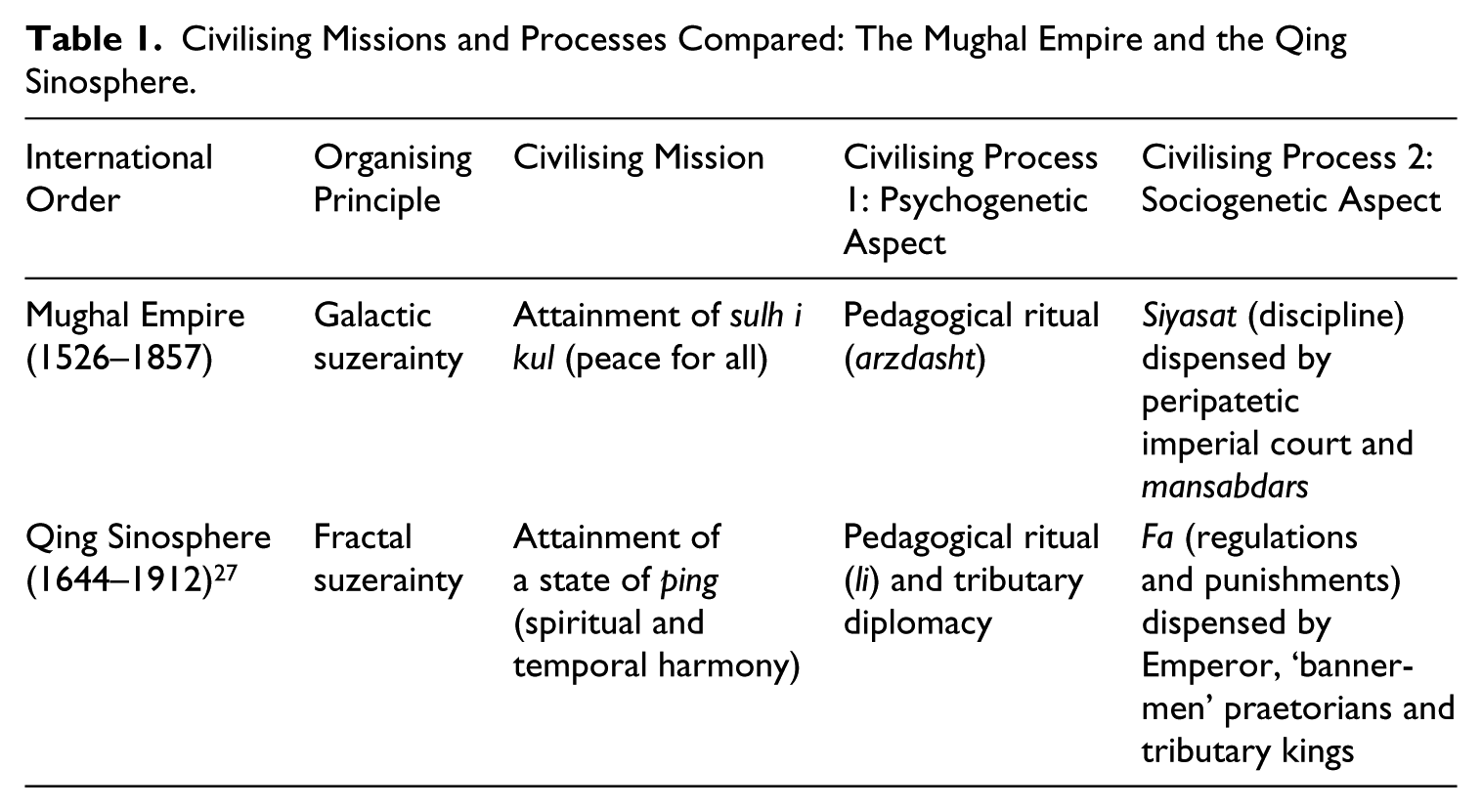
The Mughal and Qing empires not only formed around distinct civilising missions; each also relied on psychogenetic and sociogenetic civilising processes to realise these missions. Mughal ideology thus drew from a tradition of Persianate Islamic ethics that saw the cultivation of popular moral virtue as one of the Emperor’s core responsibilities. 22 The Emperor discharged these responsibilities through incorporative rituals designed to symbolically reconcile the empire’s communities. 23 A system of siyasat (discipline) meanwhile arrogated to the Emperor and his liegemen (the mansabdars) the prerogative to use force to maintain the empire. 24
When engaging their Han subjects and Confucian vassal kingdoms, the Manchu emperors likewise monopolised the responsibility for performing li (the rites needed to sustain cosmic and temporal harmony), while reproducing Confucian hierarchy internationally through practices of investiture and tributary diplomacy. 25 Together with his praetorian guard (the banner-men) and vassal Confucian kings in neighbouring polities, the Emperor also employed fa (‘inducements and punishments’) to chastise barbarians and uphold stability within tianxia (‘all under heaven’). 26
Table 1 provides a schematic point of reference for the cases to follow. With these conceptual preliminaries dispensed with, I now turn towards a more detailed discussion of the challenges that early modern empire-builders faced in Asia, and that rendered civilising missions and processes so central to their consolidation of power.
Civilising Missions and Processes Compared: The Mughal Empire and the Qing Sinosphere.
Connection, Conquest, Civilisation and Barbarism in Late Medieval and Early Modern Eurasia
Across the late medieval and early modern eras, two interconnected master processes transformed Eurasia. These were an unprecedented growth in human interconnectedness (driven primarily but not exclusively by expanding trade) and the rise of powerful new conquest states. Considered together, these processes formed the common context within which potent new ‘civilising missions’ developed, including but not limited to those of the Mughals and Manchus.
The early modern period (1500–1800
This infusion of American bullion into Asia not only stimulated trade; it also further encouraged the growth of powerful new conquest states. Once again, this consolidation built on medieval precedents. From the violent spread of Norman ‘aristocratic diasporas’ throughout Western Europe and the Levant, 30 to periodic waves of Turkic and Mongol conquerors erupting from the Eurasian steppe, mobile warrior elites had already carved out expansive domains of varying longevity by the close of the medieval period. Eurasian economies’ growing monetisation from the 16th century further aided state-building, expanding rulers’ ability to fund a salaried bureaucracy and greater reserves of military power than before.
The Habsburgs in Europe; the Ottoman, Safavid and Mughal dynasties in the Islamic world; the Ming and later Qing dynasties in China; even Japan’s Tokugawa Shogunate – all benefited or would soon benefit from the aforementioned processes. As centralising elites, each also spearheaded a sub-process associated with state-building, namely the pursuit of projects of normative pacification in the form of ‘civilising missions’. In Western Europe, this internal ‘civilising mission’ tried to tame a feudal warrior elite. But this ‘courtisation of the warriors’ was by no means confined to Europe, being present also in East Asia. 31 In South Asia, too, royal courts had served an analogous function from the medieval era, working as ‘an acculturative mechanism, whereby men and women were integrated into a mutually intelligible pan-regional culture with its own distinctive protocols of sociability, gestural and mental proclivities, modes of communication and ethical preoccupations’. 32 Just as royal courts provided in Europe a key site for taming a warrior nobility, so too did they perform a similar role in the Chinese and Islamic worlds, comparable notions of li and adab respectively providing a common code of ethics and manners to domesticate elites. 33
Projects of normative pacification – in the form of ‘civilising missions’ aimed at the taming of warrior elites – thus formed a critical component of late medieval and early modern Eurasian political consolidation. But as Europe’s transition from medieval heteronomy to sovereign anarchy shows, powerful centrifugal processes at times thwarted early modern empire-building. The earlier rise of local vernacular high cultures presented particularly vexing challenges for empire-builders after 1500
As they stretched their suzerainty over ever larger swathes of South and East Asia respectively, then, the Mughals and the Manchus faced an imperative of normative pacification confronting all early modern rulers – but with a crucial twist. For within both India and China, it was the Mughals and the Manchus themselves who were most vulnerable to stigmatisation as ‘barbarians’. Admittedly, identity distinctions between Mughals and non-Mughals, and between Manchus and Han Chinese, were far less rigid than subsequent generations of Indian and Chinese nationalists have supposed. 36 But the fact remains that lettered local elites undeniably saw the Mughals and Manchus as parvenu conquerors in the decades following their conquest. To consolidate their power, the Mughals and Manchus needed to co-opt these elites, both to legitimate their rule and also to help them administer their empires. For recently established ‘barbarian’-dominated suzerain orders to flourish, new visions of political community were needed that could not only motivate and justify continued conquest, but also bind local collaborators to imperial structures and stabilise the hierarchical international orders that developed around emerging empires. These were the common challenges the Mughals and Manchus faced as they forged new imperial orders. Both responded by articulating and institutionalising distinct civilising missions, which proved indispensable in consolidating the imperial hierarchies that dominated early modern Asia.
Civilising Missions and Processes and the Constitution of International Hierarchies: The Mughal and Manchu Empires Compared
The Mughal Civilising Mission
The Mughals ruled most of South Asia from 1526 down to the early 18th century. Turkic-speaking pastoralists from the Fergana Valley, the Mughals proudly claimed descent from Mongol conquerors Genghis Khan and Tamerlane. 37 The identity of the Mughals, who were nominal Muslims and already the legatees of both Turkic and Mongol traditions, became even more compound following their conquest of northern India. This is because the high culture they inherited there was already irrepressibly cosmopolitan, composed of an amalgam of Turkic, Persian and local influences. From the early second millennium CE, a broad swathe of southwest Asia was transformed through the intersection and partial synthesis of the Turkic and Persian traditions. 38 The resulting hybrid formed the primary filter through which Muslim conceptions of ethics and statecraft spread east throughout Asia. 39 Ideas from these traditions formed the cultural raw material from which the Mughals synthesised their civilising mission, and so warrant consideration.
Central to Turko-Persian conceptions of rule were two competing notions of imperial authority. The first was the ideal of the ruler as caliph – Allah’s ‘shadow on earth’ – charged with upholding God’s laws in the temporal world. 40 This conception of kingship enjoined submission to kingly authority as consistent with Islam. But it also constrained the monarch to do Allah’s will on earth, through upholding ideals of justice as revealed through the Quran and Hadith. 41
The idea of ruler-as-caliph certainly shaped Mughal conceptions of political authority. But it contended with an older, distinctly Persian conception of the ruler as universal monarch, or padshah. The ruler-as-caliph conceived the monarch as owing his authority entirely to Allah. This imbued the institution of monarchy with a subordinate and subsidiary character. Contrarily, the idea of the ruler-as-padshah invested the imperial office with a more directly charismatic and creative function. Not merely God’s lieutenant, the padshah purportedly possessed a ‘divine effulgence’ that harked back to Persia’s long pre-Islamic history. 42 Possessing the ‘divine light’, the Emperor wielded an independently pivotal centripetal influence in holding otherwise irredeemably divided and diverse communities together. 43
The Mughals braided together the competing ideas of caliph and padshah to form the basis of the civilising mission that sustained their empire. For the empire’s duration, Mughal ideology remained multi-faceted. But at its zenith, the Persian ideal of the padshah, as one who embraced rather than effaced communal differences, predominated. At Akbar’s court, the Mughal civilising mission was thus defined by the Emperor’s task of securing a state of sulh i kul (peace for all, or universal reconciliation). 44 Akbar’s court celebrated religious diversity, elevating toleration as one of kingship’s defining virtues. 45 Sovereignty was furthermore conceived not in absolutist terms; instead, the padshah formed the solar centre of a ‘galactic polity’ in which power radiated outwards from the Emperor, the multiple sovereignties that composed the empire being hierarchically ordered under loose suzerain arrangements that preserved rather than eradicated pluralism. 46
Consistent with the eclecticism of the Turko-Persian cultural universe they had conquered, the Mughals thus articulated a civilising mission that was incorporative rather than assimilationist. The Mughals institutionalised this mission through both psychogenetic and sociogenetic civilising processes. Central to the psychogenetic dimension of Mughal civilising processes was the Islamic notion of akhlaq, or political ethics (literally: ‘disposition of the soul’). 47 Cultivating virtue among his subjects formed one of the Mughal Emperor’s most sacred responsibilities. Lacking a bureaucracy intrusive enough to instil these virtues directly, the Mughals discharged this duty instead through pedagogical rituals centring around the imperial court, and particularly on the body of the Emperor. 48
For the Mughals, the disciplining of the soul, the cultivation of adab (civility), submission to the Emperor and surrender to the divine were mutually constitutive imperatives. Consequently, Mughal courtly ritual focused on highly elaborate rites that affirmed the deep ties of fealty linking the Emperor to his ‘slaves’. Be they local courtiers, regional magnates or foreign dignitaries, imperial ‘slaves’ could petition the Emperor for favours, but only through a form of supplication, or arzdasht (literally: ‘prayer’), that ritually enacted their submission to the Emperor, while reproducing the divine moral order over which the Emperor presided. 49 As part of the rite of arzdasht, honoured vassals (typically the more powerful regional magnates) were gifted robes worn by the Emperor himself. 50 This established a direct corporeal bond between Emperor and subject. It thereby symbolically reaffirmed vassals’ integration into the empire and reinforced the Emperor’s status as the solar centre around which the empire’s multiple sovereignties orbited. 51
As in early modern Europe, then, courtly ritual provided one of the main acculturative mechanisms through which the Mughals tried to instil ‘civilised’ manners among their subjects. But civilising missions not merely entail the refinement of manners, but also encompass sociogenetic processes regulating organised violence. For this reason, the Mughals also embraced the Islamic idea of government as discipline (siyasat). The siyasat tradition saw the ruler’s function as upholding justice through the maintenance of a strict system of repression and punishment. 52 Consistent with Augustinian themes within the Western canon and the existential pessimism of Chinese Legalism, the philosophy underpinning siyasat regarded kingship as having evolved ‘to exercise a restraining influence on the animal nature of man’. 53 Civilised polities were those in which ruling elites wielded violence to discipline subjects, punish wickedness and preserve the civil peace. 54 Within the Mughal order, this responsibility fell first on the Emperor, who circulated throughout the empire, dispensing justice from a mobile court comprising an entire capital city on the move. 55 But the Emperor could not be everywhere at once. Consequently, regional magnates (the mansabdars) administered the Emperor’s justice in his absence, their periodic circulation among different provinces preventing them from establishing their own local power bases. 56
Moving from an overview of its constitution to an assessment of its character, the Mughal order was most thoroughly defined by its ecumenicism. This contrasted with the ‘pathological homogenisation’ that attended state formation in parts of Western Europe. 57 There, the Reformation and the Wars of Religion disrupted dynastic strategies of heterogeneous contracting, destroying Charles V’s hopes for universal monarchy. 58 By contrast, the Mughals preserved a vast multi-faith empire, cementing lettered elites’ allegiance through a court culture that celebrated ecumenicism as the chief marker of civilisation. In embracing rather than effacing religious difference, the Mughals were hardly Lockean proto-liberals. Mughal toleration was built not on ideas of individual rights, but on an incorporative discourse that elevated the Emperor as the chief reconciler of distinct religious traditions that were inherently communal. 59 The advantage of this formulation was that it justified the Emperor’s even-handed patronage of the empire’s religious establishments, enabling the Mughals to lock in the allegiance of otherwise antagonistic communal groupings. 60 Coupled with the Mughals’ sponsorship of Persianate high culture, which secured the loyalty of the lettered ashraf class, this ecumenical civilising mission bound the empire’s religious and cultural leadership tightly to the Mughal cause. 61 Until Emperor Aurangzeb’s self-destructive abandonment of ecumenicism for a more exclusionary Islamic identity towards the end of the 17th century, this incorporative civilising mission stabilised one of the early modern world’s wealthiest and most powerful empires.
The Qing Chinese Civilising Mission
Like the Mughals before them, the Manchus were parvenu conquerors. Initially scorned as ‘barbarians’ by China’s Confucian scholar-gentry, the Manchus faced formidable hurdles legitimising their rule following their overthrow of the Han Chinese Ming Dynasty in 1644. Throughout their rule (1644–1912
Noting the Qing Dynasty’s ambivalent and conflicted relationship with the ‘Confucian Man’s Burden’, Mark Elliott observes: the Qing civilizing center, though at times very ‘Chinese’ in its preoccupation with acculturating peoples in certain parts of the empire, was not consistent in this regard. Unlike, say, the Yao, Miao, Yi, or Zhuang [indigenous non-Han peoples the Qing targeted for Confucianization], peoples such as the Mongols, Tibetans and Turks – not to mention the Manchus themselves – were off the menu for civilization.
64
This ambivalence is hardly surprising, given that the Manchus constituted a conquest elite of perhaps two million ruling over a population that would under Qing rule surpass four hundred million. 65 It is nevertheless worth re-emphasising, given the traditional bias in the specialist literature that has long exaggerated the extent of Manchu Sinicisation. 66
This crucial qualifier notwithstanding, I focus here on the Confucian dimension of Manchu imperialism, accepting that it constituted merely one part of a multi-faceted emperor-centric legitimation strategy that the Manchus continuously customised to resonate with the different communities they ruled. I do so for two reasons: first, to draw a sharper contrast against the Mughal case, and, second, because the Manchus’ adoption of the Confucian civilising mission was key to recruiting the Confucian scholar-gentry, and thus stabilising the suzerain order over which the Qing Dynasty ruled.
Central to the Manchus’ adopted Confucian civilising mission was the idea that the cosmic and social orders were inextricably entwined, and that the ruler’s task was to promote a state of ping, understood as a condition of universal harmony. 67 In Confucian ideology, the Emperor was the Son of Heaven, the supreme authority over tianxia (‘all under heaven’) responsible for cultivating moral virtue in his subjects and guarding against temporal and cosmic chaos. 68 Presiding over a rigidly inegalitarian order, the Emperor sought to preserve a world in which social relationships were organised around asymmetric bonds of benevolence and obedience, linking rulers and ruled, husbands and wives, and fathers and sons. 69
Confucianism’s pervasive paternalism found external reflection in the form of a hierarchically organised suzerain state system linking vassal rulers to the Son of Heaven. 70 Unlike the looser form of suzerainty underpinning the Mughal imperium, the Qing-dominated hierarchy was fractal rather than galactic in character, at least with respect to Han Chinese provinces and the empire’s Confucian satellites. There, the Emperor presided over a system in which the hierarchy at the inter-polity level (i.e. between the Emperor and his tributary satellite kingdoms) reflected in a macro form the same paternalism said to govern the properly ordered Confucian household.
This Confucian commitment to hierarchy was nevertheless underwritten by a firm belief that humans were capable of moral improvement, and that the Emperor must promote this potentiality through exemplary leadership and moral instruction. Like the Mughal padshah, the Confucian civilising mission also stressed the power of ritual to instil civilised conduct among the populace. In particular, the Chinese concept of wen-hua (‘to civilise’) stressed the supposedly transformative power of Chinese rites, language and culture upon ‘barbarian’ peoples, whose animal instinct towards violence could be tamed through exposure to ‘civilisation’ (wen-ming) and through the Emperor’s ritual maintenance of cosmic order. 71
Like the Mughals, the Manchus thus justified imperial hierarchy by appealing to a distinct civilising mission, to be practically realised through both psychogenetic and sociogenetic processes. In the former case, the Son of Heaven was invested with duties that aimed to improve subjects’ moral condition. In particular, Confucians invested the Emperor’s adherence to prescribed ceremonies (li) with special significance. 72 Confucians regarded proper performance of these rituals as essential for retaining the Mandate of Heaven on which imperial authority rested. Internationally, this belief in the power of ritual manifested itself in Confucian tributary diplomacy. Successive Qing emperors expected Confucian vassals to ritually uphold their duties of obedience to the Son of Heaven whenever the two came in contact with one another. Elaborate investiture rites enabled the Emperor to legitimise the rule of vassal kings, while ritually reaffirming their status as dutiful inferiors. 73 The organisation of trade around practices of gift exchange (the tribute trade system) similarly symbolically reproduced a hierarchical relationship, predicated on asymmetric bonds of benevolence and obedience linking the Son of Heaven to his loyal satellites. 74 In particular, Confucian orthodoxy held vassals’ performance of the kowtow (ketou) as constituting at once a cosmically significant acknowledgement of imperial authority and a powerful discipline inculcating civility into foreign visitors. 75
Throughout Confucian East Asia, the Qing Dynasty thus maintained a hierarchical order resting in part on psychogenetic civilising processes anchored in pedagogical ritual. But rituals alone were not enough to sustain the Sinosphere. In addition, like the Mughals’ embrace of siyasat, the Manchus weaved coercive strands of the Chinese tradition into their system of rule. Consistent with the civilising imperative of regulating violence, the Manchus selectively embraced Chinese ideas of Legalism. In contrast to the Confucian outlook, Legalists regarded humans as weak and corrupt, and saw force as order’s ultimate guarantor. 76 From Legalism, the Manchus took the idea of fa (‘regulations’), understood as the ‘two handles’ of bribes and exemplary punishment, as indispensable for the Sinosphere’s preservation. 77 Within the empire itself, fa licensed the maintenance of a praetorian guard (the ‘banner-men’). 78 The banner-men fought with the Emperor’s regular forces to defend the empire from outside threats, but also guaranteed the Manchus’ dominance over the Chinese Han majority. 79 Beyond the empire, in the Manchus’ dealings with vassal rulers and other foreigners, practices of fa revolved around punitive expeditions aimed at protecting vassals while chastising those that refused to submit to the Emperor’s authority.
For the ‘barbarian’ Manchus, leveraging the Confucian scholar-gentry’s faith in the universality and transmissibility of Confucian values proved a cunning means of hastening local acceptance of Qing dominion. The scholar-gentry’s very conviction that exposure to Confucian culture would Sinicise and so civilise the ‘barbarian’ Manchus predisposed them to accommodate the Qing Dynasty. In practice, the Manchus’ Confucian collaborators would be disappointed, for, like the Mughals, the Manchus feared losing their culture and martial prowess as they transitioned from raiders to rulers. 80 Consequently, the Manchus worked hard to preserve their distinctiveness, even while appropriating the Confucian civilising mission to bolster their legitimacy. The Manchu conquests of the 18th century moreover extended Qing over-rule into vast non-Han Chinese territories, where a simple extension of the Confucian civilising mission was in any case not the best means of consolidating power. Strategies of incorporation rather than Confucian assimilation constituted a more efficient means of mobilising local collaborators in these ‘outer territories’. 81 Manchu recognition of this reality reinforced their aversion to completely surrendering to Confucianism. This left the ‘Manchu Raj’ a decidedly hybrid entity, in which the Qing ‘cultivated different forms of rulership to legitimate their hegemony over their imperial constituencies: a Confucian monarch among the Chinese; a “divine lord” among the Manchus; “a great khan” among the Mongols and Manjusri, the Bodhisattva of Wisdom, among the Tibetans’. 82 As the Manchus extended their territorial reach, they thus diluted the dynasty’s Confucian character, potentially weakening the ideological bridge connecting them to their most critical Han constituencies.
Ultimately, however, the Manchus’ alliance with the Han scholar-gentry proved robust. The 19th century saw massive internal rebellions and powerful Western ‘barbarians’ challenge the Manchus’ hold on power. This prompted the dynasty to double down on its Confucian commitments rather than abandoning them. 83 This is not to suggest that the Manchus’ commitment to Confucianism inoculated them against dissent, either within the empire or among its penumbra of vassal states. On the contrary, at least from the Taiping Rebellion (1851–64) onwards, the Manchus were increasingly forced to combat an embryonic Han nativism that decried the Qing Dynasty in racialist terms. Abroad, the Korean Yi Dynasty meanwhile never truly accepted the Manchu ‘barbarians’ as legitimate suzerains, despite Qing efforts to uphold Confucian orthodoxy. 84 These qualifiers aside, the Manchus’ selective embrace of Confucianism undeniably played an integral role in stabilising their imperial hierarchy. Alongside an incorporative strategy of customisation that bore distinct resemblances to parallel Mughal attempts to reconcile internal diversity, this selective and partial embrace of an assimilationist Confucian civilising mission ensured the Qing Dynasty’s legitimacy survival down to its final dissolution in 1911–12.
Conclusion
My aim here has been to vindicate a comparative approach to studying the role of civilising missions and processes in constituting international hierarchies. What I have shown is that Asian conquerors – like their eventual Western successors – faced comparable challenges in terms of legitimating the suzerain orders that arose from imperial expansion, and that civilising missions and processes were integral in consolidating these orders. Beyond this aim, my analysis raises four implications of more general relevance for the study of civilisation, civilising processes and hierarchy in global politics.
First, this study corroborates constructivist approaches to studying international hierarchies that foreground questions of legitimacy and identity, rather than reducing hierarchy to a function of asymmetries in material power, or to the voluntary contracting out of sovereign prerogatives between unequal parties. Despite enjoying military superiority, the Mughals and the Manchus entrenched their power only after they had articulated a civilising mission that could bind indigenous collaborators to their cause. In the early modern world – where rulers were far less ethically constrained from resorting to violence than they are today – Asian empire-builders nevertheless still felt compelled to invoke civilising missions to consolidate their rule. Far from being merely a licence for aggression, then, civilising missions and processes were critically implicated in constituting the suzerain orders that dominated Asia after 1500
Second, not only do my findings support claims regarding international hierarchies’ socially constructed nature; they also help to reveal some of the processes through which international hierarchies form. The field’s traditional focus on the late 19th century Western ‘standard of civilisation’ has bequeathed an understanding of imperial hierarchy conceived in terms of top-down imposition. Seen through this lens, civilising standards remain externally imposed constructs, made possible by the greater material power of the strong and reproduced via weaker actors’ coercive socialisation into a system of stratification of entirely foreign origin. By contrast, the Mughal and Manchu cases show that civilising missions are not always simply unilaterally imposed from without. Rather, they can emerge endogenously across time through the interactions of dominant and subordinate actors, and involve intensive cross-cultural borrowing and hybridisation. In both of my cases, parvenu conquerors enjoyed unquestionable military dominance over defeated subject peoples. But this material advantage was partially offset by an asymmetry in communicative and cultural prowess favouring local lettered elites. 85 This asymmetry forced the Mughals and Manchus to creatively engage with these elites to craft the civilising missions needed to legitimise their rule and cement the latters’ allegiance. The strategies the Mughals and Manchus adopted to meet this challenge – synthetic innovation combined with elements of imitative appropriation – varied. But these differences masked a more profound similarity, whereby suzerain international orders in both instances took root via protracted processes of cultural borrowing and bricolage.
These processes of cultural synthesis and hybridisation depart fundamentally from stereotypes of ‘civilising missions’ as mere exercises in one-way cultural imperialism. What is more, as even the most cursory comparative consideration of empires indicates, this preference for hybridisation over standardisation was hardly idiosyncratic to the Mughals and the Manchus. Beyond early modern Asia, for example, successive Roman emperors famously harnessed the cultural resources of the Hellenistic world to fortify their legitimacy.
86
Material power did not automatically co-vary with cultural prestige in the ancient Roman world, the Roman conquerors instead systematically integrating Hellenistic aesthetic and cultural values into their ideological armoury.
87
More starkly still, though the ancient Greeks held fast to a ‘civilising mission’ asserting Hellenistic cultural superiority, in practice Greek colonisation in Asia drew similarly on strategies of hybridisation to sustain Greek rule there. Most famously, the Indo-Greek kingdom (180
Third, consistent with Linklater’s analysis of the importance of civilising processes from a global history perspective, my argument has foregrounded the centrality of civilising missions and processes in integrating the early modern world. IR scholars are already familiar with the role Western civilisational standards played in coercively integrating the world’s first global international system before the First World War. I have shown that civilising missions and processes were equally important as mechanisms of normative pacification within the more polycentric era of early modern ‘archaic globalisation’.
89
Consistent with Elias and Linklater, this period also saw a powerful correspondence between lengthening chains of material interdependence, empire formation and the spread of civilising processes.
90
To make this observation in no way diminishes the genocidal violence that attended this first modern wave of global integration. What it does do is open up the possibility of developing a ‘horizontally integrative macrohistory’ of early modern civilising missions and processes, in which Western projects of state-building and normative pacification can be situated within the common Eurasian context in which they played out.
91
It also undermines the singularity of the 19th century Western civilisational standard, opening up the field for a comparative inquiry into the diverse civilisational missions and processes that have accompanied waves of globalisation in the early modern (1500–1800
A final pay-off from exploring non-Western civilising missions and processes is that doing so can help us to isolate what was genuinely distinctive about the classical Western civilisational standard that prevailed in the late 19th and early 20th centuries. The unstable pairing of sovereign equality alongside imperial hierarchy, and the contradictory co-existence of rights-based moral universalism with ideas of racial supremacy, both stand out as potentially exceptional features distinguishing the Western civilisational standard from its non-Western predecessors. So too does the anchoring of civilising missions within positive international law, and the accompanying obsession with standardisation and proselytisation over customisation and cultural bricolage that marked many Western imperial projects. Lastly, the West’s pervasive stress on technology as a marker of civilisational supremacy stands as an especially noteworthy feature of the classic standard of civilisation, which further distinguishes it from other historical comparators. In the pre-industrial world, ‘civilisers’ and ‘barbarians’ were by no means distinguishable in their respective levels of technological sophistication, with conquest dynasties frequently assimilating the capabilities and techniques of conquered societies as readily as they appropriated their cultures and ideas. Conversely, industrialisation not only gave the West the ability to outgun ‘the rest’. 92 The mere fact and magnitude of Western technological supremacy appeared also to provide a self-evident vindication of claims of civilisational superiority, which could stand supposedly independently of the higher divine sanctions that had formerly infused civilising missions elsewhere. The resulting reinforcement of civilisational hubris with technological supremacy arguably infused the classic Western civilisational standard with an especially intense rigidity, which was only seriously shaken with the catastrophe of the First World War. 93
The preceding observations can only gesture towards the broader benefits a comparative analysis of civilising missions might bring. But what seems evident from even this cursory engagement is that the classic 19th century Western civilisational standard was unusually exclusivist compared to its historical predecessors. The late 19th century codification and institutionalisation of civilisational hierarchy in positive international law, and the endorsement of ‘scientific racism’ – supposedly vindicated in Western technological supremacy – as a basis for imperial domination, both support this claim. Where Mughal and Manchu civilising missions centred on processes of ritual incorporation, and sought to embrace rather than efface cultural difference through practices of cultural borrowing and bricolage, proponents of the classic Western civilisational standard were far less plastic and permissive in their accommodation of cultural difference. This remained the case regardless of whether they were ‘racists’ committed to imperial strategies of segregation or annihilation, or ‘improvers’ more open to strategies of elevating subject peoples through assimilation. 94
To suggest that the classic Western civilisational standard was unusually chauvinistic is hardly a revolutionary insight by itself. But corroborating this claim through comparison with other civilising missions may help us to better appreciate how unrepresentative this standard truly was from a world historical perspective. This may in turn enable us to avoid over-generalising from this case when investigating the ways in which civilising missions and processes have historically been implicated in the rise of international hierarchies. For the Western civilisational standard rested on a very specific conjunction of ideas (‘scientific’ racism), institutions (a civilisational hierarchy codified in positive international law) and material conditions (uneven industrialisation that temporarily favoured the West) that briefly sustained Western global dominance, and find few ifany parallels in other historical epochs. Only once we recognise the classical Western civilisational standard as merely one (albeit critical) instance of larger species of civilising discourses and practices, which have been operative in world politics at least since early modernity, can a more precise understanding of its true character and significance be attained. In introducing here two non-Western comparators, this article constitutes a step towards engaging this larger enterprise.
Footnotes
Acknowledgements
This paper was presented at the 2013 Australian Political Studies annual conference in Perth, Australia, and at the 2013 Millennium annual conference in London, United Kingdom. I also presented this paper to the School of Social Sciences at the University of Tasmania, and to the Department of Political Science at the National University of Singapore. I thank everyone who provided me with constructive critical feedback at these various venues, as well as Matt Killingsworth and Will Bain for invitations to speak at the latter two fora. I also thank Andrew Linklater, Cindy O’Hagan, Heather Rae, Christian Reus-Smit, Jacqui True and Ranjith Vijayakumar, as well as the anonymous reviewers and Dimitrios Stroikos, for their constructive criticisms and support.
Declaration of Conflicting Interest
The author declares that there is no conflict of interest.
Funding
This research was funded in part by Australian Research Council Discovery Early Career Research Award Fellowship Grant DE 130100644, ‘Understanding Asia’s Fragile Giants: Empire, Sovereignty and Chinese and Indian Security Perceptions and Strategies in the Asian Century’.
1.
See, for example, John M. Hobson and Jason C. Sharman, ‘The Enduring Place of Hierarchy in World Politics: Tracing the Social Logics of Hierarchy and Political Change’, European Journal of International Relations 11, no. 1 (2005): 63–98; David A. Lake, Hierarchy in International Relations (Ithaca, NY: Cornell University Press, 2009).
2.
Andrew Linklater, ‘Norbert Elias, the “Civilizing Process” and the Sociology of International Relations’, International Politics 41, no. 1 (2004): 3–35.
3.
See, for example, Amitav Acharya and Barry Buzan, ‘Why Is There No Non-Western International Relations Theory? An Introduction’, International Relations of the Asia-Pacific 7, no. 2 (2007): 287–312; John M. Hobson, The Eastern Origins of Western Civilization (Cambridge: Cambridge University Press, 2004); Shogo Suzuki, Yongjin Zhang and Joel Quirk, International Orders in the Early Modern World: Before the Rise of the West (London: Routledge, 2013).
4.
Norbert Elias, The Civilizing Process: Sociogenetic and Psychogenetic Investigations (Oxford: Blackwell, 2000), 28–9.
5.
Ibid.
6.
Ibid.
7.
Elias, The Civilizing Process, 47.
8.
Ibid., 49.
9.
Bruce Mazlish, ‘Civilization in a Historical and Global Perspective’, International Sociology 16, no. 3 (2001): 293.
10.
Ibid.
11.
Ibid.
12.
Elias, The Civilizing Process, 28–9.
13.
Ibid.
14.
Ibid., 268–76.
15.
Comparisons between Qing and Western colonialism are now particularly extensive. See, for example, the special issue of the International History Review, culminating with Michael Adas, ‘Imperialism and Colonialism in Comparative Perspective’, International History Review 20, no. 2 (1998): 371–88.
16.
Elias, The Civilizing Process, 269–70.
17.
On family resemblances as a basis for comparative inquiry between otherwise seemingly disparate phenomena, see David Collier and James E. Mahon Jr, ‘“Conceptual Stretching” Revisited: Adapting Categories in Comparative Analysis’, American Political Science Review 87, no. 4 (1993): 846–8.
18.
Iqtidar Alam Khan, ‘State in the Mughal India: Re-examining the Myths of a Counter-vision’, Social Scientist 29, no. 1/2 (2001): 16–45.
19.
William T. Rowe, China’s Last Empire: The Great Qing (Cambridge, MA: Harvard University Press, 2010), 17.
20.
Frederick Tse-shyang Chen, ‘The Confucian View of World Order’, in Religion and International Law, eds Mark W. Janis and Carolyn Evans (Leiden: Martinus Nijhoff Publishers, 2004), 27–30.
21.
Evelyn Rawski, ‘The Qing Empire during the Qianlong Reign’, in New Qing Imperial History – The Making of Inner Asian Empire at Qing Chengde, eds James Millward et al. (London: Routledge, 2004), 16.
22.
Jon E. Wilson, ‘Early Colonial India beyond Empire’, Historical Journal 50, no. 4 (2007): 956.
23.
Anand S. Pandian, ‘Predatory Care: The Imperial Hunt in Mughal and British India’, Journal of Historical Sociology 14, no. 1 (2001): 92.
24.
Said Amir Arjomand, ‘The Salience of Political Ethic in the Spread of Persianate Islam’, Journal of Persianate Studies 1, no. 1 (2008): 11–12; Pandian, ‘Predatory Care’, 92.
25.
Michael Loewe, ‘The Concept of Sovereignty,’ in The Cambridge History of China, I: The Ch’in and Han Empires, 221BC –AD220, eds Denis Twitchett and Michael Loewe (Cambridge: Cambridge University Press, 1986), 206–8.
26.
Joseph R. Levenson, Confucian China and Its Modern Fate, Volume 1: The Problem of Intellectual Decay (London: Routledge, 1958), 99.
27.
‘Sinosphere’ here refers only to Han-dominated China and the Qing Dynasty’s Confucian tributaries in East Asia. This table thus compares Mughal civilising missions and processes against merely one facet of a complex and heterogeneous set of locally specific ideological resources the Manchus harnessed to consolidate rule over their vast and polyglot empire.
28.
Kirti N. Chaudhuri, The Trading World of Asia and the English East India Company: 1660–1760 (Cambridge: Cambridge University Press, 2006), 462.
29.
Ibid.
30.
Robert R. Bartlett, The Making of Europe: Conquest, Colonization and Cultural Change 950–1350 (Princeton, NJ: Princeton University Press, 1993), 24.
31.
Elias, The Civilizing Process, 387–8. See also Eiko Ikegami, The Taming of the Samurai: Honorific Individualism and the Making of Modern Japan (Cambridge, MA: Harvard University Press, 1995).
32.
Daud Ali, Courtly Culture and Political Life in Early Medieval India (Cambridge: Cambridge University Press, 2004), 264.
33.
On li (‘ritual or etiquette’), see William T. Rowe, ‘The Problem of “Civil Society” in Late Imperial China’, Modern China 19, no. 2 (1993): 152. On adab, see generally Ira M. Lapidus, ‘Knowledge, Virtue and Action: The Classical Muslim Conception of Adab and the Nature of Religious Fulfilment in Islam’, in Moral Conduct and Authority: The Place of Adab in South Asian Islam, ed. Barbara Daly Medcalf (Los Angeles: University of California Press, 1984), 38–61.
34.
On this point, see generally Björn Wittrock, ‘Social Theory and Global History: The Three Cultural Crystallizations’, Thesis Eleven 65, no. 1 (2001): 39.
35.
On the ashrafs’ importance within early modern India, see generally Seema Alavi, The Sepoys and the Company: Tradition and Transition in Northern India, 1770–1830 (Cambridge: Cambridge University Press, 1998), 15.
36.
Jos Gommans, ‘Warhorse and Post-nomadic Empire in Asia, c.1000–1800’, Journal of Global History 2, no. 1 (2007): 12. On the heterogeneous character of Qing identity before the 20th century, see James Leibold, Reconfiguring Chinese Nationalism: How the Qing Frontier and Its Indigenes Became Chinese (London: Palgrave MacMillan, 2007), 28. See also Mark C. Elliott, ‘Ethnicity in the Qing Eight Banners’, in Empire at the Margins: Culture, Ethnicity and Frontier in Early Modern China, eds Pamela Kyle Crossley, Helen F. Sui and Donald S. Sutton (Berkeley: University of California Press, 2006), 34–5.
37.
Lisa Balabanlilar, Imperial Identity in Mughal Empire: Memory and Dynastic Politics in Early Modern Central Asia (London: IB Tauris, 2012), 5.
38.
Said Amir Arjomand, ‘The Salience of Political Ethic in the Spread of Persianate Islam’, Journal of Persianate Studies 1, no. 1 (2008): 7.
39.
Ibid.
40.
Said Amir Arjomand, ‘Evolution of the Persianate Polity and Its Transmission to India’, Journal of Persianate Studies 2, no. 2 (2009): 124.
41.
Ibid.
42.
Arjomand, ‘The Salience of Political Ethic’, 20.
43.
Iqtidar Alam Khan, ‘Tracing Sources of Principles of Mughal Governance: A Critique of Recent Historiography’, Social Scientist, 37, nos. 5–6 (2009): 50.
44.
Ibid., 51.
45.
Iqtidar Alam Khan, ‘Medieval Indian Notions of Secular Statecraft in Retrospect’, Social Scientist 14, no. 1 (1986): 13.
46.
Stanley J. Tambiah, ‘What Did Bernier Actually Say? Profiling the Mughal Empire’, Contributions to Indian Sociology, 32, no. 2 (1998): 380.
47.
Wilson, ‘Early Colonial India beyond Empire’, 956.
48.
Pandian, ‘Predatory Care’, 92.
49.
Majid Siddiqi, The British Historical Context and Petitioning in India (New Delhi: Aakar Books, 2005), 10.
50.
Farhat Hasan, State and Locality in Mughal India: Power Relations in Western India, c. 1572–1730 (Cambridge: Cambridge University Press, 2004), 37.
51.
Ibid.
52.
Arjomand, ‘The Salience of Political Ethic’, 11–12.
53.
Khan, ‘Tracing Sources of Principles of Mughal Governance’, 46. Khan attributes this quote to Ibn Khaldun, who influenced Akbar’s chief ideologue, Abu’l Fazl. Interestingly, he attributes the original source of this postulate on kingship’s purpose to Plato and Epicurus, whose ideas about government exercised a profound impact on medieval Islamic philosophies of rule.
54.
Ibid.
55.
Gommans, ‘Warhorse and Post-nomadic Empire’, 14–16.
56.
Ibid., 18.
57.
Heather Rae, State Identities and the Homogenisation of Peoples (Cambridge: Cambridge University Press, 2002), 14–15.
58.
Daniel H. Nexon, The Struggle for Power in Early Modern Europe: Religious Conflict, Dynastic Empires and International Change (Princeton, NJ: Princeton University Press, 2009), 99–103.
59.
Jonathan Benthall, ‘Confessional Cousins and the Rest: The Structure of Islamic Toleration’, Anthropology Today 21, no. 1 (2005): 16–20; Savitri Chandra, ‘Akbar’s Concept of Sulh-Kul, Tulsi’s Concept of Maryada and Dadu’s Concept of Nipakh: A Comparative Study’, Social Scientist 20, nos. 9/10 (1992): 34.
60.
Khan, ‘Tracing Sources of Principles of Mughal Governance’, 45–6.
61.
Akbar’s decision in 1582 to declare Persian the empire’s official language marks a particularly important turning point in this process. See Audrey Trushcke, ‘Cosmopolitan Encounters: Sanskrit and Persian at the Mughal Court’, PhD dissertation, Columbia University, New York, 2012, 327.
62.
Evelyn S. Rawski, ‘The Qing Formation in the Early Modern Period’, in The Qing Formation in World Historical Time, ed. L.A. Struve (Cambridge, MA: Harvard University Press, 2004), 224–5.
63.
Ibid. See also Leibold, Reconfiguring Chinese Nationalism, 28.
64.
Elliott, ‘Ethnicity in the Qing Eight Banners’, 33.
65.
Leibold, Reconfiguring Chinese Nationalism, 26.
66.
Rawski, ‘The Qing Empire during the Qianlong Reign’, 17.
67.
Chen, ‘The Confucian View of World Order’, 28.
68.
Ibid.
69.
See generally Evelyn S. Rawski, ‘Sons of Heaven: The Qing Appropriation of the Chinese Model of Universal Empire’, in Universal Empire: A Comparative Approach to Imperial Culture and Representation in Eurasian History, eds Peter Fibiger Bang and Dariusz Kolodziejczyk (London: Cambridge University Press, 2012), 233–49.
70.
See generally chapter one of Kirk W. Larsen, Tradition, Treaties and Trade: Qing Imperialism and Choson Korea, 1850–1910 (Cambridge, MA: Harvard University Press, 2008).
71.
On wen-hua and wen-ming within the Chinese political tradition, see Wang Gungwu, ‘The Chinese Urge to Civilize: Reflections on Change’, Journal of Asian History 18, no. 1 (1984): 1–4.
72.
Ibid.
73.
T.B. Lam, ‘Investiture versus Tribute in Sino-Vietnamese Relations, 1788–1790’, in The Chinese World Order: Traditional China’s Foreign Relations, ed. John K. Fairbank (Cambridge, MA: Harvard University Press, 1968), 179.
74.
Ibid.
75.
Hevia nevertheless notes that the kowtow was never intended to debase or humiliate foreign visitors, contrary to the perceptions of generations of Western diplomats and observers. See James L. Hevia, ‘“The Ultimate Gesture of Deference and Debasement”: Kowtowing in China’, Past and Present 203, no. 4 (2009): 224.
76.
A useful summary of Legalist thought can be found in Yu-lan Fung, A Short History of Chinese Philosophy: A Systematic Account of Chinese Thought from Its Origins to the Present Day (New York: The Free Press, 1976), 155–65.
77.
Ibid.
78.
Edward J.M. Rhoads, Manchus and Han: Ethnic Relations and Political Power in Late Qing and Early Republican China, 1861–1928 (Seattle: University of Washington Press, 2011), 11.
79.
Ibid. It is worth noting also that the banner system derived much of its legitimacy from a distinctively Manchu culture of militarism that the Qing Dynasty cultivated to fortify their authority, and which sat uneasily with Confucianism’s traditional emphasis on the primacy of civil over military power as the basis for legitimate government. On this point, see generally Joanna Waley-Cohen, The Culture of War in China: Empire and the Military under the Qing Dynasty (London: I.B. Tauris, 2006).
80.
Gommans, ‘Warhorse and Post-Nomadic Empire’, 12.
81.
Rawski, ‘The Qing Formation in the Early Modern Period’, 225–6.
82.
Leibold, Reconfiguring Chinese Nationalism, 28. The phrase ‘Manchu Raj’ is taken from John Darwin, After Tamerlane: The Global History of Empire since 1405 (London: Allen Lane, 2007), 132.
83.
Mary Clabaugh Wright, The Last Stand of Chinese Conservatism: The T’ung-Chih Restoration, 1862–1874 (Stanford, CA: Stanford University Press, 1962), 195.
84.
Rawski, ‘Sons of Heaven’, 243–4.
85.
I thank Janice Bially Mattern for the phrase ‘asymmetry in communicative [and cultural] prowess’.
86.
See, for example, Richard Hingley, Globalizing Roman Culture: Unity, Diversity and Empire (London: Routledge, 2005), 54–5.
87.
Ibid.
88.
See generally A.K. Narain, The Indo-Greeks (Oxford: Clarendon Press, 1957).
89.
On ‘archaic globalisation’, see Anthony G. Hopkins, ‘Introduction: Globalization – An Agenda for Historians’, in Globalization in World History, ed. Anthony G. Hopkins (New York: W.W. Norton, 2002), 4–7.
90.
On the relationship between expanding human interconnectedness and the spread of civilising processes, see Andrew Linklater, ‘Global Civilizing Processes and the Ambiguities of Human Interconnectedness’, European Journal of International Relations 16, no. 2 (2010), 163–4; Elias, The Civilizing Process, 275–6.
91.
The phrase ‘horizontally integrative macrohistory’ is taken from Andre Gunder Frank, who in turn attributes it to Joseph Fletcher. See Andre Gunder Frank, ReOrient: Global Economy in the Asian Age (Berkeley: University of California Press, 1998), 226.
92.
D.R. Headrick, Power over Peoples: Technology Environments and Western Imperialism, 1400 to the Present (Princeton, NJ: Princeton University Press, 2012), 291–2.
93.
Michael Adas, ‘Contested Hegemony: The Great War and the Afro-Asian Assault on the Civilizing Ideology’, Journal of World History 15, no. 1 (2004), 31–63.
94.
Michael Adas, Machines as the Measure of Men: Science, Technology and Ideologies of Western Dominance (Ithaca, NY: Cornell University Press, 1989), 318.