



Abstract
Ever since global governance was introduced to the discipline of International Relations (IR), it has been criticised for its conceptual vagueness and ambiguity. In fact, how to even speak and think global governance – whether as a mere description of world politics, as a theoretical perspective to explain it, or as a normative notion to be realised through global policy – remains unclear. The article argues that this confusion exists not because of a lack of debate but rather because of the multiple understandings of global governance that are continuously advanced and implicitly reproduced within these debates. These different, partially overlapping and partially contradicting understandings constitute global governance as a ‘floating signifier’. It is argued that precisely because of this, global governance has obtained its ‘celebrity status’ within and beyond IR. Advancing a singular definition of global governance thus appears to be an arbitrary exercise as well as unnecessary disciplining. Rather than reducing global governance to a singular meaning, the debate in and of global governance would benefit from more self-reflected awareness as to when and how different concepts and understandings of it are invoked. To provide a framework for this, the article structures the different meanings of global governance by offering a taxonomy of different global governance applications.
Sorting out how people think about global governance is a challenge.
Introduction
More than twenty years ago, Rosenau and Czempiel introduced the idea of global governance to the discipline of International Relations and its study of world politics. 1 Perceiving ground-shaking real-world transformations such as ‘hegemons declining’, ‘borders disappearing’, and ‘authorities being challenged by citizens in the squares of the world’s cities’ 2 , many IR scholars felt that the 1990s marked a turning point in history. Enthusiastic and anxious at the same time, the emergence of global governance during this time can in retrospect be understood as a twofold challenge. First, in disciplinary terms, conventional ways of studying global problems were criticised. Second, in political terms, measures designed to solve them were deemed to be failing. Eager to challenge dominant views on and of world politics at a time when real-world events seemed to clash with conventional wisdom, global governance fell on fertile ground, both intellectually and politically, and quickly became attractive, in and beyond IR. 3
The enduring attractiveness of global governance can be explained by the fact that it emphasised the growing complexity of global issues and their solutions and tried to provide answers on how to study them. Both academics and policymakers were keen to relate to the notion of increased complexity of ‘the world out there’ since both struggled with it. Because of different speakers and different audiences, however, multiple understandings of global governance emerged which continue to influence the debate today. Ever since the early ‘mission statements’, different authors, some sympathetic to global governance and some not, have criticised its conceptual vagueness and ambiguity as well as its normative content. 4 In fact, with global change becoming all the rage, it seemed that compromises in terms of clarity and conciseness were made to the point that ‘global governance appears to be virtually anything’. 5 This state of conceptual vagueness, although being discussed manifold and fierce, continues to haunt the debates in and of global governance to the present day as confusion persists and the slippery nature of global governance remains its most notorious feature. 6
In this article, I argue that the slippery nature of global governance originates in the simple fact that it is continuously (and deliberately) used to imply different things. It will be argued that there is not one concept of global governance lacking specificity but many with very different meanings and very different normative commitments. In order to structure these, we can distinguish between an analytical and a normative use as some advance global governance as a perspective to look at world politics while others see in it a normative notion to be translated into political programs. 7 Hence, in terms of normative commitments, we find those welcoming the new diversity of actors in global governance and those who worry about how the world is currently structured and governed. In addition to this distinction, some understand global governance only as a new phenomenon to be discussed within IR while others see in it the potential of a new disciplinary narrative or even a new field beyond IR. According to the latter, global governance has to be related to and will change previous ways of studying world politics as it entails ‘something new’. 8 While this understanding features a rather prominent role for global governance, others more sceptical contend that global governance is more descriptive than theoretical and thus at best describes current conditions of world politics, oftentimes with a too optimistic or even naive outlook. 9
These introductory remarks already indicate that global governance has become a floating signifier within IR and beyond, constituting not a monolithic concept but rather a plethora of different meanings. Instead of analytical precision, then, the value of the term apparently lies in the fact that everyone in academia and policy-making can relate to it. This is not necessarily problematic, at least as long as different meanings are advanced and discussed in a cautious and self-reflective fashion. Assuming that global governance cannot be reduced to one singular meaning, the article’s intention is not to ‘sharpen’ global governance conceptually by advancing a specific understanding of it. Rather, by drawing on Dingwerth and Pattberg (2006) and adding to their ‘taxonomy of uses’, the article intends to shed light on the different meanings of global governance and their implications by reconstructing and structuring them. This reconstruction intends to spell out potential sources of confusion, fault lines of contestation, and challenges originating from the different usages of the term.
To do so, the article proceeds as follows. First, in order to trace potential sources of current confusion, the historical contexts of the emergence of global governance are discussed. This is done by reconstructing, admittedly in crude terms, the historical and the disciplinary context. Second, a conceptual taxonomy of the different meanings of global governance is offered by spelling out different understandings and applications and by advancing two dimensions that help to structure these meanings. This reconstruction not only helps to advance the discussion in and of global governance by fostering dialogue between different understandings. It also reveals common collective practices and normative biases in the debate. Along these lines, it will be argued that a plurality of meanings is not only inevitable but also potentially beneficial for the discourse of global governance.
The Emergence of Global Governance
The study of governance and order on a global scale obviously has always played an important role in IR in one way or another. However, in order to develop and advance a more specific and analytically sharper term, various authors during the early 1990s ‘bundled’ certain elements of studying world order anew and thereby created what later came to be known as global governance. 10 Four defining elements stood out which, taken together, distinguished this new narrative from other approaches to world politics: (1) the perception of governance problems to be potentially global in nature and hence the need to find new and potentially global solutions, (2) the analytical consideration of other actors beyond the state to provide such solutions, (3) the notion that ‘order’ as a precept for governance is more than formal-legal authority and is constantly undergoing change, and (4) the articulation of an explicitly normative interest to direct this change. While each element by itself is by no means unique to global governance, taken together they created a certain intellectual momentum whose origins can be dated back to the early 1990s. At that time, different authors weaved them together in a fashion that led to the emergence of a new approach distinct enough to separate it from traditional ones. Introduced into a discipline suffering from and struggling with its self-made straightjackets of state-centrism, paradigm wars, and rationalism, this new approach, despite its vagueness and the multiple meanings it inherently carried with it, quickly gained space and established a new discourse to be reckoned with. 11
In order to contextualise the emergence of global governance, one has to start with the term itself and the way it was introduced and understood in the early stages. ‘[B]orn from a marriage between academic theory and practical policy’ 12 , global governance from its beginning interested both academics and political practitioners. From its first inaugural, global governance was therefore situated in and related to two overlapping yet at the same time distinct contexts: The first context of emergence was constituted by the real-world developments which happened prior and parallel to the incipient academic reflection while the discipline of IR formed a second, disciplinary context of emergence. Although obviously informing each other, real-world developments will be discussed separately before the article turns to the disciplinary dynamics. The historical contextualisation of real-world developments will be kept short in order to create space for the disciplinary reconstruction, which only more recently received attention. 13
The Real-world Context: Change, Hope, and Fear
Based on self-reflections of authors who wrote ‘in the early years’, the end of the Cold War and ‘that other meta-phenomenon of the last two decades’ 14 – globalisation – informed and framed the initial thinking of global governance. As to the first, ‘after the end of the Cold War’ not only became a popular first line for publications, it also became an intellectual reference point. Fascinated and at the same time terrified by the upheaval it might bring, the question of systemic change rose to prominence. The feeling of living in a period of fundamental change and the perceived need to raise new and more comprehensive questions was further propelled by the notion that the 1990s marked a time of increased globalisation, the shrinking of distances, and overall a feeling of being more interconnected than ever before. Increased opportunities to experience the world through travelling and communication, as well as an ever faster pace of technological advances all contributed to the emergence of a global consciousness and imaginary which, as a background, became influential for all debates in social science and beyond. 15
While not clearly defined, global governance ‘emerged as a key vantage point on [the] central question of our times’ which was focused on ‘global change, its sources and implications’ 16 . Gaining intellectual momentum, global governance for the first time in the lifespan of an academic IR generation no longer put explanatory emphasis on stability and continuity and many scholars embraced this opportunity to show how traditional ways of IR thinking had reached an impasse. The underlying logic which prompted and promoted such new thinking was the idea that if the very foundation of the international system could change and if the discipline was neither able to predict nor deal with the consequences of this development in an adequate fashion, the disciplinary focus was flawed. Hence, because of real-world change, global governance advocates became interested in broad questions and were willing to challenge the discipline of IR in more fundamental ways. In a nutshell, global governance became the intellectual shortcut and political answer for living in and dealing with a world of ‘increased complexity’ in which ‘ground-shaking events’ had created an atmosphere of change, hope, and fear. ‘[S]eizing upon this time of change’ 17 , global governance quickly gained intellectual space in IR as it provided at least some sort of framework which other perspectives presumably no longer offered. Emphasising the novelty of contemporary developments and experiences, however, became more important than spelling out the details and implications of the conceptual framework. Basically, an ambiguous historical context was translated into and interpreted from within an ambiguous concept, leaving the historical context as one source of the confusion surrounding global governance today.
The Disciplinary Context: Between Overlaps and Distinctions
Both the notion of change and the idea that other actors beyond the state provide governance had been entertained in IR prior to the emergence of global governance in the 1990s. Broadly speaking, the new narrative intellectually connected to the study of intergovernmental organisations and international law. Regarding these two, it was argued that intergovernmental organisations and international law as organising principles for world politics had failed and IR would be too narrow and limited if attention was given to these aspects only. 18 In order to advance a more comprehensive perspective, other developments and intellectual predecessors became more important. Considering the disciplinary context of IR during the 1990s, three developments stand out in particular: (1) the parallel emergence of (social) constructivism and the opening of the discipline to alternative knowledge claims, (2) the English School, regime theory and the study of transnational actors as intellectual predecessors, and (3) the (allegedly non-)normative commitment of mainstream IR towards rigorous analytical theorising instead of committing to international policy.
Just as scholars committed to global governance, constructivists were also interested in and spurred on by the end of the Cold War to challenge previous assumptions about world politics. Thus, despite the lack of explicit references between global governance and constructivism, one can argue they intellectually influenced each other. In his opening chapter, Rosenau for example argued that ‘the essential dynamics of any global order are, in effect, both independent and dependent variables in the endless processes whereby the patterns that constitute the order are maintained’. 19 If one relates this argument to the constructivist tenet of mutual co-constitution of agency and structure, it is no surprise that Rosenau, just as constructivists, argued in favour of ‘eschewing the scientific procedure of designating independent and dependent variables, replacing it with a method of sensitivity to the interactive complexity of global order’. 20 Hence, both intellectual strands wanted to avoid the pitfalls of structural determinism and reductionism and rejecting simple causality in favour of more complex interrelations became the underlying mantra advanced in global governance and by constructivists alike. The main difference between them was that the latter advanced their arguments from a more theoretically inspired perspective and discussed methodological implications while the former was more concerned with this dynamic interplay from a substantial point of view and in terms of its implications for world order.
More importantly, despite limited reference and exchange between constructivism and global governance, their parallel emergence created intellectual space and opened up the discipline towards new knowledge claims and substantial issues. To account for and keep in touch with change in world politics, IR loosened its disciplinarity as to what were accepted topics, methodologies, and knowledge claims. 21 Global governance contributed to and at the same time benefited from this development as it filled some of the gaps caused by the disciplinary shake-up. More specifically, constructivism saved global governance from fighting the same methodological battles twice and allowed global governance to focus on substantial issues of world order and change. At the same time though, this left global governance in its awkward position of not immediately relating to the traditional set of IR theories or at least of never quite clarifying these relations. While constructivism positioned itself in relations to other theories and thereby created a new ‘middle ground orthodoxy’, 22 global governance remained at odds with the larger theoretical landscape of IR. This disconnect contributed and continues to contribute to the confusion of global governance as it can be understood as an approach either within or beyond IR theory.
As to intellectual predecessors, the study of transnational actors, the English School, and regime theory stand out in particular since they served both as reference objects and approaches to differentiate from. Just as with constructivism, we find global governance connecting to and drawing on them yet at the same time not engaging with them in explicit dialogue. The shift of attention within global governance towards non-state actors, for example, can intellectually be traced back to the late 1960s and early 1970s. In that sense, the seminal collection of essays on transnational actors first published as an International Organisation special issue in 1971 and then later as an edited volume already challenged IR’s state centrism which later became the ‘signature move’ of global governance. 23 Although already intended ‘as a substitute for the state-centric analytic framework’, 24 global governance never fully connected to these early studies on transnational actors. Nevertheless, this early research on transnational actors proved to be beneficial for global governance in the long run. Because of this early discussion, global governance was able to challenge IR’s state centrism anew while at the same time ‘bringing transnational relations back in’. 25 This constellation allowed global governance to take advantage of intellectual space already fought for by others and yet present itself in a different light. For those who already had studied transnational actors before, global governance offered a new frame to relate to and re-state the relevance of their studies on non-state actors and private authority in world politics. For those who had argued against their consideration before, global governance appeared to be a much larger contender than previous approaches as the renewed interest in transnational actors immediately connected to real-world developments and thereby made a stronger case. 26
Given that the study of transnational actors to some extent remained vague in the first place, it is not surprising that global governance was able to reintroduce this notion with some sense of novelty. As to the other two predecessors, the English School and regime theory, global governance had to relate more specifically simply because both marked obvious reference points in the theoretical landscape of IR. As to the English School in particular, Rosenau did not distinguish global governance in substantial terms but rather by historical circumstance: ‘[M]ost prior attempts to delineate global order [referring, among others, to Bull’s Anarchical Society] have not been propelled by a world undergoing change in the fundamental arrangements through which the course of events unfolds. Our advantage is the perplexity induced by recent developments, an awe that enables us to pose questions that might not otherwise get asked and to identify alternative lines of development that might otherwise not get explored’.
27
Despite the fact that the quote reflects ‘striking parallels between the governance paradigm and the idea of international society which came to dominate international-relations thinking in Britain after 1945’, 28 Rosenau saw no need to engage with the English School explicitly. This is surprising as the parallels entail central tenets such as a shared interest in world order and how to theorise it, the important role ascribed to institutions, and the normative commitment to not only study but also improve these. 29 Regime theory also was a likely candidate for exchange due to its ‘significant impact on scholarly thinking in the 1980s’ in general and its focus on governance in particular. 30 And yet again, we also only find limited connections between regime theory and global governance, at least in explicit form. Rosenau simultaneously connected his approach to and differentiated it from regime theory as he recognized that the ‘concept of international regimes […] is presently very much in vogue in the study of world politics’ yet argued that governance is the ‘more encompassing concept’. 31 In his view, regime theory was limited to specific issue areas instead of considering the provision of governance on a global scale. Global governance therefore embraced but at the same time superseded regime theory by situating singular regimes within a broader governance perspective and relating them to each other.
The more comprehensive focus of global governance, however, also implied that the new approach was less precise and analytically sharp than its predecessors. In other words, it was the interest in ‘larger questions’ that set global governance apart and made it attractive to many IR scholars. 32 While entailing some intellectual proximity and family resemblance with all three, early proponents of global governance appeared to be reluctant to fully embrace any of them but rather distinguished their new approach. Whereas there was enough overlap to connect to debates that have already been led in IR, global governance at the same time appeared to be different enough to justify the establishment of a new approach. It can thus be argued that much of the attractiveness that made global governance climb from the ‘ranks of the unknown to one of the central orienting themes in the practice and study of international affairs’ 33 originated from finding the sweet spot between drawing on, yet at the same time differentiating from, other existing approaches. It is also safe to assume that this rhetorical strategy of simultaneously connecting to and distinguishing from other approaches further contributed to the ambiguities and vagueness that haunt global governance today. By relating to other approaches in this particular fashion, global governance, deliberately or not, appeared ‘open and diffuse, if not a little noncommittal’ as these characteristics were perceived as ‘attractive qualities in an era of ambiguity, uncertainty, and flux’. 34
Finally, global governance was influenced by and benefited from the disciplinary turn to rigorous analytical theorising in the 1990s. While global governance proponents were not shy to discuss the possibility of a ‘better world’, mainstream IR had become very sceptical of voicing commitment to specific policy goals as it was afraid of ‘the glide into policy science’. 35 In its embrace of scientism and analytical theorising, it was argued that IR should be as value-free as the role-model natural sciences it tried to emulate. 36 Just as its flagship publication International Organizations, the discipline as a whole ‘increasingly drew back from matters of international policy and instead became a vehicle for the development of rigorous academic theorizing’. 37 Formal theories and the notion ‘to count what we could to make sense of the world’ 38 became integral to the study of world politics and the (allegedly non-)normative background from which global governance set itself apart. Against this background, global governance succeeded in turning its normative commitment into one of its defining characteristics which made it attractive precisely because IR mainstream was reluctant to discuss normative questions. Questions such as ‘what forms of organisation and governance should prevail, how scarce resources should be allocated, and what kind if policy ought to be put in place’ became questions that were raised, discussed, and answered exclusively within a global governance perspective. 39 However, as will be discussed in the next section, the inclusion of both an analytical and a normative understanding of global governance also further contributed to the confusion surrounding global governance today.
A Taxonomy of Global Governance Meanings
It was argued in the previous section that global governance as it was advanced in the early 1990s departed ‘from conventional international relations thinking by conceiving [world politics] in a [more] holistic way’. 40 This departure and its intellectual emphasis on broad questions of global change and world order came as a reaction to the limitations scholars perceived in mainstream IR in the 1990s and their explicit wish ‘to go beyond’. However, venturing into the conceptual and empirical unknown was risky, specifically so because global governance by its own standards had to deal with ‘the immense complexity and diversity of global life’. 41 In the process of studying nothing less but ‘what makes the world hang together’, 42 global governance became a floating signifier as it accommodated multiple and different meanings. While sharing the disappointment with the intellectual confusion stemming from the overextended and sometimes non-reflected usage of global governance, the existence of multiple meanings of global governance itself is not considered problematic. Rather, the open nature of a floating signifier invites to dialogue, constitutes identity, accounts for ongoing change, and thereby contributes to the relevance of a concept, which is why the article embraces and cherishes the existence of different meanings. 43 Stating the obvious and conceptualising global governance as a floating signifier instead of arbitrarily reducing it to any particular meaning allows one to reflect upon and discuss the contingencies of (global governance) language in use. 44 As will be argued below, different understandings of global governance reflect different commitments to the concept. The task at hand is therefore not to propose and champion a specific usage of the term but rather to map the different meanings of global governance in order to reveal lasting fault lines of confusion between them, promote more reflective and cautious applications of global governance, and foster dialogue between different understandings.
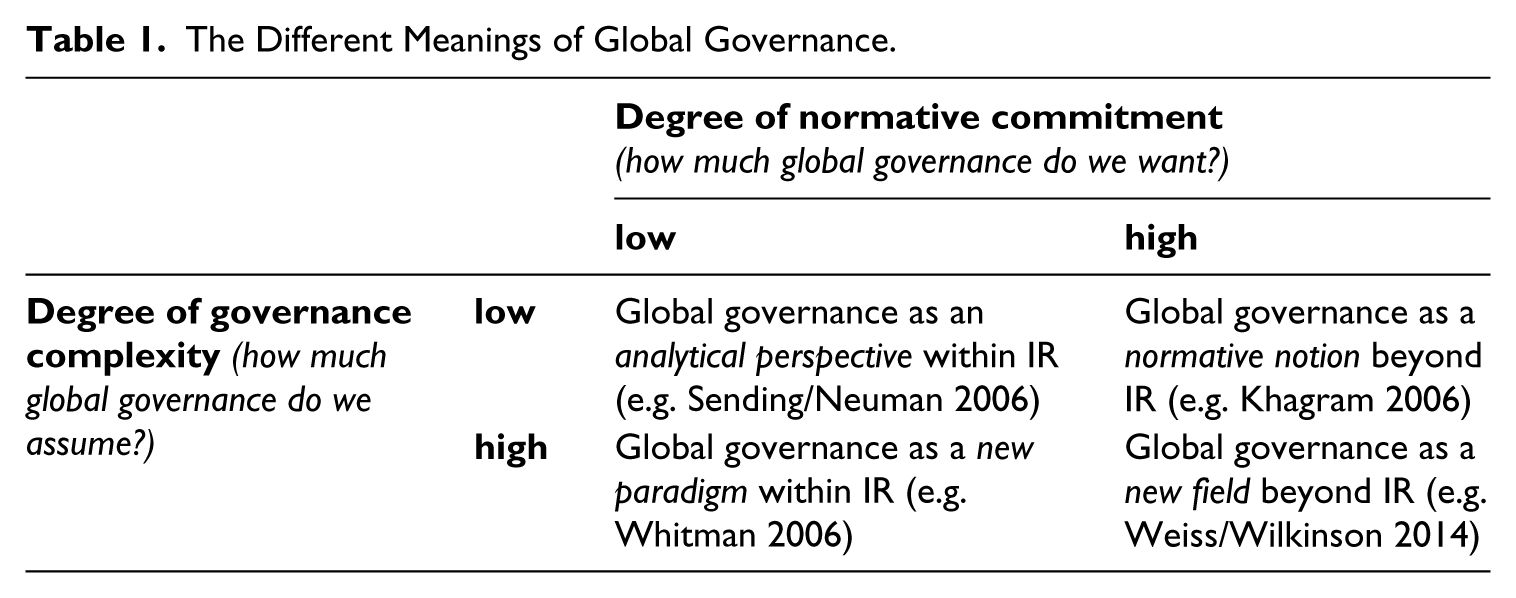
In order to do so, the article draws on previous proposals which argued for the distinction between an analytical and a normative understanding of global governance. 45 A second dimension is added to this distinction, creating four different ideal-types of how one can understand and use global governance. These are summarised in table 1 which reflects a continuous and fluid matrix of global governance meanings as (1) an analytical perspective on world politics within IR, (2) a normative notion to be translated into political programmes beyond IR, (3) a new and fundamentally challenging phenomenon within IR to which other theories have to relate, and (4) a new field beyond IR, both in substance and in normative commitment. These different meanings as well as sub-distinctions within them will be spelled out in more detail in the two following sections. 46
The Different Meanings of Global Governance.
Between Perspective and Notion: How Much Global Governance Do We Want?
In the broadest sense, we can think of global governance as either an analytical perspective or a normative notion. While the former promises analytical value by focusing attention to otherwise non-considered aspects of world politics, the latter reflects a more visionary component in global governance thinking. Put differently, global governance understood as a perspective assumes a neutral stance to the question of how much global governance do we want. Global governance advanced as a notion on the other hand implicates the normative commitment that more pluralisation, more decentralisation, and more diffusion of political authority would be beneficial. Stated as such, global governance as a notion recommends specific political measures and hence can be translated into a policy and political programs. Such a policy-oriented understanding of global governance reflects a certain disappointment with mainstream IR and its emphasis on rigorous analytical theorising instead of committing to international policy with the intention of improving it. Global governance as an analytical perspective on the other hand can be situated within ‘established approaches’.
We find these two different meanings of global governance already present in Rosenau’s writing. Given his preoccupation with change, he argued that there would necessarily always be a ‘concern around the desirability of the emergent global arrangements vis-á-vis those they are replacing’. 47 Following this assumption, different authors commit to the notion of global governance in very different degrees. On the far end we have those authors who try not to commit to global governance in a normative way at all by advancing a ‘purely’ analytical account of it. At the same end, we also find critical authors worried about current formations of global governance whose normative commitment to global governance in its neoliberal manifestation is rather limited as well. 48 This normative rejection of global governance is advanced within but not exclusively limited to historical materialist and Marxist perspectives which critically assess the involvement of private actors such as multinational enterprises in world politics. 49 A prime example of a more confirmative normative application of global governance on the other hand would be Khagram, who, based on the disfunctionality of current institutions, discusses possible future architectures to connect ‘insufficient separate analysis and disjoint restructuring of specific organizations’. 50 In order to do so, he advances certain values and argues that the world needs ‘more global governance’ to realise these values.
In its more analytical meaning, global governance is employed with other purposes in mind. In this understanding, global governance entails ‘a vantage point designed to foster a regard for the immense complexity and diversity of global life’. 51 From this analytical vantage point, global governance sometimes is advanced in a descriptive fashion to label what one sees. In a slightly different understanding, global governance constitutes a heuristic device (i.e. a lens). Taken together, global governance marks both the sum of self-conscious activities of actors engaged in world politics and the analytic description thereof as well as the conceptual tools and the ontology to intellectually grasp these activities. Despite its analytical commitment, however, global governance in this understanding is more concerned with stating complexity rather than explaining it. While it demarcates ‘a new thinking’ which implies going beyond descriptive accounts, it does not offer precise theoretical explanations for what it assumes in world politics (yet). As Smouts (1998) put it, global governance ‘betokens no major epistemological breakthrough’. 52 Put differently, the heuristic understanding insinuates certain explanations in and of global governance yet does not advance a full-fledged theoretical argument. Thus, although global governance is sometimes connected to and listed amongst IR theories, it fundamentally lacks systematically derived arguments on why change occurs or why a new global order emerged, at least in the sense other IR theories provide (however limited) foundational assumptions about the behaviour of their actors and the systemic dynamics derived therefrom.
It is in this sense that we can think of global governance as a theoretical interregnum which suffers from conceptual conflation as explanation and description constantly become enmeshed – it appears that one cannot advance global governance as a heuristic device without relying on the descriptions that one can only come up with when using such a device and vice versa. As with any ‘ontological wager’, there is the real danger of tautological inference as in ‘what we see empirically is what we assume theoretically’. 53 Based on a polyarchic, non-state ontology of world politics, one – to no big surprise – finds a world that can best be described as polyarchic and which is characterised by the involvement of non-state actors. Nonetheless, we have to rely on certain assumptions to focus on particular aspects of the empirical ‘world out there’ to analytically deal with its complexities. Basically, as an analytical perspective, global governance allows us to see things we would otherwise miss, even if as an ontology it constitutes what we see and the descriptions we end up with. Other than being aware of the mutually co-constitutive relation between one’s theoretical assumptions and one’s empirical observations, there is little one can do when dealing with a complex issue such as global governance as it remains impossible to determine where theoretical argumentation ends and empirical evidence begins. 54
Albeit Rosenau’s reservations that global governance is concerned with inherently normative questions since it discusses public goods and their provision and hence always committed in one way or another, we find much of the global governance literature trying to maintain this first distinction. Independent of the respective meaning that is advanced, we find most contributions trying to hold on to the dualistic distinction between an analytical and a normative commitment. The most common rhetorical strategy to connect the perspective and the notion of global governance is to sequentialise them. Thus, we oftentimes see an analytical understanding in the first step embracing a more normative notion of global governance in the second step. This practice, however, heavily relies on the assumption to be able to keep one’s analytical devices and one’s normative commitments separated. Just as Weiss and Wilkinson rightfully remind us, though, even in an analytical commitment and proposed as a heuristic device, ‘[v]ision is essential’ to the global governance discourse. 55 Put differently, in the debate of global order and change, one’s normative commitments are most likely more constitutive of one’s analytical devices and derived conclusions than the scientist in us would like to admit. It remains to be seen how visionary components of global governance can logically be kept separated from analytical perspectives or whether the open inclusion of a more policy-oriented understanding which is reflective of its own commitments in the long run would allow global governance to not only establish itself vis-á-vis but in fact come ‘to the rescue’ of traditional IR. 56
Between Paradigm and Field: How Much Global Governance Do We Assume?
In addition to the first distinction and its different manifestations, we find in the literature different answers to how much global governance we assume. Different applications of global governance hence entail different ideas about how much global governance we already have in place independent of how much of these we would like to see in the future. The scale to this question obviously is also continuous. Different positions, however, are based on which aspects one considers to be relevant for the assessment of global governance. Among others, different ‘measurements’ for the degree of global governance advanced in the literature include the amount of different actor groups – state and non-state – becoming involved in governance, 57 the strength and robustness of intergovernmental organisations, 58 the size of ‘autonomous spheres of authority beyond the national/international dichotomy’ resulting from the involvement of new actors, 59 the progress made along the lines of institutionalism, transnationalism, and cosmopolitanism, 60 the number of governance gaps successfully closed in world politics, 61 or, in the most encompassing sense, the degree of change among different layers of order. 62
These different ‘yardsticks’ of global governance all point to the fact that distinctions to be made along this dimension are relative as different authors advance different meanings of global governance. Nonetheless and independent of the respective measurement, different accounts of global governance come in different shades of more or less. While the scale proposed in the matrix should be understood as rather fluid, one can still distinguish different applications of global governance according to how advanced one imagines the diffusion and dilution of state power and its dispersion among a much broader range of actors.
63
Put differently, respective answers to the question of how much global governance one assumes are answers along the lines of how much governance complexity in world politics one assumes.
64
Distinguishing the two proposed scales in the matrix, the second one is concerned with how much dispersion, disaggregation, and fragmentation of political authority one sees rather than how one normatively addresses these developments. Given that IR as a discipline for the most part imagined the exercise of political authority on a global scale to be the exclusive sphere of states and hence rather straight-forward, we can consider global governance scaled in the second dimension not only as a critique of IR but also ‘measure’ it in the sense of whether one wants to remain within IR or go beyond it: ‘[S]ome authors feel that understanding global governance requires breaking new theoretical ground, while others feel comfortable examining global governance with traditional, though expanded, theoretical perspectives’.
65
To offer a complete scale, one has to start with those contributions arguing that there is little to no global governance. Put differently, the most sceptical understanding to be advanced is one which answers the question of how much global governance one assumes in a negligible fashion. Since global governance assumptions and tenets clash with those of the (neo-)realist tradition, it is no surprise that we find this notion being most heavily advanced by such authors. 66 Rhetorically, these authors connect global governance to the idea of international anarchy which in the end ‘outdoes’ any authority dispersion beyond the nation state. Political authority in this understanding remains centralized within the state and attempts to develop ‘a “new” analytical approach […] will fail miserably to understand’ international relations. 67 Assuming anything else is to consider ‘imagined dragons and genuine fire-breathers’. 68
In a more moderate assessment of global governance, political authority has been diffused but this diffusion remains limited and hence can be discussed in the traditional terms of the discipline. International Relations, so the argument goes, has always dealt with governance and therefore is best-equipped to integrate new dynamics of global governance. Thus, the argument here is no longer the denial of the increased complexity of governance based on the dispersion of political authority but the limited need for new perspectives to study and explain it. While diffusion is happening, it can still be discussed by referring back to established theories and mind-sets. It might need the sharpening and refocusing of some conceptual terms by drawing on debates that took place within IR and compare it with insights from other disciplines. 69 Overall, though, global governance remains limited and can best be studied within IR. The rather sceptical account of Sending/Neuman 70 on the relation between NGOs and state actors can serve as an illustrative example as they argue that political authority might have been dispersed but its exercise in spheres not controlled by the state remains limited and rather irrelevant.
As an intermediate step, we find global governance being understood and advanced as a new framework or paradigm. As such, global governance remains situated within IR yet fundamentally changes its theoretical landscape in the sense that it is considered to be on par with other IR approaches and theories. Because of fundamental and empirically undeniable developments and changes in how the world is governed, IR, so the argument goes, needs a new framework to deal with this changed reality. Whitman, 71 for example assumes high degrees of dissemination and exchange, which command new thinking in and of global governance. While he discusses radical change in terms of how world politics works, he overall remains committed to the intellectual structures of IR. The same understanding of global governance seems to be advanced by Pegram in this issue as he applies orchestration theory to better understand global human rights governance. Both contributions share the view that global governance as a new phenomenon has advanced to quite an extent and this new development hosts potential to innovate IR. In a sense, global governance and IR appear to mutually benefit from each other. Overall, though, it remains to be assessed how ‘traditional IR theory has responded to the “new” dynamics of global governance as well as how the phenomenon of global governance has inspired theoretical innovations in IR theory’. 72
In the most radical sense and explicitly committed to normative values (i.e. moving to the bottom right box), other authors advance global governance as a new narrative with the potential to transcend IR. 73 Since the state centrism of IR has not only been a but rather the defining feature of IR – a discipline that since its inauguration has been characterised and dominated by the ‘“states-as-the-sole-actors” approach’ 74 – empirically assuming the comprehensive decentralisation of authority for some is more than appending yet another new paradigm. It is rather a fundamental shift that changes how we (should) think and make sense of world politics. According to such an understanding, the imperative of global governance is to not only develop a new language within established boundaries (i.e. advancing yet another paradigm within IR) but rather altogether shed the IR language and develop a new narrative of world politics beyond it. Weiss and Wilkinson can serve as an illustrative example here as they see in global governance the potential to provide a new mind-set for the study of world politics and thereby transcend the field of IR in order to reinvent it. 75 According to them, it makes little sense to hold on to the disciplinary structure of IR. Put differently, the assumed empirical transition from international relations to global governance has to be echoed by a transition in the intellectual structures that accommodate these topics. This is specifically the case because Weiss and Wilkinson see IR ‘teeter[ing] on the abyss of irrelevance’ as it became increasingly disparate and fragmented. 76 Thinking of global governance as a new field and discipline beyond IR thus reflects a certain disappointment and discomfort with both the terms of international relations and its disciplinary structures.
In this radical understanding, global governance brings with it the opportunity as well as the necessity of embracing a more interdisciplinary perspective on governance, rules, and the exercise of authority. Just as Rosenau has always been interested in ‘a sociology of global life’, 77 this understanding of global governance cannot be limited to either IR or political science. Rather, it embraces diverse disciplines such as economics, history, (international) law and even the technical sciences as argued by Acuto and Mayer in this volume and recombine these traditions of thought into a new field. It is this radical understanding of global governance that is advanced as ‘a conscious effort to break with traditional approaches’. 78 Given the novelty of the empirical changes and developments that have fostered this break, the identity and intellectual structures of global governance as a new field have yet to be specified and developed. While we can see initial separation reflected in disciplinary transformations such as the inauguration and establishment of new global governance centres, programmes, and journals, it remains the task of the following conclusion to relate the different meanings and outline two conceptual implications following from the current state of affairs.
Conclusions and Challenges Ahead
Essentially, we have found both agreement and debate in conceptions of global governance.
Ever since Rosenau and Czempiel introduced the idea of global governance, the discourse has struggled for a clear definition which would leave enough space to accommodate the different understandings it inherently entails. This has created ‘a cacophony of voices [and] the maze that is the global governance literature’. 79 In a first step, the article outlined potential sources of the different meanings by discussing the emergence of global governance. Among contextual sources, one can list the enticement of and enthusiasm for change fired up by real-world developments during the 1990s. As an amplifier of this initial emphasis on novelty, global governance emerged within a disciplinary context with which many were not only disappointed but which also demanded and hence rewarded innovation. Instead of connecting to and elaborating existing approaches, global governance drew on them yet at the same time presented itself as novel. In this sense, global governance became more of a label to signal departure from traditional approaches than a clear-cut, well-defined concept. Overall, the contexts in which global governance emerged proved to be a curse and a blessing: It allowed global governance to rise to prominence very quickly but only by committing to all-inclusiveness and ambiguity rather than analytical precision and conceptual clarity. 80
The taxonomy of meanings offered here revealed that global governance meanings can be structured along two dimensions. First, authors ascribe different meanings to global governance depending on how much and what formation of it they want. As such, global governance remains in a hybrid state between an analytical perspective and a normative notion. Second, depending on how much of it one assumes, global governance floats between being understood simply as a new phenomenon, a new paradigm or a new field. This conceptual hybridity of global governance and its ensuing ambiguity lies at the heart of today’s often stated confusion. Basically, how one perceives global governance determines which meanings of it one advances which impacts one’s perception of it. To be more precise, however, the confusion does not directly originate from the existence of multiple meanings of global governance but rather (1) from the assumed need for a singular definition and (2) from the fact that different meanings are advanced and thrown around carelessly. Put differently, the existence of multiple meanings of global governance itself is not a problem. Rather, because of its plurality, global governance has become such a lively debated and successful idea within the last two decades and today provides a new ‘orienting theme’ in and beyond IR. 81
Being aware of the dangers and the inadvertent disciplining effects of discussing ‘cornerstones’ in the debate of global governance, the article recognises potential in the ambiguous nature of global governance and hence argues to embrace its plurality. While clearly lacking clarity, the discourse on global governance needs to emancipate itself from the notion of having to develop a singular definition as the very nature of the beast itself pre-empts such an exercise. Rather, understood as a floating signifier, the different meanings of global governance can be accommodated and related to each other. This would not only foster dialogue but would also provide enough intellectual space to outline and relate research agendas while keeping the discourse open and alive. Ultimately, the different meanings ascribed to global governance should not be considered as indicators of a not yet fully matured discourse but rather as an indicator of a discourse which has ‘captive audience[s] and [is] employed because what we do is associated with the big events of today’. 82 The balancing act in the current interregnum of global governance thus is to become aware of the different meanings and connect them without negating their existence since they reflect different answers to and assessments of crucial questions. None of these can be answered in a conclusive or ‘right’ fashion. Rather than doing away with different answers, the taxonomy suggested here might help to navigate and communicate between them. Rather than championing a specific meaning of global governance, it appears to be more fruitful to consider the conceptual implications and potentially problematic collective practices and habits that follow from the plurality of meanings. Among others, these currently include (1) the structural bias of global governance and (2) the functionalist logic that underlies this emphasis on structure.
First, since it never clearly positioned itself vis-á-vis other approaches but rather attempted to provide a new macro framework, global governance has always been committed to broad questions and general conclusions. 83 While this macro perspective generated and continues to generate important insights, it misses details and nuances and overall appears too broad and structural for a balanced analytical perspective. Due to its macro bias, more often than not global governance is thought of in passive, structural terms and not as the result of process and deliberate choices of actors involved in these processes. Additionally, processes of ‘actor creation’ remain exogenised as discrete actors – be it states, intergovernmental organisations, NGOs or enterprises – are assumed a priori in order to discuss structural, long-term dynamics in their collect efforts to provide governance. 84 While broad questions obviously need to be engaged when studying global governance, there is a balance to be struck between simplification and structural abstraction on the one hand and doing justice to complex realities and agents without losing oneself in idiosyncrasies on the other hand. It can be argued that within the discourse on global governance, overall, this balance has been tipped too much in favour of sweeping conclusions and large-scale generalisations. After twenty years of ‘proving its worth to the discipline’, global governance could benefit from a more concise focus on the emergence of and interaction between different actors instead of specifying discrete actors a priori to then discuss the broader picture.
Second, even if oftentimes suggested differently, the distinction between global governance as an analytical perspective and global governance as a normative notion represents an ideal-type distinction. As was shown in the reconstruction, it remains continuous and fluid. In practice, we often find assumingly analytical global governance contributions steeped in a functionalist, managerial logic. 85 This logic is advanced by assuming that global problems are tractable and solutions feasible if actors will only come and work together to solve them. Drawing too heavily on this logic deprives global governance and the problems it is concerned with of their political character. It basically leaves conflict and contestation unconsidered. The difficult balancing act for global governance thus will be to commit to normative questions and political problems and engage with them intellectually without reifying them. A self-reflective assessment of the different meanings and applications of global governance as well as more cautious usage of them will hopefully prove to be helpful in this context. In fact, it appears vital in order to keep ‘global governance fit for purpose in the twenty-first century’. 86 The novel thinking, ingenuity, and critical diversity and plurality expressed in more than twenty years of discussing global governance deserve nothing less.
Footnotes
Acknowledgements
I would like to thank Philipp Pattberg and the other panel participants who discussed an earlier draft of this paper at the Fourth Global International Studies Conference 2014 as well as the two anonymous reviewers for their comments. Also, feedback and guidance provided by Tom Pegram and Michele Acuto was very helpful during the writing and revision process.
Declaration of Conflicting Interest
The author declares that there is no conflict of interest.
Funding
No funding has been received for this article, and there is no conflict of interests.
1.
James N. Rosenau and Ernst-Otto Czempiel, eds., Governance without Government. Order and Change in World Politics (Cambridge: Cambridge University Press, 1992).
2.
James N. Rosenau, ‘Governance, Order, and Change in World Politics’, in Rosenau and Czempiel, Governance without Government, 1.
3.
Thomas G. Weiss and Rorden Wilkinson, ‘Global Governance to the Rescue: Saving International Relations?’, Global Governance 20, no. 1 (2014), 31–3.
4.
See among others, Lawrence Finkelstein, ‘What is Global Governance?’, Global Governance 1, no. 3 (1995); Robert Latham, ‘Politics in a Floating World. Toward a Critique of Global Governance’, in Approaches to Global Governance Theory, eds. Martin Hewson and Timothy J. Sinclair (Albany: State University of New York Press, 1999), and Craig Murphy, ‘Global Governance: Poorly Done, Poorly Understood’, International Affairs 76, no 4 (2000).
5.
Finkelstein, ‘What is Global Governance?’, 368.
6.
Thomas G. Weiss and Rorden Wilkinson, ‘Rethinking Global Governance? Complexity, Authority, Power, Change’, International Studies Quarterly 58, no. 1 (2014): 207–8.
7.
Klaus Dingwerth and Philipp Pattberg, ‘Global Governance as a Perspective on World Politics’, Global Governance 12, no. 2 (2006): 189–96.
8.
Michael Barnett and Kathryn Sikkink, ‘From International Relations to Global Society’, in The Oxford Handbook of International Relations, eds. Christian Reus-Smit and Duncan Snidal (Oxford: Oxford University Press, 2008), 78–83.
9.
Kenneth Waltz, ‘Globalization and Governance’, PS: Political Science and Politics 32, no. 4 (1999) and Jennifer Sterling-Folker, ‘Realist Global Governance: Revisiting Cave! Hic Dragones and Beyond’, in Contending Perspectives on Global Governance. Coherence, Contestation and World Order, eds. Alice D. Ba and Matthew J. Hoffmann (New York: Routledge, 2005).
10.
The following discussion will focus on a rather singular understanding of global governance advanced by Rosenau and others. This limited focus is chosen for practical purposes and should not suggest that there were no other, more critical voices. Despite the importance of these critical voices, the following section is first and foremost interested in the mainstream account of global governance that was introduced during the 1990s, simply because most scholars in one way or another relate to these early contributions.
11.
Martin Hewson and Timothy J. Sinclair, ‘The Emergence of Global Governance Theory’, in Hewson and Sinclair, Approaches to Global Governance Theory, 3–5.
12.
Weiss and Wilkinson, ‘Rethinking Global Governance?’, 208.
13.
See for example, Timothy J. Sinclair, Global Governance (Cambridge: Polity Press, 2012) and Weiss and Wilkinson, ‘Global Governance to the Rescue’.
14.
Weiss and Wilkinson, ‘Rethinking Global Governance?’, 208.
15.
Jan Aart Scholte, Globalization. A Critical Introduction (Basingstoke: Palgrave Macmillan, 2005), 101–10.
16.
Hewson and Sinclair, ‘The Emergence of Global Governance Theory’, 3.
17.
Rosenau, ‘Governance, Order, and Change’, 1.
18.
Sinclair, Global Governance, 15–20.
19.
Rosenau, ‘Governance, Order, and Change’, 18–19.
20.
Ibid., 18.
21.
Steve Smith, ‘Introduction: Diversity and Disciplinarity in International Relations’, in International Relations Theory, eds. Tim Dunne, Milja Kurki and Steve Smith (Oxford: Oxford University Press, 2007), 1–12.
22.
Friedrich V. Kratochwil, ‘Constructing a New Orthodoxy? Wendt’s “Social Theory of International Politics” and the Constructivist Challenge’, Millennium: Journal of International Studies 29, no. 1 (2000).
23.
Robert O. Keohane and Joseph S. Nye, eds., Transnational Relations and World Politics (Cambridge: Harvard University Press, 1973).
24.
Joseph S. Nye and Robert O. Keohane, ‘Transnational Relations and World Politics: An Introduction’, in Keohane and Nye, Transnational Relations and World Politics, xxv.
25.
Thomas Risse-Kappen, ed., Bringing Transnational Relations Back In. Non-State Actors, Domestic Structures and International Institutions (Cambridge: Cambridge University Press, 1995).
26.
Deborah D. Avant, Martha Finnemore and Susan K. Sell, eds., Who Governs the Globe? (Cambridge: Cambridge University Press, 2010).
27.
Rosenau, ‘Governance, Order, and Change’, 2.
28.
Tim Dunne, ‘Global Governance. An English School Perspective’, in Ba and Hoffmann, Contending Perspectives on Global Governance, 72.
29.
The lack of intellectual engagement might be explained by the fact that the English School itself remained ambiguous in respect to some of its central concepts as well as global governance scepticism about the state-centric ontology of the English School. Either way, the idea of ‘order’ as a normative precept did not prove enough of a shared interest to fully connect global governance and the English School.
30.
Hewson and Sinclair, ‘The Emergence of Global Governance Theory’, 11.
31.
Rosenau, ‘Governance, Order, and Change’, 8.
32.
Weiss and Wilkinson, ‘Global Governance to the Rescue’, 20.
33.
Michael Barnett and Raymond Duvall, ‘Power in Global Governance’, in Power in Global Governance, eds. Michael Barnett and Raymond Duvall (Cambridge: Cambridge University Press, 2005), 1.
34.
Latham, ‘Politics in a Floating World’, 24.
35.
Stanley Hoffman, ‘An American Social Science: International Relations’ Daedalus 106, no. 3 (1977): 59.
36.
Patrick T. Jackson, The Conduct of Inquiry in International Relations (London: Routledge, 2011), 32–40.
37.
Sinclair, Global Governance, 16.
38.
Weiss and Wilkinson, ‘Global Governance to the Rescue’, 22.
39.
Ibid., 29.
40.
Hewson and Sinclair, ‘The Emergence of Global Governance Theory’, 7.
41.
Ibid., 7.
42.
John G. Ruggie, ‘What Makes the World Hang Together? Neo-Utilitarian and the Social Constructivist Challenge’, International Organization 52, no. 4 (1998): 855.
43.
Claude Lévi-Strauss, Introduction to the Work of Marcel Mauss (London: Routledge, 1950), 61–4.
44.
Richard Rorty, Contingency, Irony, and Solidarity (Cambridge: Cambridge University Press, 1989), 9–12.
45.
Dingwerth and Pattberg, ‘Global Governance as a Perspective’ and Matthew J. Hoffmann and Alice D. Ba, ‘Introduction. Coherence and Contestation’, in Ba and Hoffmann, Contending Perspectives on Global Governance.
46.
Obviously, the proposed ideal-types mark extremes on the respective scales. In that sense, the dimension of normative commitment as well as the assumed degree of governance complexity should not be thought of as either/or distinctions but rather as continuous. The authors included in the table as well as others discussed below should also be understood as illustrative examples since their full arguments cannot easily be subsumed into a matrix without doing them some form of injustice.
47.
Rosenau, ‘Governance, Order, and Change’, 10.
48.
Jörg Friedrichs, ‘Global Governance as Liberal Hegemony’, in Palgrave Advances in Global Governance, ed. Jim Whitman (Houndsmills: Palgrave Macmillan, 2009).
49.
Among many others, see Craig Murphy, International Organization and Industrial Change (Cambridge: Polity, 1994); Robert Cox, ed., The New Realism. Perspectives on Multilateralism and World Order (Basingstoke: Macmillan, 1997); and Henk Overbeek, ‘Global Governance, Class, Hegemony: a Historical Materialist Perspective’, in Ba and Hoffmann, Contending Perspectives on Global Governance. Relating these critical voices to the matrix proposed here, what kind of global governance instead of how much global governance one wants appears to be the more pressing question for those skeptical of the current global governance formation. The author would like to thank one of the anonymous reviewers for pointing this out.
50.
Sanjeev Khagram, ‘Possible Future Architectures of Global Governance: A Transnational Perspective/Prospective’, Global Governance 12, no. 1 (2006): 113.
51.
Hewson and Sinclair, ‘The Emergence of Global Governance Theory’, 7.
52.
Marie Claude Smouts, ‘The Proper Use of Governance in International Relations’, International Social Science Journal 50, no. 1 (1998): 81.
53.
Patrick T. Jackson, ‘Disciplined Imagination, or, the Cash Value of a Pragmatist Wager for IR’, International Studies Review 11, no. 3 (2009): 656-9.
54.
Ian Shapiro, ‘Problems, Methods, and Theories in the Study of Politics, or: What’s Wrong with Political Science and What to Do about It’, in Problems and Methods in the Study of Politics, eds. Ian Shapiro, Rogers M. Smith and Tarek E. Masoud (Cambridge: Cambridge University Press), 23–5.
55.
Weiss and Wilkinson, ‘Rethinking Global Governance?’, 213.
56.
Weiss and Wilkinson, ‘Global Governance to the Rescue’.
57.
Avant et al., Who Governs the Globe?
58.
Margaret P. Karns and Karen A. Mingst, International Organizations. The Politics and Processes of Global Governance (London: Lynne Rienner Publishers, 2010).
59.
Dingwerth and Pattberg, ‘Global Governance as a Perspective’.
60.
Sinclair, Global Governance.
61.
Thomas G. Weiss, Global Governance: Why? What? Whither? (Cambridge: Polity Press, 2013).
62.
Rosenau, ‘Governance, Order, and Change’.
63.
Bruce W. Jentleson, ‘The John Holmes Memorial Lecture: Global Governance in a Copernican World’, Global Governance 18, no. 2 (2012): 134–40.
64.
James N. Rosenau, ‘Governance in the Twenty-First Century’, Global Governance 1, no. 1 (1995): 39.
65.
Matthew J. Hoffmann and Alice D. Ba, ‘Contending Perspectives on Global Governance. Dialogue and Debate’, in Ba and Hoffmann, Contending Perspectives on Global Governance, 257.
66.
Among others, see Waltz, ‘Globalization and Governance’.
67.
Ibid., 33.
68.
Sterling-Folker, ‘Realist Global Governance’, 26.
69.
See for example, Barnett and Duvall, ‘Power in Global Governance’.
70.
Ole Jacob Sending and Yver B. Neumann, ‘Governance to Governmentality: Analyzing NGOs, States, and Power’, International Studies Quarterly 50, no. 3 (2006).
71.
Jim Whitman, ‘Disseminative Systems and Global Governance’, Global Governance 11, no. 1 (2006).
72.
Hoffmann and Ba, ‘Introduction’, 2.
73.
Weiss and Wilkinson, ‘Global Governance to the Rescue’, and Barnett and Sikkink, ‘From International Relations to Global Society’.
74.
Arnold Wolfers, ‘The Actors in International Relations’, in Theoretical Aspects of International Relations, ed. William T.R. Fox (Notre Dame: University of Notre Dame Press, 1959).
75.
Weiss and Wilkinson, ‘Global Governance to the Rescue’. Also see Barnett and Sikkink, ‘From International Relations to Global Society’, 75–8, who advance the idea of a narrative but remain a little more sceptical on its transcending potential.
76.
Weiss and Wilkinson, ‘Global Governance to the Rescue’.
77.
Hewson and Sinclair, ‘The Emergence of Global Governance Theory’, 6.
78.
Hoffmann and Ba, ‘Introduction’, 5.
79.
Ibid., 2.
80.
Latham, ‘Politics in a Floating World’.
81.
Barnett and Duvall, ‘Power in Global Governance’.
82.
Weiss and Wilkinson, ‘Global Governance to the Rescue’, 33.
83.
Weiss and Wilkinson, ‘Rethinking Global Governance?’, 211.
84.
Martha Finnemore, ‘Dynamics of Global Governance: Building on What We know’, International Studies Quarterly 58, no. 1 (2014): 223–4.
85.
Sinclair, Global Governance, 19–22.
86.
Weiss and Wilkinson, ‘Global Governance to the Rescue’, 31.