




Abstract
Publics are an undertheorised and somewhat marginal presence in critical security studies. This article argues that a better understanding of publics can advance our understanding of the governance as well as the contestation of security regimes and practices. We develop this argument in three parts. First, we discuss the marginality of publics in critical security studies while highlighting those limited instances where publics have been engaged. Second, we direct attention to emerging research on publics in cognate disciplines, focusing in particular on the literature about material publics. We distil from this work some useful lessons for security studies. In a final section we suggest two research moves for promoting a stronger focus on publics within critical security studies. We conclude that a focus on material publics can furnish security studies with a better understanding of the phenomenon of politics.
Introduction
It is now just over 25 years since the English translation of Jürgen Habermas’s The Structural Transformation of the Public Sphere (1989), a book that has been acclaimed as motivating and shaping the significant turn towards the study of publics across key areas of the social sciences. 1 Speaking of anthropology, Francis Cody has argued that together with Benedict Anderson’s Imagined Communities, Structural Transformation opened up new ways of studying politics. For it not only sharpened ‘theorization of the connections among communication, capitalism, and mass politics’, it also insisted on the ‘centrality of a form of stranger sociability that arises with the conjuncture of print-mediated discourse and new modes of imagining public life’. 2 However, whatever the renewed interest in publics that were catalysed by these publications, this shift also had extra-academic dynamics as it resonated with significant political developments in world politics. As Gaonkar has put it: ‘The tumultuous events of the late eighties and early nineties – the downfall of the Soviet Union, the liberation of Eastern Europe, democracy movements in Asia, Tiananmen, and the Rushdie affair – not only confirmed the centrality of these two concepts [civil society and public sphere] but gave them a global inflection’. 3
At about the same time Structural Transformation was connecting with revived critical interest in publics and publicity in many areas of the social sciences, another development was at work in International Relations (IR). We speak here of the rise of critical security studies. 4 This intellectual sea change also found some of its key conditions of emergence in the same shifts in world politics, not least the receding of the Cold War and the desire to think beyond the orthodoxies of security theory that had accompanied the bipolar security complex. Beginning in the late 1980s, we have witnessed a period in which the field of security studies has undergone important transformations marked by the emergence of new methods, theories, issues, and concerns. It may only be a mild exaggeration to speak of the ‘securitization of everything’: 5 the language of security, and securitised modes of thinking and acting on issues, has perhaps never been more pervasive.
We begin this article with the observation that these two trajectories of research – sociologies of publics and critical security studies – have yet to meet or cross-fertilise. Security studies has seen analytics like citizenship, community, gender, and biopolitics accorded new centrality in the understanding of what security is, what it does, whose interests and lives it advances, and whose it diminishes or obliterates. And yet the angle of inquiry we are calling publics is rather conspicuous by its marginality in this respect. 6 While there has been a notable renewal of interest in the theme of publics in disciplines like anthropology, sociology and cultural studies, it remains undertheorised and underproblematised in critical security studies. 7 A glance over various ‘state of the field’ collections as well as specialist journals dedicated to critical research on security, reveals that the question of publics rarely features as an explicit theme. In this article we argue it is time to bring publics into the centre of this research area.
Our main argument is that the field of security studies would benefit from greater engagement with, and theorisation of, the phenomenon of publics. In the remainder of this article we develop this claim in terms of three sections. First, we briefly discuss how publics have operated as a kind of blind spot or spectral existence in security studies: there but not quite there, a presence that has failed to be properly reckoned with. Second, we briefly survey the exciting focus on material publics that has arisen in certain cognate disciplines and interdisciplinary sites. From this research we distil certain insights and arguments with potential to advance theorisation of security politics.
Third, and finally, we propose two research moves that we offer as both provocations and guidelines for developing a future research agenda at the interface of security and publics. The first one is a call for a relational and open-ended way of understanding the nexus of security and publics – a move we call diagramming. Our second gesture is a call for a greater focus on arts of demonstration as a way to better understand how publics feature in the contentious politics of security. Our point is not that these two moves in any way exhaust the possible ways that themes of publics could be taken up in security fields. They are more modestly suggestions for some productive points of departure. Nevertheless, we do suggest that taken together, these moves could help to foster a more nuanced account of both the governance and the contentious politics of security, one in which politics is understood as a question of arts and practices and not simply a generic phenomenon.
A Phantom Public is Haunting Security Studies
The question of publics has been a lacuna in the lively and important debates about the politics and the transformation of security that have taken shape over the past 25 years or so. Seeking to express the elusive and non-totalisable nature of the public that was being brought into being by developments like radio broadcasting, mass marketing, and opinion polling during the 1920s, Walter Lippmann famously remarked that the public was not ‘a fixed body of individuals… [but] a mere phantom’. 8 This seems an apt metaphor for grasping not just the elusive character of the public but the place this concept occupies in security studies today. As a research theme within security studies and IR it is often as though the public is both there and not there; absent but also present. Certainly there is a widespread awareness amongst researchers in security studies of the significance of publics, whether as opinions to be quantified, audiences for securitising discourses, targets for surveillance practices, referents in political claims-making, or as sources of values that can be discerned within or brought to bear on security policies. Nevertheless, publics as such have yet to be identified as a site of theorisation and critical reflection within most studies of security and securitisation. They hover around the scene of inquiry but are rarely pinned down.
There are of course important and noteworthy exceptions to this more general rule of oversight. For instance, in a largely positive reading of Buzan and Hansen’s The Evolution of International Security Studies (2009) Williams observes that a notable absence from the book’s analytical framework is a sustained account of ‘the question of the relationship between the public and the private and its central place in conceptions, politics and practices of security’. 9 As such he highlights the kind of missing public that we have been flagging. In other work, together with Abrahamsen and focusing on the commercial provision of security, Williams has made an important contribution in bringing the theme of public/private (albeit from a non-feminist perspective) into the centre of debates about security governance. 10 Indeed, we can say that it is with regard to the question of the privatisation of security, along with rich discussions on the gendered nature and impacts of the public/private divide, that we find one of the more frequent ways in which the public does feature in security studies. That said, it is often as something of a foil or a default. While Abrahamsen and Williams are careful to point out that public and private governance interact in unpredictable ways within security assemblages, 11 in certain rather linear narratives, public governance features as a past that is now being transformed by commercialising, neoliberalising programmes and logics. The dynamism always seems to lie with the forces and agents of privatisation, while the public appears as a residual category. Little thought has been given to emergent publics, that is, the way that new modes of public action and public values are sometimes brought into being in correspondence with the institutional and political changes associated with globalisation and privatisation. 12
Likewise, the presence of publics is implicit while not directly identified in a whole line of research that has examined cultures of fear and insecurity – whether the cultural work of normalising security practices and policies, 13 the visual cultures of nongovernmental politics and activisms, 14 or the rise of a military-industrial-media-entertainment complex. 15
To be sure, there have been some important and valuable lines of inquiry suggestive of ways in which future scholarship could deepen understanding of the security/publics nexus. While the public may not feature as an explicit category, it is certainly implicit in other areas of security studies. The concept of ‘audience’ as a means of generating a more robust account of the ways in which securitising claims are received and processed amongst societal actors, for instance, has definitely garnered some interest in securitisation theory. 16 Still, a principal claim running through our article is that the question of publics has been something of a blind spot in these lively and important debates about the politics of security that the idea of audience does not capture.
For one thing, as Bourbeau rightly criticises, securitisation theory ‘treats the sequence of the securitization process in a unidirectional fashion in which audience stands only at the very end’. 17 In other words, the audience is a preliminary formed body, whose primary, if not sole role, is limited to hearing, and then approving or rejecting, a securitisation process. Moving beyond the notion of a generic audience, and nuancing between different possible audiences (into ‘popular, elite, technocratic, and scientific’ as Salter proposes, or into ‘sufficient’ or ‘significant’ audiences as Buzan et al. do) is important. 18 Nevertheless, it still does not resolve this problem either, as it still presupposes a preformed public or space to be identified.
The notion of audience is also limited because it grants a rather restricted form of agency to its subjects. What of all those situations in which the subjects of security practices are engaged, not primarily as audiences who watch, listen, and interpret, but as users who act? For example, this would seem to be the case with certain everyday strategies to secure public health. Consider the case of the hand sanitiser dispenser. These modest devices became ubiquitous from 2009 onwards as a response to the swine flu epidemic. As they spread throughout the social space of airports, malls, and other places of mobility, they became ‘palpable signs of a population on zoonotic alert’. 19 These little technologies of hygiene certainly engage a population, but not primarily in its capacity as an audience. After all, often the public at stake might not even share a common language or customs. If these soap dispensers play an ongoing function in the governance of public health amongst circulatory populations, it is not through appealing to the latter as audiences, but as user-publics. 20 Elbe is right to highlight how pandemic disease increasingly became perceived by national security experts as a security issue from the 1990s onwards. 21 However, moving beyond a public policy focus to consider the cultural history of hand sanitisers would surely illuminate key aspects of the capillary nature of this securitisation of health, and in particular how it connects with publics on the scale of their hands, through the sense of touch and via the mechanism of routine gestures.
Aside from debates about audience, another way that security studies has tangentially addressed publics is in the guise of public sphere theory. We mentioned Habermas earlier, and his work has proved influential for IR and European integration scholars examining the rise of transnational public spheres. While such work has had a direct bearing on theories of sovereignty, democracy, and citizenship, 22 it has yet to connect in a sustained way with the study of security. We should also mention in this regard scholarship that situates security and foreign policy in the political tradition of Republicanism. For example, Tjalve has made a strong case for connecting debates in securitisation theory to the kinds of public sphere theory that developed in the US in the first half of the 20th century, debates associated with such names as Lippmann, Dewey, Arendt and Morgenthau. 23 In such debates the public sphere came to be understood as a site of Republican democracy capable of exercising important checking and restraining effects on the conduct of security policy. Public sphere theory has lessons to teach security studies, she suggests, not least the value of cultivating ‘a public sphere with a public language in which [security] acts may be contemplated or opposed’. 24 Given that a culture of state secrecy as much as publicity has characterised the climate in which security policy in the post-Cold War era continues to be organised, Tjalve’s plea for a thicker space of political deliberation and opacity is timely. Yet, as we argue below, were we to stake all our political hopes on the cultivation of a more rational-critical public sphere, we would probably be disappointed. It is better, we suggest, to consider some of the other ways in which publics can be figured as zones of political communication, engagement, and understanding.
With this point about the limits of the rationalist version of public sphere theory in mind we turn now to discuss recent research on material publics that is emerging beyond security studies. This is investigating ways in which publics – understood as lively, affective and creative assemblies, and as modalities of engaging, mobilising and informing subjects – can bring energy to democratic life, albeit not always in ways that conform to the Habermasian ideal of a rational-deliberative space.
Rethinking the Public: Some Lessons from Materialist Approaches
We have argued that in critical security studies the question of publics has neither been accorded sufficient theoretical attention nor engaged with enough reflexivity. When publics do come up it is typically as a public sector that forms the backdrop in studies of privatisation (e.g. of military force), as an audience that (mis)interprets security messages, or as a particular realm of deliberation and discussion – for example, the space constituted through parliaments, media, etc. – where policy goals might be assessed and debated. These are valid observations. Yet this seems to us an unnecessarily restricted and thin account of what publics are and how they function in contemporary politics. What might critical security studies gain by rethinking the public? What might a more nuanced account of the nature, character, making and unmaking of publics bring to our understanding of practices, regimes and politics of security? To answer these questions we need to take stock of certain recent theoretical developments in the study of publics.
Over the last decade there has been a renewed interest on the part of scholars in a number of disciplinary and interdisciplinary sites – but in particular, geography, sociology, anthropology, cultural studies, and science studies – to move beyond the old idea of a public as a transcendental subject or fixed space, and to understand publics as material entities. Borrowing a term from Marres and Lezaun, we refer to this work as material publics. 25 Building on queer theory, 26 actor-network theory, 27 feminist thought, 28 Foucauldian genealogies, 29 democratic theory, 30 and cultural studies of transparency and secrecy, 31 material publics research is showing that the public is not a given or a self-evident phenomenon. Instead, it can be understood as the correlate and the effect of a whole range of historically conditioned and socially structured practices, ranging from petitions 32 to opinion polls, 33 and from the Victorian idea of a library or museum 34 to Twitter. 35 If genealogy and critical political economy has demonstrated to us that such seemingly self-evident phenomena as ‘the economy’, 36 ‘the state’ 37 and ‘the international’ 38 are not universals but are historically and socially-constituted effects within power relations, then it seems the same should now be said for ‘the public’.
It would be a mistake to imagine that a material perspective on publics is particularly recent or entirely unprecedented. We mentioned Habermas’s Structural Transformation at the start of this article. That work was notable for the empirical nuance with which it did situate the birth of the modern bourgeois public, and the idea of publicity in the 17th century within a matrix of class dynamics, economic processes (e.g. the spread of print media), cultural practices (e.g. literary criticism), and urban spaces (e.g. coffee houses and salons). The approaches we highlight in this section share this sensitivity towards material practices. However, a key way they depart from Habermas is that they do not assume his task of locating these practices in an overarching developmental trajectory of modern capitalism and class struggle. Instead, and at the risk of generalising, we could say they are closer to the more situated form of analysis associated with Foucault, and the task of accounting for the emergence of practices in terms of polymorphous power relations and contingent events.
Space precludes the kind of elaboration of material publics research that it deserves. For the purpose of this article it will suffice to highlight three themes, and elaborate their relevance for critical security studies. First, a point about what we might call the transitory mode of existence of publics. It is that publics are better understood as convened or assembled than as transcendental actors who are always already there. This point has been underscored by Marres who stresses that ‘issues spark a public into being’. 39 Building on the immanent and pragmatist conception of publics first elaborated by Dewey and Lippmann, she insists that research into publics should start with issues. It should begin with events, incidents, and controversies – the kinds of phenomena that are the everyday stuff of political life but which political science and IR often devalue as mere ephemera. It should then consider how publics attend to these issues. As we see it, the value of a focus on issues is that it brings out the aleatory quality of publics: how they come and go, how they gather and disperse. In this view, the public is not ever present. Instead, publics only exist as long as an issue is being attended to. But as we know, there is nothing automatic or guaranteed about attention. Hence the question becomes: by what means and modalities, with what devices and mediators is attention sought, captured, diverted, engineered and/or lost?
To illustrate this point, and to highlight its relevance for the study of issues of security, consider the elegant study which anthropologist Joseph Masco offers of a billboard campaign and its role in the making of what he calls a nuclear public sphere. 40 Masco examines the case of the Los Alamos Study Group (LASG), a peace activism and nonproliferation organisation operating in New Mexico, and the tactics they used to draw a public’s attention to the issue of the nuclear weapons research complex. LASG rented billboard space along some of the major highways crossing the state. Using eye-catching graphics and slogans like ‘Welcome to New Mexico: America’s Nuclear Weapons Colony’, they sought to repurpose a device normally dedicated to advertising accident lawyers or hamburgers into a political tool for drawing attention to US nuclear policy and its effects on the regional environment. Masco notes that sometimes the billboards would be ripped and vandalised. 41 The point is interesting from a material publics point of view. Bringing attention to issues is never effortless but takes hard work and inventiveness. It must also grapple with the fact that material forms of communication are themselves prone to decay or destruction, and thus require a work of upkeep. This captures nicely the idea that publics do not float effortlessly, but depend for their existence on the ongoing work of creating and remaking a material world.
This example of the billboard campaign can be used to show how a material publics perspective addresses some of the limitations of the more linguistic, social-constructivist framing that has characterised much work in securitisation theory. Social constructivist and narrowly discursive approaches would probably not reflect on the materiality of the billboard itself. Their attention would focus largely on the images it conveys, and no doubt the framing it offers of nuclear weapons policy. While a material publics approach takes this work of framing and interpreting seriously, it refuses to treat it in isolation from the practical and infrastructural work that might locate, sustain, or constrain that interpretive work in social space. Put simply, someone had to make a calculation that highways are an effective place to catch the eye of a moving population (and perhaps more effective than newspaper advertisements); someone had to raise funds to pay for the billboard space; and someone had to repair the billboards, which, like all things, are subject to processes of decay. Flows of funding and volunteered work, desert and highway geographies, passing cars, catchy slogans and jarring images, metal, glue, paper and electric light – all are brought together to modulate public concern over nuclear weaponry in New Mexico. In highlighting these connections – fragile connections since they are easily damaged – it is not a question of asserting the pre-eminence of material over ideational or symbolic factors. Rather, the emphasis of the material publics focus that we propose here is that the symbolic and the material are imbricated in one another, and that the circulation of symbols, images, and ideas in the public domain, cannot be assumed but demands precise explanation.
The second point that we draw from recent research on material publics is that publics are a matter of things as much as they are a matter of opinions and speech. Publics attend to issues, but the issues typically involve things. Ask a social scientist what publics are made from and she might reply with a list that includes listeners, pundits, values, opinion polls, and perhaps TV. Such a list would suggest a rather impoverished ontology of publics. It leaves out the very heterogeneous domain of things that so often animate the issues that concern a public. And here we don’t just mean the things like billboards or tweets through which communications are relayed. We mean also the things that form the stuff of public controversies, whether it be an oil slick, leaked intelligence papers, or diseased cattle.
Consider how issues capture a public’s attention, or how public disputes find a point of focus and dis/agreement. Bruno Latour’s work on Dingpolitik has been particularly important in clarifying how things interact with and shape the making of publics. 42 He reminds us that public debate about the appropriate course of, say, foreign policy, is shaped not just by rival political arguments or appeals to interests, but through disputes about things – including, most infamously, the absent things that were Iraq’s weapons of mass destruction. Of course, the things never speak for themselves. Instead, they require mediators and translators who speak (or claim to speak) for them in public forums. Through the testimony of forensic scientists human remains become lively participants in debates about war crimes; 43 through the speech of metallurgists oil pipelines play an active role in environmental and geopolitical disputes. 44 In these and myriad other ways, a focus on material publics reveals how things, and not just human actors, have an irreducible role in shaping publics in the security domain.
While the implications of a material turn for security studies and IR have by now been debated at considerable length, our sense is that its consequences for understandings of politics have not been adequately addressed. Hence the point that material objects like files, maps, and infrastructures, shape relations of power and governance, and that the specific and unpredictable agency of objects can sometimes confound the best laid plans of experts. Indeed, these important arguments are by now firmly established. 45 We argue that a focus on things and publics brings something valuable to the material turn: it offers security studies a better understanding of how things become entangled in political disputes. As such, it offers a path to expand the debate about the material turn from governance and assemblages of power, to more fully encompass questions of politics. 46
The third and final lesson we draw from recent material approaches to publics and publicity comes from feminist approaches, which bring bodies and affects into the explanatory picture. For our present purposes such work is important not only for the way it unsettles the rationalist assumption that publics are, or should be, configured in terms of disembodied deliberative processes. It is important because they also show public and private distinctions to be not static or fixed, but relational and shaped by social identities. This point can be elaborated by considering feminist scholar Susan Gal’s argument about what she calls ‘fractal thinking’. 47
To think the relationship of public and private in fractal terms means that ‘whatever the local, historically specific content of the dichotomy, the distinction between public and private can be reproduced repeatedly by projecting it onto narrower contexts or broader ones’.
48
To illustrate this more concretely she gives the example of street cleaning. The street is usually thought of as public space. Yet, the distinction between a store-front swept and cleaned by a proprietor as opposed to the sidewalk and road that are ideally the city’s or public’s responsibility also relies on a public/private difference, this time projected onto spaces that, when calibrated to a more encompassing context [i.e. “the street”], are all “public.” Thus spaces that are undoubtedly public (in one context) can be turned into private ones by indexical gestures (the sweeping and caretaking) which are recalibrations that bring them into new contrast sets.
49
Gal’s discussion builds on an insight that feminists have long discussed, namely the fact that who does what directly participates in the spatial quality of what is deemed public or private. This example of street-sweeping might seem far removed from the sombre world of security, but just consider some of its implications. Some bodies doing some things (sometimes involving some objects) create for others a sense of place or out-of-placeness, reflected in feeling shock, disgust, admiration, solidarity, etc. Moving bodies in space are always racialised and gendered, and the implications far exceed identifying differential social markers. This means that each body’s affective registers, and its capacity to affect others in certain ways, varies greatly, thus creating different geographies. 50 ‘[R]acial hierarchies continue to exist and thus influence the material ways in which marked bodies shape modern social space, thus assuring the different capacities, rhythms and resistances afforded them’. 51 A Muslim man murmuring his prayers while reading the Qur’an and a nun softly praying her rosary while waiting for their connection at Chicago O’Hare International Airport after the attacks of 9/11 might elicit quite different affective responses from fellow passengers waiting. So, when empirically studying a phenomenon, can we identify the objects, technologies, emotions, and gestures that might connect bodies and relationships to space in such a way that different understanding and deployments of public and private are enacted and deployed in relation to security? With what political consequences? This attention paid to marked bodies and emotions involved in the creation of ‘public’ and ‘private’ spaces allows for a less dichotomous or static understanding of the public and private in relation to security, and decompartmentalises them from their traditional relation, if not confinement, to the idea of public deliberations.
A focus on issues and the material work of convening publics and generating attention; attunement to things and the powerful ways they participate in the shaping of public controversies; and a concern with bodies, affects and the uneven and fluctuating geographies of public/private spaces and boundaries – these are three insights we take from new materialist approaches that are rethinking the public. We could have drawn out many other points. Our point is as much exemplary as anything else: to suggest the great potential of a greater dialogue between security studies and material publics.
Researching the Security/Publics Nexus
In our final section we seek to give our argument for a stronger dialogue between security studies and material publics some greater empirical heft and nuance. Here we present two research moves that we offer as guidelines and provocations for future investigation in this area. We see these moves not as defining a research agenda so much as indicating some practical steps for getting things going.
Move I: Security, Publics, Diagrams
What research logic is appropriate to advance our understanding of the relationship between security and publics? How might this theme be pursued? While some might wish to develop a general theory that would guide understanding in this incipient area, and others might work inductively from the ground up, our sense is that future studies would do well to employ a research logic that is closer to abduction than deduction or induction. What interpretivists call abduction operates at an ‘intermediate level’ and is ‘concept-driven rather than theory-driven’. 52 Rather than seek a monocausal or universal relationship between security and publics, such a perspective would proceed in an open-ended way, starting with cases where issues and controversies arise, and examining what security and publics might mean in these contexts.
This affirmation of an abductive ethos and case-oriented style of critical thinking is consistent with certain important tendencies in contemporary social thought. 53 We underline, for example, the way in which Foucault’s thinking about security unfolds in the course of his now famous lecture series, Security, Territory, Population. While some commentators have read ‘governmentality’ in ways that cast it as a theory of power, we note in contrast that Foucault develops an understanding of liberalism and security in a rather heuristic manner. 54 He proceeds by engagement with the texts of various political economists, statisticians, reformers, and planners, as they grapple with the concrete problems of vagrancy, epidemic, famine, town planning, and so on. The understanding of governmentality he offers us is thus built up from the analysis of constellations of governmental elements and practices that take shape under particular historical and social conditions. One could call this approach a concern to produce specific diagrams of power rather than the revelation of an immanent social logic; diagrams which clarify how particular elements, practices, and identities, are constellated in a given conjuncture. 55
One reason we favour the concept of the diagram is that it gets us away from thinking about security and publics in terms of universal identities and invariant structures, and moves us towards an understanding based on the immanence of material practices. A diagram expresses a particular constellation of practices. It does not presume that the state, the public, civil society, or any other identity is fixed and invariant. Instead, the diagram is consistent with the view that what a state is, what a public is, what security is, and what ends they serve, is best approached at the level of the particular technologies, programmes, and devices that give material presence and effect to these identities. The diagram also reminds us that technologies are not the sole property of one particular agent – be it a state, a social movement, an international organisation. Rather, it is a question of how practices are borrowed, adapted, repurposed, and recombined across the social space. The diagram expresses the practice in abstract form. The task of concrete analysis is to demonstrate how a given practice is taken up and with what effects.
Let us illustrate the utility of a focus on constellations and diagrams by means of two brief cases. First, consider Figure 1. It is instantly recognisable as Freedom from Fear – one of the quartet of paintings Norman Rockwell produced to illustrate the theme of The Four Freedoms during the Second World War. As Francis Frascina has observed, 56 these are amongst the most reproduced paintings of all time, appearing not just in exhibitions and galleries but in textbooks, on neckties, murals (Figure 1 is in fact painted on a wall in the town of Silverton, Oregon), and in countless other settings. The inspiration for Rockwell’s painting is generally attributed to President Roosevelt’s 1941 State of the Union speech outlining the fundamental principles for which America stood, and in defence of which the nation was entering the Second World War. The paintings were quickly featured on the cover of successive issues of the popular weekly magazine The Saturday Evening Post where they were accompanied by essays from leading American commentators. But their reach and their impact extended even more widely when in 1943 the US government selected the four paintings as the official posters for its second War Bond Loan Drive. Four million posters were printed by the US Treasury, and the paintings went on a national tour to great public acclaim.

Mural of Norman Rockwell’s Freedom from Fear, Silverton, Oregon. Photograph: Gary Halvorson, Reproduced with kind permission the Oregon State Archives.
In The Four Freedoms, the public has a double presence. It is both the addressee of the paintings and posters, as well as the subject – whether worshipping, politicking, celebrating, or caring – depicted within these images. However, we are interested in these images not for the purposes of a semiotic analysis but for a sense of the economy of power they will enter into. It seems that with The Four Freedoms the public becomes internal to what Best and Paterson might call the ‘cultural political economy’ of national and international security. 57 Inasmuch as the publicity campaign would help to sell nearly $133m worth of war bonds, stimulating public affects of concern, duty, and patriotism, and translating these energies into the mass production of tanks and fighter planes, publicity became in this instance part of a new kind of war machine. Foucault has likened security to an apparatus that pulls together heterogeneous actors, spaces and forces. It is ‘centrifugal’, since it expands by rhizomatically adding on bits and pieces. 58 So in 1943, the apparatus of war and security took on a new shape. It combined among other things, popular art, Rockwell’s celebrity, the commercial circulation of a magazine, and the financial instrument of war bonds, and through these connections generated political energy and military power. It is not exactly the same assemblage we mapped in the case of the anti-nuclear billboards, but it reveals a similar stitching together of discursive and extra-discursive elements and practices. And recall our earlier point about diagrams and how they express an arrangement of material practices that can be put to multiple purposes. In the billboard case a novel kind of publicity machine is invented and mobilised against the nuclear state. In the Four Freedoms case, we find a different version of the publicity machine, this time serving to constitute rather than oppose the security state.
Now, let us turn to a very different diagram of security, publics, and presence. The date is 22 March 2012, and the city of Montreal becomes the theatre of the largest protest in Quebec’s history. As many as 200,000 persons are gathered in the streets in solidarity with post-secondary students, who have been on a general unlimited strike for over a month to protest against the government’s decision to increase tuition fees by 75 percent over a five-year period. Between March and July 2012, during the so-called printemps érable or
What effectively started as a standard public demonstration against government policies ended up being a mass public movement met by state violence, justified in the name of the protection of an imagined powerful public: ‘the silent majority’. 60 It is indeed in the name of this ‘silent majority’ – a figure that has become so critical in the imagination and legitimation of citizenship in modern liberal democracies – that the government adopted on 18 May 2012, the emergency law entitled Bill 78. The emergency law’s official purpose was to ‘ensure that no student is denied the right to receive education at the school they attend and that no one may impede the school’s ability to provide it’. 61 Student violence, so the government claimed, had become so intense that the government had to step in to protect the ‘public order’ and social security, and especially those wanting to exercise their ‘sacred right to education’. 62 Bill 78’s security concerns led to significant encroachment on individual liberties: ‘Among its many preposterous provisions, any spontaneous gathering of over 50 people is illegal without prior police approval—even a picnic. Protesters not only must disclose their planned route, but also their means of transportation’. 63
Freedoms being curtailed in the name of security is an old theme, but what is especially striking here is how such dramatic curtailment was justified in the name of protecting this ‘silent majority’, this present yet absent public. This ‘silent majority’ invoked in Montreal to justify neoliberal economic measures in education, finds its roots in former US President Richard Nixon’s famous speech of 3 November 1969. The term was coined to identify a people who did not take part in the massive and vocal demonstrations against US foreign policy and its involvement in the Vietnam War; who kept to themselves, dominant yet silent. The silent majority is positioned in the speech as opposing those who took to the streets and to the media to voice their dissent. Nixon’s new term changed the very presence of ‘the silent majority’: the expression was previously used to refer to the dead in general, who necessarily outnumbered the living, and could not be heard anymore. An 1874 Harper’s Magazine article entitled ‘The Silent Majority’ thus reads as a description of various burial practices, and a criticism of how humans tend to cater more to the dead than to the living. 64
What kind of public is this absent public, whose very silence and apparent remoteness from the scene becomes the source of its power and presence to defend and justify national as well as foreign policy goals, opposed to the embodied public in the streets voicing their political demands and concerns? Silent or dead, being made alive or being made dead, 65 these conjured publics encompass specific bodies which can create a sense of political obligation. What social role does it play in relationship to security, from decisions to pursue wars abroad to securing a specific social order? Whose presence has to be imagined, effected, to make this silence speak and act when it comes to judging security claims or securitisation processes?
It is instructive to compare the Montreal protests and The Four Freedoms in terms of the way they configure the question of rights with regard to security and publics. Rockwell’s series enshrines specific rights, such as a right to worship and a right to free speech as being the hallmark of the American public it represents. The Montreal student protests illustrate that the curtailment of rights, such as the right to protest, can be justified on the grounds that ‘the right to education’ had to be protected for ‘the silent majority’ not willing to respect the various strike mandates, and made insecure by the movement’s actions. In the first instance, a public is called upon to become involved in a fight to secure those rights in a war that might jeopardise them. In the second one, a public is invoked to restrict rights in the name of security, thereby also threatening the safety of hundreds of protesters facing arrests and police brutality. 66 These two instances draw our attention to what we mean by publics (as opposed to ‘communities’ or ‘people’, for instance), but also to the question of which publics are deemed to be legitimate by political authorities, and which are deemed politically threatening. Both cases reveal diagrams of power where security, publics, and presence, are deployed, mobilised, and enacted in different ways, revealing difference and repetition across time and space.
Some readers might object that our mention of the ‘silent majority’ public owes more to a purely discourse-oriented approach to the construction of security and insecurity, and order and disorder, than a focus on material publics. Surely the silent majority is an idea and not part of a material arrangement. We disagree with this reading and insist that the silent majority illuminates and is illuminated by a material publics approach. Think of it like this. The silent majority is a rhetorical device. 67 As a consequence of being iterated countless times across diverse social contexts and communicated in various media platforms, the rhetorical device has acquired a deeply sedimented meaning. A public has become habituated to this stock expression through a history of repeated exposure. Politicians, editorialists, and cartoonists can use it without having to unpack or explain it: it has already been tried and tested. Silent majority can be considered a device because it performs a certain kind of interpretive work. Of course, nothing guarantees the rhetorical device will be successful in branding the student protest. But then neither is it guaranteed that a billboard will catch a driver’s eye, or that a hand sanitiser will win a passenger’s participation in a campaign of public hygiene. Success depends on many factors and is never fully within the control of a given agent. Publics are not trained seals that appear on cue. There is always an element of indeterminacy to the public, an element that escapes and confounds all attempts to manage it in its entirety.
The capitalisation of celebrity and the silent majority are two diagrams for thinking about how publics and security come to be connected under specific conditions and with particular effects. These diagrams bear no necessary relationship to one another. Nor do they exhaust the field of security and publics. We could have drawn many others. But we do argue they illustrate the abductive way of approaching this topic that we advocate for security studies.
Move II: A Focus on Arts of Demonstration
Crucial in understanding how issues of security acquire shape and presence in public is the activity of demonstration. Our second move consists of a call to accord what we call arts of demonstration greater theoretical and empirical scrutiny. If diagrams of power offer a way to locate the place of publics within modalities of security governance, a focus on arts of demonstration might place on the research agenda the question of the role publics play in interrogating and unsettling such modalities. Our thinking on this point is shaped by Barry’s pioneering discussion of demonstration as a mode of contentious politics. Barry reminds us that demonstration is not a self-evident practice but instead a difficult ethico-political activity. As we intimated earlier, bringing issues before a public requires complex technical practices and social skills on the part of those who seek to make things political. Barry reminds us that in certain forms of direct action – such as environmental protest – two senses of demonstration join up. Demonstration as political action resonates with the older idea of demonstration that belongs to science and medicine. With the latter the ‘truth of the lecturer’s knowledge was established through observing a demonstration’. 68
To illustrate the benefits of bringing a notion of arts of demonstration to bear on issues of security, consider the scene depicted in Figure 2. When Greenpeace and the Electronic Frontier Foundation recently flew a 135-foot blimp over a vast data centre in Bluffdale, Utah, 69 it could be said they were making things public – to recall the Latourian theme we introduced in our earlier discussion of material publics. The presence of the blimp before assorted media helped to expose an anonymous and functional building as being implicated in the National Security Agency’s (NSA’s) surveillance activities. But we argue these NGOs were doing more than adding powerful visual content to Edward Snowden’s and James Bamford’s revelations of the NSA’s secretive activities. Bearing the words ‘NSA illegal spying below’, the thermal airship was also reminding us that assembling publics, and making things public is something learned and iterative. After all, for many decades Greenpeace has looked, with some success, to its ships (most famously the Rainbow Warrior) in order to interrupt processes and dramatise scenes of environmental destruction at sea. 70 Now it is using a different vehicle to protest a different risk to the planet, and mobilising the sky rather than the ocean as its canvass. Yet for Greenpeace one could say that the art of demonstration remains relatively constant across these different milieu. This should remind us that there is an art to protest. Building on Death, 71 we insist these arts of demonstration and protest, in addition to and in patterns of correlation with what Foucault 72 called the arts of government, are relevant to understanding the historical making and unmaking of publics. 73

Airship flying over the Utah Data Center, June 2014. Photograph: Greenpeace via Wikimedia Commons.
But the art of demonstration encompasses considerably more than the tactics of framing security issues and making them sensible to the eyes and ears of a public. It also requires us to pay attention to the ways in which bodies, emotions, and the affects that participate in enacting them and give meaning to the space they inhabit, relate to security and become politically salient and take different form. How protesters contrive and improvise modalities of care, of security/safety and concern for one another, or how they create a sense of ‘out of placeness’ in public space, for instance, point to the complexity of the art of demonstration in relation to publicity.
To better illustrate this, let us return to the streets of the Montreal 2012 protests, and highlight the much-publicised ‘naked protests’ held on 3 May and 16 May 2012, and seen around the world. On those days, students organised a protest entitled: Manifestation ludique: En sous-vêtements pour un gouvernement transparent (Playful Demonstration: In Underwear for a Transparent Government). People joined in the demonstration as the initial 300 protesters were marching in the streets, leading up to a crowd of around 1500. The politicisation and sudden publicness of the naked body, usually conceived as private and able to be seen as such only in the privacy of a home, challenged the police force. Far from being obscene or shocking to most observers, the ‘naked’ demonstration was hailed as an example of poetic resistance, of effective ‘out-of-placeness’, as the authorities would not dare to intervene. Faced with vulnerable bodies made strong by their number, with a humorous, joyful crowd, the police were seen as sometimes laughing at the humorous slogans that played on double meanings of words involving the naked body in its individuality and ‘the body’ as that of the general or student population. Students in underwear carried signs such as ‘The student body against the tuition raise’ or ‘My university rector is crooked, but my dick is straight’, ‘82% tuition increase, that’s what’s indecent!’ The police were also acutely conscious of the ridiculousness of the scene: fully clothed, heavily armed state representatives called to contain a barely dressed carnivalesque crowd.
Apart from the naked protests, daily ‘pots and pans protests’ in the streets of Montreal and other towns across Quebec rallied a public. The music of these instruments of fortune acted as a call to assemble, and as people marched in the streets, others joined, coming down the stairs of their apartments to mix in. The use of pots and pans as musical instruments of protest certainly illustrates a point that we noted earlier: to recognise how material objects – in this case some rather mundane household objects – play a key part in mediating assemblies. 74 Yet they also illustrate well how expressive forms and musical energies connect bodies to space in such a way that it might lead to the creation of different publics. 75 Sterne explains that the use of these everyday objects, along with the improvised music resulting from their hammering, was central in creating a new political public, one that transcended powerful divisions in Quebec such as language, gender, race, class and age.
We need to listen to the casseroles protests to understand them. They are, after all, embodied acts in the old-fashioned sense, performed loudly and defiantly by people in the streets. They have a politics of volume and frequency, as well as rhythm…Because the instruments are simple, cheap and improvised, almost anyone can join. Because the music is deliberately non-professional, the ideals of mastery and perfection and the weighty gendered and aged assumptions about who can be a “good musician” are inoperative.
76
Affective, bodily reactions to sounds and music can connect bodies to space in such a way that it might lead to the creation of different publics, but also lead to challenges to dominant security narratives.
A different tactic of humorous bodily out-of-placeness also involved some costumed demonstrators, one of the most famous being ‘Anarchopanda’ (see Figure 3). Present at most demonstrations during the Maple Spring, Anarchopanda became one of the unofficial emblematic figures of the protests. A giant fluffy white and black mascot with its head towering over demonstrators, Anarchopanda was there to provide hugs to students and policemen alike. His bodily presence, along with the sensuality of the costume (soft, fluffiness, compared to the hardness of police equipment) evoking that of a stuffed animal, drew forth specific bodily and affective reactions. Protestors explicitly sought hugs from the mascot, sometimes even chanting in chorus: ‘Un câlin, un câlin! [A hug, a hug!]), creating togetherness. Behind the costume of Anarchopanda hid a self-professed anarcho-pacifist philosophy professor who wanted to ‘bring out the human side in police officers in the hope that it would result in less brutality against the students on their part’, but also to ‘provide comfort to strained students and demonstrators, tired of fighting and being ignored’ day after day. 77
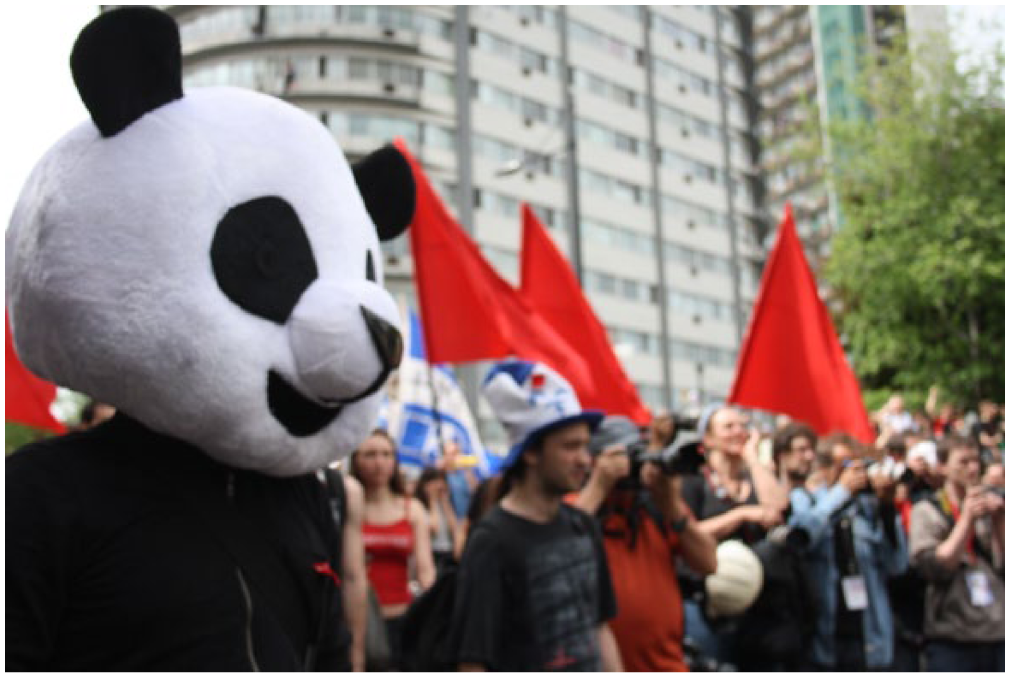
Anarchopanda, Montreal, May 2012. Photograph: Justin Ling via Wikimedia Commons.
Neither fully ‘object’ nor fully ‘human’, Anarchopanda nonetheless acquired a life form of its own, and evoked a comforting, reassuring presence that contributed in consolidating a specific public. Stuffed animals are often common objects of companionship or friendship for children, and this powerful affective identification undoubtedly featured in Anarchopanda’s appeal. As Melissa Grant explains, the attention Anarchopanda garnered in the media created a space of protection around him. ‘Once’, recalls Julien Villeneuve, the man behind Anarchopanda, ‘there was a line of riot police charging a cluster of students, and the line stopped at me for a while. Then the police said, “Run!” and I started moving as fast as I could, and that bought the students some time’. 78 Journalists and photographs were on the look out for him, constantly trying to locate him in the crowds. This constant actual or potential public gaze extending from demonstration participants seeing him to other dispersed publics, such Facebook and virtual friends, TV watchers and newspaper readers not physically present, translated into the creation of an inadvertent physical ‘buffer zone’ between the police force and the students on the ground. As the city of Montreal had decided to officially ban masks from protests, politicians had to clarify that, yes, this ban should be extended to include Anarchopanda, and not only those wearing the more alarming Guy Fawkes masks. Again, this forced an open spelling out of the ridiculousness of the invocation of security threats when juxtaposed next to the giant mascot. Naked bodies, fake pandas, pots and pans: objects and bodies here interwoven together, creating unexpected sentient publics met with warm hugging, laughter, and incongruity, when and where it was not expected to be found.
Conclusion
No doubt some would read the 2012 Montreal protests, this highly visible and audible demonstration and occupation of public space, as a very fleeting and ephemeral moment that is somewhat insignificant when set against the broader cultural and political currents that are often said to be eroding public space – the very same currents that Habermas theorised in his pioneering research on the public sphere. Yet, as Law and Urry have argued, the social sciences have not always done an adequate job when it comes to grappling with ‘twenty-first-century realities’ like the fleeting, the distributed, the sensory and the emotional. 79 While we hesitate about naming these aspects as ‘twenty-first century’ (since that might imply they are rather recent) we agree wholeheartedly on the need to bring these realities within the scope of critical inquiry. Perhaps the apparent decline of the public sphere is more a matter of the methods and tools we are using to research the public than it is a fact rooted in structural conditions or social processes. With different tools it should be possible to tell a different story about publics: one which captures their emergence and transformation, whether fleeting, or more enduring. If this article has managed to identify a few such tools, then it will have gone some way to doing its job.
Bringing publics into critical security studies is for us more than an academic bridge-building exercise. It is not simply a matter of connecting hitherto separate research fields or fostering greater interdisciplinarity – worthy as those aims may be. In addition, it represents an important step in developing a more nuanced account of how practices, regimes, and technologies of security, afford possibilities and limits for politics. This is not the place to debate whether or not critical security studies has developed an adequate understanding of the politics of security. 80 What we can say, in conclusion, is that a focus on publics offers a very fruitful way to analyse how politics is enacted in the domains of security. For when we focus on publics, and do so in an open-ended, relational, and diagrammatic way, we move beyond a universalistic notion of politics – as though we always already know what politics looks like, and where it is to be found. Instead, we move towards accounts of politics in which the political is something that has to be staged, assembled, and accomplished in particular places and always under specific conditions. Taking seriously the materiality of publics is therefore an important challenge facing those interested in better understanding not just the security and public nexus, but security and politics.
Footnotes
Acknowledgements
A much earlier version of this article was first presented at the workshop ‘Security and its Publics’ at Carleton University, September 2012, and we thank the participants at that event for their helpful comments as well as the editors and anonymous reviewers at Millennium. We are grateful to Alex Luscombe for research assistance.
Funding
Support for this research was generously provided by the Social Sciences and Humanities Research Council of Canada, #646-2011-1133.
1.
Nancy Fraser, ‘Transnationalizing the Public Sphere: On the Legitimacy and Efficacy of Public Opinion in a Post-Westphalian World’, Theory, Culture & Society 24, no. 4 (2007): 7–30; Craig Calhoun, ed., Habermas and the Public Sphere (Cambridge: MIT Press, 1992).
2.
Francis Cody, ‘Publics and Politics’, Annual Review of Anthropology 40 (2011): 3.
3.
Dilip Parameshwar Gaonkar, ‘Toward New Imaginaries: An Introduction’, Public Culture 14, no.1 (2002): 1.
4.
Keith Krause and Michael C. Williams, Critical Security Studies (Minneapolis: University of Minnesota Press, 1997); Karin M. Fierke, Critical Approaches to International Security (Cambridge: Polity, 2007); Columba Peoples and Nick Vaughan-Williams, Critical Security Studies: an Introduction (New York: Routledge, 2010); Barry Buzan et al., Security: A New Framework for Analysis (Boulder: Lynne Rienner, 1998); Peter J. Burgess, ed., The Routledge Handbook of New Security Studies (London: Routledge, 2010).
5.
Clive Barnett, ‘On the Milieu of Security: Situating the Emergence of New Spaces of Public Action’, Dialogues in Human Geography (Forthcoming).
6.
We pluralise the word to signal the multiplicity of public – whether understood as space, subject, value, or analytical perspective.
7.
Noortje Marres and Javier Lezaun, ‘Materials and Devices of the Public: An Introduction’, Economy & Society 40, no. 4 (2011): 489–509; Bruce Braun et al., eds., Political Matter: Technoscience, Democracy, and Public Life (Minneapolis: University of Minnesota Press, 2010); Nick Mahony et al., eds., Rethinking the Public: Innovations in Research, Theory and Politics (Bristol: The Policy Press, 2010); Francis Cody, ‘Publics and Politics’, Annual Review of Anthropology 40 (2011): 37–52; Bruno Latour and Peter Weibel, eds., Making Things Public: Atmospheres of Democracy (Cambridge: MIT Press, 2005).
8.
Walter Lippmann, The Phantom Public (New York: Harcourt, 1927), 67.
9.
Michael C. Williams, ‘The Public, The Private, and the Evolution of Security Studies’, Security Dialogue 41, no. 6 (2010): 624.
10.
Michael C. Williams and Rita Abrahamsen, Security Beyond The State: Private Security in International Politics (New York: Cambridge University Press, 2010).
11.
Ibid., 17, 106, 114.
12.
Best and Gheciu emphasize the ‘return’ of the public within structures of global governance while insisting that the public now takes a new form: no longer a ‘bounded space’ but dispersed and better understood at the level of ‘a collection of social practices’. See Jacqueline Best and Alexandra Gheciu, eds., The Return of the Public in Global Governance (Cambridge: Cambridge University Press. 2014), 3.
13.
Jutta Weldes, Mark Laffey, Hugh Gusterson and Raymond Duvall, eds., Cultures of Insecurity: States, Communities, and the Production of Danger (Minneapolis: University of Minnesota Press, 1999).
14.
Meg McLagan and Yates McKee, eds., Sensible Politics: The Visual Culture of Nongovernmental Activism (New York: Zone Books, 2012); Louise Amoore and Alexandra Hall, ‘Border Theatre: On the Arts of Security and Resistance’, Cultural Geographies 17, no. 3 (2011): 299–319.
15.
James Der Derian, Virtuous War: Mapping the Military-Industrial-Media-Entertainment Network, Second Edition (New York: Routledge, 2009).
16.
Thierry Balzacq, ‘The Three Faces of Securitization: Political Agency, Audience and Context’, European Journal of International Relations 11, no. 2 (2005): 171–201; Mark Salter, ‘Securitization and Desecuritization: A Dramaturgical Analysis of the Canadian Air Transport Security Authority’, Journal of International Relations and Development 11, no. 4 (2008): 321–49; Philippe Bourbeau, The Securitization of Migration (London: Routledge, 2011).
17.
Bourbeau, The Securitization of Migration , 41.
18.
Buzan et al., Security: A New Framework for Analysis.
19.
Nicole Shukin, ‘Transfections of Animal Touch, Techniques of Biosecurity’, Social Semiotics 21, no. 4 (2011): 491.
20.
See Noortje Marres, ‘The Costs of Public Involvement: Everyday Devices of Carbon Accounting and the Materialization of Participation’, Economy and Society 40, no. 4 (2011): 510–33. Marres draws attention to the way that everyday household devices like kettles can be designed in such a way as to lower the ‘costs’ of participating in environmentally oriented action. As such she offers important guidelines for theorising how user-publics are mobilised.
21.
Stefan Elbe, Security and Global Health (Cambridge: Polity, 2010), esp. 30–65.
22.
Nancy Fraser, ‘Transnationalizing the Public Sphere: On the Legitimacy and Efficacy of Public Opinion in a Post-Westphalian World’; Andrew Linklater, ‘Citizenship and Sovereignty in the Post-Westphalian European State’, in Re-imagining Political Community, eds. Daniele Archibugi, David Held, and Martin Köhler (Cambridge: Polity, 1998).
23.
Vibeke Schou Tjalve, ‘Designing (De)Security: European Exceptionalism, Atlantic Republicanism and the “Public Sphere”’, Security Dialogue 42, no. 4/5 (2011): 441–52. For key works that seek to retrieve a history of Republican political thought that had become eclipsed with the rise of modern international relations theory see Nicholas Onuf, The Republican Legacy in International Thought (Cambridge: Cambridge University Press, 1998) and Daniel Deudney, Bounding Power: Republican Security Theory from the Polis to the Global Village (Princeton: Princeton University Press, 2007).
24.
Tjalve, ‘Designing (De)Security’, 448.
25.
Noortje Marres and Javier Lezaun, ‘Materials and Devices of the Public: An Introduction’, Economy & Society 40, no.4 (2011): 489–509.
26.
Michael Warner, Publics and Counterpublics (New York: Zone Books, 2002).
27.
Bruno Latour, ‘From Realpolitik to Dingpolitik, or How to Make Things Public’, in Making Things Public: Atmospheres of Democracy, eds. Bruno Latour and Peter Weibel (Cambridge: MIT Press, 2005), 14–41; Michel Callon et al., Acting in an Uncertain World: An Essay on Technical Democracy (Cambridge: MIT Press, 2009).
28.
Susan Gal, ‘A Semiotics of the Public/Private Distinction’, Differences: A Journal of Feminist Cultural Studies 13, no. 1 (2002): 77–95.
29.
Kristin Asdal, ‘On Politics and the Little Tools of Democracy’, Distinktion: Scandinavian Journal of Social Theory 9, no. 1 (2008): 11–26; Thomas Osborne and Nikolas Rose, ‘Do the Social Sciences Create Phenomena? The Example of Public Opinion Research’, British Journal of Sociology 50, no. 3 (1999): 367–96.
30.
Clive Barnett, ‘Convening Publics: The Parasitical Spaces of Public Action’, in The SAGE Handbook of Political Geography, eds. Kevin R. Cox, Murray Low, and Jennifer Robinson (London: SAGE, 2008), 403–17.
31.
Claire Birchall, ‘“There’s Been Too Much Secrecy in This City”: The False Choice Between Secrecy and Transparency in US Politics’, Cultural Politics 7, no. 1 (2011): 133–56.
32.
David Zaret, ‘Petitions and the “Invention” of Public Opinion in the English Revolution’, American Journal of Sociology 101, no. 6 (1996): 1497–555.
33.
Osborne and Rose, ‘Do the Social Sciences Create Phenomena?’
34.
Patrick Joyce, The Rule of Freedom (London: Verso, 2005).
35.
Julian Ausserhofer and Axel Maireder, ‘National Politics on Twitter: Structures and Topics of a Networked Public Sphere’, Information, Communication & Society 16, no. 3 (2013): 291–314.
36.
Timothy Mitchell, ‘Society, Economy, and the State Effect’, in State/Culture: State-Formation after the Cultural Turn, ed. George Steinmetz (Ithaca: Cornell University Press, 1999), 76–97.
37.
Michel Foucault, Security, Territory, Population: Lectures at the Collège de France 1977–78, trans. Graham Burchell (New York: Picador Press, 2007).
38.
Iver B. Neumann and Ole J. Sending, ‘The International as Governmentality’, Millennium: Journal of International Studies 35, no. 3 (2007): 677–701.
39.
Noortje Marres, ‘Issues Spark a Public into Being, a Key but often Forgotten Point of the Lippmann-Dewey Debate’, in Making Things Public: Atmospheres of Democracy, eds. Bruno Latour and Peter Weibel (Cambridge: MIT Press, 2005), 208–17; see also Clive Barnett, ‘Convening Publics: The Parasitical Spaces of Public Action’.
40.
Joseph Masco, ‘The Billboard Campaign: The Los Alamos Study Group and the Nuclear Public Sphere’, Public Culture 17, no. 3 (2005): 487–96.
41.
Ibid., 494.
42.
Latour, ‘From Realpolitik to Dingpolitik’; see also Michel Callon et al., Acting in an Uncertain World : An Essay On Technical Democracy (Cambridge: MIT Press, 2009); Eyal Weizman, ‘Forensic Architecture: Only the Criminal can Solve the Crime’, Radical Philosophy 164 (2010): 9–24.
43.
Thomas Keenan, ‘Getting the Dead to Tell Me What Happened: Justice, Prosopopoeia, and Forensic Afterlives’, in Forensis: The Architecture of Public Truth, eds. Anselm Franke, Eyal Weizman, and Haus der Kulteren der Welt (Oberhausen: Sternberg Press, 2014), 35–55.
44.
Andrew Barry, ‘Materialist Politics: Metallurgy’, in Political Matter: Technoscience, Democracy, and Public Life, eds. Bruce Braun and Sarah Whatmore (Minneapolis: University of Minnesota Press, 2010), 89–118.
45.
Claudia Aradau, ‘Security that Matters: Critical Infrastructure and Objects of Protection’, Security Dialogue 41, no. 5 (2010): 491–514; Nadine Voelkner, ‘Managing Pathogenic Circulation: Human Security and the Migrant Health Assemblage in Thailand’, Security Dialogue 42, no. 3 (2011): 239–59; Mike Bourne, ‘Guns Don’t Kill People, Cyborgs Do: A Latourian Provocation for Transformatory Arms Control and Disarmament’, Global Change, Peace & Security 24, no. 1 (2012): 141–63; Rocco Bellanova and Dennis Duez, ‘A Different View on the “Making” of European Security: The EU Passenger Name Record System as a Socio-Technical Assemblage’, European Foreign Affairs Review 17, no. 2 (2012): 109–24; Mark Salter, ed., Making Things International I: Circuits and Motion (Minneapolis: University of Minnesota Press, 2015); Michele Acuto and Simon Curtis, eds, Reassembling International Relations Theory: Assemblage Thinking and International Relations (Houndmills: Palgrave Macmillan, 2013).
46.
This point has been further developed in William Walters, ‘Drones, Dingpolitik and Beyond: Furthering the Debate on Security and Materiality’, Security Dialogue 45, no. 2 (2012): 101–18.
47.
Susan Gal, ‘A Semiotics of the Public/Private Distinction’, Differences: A Journal of Feminist Cultural Studies 13, no. 1 (2002): 77–95.
48.
Ibid., 81.
49.
Ibid., 82.
50.
Divya P. Tobia-Kelly, ‘Affect – An Ethnocentric Encounter? Exploring the ‘Universalist’ Imperative of Emotional/Affectual Geographies’, Area 38, no. 2 (2006): 213–17.
51.
Ibid., 215.
52.
Jörg Friedrichs and Friedrich Kratochwil, ‘On Acting and Knowing: How Pragmatism can Advance International Relations Research and Methodology’, International Organization 83, no. 4 (2009): 709, 716–17, as quoted in Interpreting International Politics, ed. Cecelia Lynch (New York: Routledge, 2014), 21.
53.
Bent Flyvbjerg, Making Social Science Matter: Why Social Inquiry Fails and How it Can Succeed Again (Cambridge: Cambridge University Press, 2001).
54.
Stephen J. Collier, ‘Topologies of Power: Foucault’s Analysis of Political Government beyond “Governmentality”’, Theory, Culture & Society 26 (2009): 78–108; William Walters, Governmentality: Critical Encounters (New York: Routledge, 2012).
55.
Gilles Deleuze, Foucault, trans. Seán Hand (Minneapolis: University of Minnesota Press, 1988).
56.
Francis Frascina, ‘The New York Times, Norman Rockwell and the New Patriotism’, Journal of Visual Culture 2, no. 1 (2003): 102.
57.
Jacqueline Best and Matthew Paterson, eds., Cultural Political Economy (London: Routledge, 2009).
58.
Foucault, Security, Territory, Population, 45.
59.
The expression ‘printemps érable’ (‘Maple Spring’) was coined by francophone students as a funny wordplay, but also to draw attention to the extent of political change they wanted to see come about. The word ‘maple’ in French is érable, and its pronunciation is very close to the French word for ‘arab’, arabe. This wordplay is lost in English translation and, rather ironically, seems to convey the fact that it is a ‘Canadian’ protest – which is misleading, as the protests mostly took place in the province of Quebec.
60.
There is a case to be made that in an age of neoliberal public policy such protests and their policing are never merely local. In their impressive study of the policing of popular dissent, Laffey and Weldes suggest a tight fit between neoliberal reforms, popular protest, and violent police action, so that ‘global governance’ is not as benign or irenic as political scientists sometimes portray it. See Mark Laffey and Jutta Weldes, ‘Policing and Global Governance’ in Power in Global Governance, eds. Michael Barnett and Raymond Duvall (Cambridge: Cambridge University Press), 59–79.
61.
The full English version of the law’s provisions are available at: http://www2.publi-cationsduquebec.gouv.qc.ca/dynamicSearch/telecharge.php?type=5&file=2012C12A.PDF. Last accessed June 28, 2015.
62.
The sacralisation of the right to learn: there is perhaps an intriguing parallel between a right to education that becomes sacred only once it is represented as threatened, and Taussig’s public statues which only become noticed and sacred the moment they are defaced. See Michael Taussig, Defacement: Public Secrecy and the Labor of the Negative (Stanford: Stanford University Press, 1999), 1–3.
63.
Jonathan Sterne, ‘Quebec’s #casseroles: On Participation, Percussion and Protest’, Theory and Event 15, no. 3 (2013): n.p.
64.
Junius Henry Browne, ‘The Silent Majority’, Harper’s New Monthly Magazine 49 (June to November 1874), 468–86.
65.
Jessica Auchter, The Politics of Haunting and Memory In International Relations (London: Routledge, 2014); François Debrix and Alexander D. Barder, Beyond Biopolitics: Theory, Violence, and Horror in World Politics (New York: Routledge, 2012); Anna M. Agathangelou, ‘Bodies of Desire, Terror and the War in Eurasia: Impolite Disruptions of (Neo)Liberal Internationalism, Neoconservatism and the “New” Imperium’, Millennium: Journal of International Studies 38, no. 3 (2010): 693–722.
66.
Cassandra Harbour and Christophe Tremblay, Les Effets de la Répression Policière Visant les Manifestants Dans le Contexte du ‘Printemps érable’ (The Effects of Police Repression On Demonstrators in the Context of the ‘Maple Spring’), Final report presented to the ‘Ligue des droits et libertés – Section Québec’, Laval University, April 2013. Available at:  . Last accessed June 28, 2015.
67.
Our use of rhetorical device builds on Pouliot’s argument about what he calls ‘rhetorical commonplaces’. His use of this term is motivated by a frustration over material/ideal binaries similar to the one we have expressed here. In calling the Cold War a rhetorical commonplace Pouliot seeks to emphasize it is more than a word or idea, but a thickly formed image so embedded in cultural memory and political practice that it continues to mediate Russian-Atlantic diplomacy ‘after’ the Cold War. If we prefer to speak of devices, this is to emphasize that expressions can also be considered as equipment. See Vincent Pouliot, ‘The Materials of Practice: Nuclear Warheads, Rhetorical Commonplaces and Committee Meetings in Russian-Atlantic Relations’, Cooperation and Conflict 45, no. 3 (2010): 294–311.
68.
Andrew Barry, Political Machines: Governing in a Technological Society (London: Athlone Press, 2001), 177.
69.
70.
On the historical role that such ‘nongovernmental ships’ have played in expanding the ‘field of visual and aural imaging’ and, in addition to demonstrating environmental issues, advancing a distinctive ‘humanitarianism at sea’ in the domain of refugee policy, see Lorenzo Pezzani, ‘The Two Lives of the Cap Anamur’, in Forensis: The Architecture of Public Truth, eds. Anselm Franke, Eyal Weizman, and Haus der Kulteren der Welt (Oberhausen: Sternberg Press, 2014), 685–92.
71.
Carl Death, ‘Counter-Conducts: a Foucauldian Analytics of Protest’, Social Movement Studies 9, no. 3 (2010): 235–51.
72.
Foucault, Security, Territory, Population; Michel Foucault, The Birth of Biopolitics: Lectures at the Collège de France 1978–1979, translated by Graham Burchell (New York: Palgrave Macmillan 2008).
73.
It should be stressed that arts of demonstration are in no way confined to social movements or projects of resistance. Governments, corporations, and other organised actors all use, invent and adapt forms of demonstration to mobilise (and de-mobilise) publics around issues.
74.
Latour, ‘From Realpolitik to Dingpolitik’, 14–41.
76.
Sterne, ‘Quebec’s #casseroles’, n.p.
77.
78.
79.
John Law and John Urry, ‘Enacting the Social’, Economy & Society 33, no. 3 (2004): 404.
80.
For example, see Christopher Browning and Matt McDonald, ‘The Future of Critical Security Studies: Ethics and the Politics of Security’, European Journal of International Relations 19, no. 2 (2011): 235–55.