



Abstract
This article theorises the relationship between material environment and state ontological security by analysing how public architecture is used to defend, assert or construct state sense of self in international society. The article articulates the dynamic relationship between the two audiences of public architecture projects – international and domestic – and demonstrates how a project aimed at ensuring ontological security with one audience can produce anxiety and insecurity for the other. We illustrate this argument with the analysis of ‘Skopje 2014’ – a hugely ambitious architectural project by the government of Macedonia (now North Macedonia), designed to give the capital Skopje a completely new, neo-classical architectural look. However, instead of securing Macedonia’s ‘European’ visual identity, ‘Skopje 2014’ produced tremendous domestic political conflict and further removed Macedonia from the European cultural space it so much desired. Our study moves the scholarship on ontological security forward by specifying the dynamic trade-off between international and domestic security-seeking in contested polities.
In 2010, the government of Republic of Macedonia (now North Macedonia) 1 embarked on an ambitious plan of public architectural redesign. Named ‘Skopje 2014’, this project entailed the construction of multiple new government buildings, monuments, a symphony hall, national theatre, museums, an arc-de-triomphe, bridges and over 20 new statues of various Macedonian national historical figures, the most visible of which was a 47 ft tall statue of Alexander the Great, placed in the centre of the main Skopje city plaza. 2 This massive public project’s purpose was to both erase visual legacies of communist and Ottoman rule and visually render Skopje, the capital city, in line within Macedonia’s ‘antiquisation’ project that sought to link the modern Macedonian state to ancient Greece, Byzantine Christianity and revolutionary nationalism. Skopje 2014 was intended to shift Macedonia to the Western European cultural space, one that builds on the classical antiquity of Greece and Rome and sidesteps the internalised ‘backwardness’ of the Ottomans and the 20th century Yugoslav communists. 3 Since Macedonia carried a deep sense of loss after the devastating 1963 earthquake which levelled parts of the city and destroyed much of the major public architecture in the city centre, Skopje 2014 was also supposed to reinvigorate the capital city and make it sparkle again.
Whatever grand plans the Macedonian government had in investing in this massive project, the result was something more akin to ridicule and outrage. Architecture and urban design experts, both local and international, criticised the ‘fakeness’ of this new ‘Macedonian heritage’, its cheap imitation of classical Greek style and unsophisticated attempt at ‘counterfeiting’ Macedonian history. 4 Skopje 2014 resembled other massive public architecture projects in the post-communist world (such as those in Astana/Nur-Sultan or Baku) in their over-the-top, exaggerated, megalomaniacal ‘visions of excess’. 5 Scholars of Greek antiquity – both in Greece and around the world – were outraged at Skopje 2014s claim about contemporary Macedonia’s deep ancient Macedonian heritage, which they claimed was rightfully Greek only. 6 The government of Greece saw Skopje 2014 as a provocation in a long-standing dispute and doubled-down on its opposition to recognising Macedonia by its constitutional name, which, Greece claimed, exclusively belonged to the Greek cultural and historical domain. This standoff with Greece stalled Macedonia’s progress towards accession to the European Union and NATO.
This article uses project Skopje 2014 and its domestic and international political consequences to explore the relationship between public architecture and state sense of self. 7 While all states are constantly in the process of renegotiating their selves – domestic as well as international – we focus specifically on states with uncertain, liminal or contested identities (because of contested borders, territory, sovereignty or lack of international recognition) to demonstrate ways in which public architecture is used to defend, construct and securitise state sense of self in international society, a process that produces deep domestic political contestation.
Our argument advances IR scholarship along two dimensions. First, following Krickel-Choi, we understand ‘self’ and ‘identity’ to be two distinct elements of the ontological security framework. 8 Ontological security-seeking, then, is a dynamic process that involves stabilising routines, practices, narratives and, yes, identities, through time in order to avoid anxiety of change and provide a sense of continuity of the self. 9 Seeking stability of identity then becomes the first element of the broader search for ontological security.
We demonstrate that public architecture – as part of a bundle of state interventions – serves a significant role in state ontological security-seeking. Its physical durability offers seemingly uninterrupted biographical continuity through time. But it can also produce deep domestic anxiety and insecurity as trying to secure a stable self internationally can create boundaries and exclusion at home. We illustrate these arguments by showing how the goal of Skopje 2014 was to demonstrate to international audiences that Macedonia had a distinct and stable (Slavic not Greek) identity, that it truly existed as a unique polity, and that it should be granted the privileges of statehood and sovereignty despite continuing Greek opposition. Stabilising Macedonian identity internationally through nationalist public architecture was a process of securing the Macedonian state self. But defining Macedonia as a nation of Macedonian Slavs also excluded and isolated the country’s large non-Slav Albanian minority from belonging and sharing in this newly reinforced sense of self. A project meant to securitise state self abroad produced insecurity and division at home.
Second, we further expand the scholarship on ontological security by theorising the relationship between its international and domestic dimensions. We demonstrate that the state attempts to resolve an international source of ontological insecurity (such as, e.g. an external challenge to state sovereignty) can lead to domestic anxiety and physical insecurity. Additionally, we show that responses to this new ontological condition – when propagated by a narrow political coalition in a politically unstable setting – generate further insecurity through domestic policy contestation. Domestic coalitions may contest not only the state’s current positionality in the contemporary society of states, but also the selection of ‘usable history’ that forms the key chapters in the state biography.
This focus on domestic insecurity and political contestation as a result, and not only a cause of international ontological security-seeking, then directly addresses much of the criticism of ontological security scholarship for its supposed homogenising of the state. 10 Instead, we open up the ‘black box’ of the state to trace distinct domestic narratives, their competition, and their periodisation and sequencing. We demonstrate how various domestic coalitions respond to public architecture and its ontological power and the ways in which built environment helps form domestic identities to include some groups while excluding others.
Responses to public architecture – be they in North Macedonia over Skopje 2014, or in the United States over Confederate statutes, or in the United Kingdom over colonial and imperial monuments – are, therefore, not simply issues of political contestation. That they produce the multiplicity of domestic responses is not surprising. What they do, instead, is go to the core of the state understanding of self – of North Macedonia as a besieged Slavic nation-state, of the United States as a democracy linearly progressing through time, of the United Kingdom as a post-empire holding on to its visions of greatness. Fights over public architecture can lead to anxiety and even physical insecurity because they destabilise the collectively shared sense of what the state is and where it is going, who are its friends and who are its enemies. These fights are vicious and divisive because they are fights over what the state is, what it was, what it wants to be, who belongs and who is excluded.
The article proceeds as follows. We first offer a brief snapshot of the literature on public architecture and state identity and point to areas where this scholarship should most directly intersect with some of the core interests of IR. We then connect this literature to the scholarship on ontological security and articulate an argument about the dynamic relationship between the two audiences of public architecture projects – international and domestic – and ways in which a project aimed at one audience can produce ontological insecurity for the other. These arguments are then illustrated with the account of the Skopje 2014 project. The brief case study first presents the acute external challenges against Macedonia’s sovereignty, which it experienced in the run up to the project. Second, the case demonstrates how Skopje 2014 was designed to resolve these ontological insecurities, but ended up only deepening them. We conclude by discussing the broader theoretical implications of this project and suggest avenues for further research.
Architecture, Built Environment and State Identity
Despite the well-established literature on the relationship between public architecture – such as government buildings, monuments, state museums or statues – and state identity, 11 this scholarship has yet to fully make its way into International Relations (IR). Other than the path-breaking work by Sylvester, who looked at the relationship between art museums and IR, 12 Steele, who analysed how scars of violence manifest themselves in architecture and landscape, 13 Coward, who looked at destruction of urban spaces as a practice of war 14 and the recent interventions by Ejdus on material environments as ontic spaces, 15 most of the developments within this research agenda have occurred in other disciplines – mostly geography, urban studies or anthropology, where scholarship on this topic is booming. But whether we are looking at cityscapes of Hitler’s Berlin, Mussolini’s Rome, Franco’s Madrid or Orbán’s Budapest, public architecture as a direct representation of state power and as an instrument of statecraft should be of immediate interest to IR.
Public architecture shapes state identity – and is of course itself shaped by it – in several ways. First, public architecture is inherently political. As Ulrich Beck famously remarked, ‘architecture is politics with bricks and mortar’. 16 But public architecture projects are also forms of political action, as they provide legitimacy to regimes and social orders they strive to create. 17 Public architecture serves a dual function in that it has huge symbolic implications for state identity while at the same time it serves the practical affairs of politics. 18 Another way of putting this is that public architecture both symbolises social order while at the same time protects the institutions of that order from political challenge and critique. 19 Major public architecture projects make state ideologies publicly visible by invoking easily recognisable symbols of desirable national values. Public architecture materially embodies national institutions and constructs shared cultural heritage around which national identity can be formed. 20 Architecture solidifies national identity in time and space, and it provides states with a ‘spatial identity’. 21
Making national identity visible through public architecture, then, involves as much construction as destruction and removal of structures that do not fit the new identity or challenge it. It involves constant reinterpretation and renarration. This process of identity disruption has, for example, played out in spectacular fashion with the destruction of socialist structures, monuments or buildings in post-communist Europe since 1989. 22 Public architecture in post-communist Europe has also been the site of major struggles over competing meanings of the nation and of Europe, of socialism, and liberalism, and over contested views of state transformation and social change. 23
Second, public architecture signals a state’s international desires. While much of the focus in the existing literature is on how architecture shapes state identity by reimagining a state’s past, displaying what is to be remembered, what to be forgotten, which past is presented and how, 24 public architecture can also create history from full cloth, visually reimagining a nation’s history and constructing a new state identity. Built environment is often, then, not about the state’s past at all but about the state’s present and future. Here again it serves a dual purpose – domestically, it imprints the norms, desires and vision of the state into built landscape, disciplining citizen participation, expectations and loyalty, while internationally, it sends a signal of what the state imagines itself to be, what cultural space it wishes to belong to and where in the international status hierarchy it finds itself. Expressing belonging to, for example, the European cultural space would manifest itself directly in public architecture projects. 25 Public architecture can then be used to translate these state desires into specific foreign policy needs and demands, as the case of Skopje 2014 demonstrates below.
Third, the role of public architecture in defining state identity is particularly visible in massive redesigns of capital cities which ‘act as national symbols for global audiences’. 26 Often these redesigns follow state restructuring after conflict or newly acquired state independence, as states renegotiate their new international identities. Capitals are sites of political authority and as such their visual identity projects a meaning to that authority further into the world outside of national borders. Capital cities are ‘places showing to the domestic public and the outside world what the state is, what the national identity is, and how the polity imagines the rest of the world in light of its own position’. 27 Capital city public architecture projects also often involve similar aesthetic choices – for example, neo-classical style is often the choice of regimes that want to signal they are democracies, which leads many capitals to look more similar to one another than to smaller cities in their own countries. 28
Azerbaijan, for example, has embarked on a massive public architecture ‘hyperbuilding’ spree, which has completely reshaped the cityscape of the capital Baku to transform it into a hyper-modern, vertical, futuristic city. While the government has argued that this public architecture revamp is carried out to attract tourists, it also comes from a sense of ontological insecurity and a desire to be seen in a different light internationally. Reclaiming Azerbaijan from the post-Soviet space was critical to this effort. President Ilhan Aliyev has consistently presented Baku’s visual transformation as a sign of Azerbaijan’s non-Soviet identity: ‘We have long left the name of a post-Soviet country. We are not a post-Soviet country. When sometimes in meetings with foreign partners, they say “post-Soviet countries,” and I say, “Wait. Azerbaijan is not a post-Soviet country. Perhaps some are post-Soviet countries, but we are not”’. 29
To sum up, it is through public architecture – its maintenance, preservation and narration – that we locate what states consider to be their visual identity, how they want to be seen and understood by international society. Since architecture is central to the construction and maintenance of state identity, its management is a state project of critical importance. At the very basic, states engage in public architecture projects to promote or solidify nation-building, 30 especially when facing domestic or international crises or external shocks, such as external challenges to their sovereignty. It is here that public architecture interacts most clearly with ontological security-seeking, and we turn to this relationship next.
Public Architecture and the Search for Ontological Security
While there is thus a large, multidisciplinary literature on the relation between public architecture and state identity, we bring in the framework of ontological security (as theorised in IR) to capture the dynamic and often paradoxical effects public architecture projects generate in international and domestic politics. Building on the growing interest in material environments in IR, we start with the premise that physical spaces (such as buildings, monuments and architecture in general) are material environments that provide states their ontological security or security of the self. It is trust in the constancy of material environment that provides states their ontological security as this physical environment becomes an anchor of the state self. Perhaps nowhere is this relationship as clear or as powerful as in the state ontological need for territory, evidenced in the ontological stress caused by territorial contestation, secession or dispute. This ‘ontological significance’ of territory for a state sense of self has been demonstrated in the cases of contested territories of Karelia (Finland) and especially in the cases of Kosovo and Jerusalem and their continuing ontological importance for Serbia and Israel/Palestine, respectively. 31 More broadly, constructing a notion of ‘territoriality’ and creating boundaries around a community (e.g. constructing the ‘European Union’) is a fundamental state practice that provides ontological security but also guides state agency. 32
As the scholarship on ontological security has already established, a state sense of self is based in large part on its biographical continuity. 33 It is important for a state to have a secure biography, a firm grasp on its past and its history, as this provides it a sense of stability, routine and familiarity, and allows it to interact with other actors in international society. Public architecture provides that continuity through time by creating physical, material structures that are designed to be eternal. 34 It ‘stabilise(s) social life’. 35 It provides permanence to the national self by, quite literally, etching it in stone. This presumed durability further provides state its ontological security needs. This is especially evident in the importance states place on sites of mourning and memorialisation, affixing their meaning through time and providing a routinised sense of stability and calm. Public monuments built to commemorate victims of mass death are prime example of this practice. 36 Public architecture also serves as a tool of foreign policy and influence. In addition to large webs of interconnected financing across state borders, states at times not just finance but actually build large architectural projects in other countries, as a sign of marking their territory, cultural domain or just exercising their soft power by demonstrating their technical or construction prowess. 37
In his pioneering work on material environments in IR, Ejdus argued that material environments, once discursively linked to collective identity, ‘become “ontic spaces,” spatial extensions of the collective self that render state identities to appear more firm, continuous and real’. 38 This process can occur in two ways – through projection of state identity narratives onto the material environment or through introjection of the material environment back into state narratives. 39 In his later work, Ejdus introduced the concept of abjection, or rejection of material environment from the narrative of the state self, in an attempt to stabilise biographical continuity by rejecting what is unwanted or undesired. 40
We expand on this scholarship by adding a new dynamic – the interaction between the international and the domestic role that material environment plays in state ontological security-seeking. Our principal argument is that a project aimed at seeking ontological security internationally can produce anxiety and insecurity domestically, leading to a failed attempt at ontic space-building.
We argue, first, that in addition to providing a sense of ontological security at home, public architecture also provides a desirable state biography internationally and serves as an instrument of foreign policy. Public architecture can provide visual signalling to international others about which cultural space the state wants to belong to, how it views itself and how it wants to be perceived by other international actors. It is especially ontologically insecure states, those whose core aspects of statehood such as international recognition and sovereignty are unstable or challenged, or who are undergoing a period of particular ontological stress and crisis that will choose radical, grandiose and large-scale public revisioning of their cityscapes. These states are more likely to either completely restore their old material environments or construct everything new from scratch. 41 Public architecture projects then become direct mechanisms of international ontological security-seeking, designed to define and stabilise state sense of self, affix it in physical, immovable and timeless material environment, and create boundaries around who belongs and who is excluded.
Second, state international ontological security-seeking projects can lead to ontological insecurity for domestic groups. The more radical and excessive these public architecture projects are, the more likely they are to be noticed by international audiences. At the same time, however, the more visible and intrusive they are, the more they will produce strong domestic contestation. In deeply divided states, these internationally facing projects designed to present a single unifying visual state identity end up flattening domestic diversity and excluding minority identities. They are violent interventions into how different domestic groups view themselves and their place in the national body politic. They create insecurity of national belonging and violent rupturing of the self and the self’s representation. Their presence becomes a form of daily, routinised symbolic violence perpetrated on members of groups that do not belong to this vision of the nation but who are reminded of their exclusion as they go about their everyday life and walk through their city.
These public projects further create domestic anxiety and insecurity by intruding into the public space and disrupting people’s daily routines – a basic need for the maintenance of ontological security of the self. International ontological security-seeking can, therefore, produce domestic anxiety and physical insecurity for groups that are excluded from the state project. This dynamic can be understood as the reverse of the well-established concept of ‘cultural intimacy’, where domestic practices that bring the nation together in a jointly shared cultural script, when viewed by outsiders, can create embarrassment or shame. 42
Finally, public architecture projects are massively expensive and are hard to justify in the era of austerity politics – and this expense also influences the architectural form chosen. 43 Public architecture can, then, be understood not only as a political, social or cultural state intervention, but also as a directly economic one, as the case study of Skopje 2014 explicitly shows.
A Note on Methodology
We selected the case of Macedonia and the Skopje 2014 project for two reasons. More so than most post-communist states in transition, Macedonia had its vision of statehood called into question in the international realm by other state actors so consistently and so repeatedly that the issue needed to be resolved by international mediators. The international visibility of this case and the very high stakes (state recognition) made it apt for developing not only theoretical, but also empirical links between state ontological security-seeking and the use of public architecture. While not all states have such extremely contested identities and may not face the same degree of insecurities as Macedonia, the Skopje 2014 case generates useful theoretical insights for understanding other state practices of internationally facing nation-building and effects these practices have on domestic politics. We focus our analysis on the interpretation of public debates surrounding Skopje 2014 and Macedonian state identity more broadly, situating these debates within the broader context of Macedonia’s claim to sovereignty.
We draw primarily from our own fieldwork site visits to Skopje, analysis of four local and three international news sources published in English, Macedonian, Albanian and Serbian 44 ; international organisations’ reports; and secondary literature on the topic of Macedonian independence, identity and politics. News sources were selected for their coverage of discussions and debates of Skopje 2014 from multiple perspectives, including the government, opposition, Albanian community and professional organisations. Rather than analyse content of discrete sources, we compiled a corpus of approximately 450 news articles located using keyword searches in English, Serbian, Macedonian and Albanian for specific topics related to Skopje 2014 or key political actors during the periods analysed. Specific pieces of evidence, indicating a perspective or preference are cited, but the larger corpus of documents and news sources was critical to informing our analysis. 45
Skopje 2014 as Ontic Space
Macedonian capital’s redesign in ‘Skopje 2014’ was meant to showcase a recast vision of the nation and its place in broader regional and global contexts. This recast vision intended to plaster over the visual legacies of Ottoman and communist rule while physically co-opting historical nodes that located the modern Macedonian state in the Western, Christian world rather than the post-Ottoman, post-communist, Balkan space. By 2017, when the ruling VMRO-DPMNE (Internal Macedonian Revolutionary Organisation – Democratic Party for Macedonian National Unity) government which championed Skopje 2014 and its accompanying ‘antiquisation’ project was ousted, Skopje 2014 had become a physical emblem of the party’s autocratic nationalist rule, corruption and more broadly Macedonia’s turn away from Euro-Atlantic integration. The contentious selection of ‘usable’ historical nodes to locate Macedonia in the modern and historical worlds had divided the multi-ethnic population still working past a violent conflict in 2001. It had also further antagonised Macedonia’s neighbours, leaving it ostracised by international organisations at a time when it was seeking accession to NATO and the European Union.
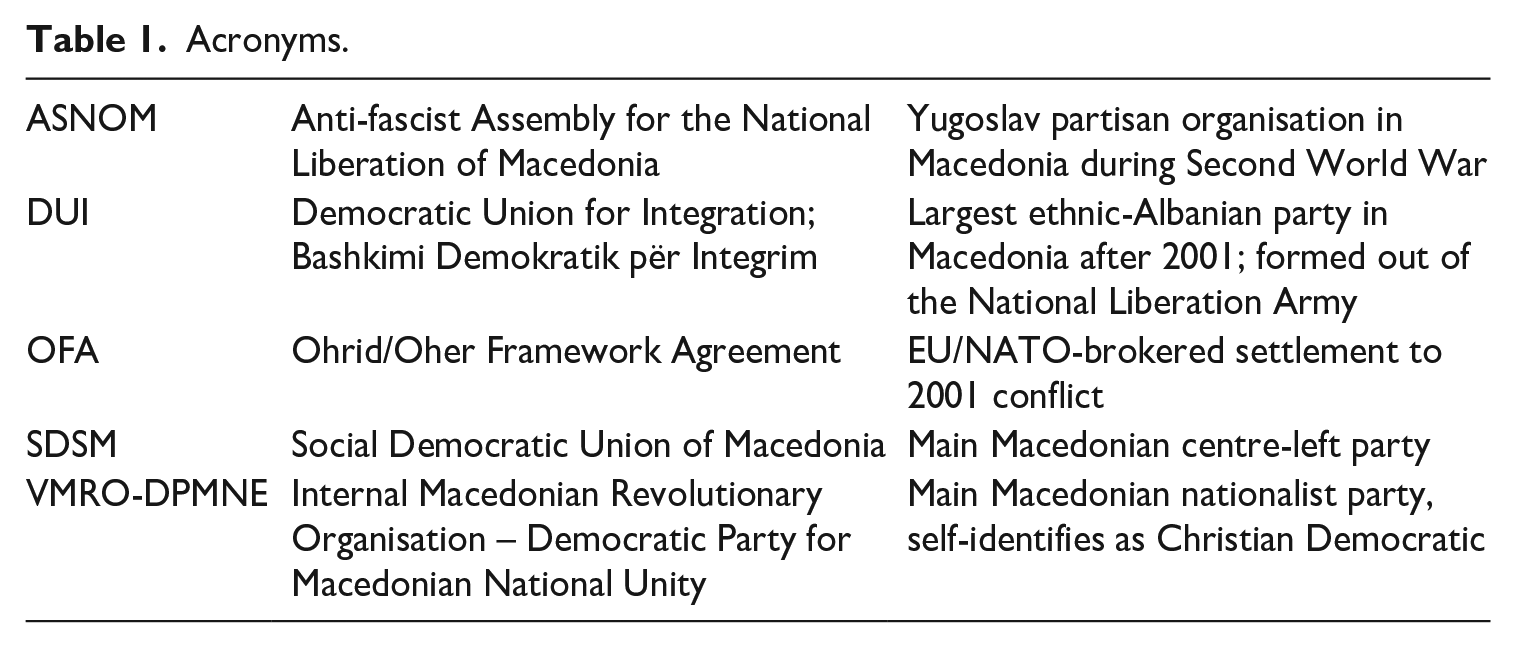
To understand the politics behind the Skopje 2014 project and its fallout, we focus our analysis on the use of public architecture to conceptualise and project a secure state biography that signals stability over time and vision for the future. This hegemonic vision progressing from ancient Greece to modern Macedonia, albeit ‘interrupted’ by foreign subjugation, accounted for one conceptualisation over others and generated notable backlash from political opposition and ethnic minorities alike. Accordingly, we focus the analysis not on the unitary state, (Table 1) but on domestic coalitions and their contestation of the Macedonian self, thus overcoming some critiques of state-centric ontological security scholarship. While some studies of memory and identity politics have focused their analyses on domestic contestation of imagery and self-conceptualisation, 46 Macedonia presents a case in which domestic contestation and insecurity around conceptualising the self within an international society are driven by anxiety and insecurity about rejection by others in that society of states. Our analysis proceeds in three stages: (1) we identify the sources of insecurity for the Macedonian state; (2) we outline attempts to resolve that insecurity through physical construction anchoring Macedonia’s biography in antiquity and selected periods; and (3) we analyse the project’s domestic and international consequences.
Acronyms.
The ‘Four Wolves’ as Sources of Macedonian Ontological Insecurity
We begin by considering the origins of Macedonian ontological insecurity after its independence from Yugoslavia in 1991 and its introduction as a sovereign state into the modern international society of states. Independence in 1991, for the first time, paved the way for the territory of Macedonia and the Macedonian people being constituted as sovereign and independent of a larger order, having previously been a part of socialist Yugoslavia, the Kingdom of Yugoslavia, the Ottoman Empire, the medieval Serbian and Bulgarian kingdoms, and the Byzantine Empire. The origins of both Macedonia’s insecurity and others’ challenges to its sovereignty stemmed from the much older ‘Macedonian question’ that pertained to the division of territory and peoples during the Ottoman Empire’s decline, and prominently after the Balkan Wars in 1912–3. 47 Independence thus constituted a ‘critical situation’ in which existing dominant concepts of the self and its place relative to others were disrupted, leading to anxiety and defensive responses. 48 For Macedonia, independence further necessitated reassessment of the state’s position in regional and world contexts as a state having historically lacked sovereignty.
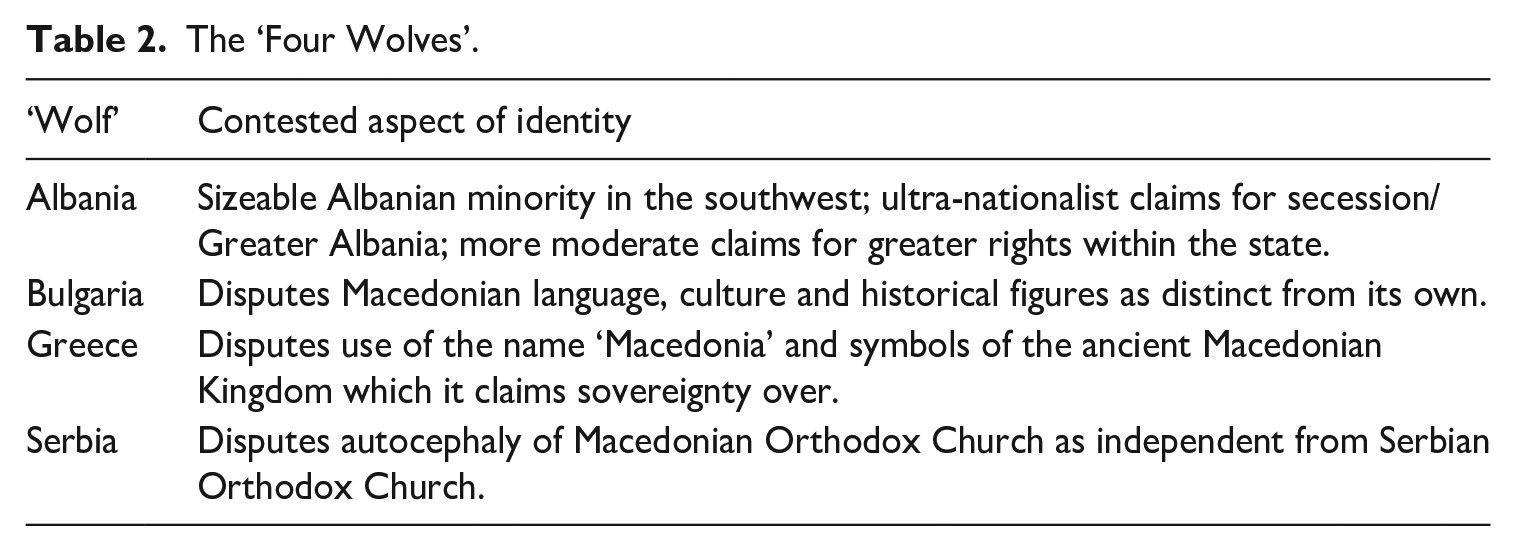
Macedonian anxiety following independence was driven in large part by what was known in national narratives as the ‘four wolves’ – four neighbouring states that historically ‘preyed’ upon Macedonian sovereignty. 49 Individually, each disputed a distinct and sovereign Macedonian territory, language, religion and cultural heritage (Table 2). The origin of ‘four wolves’ narrative is traced to the Balkan Wars (1912–3) when the Ottoman region of Macedonia was partitioned into three territories and divided among three states: Aegean Macedonia went to Greece, Pirin Macedonia to Bulgaria and Vardar Macedonia to Serbia where it was labelled first ‘South Serbia’ and then ‘Vardar Banate’, stripping it of a distinct Macedonian identity. 50 This anxiety was compounded by the unresolved question, also linked to Ottoman decline, of a sizeable ethnic-Albanian minority in southwestern Macedonia that was culturally, linguistically and religiously distinct, with kinship ties to neighbouring Albania and Kosovo. Countering the four wolves’ predation of Macedonian sovereignty was a shared cause for early 20th century nationalists, namely the revolutionary Internal Macedonian Revolutionary Organization/VMRO, which sought unification of the partitioned Macedonian lands.
The ‘Four Wolves’.
Independence in 1991 reanimated both selected memories of the Balkan Wars-era ‘Macedonian question’ and the anxiety induced by the four wolves. The VMRO-DPMNE party, founded in 1990, distinguished itself with making these issues of historical sovereignty and biographical continuity central to its platform. The party’s name itself was an homage to the Ottoman-era revolutionary Internal Macedonian Revolutionary Organization/VMRO, and in addition to independence from Yugoslavia, it advocated reunification of the partitioned Macedonian territories as a national homeland and opposed a multinational state. 51 The former threatened Bulgaria and Greece, which saw this as a territorial claim on Pirin and Aegean Macedonia, leading both to deny the existence of a distinct and sovereign Macedonian nation to be reunified. Greece further imposed a trade embargo and blocked recognition in the European Community and United Nations, demanding the country not use the name ‘Macedonia’ in any form and remove the Star of Vergina from its state symbols, both of which Greece claimed cultural sovereignty over. 52 The latter position angered the domestic Albanian community, roughly a quarter of the total population, the repression of whose cultural, educational and religious rights boiled over into armed conflict in 2001. 53
Macedonia’s constitution, drafted in November 1991, ostensibly sought to enshrine these disputed aspects of sovereignty. The Macedonian language, Macedonian Orthodox Church and the existence of a culturally distinct Macedonian nation were all protected in the constitution, under the name ‘The Republic of Macedonia’. 54 However, the state was required to remove these protections out of its constitution in the 1990s and early 2000s. In exchange for recognition by the European Union in 1992, Macedonia amended its constitution to explicitly renounce any territorial claims against its neighbours. 55 For membership in the UN in 1995, Macedonia was required to adopt the temporary name ‘the Former Yugoslav Republic of Macedonia’ for international use and a new flag without the Star of Vergina. 56 And in resolving the 2001 conflict, Macedonia accepted the EU/NATO-brokered OFA, which required constitutional amendments granting Albanians equal status and placing the Albanian language and cultural practices on par with Macedonian, and Islam on par with the Macedonian Orthodox Church. 57 Consequently, within 10 years of independence, Macedonia was compelled to forfeit institutional protections of the contested aspects of its sovereignty that had generated renewed anxiety after 1991.
The increasingly threatening question of Macedonia’s external recognition and internal security called into question the idea of Macedonian sovereignty as a whole, and both deepened anxiety and triggered defensive responses. These were manifested both internally and externally. Internally, the two major parties were split over their visions of Macedonia’s international position, its future and the formulation of its biography. The left-leaning SDSM was largely forward-looking in favour of acquiescence to international pressure both over the name dispute and OFA as necessitated by its vision of Macedonia’s future in Euro-Atlantic organisations. The VMRO-DPMNE, which returned to power in 2006, was conversely rearward-facing with an aim to consolidate Macedonian identity within Western, Christian Europe through the selective construction of a national autobiography. This latter position became most explicitly evident after Macedonia’s NATO membership was withheld in 2008 at Greece’s behest over the name dispute – what was viewed as punishment for claiming sovereignty (summarized in Figure 1). Macedonia responded immediately by renaming infrastructure for ancient Macedonian figures, such as ‘Alexander the Great Highway’, ‘Philip II Airport’ and ‘Philip of Macedon Arena’, aware that previously renaming Skopje’s airport ‘Alexander the Great Airport’ in 2006 had irked Athens. 58 Accordingly, the public and embarrassing NATO snub triggered a response from the VMRO-DPMNE that was not simply a petty jab at Athens, but a claim to sovereignty over its disputed biography. In the following years, this claim would be literally built in stone, something that could not simply be written over or amended out of existence.
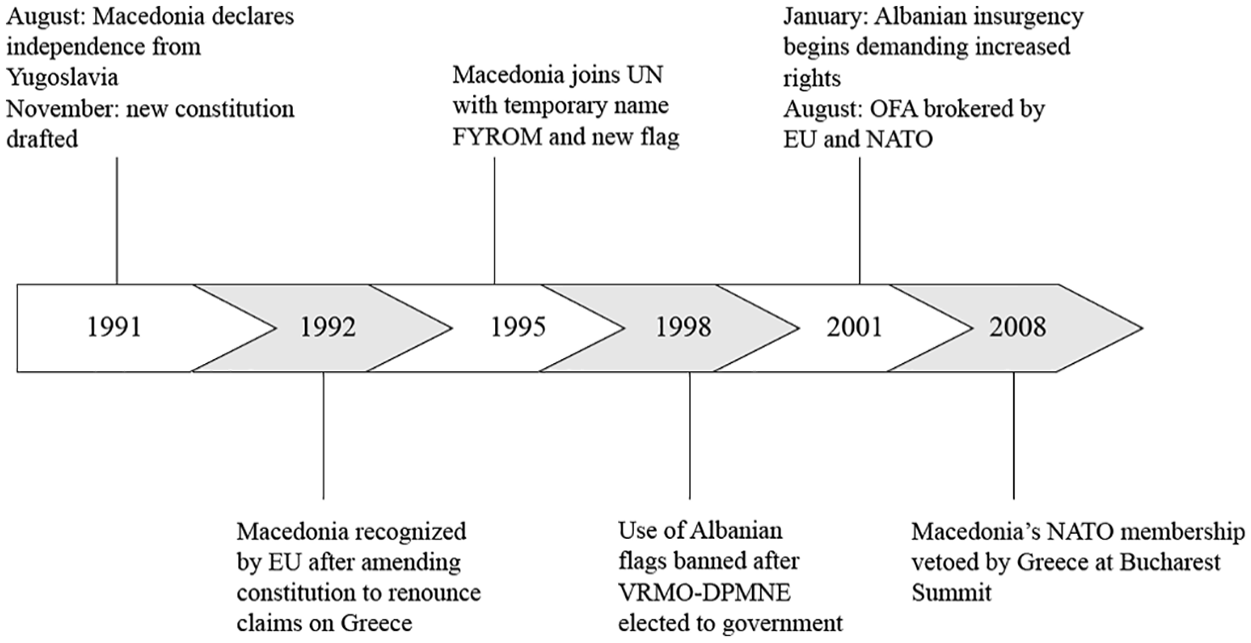
Timeline of threats to Macedonian ontological security, 1991–2008.
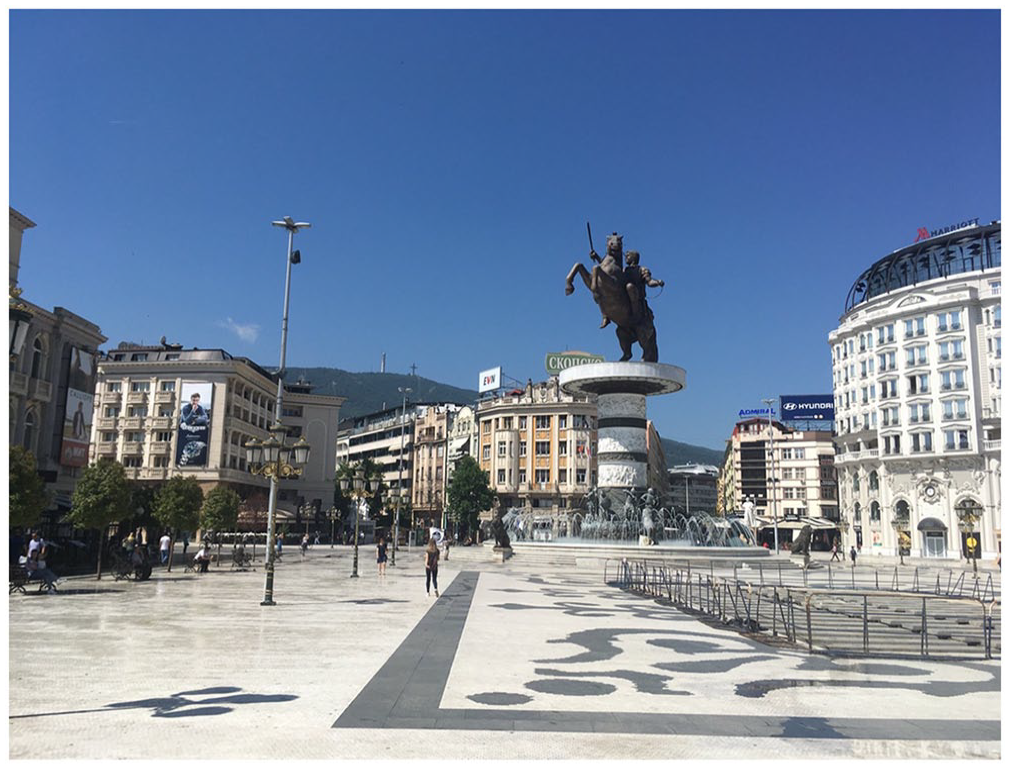
Equestrian Alexander the Great in Macedonia Square, Skopje.

Neo-classical buildings on the northern bank of the Vardar River.

‘Porta Macedonia’ triumphal arch on Pella Square, Skopje.
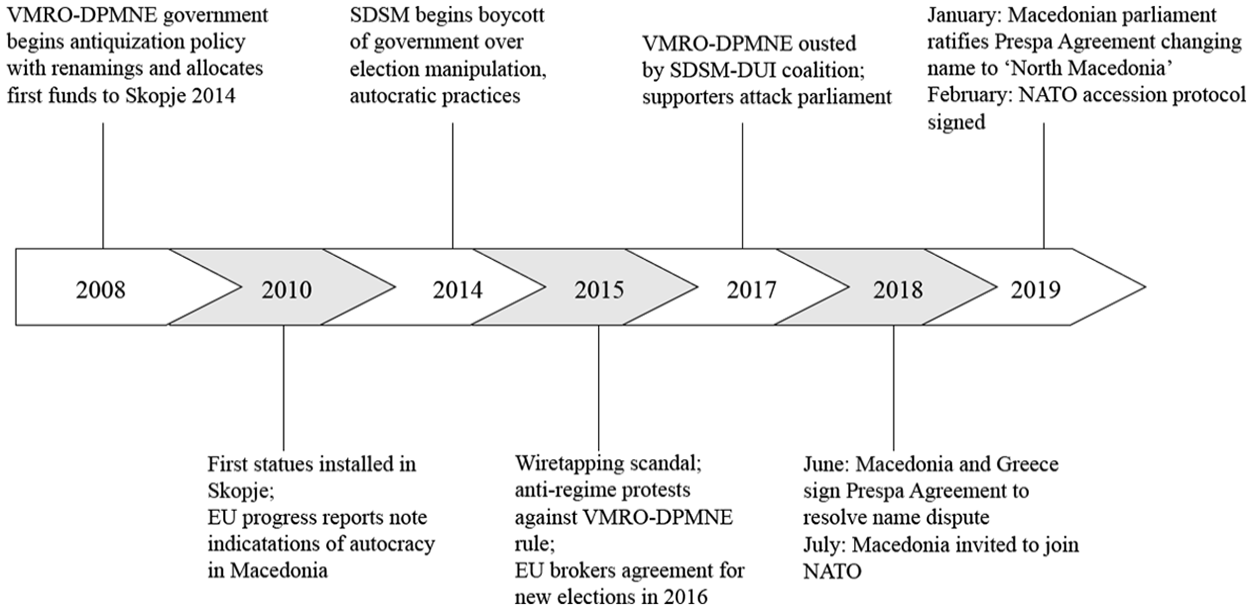
Timeline, post-2008.
Constructing Macedonia – Seeking Ontological Security Internationally
The VMRO-DPMNE’s policy of ‘antiquisation’ aimed to culturally and visually enshrine biographical continuity between the ancient Kingdom of Macedonia and the modern Macedonian state, thereby imposing the party’s hegemonic vision of the state during a period of acute ontological insecurity. In so doing, the government was not only crafting an image of the Macedonian nation-state, but also reclaiming aspects of its biographical self it was coerced to write out of state institutions to attain recognition by international organisations. As noted, antiquisation began with renaming public infrastructure to claim disputed aspects of VMRO-DPMNE’s biographical understanding of the state. This was followed in 2009 by a government-directed production of a national encyclopaedia which, controversially both to domestic scholars and international audiences, declared modern Macedonians to be directly descended from the ancient Kingdom of Macedonia. 59 The public broadcaster produced accompanying, government-funded films that explicitly linked the modern nation to key historical nodes. They claimed the modern Macedonian state was the historical ‘biblical nation’ evolved from Alexander the Great, to Byzantium, to the revolutionary organisations Internal Macedonian Revolutionary Organization/VMRO and ASNOM, while notably omitting mention of centuries of Ottoman rule and communist Yugoslavia. Selective inclusion thus forwarded a vision of a modern Slavic, Christian nation-state, descended from a great empire and historically resistant to foreign subjugation. 60 This vision was further evident in VMRO-DPMNE’s 2008 election manifesto that envisioned the government as the sole protector of Macedonian culture, language and the Orthodox Church – those features amended from the constitution after 2001. 61
Skopje 2014, which began transforming the image of Macedonia’s capital city in 2010 when the first statues were erected in Skopje’s main square, constituted a physical manifestation of antiquisation. Monuments were chosen to reflect the selected periods, or historical nodes, highlighted in the nationalist reading of history presented in the government-funded encyclopaedia and films, namely the Kingdom of Macedonia, Byzantium and Orthodox Christianity, the Internal Macedonian Revolutionary Organization/VMRO struggle against Ottoman rule and ASNOM’s anti-fascist struggle during the Second World War. The most imposing pieces were those representing the Kingdom of Macedonia – told as the nation’s origin – in two bronze casts of Alexander (Figure 2) and his father Philip of Macedon, 24 and 28 m tall respectively and mounted atop fountains. 62 More than 30 additional monuments were erected over the next 2 years, fitting into the selected historical periods. The choice of particular historical figures and their representation reflected a particular vision of the ruling party.
Omissions from Skopje 2014 were as important as the inclusions in visually representing an interpretation of history in the national biography. This was tantamount to erasing those undesirable chapters of Macedonia’s history from the ruling party’s telling of its biography, namely in covering over the city’s brutalist communist-era architecture and distinct Ottoman-era influences. This entailed new construction and renovation of government buildings and public spaces to reflect a neo-classical style generally associated with the Western world and classical heritage, coupled with a narrative message of durability and persistence. The constitutional court, national theatre and state museums, along with centrally located residential buildings, were fitted with columns, domes and stone façades (Figure 3). 63 Though preserved as a heritage site, the childhood home of Mother Teresa in central Skopje, who was born to an Albanian family during Ottoman rule, had an imposing new Orthodox Church covered in gold-leaf constructed beside it. 64
Additional construction more directly intended to position Macedonia within the Western world and connect Skopje to other major Western capitals, regarded as historically Western political and cultural centres. Among these were replicas of iconic structures, crammed without visual context into open, often busy public spaces, including a triumphal arch (Figure 4) and obelisk in the thoroughfares leading to the main square, a replica of the Brandenburg Gate in a park across from Parliament, chrome planters in the Vardar River and the presidential Cuckov Palace remodelled to resemble the American White House. 65 In a conscious effort to place Macedonia within Western political history, the Ministry of Foreign Affairs installed 60 concrete, stone and bronze sculptures of notable world politicians, among them Abraham Lincoln and Winston Churchill. 66 Though never completed, further plans were made for replicas of Rome’s Spanish Steps and the London Eye. 67 These various internationally themed monuments and buildings, coupled with even more out-of-place replica ships placed in the Vardar River conveyed an image both to domestic and external audiences of Skopje 2014 as an amusement park of kitsch rather than a robust representation of self. 68
Politically, this effort to construct a biography that placed Macedonia within the cultural history of Europe and the West played into the Orientalist narrative of ‘interrupted history’, according to which Macedonia was progressing linearly through history towards an inevitable place in Europe and Western culture but was ‘interrupted’ by the regressive forces of Ottoman imperialism and Yugoslav socialism. The role of Skopje 2014, here, was to secure biographical continuity by linking modern Macedonia to its more desirable identity as European and Western and not a ‘backward’ post-Ottoman, post-Yugoslav Balkan state. 69
More broadly, insistence on creating a ‘European’ visual identity for Skopje spoke to the larger Macedonian desires and fantasies of Europe. Skopje 2014, in this sense, was ‘performing Europe’ through the new state-sponsored built environment. 70 The project leaders argued that the Skopje 2014 redesign was to ‘give the city a new image, the style of a European metropole’. 71 This European desire – as well as a profound sense of international insecurity – was evident in the project justification by the Minister of Foreign Affairs, who stated in an interview ‘. . . each country, each society, each political system, has its own preferred style in architecture. Skopje 2014 is something that we thought we were missing in the previous part of our own history, and that is this neoclassical style that we were a bit jealous of, when looking towards Zagreb or Prague, or Sofia, or elsewhere . . . so we thought, why not also give that character to our architecture’. 72
In the aftermath of the 1963 earthquake, urban reconstruction focused on modern, concrete buildings in the brutalist style fashionable at the time and financed primarily by international aid. In the aftermath of the Yugoslav breakup and as part of Macedonia’s post-Yugoslav nation-building, this brutalist style was often dismissed as an unwanted legacy of Yugoslav modernism, which the new Macedonia sought to overcome politically and aesthetically. 73 Replacing the 1960s international brutalism with an imagined ‘authentic’ Macedonian style was a key element of Skopje 2014’s political appeal.
The redesign project, therefore, became the identifiable foundation of the Macedonian regime’s new nation-building project. 74 More directly, it was meant to be a response to external threats that called into question the Macedonian nation as ‘authentic’ by putting forward a visual narrative of Macedonia as a state deserving of international recognition and respect, and a state belonging in the Western cultural space. Skopje 2014 was meant to stabilise Macedonia’s ontological security by carving its identity in marble and cement.
Domestic Insecurity and Skopje 2014
Skopje 2014, and the VMRO-DPMNE’s nationalist policies more generally, took place in the context of deeply polarised, and increasingly autocratic Macedonian politics. A series of violent incidents from 2011 to 15 strained inter-ethnic relations and in 2014 the opposition SDSM began boycotting Parliament in protest of what it viewed as autocratic moves by the regime. This was compounded in 2015 when, under the SDSM’s initiative, a massive wiretapping scheme run by security services was revealed that had been targeting journalists, opposition leaders and the regime’s political allies. The VMRO-DPMNE attempted to cling to power by stoking inter-ethnic tensions and in 2017 by leading a mob to storm the Parliament to prevent the transfer of power to the new government, (see Figure 5) the election of whose Albanian Speaker of Parliament VMRO/DPMNE disputed as illegal and a foreign plot. 75 While these political disputes were largely independent of Skopje 2014, the project exacerbated them as a point of contention over mismanagement of the economy between the SDSM and the government, and by furthering inter-ethnic tensions through the omission of ethnic-Albanians and other Muslim groups not included in the VMRO-DPMNE’s image of the nation-state. Seeking ontological security in the face of external threats generated domestic insecurity. Ultimately, Skopje 2014 became a physical symbol of VMRO-DPMNE misrule and the target of anti-regime protests amid these tensions.
For VMRO-DPMNE supporters, Skopje 2014 manifested a triumphal conceptualisation of the Macedonian nation as culturally distinct, sovereign and Christian, rooted in antiquity, early Christianity and revolutionary nationalism. 76 Accordingly, it become not only a project to consolidate Macedonian self-image, but also to discipline domestic political loyalties. 77 Pro-regime voices, including in the media, accused opposition to the project, such as groups raising concerns on fiscal or aesthetic grounds, of being ‘unpatriotic’ or in the pocket of an ‘anti-Macedonian lobby’. 78 Albanian opposition was labelled ‘threatening’ to national sovereignty and accused of an effort to ‘rape’ the capital city comparable to Albanian insurgents’ advance to the outskirts of Skopje in 2001. 79 On multiple occasions, these supporters clashed violently with students protesting construction or with Skopje-Centar’s SDSM mayor who halted construction, calling them ‘communists’ and ‘Muslims’ and demanding they be ‘thrown out of the country’. 80
Not only did such displays demonstrate affinity with the project’s vision from regime supporters, they also affirmed their conceptualisation of Macedonia as excluding Islamic, Ottoman and communist pasts from its autobiography. Considering the confrontational and exclusionary nationalism espoused by the government and its supporters, and circulated in government-backed media, Skopje 2014 failed to win wider support outside the ruling party. 81 Civic and professional organisations, political opposition and the ethnic-Albanian community all opposed the project as a ruling party’s ‘imposition’ upon the city and the country and equated it with architectural and narrative violence. 82
General critiques from the public and from professional and civic organisations, including those representing artists and architects condemned the new installations and construction as not reflecting any urban vision or identifiable style, contravening government officials’ claims to an ‘authentic’ Macedonian style. The Association of Macedonian Architects critiqued the project as lacking coherence and seeking to ‘cram monumentality into every available space’. 83 Architects further labelled it as ‘architectural genocide’ and imposition of ‘turbofolk’ identity upon the city, in reference to the Serbian musical genre known for blending incompatible musical styles with erotic imagery, and often associated with militant nationalism. 84 Urban planners similarly critiqued the lack of coherence as ‘a collection of souvenirs from different space-times’. 85 And the Union of Women’s Organisations of Macedonia criticised the chauvinistic imagery of women in monuments as ornaments in primitive depictions of male power rather than figures worthy of note. 86 In all, these responses reflected broad public disdain for the popular tastes of the ruling party. 87 This view was further validated in the international press which ridiculed Skopje as the ‘capital of kitsch’ – the exact opposite international image the project was meant to engender. 88
Political opposition, namely the SDSM, used Skopje 2014 to double down on criticism of the VMRO-DPMNE’s misplaced priorities and economic mismanagement at a time when Macedonia was seeking improved relations within the region. SDSM leaders protested the project’s astronomical cost and lack of transparency or public debate in its design and funding, 89 filed numerous lawsuits against it, launched corruption investigations into its funding, 90 and when a SDSM mayor was elected in Skopje’s Centar municipality, he halted construction. 91 These political concerns were layered on existing scrutiny of Macedonian construction companies’ shady dealings and the use of construction projects by politicians to indicate status and distribute jobs. 92 Opposition further noted that while Macedonia’s neighbours were forward-looking in their priorities and invested in modern infrastructure and economic development, Macedonia had spent more than 600 million euros on tacky monuments. 93 Instead of fulfilling its promise of improving Macedonia’s international image, Skopje 2014 produced international scorn, deepened social divisions, further lowered Macedonia’s international standing and gave ammunition to Macedonia’s purported enemies – most directly, Greece – to claim that Macedonia was an ‘invented nation’ without an ‘authentic’ self-image. 94 Beyond claims of blatant corruption, the opposition decried Skopje 2014 as doing irreparable damage to Macedonia’s relations with Greece, its own inter-ethnic relations, and stalling progress towards EU and NATO accession. 95
The most notable insecurity that Skopje 2014 generated was within the sizable ethnic-Albanian community. For its part, the SDSM had criticised the project for exacerbating inter-ethnic tensions, though the largest Albanian party, the DUI, remained in coalition with the VMRO-DPMNE from 2008 to 16. Albanian leaders, though, opposed the image forwarded by the VMRO-DPMNE of the state as the protector of a ‘Macedonian nation’ – an idea which had relegated them to virtual second-class citizenship in the 1990s and led to the 2001 conflict. 96 They viewed Skopje 2014 as divisive in promotion of a singular nationalism, which the OFA had sought to revise, and indicative of the ruling party’s enduring intolerance, arrogance and political immaturity in the aftermath of a settlement its leaders had opposed. 97
Albanian communal opposition focused primarily on two aspects of Skopje 2014. One was the lack of representation of Albanian figures or heritage, which they viewed as the state ‘partitioning’ them from modern Macedonia and erasing them from its historical biography. 98 The DUI proposed the revitalisation of Skopje’s Ottoman-era Old Bazaar and the inclusion of statues of notable Albanian figures. Though the former was at odds with the VMRO-DPMNE’s writing over Ottoman and Islamic heritage, they acquiesced to the latter and commissioned three statues of Albanian figures in 2013, but they were never delivered. 99
The other aspect opposed by the Albanian community was the centrality of Orthodox Christianity in the state-funded project, including new churches and monumental crucifixes, while no such provisions were made for Islamic sites, rightly considered to contravene the OFA. 100 They further protested the inclusion of a statue of the medieval Serbian ruler Tsar Dušan, who, though a revered figure in Serbian and Orthodox Christian history, was regarded by Albanians as an occupier of their ancestral land. 101 Albanian leaders further worried that these aspects contributed to the ‘Slavicisation’ of the city, including its historically multi-cultural Old Bazaar and Cair municipality on the Vardar’s northern bank where the imposing statue of Philip was installed in front of ageing Ottoman structures. 102 The Albanian community, which constituted roughly a quarter of the state’s population, as well as other Slavic Muslim groups, were excluded from this narrow conceptualisation of the nation with a central focus on Christianity. Skopje 2014, therefore, imprinted an ethnic identity on the city that othered and excluded minority narratives and heritage from the state’s biography. 103
General division amongst domestic groups over Skopje 2014 meant that it became a symbol of VMRO-DPMNE misrule and the exclusionary understanding of the nation it espoused. Accordingly, it became a physical space for opposition to contest the regime amid growing unrest in 2015–6, spurred on by the state-run wiretapping scandal, the SDSM boycott and mounting inter-ethnic tensions. 104 Protest groups, in particular the ‘I Protest’ movement, targeted Skopje 2014 monuments and façades as symbolic rejection of the regime and its vision. Organisers used social media to coordinate a ‘target of the day’, a statue or structure, at which protestors would gather and throw paint-filled balloons, calling for the government to resign. 105 Notably, though the DUI remained in coalition with the VMRO-DPMNE until 2016, fearful of losing access to centralised patronage structures, Skopje 2014 was one policy it explicitly did not support and was willing to criticise its coalition partner for. 106 When it finally broke from the coalition in 2016, that decision followed a large portion of Albanians voting across ethnic lines in protest of the DUI supporting the ruling party in spite of its exclusionary policies and practices, including Skopje 2014. 107 It was the DUI’s refusal to re-join a coalition with the VMRO-DPMNE in 2017 that led to the latter’s ousting. 108
In April 2017 the VMRO-DPMNE was ousted from power by a SDSM-led coalition, which in 2018 agreed to and ratified the Prespa Agreement with Greece, whereby it would change its official name to the ‘Republic of North Macedonia’, but keep the demonym ‘Macedonian’ in exchange for Greece unblocking Macedonian accession to NATO and the EU. 109 While this resolved the diplomatic row with Greece and allowed Macedonia to progress towards Euro-Atlantic integration, it did not necessarily resolve the issue of Macedonian ontological security, or internal anxiety over it. The new leader of VMRO-DPMNE, still the single largest political party, responded that the Prespa Agreement was an afront to the nation, and claimed to be in favour of EU and NATO accession as a dignified and proud member, ‘not humiliated, disfigured, and disgraced’. 110 Furthermore, the Prespa Agreement did not address the other of the ‘four wolves’, namely Bulgaria which blocked EU accession talks in 2020 over disputed cultural heritage, demanding that Bulgarians be named as ‘founding peoples’ of the state in Macedonian textbooks and the constitution. 111 While the SDSM government was keen to meet EU demands, and VMRO-DPMNE equally keen to criticise them, Skopje 2014 physically enshrined the presence of these disputed figures in [North] Macedonia’s state biography.
As a built environment, public architecture outlived the regime and could not simply be written over or edited to appease critics. Though the new government did remove one controversial statue on legal grounds and the replica ships from the Vardar on environmental grounds, it could not simply undo the project without further financial cost or the symbolism of tearing down ‘heritage’. 112 Instead, the controversial statues were fitted with plaques qualifying them as symbols of Greek-Macedonian friendship, which themselves became the target of nationalist vandalism. 113 This was in stark contrast to the efforts to enshrine Macedonian identity in written institutions and symbols in the 1990s which were amended to appease external audiences. Identity etched in stone could not be as easily reimagined.
Skopje 2014 exists in the open public space where it signifies Macedonian nationalists’ claims to biographical continuity with ancient Macedonia, early Christianity and Ottoman-era revolutionaries, while marginalising what were considered ‘backward’ legacies of Ottoman subjugation and communism. The narrative and visual message of this project was that ‘Skopje will remain ethnic Macedonian forever’. 114 And in so conveying this message, political opponents and ethnic minorities were othered and excluded. To write over these physical manifestations of Macedonian self-imagining would mean the physical tearing down of buildings and monuments in front of thousands, mainly VMRO-DPMNE supporters, who opposed the Prespa Agreement, like the OFA and those with the UN and EU in the 1990s, as a foreign imposition upon Macedonian sovereignty. Skopje 2014 was a massive public architecture project intended to stabilise Macedonian ontological security at times of great crises, but has become a source of continuing ontological and internal physical insecurity – a reminder of Macedonia’s failure to locate itself in European and Western heritage, a physical remnant of a reviled regime, and an embodiment of ‘undesirable heritage’. 115 It also turned into a daily visual reminder of Macedonia’s deepening social divisions along political, ethnic and religious lines and the exclusionary understanding of fellow citizens.
Conclusion
We conclude with a few key observations. The physical manifestation of antiquisation in the monuments and façades of Skopje 2014 were meant to be an ontic space representing the ruling party’s long-held image of the Macedonian nation, biographically continuous with ancient Macedonia and early Orthodox Christianity, enduring unchanged and undisturbed through time and space. The Skopje 2014 project, however, was not only contested domestically, but also internationally where instead of leading to the recognition and acceptance that Macedonia was seeking, it produced international ridicule and scorn. In this case, international ontic space-building failed in the sense that it did not resolve the tensions between international and domestic aspects of Macedonia’s ontological security. However, it can be argued that a certain ontic space has, in fact, been constructed, but it is a space that remains part of the state symbolic landscape even if it produces new domestic and international insecurities. 116
We can offer a few suggestions for why this was the case. First, the project was internally narratively incoherent. It was designed along politically exclusionary lines that marginalised a sizeable ethnic minority, while attempting to promote Macedonia as a modern European democracy, a designation that should, at least rhetorically, include an embrace of multiculturalism. Symbolically, the project was inconsistent and contradictory – it tried to project Macedonia as simultaneously ancient, Christian, European, Slavic and modern. The inherent tension between these various scripted identities resulted in a cacophony of signals that could not represent the biographical continuity necessary for building a stable ontic space, at least not one comprehensible and readable by international audiences. The Skopje 2014 case, therefore, can be useful for further theory building and application to other settings regarding which conditions bring about success and which bring about failure in attempts at creating stable ontic spaces.
Further, the case study of Skopje 2014 draws additional links between how states respond to ontological insecurity by seeking to literally ‘cement’ aspects of their own autobiographies and how they generate domestic insecurities, drawing on domestic political debates surrounding the project. While all states in transition may not face the same degree of insecurities as Macedonia, or respond in the same way, this case generates useful observations for analyses of other transitional states’ practices of nation or image-building for external audiences and the effects of these practices on domestic politics. Our approach invites scholars of ontological security to think more systematically about the dynamic between international and domestic ontological security-seeking, and the trade-offs and contradictions between the inside and outside boundaries of a political community.
Finally, the Skopje 2014 project illuminates the power that public architecture has to shape domestic and international state identities but also to reveal and amplify existing domestic political ruptures by making concrete which identities are included and which are excluded from public life. Our account further supports the recent interest in IR in material environments as sources of ontological security and demonstrates that built, material environments provide both security as well as deep insecurity and even political conflict. As this research agenda develops and matures, IR scholars should begin to pay more attention to the interplay between landscape, physical environment, and state power and trace the ways in which different political groups respond to the changing environment around them, and how they attempt to resolve their insecurities and challenges by adapting the physical landscape they control.
Footnotes
Acknowledgements
Earlier versions of this article were presented at the International Studies Association annual convention in 2021, at the University of Utah in 2021 and at Georgia State University in 2022. We would like to thank participants in these events, as well as Brent J. Steele, anonymous reviewers and editors of Millennium for very helpful and constructive feedback.
Declaration of Conflicting Interests
The author(s) declared no potential conflicts of interest with respect to the research, authorship, and/or publication of this article.
Funding
The author(s) received no financial support for the research, authorship, and/or publication of this article.
