



Abstract
This essay reassembles from archival materials the lost collaboration between Muriel Rukeyser and Berenice Abbott, So Easy to See, which pairs Abbott’s innovative Super-Sight photographs with Rukeyser’s poetic-theoretical discussions of ‘seeing’ in order to discuss lesbian desire, the atomic bomb, the relationship between art and science, and female genius. The work was repeatedly rejected by male editors and curators, who demeaned and undervalued the innovative nature of the project, in part because Abbott and Rukeyser dared to assert themselves as scientific experts; nevertheless, it is an intellectually rich and artistically innovative collaboration by two of the twentieth century’s most versatile artists. From the early 1940s through the 1960s, in a period in the U.S. defined by the elevation of the sciences over the arts, they shared a similar goal: to develop new methods for demonstrating the uses of and relationships between the arts and the sciences. Through their collaboration, Rukeyser and Abbott worked against accepted gendered and disciplinary boundaries, in order to show how ‘science and art meet and might meet in our time’ as sources of imaginative possibility and social progress. In doing so, they engendered questions about what kinds of collaborative and artistic practices are sanctioned, about the ontology of things and the everyday, about materialist philosophy and about the radical possibilities of interdisciplinarity. By making visible this lost collaboration, this essay participates in the recovery of an innovative and exciting modernist collaboration, and asks us to see both the lost potential of its inventiveness as well as to contextualise its disappearance. In order to see their work on ‘seeing’, we must also undertake an exploration into the cultural mechanisms that obfuscated it at mid-century.
Keywords
Trace/Force/Focus
On 5 August 1948 the photographer Berenice Abbott wrote to the poet Muriel Rukeyser: Darling Muriel, I was overjoyed to hear from you and I hope you will write me often and tell me more about yourself. As you must know I miss you very much and need you. There is a very important place in my heart for you that I doubt very much another will fill – a trace/force/focus of abstraction and recognition of sorts – a much needed support, communication, call it what you will. I was acutely sad to see nothing of you here. I wish we could finish that book but you need to be here … I am indeed curious to know why the next holds so much for you. I need your moral support. I have been poor with all this waiting – every thing goes out – nothing comes in – or could I see some exchange. I hope we can do some work together some day. Do you think that will be possible?
1
For Abbott this aim was manifest in her desire to bring ‘science to the public by means of photography’
4
through her invention of the Super-Sight camera. By ‘reversing the operation of the camera obscura’,
5
the camera enabled her to enlarge an object’s projection before exposure, producing an incredibly detailed image (as in Rukeyser’s eye, see Figure 1). Already a master of modernist realism, as demonstrated in her Paris portraiture and the Federal Art Project funded series Changing New York (1939), Abbott developed the Super-Sight to gain ‘greater realism in pictures’.
6
This would prove beneficial not only to making detailed images of scientific methods in action, but to the development of photographic realism.
7
Seeking funding for her project, Abbott wrote in a letter to Dr Charles C Adams of the New York State Museum: We live in a world made by science. But we–the millions of laymen–do not understand or appreciate the knowledge which thus controls daily life … The function of the artist is needed here, as well as the function of the recorder. The artist through history has been the spokesman and conservator of human and spiritual energies and ideas. Today science needs its voice. It needs the vivification of the visual image, the warm human quality of imagination added to its austere and stern disciplines. It needs to speak to the people in terms they will understand. They can understand photography preeminently.
8
Photo of Muriel Rukeyser's ‘Eye’ taken with Abbott's Super-Sight camera in the 1940s. Berenice Abbott Archive, Ryerson Image Centre © Ronald Kurtz, administered by Commerce Graphics Ltd. Inc.
Both Abbott and Rukeyser wanted to make a claim on the sciences as women and artists during a time when the field was not only dominated by men, but when the notion of specialisation was used to separate fields of study from each other, defining who had the right to participate in intellectual inquiry. In 1959, The Bulletin of Atomic Scientists put out a special issue on ‘Science and Art’ that almost exclusively featured the writings of male scholars and scientists (and one ‘wife’) about the work of male scientists and artists. Through their collaboration, Rukeyser and Abbott worked against these gendered and bifurcating systems in order to show how ‘science and art meet and might meet in our time’ 12 as sources of imaginative possibility and social progress. In doing so, they engendered questions about what kinds of collaborative practices are sanctioned, about women’s bodies and lesbian desire, about the ontology of things and the everyday, about materialist philosophy and about the radical possibilities of interdisciplinarity.
Despite the fact that their collaborative photo-text project was to be entitled So Easy to See, it is anything but that – the final version has been lost, or was never fully completed, and instead there remain drafts, descriptions, correspondences and fragments, to be pieced together from across various archives. The incomplete record of Rukeyser and Abbott’s collaboration is not particularly surprising, considering the kinds of artists they were – radicals, dissidents, women, lesbians, self-taught scientists – and the politics of the works themselves, which challenged the accepted gender and disciplinary binaries inculcated in postwar cultural institutions. Experiencing similar career trajectories, Rukeyser and Abbott both earned a tremendous amount of early success at the forefronts of transatlantic modernist and left-wing political and artistic movements, and both experienced difficulties in the Cold War period, a time that saw the effective depoliticisation of artistic production and public discourse as well as the re-inscription of the gender and disciplinary binaries that had been challenged in the previous decades. More than Abbott, who also ran up against the sexism of Cold War artistic norms and academic sciences, Rukeyser found herself hounded by the FBI and the Un-American Activities Committee, which compounded her difficulties in finding support for the kinds of experimental projects she wanted to undertake. Despite their marginalisation, both Rukeyser and Abbott, individually and together, produced work throughout the subsequent decades that formulated new ways of seeing and reading, often through collaboration, work that was for many years undervalued and overlooked, and thus effectively lost.
By making visible this lost collaboration, this essay participates in the recovery of an innovative and exciting modernist collaboration and asks us to see both the lost potential of its inventiveness as well as to contextualise its disappearance. In order to see their work on ‘seeing’, we must also undertake an exploration into the cultural mechanisms that obfuscated it at mid-century. The recovery of such a project demonstrates the continued importance of collaboration between women, not only between artists but between scholars who teach each other how to see and look for things – texts, histories, images – that are not readily visible and available. Collaboration has been and continues to be essential for effective feminist scholarship, dependent as it is on archival recuperation and the reconstruction and reanimation of texts and authors who have been lost.
13
This is necessary not only so that women can be read and taught as makers and subjects of history, but also because scholarly collaboration produces a better and more complete understanding of the histories, networks, modes of production and communities that defined the modernist period.
14
Through this another kind of collaborative project blooms, between an author and a scholar, the person who encounters a work in an archive decades later, who will become editor, publisher, translator and theorist. Collaborating, then, becomes a particularly complex feminist project about recovery, legacies, counter-canons and pedagogy as well as about the ways in which the writers and artists in the period were themselves producing and communicating with each other. In The Life of Poetry, Rukeyser writes of how a work is formed through collaboration between writer and reader, changing always in that moment of encounter. She writes, facing and communicating, that will be our life, in the world and in poetry. This is the knowledge of communication, and it is the fear of it which has cut us down. Our lives may rest on this; and our lives are our images.
15
Use, democracy and collaborative modernism
When Abbott writes to Rukeyser of their shared intellectual and artistic sympathies, it not only gives a sense of the intimate bond between the two in formulating and stimulating each other’s work but signals something of the important nature of collaboration for modernism more broadly. Both Abbott and Rukeyser had undertaken multiple collaborative projects with other artists before working together, engaging many of the aesthetic and political aims of modernism. In many ways their insistence on experimental and collaborative formal practices not only underscores their radical vision for the uses of art in democracy, something they believed So Easy to See would demonstrate, but also indicates how collaboration can create alternative spaces of knowledge and solidarity in periods of political repression. In a draft of the Introduction to their book, Rukeyser begins: In our time there has been much talk about the differences between truth and reality. We are familiar with contradictions, our society is based on them. And this division, with truth on the one hand and reality on the other, is known to us; it is as clear and obvious (as) moonrise and morning, bombing in peacetime. The contradictions around us are not simply contradictions of meaning, but of the whole visible world. In the process of setting barriers between truth and reality, we have gone ahead with barrier building. And now, all around us, we see the walls: between people and people, between art and science, between idea and idea. Those of us who mean in our lives the unity of people, the unity of nature and knowledge, mean also the unity of imagination.
16
[w]e can have each other to dinner. We ourselves, and with each other, by our converse, can create, not an architecture of global scope, but an immense, intricate network of intimacy, illumination, and understanding. Everything cannot be connected with everything in the world we live in. Everything can be connected with anything.
19
By the time Rukeyser and Abbott began to work together, Rukeyser was deeply immersed in finding a ‘system of relations’ 22 that could be expressed symbolically, and there has been considerable attention paid to the ways in which she developed formal modes to translate these theories, from radical documentary and avant-garde poetics to experimental theatre, but especially though the combination of text and image. 23 She was also practicing this ‘unity of imagination’ through a series of collaborative projects and multi-form experiments, beginning in the mid-1930s. With the photographer Nancy Naumberg, she famously documented the stories of miners dying of silicosis in Gauly Bridge, West Virginia, resulting in her modernist work The Book of the Dead (1938), though it was never published with the photos. She published two photo-essays, ‘Adventures in Childhood’ and ‘Worlds Along Side’, for Coronet Magazine in 1939. With Rudolph Von Charles Ripper, an Austrian artist and political exile who fought in the Spanish Civil War, she worked on a long, illustrated poem, The Soul and Body of John Brown (1940), about the American abolitionist who tried to lead a slave liberation and was hanged for treason. With the filmmakers Ben Maddow and Lee Bobker, Rukeyser wrote the scripts for two films about the poor and socially marginalised: A Place to Live (1941), which was shown at a documentary film festival at MoMa along with other WPA-era classics like The River; and another film, All the Way Home (1957). She also collaborated on text and image projects while working for the Office of War Information (OWI) as a visual information specialist in 1942, a position from which she resigned in 1943 after Hoover began an investigation of the OWI as a ‘pro-communist’ agency, an investigation in which Rukeyser, monitored by the FBI from 1937 until the mid-1970s, found herself a central target. 24 In response to her disappointing experience at the OWI, she wrote an essay, ‘Words and Images’ (1943), in which she writes about photo-text collaboration: ‘the point is not the naming of a picture, but a reinforcement which is mutual’. 25
Like Rukeyser, Abbott collaborated often. In 1920s Paris she was preeminent as a portrait photographer, first learning from and working for Man Ray, and then working on her own with a successful Left Bank studio and by giving solo exhibitions in Paris. Ensconced in the expatriate community, she photographed the major artists of her day, and particularly the women of the Left Bank, still considered to be the centre of experimental, lesbian and radical modernisms in the 1920s. She curated and recuperated Eugene Atget’s work, which she described upon first seeing as ‘the shock of realism unadorned’, 26 and brought it to the US. In 1929 she moved back to New York City and remained a vital figure through the 1930s with her ten-year New Deal Federal Art Project, Changing New York (1939), which she produced with her partner Elizabeth McCausland, who wrote the captions, though the original version of the book, much more political and avant-garde, has never been published. During Abbott’s Paris portrait phase she had also wanted to collaborate with writers, according to Julia Van Haaften, and in the 1950s–60s had been in conversation with Janet Flanner, Kay Boyle and Peggy Guggenheim about possible collaborations, though none were ever realised. Abbott asserted a view of photography more generally as collaborative, recognising that her style appealed more to women than Man Ray’s because she treated women sitters as ‘human beings’ rather than ‘beautiful art objects’. She wrote in 1963, ‘to photograph a person there must be an exchange—a cooperation….No one was ever a still life—a pattern—an ‘expression of myself’. 27 This is not dissimilar to Rukeyser’s notion of a mobile and interactive poetry of ‘meeting places’, where meaning is made between writer, text and reader.
Abbott’s notions of collaboration and interaction found their apotheosis in her documentation of the transformation of the social landscape of New York City, and America more generally, in the 1930s. With McCausland, the progressive art critic, she developed a theory for a modernist-realist mode. Weissman writes: Abbott’s idea of a realist image did possess certain unvarying characteristics, including emphasis on the relationship of photography to history and on a communication-oriented practice. The image’s communicative role: it is conceived not as a one-way message but as a two-way dialogue. Abbott expected her viewers to question—and act on—their own perceptions. Rather than distinguish between the social- and communication-oriented and the modern, or the documentary and the realist, or the realist and the avant-garde, Abbott hoped to eliminate these boundaries.
28
Content is inseparable from form here. Of other photographs in this series, it has been said that composition is dynamic, form powerful, organization of parallel and diagonal lines rhythmic and moving, as if subject matter and style could be divided. In this picture, subject matter Frank Lava’s gun shop was founded in 1850 by Eli Parker. It closed up during the Civil War, but was re-opened in 1870 by ancestors of the present owner. The Lava shop used to repair work for the police, until the department retained its own armorers. It still does work, however, for the sheriff’s staff.
As both Terri Weissman and Catherine Gander point out, the kinds of multi-disciplinary and cross genre photo-text projects that Abbott and Rukeyser undertook, alone and together, were emblematic of the ethos of the WPA era (not surprisingly, the only recent monographs dedicated to each artist are on this mode of documentary). Abbott describes the photo book as a ‘loud speaker’, writing: ‘It amplified what is said. Not hidden away in portfolios, not put on a wall necessarily, but published—that is the rightful destiny of photographs.’ 31 Rukeyser asserts, in her 1938 poem US.1 – itself a documentary and scientific exploration of the effects of silicosis on miners – that ‘poetry can extend the document’; 32 she continues, in The Life of Poetry, that situating a text and image ‘in this combination … there are separables: the meaning of the image, the meaning of the words, and a third, the meaning of the two in combination. The words are not used to describe the picture, but extend the meaning’. 33 In this sense, she saw collaboration not only as a way to make new modes of representation, but to make new modes of thought.
Certain ways of seeing/adventures in seeing/ seeing things
‘Photography is a new way of seeing’, Abbott opens her 1941 A Guide to Better Photography; ‘it is a matter of the imagination, of seeing what the human eye had been too lazy or too blind to see before’.
34
In 1942, Abbott began to develop what would become her Super-Sight Camera, ‘an ingenious and deceptively simple system of direct image capture’,
35
as biographer Julia Van Haaften describes it. Abbott wrote her idea down and sent it to herself, with witnesses, in order to ‘prove and date her invention’: I had previously projected objects in my enlarger, but only transparent objects can be so treated. While considering how to make photographs which possess greater definition and roundness and so are more faithful to their real appearance, I suddenly thought: Can I not project opaque objects if they are lit from the front?
36
the image of any three-dimensional object, when illuminated inside a closed dark box, in a darkened room, is transmitted or projected via an enlarging lens mounted on the side of that box. When received by a photosensitive surface outside the box that transmission creates an enlarged image of the thing itself, with no intervening “noisy” medium to filter or dilute the image, as does, for example, grain in a negative.
37
Nevertheless, she persisted. From 1944 to 1945 Abbott worked as photo editor of Science Illustrated, exploring the theme ‘Adventures in Seeing’. She envisioned a Super-Sight series on ‘laws of nature’ and ‘Eyes’, writing, ‘whose/what eye is this? Specific animals to photograph included frog, owl, reptile, bird, horse, cat, human, rat, cow, and bat’, 41 but the project never materialised. Her famous Super-Sight picture of ‘Soap Bubbles’ appeared in the magazine, but by 1946 the magazine was bought out and featured models in the photographs, and Abbott resigned. While seeking greater support for her projects, she exhibited a few of the Super-Sight series in Steichen’s 1948 show at MoMA, In and Out of Focus, and at the Akron Institute of Art in 1950. In 1948 a few of the photos were included in a high-school biology text book. In 1953 she revised her Guide to Better Photography to include the science pictures. In 1957 she was hired by Physical Science Studies Committee at MIT to illustrate physics text books, for which she developed a specific photographic approach, but in 1960 she was replaced by a younger man. Her science photos appeared in numerous text books in the subsequent decades. However, according to Van Haaften and Weissman, Abbott’s Super-Sight photographs were not showcased in her lifetime, and most of them have still not been published together. 42
Abbott and Rukeyser met in 1939, just when Rukeyser was working on her un-authorised biography of the physical mathematician and chemist Willard Gibbs. The book begins: When one is a woman, when one is writing poems, when one is drawn through a passion to know people today and the web in which they, suffering, find themselves, to learn the people, to dissect the web, one deals with the processes themselves. To know the processes and the machines of process: plane and dynamo, gun and dam. To see and declare the full disaster that the people have brought on themselves by letting these processes slip out of the control of the people. To look for the sources of energy, sources that will enable us to find the strength for the leaps that must be made.
43
Rukeyser’s work on Gibbs and other discipline-defying topics in the 1940s provoked consistent sexist rebuke. As one reviewer sums up neatly in discussing Gibbs: Both before and after writing this book, Miss Rukeyser has received for her intrepidity a number of slaps on the wrist—and even, from a particularly malicious review, one in the face. That a young woman poet should be so bold as to do a full-length intellectual biography of a neglected mathematical physicist, an abstruse man who still has terrors for specialists, obviously proved her a hussy and the book no good.
45
According to Van Haaften, Rukeyser, who sat on the board of Abbott’s House of Photography, was the only person who knew how the Super-Sight camera worked, as Abbott guarded its process closely for fear of copyright infringement. Through their shared interest in the sciences and personal relationship, they developed their book project, alternately titled Certain Ways of Seeing, Things, Seeing Things, and ultimately So Easy to See. The book, as Rukeyser describes it, would consist of three parts: ‘a brief introduction to “prepare” the seeing of these pictures’; ‘the photographs, accompanied by a running text set opposite the pictures, which occupy the right side of each spread … The text is photographed by the method of the pictures’; and ‘a brief conclusion on the nature of possibility’. 47 In the archive there is a beautiful list of possible images that they wanted to include in the book – apple, walnut, bug, watch, eye, corn, grass roots, etc. – along with Rukeyser’s numerous drafts of the first section. They first pitched the book to Rukeyser’s editor at Doubleday, John Sargent, who agreed to publish it on the condition that Edward Steichen would exhibit the works at MoMA. When he declined, the publisher backed out. Abbott and Rukeyser pursued other publishers – Scribner, Crown and Simon and Schuster, and in 1962 they even corresponded about pitching their collaboration to World Publishing 48 – but the project was never realised. Only a small portion of Rukeyser’s text was later used to introduce Abbott’s first collection in 1970.
Another kind of realism
In one draft of Rukeyser’s introduction to So Easy to See, she opens with this narrative about the photograph of an Apple (intended to be the cover of the book, see Figure 2): ‘It’s the moon!’ said a child. I lived for a while in a room of an unfinished house where the carpenter and painters were still at work, and two or three of these pictures were on the walls. The painter came in and stopped short. ‘What’s that?’ he asked. And then he saw what it was. The carpenter had to see that, he said, and called the carpenter in. ‘Nothing like that,’ said the carpenter of the apple, ‘has ever been seen in the world.’ He went and got the contractor, brought him to face the apple, and said, ‘what do you make of this?’ Tell me what you think it is, don’t tell me what it reminds you of.’
[one can’t get used to the atom bomb, and I can’t take another kind of seeing. It’s too disturbing]’.
But the house painter’s disturbance was of a different order. He asked, why didn’t I know what they were, when I first saw the apple and the walnut? They’re right in front of me. Nothing is artsy or faked; these are wonderful pictures. What’s the matter with me, that I didn’t see the things?
‘I’m a layman—how are you going to be sure the layman can see them? You’ll have to prepare people somehow.’
Prepare people to look at what they know? Prepare them to see things that are deep in our lives, deep in childhood – a face, a wing, a hand?
Prepare people to see? 49
Rukeyser’s rhetorical astonishment that someone needs to be ‘prepared’ to see what they already know from childhood, and her assertion that we harbour a latent openness to the connectivity of things and that we can derive meaning from sources of knowledge otherwise obfuscated by hegemonic norms, can be understood, in part, through her interest in Jung’s symbolic interpretations, but it is how she endows the aesthetic symbol with the power to open us to those sources of knowledge that is particularly important. Whereas Barthes would assert in Camera Lucida that ‘every photograph is contingent (and thereby outside of meaning), that photography can not signify (aim at generality) except by assuming a mask’,
50
Rukeyser and Abbott believe that the Super-Sight produces a photograph that can actually expose to us the ‘essence’ of a thing that we fail to see ordinarily, but know to be there.
51
In Rukeyser’s narrative, the painter looks at an image of a roughly sliced half of an apple that is somehow as startling as the knowledge of the atom bomb for another. The image is startling in its realness, absolutely, but it is also startling in its ‘correspondences’. It is impossible to not see the image’s vulvic approximation. ‘The apple’, Rukeyser continues, ‘is here in its wetness and life, with its many textures, its flesh, its moment of ripeness—and its infinite suggestive correspondences with other textures and other flesh’.
52
What Abbott’s invention can do is make us see what the ‘human eye can almost see’ but does not. The Super-Sight brings the texture of the flesh, the seeds, the core so close to the eye that it would be hard not to see also its ‘correspondences’ to other ‘close familiar things’. The viewer makes meaning by both holding together the real and referent simultaneously. This is not an apolitical assertion that undermines what Walter Benjamin describes as the ‘dialectical image’,
53
where the past and present meet and are interpreted through historiographic language, but an even more radical assertion about a deeper knowledge that Rukeyser and Abbott feel is ‘clouded’, and that can be recovered through ‘another kind of seeing’. Rukeyser continues: Another kind of realism is possible through these photographs. And physical realism—of which our lives have very little indeed—lead at once to spiritual materialism. The sentimental eye has closed over many of these perceptions; here it is freed again.
54
Berenice Abbott ‘Apple’ taken with her Super-Sight camera. Berenice Abbott Archive, Ryerson Image Centre © Ronald Kurtz, administered by Commerce Graphics Ltd. Inc.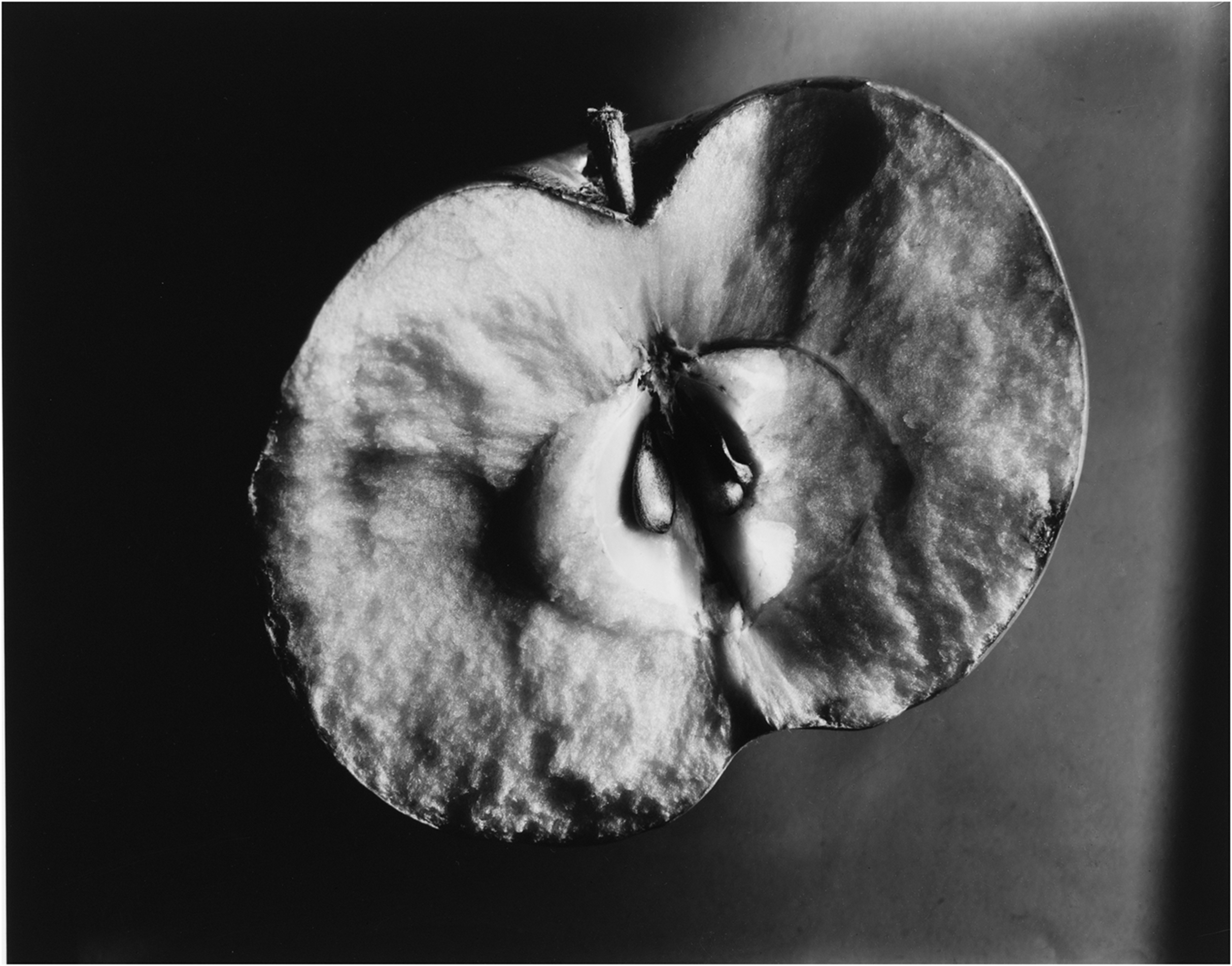
A kind of thinking and a kind of hope
Rukeyser and Abbott’s intent was to begin So Easy to See with a quotation from Francis Bacon’s Novum Organum (1620), in which he theorises the development of the scientific method and inductive reasoning (Abbott would use some of the same section in her reprint of A Guide to Better Photography). In the quotation Bacon writes of the inadequacy of the microscope, stating for if the invention could be extended to greater bodies, or the minute parts of greater bodies, so that a piece of cloth could appear like a net, and the latent minutiae and irregularities of germs, liquids, urine, blood, wounds and many other things could be rendered visible, the greatest advantage would, without doubt, be derived.
57
The ‘many things’ which, according to Bacon, knowledge still held in store are themselves mere instruments: the radio as a sublimated printing press, the dive bomber as a more effective form of artillery, remote control as a more reliable compass. What human beings seek to learn from nature is how to use it to dominate wholly both it and human beings. Nothing else counts. Ruthless toward itself, the Enlightenment has eradicated the last remnant of its own self-awareness. Only thought which does violence to itself is hard enough to shatter myths.
58
in work like these pictures, nature is used as a symbol of itself; but the realism goes farther than we have yet gone. And there is always the danger of the real, which assumes a mythological character, an aspect of menace in a society that hides and evades and hurries towards compromise, hurries toward self-censorship. The pictures offer another attitude toward reality and toward truth.
59
Is it possible for Abbott’s images to do this kind of political and philosophical labour alone, or do we need Rukeyser’s text to help us to get there? It is, I think, the job of the viewer/reader to make those leaps, to find the correspondences. Perhaps that is the particularly interesting aspect of this collaboration – it is at once doing a kind of mid-century theorising about the political role of art, while offering a particularly feminist intervention: it wants to democratise our sight, it wants to dissolve the gendered discourses of specialisation, it wants to reveal to us the systems of power and knowledge broadly, to make visible the bodies and desires that are so often apparitional. Rukeyser ends the outline of the project with this assertion: It will deal with the way science and art meet and might meet in our time. It will talk about the role of novelty in our life, and how—in art—its function is partly to give us the
Clearly, Rukeyser and Abbott’s interest in the ontology of things – their aura, essence and power – can be read in a matrix of modernist thought and art (Heidegger, Levinas, Benjamin, Pound, Williams, Woolf, etc.). But there is something uniquely forward-looking about their collaborative project. Think of how Bill Brown frames his seminal work on ‘Thing Theory’ in 2001: the real, of course, is no more phenomenal in physics than it is in psychoanalysis—or, as in psychoanalysis, it is phenomenal only in its effects. Somewhere beyond or beneath the phenomena we see and touch there lurks some other life and law of things, the swarm of electrons.
62
Rukeyser and Abbott’s lost collaboration, so connected to and expanding upon the theoretical, scientific and artistic modes of the twentieth century, was never realised because of their status as scientific amateurs, as women and lesbians, as philosophical, artistic and political others. They did recuperate each other, though: Rukeyser uses Abbott’s photograph of her eye for her book about the enlightenment explorer and astronomer Thomas Hariot; and Rukeyser writes the 1970 foreword to Abbott’s book. It is impossible not to see the loss of their work as a result of deeply ingrained sexism, of the failure to see women as inventors and discoverers, philosophers and geniuses, and it should provide another warning, among many, about how much is lost, is wasted, by our failure ‘to see things as they really are’. Rukeyser ends the 1970 Foreword to Abbott’s first collection on this note of loss: There are those who lived through the period when the pictures were made and never recognized … How is it possible that this book was not with us years ago? Is it that the time has finally come around to this artist, explorer, discoverer, and these forms pour through herself to us.
63
Peddler, drowned pier, birdcage——images caught in your lens forever, Berenice. You said, ‘I need a light great as the sun. No. Greater than the sun.’ You said, ‘I must invent: clothes, architecture. a camera that is a room, the child of camera obscura.’ I went journeying in Baptista della Porta. I went marketing on Sixth Avenue and so we found the fish-head, Berenice, you turned his teeth to icicles, and his great tongue—— I found the apple and the ear of corn. Twelve huge lights went off blazing at my left eye. Visionary lavender, flaming. Then lime-green burning. A vision of sight. Then blindness. Blindness. Black, returning me to sight.
64
Footnotes
Declaration of Conflicting Interests
The author(s) declared no potential conflicts of interest with respect to the research, authorship, and/or publication of this article.
Funding
The author(s) received no financial support for the research, authorship, and/or publication of this article.