



Abstract
Analysing Albert Smith’s and Charley Dickens’s 1858 and 1860 trips to the sites of the Second Anglo-Chinese War, the article suggests that the experience of war, especially of wars fought abroad, is characterised by affective unease and epistemological breakdowns. Smith and Dickens enact war tourism in Hong Kong, Canton and Shanghai as they perform incongruous and tone-deaf cross-cultural relations in a ‘theatre of war’. Similarly, contemporary novels reveal the complicated entanglements of the Sino-British (opium) relationship as writers try to make sense of a world in which cultural contact is fraught with violence and cognition is brought to its limits.
Keywords
The Arrow incident of October 1856 put China once more in the British news. 1 An initially trifling issue about the ship’s expired certificate of registration in Hong Kong, which led to the Chinese charge of piracy, caused failed negotiations between the British and the Chinese and, ultimately, hostilities as the British naval force attacked the Bogue forts close to Canton. The Chinese retaliated by torching the Canton warehouses of the foreign merchants and also massacring the passengers on the steamboat, the Thistle. The Second Opium War had begun. In its origin, it had nothing to do with opium, writes John Wong, although narcotics and big money were certainly the motivation behind the British actions that followed. 2 The Chinese government had declared the opium trade illegal, and the British needed to change this. Under the command of the Acting British Consul in Canton Harry Parkes, Hong Kong Governor Sir John Bowring and Admiral Michael Seymour, Canton was thus captured by Franco-British troops on 1 January 1858. The Treaty of Tientsin followed in June 1858, ending the first phase of this war. 3 While in fact not mentioning opium, the treaty made it abundantly clear to the Chinese, Martin Booth writes, that unless the opium trade ‘was legalised, relations between the countries would remain fragile’. 4 Relations did remain delicate, and it would only be after the Franco-British China campaign around Tientsin and Peking, the burning of the Summer Palaces, and the Convention of Peking of October 1860 that these demands would be ratified and the opium trade legalised by placing a tariff on the drug's importation.
This essay centres on two voyages in the midst of the Second Opium War. They were journeys into a war zone – just like W. H. Auden and Christopher Isherwood’s China trip in 1938 – but they were specifically not undertaken with a journalistic or documentary agenda but for rather different, and bewildering, reasons: namely entertainment, shopping, and work experience. In 1858, journalist, writer, and entertainer Albert Smith went to Hong Kong to collect material and curios for a new one-man show he was planning. His travelogue, To China and Back was printed to advertise his act, Mont Blanc to China, at the Egyptian Hall, which became a roaring success from December 1858. With Smith back from Hong Kong, Macau and Canton (which had only been taken by Franco-British troops a few months prior to Smith’s China sojourn, in January 1858) and full of information and stories, Dickens Sr. decided to send his eldest son Charley abroad to find his business calling. No doubt Smith’s adventures and anecdotes about Hong Kong’s entrepreneurial activities related to opium and other goods had inspired Dickens. Charley was to go to China to learn about and buy tea before starting his own business in London. He spent a week in Hong Kong in the first half of July 1860 and two months in Shanghai from 28 July until 21 September 1860, where he came close to the Chinese campaign under Sir James Hope Grant and James Bruce, Eighth Earl of Elgin. Grant and Bruce would order the burning of the Summer Palaces in October 1860, shortly after Charley left China.
As accounts of the two journeys – Smith’s travelogue and the tracing of Charley’s experience abroad through letters and shipping notes – will show, there is something oddly dissonant, incongruous, unfocused, and even tone-deaf about these trips and the motivations behind them. However, following Mary Favret’s (2010) argument in War at a Distance, the essay suggests that this lack of harmony is not something to be solved and resolved. Rather, it is exactly representative of the cognitive shortfall, the disorder and the ‘affective and epistemological unease’ that results from and accompanies the experience of war and, specifically, a war fought not on one’s own soil but elsewhere. 5 With this understanding, the proliferation of English literature in the years following the Second Opium War, which highlights mental lapses with regard to Sino–British relations and especially opium, is also explicable, as authors attempt to tie together the disconnected elements of a world in which cultural contact is fraught with violence, where cognition is brought to its limits, and where a writer can only try to make sense of it all.
Performance
‘Albert Smith starts for Hong Kong, viâ Marseilles, tomorrow night, a hot and a weary journey for a man of his figure’, wrote Charles Dickens on 7 July 1858 to Times journalist William Russell, who was in India to inquire into reports of the Indian rebellion. 6 Dickens’s humorous implication that his friend embarked on this journey simply to say afterwards that he had done it was not entirely correct, although it is indicative of the light-hearted way in which Smith undertook this journey into an unsafe region. On the surface, Smith’s was a business trip – although it, apparently, turned out to be enjoyable and informative too. Originally trained as a surgeon and apothecary, Smith had turned to writing from the 1840s: he became a contributor to Bentley’s Miscellany and Punch, the drama critic of the Illustrated London News, Dickens’s collaborator, and author of more than thirty novels, essay collections and plays. 7 However, Smith became best known for the comic lecture shows about his various voyages. 8 His The Overland Mail (1850) comprised stories and songs about his 1849 journeys to Constantinople and Egypt; Mr. Albert Smith’s Ascent of Mont Blanc (1852–56) was about his European tour to Chamonix and up the mountain. The latter, housed in the Egyptian Hall for two thousand performances, involved Alpine plants, examples of Swiss folk art, a huge diorama painting by William Beverley, a two-storied Swiss chalet, and St Bernard dogs roaming freely during the intermission. But after five years, Smith’s shows had become stale, and he was on the lookout for new material. In 1858, Edmund Yates suggested to his fellow Garrick Club member a journey to China. 9
Smith travelled over the summer in order to return with stories and souvenirs in time for the winter season. He left London on 6 July and arrived in Hong Kong on 21 August, leaving the colony again (after a trip to Canton) on 28 September 1858. In terms of the war, Hong Kong and Canton were relatively quiet: the second phase of the War would only recommence with battles up north from the summer of 1859. However, Smith found in Hong Kong a small expatriate colony separated by infighting. As G. B. Endecott writes, Governor Bowring’s sense of self-importance had not just let the Arrow incident escalate but had also allowed Hong Kong’s administration, in that waiting period, to degenerate into ‘[p]etty bickering, personal abuse, libel actions, lawsuits and official enquiries in which government officers were involved’. 10 In the late summer, the community was in an uproar because a government employee, Daniel Caldwell, whose role was to be ‘the Protector of the Chinese’ and represent their voice in colonial dealings had, apparently, become too friendly with the Chinese which displeased Thomas Anstey, the Attorney-General, who sensed corruption. 11 Smith called this affair one of those ‘storms in a teacup, about which [people back in Britain] never hear, or care’. 12 His words appear strangely aloof but they also paint an unsettling picture of the British not being in control.
In his diary, Smith expresses bewilderment with regard to the commercials’ and administrators’ ‘almost remarkable ignorance of every feature and phase of Chinese life […]. The Almighty Dollar, in its relation to tea, silk and opium, is the only study, or source of thought, with them’: ‘Many had lived years in China, but could tell me absolutely nothing about it.’ (p. 47 and p. 16) Apparently to remedy this and to collect authentic Chinese material, Smith mingles with the locals. His encounters, however, are curious: the most valued are a dinner party at a P&O comprador’s house where he performs, beyond linguistic barriers, ‘some few conjuring tricks, also the thimble-rig with three nutshells’ and a ventriloquist singing act (p. 31); and a visit to a local shop where he shows two apothecaries ‘how we put up powders in England’ (p. 34). The clichéd expression of ‘the theatre of war’ can be taken literally with regard to Smith’s experiences, as Hong Kong and later Canton become the actual stage for performances of East–West relations. Smith also roams in the notorious ‘low quarters’ in Hong Kong’s Tai Ping Shan district, where he sees, he writes, ‘a wonderful deal’ (p. 52). We may assume that he talks about brothels and opium dens, for he censors this part of the diary, ‘for private circulation [rather] than publicity’ (p. 52). 13 Certainly, he would later have entertained his male friends in London, including Dickens Sr., with his tales.
Perhaps not unsurprising then, given Smith’s shopping agenda, carefree attitude and flair for performance, references to opium and politics related to the war are subtle in Smith’s travelogue, which was meant as a piece of informative entertainment. Smith mentions opium in the ‘Preface’: ‘I hope some of my old friends at Hong Kong and Canton, who so puzzled themselves about “what I could possibly find interesting out there, as I did not care about trade,” will see that to a stranger there are yet a few points to interest, beyond opium, silk, tea, markets, exchange, and gunny-bags.’ (‘Preface’) He arrives on the Norna, an opium carrier owned by Dent and Company, on which the ‘smell of the opium cargo, which is very strong, makes [passengers] drowsy’ (p. 16). Similarly, the first two Hong Kong residents he meets are opium merchants, John Darby Gibb and Mr Maclean of Jardine Matheson, and he will meet other dealers later on, but Smith does not seem to make much of these connections while in Hong Kong: 14 Douglas Lapraik, George Lyall Jr., and William and John Dent of Dent and Co., Jardine-Matheson’s biggest rivals, are merely dinner companions for the tourist and performer Smith. William Dent is also a passenger on the Norna on Smith’s return trip to Marseilles (see p. 65).
Smith also visits the Calcutta. Commanded by Captain William Hall, she was the flagship of Admiral Seymour, and Smith meets both men on 29 August for yet another dinner on board. Seymour, Commander-in-Chief of the East Indies and China Station from 1856, conducted from the Calcutta the operations arising from the Arrow incident: he helped destroy the Chinese fleet in June 1857, took Canton in January 1858 and captured the forts on the Peiho (Hai River), which connects Tientsin with Peking, later that year, thus forcing the Chinese government to consent to the Treaty of Tientsin. One can only speculate whether or not Smith and Hall talked about the war, China and opium: Smith’s diary remains silent with regard to any conversations he may have had with military men he met, including Governor Bowring, Admiral Seymour, General von Straubenzee (commander of the Hong Kong garrison, involved in the attack on Canton), Major William Caine (Lieutenant-Governor), Dr William Bridges (Acting Colonial Secretary), Mr Ratherford Alcock (British Consul at Canton) and John Hume (Chief Justice).
Opium is also discussed in court cases. One case Smith hears at the Magistracy – again as a spectator in this ‘theatre of war’ – is ‘about selling a ball of opium’ (p. 24). Opium is traded at auction, and Smith sees one such in the company of Lapraik: ‘It was salvage opium – damaged by sea water. There were twenty balls, somewhat smaller than Dutch cheeses, in each box, and the first lots sold for two hundred and thirty-six dollars a box, which was accounted a good price.’ (p. 30) Opium is in private houses, like the comprador’s which has ‘[t]he couch for the opium smoking’ (p. 35), and in restaurants: ‘[the upper room] was very nicely fitted up, with panels carved au jour, and painted and gilded recesses, for private parties and opium smokers.’ (p. 28) And, finally, among the many curios Smith brings back to London are ‘pipes used for smoking opium’, which would later be on display outside the auditorium in the ante-rooms of the Egyptian Hall in ‘Albert Smith’s Chinese Museum’. 15 But in all these references, opium seems no more than a prop in this China-West performance.
The most prominent mention of opium, however, is in the episode related to Smith’s trip to Canton in September. The night after the Hongkongers hear a report ‘that the Chinese are shuffling about the treaty [of Tientsin]’ (p. 37), Smith leaves – again in a rather nonchalant manner – for Canton via Macao. 16 In Canton, Smith becomes excited as he approaches the original site of war. ‘I could not sleep for some time, from the mere actual excitement of feeling that I was at last inside Canton’ (p. 39), and for also having arrived in what he calls ‘the real China’ (p. 38). Barely nine months after the Franco-British troops took Canton, Smith stays in Head Quarters, visits temples and gardens and also the Execution Ground where the former Governor, Ye Mingchen, had put down thousands of Taiping rebels. 17 This is not war reportage, but rather war tourism. Smith encounters the enemy in the aftermath of war, in a cross-cultural pageant. There is bewildering evidence of an affective and cognitive breakdown as Smith tours a site that had only recently seen actual violence and bloodshed.
Smith also meets Harry Parkes, Yeh’s counterpart during the Arrow incident, who takes him on a visit to the new Governor of Canton, Pei-Kwei. While Parkes talks to Pei-Kwei, Smith is taken on a tour of the Governor’s house and gardens, which he finds in a deplorable, rotten state; an impression on which Smith elaborates in the article ‘Inside Canton’. ‘Nothing so dreary [as Canton] – not even Vauxhall on a wet Christmas Day – ever could be imagined. […] Combine all you can call to mind of dreary places […] – mix them together, and extract their essence, and you will not have the least idea of the general rot and ruin that is spreading, like an ulcer, throughout Canton.’ 18 Ideology certainly accounts for Smith’s comment here, but his flair for drama, entertainment and ‘show’ is never far away either. In his reminiscences of Canton, Smith says that it was here that he left behind his Arabian Nights and ‘our old’ fantasies of China. 19 He said that he understood better the value and varieties of opium, the communication problems and the political treatises between the British and the Chinese. But can we trust Smith that the country was different now from the exotic placeholder ‘China’ he used in Aladdin, the extravaganza he had written for the Lyceum in 1844? 20 The end of his journey and of his travelogue suggest otherwise: when Smith prepared to leave on 28 September the local Chinese, who had learned that the proceeds from a show Smith had put on for the expatriate community at the Hong Kong Club were to go to local charities, organised a spectacular procession to accompany him to the wharf: seated in a sedan chair, with flags ‘setting forth his virtues and talents’ and the sound of firecrackers warding off evil spirits, Smith’s fantastical Aladdin procession was now performed in real life. 21 Theatre indeed.
Barely two weeks before Smith left Hong Kong, Dickens Sr. penned a letter to him from Yorkshire, where his reading tour had taken him. In this letter, Dickens writes teasingly: Do you understand the following Chinese sentence yet? [joke Chinese characters follow] It is a poetical idea, I think, and very expressive of the general virtues of the Tea Plant. Is it really in the works of their great poet [more joke Chinese characters follow]. When this reaches you, you will be running home as hopefully and happily as possible. […] We will talk Chinese (I have a smattering of that tongue) always.
22
Diversion
Charley’s journey to a war starts with a domineering father and a peculiar gift. As she had financed his education at Eton, Dickens’s friend and collaborator, the wealthy philanthropist Angela Burdett Coutts also sponsored Charley’s China trip, as a present for his 23rd birthday in January 1860. 24 The idea was longer standing, however, as Charles Sr. had long hoped to move Charley out of a desk job at Baring’s Bank, and to get him ‘into one of the business opportunities out of London, no matter where’. 25 Charley had no desire of being a merchant; 26 nor any aptitude to be one, as events would show. However, being a ‘cheerful boy with good manners, [although] without ambition or drive’, he ‘allowed his life to be in large part guided by his father’s wishes’. 27 So he agreed to go to China – still a war zone – ‘to buy Tea on his own account, as a means of forming a connexion and seeing more of the practical part of a merchant’s calling, before starting in London for himself’, as his father wrote to an acquaintance. 28 Charley must have been excited and ‘full of hope and spirit’ at the prospect of a sabbatical in China: he was young after all. 29 He prepared for his trip while waiting for his replacement at Baring’s. His father describes him in April 1860 – in his typically humorous way which also catches Charley’s talent for amateur theatrics – as ‘lecturing on China, in the garden [of Gad’s Hill], to two of his younger brothers and a dog’. 30
Charley left England on 2 May 1860 on the P&O steamer Cadiz (which, like the Norna, was involved in the carrying of opium), and arrived, via Bombay, in Hong Kong on 6 July. 31 He stayed in Hong Kong for a week where he was probably looked after by some of his father’s more remote acquaintances, although we cannot know for sure. 32 It is baffling that there is so little information about what exactly Charley was doing in China; and equally striking are his and his father’s untroubled attitudes with regard to the war. Newspaper records tell us that Charley left Hong Kong again on 13 July, to continue on the Cadiz to Shanghai. 33 But was opium on Charley’s mind? Was tea, the alleged reason he had been sent to China? Was the war? Many newspaper articles of the time addressed and linked all three, like the China Mail of 13 July, which tells of limited opium sales and ‘light’ tea transactions due to ‘the near approach of the rebels to Shanghae and the unsettled state of the country generally’. 34 Preparations for war were certainly in the air. Three battles would eventually be fought around Tientsin between May and August 1860 under Admiral Sir James Hope as Anglo-French forces had sailed up north to accompany the newly appointed British and French diplomats to Peking. The Taku Forts would be taken in the last battle which was now better manned as the Indian Mutiny had finally been quelled and troops (under Sir Colin Campbell) were freed up to help in a third offensive in China. While Charley was in Shanghai, the troops moved from Tientsin into Peking for a final showdown. But how ‘close’ was the war to Charley, physically and mentally?
The Cadiz arrived in Shanghai on 15 July and left again on 18 July for a return trip to Nagasaki, with Charley on board. 35 Why did Charley not leave the ship in Shanghai, and why this unnecessary and, as it turned out to be, perilous, typhoon-ridden trip to Japan? 36 If Charley’s moves seem distracted, the letter he wrote to his father from Shanghai is even more incongruous: he told his father of his plan to visit his brother Walter in Calcutta on his return journey, but also that he had ‘an idea of beguiling the time between-whiles by asking to be taken as an amateur with the English Chinese forces.’ 37 Here is a young man on a speculative business trip during which he intends to have ‘a go’ at war, occupying the terrain as though it were some kind of game. As in Smith’s encounter with the Chinese war zone, the emotional and mental disjunctures we can observe during Charley’s trip are striking.
Charley stayed a few days in Nagasaki until the Cadiz turned back on 25 July, landing in Shanghai again on 28 July. This time, Charley stayed for two whole months, until 21 September, when he returned to Hong Kong, once more on the Cadiz. Again, we do not know how he spent his time: his brother Henry wrote in his Recollections that Charley had been ‘to China in a large mercantile house’. 38 Perhaps this is true. Charley’s comment to his father that he fancied joining the China campaign does not hold up: in August and September, the British forces were already 600 miles north of Shanghai. 39 Or did he sow the seeds of his later writing career, penning in Shanghai some of the many China articles that would appear in the 1860 numbers of All the Year Round? We know that the Dickens children wrote for the journal while the father was in charge, and we also know that Charley took a particular liking to writing China articles after he took over as editor of the ‘New Series’ of All the Year Round. 40
‘Chas. Dickens, jr.’ returned to Hong Kong on 25 September and, it seems, he did not leave for quite some time, although we have, once again, no record of any activities. 41 He also did not go back on a P&O steamer although his father and Ms Coutts would most certainly have purchased a round trip ticket for him. We next find Charley arriving in Madras on Jardine-Matheson’s opium-carrier Lancefield on 1 November 1860. 42 He then spent a fortnight with Walter in Calcutta, as we know from one of his father’s letters. 43
Charley personified indecisiveness, as his father knew well. As the son was returning to England, his father’s Great Expectations was being serialised in All the Year Round. Margaret Cardwell and Robert Douglas-Fairhurst have suggested that Herbert Pocket’s character was most certainly influenced by Charley. 44 In the manuscript version, Herbert is a merchant trading with China rather than the marine insurer of the printed text. 45 ‘There was something wonderfully hopeful about his general air, and something that at the same time whispered to me he would never be very successful or rich’, says Pip about his friend. 46 Herbert’s enthusiasm is infectious but even more commendable is his eventual modest success (and also Pip’s) as a partner in the merchandise and shipbroking house Clarriker and Company. Herbert, Pip and Clarriker end up ‘not in a grand way of business, but [they] had a good name, and worked for [their] profits, and did very well’. 47 This success is said to be due to Herbert’s cheerful industry and readiness. Pip’s final comment that earlier considerations of Herbert’s inaptitude might have resulted from his own rather than Herbert’s deficiencies may also have reflected Dickens Sr.’s deliberations in 1861 regarding his relationship with Charley: the Dickenses’ plans for Charley’s tea business never got off the ground. Charley was ‘spotted’ in Marseilles in late January 1861 and returned to England in early February. 48 Again, his family’s nonchalance regarding the boy’s return from the war is mind-boggling.
It is equally important that in Charley’s story, China and the war are, literally and metaphorically, out of the way sites and experiences that seem to contribute to Charley’s lack of focus. This is at least how Wilkie Collins – another friend of both Smith and Dickens – saw it in his novel No Name (1861).
49
He created a minor character – the heroine Magdalen Vinstone’s fiancé Francis (Frank) Clare – whose experience and character also echo Charley’s. While the main plot focuses on Magdalen’s directed efforts to overcome the stigma of illegitimacy and reclaim a social identity as well as an inheritance,
50
Frank is seen wandering aimlessly in the background. The ‘great Mercantile Firm in the City’ where Frank is sent to work,
51
realises quickly that the young man lacks substance and determination and that he shows ‘no industry, no ambition, no firmness of purpose’ (NN, p. 28). Hence they decide that he, should enter the house of their correspondents in China; that he should remain there, familiarizing himself thoroughly on the spot with the tea-trade and the silk-trade for five years; and that he should return, at the expiration of this period, to the central establishment in London. If he made a fair use of his opportunities in China, he would come back […] fit for a position of trust and emolument, and justified in looking forward, at no distant date, to a time when the House would assist him to start in business for himself. (NN, p. 63)
‘Solution’
The war elsewhere caused cognitive failure or mental lapse, manifesting itself in incongruous comments, untroubled yet troubling attitudes and discordant actions, as Favret has suggested: war-site tourism, running errands 6000 miles from home, uncertain business ventures, unsteadiness of purpose, playing war games and performing East–West relations in the ‘theatre of war’. While this cognitive shortfall is of course not exclusive to the Second Opium War, the concentration of images in English literature in and around the Second Opium War which focus on this cognitive breakdown evident in, and caused by, the Sino-British (opium) relationship is, indeed, distinctive.
Dickens Sr.’s early China and opium references are both fleeting and conventional. When shipwrecked, Walter Gay in Dombey and Son (1846–48) is rescued by a China-bound trader where he builds a career as a ‘supercargo’ which will, after his marriage to Florence, take him back ‘on a woyage to China’. 53 In Bleak House (1852–53) China is, with regard to Allan Woodcourt’s fated journey, a similarly off-hand reference to a faraway location – and Nemo/Captain Hawdon’s accidental opium overdose is a convenient, unoriginal plot device. 54 Comments about the inscrutability of Chinese writing or the prettiness of the Chinese pagoda in which Dora Spenlow’s dog lives in David Copperfield (1849–50) are similarly standard as are, in Little Dorrit (1855–57), Flora Finching’s clichés about Chinese men and women, lanterns, umbrellas and tea chests. 55 China exists but is faraway and best left alone and behind, which also explains Arthur Clennam’s silence about his two-decade long business dealings in China although we may conjecture that his melancholy and guilt are the result of his own – possibly cotton – business failure as the opium trade took over.
But around and after the Second Opium War, representations change and there is a new emphasis on the entanglements of China, Britain and especially opium, and a new focus on images of mental breakdown. In Silas Marner (1861), George Eliot portrays in Molly Farren a character whose opium addiction has made her morally unfit to be a mother: while keeping her daughter fed and alive, the ‘demon Opium to whom [Molly] was enslaved, body and soul’ prevents her from creating the instinctive bond between a mother and her child through ‘tender touch or sound’. 56 Nature has been disturbed so, clearly, Eppie is better off with Silas and away from the opium addict whose vindictiveness and animosity towards her husband Godfrey Cass are probably also fed by the drug. Lydia Gwilt’s laudanum addiction in Collins’s Armadale (1864–66) – ‘Who was the man who invented laudanum? I thank him from the bottom of my heart whoever he was. […] “Drops,” you are a darling! If I love nothing else, I love you.’ – also leads to her moral decline, her deviousness and murderous intentions. 57 And Charles Reade, too, sees opium in Hard Cash (1863) as a ‘tremendous brain-stealer’. 58 In Dickens’s Our Mutual Friend (1864–5), John Rokesmith’s dealings in ‘China House’ in the City – with ‘tea, rice, odd-smelling silks, [and] carved boxes’ that is, implicitly, also opium – take him and the reader back to the beginning of the story where he, John Harmon, was drugged, possibly with opium, robbed and thrown into the Thames, causing the disguise and identity crisis that is at the heart of Dickens’s final finished novel. 59 As Rokesmith/Harmon retraces the steps of his arrival in England and his attempted murder, his soliloquy turns to ‘sick and deranged impressions’ of himself and an impossibility to assert his own identity: ‘I could not have said that my name was John Harmon – I could not have thought it – I didn’t know it’. 60 Here is a British identity lost through an involuntary opium stupor, along with Rokesmith’s attempt to master his own impotence.
Dickens’s final novel, The Mystery of Edwin Drood (1870), is about the conscious corruption of a respectable Englishman through opium, and his failure to achieve a happy ending, like Rokesmith’s, as opium leads him to murder his own nephew. 61 The novel opens with Jasper in a London opium den, which is run by an Englishwoman called the Princess Puffer. Luke Fildes’s illustration, ‘In the Court’ (Illustration 1), which accompanies the first chapter, picks up on the aggressive power of opium described in the text, as it shows a respectably dressed but dishevelled Jasper, who has smoked six opium pipes since midnight, holding on to a bed frame and looking down on the bed on which a Chinaman, a Lascar and the hostess of this ‘meanest and closest’ of all opium dens have all collapsed. 62 The Chinaman fights a battle of his own, as he ‘convulsively wrestles with one of his many Gods, or Devils, perhaps, and snarls horribly’ (ED, p. 2). But he also literally fights Jasper who – wanting to hear whether the Chinaman’s mutterings are comprehensible or not, as he already fears he might have betrayed his murderous intentions to the Princess Puffer – ‘pounces on the Chinaman, and seizing him with both hands by the throat, turns him violently on the bed. The Chinaman clutches the aggressive hands, resists, gasps, and protests’ (ED, p. 2). As if this was not enough evidence of a violent cross-cultural contact with opium and those representing and using it, Jasper now also grabs the Lascar and drags him on the floor, which prompts the latter to ‘las[h] about him fiercely with his arms, and dra[w] a phantom knife’ (ED, p. 3).
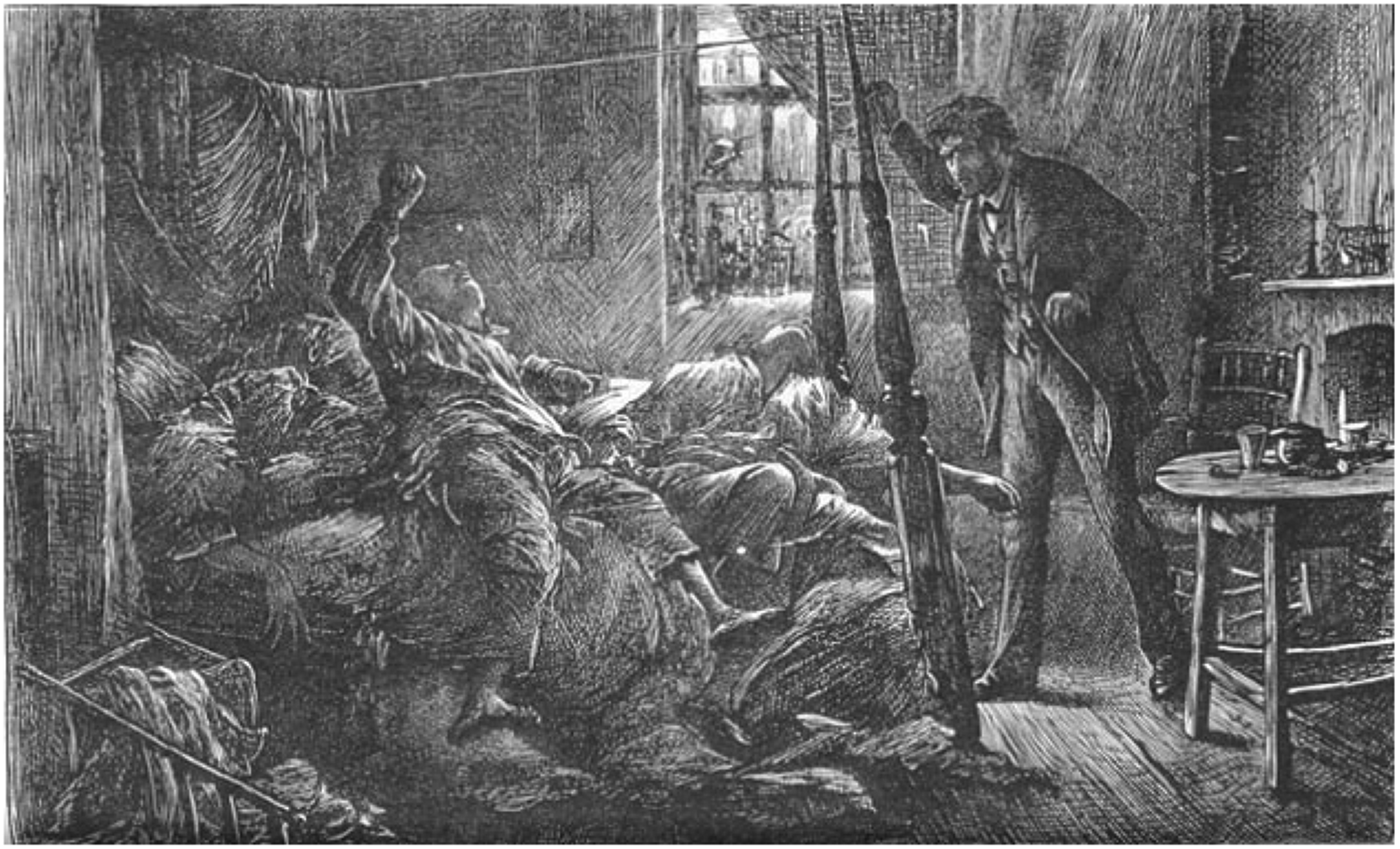
‘In the Court’. By Luke Fildes. 15.9 cm wide by 9.9 cm high. Image courtesy of Victorian Web.
Fildes’s second representation of the East End opium den, ‘Sleeping it Off’ (Illustration 2), illustrates a moment half a year later in the story, after Jasper has revealed to the Princess Puffer Drood’s murder, which he had visualised and planned over and over again during his opium reveries: ‘[W]hen it comes to be real at last, it is so short that it seems unreal for the first time. […] The journey’s made. It’s over.’ (ED, p. 209) Fildes now shows Jasper collapsed on the dirty bed, after his disturbed mind and diseased morality have led him to the horrifying act of killing his own nephew and speaking of it now, when once more under the influence of the drug. 63

‘Sleeping it Off’. By Luke Fildes. 16.4 cm wide by 10 cm high. Image courtesy of Victorian Web.
This is Dickens’s attempt to tie together the dissociated elements of a world in which cultural contact is fraught with violence, produces cognitive failures and leads to incongruous acts. The original illustrator employed for Edwin Drood, Pre-Raphaelite painter and illustrator Charles Collins, sketched out a cover before he was forced to withdraw from the project due to ill health, which shows the various entanglements between China and Britain through opium (Illustration 3). 64 The wrapper portrays, in the bottom right vignette, an opium-smoking Chinaman, endowed with the stereotypical queue and pyjama-style outfit, and reclining in a chair: the smoke from his pipe blends with the thorny, leafless and flowerless rose branches of the right-hand side of the image. This may be Princess Puffer’s rival from the novel, whom she calls Jack Chinaman, and who runs the opium den on the other side of the court. The vignette in the bottom left corner shows Princess Puffer, John Jasper’s London supplier, also smoking. The smoke from her pipe mixes with the healthy rose branches on the left side of the cover as it meets rose buds and leaves. Death and life, tragedy and romance, hate and love are juxtaposed on the two sides of this cover, but also interconnected and interwoven through the rose branches in the overall cycle of existence: Edwin Drood and Rosa Bud’s romance and betrothal are, after all, the cause of John Jasper’s jealousy and murder of his nephew. Opium exists on both sides and ‘underlies the whole history of the “Mystery of Edwin Drood”’, as early critic J. Cuming Walters noticed: 65 the English opium smoker sits underneath the allegorical female figure representing Love and Beauty; the Chinese opium smoker underneath the allegorical female figure signifying Revenge, Hate and Murder. Opium supply and addiction unite bliss and sorrow, just as they entangled lives in Britain and China. Dickens’s final novel, written after the Second Opium War, reflects on the mental breakdown caused by violence, war and cross-cultural contact. It seems inevitable, therefore, that his attempt to pull the novel into a whole would be defeated in what remains an unfinished work.
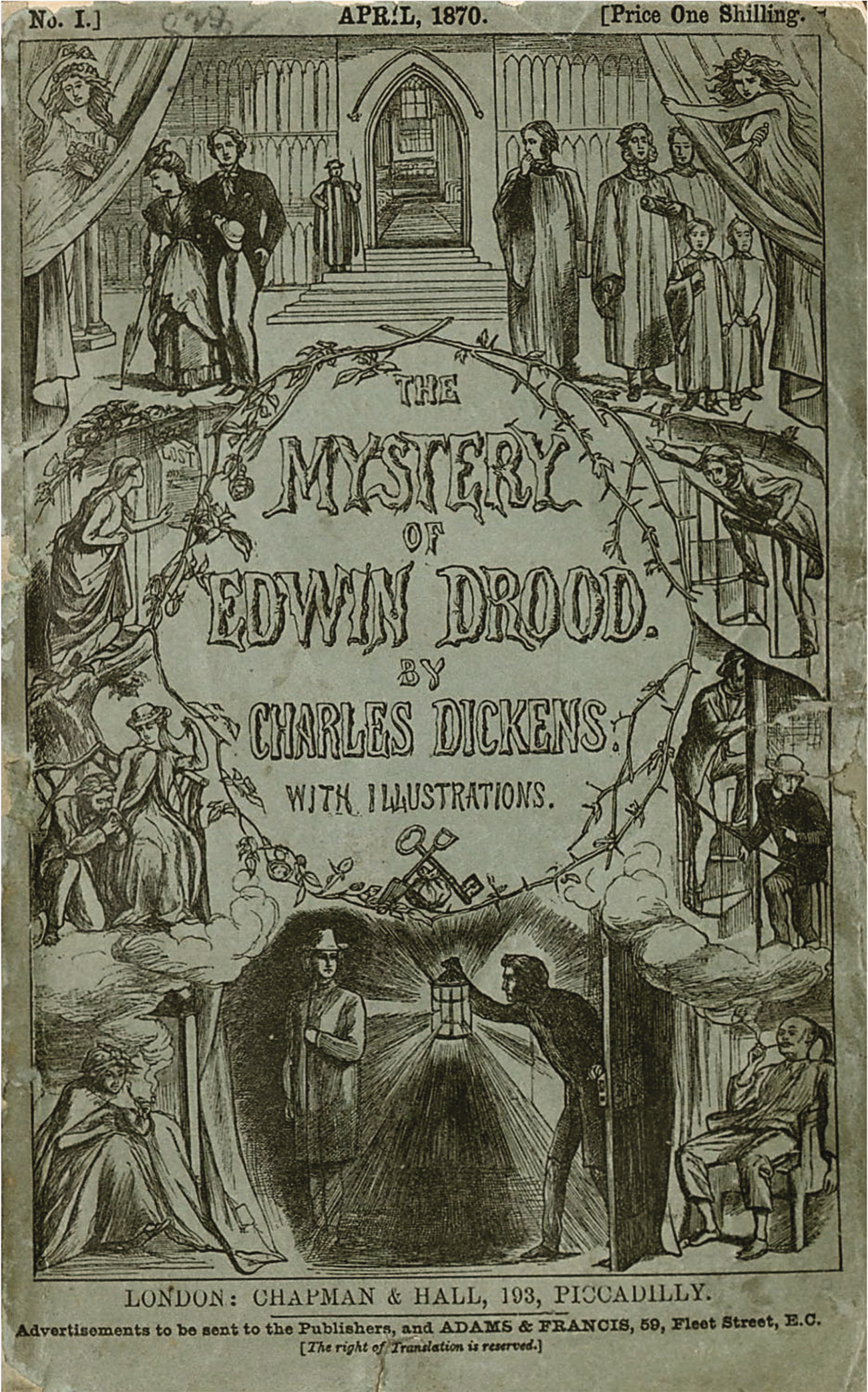
Cover Illustration (for the entire series) of The Mystery of Edwin Drood. By Charles Allston Collins, with modifications by Luke Fildes.
Footnotes
Declaration of Conflicting Interests
The author(s) declared no potential conflicts of interest with respect to the research, authorship, and/or publication of this article.
Funding
The author(s) received no financial support for the research, authorship, and/or publication of this article.