



Abstract
This article aims to examine the evolution of the business accelerators and their impact in New Zealand over the course of last decade to develop a better understanding of the role accelerators have played within the New Zealand innovation ecosystem, their influence on the innovation community and how accelerators measure their success. An exploratory qualitative study was undertaken which mainly draws from semi-structured interviews with mentors, participants and senior executives of accelerator programs. Secondary data were collected from presentations on YouTube, consultancy reports and internal reporting to provide context for the interviewee’s perspective. New Zealand with its remote geographical location, distinct company environment and its uniqueness within the wider business environment and institutional configuration provides a novel context to this study. The findings indicate that after more than a decade of operations, long-term outcome and benefits of accelerators to New Zealand innovation ecosystem are still unclear.
Keywords
Introduction
Sir Paul Callaghan, a renowned New Zealand physicist, mentioned in his book Get off the Grass that New Zealand needs to move towards a knowledge-based economy. This knowledge-based economy requires an innovation ecosystem built around a New Zealand-centric view. Over the last 20 years, increasing importance has been attached to incubators as mechanisms for enhancing the economic and technological development of countries by promoting the rise of promising ideas and encouraging the growth of newly established ventures. The start-up process and early growth of new ventures have been the focus of considerable economic development efforts in recent times. The incubation concept seeks to be an effective means to foster this success by linking technology, capital and know-how to leverage entrepreneurial talent, accelerate the development of new companies and speed-up the exploitation of new ventures (Grimaldi and Grandi, 2005). There is a general agreement on the contribution of incubation models to the nurturing of new ventures among researchers and mainly research in this domain has been focused on the identification of the factors, characteristics and conditions which foster entrepreneurial success (MacMillan et al., 1987; Roberts, 1991; Roure and Keeley, 1990; Smilor, 1987; Stuart and Abetti, 1987). Incubation models have evolved and continue to evolve into new generation incubation models. It is therefore important to gain insights into the specific features of evolving incubation models to assess their working, performance and their impact on incubated ventures and knowledge-based economy (Barbero et al., 2012; Mian, 1997).
During the last three decades, two main incubating models have been the locus of creating an innovation environment. These models are separated at a high level of model 1 (business incubators) and model 2 (accelerators) (Grimaldi and Grandi, 2005). Accelerators emerged mid-2000 as a response to the shortcomings of previous generations of incubation models, which are primarily focused on providing office space and in-house business support services (Bruneel et al., 2012) to technology start-ups, but the concept is also applicable to other products or services. Despite the rapid rise of accelerators across different regions, empirical and theoretical knowledge about the historical development, distinct characteristics and drivers of this new generation incubation model is scarce (Wise and Valliere, 2014). This work attempts to gain insights after more than a decade of operations from the accelerators in New Zealand.
The aim of this study is to get a better understanding of the role played by accelerators within the New Zealand innovation ecosystem, their influence on the innovation community, how accelerators measure their success and whether New Zealand is seeing any benefits from the accelerator model. Is the accelerator model working and is New Zealand seeing any benefit or move towards the knowledge-based economy envisioned by Sir Paul Callaghan? This article is guided by three research questions that address the development of accelerators within the context of a geographically remote country like New Zealand. Firstly, how do accelerators fit within a potential New Zealand knowledge-based economy and do accelerators influence change? Secondly, we aim to understand what sets the accelerators apart from traditional incubators, which lead us to the next research question of ‘Why are accelerators preferred over traditional business incubators in New Zealand?’ Thirdly, for any endeavour to be considered a success or a failure, it is of utmost importance to develop appropriate success measurement criteria. We uncover these success measurement criteria employed by accelerators in New Zealand with the last research question, ‘What is the approach adopted by accelerators in measuring their success?’
The main contribution of the article is the identification of the role that accelerators fulfil from a New Zealand perspective, how these accelerators measure their own success and what influence have New Zealand accelerators had on the move towards a knowledge-based economy through innovation. Previous research on accelerators has been mainly conducted from a perspective of what accelerators do and what services these accelerators offer to the participants. This research also compares accelerators to traditional business incubators and shows how an evolution of innovation incubators has emerged. It helps in discovering a rich and untapped resource of New Zealand creativity and innovation, which can provide a depth of research and application for many years into the future. The opportunities for the New Zealand innovation community and those within the business and academic communities have huge unfulfilled potential.
The rest of the article is structured as follows. First, the authors provide an outline of the origins of accelerators followed by the study context, highlighting the innovation ecosystem in New Zealand. The next section provides details of the research methodology used in conducting this research, which is followed by findings. In findings, the purpose of accelerators, success measurement and impact are uncovered. The article ends with the conclusion after discussion and implications of accelerators to New Zealand innovation ecosystem.
Research background
Innovation ecosystem
The extant literature points out that innovation takes place in complex systems (e.g. Dolphin and Nash, 2012; Garnsey and McGlade, 2006; Isenberg, 2010). ‘Innovation ecosystem’ is a metaphor used to rationalize the knowledge commercialization process but is held out to be a rigorous and complex construct in which innovation thrives (Hannan and Freeman, 1989; Moore, 1993; Oh et al., 2016; Schot, 1998). Jackson (2011) defines an ‘innovation ecosystem’ as the complex relationships formed between actors or entities with the objective to enable technology development and innovation. Papaioannou et al. (2009) note that innovation ecosystems differ from natural ecosystems in two ways: firstly, the presence of intention and technology and secondly, the acknowledged importance of governance for innovation to survive and succeed. The investment in innovation is not only affected by simple commercial considerations, but it is also influenced by institutions (the nature of the education system or technological standards), culture (long-term investment decisions inclination, tolerance of business failure ethos) and social ties (Dolphin and Nash, 2012; Lundvall, 2002). Jackson (2011) argues that to foster the serendipitous investigations that are essential to innovative discovery, it is important that the incentives driving the research economy to be decoupled from the financial incentives driving the commercial economy.
‘Innovation ecosystems’ differ from earlier concepts of science and technology parks, regional innovation systems, science cities or innovation clusters on a number of factors (Oh et al., 2016). It places greater emphasis on the diversity of supporting organizations, their interconnections and the paths adopted by entrepreneurs to navigate through these entities. Rogers (2010) emphasizes that innovation diffuses through a social system. The interactions among the ecosystem’s component organizations bring attention to the rich substance and diversity of actors that can, in theory, give rise to emergent behaviour (Fetters et al., 2010).
Another factor which differentiates innovation ecosystems from earlier concepts is open innovation. It facilitates licensing, open sourcing and crowd sourcing that allow ideas from diverse sources to be combined into new products and services (Oh et al., 2016). Innovation ecosystem view also places greater emphasis on differentiated roles or ‘niches’ occupied by organizations (Raven, 2005). These niches can correspond to links in industry value chains. This emphasis contrasts with the more amorphous ‘It takes a village to raise an entrepreneur’ and ‘Everybody in the community pulls together’ approaches taken by past Technopolis initiatives (Frenkel and Maital, 2014; Oh et al., 2016). This is where a better understanding of the innovation ecosystem in New Zealand can help create the environment to better commercialize knowledge. Understanding the way New Zealand incubates and supports new ventures can provide the next step towards exploiting the knowledge-based New Zealand economy.
Origins of incubators and accelerators
An incubation model is broadly defined as the way in which an incubation entity provides support to new ventures to improve the probability of survival and accelerate their development (Pauwels et al., 2016). The primary focus of incubation is on overcoming the new venture’s liability of newness, which in turn improves its survival rate (Dettwiler et al., 2006). The first generation of incubation models, introduced in the early 90s, primarily focused on providing physical and financial resource support, for example, office space and small financial injections to early-stage high potential ventures (Phan et al., 2005). Throughout the 90s, new incubation models emerged, which gradually moved away from a mere focus on offering basic office space and financial support, towards a broad range of more intangible high value added services (Pauwels et al., 2016). This second generation of incubation models included, amongst other things, services such as aid in evaluating different market opportunities, access to knowledge-intensive services, product development support, access to knowledge, expertise and networks of entrepreneurs and provision of entrepreneurial finance (Clarysse and Bruneel, 2007; Soetanto and Jack, 2013).
At first, the objective of incubators was to provide logistical services, so as to reduce the start-up costs for new ventures and to provide local visibility for emerging businesses. The focus of more recent private incubation experience, such as accelerators, seems to be on shortening clients’ time-to-market, providing more specialized services and bringing start-ups, technological and commercial big players into a common network. They also seem to monitor their participants more carefully, providing day-to-day operational support and access to advanced sources of technical and management expertise (Grimaldi and Grandi, 2005). More recently, a further shift hints at a new generation of incubation models, which focuses on knowledge-intensive business services, moving away almost entirely from the primary services for which the incubation models were founded. Two main incubating models can be identified and are the focus of creating an innovation environment. These models are separated at a high level of model 1 (business incubators) and model 2 (accelerators) (Grimaldi and Grandi, 2005). Over the last 20 years, increasing importance has been attached to incubators as mechanisms for enhancing the economic and technological development of countries by promoting the rise of promising ideas and encouraging the growth of newly established ventures (Grimaldi and Grandi, 2005). Despite the differences and overlaps between incubation models, an incubation model’s main components include at least four of the five following services recognized by Carayannis and Von Zedtwitz (2005).
Access to physical resources: Incubators provide office space, furniture, a computer network, security and other amenities required by entrepreneurs in terms of real estate and physical infrastructure.
Office support services: Incubators also arrange basic office support, for example, reception services, mail handling, fax and copying services and computer network support.
Access to capital: Incubators offer access to venture capital – usually a combination of private funds and outside capital invested by different entities such as business angels, venture capitalists or local institutions and companies.
Process support: Incubators guide entrepreneurs through the necessary steps a newly founded company must take and provide support to entrepreneurs so they overcome lack of organizational, management and legal skills. Incubators also help entrepreneurs in developing leadership and management skills.
Networking services: Good incubators are able to identify and leverage key individuals for the success of their start-ups. Entrepreneurs usually do not have the network that an incubator has taken years to create.
The drivers of the incubator industry have been led by incubators’ attempts to satisfy the emerging requirements of new ventures, most of which have been brought in by the Internet revolution. It is reasonable to assume that in the attempt to satisfy the new expectations of companies, a new breed of incubators has emerged and has started providing new services, adding value to their participants, while paying less attention or disregarding old services (Grimaldi and Grandi, 2005). This shift of attention and the increasing focus on more intangible and high-value services (access to advanced competencies, learning experiences, knowledge, networking and synergies) has governed the emergence of a new incubating model. The attention of more recent incubators, particularly private ones, is focused on the provision of direct access to capital and of more intangible and high-value services (Grimaldi and Grandi, 2005). The first accelerator, YCombinator, was established in 2005 in Cambridge, Massachusetts, and it has been a source of inspiration for many accelerators to follow. In 2009, the Difference Engine kick-started the European accelerator sector, and in 2013, Seed-DB, a platform which analyses accelerators and their companies, reported over 213 accelerators worldwide. Despite the rapid rise of accelerators across different regions, empirical and theoretical knowledge about the distinct characteristics and drivers of this new generation incubation model is scarce (Birdsall et al., 2013).
Differentiation between incubators and accelerators
It is widely understood that incubation models in general nurture new ventures. However, it is vital to consider the implications associated in relation to differences in various incubation models (Barbero et al., 2014). Incubation models have evolved (Bruneel et al., 2012) and continue to evolve into new generation incubation models (Bøllingtoft, 2012). Accelerators are a relatively new type of organization, which aim to accelerate new venture creation by providing education and mentoring to cohorts of ventures during a limited time (Cohen and Hochberg, 2014). Although the accelerator model includes many services offered by traditional incubators such as funding, mentoring and networking, it has a number of other specific features that sets it apart from traditional incubation models (Ganamotse et al., 2017; Isabelle, 2013).
Several studies (e.g. Bliemel et al., 2019; Ganamotse et al., 2017; Huijgevoort, 2012; Malek et al., 2014; Pauwels et al., 2016) have highlighted the main features of accelerators. Malek et al. (2014) present five aspects, which differentiate accelerators from traditional incubators. (i) Competitive entry, (ii) greater number of start-ups, (iii) equity-based funding, (iv) rapid and intense program compared to incubators and (v) networking between start-ups. Pauwels et al. (2016) discuss mainly similar characteristics except for competitive entry, although using different terms. They also add that accelerators offer more intensive monitoring (Christiansen, 2009) and are less focused on venture capitalists as the next step of finance. They are more closely connected to business angels1 and small-scale individual investors (Pauwels et al., 2016). One of the reasons for this difference could be that their focus is on early-stage technology start-ups for which the costs of experimentation have dropped significantly in the last decade rather than capital-intensive start-ups, such as technology-oriented spin-offs from universities.
Huijgevoort (2012) provide key elements of accelerators, which include the above-mentioned elements. The article also adds that accelerators are fixed term, finish with a demo day and start-ups consist of small teams. Ganamotse et al. (2017) also mention cohort-based entry, demo day and accelerators fixed term as differentiating features, although mentioning that some accelerators provide continued networking support beyond the programme as well. Bliemel et al. (2019) differentiate accelerators based on seed funding, cohorts, co-location, structured programme and mentoring as features of accelerators but emphasize on cohorts as the lynchpin which differentiates accelerators from traditional incubators. In summary, accelerators play an important role in stimulating innovation through a programme designed to take a cohort of participants and their ideas through an intensive programme to create, build and commercialize an investable product to grow and operate in the real world. If those ideas are not viable, participants will find out early, take their learnings and apply them to a new venture. Characteristics agreed upon by multiple researchers are succinctly summarized in Table 1.
Distinct features of accelerators.

Context of New Zealand in the study
New Zealand has been often described as ‘the last bus-stop on the planet’ (Kirk and Bibby, 2001). It is a remote and small country. However, New Zealand has many natural advantages, including a moderate climate, a magnificent landscape and cultural diversity (Kirk and Bibby, 2001). Huge distance to most major consumer markets is one of the main barriers to an expansion of New Zealand’s export base. For most of the 20th century and early 21st century, New Zealand relied on exports of commodities which were based around agricultural and farm products (Conway, 2016). Until the late 1960s, New Zealand could well have been described as ‘Britain’s farm in the South Pacific’ (Kirk and Bibby, 2001). This commodity-based economy has provided a first-world lifestyle, but the situation has been eroding rapidly.
In the so-called ‘old’ economy, competitive advantage depended on natural resources and economies of scale. Location was a significant factor and being away from markets added real costs. In the ‘new’ economy focused on knowledge-based industries, a different kind of competition has emerged (Papaioannou et al., 2009). To develop a knowledge-led economy effectively, New Zealand needs to systematically integrate national effort that links universities, research and development institutions, industry and government with a common purpose (Kirk and Bibby, 2001). New Zealand recent governments mostly had a very ‘hands-off’ approach to industry stimulation (Conway, 2016). This ideology based on the notion that ‘market forces’ will find solutions to New Zealand’s economic problems failed to spur growth. New Zealand’s living standard which was rated 21st in the Organisation for Economic Co-operation and Development in 1984 (when the ‘reforms’ started) dropped to 25th in 1998 (Kirk and Bibby, 2001).
New Zealand’s method for incentivizing innovation is partly done through a vast majority of grants and involves small companies using consultants to undertake an introductory ‘assessment’ of firms (Clark, 2010). The challenge New Zealand faces is to reconfigure this successful scheme to be even more effective (Kirk and Bibby, 2001). Kirk and Bibby (2001) identified that the use of venture capital distinguishes different stages in the development of companies. These are generally divided into the concept, seed, development and expansion phases. In contrast, many other countries provide widespread packages to assist in new business developments.
Many companies require assistance with their business plans, systems and marketing before they can start growing (Kirk and Bibby, 2001). There is plenty of enthusiasm for innovation, and there is no shortage of entrepreneurs prepared to take risks. However, there is a shortage of practical help to improve business systems and a dearth of qualified people with both business experience and technology understanding in an environment in which even the smallest company has to focus on exports. Kirk and Bibby (2001) believe most small to medium-sized enterprises (SMEs) in New Zealand start by matching an opportunity with a product or service, which is often based on the owner’s competency. SMEs tend to operate businesses based on relationships since the business owner generally knows the customer. Businesses are mostly small, undercapitalized, not ready for the next development and often struggling for working capital. Most SMEs planning is survival-oriented rather than being growth-oriented.
New Zealand innovation ecosystem and key actors
Different support organization plays a vital role in the innovation ecosystem (Bliemel et al., 2018). Organizations in the ecosystem covered in this section include government and associated agencies, accelerators, key start-ups, venture capitalist and angel organizations. The current wave of innovation in New Zealand has its roots in the knowledge wave conference held in 2001(Allen, 2019). Knowledge and Innovation Framework (GIF) and the New Zealand Venture Investment Fund (NZVIF) were put in place after this conference in 2002. Around the same time, New Zealand Trade and Enterprise (NZTE) was established with a mandate to develop and implement trade, industry and regional development policies, in partnership with businesses (Statistics New Zealand and Ministry of Business, 2015). Callaghan Innovation was then established in 2013 to partner with businesses to help them become more innovative and to enhance the operation of New Zealand’s innovation ecosystem (Statistics New Zealand and Ministry of Business, 2015). This coincided with the formation of New Zealand digital technology development fund in 2014 to further boost innovation.
Since its inception, NZTE has supported many New Zealand firms to gain a foothold in international markets. Callaghan Innovation similarly partners with businesses at all stages to support development and uptake of new products, services and processes ( Callaghan Innovation, 2020). The introduction of NZVIF and tech incubators has enhanced the prospects of new and emerging businesses by addressing a hole in the capital market that was inhibiting growth in many of the innovative industries. Independent research institutions such as the Malaghan Institute of Medical Research, the Cawthron Institute and Gillies McIndoe Research Institute work with start-up companies, attracting domestic and international private investment (Allen, 2019). Venture funds and angel organizations are other key players in the ecosystem (Bliemel et al., 2018). In recent years, there is around NZ$295 million of venture funds and around NZ$50 million of angel investment activity a year (NZVIF, 2020). Under NZVIF umbrella, there are 11 venture capital funds and 18 seed investment partners operating.
Across New Zealand, there are more than 12 accelerators, with some accelerators offering their services in multiple locations or for multiple corporate partners. The New Zealand company environment is dominated by SMEs – defined by the Ministry of Business, Innovation and Employment in New Zealand as companies with a turnover of less than NZ$50 million and fewer than 50 employees. There are over 100,000 New Zealand companies in this category but many of these are sole traders, retailers and service providers (Conway, 2016). Xero is one of the most successful start-ups in New Zealand with its current market capitalization over NZ$7.5 billion (Xero Market Cap | XROLF, 2020).
Significance of innovation incubation in New Zealand
There are enough SMEs in New Zealand with the potential to focus on high growth, new exports and wealth creation to enhance New Zealand’s overall economic performance significantly (Clark, 2010). New Zealand has a strong knowledge base (Codd, 2005). However, in this knowledge base, entities are still mainly disconnected from wealth-creating enterprises (Conway, 2016). There is a real urgency to transform New Zealand’s export profile from its current pastoral base and over-reliance on commodity products (Kirk and Bibby, 2001). This is where a better understanding of the innovation ecosystem in New Zealand can help create the environment to better commercialize knowledge. Understanding the way New Zealand incubates and support new ventures can provide the next step towards exploiting the knowledge-based New Zealand economy (Conway, 2016). Both business incubators and accelerators fulfil roles with the innovation community with a preference towards the accelerator model as the next generation of innovation incubation.
Methodology
Research design
Qualitative research was used to gain an understanding of the complex and idiosyncratic nature of the phenomena of accelerators (Cavana et al., 2001). New Zealand with its remote geographical location, distinct company environment and its uniqueness within the wider business environment and institutional configuration provides a novel context to use an exploratory qualitative study to examine the role of accelerators in the New Zealand innovation ecosystem. The approach used to examine was of the interpretivist paradigm (Leitch et al., 2010). As with an exploratory study, when little is known about a subject, interpretivism is a good approach to use to uncover salient critical factors and relationships. The interpretivist paradigm also aligns with the qualitative research approach and the proposition to use semi-structured interviews to collect data (Cavana et al., 2001). Table 2 summarizes the process followed to ensure reliability and generalizability of the research in this study based on Yin’s (2017) criteria.
Measures for reliability and generalizability of the research.

Participant selection
We adopted a purposive sampling strategy for the selection of interviewees following Goswami et al. (2018). Interviewees were identified in a variety of ways (Ayentimi et al., 2018). They were contacted directly through their accelerator organizations or venture websites. Interviewees were also contacted via a network of contacts obtained by the researcher. Additionally, future interviewees were identified through research online and contacted via email or LinkedIn.
The target group for interviewees was senior leaders and influencers of accelerators, mentors and participant ventures of accelerator programmes. Information regarding interviewees is shown in Table 3. There are several reasons for choosing this target group, which were focused on wanting to understand the role and impact of accelerators in the New Zealand innovation ecosystem. The senior leaders had roles related to the creation of an innovation environment that sets up new ventures for success. Mentors and participants were targeted to get a better understanding of the history of accelerators in New Zealand, how accelerators approached innovation and to get the necessary context to answer the research questions.
Characteristics of interview participant.
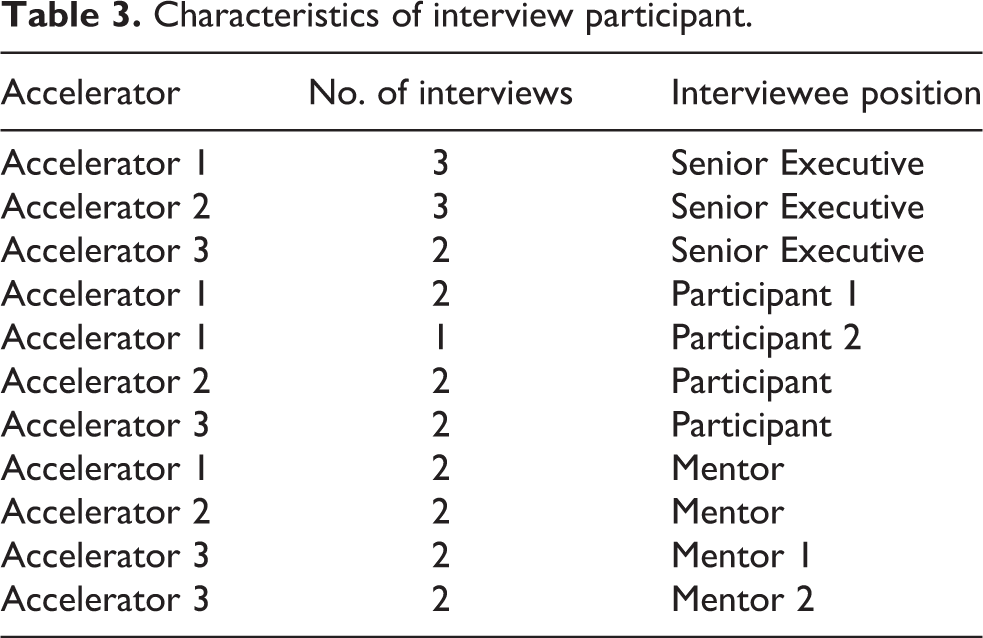
Accelerators which were part of our study were all based in New Zealand. They have been operating on average for 3–4 years with the longest operating accelerator in our study now active for more than 7 years. These accelerators are working with start-ups and scale-ups encompassing varied contexts (e.g. digital technology, fintech and tourism). The cohort of the accelerator programmes varied from 4 teams to 20 teams working for 3–4 months. All accelerator programs culminated with Demo Day investment events and received support from expert mentors, previous accelerator participants, external companies and potential partners.
Data collection and analysis
The main source of data collection was semi-structured interviews following similar exploratory research (e.g. Belkhodja et al., 2012; Francis-Smythe et al., 2013; Goswami et al., 2018). The interviews were conducted by the first author, and the interviewer had a set of pre-prepared questions and used these as a conversation starter to extract information with the flexibility to change the sequence if required to ask further questions in response to any significant replies (Bell et al., 2018). This research received the Human Ethics Committee approval from the first author’s university, and interviewees were contacted with the information sheet and consent. Interviews were conducted in person, and interviewing where the participant is visible to the researcher was preferred as the context was gained from seeing the participant’s body language and gestures. Interviews were recorded with permission for analysis. In all, 23 face-to-face interviews were conducted and the interviews lasted around 40 min each. Interviewees were asked open-ended questions about their backgrounds, roles, funding model, measurement of success, support received/provided, mentoring received, cohorts, demo day, accelerator’s position in New Zealand’s innovation ecosystem and accelerators advantage over traditional incubators. Further information was sought by interviewees such as presentations on YouTube, consultancy reports and internal reporting to provide context for the interviewee’s perspective. The data from these sources were assessed along with the interview data. Data from multiple sources provided the ability to answer the research questions more effectively and understand the role accelerators have within the New Zealand innovation ecosystem. Once interviews were completed, the recordings and other relevant materials were analysed to carry out the thematic analysis. Thematic analysis focuses on identifying themes and patterns by analysing the data (Aronson, 1995). We followed a thematic analysis approach in line with Nowell et al. (2017) to ensure the reliability of our analysis. First, all raw data which were collected mainly from interviews but also from other sources, for example, YouTube, consultancy reports and so on were converted to text (Nowell et al., 2017). This was subsequently analysed by generating initial codes and reviewed to extract key themes relating to the role of accelerators and their influence on the New Zealand innovation ecosystem. The aim was to find themes within each interview, which were analysed with literature. Next, we reviewed the themes and where there were gaps this required further assessment to ascertain the rationale for the gap. The themes were confirmed in the fifth phase. Once the themes were defined, it provided the ability to consider areas for improving the accelerator model and understanding the role of accelerators within the New Zealand innovation ecosystem.
Findings
The purpose of the accelerator
Accelerators are currently seen as the preferred way forward for one main reason – time! In the innovation community, time is of the essence for entrepreneurs. Entrepreneurs want to get ventures started and running so they can leave them to grow under the watchful eyes of someone more capable. They are looking for opportunities in every aspect of life. Therefore, spending time determining whether an opportunity is feasible can be seen as a disadvantage. Accelerators attempt to attract potential entrepreneurs and determine the feasibility of an idea in a short time frame. This helps entrepreneurs in making decisions very quickly about what to invest their time in and if needed entrepreneurs can take their learnings and apply them to the next venture which may have more potential to succeed. One participant stated: I see the point of accelerators as the ability to test ideas quickly and to bring the community together on a semi-regular basis. Accelerators provided potential entrepreneurs exposure to the business and technical experience required to operate and grow ventures… The team we established had gaps and had it not been for the accelerator…we would not have been made aware of those gaps. They felt a lot of pressure to change a team even after a firm decision not to. This created a tension towards the end of the programme between the team and the accelerator programme. Mentors should assist with team formation and function… …. Accelerators needed to tailor their programmes more towards what ventures were trying to achieve and to fill the gaps rather than a one-size-fits all approach. …the end goal should not be to get an investment but to create viable sustainable ventures.
Measuring the success of New Zealand accelerator programmes
At present, accelerators only measure success by the number of accelerator participants who receive funding on Demo Day. There is no measure, which tracks the success of ventures who received investment. Measures which track the success of ventures 2–5 years out from an accelerator programme would provide a better picture about the success of accelerators. It was also suggested during the interviews that metrics which measured the internal aspects of a venture would be beneficial. A senior executive stated: The measures for success in an accelerator programme are something that should be assessed and perhaps are not right. Our accelerator has tracked internal soft measures on some ventures to see how those ventures had grown after the accelerator programme, but there needs to be more focus on measuring the benefits of an accelerator programme. …to determine if they are “one and done” or if they are serial entrepreneurs.
A senior executive mentioned: It was only a choice for mentors to stay in touch with participants and there was no requirement for mentors or the accelerator programme to provide any ongoing support. The support is needed to allow ventures to get set up correctly and operating in a cost effective manner. This could include support to set up organisational governance, fiscal responsibility, and strategic planning. Current funding model is creating a conflict between ensuring accelerator participants were set up for success and ensuring the accelerator was commercially viable. The push for participants to pitch on Demo Day should be considered as not all products were ready for investment. The push for pitches at Demo Day came across as an attempt to get investment to ensure a return on investment.
The impact of accelerators in New Zealand
There is a perception that accelerators are the tip of the spear when it comes to driving innovation in New Zealand. At a high level, the expectation is that accelerators will produce the next Xero today or other billion-dollar technology company. At a more practical level, the expectation is accelerators are fostering an environment in which New Zealand is growing as a whole through innovative ways to approach problems. The ‘fast to fail’ approach which allows ventures to determine very quickly whether they have a real product or service means time is appreciated and made a priority in the context of innovation.
The findings were unclear about the impact accelerators have had or should have within the New Zealand innovation ecosystem. A senior executive noted …If you measured influence against creating more Xero-type billion dollar companies in New Zealand then influence has not been achieved. However, if you measured influence against the visibility financial and capital markets have of the start-up and technology industry in New Zealand then influence has been achieved. There is a need for accelerators to be seen as a way to find solutions to real life problems through an iterative approach. The example being the New Zealand Government’s R9 Accelerator which could be described as a live test environment for solving procurement problems. I am not sure if accelerators are making any impact in producing more sustainable ventures. accelerators current model need changing. They need to spend more time working on making ventures accountable and viable rather than pushing for investment in a 12-week timeframe. …While organisations should be autonomous, a clear direction from a leader organisation such as Callaghan Innovation could provide the direction needed to extract as much value as possible from the accelerator programme.
Discussion and implications
Theoretical implications
Against a background of sparse research about accelerators, our study has several implications for research on accelerators. First, we respond to the call in extant research to analyse suitable success metrics for accelerators (e.g. Pauwels et al., 2016). Accelerators in New Zealand currently measure success with one main metric – do the participants of an accelerator programme receive investment on Demo Day or not. Accelerators see this as a measure of the accelerator facilitating a viable product ready to be taken to the next stage. While success can be measured in many different ways to ensure a real, long-lasting change in the innovation comes from accelerators, the metrics of success need to change. These need to align with a direction and track data that show real value to the New Zealand innovation ecosystem. However, metrics do need to be assessed to ensure accelerators are setting participant ventures up for success. These measures include tracking ventures survival and growth rate, successive entrepreneurial success and capability building.
Secondly, our study in New Zealand advances the existing body of knowledge on accelerators as spatial context can have an important influence on an innovation ecosystem (Levie et al., 2014). When looking at the New Zealand economy and how it is based on commodities set-up mainly in the primary industry, there is a need for New Zealand to shift its thinking if it intends to remain relevant in a global context. This is where innovation is crucial for the economy and a move towards a knowledge-based economy is perceived as the next step. To design an innovation ecosystem for success, accelerators have a role to play and have been making contributions to innovation in New Zealand since the mid-2000s. The role of the accelerator is to facilitate the development of successful ventures, which can grow and add value to the New Zealand economy. These ventures are mainly in technology and are the first steps towards moving New Zealand away from a commodity-based economy. There is a lack of cohesion in defining the purpose of accelerators which could be due to a lack of leadership to provide direction for innovation in New Zealand. Perhaps accelerators can find a way to combine what it has learnt to the activities New Zealand does well, for example, in the agriculture sector. With New Zealand being a remote country with a well-networked community, a direction of capability building would also allow New Zealand innovators to leverage off one another. This direction would allow accelerators to target their efforts. A direction would also provide advice to accelerator programmes about what needs to be achieved. Stakeholders of New Zealand innovation ecosystem don’t have a unified view on the long-term outcome and benefits of accelerators. For accelerators successful contribution to an innovation ecosystem, the outcome has to be clear. It can be to create ventures that have the potential to grow and add value to the New Zealand economy or to provide an environment to test and provide experience for potential entrepreneurs in a controlled environment.
Third, other stakeholders need to play a role to ensure the success of accelerators. Our research demonstrates that accelerators can only work efficiently when they are integrated within the fabric of an innovation ecosystem and the community at an earlier stage. This is in line with Ganamotse et al. (2017) who found that the duality of intentions and exchange between key stakeholders trigger creation of business accelerators in developing countries. The accelerator model can be improved through good leadership, a clear direction about what accelerators are meant to foster and achieve. Creating a feedback loop, which underpins these key aspects to provide feedback to accelerators to iterate on the accelerator concept, will ensure accelerators remain relevant and drive the New Zealand innovation ecosystem.
Implications for New Zealand innovation ecosystem
Accelerators have been a part of the New Zealand innovation ecosystem for approximately 10 years. Born out of an idea from the United States and applied as a model to the New Zealand context accelerators have become the preferred method of driving innovation. Accelerators have a place within the New Zealand innovation ecosystem and provide a vital service. Accelerators contribute to the vast amount of ventures and entrepreneurial experience not encouraged anywhere else in either the public or the private sector. Accelerators encourage potential entrepreneurs in New Zealand to give their ideas a go in an environment that allows them to leverage off others. This environment provides support that would not be easily fostered by an individual with little to no network. Accelerator programmes help potential entrepreneurs with ideas to understand the commercialization process of those ideas. This fills knowledge gaps those potential entrepreneurs may have. The accelerator model can be improved through good leadership, a clear direction about what accelerators are meant to foster and achieve, and the right metrics used to track success. Creating a feedback loop, which underpins these key aspects to provide feedback to accelerators to iterate on the accelerator concept, will ensure that accelerators remain relevant and drive the New Zealand innovation ecosystem. The leadership of the New Zealand innovation sector needs to set the direction of what is to be achieved from accelerator programmes. Direction needs to be set through leadership without affecting the accelerators ability to be autonomous and flexible. This will ensure that those who operate in the New Zealand innovation space move along a consistent innovation trajectory. The funding of accelerator programmes needs to allow entities to be commercially viable and autonomous without creating a conflict with the objectives of the New Zealand innovation sector. There is potential to lose focus on the purpose of accelerators, which is to facilitate the development of successful start-up ventures. If the purpose gets lost because accelerators need to make a profit, the drivers for innovation will clash and choices will need to be made which may not be in the best interest of New Zealand’s innovation community. Further analysis of how the accelerator programmes are designed from a pre-accelerator stage to a post-accelerator environment. Accelerator programmes may need to consider how to extract the best quality candidates to benefit from an accelerator programme through some type of pre-accelerator work. This would allow better selection of ideas to commercialize and enhanced investment in potential entrepreneurs who can have tailored programmes. This can also act a support function which gives the successful ventures every chance of success after a 12-week programme and assist those ventures through the ‘what next’ phase. Accelerator programmes and funders of those programmes need to assess their metric for success and align them to the direction of the wider New Zealand innovation ecosystem.
The research also has implications for innovation support organizations such as Callaghan Innovation and the role these organizations fulfil not only to support the accelerators but also to support the entire New Zealand innovation community. Because accelerators have had approximately a decade to operate, now is an ideal time to plan for the next stage of innovation. New Zealand has fallen into a habit of trying to replicate what success looks like overseas. This has been done without consideration of comparable countries with similar intricacies. This replication has also been done without assessment of what the downsides of replication cost. Because New Zealand is a distinctive place and the role New Zealand fulfils on a global stage can be impactful, perhaps it is time to look towards leading and creating so others can replicate from New Zealand. The research leaves us pondering a quote from Sir Paul Callaghan when speaking about creative acts, boosting creativity and growing ‘smart’ industries in New Zealand: We need to discover what works for us, what gives us our global advantage. Find what is best in our society and nurture it. Find what we do badly and correct it. And most importantly of all, grow out of adolescence into adulthood.
Limitations and further research
The body of work represented here is an exploratory move towards looking into and beyond the surface of accelerators. The aim is to start the conversation about the role and impact accelerators have had or should have on innovation in New Zealand. To that extent, further research at both qualitative and quantitative levels should be conducted to gain a complete picture of the accelerator portfolio in New Zealand. Further research should focus on testing the metrics identified for accelerators success measurement and whether these metrics could enhance the direction of accelerators. It could also include the funding model and makeup of the accelerators in a wider New Zealand innovation ecosystem. This would help in the determination of the relationship accelerators have to other organization. Future research can also be directed towards ventures who have completed an accelerator programme and what happened to those ventures in the post-accelerator environment. This could assist in the development of lag and lead indicators accelerators could use when planning future accelerator programmes. It could also include the influence accelerators have had on networking and connecting the New Zealand innovation community.
This study discovered a rich and untapped resource of creativity and innovation, which can provide a depth of research and application for many years into the future. The opportunities for the New Zealand innovation community and those within the business and academic communities have huge unfulfilled potential. These are only a few research topics available in the New Zealand accelerator space. As mentioned before, the area for research has unfulfilled potential. Finally, the research comes to an interesting question to pose for future research. Is New Zealand better to replicate an innovation ecosystem which includes accelerator models from overseas or should New Zealand be looking to create an ecosystem which has a New Zealand-centric view at the very core of its innovation?
Conclusion
This study looked into a rich and relatively untapped resource of New Zealand creativity and innovation, which can provide a depth of research and application for many years into the future. To design a New Zealand innovation ecosystem for success, accelerators have a role to play and have been making contributions to innovation in New Zealand since the mid-2000s, but the opportunities for the New Zealand innovation community and those within the business and academic communities have huge unfulfilled potential. After more than a decade of operations in New Zealand, the accelerators are not advancing innovation on the scale or within the time frame expected. There is room for improvement and adjustment in the role of the accelerators to ensure New Zealand is building capability and leveraging off its previous success. Accelerators are seen as the preferred way forward because of time as time is of the essence for entrepreneurs but other factors have to be considered as well. Metrics for success measurement for accelerators do need to be assessed to ensure accelerators are setting participant ventures up for success. These measures include tracking ventures survival and growth rate, successive entrepreneurial success and capability building.
Footnotes
Declaration of conflicting interests
The authors declared no potential conflicts of interest with respect to the research, authorship, and/or publication of this article.
Funding
The authors received no financial support for the research, authorship, and/or publication of this article.
