




Abstract
Organizations are relying on their leaders to demonstrate effective leadership behavior that positively affects employee innovation. However, discrepancies are often found between leaders’ self-perception and followers’ perception of leadership. Understanding the discrepancies is critical for narrowing the leader–follower perception gap and achieving congruence between leaders and followers. This forms the motivation of this study, which aims to compare and contrast the direct and mediated (through psychological empowerment) impact of transformational leadership behavior on employee innovation performance from the perspective of both leaders and followers. Multisource data using questionnaires were collected from 66 leaders and 220 followers in the United Arab Emirates. The results show that leaders’ self-perception scores were significantly lower than that of their followers. Also, discrepancies in perceptions of the direct impact of transformational leadership behavior on employee innovation were found such that a positive and significant relationship was found for followers while no significant relationship was found for leaders. Finally, psychological empowerment mediates the relationship between transformational leadership and employee innovation performance for both leaders and followers, though leaders perceive the mediation of psychological empowerment to be stronger than followers perceive it to be. The study findings show the importance of obtaining multiple-source feedback to first assess the perceptions of both leaders and followers and then make necessary interventions (if required) to narrow perception gaps between leaders and followers since discrepancies could lead to poor organizational culture.
Keywords
Introduction
Innovation is a key constituent of organizational success, especially in today’s globally competitive market, irrespective of what industry or sector an organization belongs to (Chaubey et al., 2019). Employees play a central role in organizational innovation, since the foundation of innovation is ideas, and it is employees who “develop, carry, react to, and modify ideas” (Scott and Bruce, 1994). Employee innovation performance is defined as the development and initiation of novel and useful ideas and implementation of these ideas for new or improved products, services, or ways of doing things (Afsar et al., 2014). Innovative employees use creativity to seek new ways of doing their jobs to improve their own performance as well as the organization’s procedures, practices, or products (Mumtaz and Parahoo, 2019). The significance of employee innovation is even greater during a crisis. As was apparent during the COVID-19 pandemic, nearly every organization worldwide was forced to be innovative to adapt to the new reality, including mass transitioning to online/virtual work environments. According to McKinsey, prioritizing innovation is the key to unlocking postcrisis growth (McKinsey, 2020). Despite its recognized importance, levels of employee creativity and innovation (terms often used interchangeably) in many organizations remain low (Mumtaz and Parahoo, 2019). Therefore, understanding the key organizational factors that act as antecedents of employee innovation performance merits the additional effort.
Leadership is a fundamental process within organizations and is a significant factor in determining organizational success or failure. Most organizations are relying on their leaders to lead them out of this COVID-19 crisis, but it is important that they demonstrate effective leadership behavior that positively affects employee creativity and innovation (Bin Saeed et al., 2019; Chaubey et al., 2019). Several studies have suggested that leadership is one of the most significant predictors of employee innovation (Jia et al., 2018; Sanders and Shipton, 2012) and that transformational leadership, in particular, may serve as a conduit to securing innovation gains (García-Morales et al., 2012). Yet, most of the studies that have explored the transformation leadership–innovation relationship have focused on organizational innovation (e.g. Gumusluoğlu and Ilsev, 2009; Jung et al., 2003). The effect of transformational leadership behavior on the innovative work behavior of employees is scarce and inconsistent, with studies finding both positive and negative effects (Afsar et al., 2014; Basu and Green, 1997). These inconsistent findings demonstrate a dilemma, whether transformational leaders are genuinely capable of promoting innovative employee behavior, they perceive themselves to be such, or they are perceived as such by others. One means of learning this is to understand how employees perceive their leaders and the degree to which this perception corresponds with the leader’s self-perception. This is critical to understanding and narrowing the leader–follower perception gap and achieving congruence between leaders and followers, one that enables the development of an organizational culture that stimulates employee innovation (Černe et al., 2014). Unfortunately, no study to date appears to have investigated the relationship between transformational leadership and employee innovation from both leader and follower perspectives; studies have looked at this relationship either from an employee perspective or from a leader perspective, threatening their conclusions (Černe et al., 2014). A clear understanding of the impact of transformation leadership on employee innovation has wide-ranging implications, given that, on the one hand, transformational leadership is increasingly becoming the most popular leadership model, while, on the other hand, nearly every organization is attempting to innovate.
This forms the motivation of this study, which aims to compare and contrast the direct and mediated (through psychological empowerment) impact of transformational leadership behavior on employee innovation performance from the perspective of both leaders and followers. We have considered psychological empowerment as a mediator because it is regarded as a critical factor helping keep employees engaged in the creative work process and, therefore, could potentially strengthen the effect of transformational leadership on employee innovation (Bin Saeed et al., 2019; Zhang and Bartol, 2010).
Therefore, the study attempts to answer the following research questions (RQs):
Overall, the study contributes to the literature by paving the way toward a better understanding of the degree to which transformational leadership is effective in promoting employee innovation, as well as the mediating role of psychological empowerment. Furthermore, the simultaneous assessment of leader and follower perceptions has not previously been undertaken and constitutes the novelty of this study. Understanding both leader and follower perceptions helps with understanding whether leader–follower discrepancies exist and, if so, the directionality of such differences. Also, from a theoretical perspective, understanding discrepancies in leader and follower perceptions could enable further insights into how transformational leadership may contribute to beneficial employee outcomes—in this case, employee innovation performance. From a practitioner perspective, the alignment of leader and follower perspectives on managerial effectiveness indicates better communication between leaders and their followers, which is likely to lead to more positive organizational outcomes (Aarons et al., 2017).
The remainder of the article is structured as follows. In the next section, the extant literature is reviewed to develop the study framework and hypotheses. The methodology used in this study is discussed in the third section, followed by analysis and findings in the fourth section. We conclude in the fifth section with a discussion of the study findings and their implications, together with limitations and suggestions for future research.
Theoretical framework and hypothesis development
Multisource feedback about leadership is useful in organizational research and applied practice to overcome biases and limitations inherent in using only one source, either leaders or followers (Aarons et al., 2017). Research has shown that leader and follower perceptions of leadership styles can differ (e.g. Aarons et al., 2017; Černe et al., 2014). Therefore, it could be argued that earlier research on transformational leadership from a single type of source (i.e. leader or follower) may have masked the “true score” relationship between transformational leadership and performance and may have contributed to under- [Golem effect] and/or overpredicting [Pygmalion effect] the true impact of transformational leadership on performance. Few transformational leadership studies have attempted to address this issue. Muterera et al. (2015) found discrepancies in leaders’ and followers’ perceptions of transformational leadership behavior and its relationship with job satisfaction and organizational performance. Aarons et al. (2017) found discrepancies in leaders’ and followers’ perceptions of transformational leadership, which were associated with a more negative organizational culture. In other words, organizational culture suffers where leaders rate themselves more positively than followers. We have not come across any research that has examined leader–follower congruence/discrepancies on transformational leadership as it relates to employee innovation. In the following section, we synthesize the literature to develop the study’s hypotheses and conceptual model.
Transformational leadership behavior and employee innovation performance
Transformational leaders possess characteristics that are posited to motivate followers to move beyond their self-interest and commit themselves to organizational goals, thus performing beyond expectations (Muterera et al., 2015). They make employees aware of and believe in the organization’s vision and perceive their work to be meaningful and important toward achieving the organization’s goals (Aarons et al., 2017; Arnold et al., 2000; Avolio and Bass, 1988; Piccolo and Colquitt, 2006). In addition, transformational leaders provide personal consideration for employees’ personal growth and spend time coaching, teaching, and developing employees’ strengths so that they reach their full potential (Rao and Abdul, 2015). Transformational leaders show a keen interest in their followers by encouraging intellectual stimulation and providing development opportunities (Rao and Abdul, 2015). By communicating high expectations, transformational leaders also help develop followers’ commitment and dedication to vision, mission, and long-term goals and shift the focus of followers from short-term solutions and objectives to long-term and fundamental objectives (Rao and Abdul, 2015).
In terms of discrepancies in leader self-perception and follower perception of leadership, studies have shown that leaders tend to overrate their own leadership abilities relative to ratings provided by followers (Atwater and Yammarino, 1992; Fleenor et al., 1996). For instance, a study by Failla and Stichler (2008) found significant differences between the leader and follower perceptions of the individual stimulation and individualized consideration subdimensions of transformational leadership. Similarly, Aarons et al. (2017) found that leaders rated their transformational leadership skills more positively than did their followers. This leads to our first hypothesis and sub-hypotheses:
Employee innovation performance at work is the recognition of problems and intentional introduction and implementation of new and useful ideas with an aim to enhancing personal and/or business performance (Afsar et al., 2014). This involves a creativity stage at which new ideas are generated and an implementation stage for the conversion of these ideas into reality (Chaubey et al., 2019). The latter stage is equally important, given that ideas are meaningless unless used. Yao and Heng (2012) conceptualized employee innovation performance as innovative behavior and innovation effect/result such as improvement in their job performance.
Previous studies have shown that transformational leaders play an important role in promoting an employee’s innovative work behavior (Bin Saeed et al., 2019; Sheehan et al., 2020). A study by Afsar et al. (2014) revealed that transformational leadership behavior has a direct impact on employee innovation behavior. Eisenbeiss et al. (2008) identified a positive association between transformational leadership and employee innovation. A study of professional employees of an IT company in China found that transformational leadership fostered employee creativity and innovation (Zhang and Bartol, 2010). A similar study in a research and development (R&D) setting by Eisenbeiss and Boerner (2013) reported that followers’ creativity was influenced by transformational leadership in an R&D setting. Gumusluoğlu and Ilsev (2009) found that transformational leadership behaviors act as employee creativity-enhancing forces. These studies show that to promote employee innovation, one must motivate and inspire followers to generate creative ideas, making creativity an essential prerequisite for innovation (Chaubey et al., 2019). For instance, a clear vision is often emphasized as essential for employee innovation performance, and when leaders articulate such a vision around innovation, it stimulates employees to both generate and implement innovative ideas (Sheehan et al., 2020). However, contrary to expectations, some studies, such as that of Basu and Green (1997), have found that transformational leadership can adversely affect employee innovation.
On the other hand, limited research has been undertaken to understand the congruence of or discrepancies in the leader and follower perceptions with regard to the association between transformational leadership and employee outcomes. The only study we came across was by Muterera et al. (2015), who explored the relationship between transformational leadership and organizational performance and found that leaders perceive the direct relationship between the two to be significantly greater than followers perceived it to be. Leaders tend to overrate their own leadership abilities and their impact on organizational performance relative to the ratings provided by followers. This leads to our second hypothesis:
Transformational leadership behavior and employee innovation performance—Mediating effect of psychological empowerment
Psychological empowerment is an individual’s perception of autonomy and their power to instigate novel and innovative positive changes (Afsar et al., 2014). Bin Saeed et al. (2019) highlighted that psychological empowerment makes employees see themselves as competent, capable, and proficient to initiate changes, influence work roles, shape empowerment work contexts according to their own preferences, and extract meaning from their activities by acting independently. Several studies have reported the mediating role of psychological empowerment with regard to the impact of transformational leadership on employee/organizational outcomes. Bass (1999) emphasized that since transformational leaders inspire and motivate employees to display positive work behaviors, psychological empowerment, which is a motivational construct, mediates the effects of transformational leadership on employees’ work outcomes. Similarly, Dust et al. (2014) found that psychological empowerment mediates the relationships between transformational leadership, individual task performance, and organizational citizenship behaviors (Dust et al., 2014). Rao and Abdul (2015) determined that psychological empowerment mediates the relationship between transformational leadership and team performance.
With the mediating roles of psychological empowerment, it could be argued that it may positively mediate the relationship between transformational leadership behavior and employee innovation performance. Thus, transformational leadership may indirectly promote employee innovation by positively influencing followers’ sense of psychological empowerment. This is because transformational leaders demonstrate empowering behaviors such as delegation, enhancing the capacity of followers to think on their own and motivating them to express new and creative ideas (Dvir et al., 2002). Jung et al. (2003) highlighted that empowered employees exhibit creative behaviors because they find worth in their work roles. Other studies have shown that psychological empowerment relating to self-assurance, autonomy, freedom, and independence is regarded as a critical factor helping keep employees engaged in the creative work process (Spreitzer, 1995). Sheldon (1995) demonstrated that personal autonomy is a core characteristic of creative people, and Mumford and Gustafson (1988) suggested that innovative achievement might increase when an organization supports autonomy. According to Kendall et al. (1998), when employees feel that they have personal decision-making control, freedom, flexibility, meaningful work, and inspiration to achieve an attractive, envisioned future, they tend to produce more creative endeavors that enhance their job performance. Conversely, a lack of psychological empowerment leads to a propensity to avoid being innovative (Zhang and Bartol, 2010). Employees with such feelings seek to follow the rules, regulations, and organizational policies and do not try new solutions to organizational problems due to lack of confidence and lack of opportunity to be creative (Bin Saeed et al., 2019). This indirect evidence from the literature suggests that psychological empowerment could strengthen the effects of transformational leadership on employee innovative work behavior. In terms of direct evidence, a few studies, such as those by García-Morales et al. (2008) and Jung et al. (2003), have indicated that transformational leadership has significant and positive relations with both empowerment and innovation. Afsar et al. (2014) explored the mediating effect of psychological empowerment on the relationship between transformational leadership and employee innovation performance and found that psychological empowerment positively mediates the relationship between the two. However, these studies have all relied on follower perception only; therefore, a research gap exists in understanding the moderating effect of psychological empowerment from both leader and follower perspectives.
Relying on the same logic used for hypothesis 2, we expect the mediating impact of psychological empowerment on the relationship between transformational leadership and employee innovation to be perceived greater by leaders than by followers. Hence, we propose the following hypotheses 3 and 4, for understanding the mediating effect of psychological empowerment.
Figure 1 captures the proposed study hypotheses in a conceptual model.

Proposed conceptual model and study hypotheses.
Research method
Participants and procedure
A survey methodology was adopted in this study. A total of 220 followers and 66 leaders in the United Arab Emirates (UAE) participated. UAE is an ideal setting, given the importance afforded to innovation by UAE leadership. Innovation is one of the six pillars of the national agenda, and organizations are encouraged to be innovative (UAE, 2020). For instance, UAE launched the National Innovation Strategy in 2014 and the employee-centric National Strategy for Advanced innovation in 2018 to position UAE among the world’s top leaders for innovation and to develop a type of thinking that encourages creative ideas and the taking of well-considered risks to achieve goals (UAE, 2020). Also, the Dubai government has launched the 10X initiative, designed to use disruptive innovation to place Dubai “10 years” ahead of other cities in the world (Dubai 10X, 2020).
The participants represented various service-oriented organizations. The followers who participated were predominantly male (64%) with an average of 4 years of experience with their current organization. The followers had a variety of job titles (e.g. accountant, sales manager, retail executive, warehouse manager, systems analyst, and customer relations executive) across a diverse set of functional areas, whereas the leaders who participated in the survey included CEOs, presidents, and directors. A sampling method that maximized convenience was used to collect the data. All the participants (leaders and followers) were sent soft copies of the questionnaires. Leaders were requested to provide an estimation of their own transformational leadership behaviors, psychological empowerment (provided), and their employee innovation performance, while followers were requested to provide their estimation of the leader’s transformational leadership behaviors, psychological empowerment (received), and their own innovation performance. To prompt accurate responses, the questionnaires included clear statements regarding respondent confidentiality and anonymity.
Measures and instrument
The following measures were used for capturing the study constructs. The full survey instrument used in this study is provided in Appendix 1.
Transformational leadership behavior
Leader and follower perceptions of leaders’ transformational leadership behavior, which comprised five dimensions (articulating vision, fostering acceptable goals, high-performance expectations, individual support, and intellectual stimulation), were captured using a 20-item scale adapted from Podsakoff et al. (1990). A sample item for followers is “Provides a good model for me to follow,” and the corresponding item for the leader is “I provide a good model for others to follow.” Both leaders and followers were asked to rate items on a five-point Likert-type scale ranging from 0 (not at all) to 4 (frequently, if not always).
Psychological empowerment
Leader and follower perceptions of psychological empowerment were captured using a four-item scale adapted from Spreitzer (1995). A sample item for followers is “I can decide on my own how to go about doing my work,” and the corresponding item for leaders is “My team members can decide on their own how to go about doing their work.” Both leaders and followers were asked to rate items on a five-point Likert-type scale ranging from 0 (not at all) to 4 (frequently, if not always).
Employee innovation performance
Leader and follower perceptions of employee innovation performance were captured using a five-item scale selected and adapted from Scott and Bruce (1994). A sample item for followers is “I encourage my team members to generate creative ideas,” and the corresponding item for leaders is “I am encouraged to generate creative ideas.” Both leaders and followers were asked to rate the items on a five-point Likert-type scale ranging from 0 (not at all) to 4 (frequently, if not always).
Findings and discussion
Before proceeding with the main analysis and hypothesis testing, we investigated several factors to ensure data and construct validity before proceeding with testing the study hypotheses.
Common method bias
To eliminate common method bias (a problem that occurs when one respondent answers all the items of a self-reported questionnaire involving multiple constructs), procedural remedies suggested by Podsakoff et al. (2003), such as informing respondents about the confidentiality and anonymity of data, were performed prior to data collection to prompt honest responses. The Harman’s single factor test, as recommended by Podsakoff et al. (2003), was performed post-data collection and showed that common method bias was not a major issue in this study for either leader or follower data.
Convergent validity
The convergent validity of the seven first-order constructs and one second-order construct was assessed using confirmatory factor analysis (CFA). The results of the first- and second-order CFA for both leaders and followers are given in Table 1. As seen in the table, the factor loadings of items (which indicate the correlation between individual items and the corresponding construct) were, in most cases, well above the recommended threshold of 0.5 (Anderson and Gerbing, 1988) or at least above the acceptable threshold of 0.3 (Tabachnick and Fidell, 2019), indicating strong convergent validity. Items with factor loadings of less than 0.3 (e.g. INDS_01) were removed from the subsequent analysis.
Convergent validity (confirmatory factor analysis).
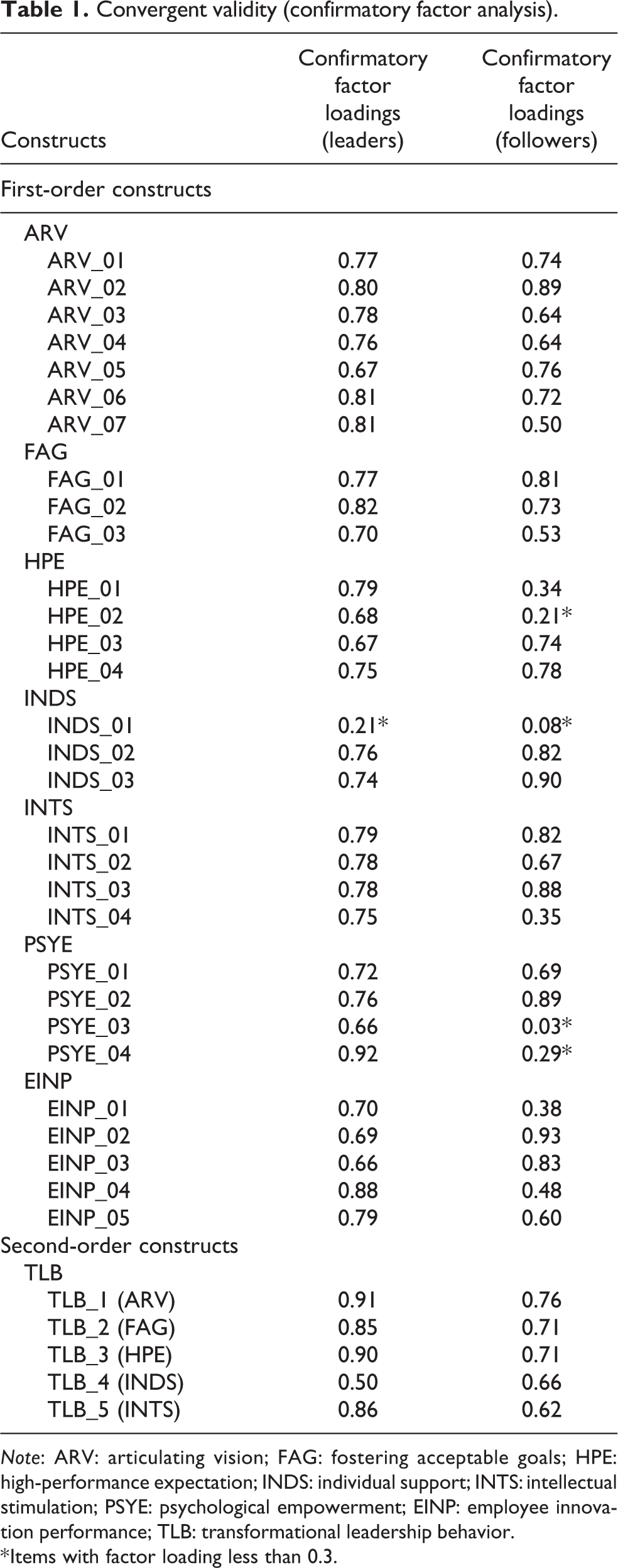
Note: ARV: articulating vision; FAG: fostering acceptable goals; HPE: high-performance expectation; INDS: individual support; INTS: intellectual stimulation; PSYE: psychological empowerment; EINP: employee innovation performance; TLB: transformational leadership behavior.
* Items with factor loading less than 0.3.
Also, as can be observed in the table, second-order factor loadings were well above 0.5, thereby demonstrating a strong convergent validity for the second-order transformational leadership behavior construct comprising the five first-order constructs, namely, articulating vision, fostering acceptable goals, high-performance expectations, individual support, and intellectual stimulation.
Discriminant validity
A discriminant validity test was conducted to ensure that the items representing different first-order constructs were not related to each other (i.e. that the correlation of items representing different constructs was weak). The results, presented in Table 2, show that the pair-wise correlations between the constructs were less than the suggested threshold of 0.85 (Kline, 2005), thereby demonstrating discriminant validity.
Correlation between constructs for leaders and followers.
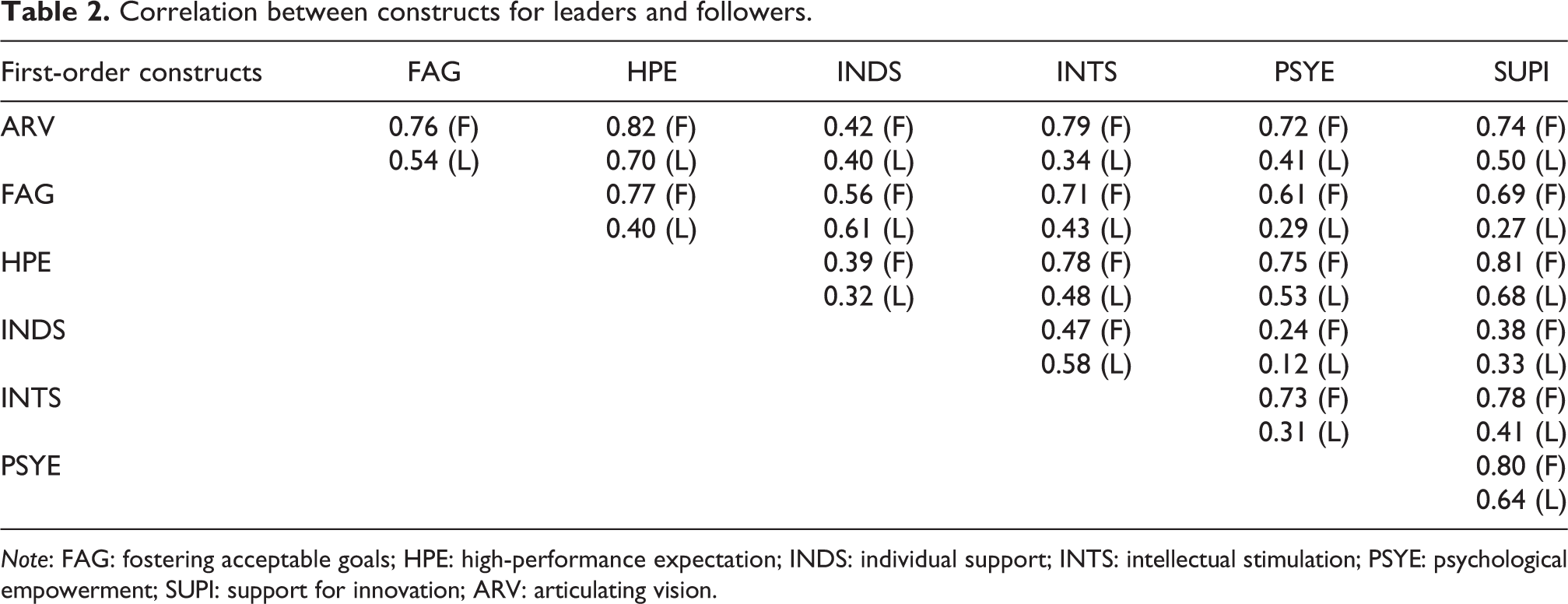
Note: FAG: fostering acceptable goals; HPE: high-performance expectation; INDS: individual support; INTS: intellectual stimulation; PSYE: psychological empowerment; SUPI: support for innovation; ARV: articulating vision.
Construct reliability
Cronbach’s α, the calculation of which measures the consistency, precision, and repeatability of items within constructs, was used to evaluate reliability. Cronbach’s α values for the constructs were well above the recommended threshold of 0.70 in all cases, except for individual support (0.66), which was nevertheless above the acceptable minimum threshold of 0.65 (Nunnally and Bernstein, 1994; Taber, 2018), demonstrating the strong reliability of the constructs (Table 3).
Construct reliability.

Descriptive statistics and analysis of variance (testing hypothesis 1)
The analysis of variance (ANOVA) was used to test for any significant difference (δ) in the assessment of transformational leadership behavior among leaders and followers.
As may be seen in Table 4, the composite mean (X̄) of constructs shows that for transformational leadership behavior (overall) and for its individual subdimensions, leaders’ self-perceptions were consistently lower than those of followers. The relatively low standard deviations (<1) indicate that perceptions were relatively consistent across participants in both the leader and the follower categories.
Descriptive statistics and hypotheses test results (H1, H1a–H1e).
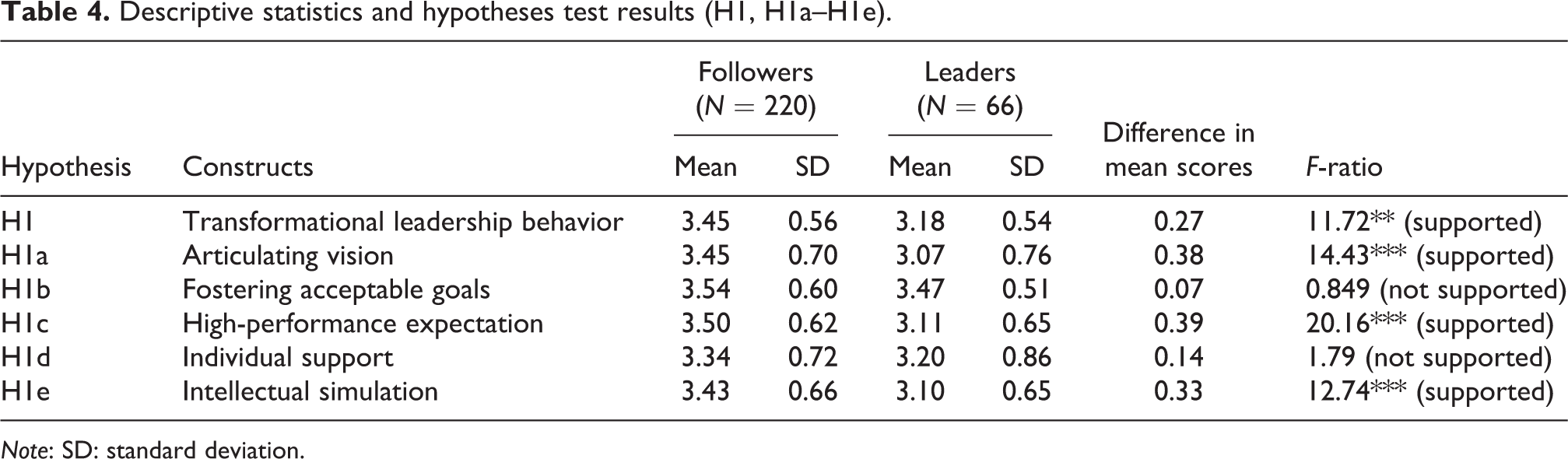
Note: SD: standard deviation.
ANOVA results show that, at the second-order construct level, perceptions of transformational leadership behavior were significantly different (δ = 0.27, F = 11.72, p < 0.01) among leaders (X̄ = 3.18) and followers (X̄ = 3.45), supporting hypothesis 1. Similarly, with regard to the first-order constructs of transformational leadership behavior, significant differences were found for three constructs, namely, articulating vision (δ = 0.38, F = 14.43, p < 0.001), high-performance expectations (δ = 0.39, F = 20.16, p < 0.001), and intellectual simulation (δ = 0.33, F = 12.74, p < 0.001). However, no significant difference in perception was found for fostering acceptable goals (δ = 0.07, F = 0.849, p > 0.05) between leaders (X̄ = 3.47) and followers (X̄ = 3.54). Similarly, no significant difference in the perceptions (δ = 0.14, F = 1.79, p > 0.05) of leaders (X̄ = 3.20) and followers (X̄ = 3.34) was found for the construct of individual support.
Overall, in line with our RQ1, it is evident that there are discrepancies in the leader and follower perceptions with regard to leaders’ transformational leadership. However, contrary to the popular belief that leaders tend to overrate their own leadership abilities relative to ratings provided by followers (Atwater and Yammarino, 1992; Fleenor et al., 1996), the results indicate that leaders, in this context, underrated their transformational leadership capabilities compared to the ratings of these by followers. Follower ratings that are higher than leader ratings may indicate dysfunction within the team, such as lack of leader self-confidence, though the implications are likely less concerning than the opposite (leader rating their abilities higher than followers do) (Aarons et al., 2017). Regardless, any discrepancies in perceptions among leaders and followers (whether leaders overate or underrated their leadership abilities) could lead to a poor organizational culture (Aarons et al., 2017).
Structural equation modeling results
Structural equation modeling (SEM), a statistical technique for representing, estimating, and testing hypothesized relationships, was used in this study (Al Ahbabi et al., 2019). However, before proceeding with the testing of hypotheses, it is important to establish the overall model fit and various other goodness-of-fit indices (GFIs) to ensure the statistical appropriateness of the model.
Model fit
SEM using IBM AMOS 25 software was employed to check the model fit of the structural model (Figure 1). The model fit indices used to check the fit included the overall model fit index, chi-square/degrees of freedom (χ2/df), and other GFIs, namely, comparative fit index (CFI), GFI, adjusted goodness-of-fit index (AGFI), and root mean square error of approximation (RMSEA) (Balasubramanian and Shukla, 2017). The selection ensured that at least one fitness index was selected from the three model fit categories, namely, absolute fit, incremental fit, and parsimonious fit, as recommended by Hair et al. (2006).
The results showed that the χ2/df obtained was 1.863 (i.e. less than 2), indicating an excellent overall model fit (Tabachnick and Fidell, 2019). Regarding the other indices, CFI = 0.992 (>0.90), GFI = 0.976 (>0.90), AGFI = 0.906 (∼0.90), and RMSEA = 0.055 (∼0.05) also demonstrated the good fit of the structural model (Bagozzi and Yi, 1988; Hooper et al., 2008; Hu and Bentler, 1999).
Path analysis (testing hypotheses 2, 3, and 4)
To test our hypotheses regarding the relationships (hypotheses 2, 3, and 4), path analysis and multigroup analysis using IBM AMOS 25 were performed to estimate the differences in the relationships (Balasubramanian et al., 2019) across the leaders and followers, as hypothesized. However, before proceeding with the tests, it was important to ensure that significant differences existed in the overall model for leaders and followers. For this, the χ2 difference test, the difference of the χ2 values of the two models (leaders and followers), was undertaken. The result of the χ2 difference test was Δχ2 = 62.991, p < 0.001, indicating that the overall model significantly differed between the groups.
Next, in line with RQ2, to test the differences in the individual relationships and their corresponding hypotheses, SEM was first used to estimate the structural relationships (standardized path coefficients) for leaders and followers. The standardized path coefficients for the two groups are shown in Figure 2.
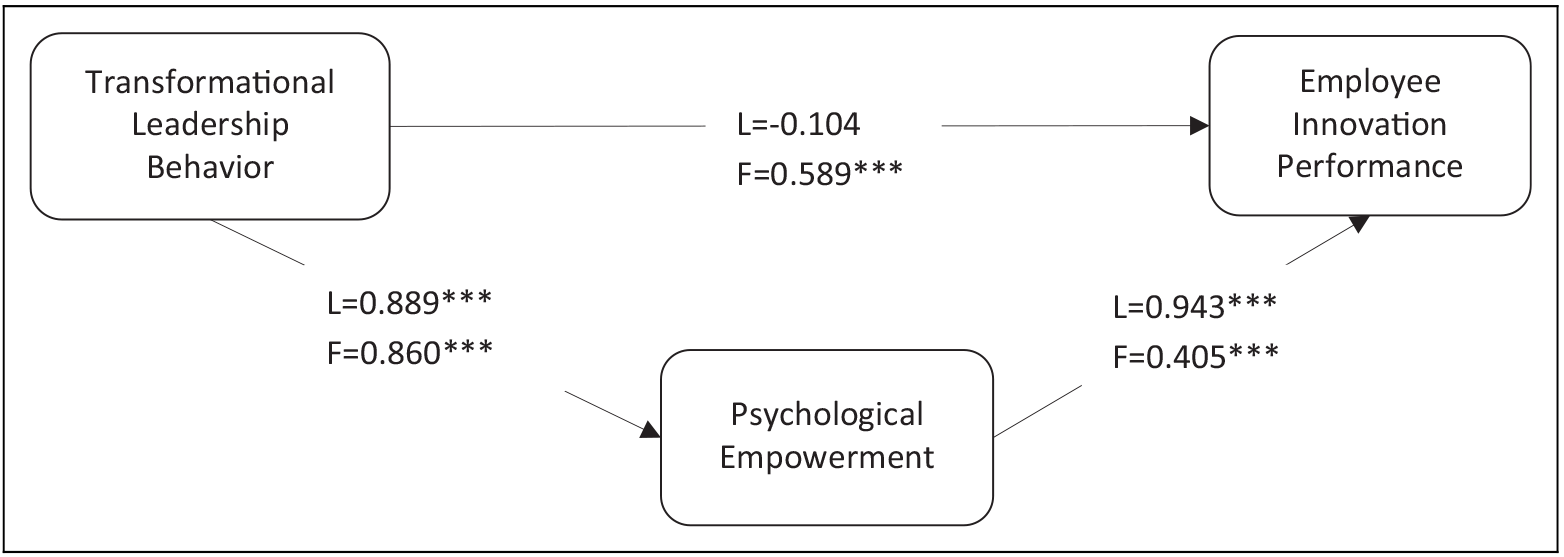
Structural equation model results for leaders and followers. ***p < 0.001; **p < 0.01; *p < 0.05; L: Leader; F: Follower.
To test whether these difference in path coefficients were statistically significant, we compared the unconstrained (or free) model with the constrained model, in which the hypothesized path was constrained to be equal for the two groups, while other paths were set free to vary (Lee and Back, 2009; Muterera et al., 2015). For example, to test hypothesis 1, the unconstrained model for leader and follower groups was compared with the constrained model “b1,” in which the path coefficient indicating the strength of the relationship between transformational leadership behavior and employee innovation was kept equal for both groups. The χ2 difference was then computed by comparing the constrained model with the unconstrained model; if the results were significant, this meant the selected path (relationship) was different for leaders and followers.
The multigroup moderation test results for the individual paths of the leader and follower groups are given in Table 5. As can be seen in the table, there was a statistically significant difference (Δχ2 = 4.042, p < 0.05) in the strength of the relationship between transformational leadership behavior and employee innovation performance for both leaders (β = −0.104, p > 0.05) and followers (β = 0.589, p < 0.001). However, hypothesis 2 is not supported, given that we expected this relationship to be greater for leaders than for followers. In other words, the study findings are in stark contrast to the findings of Muterera et al. (2015), who found the direct relationship between transformational leadership and organizational performance to be greater for leaders than followers. Further, the structural path coefficients show that the relationship between transformational leadership behavior and employee innovation performance for leaders was negative but not significant. This implies that leaders do not perceive their leadership behavior to directly result in employee innovation. Followers, on the other hand, perceived a direct, positive, and significant relationship between transformational leadership behavior and employee innovation performance, in line with studies reporting a similar positive association for followers (Afsar et al., 2014; Eisenbeiss et al., 2008).
Chi-square difference test for the hypothesized relationships.
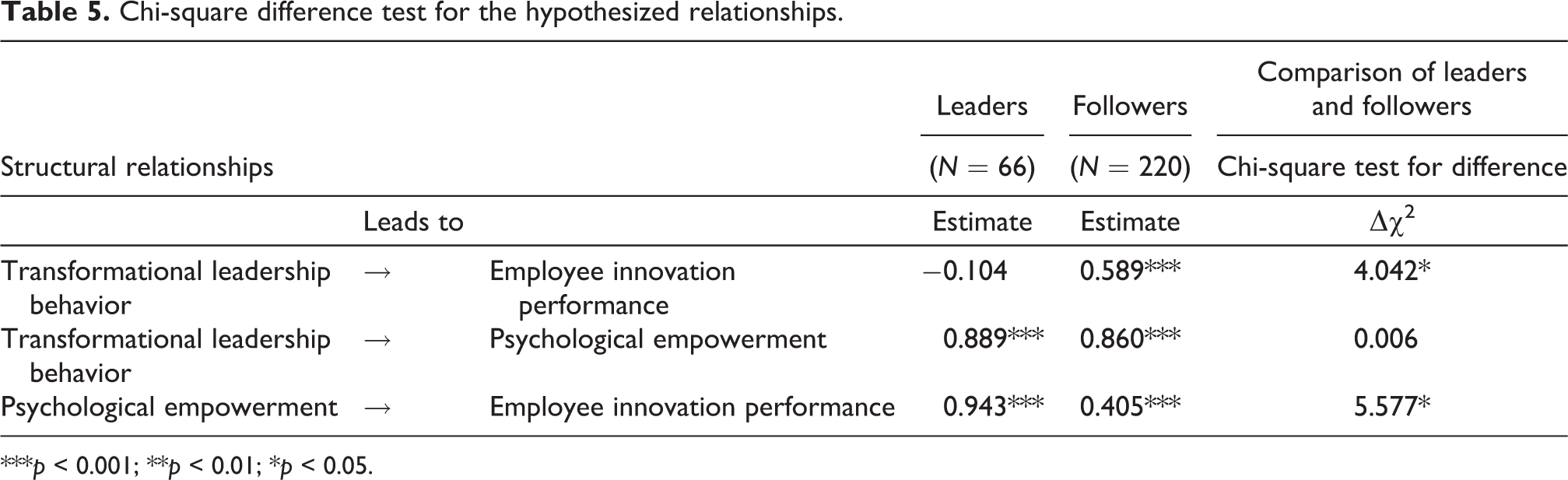
***p < 0.001; **p < 0.01; *p < 0.05.
For the relationship between transformational leadership behavior and psychological empowerment, the difference between leaders (β = 0.889, p < 0.001) and followers (β = 0.860, p < 0.001) was not statistically significant (Δχ2 = 0.006, p > 0.05), again rejecting our hypothesis 3, which hypothesized this relationship to be greater for leaders than followers. Finally, the relationship between psychological empowerment and employee innovation performance among leaders (β = 0.943, p < 0.001) and followers (β = 0.405, p < 0.001) was statistically significant (Δχ2 = 5.577, p < 0.05). Hence, hypothesis 4 is supported, given that the relationship is greater for leaders vis-à-vis followers. Finally, using the structural path coefficients of the relationships, transformational leadership behavior, and psychological empowerment as well as psychological empowerment and employee innovation performance, we computed the mediating effects of psychological empowerment on the relationship between transformational leadership and employee innovation performance for both leaders and followers. For leaders, the indirect effect of transformation leadership on employee innovation performance, mediated through psychological empowerment, was 0.485 × 0.403 = 0.838; for followers, the indirect effect of transformation leadership on employee innovation performance—mediated through psychological empowerment—was 0.880 × 0.330 = 0.348. This suggests a discrepancy in the perceptions of leaders and followers regarding the mediating role of psychological empowerment. Leaders perceive the mediation of psychological empowerment to be stronger than followers perceive it to be.
While the findings support the results of Afsar et al. (2014), who determined that psychological empowerment mediates the relationship between transformation leadership and employee innovation performance, the results also demonstrate discrepancies between leaders and followers, which is concerning. This is because, if we take a holistic view of hypotheses 2, 3, and 4, the leaders perceived no direct impact for their transformational leadership on employee innovation performance; instead, they strongly perceived that they need to first psychologically empower employees to strengthen their innovation performance. Followers, on the other hand, perceived the direct positive impact of transformational leadership on their innovation and less through psychological empowerment. This shows that the leaders and followers were living in two different worlds, and they perceive two different approaches to employee innovation—a direct approach preferred by followers and an indirect approach by leaders. This lack of congruence in leader and follower perceptions means that leaders may be needlessly spending time and effort to psychologically empower employees who are already empowered (psychological empowerment composite mean score was 3.42 for followers vs. 2.73 for leaders) instead of focusing on making direct improvements in employee innovation. This is also indicative of a lack of communication and understanding between leaders and their followers, which is likely to lead to more negative organizational outcomes (Aarons et al., 2017).
Implications and conclusions
This study compared leader and follower perceptions of leaders’ transformational leadership behavior and its direct and mediated (through psychological empowerment) relationship with employee innovation performance.
The implications of this study are manifold. In terms of research implications, the study supports the growing notion (e.g. Aarons et al., 2017; Černe et al., 2014) that leader and follower perceptions can differ. Specifically, the study found that leaders’ self-perception of their transformational leadership behavior was consistently lower than that of followers (Golem effect). It also found a discrepancy in leaders’ and followers’ perceptions of the direct (Golem effect) and mediated (Pygmalion effect) impact of transformational leadership on employee innovation. This discrepancy is indicative of a dilemma—whether transformational leaders are genuinely capable of promoting innovative employee behavior, they perceive themselves to be, or they are perceived to be by others. This shows that transformational leadership relying on one source (i.e. either leaders or followers) could mask the “true score” relationship between transformational leadership and performance and supports increasing calls in leadership research for obtaining multiple-source feedback to overcome biases and limitations inherent in using only one source (Aarons et al., 2017; Černe et al., 2014; Muterera et al., 2015). Overall, the findings show that researchers should be conscious of different perceptions concerning leadership and any potential drawbacks of assessing leadership from only one perspective. However, despite the differences in perceptions, the results show that both leaders and followers agree on the importance of psychological empowerment as a mediator between transformational leadership and employee outcomes, in this case, employee innovation performance.
From a practitioner perspective, the multisource feedback can be effective as a developmental tool to help support leaders and followers in understanding their own stance and the biases or misperceptions they may be holding. Organizations may need to consider how such differences in perceptions may support or derail change initiatives and the effectiveness of managers and then make a concerted effort to narrow perception gaps (if any) between leaders and followers. For instance, it is important to understand the reasons why leaders underrated themselves, such as, was it due to lack of confidence? Alternatively, were followers overestimating their leaders? Also, it is important to understand why leaders were taking an indirect approach to employee innovation through psychological empowerment rather than making a more direct effort. Alternatively, would followers prefer a direct leadership approach to an approach mediated by psychological empowerment?
However, previous studies have cautioned that even if leaders are aware of a discrepancy between their opinions and those of followers, they fail to act on this to make behavioral changes or force behavioral changes among followers, though they may express surprise, consternation, disbelief, or emotional distress upon learning of such discrepancies (Aarons et al., 2017). Given that such discrepancies could lead to a poor organizational culture (Aarons et al., 2017), intervention is required to ensure that leaders and followers have clear understandings of where they stand and what biases or misperceptions they may hold to promote a more positive organizational culture. Congruence between leaders and followers’ self-perceptions is found to be beneficial to achieve organizational outcomes such as job satisfaction (Černe et al., 2014).
To the best of our knowledge, this study represents the first attempt to simultaneously assess the impact of transformational leadership on employee innovation from both leader and follower perspectives. However, the study has limitations. First, the data were collected from one country and one sector (banking), which limits the generalizability of the findings. Also, the sample was relatively small, especially for leaders, again a concern for generalizability. Future studies could therefore focus on conducting a similar study of other sectors and other countries to determine whether similar discrepancies exist between leaders and followers.
Despite the limitations, we believe our approach and findings can encourage additional research into congruence/discrepancies in leader and follower perceptions of leadership.
Footnotes
Declaration of conflicting interests
The author(s) declared no potential conflicts of interest with respect to the research, authorship, and/or publication of this article.
Funding
The author(s) received no financial support for the research, authorship, and/or publication of this article.
