




Abstract
Organizational resilience has attracted much attention with regard to a company’s survival and to achieve higher performance in today’s uncertain conditions. However, how organizational resilience is built remains unclear. This study sheds light on the function of the top management team (TMT) from upper echelons theory and argues that its deep-level diversity has a positive impact on organizational resilience. Our empirical study of the Japanese automotive industry found that tenure, international, and wise diversity have a positive impact on building organizational resilience. In contrast, educational background diversity was found to have a negative impact on building organizational resilience, contrary to our hypothesis. Our results revealed that diversity was a double-edged sword and established the need to focus on environmental and industrial contexts in linking diversity and organizational resilience. Further elucidation of the relationship between diversity and organizational resilience can be achieved by simultaneously focusing on other aspects of diversity, in concurrence with existing diversity indices for variety.
Introduction
Companies are facing changes, such as rapid global competition and increasing digitalization. In multinational companies, in particular, supply chains might be affected by regional problems, and the adverse effects of globalization and highly digitalized operations. Thus, the environment surrounding companies today is extremely volatile and uncertain.
The concept of “organizational resilience” explains how organizations can survive and thrive in such environments. Firms with high levels of organizational resilience are able to remain flexible and maintain stability in the face of environmental turbulence (DesJardine et al., 2019). Organizational resilience as a concept explains how organizations can survive and grow in the face of adversity and turbulence (Hillmann and Guenther, 2021; Williams et al., 2017). Companies thus need to increase their organizational resilience for sustainable growth and success (Duchek et al., 2020).
Although diversity has been suggested to have a positive impact on building organizational resilience, it is not clear at what unit level and what type of diversity will have an impact; therefore, the role of diversity in the resilience of specific teams and organizations needs to be examined (Duchek et al., 2020). This study focuses on the diversity of the top management team (TMT). The TMT is an aggregate of top executives, who directly influence the corporate strategy formulation. Based on their cognitive abilities and characteristics, the external environment is scanned and interpreted, which leads to strategic decision-making and corporate behavior (Hambrick and Mason, 1984; Neely et al., 2020). An increase in the breadth of cognition within the TMT, that is, deep-level diversity, enables the exploration of external environments and detection of minute information. It will lead to the process of building organizational resilience, which is to anticipate, cope with, and adapt to changes in the environment (Duchek, 2020). However, the relationship between organizational resilience and TMT diversity has not been sufficiently examined. Therefore, this study aims to answer the following research question: “What type of TMT diversity positively influences organizational resilience building?”
In this study, the hypotheses that diverse cognitions, understandings, and values held within the TMT have a positive impact on the breadth of cognitive and problem-solving abilities, and lead to a positive effect on building organizational resilience, were empirically tested.
The data were collected from the automotive industry, which is said to be currently undergoing a structural transformation, represented by the word “CASE” which refers to new automobile technology areas of “Connected,” “Autonomous,” “Shared,” and “Electric,” and is exposed to uncertainty. The transportation equipment companies listed on the first section of the Tokyo Stock Exchange were targeted for this study and included competitive global brands, such as the Toyota Motor Corporation.
Our results showed that tenure, international, and wise diversity had positive effects on organizational resilience among deep-level diversity. However, contrary to our hypothesis, educational diversity showed a negative effect on organizational resilience.
These results not only contribute theoretically by bridging organizational resilience and diversity, but also suggest that deep-level diversity is a double-edged sword and that the possible meanings of diversity indicators may vary depending on the context of the company. These findings also have practical implications as our results clarify what type of TMT conditions would lead to organizational resilience which has gathered scholars’ and practitioners’ attention in the era of uncertainty.
Theoretical background
First, this study provides a theoretical overview of organizational resilience and TMT diversity. It examines the relationship between the concept of organizational resilience, its process, and the role of TMT diversity, based on earlier literature.
Organizational resilience
Organizational resilience differs from flexibility and agility (Duchek, 2020; Lengnick-Hall et al., 2011). It has attracted much attention, especially since the September 11 attacks (Linnenluecke, 2017) and explains how companies can survive and thrive in situations of increased uncertainty (Hillmann and Guenther, 2021). Organizational resilience has been gaining attention, not only out of concern for terrorism and sudden disasters but also for the increased risk of failure owing to the complexity and interdependence of socioeconomic and technological developments.
It has been noted that organizations with organizational resilience have two essential characteristics: stability, which maintains key organizational attributes such as core functions and structure in the face of disturbances, and flexibility, which facilitates the development of alternative solutions to disturbances owing to uncertainty (DesJardine et al., 2019; Sajko et al., 2021). To date, research has described resilience as a defensive response, and resistance or recovery (Gittell et al., 2006; Sutcliffe and Vogus, 2003). Currently, with a shift in perspective, resilience is now identified as a more aggressive response (Duchek, 2020).
Hillmann and Guenther (2021) stated that with regard to firm performance, outcomes set resilient companies apart from those that are not. In other words, companies with resilience are able to grow and take advantage of market trends, in addition to meeting current market demands (Ismail et al., 2011). Organizational resilience is not just about recovering from external disturbances, but being proactive and adapting with foresight in rapidly changing industrial structures and other factors.
Duchek (2020) argued that organizational resilience is built through the processes of anticipation, coping, and adaptation. In the anticipation stage, it is necessary to recognize and identify the value of external knowledge, and in the adaptation stage, diverse perspectives, constructive confrontation, and discussion are needed to translate new lessons and knowledge into action (Duchek et al., 2020). In other words, companies with organizational resilience are able to achieve both stable high performance in the present and flexibility to continue to achieve stability in the future when compared to their competitors, not only in emergencies but also in normal times, by being flexible and anticipating market trends.
Ortiz-de-Mandojana and Bansal (2016) argued that corporate social and environmental practices help companies sense and understand long-term opportunities and mitigate threats, which contributes to organizational resilience. At a glance, social and environmental practices may not seem directly related, but through these practices, companies can detect the diversity of the environment, including weak clues and new problems.
This study focuses on organizational resilience as the ability to anticipate potential threats and proactively perceive and react to the environment. Hence, this study adopts the following definition of organizational resilience “an organization’s ability to anticipate potential threats, to cope effectively with adverse events, and to adapt to changing conditions” (Duchek, 2020). This study postulates that companies with organizational resilience will be able to outperform their competitors, especially in changing environments, and sustain consistently high future performance.
Factors leading to organizational resilience have been previously identified as organizational strategy (Carmeli and Markman, 2011), the existence of abundant resources (Gittell et al., 2006; Tognazzo et al., 2016), and reputation (Tracey & French, 2017).
In addition, considering the characteristics of organizational resilience which include anticipating and adapting to the environment, this study focuses on top executives’ function. Hambrick and Mason (1984) argued that in upper echelons theory, top level executives importantly recognize the external environment and through their perceptions, understandings, and values, situations are understood and corporate decisions and actions are determined. Managers significantly influence organizational change (Adner & Helfat, 2003; Helfat and Martin, 2015), and to enhance organizational resilience, they are often required to detect environmental change and dealing with uncertainty and complexity (Hillmann et al., 2018). Therefore, the TMT, the strategic decision-making unit of a company, plays an important role in building organizational resilience.
Top management team diversity
The impact of CEOs on organizational behavior and outcomes continues to attract the interest of researchers (Wernicke et al., 2021). There exist many studies highlighting relationships between organizational outcomes and a variety of CEO-related indicators, including CEO characteristic (Cha and Rew, 2018), power (Amedu and Dulewicz, 2018), and duality (Bui et al., 2020). Research on organizational resilience has thus studied the impact of CEOs (Kim et al., 2021; Sajko et al., 2021). Following upper echelons theory, however, owing to the importance of the TMT as a coalition, focusing on its characteristics instead of on individual CEOs may provide complementary findings to earlier studies (Hambrick, 2007). The importance of studies shedding light on the relationship between TMT composition and organizational level outcomes has been growing (Wangrow et al., 2019).
To examine the factors that increase the TMT’s impact on organizational resilience, this study regards TMT diversity as noteworthy. Diversity is the distribution of personal attributes among work unit members (Harrison and Klein, 2007; Jackson et al., 2003), and TMT diversity refers to the degree to which the attributes of highly skilled executives are distributed. Diversity comprises superficial attributes, such as age, gender, and nationality (Bengtsson et al., 2020; Joshi and Roh, 2009) and deeper-level attributes such as knowledge and work experience (Bengtsson et al., 2020; Joshi and Roh, 2009), and is understood as a multidimensional construct (Padilla-Angulo, 2020).
The TMT is a decision-making unit composed of top executives and highly skilled individuals, with various levels of interdependence for complex, uncertain, and multifaceted tasks (Tasheva and Hillman, 2019). Duchek (2020) describes the organizational resilience building process as that of anticipation, coping, and adaptation, and argues that knowledge base, resource availability, and professional capabilities can be the starting point for all stages of the process. This can be seen as a component of the deep-level diversity of the TMT, the strategic decision-making unit.
If executives have the same breadth of knowledge base, they may fail to anticipate the environment, the starting point of organizational resilience. Conversely, TMTs with a high diversity of knowledge can navigate uncertain and complex environments (Sajko et al., 2021). This can enhance cognitive conflict within the TMT and result in a better understanding of complex problems (Bengtsson et al., 2020).
Hence, deep-level diversity within the TMT broadens the team’s scanning activities, changes their choices, and improves problem-solving (Keck, 1997). In other words, even under normal conditions, a TMT with deep-level diversity can detect a variety of information and provide several options to the enterprise. Furthermore, in a changing environment, heterogeneous groups are more likely to have the skills needed when changes occur. Thus, although they may be less efficient in handling the current situation, resolving conflicts may lead to better solutions to environmental adaptation (Murray, 1989).
Hypotheses building
Organizational resilience and deep-level diversity
This study focuses on the process of building organizational resilience and argues that the deep-level diversity of the TMT contributes to a better understanding of complex problems by strengthening its cognitive conflicts (Bengtsson et al., 2020) and, therefore, has a positive effect on organizational resilience. The following section examines the attributes that comprise the deep-level diversity of the TMT.
Hypotheses building: Deep-level diversity
Tenure diversity
With regard to the filtering function of a company’s external environment, Keck (1997) pointed out that when members of a TMT spend long periods of time together, their communication with the outside world is reduced, which may filter out useful external information. The TMT’s short tenure, with the entry and exit of its members, has been argued to have a positive impact on firm performance (Carpenter, 2002; Keck, 1997).
Hence, this study examines the mechanism by which tenure heterogeneity has a positive impact on firm performance. Tenure reflects the accumulated experience of TMT members (Agnihotri and Bhattacharya, 2021). Tenure heterogeneity in situations where the industry is changing or is predicted to change leads to increased sensitivity of the TMT to external information. This can lead to the avoidance of negative aspects of long-term tenure, such as groupthink, risk aversion, and status quo (Pfeffer, 1985). It also causes the TMT to anticipate the implications of the external environment on the organization, which is a process of organizational resilience (Duchek, 2020). Thus, the following hypothesis is developed:
H1: Tenure heterogeneity in the TMT positively influences organizational resilience.
Functional background diversity
With respect to the TMT’s deep-level diversity, its functional background diversity tends to increase the total pool of expertise and knowledge of the team and enhance cognitive conflict (Bengtsson et al., 2020).
Amason (1996) stated that cognitive conflict helps teams reach a common understanding and promotes acceptance and commitment to decisions made. This cognitive conflict contributes to the process of anticipating, coping, and adapting (Duchek, 2020) wherein organizational resilience is built, and the organization adapts its practices based on the newly acquired knowledge.
In other words, the increase in TMT functional background diversity not only enriches its cognitive base but also allows teams with diversity to creatively solve complex problems by reaching a common understanding of the events the company faces, from various angles through cognitive conflicts, generating more options, and improving the quality of decision-making (Cannella et al., 2008). Consequently, it is thought to contribute to the process of organizations adapting to uncertain environments and building organizational resilience.
Based on the above facts, the following hypothesis is developed:
H2: Functional background diversity in the TMT positively influences organizational resilience.
International diversity
Internationalization is an important factor when considering the uncertain environment surrounding businesses. With globalization, both business risks and opportunities are scattered worldwide.
The TMT’s international diversity coping with these international changes has been explained in terms of familiarity with overseas R&D sites and social networks, which can help to effectively allocate geographically international tasks and promote collaboration and knowledge integration across the enterprise (Belderbos et al., 2022). International diversity in TMT, therefore, can have a positive impact on building organizational resilience in the sense that it provides knowledge integration, diverse perspectives, and augmented cognitive conflict for companies in today’s increasingly globalized world.
Boone et al. (2019) captured international diversity from two aspects: nationality and international experience. This study examines international diversity in terms of international experiences, such as practical knowledge of specific institutions and markets and informal social ties as a deep level of diversity (Belderbos et al., 2022; Carpenter and Fredrickson, 2001) rather than nationality. Thus, as international diversity positively influences the building of organizational resilience, the following hypothesis is developed.
H3: International diversity in the TMT positively influences organizational resilience.
Educational background diversity and wise diversity
The educational level achieved influences the skills and values held by TMT members (Barkema and Shvyrkov, 2007), and when the task is complex and resources and attention allocated are limited, executives tend to rely on their own work and educational experience (Shepherd et al., 2017). In other words, the presence of executives with diverse work and educational experiences within a TMT will increase the overall pool of expertise and knowledge. This fact suggests that diverse educational backgrounds may have a positive impact on building organizational resilience.
Furthermore, this study extends the perspective by examining the possibility of appointing external professionals to the TMT. Sako and Kubo (2019) demonstrated that the appointment of licensed professionals, including lawyers and accountants, to the board of directors has a positive impact on financial performance, corporate risk reduction, and the reliance on external expertise. Executives with external professional backgrounds may expand cognitive resources within the TMT and positively affect organizational resilience by increasing cognitive conflicts within the TMT.
Therefore, the following hypothesis is formulated.
H4: Educational background diversity in the TMT positively influences organizational resilience.
H5: The inclusion of professionals as wise counsel in the TMT positively influences organizational resilience.
Data and analysis
Data
This study focused on the Japanese automotive industry to observe organizational resilience. As represented by the term “CASE,” the automotive industry experiences discontinuous and radical changes “Once in a Century” 1 such as the emergence of electric vehicles and other segments whose composition differs from that of conventional vehicles, and causes a shift in the value demand from ownership to sharing. Japan’s automotive industry is highly competitive globally and includes companies, such as Toyota Motor Corporation, and is thought to be a good sample to capture the trend. Another point to note is that the targeted companies in the automobile industry are some of Japan’s largest companies with an average of approximately 30,000 employees, and have overcome crises such as the oil crisis and US–Japan trade friction, and are now being highly competitive in the world.
To cope with such discontinuous innovations, such as rapid environmental changes, uncertainty, and CASE in the automotive industry, the process of building organizational resilience, including anticipating, coping with, and adapting to environmental changes (Duchek, 2020), will be important. Therefore, from the 33 industry categories of companies listed in the first section of the Tokyo Stock Exchange, 62 companies in the transportation equipment category including automotive-related companies were selected.
The financial data was taken from EDINET 2 and the Kaisya Shikiho for fiscal years 2017 and 2018.
The TMT was composed of executives listed in the Yakuin Shikiho (Tanikawa and Jung, 2019). The Yakuin Shikiho is based on annual securities reports, and the operational definition of TMT was taken from earlier studies on Japanese companies (Nakauchi and Wiersema, 2015).
The Yakuin Shikiho for fiscal years 2017 and 2018 was used to obtain data on tenure, shareholding ratio, and so on. Individual attribute information was also obtained from the Nikkei Telecom and each company’s website.
Taking into account the time lag of the impact of executive diversity on the corporate performance indicator of resilience, 2 years of data were obtained.
Variable settings and analysis
Dependent variables
For the dependent variable, organizational resilience in this study is measured in reference to the work of Ortiz-de-Mandojana and Bansal (2016) by considering a company’s higher growth compared with competitors (HGCC) and low financial risk (LFR) as a result of organizational resilience.
The HGCC is calculated as follows: Total demand is calculated by combining the industry’s cumulative sales revenue and then determining the fluctuation amount (%) from FY2018 to FY2019. Then, the fluctuation (%) of the companies is calculated. If the fluctuation is positively higher than that of the market, it is coded as “1” as the dummy variable, and “0” otherwise. Further, logistic regression analysis was carried out. It allowed us to consider the essential characteristics of organizational resilience, flexibility, and stability (DesJardine et al., 2019; Sajko et al., 2021), if they outperformed the rate of change in total demand in a changing environment.
For LFR, this study refers to Singh et al. (2018), who used Tobin’s q 3 as a result of board characteristics. Tobin’s q is the present value of future cash flows based on the current market-based performance and future-oriented expectations from investors, rather than the ROA or ROE, to obtain the total market value. The company is expected to flexibly adapt to the environment and generate stable profits in the future and this feat can be seen as the market’s expectation of the flexibility and stability of organizational resilience (Sajko et al., 2021). In addition, stock price is a good measure to assess resilience in general crises (DesJardine et al., 2019), and Tobin’s q, a performance indicator that reflects stock price, is a proper measure of organizational resilience.
Explanatory variables
The variables are set in light of the employment and labor practices in the Japanese automobile industry, while referring to the variables set in earlier studies.
In relation to H1, tenure diversity was measured as the average years of team tenure (Keck, 1997) and the average number of years since joining the company for each top executive. It takes into account employment and labor practices that are unique to Japanese firms. The top executives in Japanese firms were originally hired as new graduates and reached the top executive position through internal promotion (Aoki et al., 2007), and the automotive industry in Japan is no exception. Thus, changes in the TMT’s metabolism can be proxied by the length of these two indicators.
For the functional background diversity in H2, Blau’s (1977) index was used based on the distinction between entry-level positions, such as high school graduates, technical college graduates, university graduates or graduate schools with a social science or administrative degree, and university or graduate school with a technology and science degree. In Japanese companies, it is common to hire new graduates simultaneously (Nagano, 2014), and they develop skills in areas that span related departments, mainly in the unit wherein they are assigned, based on their employment classification (Takeuchi and Takeuchi, 2013). Owing to the high degree to which the assignment, or function, is fixed, the hiring classification was used for the function in this study.
For H3, international diversity, the percentage of top executives who studied abroad was used to capture international experience, referring to Boone et al. (2019).
For H4, educational background diversity, this study focused on higher education to measure the expansion of the pool of cognitive resources in the TMT. Our target Japanese firms generally hire new graduates in large numbers from high schools, technical colleges, universities, and graduate schools based on recruitment categories, and have a system to develop their human resources through internal training (Nagano, 2014). Therefore, most of the members who joined the company through the new graduate recruitment process have a bachelor’s or master’s degree. Therefore, in this study, the percentage of doctoral degree holders was measured as an indicator of educational diversity.
As for H5, wise diversity was measured by the percentage of top executives from research institutions, such as universities and institutes, because collaboration between companies and academia, such as joint research projects with academic institutions, is widely practiced in the industry.
Control variables
Other diversity variables that have been explained to affect firm performance, such as control variables, are gender, average age (Cox and Blake, 1991; Wangrow et al., 2015), age diversity, nationality (Boone et al., 2019), and other superficial diversity attributes.
The proportion of lawyers, accountants, and tax accountants who were counted as professionals in the Yakuin Shikiho was measured as an indicator of the use of external wisdom.
Furthermore, factors such as TMT size, sales, overseas sales ratio, and R&D ratio as performance-related variables were included, and shareholding ratio as an indicator of TMT interdependence (Hambrick et al., 2015) was used.
When the objective variable was LHR, the investment cash flow of the firm was included as a control variable.
Results
Descriptive statistics
Correlations and descriptive statistics.

Multi regression and logistic regression results
Dependent variable: Low financial risk (LFR).
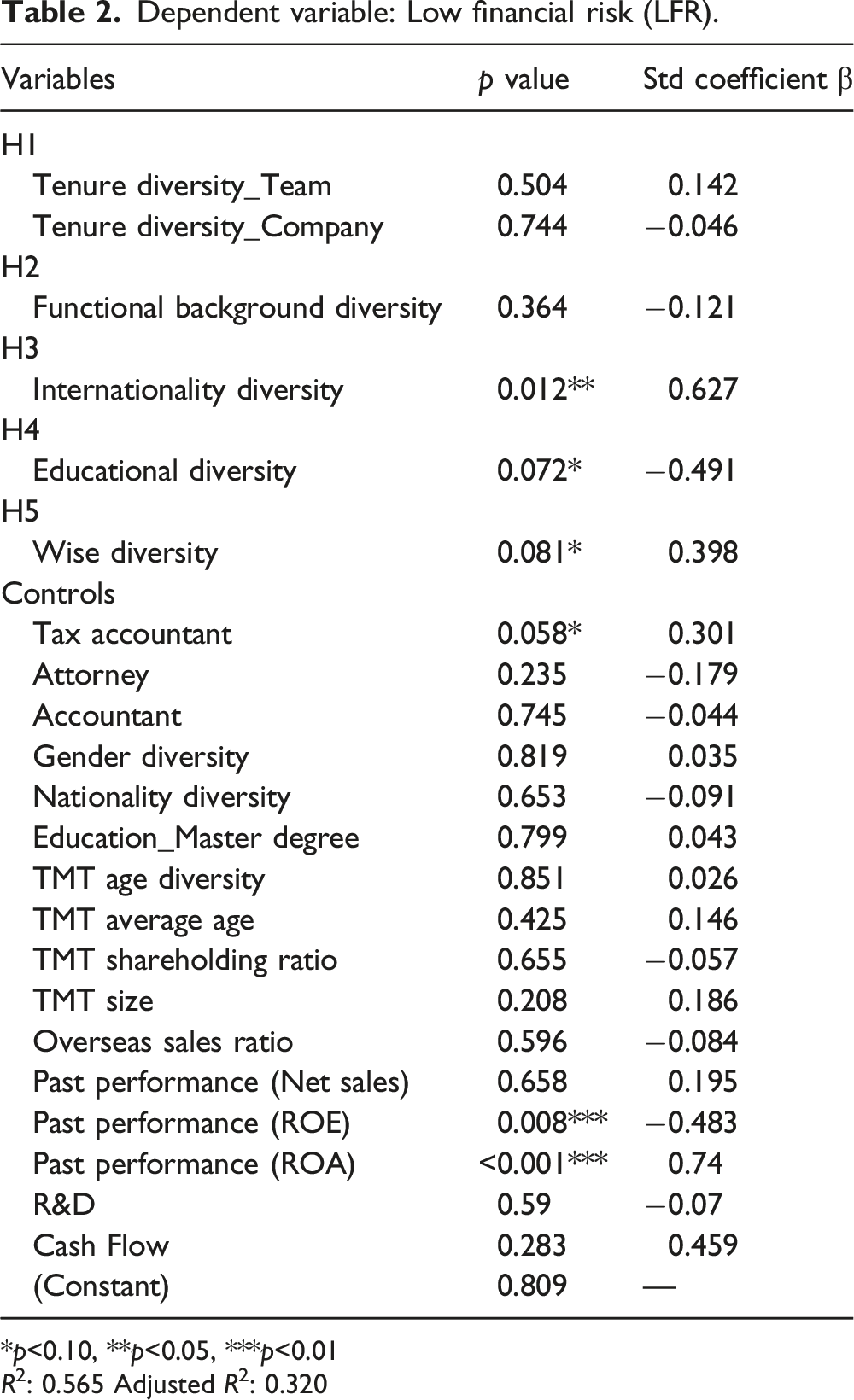
*p<0.10, **p<0.05, ***p<0.01
R2: 0.565 Adjusted R2: 0.320
Dependent variable: Higher growth compared with competitors (HGCC).
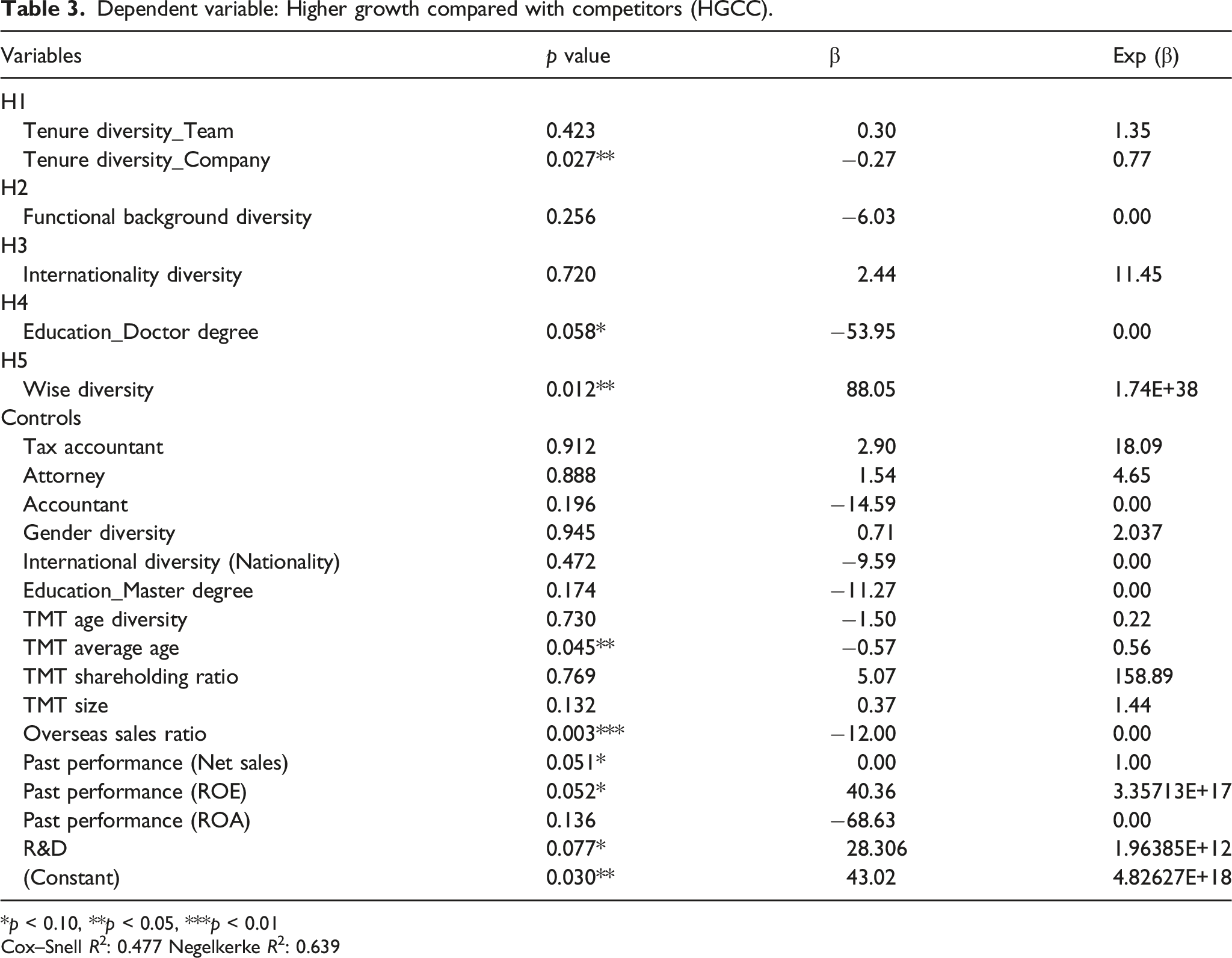
*p < 0.10, **p < 0.05, ***p < 0.01
Cox–Snell R2: 0.477 Negelkerke R2: 0.639
For H1, although TMT team tenure is not significant, TMT tenure has a negatively significant effect on HGCC (β = −0.27, p <0.05). This result shows that the short tenure of TMTs, and the changes in its metabolism, may have a positive impact on building organizational resilience in the context of a transforming industry (Keck, 1997). Therefore, H1 is partially supported.
For H2, no significant effect regarding functional background diversity was confirmed for both HGCC and LFR.
With regard to H3, international diversity was confirmed to have a positive impact on LFR (β = 0.627, p < 0.05). As there was no significant effect of nationality diversity as a control variable, and only overseas experience had a significant effect, it can be concluded that the overseas experience of top executives, rather than the superficial attribute of nationality, has a positive effect on the cognition and behavior of executives (Belderbos et al., 2022). This result is consistent with our research question formulation that the deep diversity of TMT has a positive impact on organizational resilience; hence, H3 is supported.
Regarding H4, educational background diversity had a negative impact on both LFR (β = −0.491, p < 0.05) and HGCC (β = −53.95, p < 0.05), contrary to our hypotheses. Therefore, a post hoc analysis was conducted.
The post hoc analysis confirmed that the average age of the doctoral degree holders used as an indicator of educational diversity was 64.9 years, and the average length of service was 5.4 years. This result indicates that they are mainly external appointments and not new graduates. The average age of the non-doctoral degree holders was 62.3 years, and the results of the t-test confirmed that the doctoral degree holders were statistically significantly older than the rest (t = 2.11, p < 0.05). In other words, doctoral degree holders were older than other top executives and were externally sourced talent. This result suggests that, rather than viewing doctoral degree holders as a knowledge acquisition source and securing diversity in TMT, the presence of doctoral degree holders strengthens existing relationships, such as having an authority in the field or a researcher from a university with whom they have close ties; in such cases, the results do not lead to resilience building contrary to our hypothesis.
As for H5, wise diversity was confirmed to have a positive impact on both LFR (β = 0.398, p < 0.10) and HGCC to competitors (β = 88.05, p < 0.05). Thus, H5 was supported.
In summary, the results of the empirical test of the hypotheses set in this study revealed that the TMT’s deep-level diversity has a positive impact on building organizational resilience. In an environment where the industrial structure is changing, it was also demonstrated that the deep-level diversity has a positive impact on building organizational resilience.
Discussion
The hypotheses in this study were generally supported, except for functional background diversity. Contrary to our original hypothesis, this study also demonstrated that educational background diversity has a negative impact on building organizational resilience in a changing environment.
Functional background diversity did not have a significant impact, probably owing to the industrial context. Although trends such as CASE dominate the automotive industry at present, they are still in a transitional stage, such as when companies start advocating specific goals for the electrification ratio. In the near future, the knowledge of key products and industries in the future, such as electric vehicles, may be more useful and functional, and background diversity will play a more important role.
As for educational background diversity, which contradicted our hypothesis, the post hoc analysis revealed that veterans who were appointed externally contributed to the increase in diversity of the educational background index. Judging from this result, it is possible to strengthen the relationship with the authority in a specific institute or university in a path-dependent manner, rather than conducting a new technological search in a changing situation. In the context of the current analysis, educational diversity is also a proxy variable for path-dependent behavior and is likely to have worked negatively on building organizational resilience.
Given these results, simply organizing a TMT based on diversity indices can be a double-edged sword that can negatively affect organizational outcomes (Minbaeva et al., 2021; Triana et al., 2014). It will be necessary to utilize diversity carefully, taking into account the industrial and historical context that surrounds the focal industry and companies.
Contribution of this study and its implications
Organizational resilience is a promising concept when explaining the survival and growth of companies in today’s increasingly complex world (Hillmann and Guenther, 2021). The question of how organizational resilience can be built has received a great deal of attention not only in the academic field but also in practice. In response to this situation, Duchek et al. (2020) suggested that diversity is key, but it was not clear at what unit level and what kind of diversity has an impact on organizational resilience.
In this regard, this study focused on the TMT, argued that deep-level diversity has a positive impact on building organizational resilience, and conducted an empirical analysis of the automobile industry in Japan. Consequently, this study demonstrated the impact of different diversity indicators on corporate resilience. In addition, this study showed that diversity can be a double-edged sword, and it is necessary to focus on the context of linking diversity and organizational resilience. In addition to contributing to the advancement of theory on organizational resilience, these findings have contributed to the extension of TMT’s research theory, especially in the area of diversity and organizational outcomes.
For managerial implications, our results and discussion give important suggestions for practitioners especially when organizing the TMT. Our results revealed that just allocating diverse members is not enough and necessary to consider the context.
The limitations of this study are as follows. First, it focused on a single industry. Therefore, our hypotheses on resilience can be robustly tested by considering industry specificity (Buyl et al., 2019). However, there are limitations in generalization as well. This study cannot rule out the possibility that the findings may be influenced by the characteristics of the industry. The automotive industry which is the target of the study is just beginning to undergo changes such as CASE and further changes can be expected in future, however, the number of years for analysis is presently limited.
In future research, the finding that the relationship between diversity and organizational resilience is likely to be context-dependent will contribute to further theoretical clarification. Conducting longitudinal and multi-industry analyses to discover contextual factors that have a significant impact on the relationship between diversity and organizational resilience may lead to further theoretical development. For example, one possible method would be to obtain longitudinal and multi-industry data for companies in stock indices such as S&P 500, and TOPIX. These data allow researchers to examine the industry effect. Furthermore, checking for interactions related to TMT diversity and industry dynamism may lead to clarification of the context-dependent factors.
Second, this study focused on the diversity of TMT, and therefore, the role of the CEO has not been fully discussed.
Harrison and Klein (2007) argued that there are three types of diversity within a work unit: “separation,” “variety,” and “disparity.” This study clarified the relationship between diversity as “variety” and organizational resilience. In future research, it will be necessary to elucidate the group process in TMT by capturing diversity from other aspects, such as “separation” and “disparity,” to discover patterns that lead to organizational resilience and those that do not, even with the same degree of diversity. In addition, research on the diversity of the management team, including its relationship with the CEO, will be useful (Li and Jones, 2019). Given there are studies connecting power dynamics among executives with organizational level outcomes such as CEO duality and corporate entrepreneurship (Bui et al., 2020), types of managerial power and performance (Wangrow et al., 2021), examining the power dynamics in the TMT from the viewpoints of “separation” and “disparity” will elucidate other aspects of diversity. In addition, there is a study stating that there is room for future research here given the limited literature that distinguishes between the role of the CEO and the role of the TMT in influencing organizational resilience (Friedman et al., 2016).
Finally, because this study focuses on the relationship between TMT diversity and organizational resilience, we do not discuss the resilience of the TMT as a team (Carmeli et al., 2013). Research on resilience at the team level is limited compared to research at the individual and organizational levels (Brykman and King, 2021; Chen and Zhang, 2021; Raetze et al., 2021). Therefore, the importance of multilevel analysis has been pointed out (Raetze et al., 2021), and studies examining the relationship between individual and organizational levels (Branicki et al., 2018, 2019) exist. Whereas, limited research exists linking team resilience to organizational resilience. Future research should also pay attention to the impact of TMT resilience on organizational resilience.
As mentioned above, future studies can further theoretical discoveries about the mechanisms of TMT diversity and organizational resilience, by exploring not only direct effects but also mediating and moderating factors through analysis that includes the industrial context and the relationship with CEOs, observation from other aspects of diversity.
Footnotes
Declaration of Conflicting Interests
The author(s) declared no potential conflicts of interest with respect to the research, authorship, and/or publication of this article.
Funding
The author(s) disclosed receipt of the following financial support for the research, authorship, and/or publication of this article: This work was supported by JSPS KAKENHI Grant Number JP19K13767.
