




Abstract
As the most disruptive information technology at present, blockchain technology has considerable application potential in supply chain risk management. On the basis of technology–task fit theory, this study aims to theorize and examine blockchain technology and supply chain risk management by proposing a set of research hypotheses. To achieve this, blockchain technology is classified into two main characteristics, namely, traceability and security, and categorized supply chain risks into supply, demand, and process risks. This study also empirically validates the conceptual framework and proposes hypotheses using structural equation modeling, with 355 Chinese manufacturing firms as the research sample. Empirical findings demonstrate that all the three types of risk and the two main characteristics of blockchain (i.e., blockchain traceability and security) positively contribute to the supply chain risk–blockchain technology fit. Results also suggest that the supply chain risk–blockchain technology fit positively affects new product development (NPD) performance. In addition, the relationship between supply chain risk–blockchain technology fit and NPD performance is positively moderated by global value chain upgrading.
Keywords
Introduction
Amid the COVID-19 pandemic and the uncertainty in global political and economic environments, firms are facing increasing supply chain risks, representing the “potential deviation from the expected value of a certain supply chain performance measure” (Chen et al., 2013: 2187). Supply chain risks can be broadly classified as supply, demand, and process risks. Supply risks involve the potential failure of suppliers in adhering to delivery schedules, maintaining quality, and providing an adequate quantity of goods (Chen et al., 2013; Tang and Tomlin, 2008). Demand risks encompass deviations between forecasted and actual demand, whereas process risks implicate notable discrepancies in product quality and quantity during manufacturing (Chen et al., 2013; Howard and Rose, 2019). To minimize supply chain risks and survive in the fiercely competitive market environment, firms have increasingly adopted blockchain technology to enhance their supply chain risk management. More recently, some scholars have argued that as a distributed ledger, blockchain can provide decentralized, reliable access to secure information in supply chain management (Kouhizadeh et al., 2021). However, academic consensus regarding the applicability and implementation of blockchain technology in supply chain management remains elusive. This discrepancy is surprising, given the extensive adoption of blockchain technology in global businesses and its potential to mitigate supply chain risks, thereby underscoring a critical gap in existing literature on supply chain risk management.
Blockchain technology can streamline supply chains by removing unnecessary steps, reducing transaction costs and time, and avoiding cost wastage (Ward, 2017). It also enhances data security, prevents data alteration, and lowers supply chain risks (Dolgui et al., 2018). Implementing blockchain in supply chains can lessen speculations and foster sustainable management (Saberi et al., 2019). Blockchain technology can also build trust among supply chain firms through unique features, such as digital signatures, smart contracts, and immutable transaction records (Dubey et al., 2020; Ji et al., 2022; Wan et al., 2022). Despite all these benefits, some scholars have argued that blockchain technology cannot be blindly adopted by supply chains, and consumer awareness of traceability and adoption cost must be considered (Fan et al., 2020). Blockchain technology cannot operate with the three aspects of decentralization, high security, and strong throughput rate simultaneously. Blockchain’s transparency can potentially cause data leaks, and smart contracts may be susceptible to hacking and communication failures (Reyna et al., 2018). Given these technical drawbacks, the value of adopting block chain businesses remains uncertain, with some firms choosing a “wait-and-see” approach or even oppose it (Liang et al., 2021). Finally, when considering adopting blockchain technologies in supply chains, understanding the consumer through market research is important. Knowing the types of consumers, their psychology, and their additional product demands can provide insight into how blockchain’s introduction might affect prices and manufacturer profits in various market conditions (Ji et al., 2022).
With the rapid economic globalization, no single country independently produces all goods. Global value chain (GVC) explains that various segments of production can be divided into different countries or regions (Liu and Zhao, 2021; Yu and Luo, 2018). Such a division of labor forms a global network that determines the GVC system. A country’s GVC participation affects the international competitiveness of its major industries. Moreover, a country’s position in the GVC indicates if its leading industry is at the high or low end of the value chain. Evaluating a country’s position or participation in the GVC allows us to measure its international specialization and participation degree in “international production networks” (Ernst and Guerrieri, 1998). For example, initially, China participated in the GVC and international production passively. However, as it gained a stronger position, Chinese firms began to participate more actively. As China’s manufacturing industry became more competitive, Chinese firms’ involvement in the GVC evolved from merely accommodating international industrial transfers to incrementally ascending to the high end of the GVC, with complete industrial systems and active innovation activities (Lu et al., 2018; Wang et al., 2020). Given the complex relationships between the members of a supply chain network and different statuses of each enterprise in the GVC, value chain upgrading issues should not be overlooked when using blockchain technology to reduce supply chain risks. However, researchers seem to pay little attention to how adopting blockchain technology can help firms mitigate supply chain risks. Moreover, questions surrounding the potential influence of GVC upgrading on the contribution of blockchain technology to performance outcomes, such as new product development (NPD), remain underexplored, representing another distinct research gap in the field.
In summary, the increasing importance of blockchain technology within supply chain management necessitates theoretical and empirical examination of its possible contributions to this field. Although some studies have recognized this need (Alazab et al., 2021; Lyasnikov et al., 2020), scholars have different opinions on whether blockchain technology can reduce supply chain risks (Gurtu and Johny, 2019; Kumar et al., 2020; Rauniyar et al., 2022). Moreover, prior studies have failed to systematically theorize and empirically analyze how firms may mitigate specific supply chain risks by adopting blockchain technology. Progress in supply chain management has been slowed down due to a lack of a comprehensive understanding of the use of blockchain in mitigating supply chain risks. Given the growing pressure firms face to manage potential supply chain risks effectively, there exists an urgent need to understand whether and how blockchain technology can reduce these risks and enhance firm performance, such as NPD. Therefore, this study aims to determine whether blockchain technology is suitable and effective for supply chain risk management. It also plans to fill research gaps in supply chain risk management by examining three unique features of blockchain technology, namely, security, transparency, and traceability. By analyzing the specific characteristics of blockchain technology and various types of supply chain risk, the present study clarifies some overlooked aspects of the relationship among blockchain characteristics, supply chain risks, and firm performance through empirical analyses. This study contributes to the literature on blockchain technology adoption, supply risk management, and corporate strategy by suggesting that blockchain can potentially mitigate supply chain risk issues. This study offers new insights on how firms can utilize blockchain to reduce potential supply risks and consequently enhance performance. Specifically, it emphasizes the importance of a good technology–task fit (TTF), explaining how blockchain technology can lead to performance improvements.
In addition, this study aims to investigate the moderating role of GVC upgrading in the relationship between blockchain technology–supply chain risk task fit and firm performance. Thus, this study offers valuable insights for firms on using blockchain technology to reduce supply chain risks and improve performance. To the best of the author’s knowledge, little is known in the supply chain management literature about the factors explaining the variations across firms in using blockchain technology to enhance performance. By examining the conditions under which firms can utilize blockchain technology to mitigate supply chain risks and improve performance, this study contributes theoretically to the supply chain management literature by connecting and incorporating typically separate domains. This study also helps understand why some firms are more likely to achieve superior performance through blockchain adoption. By doing so, the study offers new insights by elucidating the value of GVC upgrading and suggesting that blockchain’s effectiveness in supply chain risk management is affected by successful GVC upgrading. Thus, considering the moderating role of GVC upgrading in an interactive approach could be beneficial.
Theoretical background and hypothesis development
The TTF framework predicts technology adoption and performance through indicators, such as task characteristics, technology characteristics, and TTF. The TTF theory suggests that the influence of a new technology on performance depends on whether the adopted technology matches the task, emphasizing the importance of TTF in improving performance (Goodhue and Thompson, 1995). A suitable technology can enhance performance by helping employees perform tasks efficiently. TTF can be divided into task and technology characteristics. Task characteristics include potential challenges encountered during the task, whereas technology characteristics include benefits technology provides for successful task completion (Liang et al., 2021). Given that blockchain technology is one of the groundbreaking technologies in Industry 4.0, this study creates a TTF model and a research framework, as shown in Figure 1. This study proposes that supply chain risks, as a task characteristic, include three dimensions: supply, process, and demand risks. Conversely, as a new technology, blockchain can be divided based on its three dimensions of traceability, transparency, and security. Thus, this study further aims to understand how the blockchain technology–supply chain risk fit can explain performance variation among firms. Supply chain member firms may have different positions in the value chain. Thus, this study incorporates GVC upgrading as a moderating variable and explores how it can moderate the effect of blockchain technology–supply chain risk fit on firm performance. Conceptual framework.
Supply chain risks and TTF
Firms face various supply chain risks from external factors such as political, social, environmental, and economic risks, as well as risks from suppliers and customers (Brusset and Teller, 2017). Supply chain risks can generally be divided into three types: supply, demand, and process risks (Chen et al., 2013). Supply risks involve potential issues a firm encounters if its orders cannot be fulfilled due to unexpected changes in inbound purchasing and supply regarding time, quality, and quantity (Chen et al., 2013; Kumar et al., 2010). Demand risks are caused by unexpected changes in demand, making it difficult for a firm to predict accurately, thereby resulting in deviations between predicted and actual demand (Kumar et al., 2010). Process risks refer to potential problems in production and manufacturing that prevent a firm from successfully fulfilling customer orders (Chen et al., 2013). Blockchain technology can help a firm update the demand and supply information and ensure transaction processes and records are transparent and traceable to help the firm assess the risks. In terms of supplier coordination, blockchain technology can support smart contracts, digitizing contractual mechanisms and ensuring information security between suppliers (Choi et al., 2019). Traditional information technology cannot effectively solve potential supply chain risks. Thus, firms must urgently introduce new information technology to eliminate or mitigate supply, demand, and process risks in the supply chain, thereby reducing the overall supply chain risks. Blockchain, which is crucial for supply chain risk management, can help firms manage and predict risks, and improve supply chain robustness and resilience amid increasing risks and environmental uncertainties (Etemadi et al., 2021). In summary, the supply, demand, and process risks within the supply chain should compel firms to adopt blockchain technology, which, in turn, positively affects the supply chain risk–blockchain technology fit. Therefore, this study proposes the following hypotheses:
Supply risk positively affects the supply chain risk–blockchain technology fit.
Demand risk positively affects the supply chain risk–blockchain technology fit.
Process risk positively affects the supply chain risk–blockchain technology fit.
Blockchain technology and TTF
Supply chain members must fully collaborate and share information to decrease supply, demand, and process risks within the supply chain. Blockchain technology works as a database system that records and distributes transaction data. Firms or individuals participating in the blockchain can interact, creating various records, such as product information, certificates, data, and transactions. Such records are verified using a specific consensus mechanism before being stored on the blockchain, forming a linked chain or “blockchain” of data blocks. Public blockchains are usually open and transparent, allowing everyone to access the data. By contrast, private blockchains require participants with specific access rights (Agi and Jha, 2022). Blockchain’s ability to provide identical and verified information to supply chain members offers unique advantages in maintaining connectivity and reliability among supply chain partners. Blockchain traceability enables tracking and retracing of information. Such traceability can provide stakeholders (e.g., suppliers and customers) with services (e.g., tracking the origin of products and raw materials and regulating the entire supply chain) by tracking the performance of supply chain members to ensure product quality and quantity (Sunny et al., 2020). Security-wise, blockchain uses smart contracts, that is, contractual agreements legally encoded into computer programming, mandating that each transaction created or modified must be notified to all participants and approved, thereby considerably reducing potential disputes between supply chain partners (Kim and Shin, 2019). Empirical proof shows that blockchain’s intrinsic security strengthens trust among supply chain firms and indirectly improves supply chain resilience (Wang and Yang, 2022). Given the substantial benefits of blockchain technology features for supply chain management, the traceability and security of blockchain are assumed to positively affect the blockchain technology–supply chain risk fit. Therefore, this paper proposes the following hypotheses:
Blockchain traceability positively affects the supply chain risk–blockchain technology fit.
Blockchain security positively affects the supply chain risk–blockchain technology fit.
TTF and NPD performance
The TTF theory suggests that a higher TTF positively affects firm performance (Goodhue and Thompson, 1995). Therefore, adopting blockchain technology can generate positive functional benefits, particularly, if the blockchain technology–corporate task fit is high. Functional benefits are the advantages gained from the use of new technology, such as saving time, increasing efficiency, and improving finances (Liang et al., 2021). In this regard, the blockchain technology–supply chain risk fit reflects the ability of this technology to reduce supply chain risks. Given that blockchain technology can provide various benefits to firms, it can significantly enhance a firm’s NPD performance, a critical measure of firm performance, if used to implement supply chain risk reduction tasks. That is, the higher the blockchain technology–supply chain risk fit is, the higher the NPD performance will be. Therefore, the following hypothesis is proposed:
The supply chain risk–blockchain technology fit positively affects NPD performance.
Moderating role of GVC upgrading
This study further investigates the effect of the blockchain technology–supply chain risk fit, considering the moderating role of external value chain environment (i.e., GVC upgrading). In the present study, GVC upgrading represents the shift of firms toward conducting higher value-added production activities using more advanced technology, knowledge, and skills, thereby maximizing their benefits in the GVC (Gibbon and Ponte, 2005). However, not all economies can benefit from participation in the GVC due to variation in their systems and political and economic environments. Sellers usually contribute more to the upgrading of global value volumes than buyers (Kummritz et al., 2017). A firm’s position in the GVC presents them with global sourcing and distributing opportunities, and the firm’s level within the GVC usually determines its supply chain management strategies; larger and more competitive firms have more options in terms of suppliers and customers, as well as the degree of cooperation between companies (Golini et al., 2016). The effects of electronic on NPD performance depend on whether the firm is upstream or downstream in the supply chain. Upstream suppliers can reduce the “bullwhip effect” and improve NPD performance, whereas downstream buyers using these links might amplify the bullwhip effect, negatively influencing NPD performance. To reduce or mitigate supply chain risk issues, such as the bullwhip effect, suppliers must adopt information technology (Yao and Zhu, 2012). In summary, whether the adoption of blockchain technology to manage supply chain risks can positively affect NPD performance depends on the firm successfully upgrading its GVC. From the perspective of GVC upgrading, the focal relationship of the blockchain technology–supply chain risk fit is likely to be moderated by the degree of GVC upgrading. Accordingly, the following hypothesis is proposed:
GVC upgrading positively moderates the relationship between supply chain risk–blockchain technology fit and NPD performance.
Methodology
Sampling and data collection
The hypotheses proposed in this study were examined empirically using data gathered from a survey of manufacturing firms in China. China is an ideal setting for testing the conceptual framework due to the following reasons. First, since initiating its reform and opening up in the late 1970s, China has experienced swift economic development over the last four decades. Consequently, it has rapidly emerged as the world’s second largest economy and the largest emerging economy in the world in terms of nominal GDP. Second, China has rapidly become a leading player in the development and application of blockchain technology (Wang and Yang, 2022). Chinese firms are investing significantly in blockchain technology with other advanced information technologies, such as artificial intelligence and big data, by developing more globally competitive marketers. As a result, many Chinese firms have been drawn to the blockchain field, investing significantly in the development of the technology. According to Tianyancha, a corporate information provider, more than 120,000 Chinese firms operate within blockchain-related industries. In addition, Chinese firms are leading the world’s blockchain industry by occupying a majority of global blockchain patent filings. Therefore, China provides a unique research setting to empirically validate the conceptual framework proposed in this study.
Data from Chinese manufacturing were gathered through a survey. The survey instrument used for this study was initially developed in English and was then translated into Chinese by two independent translators skilled in both languages. Finally, to ensure conceptual equivalence, the translated Chinese language was back-translated into English by two additional independent professional translators (Hoskisson et al., 2000; Xiao et al., 2020). To understand the focal phenomenon further and validate the survey’s measures, a series of field interviews were conducted with senior managers, including CEO, president, vice president, and other senior directors of firms, before administering the formal questionnaire (Xiao et al., 2021). The insights from these interviews led to further modifications in the survey’s items. Given the potential challenges found in past studies when collecting reliable firm data in China, special emphasis was placed on developing guanxi or relationships (Peng and Luo, 2000; Roy et al., 2001). Consequently, a renowned Chinese research company was hired for the survey process. This company, recognized for its data collection abilities and close relationships with local firms, facilitated a thorough data collection process. This approach yielded 368 responses, with a response rate of 61.3%. After excluding 13 responses due to missing data on crucial variables, a total of 355 usable responses remained, accounting for an effective rate of 59.2%.
Nonresponse bias and common method variance testing
Nonresponse bias may emerge in survey research. To check for this, an early-to-late responder analysis was conducted, comparing key firm characteristics (e.g., number of employees and firm age). The results demonstrate that the t-statistics for the number of employees (t = 1.148, p > .05) and age of the firm (t = 0.417, p > .05) between early- and late-responding firms are all statistically insignificant, indicating no significant nonresponse bias in this study (Armstrong and Overton, 1977). Potential CMV, which commonly occurs when collecting data with a self-reported questionnaire, was also examined. However, this study is less likely to suffer from potential CMV because the questionnaire was carefully designed and administered through the following procedures. First, the survey was carefully designed with different subsections (Chang et al., 2010; Johnson et al., 2011) and a randomized item order. Finally, participants were assured of anonymity, no right or wrong answers, and that their responses would be used only for academic research. Potential CMV was further examined using Harman’s one-factor approach (Podsakoff et al., 2003). A principal component factor analysis was conducted, with all items for the eight multiple-item constructs. The results of principal component factor analysis showed eight factors, accounting for 82.9% of the total variance. However, no single factor accounted for more than 50% of the variance, with the main factor accounting only 45.4% of the total variance. Thus, no evidence indicates a substantial amount of CMV in the data.
Variables and measurement
In this study, all the items of all the variables, including dependent, independent, and moderating variables, were measured using multiple-item, five-point Likert scales (1 = strongly disagree and 7 = strongly agree).
NPD performance was measured by asking the respondents to assess their performance in developing new products over the past 3 years, relative to those of their closest competitors. Six multiple-item scales were used for consistency with prior studies (Gatignon and Xuereb, 1997). Supply chain risk–blockchain technology fit was measured using four items developed from prior works (Howard and Rose, 2019; Wang and Fan, 2021), tailored specifically for this study. Following previous research (Chen et al., 2013; Sreedevi and Saranga, 2017), three types of supply chain risk, namely, supply, demand, and process risks, were measured using four items for supply risk and three items for demand and process risks. Three items from the literature (Moody et al., 2018; Wang and Yang, 2022; Xu et al., 2021) were used to measure two major characteristics of blockchain technology (i.e., traceability and security). The firm’s role and position in GVC upgrading were assessed using five items from prior works (Golini et al., 2016; Stolzenburg et al., 2019). In addition, several control variables, including firm size, firm age, and industry type, were included to eliminate alternative explanations. Following earlier studies (Park and Xiao, 2021), firm size was measured by the logarithm of the number of employees, and age was measured by the number of years since the firm’s inception. Industry effect was controlled by creating a dummy variable with industrial product firms coded as 1 and others as 0.
Empirical analyses and results
Construct reliability and validity
Descriptive statistics and validity assessments.
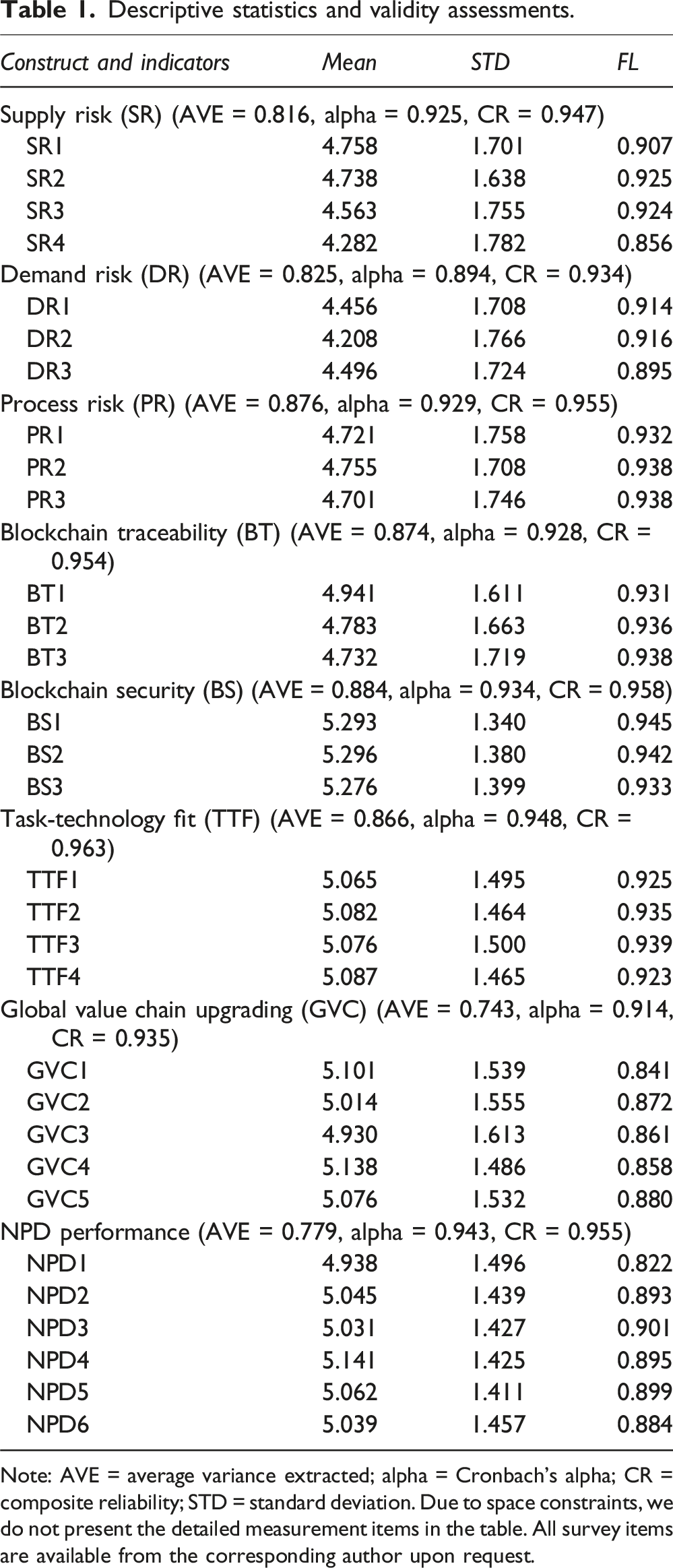
Note: AVE = average variance extracted; alpha = Cronbach’s alpha; CR = composite reliability; STD = standard deviation. Due to space constraints, we do not present the detailed measurement items in the table. All survey items are available from the corresponding author upon request.
Correlations among the variables and discriminant validity.

Note: N = 355. The square root of the AVE value of each study construct is highlighted in bold and italics.
Hypothesis testing
To examine the hypotheses, a structural model was constructed. The potential concern about multicollinearity was addressed by checking the variance inflation factor (VIF) values, all of which fell between 2.35 and 4.71, considerably below the recommended benchmark of 10 (Hair et al., 1998). Therefore, multicollinearity is not a serious problem in the data (Burns and Bush, 2000). Nevertheless, to eliminate potential multicollinearity, all independent and moderating variables were mean-centered while creating the interaction terms used for testing the moderating effect of GVC upgrading.
Figure 2 reports the SEM results. As shown in Figure 2, the coefficients of determination R2 are 0.555 and 0.581 for TTF and NPD performance, respectively, suggesting adequate explanatory power for the structural model. The path coefficients reported in Figure 2 provide the results of hypothesis testing. Specifically, significantly positive relationship is observed among the supply risk (b = 0.149, p < .01), demand risk (b = 0.172, p < .01), and process risk (b = 0.122, p < .05) and TTF of manufacturing firms in China. Therefore, a better blockchain technology–supply chain risk fit is found amid Chinese manufacturing firms experiencing supply, demand, and process risks, thereby strongly supporting Hypotheses 1–3. Results of the structural equation model.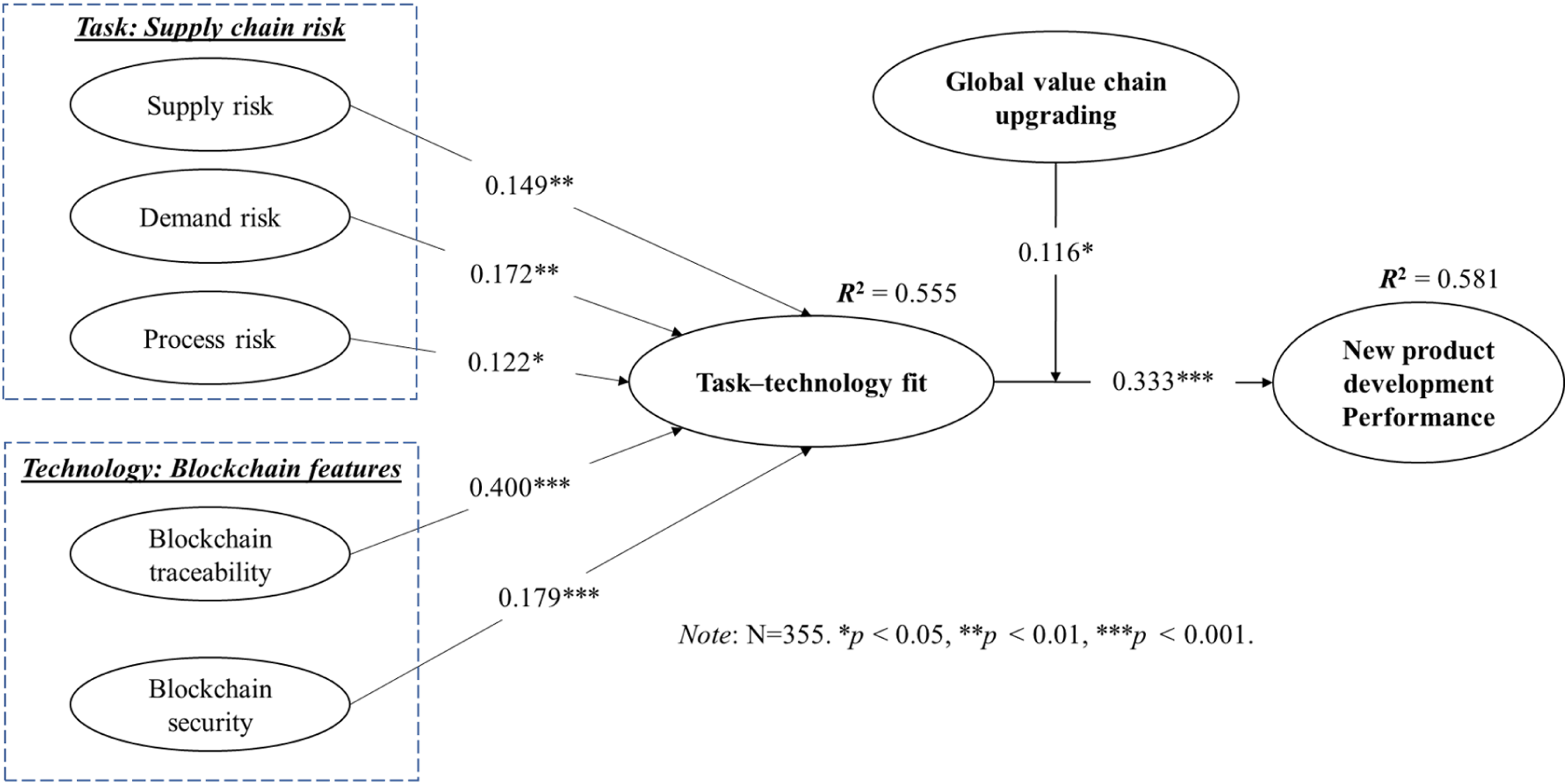
The relationship between the two major characteristics of blockchain technology (i.e., traceability and security) and the supply chain risk–blockchain fit was also tested. The results shown in Figure 2 suggest that blockchain traceability (b = 0.400, p < .001) and security (b = 0.179, p < .001) are statistically and positively associated with the supply chain risk–blockchain fit, demonstrating strong support for Hypotheses 4 and 5. Moreover, the supply chain risk–blockchain fit contributes positively to the NPD performance of manufacturing firms in China (b = 0.333, p < .001), thereby providing strong evidence for Hypothesis 6. Furthermore, the coefficients for the interaction between the supply chain risk–blockchain fit and GVC upgrading are statistically significant and positive (b = 0.116, p < .05), thereby supporting Hypothesis 7.
Results for direct and indirect effects.
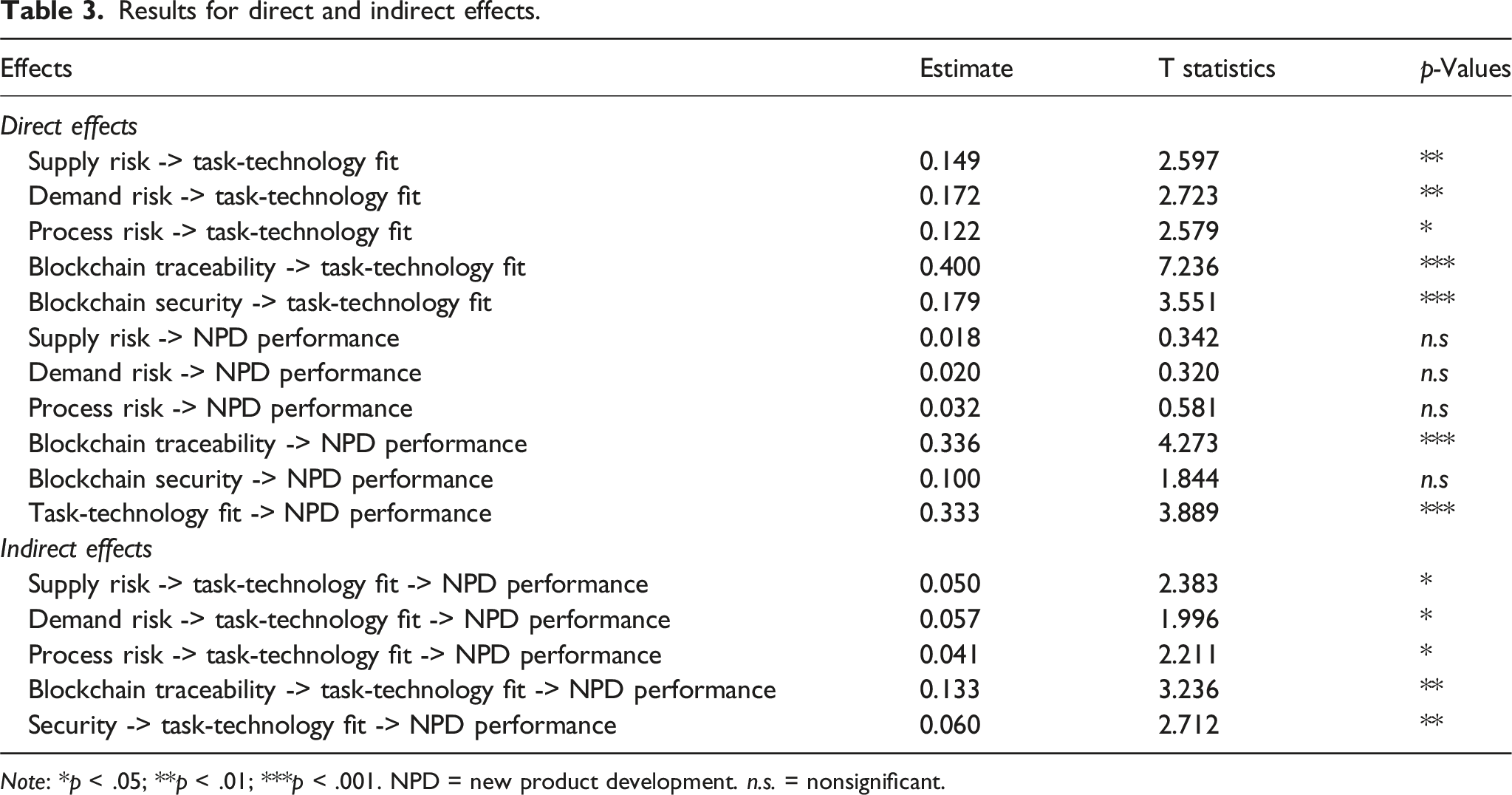
Note: *p < .05; **p < .01; ***p < .001. NPD = new product development. n.s. = nonsignificant.
Discussion and implications
Against the background of increasing market competition and evolving demands, global marketers are increasingly focusing on blockchain, supply chain, and value chain. The potential of blockchain technology to reduce supply chain risks is attracting heightened interest. As this focus deepens, the present study aims to empirically explore the role of major blockchain technology characteristics (i.e., traceability and security) in reducing supply chain risks. This study is geared toward aiding marketers in determining the relationship between blockchain technology characteristics. Therefore, the study offers important contributions to the literature by filling the gaps of related research on blockchain, supply chain, and value chain, thereby broadening the scope of application of the TTF theory and providing useful guidelines for firms. In this manner, firms can formulate a supply chain risk management strategy in the post-COVID-19 pandemic era effectively. The results obtained in this study are expected to provide an effective solution for firms to maximize their NPD performance.
Specifically, this study theorizes and empirically examines blockchain technology and supply chain risk management by proposing a series of hypotheses. The study suggests that supply chain risks and the information traceability and security of blockchain technology positively affect supply chain risk management by achieving a better supply chain risk–blockchain technology fit. This alignment, in turn, is expected to positively affect NPD performance. In addition, this study expects the relationship between supply chain risk–blockchain technology fit and NPD performance to be positively moderated by GVC upgrading. On the basis of the TTF theory, this study makes important contributions to the literature by theorizing the effect of the blockchain technology–supply chain risk fit on NPD performance. Particularly, this study provides theoretical and empirical clarifications on the relationships among the two main characteristics of blockchain technology, supply chain risks, value chain upgrading, and NPD performance. Furthermore, this study provides important implications for theory building by addressing several research gaps in the literature and a useful reference to firms to minimize supply chain risks using blockchain technology.
This study also offers important practical implications. First, it expects the blockchain technology–supply chain risk fit and the introduction of blockchain technology into supply chain risk management to reduce supply, demand, and process risks in the supply chain effectively. The results suggest that supply, demand, and process risks in the supply chain all positively contribute to the supply chain risk–blockchain technology fit. Given that each firm may face different supply chain risks, the requirements for blockchain technology vary. These results imply that firms must strengthen their cooperation with their suppliers, customers, and other firms to reduce supply chain risks (Chen et al., 2013). In other words, supply chain risk can be viewed as a double-edged sword, which can bring challenges and pressure to firms, and opportunities to adopt blockchain technology.
Second, the results demonstrate that the traceability and security of blockchain technology positively influence the supply chain risk–blockchain technology fit. Therefore, the results provide important implications by suggesting that blockchain technology can not only promote trust among the suppliers (Choi et al., 2019; Wang and Yang, 2022) and enhance the efficiency of business transactions among supply chain partners (Kim and Shin, 2019) but also meet the needs of firms to reduce supply chain risks. Having the blockchain technology–supply chain risk fit and adopting blockchain technology into supply chain risk management can help firms effectively reduce supply, demand, and process risks in the supply chain. Firms can maximize the traceability characteristics of blockchain technology, which allows easy verification of historical transaction records between firms in the supply chain and provides all participants with timely and accurate information about each product link. At the same time, blockchain technology provides a new security protection mode for network security. Given that data cannot be tampered with artificially, transaction records are encrypted, making information more real and reliable. Thus, upstream and downstream firms within the supply chain can conduct transactions with confidence. However, supply chain managers should be aware that the role of the two characteristics of blockchain technology in reducing supply chain risks may differ.
Moreover, this study expects the blockchain technology–supply chain risk fit to play a positive role in improving NPD performance. The results confirm this expectation by showing that supply chain risk–blockchain technology fit has a statistically significant and positive effect on NPD performance. The results of this study are consistent with those of the previous literature, which states that blockchain technology can not only help firms improve functional efficiency (Liang et al., 2021) but also help improve NPD performance. Only by improving the blockchain technology–supply chain risk fit can firms effectively improve their NPD performance. Therefore, firms should maximize the characteristics of blockchain technology to meet the needs of supply chain risk management. That is, given the different potential supply chain risks that each firm may encounter, this study expects blockchain technology requirements to differ. Therefore, managers should understand that improving the blockchain technology–supply chain risk fit is the only effectively means to enhance their firm’s performance.
Furthermore, this study suggests value chain upgrading to moderate the relationship between TTF and firm performance positively. Specifically, value chain upgrading has a positive moderating effect between supply chain risk–blockchain technology fit and NPD performance. As indicated in the previous literature, the level at which a firm is located in the GVC determines what supply chain management strategy will be implemented (Golini et al., 2016). Therefore, when using blockchain technology to reduce supply chain risks, firms should be aware of the importance of updating their position in the value chain and utilizing blockchain technology to minimize supply chain risks. This understanding is necessary for firms and managers to improve their performance substantially. These results imply that when firms attempt to reduce supply chain risks by adopting blockchain technology, they must upgrade their position in the value chain to improve the contribution of such fit to their NPD performance. The better the value chain upgrading is, the greater the positive effect of the supply chain risk reduction task will be, through the use of blockchain technology on NPD performance. For this reason, manufacturing firms should use the best technology, equipment, knowledge, skills, and other resources to facilitate their transformation toward higher value-added and higher-end directions.
Overall, this study pioneers an exploration into the theoretical and empirical performance implications of the simultaneous pursuit of blockchain technology adoption and supply chain risk management. By extending a small but influential empirical literature on blockchain technology adoption and supply chain risk management, the findings demonstrate that the pursuit of TTF provides a benefit by alleviating tradeoffs in achieving higher performance. This study also contributes to the literature on the influence of GVC upgrading on the relationship between TTF and NPD performance, providing important insights about how GVC upgrading affects the performance implications of TTF. The results provide empirical support for the importance of GVC upgrading in supply chain management, as well as the interface of TTF and GVC for strategic decisions and firm performance.
Although this study offers valuable contributions in enriching the theoretical and empirical research on blockchain adoption and supply chain and value chain management, it also has several limitations, which provide important avenues for future research. First, given data constraints, this study only focuses on Chinese manufacturing firms and uses China as the research setting. The political, economic, and cultural environments of China may vary from other emerging economies or more advanced economies. Thus, future research is encouraged to enhance the generalizability of the results produced in the present study and extend it by collecting data on samples from other emerging or more advanced economies. Second, the value chain upgrading of firms may involve multiple links within the value chain networks, such as the procurement and distribution processes. Given that this study only focuses on the improvement of the position improvement in the value chain network, future research must expand the scope of the measurement for value chain upgrading. Third, this study largely focuses on the information security and traceability of blockchain technology. As an emerging technology, blockchain may have various complex characteristics, such as decentralization, openness, and nontamperability. Thus, future research should explore the role played by other characteristics of the blockchain technology in depth. In addition, this study only investigates the role of blockchain technology–supply chain risk fit in contributing to one dimension of firm performance. Researchers should extend this stream of study by examining the value of TTF in improving additional dimensions of firm performance, such as financial and environmental performance. Finally, although this paper offers insights into the role of blockchain in mitigating supply chain risks, it opens opportunities for future research to examine the potential implications of other emerging digital technologies. Technologies such as big data, artificial intelligence, fintech, and broader digital transformations could also play a significant role in managing supply chain risks and improving performance. Consequently, future work focused on these newer technologies could contribute to novel understandings in this sphere of the literature.
Footnotes
Declaration of conflicting interests
The author(s) declared no potential conflicts of interest with respect to the research, authorship, and/or publication of this article.
Funding
The author(s) received no financial support for the research, authorship, and/or publication of this article.
