




Abstract
Creativity and service innovation in the banking sector have been attracting the attention of researchers in Vietnam recently. Therefore, this study focuses on examining the influence of knowledge acquisition and knowledge provision on individual creativity and service innovation in the banking sector. The structural equation modeling (SEM) is used to analyze survey data from 282 employees working in the banking sector in Vietnam. The results show that knowledge acquisition has a direct positive influence on creativity and service innovation. Knowledge acquisition also has an indirect positive influence on service innovation through the mediating role of creativity. Furthermore, knowledge provision has a direct positive influence on knowledge acquisition and an indirect positive influence on creativity and service innovation. Based on these findings, the study provides implications for theory and practice in promoting knowledge sharing to enhance creativity and service innovation in the banking sector.
Introduction
Creativity and innovation have been compelling topics for many researchers in recent times. The rapid changes in the business environment have driven organizations to seek optimal solutions to gain a competitive advantage. The knowledge-based view of the organization is an extension of the resource-based theory, positing that knowledge is a crucial resource for creating competitive advantages (Kucharska and Erickson, 2023). Garcia-Perez et al. (2020) also argues that creating and accumulating resources related to knowledge is the most appropriate competitive advantage. Knowledge is a strategic resource with the power to transform individuals, companies, and even nations (Ávila, 2022). Creativity and innovation are key factors that can bring about sustainable competitive advantages. Allameh et al. (2020) suggest that organizations must build their foundation on knowledge and particularly emphasize knowledge acquisition and creativity to gain a competitive edge in the market. Knowledge is continuously increasing and diversifying. Allameh et al. (2020), which requires companies to constantly update the necessary knowledge in line with development trends. Absorbing knowledge can enhance the utilization of existing internal knowledge and become more effective in assimilating new technologies (Griffith et al., 2012).
Ahmed et al. (2016) argue that the creativity and innovation of an organization depend on the sharing of knowledge that occurs within the organization's internal context. Therefore, knowledge management is considered an important activity in driving organizations to expand their knowledge repository, thereby generating creativity ideas and leading to organizational innovation. The banking industry is a knowledge-intensive sector that faces increasing competitive pressures. Therefore, from a resource-based view on knowledge, it holds particular significance for knowledge-intensive organizations, as knowledge needs to be continuously replenished. Building on a knowledge foundation to stimulate employee creativity in addressing and meeting diverse customer needs and employees' innovative efforts to satisfy customer demands creates pressure for service innovation within the organization (Jung and Yoon, 2016; Huang and Liu, 2019).
Knowledge management is a process that encompasses various activities, with knowledge sharing being a crucial unit of knowledge management activities (Javaid et al., 2020). However, knowledge sharing is not a one-way process but involves both the supply and demand for new knowledge (Ardichvili et al., 2003). Therefore, van den Hooff and de Ridder (2004) suggest that the knowledge sharing process is bidirectional, encompassing both knowledge provision and knowledge acquisition. Some studies have approached knowledge sharing as a unidirectional concept (Jolaee et al., 2014;Abdelwhab Ali et al., 2019; Javaid et al., 2020), while others argue that knowledge sharing should be viewed as a multidirectional structure (Reinholt et al., 2011; Ahmed et al., 2016; Soda et al., 2019), meaning that it includes both knowledge provision and acquisition. Nguyen (2021) points out that most previous studies have focused on the one-way behavior of knowledge sharing, from the provider to the recipient, with limited investigation of both aspects, including knowledge acquisition and provision. Therefore, the two aspects of knowledge acquisition and provision should be separately examined within the same context (Nguyen et al., 2019).
Although there have been some prior studies examining knowledge sharing from two perspectives, knowledge provision and knowledge acquisition, such as (Reinholt et al., 2011; Ahmed et al., 2016; Soda et al., 2019) the relationship between knowledge provision and knowledge acquisition has not been fully explored. The relationship between knowledge provision and knowledge acquisition, as well as their roles in fostering creativity and innovation within knowledge-intensive organizations, is a question that needs to be clarified. Therefore, this study focuses on exploring the relationship between knowledge provision and knowledge acquisition within the same research framework, creativity and innovation based on social exchange theory and resource-based theory. The findings from this research will provide a deeper understanding of the intricate relationship between knowledge sharing, creativity, and innovation in knowledge-intensive organizations.
Although the transition from creativity to innovation has been discussed in some previous studies, both Chang and Teng (2017); Huang and Liu (2019) confirm that the relationships between the antecedents and consequences of creativity, as well as how creativity influences organizational service innovation, have not been well connected. Liu et al. (2017) argue that there is a lack of empirical research examining the relationship between overall employee creativity and organizational innovation. Recent studies such as Liu et al. (2017), Kim and Choi (2023) have highlighted a key issue in innovation research, which is the lack of clarity on how to effectively implement and translate creative ideas into innovation.
Both Henttonen, Kianto and Ritala (2016); Ahmad and Karim (2019) confirm that previous studies on knowledge sharing have primarily focused on examining the antecedents of knowledge sharing, with limited research exploring the consequences of knowledge sharing. A review of studies conducted in Vietnam shows that most recent research has only focused on the behavior of knowledge sharing (Nguyen et al., 2019; Nguyen and Malik, 2020) without considering the consequences of knowledge sharing, such as creativity and innovation. Therefore, this study extends from prior research by simultaneously examining both aspects of knowledge provision and knowledge acquisition and how they drive innovation through a mediator of creativity within knowledge-intensive organizations.
The results of this study provide some important evidence not fully explored in previous research. First, knowledge provision positively influences knowledge acquisition; second, knowledge provision does not have a direct impact on creativity and innovation but exerts an indirect influence through a mediator of knowledge acquisition. Additionally, creativity is also considered to play a mediator role in the relationship between knowledge acquisition and innovation.
In summary, this study extends the resource-based theory by considering knowledge as a vital resource within organizations. Consequently, it integrates the investigation of knowledge sharing, creativity, and innovation within the same research framework. By applying social exchange theory, this study explores the relationship between knowledge provision and knowledge acquisition, a relationship that has been underexplored in previous research, and subsequently examines their influence on creativity and innovation. The results of this study make a valuable contribution to the theoretical foundation, providing a deeper understanding of the relationship between knowledge sharing, creativity, and innovation. From a practical perspective, the findings of this research assist organizations operating in knowledge-intensive fields, such as banking, in understanding the benefits of knowledge sharing through knowledge provision and acquisition to enhance creativity and promote innovation. To achieve these objectives, the structural equation modeling is used to test the research hypotheses through SPSS 20 and AMOS 20 software.
The structure of the paper includes an introduction, theoretical framework and research model, research methodology, research findings and discussion, and finally, the conclusion and implications of the study.
Literature review
Amabile (1996) developed a three-component model of creativity, including expertise, creative skills, and motivation. The expertise component refers to what a person knows and is able to work with or solve problems in a specific field. Expertise includes knowledge, skills, techniques, talent, and intelligence. Amabile (1996) also argues that expertise plays an important role and is the foundation of all creative activities. This model has been widely used by many researchers by exploring it from various perspectives. One of the approaches to analyzing creativity is based on individuals’ knowledge. Therefore, to be creative, individuals first need to have expertise and skills in that particular field. Davenport (1998) point out that knowledge is personal, so organizations can only effectively manage their knowledge assets when employees are willing to collaborate with colleagues to contribute knowledge to the organization.
Until now, there has been a lack of consensus among researchers regarding the definition of creativity and innovation (Anderson et al., 2014). Creativity is considered as the process of generating new, novel, and useful ideas. It is seen as the initial stage of innovation, while innovation emphasizes the implementation of those ideas (Amabile, 1996; Anderson et al., 2014). The perspective based on organizational knowledge is an extension of resource-based theory. This theory posits that knowledge is a vital resource, and organizations can capture and leverage this knowledge to gain a competitive advantage (Kucharska and Erickson, 2023). Knowledge sharing, including both knowledge provision and knowledge acquisition, reflects social interactions based on reciprocal standards (Radaelli et al., 2014). Social exchange theory argues that social interactions are governed by reciprocal standards, where individuals respond in kind to reciprocate with their peers (Blau, 1964). Watson and Hewett (2006) suggest that when a person shares knowledge, they create a sense of indebtedness in the recipients, and these knowledge recipients subsequently seek ways to reciprocate. The relationship between knowledge acquisition, creativity, and service innovation has been supported by the research findings of Huang and Liu (2019), who argue that knowledge acquisition can enhance services through employee creativity.
Some studies approach knowledge sharing as a one-way structure, but divide it into tacit and explicit knowledge (Reychav and Weisberg, 2010; Wang and Wang, 2012; Le et al., 2020) while others argue that knowledge sharing is a two-way process, involving both knowledge acquisition and knowledge contribution (Ahmed et al., 2016; Soda et al., 2019). Knowledge sharing is always a challenging task as it involves both the “receiving” and “giving” of knowledge from various social entities (Ahmed et al., 2016). Therefore, approaching knowledge sharing as a two-way structure to examine its impact on individual creativity would be more comprehensive. • Knowledge acquisition, creativity and innovation
Knowledge acquisition is the activity of capturing specialized knowledge from individuals and other knowledge sources to aid an organization in specific ways (Milton, 2007). Jelinek (2017) further argues that knowledge acquisition refers to the process of identifying and capturing knowledge from the internal environment of an organization or from the external environment. Individuals with broader access to knowledge are capable of offering multiple perspectives, thereby stimulating the integration of new knowledge. Perry-Smith and Shalley (2003) contend that increasing knowledge will promote skills related to creativity, thus enhancing employees' propensity for creativity in their work. Similarly, de Jong and Den Hartog (2007) assert that sharing knowledge within an organization can enhance new idea generation and creativity among employees. Through individual cognitive structures, individuals who acquire more knowledge have a higher capacity for creativity (Soda et al., 2019).
The knowledge acquisition process involves the interaction of employees seeking advice and learning from their peers, thereby new knowledge acquisition (Ahmed et al., 2016). Huang and Liu (2019) have shown that knowledge acquisition from colleagues offers opportunities for knowledge exploration and accessing new ideas, with individuals who have a higher level of knowledge absorption and exploration more likely to gain valuable knowledge and insights to enhance their creativity. Ahmed et al. (2016) also suggest that knowledge acquisition behavior shapes creative thinking and promotes employees' intention to be creative. Therefore, if an employee actively engages in knowledge acquisition, they can become more creative in their respective domains. The findings of previous studies, such as Ahmed et al. (2016); Soda et al. (2019) have demonstrated a positive relationship between knowledge acquisition and individual creativity.
Knowledge acquisition plays a crucial role in the organizational learning process as it helps the organization continuously develop and expand its knowledge base, thereby fostering innovation activities (Ngoc Thang and Anh Tuan, 2020). Chen and Huang (2009) argue that newly acquired knowledge interacting with existing knowledge generates new knowledge for the organization, thus enhancing its creative and innovative capabilities. The research findings of Huang and Liu (2019); Ge et al. (2023) demonstrate the positive influence of knowledge acquisition on creativity and innovation. Based on this foundation, the authors put forward the following hypothesis:
Knowledge acquisition positively influences individual creativity.
Knowledge acquisition positively influences service innovation. • Knowledge provision Knowledge flows typically have a two-way nature, with employees engaging in both knowledge acquisition and knowledge provision within an organization. Simultaneously, individuals who acquire more knowledge tend to have more information to share with their colleagues Soda et al. (2019). Therefore, knowledge provision plays a crucial role in fostering individual creativity. Davenport and Prusak (1998) have demonstrated the link between knowledge sharing, knowledge transfer, and knowledge acquisition. Building upon this perspective, Reinholt et al. (2011) have divided the structure of knowledge sharing into two components: knowledge acquisition and knowledge provision. van Den Hooff and De Ridder (2004) argues that knowledge provision represents the transmission of knowledge from one employee to others. Knowledge provision is part of knowledge sharing, which facilitates the generation of more new knowledge within an organization. Chen and Hung (2010); Yan et al. (2013); Ahmed et al. (2016) all confirm that knowledge provision supports the use of knowledge for improvement, creativity and innovation in work. Ahmed et al. (2016) also determined that knowledge provision stimulates employee creativity and enhances innovation outcomes. Chen and Huang (2009), Andreeva and Kianto (2011) argue that both knowledge acquisition and knowledge provision have the potential to foster innovation. The findings of previous studies, such as Ahmed et al. (2016); Soda et al. (2019) also showed a positive relationship between knowledge provision and individual creativity. Based on this foundation, the authors propose the following hypothesis:
Knowledge provision positively influences individual creativity.
Knowledge provision positively influences service innovation. • Creativity and innovation Chang et al. (2014) argue that employee creativity involves generating novel and valuable ideas, which is a key factor contributing to organizational innovation and creating a competitive advantage in a dynamic environment. This is why employee creativity has attracted the attention of many researchers Saunila et al. (2014); Zhou and George (2001) conclude that most studies on creativity and innovation primarily emphasize employee creativity as the starting point for innovation. According to El-Kassar et al. (2022) an individual’s creativity and their ability to learn and share knowledge lead to an innovation process that facilitates personal development. Sharing information is crucial for both idea generation and the implementation of innovations. Therefore, an environment where employees share the outcomes of their knowledge in improving innovative behavior will encourage employees to be proactive and explore different perspectives. According to Zhou and George (2001) studies on creativity and innovation often consider employee creativity as the starting point for innovation. Giannopoulou et al. (2014) argue that any form of innovation initially requires creativity, and without creativity, the potential for innovation is unlikely to occur Howard et al. (2008) also state that without creativity, there is no potential for innovation, as it is where truly innovative ideas are realized and transformed into commercial value. Liu et al. (2017) found evidence supporting a positive relationship between creativity and innovation. The research findings of Huang and Liu (2019) demonstrate a positive relationship between creativity and service innovation within the hotel industry. Based on the aforementioned arguments, the authors propose the following hypothesis:
Creativity positively influences service innovation. Reinholt et al. (2011) approached knowledge sharing in two components, including knowledge acquisition and knowledge provision. This means that knowledge sharing involves not only giving but also receiving. Konstantinou and Fincham (2011) argue that employees engage in knowledge exchange rather than just knowledge sharing, as they expect future reciprocity. Therefore, those who are willing to provide knowledge to others are also likely to receive more knowledge in return in the future. This argument aligns with the social exchange theory, which is based on the principle of “give and take.” Radaelli et al. (2014) suggest that employees who share more knowledge are more likely to receive back new ideas and support from others, thus providing them with more opportunities to engage in innovative behaviors. The empirical findings of Soda et al. (2019) demonstrate that knowledge provision positively influences knowledge acquisition. Based on this foundation, the study proposes the following hypothesis:
Knowledge provision positively influences knowledge acquisition. Based on the reasoning and hypotheses presented, the article proposes a research model like Figure 1.
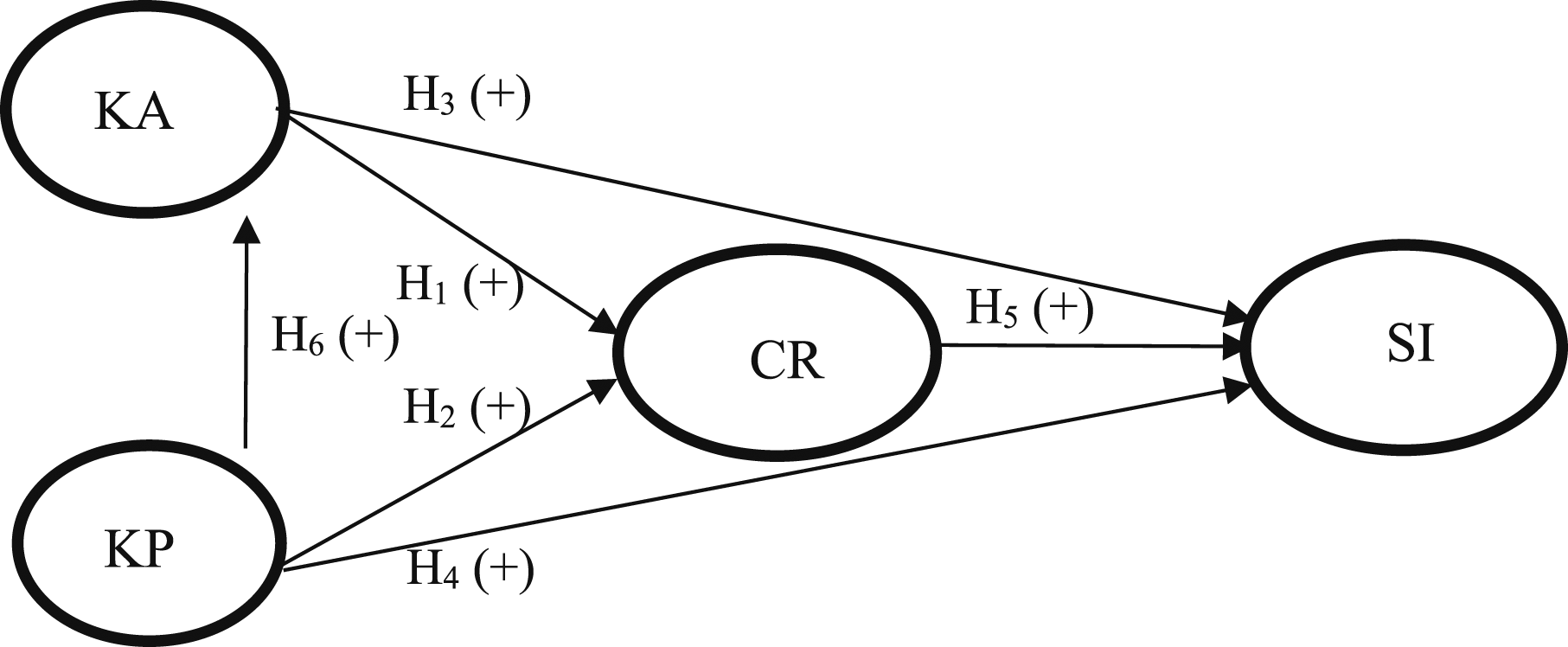
Research model. Note: KA = Knowledge Acquisition; KP = Knowledge Provision; CR = Creativity; SI = Service Innovation.
Research methods
Sample
The data in this study was collected through a survey questionnaire administered to employees working in the banking sector in Ho Chi Minh City. With the rapid development of science and technology, the banking industry in Vietnam is facing increasing competitive pressure. Therefore, innovation and creativity activities are of interest to managers in this field. The study distributed 450 survey questionnaires and received 321 responses, corresponding to a response rate of 71.3%. After screening out invalid questionnaires, the final sample size of this study was 282. In the research sample, males accounted for 22.7% and females accounted for 77.3%. The age distribution of the survey participants was as follows: ages 21-30 accounted for 16.3%; ages 31-40 accounted for 43.2%; ages 41-50 accounted for 27%, and over 50 accounted for 13.5%. The predominant educational level in the research sample was undergraduate degree holders at 76.6%, followed by postgraduate degree holders at 23.4%.
Measurement
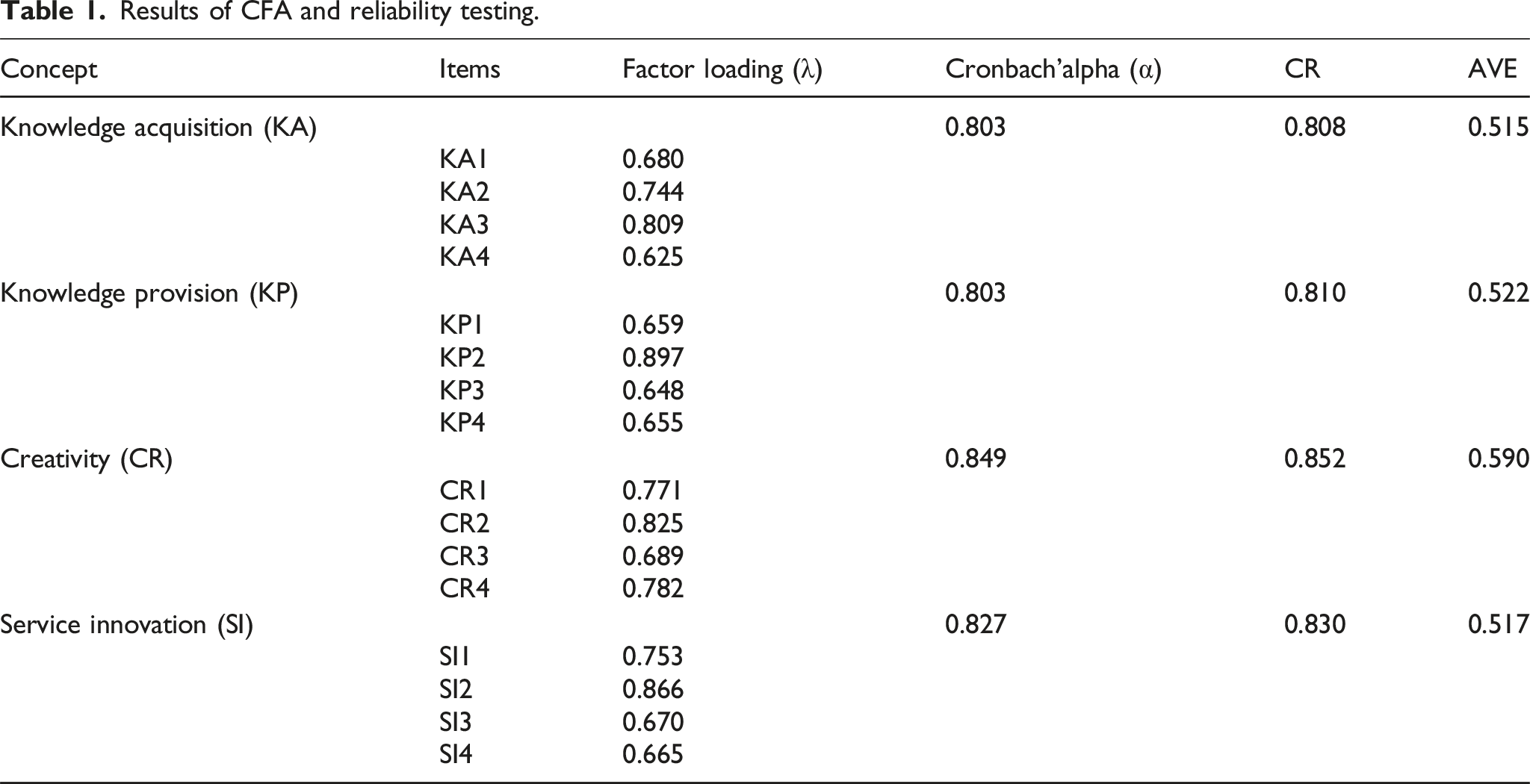
This study used a 5-point Likert scale, with level 1 corresponding to “strongly disagree” and level 5 corresponding to “strongly agree.” To ensure clarity of the survey items on the scale, a preliminary interview was conducted with 12 employees currently working in banks to refine and clarify the survey items before conducting the formal survey. All items of constructs in this study were adapted from previous papers to ensure reliability and validity. This study evaluated the reliability and convergence value of the construct through Cronbach's alpha, Composite reliability (CR), Average variance extracted (AVE).
Knowledge acquisition: This construct consists of four items adapted from previous studies (Reinholt et al., 2011; Soda et al., 2019). Items are “I received knowledge from colleagues in my own department”; “I used knowledge provided by colleagues in my own department”; “I received knowledge from colleagues in other departments”; “I used knowledge provided by colleagues in other departments.” Cronbach’s alpha was 0.803; and the CR was 0.808, with an AVE value of 0.515.
Knowledge provision: This study evaluated knowledge provision using four items from the research of Zhou and George (2001); Soda et al. (2019). Items are “Colleagues from my own department have received knowledge from me”; “Colleagues from my own department have used knowledge provided by me”; “Colleagues from other departments have received knowledge from me”; “Colleagues from other departments have used knowledge provided by me.” The Cronbach’s alpha value for this construct was 0.803, CR was 0.810, AVE was 0.522.
Creativity: This construct consists of four items adapted from previous studies (Zhou and George, 2001; Soda et al., 2019). Items are “I provide new ideas to improve the department’s performance”; “I suggest new ways of optimizing processes and routines”; “I suggest new ways to increase quality”; “I come up with creative solutions to emerging problems.” Cronbach’s alpha was 0.849, CR was 0.852, AVE was 0.590. These measures suggest that the construct achieves reliability and convergent validity.
Service Innovation: This current study rated service innovation using five items adapted from the research of Grawe et al. (2009), Huang and Liu (2019). Items are “Innovation is already readily accepted in bank management”; “Our bank’s top management gives special emphasis to service innovation”; “Our bank constantly seeks new ways to provide better service to our customers”; “Our bank is able to change/modify our current service approaches to meet special requirements from customers”; “Compared to our competition, our organization is able to come up with new service offerings.” However, the exclusion of the item “Compared to our competition, our organization is able to come up with new service offerings” was justified due to its Corrected Item-Total Correlation coefficient being less than 0.3. Cronbach’s alpha was 0.827; and the CR was 0.830, with an AVE value of 0.517. These measures suggest the construct is reliable and characterized by convergent validity.
Results and discussion
Measurement model
Results of CFA and reliability testing.
Structural model
This study employs the structural equation modeling (SEM) to test the model and proposed hypothesis tests. The results of the structural model present an acceptable model fit: CMIN/df = 2.069, CFI = 0.942, TLI = 0.933, and RMSEA = 0.064. The standardized regression weights are all greater than 0.5 (p < 0.001).
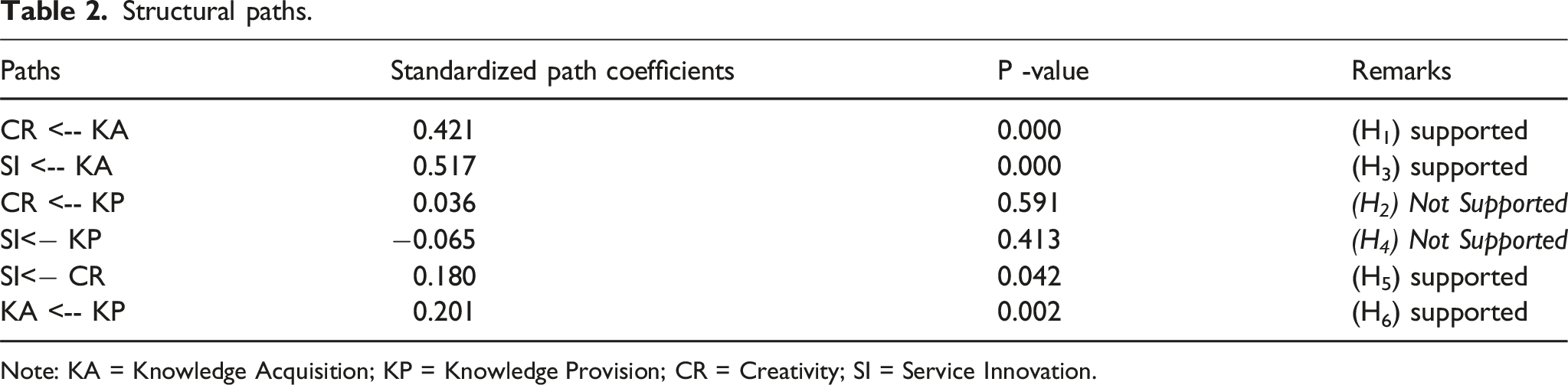
The results indicate a positive relationship between KA and CR (β 1 = 0.421, p < 0.001). KA has a significant, positive effect on SI (β3 = 0.517, p < 0.001). Thus, hypotheses H1 and H3 are accepted. However, KP has a nonsignificant effect on CR (β2 = 0.036, p > 0.05) and a nonsignificant effect on SI (β4 = −0.065, p > 0.05). Thus, hypotheses H2 and H4 were not supported.
CR had a positive effect on SI (β5 = 0.180, p < 0.001). Thus, H5 was accepted. Lastly, the effect of KP on KA is positive and significant (β6 = 0.201, p < 0.001). Thus, Hypothesis 6 was supported. The results showed that KP does not directly affect CR, but it indirectly influences CR through the intermediary role of PA (β = 0.086, p < 0.01). Similarly, KP does not directly affect SI, but it indirectly influences SI through the intermediary role of PA (β = 0.105, p < 0.01). These results show that the standardized coefficients (Figure 2) of KA to CR are positive (β = 0.218, p < 0.001), CR is positive to SI (β = 0.148, p < 0.05), and the indirect effects of KA are significant (β = 0.059, p < 0.05). Table 2 summarizes the hypothesis testing results of the study. Results of the structural equation model. Note: KA = Knowledge Acquisition; KP = Knowledge Provision; CR = Creativity; SI = Service Innovation ***p < 0.001; **p < 0.01; *p < 0.05. Structural paths. Note: KA = Knowledge Acquisition; KP = Knowledge Provision; CR = Creativity; SI = Service Innovation.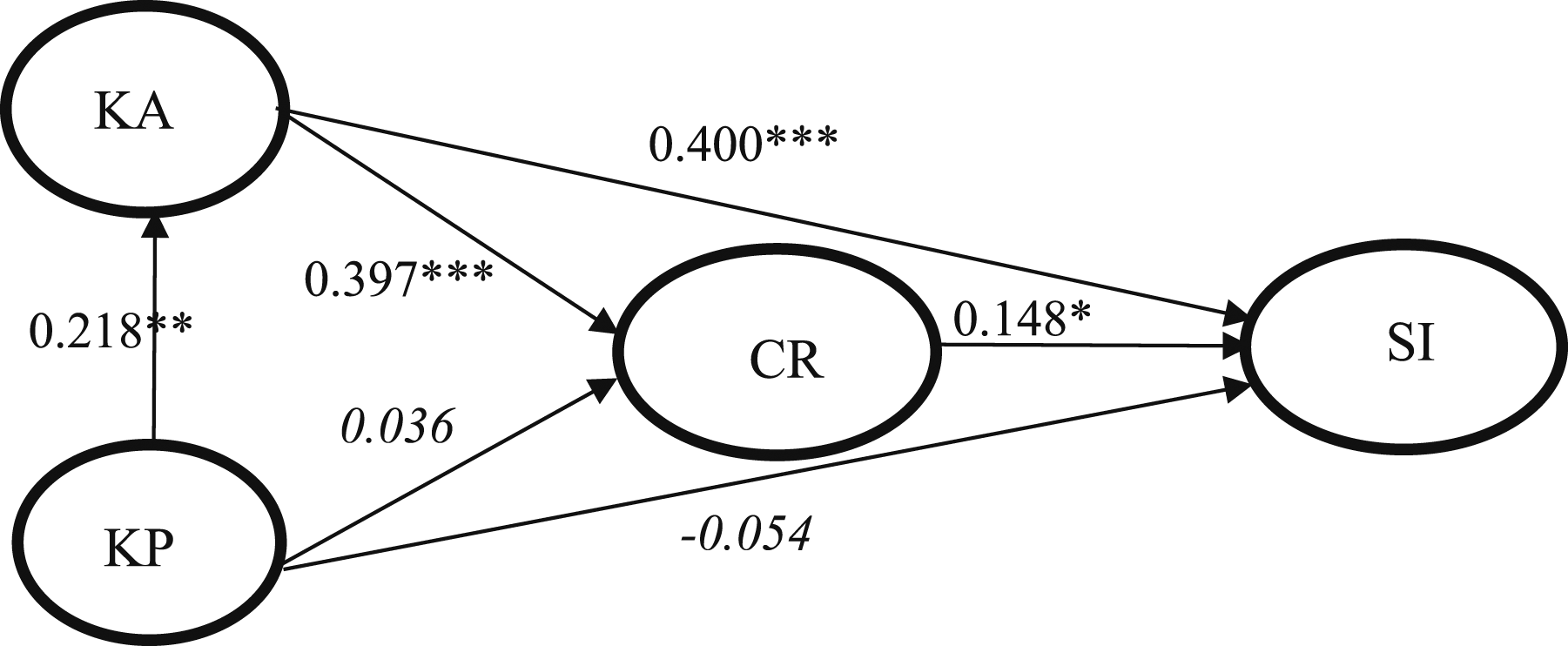
Discussion
Although hypotheses H2 and H4 were not supported, the research results provide support for hypothesis H6. This suggests that knowledge provision may not directly influence individual creativity and service innovation, but it indirectly affects them through the mediating role of knowledge acquisition. An important finding in this study is the impact of knowledge provision on knowledge acquisition. Consistent with the reciprocation standards from social exchange theory, when an employee engages in the behavior of providing knowledge to other employees, they also receive reciprocation of knowledge from those employees. Radaelli et al. (2014) argue that knowledge provision is an effective strategy for knowledge acquisition through the reciprocation process of the recipients. The relationship between knowledge provision and creativity and innovation is not supported. An explanation for this could be the presence of knowledge acquisition. Employees may easily provide explicit knowledge but struggle to provide tacit knowledge (Kucharska and Erickson, 2023) because tacit knowledge is abstract, hard to understand, difficult to express, and explain to others (Chergui et al., 2020). When employees acquire a wealth of knowledge, it fosters the development of knowledge breadth, enhancing adaptability and learning capabilities. Consequently, this can lead to better innovative outcomes (Du, 2021).
Therefore, according to this logic, employees' knowledge provision primarily consists of explicit knowledge because it can be easily explained for others to understand (Reychav and Weisberg, 2009) and can be disseminated through verbal communication (Kaushal and Nyoni, 2022). However, Reychav and Weisberg (2009) also argue that tacit knowledge is more valuable than explicit knowledge, and tacit knowledge is considered a more “expensive” type of knowledge than explicit knowledge. Meanwhile, the process of knowledge acquisition reciprocated from other employees helps combine internal knowledge and external knowledge into new knowledge. Based on the internalization and combination process proposed by Nonaka and Takeuchi (1995), when receiving tacit and explicit knowledge, the recipient must construct, integrate, and interpret information to generate new and creative knowledge. This action triggers the process of building and reconstructing perceptions to provide new understanding and support for creativity and innovation (Kucharska and Erickson, 2023).
Therefore, knowledge acquisition is a crucial step for the transformation into new knowledge and the stimulation of innovation. Providing knowledge is seen as the initial stage of interaction under the lens of a reciprocation standard. At the knowledge provision stage, employees may not possess sufficient capability to transform it into new knowledge in a creative and innovative manner. Creativity is associated with the ability to generate new and useful ideas (Amabile, 1996). Thus, to foster creativity, employees are required to embrace new knowledge, combining it with existing knowledge through internalization and externalization processes to generate novel knowledge. The newly acquired knowledge interacts with the existing knowledge, contributing to the refinement of the organization's knowledge, thereby enhancing both the breadth and depth of organizational knowledge and increasing the potential for creative outcomes (Chen and Huang, 2009).
The acceptance of hypotheses H1 and H3 indicates that knowledge acquisition had a positive influence on individual creativity and service innovation. This demonstrates the important role of knowledge acquisition in fostering individual creativity within an organization. When employees acquire knowledge through sharing, particularly within their team, department, or organization, it enables them to explore knowledge and access new ideas to enhance their creative abilities, as demonstrated by Huang and Liu (2019). These findings align with the theory of the components of creativity proposed by Amabile and Pillemer (2012). One of the components contributing to individual creativity belongs to the individual's internal factors. The first factor identified by Amabile and Pillemer (2012) is domain-specific knowledge in the area in which the individual seeks to be creative. The results regarding this relationship reaffirm the findings of previous studies, such as Soda et al. (2019), Huang and Liu (2019).
The research findings of Huang and Liu (2019) demonstrate that when employees receive new knowledge from customers or colleagues, they have the ability to contribute to innovative solutions and transform them into organizational innovations. Studies by Darroch (2005); Chen and Huang (2009); Andreeva and Kianto (2011) also indicate that knowledge acquisition has a positive impact on organizational innovation. Therefore, this research result suggests that when employees acquire knowledge from others, it increases their knowledge both in depth and breadth, enhances their ability to integrate knowledge from within and outside the organization, and thus has the potential to lead to innovation within the organization (Yli-Renko et al., 2001).
The acceptance of hypothesis H5 confirms that individual creativity has a positive influence on service innovation in the banking sector. The relationship between individual creativity and service innovation has been found in previous research by Huang and Liu (2019) in the hotel service field. However, the relationship between creativity and innovation in the banking service sector is still limited. As indicated by previous studies, innovation can be driven by various factors, but individual creativity is the primary factor in the innovation process of an organization. To foster service innovation, the creativity of employees is essential. The banking sector is a knowledge-intensive domain; therefore, to foster innovation, knowledge plays a crucial role. Employees who regularly assimilate knowledge from their peers are more likely to generate new knowledge, leading to the creation of creativity ideas and the ability to actively participate in the innovation process. Creativity at the organizational, group, or individual level can all contribute to the formation and promotion of innovation. Employees with higher levels of individual creativity tend to be more engaged in the innovation process. These findings are consistent with many previous studies on the relationship between creativity and innovation. The research results of Huang and Liu (2019) serve as evidence for the relationship between employee creativity and service innovation in an organization.
Furthermore, creativity plays an intermediary role in the relationship between knowledge acquisition and innovation. Ahmed et al. (2016) argue that knowledge acquisition stimulates employee creativity and innovation capabilities. This finding aligns with earlier discoveries by Smith et al. (2005), as well as Andreeva and Kianto (2011). In the knowledge-intensive domain, the mediator role of creativity in the relationship between knowledge acquisition and innovation becomes even more pronounced. Andreeva and Kianto (2011) also posit that creativity is a central process for generating innovation, and the knowledge absorption process influences innovation by creating favorable conditions for creativity through the provision of raw materials for it. However, the findings of this study differ somewhat from those of Andreeva and Kianto (2011). Specifically, knowledge acquisition not only has indirect but also direct effects on innovation. This discrepancy may be attributed to the contextual choice of knowledge-intensive domains, which differs from the less knowledge-intensive domains studied by Andreeva and Kianto (2011).
Therefore, both knowledge acquisition and knowledge provision remain important components in driving service innovation and creativity within organizations. As argued by Soda et al. (2019), knowledge flows often have a two-way nature, and employees engage in both receiving and providing relevant information. Individuals who acquire more knowledge will have more information to share with their colleagues. In the service industry, the banking sector is one that faces pressure for rapid innovation to gain a competitive advantage. The findings of this study suggest the need to promote knowledge sharing (including both knowledge acquisition and provision) to enhance individual creativity and, consequently, generate service innovation within the organization.
Conclusion and implications
Conclusion
This study examines the influence of knowledge acquisition and knowledge provision on individual creativity and service innovation in the banking sector in Vietnam. Data was collected using a convenience sampling method from 282 employees working in the banking industry. A linear structural model was used to test the research hypotheses. The results demonstrate the significant role of knowledge acquisition in fostering individual creativity and service innovation in the banking sector. While knowledge provision does not have a direct impact, it indirectly affects creativity and innovation through the mediating role of knowledge acquisition. Additionally, a positive relationship between creativity and service innovation was also found in this study.
Implications
This research makes significant contributions both theoretically and practically in the context of knowledge management, creativity, and innovation.
Theoretically, the study extends the theory of the relationship between knowledge provision and knowledge acquisition within a comprehensive model of creativity and innovation. This relationship has been explored to a limited extent in previous studies. The findings of this study indicate that providing knowledge positively influences knowledge acquisition. However, knowledge provision only indirectly affects creativity and innovation through knowledge acquisition. In knowledge-intensive organizations such as the banking industry, these organizations not only exploit existing knowledge but also need to discover new knowledge to create a foundation for creativity and innovation. Therefore, knowledge provision is considered a source of input to supplement and combine with existing knowledge (knowledge acquisition) to generate new knowledge. In turn, knowledge acquisition creates conditions to stimulate creativity, thereby enhancing innovation. Andreeva and Kianto (2011) also confirm that knowledge acquisition is often deemed particularly important for knowledge-intensive industries.
In practical terms, this research suggests considerations for organizations operating in knowledge-intensive sectors, such as banks, when undertaking innovation activities within the organization. Notably, knowledge acquisition is of particular importance for fostering creativity and innovation. Some practical implications include:
Firstly, according to Amabile (1996), knowledge and specialized skills are crucial components that contribute to individual creativity. Therefore, creating an environment that promotes knowledge sharing among employees within departments and across the organization in both “giving” and “receiving” directions is essential. Banks need to find ways to encourage knowledge acquisition through various forms to enhance employees' domain-specific knowledge. Knowledge acquisition should not be limited to internal sources within departments or organizations but can also be expanded to include external knowledge sources. Although knowledge provision does not directly impact creativity and innovation, it increases the knowledge acquisition of employees within the organization, thereby fostering creativity and service innovation. This implies for bank managers the need to enhance knowledge provision activities within the organization. Supplying knowledge serves as a stepping stone to increase employees' knowledge acquisition capabilities. Consequently, employees will be adequately equipped to generate innovative ideas and participate in service innovation activities. Secondly, service innovation can stem from the creativity of employees within the organization. Promoting knowledge sharing to enhance individual creativity is a prerequisite for service innovation. Knowledge flows not only in the direction of acquisition but also in the direction of provision, contributing to the enhancement of service innovation capabilities (Huang and Liu, 2019). Bulut et al. (2022) posit that, within service organizations, creativity will exert a more significant influence on innovation when the intensity of knowledge sharing within the organization is high. The acquisition of knowledge helps employees reinforce expertise, improve skills, and advance in their careers (Perry-Smith and Mannucci, 2017; Huang and Liu, 2019). This not only enhances creativity but also stimulates innovation. Therefore, managers need to establish mechanisms to encourage creativity and innovation, thereby improving employees' professional skills. The findings of this research also provide evidence for a strong relationship between knowledge acquisition and service innovation. Hence, managers should pay special attention to building mechanisms that stimulate employees’ knowledge acquisition activities within the organization. Therefore, creating a conducive environment for knowledge sharing and stimulating employee creativity will contribute to increased service innovation within the organization. Service innovation in the banking sector can be improved by enhancing knowledge-sharing activities, including both knowledge acquisition and provision among employees within the organization.
Limitations
Although the study has yielded certain specific results, there are still some limitations to consider. Specifically, the research only employed a convenience sampling method and was restricted to the banking sector without extending the scope to other fields. Therefore, future studies could utilize more robust sampling methods and expand the sample selection to various industries. Additionally, in this study, the authors focused solely on examining the relationship between knowledge acquisition, provision, creativity, and innovation, without addressing other relationships such as the environment that promotes knowledge sharing. Therefore, future research could incorporate these additional relationships. This study was conducted within the context of Vietnam, and cultural differences may exist among nations. Therefore, the generalizability needs further consideration by extending to the cultural contexts of other countries. Additionally, more experimental studies are needed to further strengthen the evidence regarding the relationships among the structures proposed in the research model, as creativity and innovation are complex topics. The moderating relationships should be integrated to achieve a deeper understanding. Furthermore, creativity and innovation can occur at multiple levels; however, this study only explored them at the individual level, without considering the group or organizational levels. Hence, future studies could address this by approaching the research at the group or organizational level to obtain a more comprehensive understanding of the subject.
Footnotes
Declaration of conflicting interests
The author(s) declared no potential conflicts of interest with respect to the research, authorship, and/or publication of this article.
Funding
The author(s) received no financial support for the research, authorship, and/or publication of this article.
