



Abstract
Despite the great potential that drone technology can bring to last-mile logistics, consumers’ intent to use it appears to be lower than expected. Therefore, this study investigated the factors influencing consumers’ intentions to use drone delivery. A theoretical model based on value–belief–norm theory was developed and tested with structural equation modeling based on data collected from 458 Korean consumers. The results suggest that the environmental protection, economic, and altruistic values of drone delivery positively impact consumers’ perceptions of responsibility. In addition, the ascription of responsibility positively influences consumers’ personal norms. Finally, personal norms are found to increase consumers’ intentions to use drone delivery, and the impact is positively moderated by moral obligation. This study employs the extended value–belief–norm (VBN) framework and makes a valuable contribution to the existing body of literature. Furthermore, this study employs the VBN model to ascertain the ecological advantages associated with environmentally sustainable unmanned aerial vehicles (UAVs). Additionally, it provides valuable practical implications for professionals and policymakers in the field.
Keywords
Introduction
In the context of rapid economic development, environmental issues, such as climate change and urban air pollution, have been exacerbated by human consumption (e.g., IPCC, 2014; UNETP, 2012). Alleviating these environmental issues requires us to consider how to encourage human behaviors that reduce environmental pollution. In this regard, there has been significant interest in an eco-friendly drone delivery service that proves attractive to consumers. Unlike conventional delivery methods, such as automobiles and motorcycles, drones are propelled by electricity (Hwang and Kim, 2019a). Indeed, unmanned aerial vehicles (UAVs) are increasingly used for delivery services, propelled by the rapid development of UAV technology (Snead and Seibler, 2017). Drone delivery service utilizes drone technology for material conveyance, and the use of drones in delivery networks can increase delivery speed and decrease energy costs (Goodchild and Toy, 2018). Early applications of drone delivery are already reflected in the distribution of packages, food, and medical supplies, and are expected to scale up in the near future (Olsson et al., 2022; Sham et al., 2022). According to studies, drone delivery can reduce the waiting time for online consumer requests to less than 30 min (Seo et al., 2016). Furthermore, drone delivery is essential for minimizing energy consumption and carbon dioxide (CO2) emissions, thereby contributing to the decrease of greenhouse gas (GHG) emissions (Goodchild and Toy, 2018; Hwang and Kim, 2019b). In fact, drone delivery services are optimal for addressing environmental pollution in consumer services (Hwang et al., 2020a; Koiwanit, 2018). Therefore, to safeguard the environment, it is necessary to encourage consumers to utilize drone delivery services.
However, it appears that consumers continue to be skeptical of drone delivery services. Research on delivery services via drone remains controversial. First, since the movement of drones is not constrained by existing traffic networks, research on the technical aspects of drone delivery is being undertaken and requires path planning in continuous space and consideration of flight obstacles. Hong et al. (2017) created a novel coverage model to optimize the location of charging stations for delivery drones and guarantee the construction of a continuous space-based shortest path connecting charging stations and coverage requirements in a given area. Additionally, Huang et al. (2021) conducted research on optimizing UAV delivery including the issue of UAV flight energy consumption and planning the construction of UAV charging stations to construct optimal station configurations by developing a novel location model. Furthermore, the hotspots in drone delivery research at the consumer perception level are primarily focused on drone delivery services, including on the perception of innovation in these services (Hwang et al., 2019c), the green image displayed for these services (Mathew et al., 2021), and studies on the risk associated with drone delivery services (Choe et al., 2021). In the aftermath of the COVID-19 outbreak, innovative perceptual changes in drone use have also been studied. The advantages of “contactless” delivery moderated the relationship between consumer attitudes and behavioral intentions toward drone use (Kim et al., 2021).
However, while research on the green image of drones has been on the agenda, there is a relatively limited research on the impact of their environmental benefits on consumers’ values and attitudes. In other words, there is a lack of research on how the values and beliefs of consumers affect their psychological pathways when using drones. Current delivery methods, such as automobiles and motorcycles, are major contributors to environmental pollution (Yoo et al., 2018). In this regard, since electric drone delivery is more environmentally friendly than traditional delivery methods, a type of drone delivery that appeals to consumers in an environmentally friendly way is ideal for alleviating the problem of environmental pollution (Goodchild and Toy, 2018; Koiwanit, 2018). It is, therefore, necessary to encourage consumers to use drone delivery services to protect the environment. In light of the unique environmental and economic value of drone delivery, this study will analyze the value of drones and the influence of consumers’ ecological values and ethics on their consumer behavior using the value–belief–norm theory (Stern et al., 1999) framework. Specifically, the value–belief–norm (VBN) theory of environmentalism is a model that concentrates on the influence of such moral or normative factors on behavior. VBN theory contends for a theory that begins with environmental values and therefore strengthens the formation of environmental beliefs, which in turn guide norms and participation in environmental activities. Pro-environmental behavior results from the activation of personal norms, which are anchored in personal values (Han, 2015; Stern et al., 1999; Ünal et al., 2019). The VBN theory is founded on the premise that personal values contribute to the formation of beliefs, which in turn contribute to the formation of personal norms. The theory has been widely applied in diverse contexts, and its efficiency in explaining environmentally responsible behavior has been demonstrated (Han, 2015; Han et al., 2017; Van Riper and Kyle, 2014). This paper will analyze the influence of the four influencing factors of environmental protection value, egocentric value, economic value, and social altruism value of drone delivery on the pro-environmental behavior of consumers’ drone delivery choice decisions.
The necessity and contribution of this study are as follows. First, few studies have analyzed how consumers’ values and beliefs affect their psychological path to drone delivery. Although the development of drone delivery services has begun to impact retail delivery, there is still little research on consumers’ propensity to adjust and adapt to this new innovation (Hwang et al., 2021; Olsson et al., 2022). Therefore, based on exploring the influencing factors of consumers’ choice of drone delivery service, this paper focuses on the unique environmental protection value and economic value of drone delivery. VBN theory establishes a causal relationship between values, beliefs, norms and behaviors. Therefore, it is reasonable to apply VBN theory to analyze the value of drones and the impact of consumers' ecological values and ethics on consumer behavior. Then, this study investigates the role of values in the construction of beliefs, the impact of beliefs on personal norms, and the relationship between personal norms and behavior. In addition, this study employs moral norms as moderators to enhance the VBN model. The results of this study will also provide courier service companies with important hints for developing effective marketing strategies based on consumers’ motivation to use drones. Furthermore, our results will have significant implications for government environmental policies based on the environmental characteristics of drones.
The remainder of the study is structured as follows: First, a literature review is conducted, followed by the development of a theoretical model. Then, we collect data and evaluate the proposed hypotheses using structural equation modeling (SEM). The analysis results are then described and discussed. The conclusion is elaborated upon in the final section.
Literature review
VBN theory
Stern et al. (1999) proposed a linear psychosocial model known as VBN theory to explain attitudes and behaviors related to the natural environment (Dietz et al., 2005; Nordlund and Garvill, 2003; Stern, 2000; Stern et al., 1995; Stern et al., 1995, 1995). VBN theory establishes a causal connection between norms, beliefs, values, and behavior and seeks to explain the influence of human values on behavior in the context of environmental protectionism (Ghazali et al., 2019). According to VBN theory, environmental behavior is primarily stimulated by personal norms, which are largely influenced by beliefs about the human–environment relationship, its consequences, and the responsibility of individuals to take corrective action (Stern, 2000). As predictors of subsequent psychosocial factors, the values of beliefs indicate their initial stability and do not change over time. VBN theory was the first theory proposed and extensively utilized in environmental protection research, reporting the influence of individual norms in areas such as energy conservation (Black et al., 1985), willingness to pay for environmental protection (Guagnano, 2001), and recycling behavior (Bratt, 1999). The theory incorporates these newly integrated constructs as well as the variables originally established in the norm activation model (i.e., awareness of consequences, attribution of responsibility, and personal norms) to explain the decision-making process or behavior of individuals responsible for the environment (De Groot and Steg, 2008; Han et al., 2017). It has also been demonstrated that the VBN theory effectively explains how individuals’ perceptions of values as a result of their beliefs and norms significantly impact their intentions to choose consumer behavior (Youn et al., 2020). Moreover, it has been demonstrated that value orientation indirectly influences intention via the norm activation process (Hiratsuka et al., 2018). Norm activation theory is crucial to the VBN model (Stern, 2000; Stern et al., 1999). By incorporating altruistic value orientations into personal norms, VBN theory generalizes norm activation theory. In numerous domains, the norm activation model has been shown to accurately predict pro-social intentions and actions. In the field of pro-social behavior, the norm activation model is widely employed, whereas value–belief–norm theory is extensively employed in the field of pro-environmental behavior.
Hypothesis development
Kamakura and Novak (1992) defined values as perceptual expressions of consumers’ most fundamental desires and purposes, and as criteria by which consumers evaluate the significance of objects in their daily lives. Specifically, values refer to the principles that individuals use to guide their lives (Schwartz, 1997). This study contends that values influence consumer attitudes, beliefs, norms, preferences, and ultimately consumer behavior in selecting drone delivery services (Ünal et al., 2019). In VBN theory, personal values are an antecedent factor for consequence awareness (AC), attribution of responsibility (AR), and personal norms. Personal values are frequently employed in studies of consumer behavior, such as consumption and product use intentions (Boecker et al., 2008; Kitsawad and Guinard, 2014). In the VBN framework, the combination of an individual’s level of awareness of the negative consequences of what they value (AC) and attributed responsibility (AR) refers to “a sense of responsibility for the negative consequences of unsocial behavior,” a combination that describes an individual’s beliefs. There may be a direct correlation between consumers’ personal values and their drone usage patterns. Moreover, other researchers have proposed that beliefs or personal norms may strengthen this relationship as mediating variables (Nordlund and Garvill, 2003; Poortinga et al., 2004; Stern, 2000). Responsibility attribution is the belief that a person’s actions can prevent the occurrence of potentially negative outcomes (Ghazali et al., 2019; Nordlund and Garvill, 2003). Consequently, based on the findings of prior research, this study concentrates on the attribution of responsibility for consumers’ pro-environmental behaviors when examining their choices regarding drone delivery behavior. From the perspective of the end consumer, the primary benefit of drone delivery initially perceived by consumers is its environmental value. In this regard, drones powered by batteries do not emit diesel pollution like vehicles and can alleviate road congestion (Yoo et al., 2018). Goodchild and Toy (2018) used simulations to compare the CO2 emissions of drone and truck deliveries. Their results affirmed that drone deliveries emit less carbon than truck deliveries. Hence, based on the above discussion, we established the following hypothesis.
In addition, from the company’s perspective, the rapid growth of the e-commerce sector is imposing new challenges in terms of the velocity and magnitude of product delivery. The contemporary retail industry is currently facing notable obstacles in the realm of delivery, which may be attributed to a range of economic, environmental, and social behavioral factors. These concerns encompass several aspects, such as inadequate workforce availability, constrained warehouse capacity, elevated fuel usage, and the resultant emission of greenhouse gases (Kader et al., 2022). The contemporary retail industry depends heavily on human delivery methods, characterized by inefficiency and a significant allocation of time resources (Sham et al., 2023). Hence, in light of the prevailing circumstances of an aging population and escalating labor expenses, drones are seen as the optimal choice for parcel delivery (Yoo et al., 2018). Compared to conventional courier delivery techniques that require substantial human resources, the utilization of drone deliveries offers potential benefits, such as reducing couriers’ wages (Business Insider and Seibler, 2017), effectively managing labor costs, and serving as a viable solution for minimizing service expenses. In summary, the economic viability of drone deliveries surpasses that of trucks and motorbikes because of the time efficiency, reduced human intervention, and computerized route planning. Meanwhile, about 30 people die in courier accidents in South Korea every year, and using drone delivery can reduce such casualties (Asia Economy, 2017). Therefore, the following hypothesis is proposed in this paper.
Altruistic values refer to how an individual perceives their relationship with others, how they view society as a whole, and how they demonstrate concern for the welfare of others (Guagnano, 2001; Hwang et al., 2020b). Previous research has found that social altruism and biosphere values are positively correlated with pro-environmental behaviors, and that people with strong altruistic values are more concerned about their impact on others (Hopper and Nielsen, 1991; Hiratsuka et al., 2018). Taking an eco-friendly approach to drone delivery reduces energy consumption. Furthermore, drone delivery can effectively reduce air pollution, thereby contributing to environmental protection on a social level. The greater an individual’s propensity to pursue altruism, the more favorable their attitude and normative level toward recycling. This study concludes that for consumers who value altruism, environmentally friendly drone delivery services are an essential and meaningful way to protect the ecosystem, and they are more likely to use such services. Based on the above discussion, we established the following hypothesis.
VBN theory establishes a causal connection between consumer behavior, values, beliefs, and norms. Personal norms are defined as the responsibility of individuals to control their behavior in accordance with their personal values and coherence (Hwang et al., 2020c). Thus, personal norms can be defined as the intention to generate the desire to engage in environmentally responsible conduct. Personal standards determine the scope of environmentally friendly behavior. Moreover, personal norms assist consumers in determining whether drone delivery services are environmentally friendly, leading them to engage in additional pro-environmental behaviors (Mathew et al., 2021). Pro-environmental sentiments contribute to the development of personal norms among individuals who hold enduring beliefs and ideals crucial to environmental protection (Youn et al., 2020). It is, therefore, implied that consumers whose sense of responsibility is already ascribed to them will be influenced by their choice of delivery method when they are aware that drone delivery is more environmentally friendly than traditional delivery methods. Personal norms regarding the environment have a significant influence on environmentally friendly behavior. Hence, it is predicted that as personal norms increase, so too will pro-environmental behavior (Youn et al., 2020). Furthermore, Ünal et al. (2019) confirmed that AR in personal norms is activated when an individual believes that their actions can reduce environmental pollution issues. In other words, if people do not perceive that drone delivery contributes to environmental protection, their interest in using drones may decrease, and programs or actions that promote drone delivery may be undermined. When a consumer is aware of the positive impact of drone delivery services on environmental protection and how they can contribute to mitigating existing environmental problems, their personal norm to accept drone delivery services will increase (Han et al., 2017; Hwang et al., 2019c; Ünal et al., 2019). Consequently, we advance the following hypothesis:
Moral obligations are formed progressively over the course of a person’s social life because of the convergence of the objective requirements of social development and the subjective perceptions of individuals (Van Riper and Kyle, 2014). The hypothetical causal chain in VBN theory “moves from relatively stable core elements of personality and belief structures to. Mehmetoglu (2010) and Brown et al. (2010) emphasize the critical importance of moral obligation in determining the propensity to engage in pro-environmental behavior. Restraining individual interests for the collective welfare or for nature itself is a moral choice because it entails “doing the right thing” (Park and Ha, 2014; Ünal et al., 2019). In other words, consumers may incorporate their pro-environmental lifestyle principles as well as their ethical and moral values into their choice of drone delivery services. Personal norms, or internalized moral beliefs, are activated when a threat to a valuable object is perceived. If using a drone delivery service contradicts their moral convictions, they may not choose it. The more profoundly ingrained these general beliefs are, the greater people’s awareness of the environmental consequences of their actions. This consciousness suggests a belief that actions can mitigate consequences. Acceptance of personal responsibility leads to a sense of moral obligation toward the environment or the activation of personal norms of behavior (Ibtissem, 2010; Su et al., 2023). Thus, pro-environmental actions, such as selecting drone delivery, are most likely motivated by ethics. The following hypothesis is therefore proposed in this paper:
Method
Questionnaire design
Measurement items.

We administered a pre-test to 10 native Korean speakers and 10 native English speakers to evaluate the readability of the survey’s content and queries. In March 2023, we printed numerous survey QR code posters and posted them on the bulletin board in the university building of the first author. After 2 weeks, we received 37 responses. However, after screening, we eliminated seven responses that did not pass the attention test. Following the survey, we invited respondents to our seminars to collect their feedback. We made the necessary changes to simplify the questions and resent the revised survey to the evaluation team to assure its quality. We then utilized translation and back-translation to assure readability and semantic equivalence between the English and Korean surveys. Specifically, we first had a professional translator translate the questionnaire into Korean. Then, another translator was appointed to back-translate the Korean questionnaire. Finally, we met with the translator to compare the original, translated, and back-translated versions of the questionnaire to identify differences and enhance the Korean version of the questionnaire compared to the English version. The formal investigation was conducted in April 2023, and a professional survey company was invited to help us do the survey. We randomly selected 500 participants; however, 29 responses were considered invalid and excluded in the formal analysis. Specifically, 18 responses did not pass the screening questions and 11 participants took too short a time to answer the questions (ranging from one to 5 minutes).
Results
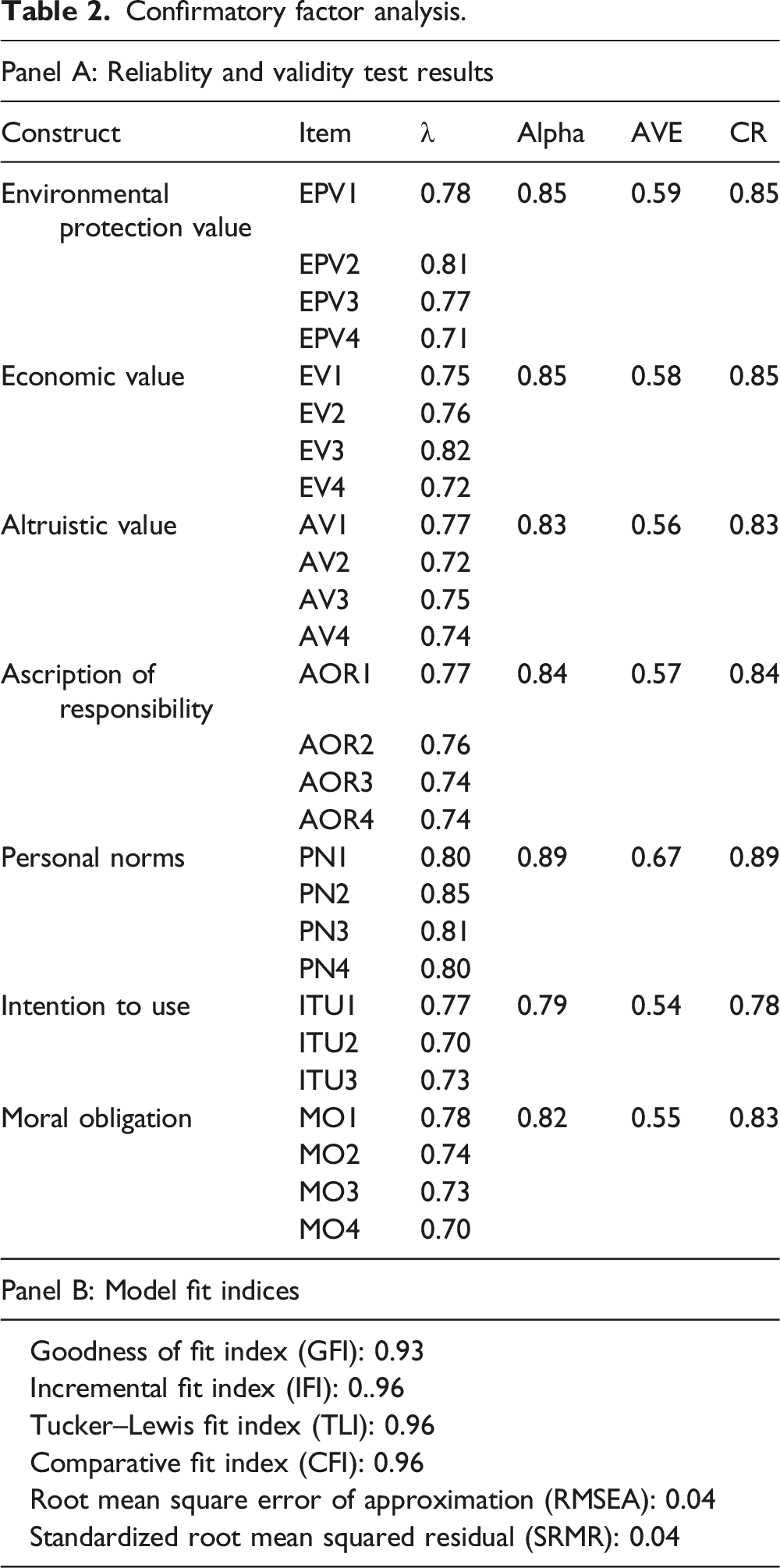
Confirmatory factor analysis
Confirmatory factor analysis.
Discriminant validity.
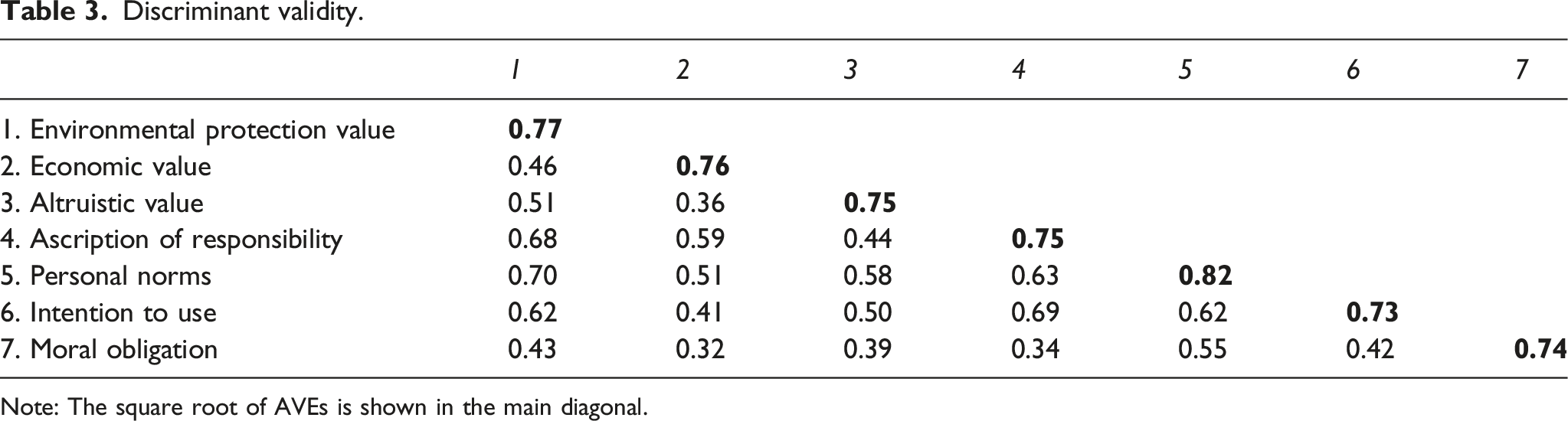
Note: The square root of AVEs is shown in the main diagonal.
Hypothesis testing
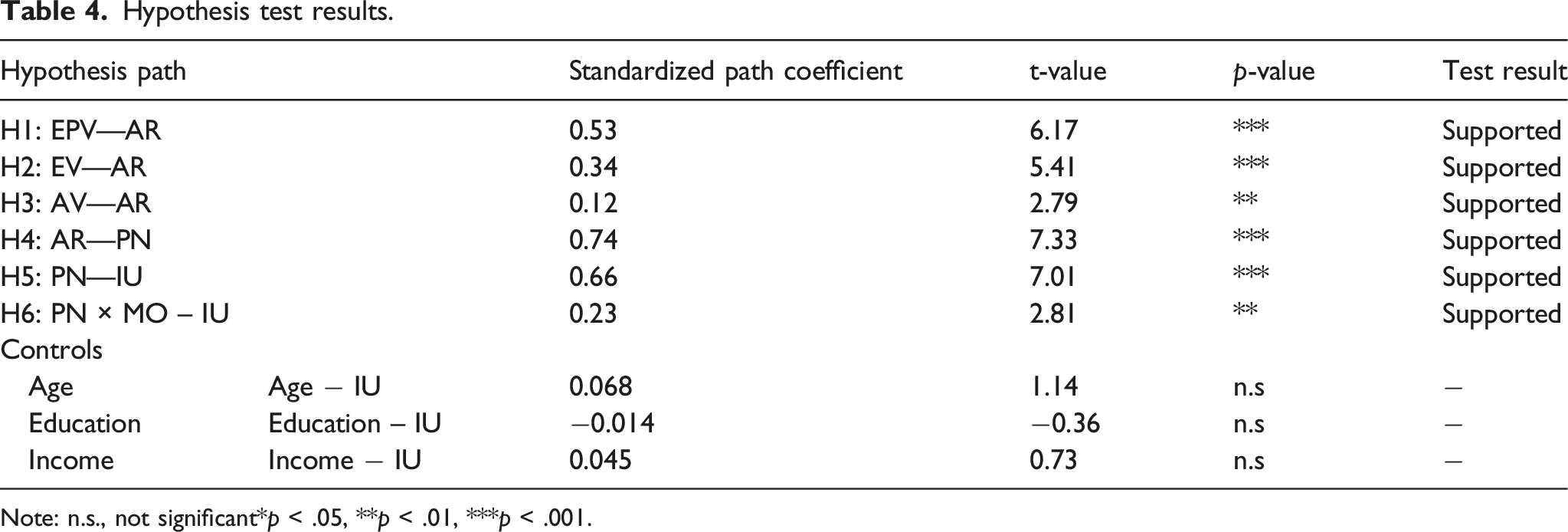
SEM analysis was conducted to examine our hypotheses (Figure 1). Respondents’ age, annual income, and education level are included as control variables in the model. As expected, the results suggest a good model fit (χ2/df = 2.448, GFI = 0.91, IFI = 0.93, TLI = 0.92, CFI = 0.93, RMSEA = 0.05, SRMR = 0.07). The results show that all three control variables have no significant effects on usage intention at the 5% level. Concerning our hypotheses, we find the impacts of environmental protection value (b = 0.53, p < .001), economic value (b = 0.34, p < .001), and altruistic value (b = 0.12, p < .01). These three variables explain 66.3% of the variance in ascription of responsibility. Therefore, H1–H3 are accepted. Next, H4 is also supported, as the results show a significant positive relationship between ascription of responsibility and personal norms (b = 0.74, p < .001), with a variance explanation of 54.8%. In addition, H5 is validated because the impact of personal norms on intention to use is significantly positive (b = 0.66, p < .001), and it explains 44.2% of the variance in intention to use. Following Ping (1995), we employed moderation analysis to investigate H6. To this end, we first mean-centered personal norms and moral obligation and then summed up the values to create the interaction term (personal norms × moral obligation). After including the interaction terms, we re-ran the SEM analysis. The results show that the standardized coefficient is significantly positive (b = 0.23, p < .01), thus validating our H5. The hypothesis test results are summarized in Table 4. Hypothesis testing results. Hypothesis test results. Note: n.s., not significant*p < .05, **p < .01, ***p < .001.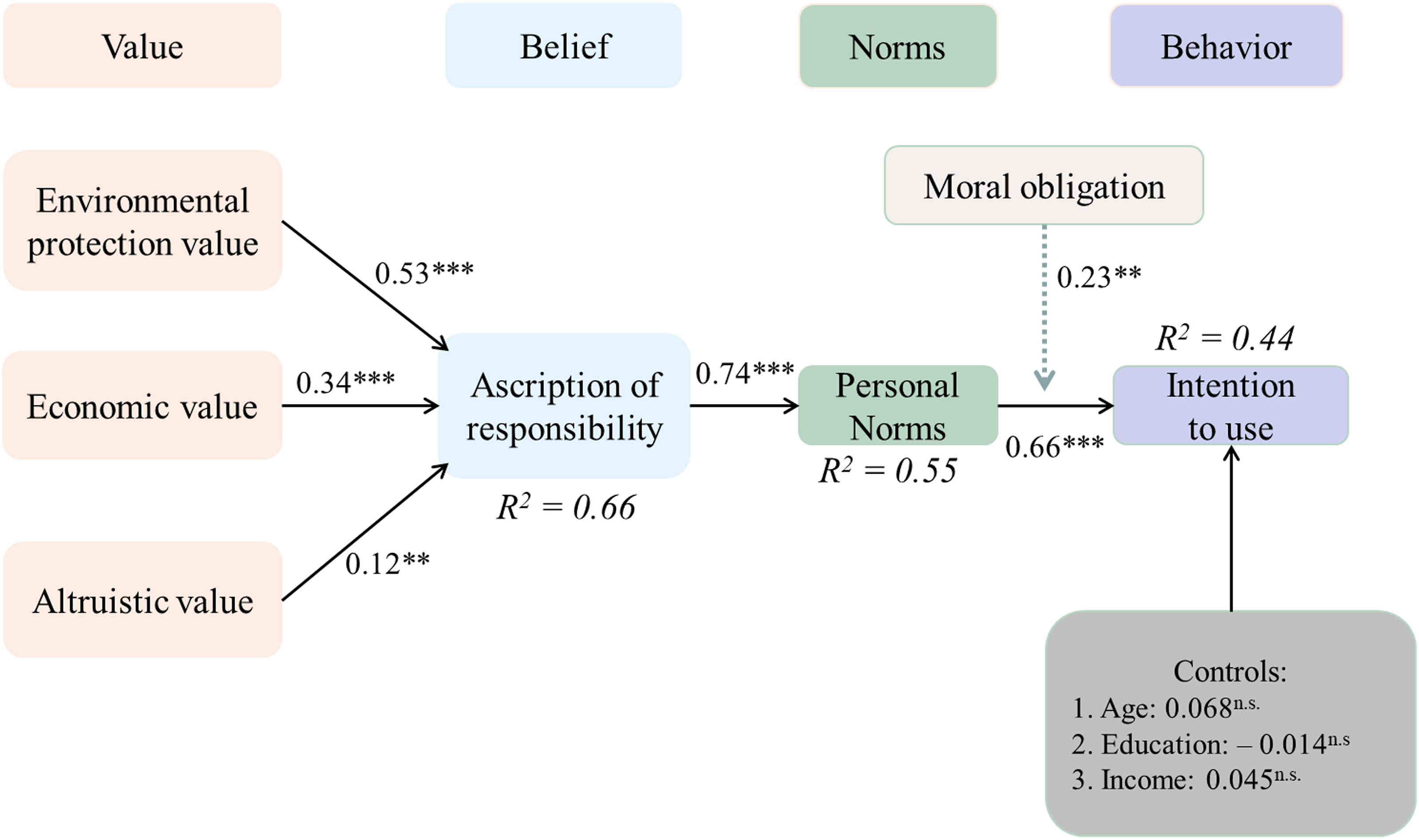
Discussion
This study developed a conceptual model based on the relationship between the proposed constructs. The model was evaluated by using 471 valid pieces of data collected from respondents. The results of the data analysis have the following significant implications for theory and management.
Theoretical contribution
This research contributes to the literature on drone delivery services in three ways. First, it contributes to the body of knowledge on consumers’ intent to use drone delivery. Prior research has investigated the factors affecting consumers' attitudes toward drone delivery services. We concur with Jinsoo Hwang’s contention (2021) that eight sub-dimensions of consumer innovativeness positively influence attitudes and behavioral intentions (including intention to use and word-of-mouth intentions) toward using drone delivery services. In contrast, this study begins with the environmental and economic value of drones and incorporates consumers’ social altruism values as a factor in the formation of responsibility attribution. This study employs an extended VBN framework that incorporates responsibility attribution to investigate consumers’ intention to use environmentally friendly drones, thereby enhancing our understanding of consumers' intent to use drones for distribution purposes.
Second, this study investigates the contribution of environmentally friendly drones to environmental protection. The use of electric energy drones for delivery could be a significant and novel method to protect ecosystems. According to previous research, traditional vehicle delivery methods produce greater CO2 emissions than battery-powered drones (Goodchild and Toy, 2018). In addition, the use of drone delivery will reduce traffic congestion caused by traditional deliveries and individual store visits. Then, consumers with a strong sense of environmental responsibility would be more likely to choose drone delivery services that are environmentally friendly. In this regard, this thesis validates and expands the research on environmental protection for drone delivery by empirically identifying the eco-friendly benefits of environmentally friendly drones using the VBN model. Drones that are friendly to the environment provide new technical support for environmental protection, which will significantly increase people’s concern for the environment, improve environmental quality, and contribute to sustainable development.
Thirdly, this study creates and evaluates a new theoretical framework based on VBN theory. From a theoretical standpoint, it provides essential sequential processes by which individual value orientations determine consumer behavior and the substantial influence of moral responsibility on personal norms. For instance, this study confirms the findings of previous research that individuals’ value orientations have a significant influence on their purchase intentions via beliefs and norms (Choi et al., 2015; Han, 2015; Han et al., 2018; Nordlund and Garvill, 2003; Poortinga et al., 2004). In other words, when consumers place a high value on environmental protection awareness, they are more concerned about how their actions will affect the environment, resulting in a strong sense of shared responsibility for environmental protection. As stated previously, our findings indicate that the proposed model has a strong ability to predict consumers' propensity to use drone delivery services, and all proposed causal pathways are supported. In particular, we find that personal norms are the primary determinant of green consumer behavior among consumers and that they exert a substantial moderating effect. This result confirms previous findings that VBN theory is highly accurate at predicting individuals’ environmentally responsible behaviors and intentions (Han et al., 2017; Van Riper and Kyle, 2014). In addition, a sense of environmental responsibility plays a significant role in the formulation of intent to use and willingness to pay, which can be explained by the fact that consumers with higher levels of personal norms are more likely to use, pay for, and recommend drone delivery services. Consistent with prior research (Dalton et al., 2008; Kim and Kim, 2018), the findings indicate that personal norms positively influence behavioral intentions. Second, this study empirically determined the impact of a sense of responsibility and obligation for pro-environmental actions on the intention to use and pay for drones in the context of environmentally friendly drone delivery services, thereby confirming and expanding the existing VBN theory.
Managerial implications
The following are the managerial implications of this study. It employs the VBN model to assess the significance of environmentally friendly UAVs entering the delivery service industry, thereby shedding light on future UAV delivery research. The current study also provides several managerial implications for courier companies and consumers. First, for courier companies, drones have emerged as an innovative new technology for courier services that could potentially replace traditional delivery systems. Companies have attempted to use drones for commercial purposes and are improving their drone transport systems. It is well-known that current delivery services, such as motorcycles and automobiles, contribute to environmental pollution. Since drone delivery is controlled by a computerized system, it can reduce labor costs during logistical surges when manpower is in short supply. As a result, delivery companies can incorporate the environmental benefits of drone delivery services into their strategies for attracting and retaining customers and promoting awareness of these benefits. Adopting green drones can significantly reduce labor costs and contribute to a company’s positive green image. In addition, businesses should do an excellent job of promoting environmental protection while strengthening their marketing efforts to encourage consumers to use their products, thereby realizing the company’s ultimate vision of advancing sustainable development and environmental protection.
Second, for consumers, the fact that drones no longer involve gasoline emissions and air pollution when performing logistics delivery operations is essential for the development and improvement of their environmental awareness. The results of the study indicate that customers with a higher sense of attribution of environmental responsibility prompting pro-environmental behavior are more willing to use drone delivery. If delivery service companies emphasize that drone delivery services can reliably deliver food to customers without loss of life, consumers will have a higher incentive to use drone delivery services when ordering food. Based on these key factors, a socially altruistic drone delivery service would further improve consumer perceptions of the service and increase consumers’ willingness and commitment to choose a “drone delivery” service. There is still a need to test the safety of drones in the future to assuage consumer concerns, which will further increase consumers' intention to use drone delivery.
Third, the results of the data analysis in this study suggest that attribution of responsibility (AR) positively influences individuals’ norms of environmental obligations (Hypothesis 4). Therefore, it is suggested that the readiness of delivery companies to introduce environmentally friendly drone delivery services is essential for consumers to affirm their personal convictions. Educating consumers on the significance of environmentally friendly drone delivery services for environmental protection by increasing their awareness of the severity of environmental pollution and personal responsibility. Consumers may, therefor be encourages to consider environmentally responsible purchasing practices. To promote green consumption among the general public, the government should also encourage other companies to participate in drone services and educate consumers on the significance of these environmentally friendly services for environmental protection. Thus regard, more people will consider environmentally conscious green behaviors when making purchase decisions.
Conclusion and limitations
Conclusion
Using the value–belief–norm theory, this study was chosen to investigate the effect of drone delivery services on consumers’ ecological behavior. It investigates whether the economic, altruistic, and environmental protection values of drones have a positive effect on attribution of responsibility (AR). Second, we examined whether attribution of responsibility (AR) has a direct positive influence on personal norms and examined the model’s causality. In addition, we examined whether ethical norms play a moderating role in the formulation of consumers' attitudes toward drone delivery services. Our research confirms that the affordability of drone delivery has a positive effect on consumers’ attitudes toward the use of environmentally beneficial drones. In addition, individuals with social altruism and environmental protection values have a strong sense of responsibility attribution, and these beliefs result in strong personal standards. This outcome is evidenced by the fact that consumers support environmental protection by utilizing drones that are favorable to the environment.
Limitations and future research
Despite its theoretical and applied contributions, this study has the following limitations. First, it was conducted exclusively in Korea with Korean participants. Therefore, the results may be influenced by the participants’ national cultures. Oreg and Katz-Gerro (2006) observed that the environmental responsibility of individuals may vary by national culture. Future cross-cultural studies from various national groups could help establish the generalizability of this study’s results. Second, only the VBN single theory-building hypothesis was included in this study’s paradigm for empirical research, which considers environmental responsibility as a personal behavioral norm. However, social norms, ecological norms, and subjective norms also impact consumer eco-friendly behavior (Han et al., 2017), and future research could investigate consumer environmental behavior using additional variables. Thirdly, the majority of respondents lacked prior exposure to drone delivery services. Although respondents were provided with information and images regarding drone deliveries, their attitudes and intentions may change after actual use. It would be beneficial to include in the sample individuals with “drone experience” (e.g., drone pilots). Future research may benefit incorporating other independent variables, such as privacy requirements, drone exposure, transportation costs, product type, and even cross-cultural factors (Yoo et al., 2018).
Footnotes
Declaration of conflicting interests
The author(s) declared no potential conflicts of interest with respect to the research, authorship, and/or publication of this article.
Funding
The author(s) received no financial support for the research, authorship, and/or publication of this article.
